
Global Car Rental Market Report, Size & Forecast 2026-2033
Global Car Rental Market Report, Size, Share and Forecast 2026???2033
Market Forecast Snapshot (2025???2033)
| Metric | Value |
|---|---|
| Market Size (2025) | USD 112.40 Billion |
| Market Size (2033) | USD 198.65 Billion |
| CAGR (2026???2033) | 7.36% |
| Largest Segment | Economy & Mid-Size Passenger Vehicle Rentals |
| Fastest Growing Segment | App-Based & Electric Vehicle (EV) Rental Services |
| Leading End-Use Segment | Leisure & Tourism Travelers |
| Key Trend | Digital Mobility Platforms & EV Fleet Expansion |
| Regulatory Influence | Vehicle Emission Regulations, Ride-Sharing Policies & Transportation Compliance |
| Future Outlook | Growth Driven by Smart Mobility, Tourism Recovery & Subscription-Based Rentals |
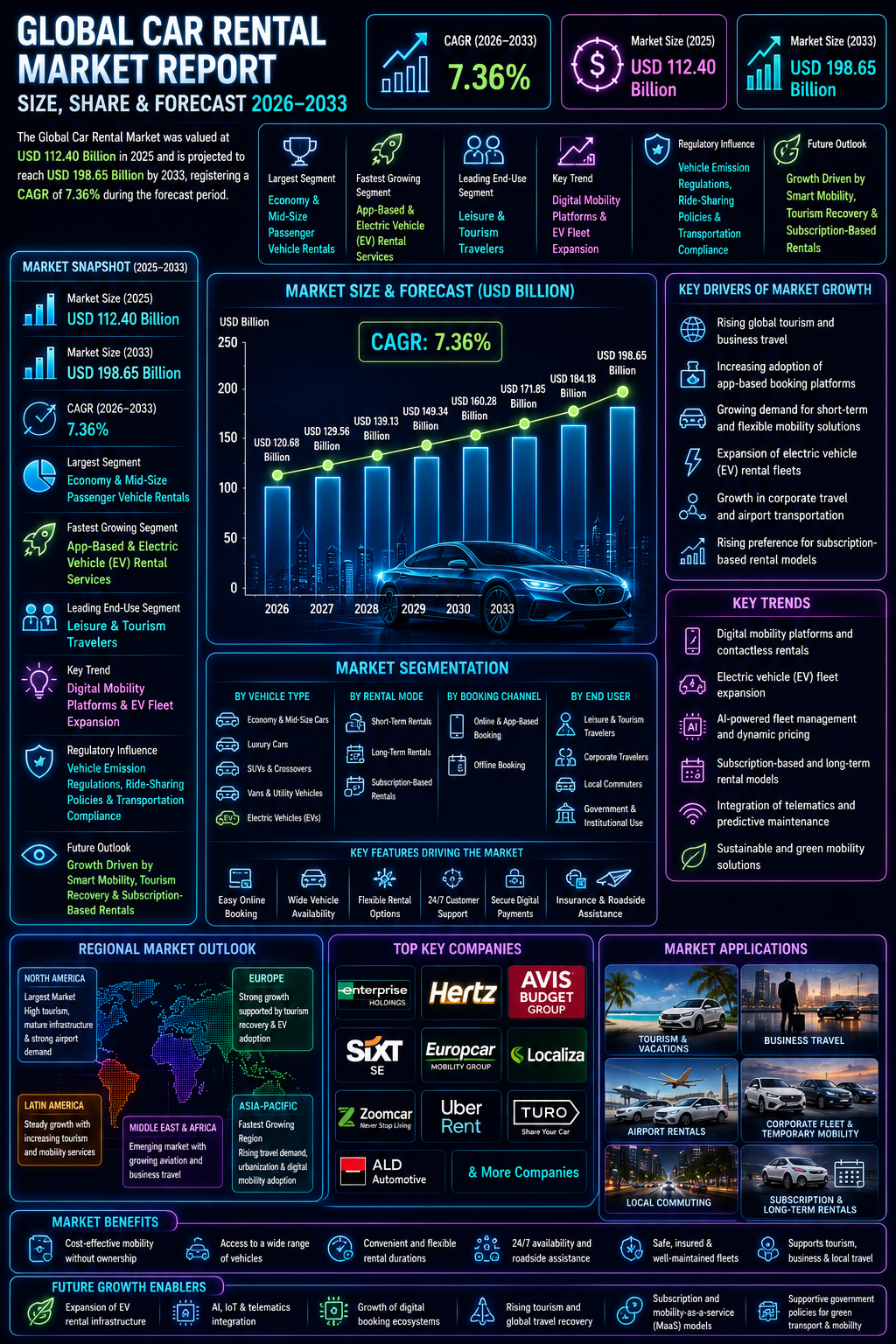
Market Size & Forecast
The Global Car Rental Market is expected to witness steady expansion during the forecast period from 2026 to 2033. The market was valued at USD 112.40 billion in 2025 and is projected to reach approximately USD 198.65 billion by 2033, registering a CAGR of 7.36%. The market growth is primarily driven by rising global tourism, increasing business travel, expanding airport transportation demand, growing preference for short-term mobility solutions, and the rise of digital booking ecosystems. Car rental services are increasingly critical for tourism mobility, corporate transportation, temporary vehicle access, last-mile travel, and urban mobility flexibility. Rising adoption of app-based booking, fleet telematics, contactless rentals, AI-based fleet optimization, and electric rental vehicles is accelerating market growth. In addition, increasing urbanization, shared mobility trends, and subscription-based rental models are supporting long-term market expansion.Global Car Rental Market Overview
Car rental services provide short-term or long-term vehicle access to consumers, businesses, and travelers without vehicle ownership requirements. The market includes economy cars, luxury vehicles, SUVs, vans, electric rental vehicles, chauffeur-driven rentals, airport rentals, corporate leasing, and subscription-based mobility solutions. Car rental services are widely used across tourism, corporate travel, local commuting, logistics support, and event-based transportation. The market is shifting from traditional offline booking systems toward digital mobility platforms, AI-enabled fleet management, telematics-driven maintenance, EV rental ecosystems, and flexible subscription-based vehicle access.Structural Drivers of Market Growth
1. Innovation and Commercialization Acceleration
Rapid innovation in fleet telematics, mobile apps, AI pricing optimization, digital booking platforms, and EV rental infrastructure is accelerating service expansion. Smart fleet utilization and predictive maintenance are improving profitability and customer experience.Market Implications
Companies investing in app-based rentals, EV fleet integration, and AI-driven booking systems are expected to strengthen market leadership.2. Compliance and Risk Repricing
Vehicle safety regulations, transportation licensing, emission mandates, insurance policies, and sustainability regulations are influencing fleet modernization. Governments are increasingly promoting low-emission and electric rental fleets.Market Implications
Firms offering compliant, insured, sustainable, and digitally secure rental services are likely to gain stronger market trust.3. Competitive and Value-Chain Reconfiguration
The market is highly competitive as rental operators, ride-sharing platforms, mobility startups, leasing firms, and EV providers expand offerings. Fleet ownership models, partnerships with automakers, and subscription mobility are altering value-chain economics.Market Implications
Companies focusing on mobility-as-a-service (MaaS), EV fleets, and flexible rental ecosystems may gain stronger margins.4. Capital and Capacity Scaling
Rising investment in EV charging infrastructure, airport fleets, smart mobility platforms, and autonomous fleet technologies is supporting market expansion. Travel recovery and tourism infrastructure are also increasing demand.Market Implications
Operators scaling EV fleets, AI fleet optimization, and digital infrastructure are expected to capture future opportunities.Market Segmentation Analysis
By Vehicle Type
1. Economy & Mid-Size Cars
This remains the largest segment due to affordability and strong tourism demand.2. Luxury Cars
Used in premium travel and executive transportation.3. SUVs & Crossovers
Strong growth due to family travel and off-road flexibility.4. Vans & Utility Vehicles
Used for group travel and logistics support.5. Electric Vehicles (EVs)
Fastest-growing due to sustainability and lower operating costs.By Rental Mode
1. Short-Term Rentals
Largest segment due to tourism and temporary transportation needs.2. Long-Term Rentals
Growing in corporate and leasing applications.3. Subscription-Based Rentals
Rapidly expanding in urban mobility and flexible ownership alternatives.By Booking Channel
1. Online & App-Based Booking
Fastest-growing segment due to convenience and digital adoption.2. Offline Booking
Still relevant in regional and traditional markets.By End User
1. Leisure & Tourism Travelers
Largest segment due to vacation and travel mobility demand.2. Corporate Travelers
Strong demand from business travel and temporary executive mobility.3. Local Commuters
Growing adoption for flexible city transport.4. Government & Institutional Use
Used for official transport and contracted mobility services.Regional Market Dynamics
North America
North America dominates the global car rental market due to high tourism activity, mature digital rental infrastructure, airport demand, and strong fleet operators.Europe
Europe remains a major market supported by tourism, EV rental expansion, and sustainable mobility policies.Asia-Pacific
Asia-Pacific is the fastest-growing region due to urbanization, rising travel demand, digital mobility adoption, and increasing middle-class spending.Latin America
Latin America is gradually expanding due to tourism recovery and growing ride-sharing integration.Middle East & Africa
The region is witnessing emerging adoption driven by business tourism, airport development, and luxury rental demand.Competitive Landscape
The Global Car Rental Market is highly competitive with international rental firms, mobility platforms, leasing providers, and EV-based rental operators expanding globally.Key companies operating in the market include:
- Enterprise Holdings
- Hertz Global Holdings
- Avis Budget Group
- Sixt SE
- Europcar Mobility Group
- Localiza
- Zoomcar
- Uber Rent
- Turo
- ALD Automotive
Strategic Outlook
The future of the car rental market will be shaped by EV fleet adoption, mobility-as-a-service (MaaS), autonomous vehicle rentals, AI-based fleet management, and subscription-driven transport models. Contactless booking, digital identity verification, predictive fleet maintenance, and smart urban mobility will significantly improve service efficiency. The rise of EV rentals, tourism-driven mobility, and flexible ownership alternatives is expected to create strong long-term growth opportunities.Final Market Perspective
The Global Car Rental Market remains a major segment within travel, transportation, and smart mobility ecosystems. Rising tourism, digital booking adoption, EV integration, and flexible vehicle access continue driving long-term market growth. Companies capable of delivering scalable, tech-enabled, sustainable, and customer-centric rental ecosystems will be best positioned to capture future opportunities. The convergence of AI, EV fleets, mobility subscriptions, and digital travel services is expected to redefine the future of the global car rental industry.Table of Contents
Table of Contents
1. Executive Summary
1.1 Market Snapshot
1.2 Key Growth Highlights
1.3 Largest Segment Analysis
1.4 Fastest Growing Segment Analysis
1.5 Regional Outlook
1.6 Competitive Landscape Snapshot
1.7 Future Market Outlook
2. Global Car Rental Market Introduction
2.1 Market Definition
2.2 Scope of Study
2.3 Research Assumptions
2.4 Research Methodology
2.5 Forecast Parameters
3. Global Car Rental Market Overview
3.1 Market Evolution
3.2 Industry Ecosystem Analysis
3.3 Value Chain Analysis
3.4 Pricing & Revenue Structure Analysis
3.5 Fleet Supply Chain & Transportation Infrastructure Overview
3.6 Technology & Digital Mobility Landscape
3.6.1 App-Based Booking Platforms
3.6.1.1 Digital Reservation Systems
3.6.1.1.1 Contactless Rental Processing
3.6.1.1.1.1 Real-Time Booking Optimization
3.6.1.1.1.2 AI-Powered Customer Journey Systems
3.6.2 Fleet Telematics & AI-Based Optimization
3.6.2.1 Vehicle Tracking Systems
3.6.2.1.1 Predictive Maintenance Solutions
3.6.2.1.1.1 Fleet Utilization Analytics
3.6.2.1.1.2 Cost & Fuel Efficiency Monitoring
3.6.3 EV Rental Ecosystems
3.6.3.1 Electric Fleet Integration
3.6.3.1.1 Charging Infrastructure Support
3.6.3.1.1.1 Sustainable Mobility Expansion
3.6.3.1.1.2 Low-Emission Fleet Deployment
3.6.4 Subscription-Based Mobility Models
3.6.4.1 Flexible Vehicle Access
3.6.4.1.1 Long-Term Rental Services
3.6.4.1.1.1 Mobility-as-a-Service (MaaS) Models
3.6.4.1.1.2 Shared Fleet Utilization Strategies
3.7 Regulatory Landscape
3.7.1 Vehicle Emission Regulations
3.7.1.1 Transportation Licensing Policies
3.7.1.1.1 Ride-Sharing Compliance Standards
3.7.1.1.1.1 Insurance & Passenger Safety Rules
3.7.1.1.1.2 Cross-Border Mobility Regulations
3.8 Market Trends & Innovation Outlook
3.8.1 Smart Mobility Platforms
3.8.1.1 AI-Based Fleet Intelligence
3.8.1.1.1 Autonomous Rental Systems
3.8.1.1.1.1 Digital Mobility Transformation
3.8.1.1.1.2 EV Subscription Expansion
4. Global Car Rental Market Dynamics
4.1 Market Drivers
4.1.1 Rising Global Tourism Demand
4.1.1.1 International Travel Recovery
4.1.1.1.1 Airport Rental Expansion
4.1.1.1.1.1 Leisure Travel Mobility Growth
4.1.2 Increasing Business Travel
4.1.2.1 Corporate Mobility Services
4.1.2.1.1 Executive Vehicle Rental Demand
4.1.2.1.1.1 Enterprise Travel Optimization
4.1.3 Growth in App-Based Rental Services
4.1.3.1 Mobile Booking Penetration
4.1.3.1.1 Contactless Service Demand
4.1.3.1.1.1 Digital Payment Integration
4.1.4 Expansion of EV Rental Fleets
4.1.4.1 Low-Emission Mobility Solutions
4.1.4.1.1 Charging Ecosystem Growth
4.1.4.1.1.1 Sustainable Urban Transportation
4.1.5 Urbanization & Shared Mobility Growth
4.1.5.1 Flexible Transportation Demand
4.1.5.1.1 Subscription-Based Access
4.1.5.1.1.1 Short-Term Ownership Alternatives
4.2 Market Restraints
4.2.1 High Fleet Maintenance Costs
4.2.1.1 Vehicle Repair & Depreciation
4.2.1.1.1 Operating Cost Pressure
4.2.1.1.1.1 Profit Margin Constraints
4.2.2 Fuel Price Volatility
4.2.2.1 Transportation Cost Fluctuation
4.2.2.1.1 Fleet Cost Optimization Challenges
4.2.2.1.1.1 Pricing Instability
4.2.3 Regulatory Compliance Complexity
4.2.3.1 Insurance & Safety Mandates
4.2.3.1.1 Licensing Variability
4.2.3.1.1.1 Regional Mobility Restrictions
4.2.4 Fleet Theft & Security Risks
4.2.4.1 Vehicle Misuse
4.2.4.1.1 Fraud & Digital Security Concerns
4.2.4.1.1.1 Data Privacy Issues
4.3 Market Opportunities
4.3.1 EV Rental Expansion
4.3.1.1 Green Mobility Adoption
4.3.1.1.1 Low-Carbon Fleet Deployment
4.3.1.1.1.1 EV Infrastructure Investment
4.3.2 Subscription-Based Rentals
4.3.2.1 Long-Term Flexible Mobility
4.3.2.1.1 Customer Retention Models
4.3.2.1.1.1 Urban Mobility Innovation
4.3.3 Tourism Recovery & Airport Growth
4.3.3.1 Travel Infrastructure Expansion
4.3.3.1.1 Regional Tourism Mobility
4.3.3.1.1.1 High-Demand Seasonal Rentals
4.3.4 Autonomous & Smart Mobility Systems
4.3.4.1 AI Fleet Automation
4.3.4.1.1 Self-Service Rental Models
4.3.4.1.1.1 Intelligent Transport Networks
4.4 Market Challenges
4.4.1 Fleet Optimization Complexity
4.4.2 Competitive Pricing Pressure
4.4.3 Infrastructure Dependence
4.4.4 Digital Platform Integration Risks
5. Global Car Rental Market Size Analysis (USD Billion), 2026???2033
5.1 Revenue Forecast Analysis
5.2 CAGR Analysis
5.3 Demand-Supply Analysis
5.4 Segment Contribution Analysis
5.5 Pricing Trend Analysis
6. Global Car Rental Market Segmentation Analysis
6.1 By Vehicle Type
6.1.1 Economy & Mid-Size Cars
6.1.1.1 Budget Passenger Mobility
6.1.1.1.1 Tourism Fleet Optimization
6.1.1.1.1.1 Cost-Efficient Rental Models
6.1.2 Luxury Cars
6.1.2.1 Executive Rentals
6.1.2.1.1 Premium Travel Mobility
6.1.2.1.1.1 Chauffeur-Driven Services
6.1.3 SUVs & Crossovers
6.1.3.1 Family Travel Rentals
6.1.3.1.1 Off-Road Rental Solutions
6.1.3.1.1.1 Adventure Tourism Fleets
6.1.4 Vans & Utility Vehicles
6.1.4.1 Group Transportation
6.1.4.1.1 Logistics Support Vehicles
6.1.4.1.1.1 Commercial Rental Fleets
6.1.5 Electric Vehicles (EVs)
6.1.5.1 Sustainable Rental Mobility
6.1.5.1.1 Smart Charging Ecosystems
6.1.5.1.1.1 EV Subscription Platforms
6.2 By Rental Mode
6.2.1 Short-Term Rentals
6.2.2 Long-Term Rentals
6.2.3 Subscription-Based Rentals
6.3 By Booking Channel
6.3.1 Online & App-Based Booking
6.3.2 Offline Booking
6.4 By End User
6.4.1 Leisure & Tourism Travelers
6.4.2 Corporate Travelers
6.4.3 Local Commuters
6.4.4 Government & Institutional Use
7. Regional Market Analysis
7.1 North America
7.1.1 U.S.
7.1.2 Canada
7.1.3 Mexico
7.2 Europe
7.2.1 Germany
7.2.2 U.K.
7.2.3 France
7.2.4 Italy
7.2.5 Spain
7.2.6 Rest of Europe
7.3 Asia-Pacific
7.3.1 China
7.3.2 Japan
7.3.3 India
7.3.4 South Korea
7.3.5 Australia
7.3.6 Rest of Asia-Pacific
7.4 Latin America
7.4.1 Brazil
7.4.2 Argentina
7.4.3 Rest of Latin America
7.5 Middle East & Africa
7.5.1 GCC Countries
7.5.2 South Africa
7.5.3 Rest of Middle East & Africa
8. Competitive Landscape
8.1 Market Share Analysis
8.2 Competitive Intensity Overview
8.3 Strategic Developments
8.4 Product Innovation & Fleet Expansion
8.5 Partnerships, Mergers & Acquisitions
8.6 Mobility Platform Ecosystem Positioning Analysis
9. Company Profiles
9.1 Enterprise Holdings
9.2 Hertz Global Holdings
9.3 Avis Budget Group
9.4 Sixt SE
9.5 Europcar Mobility Group
9.6 Localiza
9.7 Zoomcar
9.8 Uber Rent
9.9 Turo
9.10 ALD Automotive
10. Strategic Intelligence & Pheonix AI Insights
10.1 Pheonix Demand Forecast Engine
10.2 Mobility Platform Growth Analyzer
10.3 Fleet Optimization Risk Tracker
10.4 EV Rental Opportunity Insights
10.5 Automated Porter???s Five Forces Analysis
11. Future Outlook & Strategic Recommendations
11.1 EV Fleet Expansion Strategies
11.2 Subscription-Based Rental Growth
11.3 Smart Mobility Integration
11.4 Tourism Recovery & Regional Expansion
11.5 Long-Term Market Outlook (2033+)
12. Appendix
12.1 Abbreviations
12.2 Research References
12.3 Data Sources
13. About Pheonix
14. Market Research
15. Disclaimer
Competitive Landscape
Global Car Rental Market Competitive Intensity & Market Structure Overview
The Global Car Rental Market is characterized by a moderately consolidated and fleet-scale-driven competitive structure, where major international rental operators, mobility platforms, leasing providers, and digital-first vehicle access companies compete through fleet size, geographic presence, pricing efficiency, digital booking ecosystems, and mobility service diversification. Competition is primarily driven by fleet optimization, airport partnerships, EV adoption, app-based booking platforms, subscription models, telematics integration, and customer experience differentiation.
The market is led by major players such as Enterprise Holdings, Hertz Global Holdings, Avis Budget Group, Sixt SE, Europcar Mobility Group, Localiza, Zoomcar, Uber Rent, Turo, and ALD Automotive, which compete through global fleet reach, digital mobility services, pricing strategies, corporate contracts, EV fleet integration, and flexible vehicle access ecosystems.
Growing demand across tourism, business travel, airport transportation, urban commuting, corporate leasing, government mobility, and subscription-based rentals is intensifying competition. Companies are increasingly investing in electric vehicle fleets, AI-based fleet optimization, contactless booking, predictive maintenance, autonomous rental ecosystems, and mobility-as-a-service (MaaS) models.
Global Car Rental Market Competitive Landscape
Leading Company Profiles
- Enterprise Holdings ??? Global leader with strong fleet scale, airport rental dominance, and diversified brands across leisure and corporate rentals.
- Hertz Global Holdings ??? Major international rental provider with EV fleet expansion and digital booking modernization.
- Avis Budget Group ??? Strong global player in travel rentals, fleet services, and mobility technology adoption.
- Sixt SE ??? Premium and digital-first rental operator with strong European footprint and mobility innovation.
- Europcar Mobility Group ??? Key provider in flexible rentals, subscription mobility, and corporate vehicle access.
- Localiza ??? Leading Latin American rental and fleet management company with strong regional scale.
- Zoomcar ??? Major digital self-drive and shared mobility platform focused on app-based rentals.
- Uber Rent ??? Expanding vehicle rental access through integrated ride-platform ecosystems.
- Turo ??? Key peer-to-peer car-sharing and rental marketplace disrupting traditional ownership models.
- ALD Automotive ??? Strong presence in fleet leasing, long-term rentals, and mobility services.
Key Competitive Intensity Signals
- Competition in digital booking platforms and app-based rentals is rapidly intensifying.
- EV fleet adoption is becoming a major strategic differentiator.
- Airport partnerships and travel ecosystem integration remain strong barriers to entry.
- Subscription-based mobility and vehicle-as-a-service models are expanding competitive diversification.
- Peer-to-peer rentals and shared mobility platforms are reshaping traditional fleet economics.
- AI-based fleet pricing, telematics, and predictive maintenance are improving operational efficiency.
- Corporate travel contracts and long-term leasing relationships create recurring revenue stability.
Strategic Implications
- Companies with strong fleet scale and airport presence can maintain pricing and occupancy advantages.
- EV fleet investments may become a long-term competitive differentiator.
- Digital-first customer experience and contactless booking can improve retention and market share.
- Subscription mobility and MaaS ecosystems may create premium-margin growth opportunities.
- Partnerships with airlines, travel aggregators, and mobility platforms can strengthen customer acquisition.
Forward Outlook
The Global Car Rental Market is expected to remain moderately consolidated with very high competitive intensity, supported by tourism recovery, EV fleet growth, digital mobility adoption, and flexible transport demand.
Future competition will increasingly focus on:
- Electric vehicle rental fleets
- AI-based fleet optimization
- Contactless and app-based booking ecosystems
- Subscription-based vehicle access
- Mobility-as-a-Service (MaaS) integration
- Autonomous and connected fleet systems
- Customer-centric digital travel ecosystems
The convergence of EVs, AI, telematics, smart mobility, digital booking, subscription rentals, and shared transportation platforms will continue reshaping the long-term competitive landscape.
Value Chain
Global Car Rental Market Value Chain & Supply Chain Evolution Overview
The Global Car Rental Market operates through a mobility-service-driven ecosystem supported by fleet procurement, digital booking platforms, vehicle maintenance, mobility partnerships, rental distribution systems, and end-user transportation services. The market is increasingly shaped by app-based rentals, EV fleet expansion, AI-driven fleet optimization, and subscription-based mobility models.
Unlike manufacturing-heavy sectors, the value chain is centered around fleet ownership/management, software-enabled booking, telematics, insurance coordination, maintenance networks, and customer mobility services.
Supply chain complexity is moderate due to fleet procurement, maintenance cycles, regional compliance, insurance integration, charging infrastructure (EVs), seasonal demand shifts, and multi-location fleet balancing.
Global Car Rental Market Value Chain & Supply Chain Evolution Current Scenario
Market-Specific Value Chain
1. Vehicle Procurement & Fleet Sourcing
Automakers, leasing firms, EV suppliers, fleet financing, vehicle acquisition, and mobility partnerships.
2. Digital Platform & Booking Infrastructure
Mobile apps, reservation systems, pricing engines, AI-based fleet optimization, telematics, payment systems, and identity verification.
3. Fleet Operations & Asset Management
Vehicle deployment, utilization optimization, charging/fueling, telematics tracking, predictive maintenance, and repairs.
4. Compliance, Insurance & Safety Management
Licensing, insurance coverage, vehicle safety inspections, transport regulations, emission compliance, and rental agreements.
5. Distribution & Rental Access Networks
Airport counters, direct booking websites, mobile apps, travel agencies, corporate contracts, franchise operators, and mobility aggregators.
6. End-Use Mobility Ecosystem
Leisure travelers, corporate users, commuters, logistics support, tourism operators, and institutional users.
Key Value Chain Evolution Signals
1. Shift Toward EV Fleets
Electric rental vehicles are rapidly expanding.
2. App-Based Booking Growth
Digital-first mobility is dominating distribution.
3. AI Fleet Optimization
Dynamic pricing and predictive maintenance improve margins.
4. Subscription Mobility Models
Flexible rentals are altering ownership economics.
5. Airport & Tourism Dependency
Travel ecosystems remain critical demand drivers.
6. Shared Mobility Integration
Ride-sharing and peer-to-peer models are expanding.
Strategic Implications
1. Fleet Utilization Efficiency
Higher asset turnover improves profitability.
2. Digital Platform Leadership
Apps and automation improve customer retention.
3. EV Infrastructure Readiness
Charging networks strengthen competitiveness.
4. Geographic Expansion
Multi-location access improves market reach.
5. Partnership Ecosystems
Airlines, hotels, and travel platforms expand bookings.
Forward Outlook
The market is expected to evolve toward a more intelligent and flexible mobility ecosystem through:
- EV fleet expansion
- AI-driven fleet analytics
- Subscription-based rentals
- Autonomous mobility pilots
- Contactless rental systems
- Shared mobility integration
- Smart tourism transport networks
Investment Activity
Global Car Rental Market Investment & Funding Dynamics Overview
The Global Car Rental Market is witnessing strong investment momentum driven by rising tourism recovery, digital mobility transformation, EV fleet adoption, and flexible vehicle-access models. Rental operators, mobility platforms, leasing firms, ride-sharing providers, and automotive partners are actively investing in fleet modernization, app-based rental ecosystems, telematics infrastructure, EV charging networks, and AI-enabled fleet optimization systems.
Investment activity is accelerating due to growing demand for short-term mobility, airport transportation, subscription-based rentals, contactless booking, and shared mobility solutions. The increasing shift toward electric vehicle fleets, mobility-as-a-service (MaaS), smart fleet analytics, and digital booking ecosystems is significantly reshaping capital allocation across the market.
Additionally, expanding investments in autonomous fleet technologies, airport rental expansion, charging infrastructure, and mobility software platforms are strengthening long-term growth opportunities globally.
Global Car Rental Market Investment & Funding Dynamics Current Scenario
Currently, the Global Car Rental Market demonstrates rising investment activity with high capital intensity due to vehicle fleet acquisition, EV integration, charging infrastructure, telematics deployment, and digital platform development requirements. Major players are heavily investing in app-based booking systems, AI-driven pricing engines, predictive maintenance tools, subscription mobility platforms, and sustainable fleet upgrades.
The market is attracting strong funding into EV rental services, smart mobility platforms, fleet analytics, digital identity verification, and automated customer-service ecosystems. Rising adoption of flexible mobility solutions and travel-driven vehicle demand is further strengthening investment flow.
The industry is witnessing active merger, partnership, and acquisition activity as rental firms, ride-sharing companies, leasing providers, and digital mobility startups pursue fleet expansion, service diversification, and platform consolidation.
Key Investment & Funding Dynamics Signals in Global Car Rental Market
- Rising demand from tourism, business travel, airport transport, and urban mobility is accelerating fleet and infrastructure investments.
- Expansion of EV fleets, charging infrastructure, and smart telematics systems is increasing long-term capital deployment.
- Growing adoption of app-based rentals, subscription mobility, and contactless booking platforms is strengthening digital mobility funding.
- Strategic investments in AI fleet optimization, predictive maintenance, and mobility-as-a-service ecosystems are reshaping operational priorities.
- Partnerships between rental operators, automakers, EV providers, and mobility-tech firms are improving fleet efficiency and ecosystem expansion.
- Increasing regulatory focus on vehicle emissions, insurance compliance, and transportation safety standards is supporting investor confidence.
- Rising demand for scalable, tech-enabled, and sustainable rental ecosystems is accelerating R&D and platform spending.
Strategic Implications of Investment & Funding Dynamics in Global Car Rental Market
- Continuous investment in EV fleet adoption, AI-driven booking systems, and digital mobility platforms is essential for long-term competitiveness.
- High capital intensity requires strong allocation toward fleet expansion, charging infrastructure, telematics, and customer-facing digital systems.
- Companies capable of delivering customer-centric, scalable, and sustainable rental solutions will strengthen market positioning significantly.
- Strategic M&A and mobility-platform consolidation are accelerating service diversification and market expansion.
- Investments in autonomous rentals, fleet analytics, and subscription-based vehicle access will remain major priorities.
- Compliance with transport safety, emissions, and insurance regulations is critical for long-term trust and adoption.
- Companies investing in MaaS, EV ecosystems, and intelligent fleet utilization are expected to capture substantial future growth opportunities.
Global Car Rental Market Investment & Funding Dynamics Forward Outlook
Looking ahead, the Global Car Rental Market is expected to maintain strong investment growth driven by EV fleet expansion, tourism recovery, digital mobility adoption, and subscription-based rental ecosystems.
Future capital deployment will increasingly focus on autonomous rental technologies, smart mobility platforms, fleet electrification, AI-based pricing optimization, digital identity systems, and integrated travel-mobility services. Sustainable transportation and tech-enabled fleet management are expected to become major long-term innovation priorities.
In conclusion, the Global Car Rental Market represents a high-growth, mobility-intensive investment landscape where EV adoption, digital transformation, flexible rentals, and intelligent fleet ecosystems will define future capital strategies.
Technology & Innovation
Global Car Rental Market Technology & Innovation Landscape Overview
The Global Car Rental Market is undergoing significant transformation driven by advancements in digital mobility platforms, AI-based fleet optimization, telematics, EV fleet integration, IoT-enabled vehicle tracking, autonomous mobility systems, and subscription-based rental ecosystems. The market demonstrates a high innovation intensity level, supported by rising tourism recovery, shared mobility adoption, urban transportation flexibility, and growing digitization of travel services.
At the center of this transformation is the shift from conventional rental counter-based services toward digital-first mobility ecosystems, where customers increasingly rely on app-based booking, contactless vehicle access, digital payments, and real-time rental management. Companies are heavily investing in AI-powered pricing engines, predictive demand forecasting, and smart fleet allocation systems to improve profitability and customer experience.
A major innovation area is EV fleet expansion and charging ecosystem integration, where rental companies are increasingly adopting electric vehicles to reduce emissions, lower operating costs, and align with sustainability mandates. These systems are improving long-term fleet efficiency and regulatory compliance.
The market is also seeing rapid development in telematics and IoT-connected fleet technologies, including GPS tracking, vehicle diagnostics, remote locking, fuel monitoring, and predictive maintenance systems that improve utilization and operational reliability.
Autonomous and smart mobility innovation remains critical, with increasing interest in self-driving rental prototypes, ADAS-integrated fleets, and connected transportation ecosystems, helping redefine future rental operations.
Manufacturers and mobility providers are innovating in digital identity verification, blockchain-based vehicle records, AI-assisted customer analytics, and cloud-based fleet management software, strengthening service automation and security.
Additionally, advances in mobility-as-a-service (MaaS), ride-sharing integration, subscription rentals, and flexible vehicle-access models are reshaping competitive differentiation.
The convergence of AI, EV mobility, telematics, IoT, automation, and digital transportation ecosystems is redefining the future technology landscape of the global car rental market.
Global Car Rental Market Technology & Innovation Landscape Current Scenario
Currently, the Global Car Rental Market demonstrates moderate patent activity and strong commercialization across mobility software, EV fleet systems, AI-based fleet tools, and connected rental ecosystems.
1. AI-Based Fleet Optimization
Dynamic pricing, predictive maintenance, and smart allocation systems are improving fleet efficiency.
2. Digital Booking & Contactless Rentals
Mobile-first rental platforms are accelerating user convenience and automation.
3. EV Fleet & Charging Infrastructure
Electric rental fleets are expanding rapidly due to sustainability priorities.
4. Telematics & IoT Fleet Connectivity
GPS, remote diagnostics, and usage monitoring are strengthening operational visibility.
5. Subscription Mobility & MaaS Platforms
Flexible rental models are improving customer retention and recurring revenue.
6. Smart Security & Digital Verification
Identity authentication and cloud-based rental systems are improving trust and safety.
Key Technology & Innovation Landscape Signals in Global Car Rental Market
Several innovation signals are shaping the market:
1. Rising App-Based Mobility Adoption
Digital-first booking and vehicle access are becoming standard.
2. Expansion of EV Rental Ecosystems
Sustainable transportation and lower-cost fleets are increasing innovation investments.
3. Growth of AI Fleet Intelligence
AI is improving demand forecasting, pricing, and utilization efficiency.
4. Increasing Telematics Penetration
Connected fleets are improving maintenance, safety, and analytics.
5. Subscription & Flexible Ownership Models
Vehicle-as-a-service models are expanding urban mobility adoption.
6. Contactless & Autonomous Rental Innovation
Self-service access and automated rental workflows are gaining traction.
7. Integration with Smart Mobility Platforms
Ride-sharing, travel apps, and MaaS ecosystems are reshaping service delivery.
Strategic Implications of Technology & Innovation Landscape in Global Car Rental Market
The evolving innovation landscape is significantly reshaping competition across the market. Companies are increasingly competing on fleet intelligence, EV readiness, customer experience automation, digital infrastructure, telematics integration, pricing optimization, and subscription flexibility.
Operators investing in AI fleet software, EV charging ecosystems, IoT-connected vehicles, MaaS platforms, predictive maintenance tools, and autonomous mobility pilots are expected to strengthen long-term market positioning.
Strategic collaborations between car rental firms, automakers, EV providers, charging companies, software developers, travel platforms, and ride-sharing operators are accelerating commercialization and transforming mobility ecosystems globally.
The growing convergence of AI, electric mobility, IoT, telematics, automation, digital identity verification, and cloud-based fleet systems is creating strong long-term differentiation opportunities.
Additionally, regulatory emphasis on vehicle safety, emission reduction, insurance compliance, transport licensing, and digital security is encouraging stronger innovation and operational modernization.
Global Car Rental Market Technology & Innovation Landscape Forward Outlook
Looking ahead to 2026???2033, the Global Car Rental Market is expected to evolve toward highly connected, automated, and sustainable mobility ecosystems.
Future technological developments are likely to include:
1. AI-Driven Autonomous Fleet Management
Self-optimizing fleet allocation and predictive logistics will improve efficiency.
2. EV-Dominant Rental Fleets
Electric mobility adoption will strengthen sustainability and cost optimization.
3. Advanced Telematics & Real-Time Monitoring
Connected vehicles will improve maintenance, analytics, and fleet safety.
4. Contactless Smart Rental Platforms
App-controlled rentals and digital verification will improve customer convenience.
5. Subscription-Based Vehicle Ecosystems
Flexible access models will expand beyond traditional rental services.
6. Mobility-as-a-Service (MaaS) Integration
Rental services may become embedded into broader travel and smart-city platforms.
7. Autonomous & ADAS-Enabled Rental Vehicles
Future fleets may increasingly integrate semi-autonomous and self-driving capabilities.
In conclusion, companies capable of combining AI-driven fleet intelligence, EV expansion, telematics, IoT connectivity, mobility software, automation, and sustainable transport ecosystems will be best positioned to lead the future evolution of the Global Car Rental Market.
Market Risk
Global Car Rental Market Risk & Disruption Analysis
The Global Car Rental Market operates within a moderate-to-high disruption and mobility-transition environment, driven by tourism cyclicality, EV fleet transition, digital platform competition, fuel-price volatility, regulatory shifts, and evolving mobility-as-a-service models. While the market demonstrates strong long-term growth due to tourism recovery, business travel, urban mobility demand, and app-based rental ecosystems, it remains exposed to fleet cost inflation, macroeconomic sensitivity, insurance complexity, and substitution from alternative mobility platforms.
A defining structural characteristic of the market is its dependence on high-utilization fleet economics, where profitability is strongly influenced by fleet acquisition cost, depreciation, maintenance efficiency, utilization rates, insurance costs, and seasonal travel demand. Economy and mid-size vehicle rentals remain dominant by volume, while high-growth value is increasingly shifting toward EV rentals, app-based services, subscription mobility, and digitally optimized fleets.
The market is also transitioning from conventional rental models toward mobility-as-a-service (MaaS), telematics-based fleet intelligence, EV infrastructure integration, and platform-led rental ecosystems, increasing strategic pressure for operators to digitize and diversify.
Global Car Rental Market Current Risk Environment
The current market environment is characterized by strong mobility demand, high operational sensitivity, and platform disruption.
One of the most significant disruption factors involves travel and tourism cyclicality. Rental demand is closely tied to leisure travel, airport traffic, hospitality recovery, and business mobility. Economic slowdowns, geopolitical instability, health events, or travel restrictions can sharply affect utilization.
Another major risk area is fleet acquisition, depreciation, and vehicle cost inflation. Rental operators depend heavily on automotive procurement economics. Rising vehicle prices, EV fleet transition costs, semiconductor-driven vehicle supply constraints, and residual-value fluctuations may compress margins.
The market also faces substitution pressure from ride-sharing, peer-to-peer car sharing, public transit, and micro-mobility platforms. Urban consumers increasingly compare rental services with Uber-like mobility, subscription fleets, and short-distance alternatives.
Additionally, insurance, liability, and transportation compliance complexity remain structurally important. Vehicle safety standards, fleet licensing, emissions mandates, accident liability, and cross-border rental regulations increase operating risk.
In parallel, digital booking dependency, cybersecurity exposure, and pricing transparency are reshaping customer acquisition and loyalty.
Key Market Risk & Disruption Signals in Global Car Rental Market
1. Travel & Tourism Demand Volatility
Leisure and business travel cycles strongly affect rental utilization and revenue stability.
2. Fleet Cost Inflation & Depreciation Risk
Vehicle acquisition costs, EV transition, maintenance, and resale values directly impact profitability.
3. Substitution from Alternative Mobility Models
Ride-sharing, peer-to-peer rentals, public transport, and micro-mobility create competitive pressure.
4. Fuel Price & Energy Transition Exposure
ICE fleet operating costs and EV charging infrastructure economics create transition complexity.
5. Insurance, Liability & Compliance Risk
Fleet safety, accident exposure, licensing, and transportation regulation remain major operational burdens.
6. Platform & Digital Booking Dependency
Online booking ecosystems, dynamic pricing, and cybersecurity influence competitiveness.
7. Macroeconomic & Consumer Spending Sensitivity
Discretionary travel and rental behavior are linked to inflation and economic conditions.
8. Fleet Supply Chain Exposure
Automotive manufacturing disruptions and semiconductor shortages may constrain fleet scaling.
Strategic Implications of Market Risk & Disruption in Global Car Rental Market
The evolving disruption environment creates both strong mobility growth opportunities and operational complexity.
One of the most important strategic implications is the need for digitally optimized fleet ecosystems. Operators increasingly must combine booking platforms, telematics, AI pricing, predictive maintenance, and customer analytics.
Companies are required to invest in EV fleet expansion, contactless rental systems, subscription mobility, telematics-driven utilization, and dynamic pricing optimization to remain competitive.
Vertical integration across vehicle procurement, leasing, charging infrastructure, insurance partnerships, and digital identity verification is becoming increasingly valuable.
The convergence of EV adoption, MaaS, ride-sharing logic, AI fleet analytics, and smart mobility is also reshaping the value chain. Firms with stronger interoperability across travel, airport ecosystems, digital platforms, and fleet intelligence may gain higher utilization and recurring revenue.
Additionally, tourism recovery, urban mobility flexibility, and corporate fleet outsourcing may create high-growth demand pockets.
Companies focusing on EV rentals, digital booking ecosystems, flexible subscription fleets, smart utilization, and customer-centric mobility platforms are expected to strengthen long-term market leadership.
Global Car Rental Market Risk & Disruption Forward Outlook
Looking ahead to 2026???2033, the Global Car Rental Market is expected to become increasingly digital, electrified, and platform-driven.
1. Expansion of EV Rental Fleets
Electric vehicle adoption will capture growing strategic value.
2. Greater App-Based & Contactless Rental Systems
Digital onboarding and frictionless rentals will become more standard.
3. Rising Subscription & Flexible Ownership Models
Consumers may increasingly adopt rental-based alternatives to ownership.
4. Higher Fleet Telematics & AI Optimization
Predictive maintenance, route analytics, and utilization intelligence will improve margins.
5. Stronger Sustainability & Emission Compliance
Low-emission fleets and environmental alignment will become more important.
6. Continued Competition from Shared Mobility
Ride-sharing and peer-to-peer models will remain structural substitutes.
7. Growth in Airport, Tourism & Urban Mobility Demand
Travel-linked and flexible transport demand will expand.
8. Greater Consolidation & Strategic Partnerships
Rental firms may strengthen alliances with automakers, charging networks, and mobility platforms.
In conclusion, the Global Car Rental Market represents a high-volume, service-intensive, and digitally transforming mobility ecosystem, where fleet efficiency, platform strength, EV readiness, regulatory compliance, and customer flexibility will define long-term competitive success.
Regulatory Landscape
Global Car Rental Market Regulatory & Policy Environment Overview
The regulatory and policy environment plays a significant role in shaping the Global Car Rental Market due to increasing oversight around vehicle safety, transportation licensing, fleet emissions, insurance requirements, digital mobility governance, and passenger protection standards. Regulatory frameworks governing fleet operations, rental contracts, driver verification, emissions compliance, EV deployment, and cross-border transportation significantly influence market expansion, service delivery, and operational scalability.
Car rental services are widely used across tourism, business travel, local commuting, airport transportation, and mobility-as-a-service ecosystems. As rental operators increasingly integrate digital booking, app-based access, telematics, and EV fleets, compliance around safety, environmental standards, and transportation governance is becoming more important.
The market is also influenced by evolving ride-sharing regulations, low-emission transport policies, EV incentives, digital payment security, data privacy requirements, and urban mobility governance. Governments are increasingly balancing transportation accessibility with environmental sustainability and passenger safety.
In addition, tourism recovery policies, smart city transportation initiatives, and EV infrastructure development are further strengthening structured regulatory oversight globally.
Global Car Rental Market Regulatory & Policy Environment Current Scenario
Currently, the Global Car Rental Market operates under a highly structured and transport-compliance-driven regulatory framework involving vehicle registration, insurance mandates, safety inspections, rental licensing, emissions compliance, and consumer protection standards.
One of the most important regulatory trends is vehicle safety and transport licensing. Rental operators must maintain roadworthy fleets, periodic inspections, driver compliance, and legally certified vehicle operations.
Another major regulatory factor involves emission standards and EV transition mandates. Many jurisdictions are encouraging low-carbon fleets, electric rental vehicles, and reduced fuel-emission transportation models.
Cross-border rental and mobility compliance also remain important, especially in international tourism and regional fleet-sharing operations.
Sector-specific compliance is especially strong in airport rentals, ride-sharing-linked mobility, chauffeur-driven services, and subscription-based rental platforms.
Additionally, digital identity verification, cybersecurity, and payment data protection are creating growing oversight for app-based rental ecosystems.
Key Regulatory & Policy Environment Signals in Global Car Rental Market
1. Rising Vehicle Safety & Transport Licensing Standards
Fleet inspections, insurance, and legal transport operations remain essential.
2. Expansion of Emission & EV Fleet Compliance
Low-carbon mobility and electric fleet integration are gaining regulatory importance.
3. Growing Cross-Border Mobility Governance
International rentals and regional mobility require jurisdiction-specific transport compliance.
4. Consumer Protection & Digital Rental Oversight
Transparent contracts, payment security, and customer rights are increasingly critical.
5. Smart Mobility & Ride-Sharing Policy Influence
Digital fleet models and mobility platforms are shaping transport regulations.
Strategic Implications of Regulatory & Policy Environment in Global Car Rental Market
The evolving regulatory environment creates major strategic implications for rental operators, mobility platforms, fleet-leasing firms, EV providers, and subscription-based mobility companies. One major implication is the growing need for compliant, sustainable, and digitally secure fleet ecosystems.
Companies must invest in fleet safety systems, emissions reduction, EV adoption, transport licensing, cybersecurity, and digital identity verification to remain globally competitive.
The increasing convergence of smart mobility, app-based rentals, telematics, and environmental sustainability is also pushing operators toward compliance-led service innovation.
Organizations capable of balancing fleet scalability, operational efficiency, customer trust, and regulatory readiness will likely strengthen long-term market positioning.
Additionally, firms with strong EV integration, cross-border fleet compliance, and digital mobility governance strategies will gain stronger competitive advantages.
Global Car Rental Market Regulatory & Policy Environment Forward Outlook
Looking ahead to 2026???2033, the regulatory environment for car rental services is expected to become increasingly sustainability-driven, digitally governed, and mobility-focused as intelligent transportation ecosystems continue expanding.
Future regulations are likely to place stronger emphasis on EV fleet mandates, carbon reduction, smart mobility oversight, autonomous rental systems, digital identity security, and consumer rights.
Governments may continue strengthening vehicle emissions laws, transport licensing, rental transparency, fleet safety protocols, and smart-city mobility frameworks.
The expansion of EV rentals, subscription mobility, autonomous fleets, and app-based transportation may further increase regulatory complexity.
Overall, the regulatory and policy environment will remain a major factor influencing trust, fleet modernization, service scalability, sustainability adoption, and competitive positioning within the Global Car Rental Market.