
China Instant Retail Market Report, Size, Share and Forecast 2026–2033: RMB 2.7 Trillion by 2033 and the Only Basket in the World That Is Shrinking
China's instant retail market was worth RMB 971.4 billion in 2025 and reaches RMB 2,698 billion in 2033, a 13.62% compound annual rate across eight periods. At the RMB 7.15 average the currency held through 2025, that is US$135.86 billion rising to US$377.34 billion. It is the single largest block of instant retail anywhere: 66.73% of the US$203.6 billion global market in 2025, easing only to 63.10% of the US$598.0 billion global total in 2033.
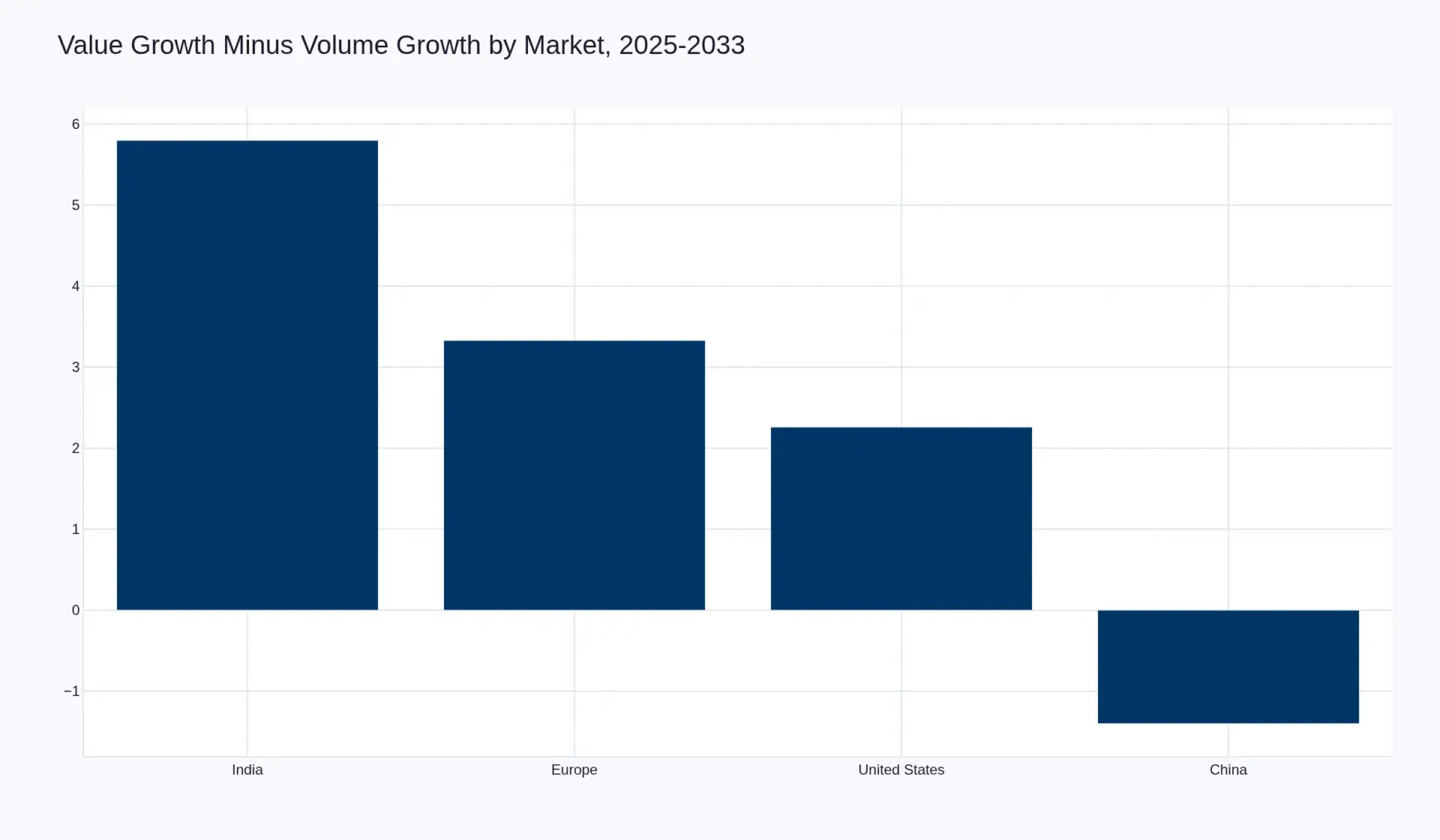
The growth is almost entirely a unit story. Orders rise from 11,900 million to 36,460 million, a 15.02% compound rate, while the average order falls from RMB 81.63 to RMB 74.00 — down 1.22% a year. China is the only market in this cluster where the basket is deflating. The United States adds 2.26 percentage points of basket growth; India adds 5.8; Europe adds 3.33. China subtracts 1.40. That single sign change explains more about the Chinese channel than any growth rate in this report.
The base series is the Ministry of Commerce Research Institute's Instant Retail Industry Development Report (2025), published on 25 November 2025: RMB 781.0 billion in 2024, up 20.15%, and RMB 971.4 billion estimated for 2025, up 24.38%. From RMB 68.7 billion in 2018, the market multiplied 11.37 times in six years, a 50.0% compound rate. Nothing else in Chinese retail has compounded at that speed from a standing start.
Market size at a glance
| 2024 market size | RMB 781.0 billion (+20.15%) |
| 2025 market size | RMB 971.4 billion (+24.38%) |
| 2030 waypoint (published) | RMB 2,000 billion |
| 2033 forecast | RMB 2,698 billion |
| CAGR, 2025–2033 | 13.62% |
| Order volume, 2025 → 2033 | 11,900m → 36,460m orders (15.02% CAGR) |
| Average order, 2025 → 2033 | RMB 81.63 → RMB 74.00 (−1.22% CAGR) |
| USD equivalent, 2025 → 2033 | US$135.86bn → US$377.34bn (RMB 7.15 flat) |
| Share of global instant retail | 66.73% → 63.10% |
| Currency and scale | RMB, billions |
What instant retail actually is, and what it is not
The Ministry of Commerce Research Institute defines instant retail narrowly and usefully: an order placed online, fulfilled from local retail supply, to meet a local need within a short window. Four parties sit inside that definition — the consumer, the platform, the rider, and the local merchant or warehouse — and all four have to be paid out of the same basket. That is the structural constraint the whole market runs on.
Three things are deliberately outside it. It is not ordinary e-commerce: a parcel that ships from a regional warehouse over two days is a different business with a different cost curve, and the Research Institute measures it separately. It is not food delivery, even though the same rider fleets and the same apps carry both — a restaurant meal is prepared to order and has no shelf. And it is not community group buying, which aggregates demand the previous evening and delivers to a pickup point the next day, removing the rider entirely.
The perimeter matters because two of the three numbers most often quoted for Chinese quick commerce come from perimeters that include food delivery. When a platform reports "instant retail orders" growth, it is usually reporting a bundle. This report uses the Research Institute definition throughout, and it is the reason the market can be described in three platforms when the underlying supply base runs into hundreds of thousands of merchants.
Why the basket is falling
Every instant retail market begins with a large basket and a small one gets in. In China the opposite happened, for three reasons that compound.
First, the categories moved down the ticket. The growth of 2024 and 2025 was concentrated in beverages, snacks, fresh produce, over-the-counter medicine and convenience goods — the low-value, high-frequency end of the assortment. A 500ml drink delivered in 30 minutes at a competitive price is a demonstration of capability, not a high-value transaction.
Second, the subsidy cycle priced the basket down directly. From early 2025 the three platforms competed on delivered price rather than on speed, which was already solved. Coupons attached to the order, not to the delivery fee, reduce measured basket value in a way that a fee waiver does not.
Third, the supply base changed shape. The shop-warehouse (shandiancang) layer that carries much of the volume is not a supermarket and does not try to be. It carries 3,000 to 8,000 lines chosen for turn, not for basket breadth. An operator optimising a 5,000-SKU box for orders per day is optimising for the next order, not the next basket.
The consequence is arithmetic. If value compounds at 13.62% and volume at 15.02%, the basket must fall 1.22% a year, and it does. Any Chinese instant retail forecast that shows the basket rising is really a forecast that the category mix stops moving — which would be a different market.
Three platforms, three businesses wearing the same name
The competitive structure is oligopolistic but not symmetrical, and the asymmetry is what makes the segment interesting to price.
Meituan owns the demand. Its food delivery base gives it the highest-frequency app in Chinese consumer internet and it converts that frequency into instant retail at almost no acquisition cost. It is a marketplace: merchants stock the shelf, Meituan supplies demand and the rider.
JD.com owns the inventory. Its instant retail push runs through its own warehousing and its own rider network, which means it books goods rather than commission and carries the working capital. That is a slower, more expensive model, and it is the only one that can guarantee provenance on a branded item.
Alibaba owns the merchant relationships, through the merchant base of its commerce platforms, and folded its instant retail offer into that estate rather than building a separate app. The strategic logic is defensive: if a consumer can get a grocery order in 30 minutes without opening Taobao, Taobao's daily-active habit is worth less.
None of the three discloses instant retail volume separately with the consistency the Indian platforms apply to quarterly reporting. That is the single largest evidence gap in this report, and it is why the model is built on the Research Institute's aggregate series rather than on a sum of disclosed company figures.
The shop-warehouse layer, and the cost of building it fast
The physical asset behind the market is the shandiancang — a franchise-operated micro-warehouse, typically 200 to 500 square metres, carrying a few thousand lines, sited to serve a catchment of roughly three kilometres. It is not a dark store in the European sense. It is cheap, it is franchised, it multiplies quickly, and it is the reason China's instant retail has spread into lower-tier cities faster than any comparable format elsewhere.
It is also where the market's stress shows first. Trade coverage in January 2026 reported shop-warehouses being transferred at around 30% of build cost becoming routine — the signature of a layer that expanded faster than the order density underneath it. A franchise model converts network growth into an owner-operator's problem very quickly, and the operator who cannot reach roughly 500 to 800 orders a day at a viable basket is the one selling.
This is the mechanism behind the basket finding. A layer built for order count, staffed by franchisees paid on throughput, and subsidised through a price war will produce volume growth ahead of value growth for as long as it is being built out. The model expects that to persist to about 2030 and to reverse slowly after it, which is why the basket decline decelerates across the forecast rather than holding at 1.22%.
Two numbers in the official base that do not reconcile
The Research Institute publishes three endpoints and one growth rate, and they are not mutually consistent. The endpoints are RMB 971.4 billion (2025), "above RMB 1 trillion" (2026) and RMB 2 trillion (2030). The growth rate is 12.6% average across the Fifteenth Five-Year Plan period, 2026 to 2030.
Compounded at 12.6% from RMB 971.4 billion, the market reaches RMB 1,758.29 billion in 2030 — RMB 241.71 billion short of the published target. The compound rate actually implied by RMB 971.4 billion to RMB 2,000 billion over five years is 15.54%, not 12.6%.
We build to the RMB 2 trillion endpoint rather than to the 12.6% rate, because the endpoint is the figure the industry plans against and because it is consistent with the 2025 actual. The 12.6% is disclosed here as inconsistent rather than silently dropped. It is also worth noting what "above RMB 1 trillion in 2026" implies: on a 13.6% path the market reaches RMB 1,008 billion during 2026, so the threshold is crossed almost immediately and the statement tells us nothing about the year's total.
What the model assumes, and what it excludes
The path is decelerating rather than linear: 2026 through 2030 runs at or just above the implied 15.5% rate to land on the published RMB 2 trillion, and 2031 through 2033 steps down to the low double digits as penetration in the largest cities saturates and growth shifts to lower-tier cities where order density is thinner and the basket is smaller. The result is the 13.62% average and the RMB 2,698 billion endpoint.
Both the value and the volume series exclude food delivery, community group buying, ordinary e-commerce and cross-border purchases. They include platform-fulfilled orders sourced from local merchants as well as from shop-warehouses and store-based dark capacity. The USD conversions use a single RMB 7.15 rate across the whole period; a moving currency would change the dollar figures without changing a single analytical conclusion, and holding it flat keeps the compound rates comparable with the rest of the cluster.
Where this report departs from the market's own narrative, it is flagged in the section it appears in rather than collected into a methodology note at the end. There are two such places: the growth-rate inconsistency above, and the treatment of the shop-warehouse layer, which most commentary counts as a fulfilment channel rather than as an asset base with its own failure mode.
Section index: contents · value chain · technology · competitive landscape · regulation · investment activity · market risk
Table des matières
- Overview and market size
- Value chain: who is paid out of the basket
- Technology and innovation: routing, forecasting, robotics
- Competitive landscape: Meituan, JD, Alibaba, Douyin
- Regulatory landscape: platform economy, labour, local government
- Investment activity: funding, subsidy, franchise capital
- Market risk: basket deflation, franchise stress, subsidy unwind
- Methodology and exclusions
Paysage concurrentiel
An oligopoly of four, asymmetrically built
Four platforms hold the Chinese instant retail market: Meituan, JD.com, Alibaba and Douyin. The market structure is oligopolistic, with a tier-one count of four, but the four do not compete with the same asset base and cannot be ranked on a single axis.
Meituan enters from the highest-frequency position in Chinese consumer internet. Food delivery gives it daily app opens, a rider fleet and merchant density, and instant retail monetises that existing frequency. Its model is marketplace: the merchant owns the shelf. Its structural advantage is acquisition cost, which for it is close to zero and for everyone else is a subsidy.
JD.com enters from inventory. It owns warehouses, it owns the rider network, and it books goods rather than commission. That model carries working capital, produces lower gross margin on a given basket, and can guarantee provenance on a branded item — which matters most in electronics, pharmacy and premium grocery. It is the only one of the four that can credibly promise the thing it sells.
Alibaba enters from merchant relationships and defends an existing habit. Its commerce estate already holds the merchants and the consumers; instant retail is integrated into that estate rather than run as a separate app. The strategic driver is defensive: a consumer who can satisfy a top-up need in 30 minutes without opening the main app is a consumer whose daily-active relationship is worth less.
Douyin enters from attention. Its position is demand generation rather than fulfilment, and its instant retail presence runs largely through partner capacity. It is the least capital-intensive entrant and the least likely to own a dark-store estate.
The 2025 price war, and what it bought
Through 2025 the three largest platforms competed on delivered price rather than on speed, which had already been solved at 30 minutes across most of urban China. The result was the deepest promotional cycle the channel has seen, and it bought volume at the expense of basket: on our model, value growth of 13.62% against volume growth of 15.02% is the arithmetic signature of a subsidy that attaches to the order rather than to the delivery fee.
The disclosure problem
The most important fact about the competitive landscape is one this report cannot fix. None of the four discloses instant retail gross order value, order count or segment margin with the quarterly consistency the Indian platforms apply to their disclosures. Share estimates circulating in the Chinese trade press are therefore not comparable with one another, and this report does not publish a share table it cannot build. Competitive intensity is assessed as high on the observable evidence — subsidy behaviour, node expansion and assortment overlap — rather than on a share calculation.
Chaîne de valeur
Four parties, one basket
An instant retail order in China divides a single pool of renminbi among four parties, and the split is the whole economics of the format. The consumer pays an order value — RMB 81.63 on average in 2025. Out of that, the merchant is paid for the goods, the platform is paid a commission, the rider is paid for the last three kilometres, and the fulfilment node — a shop-warehouse, a store’s back room, or a platform-operated dark store — is paid for holding and picking.
The proportions below are modelled from disclosed platform economics and stated assumptions, not from any company’s disclosed unit economics, because none of the three platforms discloses an instant retail P&L separately. On roughly RMB 81.63 of order value: about RMB 66 is the goods cost the merchant carries; about RMB 12 is platform commission at a blended 15%, with the customer also paying a delivery fee on perhaps half of orders; of the RMB 15 to RMB 16 the platform handles, roughly RMB 7 goes to the rider. That leaves close to RMB 8.6 per order before warehousing overhead, marketing, technology and subsidy — which is why the format only works at volume.
Where advertising sits
Advertising is the fifth party and it is not in the order at all: it is a separate payment from a brand into the platform, running at roughly 0.9% of order value nationally in 2025, or about RMB 0.73 per order. That is the lowest advertising take rate in this cluster, against 3.72% in the United States and 4.30% in India. It is also the line most likely to grow: it is nearly pure margin, it needs no rider, and it is the one revenue stream that improves as the basket falls.
The shop-warehouse franchise
The physical layer is franchised rather than owned, which moves capital off the platform’s balance sheet and onto an operator who is paid on throughput. The franchisee pays the build, the rent and the local staff; the platform supplies the brand, the demand, the forecasting and the rider. This is the cheapest way to build a national network quickly and the most fragile way to hold one, because the operator’s break-even sits at a specific order density and the platform controls the subsidy that determines it.
What the chain implies
Because the merchant sets the shelf price and the platform takes a percentage of it, every party except the rider is exposed to basket deflation. A falling basket with rising volume is a good outcome for the platform’s advertising line and a bad one for the franchisee, whose rent is fixed. That divergence, not the growth rate, is the thing to watch in the Chinese market through 2030.
Activité d'investissement
Capital intensity is high, and it has moved off the platform balance sheet
The Chinese model is capital-intensive in aggregate and asset-light per platform, and that combination is the most important thing to understand about investment in this market. The estate is large and expensive; the platforms do not own most of it.
Three pools of capital are being deployed. The first is platform subsidy, which is operating expenditure that behaves like customer acquisition and is the reason the 2025 basket fell. The second is franchise capital, deployed by owner-operators into shop-warehouses, typically at the low hundreds of thousands of renminbi per node for fit-out and initial stock. The third is platform-owned automated capacity in first-tier cities, where nodes are larger, automated and on the balance sheet.
The investment trend direction is rising, but the composition has shifted. Venture and growth capital into standalone instant retail companies is much thinner than it was in 2021; the capital now comes from the platforms themselves and from franchisees who are effectively lending their balance sheets to a demand aggregator.
Recent M&A activity: no
There has been no material acquisition activity in this market over the review period, and that is a finding rather than an omission. Consolidation in Chinese instant retail has taken the form of platform integration — folding an instant retail offer into an existing app, an existing rider fleet and an existing merchant base — rather than acquisition. The strategic question the platforms have been answering is not which company to buy but which existing asset to attach the offer to, and each of the three largest has answered it differently.
The capital risk the model carries
The consequence of financing an estate through franchisees is that the franchisee is the marginal investor in the market, and a franchisee’s willingness to invest is a function of order density and subsidy, both controlled by the platform. When transfers of shop-warehouses at around 30% of build cost become routine — as trade coverage reported in January 2026 — the market is saying that the marginal investor has stopped believing the density forecast. That is a capital-markets signal rather than an operational one, and it typically leads the reported growth rate by two to four quarters.
Technologie et innovation
The technology that matters is not the robot
Chinese instant retail is often described through its most photogenic technology — unmanned delivery vehicles, drone corridors, robotic picking arms. None of those decides who wins. The binding technology is the dispatch engine: the system that matches an order to a picker, a rider, a route and a promise window in under a second, at a cost measured in fen per order.
Three capabilities sit underneath it. Demand forecasting at the level of an individual shop-warehouse, on a two-hour resolution, decides what is in stock and therefore what can be sold. Assortment selection per catchment decides the basket. Batching and routing decide whether the rider carries one order or three, which is the difference between a delivery cost of RMB 7 and RMB 3.
Robotics and automation
Automated picking is real but marginal in the Chinese format, because a 200 to 500 square metre shop-warehouse with 3,000 to 8,000 lines is already walkable and a robotic arm buys little. The economics of small-format nodes do not reward automation until labour cost per pick exceeds the amortised cost of the equipment, which in most Chinese cities it does not yet. Automation arrives first in larger nodes — the 10,000-plus square metre automated fulfilment centres that sit behind the shop-warehouse layer in first-tier cities.
Autonomous delivery
Unmanned ground vehicles and drone delivery have moved from demonstration to limited commercial service in several cities, mainly on fixed corridors and in low-density environments. Their constraint is regulatory rather than technical, and their economics improve fastest exactly where instant retail is weakest: sparse catchments where a rider’s round trip is long. That makes them a lower-tier-city technology rather than a first-tier one.
Innovation intensity and maturity
Innovation intensity is high but concentrated in software. Patent activity is moderate and skewed toward logistics hardware and dispatch methods rather than toward store formats. The technology maturity stage is growth, not maturity: the core dispatch problem is solved, the forecasting problem is being solved, and the physical layer is still being standardised.
Risque de marché
Four risks, ranked by what they would actually do
1. Basket deflation outrunning volume growth. This is the central risk and it is already visible. The model requires volume to compound 1.40 points faster than value for eight years. If basket decline accelerates past 1.22% — through a deeper price war, a further mix shift into beverages and convenience, or a squeeze on branded assortment — then volume has to grow faster still to hit the same value endpoint, and rider and warehousing cost per yuan of value rises. Basket deflation is not only a margin problem; it is a cost-per-order problem, because the rider is paid per trip and not per yuan.
2. Franchise-layer distress. Trade coverage in January 2026 reported shop-warehouses changing hands at around 30% of build cost as a routine event. A franchise network is a demand-side bet made by thousands of small balance sheets, and those balance sheets break before the platform’s does. Distress at node level shrinks catchment coverage, which shrinks the promise window, which shrinks the order. Spillover is bounded by the fact that the platform owns the demand and can reseed nodes, but reseeding is a cost.
3. Subsidy unwind. The 2025 volume was bought. When the three largest platforms stop competing on delivered price — and they will, because the capital for it is finite — the marginal order disappears first. Those orders are the low-basket, high-frequency ones that make the shop-warehouse economics work, so the unwind hits the franchise layer and the reported volume at the same time.
4. Regulatory tightening on rider cost. Social insurance and algorithm-transparency requirements raise the single largest variable cost in the format. This is a low-probability, high-impact risk with a specific transmission path: rider cost per order rises, platform contribution per order falls, and the platform recovers it from either the merchant’s commission or the rider’s pay. Neither is frictionless.
Risks we assess as low
Substitution risk is low. There is no adjacent channel that delivers a top-up grocery need in 30 minutes, and the two plausible substitutes — the convenience store downstairs and next-day e-commerce — are the behaviours instant retail is taking share from. Geopolitical exposure is moderate rather than high: this is a domestic demand market with a domestic supply chain, and the exposure runs through platform regulation and currency rather than through trade. Overall market risk is moderate: the demand is real, the format is penetrating, and the supply side’s capital structure is the part that is not yet stable.
Paysage réglementaire
Four regulatory layers, none of which is about delivery speed
Instant retail in China is regulated at four levels, and the complexity is high relative to other retail formats because the format touches platform conduct, labour, food safety, land use and local economic policy at once. The approval pathway is licence-based: a shop-warehouse cannot operate without a food business licence, a business registration and local fire and planning clearance, and each of those sits with a different authority.
Platform conduct. The Anti-Monopoly Law and the platform economy guidelines constrain the exclusivity arrangements that once forced merchants to choose a single platform, and they constrain algorithmic pricing in ways that matter directly to a market where price is the competitive variable. The practical effect has been to make the 2025 price war legal in a way the previous decade’s exclusivity war was not.
Rider labour. The classification of riders and the scope of social insurance obligations has been the most consequential regulatory question for the delivery platforms. Incremental requirements around injury insurance, algorithm transparency and rest periods raise the per-order cost of the last mile, which is the largest single variable cost in the format. Any material tightening moves the delivery-cost line in the unit economics above.
Food safety and premises. Shop-warehouses hold and handle food, which brings them inside food-safety licensing and inspection. The franchise model multiplies the number of licensed premises without multiplying the platform’s direct control over them, and food-safety incidents at franchise nodes are a recurring enforcement theme.
Local economic policy. City governments have generally been supportive, treating 15-minute and 30-minute catchments as municipal infrastructure and competing to attract node investment. That support is not uniform: dense residential districts in first-tier cities have become more restrictive on ground-floor logistics use as residents have objected to rider traffic and noise.
What is not regulated
There is no national cap on shop-warehouse density and no national planning classification for the format. That is the opposite of the position in several European markets, where the format has run into exactly that constraint. The absence of a density rule is one reason the Chinese network could scale faster than any comparable market, and it is the regulation most likely to appear if the format becomes politically visible.