
Editorial Article
The Same Bay Has Two Prices — and the Buyer Keeps Choosing the Dearer One
A market that grows by charging more for the same bay
The global parking access and revenue control systems market was worth USD 3.10 billion in 2025, the base year, and reaches USD 6.19 billion in 2033 at 9.03 per cent. That is a doubling, and it is not a story about car parks. The number of controlled spaces goes from 40.0 million to 46.5 million across the same eight years — a multiple of 1.16 — while the value of the market multiplies by 2.00. Revenue per controlled space rises from USD 77.50 to USD 133.12 a year, up 71.8 per cent.
Put plainly: four-fifths of the growth in this market is the same physical bay being sold for more money to the same supplier. Which raises the only question worth asking. Sold how?
Because there are two ways to buy a parking system, and the industry has spent the last four years moving from one to the other. In the first, a public body buys lanes, pay stations, cameras and software outright, takes the asset onto its books, and pays for maintenance until the equipment dies. In the second, it buys a service: the vendor installs everything at no upfront cost, charges a fee per space per year and a fee per transaction, and keeps the asset. Both prices are observable. Neither is published in a rate card. Both appear in procurement records, which is where this article goes looking.
Four awards, and what each one priced
Houston priced a parking space at USD 471.43. In July 2022 its council authorised a maximum contract of USD 14,143,015 with TIBA for a new access and revenue control system with plate recognition at the entrances and exits of every facility across George Bush Intercontinental and William P. Hobby — roughly 30,000 spaces, appropriated USD 13,716,175 from the Airports Improvement Fund and a further USD 426,840 from the airport system’s revenue fund. The council record lists six submissions — TIBA, Amano McGann, DESIGNA, Scheidt & Bachmann USA, SKIDATA and Azteca. The specification is worth noting for later: the city required a card-data compliant environment using point-to-point encryption with processing handed to an off-site third party. That was 2022, three years before the standard’s new requirements became mandatory.
Evanston, Illinois priced the same space at USD 270.67. On 31 March 2025 its council awarded USD 969,823 to RevCon Technology Group to replace the access and revenue control systems in three city-owned decks — 525 Church, 821 Davis and 1800 Maple, 3,583 spaces — where the existing equipment was a nine-year-old SKIDATA installation. Seven proposals came in. Staff scored three within 1.6 points of each other: RevCon at USD 969,823 and 90.3, Amano McGann at USD 1,278,823 and 89.2, HUB Parking at USD 1,092,237 and 88.7. The city took the lowest of the three, which was also the highest-scoring, against a top bid 31.9 per cent higher. It also rejected the genuinely gateless option that some bidders proposed.
Irvine priced it at USD 245.16. On 23 June 2026 its council awarded a not-to-exceed contract of USD 1,083,377 to Parking Concepts, Inc. for a gateless, plate-recognition paid parking programme at the Great Park, 4,419 spaces, with payment by kiosk, browser, mobile app or QR code and on-site full-service maintenance. The request for proposals went out in February 2026 with an April deadline; two firms were interviewed and payment kiosks were tested in the field. Irvine took the gateless route Evanston declined, three years later, for a smaller unit price.
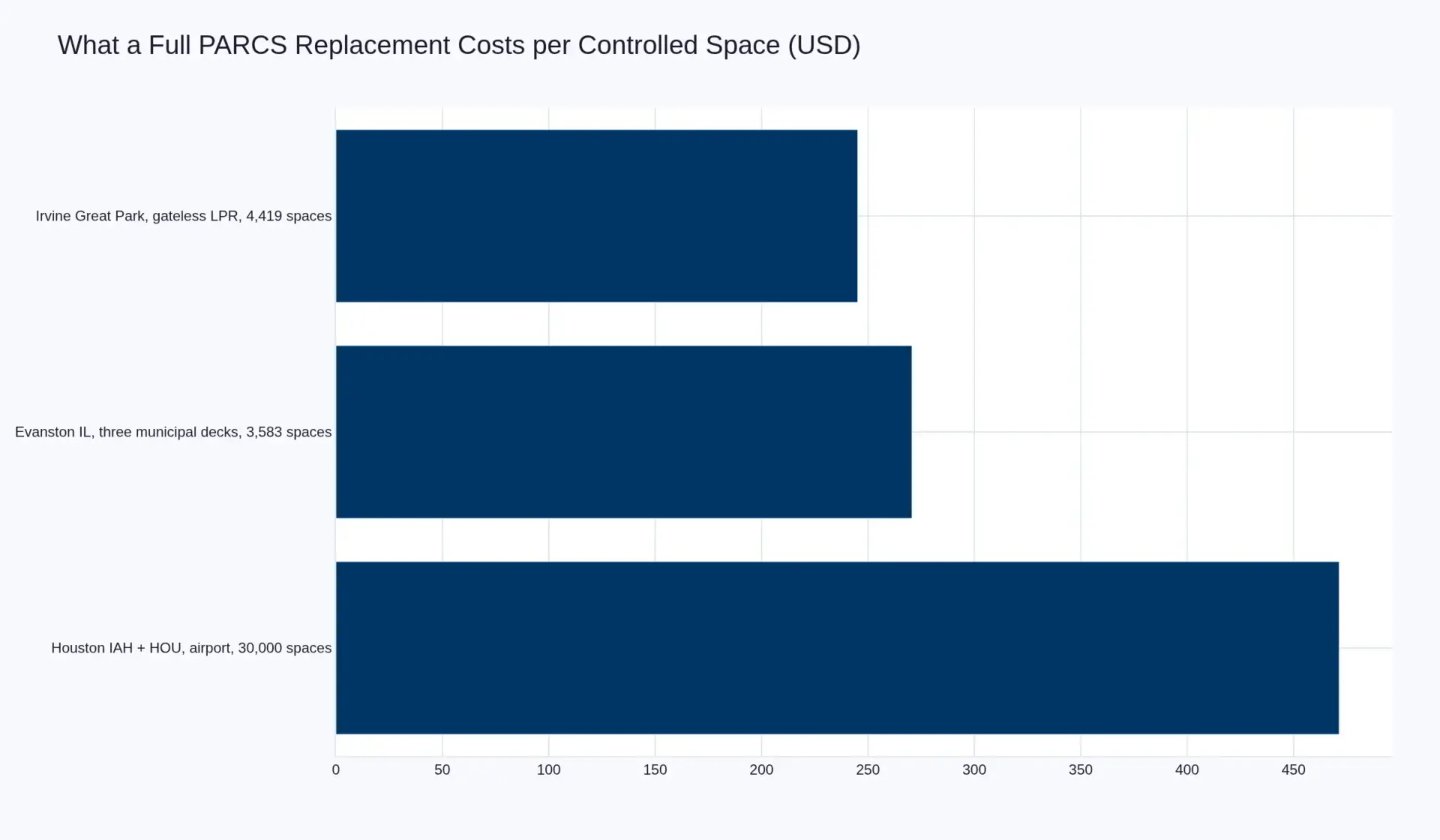
Three numbers, one direction, and a trap in the ordering. The largest project — 30,000 spaces, two airports, 24-hour duty cycle, transient, contract, employee and crew traffic in the same facility — carries the highest unit price. The smallest is the middle one. Whatever sets the price per space in this market, it is not economies of scale. It is lane count, service intensity and the number of distinct traffic classes a site has to bill correctly.
The invoice after the invoice
None of those three numbers is the cost of owning a parking system, because the capital award buys hardware and three years of cover. Evanston’s documents set out the warranty precisely: one year from TIBA as manufacturer, plus two further years from the integrator covering equipment, parts, maintenance and workmanship. For three years the city pays nothing to keep the system running.
Then the tail starts. On the nine-year-old system being replaced, Evanston’s own records put service at USD 34.61 per space per year — 130 invoices totalling over USD 125,000 in 2023 and 119 totalling over USD 123,000 in 2024. Nine years of that is USD 311.49 per space, which turns a USD 270.67 purchase into a USD 582.16 space. Strip out the three warranty years and it is still the largest single line in the lifecycle, larger than the equipment.
That is the arithmetic a buyer is making when a vendor offers to make the capital cost disappear. It does not disappear; it moves.
The other price, and why it is higher
San Antonio International priced the same space at USD 84.70 a year. Its contract with Metropolis, awarded in spring 2024 with operations from June, carries a software-as-a-service fee of USD 565,000 a year with a 3 per cent escalator, a management and ground-transportation fee of USD 282,000 in the first year of a ten-year term with the same escalator, and no upfront equipment cost at all. Ten thousand spaces. The gate, the cameras and the payment platform are the vendor’s problem. USD 565,000 and USD 282,000 make USD 847,000 a year, and the buyer’s cost is the fee.
The rest of the money comes from somewhere else. Drivers pay a transaction fee of 99 cents to USD 3.99 depending on length of stay and service level, collected at the point of payment and never entering the airport’s accounts.
Now run the term. USD 84.70 per space per year over ten years is USD 847 per space — 1.80 times the Houston capital price, 3.45 times the Irvine one, and USD 264.84 more than Evanston’s capital plus nine years of observed service, a premium of 45.5 per cent. The subscription is the most expensive way to acquire a parking system in this sample. It is also the one that is spreading.
What the buyer is actually buying
Not equipment. Three other things, and each of them is real.
A budget line that already exists. Evanston’s USD 969,823 came from an improvement account holding USD 2,425,000 — a capital reserve, spent once, and then gone. A reserve that size is a queue of competing projects. An operating fee arrives in a different budget, is approved as a service rather than an asset, and does not require the council to rank a parking system against a fire station. When Irvine approved its programme, the stated driver was a park operating deficit of USD 7.5 million heading for USD 12.7 million by 2029–30, against projected parking revenue of USD 3–5 million in the first year and USD 8–10 million at build-out. That is a revenue-recovery case, not an asset-renewal case, and it is a case only a fee model can answer.
The transfer of the technology risk. In the capital model the owner holds the residual value, the obsolescence risk and the maintenance obligation. In the subscription it holds a service level and a term. That is a genuine transfer, and it is worth something — but only something. What the owner retains is the risk that the revenue projection behind the business case was wrong, which is harder to see than a depreciating asset because it appears in a forecast rather than on a balance sheet.
Somebody else’s warranty. Under the subscription the asset is the vendor’s, so the refresh obligation is the vendor’s. Under the capital model it is a three-year holiday followed by a nine-year bill.
What the owner gives up is narrower and more consequential: the customer relationship. In the capital model the owner holds the rate card, the ticket, the cashier and the loyalty scheme. In the platform model the customer registers with the platform, stores a card with the platform, is recognised by plate across the platform’s other sites, and receives the platform’s notifications. San Antonio’s own account is candid about the upside — more than 100,000 local travellers registered within a year, real-time visibility of average transaction values and customer origin by postcode — and equally clear about who is supplying it. Metropolis operates more than 4,000 locations and processes over USD 4 billion of payments a year. The airport is one site inside a network, and it is the network that now knows the customer.
The fee the owner never sees
Here is the part of the model that makes the sale easy and that carries the political risk. A fee of 99 cents on a twelve-dollar stay is 8.2 per cent of the price. On a valet transaction at USD 3.99 it is 33.2 per cent. Neither figure appears in the owner’s budget, because the owner never touches the money. For the driver, the price of parking has risen by a component that is neither the tariff nor the tax, and is announced at the point of payment by a party the driver did not choose.
The counter-current is already legislative. New Jersey’s consumer statute prohibits a retail seller from requiring card payment or refusing cash, with civil penalties of up to USD 2,500 for a first offence, and its exemptions define the exposed configuration precisely: municipal facilities are exempt regardless of operator, and so is a fully cashless private operator. What is exposed is the ordinary private garage that kept the booth, kept the card reader and removed the note acceptor. Evanston, notably, bought itself out of that exposure voluntarily — one cash-and-card machine in each of three decks, USD 59,625 for the three — before anyone complained.
The fee is not the tariff, but to a council under pressure it will look like one. A rule that a parking charge must be the advertised price, with nothing added at the point of payment, would remove the driver-paid line from every platform’s model overnight and push the fee back onto the owner’s budget. That is a repricing event, not a compliance cost, and it is the largest single risk in the forecast.
The audit is the salesman
What actually forces a replacement is not wear. Evanston’s nine-year-old system was working. It was, however, nine years old in a market where the payment-card standard moved underneath it: PCI DSS v4.0 was published in March 2022, v4.0.1 replaced it in June 2024 with no new or deleted requirements, v4.0 was retired on 31 December 2024, and the 51 future-dated requirements that v4.0 introduced became mandatory on 31 March 2025. The Council said explicitly that the revision did not change that date.
A lane that stores, transmits or processes card data sits inside the audit. The cheapest way out is architectural: stop doing all three. Houston specified point-to-point encryption with off-site processing in 2022. San Antonio took the other route — a stored credential against a registered plate, so no card is ever presented at a barrier. Both are more expensive to build than a lane that reads a card and posts a transaction, and both shrink the audit surface to a fraction of what it was.
That is why a compliant, functioning, perfectly serviceable lane can be uneconomic to keep. It fails an assessment years before it fails mechanically, and assessment dates, unlike equipment, are on a calendar.
Where the value went
The layer data shows the same movement from the supplier’s side. Lanes and access hardware fall from 33.9 per cent of market value in 2025 to 22.6 per cent in 2033. Service and maintenance fall from 25.2 to 21.3. Software rises from 20.0 to 29.9, and the transaction and enforcement layer — the fee, the validation, the enforcement record — rises from 21.0 to 26.2. Software and transaction together reach 56.1 per cent of the market.
The manufacturers have read this and reorganised accordingly. TIBA’s platform page attacks the replacement cycle its competitors live on: “Every few years, a vendor tells you your system is finished and it’s time to start over. Not with SPARK. Our system doesn’t age, it evolves.” SKIDATA now sells a mobility suite as a service and a subscription it describes as future-proof parking, alongside zone and curb management. Scheidt & Bachmann lists operational continuity as a product category. DESIGNA, which runs 12 million parking events a year at Frankfurt, certified its information security management system to ISO/IEC 27001 in March 2026 — an assurance credential for a payment business, not an equipment business. When the hardware makers’ headline products are subscriptions, the hardware has become the channel.
Who ends up owning the customer
Capital has already voted. In May 2024 Metropolis took SP+ private with USD 1.8 billion of financing, paying USD 54.00 a share — a premium of roughly 52 per cent to the October 2023 close — and acquired 4,000 locations, over 20,000 employees and more than USD 4 billion of annual payment flow. In November 2025 it raised a further USD 1.6 billion, a USD 1.1 billion term loan and about USD 500 million of equity, at a valuation of approximately USD 5 billion. Neither transaction bought a single barrier gate. Both bought the site portfolio and the transaction.
Arrive did the same from the other direction. EasyPark Group renamed itself in June 2025 and became parent to EasyPark, Flowbird, ParkMobile, RingGo, Parkopedia, Yellowbrick and Your Parking Space — the consumer app, the payment rails and the machine manufacturer under one owner, present in more than 90 countries and 20,000 cities.
For a supplier that means scale runs through the portfolio, not the product. For a buyer it means the competitive tension a capital bid creates is not automatically reproduced in a subscription negotiation, because the party offering the subscription usually already operates the neighbouring city’s parking. And it means the justification for the fee has to be a number. San Antonio has one: automating validation took the transaction from four minutes to two seconds, and early analysis of the reservation capability alone showed about 91 cents of additional revenue per passenger. Against parking revenue of roughly USD 3,100 per space a year, an USD 84.70 fee is 2.7 per cent. Where a platform can demonstrate that, the subscription is cheap. Where it cannot, the owner is paying a 45.5 per cent premium over owning the system for a reporting suite and a warranty.
Where this article is weakest
Two numbers in the market model behind this piece are our own construction and should be read as such. The 40.0 million controlled-space base has no register behind it anywhere in the world; it is an aggregation from facility counts, operator portfolios and national parking inventories, and the regional splits are disclosed as inference wherever they are not direct disclosure. The USD 650 million transaction and enforcement layer is fee revenue retained after scheme and acquirer costs, which almost nobody discloses; a change in take rate moves that line, and the forecast, more than anything else in the model. Latin America — USD 0.16 billion by 2033 on a very small installed base — is the softest regional number in the document.
What is not a construction is the procurement record. Four awards, four published documents, four prices. The argument in this article rests on those.
Three markers to watch
One: regulation of the consumer fee. If any of the five largest markets restricts per-transaction charges at the point of payment, the driver-paid line moves onto the owner’s budget and the subscription premium has to be justified against capital on price alone.
Two: a run of competitive capital awards. If municipal buyers start returning to outright purchase after trying the subscription, the value-per-space assumption — the 71.8 per cent rise this forecast depends on — weakens. A single negotiated conversion is not evidence. Five competitive awards in a year would be.
Three: the compliance wave deferring. The replacement case is built on a date. If lane shipments fall across two consecutive quarters while the installed base keeps ageing, the deadline is being absorbed rather than enforced, and the hardware line falls faster than modelled.
None of the three is present in the record today. All three are plausible inside the forecast window. That is why the market grows at 9.03 per cent and not at the 14 per cent its software and transaction layers would imply on their own.
How this was researched
Seventy per cent secondary, 30 per cent primary, and the primary strand is ours. Structured interviews with airport and municipal parking development and operations teams; open-ended interviews with access-control manufacturers, integrators and payment platforms; a survey programme covering procurement practice, lifecycle cost expectations and payment-interface selection; and conference-floor discussion through 2025 and 2026, including the corridor conversations where operators say what they will not put in a reference call. The secondary base is procurement records, council memoranda, standards publications and corporate filings, used in preference to any third-party market estimate. No competitor research is cited anywhere in this article or in the report beneath it.
Sources
City of Houston, council action of 12 July 2022, parking access and revenue control system professional installation services agreement with TIBA at IAH and HOU, maximum contract USD 14,143,015: houston.novusagenda.com.
City of Evanston, city council actions of 31 March 2025, contract award to RevCon Technology Group for a parking access revenue control system in three city-owned garages, USD 969,823: doccenter.cityofevanston.org (actions); and the staff memorandum with the bid tabulation and warranty terms: doccenter.cityofevanston.org (memorandum).
City of Irvine, request for city council and board action, meeting of 23 June 2026, Great Park parking system award of contract to Parking Concepts, Inc., USD 1,083,377: irvine.granicus.com.
Airport Improvement, “San Antonio Int’l outsources parking management, adds drive-in, drive-out ease for customers”, January 2026 — software-as-a-service fee USD 565,000 a year with 3 per cent escalator, management fee USD 282,000 in year one of a ten-year contract, no upfront equipment costs, per-transaction fee of 99 cents to USD 3.99: airportimprovement.com.
PCI Security Standards Council, “Just Published: PCI DSS v4.0.1” — v4.0 retired 31 December 2024, effective date of the new requirements unchanged: blog.pcisecuritystandards.org; and “Now is the Time for Organizations to Adopt the Future-Dated Requirements of PCI DSS v4.x” — 51 of 64 new requirements future-dated to 31 March 2025: blog.pcisecuritystandards.org.
New Jersey consumer payment statute N.J.S.A. 56:8-2.33 and its exemptions, as analysed in the market report beneath this article. Figures for market value, volume, layer shares, regional shares and company revenues are from Pheonix Research, Global Parking Access & Revenue Control Systems (PARCS) Market Report, Size, Share and Forecast 2026–2033, base year 2025.
Related research
The report this article draws on is Global Parking Access & Revenue Control Systems (PARCS) Market Report, Size, Share and Forecast 2026–2033 — the full twelve sections, six analytical chapters, layer and regional tables, and the complete procurement evidence base behind every figure used here.
Two layers up the same journey, Airport Parking & Pre-Booked Reservation Platforms makes the adjacent argument: a bay is perishable and a booking is an asset, so the party that holds the reservation holds the price. PARCS charges for the space after it is occupied; the reservation platform sells it before.
Parking Occupancy Sensing & Space-Guidance is the same economics with a cheaper sensor: coverage that gets bought because it is not installed. It is the layer where the cost per data point falls fastest, and the natural complement to a gate that no longer needs to exist to collect.
Curb & Kerbside Management is where the same per-transaction logic meets a public asset that cannot be enclosed — a collection layer that gets digitised against an allocation layer that gets decided.
And Airport Baggage Handling Systems carries the identical structural question at a different seam: a market paid for steel that loses the bag at the handover between two vendors and two contracts. Here the handover is between the owner and the platform, and the thing that gets lost is the customer.
Vertiport & UAM Ground Infrastructure is the neighbouring case where a site gets cheaper every year because the mix shifts to the format that needs permission least — the same falling ticket, for a different reason.
Companies referred to in this article
SKIDATA — the incumbent system replaced at Evanston, and now selling mobility and subscription formats alongside access hardware. TIBA Parking Systems — awarded Houston’s two-airport contract and the hardware behind Evanston’s replacement. Scheidt & Bachmann — bidder at Houston, and selling operational continuity as a product. DESIGNA — Frankfurt’s 12 million parking events a year and an ISO/IEC 27001 certificate obtained in March 2026. Amano McGann — the highest-priced of Evanston’s three finalists at USD 1,278,823. Metropolis Technologies — the platform operator at San Antonio, and the acquirer of SP+ at USD 1.8 billion. Arrive — EasyPark, Flowbird, ParkMobile, RingGo and Parkopedia under one owner since June 2025. Parking Concepts, Inc. — Irvine’s gateless award at USD 1,083,377.