
Global Security Orchestration, Automation and Response (SOAR) Market Report, Size & Forecast 2026-2033
Global Security Orchestration, Automation and Response (SOAR) Market Forecast Snapshot (2026–2033)
| Metric | Value |
|---|---|
| Market Size (2025) | USD 2.35 Billion |
| Market Size (2033) | USD 7.95 Billion |
| CAGR (2026–2033) | 16.45% |
| Largest Segment | Cloud-Based SOAR Solutions |
| Fastest Growing Segment | AI-Powered Security Automation Platforms |
| Leading End-Use Segment | Large Enterprises |
| Key Trend | AI-Driven Threat Detection, Security Automation, Extended Detection and Response (XDR) Integration & Zero Trust Security |
| Regulatory Influence | Cybersecurity Regulations, Data Privacy Laws, Critical Infrastructure Security Standards & Compliance Management Frameworks |
| Future Outlook | Growth Driven by Increasing Cyber Threats, SOC Automation, Cloud Security Adoption & AI-Enabled Incident Response |
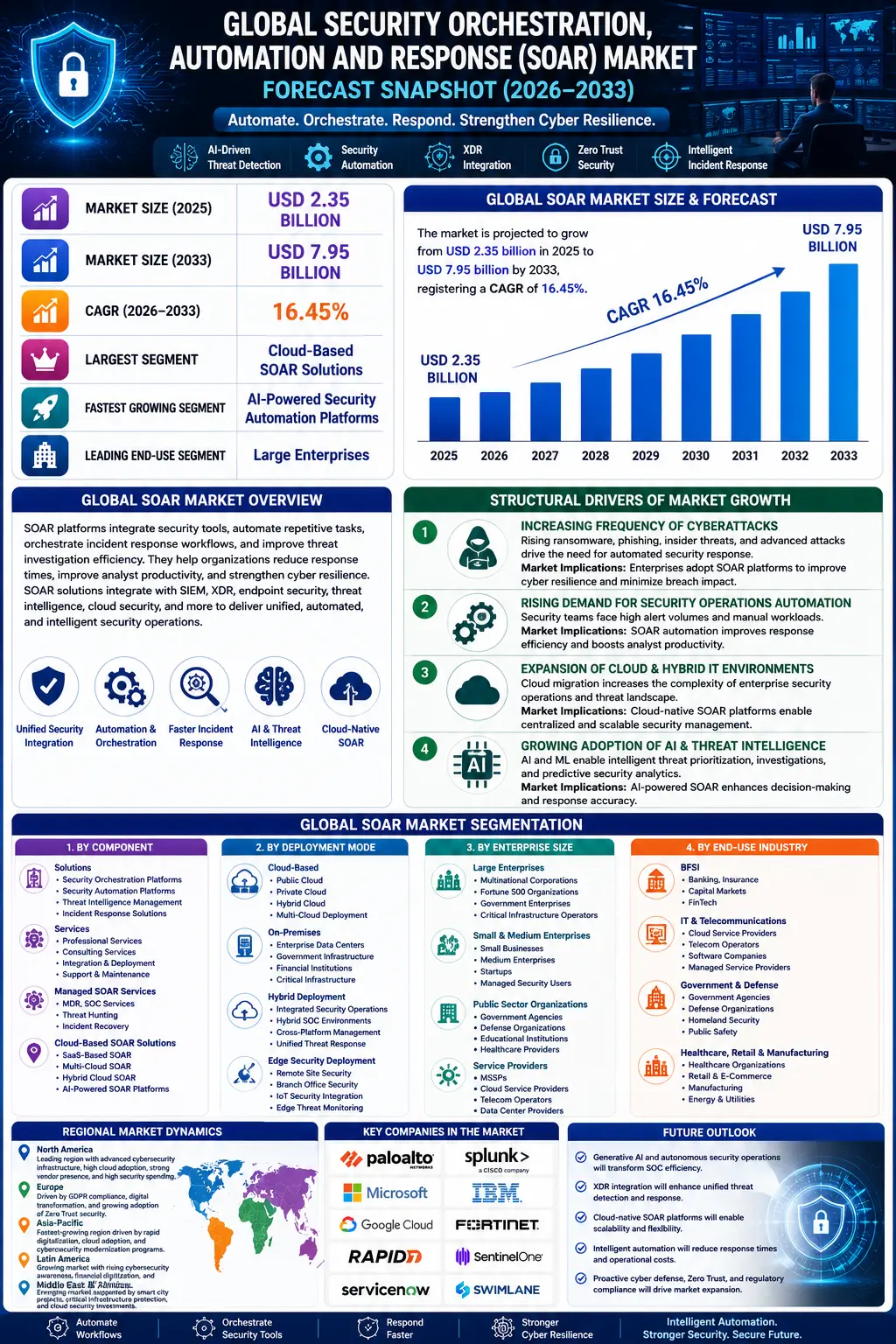
Global Security Orchestration, Automation and Response (SOAR) Market Size & Forecast
The Global Security Orchestration, Automation and Response (SOAR) Market is expected to witness robust growth during the forecast period from 2026 to 2033. The market was valued at USD 2.35 billion in 2025 and is projected to reach approximately USD 7.95 billion by 2033, registering a CAGR of 16.45%. Market growth is primarily driven by the increasing frequency and sophistication of cyberattacks, rising adoption of Security Operations Centers (SOCs), growing shortage of cybersecurity professionals, expanding cloud infrastructure, and increasing demand for automated incident detection, investigation, and response capabilities.Global Security Orchestration, Automation and Response (SOAR) Market Overview
Security Orchestration, Automation and Response (SOAR) platforms integrate security tools, automate repetitive cybersecurity tasks, orchestrate incident response workflows, and improve threat investigation efficiency. SOAR solutions enable organizations to consolidate security operations, reduce response times, improve analyst productivity, and strengthen overall cyber resilience. The market serves enterprises across banking, financial services, healthcare, government, manufacturing, retail, telecommunications, energy, and critical infrastructure sectors. Integration with SIEM, XDR, endpoint security, threat intelligence, cloud security, and artificial intelligence continues to drive market innovation.Structural Drivers of Market Growth
1. Increasing Frequency of Cyberattacks
Organizations are experiencing growing volumes of ransomware, phishing, insider threats, and advanced persistent attacks. Market Implications: Enterprises are adopting automated security response platforms to improve cyber resilience.2. Rising Demand for Security Operations Automation
Security teams require automation to manage increasing alert volumes while reducing manual workloads. Market Implications: SOAR platforms significantly improve incident response efficiency and analyst productivity.3. Expansion of Cloud and Hybrid IT Environments
Cloud migration and hybrid infrastructure are increasing the complexity of enterprise cybersecurity operations. Market Implications: Cloud-native SOAR platforms are becoming essential for centralized security management.4. Growing Adoption of AI and Threat Intelligence
Artificial intelligence and machine learning enable intelligent threat prioritization, automated investigations, and predictive cybersecurity analytics. Market Implications: AI-powered SOAR platforms are enhancing security decision-making and response accuracy.Global Security Orchestration, Automation and Response (SOAR) Market Segmentation
1. By Component
1.1 Solutions
1.1.1 Security Orchestration Platforms 1.1.1.1 Workflow Automation Solutions 1.1.1.1.1 Incident Response Automation 1.1.1.1.2 Threat Intelligence Integration 1.1.1.1.3 Security Playbook Automation 1.1.1.1.4 Case Management Solutions 1.1.2 Threat Intelligence Management 1.1.3 Security Automation Platforms 1.1.4 Incident Response Management Solutions1.2 Services
1.2.1 Professional Services 1.2.2 Consulting Services 1.2.3 Integration & Deployment Services 1.2.4 Support & Maintenance Services1.3 Managed SOAR Services
1.3.1 Managed Detection & Response (MDR) 1.3.2 Security Operations Center (SOC) Services 1.3.3 Threat Hunting Services 1.3.4 Incident Recovery Services1.4 Cloud-Based SOAR Solutions
1.4.1 SaaS-Based SOAR 1.4.2 Multi-Cloud SOAR 1.4.3 Hybrid Cloud SOAR 1.4.4 AI-Powered SOAR Platforms2. By Deployment Mode
2.1 Cloud-Based
2.1.1 Public Cloud 2.1.1.1 Cloud-Native Security Platforms 2.1.1.1.1 Multi-Tenant Architecture 2.1.1.1.2 Automated Threat Detection 2.1.1.1.3 Cloud Security Analytics 2.1.1.1.4 AI-Driven Security Operations 2.1.2 Private Cloud 2.1.3 Hybrid Cloud 2.1.4 Multi-Cloud Deployment2.2 On-Premises
2.2.1 Enterprise Data Centers 2.2.2 Government Infrastructure 2.2.3 Financial Institution Deployment 2.2.4 Critical Infrastructure Security2.3 Hybrid Deployment
2.3.1 Integrated Security Operations 2.3.2 Hybrid SOC Environments 2.3.3 Cross-Platform Security Management 2.3.4 Unified Threat Response2.4 Edge Security Deployment
2.4.1 Remote Site Security 2.4.2 Branch Office Security 2.4.3 IoT Security Integration 2.4.4 Edge Threat Monitoring3. By Enterprise Size
3.1 Large Enterprises
3.1.1 Multinational Corporations 3.1.1.1 Enterprise Security Operations 3.1.1.1.1 Global SOC Management 3.1.1.1.2 Automated Incident Response 3.1.1.1.3 Threat Intelligence Sharing 3.1.1.1.4 Compliance Management 3.1.2 Fortune 500 Organizations 3.1.3 Government Enterprises 3.1.4 Critical Infrastructure Operators3.2 Small & Medium Enterprises (SMEs)
3.2.1 Small Businesses 3.2.2 Medium Enterprises 3.2.3 Startups 3.2.4 Managed Security Users3.3 Public Sector Organizations
3.3.1 Government Agencies 3.3.2 Defense Organizations 3.3.3 Educational Institutions 3.3.4 Healthcare Providers3.4 Service Providers
3.4.1 Managed Security Service Providers 3.4.2 Cloud Service Providers 3.4.3 Telecom Operators 3.4.4 Data Center Providers4. By End-Use Industry
4.1 BFSI
4.1.1 Banking 4.1.1.1 Financial Cybersecurity 4.1.1.1.1 Fraud Detection 4.1.1.1.2 Payment Security 4.1.1.1.3 Identity & Access Management 4.1.1.1.4 Regulatory Compliance 4.1.2 Insurance 4.1.3 Capital Markets 4.1.4 FinTech4.2 IT & Telecommunications
4.2.1 Cloud Service Providers 4.2.2 Telecom Operators 4.2.3 Software Companies 4.2.4 Managed Service Providers4.3 Government & Defense
4.3.1 Government Agencies 4.3.2 Defense Organizations 4.3.3 Homeland Security 4.3.4 Public Safety4.4 Healthcare, Retail & Manufacturing
4.4.1 Healthcare Organizations 4.4.2 Retail & E-Commerce 4.4.3 Manufacturing 4.4.4 Energy & UtilitiesRegional Market Dynamics
North America
Leading region supported by advanced cybersecurity infrastructure, high cloud adoption, increasing enterprise cybersecurity spending, and strong presence of global cybersecurity vendors.Europe
Driven by GDPR compliance, expanding digital transformation initiatives, growing investments in cyber resilience, and increasing adoption of Zero Trust architectures.Asia-Pacific
Fastest-growing region supported by rapid enterprise digitalization, expanding cloud adoption, increasing cyber threats, and government cybersecurity modernization programs.Latin America
Growing market driven by increasing cybersecurity awareness, financial sector digitization, and rising investments in managed security services.Middle East & Africa
Emerging market supported by smart city projects, digital government initiatives, critical infrastructure protection, and cloud security investments.Competitive Landscape
The Global Security Orchestration, Automation and Response (SOAR) Market is highly competitive with cybersecurity software vendors, cloud security providers, security analytics companies, and managed security service providers focusing on AI-driven automation, threat intelligence, and integrated security operations platforms. Key Companies Operating in the Market Include:- Palo Alto Networks, Inc.
- Splunk Inc. (Cisco)
- Microsoft Corporation
- IBM Corporation
- Google LLC (Google Cloud Security)
- Fortinet, Inc.
- Rapid7, Inc.
- SentinelOne, Inc.
- ServiceNow, Inc.
- Swimlane Inc.
Strategic Outlook
The future of the SOAR market will be shaped by generative AI, autonomous security operations, extended detection and response (XDR), cloud-native security platforms, threat intelligence automation, and predictive cyber defense technologies. Organizations are increasingly investing in AI-powered security operations centers, intelligent orchestration platforms, automated compliance management, and unified cybersecurity ecosystems to strengthen resilience against evolving cyber threats. Integration of SOAR with SIEM, EDR, CNAPP, and Zero Trust frameworks will continue driving enterprise adoption. Growing emphasis on proactive cybersecurity, automated incident response, cloud security, digital resilience, and regulatory compliance will continue creating significant market opportunities. Companies focusing on AI innovation, intelligent threat detection, scalable cloud security, and integrated cybersecurity platforms will strengthen their competitive position within the global cybersecurity software industry.Final Market Perspective
The Global Security Orchestration, Automation and Response (SOAR) Market is becoming a foundational technology for modern cybersecurity operations. Rising cyber threats, increasing security alert volumes, continuous cloud adoption, and growing demand for intelligent automation are expected to support sustained market growth throughout the forecast period. Organizations delivering advanced, AI-powered, and highly integrated SOAR platforms will be well-positioned to capitalize on long-term opportunities across the global cybersecurity market.Table of Contents
1. Executive Summary
1.1 Market Snapshot (2026–2033)
1.2 Key Growth Highlights
1.3 Demand-Supply Overview
1.4 Key Strategic Insights
1.5 Analyst Viewpoint
2. Market Overview
2.1 Introduction to Global Security Orchestration, Automation and Response (SOAR) Market
2.2 Industry Value Chain Analysis
2.3 Market Evolution & Historical Trends
2.4 Macro-Economic Impact Analysis
2.5 Cybersecurity Operations Ecosystem & Security Infrastructure
2.6 AI-Driven Threat Detection, Security Automation, XDR Integration & Zero Trust Security Trends
3. Global Security Orchestration, Automation and Response (SOAR) Market Forecast Snapshot (USD Billion), 2026–2033
3.1 2025 Market Size
3.2 2033 Market Size
3.3 CAGR (2026–2033)
3.4 Largest Region
3.5 Fastest Growing Region
3.6 Largest Segment
3.7 Key Trend
3.8 Future Outlook
4. Key Drivers of Market Growth
4.1 Increasing Frequency of Cyberattacks
4.2 Rising Demand for Security Operations Automation
4.3 Expansion of Cloud and Hybrid IT Environments
4.4 Growing Adoption of AI and Threat Intelligence
4.5 Increasing Regulatory Compliance Requirements
5. Market Challenges
5.1 Complexity of Multi-Vendor Security Integration
5.2 Shortage of Skilled Cybersecurity Professionals
5.3 High Implementation & Operational Costs
5.4 Data Privacy & Compliance Challenges
6. Market Segmentation by Deployment Mode (USD Billion), 2026–2033
6.1 Cloud-Based SOAR Solutions
6.1.1 Public Cloud SOAR
6.1.1.1 Multi-Tenant Cloud Security Platforms
6.1.1.1.1 SaaS-Based SOAR
6.1.1.1.2 Cloud Security Operations
6.1.1.1.3 Cloud-Native Threat Detection
6.1.1.1.4 Managed Cloud SOAR
6.1.2 Private Cloud SOAR
6.1.3 Hosted SOAR Platforms
6.1.4 Cloud Security Automation
6.2 On-Premise SOAR Solutions
6.2.1 Enterprise Security Infrastructure
6.2.2 Data Center Security Automation
6.2.3 Private Network SOAR
6.2.4 Compliance-Focused Deployments
6.3 Hybrid SOAR Platforms
6.3.1 Hybrid Security Operations
6.3.2 Multi-Cloud Security Integration
6.3.3 Unified Threat Management
6.3.4 Cross-Platform Security Automation
6.4 Managed SOAR Services
6.4.1 Managed Detection & Response (MDR)
6.4.2 Security Operations Outsourcing
6.4.3 SOC-as-a-Service
6.4.4 Managed Threat Intelligence
7. Market Segmentation by Solution (USD Billion), 2026–2033
7.1 Security Orchestration Platforms
7.1.1 Workflow Automation
7.1.1.1 Integrated Security Workflows
7.1.1.1.1 SIEM Integration
7.1.1.1.2 Endpoint Security Integration
7.1.1.1.3 Firewall Integration
7.1.1.1.4 Threat Intelligence Integration
7.1.2 Playbook Management
7.1.3 Case Management
7.1.4 Workflow Orchestration
7.2 AI-Powered Security Automation Platforms
7.2.1 AI-Based Incident Response
7.2.2 Machine Learning Threat Detection
7.2.3 Predictive Security Analytics
7.2.4 Autonomous Security Operations
7.3 Threat Intelligence Management
7.3.1 Threat Intelligence Feeds
7.3.2 Threat Correlation
7.3.3 Threat Enrichment
7.3.4 Risk Prioritization
7.4 Incident Response Automation
7.4.1 Automated Investigation
7.4.2 Automated Remediation
7.4.3 Security Case Management
7.4.4 Compliance Reporting
8. Market Segmentation by Enterprise Size (USD Billion), 2026–2033
8.1 Large Enterprises
8.1.1 Global Enterprises
8.1.1.1 Enterprise Security Operations Centers
8.1.1.1.1 Multi-Site Security Management
8.1.1.1.2 Threat Intelligence Operations
8.1.1.1.3 Security Automation Platforms
8.1.1.1.4 Compliance Monitoring
8.1.2 Fortune 500 Companies
8.1.3 Multinational Corporations
8.1.4 Government Organizations
8.2 Small & Medium Enterprises (SMEs)
8.2.1 Small Businesses
8.2.2 Medium Enterprises
8.2.3 Cloud-Based Security Users
8.2.4 Managed Security Customers
8.3 Public Sector Organizations
8.3.1 Government Agencies
8.3.2 Defense Organizations
8.3.3 Educational Institutions
8.3.4 Public Utilities
8.4 Critical Infrastructure Operators
8.4.1 Energy & Utilities
8.4.2 Transportation
8.4.3 Healthcare Infrastructure
8.4.4 Smart City Infrastructure
9. Market Segmentation by End Use (USD Billion), 2026–2033
9.1 BFSI
9.1.1 Banking
9.1.1.1 Fraud Detection & Security Operations
9.1.1.1.1 Banking SOC
9.1.1.1.2 Payment Security
9.1.1.1.3 Financial Threat Intelligence
9.1.1.1.4 Regulatory Compliance
9.1.2 Insurance
9.1.3 Capital Markets
9.1.4 FinTech
9.2 Government & Defense
9.2.1 Government Agencies
9.2.2 Defense Organizations
9.2.3 Public Safety
9.2.4 Critical Infrastructure Protection
9.3 Healthcare
9.3.1 Hospitals
9.3.2 Healthcare Networks
9.3.3 Medical Research Centers
9.3.4 Digital Health Organizations
9.4 IT, Telecommunications, Manufacturing, Retail, Energy & Others
9.4.1 IT & Telecommunications
9.4.2 Manufacturing
9.4.3 Retail & E-Commerce
9.4.4 Energy & Utilities
10. Market Segmentation by Region (USD Billion), 2026–2033
10.1 North America
10.2 Europe
10.3 Asia-Pacific
10.4 Latin America
10.5 Middle East & Africa
11. Regional Market Analysis
11.1 North America – Global Cybersecurity Market Leader
11.2 Asia-Pacific – Fastest Growing Region
11.3 Europe – Compliance-Driven Security Automation Market
11.4 Latin America – Emerging Enterprise Cybersecurity Adoption
11.5 Middle East & Africa – Expanding Digital Security Infrastructure
12. Competitive Landscape
12.1 Market Share Analysis
12.2 Competitive Positioning Matrix
12.3 Strategic Developments (M&A, Product Launches, Partnerships)
12.4 Innovation Benchmarking
12.5 AI-Powered Security Operations & Threat Intelligence Assessment
13. Company Profiles
13.1 Palo Alto Networks, Inc.
13.2 Splunk Inc. (Cisco)
13.3 Microsoft Corporation
13.4 IBM Corporation
13.5 Google LLC (Google Cloud Security)
13.6 Fortinet, Inc.
13.7 Rapid7, Inc.
13.8 SentinelOne, Inc.
13.9 ServiceNow, Inc.
13.10 Swimlane Inc.
14. Strategic Intelligence & AI-Driven Insights
14.1 Pheonix Demand Forecast Engine
14.2 Security Orchestration Dashboard
14.3 AI-Powered Threat Detection & Incident Response Analytics
14.4 Cybersecurity Intelligence & Security Automation Engine
14.5 Enterprise Security Operations & Compliance Intelligence
15. Investment & Growth Opportunities
15.1 AI-Powered Security Automation Platforms
15.2 Cloud-Based SOAR Solutions
15.3 XDR & SIEM Integration
15.4 Managed Security Services
15.5 Zero Trust Security & Threat Intelligence Platforms
16. Why the Global Security Orchestration, Automation and Response (SOAR) Market Remains Critical
16.1 Rising Cybersecurity Threats
16.2 Growing Enterprise Security Automation
16.3 Expansion of Cloud Security & Hybrid IT
16.4 AI-Driven Threat Detection & Incident Response
16.5 Long-Term Growth Across Enterprise Cybersecurity & Digital Infrastructure
17. Appendix
18. About Pheonix Research
19. Disclaimer
Competitive Landscape
Global Security Orchestration, Automation and Response (SOAR) Market Competitive Intensity & Market Structure Overview
The Global Security Orchestration, Automation and Response (SOAR) Market is highly competitive and characterized by the presence of cybersecurity software vendors, cloud security providers, security analytics companies, managed security service providers (MSSPs), enterprise security platform providers, and AI-driven cybersecurity technology companies. Competitive intensity is driven by AI-powered security automation, threat intelligence integration, Security Operations Center (SOC) modernization, cloud-native security, extended detection and response (XDR), and continuous innovation in automated incident response platforms.
Companies compete across multiple SOAR segments including cloud-based SOAR solutions, on-premise SOAR solutions, hybrid SOAR platforms, security orchestration platforms, AI-powered security automation platforms, threat intelligence management, and incident response automation. Growing enterprise demand for automated cybersecurity operations, increasing cyber threats, expanding cloud adoption, and regulatory compliance requirements are intensifying competition while accelerating innovation across security orchestration and response technologies.
The market structure is evolving toward AI-driven threat detection, autonomous security operations, Zero Trust security architectures, cloud-native SOAR platforms, predictive threat intelligence, automated compliance management, and unified cybersecurity ecosystems. Market participants are investing heavily in artificial intelligence, machine learning, cloud security integration, advanced analytics, and strategic partnerships to strengthen market positioning and improve cyber resilience.
Global Security Orchestration, Automation and Response (SOAR) Market Competitive Intensity & Market Structure Current Scenario
Leading Global SOAR Market Companies
- Palo Alto Networks, Inc.: A global cybersecurity leader offering advanced SOAR capabilities integrated with AI-powered threat detection, cloud security, and comprehensive security operations platforms.
- Splunk Inc. (Cisco): A leading security analytics company providing SOAR solutions, security information and event management (SIEM), threat intelligence, and automated incident response technologies.
- Microsoft Corporation: A major cybersecurity provider delivering cloud-native SOAR capabilities integrated with Microsoft Defender, Azure security services, and AI-driven security operations.
- IBM Corporation: A global enterprise technology company offering AI-powered SOAR platforms, security automation, threat intelligence, and enterprise cyber resilience solutions.
- Google LLC (Google Cloud Security): A leading cloud security provider delivering intelligent security operations, threat detection, cloud-native SOAR capabilities, and AI-enabled cybersecurity solutions.
- Fortinet, Inc.: A cybersecurity company specializing in integrated security operations, automated threat response, network security, and security orchestration platforms.
- Rapid7, Inc.: A cybersecurity software provider offering SOAR, vulnerability management, security analytics, and automated incident response solutions.
- SentinelOne, Inc.: A leading AI-powered cybersecurity company providing autonomous endpoint protection, threat detection, extended detection and response (XDR), and security automation capabilities.
- ServiceNow, Inc.: An enterprise workflow automation company delivering security operations automation, incident response orchestration, and integrated enterprise security workflows.
- Swimlane Inc.: A specialized SOAR platform provider focused on low-code security automation, threat intelligence orchestration, and enterprise incident response management.
Key Competitive Intensity & Market Structure Drivers
Increasing frequency and sophistication of cyberattacks, growing enterprise demand for automated security operations, and rising adoption of cloud security solutions are intensifying competition across the SOAR market.
Advancements in AI-driven threat detection, security automation, extended detection and response (XDR), threat intelligence integration, Zero Trust security, and predictive cybersecurity analytics are becoming major competitive differentiators across the market.
Growing demand for Security Operations Center (SOC) automation, intelligent incident response, cloud-native cybersecurity, digital resilience, and regulatory compliance is strengthening market competitiveness while accelerating innovation across security operations platforms.
Strategic collaborations among cybersecurity software vendors, cloud service providers, managed security service providers, technology companies, enterprises, and government organizations are accelerating product innovation, expanding cybersecurity capabilities, and improving operational resilience.
Continuous investment in artificial intelligence, automated threat investigation, cloud-native security platforms, intelligent orchestration technologies, compliance automation, and integrated cybersecurity ecosystems is enabling companies to improve operational efficiency and long-term competitiveness.
Strategic Implications of Competitive Intensity & Market Structure
Companies with comprehensive cybersecurity portfolios, AI-powered security automation, advanced threat intelligence capabilities, and integrated cloud security platforms are expected to maintain significant competitive advantages.
Investment in autonomous security operations, AI-driven threat detection, cloud-native SOAR platforms, Zero Trust architectures, automated compliance management, and intelligent incident response is becoming increasingly important for long-term market leadership.
Organizations focusing on expanding security automation capabilities, strengthening cloud security integration, improving cyber resilience, and enhancing intelligent threat response are likely to increase revenue growth and market share.
Strategic partnerships with cloud providers, cybersecurity vendors, managed security service providers, enterprises, government agencies, and technology partners are supporting innovation, operational efficiency, and global market expansion.
Businesses capable of combining artificial intelligence, security automation, cloud-native technologies, regulatory compliance, operational scalability, and comprehensive cybersecurity platforms will be best positioned to compete effectively in the evolving global SOAR market.
Global Security Orchestration, Automation and Response (SOAR) Market Competitive Intensity & Market Structure Forward Outlook
The competitive landscape of the global SOAR market is expected to become increasingly AI-driven, cloud-native, and automation-focused as enterprises continue strengthening cybersecurity resilience against evolving digital threats.
Future competition will be shaped by generative AI, autonomous security operations, extended detection and response (XDR), Zero Trust security, predictive threat intelligence, cloud-native security platforms, and intelligent compliance automation.
Market participants are expected to increase investments in AI-powered security operations, intelligent orchestration platforms, automated incident response, cloud security technologies, threat intelligence integration, and global cybersecurity platform expansion to strengthen competitive positioning.
Over the forecast period, companies that successfully combine artificial intelligence, intelligent automation, cloud security expertise, operational scalability, regulatory compliance, and comprehensive cybersecurity capabilities will be best positioned to lead the evolving global Security Orchestration, Automation and Response (SOAR) market.
Value Chain
Global Security Orchestration, Automation and Response (SOAR) Market Value Chain & Supply Chain Evolution Overview
The Global Security Orchestration, Automation and Response (SOAR) Market operates through a highly integrated cybersecurity value chain comprising cybersecurity research, threat intelligence generation, software development, cloud infrastructure deployment, security platform integration, AI model development, managed security services, enterprise implementation, and continuous security operations. The ecosystem includes cybersecurity software vendors, cloud service providers, AI technology companies, security analytics firms, managed security service providers (MSSPs), system integrators, consulting organizations, enterprise IT teams, regulatory authorities, and end-user organizations working together to deliver intelligent, automated, and scalable cybersecurity operations across global enterprises.
The market is being driven by the increasing frequency and sophistication of cyberattacks, rising adoption of Security Operations Centers (SOCs), growing shortage of cybersecurity professionals, expanding cloud infrastructure, and increasing demand for automated incident detection, investigation, and response capabilities. Organizations are increasingly investing in AI-driven threat detection, security automation, cloud-native SOAR platforms, Zero Trust architectures, XDR integration, threat intelligence platforms, and predictive security analytics to improve cyber resilience, reduce response times, and strengthen enterprise security operations.
The integration of artificial intelligence, machine learning, cloud computing, security information and event management (SIEM), extended detection and response (XDR), endpoint detection and response (EDR), threat intelligence platforms, Zero Trust security, automation technologies, and cloud-native security services has significantly strengthened the SOAR value chain. Organizations are enhancing collaboration between cybersecurity software vendors, cloud providers, managed security service providers, security operations centers, enterprise IT teams, and compliance organizations while improving threat visibility, incident response efficiency, and operational resilience.
Advancements in AI-powered threat detection, autonomous security operations, intelligent orchestration, cloud-native cybersecurity platforms, automated compliance management, predictive analytics, and integrated security ecosystems are transforming the SOAR supply chain while improving cyber defense capabilities, operational scalability, regulatory compliance, and enterprise security posture across global digital infrastructure.
Global Security Orchestration, Automation and Response (SOAR) Market Value Chain & Supply Chain Evolution Current Scenario
Market-Specific Value Chain
- Cybersecurity Research & Threat Intelligence: Threat research, malware analysis, cyber threat intelligence collection, vulnerability research, attack simulation, threat hunting, security analytics, risk intelligence, and cyber intelligence database development.
- Platform Development & Security Software Engineering: SOAR platform development, AI algorithm development, machine learning models, workflow automation, playbook development, API integration, SIEM integration, XDR integration, EDR connectivity, cloud-native application development, and security analytics platform engineering.
- Cloud Infrastructure & Security Integration: Cloud platform deployment, hybrid cloud security integration, identity and access management (IAM), Zero Trust implementation, endpoint security integration, network security management, application security, cloud workload protection, and infrastructure orchestration.
- Quality Assurance & Regulatory Compliance: Software validation, cybersecurity testing, penetration testing, compliance verification, vulnerability assessment, security certification, data privacy compliance, regulatory auditing, risk management, and continuous security monitoring.
- Deployment & Enterprise Implementation: Enterprise onboarding, security operations center (SOC) implementation, cloud deployment, managed security integration, workflow customization, cybersecurity consulting, technical implementation, user training, and digital transformation services.
- Managed Security Operations & Lifecycle Management: Incident monitoring, threat detection, automated response execution, platform optimization, AI model updates, software maintenance, security monitoring, managed detection and response (MDR), customer support, and continuous platform enhancement.
- End User Applications: Deployment across BFSI, government & defense, healthcare, IT & telecommunications, manufacturing, retail, energy & utilities, and critical infrastructure organizations.
Company-to-Stage Mapping
- Cybersecurity Research & Threat Intelligence: Cybersecurity research organizations, threat intelligence providers, vulnerability research firms, malware analysis laboratories, cyber defense organizations, and security analytics companies.
- Platform Development & Security Software Engineering: Palo Alto Networks, Inc., Splunk Inc. (Cisco), Microsoft Corporation, IBM Corporation, Google LLC (Google Cloud Security), Fortinet, Inc., Rapid7, Inc., SentinelOne, Inc., ServiceNow, Inc., and Swimlane Inc.
- Cloud Infrastructure & Security Integration: Cloud service providers, identity management providers, endpoint security vendors, SIEM providers, XDR platform vendors, cloud security companies, and enterprise cybersecurity integration partners.
- Deployment & Enterprise Implementation: Managed security service providers (MSSPs), cybersecurity consulting firms, system integrators, enterprise technology partners, cloud migration providers, and cybersecurity implementation specialists.
- Managed Security Operations & Lifecycle Management: Security operations centers (SOCs), managed detection and response providers, managed security operations providers, cybersecurity monitoring companies, cloud operations teams, and enterprise IT security organizations.
- Quality Assurance & Regulatory Compliance: Cybersecurity regulatory authorities, compliance management organizations, security certification bodies, audit firms, standards organizations, and cybersecurity testing laboratories.
- End User Applications: BFSI institutions, government agencies, defense organizations, hospitals, IT & telecommunications companies, manufacturers, retailers, energy companies, utilities, and critical infrastructure operators.
Key Value Chain & Supply Chain Evolution Signals in Global Security Orchestration, Automation and Response (SOAR) Market
Expansion of AI-Driven Security Operations
Organizations are increasingly adopting artificial intelligence and machine learning technologies to automate threat detection, incident investigation, security orchestration, and response workflows while improving analyst productivity.
Growing Integration of XDR and SIEM Platforms
SOAR platforms are increasingly integrating with Security Information and Event Management (SIEM), Extended Detection and Response (XDR), Endpoint Detection and Response (EDR), and threat intelligence platforms to provide unified security operations.
Increasing Adoption of Cloud-Native SOAR Solutions
Enterprises are deploying cloud-based SOAR platforms to improve scalability, centralized security management, operational flexibility, and hybrid cloud security visibility.
Expansion of Zero Trust Security Architectures
Organizations are strengthening Zero Trust frameworks, identity-based security, continuous authentication, and least-privilege access controls to improve enterprise cyber resilience.
Growth of Automated Compliance Management
Organizations are leveraging SOAR platforms to automate compliance reporting, policy enforcement, audit readiness, regulatory monitoring, and governance processes across enterprise security operations.
Increasing Investment in Autonomous Security Operations
Security teams are deploying intelligent orchestration, predictive analytics, automated playbooks, and AI-powered decision engines to reduce response times and improve cybersecurity effectiveness.
Strategic Implications of Value Chain & Supply Chain Evolution
Investment in AI-Powered Cybersecurity Platforms
Artificial intelligence, machine learning, predictive threat intelligence, and automated incident response strengthen cybersecurity operations while improving operational efficiency and enterprise resilience.
Expansion of Integrated Security Ecosystems
Integration between SOAR, SIEM, XDR, EDR, cloud security platforms, and threat intelligence solutions strengthens centralized security visibility and coordinated incident response.
Strengthening Cloud Security Infrastructure
Cloud-native deployments, hybrid cloud protection, Zero Trust security, identity management, and automated infrastructure security improve enterprise scalability and cyber resilience.
Optimization of Security Operations Centers (SOCs)
Security automation, intelligent orchestration, workflow optimization, predictive analytics, and AI-assisted investigations improve SOC efficiency while reducing analyst workloads.
Enhancement of Regulatory Compliance and Governance
Cybersecurity regulations, data privacy laws, compliance management frameworks, audit automation, and continuous monitoring improve regulatory adherence and enterprise risk management.
Leveraging Intelligent Threat Detection
Threat intelligence, behavioral analytics, AI-driven detection engines, predictive cyber defense, and autonomous response capabilities enable organizations to proactively identify and mitigate cyber threats.
Global Security Orchestration, Automation and Response (SOAR) Market Value Chain & Supply Chain Evolution Forward Outlook
Looking ahead, the SOAR value chain is expected to become increasingly AI-driven, autonomous, cloud-native, and intelligence-led. Continued advancements in generative AI, autonomous security operations, extended detection and response (XDR), predictive threat intelligence, cloud-native cybersecurity platforms, Zero Trust security, and intelligent automation will further improve cyber resilience, incident response, regulatory compliance, and enterprise security performance.
Key Future Developments Include:
- Expansion of AI-driven threat detection, generative AI, and autonomous security operations platforms.
- Increasing adoption of XDR, SIEM, EDR, threat intelligence platforms, and unified cybersecurity ecosystems.
- Greater integration of cloud-native SOAR platforms, Zero Trust security, identity management, and hybrid cloud protection.
- Broader deployment of predictive analytics, automated compliance management, intelligent playbooks, and security workflow automation.
- Growing investment in managed security services, cloud security, AI-enabled incident response, and digital resilience strategies.
- Strengthening collaboration between cybersecurity software vendors, cloud providers, managed security service providers, enterprise IT organizations, and regulatory authorities.
As the market evolves, competitive advantage will increasingly depend on AI innovation, intelligent threat detection, autonomous security operations, integrated cybersecurity platforms, cloud-native architecture, regulatory compliance, and scalable security automation.
Companies that successfully integrate AI-powered threat intelligence, SOAR platforms, XDR integration, cloud-native security services, Zero Trust architectures, predictive analytics, and automated cybersecurity operations will be well-positioned to achieve long-term growth in the Global Security Orchestration, Automation and Response (SOAR) Market.
Investment Activity
Global Security Orchestration, Automation and Response (SOAR) Market Investment & Funding Dynamics Overview (2026–2033)
The Global Security Orchestration, Automation and Response (SOAR) Market is witnessing robust investment momentum driven by the increasing frequency and sophistication of cyberattacks, rising adoption of Security Operations Centers (SOCs), growing shortage of cybersecurity professionals, expanding cloud infrastructure, and increasing demand for automated incident detection, investigation, and response capabilities. Cybersecurity software vendors, cloud security providers, institutional investors, venture capital firms, technology companies, managed security service providers, and enterprise software developers are actively investing in AI-powered security automation platforms, cloud-native SOAR solutions, threat intelligence platforms, incident response automation, Security Operations Center (SOC) modernization, and integrated cybersecurity ecosystems.
Investment activity is accelerating as organizations focus on strengthening cyber resilience, improving threat detection accuracy, reducing response times, enhancing analyst productivity, and automating security operations. Capital allocation is increasingly directed toward AI-driven threat detection, Security Orchestration, Automation and Response (SOAR) platforms, Extended Detection and Response (XDR) integration, Zero Trust security, cloud security platforms, predictive cyber defense technologies, and automated compliance management.
Additionally, growing investments in generative AI, intelligent orchestration platforms, threat intelligence automation, SIEM integration, endpoint security, cloud-native security architectures, and digital resilience technologies are creating substantial long-term opportunities across the global SOAR market.
Current Investment & Funding Landscape
The current investment landscape reflects active participation from cybersecurity software vendors, cloud security providers, managed security service providers, enterprise technology companies, institutional investors, venture capital firms, government cybersecurity programs, and digital infrastructure providers. Industry participants are investing heavily in AI-powered security operations, cloud-native SOAR platforms, intelligent threat detection, Security Operations Center (SOC) automation, incident response orchestration, threat intelligence platforms, and cybersecurity analytics.
Significant funding is being directed toward generative AI security solutions, Extended Detection and Response (XDR), SIEM integration, endpoint detection and response (EDR), cloud security platforms, predictive cyber defense, and automated compliance management to improve operational efficiency, strengthen cyber resilience, and support long-term market growth.
Strategic collaborations among cybersecurity software vendors, cloud service providers, managed security service providers, enterprise technology companies, government agencies, system integrators, and threat intelligence providers are accelerating innovation, improving cybersecurity capabilities, and expanding enterprise adoption of SOAR platforms.
Key Investment & Funding Dynamics Signals
- Growing investment in AI-powered security automation platforms, cloud-based SOAR solutions, and Security Operations Center (SOC) modernization is strengthening enterprise cybersecurity capabilities.
- Expansion of Extended Detection and Response (XDR), threat intelligence automation, intelligent orchestration platforms, and predictive cyber defense technologies is attracting substantial funding to improve cyber resilience.
- Increasing capital allocation toward cloud-native security platforms, incident response automation, SIEM integration, endpoint security, and Zero Trust security architectures is enhancing operational efficiency and threat response.
- Rising investment in generative AI, artificial intelligence, machine learning, automated compliance management, and cybersecurity analytics is supporting intelligent decision-making and automated security operations.
- Strategic funding for digital resilience, cloud security adoption, hybrid IT security, critical infrastructure protection, and enterprise cybersecurity transformation is accelerating innovation across cybersecurity ecosystems.
- Growing collaboration between cybersecurity software vendors, cloud security providers, managed security service providers, government organizations, enterprises, and technology partners is strengthening integrated security operations and market expansion.
- Expansion of cybersecurity infrastructure, AI-enabled security platforms, cloud security investments, and enterprise automation capabilities is creating attractive long-term investment opportunities across the global SOAR market.
Strategic Implications of Investment & Funding Dynamics
- Continuous investment in AI-driven threat detection, Security Orchestration, Automation and Response (SOAR), cloud security platforms, and threat intelligence automation will be essential for maintaining long-term competitive advantage.
- Capital allocation toward Extended Detection and Response (XDR), Zero Trust security, Security Operations Center (SOC) automation, SIEM integration, and predictive cyber defense will strengthen operational resilience and enterprise security.
- Companies developing AI-powered security platforms, intelligent automation technologies, cloud-native cybersecurity solutions, and integrated threat management capabilities are expected to secure stronger competitive positions.
- Strategic partnerships among cybersecurity vendors, cloud service providers, government agencies, managed security service providers, technology companies, and enterprise organizations will accelerate innovation and global market expansion.
- Investments in generative AI, cloud-native security, endpoint protection, automated incident response, compliance management, and digital resilience will improve cybersecurity performance, operational efficiency, and business growth.
- Compliance with Cybersecurity Regulations, Data Privacy Laws, Critical Infrastructure Security Standards, and Compliance Management Frameworks will continue influencing investment decisions.
- Organizations building integrated capabilities across AI-powered cybersecurity, cloud security, Security Operations Center (SOC) automation, regulatory compliance, digital resilience, and intelligent threat detection are expected to capture significant long-term value.
Forward Outlook
Looking ahead, the Global Security Orchestration, Automation and Response (SOAR) Market is expected to maintain robust investment momentum driven by increasing cyber threats, expanding Security Operations Center (SOC) automation, rising cloud security adoption, and continuous advancements in artificial intelligence and intelligent security orchestration.
Future capital deployment will increasingly focus on AI-powered security automation platforms, cloud-native SOAR solutions, Extended Detection and Response (XDR), Zero Trust security, threat intelligence automation, predictive cyber defense, and automated compliance management.
As organizations continue investing in advanced cybersecurity infrastructure and intelligent automation, investment activity is expected to expand across generative AI security platforms, Security Information and Event Management (SIEM) integration, endpoint security, cloud-native cybersecurity ecosystems, digital resilience technologies, and unified security operations platforms.
In conclusion, the Global Security Orchestration, Automation and Response (SOAR) Market represents a highly attractive investment landscape where AI-driven threat detection, security automation, Extended Detection and Response (XDR), Zero Trust security, cloud-native cybersecurity, and intelligent incident response will define future funding priorities, competitive differentiation, and long-term market growth.
Technology & Innovation
Global Security Orchestration, Automation and Response (SOAR) Market Technology & Innovation Landscape Overview
The Global Security Orchestration, Automation and Response (SOAR) Market is experiencing rapid technological advancement as innovations in artificial intelligence, machine learning, security orchestration, cloud-native cybersecurity, threat intelligence, extended detection and response (XDR), and Zero Trust security architectures transform enterprise security operations. Cybersecurity software vendors, cloud security providers, managed security service providers, and security analytics companies are investing heavily in intelligent automation platforms to improve threat detection, accelerate incident response, reduce analyst workload, and strengthen cyber resilience. These innovations are enabling automated security workflows, intelligent threat correlation, real-time incident response, and centralized security management across complex enterprise environments.
The market is also benefiting from advancements in generative AI, predictive threat analytics, cloud-native security platforms, Security Information and Event Management (SIEM) integration, endpoint detection and response (EDR), Cloud-Native Application Protection Platforms (CNAPP), and automated compliance management. These technologies are improving threat prioritization, security operations center (SOC) efficiency, incident investigation, regulatory compliance, and enterprise-wide cyber defense across banking, healthcare, government, manufacturing, retail, telecommunications, energy, and critical infrastructure sectors. As organizations continue strengthening cybersecurity strategies and digital resilience, technology is becoming a critical driver of market expansion and competitive differentiation.
Global Security Orchestration, Automation and Response (SOAR) Market Technology & Innovation Current Scenario
Current innovation within the SOAR market is primarily focused on AI-driven threat detection, intelligent security automation, extended detection and response (XDR), cloud-native SOAR platforms, and automated incident response. Organizations are increasingly integrating artificial intelligence, machine learning, threat intelligence platforms, and security orchestration technologies to automate repetitive security tasks, improve threat investigation, reduce response times, and strengthen Security Operations Center (SOC) performance. AI-powered analytics are enabling intelligent alert prioritization, automated playbooks, predictive threat identification, and continuous security monitoring.
Cloud-based SOAR platforms, Zero Trust security frameworks, SIEM integration, EDR platforms, CNAPP solutions, automated compliance management, and unified cybersecurity ecosystems are enhancing enterprise security capabilities while supporting secure digital transformation. In addition, advancements in predictive cyber defense, autonomous security operations, cloud security monitoring, and intelligent workflow orchestration are accelerating the adoption of highly scalable and integrated cybersecurity platforms across global enterprises.
Key Technology & Innovation Trends in Global Security Orchestration, Automation and Response (SOAR) Market
- AI-Driven Threat Detection: Leveraging artificial intelligence and machine learning to identify, prioritize, and respond to cyber threats with greater speed and accuracy.
- Security Automation: Automating repetitive cybersecurity tasks, investigation workflows, incident response, and remediation processes to improve SOC efficiency.
- Extended Detection and Response (XDR) Integration: Integrating endpoint, network, cloud, and identity security data to provide unified threat visibility and coordinated response.
- Cloud-Native SOAR Platforms: Delivering scalable, centralized, and cloud-based security orchestration capabilities for hybrid and multi-cloud environments.
- Generative AI for Security Operations: Enhancing automated threat investigation, incident summarization, security playbook creation, and analyst decision support.
- Threat Intelligence Automation: Enabling automated threat enrichment, contextual analysis, threat correlation, and proactive cyber defense.
- Zero Trust Security Integration: Supporting continuous identity verification, least-privilege access, and adaptive security policies across enterprise environments.
- SIEM, EDR & CNAPP Integration: Creating unified cybersecurity ecosystems through seamless integration of security analytics, endpoint protection, and cloud-native security platforms.
- Predictive Security Analytics: Utilizing behavioral analytics and machine learning to anticipate attack patterns, prioritize risks, and improve incident response readiness.
- Automated Compliance Management: Streamlining regulatory reporting, policy enforcement, audit readiness, and cybersecurity governance through intelligent automation.
Strategic Implications of Technology & Innovation
Technological advancements are enabling organizations to improve cyber resilience, accelerate threat response, and optimize security operations through intelligent automation and integrated cybersecurity platforms. Companies investing in artificial intelligence, cloud-native security, threat intelligence, predictive analytics, Zero Trust architectures, and security orchestration technologies are strengthening operational efficiency while reducing response times and improving overall security posture. Innovation is helping organizations enhance analyst productivity, improve regulatory compliance, and manage increasingly complex cyber threats.
As enterprises continue accelerating cloud adoption and digital transformation, organizations are increasingly prioritizing investments in scalable SOAR platforms, AI-enabled security operations, and unified cybersecurity ecosystems. Businesses successfully integrating generative AI, XDR, SIEM, EDR, CNAPP, and intelligent automation technologies are expected to gain significant competitive advantages. However, cybersecurity regulations, data privacy laws, critical infrastructure security standards, and compliance management frameworks remain critical factors influencing technology deployment and enterprise adoption.
Global Security Orchestration, Automation and Response (SOAR) Market Technology & Innovation Forward Outlook
The future of the Global Security Orchestration, Automation and Response (SOAR) Market is expected to be shaped by continued advancements in generative AI, autonomous security operations, predictive cyber defense, cloud-native security platforms, intelligent threat intelligence, Zero Trust architectures, and AI-powered compliance automation. Emerging innovations such as autonomous SOCs, adaptive security orchestration, intelligent security copilots, real-time cyber risk analytics, automated attack simulation, and self-healing security infrastructures are expected to redefine enterprise cybersecurity operations. Technology providers are likely to increase investments in scalable AI-driven security platforms that enhance cyber resilience, operational efficiency, regulatory compliance, and enterprise-wide threat protection.
As demand for proactive cybersecurity, cloud security, intelligent automation, digital resilience, and secure enterprise connectivity continues to grow, technology will play an increasingly important role in driving market development. The combination of artificial intelligence, security automation, threat intelligence, cloud-native platforms, predictive analytics, XDR integration, and Zero Trust security is expected to create substantial growth opportunities while strengthening the long-term evolution of the global Security Orchestration, Automation and Response (SOAR) market.
Market Risk
Market Risk Factors & Disruption Threats Overview
The Global Security Orchestration, Automation and Response (SOAR) Market operates in a rapidly evolving cybersecurity environment where continuous technological innovation, increasingly sophisticated cyber threats, and changing regulatory requirements significantly influence market dynamics. While the market is supported by rising demand for automated security operations, AI-driven threat detection, cloud security adoption, and Security Operations Center (SOC) modernization, vendors must address multiple operational, technological, and competitive risks to sustain long-term growth.
Key Market Risk Factors
- Rapidly Evolving Cyber Threat Landscape:
Cybercriminals continuously develop advanced ransomware, phishing campaigns, insider threats, and sophisticated attack techniques that require constant updates to SOAR platforms, automation playbooks, and threat intelligence capabilities. - Integration Complexity Across Security Ecosystems:
Organizations increasingly operate diverse cybersecurity environments consisting of SIEM, XDR, endpoint security, cloud security, identity management, and threat intelligence platforms. Integration challenges may delay deployment and reduce automation effectiveness. - Cybersecurity Skills Shortage:
Although SOAR reduces manual workloads, successful implementation and optimization still require experienced cybersecurity professionals capable of managing orchestration workflows, automation policies, and incident response strategies. - Regulatory and Compliance Requirements:
Evolving cybersecurity regulations, data privacy laws, critical infrastructure security standards, and compliance management frameworks require continuous platform enhancements to maintain regulatory alignment across multiple jurisdictions. - High Implementation and Operational Costs:
Enterprise-wide deployment, integration with existing security infrastructure, customization of automated workflows, and ongoing platform management may increase total cost of ownership, particularly for organizations with complex IT environments. - Dependence on Cloud and Hybrid Infrastructure:
As organizations expand cloud and hybrid IT environments, maintaining consistent security visibility, policy enforcement, and automated response across distributed infrastructures becomes increasingly complex.
Major Disruption Threats
- AI-Powered Cyberattacks:
The growing use of artificial intelligence by threat actors can generate more sophisticated attacks capable of bypassing conventional detection and response mechanisms, requiring continuous advancement of AI-powered SOAR capabilities. - Rapid Evolution of Security Technologies:
Continuous innovation in extended detection and response (XDR), cloud-native security, Zero Trust architectures, endpoint protection, and autonomous security operations may rapidly reshape enterprise security investment priorities. - Cloud Security Misconfigurations:
Increasing cloud adoption exposes organizations to configuration errors, identity management issues, and access control vulnerabilities that may challenge automated incident response effectiveness. - Third-Party and Supply Chain Security Risks:
Growing dependence on interconnected security vendors, managed security service providers, and cloud platforms increases exposure to third-party vulnerabilities and software supply chain attacks. - False Positives and Automation Errors:
Inaccurate threat prioritization, incomplete playbooks, or poorly configured automation workflows may generate false alerts or unintended response actions that affect business continuity. - Intense Competitive Pressure:
Continuous product innovation from cybersecurity software vendors, cloud security providers, security analytics companies, and managed security service providers increases pricing pressure while accelerating feature differentiation across AI-driven automation and threat intelligence platforms.
Risk Mitigation Outlook
Market participants are strengthening resilience through AI-driven threat detection, automated incident response, cloud-native security platforms, threat intelligence integration, Zero Trust security frameworks, compliance management capabilities, and continuous innovation across enterprise cybersecurity ecosystems. Strategic investments in intelligent orchestration, scalable cloud security, predictive cyber defense, and integrated security operations will remain essential for mitigating emerging risks while supporting sustainable long-term growth in the Global Security Orchestration, Automation and Response (SOAR) Market.
Regulatory Landscape
Global Security Orchestration, Automation and Response (SOAR) Market Regulatory Landscape Overview
The Global Security Orchestration, Automation and Response (SOAR) Market operates within a comprehensive regulatory framework shaped by Cybersecurity Regulations, Data Privacy Laws, Critical Infrastructure Security Standards, and Compliance Management Frameworks. As SOAR platforms continue to evolve through AI-Driven Threat Detection, Security Automation, Extended Detection and Response (XDR) Integration, and Zero Trust Security, regulatory compliance is becoming increasingly important for ensuring cyber resilience, secure data management, operational continuity, and enterprise security governance.
Governments and regulatory authorities worldwide are implementing policies that promote cybersecurity resilience, secure digital infrastructure, data protection, critical infrastructure security, cloud security, and responsible adoption of advanced cybersecurity technologies. These regulatory frameworks encourage innovation while supporting standardized security operations, automated compliance, risk management, incident response readiness, and sustainable growth across the global cybersecurity industry.
Key Regulatory Areas Influencing the Market
- Cybersecurity Regulations: Regulatory requirements governing cybersecurity risk management, incident response, threat detection, security controls, and organizational cyber resilience.
- Data Privacy Laws: Regulations supporting the secure collection, storage, processing, sharing, and protection of sensitive enterprise and customer data across security operations.
- Critical Infrastructure Security Standards: Standards requiring robust cybersecurity measures for protecting critical infrastructure, industrial systems, public services, and essential digital assets.
- Compliance Management Frameworks: Requirements supporting automated compliance monitoring, audit readiness, governance, risk management, and regulatory reporting across enterprise environments.
- Cloud Security & Zero Trust Requirements: Policies encouraging secure cloud adoption, Zero Trust Security architectures, identity management, access control, and secure hybrid IT environments.
- Incident Reporting & Threat Intelligence Standards: Guidelines supporting timely cybersecurity incident reporting, threat intelligence sharing, security event monitoring, and coordinated cyber defense.
- Artificial Intelligence & Security Automation Governance: Regulatory frameworks promoting responsible deployment of AI-driven security automation, transparent decision-making, and secure orchestration technologies.
Regional Regulatory Landscape
North America maintains comprehensive regulatory frameworks supporting cybersecurity resilience, cloud security, critical infrastructure protection, data privacy, and advanced security operations.
Europe emphasizes stringent data privacy laws, cybersecurity regulations, compliance management, Zero Trust security adoption, and secure digital transformation initiatives.
Asia-Pacific is strengthening regulatory oversight through national cybersecurity strategies, cloud security initiatives, critical infrastructure protection programs, and expanding digital economy regulations.
Latin America continues improving regulatory support through modernization of cybersecurity policies, increasing enterprise security awareness, and stronger data protection regulations.
Middle East & Africa is advancing regulatory development through smart city initiatives, digital government programs, critical infrastructure security investments, cybersecurity modernization, and cloud security governance.
Regulatory Impact on Market Growth
- Cybersecurity regulations are strengthening enterprise cyber resilience while accelerating adoption of advanced SOAR platforms.
- Data privacy laws are encouraging secure data management, automated compliance, and responsible security operations across organizations.
- Critical infrastructure security standards are driving investments in automated threat detection, incident response, and cyber defense technologies.
- Compliance management frameworks are enabling continuous regulatory compliance, governance automation, and efficient security audits.
- Cloud security and Zero Trust requirements are accelerating adoption of cloud-native SOAR platforms and secure enterprise connectivity.
- Incident reporting and threat intelligence standards are improving coordinated cyber defense, real-time monitoring, and proactive threat response.
- AI governance for security automation is supporting responsible deployment of intelligent orchestration, predictive threat detection, and automated incident response capabilities.
Future Regulatory Outlook
The regulatory environment for the Global Security Orchestration, Automation and Response (SOAR) Market is expected to increasingly focus on AI-Driven Threat Detection, Security Automation, Extended Detection and Response (XDR) Integration, Zero Trust Secrity, cloud security, and automated compliance management. Regulatory authorities will continue strengthening policies that encourage cybersecurity innovation while ensuring secure digital operations, enterprise resilience, and regulatory compliance.
Future regulatory developments are expected to expand support for AI-Driven Threat Detection, Security Automation, Extended Detection and Response (XDR) Integration, Zero Trust Security, intelligent threat intelligence, cloud-native security platforms, and automated incident response. Companies delivering compliant, secure, scalable, and AI-powered SOAR solutions will be well positioned to address evolving regulatory requirements and support the continued transformation of the global cybersecurity ecosystem.