
Global Battery Manufacturing Equipment Market Report, Size & Forecast 2026-2033
Global Battery Manufacturing Equipment Market Forecast Snapshot (2026–2033)
| Metric | Value |
|---|---|
| Base Year | 2025 |
| Base Year Market Size | USD 19.41 billion |
| Forecast Window | 2025–2033 |
| Baseline CAGR | 17.02% |
| Optimistic Scenario CAGR | 19.52% |
| Conservative Scenario CAGR | 14.52% |
| Baseline 2033 Market Value | USD 68.25 billion |
| Growth Shape | Front-loaded (early capex and technology ramp) |
| Key Demand Drivers | Gigafactory investments (e.g., Waaree 16 GWh), EU Battery Regulation carbon footprint compliance, U.S. DOE $500 million grant program |
| Key Risk/Constraint | Automation substitution by robotics suppliers (ABB/KUKA), trade policy uncertainties |
| Regional Focus (supplied) | No quantitative regional breakdown supplied |
| Segment Focus (supplied) | Four equipment segments: electrode manufacturing, cell assembly, formation/testing, module/pack assembly – no segment-level values supplied |
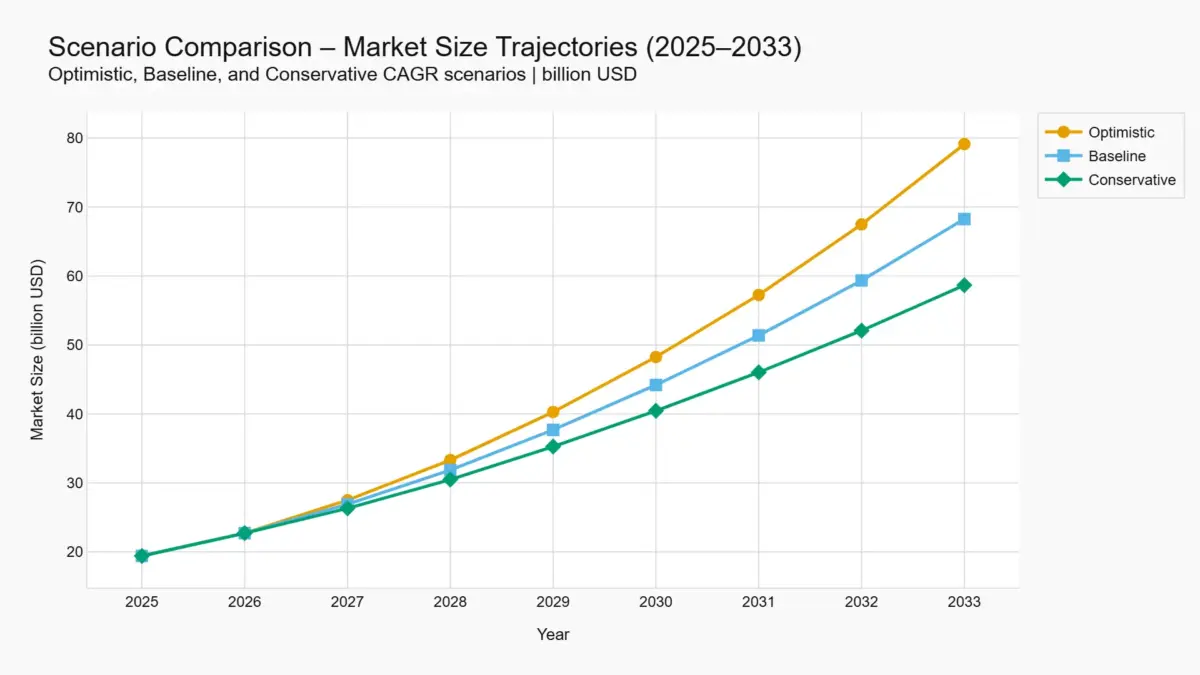
Global Battery Manufacturing Equipment Market Size and Baseline Trajectory
The global battery manufacturing equipment market covers the machines and systems used to produce lithium-ion battery cells and battery packs. It includes equipment used for electrode manufacturing, cell assembly, battery formation and testing, and module and pack assembly. The market also covers precision metal components, automation and control systems, and software when they are supplied as integral parts of battery manufacturing equipment.
The market was estimated at USD 19.41 billion in 2025 and is expected to grow to USD 68.25 billion by 2033 under the baseline scenario. This represents a 17.02% CAGR over the eight-year forecast period from 2025 to 2033.
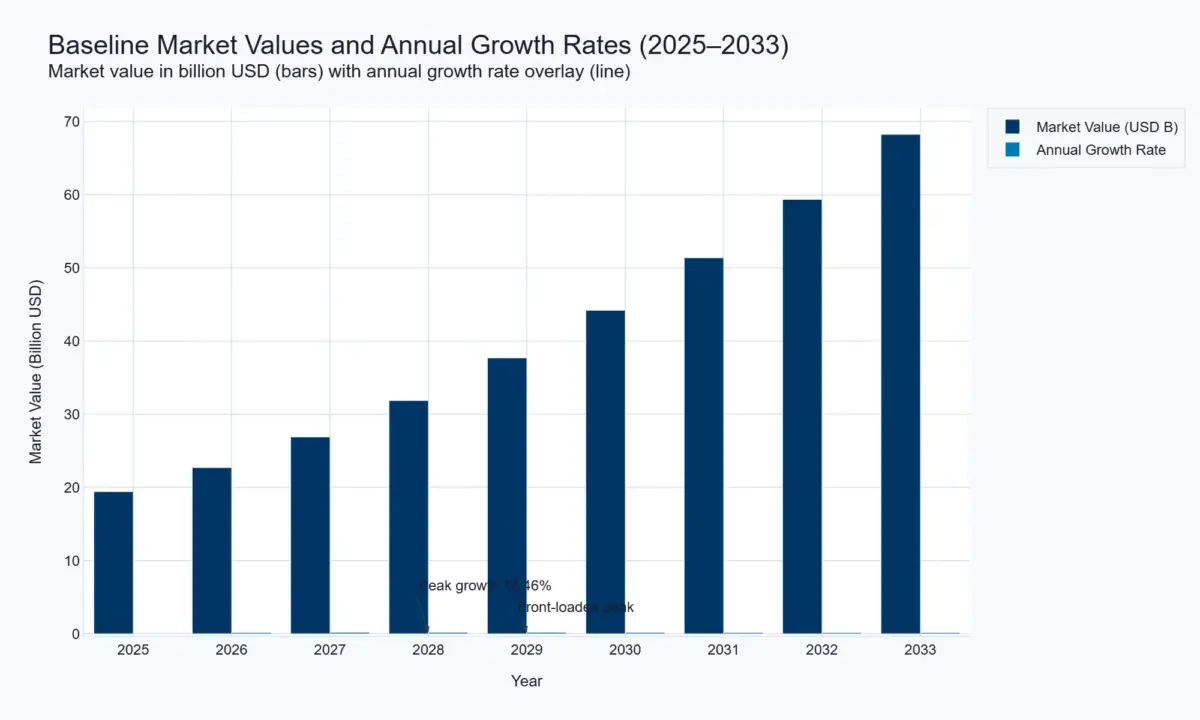
The growth trajectory is front-loaded, meaning the highest year-on-year growth rates occur in the early to middle years (2027–2029), driven by the simultaneous ramp of investment, technology adoption, and regulatory compliance. After 2030, growth moderates as risk factors accumulate and the initial capital expenditure wave passes.
Year-by-Year Global Battery Manufacturing Equipment Market Trajectory
| Year | Market Value (billion USD) | Annual Growth Rate |
| 2025 | 19.41 | — |
| 2026 | 22.71 | 17.02% |
| 2027 | 26.89 | 18.40% |
| 2028 | 31.86 | 18.46% |
| 2029 | 37.69 | 18.31% |
| 2030 | 44.20 | 17.27% |
| 2031 | 51.38 | 16.24% |
| 2032 | 59.35 | 15.52% |
|
2033 |
68.25 | 14.99% |
Key Drivers Of Global Battery Manufacturing Equipment Market Growth
Gigafactory Expansion in India – Waaree Energies
Waaree Energies is investing roughly ₹8,175 crore ($1 billion) to build a massive 16 GWh lithium-ion gigafactory in Andhra Pradesh, India. Approved in early 2026, the facility will produce battery cells, packs, and grid-scale storage—creating around 3,000 direct jobs along the way. As a brand-new project, it’s set to spur heavy demand for key manufacturing gear, including electrode, cell assembly, and testing equipment. Equipment procurement is expected to pick up significantly through 2026 and 2027.
EU Battery Regulation Compliance
The EU Battery Regulation (EU) 2023/1542 (Article 7) requires economic operators and manufacturers to issue formal carbon footprint declarations for all batteries in the EU market. To comply, production facilities must deploy specialized equipment capable of measuring energy consumption and tracing material origins.
Key highlights and metrics:
-
-
Material Due Diligence: Rules covering cobalt, lithium, nickel, and natural graphite kick in starting 18 August 2025.
-
Equipment Impact: Creates strong, compliance-led demand for advanced formation, testing, and data-management systems, despite current delays in notified body designations.
-
Signal Metrics: Evaluated as a positive signal with 0.443 confidence, verified by the Joint Research Centre of the European Commission.
-
U.S. DOE Grant Program for Battery Manufacturing
The U.S. Department of Energy, under the Infrastructure Investment and Jobs Act (IIJA) Section 40207, issued NOFO DE-FOA-0003585 making up to $500 million available for domestic battery materials processing, manufacturing, and recycling. Applications were due 24 April 2026, with awards expected in Q3 2026. The program targets a 15% increase in critical minerals production by 2030. Equipment for electrode coating, cell assembly, and recycling will be direct beneficiaries. The positive directional signal (confidence 0.471) is based on a single government source. Timing: awards in H2 2026 will begin equipment ordering in 2027–2028.
Automation Substitution by Robotics Suppliers
Industrial robotics suppliers such as ABB and KUKA offer robots specifically designed for battery cell stacking and module assembly. ABB’s IRB 4600 and IRB 6620 robots handle cell placement and laser welding, while KUKA supplies cleanroom-certified robots for all cell formats (pouch, prismatic, cylindrical). This supply-side competition represents a negative directional signal for traditional equipment OEMs, as integrated robotic systems can substitute dedicated stacking and assembly machines. The signal is negative with confidence 0.4765 and corroboration from both companies’ websites. The effect is expected to intensify through the forecast period as automation costs decline.
The confluence of regulatory mandates, public funding, and private gigafactory investments creates a broad opportunity for equipment suppliers that can offer integrated digital solutions and compliance-enabling features. The Siemens-Northvolt partnership (EUR 10 million investment in a 32 GWh Swedish gigafactory) demonstrates how automation and software portfolios can differentiate equipment offerings. Additionally, the adoption of dry electrode coating technology (Dürr X.Cellify DC, targeting 65% energy reduction) opens a new segment for capital equipment that reduces both CapEx and OpEx for cell manufacturers.
Scenario Pathways and Market Implications
The forecast is constructed under three CAGR scenarios reflecting different assumptions about the intensity and timing of investment, technology adoption, regulation, risk, and competition. All scenarios share a front-loaded growth shape triggered by early capex and technology ramp. In the optimistic scenario, strong investment and technology adoption accelerate early-year growth, with net modifiers reaching +0.1474 in 2029. The baseline scenario incorporates moderate signal offsets, with risk dampening later years (net modifier declining from +0.1404 in 2029 to +0.0281 in 2033). The conservative scenario reflects lower early-year investment and prolonged risk and competition effects, especially from automation substitution and trade barriers. Implications: Equipment OEMs should prioritize near-term capital expenditure opportunities (2026–2029) when investment and regulatory drivers are strongest. In later years, differentiation through digital solutions, compliance support, and robust supply chains will be critical. Participants exposed to Chinese equipment imports should develop alternative sourcing strategies to mitigate export control risks.Global Battery Manufacturing Equipment Market Segmentation
- 1.1 By Equipment Type
- 1.1.1 Electrode Manufacturing Equipment
- 1.1.2 Cell Assembly Equipment
- 1.1.3 Formation & Testing Equipment
- 1.1.4 Module & Pack Assembly Equipment
- 1.2 By Battery Type
- 1.2.1 Lithium-Ion Battery Manufacturing Equipment
- 1.2.2 Solid-State Battery Manufacturing Equipment
- 1.2.3 Sodium-Ion Battery Manufacturing Equipment
- 1.2.4 Other Advanced Battery Manufacturing Equipment
- 1.3 By Automation Level
- 1.3.1 Manual Equipment
- 1.3.2 Semi-Automated Equipment
- 1.3.3 Fully Automated Equipment
- 1.3.4 Digital Manufacturing Systems
- 1.4 By End User
- 1.4.1 Battery Manufacturers
- 1.4.2 Automotive OEMs
- 1.4.3 Energy Storage System Manufacturers
- 1.4.4 Research & Development Organizations
Regional Insights
- India – Waaree’s 16 GWh gigafactory in Andhra Pradesh represents a major new capacity addition, driving equipment demand from 2026 onward.
- European Union – The EU Battery Regulation (2023/1542) and IEC standards (2026) create compliance-driven demand for testing and formation equipment. The Siemens–Northvolt partnership (32 GWh Sweden) illustrates integrated digital equipment deployment.
- United States – DOE $500 million grant program and private investments (Forge Nano SPAC, EnPower assembly lines) indicate growing domestic demand, though tariff policy uncertainty has slowed project announcements.
- China – Dominates electrode slitting machine manufacturing (Naura, Wuxi Lead) but faces export control restrictions on high-density equipment.
Leading Companies in the Market
Based on the supplied competition landscape chapter, key participants include:- Naura Technology Group and Wuxi Lead Intelligent Equipment – leading manufacturers of fully automatic battery electrode slitting machines (China).
- Siemens AG– provides Digital Enterprise portfolio for gigafactory digitization; invested EUR 10 million in Northvolt’s 32 GWh facility.
- Toray Engineering, Hakusan, MTI – other global manufacturers of slitting equipment (Japan/U.S.).
- ANDRITZ– supplied a 1.5 GW formation line for a German premium automaker (operational January 2026).
- EnPower – invested in automated cell assembly lines in Indianapolis for UAV/defense (operational Q2 2026).
- Forge Nano – atomic layer deposition equipment developer; raised $40M + $97M Series D + $23M PIPE; SPAC merger valued at $1.2B.
Why Battery Manufacturing Investment Remains Critical
The global energy transition hinges on scalable battery production. The equipment market is the enabling foundation: without advanced, high-throughput manufacturing lines, cell capacity targets cannot be met. The front-loaded growth trajectory underscores that near‑term capital commitments (2025–2029) will determine market positions. Public funding (DOE), regulatory mandates (EU), and private gigafactory projects (Waaree, Northvolt) are converging to create a sustained demand cycle. Simultaneously, automation substitution and trade risks introduce competitive pressures that reward agile equipment suppliers. The market remains critical because battery manufacturing equipment directly influences the cost, quality, and security of the world’s battery supply chains.Table of Contents
1. Executive Summary
1.1 Market Snapshot (2025–2033)
1.2 Key Growth Highlights
1.3 Scenario Framework Overview
1.4 Forecast Methodology & Assumptions
1.5 Demand-Supply Overview
1.6 Analyst Viewpoint
2. Market Overview
2.1 Introduction to Global Battery Manufacturing Equipment Market
2.2 Market Definition & Scope
2.3 Industry Value Chain Analysis
2.4 Market Evolution & Historical Trends
2.5 Battery Manufacturing Equipment Ecosystem
2.6 Technology Trends, Automation & Digital Manufacturing
3. Global Battery Manufacturing Equipment Market Forecast Snapshot (USD Billion), 2025–2033
3.1 Base Year Market Size (2025)
3.2 Baseline Market Forecast (2033)
3.3 CAGR (2025–2033)
3.4 Growth Shape Analysis
3.5 Key Demand Drivers
3.6 Key Risks & Constraints
3.7 Equipment Segment Overview
3.8 Future Outlook
4. Market Forecast Scenario Analysis
4.1 Market Scope & Baseline Trajectory
4.2 Baseline Forecast Scenario
4.3 Optimistic Forecast Scenario
4.4 Conservative Forecast Scenario
4.5 Year-by-Year Market Forecast (2025–2033)
4.6 Growth Inflection Analysis (2027–2029)
4.7 Scenario Comparison & Market Implications
4.8 Forecast Methodology & Assumptions
5. Market Drivers, Restraints, Opportunities & Threats
5.1 Gigafactory Expansion Investments
5.2 EU Battery Regulation Compliance
5.3 U.S. DOE Battery Manufacturing Grant Program
5.4 Automation Substitution by Robotics Suppliers
5.5 Digital Manufacturing & Dry Electrode Technology
5.6 Geopolitical & Trade Policy Risks
6. Market Challenges
6.1 Export Control Restrictions
6.2 Trade Policy Uncertainty
6.3 Automation Competition
6.4 Supply Chain Dependencies
6.5 Capital Investment Risks
7. Market Segmentation by Equipment Type (USD Billion), 2025–2033
7.1 Electrode Manufacturing Equipment
7.1.1 Mixing Equipment
7.1.1.1 Slurry Mixing Systems
7.1.1.1.1 Cathode Slurry Mixers
7.1.1.1.2 Anode Slurry Mixers
7.1.1.1.3 Vacuum Mixing Systems
7.1.1.1.4 High-Speed Mixing Equipment
7.1.2 Coating Equipment
7.1.3 Calendering Equipment
7.1.4 Electrode Slitting Equipment
7.2 Cell Assembly Equipment
7.2.1 Electrode Stacking Equipment
7.2.2 Winding Equipment
7.2.3 Electrolyte Filling Equipment
7.2.4 Cell Sealing Equipment
7.3 Formation & Testing Equipment
7.3.1 Formation Systems
7.3.2 Aging Equipment
7.3.3 Battery Testing Systems
7.3.4 Quality Inspection Equipment
7.4 Module & Pack Assembly Equipment
7.4.1 Module Assembly Systems
7.4.2 Battery Pack Assembly Lines
7.4.3 Laser Welding Equipment
7.4.4 End-of-Line Testing Systems
8. Market Segmentation by Battery Type (USD Billion), 2025–2033
8.1 Lithium-Ion Battery Manufacturing Equipment
8.1.1 Lithium Iron Phosphate (LFP)
8.1.2 Nickel Manganese Cobalt (NMC)
8.1.3 Nickel Cobalt Aluminum (NCA)
8.1.4 Lithium Titanate (LTO)
8.2 Solid-State Battery Manufacturing Equipment
8.2.1 Sulfide-Based Battery Equipment
8.2.2 Oxide-Based Battery Equipment
8.2.3 Polymer Solid-State Equipment
8.2.4 Hybrid Solid-State Equipment
8.3 Sodium-Ion Battery Manufacturing Equipment
8.4 Other Advanced Battery Manufacturing Equipment
9. Market Segmentation by Automation Level (USD Billion), 2025–2033
9.1 Manual Equipment
9.2 Semi-Automated Equipment
9.3 Fully Automated Equipment
9.4 Digital Manufacturing Systems
10. Market Segmentation by End User (USD Billion), 2025–2033
10.1 Battery Manufacturers
10.2 Automotive OEMs
10.3 Energy Storage System Manufacturers
10.4 Research & Development Organizations
11. Regional Market Analysis
11.1 India – Gigafactory Expansion
11.2 European Union – Regulatory Driven Equipment Demand
11.3 United States – DOE Funding & Manufacturing Expansion
11.4 China – Manufacturing Leadership & Export Controls
12. Deep Market Structure & Equipment Ecosystem Analysis
12.1 Battery Manufacturing Process Flow
12.2 Equipment Value Chain Analysis
12.3 Electrode Manufacturing Equipment Ecosystem
12.4 Cell Assembly Equipment Ecosystem
12.5 Formation & Testing Equipment Ecosystem
12.6 Module & Pack Assembly Equipment Ecosystem
12.7 Precision Components, Automation & Software Integration
12.8 Industry 4.0, AI & Smart Factory Integration
12.9 Digital Manufacturing & MES Platforms
12.10 Dry Electrode Manufacturing Technology
12.11 Equipment Supply Chain & Critical Dependencies
12.12 Comparative Summary of Equipment Segmentation
13. Capacity Expansion & Investment Analysis
13.1 Global Gigafactory Pipeline
13.2 Waaree 16 GWh Gigafactory
13.3 DOE Battery Manufacturing Program
13.4 Siemens–Northvolt Partnership
13.5 Capacity Expansion Timeline (2025–2030)
13.6 Investment Impact on Equipment Demand
14. Competitive Landscape
14.1 Market Structure Analysis
14.2 Competitive Positioning Matrix
14.3 Strategic Developments
14.4 Automation & Robotics Competition
14.5 Technology Benchmarking
15. Company Profiles
15.1 Naura Technology Group
15.2 Wuxi Lead Intelligent Equipment
15.3 Siemens AG
15.4 Toray Engineering
15.5 Hakusan Corporation
15.6 MTI Corporation
15.7 ANDRITZ AG
15.8 EnPower Inc.
15.9 Forge Nano
15.10 ABB
15.11 KUKA AG
16. Strategic Intelligence & AI-Driven Insights
16.1 Pheonix Demand Forecast Engine
16.2 Battery Equipment Market Dashboard
16.3 AI-Powered Manufacturing Intelligence
16.4 Smart Factory & Automation Intelligence
16.5 Global Battery Equipment Investment Intelligence
17. Investment & Growth Opportunities
17.1 Gigafactory Equipment Investments
17.2 Digital Manufacturing Solutions
17.3 Formation & Testing Equipment
17.4 Smart Factory Automation
17.5 Dry Electrode Manufacturing Equipment
17.6 Next-Generation Battery Manufacturing Technologies
18. Why Battery Manufacturing Equipment Remains Critical
18.1 Foundation of Global Battery Production
18.2 Gigafactory Expansion Driving Equipment Demand
18.3 Automation & Digital Manufacturing Transformation
18.4 Supply Chain Localization & Equipment Innovation
18.5 Long-Term Growth Across the Battery Manufacturing Ecosystem
19. Appendix
20. About Pheonix Research
21. Disclaimer
Competitive Landscape
Global Battery Manufacturing Equipment Market Competition Landscape
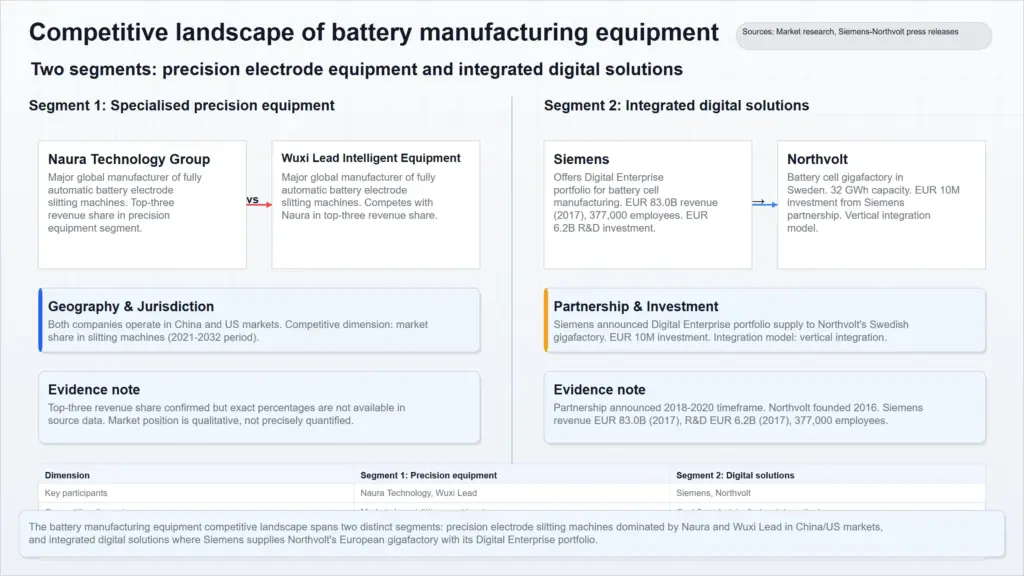
The competitive landscape for the battery manufacturing equipment market is shaped by companies supplying machinery and technology for lithium-ion battery cell and pack production. Competition is mainly focused on two areas: precision process equipment, especially fully automatic electrode slitting machines, and integrated automation and digital solutions for gigafactories. The analysis covers the global market, with particular attention to China’s electrode slitting segment and Europe’s digital integration case study.
The global battery manufacturing equipment market was estimated at approximately USD 19.41 billion in 2025 (single web estimate), creating a large and growing market for equipment suppliers. The analysis excludes equipment used for upstream materials processing, battery recycling equipment, and end-user applications beyond battery manufacturing.
Key Takeaways
- Naura Technology Group and Wuxi Lead Intelligent Equipment are among the few globally recognised manufacturers of fully automatic battery electrode slitting machines, positioning Chinese firms as critical suppliers in a precision‑centric process step.
- Siemens competes in battery equipment through its Digital Enterprise portfolio, offering end‑to‑end digitisation; its EUR 10 million investment in Northvolt’s 32 GWh gigafactory signals a partnership‑based strategy to secure reference projects.
- The market is split between specialised hardware‑focused OEMs and integrated automation/software providers, each serving different competitive dimensions (process precision vs. factory‑level digitalisation).
- China production value forecasts for electrode slitting machines (2021‑2032) are referenced in market studies, implying sustained demand growth, though the exact figures are not available in the supplied evidence.
Specialised Precision Equipment: Electrode Slitting
Fully automatic battery electrode slitting machines are an important part of lithium-ion cell manufacturing. They are used to precisely cut coated electrode foils before the cells move to the next stage of assembly. The global market includes several established manufacturers, such as Toray Engineering, Hakusan, MTI, Nagano-Automation, Maysun, Naura Technology, Ruian Loyal Machinery, Wuxi Lead Intelligent Equipment, and Wuxi Jinye Complete Equipment. Among these companies, Naura Technology Group and Wuxi Lead Intelligent Equipment are recognized as leading participants in the global market.
The report does not provide exact revenue shares, but it states that the top three vendors accounted for an unspecified share of revenue in 2025, showing that the market is somewhat concentrated. The study also provides a forecast for China Fully Automatic Battery Electrode Slitting Machine Production Value, 2021–2032 (Section 3.6.3), which indicates continued investment and capacity expansion in China. Naura and Wuxi Lead have an advantage because they are close to the world’s largest battery cell production base, helping them with logistics and production scale. However, the report does not provide exact production values or market shares, so the level of market concentration cannot be measured precisely. Toray and Hakusan from Japan and MTI from the United States are also active in the market, making it a global market with competition spread across different regions.
Integrated Digital Solutions: The Siemens‑Northvolt Partnership
In contrast to the component‑level focus of slitting machine OEMs, large industrial automation suppliers compete by offering full‑factory digitalisation. The clearest supplied example is the partnership announced in May 2018 between Siemens and Northvolt. Siemens agreed to offer its Digital Enterprise portfolio to Northvolt for the construction and operation of its lithium‑ion battery cell gigafactory in Skellefteå, Sweden. The partnership included an investment of EUR 10 million from Siemens, and after production start (the plant opened in 2020 with a planned capacity of 32 GWh), Northvolt became a preferred supplier of lithium‑ion batteries for Siemens.
The competitive logic is two‑fold. First, Siemens uses the partnership as a reference project for future battery production, demonstrating how its portfolio (software, automation, cloud computing) can digitise the entire value chain—from design and process planning to engineering and services. Jan Mrosik, then CEO of Siemens Digital Factory, stated: “With our Digital Enterprise portfolio, we contribute to a competitive battery cell production in Europe that fully exploits the benefits of software and automation: greater flexibility, efficiency and quality with shorter time to market.” Second, the supply‑side agreement (Siemens purchasing batteries) creates a closed‑loop incentive, aligning Siemens’ equipment sales with downstream offtake. Northvolt founder Peter Carlsson underscored the partnership’s strategic fit: “With its world‑class expertise within electrification, automation and digitalisation, Siemens will become an important technology partner, supplier and customer to Northvolt.” This approach contrasts with the transactional, hardware‑focused model of electrode slitting equipment suppliers.
| Dimension | Specialised equipment OEMs (e.g., Naura, Wuxi Lead) | Integrated automation suppliers (e.g., Siemens) |
|---|---|---|
| Product focus | Single‑process precision machines (electrode slitting) | End‑to‑end Digital Enterprise portfolio (software, automation, services) |
| Geographic emphasis | China (domestic production base) with global sales | Europe (reference project in Sweden) with global reach |
| Value proposition | Process‑level precision, reliability, and cost efficiency for a specific step | Factory‑level flexibility, quality, reduced time‑to‑market through full digitisation |
| Investment scale | Not disclosed for individual projects; market growth implied by China production forecasts (2021‑2032) | EUR 10 million equity investment plus long‑term battery supply commitment |
| Market structure | Multiple players; top three hold a measured but undisclosed share of revenue | Large‑scale partnerships; reference project model for client acquisition |
Value Chain
Global battery manufacturing equipment market Scope and Equipment Taxonomy
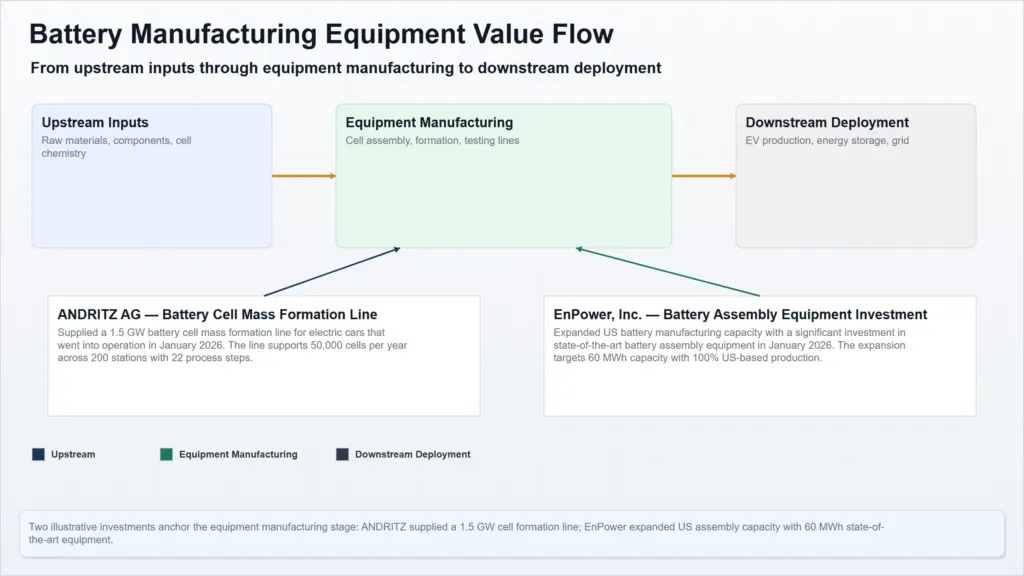
The battery manufacturing equipment market encompasses the machinery and systems used to produce lithium-ion cells and battery packs. This chapter covers four core equipment segments: electrode manufacturing, cell assembly, formation and testing, and module and pack assembly. Upstream suppliers provide industrial machinery components, precision metal parts, electrical and electronic components, automation and control systems, specialty materials (ceramics, polymers), and software and simulation tools. Downstream customers include lithium-ion battery cell producers, electric vehicle pack manufacturers, energy storage system assemblers, and consumer electronics battery lines. Supporting services such as maintenance, consulting, training, and logistics complete the ecosystem.
The total addressable market is estimated at USD 19.41 billion in 2025, based on a single web estimate. Coverage in this chapter is limited to the two investments for which evidence is available; no data was supplied for electrode manufacturing or module/pack assembly equipment, nor for regions outside Germany and the United States.
| Equipment Segment | Upstream Inputs | Downstream Applications | Recent Investment Example (from supplied evidence) |
|---|---|---|---|
| Electrode Manufacturing | Specialty materials, precision metal parts, automation/control | Li-ion cell production | No specific investment in supplied packet |
| Cell Assembly | Automation/control, precision metal parts, software | Li-ion cell production | EnPower automated assembly lines, 60 MWh, Indianapolis, Q2 2026 |
| Formation and Testing | Power electronics, electrical/electronic components, software | Li-ion cell production for EVs | ANDRITZ 1.5 GW formation line, 50,000 channels, Germany, Jan 2026 |
| Module and Pack Assembly | Automation/control, electrical components, software | EV pack, ESS | No specific investment in supplied packet |
Contrasting Investment Signals: High-Capacity Formation vs. Specialized Assembly
Two equipment expansion announcements highlight the breadth of capacity, end-use, and geography in the market. ANDRITZ’s subsidiary delivered a 1.5-gigawatt mass formation line to a battery producer in southern Germany. The line, with 50,000 channels and a throughput of 200 cells per minute, produces cylindrical booster cells for a renowned German premium automaker. The equipment features integrated power electronics, real-time data tracing, and digital solutions; ANDRITZ also provides installation, commissioning, and lifecycle support. The line entered operation in January 2026, and the company reports it is “already working intensively on follow-up orders.”
In contrast, EnPower announced an investment in advanced automated cell assembly lines at its Indianapolis headquarters. The new lines will add 60 MWh of annual assembly capacity for high-performance cells intended for the UAV and defense sectors. The equipment includes electrode processing, quality control, and end-to-end automation. EnPower emphasizes that its material sourcing is 100 % non-FEOC, ensuring a domestic supply chain. The lines are expected fully operational by Q2 2026. The company describes the investment as “a critical step in strengthening the US battery supply chain” and as addressing “urgent need for high-performance, secure, domestically sourced batteries.”
| Aspect | ANDRITZ (Germany) | EnPower (United States) |
|---|---|---|
| Capacity Scale | 1.5 GW formation line | 60 MWh annual assembly capacity |
| End-use Application | Automotive booster cells for a premium EV manufacturer | UAV and defense high-performance cells |
| Geographic Focus | Southern Germany (fully European cooperation) | Indianapolis, Indiana (100 % domestically sourced) |
| Equipment Type | Mass formation line: 50,000 channels, 200 cells/min, 22 modules, 14 racks | Automated cell assembly lines with electrode processing and quality control |
| Technology Emphasis | Digital solutions, data management, advanced power electronics, lifecycle services | End-to-end automation, non-FEOC material sourcing, quality control |
| Timeline | Operational January 2026 | Fully operational Q2 2026 |
| Customer Type | Renowned German premium automaker | US defense and UAV sector |
The two cases reveal a clear bifurcation. The ANDRITZ line targets ultra-high throughput for a premium automotive application, with digital integration and comprehensive after-sales support as competitive differentiators. The EnPower investment prioritizes supply-chain resilience, automation, and compliance with domestic sourcing rules for security-sensitive end uses. Both suppliers are positioning for follow-up orders, indicating that equipment demand is diversifying by segment and region.
Market Implications for Participants and Timing
The two announced investments point to growing demand in two distinct equipment segments: mass-production formation lines and specialised cell assembly lines. Buying factors vary by application: scale, digital capability, and lifecycle services drive decisions for high-volume automotive lines, while supply-chain security, automation, and sourcing independence dominate defense-oriented projects.
Both investments are expected to be operational in the first half of 2026, aligning with the broader scale-up of battery cell production. For equipment OEMs, the European market appears to value technology differentiation (digital solutions, power electronics) and full-lifecycle support, as exemplified by ANDRITZ’s “fully European cooperation” and its ability “to prevail over other competitors.” In North America, the emphasis on non-FEOC sourcing and domestic supply chains suggests that equipment suppliers able to offer modular, US-based assembly lines and secure material chains will have a competitive advantage.
The total addressable market of USD 19.41 billion in 2025 provides context for the scale of opportunity, but segment-level growth patterns, competitive shares, and pricing remain unsupported by the supplied evidence. Equipment OEMs should monitor the evolving requirements of automotive versus defense and UAV customers, as these segments are likely to demand increasingly differentiated equipment configurations.
Investment Activity
Investment Chapter: Battery Manufacturing Equipment Market
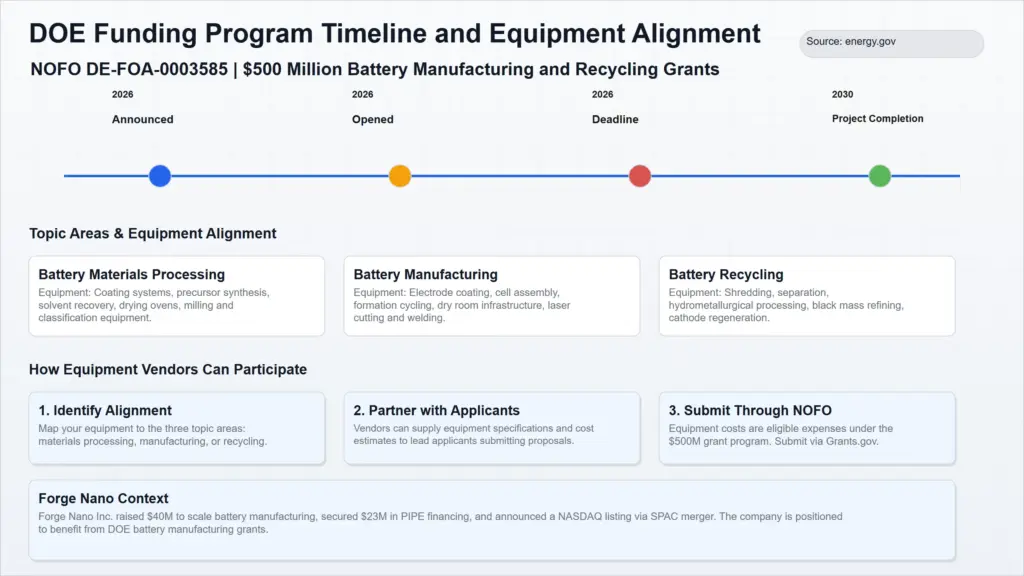
This chapter covers investment activity in battery manufacturing equipment, focusing on U.S. public and private funding during 2025–2026. The analysis is based on two main sources: a $500 million U.S. Department of Energy funding program and funding raised by Forge Nano Inc., which develops atomic layer deposition equipment. The disclosed funding includes the DOE’s $500 million commitment and Forge Nano’s $40 million funding round, $23 million PIPE, and $97 million Series D.
Key Takeaways
- The U.S. Department of Energy opened a $500 million funding opportunity for battery materials processing, manufacturing, and recycling under IIJA Section 40207. Awards are expected in Q3 2026, and the program aims to increase critical minerals production by 15% by 2030.
- Forge Nano raised $40 million in 2025 and then secured a $23 million PIPE and a $97 million Series D between 2025 and mid-2026. The company also entered into a $1.2 billion SPAC merger.
- Several strategic investors, including Samsung SDI, GM, Volkswagen, and LG Technology Ventures, have invested in Forge Nano. Their participation shows that automotive and battery companies are taking a close interest in advanced coating equipment and its role in future battery production.
- Forge Nano’s atomic layer deposition technology can be used for both semiconductor and battery applications. This gives the company exposure to more than one industry and has helped attract a broader group of investors as it moves toward a NASDAQ listing.
- Overall, the combination of government funding and private investment is supporting the development of the U.S. battery equipment supply chain. However, the available information covers only one equipment company and U.S.-based activity, so it does not provide a complete picture of investment across the global market.
Investment Landscape: Public and Private Capital Flows
Between 2025 and 2026, disclosed investments in battery manufacturing equipment include $500 million in public funding from the U.S. Department of Energy and private capital raises by Forge Nano: $40 million in 2025, a $23 million PIPE financing, and a $97 million Series D. The DOE program is the third round under the Infrastructure Investment and Jobs Act (IIJA) Section 40207, focused on domestic critical materials processing, recycling, and battery component manufacturing. Private investments are concentrated in advanced coating equipment, with Forge Nano’s atomic layer deposition technology attracting a diverse set of strategic and financial investors.
| Project / Company | Investor / Partner | Geography | Amount | Timing | Status |
|---|---|---|---|---|---|
| DOE Battery Materials Processing, Manufacturing & Recycling Grants (DE-FOA-0003585) | U.S. Department of Energy (Manufacturing Deployment Office) | United States | $500 million | Issue date March 13, 2026; applications due April 24, 2026; awards expected Q3 2026 | Open; selections anticipated Q2 2026, awards Q3 2026 |
| Forge Nano Inc. (ALD equipment for batteries and semiconductors) | Co-led by RockCreek and Ascent Funds; strategic shareholders include GM Ventures, Volkswagen, LG Technology Ventures, Hanwha, Mitsui Kinzoku, Sumitomo Corporation of Americas, Air Liquide; Samsung SDI (PIPE and Series D) | United States (Denver, Colorado) | $40 million (2025) + $23 million PIPE + $97 million Series D; SPAC merger with ~$182 million committed capital from PIPE and Series D | 2025–2026; SPAC merger announced April 2026, expected close H2 2026 | Closed funding rounds; merger pending NASDAQ listing |
The DOE program targets demonstration and commercial facilities to increase critical minerals production by up to 15% by 2030. Private investment is driven by the need for advanced manufacturing technology, with Forge Nano’s ALD equipment used in both semiconductor fabs and battery electrode coating. Strategic investments from automakers and battery manufacturers signal a push to secure access to key production equipment.
Private Capital Case Study: Forge Nano’s Funding Trajectory
Forge Nano, a U.S.-based developer of atomic layer deposition (ALD) equipment for semiconductor and battery manufacturing, has raised $40 million in 2025, a $23 million PIPE, and closed its Series D at $97 million. The company’s funding trajectory illustrates the convergence of public policy goals, strategic corporate interests, and financial market appetite for equipment technology.
- April 2025: $40 million funding round co-led by RockCreek and Ascent Funds. Total capital investment exceeded $140 million. Strategic shareholders include GM Ventures, Volkswagen, LG Technology Ventures, Hanwha, Mitsui Kinzoku, Sumitomo Corporation of Americas, and Air Liquide.
- July 2026: Additional $23 million PIPE financing at $10.00 per share, increasing total PIPE commitments to $123 million. Samsung SDI committed $20 million, split between $10 million in PIPE and $10 million in Series D. Series D closed at $97 million, rounding out pre-IPO capital formation.
- April 2026: Definitive business combination agreement with Archimedes Tech SPAC Partners II Co. valued at $1.2 billion. Committed capital from PIPE and Series D totals approximately $182 million. Transaction expected to close in H2 2026, with listing on NASDAQ under ticker NANO.
The participation of Samsung SDI, GM, Volkswagen, and LG as investors signals that battery and automotive manufacturers view advanced coating equipment as critical to their production strategies. Forge Nano’s dual-use technology for both AI-era semiconductor chips and defense batteries broadens its addressable market and investor base. The SPAC merger provides access to additional public capital for scaling manufacturing capacity.
Public Sector Catalysts: DOE’s $500 Million Program
The U.S. Department of Energy, through its Office of Critical Minerals and Energy Innovation, issued Notice of Funding Opportunity DE-FOA-0003585 on March 13, 2026, making up to $500 million available for projects that develop domestic facilities for battery materials processing, manufacturing, and recycling. This is the third round of funding under the IIJA Section 40207 program.
The program is organized into three topic areas:
-
- Domestic Critical Minerals Processing from Raw Feedstocks
- Domestic Critical Materials Recycling
- Domestic Battery Materials and Component Manufacturing
Key dates include an application deadline of April 24, 2026, at 5:00 PM ET, with selections anticipated in Q2 2026 and awards in Q3 2026. The program’s goal is to strengthen domestic manufacturing and increase critical minerals production by up to 15% by 2030. Equipment vendors in battery materials processing, electrode coating, and recycling are likely beneficiaries, though the NOFO does not specify equipment categories. The Manufacturing Deployment Office (MDO) within the Office of Critical Minerals and Energy Innovation administers the opportunity.
Technology & Innovation
Technology Landscape in Battery Manufacturing Equipment
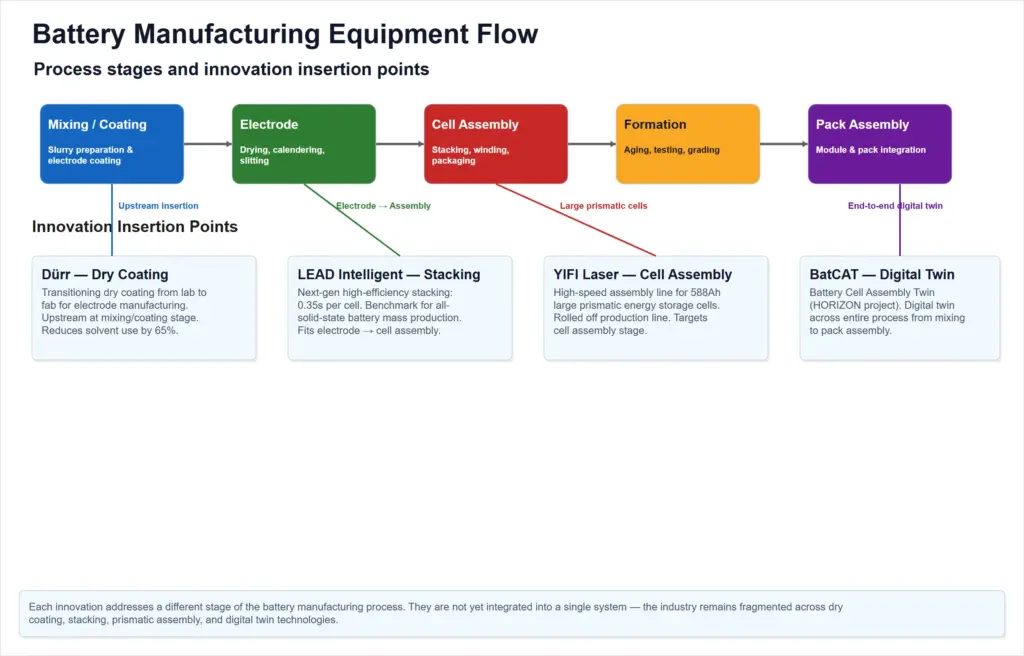
This chapter covers equipment technologies for electrode manufacturing, cell assembly, formation and testing, and module/pack assembly. Supporting services such as maintenance, consulting, training, facilities, and supply chain are excluded. Recent innovations are advancing production efficiency through digital twins, high‑speed prismatic assembly, all‑solid‑state stacking, and dry electrode coating. Their collective impact, however, depends on integration into production lines and the timing of scale‑up.
Digital Twins and Process Optimisation
The European Union-funded BatCAT project (Battery Cell Assembly Twin) is developing a digital twin that combines data-driven and physics-based methods to improve battery manufacturing. The project focuses on three main challenges: battery cell design, production operations, and trust in manufacturing data. BatCAT is creating a cross-chemistry data space covering lithium-ion, sodium-ion coin cells, and redox flow batteries, with the aim of improving product quality and process efficiency.
The digital twin is designed to provide real-time data analysis and support decision-making in Industry 5.0 manufacturing environments. The project is aligned with the BATTERY 2030+ roadmap and is expected to deliver its outcomes by 2030. For equipment OEMs, cell manufacturers, and system integrators, the project points toward greater use of digital twins in battery production. However, BatCAT is still at the prototype stage and does not yet have a confirmed commercial deployment timeline.
Comparison of Key Innovation Metrics
Three of the four innovations have clear quantitative performance measures, while BatCAT does not provide a single numerical performance metric because it is focused mainly on digital-twin development. YIFI Laser reports a throughput of 20 PPM, LEAD Intelligent Equipment reports a cycle time of 0.35 seconds per cell along with a 50% increase in speed and a 30% improvement in yield, while Dürr reports a 65% reduction in energy consumption.
The comparison therefore highlights different areas of improvement across the technologies: YIFI Laser focuses on production throughput, LEAD Intelligent on cycle time, speed, and yield, and Dürr on energy efficiency. BatCAT’s contribution is more qualitative at this stage, with its main focus on real-time data, cross-chemistry modelling, and digital decision support rather than a measured production improvement.
High‑Speed Assembly for Large‑Format Cells
All‑Solid‑State Battery Manufacturing
LEAD Intelligent unveiled a next‑generation high‑efficiency stacking solution for all‑solid‑state batteries, achieving 0.35 seconds per cell. The solution addresses the long‑standing challenge of simultaneously achieving precision, yield, and efficiency in the stacking and cutting‑stacking processes of solid‑state cells. LEAD claims a 50 % increase in stacking speed and a 30 % yield improvement compared to prior methods. The technology bridges the gap between laboratory‑scale processes and industrial mass‑production equipment. It was presented at the 10th Qidian Lithium‑ion Battery Industry Annual Conference in January 2026. This innovation de‑risks the timeline for all‑solid‑state mass production, as equipment buyers can now expect production‑ready stacking solutions that deliver the speed and yield needed for commercial viability.
Dry Electrode Coating: Lab to Fab Transition
Dürr’s X.Cellify DC dry coating technology transitions electrode manufacturing from wet‑based slurry processing to a dry‑film approach. In conventional wet coating, active material is dispersed in a solvent, applied to metal foil, dried in long ovens, and the solvent is often recovered—requiring large dryers, solvent handling, and significant energy. Dry coating removes these steps by forming a free‑standing film of active material through dosing and calendering, then laminating the film to both sides of the current collector. Dr. Stefan Doose presented this technology at the Battery Show Europe. Dürr states that dry coating reduces energy consumption by 65 % and directly lowers both CapEx and OpEx while shrinking factory footprint. The technology is moving from lab to fab; customers are evaluating pilots, but mass‑production readiness is not yet claimed.
Technology Comparison
| Technology / Innovation | Participant | Metric | Period | Application | Implication |
|---|---|---|---|---|---|
| Digital twin for cell assembly | BatCAT (HORIZON) | No single metric supplied; aligns with BATTERY 2030+; cross‑chemistry data space | Project until 2030 | Li‑ion, Na‑ion coin cells, redox‑flow batteries | Emerging prototype; integration into production lines will require industry‑wide standards |
| High‑speed prismatic assembly line | YIFI Laser | 20 PPM | Commercial (rolled off 2026) | Large‑format energy‑storage cells (187‑588 Ah) | Reduces per‑cell cost and factory footprint; enables rapid ESS capacity expansion |
| All‑solid‑state stacking solution | LEAD Intelligent | 0.35 s/cell; 50 % speed increase; 30 % yield improvement | Commercial (unveiled Jan 2026) | All‑solid‑state batteries | De‑risks mass production; equipment buyers now have a benchmark for solid‑state stacking |
| Dry electrode coating | Dürr (X.Cellify DC) | 65 % energy reduction | Lab‑to‑fab transition (presented 2026) | Electrode manufacturing | Lower CapEx/OpEx; eliminates solvent handling; factory footprint shrinks |
Implications for Industry
Each innovation—digital twin, high‑speed prismatic assembly, solid‑state stacking, and dry coating—addresses a distinct manufacturing bottleneck. BatCAT’s digital twin is a prototype that, if commercialised, could optimise the entire cell assembly process. YIFI’s 20 PPM line and LEAD’s 0.35 s/cell stacking are already commercial and can be procured today, though they target different cell formats and chemistries. Dürr’s dry coating is still in the pilot phase but offers a step change in upstream energy and space efficiency. Equipment buyers must assess their own chemistry roadmaps and scale targets before prioritising investments. The lack of a single integrated solution means that factories will likely combine best‑in‑class equipment from multiple suppliers, making interoperability and standardisation critical for future efficiency gains.
Market Risk
Risk : Battery Manufacturing Equipment Market
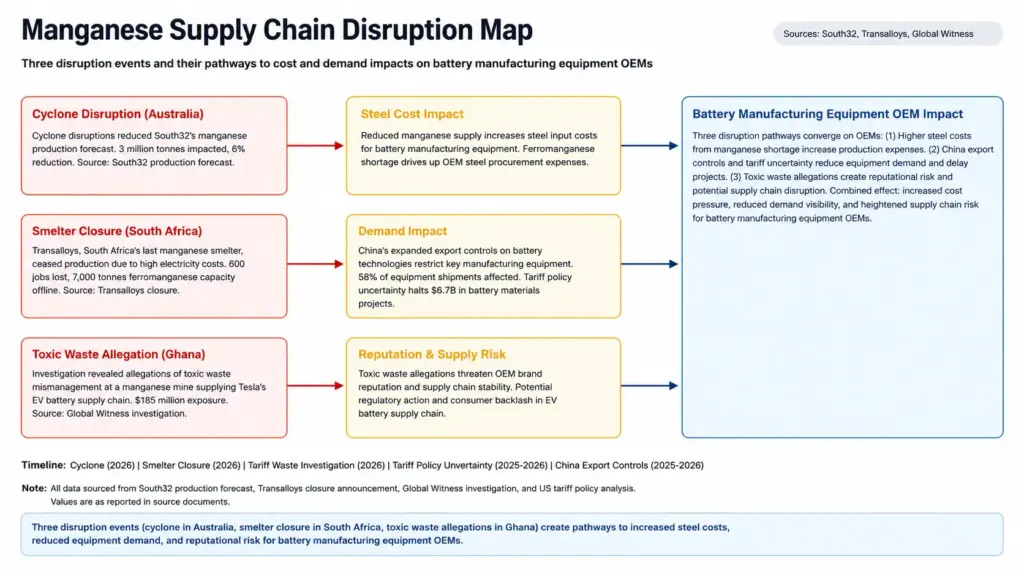
- Cyclone disruptions in Australia and closure of South Africa’s last manganese smelter tighten global manganese supply, potentially raising steel Toxic‑waste allegations at a Ghanaian manganese mine supplying Tesla’s EV chain introduce reputational and regulatory risk, potentially triggering stricter ESG audits and shifting supply sourcing, affecting equipment OEMs’ customer base.
- US tariff policy uncertainty has stalled battery materials projects: new US project announcements dropped from 19 in H1 2023 (US$6.7 billion
- China’s export controls on battery manufacturing equipment (effective 8 November 2025) restrict shipments of key machinery to non‑Chinese cell producers, disrupting supply chains and forcing alternative sourcing that may raise costs and extend lead times for equipment OEMs.
Raw Material Supply Risks: Manganese Constraints
Cyclone disruption in Australia reduces South32’s manganese output
Tropical Cyclone Narelle disrupted operations at South32’s Gemco mine in the Northern Territory during March 2026. The company reduced its fiscal 2026 production guidance for Australia manganese to 3 million wet metric tons (wmt), down more than 6% from the previous forecast. Third‑quarter output was 589,000 wmt, up from zero in the same period a year earlier. The cyclone cut into a critical manganese supply region, and the lower output tightens global availability of the metal. Manganese is essential for high‑strength steel used in battery manufacturing equipment and for certain battery cathodes. The mechanism runs from mine disruption → reduced manganese supply → higher input costs for steel‑based equipment components → potential margin pressure for equipment OEMs, and uncertainty for cell producers that depend on manganese‑rich cathode chemistries.
South Africa’s last manganese smelter ceases production
Transalloys, the last manganese smelter in South Africa, ceased production in July 2026 after years of mounting financial losses driven by high electricity costs and the slow pace of tariff relief. The facility in Mpumalanga put about 600 direct jobs and 7,000 downstream roles at risk, with a R6 billion investment under threat. Transalloys’ closure removes a major regional source of ferromanganese, an input for steelmaking and precision metal parts used in battery manufacturing equipment. The mechanism: reduced ferromanganese supply → higher prices for specialty steels and fabricated components → increased procurement costs for equipment OEMs and their component suppliers.
Toxic‑waste allegations at Ghanaian manganese mine supplying Tesla’s chain
An investigation by Global Witness in 2025–2026 revealed that waste from a giant manganese mine in Ghana—a key supplier to the EV supply chain, including Tesla—is creating toxic conditions for local communities. Interviews with more than 150 residents documented chronic health problems (skin, eye, breathing conditions) and poisoned water supplies. A 2022 water study found the mine pit water highly concentrated in arsenic and other toxic metals; the authors warned of risks of cancer, stillbirths, and even DNA alterations. Ghana is the world’s fourth‑largest manganese producer, and China processes more than 90% of global manganese products. The allegations create reputational and regulatory risk: cell producers and their equipment vendors may face pressure to tighten ESG audits, alter sourcing, or redesign supply chains to avoid material from disputed mines. For equipment OEMs, a shift away from Ghanaian or Chinese‑processed manganese could alter demand patterns for certain battery‑grade materials and, by extension, the equipment that processes them.
| Risk | Mechanism | Exposed participant / geography | Timing | Supported consequence |
|---|---|---|---|---|
| Cyclone reduces Australian manganese output | Lower mine production tightens global supply → higher steel input costs for equipment; uncertainty for manganese‑rich cathode users | Battery equipment OEMs (via steel costs); cell producers using high‑manganese chemistries; Australia, global | 2026 (forecast cut; disruption in March 2026) | South32 fiscal 2026 guidance: 3 M wmt, down >6% from prior forecast |
| South Africa smelter closure | Loss of last domestic ferromanganese source → tighter regional metal supply → higher specialty‑steel costs for equipment fabrication | Equipment OEMs sourcing steel components; South Africa, global | 2026 (closure July 2026) | Transalloys ceased production; 600 direct, 7,000 downstream jobs at risk; R6 bn investment at stake |
| Toxic‑waste allegations at Ghana mine | Reputational and regulatory pressure → potential ESG‑driven supply redirection → altered demand for battery‑grade manganese and processing equipment | Tesla’s supply chain; Ghana manganese export flows; China (processor of >90% of global manganese products); equipment OEMs reliant on those flows | 2025–2026 (investigation published, health effects documented) | More than 150 affected people; mine pit water with arsenic; calls for action not yet implemented |
Trade Policy and Export Control Risks
US tariff policy stalls battery materials project investment
After the Trump administration’s tariff policy shift, new US battery component or mineral extraction projects dropped sharply. In the first six months of 2023, companies announced 19 projects representing US$6.7 billion in planned investment. Since the policy change, only three new US projects have been announced. Specific examples: Group14 delayed its silicon anode facility in Washington until tariff clarity improves; Aspen Aerogels canceled a Georgia facility that was conditionally approved for a US$670 million Department of Energy loan; Eos Energy’s US$306 million loan closed in December 2025 but is now under review by the loan office. For battery manufacturing equipment OEMs, the mechanism is clear: fewer and smaller battery materials projects → reduced demand for cell‑production equipment → lower orders and revenue for OEMs. The pipeline stall is concentrated in the US, but the effect ripples globally as projects that would have procured equipment from American, European, or Asian OEMs are delayed or cancelled.
China’s expanded export controls restrict battery manufacturing equipment
On 9 October 2025, China’s Ministry of Commerce and General Administration of Customs jointly issued Decision No. 58 of 2025, effective 8 November 2025. This adds \”equipment for the manufacturing of rechargeable and dischargeable lithium‑ion batteries\” (including cells and packs with energy density ≥300 Wh/kg) to the List of Dual‑Use Items, an export‑controlled category. Shipments of such equipment now require an export license from Chinese authorities. The decision also controls battery technology and high‑density lithium‑ion cells themselves. China is the dominant producer of battery‑manufacturing machinery; these controls restrict the supply of critical equipment to non‑Chinese cell manufacturers. For equipment OEMs outside China, the mechanism includes two pathways: (1) OEMs that rely on Chinese‑made components face supply disruptions, higher costs, or longer lead times as they seek alternative sourcing; (2) OEMs based in China may gain a competitive advantage by controlling access to restricted machinery, while non‑Chinese OEMs could lose market share if their customers cannot obtain the controlled equipment. The timing (effective late 2025) means the impact will become visible in equipment order books and delivery schedules in 2026.
Regulatory Landscape
Scope of this Chapter
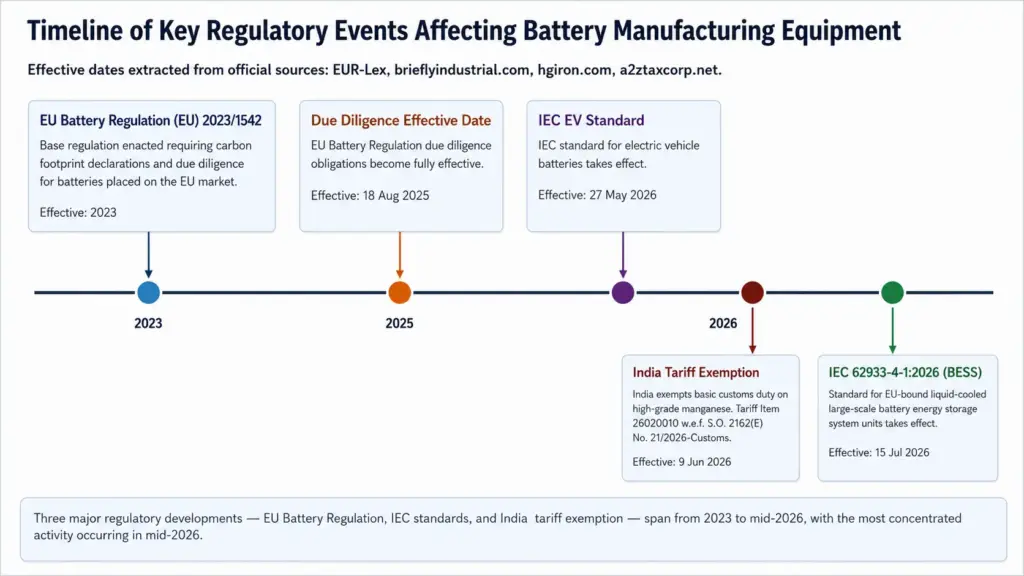
Regulatory developments in the European Union, international standards bodies, and India are redefining market entry requirements and cost structures for battery manufacturing equipment. Exporters, certification bodies, and downstream battery and pack manufacturers must calibrate compliance strategies and capital outlays to three distinct but simultaneous changes: binding sustainability and due diligence obligations in the EU, new harmonised safety standards from the International Electrotechnical Commission (IEC), and a tariff exemption on a critical raw material input in India.
EU and international standards reshaping market access
EU Battery Regulation (EU) 2023/1542
Regulation (EU) 2023/1542, as amended by (EU) 2025/1561, imposes battery due diligence obligations on economic operators that place batteries on the EU market or put them into service. These obligations cover the sourcing, processing and trading of cobalt, natural graphite, lithium and nickel. They include requirements for third‑party verification by notified bodies and for disclosure of information on supply chain risk management. The due diligence obligations are to be applied from 18 August 2025. The regulation also defines ‘carbon footprint’ as the sum of greenhouse gas emissions and removals expressed as CO₂ equivalents, based on a Product Environmental Footprint study, and mandates carbon footprint declarations for batteries placed on the market. However, the designation of notified bodies is taking longer than expected, and due diligence schemes addressing battery raw materials still need further development and implementation. This creates uncertainty about enforcement readiness during the initial compliance period.
For battery manufacturing equipment exporters, the regulation directly affects market entry: equipment used to produce batteries destined for the EU must support the collection of data required for carbon footprint declarations and due diligence reporting. Downstream battery cell and pack manufacturers will require equipment that enables traceability of material origin and energy consumption. Certification bodies and technical consulting services face additional demand for verifying compliance.
IEC 62933-4-1:2026 – BESS safety standard
On 15 July 2026, the IEC formally published and made mandatory IEC 62933-4-1:2026, replacing IEC 62933‑4:2022. The new standard applies to all liquid‑cooled large‑scale BESS units shipped to the EU. It requires grid‑forming capability and third‑party certification, and adds dynamic test requirements covering real‑time inertial response, black‑start support, and low‑voltage ride‑through (LVRT). The rule change directly affects BESS market access, type‑testing cycles, and the validity of CE declarations of conformity. Manufacturers and export‑oriented suppliers will feel the impact at the product qualification stage, where technical specifications, compliance files and certification readiness must be updated.
IEC 62660-3:2026 – EV battery safety harmonisation
Published on 27 May 2026, IEC 62660-3:2026 harmonises safety test requirements for secondary lithium‑ion traction batteries used in electric road vehicles. The standard integrates testing protocols previously divergent across GB/T (China), UN GTR 20 (EU), JIS C 8714 (Japan) and KS C IEC 62660-3 (South Korea). Adoption reduces the average type‑approval duration for battery systems exported to the EU, South Korea and Southeast Asia from 12 weeks to 7 weeks – a 40 % reduction. For battery manufacturing equipment, this means that equipment producing cells or packs for export to multiple markets can be designed to a single set of safety parameters, reducing certification logistics and time‑to‑market. However, the standard imposes new testing requirements that may necessitate equipment modifications or additional test fixtures.
| Jurisdiction | Rule / standard | Requirement | Effective date | Affected participant |
|---|---|---|---|---|
| European Union | EU Battery Regulation (EU) 2023/1542, as amended by (EU) 2025/1561 | Carbon footprint declarations; battery due diligence on cobalt, lithium, nickel, natural graphite sourcing; third‑party verification by notified bodies | Due diligence obligations from 18 August 2025 (notified body designation delayed) | Battery manufacturing equipment exporters, economic operators, notified bodies |
| International (EU market specific) | IEC 62933-4-1:2026 | Grid‑forming capability, third‑party certification, dynamic tests (inertial response, black‑start, LVRT) for liquid‑cooled large‑scale BESS | 15 July 2026 | BESS equipment manufacturers, exporters to EU, certification bodies |
| International (global) | IEC 62660-3:2026 | Harmonised safety tests for EV traction batteries; single‑test acceptance across GB/T, UN GTR 20, JIS C 8714, KS C IEC 62660-3 | 27 May 2026 | EV battery cell and pack manufacturers, equipment exporters, certification bodies |
| India | Notification No. 21/2026-Customs (Government of India Ministry of Finance) | Exemption of basic customs duty (0%) on high‑grade manganese ore under Tariff Item 26020010 | 9 June 2026 | Domestic battery equipment manufacturers (via reduced input costs) |
India’s tariff exemption: lowering input costs for domestic equipment manufacturing
On 9 June 2026, the Government of India Ministry of Finance, Department of Revenue, issued Notification No. 21/2026-Customs under the Customs Act, 1962, amending the principal notification No. 62/2022-Customs. The amendment inserts entry 825A into Table I, fixing the basic customs duty rate at 0.0% for all imports of high‑grade manganese ore falling under Tariff Item 26020010. Previously, such imports attracted positive basic customs duty rates.
High‑grade manganese ore is a critical raw material used in the production of cathode materials for certain lithium‑ion battery chemistries and in steelmaking for battery manufacturing equipment components. By eliminating the basic customs duty, the Indian government aims to stabilise raw material costs for domestic industry, including manufacturers of battery cells, packs, and the machinery used to produce them. The cost reduction passes through to battery manufacturing equipment producers indirectly, as lower input costs for cathode precursors may reduce overall production costs for battery cells, potentially increasing domestic demand for production equipment. Importers of high‑grade manganese ore can now bring in the material duty‑free, improving the competitiveness of downstream battery component manufacturing in India.
This tariff change is a national level measure. It does not directly alter equipment trade barriers, but by improving the cost position of domestic battery material and cell producers, it may shift investment decisions and equipment procurement patterns. Equipment suppliers serving the Indian market may see increased orders from domestic cell manufacturers benefiting from lower material costs.
The chapter covers the three regulatory developments that directly affect battery manufacturing equipment: EU binding regulation on battery sustainability and due diligence, IEC safety standards for BESS and EV batteries that harmonise certification, and India’s customs duty exemption on a critical raw material. Excluded are battery chemistry‑specific rules, end‑of‑life regulations only, other regional trade policies, and non‑binding guidelines. No single framework spans all markets; exporters face a fragmented landscape requiring multi‑jurisdictional compliance strategies. Enforcement details and industry response data are not available in the available documentation.