
Global Digital Human Market Report, Size & Forecast 2026-2033
Global Digital Human Market Forecast Snapshot (2026???2033)
| Metric | Value |
|---|---|
| Market Size (2025) | ?? ?? ?? ?? ?? ?? ?? ?? ?? ?? ?? ?? ?? ?? ?? ?? ?? ?? ?? ?? ?? ?? ?? ?? ?? ?? ?? ?? ?? ?? ?? ?? ?? ?? ?? ?? USD 31.80 Billion |
| Market Size (2033) | ?? ?? ?? ?? ?? ?? ?? ?? ?? ?? ?? ?? ?? ?? ?? ?? ?? ?? ?? ?? ?? ?? ?? ?? ?? ?? ?? ?? ?? ?? ?? ?? ?? ?? ?? ?? USD 168.40 Billion |
| CAGR (2026???2033) | ?? ?? ?? ?? ?? ?? ?? ?? ?? ?? ?? ?? ?? ?? ?? ?? ?? ?? ?? ?? ?? ?? ?? ?? ?? ?? ?? ?? ?? ?? ?? ?? ?? ?? ?? ?? ?? ?? ?? ?? ??23.20% |
| Largest Segment | ?? ?? ?? ?? ?? ?? ?? ?? ?? ?? ?? ?? ?? ?? ?? ?? ?? ?? ?? ?? ?? ?? ?? ?? ?? ?? ?? ?? ?? ?? ?? ?? ??AI-Powered Virtual Assistants |
| Fastest Growing Segment | ?? ?? ?? ?? ?? ?? ?? ?? ?? ?? ?? ?? ?? ?? ?? ?? ?? ?? ?? ?? ?? ?? ?? ?? ??Digital Human Customer Service Solutions |
| Leading End-Use Segment | ?? ?? ?? ?? ?? ?? ?? ?? ?? ?? ?? ?? ?? ?? ?? ?? ?? ?? ?? ?? ?? ?? ?? ?? ?? ?? ?? ?? ?? ?? ?? ?? ?? Retail & E-Commerce |
| Key Trend | ?? ?? ?? ?? ?? Generative AI Integration, Hyper-Realistic Avatars & Conversational Digital Humans |
| Regulatory Influence | AI Governance Frameworks, Data Privacy Regulations & Digital Identity Compliance Standards |
| Future Outlook | Growth Driven by Human-AI Interaction, Enterprise Automation & Immersive Digital Experiences |
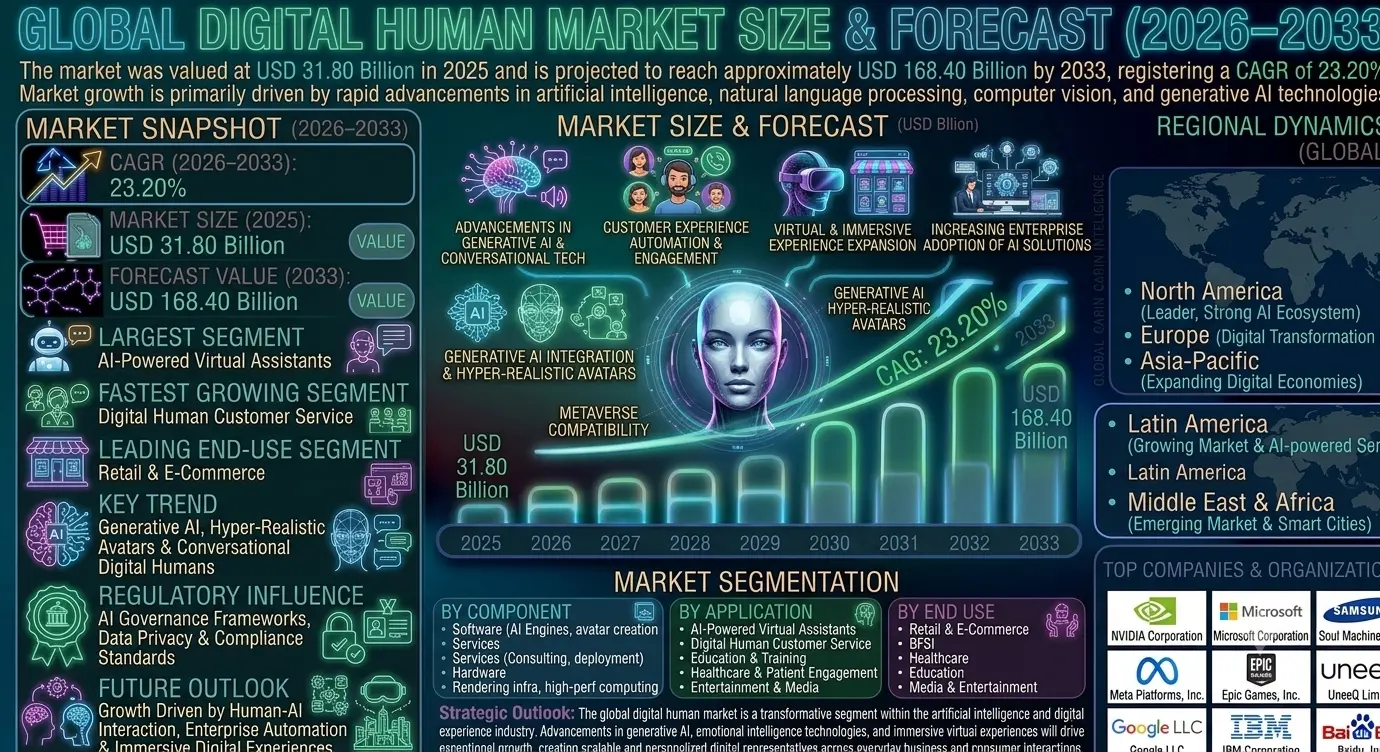
Global Digital Human Market Size & Forecast
The Global Digital Human Market is expected to witness exceptional growth during the forecast period from 2026 to 2033. The market was valued at USD 31.80 billion in 2025 and is projected to reach approximately USD 168.40 billion by 2033, registering a CAGR of 23.20%. Market growth is primarily driven by rapid advancements in artificial intelligence, natural language processing, computer vision, and generative AI technologies. Organizations across industries are increasingly deploying digital humans to enhance customer engagement, automate services, improve user experiences, and support virtual interactions across digital platforms.Global Digital Human Market Overview
Digital humans are AI-powered virtual representations designed to simulate human appearance, behavior, communication, and emotional interaction. These solutions combine artificial intelligence, 3D rendering, speech synthesis, machine learning, and conversational AI technologies to create realistic virtual personalities capable of interacting with users. Digital humans are increasingly used across customer service, healthcare, education, banking, retail, entertainment, and enterprise communication applications. The market is evolving rapidly with advancements in generative AI, metaverse technologies, and immersive digital experiences.Structural Drivers of Market Growth
1. Advancements in Generative AI and Conversational Technologies
Breakthroughs in large language models, speech synthesis, and emotional AI are significantly enhancing the realism and capabilities of digital humans. Market Implications: Organizations are increasingly adopting digital humans to deliver personalized and scalable customer interactions.2. Growing Demand for Customer Experience Automation
Businesses are seeking innovative ways to improve customer engagement while reducing operational costs through intelligent virtual representatives. Market Implications: Digital human solutions are becoming key tools for customer service transformation and engagement optimization.3. Expansion of Virtual and Immersive Experiences
The rise of virtual environments, digital commerce, and immersive experiences is creating new opportunities for human-like AI interfaces. Market Implications: Digital humans are increasingly being integrated into virtual stores, digital workplaces, and metaverse applications.4. Increasing Enterprise Adoption of AI Solutions
Organizations across multiple industries are integrating AI-powered assistants to improve productivity, communication, and service delivery. Market Implications: Enterprise demand is accelerating the commercialization of advanced digital human platforms.Market Segmentation Analysis
By Component
- Software Largest segment including AI engines, avatar creation platforms, speech synthesis systems, and conversational AI technologies.
- Services Includes consulting, deployment, customization, integration, maintenance, and support services.
- Hardware Supports rendering infrastructure, high-performance computing, and immersive display systems.
By Application
- AI-Powered Virtual Assistants Largest segment driven by widespread deployment across customer support, information services, and enterprise applications.
- Digital Human Customer Service Solutions Fastest-growing segment due to increasing demand for personalized customer engagement and service automation.
- Education & Training Used for virtual tutoring, learning assistance, and simulation-based training programs.
- Healthcare & Patient Engagement Supports patient communication, healthcare guidance, and virtual care interactions.
- Entertainment & Media Includes virtual influencers, digital presenters, gaming characters, and content creation applications.
By End Use
- Retail & E-Commerce Largest segment utilizing digital humans for customer assistance, product recommendations, and virtual shopping experiences.
- BFSI Uses digital humans for customer onboarding, financial guidance, and virtual banking services.
- Healthcare Growing adoption for patient support, telehealth interactions, and healthcare information delivery.
- Education Leverages digital humans for personalized learning and educational engagement.
- Media & Entertainment Uses digital humans for content production, virtual influencers, and audience engagement initiatives.
Regional Market Dynamics
North America
Leading region due to strong AI innovation ecosystems, high enterprise technology adoption, and significant investments in digital human development.Europe
Driven by increasing AI adoption, digital transformation initiatives, and growing demand for customer engagement technologies.Asia-Pacific
Fastest-growing region supported by expanding digital economies, widespread AI adoption, and strong investments in virtual technologies.Latin America
Growing market driven by digital transformation initiatives and increasing adoption of AI-powered customer service solutions.Middle East & Africa
Emerging market supported by smart city projects, digital government initiatives, and investments in advanced technology infrastructure.Competitive Landscape
The Global Digital Human Market is highly competitive with the presence of AI technology providers, software developers, cloud computing companies, and digital experience platforms. Market participants focus on innovation, realism, conversational capabilities, and enterprise integration features to strengthen their competitive positions. Key Companies Operating in the Market Include:- NVIDIA Corporation
- Microsoft Corporation
- Soul Machines Ltd.
- Samsung Electronics Co., Ltd.
- Meta Platforms, Inc.
- Epic Games, Inc.
- UneeQ Limited
- Google LLC
- IBM Corporation
- Baidu, Inc.
Strategic Outlook
The future of the digital human market will be shaped by advancements in generative AI, emotional intelligence technologies, and immersive virtual experiences. Organizations are expected to increasingly deploy digital humans as front-line representatives for customer engagement, sales support, training, healthcare assistance, and enterprise communication. Improvements in natural language understanding, facial animation, voice synthesis, and contextual intelligence will continue enhancing realism and user acceptance. The integration of digital humans into virtual environments, smart devices, and metaverse ecosystems is expected to create substantial new growth opportunities. Businesses that invest in scalable AI architectures, ethical AI frameworks, and personalized digital experiences will be well-positioned to capture emerging market demand.Final Market Perspective
The Global Digital Human Market is emerging as a transformative segment within the artificial intelligence and digital experience industry. Rising demand for human-like digital interactions, enterprise automation, and immersive customer experiences is driving significant market expansion. As AI technologies continue to advance, digital humans are expected to become increasingly integrated into everyday business operations and consumer interactions. Organizations that leverage innovative digital human solutions will be well-positioned to gain competitive advantages and capitalize on long-term growth opportunities across the global digital economy.Table of Contents
Table of Contents
- Executive Summary
- Global Digital Human Market Snapshot (2026???2033)
- Market Size & Growth Overview
- Key Market Highlights
- Largest & Fastest-Growing Segments
- Leading End-Use Segment Overview
- Key Market Trends & AI-Driven Human Interaction Evolution
- Strategic Outlook Through 2033
- Market Introduction & Overview
- Definition of Digital Humans
- Scope of the Global Digital Human Market
- Evolution of AI-Powered Virtual Humans
- Role of Digital Humans in Customer Engagement & Enterprise Automation
- Value Chain Analysis of the Digital Human Ecosystem
- Regulatory Influence (AI Governance Frameworks, Data Privacy Regulations & Digital Identity Compliance Standards)
- Transition Toward Generative AI-Powered and Hyper-Realistic Digital Human Platforms
- Research Methodology
- Primary Research Approach
- Secondary Research Sources
- Market Size Estimation Methodology
- Forecasting Assumptions (2026???2033)
- Data Validation & Triangulation Process
- Market Dynamics
- Structural Drivers of Market Growth
- Advancements in Generative AI and Conversational Technologies
- Growing Demand for Customer Experience Automation
- Expansion of Virtual and Immersive Experiences
- Increasing Enterprise Adoption of AI Solutions
- Market Restraints
- High Development and Deployment Costs
- Data Privacy and Ethical AI Concerns
- Complexity of Realistic Human Simulation
- Market Opportunities
- Expansion of Metaverse and Virtual Commerce Platforms
- Growing Adoption in Healthcare and Education
- Development of Emotionally Intelligent AI Systems
- Enterprise Digital Workforce Transformation
- Market Challenges
- Regulatory Uncertainty Around AI Usage
- Trust and User Acceptance Issues
- Cybersecurity and Digital Identity Risks
- Structural Drivers of Market Growth
- Global Digital Human Market Size & Forecast (2026???2033)
- Market Revenue Analysis
- CAGR Analysis
- Digital Human Adoption Trends
- Enterprise AI Deployment Analysis
- Investment Trends
- Future Market Outlook
- Market Segmentation Analysis (2026???2033)
- By Component
- Software (Largest Segment)
- Services
- Hardware
- By Application
- AI-Powered Virtual Assistants (Largest Segment)
- Digital Human Customer Service Solutions (Fastest-Growing Segment)
- Education & Training
- Healthcare & Patient Engagement
- Entertainment & Media
- By End Use
- Retail & E-Commerce (Largest Segment)
- BFSI
- Healthcare
- Education
- Media & Entertainment
- By Component
- Regional Market Analysis
- North America (Largest Regional Market)
- Europe
- Asia-Pacific (Fastest-Growing Regional Market)
- Latin America
- Middle East & Africa
- Competitive Landscape
- Market Structure & Competitive Analysis
- Key Player Benchmarking
- Strategic Developments
- Generative AI & Digital Human Innovation Strategies
- Partnerships, Acquisitions & Platform Expansion Initiatives
- Company Profiles
- NVIDIA Corporation
- Microsoft Corporation
- Soul Machines Ltd.
- Samsung Electronics Co., Ltd.
- Meta Platforms, Inc.
- Epic Games, Inc.
- UneeQ Limited
- Google LLC
- IBM Corporation
- Baidu, Inc.
- Strategic Outlook
- Future of Human-AI Interaction Technologies
- Expansion of Hyper-Realistic Digital Human Platforms
- Growth of Enterprise AI Avatars and Virtual Representatives
- Integration with Metaverse and Immersive Digital Ecosystems
- Long-Term Market Outlook (2033+)
- Final Market Perspective
- Appendix
- About Pheonix Market Research
- Disclaimer
Competitive Landscape
Global Digital Human Market Competitive Intensity & Market Structure Overview
The Global Digital Human Market is highly competitive and innovation-driven, characterized by the presence of artificial intelligence companies, cloud technology providers, avatar development platforms, conversational AI specialists, metaverse technology firms, and enterprise software vendors. Competition is primarily centered around AI capabilities, avatar realism, conversational intelligence, emotional recognition, scalability, enterprise integration, and user experience optimization.
As organizations increasingly adopt digital humans for customer engagement, virtual assistance, healthcare communication, education, and immersive digital experiences, market participants are investing heavily in generative AI, natural language processing, speech synthesis, computer vision, and real-time rendering technologies. Competitive differentiation is increasingly determined by the ability to deliver highly realistic, context-aware, and emotionally responsive digital human solutions.
The market structure is evolving from standalone virtual assistant solutions toward integrated AI-powered digital experience ecosystems. Strategic collaborations between AI developers, cloud service providers, enterprise software companies, and digital content creators are accelerating innovation and expanding commercial deployment opportunities.
Global Digital Human Market Competitive Intensity & Market Structure Current Scenario
Leading Global Digital Human Companies
- NVIDIA Corporation: A leading technology provider offering advanced AI, graphics processing, real-time rendering, and digital avatar technologies that support next-generation digital human development.
- Microsoft Corporation: Provides AI-powered conversational platforms, cloud infrastructure, and enterprise digital human solutions integrated with its broader AI ecosystem.
- Soul Machines Ltd.: A pioneer in autonomous digital humans known for creating emotionally responsive virtual assistants and highly realistic AI-driven digital personalities.
- Samsung Electronics Co., Ltd.: Invests in AI-powered virtual humans, digital assistants, and immersive consumer interaction technologies across multiple digital platforms.
- Meta Platforms, Inc.: Focuses on digital avatars, metaverse ecosystems, virtual interactions, and AI-powered digital experiences supporting future virtual environments.
- Epic Games, Inc.: Through advanced real-time rendering technologies and MetaHuman Creator, the company plays a significant role in realistic digital human creation.
- UneeQ Limited: Specializes in enterprise digital human solutions designed for customer service, sales support, healthcare communication, and business engagement applications.
- Google LLC: Leverages artificial intelligence, machine learning, conversational AI, and cloud capabilities to support advanced virtual human interactions.
- IBM Corporation: Provides enterprise AI solutions and conversational platforms that support intelligent digital human deployment across multiple industries.
- Baidu, Inc.: Expanding digital human technologies through AI innovation, speech recognition, and virtual interaction solutions targeting large-scale commercial applications.
Key Competitive Intensity & Market Structure Drivers
Rapid advancements in generative AI, large language models, speech synthesis, and emotional intelligence technologies are intensifying competition as companies race to develop more realistic and intelligent digital humans.
Growing enterprise demand for customer service automation, virtual assistants, and personalized digital engagement solutions is accelerating product innovation and market expansion.
The increasing adoption of digital humans across retail, banking, healthcare, education, and media industries is encouraging vendors to develop industry-specific solutions and specialized capabilities.
Cloud computing infrastructure, AI scalability, and integration with enterprise software ecosystems are becoming critical competitive differentiators among leading providers.
Data privacy regulations, AI governance requirements, and ethical AI standards are influencing product development strategies and creating barriers for new market entrants.
Strategic Implications of Competitive Intensity & Market Structure
Companies with advanced AI research capabilities, strong cloud infrastructure, and proprietary digital human technologies are expected to maintain significant competitive advantages.
Investment in emotional AI, hyper-realistic avatar creation, multilingual conversational systems, and contextual intelligence is becoming increasingly important for market differentiation.
Strategic partnerships between AI developers, enterprise software providers, cloud companies, and industry-specific solution providers are accelerating commercialization opportunities.
Organizations capable of delivering scalable, secure, and highly personalized digital human experiences are likely to achieve stronger customer adoption and long-term market leadership.
Continuous innovation in avatar realism, voice synthesis, behavioral modeling, and immersive interaction capabilities will remain essential for sustaining competitive positioning.
Global Digital Human Market Competitive Intensity & Market Structure Forward Outlook
The competitive landscape of the global digital human market is expected to become increasingly AI-centric, immersive, and enterprise-focused as digital interactions continue to evolve across industries.
Future competition will be shaped by advancements in generative AI, emotional intelligence systems, real-time avatar rendering, multimodal communication, and metaverse integration capabilities.
Market participants are expected to increase investments in AI model development, digital identity technologies, cloud-native architectures, and industry-specific digital human applications to strengthen their competitive positions.
Over the forecast period, companies that successfully combine artificial intelligence leadership, avatar realism, enterprise scalability, regulatory compliance, and personalized user experiences will be best positioned to lead the evolving global digital human market.
Value Chain
Global Digital Human Market Value Chain & Supply Chain Evolution Overview
The Global Digital Human Market operates through a technology-driven value chain comprising AI model development, avatar creation, software platform development, cloud infrastructure deployment, system integration, application deployment, and end-user engagement. The ecosystem combines artificial intelligence, natural language processing, computer vision, speech synthesis, machine learning, and 3D rendering technologies to create human-like virtual entities.
The market is heavily influenced by advancements in generative AI, large language models, immersive technologies, and enterprise digital transformation initiatives. Organizations across retail, healthcare, BFSI, education, and media sectors are increasingly adopting digital humans to enhance customer engagement, automate services, and improve user experiences.
The expansion of cloud computing, AI-as-a-Service platforms, and enterprise automation solutions has transformed the digital human supply chain. Companies are investing in scalable AI infrastructure, real-time rendering capabilities, and personalized conversational technologies to strengthen market competitiveness.
Advancements in emotional AI, hyper-realistic avatars, multimodal interaction technologies, and digital identity management are reshaping the industry’s value chain while enabling more immersive and human-centric digital experiences.
Global Digital Human Market Value Chain & Supply Chain Evolution Current Scenario
Market-Specific Value Chain
- AI Research & Model Development: Development of large language models, conversational AI systems, emotional intelligence algorithms, speech recognition, and machine learning technologies.
- Avatar Design & Content Creation: Creation of 3D characters, facial animations, voice synthesis systems, digital personalities, and visual assets.
- Software Platform Development: Development of digital human platforms, AI orchestration software, interaction engines, and user interface technologies.
- Cloud Infrastructure & Computing: Deployment of cloud computing resources, GPU infrastructure, AI training environments, and data processing systems.
- System Integration & Deployment: Integration of digital humans into enterprise applications, websites, mobile platforms, virtual environments, and customer engagement channels.
- Service Delivery & User Interaction: Real-time customer engagement, virtual assistance, training, education, healthcare support, and enterprise communication services.
- End User Adoption: Enterprises, government organizations, healthcare providers, educational institutions, retailers, and consumers utilizing digital human solutions.
Company-to-Stage Mapping
- AI Research & Model Development: Microsoft Corporation, Google LLC, IBM Corporation, Baidu, Inc., NVIDIA Corporation, and AI research organizations.
- Avatar Design & Content Creation: Soul Machines Ltd., UneeQ Limited, Epic Games, Inc., digital content studios, and animation technology providers.
- Software Platform Development: Microsoft Corporation, Meta Platforms, Inc., Google LLC, UneeQ Limited, and enterprise software developers.
- Cloud Infrastructure & Computing: NVIDIA Corporation, Microsoft Azure, Google Cloud, enterprise cloud providers, and AI infrastructure operators.
- System Integration & Deployment: Technology consulting firms, enterprise integration providers, digital transformation specialists, and software implementation partners.
- Service Delivery & User Interaction: Retail companies, banks, healthcare providers, educational institutions, customer service operators, and media organizations.
- End User Adoption: Retail & e-commerce businesses, BFSI institutions, healthcare organizations, educational institutions, enterprises, and consumers.
Key Value Chain & Supply Chain Evolution Signals in Global Digital Human Market
Rapid Advancement of Generative AI Technologies
Large language models, multimodal AI systems, and generative technologies are significantly improving digital human realism and conversational capabilities.
Expansion of Enterprise Automation Initiatives
Organizations are increasingly deploying digital humans to automate customer interactions, employee support, and information services.
Growth of Cloud-Based AI Infrastructure
Cloud computing platforms are enabling scalable deployment and real-time operation of digital human solutions across industries.
Increasing Adoption of Hyper-Realistic Avatars
Advancements in rendering technologies and facial animation systems are enhancing user engagement and digital interaction experiences.
Rising Demand for Personalized Customer Experiences
Businesses are leveraging AI-driven personalization capabilities to deliver tailored customer engagement through digital human interfaces.
Integration with Virtual and Immersive Environments
Digital humans are increasingly being incorporated into virtual worlds, metaverse platforms, and immersive digital commerce ecosystems.
Strategic Implications of Value Chain & Supply Chain Evolution
Investment in Advanced AI Capabilities
Organizations investing in generative AI, emotional intelligence, and conversational technologies can strengthen competitive differentiation.
Expansion of Cloud-Native Deployment Models
Scalable cloud infrastructure enables broader adoption and cost-efficient deployment of digital human solutions.
Enhancement of User Experience and Personalization
Improved personalization capabilities can increase engagement, customer satisfaction, and platform adoption rates.
Strengthening Digital Identity and Compliance Frameworks
Robust governance, privacy controls, and digital identity management systems are becoming critical for market expansion.
Development of Industry-Specific Solutions
Customized digital human applications for healthcare, BFSI, retail, and education sectors can unlock new revenue opportunities.
Expansion of Strategic Technology Partnerships
Collaboration among AI providers, cloud companies, software developers, and enterprises can accelerate innovation and commercialization.
Global Digital Human Market Value Chain & Supply Chain Evolution Forward Outlook
Looking ahead, the digital human value chain is expected to become increasingly AI-centric, cloud-enabled, and experience-driven. Advancements in generative AI, real-time rendering technologies, and human-machine interaction capabilities will continue transforming market dynamics.
Key Future Developments Include:
- Expansion of generative AI-powered digital human platforms.
- Increasing adoption of hyper-realistic avatars and emotional AI systems.
- Growth of digital humans within virtual worlds and metaverse environments.
- Greater integration with enterprise automation and customer engagement systems.
- Expansion of AI-as-a-Service and cloud-based deployment models.
- Strengthening of digital identity governance and AI compliance frameworks.
- Increased utilization of multimodal interaction and real-time personalization technologies.
As the market evolves, competitive advantage will increasingly depend on AI innovation, realism, scalability, personalization capabilities, data governance, and ecosystem partnerships.
Companies that successfully integrate advanced AI technologies, scalable cloud infrastructure, immersive digital experiences, and responsible AI frameworks will be well-positioned to achieve long-term growth in the Global Digital Human Market.
Investment Activity
Global Digital Human Market Investment & Funding Dynamics Overview (2026???2033)
The Global Digital Human Market is witnessing substantial investment activity driven by rapid advancements in generative AI, conversational intelligence, emotional AI, and immersive digital experience technologies. Technology companies, venture capital firms, enterprise software providers, cloud platform operators, AI startups, and digital experience developers are actively investing in hyper-realistic avatar technologies, conversational AI platforms, digital human development tools, enterprise automation solutions, and virtual engagement ecosystems.
Investment momentum is accelerating as organizations increasingly adopt digital humans to improve customer engagement, automate interactions, enhance user experiences, and support scalable digital communication strategies. Capital allocation is increasingly focused on AI model development, natural language processing technologies, speech synthesis systems, real-time rendering platforms, and enterprise-grade digital human deployment solutions.
Additionally, growing investments in metaverse applications, virtual customer service platforms, digital identity technologies, AI-powered brand ambassadors, and immersive human-machine interaction solutions are creating significant long-term opportunities across the global digital human ecosystem.
Current Investment & Funding Landscape
The current market environment reflects strong investor confidence in artificial intelligence, human-computer interaction technologies, and next-generation digital engagement platforms. Industry participants are investing heavily in avatar creation platforms, generative AI infrastructure, enterprise integration capabilities, customer experience technologies, and scalable cloud-based deployment models.
Significant funding is being directed toward AI-powered customer service solutions, digital workforce platforms, virtual influencers, emotional intelligence systems, and industry-specific digital human applications to improve personalization, efficiency, and customer satisfaction.
Strategic collaborations among AI technology providers, cloud computing companies, software developers, enterprise solution providers, and digital content creators are reshaping investment flows and accelerating innovation throughout the digital human value chain.
Key Investment & Funding Dynamics Signals
- Growing adoption of AI-powered virtual assistants and digital customer engagement solutions is driving investment across enterprise-focused platforms.
- Expansion of generative AI and conversational intelligence technologies is attracting substantial funding toward next-generation digital human development.
- Increasing demand for automated customer service and personalized digital experiences is supporting large-scale capital deployment.
- Rising integration of digital humans into retail, banking, healthcare, and education environments is creating new investment opportunities.
- Strategic investments in hyper-realistic avatars, emotional AI, and advanced voice synthesis technologies are accelerating product innovation.
- Growing development of metaverse ecosystems and immersive virtual environments is strengthening long-term market attractiveness.
- Expansion of digital workforce solutions and enterprise AI automation initiatives is generating additional funding opportunities worldwide.
Strategic Implications of Investment & Funding Dynamics
- Continuous investment in AI innovation, avatar realism, and conversational intelligence capabilities is essential for maintaining competitive differentiation.
- Capital allocation toward enterprise integration, cloud infrastructure, and scalable deployment platforms will strengthen long-term growth prospects.
- Companies developing industry-specific digital human solutions and personalized interaction capabilities are expected to secure stronger market positions.
- Strategic partnerships among technology firms, enterprises, cloud providers, and content creators will accelerate commercialization and adoption.
- Investments in data security, AI governance, digital identity management, and compliance frameworks will improve trust and market acceptance.
- Compliance with AI governance regulations, privacy standards, and digital identity requirements will continue influencing investment decisions.
- Organizations building capabilities across AI development, digital experience design, cloud infrastructure, and ethical AI deployment are expected to capture substantial long-term value.
Forward Outlook
Looking ahead, the Global Digital Human Market is expected to maintain strong investment momentum supported by enterprise AI adoption, increasing demand for human-like digital interactions, and continued advancements in generative AI technologies.
Future capital deployment will increasingly focus on emotional AI systems, hyper-realistic digital avatars, virtual workforce solutions, immersive customer engagement platforms, and AI-powered digital experience ecosystems.
As businesses continue prioritizing automation, personalization, and scalable customer communication strategies, investment activity is expected to expand across digital human development, conversational AI platforms, enterprise automation technologies, metaverse applications, and intelligent virtual interaction systems.
In conclusion, the Global Digital Human Market represents an attractive artificial intelligence investment landscape where generative AI innovation, enterprise automation, immersive digital experiences, human-machine interaction, and intelligent virtual engagement will define future funding priorities, competitive differentiation, and long-term market expansion.
Technology & Innovation
Global Digital Human Market Technology & Innovation Landscape Overview
The Global Digital Human Market is experiencing rapid technological innovation as advancements in artificial intelligence, generative AI, natural language processing, computer vision, and real-time 3D rendering technologies continue to transform human-machine interaction. Digital humans are becoming increasingly sophisticated, enabling organizations to deliver highly personalized, emotionally responsive, and human-like digital experiences across customer service, healthcare, education, retail, and enterprise applications. Companies are investing heavily in research and development to improve avatar realism, conversational intelligence, emotional recognition, and multilingual communication capabilities. As demand for immersive digital engagement continues to grow, technology innovation has become a critical factor driving market expansion and competitive differentiation.
The market is also benefiting from developments in cloud computing, edge AI, speech synthesis, digital identity management, and metaverse technologies. These innovations are enabling organizations to deploy scalable digital human solutions while improving user engagement, operational efficiency, and customer satisfaction. Growing enterprise adoption of AI-powered virtual representatives and increasing interest in immersive digital experiences are further accelerating investments in next-generation digital human platforms and intelligent virtual interaction systems.
Global Digital Human Market Technology & Innovation Current Scenario
Current innovation within the global digital human market is primarily focused on generative AI integration, hyper-realistic avatar creation, conversational intelligence, and emotional AI capabilities. Technology providers are increasingly utilizing large language models, neural voice synthesis, facial animation technologies, and real-time behavioral modeling to create digital humans capable of natural and context-aware interactions. These advancements are helping organizations deliver more engaging customer experiences while improving automation and service efficiency across multiple industries.
Digital transformation initiatives are also driving adoption of cloud-based deployment platforms, AI orchestration systems, and advanced analytics tools that enhance digital human performance and scalability. Organizations are integrating digital humans into websites, mobile applications, virtual environments, and customer engagement platforms to support sales, service, education, and communication activities. In addition, advances in machine learning and emotional recognition technologies are enabling digital humans to respond more effectively to user intent and sentiment.
Key Technology & Innovation Trends in Global Digital Human Market
- Generative AI-Powered Conversations: Enhancing natural language interactions, contextual understanding, and personalized communication.
- Hyper-Realistic Avatar Technologies: Improving facial expressions, body language, and visual realism for human-like experiences.
- Neural Voice Synthesis: Delivering natural, multilingual, and emotionally expressive speech capabilities.
- Emotional AI & Sentiment Analysis: Enabling digital humans to recognize and respond to user emotions in real time.
- Real-Time 3D Rendering Systems: Supporting immersive digital interactions across virtual and physical environments.
- Cloud-Based Digital Human Platforms: Improving scalability, deployment flexibility, and enterprise accessibility.
- Digital Identity & Personalization Technologies: Creating customized and context-aware user experiences.
- AI-Powered Customer Service Automation: Supporting intelligent virtual representatives for customer engagement and support.
- Metaverse & Virtual Environment Integration: Expanding digital human applications within immersive digital ecosystems.
- Advanced Analytics & Behavioral Intelligence: Optimizing interaction quality, engagement performance, and user satisfaction.
Strategic Implications of Technology & Innovation
Technological advancements are enabling digital human solution providers to improve interaction quality, enhance personalization, and expand commercial applications across diverse industries. Companies investing in generative AI, emotional intelligence technologies, and immersive digital experiences are strengthening their competitive positioning within the rapidly evolving artificial intelligence ecosystem. Innovation is helping organizations improve customer engagement, automate repetitive interactions, and create more scalable digital service models.
As enterprises increasingly prioritize digital transformation and customer experience optimization, technology providers are focusing on developing more intelligent, responsive, and realistic digital human solutions. AI-driven automation, cloud infrastructure, and advanced analytics are improving operational efficiency while expanding the range of digital human use cases. However, data privacy requirements, ethical AI considerations, digital identity regulations, and user trust remain important factors influencing long-term market development.
Global Digital Human Market Technology & Innovation Forward Outlook
The future of the global digital human market is expected to be shaped by continued advancements in generative AI, emotional intelligence systems, autonomous digital agents, and immersive virtual interaction technologies. Emerging innovations such as multimodal AI, real-time emotion modeling, personalized digital companions, and intelligent metaverse avatars are expected to further enhance user engagement and commercial adoption. Technology companies are likely to increase investments in scalable AI architectures and human-centered design frameworks to improve digital human effectiveness across enterprise and consumer applications.
As organizations continue embracing AI-driven customer engagement, virtual assistance, and immersive digital experiences, technology will play an increasingly important role in shaping the evolution of digital human platforms. The combination of advanced conversational AI, realistic avatar technologies, cloud-based infrastructure, and responsible AI governance is expected to create substantial growth opportunities while strengthening the long-term development of the global digital human market.
Market Risk
Global Digital Human Market Risk Factors & Disruption Threats Overview
The Global Digital Human Market is rapidly evolving within the broader artificial intelligence, digital experience, and enterprise automation ecosystem. While the market benefits from advances in generative AI, conversational intelligence, and immersive digital technologies, it faces significant risks related to data privacy, ethical AI concerns, regulatory compliance, cybersecurity threats, and evolving consumer trust dynamics.
One of the most significant structural risks is the increasing scrutiny surrounding the ethical use of AI-generated digital identities. As digital humans become more realistic and human-like, concerns regarding transparency, misinformation, impersonation, consent, and manipulation are attracting attention from regulators, businesses, and consumers.
The market also faces substantial risks associated with data privacy and security. Digital humans frequently rely on personal data, behavioral information, voice interactions, facial recognition technologies, and customer engagement analytics. Failure to protect sensitive data may result in legal liabilities, reputational damage, and regulatory penalties.
Another major disruption factor involves the rapid pace of technological evolution. Continuous advancements in AI models, rendering technologies, and conversational systems can quickly make existing platforms obsolete, forcing vendors to invest heavily in ongoing innovation and infrastructure upgrades.
Additionally, public skepticism regarding AI-generated interactions, deepfake technologies, and algorithmic bias may affect adoption rates in sensitive sectors such as healthcare, finance, education, and government services.
Global Digital Human Market Risk Factors & Disruption Threats Current Scenario
The current market environment is characterized by accelerating adoption of AI-powered virtual assistants, digital customer service representatives, virtual influencers, and enterprise communication platforms. Organizations are increasingly deploying digital humans to improve customer engagement, operational efficiency, and service scalability.
However, regulatory authorities across major markets are strengthening oversight of artificial intelligence applications, digital identity management, consumer protection requirements, and data governance practices. Compliance obligations continue to increase for technology providers and enterprise users.
Cybersecurity concerns are also intensifying as digital humans become integrated into customer-facing systems, cloud platforms, and enterprise communication networks. Unauthorized access, identity manipulation, and AI model exploitation represent growing operational risks.
Businesses are facing increasing pressure to ensure transparency regarding AI-generated content and interactions, particularly in customer service, healthcare guidance, financial advisory, and public information environments.
At the same time, competition is intensifying as major technology companies, AI startups, cloud providers, and digital experience platforms continue investing aggressively in digital human development and commercialization.
Key Risk Factors & Disruption Threat Signals in Global Digital Human Market
A major disruption signal is the emergence of comprehensive AI governance regulations and digital identity frameworks being introduced across multiple jurisdictions. These regulations may significantly influence product design, deployment practices, and compliance requirements.
Another important signal is the growing public concern regarding deepfakes, misinformation, synthetic media manipulation, and unauthorized digital replication of human likenesses. These issues may impact consumer trust and market acceptance.
The increasing sophistication of cyberattacks targeting AI systems, conversational platforms, and digital identities is creating new security challenges for solution providers and enterprise customers.
Growing awareness of algorithmic bias, fairness concerns, and ethical AI requirements is prompting organizations to implement more rigorous governance frameworks and monitoring systems.
The rapid evolution of generative AI technologies is shortening innovation cycles, increasing competitive pressure, and raising the risk of technology obsolescence for existing platforms.
Rising expectations for personalized, multilingual, emotionally intelligent, and context-aware digital interactions are increasing development complexity and operational costs across the industry.
Strategic Implications of Risk Factors & Disruption Threats in Global Digital Human Market
Technology providers must prioritize ethical AI development, transparency standards, and responsible deployment practices to maintain public trust and support regulatory compliance.
Investment in cybersecurity infrastructure, identity protection technologies, data encryption, and secure AI architectures will remain essential for protecting digital human platforms and user information.
Organizations should establish comprehensive AI governance frameworks that address bias mitigation, accountability, explainability, consent management, and regulatory compliance requirements.
Continuous investment in research and development will be necessary to maintain competitiveness in an environment characterized by rapid technological innovation and evolving user expectations.
Strategic partnerships with cloud providers, enterprise software vendors, industry specialists, and regulatory stakeholders can help accelerate innovation while reducing operational risks.
Companies should also focus on user education, transparency disclosures, and trust-building initiatives to improve acceptance of digital human technologies across consumer and enterprise environments.
Global Digital Human Market Risk Factors & Disruption Threats Forward Outlook
Looking ahead to 2026???2033, the Global Digital Human Market is expected to experience significant expansion as organizations increasingly adopt AI-powered human-like interfaces for customer engagement, automation, education, healthcare, and digital commerce applications. However, the market’s long-term trajectory will be heavily influenced by regulatory developments, public trust, and responsible AI implementation.
AI governance frameworks are expected to become more comprehensive, with greater emphasis on transparency, accountability, privacy protection, digital identity verification, and ethical deployment standards.
Cybersecurity and digital trust will emerge as critical competitive differentiators as businesses seek secure, reliable, and compliant digital human solutions for customer-facing and enterprise applications.
Technological innovation will continue to drive new opportunities, but companies will need to balance realism, functionality, and user experience with ethical safeguards and regulatory obligations.
Growing demand for multilingual, emotionally aware, and highly personalized digital humans is expected to increase both market opportunities and development challenges.
Overall, the market will remain highly growth-oriented but increasingly shaped by AI regulation, data governance requirements, cybersecurity resilience, ethical considerations, and consumer trust. Long-term market leaders will be defined by their ability to deliver secure, transparent, compliant, and human-centric digital experiences while adapting to the rapidly evolving artificial intelligence landscape.
Regulatory Landscape
Global Digital Human Market Regulatory & Policy Environment Overview
The regulatory and policy environment governing the Global Digital Human Market is evolving rapidly as governments, regulatory agencies, technology authorities, and international organizations establish frameworks to address the growing deployment of artificial intelligence, digital identities, synthetic media, and human-like virtual agents. As digital humans become increasingly integrated into customer service, healthcare, education, financial services, and enterprise applications, regulatory oversight is expanding to ensure transparency, accountability, privacy, and ethical AI usage.
Digital human platform providers, AI developers, enterprises, cloud service providers, and technology integrators must comply with a wide range of regulations related to artificial intelligence governance, data privacy, biometric information management, digital identity verification, cybersecurity, consumer protection, and content transparency. Regulatory compliance is becoming a critical factor influencing product design, deployment strategies, and international market expansion.
The rapid advancement of generative AI, conversational AI, and immersive digital experiences is encouraging policymakers to develop balanced frameworks that support innovation while protecting users from privacy risks, misinformation, algorithmic bias, and unauthorized digital identity usage.
Global Digital Human Market Regulatory & Policy Environment Current Scenario
The current regulatory landscape is largely centered on AI governance and responsible AI deployment. Governments and regulatory bodies are introducing guidelines and legislation focused on transparency, explainability, fairness, and accountability in AI-powered systems, including digital humans.
Data privacy regulations continue to play a major role in digital human deployment due to the extensive collection and processing of personal, behavioral, conversational, and biometric data. Compliance with regional and national privacy frameworks is essential for maintaining user trust and regulatory approval.
Digital identity and biometric regulations are becoming increasingly important as digital humans are used for customer engagement, authentication, onboarding, and virtual interactions. Regulatory authorities are emphasizing consent management, identity verification controls, and responsible handling of biometric information.
Consumer protection and synthetic media disclosure requirements are also gaining attention. Regulators are evaluating policies that require organizations to clearly identify AI-generated interactions and prevent deceptive use of hyper-realistic digital humans.
At the same time, cybersecurity regulations are strengthening to ensure secure digital interactions, protection against impersonation risks, and resilience against cyber threats targeting AI-powered platforms and virtual environments.
Key Regulatory & Policy Environment Signals in Global Digital Human Market
- AI Governance & Responsible AI Frameworks:
Policies promoting transparency, accountability, fairness, explainability, and ethical deployment of AI-powered digital humans. - Data Privacy & Personal Information Protection Regulations:
Requirements governing the collection, storage, processing, and sharing of personal, behavioral, and conversational data. - Digital Identity & Biometric Compliance Standards:
Frameworks regulating identity verification, facial recognition technologies, consent management, and biometric data usage. - Synthetic Media Transparency Requirements:
Regulations requiring disclosure of AI-generated content and digital human interactions to reduce misinformation and deception risks. - Cybersecurity & AI System Security Standards:
Requirements ensuring secure infrastructure, protection against unauthorized access, and resilience against cyber threats. - Consumer Protection & Digital Trust Policies:
Rules governing user rights, algorithmic accountability, dispute resolution mechanisms, and responsible digital engagement practices.
Strategic Implications of Regulatory & Policy Environment
The evolving regulatory environment is encouraging digital human providers to invest in AI governance frameworks, privacy-by-design architectures, transparency mechanisms, and ethical AI development practices. Regulatory compliance is emerging as a major competitive differentiator in the market.
Data privacy regulations are driving investments in secure data management systems, consent management platforms, encryption technologies, and user data protection measures to ensure compliance across jurisdictions.
AI governance requirements are motivating organizations to implement bias monitoring, explainability tools, model auditing procedures, and accountability frameworks throughout the digital human development lifecycle.
Digital identity regulations are increasing demand for secure authentication technologies, identity verification solutions, and biometric compliance capabilities to support trusted virtual interactions.
Cybersecurity requirements are encouraging market participants to strengthen platform security, monitor AI vulnerabilities, and establish robust incident response frameworks to protect users and enterprise clients.
Global Digital Human Market Regulatory & Policy Environment Forward Outlook
Between 2026 and 2033, the regulatory environment for the Global Digital Human Market is expected to become significantly more comprehensive as digital humans become increasingly embedded within enterprise operations, consumer services, and virtual ecosystems.
AI regulations are likely to expand globally, introducing stricter requirements related to transparency, risk management, algorithmic accountability, and human oversight for advanced AI-powered systems.
Data privacy and biometric compliance requirements are expected to become more stringent as organizations collect larger volumes of sensitive user information and deploy increasingly sophisticated virtual interaction technologies.
Synthetic media governance frameworks are anticipated to mature further, requiring clearer disclosure standards, identity protection mechanisms, and safeguards against misuse of digital human technologies.
Overall, the future regulatory landscape will be defined by the convergence of AI governance frameworks, data privacy regulations, digital identity standards, cybersecurity requirements, synthetic media policies, and consumer protection rules. Companies capable of delivering secure, transparent, ethical, and compliant digital human solutions will be best positioned to capitalize on long-term opportunities within the rapidly expanding global digital human market.