
Global Cannabis Market Report, Size, Share and Forecast 2026–2033
Global Cannabis Market Forecast Snapshot (2026???2033)
| Metric | Value |
|---|---|
| Market Size (2025) | USD 68.42 Billion |
| Market Size (2033) | USD 182.76 Billion |
| CAGR (2026???2033) | 13.08% |
| Largest Segment | Medical Cannabis Products |
| Fastest Growing Segment | Cannabis-Derived Wellness & CBD Products |
| Leading End-Use Segment | Healthcare & Therapeutic Applications |
| Key Trend | Expansion of Medical Cannabis Programs & Product Diversification |
| Regulatory Influence | Cannabis Legalization Policies, Medical Usage Regulations & Product Safety Standards |
| Future Outlook | Growth Driven by Medical Adoption, Regulatory Liberalization & Consumer Wellness Demand |
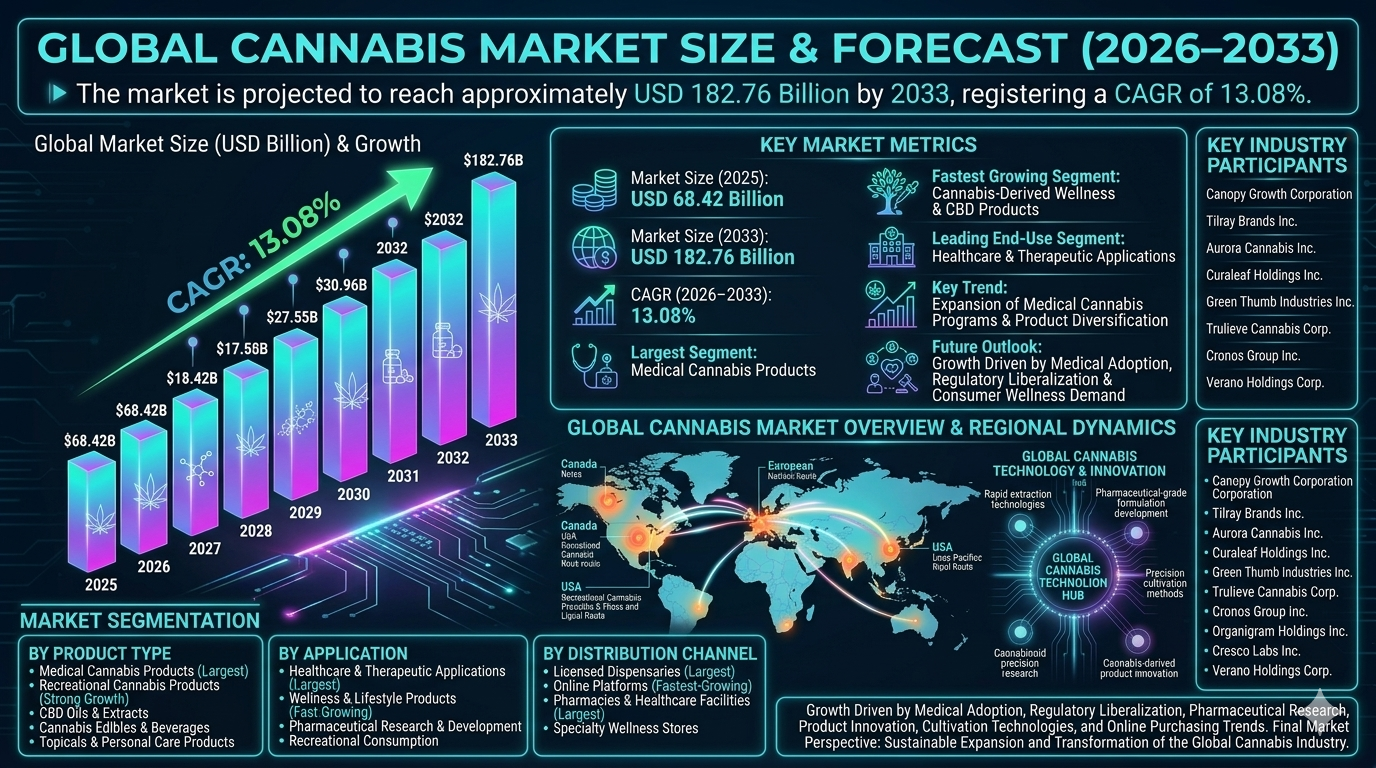
Global Cannabis Market Size & Forecast
The Global Cannabis Market is expected to witness strong growth during the forecast period from 2026 to 2033. The market was valued at USD 68.42 billion in 2025 and is projected to reach approximately USD 182.76 billion by 2033, registering a CAGR of 13.08%. The market growth is primarily driven by expanding medical cannabis legalization, increasing consumer awareness regarding therapeutic applications, rising demand for CBD-based wellness products, and ongoing regulatory reforms across major economies. Cannabis products are increasingly utilized for pain management, neurological disorders, mental health support, chronic disease treatment, wellness applications, and recreational consumption in regulated markets. In addition, growing investments in cannabis cultivation, pharmaceutical research, product innovation, and retail distribution networks are supporting long-term market expansion.Global Cannabis Market Overview
Cannabis refers to plant-derived products containing cannabinoids such as tetrahydrocannabinol (THC) and cannabidiol (CBD), which are utilized for medical, therapeutic, wellness, and recreational purposes. The market includes medical cannabis, recreational cannabis, CBD oils, cannabis edibles, beverages, concentrates, topical products, pharmaceutical formulations, and wellness supplements. Cannabis products are widely used across healthcare, pharmaceuticals, wellness, personal care, nutraceuticals, and regulated adult-use markets. The market is transitioning from limited medical applications toward diversified product portfolios supported by scientific research, regulatory developments, and consumer acceptance.Structural Drivers of Market Growth
1. Innovation and Commercialization Acceleration
Rapid innovation in cannabis extraction technologies, cannabinoid formulations, precision cultivation methods, and pharmaceutical-grade product development is accelerating market growth. Advanced cultivation and processing technologies are improving product consistency, safety, and therapeutic effectiveness.Market Implications
Companies investing in product innovation, pharmaceutical research, and premium cannabis formulations are expected to strengthen market leadership.2. Compliance and Risk Repricing
Product testing requirements, licensing frameworks, cultivation regulations, labeling standards, and quality control mandates are shaping market development. Governments are increasingly implementing strict compliance measures to ensure product safety and consumer protection.Market Implications
Firms offering compliant, traceable, and quality-assured cannabis products are likely to gain stronger market credibility.3. Competitive and Value-Chain Reconfiguration
The market is highly competitive as cultivators, pharmaceutical companies, wellness brands, biotechnology firms, and retail operators expand their cannabis portfolios. Vertical integration strategies and direct-to-consumer channels are reshaping value-chain economics.Market Implications
Companies focusing on branded products, premium formulations, and diversified distribution networks may gain stronger margins.4. Capital and Capacity Scaling
Rising investment in cultivation facilities, extraction technologies, clinical research, and cannabis retail infrastructure is supporting market expansion. Growing legalization across multiple jurisdictions is increasing production and commercialization opportunities.Market Implications
Producers scaling cultivation efficiency and regulatory-compliant production capabilities are expected to capture future opportunities.Market Segmentation Analysis
By Product Type
1. Medical Cannabis Products
This remains the largest segment due to increasing therapeutic applications and physician-supported treatment programs.2. Recreational Cannabis Products
Strong growth driven by expanding legalization in adult-use markets.3. CBD Oils & Extracts
Widely used for wellness and therapeutic support.4. Cannabis Edibles & Beverages
Growing demand due to convenience and consumer preference diversification.5. Topicals & Personal Care Products
Increasing utilization in skincare and wellness applications.By Application
1. Healthcare & Therapeutic Applications
Largest segment driven by pain management and chronic disease treatment.2. Wellness & Lifestyle Products
Fast-growing segment due to increasing consumer health awareness.3. Pharmaceutical Research & Development
Growing investment in cannabinoid-based drug development.4. Recreational Consumption
Expanding demand in legalized markets.By Distribution Channel
1. Licensed Dispensaries
Largest segment due to regulated retail sales.2. Online Platforms
Fastest-growing channel due to convenience and digital purchasing trends.3. Pharmacies & Healthcare Facilities
Widely utilized for medical cannabis distribution.4. Specialty Wellness Stores
Growing demand for CBD and wellness-focused products.Regional Market Dynamics
North America
North America dominates the global cannabis market due to widespread legalization, strong consumer demand, advanced cultivation infrastructure, and significant industry investment.Europe
Europe remains a major market supported by expanding medical cannabis programs and evolving regulatory frameworks.Asia-Pacific
Asia-Pacific is witnessing gradual growth due to increasing research activities, regulatory discussions, and healthcare-focused cannabis adoption.Latin America
Latin America is emerging as an important market due to favorable cultivation conditions and regulatory developments.Middle East & Africa
The region is experiencing selective growth driven by medical cannabis initiatives and pharmaceutical research investments.Competitive Landscape
The Global Cannabis Market is highly competitive with cultivators, pharmaceutical firms, biotechnology companies, and cannabis-focused consumer brands expanding globally.Key Companies Operating in the Market Include:
- Canopy Growth Corporation
- Tilray Brands Inc.
- Aurora Cannabis Inc.
- Curaleaf Holdings Inc.
- Green Thumb Industries Inc.
- Trulieve Cannabis Corp.
- Cronos Group Inc.
- Organigram Holdings Inc.
- Cresco Labs Inc.
- Verano Holdings Corp.
Strategic Outlook
The future of the cannabis market will be shaped by expanding legalization, pharmaceutical innovation, precision cultivation technologies, and diversified product development. Advanced extraction techniques, cannabinoid research, and personalized wellness solutions will significantly enhance commercial opportunities. The rise of medical cannabis adoption, CBD wellness products, and regulated adult-use markets is expected to create strong long-term growth opportunities.Final Market Perspective
The Global Cannabis Market remains one of the fastest-evolving segments within healthcare, wellness, pharmaceuticals, and consumer products ecosystems. Rising medical acceptance, regulatory liberalization, and product innovation continue driving long-term market growth. Companies capable of delivering safe, compliant, innovative, and scientifically validated cannabis products will be best positioned to capture future opportunities. The convergence of healthcare applications, wellness trends, biotechnology innovation, and regulatory advancements is expected to redefine the future of the global cannabis industry.Table of Contents
Table of Contents
- 1. Executive Summary
- 1.1 Global Cannabis Market Snapshot (2026???2033)
- 1.2 Market Size & Growth Overview
- 1.3 Key Market Highlights
- 1.4 Largest & Fastest-Growing Segments
- 1.5 Regional Performance Summary
- 1.6 Competitive Landscape Overview
- 1.7 Strategic Outlook Through 2033
- 2. Market Introduction & Overview
- 2.1 Definition of Cannabis & Cannabinoid-Based Products
- 2.2 Scope of the Global Cannabis Market
- 2.3 Evolution of Medical, Recreational & Wellness Cannabis Applications
- 2.4 Cannabis Value Chain Analysis
- 2.5 Regulatory & Legal Framework (Medical, Recreational & CBD)
- 2.6 Emerging Trends in Cannabinoid Research & Product Innovation
- 2.7 Pharmaceutical Integration & Wellness Industry Convergence
- 3. Research Methodology
- 3.1 Primary Research Approach
- 3.2 Secondary Research Sources
- 3.3 Market Size Estimation Methodology
- 3.4 Forecasting Assumptions (2026???2033)
- 3.5 Data Validation & Triangulation
- 4. Market Dynamics
- 4.1 Market Drivers
- 4.1.1 Expanding Medical Cannabis Legalization
- 4.1.2 Rising Demand for CBD-Based Wellness Products
- 4.1.3 Increasing Therapeutic Applications in Chronic Diseases
- 4.1.4 Growth in Pharmaceutical Research & Clinical Trials
- 4.1.5 Advancements in Cultivation & Extraction Technologies
- 4.2 Market Restraints
- 4.2.1 Complex & Evolving Regulatory Environment
- 4.2.2 Banking & Financial Restrictions in Certain Regions
- 4.2.3 Quality Control & Standardization Challenges
- 4.3 Market Opportunities
- 4.3.1 Expansion of Pharmaceutical-Grade Cannabis Products
- 4.3.2 Growth in CBD Wellness & Personal Care Markets
- 4.3.3 Increasing Online Cannabis Retail Channels
- 4.3.4 Development of Precision Cultivation Technologies
- 4.4 Market Challenges
- 4.4.1 Regulatory Uncertainty Across Regions
- 4.4.2 Social Stigma & Market Acceptance Barriers
- 4.4.3 Supply Chain Compliance & Traceability Issues
- 4.1 Market Drivers
- 5. Global Cannabis Market Size & Forecast (USD Billion), 2026???2033
- 5.1 Market Revenue Analysis
- 5.2 CAGR Analysis
- 5.3 Demand-Supply Trends
- 5.4 Pricing Analysis
- 5.5 Investment Trends
- 5.6 Future Market Outlook
- 6. Market Segmentation Analysis (USD Billion), 2026???2033
- 6.1 By Product Type
- 6.1.1 Medical Cannabis Products (Largest Segment)
- 6.1.2 Recreational Cannabis Products
- 6.1.3 CBD Oils & Extracts
- 6.1.4 Cannabis Edibles & Beverages
- 6.1.5 Topicals & Personal Care Products
- 6.2 By Application
- 6.2.1 Healthcare & Therapeutic Applications (Largest Segment)
- 6.2.2 Wellness & Lifestyle Products (Fastest-Growing Segment)
- 6.2.3 Pharmaceutical Research & Development
- 6.2.4 Recreational Consumption
- 6.3 By Distribution Channel
- 6.3.1 Licensed Dispensaries (Largest Segment)
- 6.3.2 Online Platforms (Fastest-Growing Segment)
- 6.3.3 Pharmacies & Healthcare Facilities
- 6.3.4 Specialty Wellness Stores
- 6.1 By Product Type
- 7. Regional Market Analysis
- 7.1 North America
- 7.2 Europe
- 7.3 Asia-Pacific
- 7.4 Latin America
- 7.5 Middle East & Africa
- 8. Competitive Landscape
- 8.1 Market Share Analysis
- 8.2 Competitive Benchmarking
- 8.3 Strategic Developments
- 8.4 Product Innovation & Pharmaceutical Partnerships
- 8.5 Mergers, Acquisitions & Expansion Strategies
- 9. Company Profiles
- 9.1 Canopy Growth Corporation
- 9.2 Tilray Brands Inc.
- 9.3 Aurora Cannabis Inc.
- 9.4 Curaleaf Holdings Inc.
- 9.5 Green Thumb Industries Inc.
- 9.6 Trulieve Cannabis Corp.
- 9.7 Cronos Group Inc.
- 9.8 Organigram Holdings Inc.
- 9.9 Cresco Labs Inc.
- 9.10 Verano Holdings Corp.
- 10. Strategic Intelligence & Pheonix AI Insights
- 10.1 Cannabis Demand Forecast Model
- 10.2 Medical vs Recreational Adoption Analysis
- 10.3 CBD Wellness Market Expansion Tracker
- 10.4 Regulatory Impact Assessment
- 10.5 Automated Porter???s Five Forces Analysis
- 11. Future Outlook & Strategic Recommendations
- 11.1 Expansion of Medical Cannabis Programs
- 11.2 Investment in Pharmaceutical Cannabis Research
- 11.3 Growth Opportunities in CBD Wellness Products
- 11.4 Scaling Precision Cultivation & Extraction Technologies
- 11.5 Long-Term Market Outlook (2033+)
- 12. Appendix
- 13. About Pheonix Market Research
- 14. Disclaimer
Competitive Landscape
Global Cannabis Market Competitive Intensity & Market Structure Overview
The global cannabis market is highly fragmented and rapidly consolidating in certain regulated regions, characterized by the presence of large multi-state operators, pharmaceutical companies, biotechnology firms, licensed cultivators, and wellness-focused consumer brands. Competitive intensity is shaped by regulatory access, cultivation scale, product quality consistency, brand positioning, pricing pressure, distribution control, and research capabilities in cannabinoid science.
Market participants are increasingly focusing on vertical integration strategies that combine cultivation, extraction, manufacturing, and retail distribution to improve margins and ensure regulatory compliance. As legalization expands across multiple jurisdictions, competition is intensifying between established cannabis operators and new entrants from pharmaceutical and consumer goods industries.
The market structure is evolving from fragmented, region-specific operations toward more structured, branded, and consolidated enterprises, particularly in North America and parts of Europe. This transition is driving stronger competition in product innovation, clinical validation, and premium cannabis formulations.
Global Cannabis Market Competitive Intensity & Market Structure Current Scenario
Leading Global Cannabis Companies
Canopy Growth Corporation: One of the largest global cannabis companies, focused on medical cannabis, recreational products, and cannabinoid-based research and development.
Tilray Brands Inc.: Major global player with diversified cannabis, hemp, and wellness product portfolios supported by international distribution networks.
Aurora Cannabis Inc.: Leading producer specializing in medical cannabis products and pharmaceutical-grade cannabinoid research.
Curaleaf Holdings Inc.: One of the largest multi-state operators in the U.S., offering vertically integrated cultivation, processing, and retail cannabis operations.
Green Thumb Industries Inc.: Prominent U.S.-based cannabis company focused on retail dispensaries, branded consumer products, and regulated cultivation.
Trulieve Cannabis Corp.: Leading vertically integrated cannabis operator with strong presence in medical and recreational cannabis markets.
Cronos Group Inc.: Global cannabinoid company investing heavily in research, intellectual property development, and consumer wellness products.
Organigram Holdings Inc.: Canadian cannabis producer focused on high-quality flower products, derivatives, and product innovation.
Cresco Labs Inc.: Vertically integrated cannabis operator with strong wholesale distribution and branded product strategy.
Verano Holdings Corp.: U.S.-based multi-state operator with diversified retail, cultivation, and product manufacturing capabilities.
Key Competitive Intensity & Market Structure Drivers
Expanding legalization frameworks across medical and recreational markets are increasing the number of active participants while simultaneously driving consolidation among large-scale operators.
Strict regulatory requirements related to product testing, licensing, and quality control are creating barriers to entry and favoring well-capitalized, compliant operators.
Vertical integration across cultivation, extraction, manufacturing, and retail distribution is emerging as a key competitive advantage for improving profitability and supply chain control.
Rising consumer demand for branded, consistent, and scientifically validated cannabis products is intensifying competition in product differentiation and research-backed formulations.
Increasing involvement of pharmaceutical and biotechnology companies is reshaping competitive dynamics by accelerating clinical research and pharmaceutical-grade cannabis development.
Strategic Implications of Competitive Intensity & Market Structure
Companies investing in advanced cultivation technologies, precision agriculture, and standardized extraction processes are expected to gain a significant competitive advantage in product consistency and scalability.
Strong brand development and consumer trust are becoming critical success factors as the market shifts toward premium, regulated, and wellness-oriented cannabis products.
Strategic partnerships between cannabis producers, pharmaceutical firms, and research institutions are accelerating innovation in cannabinoid-based therapies and medical applications.
Organizations with strong regulatory compliance frameworks and multi-jurisdictional licensing capabilities are better positioned to expand internationally and capture new market opportunities.
Expansion into CBD wellness products, pharmaceuticals, and consumer packaged goods is enabling companies to diversify revenue streams and reduce dependency on single-market regulatory environments.
Global Cannabis Market Competitive Intensity & Market Structure Forward Outlook
The competitive landscape of the global cannabis market is expected to become increasingly structured and consolidated as legalization expands and regulatory frameworks mature. Large-scale operators with strong capital resources, vertically integrated operations, and diversified product portfolios are expected to dominate long-term market share.
Future competition will be driven by pharmaceutical integration, clinical validation of cannabis-based therapies, and development of standardized, high-quality cannabinoid products for medical and wellness applications.
North America is expected to remain the dominant market due to advanced legalization frameworks and strong consumer demand, while Europe is projected to experience steady growth driven by medical cannabis adoption and regulatory expansion.
Over the forecast period, companies that successfully combine regulatory compliance, scientific innovation, brand strength, and scalable production capabilities will be best positioned to lead the evolving global cannabis market.
Value Chain
Global Cannabis Market Value Chain & Supply Chain Evolution Overview
The Global Cannabis Market is undergoing significant transformation driven by expanding medical cannabis legalization, growing consumer demand for wellness products, increasing pharmaceutical research, and evolving regulatory frameworks worldwide. The market???s value chain is characterized by a highly regulated and vertically integrated ecosystem connecting cultivation operators, genetics developers, extraction specialists, pharmaceutical manufacturers, testing laboratories, distributors, retailers, and healthcare providers. This interconnected framework is reshaping product development, commercialization strategies, and market accessibility across the global cannabis industry.
A defining feature of the value chain is the convergence of advanced cultivation technologies, cannabinoid extraction innovations, pharmaceutical-grade manufacturing processes, and digital retail platforms. Companies are increasingly leveraging precision agriculture, controlled-environment cultivation, data-driven crop management, and advanced cannabinoid formulation technologies to improve product quality, consistency, and scalability.
Supply chain complexity remains high due to strict regulatory requirements, licensing frameworks, product traceability mandates, laboratory testing standards, inventory controls, and cross-border trade restrictions. Market participants must coordinate cultivation, processing, testing, packaging, compliance management, distribution, and retail operations while ensuring product safety, consistency, and regulatory adherence.
Industry stakeholders are investing heavily in cultivation automation, pharmaceutical-grade processing facilities, extraction technologies, laboratory testing infrastructure, and digital commerce capabilities to strengthen operational efficiency and market competitiveness. The value chain is evolving into a highly regulated, technology-enabled, and consumer-centric ecosystem focused on product quality, transparency, and therapeutic effectiveness.
Global Cannabis Market Value Chain & Supply Chain Evolution Current Scenario
Market-Specific Value Chain
- Genetics & Cultivation Inputs: Cannabis genetics, seeds, clones, nutrients, fertilizers, cultivation equipment, greenhouse systems, lighting technologies, and environmental control systems.
- Cultivation & Harvesting: Indoor cultivation, greenhouse cultivation, outdoor farming, precision agriculture systems, crop monitoring, harvesting, and post-harvest processing.
- Extraction & Product Manufacturing: Cannabinoid extraction, distillation, purification, formulation development, pharmaceutical-grade processing, edible manufacturing, beverage production, and wellness product formulation.
- Testing, Compliance & Quality Assurance: Laboratory testing, potency verification, contaminant screening, regulatory compliance management, product certification, and traceability systems.
- Distribution & Retail Channels: Licensed distributors, dispensaries, pharmacies, healthcare facilities, specialty wellness stores, and online cannabis retail platforms.
- End-User Applications: Medical patients, healthcare providers, wellness consumers, pharmaceutical researchers, and regulated adult-use consumers.
Company-to-Stage Mapping
- Genetics & Cultivation Inputs: Cannabis genetics developers, agricultural technology providers, greenhouse equipment manufacturers, and cultivation input suppliers.
- Cultivation & Harvesting: Canopy Growth Corporation, Aurora Cannabis Inc., Tilray Brands Inc., Organigram Holdings Inc., Trulieve Cannabis Corp.
- Extraction & Product Manufacturing: Curaleaf Holdings Inc., Cronos Group Inc., Cresco Labs Inc., Verano Holdings Corp., pharmaceutical and cannabinoid processing companies.
- Testing, Compliance & Quality Assurance: Cannabis testing laboratories, compliance solution providers, certification organizations, and regulatory authorities.
- Distribution & Retail Channels: Licensed dispensaries, pharmacy networks, wellness retailers, e-commerce platforms, and regulated distribution partners.
- End-User Applications: Medical cannabis patients, healthcare institutions, wellness consumers, research organizations, and recreational users in legalized markets.
Key Value Chain & Supply Chain Evolution Signals in Global Cannabis Market
- Expansion of Medical Cannabis Programs:
Increasing legalization and physician-supported treatment programs are driving demand for pharmaceutical-grade cannabis products. - Growth of CBD-Based Wellness Products:
Consumer demand for wellness supplements, functional products, and non-intoxicating cannabinoid formulations is expanding rapidly. - Advancement of Precision Cultivation Technologies:
Controlled-environment agriculture, automation, and AI-driven crop monitoring are improving yield consistency and operational efficiency. - Increasing Product Diversification:
Companies are expanding portfolios across oils, edibles, beverages, topicals, capsules, concentrates, and pharmaceutical formulations. - Strengthening Compliance & Traceability Systems:
Regulatory authorities are emphasizing product testing, labeling accuracy, inventory controls, and end-to-end traceability. - Rise of Direct-to-Consumer & Digital Retail Channels:
Online platforms and digital commerce solutions are improving product accessibility in regulated markets.
Strategic Implications of Value Chain & Supply Chain Evolution
- Investment in Pharmaceutical-Grade Production:
High-quality manufacturing capabilities improve regulatory compliance and healthcare market penetration. - Expansion of Vertical Integration Strategies:
Controlling cultivation, processing, distribution, and retail operations enhances margin optimization and supply security. - Optimization of Cultivation Efficiency:
Advanced agricultural technologies improve productivity, consistency, and production scalability. - Strengthening Regulatory Compliance Infrastructure:
Comprehensive testing, quality assurance, and traceability capabilities are becoming critical competitive differentiators. - Development of Branded Wellness & Medical Products:
Product differentiation through innovation and scientific validation supports long-term market growth. - Expansion of Global Distribution Networks:
Strategic partnerships and localized supply chains improve market access and regulatory adaptability.
Global Cannabis Market Value Chain & Supply Chain Evolution Forward Outlook
Looking ahead, the cannabis value chain is expected to evolve into a highly sophisticated, research-driven, and globally integrated ecosystem supported by advanced cultivation technologies, pharmaceutical innovation, and expanding legalization frameworks.
Key Future Developments Include:
- Expansion of pharmaceutical-grade cannabinoid therapies and clinical research programs.
- Increased adoption of AI-enabled precision cultivation and automated greenhouse technologies.
- Growth of personalized cannabis wellness products and targeted cannabinoid formulations.
- Advancement of extraction technologies and high-purity cannabinoid production systems.
- Expansion of digital retail ecosystems and direct-to-consumer cannabis distribution models.
- Strengthening of global product traceability, compliance monitoring, and quality assurance frameworks.
As the market evolves, competitive advantage will increasingly depend on the ability to combine cultivation excellence, product innovation, regulatory compliance, scientific validation, and efficient distribution capabilities. Organizations capable of delivering safe, consistent, and differentiated cannabis products will be best positioned to capitalize on future growth opportunities.
Companies that successfully integrate advanced cultivation systems, pharmaceutical-grade manufacturing, cannabinoid research, and scalable distribution networks will achieve stronger market positioning, operational efficiency, and long-term leadership within the Global Cannabis Market.
Investment Activity
Global Cannabis Market Investment & Funding Dynamics Overview
The Global Cannabis Market is witnessing accelerating investment momentum driven by expanding legalization frameworks, increasing medical cannabis adoption, rising consumer demand for CBD-based wellness products, and growing pharmaceutical interest in cannabinoid research. Cultivators, pharmaceutical companies, biotechnology firms, wellness brands, retail operators, and institutional investors are actively deploying capital into large-scale cultivation facilities, pharmaceutical-grade extraction technologies, clinical research programs, product innovation pipelines, and regulated distribution networks.
Investment activity is intensifying as governments gradually expand medical and recreational cannabis legalization, creating new commercialization pathways across healthcare, wellness, and consumer product industries. Market participants are focusing on advanced cultivation systems, genetically optimized cannabis strains, precision extraction methods, cannabinoid formulation technologies, and quality-controlled manufacturing infrastructure.
In addition, growing investments in pharmaceutical cannabis research, CBD wellness product development, vertically integrated supply chains, and retail dispensary expansion are shaping the long-term global cannabis investment landscape.
Global Cannabis Market Investment & Funding Dynamics Current Scenario
Currently, the cannabis market is experiencing strong capital inflows from venture capital firms, private equity investors, pharmaceutical companies, and strategic corporate investors seeking exposure to high-growth medical and wellness segments. Leading companies are investing heavily in clinical cannabinoid research, pharmaceutical drug development, advanced cultivation technologies, and branded consumer cannabis products.
The market is also witnessing increasing investments in CBD wellness startups, cannabis biotechnology firms, extraction technology providers, and digital retail platforms. Investors are particularly focused on companies capable of navigating regulatory complexity while maintaining product quality and compliance standards.
Furthermore, the industry is experiencing active mergers, acquisitions, strategic alliances, and cross-border partnerships as companies consolidate operations, expand geographic presence, and strengthen vertically integrated cannabis ecosystems.
Key Investment & Funding Dynamics Signals in Global Cannabis Market
- Expanding medical cannabis legalization programs are driving pharmaceutical and clinical research investments.
- Rising demand for CBD-based wellness and therapeutic products is increasing consumer-focused capital deployment.
- Growth in recreational cannabis legalization is supporting large-scale cultivation and retail investments.
- Strategic investments in advanced extraction technologies and cannabinoid formulation systems are enhancing product innovation.
- Increasing focus on regulatory compliance, product testing, and quality assurance systems is strengthening investor confidence.
- Vertical integration strategies across cultivation, processing, and distribution are reshaping capital allocation models.
- Expansion of online cannabis retail platforms and licensed dispensary networks is accelerating commercialization opportunities.
Strategic Implications of Investment & Funding Dynamics in Global Cannabis Market
- Continuous investment in pharmaceutical-grade cannabis research and clinical trials is critical for long-term medical market expansion.
- Capital allocation toward cultivation efficiency, genetic optimization, and controlled environment agriculture will improve production scalability.
- Companies offering compliant, high-quality, and scientifically validated cannabis products are expected to gain stronger market positioning.
- Strategic acquisitions and partnerships will accelerate market consolidation and global expansion.
- Investments in CBD wellness ecosystems, nutraceutical applications, and personalized cannabinoid therapies will remain major growth priorities.
- Compliance with cannabis regulations, safety standards, and pharmaceutical guidelines will remain essential for sustained investor confidence.
- Organizations building vertically integrated and research-driven cannabis ecosystems are expected to capture significant long-term value.
Global Cannabis Market Investment & Funding Dynamics Forward Outlook
Looking ahead, the Global Cannabis Market is expected to maintain strong investment growth driven by continued regulatory liberalization, expanding medical applications, rising consumer wellness adoption, and increasing pharmaceutical innovation.
Future capital deployment will increasingly focus on precision cannabis cultivation technologies, cannabinoid-based drug development, AI-driven agriculture optimization, advanced extraction systems, and global distribution network expansion.
As the industry transitions toward a more regulated, science-backed, and diversified ecosystem, investment activity is expected to expand across medical research, wellness product innovation, and large-scale commercial cultivation infrastructure.
In conclusion, the Global Cannabis Market represents a high-growth, highly regulated investment landscape where medical innovation, biotechnology advancement, consumer wellness demand, and regulatory evolution will define future funding priorities and long-term market transformation.
Technology & Innovation
Global Cannabis Market Technology & Innovation Landscape Overview
The global cannabis market is undergoing rapid technological transformation driven by advancements in precision cultivation systems, advanced extraction technologies, biotechnology-driven cannabinoid research, AI-enabled agricultural monitoring, and pharmaceutical-grade formulation development. As legalization expands across multiple regions, the industry is shifting toward highly regulated, science-driven production and product innovation ecosystems.
Modern cannabis production systems increasingly integrate controlled environment agriculture (CEA), hydroponics, LED lighting optimization, IoT-based crop monitoring, and automated nutrient delivery systems to improve yield consistency, plant quality, and operational efficiency. These innovations are enabling producers to maintain strict compliance with pharmaceutical and safety standards.
The market is also witnessing strong adoption of CO??? extraction systems, ethanol-based extraction technologies, nano-emulsion delivery systems, and standardized cannabinoid formulation platforms, which are improving product purity, bioavailability, and therapeutic effectiveness across medical and wellness applications.
Global Cannabis Market Technology & Innovation Current Scenario
Current innovation in the cannabis market is primarily centered around medical-grade product development, precision cultivation, and cannabinoid standardization. The industry is transitioning from fragmented cultivation practices toward highly controlled, data-driven production systems that ensure consistency and regulatory compliance.
Precision agriculture technologies are being widely adopted to optimize growing conditions through real-time monitoring of temperature, humidity, light exposure, soil nutrients, and plant health indicators.
Advanced extraction and purification systems are enabling producers to isolate specific cannabinoids such as THC, CBD, CBG, and CBN with higher accuracy and purity for pharmaceutical and wellness applications.
Pharmaceutical research and clinical trials are increasingly focusing on cannabinoid-based therapies for pain management, epilepsy, anxiety disorders, neurological conditions, and chronic illness treatment.
Automation in cultivation facilities is reducing labor dependency while improving scalability, consistency, and regulatory compliance across licensed production environments.
Additionally, digital tracking systems and blockchain-based traceability solutions are emerging to ensure product authenticity, regulatory transparency, and supply chain integrity.
Key Technology & Innovation Trends in Global Cannabis Market
- Precision Cultivation Systems: Controlled environment agriculture (CEA), hydroponics, and AI-driven crop optimization.
- IoT-Based Plant Monitoring: Real-time tracking of environmental and plant health conditions.
- Advanced Extraction Technologies: CO???, ethanol, and solvent-free extraction for high-purity cannabinoid isolation.
- Pharmaceutical-Grade Formulations: Standardized dosing systems for medical cannabis applications.
- Nano-Emulsion & Delivery Innovation: Improving bioavailability and absorption rates of cannabinoids.
- Biotechnology-Driven Research: Genetic optimization and cannabinoid biosynthesis advancements.
- AI-Powered Cultivation Analytics: Predictive yield optimization and disease detection systems.
- Blockchain Traceability Systems: Ensuring transparency across cultivation, processing, and distribution.
- Automated Processing & Packaging: Enhancing efficiency and regulatory compliance in production facilities.
- Digital Pharmaceutical Integration: Supporting clinical validation and prescription-based cannabis products.
Strategic Implications of Technology & Innovation
Technological advancements are reshaping the cannabis industry by transitioning it from a fragmented agricultural sector into a regulated, pharmaceutical-aligned, and technology-intensive ecosystem.
Companies investing in precision cultivation, pharmaceutical R&D, and advanced extraction technologies are gaining stronger competitive positioning through improved product consistency, regulatory compliance, and clinical validation.
The convergence of biotechnology, AI-driven agriculture, and medical research is enabling the development of more targeted cannabinoid therapies and standardized wellness products.
Automation and digital monitoring systems are improving scalability while reducing production risks, contamination issues, and regulatory non-compliance.
However, regulatory uncertainty, banking restrictions in certain regions, product standardization challenges, and quality control inconsistencies remain key barriers to full-scale global commercialization.
Global Cannabis Market Technology & Innovation Forward Outlook
The future of the cannabis market is expected to evolve toward fully standardized, pharmaceutical-integrated, and AI-optimized production ecosystems supported by advanced biotechnology and digital cultivation systems.
Emerging innovations include AI-driven personalized cannabinoid therapies, genetically optimized cannabis strains, automated smart cultivation farms, and blockchain-secured pharmaceutical cannabis supply chains.
Medical cannabis adoption is expected to accelerate significantly as clinical research expands and regulatory frameworks become more structured and globally aligned.
The integration of digital health platforms with cannabis-based therapies will further enhance prescription tracking, dosage personalization, and treatment effectiveness.
Overall, the global cannabis market is evolving into a highly regulated, science-driven ecosystem where biotechnology, AI, pharmaceutical research, and precision agriculture collectively redefine cultivation, product development, and therapeutic applications.
Market Risk
Global Cannabis Market Risk Factors & Disruption Threats Overview
The global cannabis market operates within a highly dynamic and structurally complex risk environment shaped by evolving legalization frameworks, strict regulatory oversight, banking and financial restrictions, supply chain constraints, and ongoing societal and political sensitivities. While strong demand growth is driven by medical adoption, wellness applications, and expanding recreational legalization, the industry continues to face significant uncertainty across regulatory, operational, and financial dimensions.
Cannabis markets are uniquely influenced by fragmented legal regimes across countries and even within subnational jurisdictions. This creates a highly uneven operating landscape where companies must navigate varying rules related to cultivation, distribution, product formulation, advertising, taxation, and medical approval processes.
Additionally, despite increasing acceptance, cannabis remains a tightly controlled substance in many regions, limiting access to traditional banking services, institutional investment, and cross-border trade. These constraints continue to shape capital availability and business scalability across the industry.
The market is also experiencing rapid product diversification, especially in CBD wellness products, pharmaceutical applications, and recreational offerings. However, this diversification introduces new compliance risks, quality control challenges, and regulatory scrutiny regarding product safety and labeling accuracy.
Global Cannabis Market Risk Factors & Disruption Threats Current Scenario
The current cannabis market landscape is defined by accelerating legalization trends alongside persistent regulatory uncertainty and operational fragmentation. While North America leads in commercialization, many regions remain in early or transitional stages of policy development, resulting in uneven global market maturity.
One of the most significant risks in the cannabis industry is regulatory volatility. Frequent policy changes related to licensing, taxation, advertising restrictions, and medical approval frameworks can directly impact revenue visibility and long-term investment planning for companies operating in the sector.
Financial system limitations remain a structural challenge. In several jurisdictions, cannabis businesses face restricted access to banking services, insurance products, and institutional financing due to federal-level legal classifications. This increases reliance on cash-intensive operations and alternative financing mechanisms.
Product quality and compliance risks are also critical. Variability in cultivation practices, extraction methods, and product standardization can lead to inconsistencies in cannabinoid concentration, contamination risks, and regulatory non-compliance, potentially resulting in recalls or legal penalties.
Supply chain inefficiencies, including cultivation yield variability, climate dependency, and controlled production licensing, further contribute to operational uncertainty. Unlike conventional agricultural commodities, cannabis production is heavily regulated, limiting scalability and geographic flexibility.
Key Risk Factors & Disruption Threats Signals in the Cannabis Market
- Regulatory Fragmentation: Differing legalization statuses and regulatory frameworks across regions create inconsistent market access and compliance burdens.
- Legal and Policy Uncertainty: Ongoing changes in cannabis legalization, taxation rules, and medical approval policies can significantly impact business continuity.
- Banking and Financial Access Restrictions: Limited access to traditional financial services increases operational complexity and capital constraints.
- Product Safety and Quality Control Risks: Inconsistent cultivation and processing standards can lead to contamination, labeling errors, and regulatory violations.
- Supply Chain Constraints: Licensing limitations, cultivation controls, and geographic restrictions affect scalability and distribution efficiency.
- Taxation Pressure: High excise taxes in some jurisdictions can reduce profitability and affect pricing competitiveness.
- Black Market Competition: Illicit cannabis markets continue to compete with legal operators, affecting pricing and market share.
- Advertising and Branding Restrictions: Limitations on marketing reduce consumer awareness and brand differentiation opportunities.
- Cross-Border Trade Limitations: International trade of cannabis products remains highly restricted, limiting global expansion opportunities.
- Reputation and Social Acceptance Risk: Stigma and varying cultural attitudes toward cannabis may influence adoption rates in certain regions.
Strategic Implications of Risk Factors & Disruption Threats in the Cannabis Market
The evolving risk landscape is driving cannabis companies to prioritize regulatory compliance, product standardization, and vertical integration strategies. Firms are increasingly investing in controlled cultivation systems, advanced testing protocols, and traceability technologies to ensure consistent product quality and regulatory alignment.
Vertical integration across cultivation, processing, distribution, and retail is becoming a key strategy to manage cost pressures and improve operational control. This approach helps mitigate supply chain risks and enhances margin stability in a highly regulated environment.
Companies are also focusing on building strong domestic market positions due to limitations in cross-border trade. As a result, regional expansion strategies and localized brand development are becoming more important than global scaling in the near term.
Investment in research and development is increasing, particularly in pharmaceutical-grade cannabis products, cannabinoid-based therapeutics, and standardized wellness formulations. This shift toward medical and scientific validation is expected to improve long-term legitimacy and market stability.
Global Cannabis Market Risk Factors & Disruption Threats Forward Outlook
Looking ahead, the cannabis market is expected to continue expanding rapidly, driven by ongoing legalization, medical acceptance, and rising consumer demand for wellness-oriented products. However, the pace of growth will remain uneven due to regulatory fragmentation and policy uncertainty across regions.
Medical cannabis applications are likely to gain stronger institutional acceptance as clinical research expands and pharmaceutical companies increase involvement in cannabinoid-based drug development. This may enhance product credibility and support more structured regulatory frameworks.
CBD and wellness-based cannabis products are expected to remain key growth drivers, particularly in regions with partial legalization or regulatory ambiguity. These segments may experience faster mainstream adoption due to lower psychoactive concerns and broader consumer acceptance.
Technological advancements in cultivation, extraction, and product formulation are expected to improve efficiency, consistency, and scalability. However, companies will need to balance innovation with strict compliance requirements and evolving safety standards.
Overall, the global cannabis market will remain one of the most high-opportunity but highly regulated industries. Companies that successfully navigate legal complexity, ensure product quality, maintain compliance discipline, and build resilient supply chains will be best positioned to sustain long-term growth and competitive advantage.
Regulatory Landscape
Global Cannabis Market Regulatory & Policy Environment Overview
The regulatory and policy environment governing the Global Cannabis Market is highly complex and continues to evolve as countries progressively shift from strict prohibition models toward medical legalization, regulated adult-use frameworks, and controlled pharmaceutical integration. Governments and health authorities are primarily focused on balancing public health protection, controlled access, product safety, and prevention of misuse while enabling medical and economic opportunities associated with cannabis-derived products.
Cannabis-related businesses must comply with a wide spectrum of regulations covering cultivation licensing, processing approvals, product testing standards, labeling requirements, distribution controls, advertising restrictions, and patient access frameworks. These rules vary significantly across regions, creating a fragmented global regulatory landscape that directly influences market structure and commercialization strategies.
The growing acceptance of medical cannabis and CBD-based wellness products is prompting regulatory bodies to establish clearer guidelines for quality assurance, THC limits, pharmaceutical-grade production, and clinical validation requirements, particularly for therapeutic applications.
Global Cannabis Market Regulatory & Policy Environment Current Scenario
The current regulatory environment is characterized by uneven legalization progress, with North America leading in both medical and recreational cannabis frameworks, while Europe focuses primarily on medical cannabis expansion. Many Asia-Pacific, Middle Eastern, and African countries still maintain restrictive or highly controlled regulatory approaches, although gradual reforms are emerging in select jurisdictions.
Medical cannabis programs are expanding in multiple countries under strict physician prescription models, allowing controlled access for conditions such as chronic pain, epilepsy, cancer-related symptoms, neurological disorders, and mental health treatments. These programs require compliance with rigorous clinical oversight and pharmaceutical-grade production standards.
Regulators are also strengthening product safety frameworks by enforcing mandatory laboratory testing for contaminants, pesticide residues, heavy metals, microbial content, and cannabinoid concentration accuracy. This ensures consumer protection and improves product consistency across legal markets.
CBD products, particularly in wellness and nutraceutical segments, are facing increasing regulatory scrutiny regarding permissible THC levels, health claims, and marketing practices. Authorities are working to standardize CBD classification either as a supplement, cosmetic ingredient, or controlled substance depending on jurisdiction.
In parallel, licensing requirements for cultivation and distribution remain highly regulated, with strict controls on production volumes, security measures, traceability systems, and supply chain transparency to prevent diversion into illicit markets.
Key Regulatory & Policy Environment Signals in Global Cannabis Market
- Cannabis Legalization Frameworks: Gradual shift from prohibition to medical and regulated adult-use legalization across multiple jurisdictions.
- Medical Cannabis Regulations: Strict physician-led prescribing systems and controlled patient access for therapeutic use cases.
- Product Safety & Quality Standards: Mandatory testing for potency, contaminants, and formulation consistency to ensure consumer safety.
- Licensing & Cultivation Controls: Highly regulated approval systems governing cultivation, processing, and distribution operations.
- CBD Classification & Usage Rules: Evolving regulations defining CBD as a wellness, pharmaceutical, or controlled substance depending on region.
- Advertising & Marketing Restrictions: Tight controls on promotional activities, especially for recreational cannabis products.
Strategic Implications of Regulatory & Policy Environment
The evolving regulatory landscape is significantly shaping cannabis industry structure by favoring vertically integrated companies capable of managing cultivation, processing, compliance, and distribution under unified regulatory frameworks. Compliance capability has become a key competitive differentiator in both medical and recreational cannabis markets.
Strict product testing and quality assurance requirements are driving investment in advanced laboratory infrastructure, standardized cultivation techniques, and pharmaceutical-grade manufacturing processes. This is increasing operational costs but improving long-term product credibility and market acceptance.
Medical legalization trends are encouraging pharmaceutical companies and biotech firms to invest in cannabinoid-based drug development, clinical trials, and prescription-based cannabis therapies, thereby expanding the industry beyond traditional consumer markets.
CBD and wellness segment regulations are pushing companies toward more transparent labeling, scientifically validated claims, and diversified product portfolios aligned with health and wellness standards.
Overall, regulatory compliance is not only a legal requirement but also a major growth enabler, with companies that prioritize traceability, quality assurance, and regulatory alignment gaining stronger institutional partnerships and consumer trust.
Global Cannabis Market Regulatory & Policy Environment Forward Outlook
Between 2026 and 2033, the regulatory environment for the global cannabis market is expected to move toward greater standardization, medical integration, and controlled commercialization. More countries are likely to adopt structured medical cannabis programs, while select regions may expand regulated adult-use legalization frameworks.
Regulators are expected to introduce more harmonized product safety standards, including standardized THC/CBD thresholds, unified testing protocols, and globally recognized labeling requirements to improve cross-border trade and product consistency.
The pharmaceutical integration of cannabis is expected to intensify, with stricter clinical validation requirements and expanded approval pathways for cannabinoid-based therapies in pain management, neurology, and mental health treatment.
At the same time, digital traceability systems, blockchain-based supply chain tracking, and advanced compliance monitoring tools are likely to become mandatory components of regulated cannabis ecosystems.
Overall, regulatory liberalization combined with tighter product control frameworks will continue to define market expansion. Companies capable of operating within strict compliance environments while innovating in medical, wellness, and pharmaceutical cannabis applications will be best positioned for long-term global competitiveness.