
Global Lymphangioleiomyomatosis Therapeutics Market Report, Size, Share and Forecast 2026–2033
Market definition, scope, and the three boundaries of the measurement
Lymphangioleiomyomatosis is a progressive, cystic lung disease that affects almost exclusively women, usually of childbearing age. It is caused by loss-of-function mutations in TSC1 or TSC2, which leave mechanistic target of rapamycin — mTOR — constitutively switched on. Atypical smooth-muscle-like cells proliferate through the lung, destroy it by forming cysts, and metastasise within the chest and abdomen. Untreated, forced expiratory volume falls by 75 to 118 millilitres a year, and most patients develop clinically important respiratory impairment within a decade of symptom onset. McCormack et al., New England Journal of Medicine, 2011
This report sizes the market for prescription drugs directed at that disease process. Three boundaries define the number, and each of them excludes something a reader might expect to find.
First, it is a drug market, not a disease-cost market. Lung transplantation, oxygen, pleurodesis, surveillance imaging and specialist respiratory care are all substantial costs of LAM and none of them appear here. A figure that mixed them would be a cost-of-illness study wearing a market report's clothes.
Second, value is measured at acquisition price, not at the pharmacy counter. For the United States we use the National Average Drug Acquisition Cost, which is a published, auditable benchmark of what a pharmacy pays. Patient out-of-pocket spend, insurer spend and gross-to-net after rebate are all different numbers and none of them is the market as a supplier sees it.
Third, both forms of the disease are in scope but they are counted separately. Sporadic LAM is the labelled indication in Europe — the EMA authorises Rapamune expressly for "sporadic lymphangioleiomyomatosis (S-LAM)". TSC-associated LAM, in which the same lung disease appears in up to 30 to 40 per cent of adults with tuberous sclerosis complex, is treated with the same drugs but is not what the European label covers. We size it separately and disclose the assumption that carries it. Orphanet, ORPHA:538
The consequence is a market considerably smaller than the number of approvals would suggest, and the rest of this report is largely an explanation of why.
Market size and forecast, 2025–2033
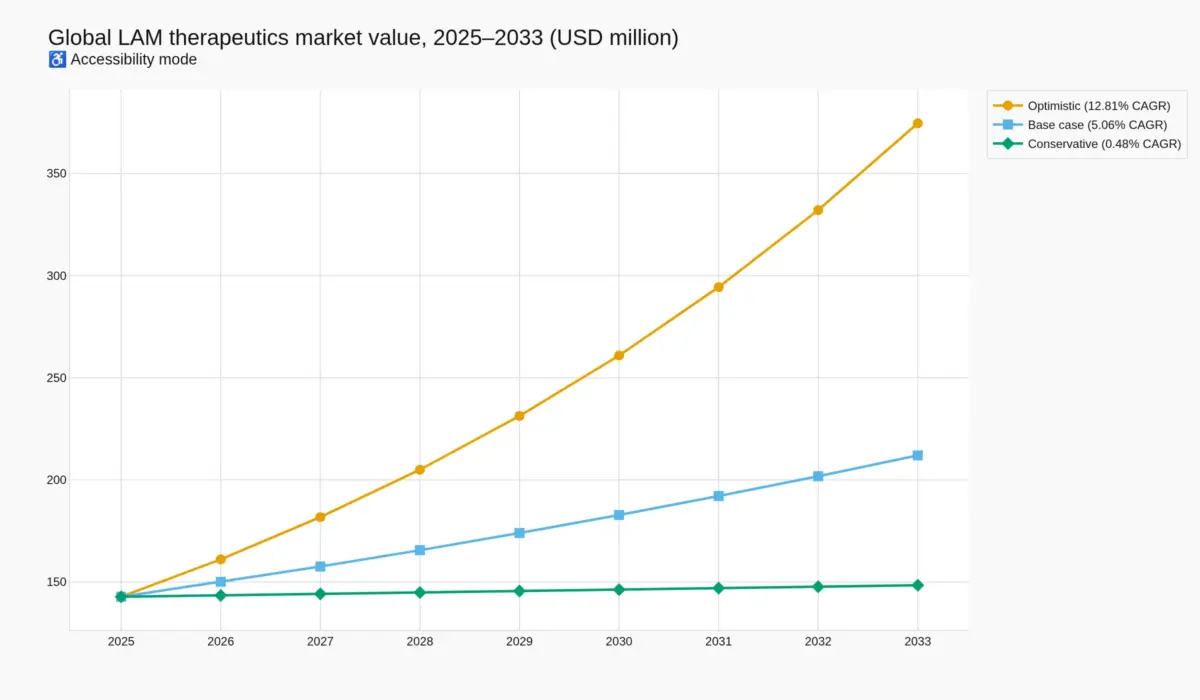
Pheonix values the global LAM-directed therapeutics market at USD 142.8 million in 2025 and forecasts USD 212.0 million in 2033, a compound annual growth rate of 5.06 per cent. The published band runs from 0.48 per cent to 12.81 per cent — USD 148.4 million to USD 374.6 million by 2033 — and the width is not a hedge. It is the honest consequence of one binary clinical readout and one binary reimbursement decision, both described below.
The build is two lines long, which is unusual for a market of this size and is entirely a feature of the disease:
| Component | 2025 | 2033 (base) | Growth |
|---|---|---|---|
| Patients on LAM-directed therapy | 22,500 | 28,502 | 3.0% a year |
| Blended annual drug spend per patient | USD 6,348 | USD 7,437 | 2.0% a year |
| Market value | USD 142.8m | USD 212.0m | 5.06% a year |
Volume growth is a diagnosis story and price growth is a mix story. Neither is a biology story, and that distinction is the single most important thing in this report.
The patient build
| Population | Basis | Cases | On therapy | Treated |
|---|---|---|---|---|
| Sporadic LAM | 15,000–23,000 prevalent globally, midpoint used | 19,000 | 45% | 8,550 |
| TSC-associated LAM | ~1m with TSC worldwide, ~50% female, 30–40% with LAM, ~8% on lung-directed therapy | 175,000 | 8% | 14,000 |
| Total | 22,550 |
Sporadic LAM is 38.0 per cent of the treated population despite being the only labelled indication. That is the first counter-intuitive result in this report and it follows directly from the epidemiology: sporadic LAM is measured in the low tens of thousands globally, while tuberous sclerosis complex is measured in the low millions. TSC Alliance
The price build
Sirolimus is dosed in LAM at 1 to 2 milligrams a day, with the European label anchoring at 2 mg daily and adjustment to a blood trough. At the published US acquisition benchmark, a 1 mg generic tablet costs USD 7.0032 and a 1 mg branded Rapamune tablet costs USD 30.9294 — a 4.42-fold premium for the same molecule from the same originator's authorised-generic stablemate. Purdue CDEK drug pricing, NADAC series
| Regimen | Annual milligrams | Annual cost |
|---|---|---|
| Generic, 2 mg/day | 730 | USD 5,112 |
| Generic, 1 mg/day (low-dose) | 365 | USD 2,556 |
| Brand Rapamune, 2 mg/day | 730 | USD 22,578 |
| Blended, 70/20/10 mix | USD 6,348 |
That blended figure is the whole price story. A therapy approved in three major jurisdictions, dosed daily, taken for life, and priced at under seven thousand dollars a year, is not a commercial asset. It is a public utility with a patient-information leaflet.
Eleven years of trial data, and what it actually says
The FDA approved Rapamune for LAM on 28 May 2015, with orphan designation, breakthrough-therapy designation and priority review. Japan had approved it ten months earlier, on 4 July 2014, as Rapalimus Tablets 1 mg for Nobelpharma — under an orphan designation notified on 13 September 2012. The European Commission authorised it for sporadic LAM. European Medicines Agency, Rapamune EPAR · PMDA review report, 15 May 2014
What has happened since is the subject of the LAM pipeline analysis published separately on this site, and this report extends it with the intervening years. Nine interventional studies have enrolled patients in the disease. Their combined enrolment is 330 people.
| Study | Registry | Drug | Enrolled | Outcome |
|---|---|---|---|---|
| MILES | NCT00414648 | Sirolimus vs placebo | 89 | Met. FEV1 slope +1 ±2 vs −12 ±2 mL/month; 153 mL difference |
| Novartis everolimus | NCT01059318 | Everolimus | 24 | FVC stabilised against a discounted historical control; never registered |
| SAIL | NCT01687179 | Sirolimus + hydroxychloroquine | 14 | Safe, no dose-limiting events; effect not established |
| RESULT | NCT03253913 | Resveratrol + sirolimus | 25 | Primary endpoint not met (VEGF-D fall ≥42%); modest quality-of-life gain |
| Nintedanib | NCT03062943 | Nintedanib | 30 | Primary endpoint not met; FEV1 stable on treatment, declined off it |
| TRAIL / letrozole | NCT01353209 | Letrozole vs placebo | 15 | Under-recruited against a target of 25; VEGF-D fell, FEV1 no difference |
| Triptorelin | — | GnRH analogue | 11 | Did not prevent FEV1 decline; bone density loss |
| SLAM-2 | NCT02737202 | Saracatinib | — | Terminated, 30 July 2019 |
| MILED | NCT03150914 | Sirolimus 1 mg vs placebo | 60 | Pending. Phase 3, primary completion 30 June 2025, no publication |
| LORALAM | NCT05190627 | Loratadine + rapamycin | 62 planned | Registry status unknown; primary completion 30 December 2022 |
Two entries in that table are worth more than the other eight, because they correct the published record. A widely cited 2025 narrative review in European Respiratory Review lists SLAM-2 as "completed, results not available" and LORALAM as "active: recruiting". Elia et al., European Respiratory Review, 2025 The registry says otherwise. SLAM-2 is recorded as terminated with a completion date of 30 July 2019 — seven years before that review appeared. LORALAM carries a status of unknown, with a primary completion date of 30 December 2022 that has passed without a posted result. Neither of the two programmes the review describes as live is, on the public record, live.
That is not a criticism of a careful review; registry statuses decay silently and reviews quote them at a point in time. It is a warning about the state of this pipeline. The two assets presented as the frontier — a Src inhibitor and an antihistamine — are respectively dead and silent.
The pipeline, asset by asset
Nintedanib is the only pipeline asset with both a result and a price. A phase 2, open-label, single-arm study treated 30 patients for 12 months and followed them for 12 more — 23 who were progressing despite sirolimus and seven who were treatment-naive, mostly through intolerance. The primary endpoint, an FEV1 response benchmarked against MILES, was not met. But FEV1, FVC, diffusing capacity and quality of life all remained stable during treatment, and FEV1 then declined with statistical significance in the twelve months after it stopped. Nausea affected half the patients and diarrhoea a quarter; four withdrew. Harari et al., Lancet Respiratory Medicine, 2024
Read that result for what it is. It is a signal in the direction of efficacy from an uncontrolled study, and it is also the only route into this disease that carries a branded price. Nintedanib costs more than USD 110,000 a year in the United States against USD 12,291 for symptom management — a cost-effectiveness analysis in idiopathic pulmonary fibrosis called neither antifibrotic cost-effective. Dempsey et al., BMC Pulmonary Medicine, 2022 Off-label use in sirolimus-refractory LAM is therefore, in value terms, the largest single variable in this report — which is why the optimistic case carries it and the conservative case does not.
Loratadine is the most interesting hypothesis and the least evidenced. Histamine-pathway metabolites are elevated in LAM plasma, histamine levels correlate negatively with lung function, and monoamine oxidase inhibitors or histamine-receptor antagonists suppressed TSC2-null tumour growth in immunocompetent mice. Herranz et al., EMBO Molecular Medicine, 2021 LORALAM was designed properly — phase 2, double-blind, randomised, placebo-controlled, 62 patients, loratadine 10 mg a day added to existing rapamycin for 52 weeks. It has produced nothing public in the four years since its primary completion date passed. A ten-cent-a-day antihistamine, if it worked, would change clinical practice and add almost nothing to the market's value.
Saracatinib is closed. Src is genuinely activated in LAM lung tissue and in TSC2-null cells, autophagy inhibition accumulates active Src, and Src inhibition reduced lung colonisation in a mouse model. Tyryshkin et al., Cancer Research, 2014 That is a coherent mechanism. The trial ran from April 2016 at 125 mg daily for nine months across six academic centres and was terminated in July 2019.
The immune programme is where the actual science is, and it is preclinical. T cells in human LAM show an exhaustion phenotype, and anti-PD-1 with anti-CTLA-4 reduced TSC2-null tumour growth so effectively in mice that some animals were tumour-free a hundred days after treatment stopped. Liu et al., JCI Insight, 2018 The suppression runs through B7-H3 (CD276), which LAM cells express under mTORC1 control. Midkine, secreted by stem-like LAM cells, drives an immunosuppressive M2 macrophage environment and appears to mediate persistence on mTOR inhibition — and midkine blockade is synergistic with rapamycin in TSC models. Tang, Kwiatkowski and Henske, Nature Communications, 2022 GD3-directed CAR T cells and gp100-specific T-cell receptor transfer have both worked in mice. Thomas et al., JCI Insight, 2021
None of this has a first-in-human LAM trial. It is the most promising area in the disease and the furthest from a market.
Why the pipeline is empty, and why that is rational
The standard explanation for thin pipelines in rare disease is small populations. That explanation does not survive contact with this case. Twenty-two thousand treated patients paying six thousand dollars a year is a hundred and forty million dollars of revenue — small, but not nothing, and plenty of commercial programmes run on less. The binding constraint is something else, and it has three parts.
The active is off patent, so nobody owns the indication. Sirolimus went generic; the LAM market is supplied by Greenstone, Zydus, Dr Reddy's and Apotex alongside Pfizer's brand. No company can recoup a registrational trial from a molecule it prices at seven dollars a milligram, which is why the durability study MIDAS — a 600-patient observational registry started in March 2015 — is sponsored by the University of Cincinnati with the Rare Diseases Clinical Research Network, the NHLBI and the LAM Foundation. NCT02432560 That collaborator list is the pipeline.
The control arm, not the drug, is the cost. When Novartis ran its 24-patient everolimus study it had no placebo group, and compared lung function against historical placebo data from MILES — borrowing 43 patients and "down weighting" them to an effective sample size of 18. A discount factor of 2.39 applied because the field could not afford a concurrent control in a disease this rare. NCT01059318
FEV1 is a slow, noisy endpoint, and sirolimus already works. To beat the standard of care you must recruit patients who are failing on it, in a population where most patients stabilise. The obvious therapeutic win — treating early, before function is lost — is precisely what MILED was built to test, and MILED's design also illustrates the trap: it needed a placebo arm in patients with preserved lung function, which is only ethically available because their short-term risk is low.
This is also why the approval of sirolimus did not open a market so much as close one. The regulator in Tokyo approved the drug while stating in writing that the evidence base was "extremely limited", and made all-case post-marketing surveillance a condition of the licence — replacing a trial with a census. That is a rational trade for an orphan specialist like Nobelpharma and an impossible one for a company that needs to price a product.
Method, assumptions and what would change the answer
Every figure above is built rather than sourced, because no authority publishes a LAM market value. The assumptions are stated so a reader can reject them individually.
| Assumption | Value used | Basis | Direction of risk |
|---|---|---|---|
| Sporadic LAM prevalence | 19,000 globally | Midpoint of the LAM Foundation's 15,000–23,000, cited by the EMA | Orphanet's 1–9 per million implies a wider range; could be higher |
| Sporadic LAM treated rate | 45% | ATS/JRS criteria (FEV1 ≤70%, decline >90 mL/year, chylous effusion, oxygen need) applied to a diagnosed population | MILED positive would raise this sharply |
| TSC population with LAM | 175,000 | ~1m with TSC, ~50% female, 30–40% with cystic change | Radiological, not all clinically significant |
| TSC-LAM on lung-directed therapy | 8% | Pheonix assumption — most TSC-LAM is mild or co-managed with everolimus for angiomyolipoma | Widest assumption in the model |
| Price basis | NADAC, blended 70/20/10 | Published US acquisition cost; brand/generic mix assumed | Ex-US prices are lower; this may overstate value |
| Nintedanib in the optimistic case | 8% of treated patients by 2033 at USD 45,000 | Below the US list of >USD 110,000 to reflect a global mix | Entirely discretionary prescribing |
What would move this number most is not a drug. It is a readout. If MILED reports that low-dose sirolimus prevents progression in patients with preserved lung function, the treated population expands from those who already meet treatment criteria to a much larger group diagnosed before function is lost — and the base case becomes the conservative case. If MILED is negative, the conservative path is the realistic one and this market flatlines near USD 148 million. The trial's primary completion date passed on 30 June 2025 and no result has been published.
The second lever is reimbursement of an off-label branded antifibrotic. Nintedanib has a signal, a labelled precedent in progressive fibrosing interstitial lung disease, and a price four to seventeen times that of generic sirolimus. Adoption at even a tenth of the treated population would do more to this market's value than any plausible improvement in diagnosis.
Pheonix takes no position on which happens. The base case assumes neither.
Table of Contents
- Market definition, scope, and the three boundaries of the measurement
- Market size and forecast, 2025–2033
- Eleven years of trial data, and what it actually says
- The pipeline, asset by asset
- Why the pipeline is empty, and why that is rational
- Competitive landscape
- Value chain
- Technology and innovation
- Regulatory landscape
- Investment activity
- Market risk
- Method, assumptions and what would change the answer
- Frequently asked questions
Competitive Landscape
One molecule, five sellers, and a company that no longer markets it
This is not a competitive market in any ordinary sense. There is no share battle for a class, because there is no class — there is one molecule in three strengths. The structure that matters is who holds the licences and who holds the price.
| Role | Party | What they hold |
|---|---|---|
| Originator, brand | Pfizer | Rapamune, approved for LAM by the FDA in 2015; USD 30.9294 per 1 mg tablet at NADAC |
| Japan licensee | Nobelpharma | Rapalimus, approved 4 July 2014; took Japanese rights from Pfizer; 10-year re-examination period |
| Authorised generic | Greenstone | USD 7.0032 per 1 mg tablet; the price that sets the market |
| Generics | Zydus, Dr Reddy’s, Apotex | 0.5, 1 and 2 mg tablets and oral solution |
| Adjacent mTOR inhibitor | Novartis | Everolimus (Afinitor, Votubia): approved for TSC-associated angiomyolipoma and SEGA, not for LAM |
| Only priced entrant | Boehringer Ingelheim | Nintedanib (Ofev): no LAM licence, a phase 2 signal, and a US price above USD 110,000 a year |
Three observations follow, and none of them is about competition in the usual sense.
The brand is no longer the reference price. At a 4.42-fold premium, Rapamune cannot hold share in a disease where the alternative is molecularly identical. Its persistence is a function of inertia and of procurement arrangements, not of differentiation, and it should be expected to erode — which is a small negative on market value and a large positive on patient access.
Novartis ran the only company-sponsored LAM trial and did not register it. The everolimus study completed in June 2012, produced a stabilisation of FVC and an improvement in FEV1 against a discounted historical control, and was never filed for the indication. That is the single clearest commercial signal in this category’s history: a large company with a branded mTOR inhibitor, an approved orphan product in the same pathway, and a positive phase 2, looked at LAM and declined. The reason is legible in this report’s price table.
The real sponsor is a consortium. MIDAS is sponsored by the University of Cincinnati with the Rare Diseases Clinical Research Network, the National Heart, Lung, and Blood Institute and the LAM Foundation. MILED is sponsored by the same university with the NHLBI, the National Center for Advancing Translational Sciences and the LAM Foundation. TRAIL was sponsored by the Department of Defense. In this disease the competitive landscape and the research funding landscape are the same diagram.
The competitor that is not a company
At the 10 per cent brand share assumed in this report’s model, the blended acquisition price across all treated patients is USD 9.39582 per milligram — 0.10 multiplied by 30.9294 plus 0.90 multiplied by 7.0032. If the last branded volume completes its migration to the authorised generic, the same patients at the same doses are supplied at USD 7.0032, a fall of 25.46 per cent in revenue per milligram with no clinical event, no guideline change and no competitor entering the market.
Applied to the 2033 base case, that is USD 53.98 million. The market would be USD 158.02 million rather than USD 212.0 million, and every year of the forecast would fall by the same proportion. This is the structural fact about competition in LAM that no share table captures: the largest single determinant of value is not who wins the market, it is whether the branded product continues to be bought at all. Rapamune’s persistence is worth a quarter of this market, and its persistence is a procurement question rather than a therapeutic one.
Where competition actually happens: off-label, and without promotion
TSC-associated LAM accounts for 14,000 of the 22,550 treated patients in this report’s build — 62 per cent of the market. In Europe it is prescribed outside the label, because the Rapamune licence covers sporadic LAM only; and everolimus, which is licensed in TSC, is licensed for the kidney and brain manifestations rather than for the lung. The result is two off-label mTOR inhibitors competing in a lung indication that neither holds in the larger of the two populations.
The practical consequence is that there is no promotional competition in this market at all: no sales force, no detailing, no share-of-voice spend, no direct-to-consumer activity. Prescribing is determined by the guideline threshold, by whether a specialist centre has seen the patient, and by which molecule the local formulary lists. An entrant would have to win on price against a generic, or on data against an endpoint the field cannot yet measure reliably — the problem set out under technology and innovation.
Value Chain
The chain, in five steps
The active ingredient is synthesised outside the treating country by a handful of manufacturers. It is tabletted, mostly as 0.5, 1 and 2 milligram strengths, by generic houses and by Pfizer for the brand. It moves through specialty and mail-order pharmacy rather than retail, because the trough-level monitoring that the label requires needs a laboratory relationship. It is prescribed by a respiratory physician — in practice, almost always one attached to a LAM clinic or a rare lung disease centre. And it is paid for by a national health service, a statutory insurer, or a private plan, at a price that in every one of those systems is set administratively.
Two features of that chain explain the economics above it.
First: the prescriber is the bottleneck, and the bottleneck is deliberate
LAM is diagnosed on high-resolution CT plus one of a defined set of findings — tuberous sclerosis, a compatible biopsy, renal angiomyolipoma, chylous effusion, lymphangioleiomyoma, or elevated serum VEGF-D. That is not a general-practice diagnosis. The consequence is that the addressable market is not the prevalent population; it is the population that a specialist centre has actually seen. The LAM Foundation’s Rare Lung Disease Clinic Network, a confederacy of clinics organised by the foundation, follows over 1,300 patients in the United States alone and serves as the recruitment infrastructure for trials. NCT03150914
That concentration cuts both ways. It makes a rare disease unusually efficient to commercialise — a handful of centres can reach most of the treated population — and it caps the market at the number of patients those centres have diagnosed, no matter how many people have the disease.
Second: the monitoring obligation is a cost, and it sits on the provider
Sirolimus has a narrow therapeutic index and the LAM label requires dose adjustment to a blood trough. That means regular venepuncture, a laboratory assay and a physician review, in a population that is otherwise largely managed in the community. The drug costs USD 5,112 a year at generic prices; the monitoring around it does not have a single published price and is not in this report’s market value, but it is a real component of what a health system spends and it is the reason low-dose regimens are attractive to payers as well as to patients.
The 2025 Japanese comparison of 1 mg against 2 mg daily matters here. Both doses suppressed mTOR and appeared to stabilise FEV1, both improved diffusing capacity significantly against baseline, and stomatitis and rash were less frequent at 1 mg — with patients preferring the lower dose after the trial. Inoue et al., AJRCCM abstracts, 2025 A shift toward 1 mg daily would halve the drug market and improve the clinical value simultaneously. That is an unusual and uncomfortable combination for anyone modelling this category.
Where the chain is weakest
Between the diagnosis and the prescription. A woman whose CT shows typical cysts in a district hospital may never be referred, and no part of the system is financially motivated to find her. Serum VEGF-D testing is the one intervention that could compress that gap, which is why this report treats a diagnostic biomarker as a supply-side variable rather than as a scientific curiosity.
What the chain costs per patient, and what that reveals
At the generic acquisition price of USD 7.0032 per milligram, the labelled 2 mg daily dose is 730 milligrams a year and costs USD 5,112. At 1 mg daily it is USD 2,556 — a halving, exactly.
The model’s blended spend of USD 6,348 per treated patient implies 675.6 milligrams a year at the blended price of USD 9.39582, which is 1.85 mg a day. That is a consistency check the value chain makes available for free: the forecast is not assuming the labelled dose, it is assuming a market already running slightly below it — which is precisely what the 2025 Japanese dose comparison would predict. Take the logic one step further and the fragility shows. At an all-generic 1 mg regimen the drug spend per patient falls to USD 2,556, or 40 per cent of today’s blended figure, and a market growing at 4.86 per cent does not survive a shift of that size.
The step the chain does not price: monitoring
Sirolimus has a narrow therapeutic index and the LAM label requires dose adjustment to a blood trough. The chain therefore includes venepuncture, a laboratory assay and a physician review, repeated for as long as the patient is treated, in a population otherwise managed in the community.
None of that appears in this report’s market value, and it is the reason a payer’s arithmetic differs from a manufacturer’s. A health system does not buy milligrams; it buys a treated patient-year, and the treated patient-year includes laboratory work that the drug price does not cover. It is also why the 1 mg comparison is attractive to payers rather than merely to patients: half the drug, and plausibly less monitoring around it. Any evaluation of this market that stops at the acquisition price is measuring the smaller half of what a treated patient costs.
Investment Activity
There is almost nothing to report, and that is the finding
This chapter would normally list licensing deals, venture rounds, IPO proceeds and manufacturing capex. In LAM there is one transaction of note in twelve years, and it was a rights transfer rather than an investment: Nobelpharma concluded a licensing agreement with Pfizer for Japanese rights to sirolimus on 1 June 2012, and filed on the strength of investigator-initiated data. No consideration was disclosed then, and none has been disclosed since.
What exists instead is grant funding and a single commercial licence. Laid out, the capital stack of a disease with three approvals on three continents looks like this.
| Layer | Party | Scale | What it bought |
|---|---|---|---|
| Philanthropy | The LAM Foundation | USD 19 million into research since 1995, from USD 38 million raised | The diagnostic biomarker, the pivotal trial behind the first approval, and the clinic network |
| Public research | NHLBI, NCATS, US Department of Defense | USD 121 million appropriated to the TSC Research Program FY2002-24; USD 10 million for FY2026 | MIDAS, MILED, TRAIL, and data coordination at the University of South Florida |
| Corporate licence | Nobelpharma, from Pfizer, 1 June 2012 | Consideration not disclosed | Japanese development and marketing rights; a label in 2014 |
| Corporate trial | Boehringer Ingelheim (nintedanib, investigator-initiated) | Not disclosed | A phase 2 signal; no filing |
| Venture capital | None identified | Zero | Nothing |
| Public equity | None identified | Zero | No company whose valuation rests on a LAM indication has listed |
The one transaction, in detail
Nobelpharma is a Japanese specialty company founded in 2003 whose stated purpose is to develop and supply “necessary but neglected pharmaceuticals” that other companies do not pursue. It took the licence on 1 June 2012, obtained orphan designation [24 yaku] No. 286 on 13 September 2012, applied on 21 October 2013, and was approved on 4 July 2014.
The consideration was not disclosed. The obligation was. The approval carried a ten-year re-examination period, a drug use-results survey covering all patients, and all-case post-marketing surveillance — imposed because the product had been evaluated in an extremely limited number of patients. All-case surveillance is not a filing fee. It is a multi-year, company-funded data collection programme running over every patient in the country, and it is the real price of this asset. The acquirer paid twice: once, invisibly, for the licence, and again, visibly, for the evidence.
Read the corporate form rather than the deal terms. The only company that has ever taken a LAM drug to market is a twenty-year-old specialist in neglected medicines, not a venture-backed developer chasing an orphan return. That is not an accident of history. A company with a return target would have looked at the price table in this report and declined — which is what Novartis did in 2012, having run the only company-sponsored LAM trial and never filing for the indication.
Philanthropy is the capital market, and it is small
The LAM Foundation was founded in 1995 as a grassroots effort. In thirty years it has raised over USD 38 million, directed more than USD 19 million of that into research, and attributes to its grants both the diagnostic biomarker that can obviate a lung biopsy and the pivotal trial that produced the first approved treatment. It estimates that its grants levered a further USD 90 million in funding from other sources.
Those three numbers are the whole of the private capital formation in this disease, and they bear arithmetic that is uncomfortable once done. The leverage ratio is 4.74 to one. The annual research spend averages USD 633,333 over those thirty years. That is 0.44 per cent of the USD 142.8 million market the research produced. And the cumulative figure — USD 19 million of grants plus the USD 90 million it levered, or USD 109 million — is 0.76 times a single year of that market’s value.
Stated plainly: thirty years of global research investment in LAM, philanthropic and follow-on combined, is smaller than one year of the revenue it created. No other category in this report’s coverage behaves that way, and it is the clearest evidence that the constraint here has never been the science.
Public money, at TSC scale
The largest single public line touching this disease is not LAM-specific. The Congressionally Directed Medical Research Programs’ Tuberous Sclerosis Complex Research Program records USD 121 million in congressional appropriations across FY2002-06 and FY2008-24, 228 awards over those periods, and USD 10 million appropriated for FY2026. Spread across twenty-two funded fiscal years, that is roughly USD 5.5 million a year — 8.68 times the LAM Foundation’s average annual research spend, and the reason TSC-LAM, which is 62 per cent of the treated population in this report’s build, is better studied than sporadic LAM.
The program’s own description gives TSC prevalence as 25,000 to 50,000 people in the United States and one to two million worldwide — an upper bound that corroborates the TSC Alliance figure used in this report’s volume build. And it exists because of a congressional appropriation rather than a commercial thesis, which is also why TRAIL, the aromatase inhibitor trial, was sponsored by the Department of Defense and not by a company.
Add the NIH and NCATS contribution — MIDAS through the Rare Lung Disease Consortium with data management at the University of South Florida, MILED through the Rare Lung Disease Clinic Network with the NHLBI, NCATS and the LAM Foundation as collaborators — and the funding landscape of this disease is fully described. It is a foundation, a defence appropriation, and a public institute.
What a LAM asset is worth, when it is worth anything at all
Two exits in the same broad patient population have been priced in public markets inside four years, and between them they bracket the question.
With a label. UCB completed its acquisition of Zogenix on 7 March 2022 for USD 26.00 per share plus a milestone-based contingent value right of USD 2.00 per share — a total transaction value of up to approximately USD 1.9 billion — for a company with two labelled orphan epilepsy indications and a pipeline. That is what an asset with a price is worth.
After a miss. Marinus announced on 24 October 2024 that its phase 3 TrustTSC trial of ganaxolone in tuberous sclerosis complex — 129 patients, the same clinics and the same families that supply LAM — had missed its primary endpoint, with a median 28-day seizure reduction of 19.7 per cent against 10.2 per cent on placebo, p=0.09. The company cut costs and engaged Barclays to review strategic alternatives. Immedica completed its acquisition of Marinus on 11 February 2025 at USD 0.55 per share, and the stock ceased trading on Nasdaq.
LAM sits in neither position. It has no label of its own to sell and no failed pivotal trial to explain. It has an off-patent molecule, one licensee, and no sponsor. Between USD 1.9 billion and fifty-five cents there is an entire range in which a LAM asset would sit if a LAM asset existed — and none does, because there is nothing to own: the molecule is generic and the price is set by the authorised generic.
The arithmetic that explains why nobody funds this
MILED is the trial that decides this forecast. NCT03150914 randomised sixty patients with FEV1 above 70 per cent predicted to 1 mg daily sirolimus or placebo for two years, with a primary endpoint of FEV1 slope; it is led by the University of Cincinnati with the NHLBI, NCATS and the LAM Foundation as collaborators and the University of South Florida as data coordinating centre; its primary completion date, 30 June 2025, has passed and the record reads active, not recruiting.
Cost it out at the blended spend this report models. Sixty patients, two years, USD 6,348 per patient-year, gives USD 761,760 of drug — 0.53 per cent of a single year of the market the trial will determine. If the barrier to entry in LAM were the cost of a trial, a commercial sponsor would have taken MILED. None did.
The reason is on the next line of arithmetic. A positive MILED expands the treated population, because it would move the guideline threshold and bring in patients with preserved lung function. It does not move the price, which is USD 7.0032 per milligram whether the patient is early or late. Volume at a generic price is not a return. The only events that change value per treated patient are a reimbursement decision for nintedanib off-label at branded prices, or a disease-modifying asset that can be priced as something other than a generic — and neither is a LAM trial.
What the absence of activity tells you
One licence in 2012 and nothing disclosed since. No venture round. No listing. One investigator-initiated phase 2. A patient foundation as the largest single source of research money, and a defence appropriation as the largest single programmatic one. In a USD 142.8 million market supplied by a generic, that is not a temporary condition of the capital market. It is the equilibrium, and it will persist for as long as the price does.
For anyone using this chapter as diligence: the question is not who is going to fund the next trial. It is whether any event exists that would make the next trial fundable by someone who needs a return. On the evidence here, there is exactly one, and it is a pricing decision rather than a scientific one.
What would change it
- A positive MILED readout. Expands the treated population; does not change the price. Necessary for the base case and not sufficient for capital to arrive.
- A LAM reimbursement decision for nintedanib. The only live price event in the category: more than USD 110,000 a year against USD 5,112 for generic sirolimus at 2 mg. Worth more to the value curve than any clinical data in the pipeline, and it rests on prescriber behaviour rather than on a trial.
- An immune-mechanism asset reaching IND. Midkine or B7-H3 blockade, or GD3-directed cell therapy — the only route to a disease-modifying claim, and therefore to orphan pricing. Years away and, today, unsponsored.
- European generic labelling for LAM. Once orphan market exclusivity expires, a generic can hold the LAM indication in its own right. That removes the last pricing argument for a branded product and completes the transition to generic reference pricing.
Technology & Innovation
The technical problem is measurement, not mechanism
The mTOR pathway is among the best-characterised targets in medicine, and the mechanism of LAM — biallelic loss of TSC1 or TSC2 producing constitutive mTORC1 activation — has been understood since the late 1990s. What the field has lacked for a decade is not a target. It is an endpoint that moves fast enough to make a trial affordable.
FEV1 slope is the standard, and it is a poor instrument. The untreated decline is 75 to 118 millilitres a year, measured in a small and heterogeneous population, over a period long enough for measurement noise to compete with signal. To detect a difference in slope you need cohort size, and cohort size in a disease this rare means multi-country recruitment over years. Every design compromise in this report follows from that arithmetic: the borrowed and discounted placebo in the everolimus study, the historical-control comparison in the nintedanib study, the within-patient dose escalation in SAIL.
Three technologies could break the deadlock
Serum VEGF-D as a diagnostic and prognostic. VEGF-D is a lymphangiogenic growth factor secreted by LAM cells, it falls on mTOR inhibition, and it is now part of the diagnostic criteria. Young, Inoue and McCormack, NEJM, 2008 Its importance to this market is not therapeutic but commercial: a blood test that shortens the path from CT to diagnosis expands the treated population faster than any drug could, and it is the mechanism by which the 3.0 per cent annual volume growth in this report’s base case is achieved.
Imaging as a surrogate. Hyperpolarised gas MRI is a secondary endpoint in MILED, on the argument that early airflow obstruction is visible before spirometry moves. If a validated imaging endpoint emerges, the cost of a LAM trial falls by an order of magnitude and the pipeline’s economics change.
Composite and multianalyte scores. Rare-disease consortia are converging on combining a biological marker, an imaging marker and a clinical measure into a single outcome, precisely to reduce trial duration and sample size. Huang et al., Orphanet Journal of Rare Diseases, 2024 In a disease where the entire interventional record is 330 patients, methodological innovation is a supply-side event.
Where the biology is genuinely moving
Two directions are worth watching because they attack persistence rather than proliferation. Midkine, secreted by stem-like LAM cells, appears to sustain an immunosuppressive M2 macrophage environment and to mediate residual disease on mTOR inhibition — and midkine blockade is synergistic with rapamycin in TSC models. Separately, B7-H3 (CD276) is upregulated by mTORC1 itself, and neutralising it remodels the immune microenvironment. If either holds up, the therapeutic question changes from “how long can we suppress mTOR” to “can we clear the cells”, which is the only route to a disease-modifying claim and therefore to a price.
Pheonix classifies technology maturity in this market as emerging and innovation intensity as low in translational terms despite very high publication activity — the published science is running years ahead of the investigational pipeline, and the gap between them is funding, not insight.
The endpoint problem is a costing problem, and the costing has already been solved
The decisive trial in this market randomised sixty patients. Set that against the rest of the record: MILES, which produced the approval, enrolled 89; the nintedanib study, 30; MILED, 60. In the adjacent TSC epilepsy indication, where the eligible population is an order of magnitude larger, Marinus’s phase 3 enrolled 129 before it failed. A LAM trial is not expensive by the standards of drug development. It is small, short, and cheap.
That removes the usual explanation for an empty pipeline, and it sharpens the diagnosis. Cost is not the barrier: a sixty-patient study generating USD 761,760 of drug spend across two years would not frighten a sponsor. The barrier is that the endpoint, once it moves, delivers volume at a generic price. Methodology is therefore necessary and not sufficient — a validated imaging or composite endpoint would make trials cheaper and leave the value problem exactly where it is. This is also why the field’s methodological work should be read as an enabling condition for a future entrant rather than as a step toward one.
Publication is not translation, and the ratio is the evidence
LAM generates a substantial peer-reviewed literature — mechanistic work on TSC1 and TSC2, lymphangiogenesis, VEGF-D, midkine, B7-H3 and the immune microenvironment — against nine interventional studies ever registered and 330 patients enrolled across all of them in twelve years. That ratio, published insight against enrolled patient, is the widest measure of the gap in this report.
It is a funding gap rather than a scientific one. Publishing is paid for by grants and institutions; enrolling requires a sponsor with a commercial reason to run the study, and in LAM the only sponsors with that reason have been a foundation, a public institute and a defence appropriation. Until the ratio changes, the maturity classification this report assigns — emerging technology, low translational intensity, high publication activity — will keep describing the same market.
Market Risk
Downside
The MILED readout is the dominant risk and it is unresolvable from outside. A negative result would confirm that early treatment does not change the course of disease, freeze the treated population at those who already meet guideline criteria, and leave the market compounding at roughly the rate of diagnosis. On the conservative assumptions used here that is USD 148.4 million in 2033 — a market that grows by 0.48 per cent a year, which is to say one that does not grow.
Dose compression. The 2025 Japanese data support 1 mg daily as effective, better tolerated and preferred by patients over 2 mg. A general shift to low-dose prescribing would halve revenue per patient while improving outcomes. This is a risk that arrives dressed as good news, and it is the single most likely route to the conservative case without any clinical failure at all.
Generic erosion of the brand. Rapamune at USD 30.9294 per milligram against an authorised generic at USD 7.0032 has no defensible position. Every point of share that moves from brand to generic reduces market value and increases patient access. The model already assumes a 10 per cent brand share; the floor is zero.
Diagnosis failure. If serum VEGF-D does not diffuse into routine respiratory practice, the volume growth in the base case does not happen. A disease diagnosed only at specialist centres grows only as fast as those centres grow.
Upside
MILED positive. The symmetric case, and the reason the published band reaches 12.81 per cent.
Off-label nintedanib at branded prices. A signal in a single-arm study, a labelled precedent in progressive fibrosing interstitial lung disease, an unmet need in exactly the patients who fail sirolimus, and a price more than four times generic sirolimus at the low end and seventeen times at the US list. This is the largest value lever in the report and it depends on prescriber behaviour and reimbursement rather than on any new data.
An immune-based entrant. The preclinical work on B7-H3, midkine and GD3-directed cell therapy is the only route to a disease-modifying claim — and therefore the only route to orphan pricing that reflects the disease rather than the molecule. It is years away and unsponsored.
Pheonix assesses the risk to this forecast as skewed to the downside on volume and to the upside on price, because the two levers are independent: a guideline change moves patients into treatment, while a branded entrant moves price per patient. Neither has occurred.
Four risks this chapter now carries
Exclusivity exhaustion across all three jurisdictions. The seven-year US orphan exclusivity expired on 28 May 2022, Japan’s ten-year re-examination period ended on 4 July 2024, and the EU’s ten-year orphan market exclusivity ends inside this forecast window. There is no remaining protected-pricing period in any major market with which to defend the value curve, which means the generic reference price is now a permanent feature rather than a phase of the product’s life.
Completion of generic substitution. The model holds a 10 per cent brand share. Removing it is a 25.46 per cent cut in revenue per milligram and USD 53.98 million off the 2033 base case, taking the market to USD 158.02 million. This requires no clinical event and no new entrant — only procurement. It is the most likely route to a materially lower number that involves nothing going wrong.
Capital starvation as a forecasting risk rather than a market risk. With no commercial sponsor anywhere in the category, the information environment does not improve: the only new evidence arrives through academic trials funded by a foundation, a public institute and a defence appropriation. A forecast built on nine lifetime trials and one unreported readout will not be corrected by a stream of new data, because there is no one with a commercial reason to generate it. The estimates here may therefore persist unchallenged rather than being refined — which is a risk to confidence, not to direction.
No exit, therefore no entrant. The bracket is public and recent: up to USD 1.9 billion for a rare-disease asset with a label, and USD 0.55 a share for one whose pivotal trial missed. A LAM asset has no label of its own to sell — the molecule is generic — so it sits outside both ends of that bracket. Until a price event occurs, the absence of capital is a stable state, and the assumptions in this report will not be stress-tested by anyone with money at stake.
Regulatory Landscape
Three approvals, three different labels, and one condition
Sirolimus is licensed for LAM in Japan, the United States and the European Union, and the three licences do not say the same thing.
Japan, 4 July 2014. Nobelpharma applied on 21 October 2013 under orphan designation [24 yaku] No. 286, notified 13 September 2012. The PMDA review report is dated 15 May 2014 and the Second Committee on New Drugs concluded on 26 May 2014 that the product may be approved. The indication is lymphangioleiomyomatosis, dosed at 2 mg once daily, not to exceed 4 mg. The approval carried a 10-year re-examination period, a drug use-results survey in all patients, and all-case post-marketing surveillance — imposed because, in the regulator’s own words, the product was evaluated in an extremely limited number of patients and serious adverse events including interstitial lung disease and serious infection may occur. PMDA Report on the Deliberation Results, 10 June 2014
United States, 28 May 2015. Rapamune was approved with orphan designation, breakthrough therapy designation and priority review, on the basis of MILES. It was the first drug approved for the disease. Development was partly supported by the FDA’s Orphan Products Grants Program.
European Union. The Commission authorised Rapamune for sporadic LAM in patients with moderate lung disease or worsening lung function, at 2 mg daily with trough adjustment. During review the CHMP noted that 30 to 40 per cent of women with tuberous sclerosis complex have cystic pulmonary changes consistent with LAM, and considered a similarity assessment against the authorised orphan Votubia before concluding that Rapamune is not similar to it. EMA variation assessment report
That last point has a commercial consequence that is easy to miss. The European licence covers sporadic LAM only. Tuberous sclerosis-associated LAM, which on this report’s modelling is the larger treated population, sits outside the label in Europe and is therefore prescribed off-label for the lung indication — while everolimus, which is licensed in TSC, is licensed for the kidney and brain manifestations rather than for the lung. The two most common real-world situations in this disease both involve a drug being used outside the indication it is licensed for.
The guideline is the operative document
The 2016 American Thoracic Society and Japanese Respiratory Society clinical practice guideline is what actually determines who gets treated, and therefore what this market is worth. It recommends sirolimus for patients with FEV1 at or below 70 per cent predicted, or a decline greater than 90 millilitres a year, or chylous effusion, or a requirement for supplemental oxygen. McCormack et al., AJRCCM, 2016
Read that list closely, because it defines a market boundary. A patient with preserved lung function and no chylous complication is not, under this guideline, a treated patient. MILED was designed to test exactly that exclusion — and a positive result would rewrite the guideline, expand the treated population, and invalidate the volume assumption in every model of this market, including this one. Regulatory change in LAM is not a matter of new approvals. It is a matter of a guideline threshold moving.
Three exclusivity clocks, and all three have run
Each of the three approvals carried a period of protection, and in every case the clock has expired or expires inside this forecast window.
- Japan. The ten-year re-examination period attached to the 4 July 2014 approval ended on 4 July 2024. The all-case surveillance obligation it imposed has been discharged, and the product now sits in the ordinary generic-eligible category.
- United States. Orphan drug exclusivity runs seven years from approval, so the protection attaching to the 28 May 2015 approval expired on 28 May 2022.
- European Union. Orphan market exclusivity runs ten years from the authorisation of the LAM indication. That period ends inside this forecast window, and when it does a generic can hold the LAM indication in its own right.
The consequence is the most important regulatory fact in this report, and it is not about approvals at all. No jurisdiction now offers a period of protected pricing for a LAM indication. The generic acquisition price is not a transitional state of this market on its way to something better; it is the settled outcome of three approvals that have each completed their protected life. Any model of this market that assumes a future branded reference price is assuming a regulatory event that no regulator has offered.