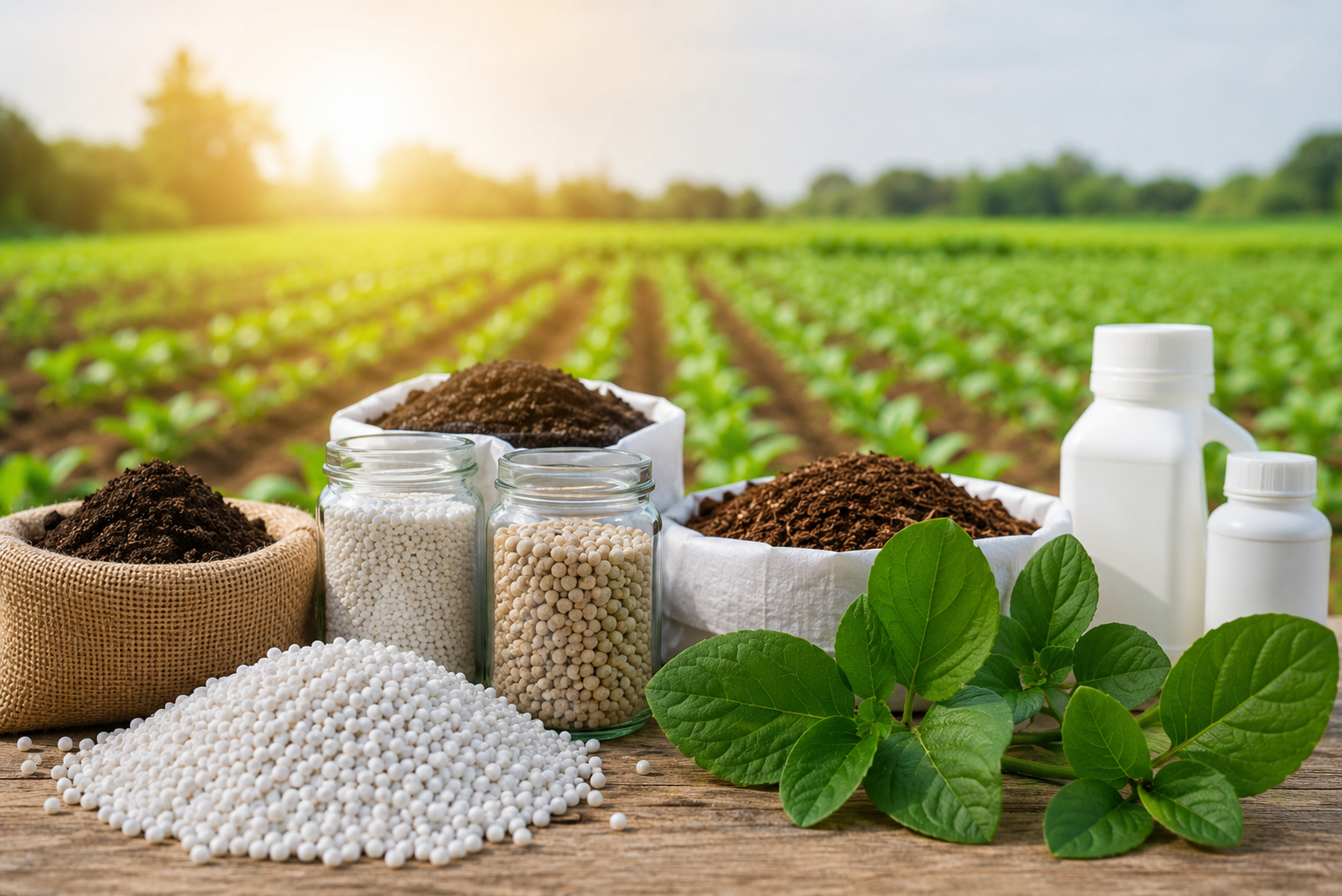

Agriculture & Agritech / Market Segment
All Types Of Fertilisers
Agriculture Inputs & All Types of Fertiliser Markets
The Agriculture Inputs & All Types of Fertiliser Markets segment represents a critical component of the global agricultural economy, supporting crop productivity, soil health, and food security across commercial farming and horticultural operations. This segment encompasses a wide range of nutrient-based agricultural products designed to improve plant growth, increase crop yields, and optimize agricultural efficiency under varying climatic and soil conditions.
The segment operates at the intersection of agricultural production, chemical manufacturing, biotechnology, environmental sustainability, and precision farming practices. It includes conventional chemical fertilizers, organic nutrient solutions, specialty fertilizers, and advanced crop nutrition technologies that collectively support modern agricultural systems.
Scope of the Agriculture Inputs & All Types of Fertiliser Markets Segment
This segment includes, but is not limited to:
Nitrogen-based fertilizers
Urea, ammonium nitrate, ammonium sulfate, calcium ammonium nitrate (CAN), and other nitrogen-rich products widely used to stimulate vegetative crop growth and improve productivity.
Phosphate fertilizers
Diammonium phosphate (DAP), monoammonium phosphate (MAP), single super phosphate (SSP), and other phosphorus-based fertilizers essential for root development, flowering, and energy transfer in plants.
Potash fertilizers
Potassium chloride (MOP), potassium sulfate (SOP), and related potash products that enhance crop quality, drought resistance, and nutrient balance.
Compound and NPK fertilizers
Balanced nutrient fertilizers containing nitrogen (N), phosphorus (P), and potassium (K) in varying ratios tailored for specific crops and soil requirements.
Organic and bio-based fertilizers
Compost fertilizers, manure-based products, microbial fertilizers, seaweed extracts, biofertilizers, and sustainable crop nutrition solutions designed to improve soil fertility and environmental sustainability.
Specialty and micronutrient fertilizers
Zinc, boron, iron, magnesium, calcium, sulfur, and trace-element fertilizers developed to address nutrient deficiencies and enhance crop-specific performance.
Controlled-release and water-soluble fertilizers
Advanced nutrient delivery products designed for precision agriculture, greenhouse cultivation, hydroponics, and high-efficiency farming applications.
Liquid fertilizers and foliar nutrition products
Liquid nutrient formulations and foliar sprays that enable rapid nutrient absorption and targeted crop feeding.
Agricultural soil conditioners and crop enhancement products
Products used to improve soil structure, water retention, nutrient uptake efficiency, and long-term agricultural productivity.
Market Characteristics
The Agriculture Inputs & All Types of Fertiliser Markets segment is characterized by several structural and operational dynamics:
- Strong dependence on global food production and agricultural output requirements
- Seasonal demand cycles influenced by crop planting and harvesting patterns
- High sensitivity to commodity prices, weather conditions, and geopolitical supply disruptions
- Increasing emphasis on sustainable agriculture and environmentally responsible nutrient management
- Rising adoption of precision farming technologies and smart fertilizer application systems
- Regulatory oversight concerning environmental emissions, nutrient runoff, and chemical usage
- Continuous innovation in biofertilizers, controlled-release nutrients, and specialty crop nutrition products
- Dependence on global raw material availability, including natural gas, phosphate rock, and potash reserves
Market demand is driven by population growth, food security concerns, shrinking arable land availability, evolving dietary consumption patterns, and the need for higher agricultural productivity.
Value Chain Perspective
This segment operates through a complex agricultural and industrial value chain that includes:
- Extraction and sourcing of raw materials such as phosphate rock, potash minerals, and natural gas
- Chemical processing, nutrient formulation, and fertilizer manufacturing
- Product blending, granulation, packaging, and quality assurance
- Distribution through agricultural cooperatives, wholesalers, retailers, and agri-input networks
- Integration with precision farming technologies and agronomic advisory services
- Farm-level application through broadcasting, fertigation, foliar spraying, and controlled nutrient delivery systems
- Crop monitoring, soil testing, and nutrient optimization practices to improve yield efficiency
Efficient value chain coordination is essential for ensuring timely fertilizer availability, cost optimization, and sustainable agricultural performance.
Strategic Importance Within the Agricultural Industry
Agriculture Inputs & All Types of Fertiliser Markets holds substantial strategic importance by:
- Supporting global food production and agricultural yield optimization
- Enhancing soil fertility and long-term crop productivity
- Enabling large-scale commercial farming and precision agriculture adoption
- Driving agricultural modernization through advanced nutrient technologies
- Contributing to food security amid growing global population pressures
- Supporting sustainable farming practices and resource-efficient agriculture
- Influencing commodity supply stability and agricultural trade dynamics
As global agriculture continues to evolve toward higher efficiency, sustainability, and technology integration, the fertilizer market remains a foundational pillar of modern crop production systems, agricultural supply chains, and long-term food security strategies.