
Global EV Thermal Management Systems Market Report, Size & Forecast 2026 - 2033
Global EV Thermal Management Systems Market Forecast Snapshot 2026 - 2033
| Metric | Value |
|---|---|
| Base Year | 2025 |
| Base Market Size | USD 4.20 billion |
| Forecast Window | 2026–2033 |
| Baseline CAGR | 14.58% |
| Optimistic CAGR | 17.08% |
| Conservative CAGR | 12.08% |
| Baseline 2033 Market Size | USD 12.48 billion |
| Largest Region (EV sales share) | China (~55% of global EV sales, indicative for thermal demand) |
| Fastest Growing Region (EV sales growth 2025) | Southeast Asia (+100%), Latin America (+75%) |
| Top Segment (by system criticality) | Battery Thermal Management |
| Key Trends | Integrated thermal modules (Hanon HICE, Bosch air compressor), natural refrigerant adoption, coolant plate optimization |
| Primary Drivers | Global EV sales growth, regulatory mandates (EU Battery Regulation, UN ECE R100.04) |
| Main Restraints | Compliance costs, supply-side constraints (refrigerant phase-down, battery fire risk) |
| Future Focus | Cold-weather range improvement, heat pump integration, system-level efficiency |
Global EV Thermal Management Systems Market Overview
The EV thermal management systems market encompasses cooling and heating components for battery packs, power electronics, electric drive units, and cabin HVAC in battery electric, hybrid, and fuel-cell electric vehicles. The market includes coolant fluids, refrigerants, thermal interface materials, pumps, valves, heat exchangers, temperature sensors, control units, and system integration services. Excluded are aftermarket service, battery management systems (except thermal monitoring), stationary storage thermal management, and non-automotive EV applications. The forecast covers global revenues for the base year 2025 and the projection window 2026–2033.
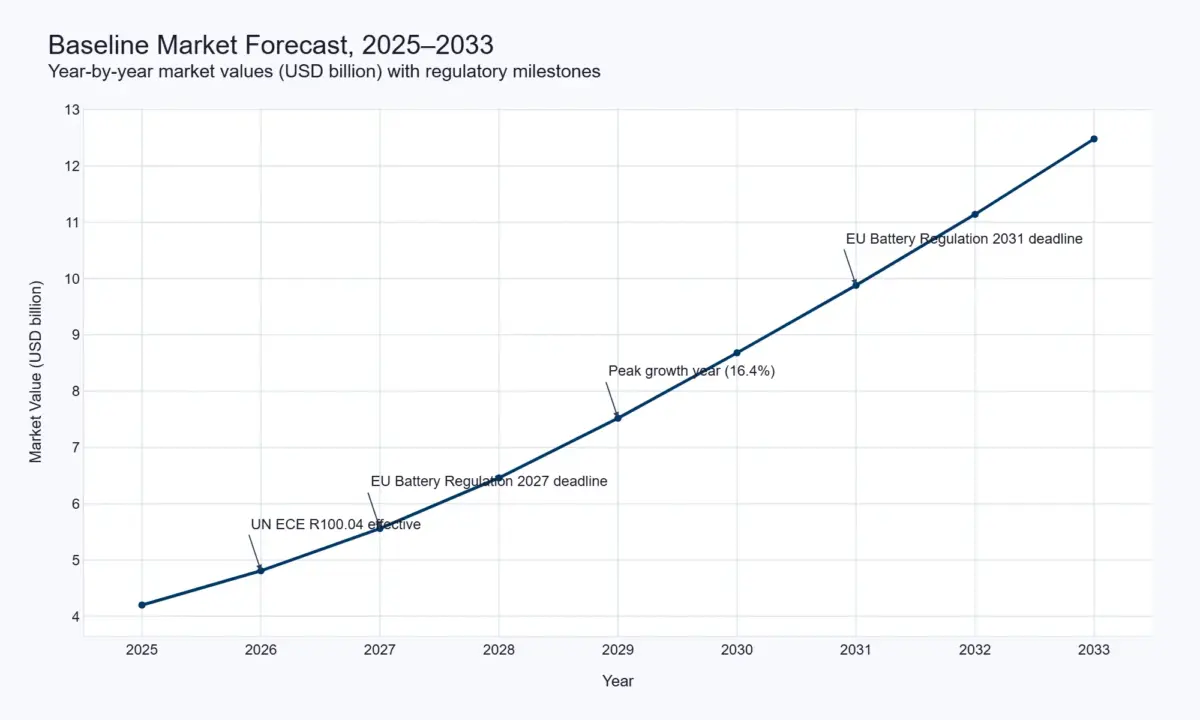
The base market size of USD 4.20 billion in 2025 (single web estimate) sets the anchor for a robust growth trajectory. With a baseline CAGR of 14.58%, the market is projected to reach USD 12.48 billion by 2033. Growth is front-loaded, peaking at 16.41% in 2029 before decelerating to 12.01% in 2033 as early capital expenditure and technology ramp-up saturates. The optimistic scenario (17.08% CAGR) depends on sustained investment, favourable regulation, and continued EV adoption, while the conservative scenario (12.08% CAGR) reflects delayed adoption and supply constraints.
Global EV sales (BEV+PHEV) exceeded 20 million in 2025, growing 20% year-on-year, with emerging markets posting triple-digit growth. Regulatory forces—particularly the EU Battery Regulation (2023/1542) recycling targets and UN ECE R100.04 thermal testing requirements—are creating both compliance costs and mandated system upgrades, shaping the forecast inflection points.
Key Takeaways
- The market will grow from USD 4.20 billion in 2025 to USD 12.48 billion in 2033 at a baseline CAGR of 14.58%, driven by EV sales growth and regulatory mandates.
- Growth is front-loaded, peaking in 2029 at 16.41% (baseline) before decelerating to 12.01% in 2033 as the early capital expenditure and technology ramp-up matures.
- Regulatory targets, including the EU Battery Regulation recycling quotas and UN ECE R100.04 thermal testing requirements, create both compliance costs and mandatory system upgrades, adding volatility during 2027–2031.
- Global EV sales exceeded 20 million units in 2025 (20% YoY growth), while emerging markets such as Southeast Asia and Latin America recorded triple-digit growth, significantly expanding the addressable market for thermal management systems.
- The optimistic scenario (17.08% CAGR) depends on continued investment in thermal technologies and supportive regulation, whereas the conservative scenario (12.08% CAGR) reflects slower EV adoption and supply-side constraints.
Market Forecast: Scenario Analysis and Growth Path
Authoritative Year-by-Year Market Values and Growth Rates (Baseline Scenario)
| Year | Market Value (USD Billion) | Annual Growth Rate (%) |
|---|---|---|
| 2025 | 4.20 | Base Year |
| 2026 | 4.81 | 14.58 |
| 2027 | 5.56 | 15.59 |
| 2028 | 6.46 | 16.07 |
| 2029 | 7.52 | 16.41 |
| 2030 | 8.68 | 15.43 |
| 2031 | 9.88 | 13.93 |
| 2032 | 11.14 | 12.70 |
| 2033 | 12.48 | 12.01 |
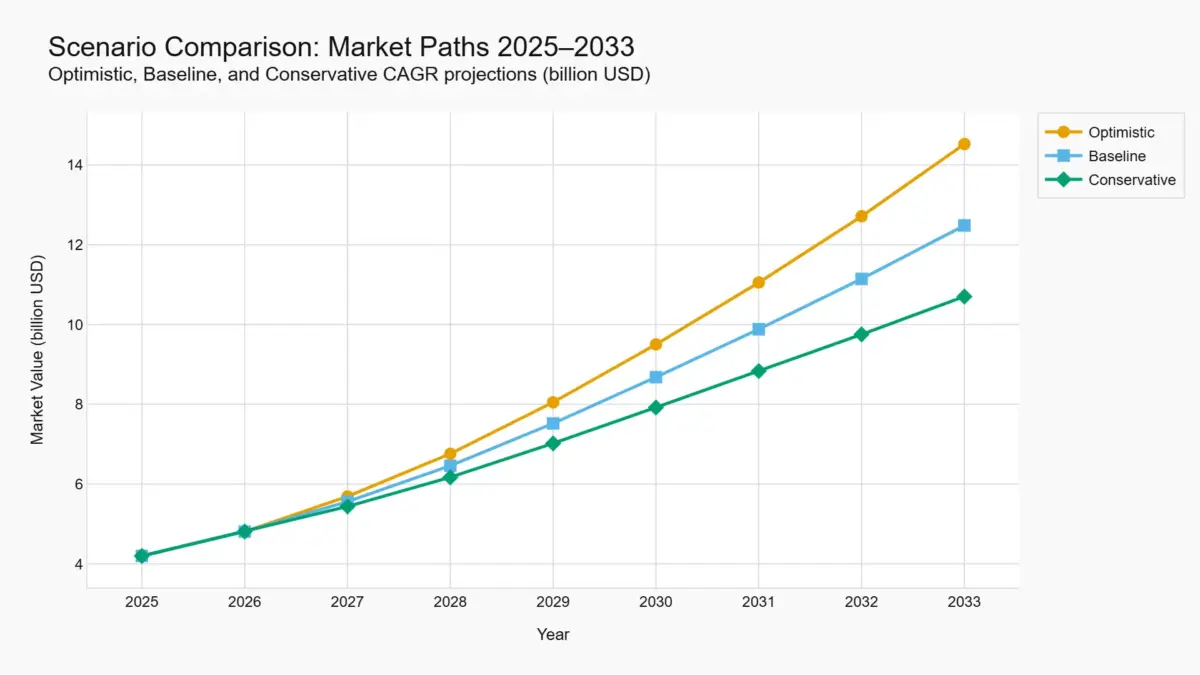
- Optimistic Scenario (17.08% CAGR): Driven by sustained technology investment, continued EV adoption, and favourable regulatory developments, producing the strongest growth trajectory.
- Baseline Scenario (14.58% CAGR): Projects a market value of USD 12.48 billion by 2033, assuming steady EV adoption and moderate compliance costs.
- Conservative Scenario (12.08% CAGR): Reflects slower EV adoption, supply-side challenges, and increased cost pressures, resulting in lower market growth.
Yearly Growth Rates by Scenario (2027–2033)
| Year | Optimistic (%) | Baseline (%) | Conservative (%) |
|---|---|---|---|
| 2027 | 18.26 | 15.59 | 13.06 |
| 2028 | 18.74 | 16.07 | 13.45 |
| 2029 | 19.07 | 16.41 | 13.71 |
| 2030 | 17.98 | 15.43 | 12.82 |
| 2031 | 16.35 | 13.93 | 11.47 |
| 2032 | 15.01 | 12.70 | 10.37 |
| 2033 | 14.26 | 12.01 | 9.75 |
Drivers, Restraints, Opportunities, and Threats
Key Drivers
1. Global EV Sales Growth
Global EV sales (BEV+PHEV) increased by 20% in 2025 to exceed 20 million units, meaning one in four new vehicles sold worldwide was electric (IEA Global EV Outlook 2026). This sustained growth directly increases demand for battery cooling, power electronics cooling, and HVAC systems. China represented nearly 55% of global EV sales, Europe recorded 30% growth, and emerging markets such as Southeast Asia (+100%) and Latin America (+75%) experienced exceptional expansion. As the EV fleet grows, demand for thermal management systems rises proportionally across both OEM and future aftermarket applications.
2. Regulatory Mandates on Safety and Recycling
The EU Battery Regulation (2023/1542) establishes progressive recycling and recycled-content targets, while UN ECE R100.04 introduces continuous temperature monitoring requirements during battery testing. These regulations require enhanced thermal monitoring, improved cooling system design, material traceability, and design-for-disassembly, increasing the value and complexity of thermal management systems despite adding compliance costs.
3. Technology Innovation in Cooling and Refrigerants
Recent advances in liquid cooling plates, natural refrigerants, and thermal optimisation are improving EV thermal performance. Optimised cold plate designs reduce battery temperatures and pressure losses, while the shift toward low-GWP refrigerants such as R290 and R744 creates demand for advanced compressors, heat exchangers, and integrated thermal modules. These innovations increase average system value and support higher market growth.
Restraints
1. Compliance Costs and Regulatory Burden
Meeting EU Battery Regulation recycling targets and UN ECE R100.04 testing requirements requires significant investment in engineering, product validation, and material recovery. Smaller suppliers may face higher development costs and longer product qualification timelines, placing pressure on profitability.
2. Supply Constraints and Raw Material Volatility
The EU F-gas Regulation accelerates the phase-down of conventional refrigerants, requiring redesign of thermal systems around alternative refrigerants. Meanwhile, battery safety recalls and fluctuating aluminium and copper prices continue to increase manufacturing costs for cooling plates, heat exchangers, and thermal components.
Opportunities
1. Emerging Market Expansion
Rapid EV adoption across Southeast Asia and Latin America presents significant opportunities for suppliers capable of localising manufacturing and delivering cost-effective thermal management solutions suited to regional requirements.
2. Cold-Weather Range Improvement via Heat Pumps
Advanced integrated heat pump systems capable of simultaneously managing battery, cabin, and powertrain temperatures can significantly improve driving range under cold conditions, creating opportunities for next-generation thermal system suppliers.
Threats
1. Regulatory Volatility
Future PFAS restrictions in the United States and continued refrigerant regulations in Europe may require repeated system redesigns and increase product development costs if replacement refrigerants fail to meet performance expectations.
2. Cell Quality and Fire Risk
Battery cell defects and thermal runaway incidents can reduce consumer confidence in EVs, slow adoption, increase warranty costs, and create additional regulatory scrutiny. Consequently, manufacturers must continue investing in advanced thermal monitoring and cooling technologies.
Global EV Thermal Management System Market Segmentation
- 1.1 By System Type
- 1.1.1 Battery Thermal Management System (BTMS)
- 1.1.2 Cabin Thermal Management System
- 1.1.3 Power Electronics Thermal Management System
- 1.1.4 Electric Powertrain Thermal Management System
- 1.2 By Technology
- 1.2.1 Air-Based Thermal Management
- 1.2.2 Liquid-Based Thermal Management
- 1.2.3 Refrigerant-Based Thermal Management
- 1.2.4 Advanced Thermal Technologies
- 1.3 By Vehicle Type
- 1.3.1 Passenger Electric Vehicles
- 1.3.2 Commercial Electric Vehicles
- 1.3.3 Electric Buses
- 1.3.4 Off-Highway Electric Vehicles
- 1.4 By Component
- 1.4.1 Compressors
- 1.4.2 Heat Exchangers
- 1.4.3 Pumps & Valves
- 1.4.4 Sensors & Control Units
- 1.5 By Sales Channel
- 1.5.1 Original Equipment Manufacturer (OEM)
- 1.5.2 Aftermarket
Regional Insights
While regional revenue data specific to EV thermal management systems is not available, the IEA Global EV Outlook 2026 provides a reliable indication of regional EV adoption trends that directly influence demand for thermal management systems.
1. China
China accounted for nearly 55% of global EV sales in 2025. Its dominance in battery cell manufacturing, EV production, and integrated supply chains makes it the world's largest market for EV thermal management systems, although exact revenue shares are not available.
2. Europe
Europe recorded approximately 30% growth in EV sales, with electric vehicles accounting for 28% of new vehicle registrations. Stringent CO₂ emission standards, the EU Battery Regulation, and F-gas refrigerant regulations are accelerating demand for advanced battery cooling systems, heat pumps, and next-generation thermal management technologies.
3. United States
The United States represented approximately 10% of global EV sales. Although the market continues to expand, uncertainty surrounding EV incentive programmes creates some volatility. The anticipated PFAS restrictions by 2029 are expected to accelerate the transition toward alternative refrigerants and advanced thermal technologies.
4. Southeast Asia and Latin America
Southeast Asia and Latin America recorded exceptional EV sales growth exceeding 75–100%, led by Viet Nam, Indonesia, Thailand, Brazil, and Mexico. Although these markets currently represent a relatively small installed base, they offer the strongest long-term growth opportunities for thermal management suppliers through increasing vehicle electrification and local manufacturing expansion.
The regulatory landscape varies significantly across regions. Europe continues to lead in lifecycle sustainability and refrigerant regulations, while China focuses on manufacturing scale, localisation, and production efficiency. Consequently, thermal management suppliers must develop flexible product platforms capable of meeting multiple regional regulatory frameworks.
Leading Companies in the Market
The competitive landscape includes several leading manufacturers and technology providers involved in EV thermal management solutions.
1. Kobe Steel (Japan)
Supplies aluminium alloy clad sheets used in battery coolers and heat exchangers, with expertise in thin-gauge materials and corrosion-resistant technologies.
2. Sanhua Intelligent Controls (China)
A leading supplier of thermal control valves, including solenoid and expansion valves, serving major OEMs such as Tesla and BYD while holding an estimated 50% global share in four-way reversing valves.
3. Hanon Systems (South Korea/United States)
Developed the HICE integrated thermal module, combining electric compressors, valves, heat exchangers, and sensors into a lightweight 16 kg system first deployed in the BMW iX3.
4. Bosch (Germany)
Supplies integrated electric air compressors ranging from 20 kW to 30 kW for fuel-cell electric vehicles through its partnership with Cellcentric, the Daimler Truck and Volvo Group joint venture.
5. Modine (United States)
Expanding commercial EV thermal management manufacturing capacity in Wisconsin while strengthening its market position through the merger with Gentherm's Performance Technologies business.
6. Valeo (France)
Announced a US$26 million manufacturing expansion in Nevada focused on producing advanced serpentine battery cooling ribbons for electric vehicles.
7. Kaori Heat Treatment (Taiwan)
Investing NT$3.25 billion in next-generation thermal management manufacturing capabilities to support future EV demand.
8. Gentherm (United States)
Expanding its EV thermal portfolio through integration with Modine's Performance Technologies business, combining thermal management expertise with advanced precision flow technologies.
9. Other Industry Participants
Other major companies, including Denso, Mahle, and Danfoss, remain active participants in the EV thermal management market, although detailed information was not included within the supplied evidence.
Why the Market Is Growing at 14.58% CAGR
The EV thermal management systems market is expected to nearly triple in value between 2025 and 2033 due to the combined impact of rapidly expanding EV production and increasingly stringent regulatory requirements. Global EV sales exceeded 20 million units in 2025, significantly increasing demand for battery cooling, power electronics cooling, electric drive thermal management, and cabin HVAC systems.
Regulatory initiatives such as the EU Battery Regulation and UN ECE R100.04 are simultaneously increasing thermal management requirements by mandating enhanced battery safety, improved thermal monitoring, and greater recyclability. At the same time, technological innovations—including advanced cooling plate designs, integrated thermal modules, natural refrigerants, and heat pump technologies—are increasing system complexity and average revenue per vehicle.
The forecast exhibits a front-loaded growth profile as manufacturers invest heavily in production capacity and technology development during the early years of the forecast period. Growth gradually moderates after 2029 as the market matures, regulatory compliance costs increase, and investment cycles stabilise. Consequently, thermal management systems are becoming an essential compliance requirement rather than simply a vehicle performance enhancement, ensuring sustained long-term market growth.
Table of Contents
1. Executive Summary
1.1 Global EV Thermal Management Systems Market Snapshot (2025–2033)
1.2 Market Size & CAGR Analysis
1.3 Largest Region & Fastest-Growing Region
1.4 Top System Segment & Key Technology Trends
1.5 Key Regional Insights
1.6 Major Market Growth Drivers
1.7 Competitive Landscape Overview
1.8 Strategic Outlook Through 2033
2. Introduction & Market Overview
2.1 Definition of EV Thermal Management Systems
2.2 Scope of the Study
2.3 Evolution of EV Thermal Management Technologies
2.4 EV Thermal Management Value Chain Analysis
2.5 Global EV Thermal Ecosystem & Supply Chain Landscape
2.6 Regulatory Framework for EV Thermal Management Systems
2.7 Technology Innovations in Thermal Management Systems
3. Research Methodology
3.1 Primary Research
3.2 Secondary Research
3.3 Market Size Estimation Model
3.4 Forecast Assumptions (2025–2033)
3.5 Data Validation & Market Triangulation
4. Market Dynamics
4.1 Drivers
4.1.1 Global EV Sales Growth
4.1.2 Regulatory Mandates on Battery Safety & Recycling
4.1.3 Technology Innovation in Cooling Systems & Refrigerants
4.1.4 Rising Adoption of Heat Pump Systems
4.1.5 Increasing System-Level Thermal Integration
4.2 Restraints
4.2.1 Compliance Costs & Regulatory Burden
4.2.2 Supply Constraints & Raw Material Price Volatility
4.2.3 Refrigerant Transition Challenges
4.2.4 High Development & Validation Costs
4.3 Opportunities
4.3.1 Expansion in Emerging EV Markets
4.3.2 Cold-Weather Range Improvement Through Heat Pumps
4.3.3 Adoption of Natural Refrigerants & Integrated Thermal Modules
4.3.4 AI-Driven Thermal Optimization & Smart Energy Management
4.4 Challenges
4.4.1 Regulatory Volatility Across Global Markets
4.4.2 Battery Cell Quality & Thermal Runaway Risks
4.4.3 Complex System Integration Requirements
4.4.4 Cost Optimization While Meeting Safety Standards
5. Global EV Thermal Management Systems Market Analysis (USD Billion), 2025–2033
5.1 Market Size Overview
5.2 CAGR Analysis
5.3 Regional Revenue Distribution
5.4 Segment Revenue Analysis
5.5 Technology Adoption Analysis
5.6 Regulatory & Investment Trends
5.7 Baseline Market Forecast Scenario (2025–2033)
5.8 Optimistic vs. Conservative Forecast Scenario Analysis
6. Market Segmentation (USD Billion), 2025–2033
6.1 By System Type
6.1.1 Battery Thermal Management System (BTMS)
6.1.1.1 Air Cooling Systems
6.1.1.1.1 Passive Air Cooling
6.1.1.1.1.1 Natural Convection, Forced Air & Hybrid Air Cooling
6.1.1.2 Liquid Cooling Systems
6.1.1.3 Refrigerant Direct Cooling Systems
6.1.1.4 Phase Change Material (PCM) Cooling Systems
6.1.2 Cabin Thermal Management System
6.1.3 Power Electronics Thermal Management System
6.1.4 Electric Powertrain Thermal Management System
6.2 By Technology
6.2.1 Air-Based Thermal Management
6.2.2 Liquid-Based Thermal Management
6.2.3 Refrigerant-Based Thermal Management
6.2.4 Advanced Thermal Technologies
6.3 By Vehicle Type
6.3.1 Passenger Electric Vehicles
6.3.2 Commercial Electric Vehicles
6.3.3 Electric Buses
6.3.4 Off-Highway Electric Vehicles
6.4 By Component
6.4.1 Compressors
6.4.2 Heat Exchangers
6.4.3 Pumps & Valves
6.4.4 Sensors & Control Units
6.5 By Sales Channel
6.5.1 Original Equipment Manufacturer (OEM)
6.5.2 Aftermarket
7. Market Segmentation by Geography
7.1 North America
7.2 Europe
7.3 Asia-Pacific
7.4 Latin America
7.5 Middle East & Africa
8. Competitive Landscape
8.1 Market Share Analysis
8.2 Technology Benchmarking
8.3 Product Portfolio Analysis
8.4 Strategic Partnerships, Investments & Acquisitions
8.5 Sustainability & Innovation Strategies
9. Company Profiles
9.1 Kobe Steel Ltd.
9.2 Sanhua Intelligent Controls Co., Ltd.
9.3 Hanon Systems
9.4 Robert Bosch GmbH
9.5 Modine Manufacturing Company
9.6 Valeo SA
9.7 Kaori Heat Treatment Co., Ltd.
9.8 Gentherm Incorporated
9.9 Denso Corporation
9.10 MAHLE GmbH
9.11 Danfoss A/S
9.12 BorgWarner Inc.
9.13 Vitesco Technologies Group AG
9.14 Valeo Thermal Systems
9.15 Modine EV Thermal Solutions
10. Strategic Intelligence & Pheonix AI Insights
10.1 Pheonix EV Thermal Demand Forecast Engine
10.2 Thermal Technology Innovation Tracker
10.3 Regulatory Compliance Intelligence Dashboard
10.4 EV Thermal Market Opportunity Monitor
10.5 Automated Porter’s Five Forces Analysis
11. Future Outlook & Strategic Recommendations
11.1 Integrated Thermal Module Adoption Outlook
11.2 Heat Pump & Natural Refrigerant Adoption Strategy
11.3 Manufacturing Localization & Supply Chain Strategy
11.4 Battery Safety & Thermal Efficiency Roadmap
11.5 Long-Term Market Outlook (2033+)
12. Appendix
13. About Pheonix Research
14. Disclaimer
Competitive Landscape
Global EV Thermal Management Systems Competitive Landscape
The EV thermal management systems competition landscape chapter maps the supplier, OEM, and integrator interactions that define how thermal components are designed, sourced, and integrated into battery electric and fuel-cell vehicles. The 2025 market is estimated at USD 4.20 billion (single web estimate), covering battery pack cooling, fuel-cell thermal management, and power electronics cooling. Core participants include thermal system integrators, automotive OEMs, battery pack producers, Tier 1 manufacturers, metal and fluid suppliers, and aftermarket distributors. The supplied evidence supports a single, well-defined partnership that shapes the fuel-cell thermal management segment; no further competitor rankings, regional splits, or market share data are available in this packet.
Key Takeaways
-
- A single dominant partnership—Bosch supplying integrated electric air compressors to Cellcentric—shapes the fuel-cell thermal management segment through a long-term agreement and vertical integration.
- The integrated compressors combine air management and power electronics in two power classes (20 kW and 30 kW) covering voltage ranges up to 850 V, indicating a trend toward system-level components.
- Cellcentric, a 50:50 joint venture of Daimler Truck and Volvo Group, gives the partnership direct access to heavy-truck and stationary fuel-cell applications, affecting downstream OEMs and pack assemblers.
- Large-scale production starting around the middle of the decade provides a near-term competitive timeline for suppliers aiming to replicate or compete with this integrated solution.
- The 2025 market size of USD 4.20 billion (single web estimate) sets a scale context, but competitive intensity data beyond this partnership is not available in the supplied packet.
Chapter Scope and Market Boundary
This chapter covers the competition landscape for EV thermal management systems, including battery pack cooling, fuel-cell thermal management, and power electronics cooling. The analysis focuses on supplier–OEM partnerships, product integration strategies, and participant segmentation as of 2025. The market boundary follows the market taxonomy supplied in the packet: products such as thermal runaway containment systems and oil cooling for e-axles; technologies such as computational fluid dynamics simulation; applications including EV battery pack and powertrain assembly; end users such as electric vehicle OEMs, commercial EV manufacturers, and battery pack producers; and services such as aftermarket EV service and supply chain logistics.
Core participants are grouped into:
-
- Thermal system integrators – companies that design and assemble complete thermal loops.
- Automotive OEMs – vehicle manufacturers that define thermal architecture requirements.
- Battery pack producers – the primary integrators of battery-cooling systems.
- Tier 1 component manufacturers – suppliers of pumps, compressors, valves, and heat exchangers.
- Metal and fluid suppliers – providers of aluminum extrusions, copper tubing, coolants, and refrigerants.
- Aftermarket parts distributors – channels for replacement and service components.
The 2025 market size of USD 4.20 billion is drawn from a single web estimate and should be treated as an indicative figure. No further market-sizing data, revenue splits, or regional breakdowns are supplied. The competitive landscape analysis that follows is therefore anchored to the one substantiated market relationship in the supplied data.
Strategic Partnership in Fuel-Cell Thermal Management
Bosch and Cellcentric have entered a long-term supply agreement for electric air compressors with integrated power electronics, a component that governs the oxygen supply in fuel-cell systems. The agreement positions Bosch as a Tier 1 manufacturer delivering a system-level part rather than a discrete air-handling component. Cellcentric, formed as a 50:50 joint venture between Daimler Truck AG and Volvo Group AB, is responsible for the entire fuel-cell value chain and aims to become a leading global manufacturer of fuel-cell systems.
Bosch offers the compressor in two power classes, detailed in the table below. The 30 kW variant is rated for 450–850 V, while the 20 kW variant is available in two voltage ranges (250–450 V or 450–850 V). Both variants feature a compressor wheel that reaches speeds above 100,000 rpm. The integration of power electronics directly into the compressor housing reduces wiring, simplifies assembly, and improves thermal management of the electronics themselves—a step toward vertical integration that changes how fuel-cell systems are designed.
Comparison of Bosch Integrated Electric Air Compressor Power Classes for Fuel-Cell Systems
| Parameter | 20 kW Class | 30 kW Class |
|---|---|---|
| Power rating | 20 kW | 30 kW |
| Voltage range option 1 | 250–450 V | — |
| Voltage range option 2 | 450–850 V | 450–850 V |
| Integrated power electronics | Yes | Yes |
| Compressor wheel speed | >100,000 rpm | >100,000 rpm |
| Intended application (from agreement) | Heavy trucks & stationary fuel-cell systems | Heavy trucks & stationary fuel-cell systems |
Large-scale production is scheduled to begin around the middle of the decade. The source material includes a future-dated reference (2050), which is treated as a placeholder; the operational timeline cited in the Bosch press release points to a mid-decade start of series production. This timing signals to the market that integrated, high-power-density compressors will be available at scale within the next few years, influencing thermal management system design choices for fuel-cell heavy trucks and stationary power units.
Implications for Competitive Dynamics and Participant Segmentation
The Bosch–Cellcentric partnership illustrates a broader competitive mechanism: vertical integration of a critical thermal management component. By combining the air compressor with its power electronics, Bosch delivers a sub-system that reduces the number of interfaces the fuel-cell system integrator (Cellcentric) must manage. This integration model (vertical integration, as identified in the supporting data) can lower system cost and assembly complexity while potentially raising barriers for modular suppliers that offer only discrete compressors or separate power stages.
The partnership directly affects several downstream participant segments. Cellcentric’s fuel-cell systems are destined for heavy trucks and stationary applications. Consequently, commercial electric vehicle manufacturers (e.g., Daimler Truck and Volvo Group through their joint venture) and battery pack producers involved in fuel-cell hybrid architectures will be early adopters of the integrated compressor. EV powertrain assembly and battery pack assembly markets also feel the effect, as the thermal management strategy for fuel-cell systems cascades into the design of cooling loops, heat exchangers, and control systems.
For other Tier 1 suppliers (e.g., those producing conventional electric air compressors without integrated power electronics), the mid-decade production timeline creates a window to develop competing integrated solutions. The cost-and-scale competitive dimension, as indicated by the supplied evidence, suggests that the partnership targets economies of scale to underpin a leading market position. Suppliers that cannot match the integration level or voltage capability (up to 850 V) may be relegated to lower-power applications or legacy platforms.
Illustration Recommendation: Illustrate how the integrated electric air compressor supplies oxygen to the fuel-cell stack, showing the combination of the compressor wheel and power electronics as a single unit and its connection to the fuel-cell thermal management loop.
Supporting Evidence: Bosch–Cellcentric partnership details from the claim ledger (air compressor function, power classes, voltage ranges, integrated power electronics).
Visualization Focus:
-
- Highlight the oxygen-supply role as the core component.
- Show the integration of power electronics within the compressor.
- Indicate downstream connections to heavy-truck and stationary fuel-cell applications.
Value Chain
EV Thermal Management Systems Value Chain Overview
The value chain for EV thermal management systems begins with raw metal processing, moves through component fabrication and system integration, and ends with vehicle assembly and in-use thermal cycling. This chapter traces the flow from upstream materials through component and system integration based on three sources. The market is estimated at USD 4.20 billion in 2025, although this figure is derived from a single web source and has not been independently verified.
Key Takeaways
- Kobe Steel supplies specialized aluminum alloy clad sheets that meet thin-gauge, high-strength, and corrosion-resistant requirements for automotive heat exchangers and battery coolers.
- Hanon Systems’ Highly Integrated Cooling Entity (HICE) module combines multiple thermal management components into a single 16 kg unit, reducing system complexity and packaging space. The module was first deployed in the BMW iX3.
- Sanhua Intelligent Controls has successfully transitioned from HVAC valves to EV thermal management valves, securing Tesla as a major customer while leveraging its approximately 50% global market share in four-way reversing valves.
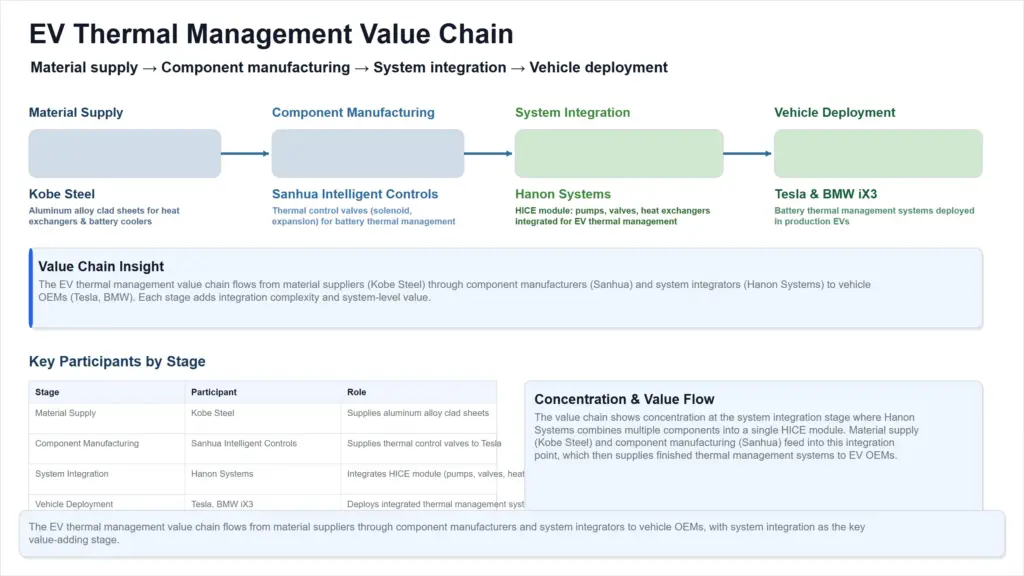
- The value chain is evolving into two distinct segments: component specialists such as Sanhua and system integrators such as Hanon Systems, each competing to capture greater value as EV thermal architectures become increasingly integrated.
Material Supply for Thermal Management
Kobe Steel supplies aluminum alloy clad sheets used in automotive heat exchangers and battery cooling systems. These clad sheets consist of multiple aluminum alloy layers engineered to deliver high thermal conductivity, excellent formability, reliable brazeability, mechanical strength, and corrosion resistance.
Kobe Steel’s product portfolio includes brazing alloys (4045MOD, 4047, 4045, 4343), core alloys (3003MOD, 3N33, 3003), and sacrificial or interlayer alloys (3003MOD Al-Si-Mn-Zn, 1100, 7072MOD Al-Si-Zn, and 7072). These materials are used for battery cooler plates, fin stock, plate stock, and tube stock that serve as the foundation for battery thermal management systems and passenger cabin HVAC heat exchangers.
The company also focuses on developing low-carbon recycled aluminum sheets to support carbon neutrality objectives, although no production timeline or manufacturing volume has been disclosed.
Component Manufacturing and System Integration
Sanhua Intelligent Controls, headquartered in Zhejiang, China, supplies thermal control valves for Tesla’s battery thermal management systems. Founded in 1979 as a farm machinery repair business, the company transitioned into refrigeration components and introduced solenoid valves in 1987, challenging established Japanese manufacturers. By 2006, Sanhua had achieved approximately 50% global market share in four-way reversing valves, a key HVAC component, further strengthened through the acquisition of US-based Ranco in 2007.
The company entered the automotive sector in 2006 and subsequently secured Tesla as a customer, successfully transferring its HVAC valve expertise into EV thermal management applications. Sanhua also supplies thermal management components to BYD, although additional customer information is not available.
Hanon Systems, a South Korean automotive thermal management supplier and subsidiary of Hankook & Company Group, provides its Highly Integrated Cooling Entity (HICE) module to electric vehicle manufacturers. The HICE module integrates an eCompressor, electronic expansion valve block, water-cooled condenser, internal heat exchanger, chiller, refrigerant lines, and pressure and temperature sensors into a single 16 kg assembly.
The integrated design reduces system complexity, improves thermal efficiency, enhances energy utilization, and contributes to extended vehicle driving range. The HICE module was first introduced in BMW’s fully electric iX3 SUV and demonstrates the industry’s movement toward highly integrated thermal management architectures that simplify vehicle assembly while reducing packaging requirements.
Selected Participants in the EV Thermal Management Value Chain
| Stage | Participant | Activity | Geography | Status |
|---|---|---|---|---|
| Material Supply | Kobe Steel | Supplies aluminum alloy clad sheets for heat exchangers and battery coolers | Japan | Active Supplier |
| Component Manufacturing | Sanhua Intelligent Controls | Supplies thermal control valves (solenoid and expansion valves) for Tesla | China | Active Supplier |
| System Integration | Hanon Systems | Integrates HICE module combining eCompressor, valves, heat exchangers, and sensors | South Korea / United States | Active Supplier; First deployed in BMW iX3 |
The contrasting business models of Sanhua and Hanon Systems illustrate two distinct approaches within the EV thermal management value chain. Sanhua focuses on specialized thermal components, while Hanon Systems integrates multiple components into complete thermal management modules. Future vehicle thermal architectures will determine how value is distributed between component manufacturers and system integrators.
Investment Activity
Investment in EV Thermal Management Systems
This chapter covers announced capital investments, joint ventures, and mergers in the EV thermal management systems market, focusing on battery and powertrain cooling components for electric and hybrid vehicles. Investments in HVAC systems for passenger comfort are included only if explicitly tied to EV thermal management. Aftermarket and service investments are excluded due to insufficient data.
Key Takeaways
-
- Five significant investment actions were announced between 2025 and 2027, totaling more than US$100 million in direct capital expenditure across three greenfield expansions (Modine US$1.6 million, Valeo US$26 million, and Kaori NT$3.25 billion), along with a US$210 million cash infusion resulting from the Gentherm–Modine transaction.
- Investments span North America (Wisconsin and Nevada) and Asia-Pacific (India and Taiwan), demonstrating global manufacturing expansion driven by EV adoption policies and OEM localization strategies.
- Corporate restructuring through a joint venture (Tata AutoComp–Jahwa) and a merger (Gentherm–Modine) is proving as strategically important as greenfield capital expenditure, reshaping the competitive landscape and expanding technology access.
- Commercial and specialty electric vehicles, including fire trucks, delivery vans, buses, and construction equipment, represent a distinct growth segment for Modine, highlighting different thermal management requirements compared with passenger EVs.
- Kaori’s investment targets both automotive thermal management and AI infrastructure and energy transition applications, indicating growing cross-industry demand that could influence future component availability and pricing.
Greenfield Capacity Expansions and New Production Lines
Three announced greenfield investments demonstrate the scale and strategic rationale behind expanding manufacturing capacity for EV thermal management components. Each project targets a different geographic market and application segment.
Modine: Commercial EV Thermal Systems in Wisconsin
In January 2025, Modine announced plans to lease a 153,000-square-foot manufacturing facility in Franklin, Wisconsin, to produce thermal management systems for specialty and commercial electric vehicles, including fire trucks, last-mile delivery vehicles, municipal buses, and construction equipment.
The City of Franklin approved US$1.6 million in Tax Increment Financing (TIF) to support the project. Modine expects to begin occupying the facility during 2025 and plans to create 200 full-time jobs by 2029. The investment reflects increasing demand for dedicated thermal management solutions designed specifically for commercial EV applications.
Valeo: Cooling Ribbon Production Line in Nevada
In June 2026, Valeo North America announced a US$26 million investment to expand its Storey County, Nevada manufacturing facility with a new production line for serpentine cooling ribbons, a critical component used in electric vehicle battery cooling systems.
The project received approval for state tax abatements through the Nevada Governor’s Office of Economic Development and will create 173 new jobs, increasing Valeo’s regional workforce from 290 to 463 employees. Over the next decade, the expansion is expected to generate more than US$11.3 million in additional tax revenue, US$177 million in regional payroll, and an estimated US$1 billion in total economic impact. The investment highlights the growing importance of advanced battery thermal management technologies for improving EV safety and performance.
Kaori: Flagship Manufacturing Hub in Taiwan
Kaori Heat Treatment Co., Ltd. initiated construction of a NT$3.25 billion manufacturing facility at Qiaotou Science Park in Kaohsiung, Taiwan. The development covers approximately 4.69 hectares and will be completed in multiple phases, with Phase I occupying roughly half of the total site.
The facility will manufacture next-generation thermal management products and energy-related technologies serving both the EV industry and AI infrastructure markets. Commercial production is targeted to begin in 2027. As the largest investment in the company’s history, the facility’s manufacturing capacity is expected to exceed the combined capacity of all existing Kaori production sites.
Greenfield Capacity Expansion Comparison
| Project / Company | Investor or Partner | Geography | Amount / Capacity | Timing | Status |
|---|---|---|---|---|---|
| Modine Commercial EV Thermal Facility | Modine (Self-funded with TIF support) | Franklin, Wisconsin, USA | US$1.6 million TIF; 153,000 sq ft; 200 jobs by 2029 | Announced January 2025; occupancy during 2025; full employment by 2029 | Planned / Under Construction |
| Valeo Serpentine Cooling Ribbon Line | Valeo North America (State tax abatements) | Storey County, Nevada, USA | US$26 million capex; 173 new jobs; US$177 million payroll impact | Announced June 2026 | Planned |
| Kaori Qiaotou Manufacturing Hub | Kaori Heat Treatment (Self-funded) | Kaohsiung, Taiwan | NT$3.25 billion; 4.69 hectares; capacity exceeds all existing facilities | Groundbreaking 2027; production target 2027–2028 | Under Construction (Phase I) |
Strategic Alliances and Corporate Restructuring
Beyond greenfield manufacturing investments, two major corporate transactions are reshaping competition within the EV thermal management systems market.
Tata AutoComp–Jahwa Electronics Joint Venture
On 28 May 2026, Tata AutoComp Systems Ltd. entered into a joint venture with South Korea’s Jahwa Electronics to manufacture advanced low-voltage and high-voltage PTC heaters for electric and hybrid vehicles in India.
The partnership combines Jahwa’s thermal technology with Tata Group’s manufacturing scale and market presence. The venture is intended to position India as a strategic production hub supplying both domestic and international automotive OEMs while strengthening the companies’ presence within the rapidly expanding EV market.
Gentherm–Modine Performance Technologies Merger
On 29 January 2026, Gentherm Incorporated announced a definitive agreement to combine with Modine’s Performance Technologies business through a Reverse Morris Trust transaction.
Under the agreement, Modine will separate its Performance Technologies division into a standalone entity, which will subsequently merge with a Gentherm subsidiary. Modine will receive US$210 million in cash, while its shareholders will own approximately 40% of the combined Gentherm business following completion of the transaction.
The merger is designed to strengthen product portfolios across thermal management and precision flow management while creating greater component-to-system integration capabilities, demonstrating the growing importance of scale and portfolio diversification within the EV thermal management market.
Technology & Innovation
Technology Landscape in EV Thermal Management Systems
Introduction
Recent advances in liquid cooling plate optimization and natural refrigerant adoption are redefining the performance and regulatory landscape of electric vehicle (EV) thermal management systems. Component suppliers and original equipment manufacturers (OEMs) are increasingly investing in multi-objective design tools and alternative refrigerant integration as the industry shifts toward safer, more efficient, and environmentally compliant thermal architectures.
The global EV thermal management system market is estimated at USD 4.20 billion in 2025, highlighting the economic significance of these technological developments.
Key Takeaways
- A CFD-GPR-NSGA-II optimization framework for mini-channel liquid cooling plates achieves simultaneous reductions of 0.569 K in maximum temperature, 0.557 K in temperature difference, and 43.25% in pressure drop under 4C discharge conditions.
- Serpentine liquid cold plates reduce peak battery temperature by 2.7% and improve temperature uniformity by 20% compared with conventional parallel-flow designs while limiting pumping losses to only 4.2% of the thermal energy removed.
- The anticipated U.S. PFAS ban by 2029 is accelerating evaluation of propane (R290) and carbon dioxide (R744) as alternatives to R1234yf. The European Commission’s QUIET project demonstrated a 25% increase in cold-weather driving range using a propane-based heat pump.
- Both liquid cooling plate innovations and natural refrigerant technologies have progressed to a stage where system-level integration and multi-objective optimization are becoming essential for meeting future performance and regulatory requirements.
- The estimated USD 4.20 billion market size in 2025 highlights the growing commercial importance of thermal management components affected by these technological advancements.
Visualization Recommendation
Illustrate the major EV thermal management technology families, their current maturity stages, manufacturing readiness, material systems, and primary applications.
Supporting evidence is derived from published 2026 literature, including MDPI Energies, Nature Scientific Reports, SAE, and Springer.
The visualization should compare:
-
- Liquid cooling plate technologies.
- Natural refrigerant technologies.
- Technology maturity.
- Manufacturing readiness.
- Primary application areas.
Liquid Cooling Plate Design Optimization
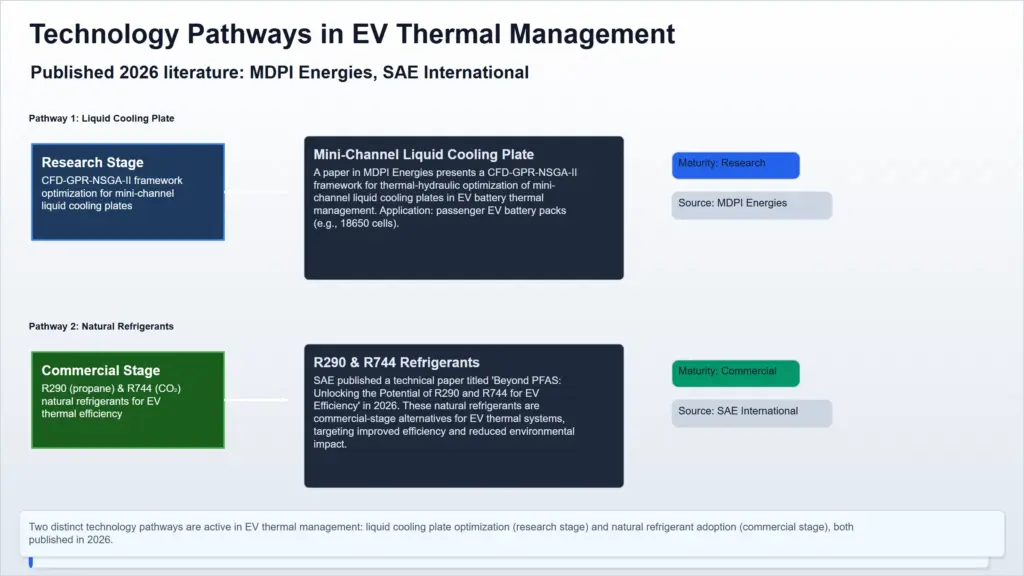
Battery thermal management systems must balance efficient heat removal with low hydraulic resistance to maximize battery safety, durability, and overall vehicle efficiency. Two recent studies published during 2026 demonstrate measurable improvements in liquid cooling plate performance.
A study published in MDPI Energies developed a multi-objective optimization framework combining:
-
- Computational Fluid Dynamics (CFD)
- Gaussian Process Regression (GPR)
- Non-Dominated Sorting Genetic Algorithm II (NSGA-II)
The framework optimized a mini-channel liquid cooling plate for a cylindrical 18650 lithium-ion battery module operating under a 4C discharge rate.
Three design variables were optimized:
-
- Channel thickness
- Wall thickness
- Coolant inlet velocity
Using Latin Hypercube Sampling, CFD simulations generated training data for GPR surrogate models, while NSGA-II identified Pareto-optimal solutions.
The optimized design achieved:
-
- Maximum temperature reduction of 0.569 K.
- Temperature difference reduction of 0.557 K.
- Pressure drop reduction of 43.25%.
- Additional 10.06% improvement in temperature uniformity compared with the initial design.
The study demonstrates that surrogate-assisted optimization can effectively improve thermal performance while minimizing hydraulic losses.
A second study published in Nature Scientific Reports evaluated a serpentine aluminum liquid cooling plate integrated into a 288-cell prismatic battery pack.
Operating conditions included:
-
- Total thermal load of 2880 W.
- Coolant flow rate of 9.84 L/min.
The cooling system maintained:
-
- Cell temperatures between 298 K and 308 K.
- Maximum temperature of 315.3 K.
- Temperature non-uniformity within ±4°C.
Performance results included:
-
- Pressure drop of 15 kPa.
- Pumping losses equal to only 4.2% of the thermal energy removed.
- Peak temperature reduction of 2.7% compared with a parallel-flow cold plate.
- Temperature uniformity improvement of 20%.
These findings provide practical guidance for designing compact, energy-efficient battery thermal management systems.
Comparison of Cooling Plate Design Optimization Results (2026 Studies)
| Technology Pathway | Metric | Result | Study Context |
|---|---|---|---|
| CFD-GPR-NSGA-II Optimized Mini-Channel Cold Plate | Maximum Temperature Reduction | 0.569 K | Cylindrical 18650 module under 4C discharge |
| Temperature Difference Reduction | 0.557 K (10.06% additional improvement) | ||
| Pressure Drop Reduction | 43.25% | ||
| Serpentine Liquid Cold Plate | Peak Temperature Reduction | 2.7% | 288-cell prismatic battery pack |
| Temperature Uniformity Improvement | 20% | ||
| Pressure Drop | 15 kPa | ||
| Pumping Losses | 4.2% of thermal energy removed |
For battery pack designers and thermal management system integrators, these studies indicate that advanced optimization techniques combining surrogate modeling and evolutionary algorithms can significantly improve both thermal and hydraulic performance. Serpentine cooling architectures offer an immediately deployable solution for reducing auxiliary power consumption while improving temperature uniformity and enabling more compact battery pack designs.
Refrigerant Alternatives for EV Thermal Systems
Growing regulatory restrictions on per- and polyfluoroalkyl substances (PFAS) are reshaping refrigerant selection for EV thermal management systems.
A 2026 SAE technical paper, “Beyond PFAS: Unlocking the Potential of R290 and R744 for EV Efficiency,” evaluates three refrigerants:
-
- R1234yf (current baseline)
- Propane (R290)
- Carbon dioxide (R744)
The anticipated U.S. PFAS ban by 2029 is increasing the urgency for OEMs to qualify alternative refrigerants.
Propane (R290)
R290 offers significantly lower Global Warming Potential (GWP) than R1234yf but is classified as flammable.
AVL developed several mitigation measures, including:
-
- Rapid refrigerant leak detection.
- Improved containment strategies.
- Optimized refrigerant circuit layouts.
These technologies were validated during the European Commission’s QUIET Project, where a Honda B-segment EV equipped with:
-
- A propane-based heat pump.
- Thermal energy storage.
- Infrared cabin heating.
- Lightweight vehicle components.
achieved a 25% increase in cold-weather driving range while maintaining passenger comfort.
An AI-based thermal management controller further improved system efficiency through coordinated energy and thermal management.
Carbon Dioxide (R744)
R744 is:
-
- Non-flammable.
- Characterized by a GWP of 1.
However, its high operating pressures require dedicated system components.
A 2026 Springer review titled “Advances and Challenges of R744-Based Thermal Management Systems in Electric Vehicles” identifies CO₂ as a promising refrigerant pathway, particularly for heat pump applications and improved cold-weather driving performance.
Comparison of Refrigerant Alternatives for EV Thermal Systems
| Refrigerant | Global Warming Potential | Flammability | Performance | Regulatory Outlook |
|---|---|---|---|---|
| R1234yf | 4 | Mildly Flammable (A2L) | Baseline | Potential PFAS restrictions by 2029 |
| R290 (Propane) | 3 | Flammable (A3) | 25% cold-weather range improvement demonstrated in QUIET Project | PFAS-free; safety mitigation required |
| R744 (CO₂) | 1 | Non-Flammable (A1) | Strong potential for heat pump systems | PFAS-free; requires high-pressure system design |
The transition toward natural refrigerants has important implications for system architecture, safety validation, and vehicle performance. R290 requires advanced leak detection and safety engineering, while R744 demands specialized high-pressure components. Both refrigerants support heat pump integration capable of improving vehicle range in low-temperature operating conditions.
Market Trajectory and Technology Convergence
The estimated USD 4.20 billion EV thermal management system market in 2025 provides the commercial backdrop for the cooling plate and refrigerant technologies described above.
Technology convergence is occurring in two primary areas.
First, both cooling plate optimization and refrigerant innovation aim to improve overall vehicle energy efficiency.
Examples include:
-
- Serpentine cooling plates reducing pumping losses.
- Natural refrigerants improving heat pump efficiency.
Second, both technologies increasingly depend on advanced simulation tools and multi-objective optimization methods.
The CFD-GPR-NSGA-II framework illustrates how simultaneous optimization of thermal and hydraulic performance can support future system-level thermal architecture design, including refrigerant selection and cooling system integration.
Several uncertainties remain within the available evidence:
-
- Adoption rates of serpentine versus parallel cooling plates are not reported.
- Cost implications of transitioning from R1234yf to R290 or R744 remain unavailable.
- System integration complexity and safety certification costs are not quantified.
- Most performance results are based on academic studies and a limited number of demonstration projects, with the QUIET project providing the primary real-world validation.
Nevertheless, regulatory pressure from the anticipated PFAS restrictions together with demonstrated improvements in cooling performance and heat pump efficiency indicate that investment in advanced cooling plate architectures and natural refrigerant technologies is expected to accelerate.
The convergence of multi-objective optimization, advanced liquid cooling geometries, and environmentally sustainable refrigerants positions EV thermal management systems for continued technological advancement. Suppliers capable of delivering validated, cost-effective, and regulatory-compliant thermal management solutions will be well positioned to capture opportunities within this growing market.
Market Risk
EV Thermal Management Systems Market Risk & Disruption Analysis
Market Scope and Risk Profile
The EV thermal management systems market encompasses cooling and heating solutions for battery packs, power electronics, electric drive units, and cabin HVAC in battery electric vehicles (BEVs), hybrid electric vehicles (HEVs), and fuel-cell electric vehicles (FCEVs). The market includes components such as coolant fluids, refrigerants, thermal interface materials, pumps, valves, heat exchangers, and system integration services. Core participants include thermal management system integrators, automotive OEMs, battery pack manufacturers, Tier 1 component suppliers, and metal and fluid suppliers.
This chapter analyzes two distinct but material risk vectors supported by observed evidence: an acute operational liability risk arising from battery fire incidents and a structural regulatory risk resulting from the phasedown of fluorinated refrigerants. Together, these risks increase design complexity, supply chain vulnerability, and product liability exposure for system integrators and OEMs.
Key Takeaways
- A Nissan Leaf recall involving 573 vehicles with a 100% suspected cell defect rate demonstrates that battery fire risk resulting from internal short circuits remains a significant operational liability, requiring enhanced cell traceability and thermal runaway mitigation.
- EU Regulation (EU) 2024/573 mandates a phasedown of HFC refrigerants, reflected in a 37% decline by metric tonnes and a 47% decline by CO₂ equivalent, directly constraining the refrigerant supply chain for EV thermal management systems.
- The two risks affect different thermal management subsystems. Battery fire risk increases demand for enhanced battery pack cooling and monitoring, while refrigerant regulation drives substitution toward low-GWP alternatives such as CO₂ and HFOs for HVAC and battery chiller systems.
- Both risks increase compliance and redesign costs across the value chain. The vehicle recall creates immediate traceability and repair costs, while the refrigerant regulation extends producer responsibility to waste F-gas management, creating long-term financial obligations for fluid suppliers and system integrators.
Battery Fire Risk: Operational Liability and System Design Pressure
A significant example of battery fire risk emerged in early 2026 when Nissan recalled certain Model Year 2026 Leaf vehicles because of a potential internal short circuit caused by suspect cathode material within battery cells. According to the NHTSA Part 573 Safety Recall Report, one confirmed thermal event occurred in Osaka, Japan, on 19 February 2026, where a parked, non-charging vehicle overheated and caught fire.
The recall covers 573 vehicles, with Nissan estimating that every recalled vehicle contains at least one suspect battery cell.
The affected batteries maintain one-to-one traceability between battery identification numbers and vehicle identification numbers (VINs), supported by supplier Charge-Discharge Check inspection records. This confirms that the defect originated during cell manufacturing and can be accurately traced throughout the supply chain. The immediate failure mechanism involves an internal short circuit that causes battery overheating and may escalate into thermal runaway, increasing the risk of fire, personal injury, and property damage.
For the EV thermal management systems market, this incident significantly increases engineering requirements. System integrators and OEMs are under greater pressure to enhance battery pack cooling capacity, implement advanced cell monitoring, and develop stronger thermal runaway prevention and containment solutions. Although no additional Nissan or Infiniti models were affected, the incident highlights broader vulnerabilities associated with battery cell quality and supply chains. The likely market impact is increased system complexity and higher validation costs for OEMs and battery pack manufacturers using comparable battery technologies.
Regulatory Risk: Refrigerant Phase-Down and Supply Chain Disruption
Alongside operational risks, the regulatory environment presents a separate but equally important challenge. The European Union’s Regulation (EU) 2024/573 on fluorinated greenhouse gases directly affects the refrigerant supply chain supporting HVAC and battery cooling systems.
The regulation documents a 37% reduction in hydrofluorocarbon (HFC) consumption measured by metric tonnes and a 47% reduction measured by CO₂ equivalent, demonstrating an already tightening refrigerant supply.
Beyond limiting HFC availability, the regulation expands producer responsibility to include collection, treatment, recovery, and environmentally sound disposal of fluorinated greenhouse gases from waste electrical and electronic equipment. These requirements align with the polluter-pays principle and Directive 2012/19/EU, creating additional long-term financial and operational obligations for manufacturers.
For thermal management system integrators and refrigerant suppliers, the regulation requires a transition away from high-GWP HFC refrigerants toward lower-GWP alternatives such as CO₂ and hydrofluoroolefins (HFOs). This transition requires significant redesign of condensers, evaporators, compressors, and related thermal management components to accommodate different thermodynamic characteristics and operating pressures.
The regulation also requires Member States to develop skilled workforces capable of handling refrigerants that may be toxic, flammable, or operate under higher pressures, increasing workforce training and certification costs. Automotive OEMs developing vehicles for the European market face the greatest short-term disruption because compliance must be incorporated into future vehicle platforms throughout the phasedown period.
Comparative Risk Assessment: Battery Fire vs. Refrigerant Regulation
The following table compares the two supported risk events across key dimensions, highlighting their different mechanisms, exposed participants, timing, and market implications.
Comparative Risk Assessment: Battery Fire vs. Refrigerant Regulation
| Risk Event | Risk Type | Trigger / Mechanism | Exposed Participants | Timing | Supported Evidence of Magnitude | Primary Market Implication |
|---|---|---|---|---|---|---|
| Battery Fire Risk (Nissan Leaf Recall) | Operational / Safety / Liability | Internal short circuit caused by suspect cathode material within battery cells | Nissan (OEM), battery cell supplier, thermal management system integrators | Acute (Incident: February 2026; Recall: 2026) | 573 vehicles affected; one confirmed thermal event; 100% suspect cell rate; one-to-one battery-to-VIN traceability | Increased engineering requirements for thermal runaway prevention, advanced battery monitoring, and enhanced battery pack cooling |
| Regulatory Risk (EU F-gas Regulation 2024/573) | Regulatory / Supply Chain | HFC phasedown through quota reductions and extended producer responsibility for waste fluorinated gases | Refrigerant suppliers, thermal management system integrators, OEMs serving the European market | Structural / Phased (Effective from 2024; ongoing phasedown) | 37% reduction in HFC consumption (metric tonnes); 47% reduction (CO₂ equivalent); expanded producer responsibility | Mandatory transition to low-GWP refrigerants (CO₂ and HFOs), requiring redesign of HVAC and battery cooling systems |
The timing of these risks differs significantly. The Nissan recall represents a short-term operational event during 2026, creating immediate traceability, recall, and repair costs. By contrast, the F-gas regulation became effective in 2024 and introduces a long-term phased transition requiring continuous redesign and compliance efforts. Despite these differences, both risks increase engineering complexity, regulatory compliance obligations, and overall cost burdens for thermal management system integrators and automotive OEMs.
Regulatory Landscape
Introduction
Recent advances in liquid cooling plate optimisation and natural refrigerant adoption are redefining the performance and regulatory landscape of electric vehicle (EV) thermal management systems. Component suppliers and original equipment manufacturers (OEMs) are increasingly investing in multi-objective design tools and alternative refrigerant integration as the industry transitions toward safer, more efficient, and environmentally compliant thermal architectures.
The global EV Thermal Management Systems Market is estimated at USD 4.20 billion in 2025, highlighting the significant commercial scale at which these technological innovations are taking place.
Key Takeaways
- A CFD-GPR-NSGA-II optimisation framework for mini-channel liquid cooling plates achieves simultaneous reductions of 0.569 K in maximum temperature, 0.557 K in temperature variation, and 43.25% in pressure drop under 4C battery discharge conditions.
- Serpentine liquid cold plate designs reduce peak battery temperature by 2.7% and improve temperature uniformity by 20% compared with conventional parallel-flow designs while limiting pumping losses to only 4.2% of the thermal energy removed.
- The anticipated US PFAS ban by 2029 is accelerating evaluation of R290 (propane) and R744 (carbon dioxide) as alternatives to R1234yf. The European Commission’s QUIET project demonstrated a 25% improvement in cold-weather driving range using a propane-based heat pump.
- Both advanced cooling plate architectures and natural refrigerant technologies have reached a stage where system-level integration and multi-objective optimisation are becoming essential to achieving performance, efficiency, and regulatory compliance targets.
- The estimated USD 4.20 billion market value in 2025 demonstrates the growing economic significance of thermal management technologies across the global EV industry.
Technology Families, Maturity Stages and Applications
The following technology pathways are supported by published 2026 literature covering liquid cooling plate optimisation and natural refrigerant adoption.
| Technology | Material / Chemistry | Maturity Stage | Manufacturing Status | Primary Application |
|---|---|---|---|---|
| CFD-GPR-NSGA-II Optimised Mini-Channel Cold Plate | Liquid-cooled aluminium mini-channel plate | Advanced research / prototype optimisation | Engineering optimisation | Battery thermal management |
| Serpentine Liquid Cold Plate | Aluminium serpentine cooling plate | Near-commercial design | Production-oriented evaluation | Large battery packs |
| R1234yf | HFO refrigerant | Commercial baseline | Mass production | EV HVAC and heat pumps |
| R290 (Propane) | Hydrocarbon refrigerant | Demonstration / pre-commercial adoption | Pilot deployment | Heat pumps and HVAC |
| R744 (CO₂) | Natural refrigerant | Advanced development | Early commercial adoption | Heat pumps and HVAC |
Liquid Cooling Plate Design Optimisation
Battery thermal management systems must balance efficient heat dissipation with acceptable hydraulic performance to maximise safety, battery life, and vehicle efficiency. Two major 2026 studies demonstrate significant advances in cooling plate optimisation.
CFD-GPR-NSGA-II Multi-Objective Optimisation
A study published in MDPI Energies developed a multi-objective optimisation framework combining:
-
- Computational Fluid Dynamics (CFD).
- Gaussian Process Regression (GPR).
- Non-Dominated Sorting Genetic Algorithm II (NSGA-II).
The framework was applied to a mini-channel liquid cooling plate for a cylindrical 18650 lithium-ion battery module operating under 4C discharge.
Three design variables were optimised:
-
- Channel thickness.
- Wall thickness.
- Coolant inlet velocity.
Using Latin Hypercube Sampling, CFD simulations generated training data for surrogate models before NSGA-II identified Pareto-optimal solutions.
The selected design achieved:
-
- 0.569 K reduction in maximum temperature.
- 0.557 K reduction in temperature difference.
- 43.25% reduction in pressure drop.
- 10.06% additional improvement in temperature uniformity compared with the original configuration.
These results demonstrate that surrogate-assisted optimisation effectively balances thermal and hydraulic performance.
Serpentine Liquid Cooling Plate
A second study published in Nature Scientific Reports evaluated a serpentine aluminium liquid cooling plate integrated into a 288-cell prismatic battery pack.
Under a thermal load of 2880 W and coolant flow rate of 9.84 L/min, the battery pack maintained:
-
- Cell temperatures between 298 K and 308 K.
- Maximum temperature of 315.3 K.
- Temperature variation within ±4°C.
Performance improvements compared with a conventional parallel-flow cold plate included:
-
- 2.7% reduction in peak temperature.
- 20% improvement in temperature uniformity.
- Pressure drop of 15 kPa.
- Pumping losses equal to only 4.2% of thermal energy removed.
Comparison of Cooling Plate Optimisation Results (2026 Studies)
| Technology | Metric | Result | Study Context |
|---|---|---|---|
| CFD-GPR-NSGA-II Mini-Channel Cold Plate | Maximum temperature reduction | 0.569 K | 18650 cylindrical battery module, 4C discharge |
| Temperature difference reduction | 0.557 K (10.06% additional improvement) | ||
| Pressure drop reduction | 43.25% | ||
| Serpentine Cold Plate | Peak temperature reduction | 2.7% | 288-cell prismatic battery pack |
| Temperature uniformity improvement | 20% | ||
| Pressure drop | 15 kPa | ||
| Pumping losses | 4.2% of thermal energy removed |
For battery manufacturers and thermal system suppliers, these studies indicate that advanced optimisation techniques and improved cooling geometries can significantly enhance thermal performance while reducing auxiliary energy consumption.
Refrigerant Alternatives for EV Thermal Systems
Increasing regulatory pressure to eliminate per- and polyfluoroalkyl substances (PFAS) is driving the transition toward natural refrigerants.
A 2026 SAE paper titled “Beyond PFAS: Unlocking the Potential of R290 and R744 for EV Efficiency” evaluates three refrigerant pathways:
-
- R1234yf (current industry baseline).
- R290 (propane).
- R744 (carbon dioxide).
R290 (Propane)
Propane offers significantly lower Global Warming Potential (GWP) than R1234yf but introduces flammability concerns.
AVL developed several mitigation strategies:
-
- Rapid leak detection.
- Improved refrigerant containment.
- Optimised refrigerant circuit layouts.
These technologies were validated within the European Commission QUIET Project, where a Honda B-segment EV equipped with:
-
- Propane heat pump.
- Thermal storage.
- Infrared cabin heating.
- Lightweight materials.
achieved:
-
- 25% improvement in cold-weather driving range.
- Maintained passenger comfort.
- Improved efficiency through AI-based thermal control.
R744 (Carbon Dioxide)
R744 offers:
-
- Global Warming Potential (GWP) of 1.
- Non-flammable operation.
- Strong suitability for heat pump integration.
However, the refrigerant requires higher-pressure system components and dedicated hardware design.
Comparison of Refrigerant Alternatives (2026)
| Refrigerant | Global Warming Potential | Flammability | Efficiency | Regulatory Outlook |
|---|---|---|---|---|
| R1234yf | 4 | Mildly flammable (A2L) | Industry baseline | Potentially affected by US PFAS restrictions after 2029 |
| R290 (Propane) | 3 | Flammable (A3) | 25% cold-weather range improvement demonstrated in QUIET project | Not affected by PFAS restrictions; safety measures required |
| R744 (CO₂) | 1 | Non-flammable (A1) | Strong heat pump performance | Not affected by PFAS restrictions; requires high-pressure components |
The refrigerant transition has important implications for safety validation, thermal system design, and cold-weather driving range. Manufacturers adopting propane must implement comprehensive safety systems, while CO₂-based systems require specialised high-pressure hardware.
Market Trajectory and Technology Convergence
The estimated USD 4.20 billion EV Thermal Management Systems Market in 2025 provides the commercial foundation for continued innovation in cooling plate design and refrigerant technology.
Technology convergence is occurring across two complementary areas:
-
- Both cooling plate optimisation and natural refrigerants improve overall thermal system efficiency.
- Both technologies increasingly depend on system-level modelling and multi-objective optimisation during product development.
The CFD-GPR-NSGA-II optimisation framework illustrates how advanced simulation tools can simultaneously optimise thermal and hydraulic performance and may eventually support full-system optimisation, including refrigerant selection and overall thermal architecture.
Several uncertainties remain:
-
- Commercial adoption rates for serpentine versus parallel cooling plates have not yet been quantified.
- Cost implications of transitioning from R1234yf to R290 or R744 remain unclear.
- Additional safety certification and system integration costs have not yet been fully evaluated.
- Most performance evidence originates from individual academic studies and the European Commission’s QUIET demonstration project, with limited fleet-scale validation.
Nevertheless, tightening environmental regulations—particularly the anticipated US PFAS restrictions by 2029—combined with demonstrated improvements in thermal performance and vehicle range, are expected to accelerate industry investment in advanced cooling technologies.
The convergence of multi-objective optimisation, advanced cooling plate geometries, and natural refrigerants positions EV thermal management systems for sustained technological innovation. Companies capable of delivering validated, scalable, and cost-effective solutions are expected to benefit from the continued expansion of a market valued at USD 4.20 billion in 2025.