
Global Battery Recycling Market Report, Size & Forecast 2026-2033
Global Battery Recycling Market Forecast Snapshot 2026 - 2033
| Metric | Value |
|---|---|
| Base Year (2025) Market Size | 21.69 billion USD |
| Forecast Window | 2026–2033 |
| Market Direction | Strong Positive |
| Baseline CAGR (2026–2033) | 17.51% |
| Optimistic Scenario CAGR | 20.01% |
| Conservative Scenario CAGR | 15.01% |
| Baseline 2033 Endpoint Value | 78.83 billion USD |
| Largest Region (Estimated) | Asia-Pacific (policy-supported capacity in India, China, South Korea) |
| Fastest Growing Region (Estimated) | Europe (EU Battery Regulation, PERTE-funded capacity) |
| Dominant Technology Segment | Hydrometallurgical processing (highest strategic investment) |
| Fastest Growing Technology Segment | Direct regeneration / novel low-emission processes |
| Key Growth Driver | Regulatory mandates (EU recycled content, collection targets) |
| Primary Restraint | Feedstock gap: end-of-life EV batteries only ~15% of current input |
Global battery recycling market Overview
The global battery recycling market focuses on recovering critical materials such as lithium, cobalt, nickel, graphite, and copper from end-of-life lithium-ion batteries, production scrap, and consumer electronics waste. This forecast covers the period from 2025, with a base-year market size of USD 21.69 billion, through 2033. Over this period, the market is expected to shift from being largely supported by production scrap and portable electronics waste toward a feedstock mix increasingly influenced by retiring electric vehicle batteries and regulatory requirements.
-
- Peak Acceleration (2027–2029): Heavy upfront investments, improved recovery technology, and new regulations will drive a rapid initial surge.
- Post-2030 Stabilization: Growth rates will slow down as the market matures, but actual annual expansion remains substantial.
- Steady 17.51% CAGR (2026–2033): Government mandates support long-term demand, but limited battery feedstock and recycled metal price volatility constrain near-term growth.
Key Takeaways
-
- The battery recycling market is projected to grow from 21.69 billion USD in 2025 to 78.83 billion USD by 2033 at a baseline CAGR of 17.51%, with optimisticand conservative scenarios extending the range.
- Growth is front-loaded: annual rates peak at 19.62% in 2029 as early regulation-driven capacity and technology investments compound, then decelerate to 14.67% by 2033 as feedstock supply growth and margin compression moderate the pace.
- Recycling makes only a modest contribution to near-term self-sufficiency for critical materials. Researchers publishing in Nature (2026) found that recycled batteries fall short of policymakers' 2030–2036 targets for European lithium, with self-sufficiency reaching 31–78% only when strategic mining projects are included.
- Feedstock composition remains a binding constraint: end-of-life EV batteries account for only about 15% of current recycler input at Accurec, with the majority sourced from portable electronics and production scrap, indicating that the anticipated wave of retired EV batteries has not yet materialized.
- The EU Battery Regulation 2023/1542 creates structural demand through mandatory recycled content of 6% for lithium and nickel and 16% for cobalt by 2031, linking battery manufacturing to recycling output at regulatory scale.
Authoritative Year by Year Forecast Global Battery Recycling Market
| Year | Market Value (Billion USD) | Annual Growth Rate (%) | |
|---|---|---|---|
| 2025 | 21.69 | — | |
| 2026 | 25.48 | 17.51 | |
| 2027 | 30.07 | 18.00 | |
| 2028 | 35.71 | 18.74 | |
| 2029 | 42.71 | 19.62 | |
| 2030 | 50.74 | 18.79 | |
| 2031 | 59.42 | 17.12 | |
| 2032 | 68.75 | 15.69 | |
| 2033 | 78.83 | 14.67 |
Growth Shape and Scenario Analysis of the Global Battery Recycling Market
The baseline growth path is front-loaded, with annual rates increasing from 17.51% in 2026 to a peak of 19.62% in 2029 before declining steadily to 14.67% by 2033. This shape is driven by an early wave of capital expenditure and technology deployment—reflected in the dominant positive modifiers from investment and technology axes in 2027–2029—followed by the progressive weighing of competition and regulation-driven scaling as the market matures. The risk axis exerts a consistent negative modifier across all years, reflecting fire hazards, price volatility for recycled cobalt sulfate (payables narrowing to 74–75% in mid-2026), and regulatory enforcement actions that temper upside.
The three CAGR scenarios define a plausible range:
-
- Baseline (17.51% CAGR): 21.69 billion USD in 2025 to 78.83 billion USD in 2033. Assumes continued regulatory implementation in the EU and US, moderate technology adoption, and gradual feedstock volume growth from retiring EV batteries after 2030.
- Optimistic (20.01% CAGR): This scenario is supported by stronger-than-expected technology breakthroughs (e.g., solvothermal direct regeneration achieving 74% CO₂ reduction with 94.08% capacity retention), accelerated policy adoption (US federal recycling mandates or faster state EPR rollout), and earlier-than-expected arrival of large-scale end-of-life EV feedstock.
- Conservative (15.01% CAGR): This scenario reflects persistent feedstock constraints, slower-than-planned capacity expansions (e.g., Fortum's 28,000-tonne black mass target delayed beyond 2029), continued recycled-content price pressure (cobalt sulfate at 81,000 yuan/tonne), and regulatory fragmentation that increases compliance costs without driving volume.
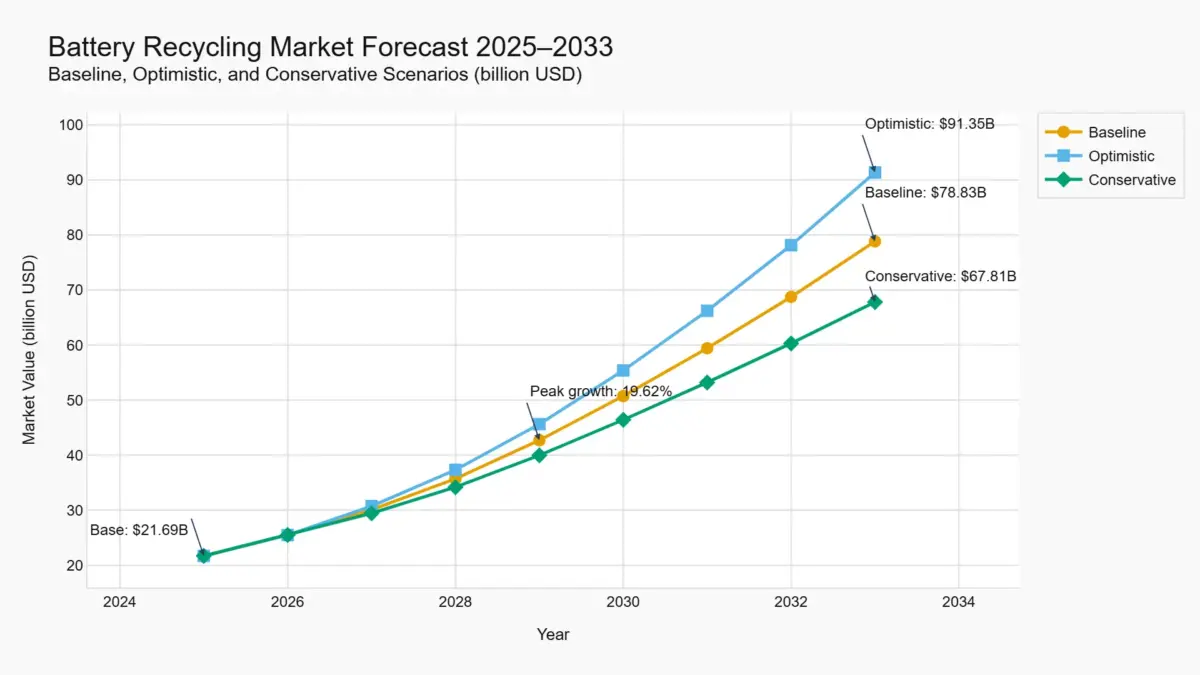 Global battery recycling market forecast 2025-2033-baseline-optimistic-and-conservative scenarios
Global battery recycling-market : Drivers, Restraints, Opportunities, and Threats
Key Drivers
Regulatory Mandates Creating Structural Demand
The EU Battery Regulation 2023/1542 stands as the single most consequential driver for recycling adoption over the forecast window. It imposes material recovery targets for lithium (50% by 2027, 80% by 2031), cobalt, nickel, and copper (90% by 2027, 95% by 2031), and mandatory recycled content in new batteries from 18 August 2031: 16% for cobalt, 85% for lead, 6% for lithium, and 6% for nickel. These provisions convert recycling from a discretionary activity into a compliance requirement for any battery manufacturer or OEM placing products on the EU market. The regulation also sets collection targets for portable batteries (63% by 2027, 73% by 2030) and LMT batteries (51% by 2028, 61% by 2031), directly increasing the feedstock available to recyclers.
Technology Innovation and Cost Reduction
Novel recycling processes are materially improving recovery economics. A solvothermal direct regeneration study (May 2026) demonstrated 94.08% capacity retention after 100 cycles with only 1.00 kg CO₂ per kg of NCM—a 74% reduction versus pyrometallurgy and 66% versus hydrometallurgy. Fortum's patented chromatographic ion-exchange process (granted US and China patents June 2026) selectively separates lithium from nickel and cobalt at low operating cost, enabling near-zero-waste closed-loop recycling. BatX Energies' hydro-electro process claims 99.95% purity for lithium, nickel, and cobalt from black mass with zero emissions, backed by $11 million in Series A funding in 2026. These innovations improve recycler margins and output quality, accelerating the substitution of secondary for primary materials.
EV Battery Retirement Wave Anticipated After 2030
According to data from CES, the global supply of used lithium-ion batteries will be almost three times higher in 2030 than in 2025, and eight times higher by 2035, covering all types of lithium-ion batteries. For long-lived batteries (EV, ESS, and industrial) that entered the market 15 years ago, the increase is significantly steeper, with volumes projected to rise from 5.8 GWh in 2025 to 28 GWh in 2030 and 106 GWh in 2035. This impending wave—though slower than early predictions—will fundamentally restructure recycler feedstock composition, reducing reliance on portable electronics and production scrap.
Investment Capacity Build-Out
Large-scale capital commitments are expanding processing capacity worldwide. In India, the National Critical Mineral Mission has catalyzed Recyclekaro's ₹300 crore (~$36 million) brownfield expansion to 50,000 metric tonnes and LICO Materials' ₹240 crore hydrometallurgical facility (10,000 TPA). In Spain, Gotion High-Tech is investing €950 million (€411.5 million for recycling alone) in a 200,000-tonne-per-year recycling plant with €138 million in PERTE grants. The Toyota Tsusho–LG Energy Solution joint venture in North Carolina targets 13,500 tons of scrap per year from 2026. These investments signal industry conviction that recycling capacity must scale ahead of feedstock availability.
Restraints
Feedstock Gap: Insufficient End-of-Life EV Batteries
The most binding near-term constraint is the mismatch between announced recycling capacity and available end-of-life EV battery feedstock. At Accurec's Krefeld facility (6,000 tonnes annual capacity), only approximately 15% of input comes from end-of-life EV batteries; the remainder is portable electronics, production scrap, and recalled products. With CES data showing global recycling volumes reaching only 28 GWh by 2030—a significant increase but still modest relative to installed capacity—many recyclers face the choice between razor-thin margins for volume or low revenues and high fixed costs. This feedstock gap limits utilization rates and depresses returns on invested capital.
Recycled Material Price Volatility
Recycled cobalt sulfate faces severe price pressure. A Fastmarkets assessment from 2026 reported prices as low as approximately 81,000 yuan per tonne in China, with payables narrowing to 74–75% in June 2026. China's April 2026 recycling framework prompted informal operators to liquidate black mass, accelerating oversupply. Downstream utilization rates across the recycling chain are estimated at 20–30%. Recycled graphite quality consistency also limits acceptance: a 2026 academic study found that thermal treatment temperature directly impacts surface functionalities critical for electrochemical performance, requiring precise process control to achieve battery-grade quality.
Operational and Safety Risks
An EPA report identified 64 US waste facilities that experienced 245 fires caused by or likely caused by lithium metal or lithium-ion batteries, with consequences including injuries, facility destruction, and emergency responses. Recent incidents in Maddington, Australia (April 2026) and Scotland (July 2026) confirm the global persistence of thermal runaway risk. Manual disassembly of automotive battery packs exposes workers to electrical hazards, with an Oak Ridge National Laboratory paper (2025) noting that no standard electrical safety practices existed until recently. These risks increase insurance costs, regulatory scrutiny, and operational complexity.
Opportunities
US Federal and State Regulatory Developments
The EPA's proposed Universal Waste Rule expansion (NPRM June 2025, final rule expected December 2026) would create a distinct lithium-battery category under RCRA, streamlining hazardous waste management and reducing compliance costs for recyclers. Maine and Oregon enacted comprehensive battery EPR laws in 2026, requiring producers to finance collection and recycling. While the US currently lacks federal recycling or recycled content targets, the regulatory trajectory toward mandatory producer responsibility creates a clear opportunity for recyclers to position as compliance partners.
Direct Regeneration as a Disruptive Technology Pathway
Solvothermal and other direct regeneration processes preserve the original cathode crystal structure rather than breaking materials down to individual elements. This approach eliminates the most energy-intensive and chemically wasteful steps of conventional recycling. With CO₂ emissions of only 1.00 kg CO₂ per kg of NCM—74% below pyrometallurgy—direct regeneration aligns with automaker decarbonization commitments and could command premium pricing for low-carbon recycled materials. The technology remains at pilot scale but represents the highest-upside innovation pathway in the forecast window.
Threats
Regulatory Fragmentation and Compliance Asymmetry
The EU's binding targets contrast sharply with the US patchwork of state EPR laws (Maine mandatory, Oregon mandatory, Kentucky voluntary) and the absence of federal recycled content mandates. Recyclers serving both markets must maintain dual compliance systems. The EPA's voluntary battery EPR framework—designed to guide state consistency without mandating it—risks entrenching rather than resolving fragmentation, creating competitive disadvantages for operators in states with stringent requirements and loopholes for non-compliant actors.
Illegal Waste Trade and Enforcement Exposure
An investigation by VSquare (2026) revealed that defective batteries from Samsung SDI's factory in Göd, Hungary were reclassified as normal products and shipped to Poland without hazard codes, with an estimated 10,000 tonnes potentially mislabeled. In South Korea, a recycling company operator was indicted for unauthorized waste battery storage and transport over 2021–2025. These cases highlight systemic vulnerabilities in the recycling chain that can disrupt operations, trigger enforcement actions, and damage market confidence.
Global Battery Recycling Market Segmentation
-
- 1.1 By Technology
- 1.1.1 Mechanical Recycling
- 1.1.2 Hydrometallurgical Recycling
- 1.1.3 Pyrometallurgical Recycling
- 1.1.4 Direct Regeneration
- 1.2 By Battery Chemistry
- 1.2.1 Lithium-Ion Batteries
- 1.2.2 Lead-Acid Batteries
- 1.2.3 Nickel-Based Batteries
- 1.2.4 Other Rechargeable Batteries
- 1.3 By Source
- 1.3.1 End-of-Life Electric Vehicle Batteries
- 1.3.2 Battery Manufacturing Scrap
- 1.3.3 Consumer Electronics Batteries
- 1.3.4 Energy Storage System Batteries
- 1.4 By End User
- 1.4.1 Battery Manufacturers
- 1.4.2 Automotive OEMs
- 1.4.3 Electronics Manufacturers
- 1.4.4 Energy Storage Companies
- 1.1 By Technology
Regional Insights
Europe is the most regulation-driven market. The EU Battery Regulation 2023/1542 sets binding targets for collection, material recovery, and recycled content, giving Europe one of the strongest policy frameworks for battery recycling. Researchers publishing in Nature (2026) found that recycling alone is unlikely to meet policymakers' 2030–2036 targets. Self-sufficiency reaches only 31% to 78% when strategic mining projects are included, showing that regulatory ambitions are currently ahead of the available secondary material supply.
At the same time, policy support is translating into new recycling capacity. The PERTE-funded Gotion recycling plant in Spain represents a €411.5 million investment with planned capacity of 200,000 tonnes/year. Fortum's NEXT HYDROMET expansion received a €40 million EU grant and is targeting 28,000 tonnes of black mass by 2029. Mulberry Waste's acquisition of Ecobat's UK plant adds another 15,000 tonnes/year of capacity. However, the feedstock transition is still at an early stage. Europe's approximately 15% end-of-life EV battery share at facilities such as Accurec suggests that the region could see stronger growth after 2030 as the first major wave of EV batteries reaches retirement.
Asia-Pacific has the largest estimated market share by volume, supported by China's dominant position in battery manufacturing and recycling. The regional market is also becoming more diversified, with India emerging as a significant recycling hub. The National Critical Mineral Mission's ₹1,500 crore incentive scheme has supported capacity expansion by Recyclekaro, which is expanding to 50,000 TPA, and LICO Materials, which operates a 10,000 TPA hydrometallurgical facility.
South Korea is also becoming more closely connected to global recycling supply chains. The EcoPro–Green Li-ion letter of intent for recycled NCM hydroxide, covering five years of supply from 2026, creates a transatlantic link between US recycling capacity and Asian cathode manufacturing. However, the region also faces significant price pressure. The April 2026 Chinese recycling framework contributed to near-term oversupply and price compression for recycled cobalt sulfate, with prices reaching 81,000 yuan/tonne and payables at 74–75%. This highlights Asia-Pacific's dual position as both the largest recycling market and a major source of recycled-material price risk.
North America is at an intermediate stage, with increasing policy support but no federal recycling or recycled content mandates. The Redwood Materials–General Motors partnership represents one of the region's deepest OEM-recycler integrations, covering scrap recycling, end-of-life collection, and repurposing. At a Michigan plant, the partnership has involved approximately 100 packs and 1.5 MW/7.2 MWh of capacity, alongside $3 million in electricity cost savings. The Toyota Tsusho–LG Energy Solution JV provides additional dedicated pre-processing capacity, handling 13,500 tons of scrap in 2026.
State-level extended producer responsibility (EPR) policies are beginning to strengthen the regional framework. Maine enacted an EPR law in April 2026, while Oregon also enacted EPR legislation in 2026, creating mandatory producer financing. However, these measures remain part of a fragmented compliance landscape. North America's market is therefore constrained by the absence of national recycling targets, although corporate partnerships and state-level policies are gradually establishing the infrastructure needed for a more integrated recycling system in the next forecast cycle.
Leading Companies in the Market
The competitive landscape is characterized by a mix of specialized recyclers, battery manufacturers integrating backward, waste management companies diversifying into lithium-ion recycling, and technology startups with proprietary processes. Based on the supplied evidence, the following companies represent the most significant competitive positions supported by investment, capacity, partnership, or technology milestones
-
- Redwood Materials (US) – Achieved the first full-lifecycle automotive partnership with General Motors, spanning scrap recycling, end-of-life collection, and repurposed energy storage deployment.
- Recyclekaro (India) – Committed ₹300 crore (~$36 million) for brownfield expansion to 50,000 metric tonnes under India's critical mineral incentive scheme.
- Gotion High-Tech (China/Spain) – Investing €411.5 million in a 200,000-tonne-per-year recycling plant in Valladolid, Spain, integrated with cathode production.
- Fortum Battery Recycling (Finland) – Operating a 3,000-tonne black mass plant with patented chromatographic ion-exchange technology, targeting tenfold expansion to 28,000 tonnes by 2029 with €40 million EU grant.
- Umicore(Belgium) – Operates the only commercial combined pyro-hydro process at Hoboken, achieving >95% recovery for Co/Ni/Cu and >90% for lithium.
- BatX Energies (India) – Developed proprietary zero-waste hydro-electro process with 99.95% purity; raised $11 million Series A in 2026.
- Green Li-ion (US/Singapore) – Signed five-year letter of intent with EcoPro Materials to supply recycled NCM hydroxide for South Korean precursor manufacturing from 2026.
- Li-Cycle(Canada/US) – Operates spoke-and-hub model; secured Glencore partnership for third-party black mass supply to supplement captive feedstock.
Table of Contents
1. Executive Summary
1.1 Market Snapshot (2026–2033)
1.2 Key Market Highlights
1.3 Forecast Assumptions & Scenario Overview
1.4 Demand-Supply Overview
1.5 Analyst Viewpoint
2. Market Overview
2.1 Introduction to the Global Battery Recycling Market
2.2 Market Definition & Scope
2.3 Industry Value Chain Analysis
2.4 Market Evolution & Historical Trends
2.5 Battery Recycling Supply Chain Structure
2.6 Regulatory Landscape & Circular Economy Transition
3. Global Battery Recycling Market Forecast Snapshot (USD Billion), 2025–2033
3.1 Base Year Market Size (2025)
3.2 Baseline Market Forecast (2033)
3.3 CAGR (2026–2033)
3.4 Market Direction
3.5 Largest Region
3.6 Fastest Growing Region
3.7 Dominant Technology Segment
3.8 Fastest Growing Technology Segment
3.9 Key Growth Drivers
3.10 Future Outlook
4. Market Forecast Scenario Analysis
4.1 Baseline Forecast Scenario
4.2 Optimistic Forecast Scenario
4.3 Conservative Forecast Scenario
4.4 Year-by-Year Market Forecast (2025–2033)
4.5 Growth Shape Analysis
4.6 Annual Growth Rate Analysis
4.7 Scenario Comparison & Market Implications
5. Market Dynamics
5.1 Drivers
5.1.1 Regulatory Mandates Creating Structural Demand
5.1.2 Technology Innovation & Cost Reduction
5.1.3 EV Battery Retirement Wave
5.1.4 Investment Capacity Build-Out
5.2 Restraints
5.2.1 Feedstock Gap for End-of-Life EV Batteries
5.2.2 Recycled Material Price Volatility
5.2.3 Operational & Safety Risks
5.3 Opportunities
5.3.1 US Federal & State Regulatory Developments
5.3.2 Direct Regeneration Technology
5.3.3 Closed-Loop Battery Supply Chains
5.4 Threats
5.4.1 Regulatory Fragmentation
5.4.2 Illegal Waste Trade & Compliance Risks
5.4.3 Market Oversupply & Margin Pressure
6. Market Segmentation by Technology (USD Billion), 2025–2033
6.1 Mechanical Recycling
6.1.1 Mechanical Shredding
6.1.2 Black Mass Production
6.1.3 Physical Separation Technologies
6.1.4 Pre-Treatment Processing
6.2 Hydrometallurgical Recycling
6.2.1 Acid Leaching
6.2.2 Solvent Extraction
6.2.3 Metal Recovery & Purification
6.2.4 Battery-Grade Material Production
6.3 Pyrometallurgical Recycling
6.3.1 Smelting Technology
6.3.2 Alloy Recovery
6.3.3 Hybrid Pyro-Hydro Processing
6.3.4 High-Temperature Recovery Systems
6.4 Direct Regeneration
6.4.1 Solvothermal Regeneration
6.4.2 Cathode Material Regeneration
6.4.3 Low-Emission Recovery Processes
6.4.4 Next-Generation Recycling Technologies
7. Market Segmentation by Battery Chemistry (USD Billion), 2025–2033
7.1 Lithium-Ion Batteries
7.1.1 LFP Batteries
7.1.2 NMC Batteries
7.1.3 NCA Batteries
7.1.4 LCO & Other Lithium-Ion Batteries
7.2 Lead-Acid Batteries
7.3 Nickel-Based Batteries
7.4 Other Rechargeable Batteries
8. Market Segmentation by Source (USD Billion), 2025–2033
8.1 End-of-Life Electric Vehicle Batteries
8.2 Battery Manufacturing Scrap
8.3 Consumer Electronics Batteries
8.4 Energy Storage System Batteries
9. Market Segmentation by End User (USD Billion), 2025–2033
9.1 Battery Manufacturers
9.2 Automotive OEMs
9.3 Electronics Manufacturers
9.4 Energy Storage Companies
10. Regional Market Analysis
10.1 Asia-Pacific
10.2 Europe
10.3 North America
10.4 Rest of the World
11. Regional Insights
11.1 Asia-Pacific – Largest Recycling Capacity Hub
11.2 Europe – Regulation-Driven Market Expansion
11.3 North America – Corporate Partnerships & State Policy Growth
11.4 Emerging Markets – India & Global Capacity Expansion
12. Supply Chain & Investment Analysis
12.1 Global Battery Recycling Value Chain
12.2 Feedstock Availability Analysis
12.3 Recycling Capacity Expansion Pipeline
12.4 Government Incentives & Industrial Policies
12.5 Critical Mineral Recovery Analysis
12.6 Closed-Loop Battery Supply Chain Development
13. Competitive Landscape
13.1 Market Structure Analysis
13.2 Competitive Positioning Matrix
13.3 Technology Comparison Matrix
13.4 Strategic Developments
13.5 Capacity Expansion & Investment Activities
14. Company Profiles
14.1 Redwood Materials
14.2 Recyclekaro
14.3 Gotion High-Tech
14.4 Fortum Battery Recycling
14.5 Umicore
14.6 BatX Energies
14.7 Green Li-ion
14.8 Li-Cycle
15. Strategic Intelligence & AI-Driven Insights
15.1 Pheonix Forecast Intelligence Engine
15.2 Battery Recycling Intelligence Dashboard
15.3 Critical Materials Recovery Intelligence
15.4 Recycling Technology Risk Monitor
15.5 Circular Economy Investment Intelligence
16. Investment & Growth Opportunities
16.1 Hydrometallurgical Capacity Expansion
16.2 Direct Regeneration Technology
16.3 Closed-Loop Battery Ecosystems
16.4 Government Incentive Programs
16.5 Critical Mineral Recovery Investments
17. Why the Global Battery Recycling Market Remains Critical
17.1 Circular Economy & Resource Security
17.2 Critical Mineral Supply Diversification
17.3 EV Battery Lifecycle Management
17.4 Regulatory-Driven Recycling Demand
17.5 Long-Term Sustainability & Decarbonization
18. Key Analytical Insights
18.1 Front-Loaded Growth Window Analysis
18.2 Feedstock Gap Assessment
18.3 Technology Competitiveness Analysis
18.4 Forecast Assumptions & Limitations
19. Methodology & Research Approach
19.1 Research Methodology
19.2 Forecast Modeling Framework
19.3 Data Sources
19.4 Assumptions & Limitations
20. About Pheonix Research
21. Disclaimer
Competitive Landscape
Competitive Landscape: Global Battery Recycling market
This chapter looks at the competitive landscape of battery recycling, with a focus on lithium-ion batteries used in electric vehicles and energy storage systems. It covers dedicated battery recyclers, automotive OEM recycling programs, battery manufacturers that are moving into recycling, and waste management companies. Lead-acid battery recycling, primary mining and refining, and upstream battery collection infrastructure are excluded unless they are part of a documented partnership or acquisition. The analysis is based on publicly announced developments from 2025–2026.
Key Takeaways
- Recyclekaro and Gotion High‑Tech are committing over $1 billion combined in recycling capacity expansions, with Recyclekaro targeting 50,000 tonnes in India and Gotion 200,000 tonnes in Spain, signalling a race to scale.
- Redwood Materials has secured the first full‑lifecycle automotive partnership with General Motors, covering scrap recycling, end‑of‑life collection, and repurposing, creating a model for OEM‑recycler integration.
- Market consolidation is underway: Mulberry Waste’s acquisition of Ecobat’s UK lithium‑ion plant and the NAN GreenMet‑Silox joint venture demonstrate entrants using M&A and partnerships to gain capacity and technology quickly.
- Partnerships with waste logistics firms (Hydrovolt‑Ragn‑Sells) are critical for feedstock access, especially in regions with nascent collection infrastructure.
- Policy support is a key competitive driver: India’s critical minerals incentive scheme and Spain’s PERTE funding directly enabled the Recyclekaro and Gotion investments respectively.
Capacity Expansion Investments
Recyclekaro’s brownfield expansion in India
Recyclekaro, described as India’s leading e‑waste and lithium‑ion battery recycling company, secured eligibility under the Indian government’s Incentive Scheme for Promotion of Critical Mineral Recycling (part of the National Critical Minerals Mission). The company has committed an investment of approximately ₹300 crore to expand its critical mineral recycling operations. The brownfield expansion, classified under Beneficiary Category Group A, aims to enhance total processing capacity to around 50,000 metric tonnes. The project will recover critical minerals from multiple waste streams, including spent lithium‑ion batteries, electronic circuit e‑waste, rare earth magnets, and spent catalytic converters. This expansion strengthens India’s domestic capabilities in extracting strategic materials such as lithium and rare earth elements, reducing import dependence for electric mobility and clean energy sectors. The investment is supported by the government’s incentive scheme, which provides a policy anchor for Recyclekaro’s scale‑up.
Gotion High‑Tech’s integrated battery facility in Spain
Chinese battery manufacturer Gotion High‑Tech, together with Spain’s Ministry of Industry, unveiled plans to build a battery cathode production facility and a recycling plant in Valladolid. Gotion will invest approximately €950 million, of which €411.5 million is allocated to the recycling plant and €539.1 million to the cathode plant. The Spanish government will provide grants totalling €138 million under the PERTE funding programme. Construction is scheduled to begin in 2027, with the recycling plant – described as Phase One – capable of processing up to 200,000 tonnes of battery material per year. The second phase will focus on producing 200,000 tonnes of cathode material annually. Gotion plans to operate these facilities in conjunction with a planned 20 GWh battery cell production plant in Morocco. This investment signals a significant vertical integration move by a battery manufacturer into recycling, leveraging European policy support to secure feedstock and reduce supply chain risk.
Comparison of capacity investments
The table below compares the scale, timeline, and policy support for these two announced expansion projects.
| Participant | Relationship | Competitive dimension | Product / focus | Geography | Measured basis |
|---|---|---|---|---|---|
| Recyclekaro | Investment – brownfield expansion | Processing capacity | Spent lithium‑ion batteries, e‑waste, rare earth magnets, catalytic converters | India | Investment ₹300 crore; target capacity 50,000 metric tonnes; policy: India’s Critical Mineral Incentive scheme |
| Gotion High‑Tech | Investment – new recycling plant (Phase I of integrated complex) | Processing capacity | Battery material recycling (200,000 tonnes/year) and cathode production (200,000 tonnes/year) | Valladolid, Spain | Total investment €950 million (€411.5M for recycling); target recycling capacity 200,000 tonnes/year; grants €138M from PERTE; construction start 2027 |
The two investments differ materially in scale: Gotion’s recycling capacity is four times that of Recyclekaro’s total processing capacity, and Gotion’s project is part of a vertically integrated complex that includes cathode manufacturing and links to a Moroccan cell plant. Both projects, however, enjoy significant government support, underscoring how policy incentives are enabling a transition from fragmented operations to large‑scale, integrated supply chains.
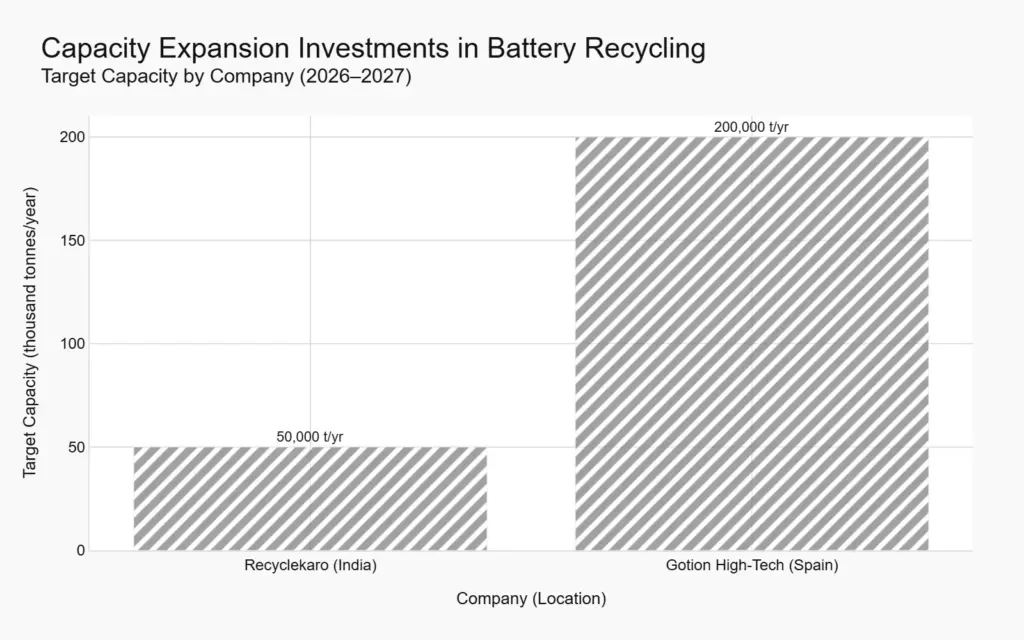
competition landscape 1 chart capacity expansion investments in battery recycling
Strategic Partnerships and Consolidation
Beyond capacity investments, companies are using partnerships and acquisitions to secure feedstock, integrate across the battery lifecycle, and enter new markets. Four distinct relationships from the 2025–2026 period illustrate the range of collaboration models.
Redwood Materials and General Motors: full lifecycle integration
Redwood Materials announced a partnership with General Motors covering the entire battery lifecycle. Under the agreement, Redwood will recover material from manufacturing scrap, recycle end‑of‑life GM EV packs, and deploy repurposed GM battery packs as energy storage. Specifically, Redwood plans to install approximately 100 repurposed GM battery packs at a GM plant in Michigan, providing 1.5 MW / 7.2 MWh of dispatchable energy, expected to save more than $3 million in electricity costs over the installation’s lifetime. This makes General Motors the first automaker to partner with Redwood across all three stages – scrap recycling, end‑of‑life recycling, and repurposed energy storage deployment. The partnership demonstrates a deep vertical integration model that differentiates Redwood from competitors that focus only on recycling or collection.
Hydrovolt and Ragn‑Sells: collection logistics in Scandinavia
Hydrovolt, a battery recycling company established in 2020, entered a cooperation agreement with Ragn‑Sells, one of Sweden’s leading recycling companies. The partnership covers the collection, storage, and transport of used electric vehicle batteries from all relevant collection points across Sweden. Hydrovolt’s facility in Fredrikstad, Norway, will receive the batteries from Ragn‑Sells’ export hubs for environmentally sound recycling. This collaboration addresses a critical bottleneck: safe and efficient feedstock collection in a region where battery collection infrastructure is still developing.
Mulberry Waste Holdings acquires Ecobat’s UK lithium‑ion plant
In May 2026, Mulberry Waste Holdings acquired Ecobat Solutions’ lithium‑ion battery recycling plant in Darlaston, West Midlands, UK. The plant employs 115 people and generates annual revenues of more than £20 million. The acquisition does not involve Ecobat’s lead recycling segment; it specifically concerns the lithium‑ion recycling operations that Ecobat had previously identified as a strategic focus. Mulberry Waste, which currently employs 90 people and specialises in hazardous waste disposal, chemical treatment, WEEE recycling, and fluorescent lamp recycling, stated that the acquisition positions it “at the forefront of a sector experiencing rapid growth”. This transaction represents a consolidation of assets from a larger lead‑based recycler to a waste management company seeking to build lithium‑ion recycling capability in the UK.
NAN GreenMet and Silox joint venture in India
NAN GreenMet, an advanced manufacturing platform founded by Vedanta Vice Chairman Navin Agarwal, partnered with Belgium‑headquartered Silox Group to form N.A.N. Silox GreenMet Pvt. Ltd., a 50:50 joint venture. The venture will develop an integrated battery recycling and critical minerals recovery facility in Andhra Pradesh, India. The project targets a spent battery shredding capacity of 40,000 tonnes per annum (TPA) and hydrometallurgical processing capacity of 20,000 TPA, recovering lithium, cobalt, nickel, and manganese. The joint venture combines Indian industrial backing with European recycling technology to address India’s growing need for domestic critical mineral supply chains. This model differs from the others: it is a technology‑driven JV between a new entrant (NAN GreenMet) and an established European recycler (Silox), entering a market with strong policy tailwinds.
Comparing partnership models
These four cases reveal different strategic approaches to competing in battery recycling:
-
- Full lifecycle integration (Redwood‑GM): deepest engagement, covering scrap, end‑of‑life, and repurposing. This creates a closed‑loop model that other recyclers may find hard to replicate.
- Collection‑focused partnership (Hydrovolt‑Ragn‑Sells): solves feedstock access in a specific geography. Essential for ensuring supply but narrower in scope.
- Acquisition of existing capacity (Mulberry‑Ecobat): allows rapid scale‑up and market entry without building from scratch. Reflects M&A as a consolidation tool.
- Technology‑driven joint venture (NAN GreenMet‑Silox): combines local manufacturing backing with foreign technology and targets a high‑growth market (India). Represents a capital‑efficient entry strategy backed by policy incentives.
Value Chain
Value chain overview
Key takeaways
-
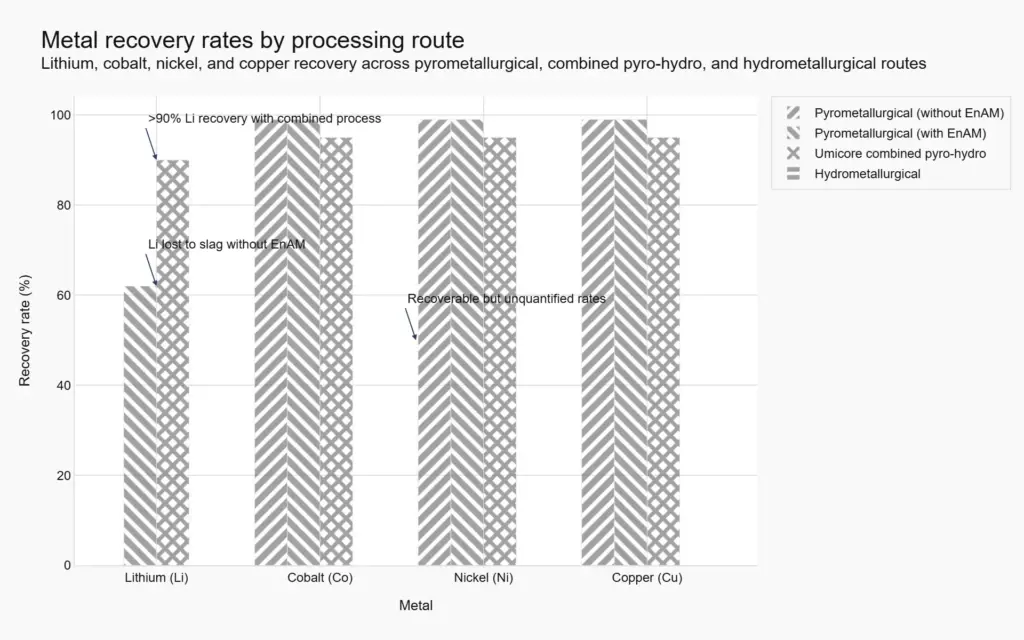
- Pyrometallurgical processing recovers cobalt, nickel, and copper alloys but loses lithium to slag unless additional controlled-cooling steps (EnAM) are applied; hydrometallurgical processing can recover lithium, cobalt, and nickel from black mass.
- Umicore’s combined pyro-hydro process achieves over 95% recovery for cobalt, nickel, and copper and over 90% for lithium, producing battery-grade salts.
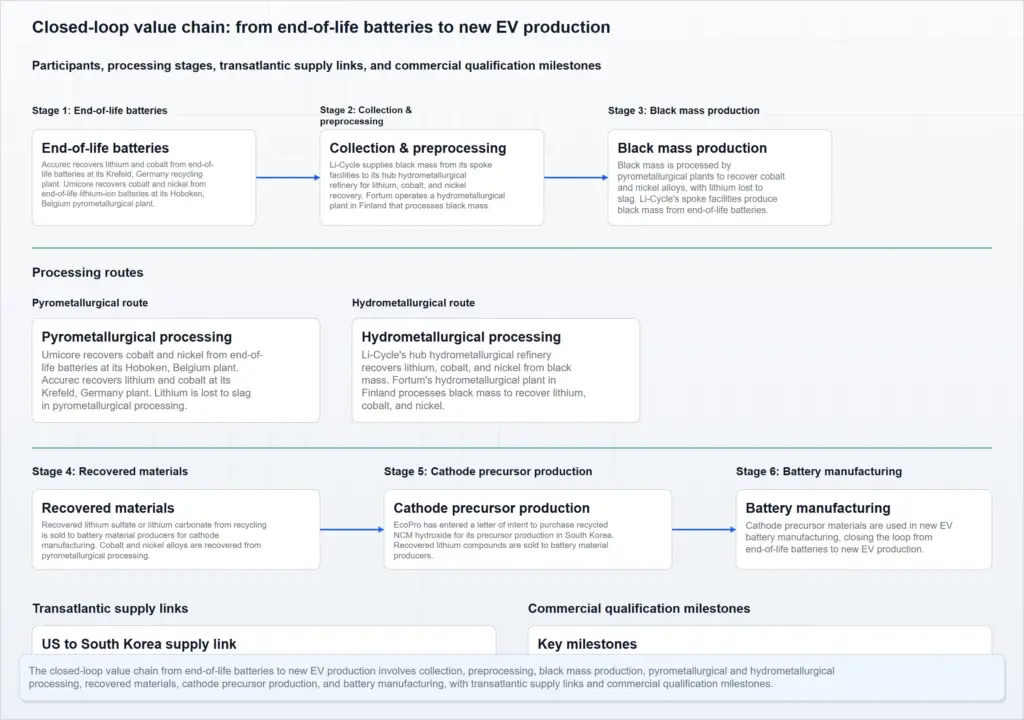
- Recycled lithium compounds are being commercially qualified and purchased for new EV battery production, as demonstrated by cylib’s customer project and EcoPro’s letter of intent to purchase recycled NCM hydroxide for precursor manufacturing in South Korea.
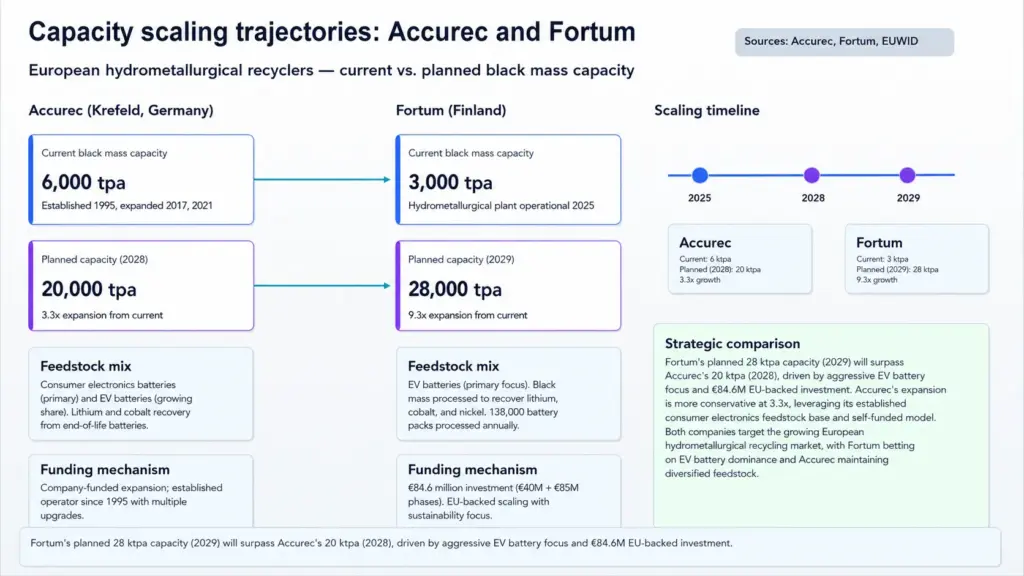
- European recyclers Accurec and Fortum are scaling hydrometallurgical capacity, with Fortum targeting a tenfold increase from 3,000 to 28,000 tonnes of black mass per year by 2029, financed by EU and national grants.
- Current feedstock at major recyclers remains dominated by portable consumer electronics and production scrap; end-of-life EV batteries account for only about 15% of Accurec’s input, indicating a near-term supply gap for the recycling value chain.
Processing routes and material recovery
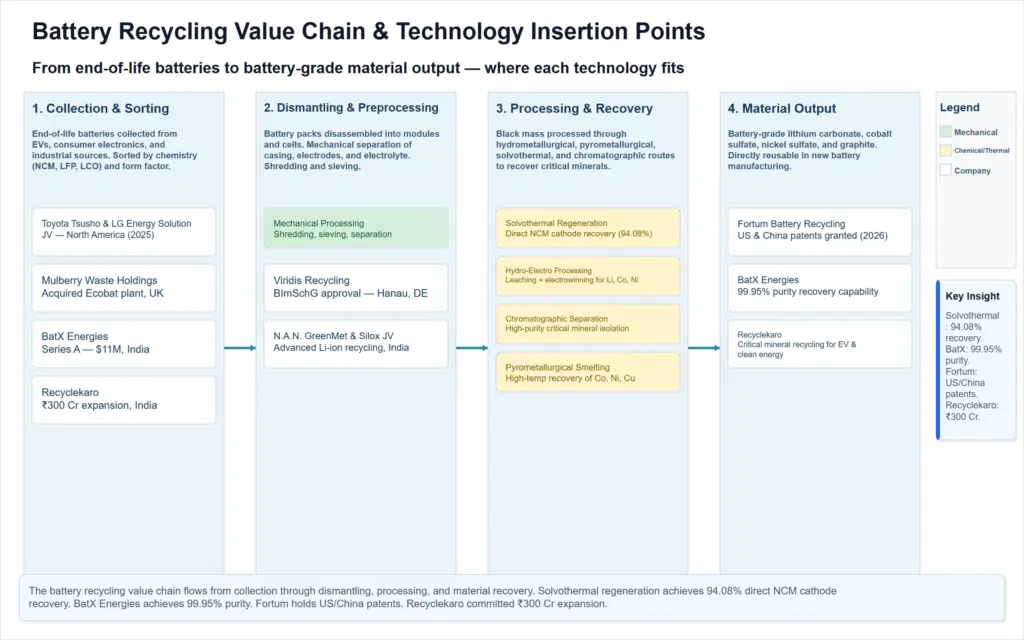
The battery recycling value chain bifurcates into two principal processing pathways — pyrometallurgical and hydrometallurgical — each with distinct metal recovery profiles. Pyrometallurgical plants treat black mass, the fine powder obtained after shredding and separating lithium-ion batteries, by smelting at high temperatures to recover cobalt and nickel alloys. Lithium, however, is lost to the slag phase unless additional measures are applied. A pilot-scale study using a 300-litre top-blown rotary converter (TBRC) treating black mass achieved approximately 99% reduction efficiency for copper, nickel, and cobalt, with about 45% of manganese transferring to the metal phase. Average energy consumption was approximately 8.5 kWh per kilogram, of which about 62% was supplied by the burner. Lithium predominantly reported to the slag, where a controlled cooling approach — Engineering of Artificial Minerals (EnAM) — promoted the formation of γ-LiAlO₂. With controlled cooling at 25 °C per hour, 76% of lithium in full-cell slag was immobilised as γ-LiAlO₂, compared with 44% in black-mass slag. The EnAM technology remains at pilot scale and is not yet commercially deployed.
Umicore operates a combined pyro-hydro process at its Hoboken, Belgium facility that integrates high-temperature smelting with chemical refining. The process achieves recovery rates above 95% for cobalt, nickel, and copper, and above 90% for lithium. End products are battery-grade lithium carbonate or lithium hydroxide, ready for use in new cathode materials. The combined approach uses the purity of the metal alloy produced in the pyrometallurgical step to reduce chemical consumption and waste in the subsequent hydrometallurgical refining stage.
Hydrometallurgical processing, by contrast, treats black mass through chemical leaching to recover lithium, cobalt, nickel, manganese, and copper as reusable metal products. The process begins with particle-size control, magnetic separation, and impurity removal, followed by leaching as the core recovery stage. Fortum’s hydrometallurgical plant in Harjavalta, Finland currently processes 3,000 tonnes of black mass per year, producing battery-grade nickel sulphate, cobalt sulphate, and lithium hydroxide. Accurec’s Krefeld, Germany facility uses a combined thermal pretreatment, mechanical processing, and hydrometallurgical refining approach — patented in 2021 — to produce black mass with 99% purity, from which it recovers lithium, nickel, and cobalt.
| Processing route | Lithium recovery | Cobalt recovery | Nickel recovery | Copper recovery | Status |
|---|---|---|---|---|---|
| Pyrometallurgical (no EnAM) | Lost to slag | ~99% | ~99% | ~99% | Commercial (pilot for EnAM) |
| Pyrometallurgical with EnAM | Up to 76% immobilised in slag (pilot scale) | ~99% | ~99% | ~99% | Pilot scale |
| Umicore combined pyro-hydro | >90% | >95% | >95% | >95% | Commercial |
| Hydrometallurgical (standalone) | Recoverable (rate not directly quantified in available data) | Recoverable | Recoverable | Recoverable | Commercial at Accurec, Fortum |
Commercial integration and offtake
Recycled battery materials are entering commercial supply chains through long-term partnerships that connect recyclers directly to cathode precursor and battery manufacturers. In September 2025, EcoPro Materials — a South Korea-based specialist in high-nickel cathode precursor production — signed a letter of intent with Green Li-ion to purchase recycled NCM hydroxide. The five-year supply agreement is scheduled to begin in 2026, with material sourced from Green Li-ion’s facility in Atoka, Oklahoma. The recycled NCM hydroxide will feed precursor production at EcoPro’s plant in Pohang, South Korea, establishing a transatlantic closed-loop link between US recycling capacity and Asian cathode manufacturing.
Li-Cycle operates a spoke-and-hub model in which its spoke facilities process lithium-ion battery manufacturing scrap and other battery materials to produce black mass. This black mass is then fed to Li-Cycle’s hub hydrometallurgical refinery, which produces nickel sulphate, cobalt sulphate, and lithium carbonate. To supplement its internal black mass supply, Li-Cycle has entered an agreement with Glencore to source third-party black mass for its hub operations globally, indicating that the company’s processing capacity exceeds its captive feedstock generation.
In a direct qualification milestone, cylib produced lithium carbonate from end-of-life NMC lithium-ion batteries using its proprietary water-based OLiC technology at a pilot facility in Aachen, Germany. In January 2026, cylib announced that an international battery manufacturer had qualified the circular lithium carbonate and was using it to produce new electric vehicle batteries — a sign that recycled material can meet the specifications required for commercial EV production. Similarly, Accurec reports that its process yields battery-grade lithium carbonate suitable for direct reuse in battery production.
Capacity expansion and feedstock composition
Current European battery recycling capacity is concentrated at a few facilities that are actively scaling up. Accurec operates in Krefeld, Germany with an annual feedstock capacity of 6,000 tonnes of lithium-ion batteries. The facility uses a combination of thermal pretreatment, mechanical processing, and hydrometallurgical refining to produce black mass with 99% purity, from which it recovers battery-grade lithium carbonate, nickel, and cobalt. The company has operated a pilot line since 2017 and scaled to commercial production with a patented process acquired in 2021. A significant expansion of the Krefeld site has been planned, though the specific target capacity is not supported in available records.
Fortum’s hydrometallurgical plant in Harjavalta, Finland currently has a processing capacity of 3,000 tonnes of black mass per year, producing battery-grade nickel sulphate, cobalt sulphate, and lithium hydroxide — enough to supply materials for approximately 138,000 electric vehicles annually. The company is planning a major expansion to 28,000 tonnes of black mass per year. The expansion project, named NEXT HYDROMET, received an EU Innovation Fund grant of up to €40 million in March 2026, following a preparatory phase that began in late 2025, and has also received national grants from Business Finland. The estimated start of operations for the expanded facility is 2029.
Feedstock composition at current recyclers reveals a near-term gap between available supply and the future volume of end-of-life EV batteries. At Accurec, approximately 15% of the annual 6,000-tonne feedstock comes from end-of-life EV batteries, with the majority originating from portable consumer electronics, production scrap, and recalled products. About 60% of the batteries processed at Accurec come from neighbouring countries — the Netherlands, Belgium, and Scandinavia. This composition indicates that the battery recycling value chain today relies primarily on non-automotive sources, and that a significant increase in end-of-life EV battery volumes will be required to achieve the feedstock mix implied by planned capacity expansions.
| Facility | Location | Current capacity | Planned capacity | Target year | Feedstock composition | Funding source |
|---|---|---|---|---|---|---|
| Accurec | Krefeld, Germany | 6,000 tonnes feedstock/year | Expansion planned (exact capacity not supported in available data) | Not specified | ~15% end-of-life EV batteries; majority from portable electronics, production scrap, recalls | Not specified |
| Fortum | Harjavalta, Finland | 3,000 tonnes black mass/year | 28,000 tonnes black mass/year | 2029 (estimated) | Not specified (black mass from lithium-ion batteries) | EU Innovation Fund (up to €40M); Business Finland national grants |
Global battery recycling market capacity scaling trajectories accurec fortum
Investment Activity
Technology & Innovation
Technology & Innovation
-
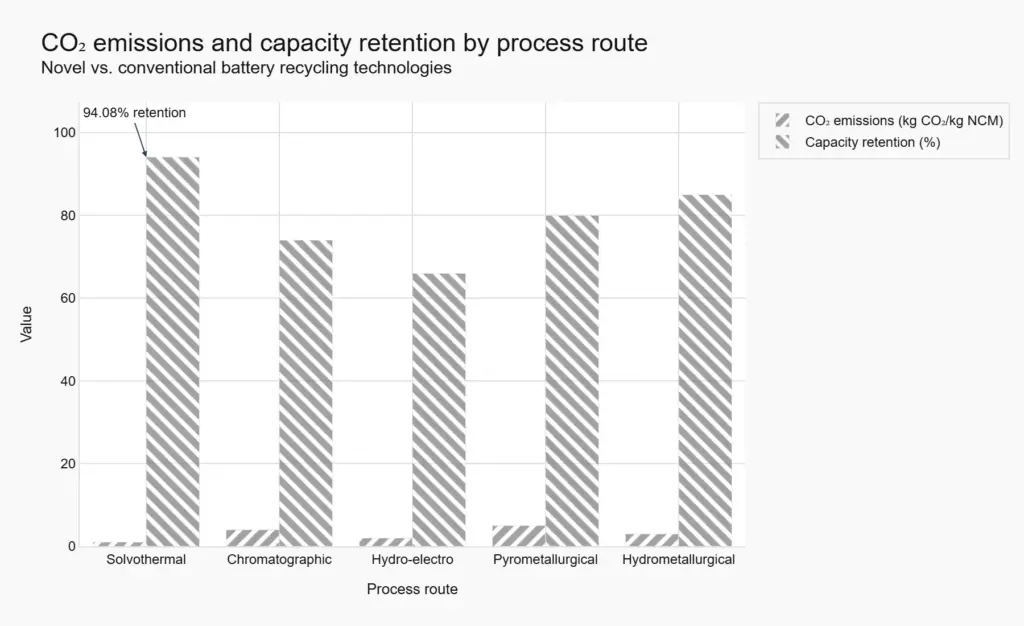
- Novel direct regeneration and low‑energy processes achieve up to 74% lower CO₂ emissions and 94.08% capacity retention compared with conventional pyrometallurgy or hydrometallurgy.
- Major recycling facility announcements in North America, Europe, and India include Green Metals Battery Innovations (13,500 tons scrap per year), Mulberry/Ecobat (15,000 tonnes per year), Recyclekaro (50,000 metric tonnes per year), and N.A.N. Silox GreenMet (40,000 tonnes shredding, 20,000 tonnes hydrometallurgical per year).
- Policy support—India’s Incentive Scheme for Promotion of Critical Mineral Recycling and Germany’s BImSchG permitting—is enabling rapid licensing and brownfield expansion.
- OEM‑led partnerships (Toyota Tsusho/LG Energy Solution) are creating dedicated closed‑loop supply chains for production scrap and end‑of‑life EV batteries.
- Funding and joint‑venture activity in India includes committed investments of ₹300 crore (approx. $36 million) from Recyclekaro and ₹105 crore (over $11 million) from BatX Energies, positioning the country as a significant recycling hub for lithium, cobalt, and nickel.
Process Innovation and Efficiency Gains
Conventional pyrometallurgical and hydrometallurgical recycling routes are energy‑intensive and generate secondary pollution. Three technology pathways—solvothermal direct regeneration, chromatographic ion exchange, and a hydro‑electro process—are being advanced to lower energy consumption, reduce CO₂ emissions, and preserve material value.
Solvothermal Direct Regeneration
A study published in May 2026 in Sustainable Energy & Fuels demonstrated a cost-effective solvothermal process for regenerating spent NCM cathode material. The researchers used an ethanol-based treatment at 130 °C for four hours. The regenerated NCM showed high discharge capacity and retained 94.08% of its capacity after 100 charge-discharge cycles.
The analysis also showed that the treatment removed surface impurities and helped restore the disordered rock-salt structure to a well-ordered layered structure. Another important finding was the reduction in emissions. The regenerated NCM produced only 1.00 kg CO₂ per kg of NCM, which is approximately 74% lower than pyrometallurgy and approximately 66% lower than hydrometallurgy. The process keeps the original metal composition of the material and could provide a more environmentally friendly direct regeneration option for large-scale recycling of high-nickel lithium-ion batteries.
Chromatographic Ion‑Exchange Separation
Fortum Battery Recycling was granted U.S. and China patents in June 2026 for a patented chromatographic ion‑exchange process that selectively separates lithium from nickel and cobalt. The technology delivers two valuable product streams: a lithium fraction suitable for battery‑grade lithium hydroxide or carbonate production, and a nickel‑cobalt sulfate solution ready for further refining. Fortum states that the process is characterized by low operating costs and a low carbon footprint, supporting a near‑zero‑waste, closed‑loop recycling operation. The patent portfolio strengthens Fortum’s competitive advantage in low‑emission battery recycling.
Hydro‑Electro Process
BatX Energies, an Indian battery‑tech startup founded in 2020, has developed a proprietary zero‑waste, zero‑emission hydro‑electro process. The company claims the process extracts 99.95% pure lithium, nickel, and cobalt from the black mass of lithium‑ion cells. In 2026, BatX raised ₹105 crore (over $11 million) in Series A funding led by IvyCap Ventures to expand its recycling and refining capacity, strengthen research and development, and accelerate the development of a domestic supply chain for critical battery materials. Prior to this round, the startup raised $5 million in pre‑Series A in 2023, bringing total funding to $17.7 million.
Technology Comparison: Novel vs. Conventional Processes
| Technology | Participant | Supplied Metric | Period | Application | Evidence‑Based Implication |
|---|---|---|---|---|---|
| Solvothermal direct regeneration | Sustainable Energy & Fuels study | 1.00 kg CO₂/kg NCM; 94.08% capacity retention after 100 cycles | May 2026 | Spent NCM cathode recycling | 74% lower CO₂ vs. pyrometallurgy, 66% lower vs. hydrometallurgy; preserves original metal composition |
| Chromatographic ion‑exchange | Fortum Battery Recycling | Battery‑grade LiOH/Li₂CO₃; Ni‑Co sulfate solution; low operating costs; low carbon footprint | June 2026 (patent) | Lithium separation from Ni/Co | Enables near‑zero‑waste closed‑loop recycling with two high‑value product streams |
| Hydro‑electro process | BatX Energies | 99.95% purity Li, Ni, Co from black mass; zero‑waste, zero‑emission | 2026 (funding) | Black mass processing | High‑purity recovery with no waste or emissions; $11 M Series A for scale‑up |
| Pyrometallurgy (baseline) | Conventional | CO₂ emissions baseline | 2026 study reference | Spent LIB processing | Highest CO₂ intensity among compared routes |
| Hydrometallurgy (baseline) | Conventional | CO₂ emissions baseline | 2026 study reference | Spent LIB processing | Lower CO₂ than pyrometallurgy but still 66% higher than solvothermal route |
Global Battery Recycling Market: CO₂ Emissions and Capacity Retention by Technology
Commercial Capacity Expansion and Partnership Activity
Technology maturity is translating into a surge of announced capacity, investment, and joint‑venture activity across North America, Europe, and India. Six projects illustrate the scale and geographic breadth of this expansion.
North America
Toyota Tsusho and LG Energy Solution agreed in June 2025 to establish Green Metals Battery Innovations, a battery recycling joint venture in Winston‑Salem, North Carolina. The facility will perform pre‑processing operations—dismantling and shredding battery production scrap to extract black mass containing nickel, cobalt, and lithium. In its initial stage, LG Energy Solution will supply scrap generated during EV battery production for Toyota Motor. The plant is scheduled to commence operations in 2026 with a maximum annual processing capacity of 13,500 tons of scrap, equivalent to over 40,000 automotive batteries. The venture represents LG Energy Solution’s first battery recycling joint venture in North America and signals a strong commitment to a closed‑loop system.
Europe
Mulberry Waste Holdings acquired Ecobat Solutions in Darlaston, West Midlands, UK, strengthening its position as a hazardous waste specialist and accelerating expansion into lithium‑ion battery recycling. Ecobat employs 115 staff and generates annual revenues of over £20 million. The Darlaston facility includes battery dismantling and health diagnostics alongside a recently installed lithium‑ion recycling process with a target capacity of 15,000 tonnes. The acquisition brings together Mulberry’s hazardous waste expertise with Ecobat’s end‑to‑end capabilities in collection, diagnostics, dismantling, and recycling.
Viridis Recycling, a Fraunhofer IWKS spin‑off, received approval under Germany’s Federal Immission Control Act (BImSchG) for its battery recycling plant in Hanau. The approval is a major milestone for the construction and operation of the industrial‑scale recycling plant for lithium‑ion batteries and battery waste. Viridis currently operates a recycling plant at technikum scale and continues to collaborate closely with Fraunhofer IWKS for knowledge and technology transfer. The company is also undergoing certification as a waste management specialist.
India
Recyclekaro, a leading Indian e‑waste and lithium‑ion battery recycler, committed an investment of approximately ₹300 crore (about $36 million) to expand its critical mineral recycling operations. The project, classified as a brownfield expansion under Beneficiary Category Group A of India’s Incentive Scheme for Promotion of Critical Mineral Recycling, aims to enhance processing capacity to around 50,000 metric tonnes. The expansion targets recovery of critical minerals from spent lithium‑ion batteries, electronic circuit e‑waste, rare earth magnets, and spent catalytic converters, strengthening India’s domestic capabilities in extracting strategic materials such as lithium and rare earth elements.
BatX Energies, with its hydro‑electro process, raised ₹105 crore (over $11 million) in Series A funding to expand recycling and refining capacity and develop a domestic supply chain for critical battery materials. The company collects used lithium‑ion batteries from EV makers, battery manufacturers, and factory waste, extracting 99.95% pure lithium, nickel, and cobalt for reuse in fresh batteries.
N.A.N. GreenMet (backed by Vedanta Vice Chairman Navin Agarwal) and Belgium‑headquartered Silox Group formed a 50:50 joint venture, N.A.N. Silox GreenMet Pvt. Ltd., to establish an integrated battery recycling and critical minerals recovery facility in Andhra Pradesh. The project will be developed in phases, ultimately targeting a spent battery shredding capacity of 40,000 tonnes per annum and hydrometallurgical processing capacity of 20,000 TPA. The facility will recover lithium, cobalt, nickel, and manganese to support India’s growing EV and energy storage ecosystem.
Announced Recycling Facilities: Capacity, Investment, and Timeline
| Parent / JV | Location | Capacity (tpa) | Technology Type | Investment | Expected Start | Key Partners |
|---|---|---|---|---|---|---|
| Green Metals Battery Innovations (Toyota Tsusho / LG Energy Solution) | Winston‑Salem, North Carolina, USA | 13,500 tons scrap (≈40,000 batteries) | Pre‑processing (shredding, black mass extraction) | Not disclosed | 2026 | Toyota Motor (scrap supply) |
| Mulberry Waste Holdings (acquired Ecobat Solutions) | Darlaston, West Midlands, UK | 15,000 | Dismantling, diagnostics, and lithium‑ion recycling | Not disclosed (revenue £20 M) | Operating (2026 acquisition) | Ecobat (115 staff) |
| Viridis Recycling (Fraunhofer IWKS spin‑off) | Hanau, Germany | Technikum‑scale (industrial permitting obtained) | Lithium‑ion battery recycling | Not disclosed | Permitting stage (2027) | Fraunhofer IWKS |
| Recyclekaro | India (brownfield expansion) | 50,000 | Critical mineral recycling (Li‑ion, e‑waste, rare earth magnets) | ₹300 crore (~$36 M) | Under expansion | India Ministry of Mines (incentive scheme) |
| BatX Energies | Delhi‑NCR, India | Not disclosed (capacity expansion underway) | Zero‑waste, zero‑emission hydro‑electro process | $11 M (Series A) | Expanding (2026) | IvyCap Ventures, Zephyr Peacock, Mankind Pharma Family Office |
| N.A.N. Silox GreenMet (N.A.N. GreenMet / Silox) | Andhra Pradesh, India | 40,000 shredding; 20,000 hydrometallurgical | Shredding and hydrometallurgical processing | Not disclosed | Phased development (2026 onward) | Silox Group (50:50 JV) |
 Global battery recycling market value chain technology insertion scaled
Market Risk
Risk : Global Battery Recycling market
-
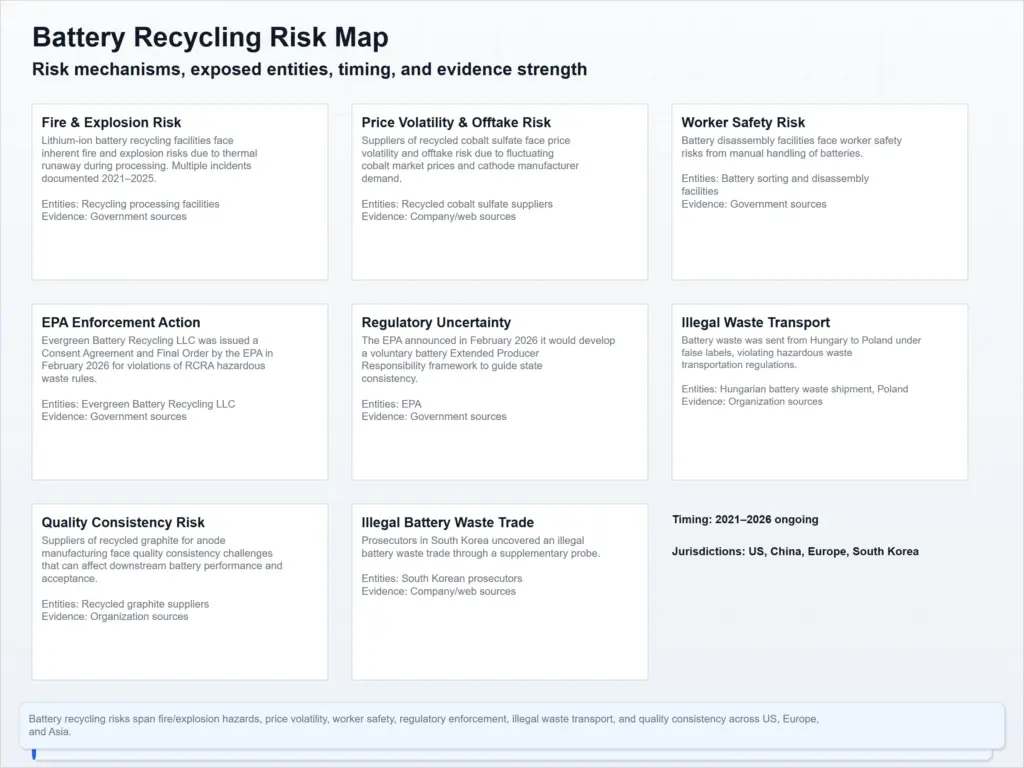
- Fire and explosion risks remain a major concern. Incidents have been reported across 64 U.S. waste facilities, with 245 fires documented. These events highlight the operational risks associated with thermal runaway during battery handling and processing.
- Recycled cobalt sulfate remains exposed to price volatility. Changes in Chinese regulations and oversupply have put pressure on the market, with payables narrowing to 74–75% and prices falling as low as 81,000 yuan per tonne.
- Graphite quality remains a challenge for recyclers. Recycled graphite needs careful thermal treatment to achieve performance comparable with battery-grade material, which is limiting its current acceptance among downstream manufacturers.
- Regulatory scrutiny is becoming more stringent. EPA compliance orders, prosecutions related to illegal waste trading in South Korea, and mislabeled shipments from Hungary to Poland show that regulators are paying closer attention to battery waste handling and cross-border movement.
- The regulatory framework remains uncertain in the United States. The EPA’s voluntary battery Extended Producer Responsibility framework leaves room for uncertainty, particularly as state-level programs continue to develop differently and there is still no national mandate.
Operational and Safety Risks
Battery recycling facilities face inherent fire and explosion risks due to thermal runaway during processing. A 2021 EPA report identified 64 waste facilities in the United States that experienced 245 fires caused by or likely caused by lithium metal or lithium-ion batteries. These incidents led to injuries, external emergency responses, service disruptions, and in some cases destroyed entire facilities. Thermal runaway can be triggered by damaged cells, residual charge, or exposure to heat during shredding and sorting. An OSTI review published in 2025 highlighted preprocessing deactivation steps, thermal safety engineering, and the role of flammable electrolytes as core risk mechanisms.
Two recent events underline the ongoing hazard. In April 2026, a battery recycling facility in Maddington (Australia) experienced an explosion and fire that led to evacuation warnings. In July 2026, a lithium battery factory fire in Scotland forced evacuations and required a major emergency response. These incidents demonstrate that the risk persists across geographies and facility types, affecting both recycling centers and dedicated battery processing plants.
Battery sorting and disassembly facilities also face significant worker safety risks. The manual disassembly of automotive lithium-ion battery packs exposes workers to electrical hazards, including accidental contact with energized conductors, electrocution, and burns. An Oak Ridge National Laboratory paper (2025) documented that no standard electrical safety practices existed for such disassembly until recently, and manual handling with insulated tools remains common. Facilities handling end-of-life batteries must manage both acute thermal risks and chronic electrical safety exposures.
Market and Raw Material Price Risks
Suppliers of recycled cobalt sulfate face price volatility and offtake risk due to fluctuating cobalt market prices and cathode manufacturer demand. A Fastmarkets assessment from 2026 reported that recycled cobalt sulfate was trading as low as approximately 81,000 yuan per tonne in China, undercutting hydroxide-based production and eroding margins. The introduction of China’s April 2026 recycling framework has prompted informal operators to liquidate black mass, accelerating near-term oversupply and further pressuring payables. Payable indicators for recycled cobalt sulfate narrowed to 74–75% in June 2026, down from 74–76% the previous week, reflecting weakening market acceptance. Downstream appetite remains subdued, with utilization rates estimated at 20–30% across the recycling chain.
Recycled graphite suppliers contend with quality consistency challenges that affect downstream battery performance and acceptance. A 2026 academic study on direct recycling of graphite found that the temperature used during thermal treatment directly impacts the surface functionalities of regenerated graphite particles, which are crucial for electrochemical performance. Achieving battery-grade quality requires precise control of processing conditions, and variability can limit the adoption of recycled graphite by anode manufacturers. This technical risk compounds the commercial challenge of proving recycled material as a reliable alternative to virgin graphite.
Regulatory and Compliance Risks
Regulatory enforcement actions are increasing across jurisdictions. In February 2026, the U.S. EPA issued a Consent Agreement and Final Order against Evergreen Battery Recycling LLC (docket RCRA-05-2026-0001) for violations of the Resource Conservation and Recovery Act hazardous waste rules. The case was closed in May 2026 after the company completed compliance actions, but it signals active oversight of recycling facilities’ waste management practices.
At the same time, regulatory uncertainty persists. In February 2026, the EPA announced it would develop a voluntary battery Extended Producer Responsibility framework to guide state consistency. The framework is explicitly voluntary, and the EPA noted that it reflects input from states such as Illinois, New York, and California, which have divergent programs. This lack of a mandatory national standard creates an uneven compliance landscape and potential competitive disadvantages for operators in states with more stringent requirements.
Cross-border illegal waste trade also poses compliance and reputational risks. An investigation by VSquare in 2026 revealed that defective batteries from Samsung SDI’s factory in Göd, Hungary, were reclassified as normal products and shipped to Poland without hazard codes. The estimated volume of mislabeled shipments may reach 10,000 tonnes. In South Korea, prosecutors in Uijeongbu indicted a recycling company operator, Jeong, for transporting and storing waste batteries containing sulfuric acid at unauthorized locations between 2021 and 2025, and for operating a licensed recycling business without proper authorization. These cases highlight the vulnerability of the recycling chain to illegal practices and the potential for enforcement actions to disrupt operations and damage market confidence.
Risk Comparison
| Risk | Mechanism | Exposed participant or geography | Timing | Supported consequence |
|---|---|---|---|---|
| Fire and explosion during battery processing | Thermal runaway from damaged cells, residual charge, or flammable electrolytes | 64 U.S. waste facilities; individual facilities in Australia and Scotland | Incidents reported through 2026; ongoing | Facility destruction, injuries, emergency response, service disruptions |
| Recycled cobalt sulfate price volatility and offtake risk | Chinese regulatory crackdown accelerating oversupply; weak downstream demand | Recycled cobalt sulfate suppliers, primarily in China | 2026; ongoing | Prices as low as 81,000 yuan/t; payables narrowing to 74–75%; eroding margins |
| Recycled graphite quality consistency | Thermal treatment temperature affects surface functionalities critical for electrochemical performance | Recycled graphite suppliers; downstream anode manufacturers | 2026; ongoing development | Limited downstream acceptance without careful process control |
| EPA enforcement for hazardous waste violations | Non-compliance with RCRA rules | Evergreen Battery Recycling LLC (U.S. Region 5) | February–May 2026 | Compliance order; potential penalties and corrective actions |
| Illegal cross-border battery waste shipments | Mislabeling defective batteries as normal products; shipment without hazard codes | Hungary-to-Poland route; South Korea domestic illegal storage | 2020–2025 (Hungary); 2021–2025 (South Korea) | Prosecution; estimated 10,000 tonnes mislabeled; reputational damage |
Regulatory Landscape
Battery Recycling Regulation
The European Union’s comprehensive Battery Regulation and the United States’ emerging federal and state-level rules are creating uneven compliance obligations across jurisdictions, forcing recyclers and producers to adapt rapidly or face material flow disruptions and cost penalties. This chapter covers regulations directly governing battery recycling collection, treatment, transportation, and recycled content requirements in the EU (Regulation 2023/1542) and the US (federal EPA and DOT rules, state EPR laws in Maine, Oregon, and Kentucky). Excluded: manufacturing emissions, workplace safety, battery design unrelated to recyclability, non-battery waste streams, and jurisdictions outside the EU and US.
Key Takeaways
-
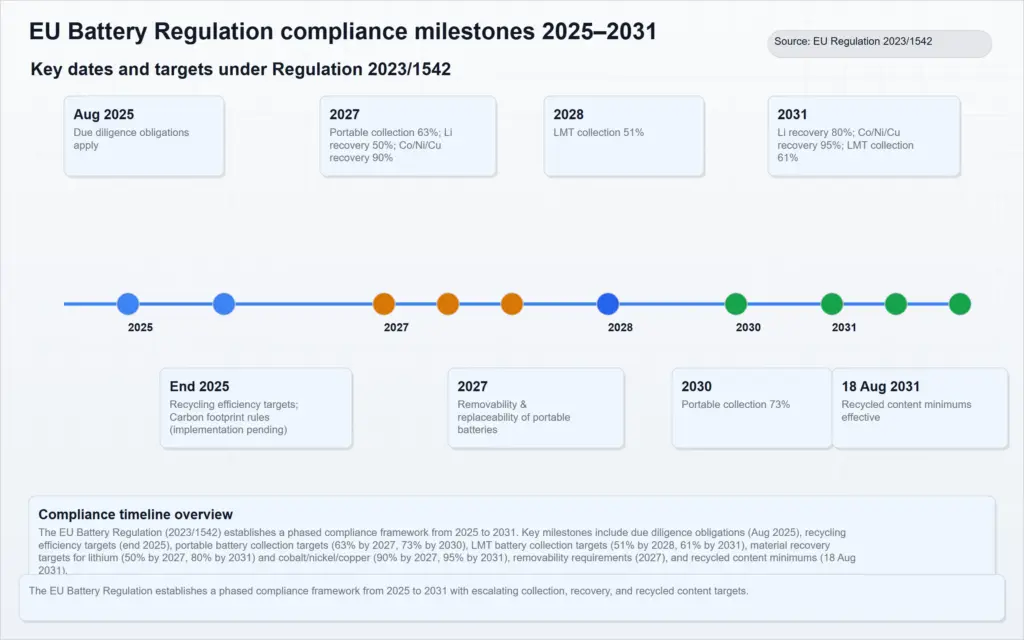
- EU Battery Regulation 2023/1542 imposes the world’s most detailed recycling requirements: sequential collection targets (63–73% for portable batteries by 2027–2030), material recovery mandates (50–80% lithium by 2027–2031), and mandatory recycled content (6–85% per metal by 2031).
- US federal action focuses on streamlining hazardous waste classification via EPA’s proposed Universal Waste Rule expansion for lithium batteries (NPRM June 2025, final rule expected December 2026) and aligning transport rules with international standards via PHMSA’s February 2026 NPRM.
- US states are advancing independent EPR laws: Maine (enacted April 2026), Oregon (HB 4144, 2026), and Kentucky (SB 49, introduced 2026) require producers to finance collection and recycling, creating a fragmented compliance landscape.
- Compliance timelines vary widely: EU due diligence starts August 2025, carbon footprint rules for large batteries are under development, recycling targets begin 2025–2027; US federal final rule likely late 2026; state laws effective 2026–2027.
European Union Battery Regulation
EU Regulation 2023/1542, already in force, establishes binding requirements across five battery categories: portable, light means of transport (LMT), electric vehicle (EV), industrial, and starting‑lighting‑ignition (SLI). The regulation applies to batteries placed on the Union market regardless of chemistry or origin.
Collection targets
Producers must meet escalating collection rates for waste portable batteries: 63% by the end of 2027 and 73% by the end of 2030. For LMT batteries, collection objectives are 51% by the end of 2028 and 61% by the end of 2031. These targets drive investment in collection networks and directly affect recycler feedstock availability.
Material recovery targets
Recyclers must achieve minimum recovery rates from waste batteries. For lithium: 50% by the end of 2027 and 80% by the end of 2031. For cobalt, copper, lead, and nickel: 90% by the end of 2027 and 95% by the end of 2031. Recycling efficiency targets also apply: for lithium‑based batteries, 65% by end of 2025, rising to higher levels from 2030; for nickel‑cadmium batteries, 80%; for lead‑acid, 75%; and 50% for other waste batteries (all by end of 2025).
Mandatory recycled content
From 18 August 2031, industrial, SLI, and EV batteries placed on the EU market must contain minimum levels of recycled content: 16% cobalt, 85% lead, 6% lithium, and 6% nickel. This creates a structural demand for secondary materials and will reshape supply agreements between recyclers and battery producers.
Carbon footprint declarations
Rechargeable industrial batteries with capacity above 2 kWh, LMT batteries, and EV batteries require carbon footprint declarations. The Joint Research Centre is developing the calculation methodology; the requirement is already enacted, with implementing acts to follow.
Removability and replaceability
Portable batteries incorporated into appliances must be removable and replaceable by the end user by 2027. LMT batteries must be replaceable by an independent professional. This affects product design for OEMs and recyclers’ disassembly processes.
Due diligence
Economic operators placing batteries on the EU market must comply with due diligence obligations covering social and environmental risks in raw material supply chains, effective from 18 August 2025. This includes identifying, preventing, and addressing risks linked to lithium, cobalt, nickel, and natural graphite.
Timeline of key EU Battery Regulation compliance milestones from 2025 to 2031, highlighting collection targets, recovery targets, recycled content effective dates, and removability requirements. EU Regulation 2023/1542 claims and evidence: collection targets, material recovery targets, recycled content dates, removability deadline. Milestone labels and years: Due diligence Aug 2025; Recycling efficiency targets end 2025; Carbon footprint rules (implementation pending); Portable collection 63% 2027; Li recovery 50% 2027; Co/Ni/Cu recovery 90% 2027; Removability 2027; LMT collection 51% 2028; Portable collection 73% 2030; Li recovery 80% 2031; Co/Ni/Cu recovery 95% 2031; LMT collection 61% 2031; Recycled content 18 Aug 2031.
US Federal Hazardous Waste and Transport Regulations
At the federal level, two major rulemakings are reshaping battery recycling logistics and classification. Neither establishes recycling or recycled content targets; instead, they focus on waste management and transportation safety.
EPA Universal Waste Rule expansion (proposed)
The US Environmental Protection Agency is proposing to modify the RCRA Universal Waste Rule (40 CFR Part 273) to create a new, distinct category for lithium batteries and to include end‑of‑life solar panels. The rule is intended to streamline hazardous waste management, improve safety standards, reduce fire risk, and promote recycling. The Notice of Proposed Rulemaking is scheduled for June 2025, with a final rule expected December 2026. Until the rule is final, spent lithium batteries remain regulated as hazardous waste under RCRA, subject to full generator, transporter, and treatment standards. The proposed expansion would simplify compliance for recyclers by allowing universal waste handling (longer accumulation times, reduced paperwork).
PHMSA Hazardous Materials harmonization (proposed)
The Pipeline and Hazardous Materials Safety Administration published a Notice of Proposed Rulemaking in February 2026 (FR Vol. 91 No. 27) to amend the Hazardous Materials Regulations (49 CFR Parts 171, 172, 173, 175, 176, 178, 180) for consistency with international standards. The NPRM covers proper shipping names, hazard classes, packing groups, packaging authorizations, air transport quantity limitations, and vessel stowage requirements – all directly affecting the transport of spent lithium batteries for recycling. The comment period closes April 13, 2026. Separately, existing 49 CFR 173.185 already specifies packaging and handling requirements for damaged or defective lithium batteries. Harmonization may reduce cross‑border compliance costs but could also tighten packaging requirements if the US aligns with stricter international provisions.
US State Extended Producer Responsibility Laws
While the federal government has not enacted recycling targets or EPR mandates, several US states have passed or proposed their own battery stewardship laws, creating a patchwork of obligations for producers and recyclers.
Maine (enacted)
Maine enacted a battery stewardship program law (LD 474) on April 3, 2026. The law amends Title 38 MRS, adding sections on collection and recycling. Producers must participate in a stewardship program and finance the collection and recycling of primary and rechargeable batteries. This is one of the first comprehensive state EPR laws for batteries in the US.
Oregon (enacted)
Oregon enacted HB 4144 during the 2026 regular session. The law requires producers of batteries or battery‑containing products to join a battery producer responsibility organization and implement a program for collection and recycling. The Oregon Department of Environmental Quality administers the program, and a Battery Producer Responsibility Fund is established. Civil penalties apply for violations.
Kentucky (introduced)
Kentucky introduced SB 49 in the 2026 regular session. The bill directs the state cabinet to establish a Covered Battery Stewardship Program by March 31, 2027, including voluntary take‑back for rechargeable batteries, listing of collection sites, and promotion of a recovery market. Unlike Maine and Oregon, Kentucky’s framework is voluntary and focuses on feasibility and coordination rather than mandatory producer financing. The bill is still under consideration.
Map of US states with enacted or proposed battery EPR laws, showing each law’s core requirement (producer PRO membership, financing collection, voluntary take‑back) and effective year. Maine LD 474 (enacted Apr 2026), Oregon HB 4144 (enacted 2026), Kentucky SB 49 (introduced 2026). State names, law status (enacted/introduced), key provision: Maine – mandatory stewardship program, producers finance; Oregon – mandatory PRO membership, fund collection; Kentucky – voluntary take‑back, cabinet program by Mar 2027.
Regulatory comparison
| Jurisdiction | Rule / instrument | Key requirement | Effective date | Affected participant |
|---|---|---|---|---|
| European Union | Regulation 2023/1542 – collection targets | Portable: 63% by 2027, 73% by 2030; LMT: 51% by 2028, 61% by 2031 | 2027–2031 | Producers, collection schemes, recyclers |
| European Union | Regulation 2023/1542 – recovery targets | Lithium: 50% by 2027, 80% by 2031; Co/Ni/Cu: 90% by 2027, 95% by 2031 | 2027, 2031 | Recyclers, treatment facilities |
| European Union | Regulation 2023/1542 – recycled content | 16% Co, 85% Pb, 6% Li, 6% Ni in new batteries | 18 Aug 2031 | Battery manufacturers, material suppliers |
| United States (federal) | EPA Universal Waste Rule expansion (proposed) | Create lithium‑battery category under 40 CFR Part 273; streamline management | NPRM June 2025; final rule Dec 2026 (projected) | Generators, transporters, recyclers |
| United States (federal) | PHMSA HMR harmonization (proposed) | Align shipping names, hazard classes, packaging, air/vessel limits with international standards | NPRM Feb 2026; comment by Apr 13 2026 | Transporters, recyclers packaging batteries |
| Maine (US state) | LD 474 battery stewardship | Producers finance collection and recycling | Enacted Apr 3 2026 | Producers, collection sites, recyclers |
| Oregon (US state) | HB 4144 battery EPR | Producers join PRO, implement collection/recycling program | 2026 regular session | Producers, DEQ, recyclers |
| Kentucky (US state – introduced) | SB 49 stewardship program | Voluntary take‑back, cabinet program by Mar 31 2027 | Introduced 2026; program deadline Mar 2027 | Producers (voluntary), collection sites, recyclers |
Implications for market participants
The asymmetric regulatory landscape forces recyclers and battery producers to juggle multiple compliance systems. In the EU, binding collection, recovery, and recycled content targets create clear investment signals but also impose penalties for non‑achievement. In the US, the absence of national targets places the burden on state EPR laws, which vary in scope and timing. Federal action on waste classification and transport is procedural rather than performance‑based. Recyclers serving both markets must adapt their processes, reporting, and feedstock strategies to satisfy EU mandates while navigating a patchwork of US state obligations. Companies with operations in Maine, Oregon, or future states with EPR laws face immediate producer‑financing requirements; those in Kentucky may face voluntary schemes that could become mandatory. The timeline gap – EU rules already in effect or imminent (due diligence August 2025) versus US final rules likely in late 2026 – means that global battery recycling supply chains will be shaped by European standards for the next several years.