
Global Cat Litter Market Report, Size & Forecast 2026-2033
Global Cat Litter Market Forecast Snapshot (2026???2033)
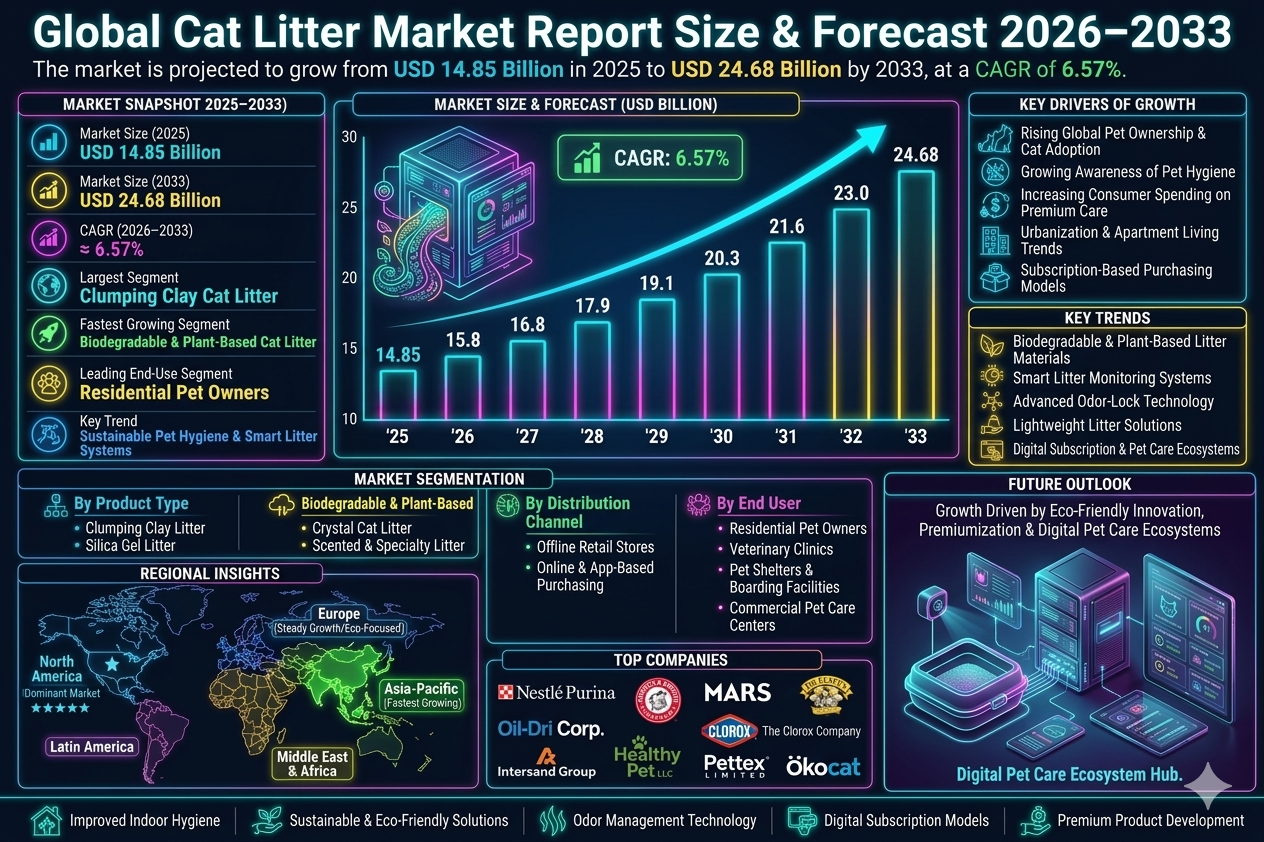
| Metric | Value |
|---|---|
| Market Size (2025) | USD 14.85 Billion |
| Market Size (2033) | USD 24.68 Billion |
| CAGR (2026???2033) | 6.57% |
| Largest Segment | Clumping Clay Cat Litter |
| Fastest Growing Segment | Biodegradable & Plant-Based Cat Litter |
| Leading End-Use Segment | Residential Pet Owners |
| Key Trend | Sustainable Pet Hygiene Solutions & Smart Litter Monitoring Systems |
| Regulatory Influence | Environmental Waste Disposal Standards, Product Safety Regulations & Sustainable Packaging Compliance |
| Future Outlook | Growth Driven by Eco-Friendly Innovation, Premiumization & Digital Pet Care Ecosystems |
Global Cat Litter Market Size & Forecast
The Global Cat Litter Market is expected to witness steady growth during the forecast period from 2026 to 2033. The market was valued at USD 14.85 billion in 2025 and is projected to reach approximately USD 24.68 billion by 2033, registering a CAGR of 6.57%. The market growth is primarily driven by rising global pet ownership, increasing cat adoption rates, growing awareness regarding pet hygiene, and rising consumer spending on premium pet care products. Cat litter products are increasingly critical for indoor pet hygiene management, odor control, waste disposal convenience, and maintaining sanitary living environments. Rising adoption of biodegradable litter materials, odor-locking technology, lightweight litter solutions, and automated smart litter systems is accelerating market growth. In addition, increasing urbanization, apartment living trends, and subscription-based pet care purchasing models are supporting long-term market expansion.Global Cat Litter Market Overview
Cat litter products provide absorbent waste management solutions designed for domestic cats and are essential for maintaining cleanliness and odor control in residential and commercial pet care environments. The market includes clumping clay litter, silica gel litter, biodegradable litter, crystal litter, scented litter, flushable litter, and automated litter management systems. Cat litter solutions are widely used across households, veterinary clinics, pet shelters, grooming centers, and commercial pet care facilities. The market is shifting from traditional clay-based litter products toward eco-friendly materials, smart litter monitoring systems, digital subscription platforms, and advanced odor-neutralizing technologies.Structural Drivers of Market Growth
1. Innovation and Commercialization Acceleration
Rapid innovation in odor-control technology, lightweight litter composition, smart litter tracking systems, and biodegradable materials is accelerating product adoption. Advanced moisture absorption and antimicrobial formulations are improving customer convenience and product performance.Market Implications
Companies investing in sustainable litter innovation, smart pet care integration, and premium product formulations are expected to strengthen market leadership.2. Compliance and Risk Repricing
Environmental waste disposal regulations, clay mining restrictions, packaging sustainability standards, and pet safety compliance requirements are influencing product development. Governments and environmental agencies are increasingly promoting biodegradable and compostable litter alternatives.Market Implications
Manufacturers offering compliant, eco-friendly, and recyclable litter solutions are likely to gain stronger market trust.3. Competitive and Value-Chain Reconfiguration
The market is highly competitive as pet care brands, sustainable product startups, e-commerce retailers, and private-label manufacturers expand their offerings. Direct-to-consumer subscription models and online retail partnerships are altering value-chain economics.Market Implications
Companies focusing on sustainability, digital distribution, and premium odor-control technologies may gain stronger margins.4. Capital and Capacity Scaling
Rising investments in automated production systems, sustainable raw material sourcing, and smart pet technology infrastructure are supporting market expansion. Growth in online pet care marketplaces is increasing global accessibility.Market Implications
Operators scaling sustainable manufacturing and digital retail infrastructure are expected to capture future opportunities.Market Segmentation Analysis
By Product Type
1. Clumping Clay Cat Litter
This remains the largest segment due to strong absorbency and widespread consumer familiarity.2. Silica Gel Cat Litter
Widely used for superior moisture retention and odor control.3. Biodegradable & Plant-Based Cat Litter
Fastest-growing due to sustainability trends and environmental awareness.4. Crystal Cat Litter
Preferred for premium hygiene performance and reduced dust generation.5. Scented & Specialty Cat Litter
Growing demand for enhanced odor management and customized solutions.By Distribution Channel
1. Offline Retail Stores
Largest segment due to widespread supermarket and pet store availability.2. Online & App-Based Purchasing
Fastest-growing segment due to convenience and subscription-based delivery.By End User
1. Residential Pet Owners
Largest segment due to increasing cat ownership globally.2. Veterinary Clinics
Strong demand for hygiene-focused pet care applications.3. Pet Shelters & Boarding Facilities
Growing usage due to operational hygiene requirements.4. Commercial Pet Care Centers
Used for professional pet maintenance services.Regional Market Dynamics
North America
North America dominates the global cat litter market due to high pet ownership rates, premium pet care spending, and strong product innovation.Europe
Europe remains a major market supported by sustainability-focused pet care adoption and stringent environmental regulations.Asia-Pacific
Asia-Pacific is the fastest-growing region due to increasing urban pet ownership, rising disposable incomes, and growing premium pet care awareness.Latin America
Latin America is gradually expanding due to rising companion animal adoption and retail market growth.Middle East & Africa
The region is witnessing emerging adoption driven by urban pet ownership growth and increasing pet care product accessibility.Competitive Landscape
The Global Cat Litter Market is highly competitive with international pet care companies, specialty litter manufacturers, and eco-friendly product innovators expanding globally.Key Companies Operating in the Market Include:
- Nestl?? Purina PetCare
- Church & Dwight Co., Inc.
- Mars Incorporated
- Oil-Dri Corporation of America
- Dr. Elsey???s
- The Clorox Company
- Intersand Group
- Healthy Pet LLC
- Pettex Limited
- ??kocat
Strategic Outlook
The future of the cat litter market will be shaped by biodegradable litter innovation, smart litter box integration, AI-enabled pet monitoring, and subscription-driven delivery models. Automated waste tracking, eco-friendly packaging, and advanced odor-neutralization technologies will significantly improve product efficiency. The rise of premium pet hygiene products, sustainable consumer behavior, and digital pet care ecosystems is expected to create strong long-term growth opportunities.Final Market Perspective
The Global Cat Litter Market remains a critical segment within the broader pet care and household hygiene ecosystem. Rising pet ownership, eco-conscious purchasing behavior, and premium product adoption continue driving long-term market growth. Companies capable of delivering scalable, sustainable, innovative, and customer-centric litter solutions will be best positioned to capture future opportunities. The convergence of smart pet care, sustainability, subscription commerce, and premium hygiene solutions is expected to redefine the future of the global cat litter industry.Table of Contents
Table of Contents
- 1. Executive Summary
- 1.1 Global Cat Litter Market Snapshot (2026???2033)
- 1.2 Market Size & CAGR Analysis
- 1.3 Largest & Fastest-Growing Segments
- 1.4 Key Regional Insights
- 1.5 Major Market Growth Drivers
- 1.6 Competitive Landscape Overview
- 1.7 Strategic Outlook Through 2033
- 2. Introduction & Market Overview
- 2.1 Definition of Cat Litter Products
- 2.2 Scope of the Study
- 2.3 Evolution of Pet Hygiene Solutions
- 2.4 Pet Care Ecosystem Analysis
- 2.5 Regulatory & Sustainability Compliance Framework
- 2.6 Consumer Purchasing Trends
- 2.7 Product Innovation Landscape
- 3. Research Methodology
- 3.1 Primary Research
- 3.2 Secondary Research
- 3.3 Market Size Estimation Model
- 3.4 Forecast Assumptions (2026???2033)
- 3.5 Data Validation & Market Triangulation
- 4. Market Dynamics
- 4.1 Drivers
- 4.1.1 Rising Global Cat Ownership
- 4.1.2 Growing Consumer Focus on Pet Hygiene
- 4.1.3 Expansion of Premium Pet Care Spending
- 4.1.4 Adoption of Sustainable Cat Litter Solutions
- 4.1.5 Smart Pet Care Technology Integration
- 4.2 Restraints
- 4.2.1 High Cost of Premium and Smart Litter Products
- 4.2.2 Environmental Concerns Around Clay Mining
- 4.2.3 Raw Material Price Volatility
- 4.2.4 Disposal Infrastructure Limitations
- 4.3 Opportunities
- 4.3.1 Expansion of Biodegradable Product Portfolios
- 4.3.2 AI-Enabled Smart Litter Monitoring Systems
- 4.3.3 Subscription-Based Digital Pet Care Models
- 4.3.4 Emerging Market Penetration
- 4.4 Challenges
- 4.4.1 Product Performance Standardization
- 4.4.2 Consumer Transition from Traditional Products
- 4.4.3 Sustainability Certification Complexity
- 4.4.4 Supply Chain Disruptions
- 4.1 Drivers
- 5. Global Cat Litter Market Analysis (USD Billion), 2026???2033
- 5.1 Market Size Overview
- 5.2 CAGR Analysis
- 5.3 Regional Revenue Distribution
- 5.4 Product Innovation Trends
- 5.5 Consumer Adoption Analysis
- 5.6 Future Growth Projections
- 6. Market Segmentation (USD Billion), 2026???2033
- 6.1 By Product Type
- 6.1.1 Clumping Clay Cat Litter
- 6.1.2 Silica Gel Cat Litter
- 6.1.3 Biodegradable & Plant-Based Cat Litter
- 6.1.4 Crystal Cat Litter
- 6.1.5 Scented & Specialty Cat Litter
- 6.1.6 Smart Automated Litter Systems
- 6.2 By Distribution Channel
- 6.2.1 Offline Retail Stores
- 6.2.2 Online & App-Based Purchasing
- 6.3 By End User
- 6.3.1 Residential Pet Owners
- 6.3.2 Veterinary Clinics
- 6.3.3 Pet Shelters & Boarding Facilities
- 6.3.4 Commercial Pet Care Centers
- 6.1 By Product Type
- 7. Market Segmentation by Geography
- 7.1 North America
- 7.2 Europe
- 7.3 Asia-Pacific
- 7.4 Latin America
- 7.5 Middle East & Africa
- 8. Competitive Landscape
- 8.1 Market Share Analysis
- 8.2 Product Innovation Benchmarking
- 8.3 Strategic Partnerships & Collaborations
- 8.4 Distribution Network Analysis
- 8.5 Brand Positioning Strategies
- 9. Company Profiles
- 9.1 Nestl?? Purina PetCare
- 9.2 Church & Dwight Co., Inc.
- 9.3 Mars Incorporated
- 9.4 Oil-Dri Corporation of America
- 9.5 Dr. Elsey???s
- 9.6 The Clorox Company
- 9.7 Intersand Group
- 9.8 Healthy Pet LLC
- 9.9 Pettex Limited
- 9.10 ??kocat
- 10. Strategic Intelligence & Pheonix AI Insights
- 10.1 Pet Care Innovation Forecast Engine
- 10.2 Consumer Behavior Analytics Dashboard
- 10.3 Sustainability Opportunity Tracker
- 10.4 Product Performance Opportunity Analyzer
- 10.5 Automated Porter???s Five Forces Analysis
- 11. Future Outlook & Strategic Recommendations
- 11.1 Investment in Sustainable Product Innovation
- 11.2 Expansion of Smart Litter Ecosystems
- 11.3 Strengthening Subscription Commerce Channels
- 11.4 Enhancing Sustainable Packaging Strategies
- 11.5 Long-Term Market Outlook (2033+)
- 12. Appendix
- 13. About Pheonix Research
- 14. Disclaimer
Competitive Landscape
Global Cat Litter Market Competitive Intensity & Market Structure Overview
The global cat litter market is highly competitive and moderately fragmented, characterized by strong competition among multinational pet care companies, specialty litter manufacturers, private-label brands, and emerging eco-friendly product innovators. Competitive intensity is driven by product innovation, sustainability-focused formulations, odor-control performance, pricing strategies, retail distribution reach, and digital subscription-based delivery ecosystems.
The market structure consists of established pet care conglomerates with broad product portfolios alongside niche brands focused on biodegradable, lightweight, plant-based, and premium hygiene solutions. Competition is increasingly shaped by eco-conscious consumer preferences, automated litter technologies, packaging sustainability, and omnichannel retail penetration.
Rising global pet ownership, increasing premiumization of pet care products, and growing consumer demand for sustainable litter alternatives are significantly intensifying competition across the global cat litter market.
Global Cat Litter Market Competitive Intensity & Market Structure Current Scenario
Leading Global Cat Litter Companies
Nestl?? Purina PetCare: Major global market participant with strong retail distribution and premium litter product offerings.
Church & Dwight Co., Inc.: Leading manufacturer recognized for innovative odor-control and clumping litter solutions.
Mars Incorporated: Strong market presence supported by integrated pet care brand ecosystems and consumer loyalty.
Oil-Dri Corporation of America: Established supplier specializing in mineral-based absorbent litter products.
Dr. Elsey???s: Premium specialty litter provider focused on veterinarian-recommended formulations.
The Clorox Company: Significant player with advanced odor-neutralization technology and strong brand equity.
Intersand Group: Global innovator in high-performance clumping and specialty litter products.
Healthy Pet LLC: Leading eco-friendly litter solutions provider focused on natural fiber-based products.
Pettex Limited: Strong regional participant with diversified litter product portfolios.
??kocat: Emerging sustainability-focused player specializing in plant-based biodegradable litter products.
Key Competitive Intensity & Market Structure Drivers
Growing consumer preference for biodegradable and plant-based litter solutions is intensifying innovation-driven competition.
The expansion of e-commerce and subscription-based pet care purchasing is reshaping competitive distribution strategies.
Increasing product differentiation through odor-control technology and lightweight formulations is strengthening competitive positioning.
Environmental regulations and sustainable packaging compliance are influencing product development and market entry barriers.
The growing adoption of automated litter systems is creating new technology-driven competitive opportunities.
Strategic Implications of Competitive Intensity & Market Structure
Manufacturers are increasingly investing in biodegradable materials and sustainable sourcing strategies to capture eco-conscious consumers.
Strategic retail partnerships and direct-to-consumer subscription models are becoming essential for market expansion.
Smart litter monitoring integration and automated waste management solutions are emerging as premium product differentiators.
Advanced odor-neutralization and antimicrobial technologies are becoming central to product innovation strategies.
Brand positioning through premium hygiene performance and sustainability messaging is strengthening customer retention.
Global Cat Litter Market Competitive Intensity & Market Structure Forward Outlook
The global cat litter market is expected to remain highly competitive as premium pet care spending and sustainability trends continue accelerating.
Future competition will increasingly focus on biodegradable innovation, smart litter ecosystem integration, automated waste tracking, and personalized subscription delivery models.
North America will remain the dominant competitive region, while Asia-Pacific is expected to witness the fastest competitive expansion due to rising urban pet ownership.
Advancements in smart litter monitoring, AI-enabled pet behavior analytics, and recyclable packaging technologies are expected to reshape market dynamics.
Overall, companies that successfully combine sustainable product innovation, digital retail scalability, premium performance, and smart pet care integration will remain strongly positioned in the evolving global cat litter market.
Value Chain
Global Cat Litter Market Value Chain & Supply Chain Evolution Overview
The Global Cat Litter Market operates through a material-intensive consumer goods ecosystem supported by raw material sourcing, litter processing technologies, product formulation innovation, packaging systems, distribution networks, and end-user pet hygiene applications. The market is increasingly shaped by sustainable litter materials, smart pet care integration, digital subscription commerce, and premium odor-control innovations.
Unlike conventional household consumables, the value chain is strongly influenced by mineral extraction, biodegradable raw material sourcing, odor-neutralization chemistry, automated packaging technologies, and evolving environmental compliance standards.
Supply chain complexity is moderate to high due to clay mining dependencies, agricultural raw material sourcing for biodegradable litter, regional regulatory requirements, logistics costs associated with product weight, sustainable packaging transitions, and demand fluctuations driven by pet ownership trends.
Global Cat Litter Market Value Chain & Supply Chain Evolution Current Scenario
Market-Specific Value Chain
1. Raw Material Sourcing & Procurement
- Bentonite clay extraction and processing
- Silica gel raw material sourcing
- Plant-based material procurement including corn, wheat, paper, wood, and recycled fibers
- Odor-neutralizing chemical compounds and antimicrobial additive sourcing
- Sustainable packaging material procurement
2. Product Formulation & Processing
- Absorbency enhancement technology development
- Clumping and moisture-locking formulation processes
- Dust reduction engineering
- Odor-control chemical integration
- Biodegradable litter material processing and refinement
3. Manufacturing & Packaging Operations
- Automated blending and granulation systems
- High-capacity drying and processing equipment
- Packaging automation and filling lines
- Lightweight product engineering for shipping optimization
- Smart packaging and recyclable packaging integration
4. Regulatory Compliance & Quality Assurance
- Pet safety product testing
- Environmental waste disposal compliance
- Sustainable packaging certification
- Chemical composition and dust emission standards
- Regional labeling and consumer safety compliance
5. Distribution & Retail Channel Infrastructure
- Pet specialty retail distribution
- Supermarket and hypermarket sales channels
- E-commerce and direct-to-consumer platforms
- Subscription-based recurring delivery systems
- Regional logistics and warehouse networks
6. End-Use Pet Care Ecosystem
- Residential cat owners
- Veterinary clinics
- Pet shelters and rescue centers
- Commercial grooming and boarding facilities
- Smart home pet care environments
Key Value Chain Evolution Signals
1. Shift Toward Sustainable Raw Materials
- Manufacturers are increasingly replacing traditional clay with renewable plant-based and recycled litter materials.
2. Smart Pet Care Integration
- Automated litter monitoring and connected hygiene systems are transforming product innovation strategies.
3. E-Commerce Distribution Expansion
- Digital retail and subscription delivery models are reshaping distribution economics.
4. Packaging Sustainability Transformation
- Recyclable and low-impact packaging solutions are becoming strategic priorities.
5. Premium Product Differentiation
- Advanced odor-locking, antimicrobial, and low-dust technologies are driving competitive advantage.
6. Supply Chain Localization
- Regional sourcing and manufacturing expansion are improving resilience against logistics disruptions.
Strategic Implications
1. Raw Material Diversification
- Securing multiple sourcing channels reduces dependency risks and stabilizes costs.
2. Manufacturing Automation
- Automated production systems improve efficiency and product consistency.
3. Sustainable Innovation Leadership
- Eco-friendly formulations strengthen regulatory alignment and consumer trust.
4. Digital Channel Expansion
- Subscription and online distribution enhance recurring revenue opportunities.
5. Premium Technology Development
- Odor-control and smart monitoring capabilities support higher-margin product positioning.
Forward Outlook
The Global Cat Litter Market is expected to evolve toward a more sustainable, digitally connected, and premium-focused pet hygiene ecosystem through:
- Biodegradable material innovation
- AI-enabled litter monitoring systems
- Automated litter management integration
- Recyclable and compostable packaging solutions
- Subscription-based supply chain optimization
- Localized production capacity expansion
- Advanced odor-neutralization technologies
Investment Activity
Global Cat Litter Market Investment & Funding Dynamics Overview
The Global Cat Litter Market is witnessing strong investment momentum driven by rising global pet ownership, increasing demand for premium pet hygiene products, sustainability-focused innovation, and rapid expansion of digital pet care ecosystems. Manufacturers, pet care brands, e-commerce retailers, and sustainable material innovators are actively investing in biodegradable litter solutions, automated production systems, odor-control technologies, smart litter monitoring systems, and eco-friendly packaging infrastructure.
Investment activity is accelerating due to growing consumer preference for plant-based litter products, subscription-based pet care purchasing models, lightweight litter solutions, and smart pet hygiene systems. The shift toward sustainable raw materials and digital pet care solutions is significantly reshaping capital allocation across the market.
Additionally, expanding investments in AI-enabled litter monitoring systems, automated litter box technologies, sustainable material processing, and omnichannel distribution platforms are strengthening long-term market growth opportunities globally.
Global Cat Litter Market Investment & Funding Dynamics Current Scenario
Currently, the global cat litter market demonstrates increasing investment activity due to rising capital requirements for sustainable raw material sourcing, automated manufacturing systems, digital retail expansion, and product innovation. Leading companies are investing heavily in biodegradable litter technologies, odor-neutralization innovation, lightweight product engineering, subscription delivery platforms, and premium packaging solutions.
The market is attracting strong funding into eco-friendly litter startups, smart litter box technologies, pet health analytics platforms, direct-to-consumer subscription models, and recyclable packaging innovation.
The industry is also witnessing active partnership, acquisition, and expansion activity as established pet care brands collaborate with technology firms, sustainable material suppliers, and e-commerce platforms to strengthen product portfolios and geographic reach.
Key Investment & Funding Dynamics Signals in Global Cat Litter Market
- Rising consumer demand for sustainable and biodegradable litter products is accelerating green manufacturing investments.
- Expansion of smart litter monitoring systems and automated litter boxes is increasing technology-focused capital deployment.
- Growing adoption of subscription-based pet care purchasing models is strengthening digital platform funding.
- Strategic investments in odor-control innovation, antimicrobial formulations, and lightweight litter solutions are reshaping product development priorities.
- Partnerships between pet care companies, technology providers, and sustainable material manufacturers are improving innovation scalability.
- Increasing regulatory emphasis on waste disposal compliance and sustainable packaging standards is supporting investment in environmentally compliant solutions.
- Rising demand for premium pet hygiene ecosystems is accelerating R&D spending globally.
Strategic Implications of Investment & Funding Dynamics in Global Cat Litter Market
- Continuous investment in biodegradable litter innovation and sustainable manufacturing systems is essential for long-term competitiveness.
- Capital allocation toward digital distribution infrastructure and subscription commerce models will strengthen market positioning.
- Companies offering smart, customer-centric, and eco-friendly pet hygiene solutions are expected to gain stronger market share.
- Strategic acquisitions and partnerships will accelerate technology integration and product diversification.
- Investments in AI-enabled litter tracking and automated pet care systems will remain major growth priorities.
- Compliance with environmental regulations and packaging sustainability mandates will remain critical for investor confidence.
- Companies scaling premium, sustainable, and digitally enabled product ecosystems are expected to capture substantial future opportunities.
Global Cat Litter Market Investment & Funding Dynamics Forward Outlook
Looking ahead, the Global Cat Litter Market is expected to maintain strong investment growth driven by eco-friendly innovation, premium pet care demand, smart litter technology adoption, and digital commerce expansion.
Future capital deployment will increasingly focus on plant-based litter production, AI-powered litter monitoring systems, sustainable packaging solutions, automated waste management technologies, and integrated digital pet care ecosystems.
Sustainability-driven product development and intelligent pet hygiene management systems are expected to become major long-term innovation priorities.
In conclusion, the Global Cat Litter Market represents a high-growth consumer pet care investment landscape where sustainable innovation, premiumization, digital pet care ecosystems, and intelligent hygiene solutions will define future capital strategies.
Technology & Innovation
Global Cat Litter Market Technology & Innovation Landscape Overview
The global cat litter market is experiencing substantial technological evolution driven by advancements in odor-neutralization chemistry, smart pet monitoring systems, biodegradable material engineering, antimicrobial litter technologies, and automated waste management solutions. The evolution of cat litter technologies is increasingly focused on improving hygiene performance, environmental sustainability, convenience, and real-time pet health monitoring capabilities.
Modern cat litter solutions are integrating advanced absorption materials, lightweight engineered granules, AI-enabled litter box sensors, moisture-locking technologies, and sustainable packaging innovations to deliver superior product performance and enhanced pet owner convenience. These innovations are significantly improving odor control, reducing waste, and supporting premium pet care experiences.
The market is also witnessing rapid adoption of smart litter boxes, app-connected waste monitoring systems, biodegradable plant-based formulations, and antimicrobial odor control technologies that are redefining the pet hygiene ecosystem globally.
Global Cat Litter Market Technology & Innovation Current Scenario
Currently, innovation in the cat litter market is centered around sustainability-focused material development and intelligent litter management systems. Manufacturers are increasingly replacing traditional clay-based litter formulations with eco-friendly alternatives such as recycled paper, corn, wheat, wood fibers, tofu-based litter, and other biodegradable materials.
Advanced odor-control technologies are being widely integrated into litter products through activated carbon, natural mineral absorption compounds, and antimicrobial formulations to enhance hygiene performance.
Smart litter monitoring systems are becoming a major innovation area by enabling automatic waste tracking, litter replacement notifications, and health pattern monitoring through connected mobile applications.
Automated self-cleaning litter systems are gaining strong consumer adoption by minimizing manual cleaning and improving household convenience.
Lightweight engineering innovations are improving product portability and reducing shipping costs while maintaining absorption efficiency.
Sustainable packaging technologies including recyclable, compostable, and low-plastic packaging formats are also expanding rapidly across premium product categories.
Key Technology & Innovation Trends in Global Cat Litter Market
- Smart Litter Monitoring Systems: Real-time waste tracking and pet health analytics through connected sensors.
- Biodegradable Material Engineering: Sustainable litter solutions using plant-based and recycled materials.
- Automated Self-Cleaning Litter Boxes: Reducing manual maintenance through intelligent waste removal systems.
- Advanced Odor-Neutralization Chemistry: Improved smell control using activated carbon and antimicrobial agents.
- Lightweight Absorbent Granule Technology: Enhanced portability without sacrificing performance.
- Moisture-Locking Formulations: Faster clumping and superior waste absorption efficiency.
- Antimicrobial Litter Solutions: Supporting enhanced sanitation and bacterial control.
- Mobile App Integration: Enabling usage alerts, refill tracking, and health insights.
- Sustainable Packaging Innovation: Eco-friendly and recyclable packaging solutions.
- Subscription-Enabled Smart Ecosystems: Automated product replenishment through digital platforms.
Strategic Implications of Technology & Innovation
Technological advancements are significantly reshaping competitive dynamics in the cat litter market by shifting competition from conventional hygiene products toward intelligent, sustainable, and premium pet care ecosystems.
Companies investing in smart litter systems, biodegradable product innovation, and advanced odor-control technologies are achieving stronger competitive differentiation through superior convenience, improved hygiene performance, and enhanced customer loyalty.
The growing integration of digital pet care ecosystems is creating new opportunities for manufacturers to offer subscription-based services and personalized pet wellness insights.
Advanced automation and sensor-enabled monitoring are helping pet owners improve convenience while enabling early detection of pet health abnormalities.
However, higher product pricing, smart device maintenance complexity, consumer education barriers, and material sourcing challenges remain significant obstacles to broader adoption.
Global Cat Litter Market Technology & Innovation Forward Outlook
The future of cat litter technology is expected to evolve toward fully autonomous, AI-enabled, and sustainability-driven pet hygiene ecosystems capable of delivering predictive pet health monitoring and minimal-waste waste management.
Emerging innovations include AI-powered behavioral analysis systems, advanced biosensor-integrated litter solutions, fully compostable high-performance litter materials, and autonomous robotic litter maintenance systems.
Smart litter platforms may increasingly incorporate biometric monitoring capabilities to detect early indicators of feline health conditions through waste pattern analysis.
Advanced material science is expected to enable next-generation ultra-lightweight, highly absorbent, and fully biodegradable litter formulations.
Connected pet care ecosystems supported by predictive analytics may further enhance personalized pet wellness management while improving convenience for pet owners.
Overall, the global cat litter market is evolving toward a highly intelligent ecosystem combining smart automation, sustainable material innovation, predictive health monitoring, and connected digital pet care infrastructure to redefine pet hygiene management worldwide.
Market Risk
Global Cat Litter Market Risk Factors & Disruption Threats Overview
The Global Cat Litter Market operates within a moderately dynamic consumer goods environment shaped by evolving pet ownership patterns, sustainability expectations, raw material volatility, digital retail disruption, and premium product innovation.
While the market demonstrates steady long-term growth driven by rising cat adoption, urban indoor pet ownership, premium pet hygiene spending, and smart litter system adoption, it remains exposed to raw material sourcing constraints, environmental compliance pressures, pricing competition, and shifting consumer preferences toward sustainable alternatives.
A defining structural characteristic of the market is its dependence on material sourcing economics, product performance consistency, odor-control innovation, and consumer brand loyalty.
Traditional clay-based litter products continue to dominate volume sales, while higher-value growth is increasingly shifting toward biodegradable litter, plant-based formulations, lightweight premium solutions, and automated litter monitoring systems.
The market is also transitioning from conventional retail distribution toward digitally enabled subscription ecosystems, smart litter integration, sustainable packaging innovation, and direct-to-consumer pet care platforms, creating strategic pressure for manufacturers to modernize product portfolios.
Global Cat Litter Market Current Risk Environment
The current market environment is characterized by strong consumer demand, increasing sustainability awareness, and rapid premiumization across pet care categories.
One of the most significant disruption factors involves raw material availability and cost volatility. Cat litter manufacturers remain highly dependent on bentonite clay, silica, recycled paper, wood fibers, corn, wheat, and other biodegradable feedstocks.
Supply disruptions, mining restrictions, agricultural feedstock competition, and transportation cost increases can directly affect production economics and pricing stability.
Another major risk area is environmental and waste disposal regulation.
Governments are increasingly implementing landfill restrictions, sustainable packaging requirements, and environmental standards that may accelerate pressure on traditional clay-based litter products.
The market also faces substitution pressure from innovative pet hygiene systems, including automated self-cleaning litter boxes, reusable pet hygiene solutions, and integrated smart monitoring systems.
In addition, digital commerce dependency is reshaping purchasing behavior, with pricing transparency and online comparison tools increasing margin pressure.
Private-label expansion by large retailers is also intensifying pricing competition.
Key Market Risk & Disruption Signals in Global Cat Litter Market
- Raw Material Supply Volatility: Fluctuations in clay, silica, and biodegradable feedstock availability impact production costs.
- Environmental Compliance Pressure: Sustainability regulations affecting disposal standards and packaging materials.
- Premium Product Pricing Sensitivity: Economic pressures may reduce consumer willingness to pay for premium litter solutions.
- Substitution from Smart Pet Hygiene Systems: Automated litter systems may shift demand away from conventional products.
- Digital Retail Margin Compression: E-commerce competition increases pricing transparency and discount pressure.
- Private Label Expansion: Retail-owned brands intensifying pricing competition.
- Supply Chain Disruptions: Logistics challenges affecting inventory availability and fulfillment efficiency.
- Consumer Preference Shifts: Rapid movement toward eco-friendly and biodegradable alternatives.
Strategic Implications of Market Risk & Disruption
The evolving disruption environment creates both strong premiumization opportunities and operational complexity.
One of the most important strategic implications is the need for sustainable product innovation and material diversification.
Manufacturers increasingly must combine eco-friendly formulations, odor-control performance, lightweight design, and digital convenience to remain competitive.
Companies are required to invest in biodegradable litter technologies, recyclable packaging, smart litter system compatibility, and subscription-enabled purchasing ecosystems.
Vertical integration across raw material sourcing, sustainable packaging partnerships, e-commerce logistics, and digital customer engagement is becoming increasingly valuable.
The convergence of sustainability, premium pet care, smart home integration, and subscription commerce is also reshaping the market value chain.
Brands with stronger digital retail presence, product innovation capabilities, and sustainability positioning are expected to capture stronger long-term margins.
Global Cat Litter Market Forward Risk Outlook
Looking ahead to 2026???2033, the Global Cat Litter Market is expected to become increasingly sustainable, digitally connected, and premium-focused.
- Expansion of Biodegradable & Plant-Based Solutions: Sustainable litter products will capture growing market value.
- Greater Smart Litter Monitoring Integration: Connected pet hygiene systems will become increasingly mainstream.
- Rising Subscription-Based Purchasing Models: Automated recurring delivery will strengthen customer retention.
- Higher Sustainable Packaging Adoption: Recyclable and compostable packaging will become a competitive necessity.
- Continued Premiumization: Consumers will increasingly seek superior odor control and hygiene performance.
- Stronger Regulatory Sustainability Compliance: Environmental standards will influence product reformulation.
- Digital Retail Ecosystem Expansion: Online pet care platforms will capture greater market share.
- Greater Industry Consolidation: Strategic acquisitions may reshape global competitive dynamics.
In conclusion, the Global Cat Litter Market represents a resilient, innovation-driven, and sustainability-sensitive pet care ecosystem, where product performance, material innovation, environmental compliance, and digital distribution strength will define long-term competitive success.
Regulatory Landscape
Global Cat Litter Market Regulatory & Policy Environment Overview
The regulatory and policy environment governing the global cat litter market is shaped by environmental waste disposal regulations, product safety standards, packaging compliance requirements, raw material sourcing restrictions, and sustainability-focused consumer product policies. As demand for cat litter products continues to rise globally, regulatory oversight is increasingly focused on environmental responsibility, pet safety, material transparency, and waste management efficiency.
Cat litter manufacturers must comply with a broad range of regulations related to mineral extraction, dust emission control, chemical safety, biodegradable material certification, and packaging sustainability. Regulatory requirements vary depending on litter composition, including clay-based, silica gel, biodegradable, crystal, and plant-based formulations.
The growing adoption of eco-friendly litter products, flushable litter systems, and smart automated litter solutions is accelerating policy development around wastewater disposal, compostability claims, digital device safety standards, and sustainable packaging practices.
Global Cat Litter Market Regulatory & Policy Environment Current Scenario
The current regulatory framework for cat litter products combines pet care product safety oversight, environmental compliance regulations, consumer product labeling requirements, and waste disposal governance.
In North America, cat litter products are regulated through consumer safety standards, environmental packaging regulations, and mining compliance frameworks governing clay extraction. Flushable and biodegradable products are increasingly subject to wastewater compatibility assessments and disposal compliance reviews.
In Europe, stringent environmental regulations and circular economy policies are encouraging adoption of biodegradable litter alternatives, recyclable packaging, and reduced environmental footprint manufacturing practices.
Asia-Pacific markets including China, Japan, South Korea, and India are strengthening product quality standards, packaging regulations, and pet care safety compliance as pet ownership and premium pet care spending continue to expand.
Emerging markets across Latin America and the Middle East are gradually aligning with international product safety and environmental standards to support pet care product commercialization and consumer protection.
Key Regulatory & Policy Environment Signals in Global Cat Litter Market
- Environmental Waste Disposal Standards: Regulations governing litter disposal methods are influencing product formulation and flushability claims.
- Raw Material Sourcing Compliance: Mining restrictions and environmental impact assessments are affecting clay-based litter production.
- Product Safety Regulations: Dust emission limits, toxicity standards, and pet-safe ingredient compliance are shaping product development.
- Sustainable Packaging Requirements: Regulatory pressure is increasing adoption of recyclable, compostable, and reduced-plastic packaging solutions.
- Biodegradability Certification Standards: Eco-friendly litter products must comply with formal compostability and biodegradability verification frameworks.
- Smart Product Compliance: Automated litter monitoring systems are subject to electronic safety and connected-device compliance requirements.
Strategic Implications of Regulatory & Policy Environment
The evolving regulatory landscape is encouraging cat litter manufacturers to invest heavily in sustainable raw materials, dust-control technologies, recyclable packaging systems, and environmentally compliant waste disposal solutions.
Environmental regulations are accelerating innovation in plant-based and compostable litter alternatives, reducing dependence on mined clay products.
Product safety standards are driving development of low-dust, hypoallergenic, and non-toxic formulations that enhance pet health and consumer confidence.
Smart litter product regulations are encouraging greater integration of certified electronics, digital monitoring security features, and connected pet care ecosystem compliance.
International harmonization of sustainability labeling and environmental disclosure standards is also promoting greater transparency across premium pet hygiene product categories.
Global Cat Litter Market Regulatory & Policy Environment Forward Outlook
Between 2026 and 2033, the regulatory environment for the global cat litter market is expected to become increasingly sustainability-focused, safety-driven, and environmentally standardized.
Governments are likely to introduce stricter controls on clay mining practices, expanded sustainable packaging mandates, and clearer disposal regulations for flushable and compostable litter products.
Environmental certification requirements for biodegradable litter products are expected to strengthen as eco-conscious consumer demand grows globally.
Digital pet care product oversight may also expand as smart litter monitoring systems become more integrated into connected home ecosystems.
Overall, regulatory and policy developments will remain a key market influence, with companies investing in sustainable innovation, transparent compliance frameworks, and certified product safety expected to maintain long-term competitive advantage.