
India Diesel Genset Market Report, Size & Forecast 2026-2033
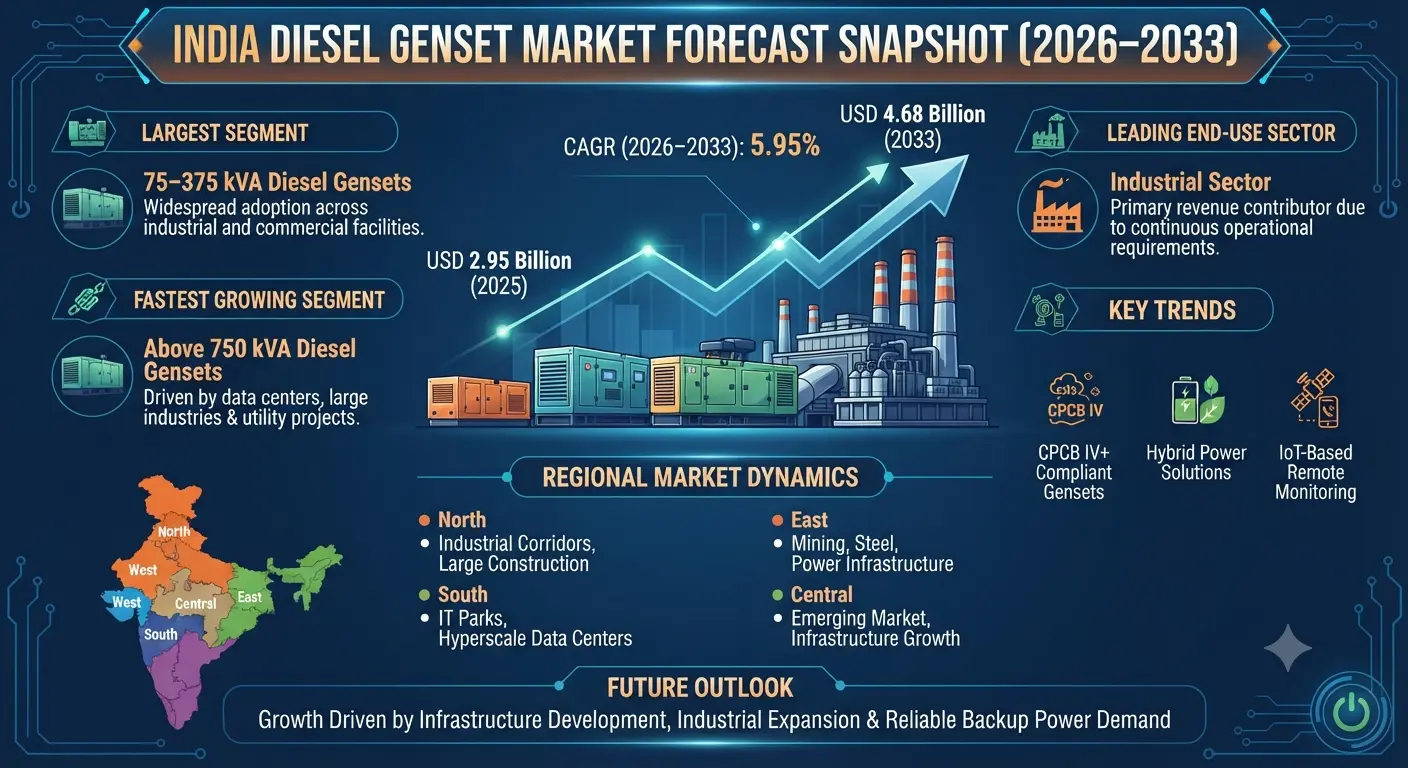
India Diesel Genset Market Forecast Snapshot (2026???2033)
| Metric | Value |
|---|---|
| Market Size (2025) | ?? ?? ?? ?? ?? ?? ?? ?? ?? ?? ?? ?? ?? ?? ?? ?? ?? ?? ?? ?? ?? ?? ?? ?? ?? ?? ?? ?? ?? ?? ?? ?? ?? ?? ?? ?? ?? ?? ?? ?? ??USD 2.95 Billion |
| Market Size (2033) | ?? ?? ?? ?? ?? ?? ?? ?? ?? ?? ?? ?? ?? ?? ?? ?? ?? ?? ?? ?? ?? ?? ?? ?? ?? ?? ?? ?? ?? ?? ?? ?? ?? ?? ?? ?? ?? ?? ?? ?? ??USD 4.68 Billion |
| CAGR (2026???2033) | ?? ?? ?? ?? ?? ?? ?? ?? ?? ?? ?? ?? ?? ?? ?? ?? ?? ?? ?? ?? ?? ?? ?? ?? ?? ?? ?? ?? ?? ?? ?? ?? ?? ?? ?? ?? ?? ?? ?? ?? ?? ?? ?? ?? ?? ??5.95% |
| Largest Segment | ?? ?? ?? ?? ?? ?? ?? ?? ?? ?? ?? ?? ?? ?? ?? ?? ?? ?? ?? ?? ?? ?? ?? ?? ?? ?? ?? ?? ?? ?? ?? ?? ?? ?? ?? ?? ?? 75???375 kVA Diesel Gensets |
| Fastest Growing Segment | ?? ?? ?? ?? ?? ?? ?? ?? ?? ?? ?? ?? ?? ?? ?? ?? ?? ?? ?? ?? ?? ?? ?? ?? ?? ?? ?? ?? ?? ?? ?? ?? ?? ?? ?? ?? Above 750 kVA Diesel Gensets |
| Leading End-Use Segment | ?? ?? ?? ?? ?? ?? ?? ?? ?? ?? ?? ?? ?? ?? ?? ?? ?? ?? ?? ?? ?? ?? ?? ?? ?? ?? ?? ?? ?? ?? ?? ?? ?? ?? ?? ?? ?? ?? ?? ?? ?? ?? Industrial Sector |
| Key Trend | ?? ?? ?? ?? ?? ?? ?? ?? ?? ?? ?? CPCB IV+ Compliant Gensets, Hybrid Power Solutions & IoT-Based Remote Monitoring |
| Regulatory Influence | ?? ?? ?? ?? ?? ?? ?? ?? ?? ?? ?? CPCB Emission Norms, Energy Efficiency Regulations & Industrial Environmental Compliance Standards |
| Future Outlook | ?? ?? ?? ?? ?? ?? ?? ?? ?? ?? ??Growth Driven by Infrastructure Development, Industrial Expansion & Reliable Backup Power Demand |
India Diesel Genset Market Size & Forecast
The India Diesel Genset Market is expected to witness steady growth during the forecast period from 2026 to 2033. The market was valued at USD 2.95 billion in 2025 and is projected to reach approximately USD 4.68 billion by 2033, registering a CAGR of 5.95%. Market growth is primarily driven by rising infrastructure development, expanding industrialization, increasing construction activities, growing demand for uninterrupted power supply, and continued investments in commercial and manufacturing facilities. Diesel generator sets continue to play a vital role in providing reliable backup and prime power solutions across multiple industries despite the growing adoption of renewable energy sources.India Diesel Genset Market Overview
Diesel generator sets (gensets) are engine-driven power generation systems used to provide backup, standby, or continuous electricity during grid outages or in off-grid locations. These systems are widely deployed across industrial facilities, commercial buildings, hospitals, telecom infrastructure, data centers, construction sites, mining operations, and residential complexes. Modern diesel gensets incorporate fuel-efficient engines, low-emission technologies, remote monitoring capabilities, and digital control systems to improve operational efficiency and regulatory compliance.Structural Drivers of Market Growth
1. Growing Infrastructure and Construction Activities
Rapid investments in transportation, commercial real estate, manufacturing facilities, and urban infrastructure are increasing demand for dependable backup power. Market Implications: Construction contractors and infrastructure developers continue to invest in high-capacity diesel gensets.2. Expanding Industrial and Manufacturing Sector
Manufacturing facilities require uninterrupted power supply to ensure continuous production and minimize operational disruptions. Market Implications: Industrial demand remains the primary revenue contributor for diesel genset manufacturers.3. Rising Demand from Data Centers and Telecom Infrastructure
Digital transformation, cloud computing, and expanding telecom networks require highly reliable standby power systems. Market Implications: Diesel gensets remain an essential component of mission-critical power infrastructure.4. Technological Advancements in Low-Emission Gensets
Manufacturers are introducing CPCB IV+ compliant engines, intelligent controllers, and hybrid power systems to improve efficiency and reduce emissions. Market Implications: Advanced gensets are gaining preference across regulated industrial and commercial sectors.India Diesel Genset Market Segmentation
??????????????1. By Power Rating
1.1 Up to 75 kVA
1.1.1 Residential Backup Power 1.1.1.1 Individual Homes 1.1.1.1.1 Urban Residential Areas 1.1.1.1.2 Rural Households 1.1.1.1.3 Farmhouses 1.1.1.1.4 Small Apartments 1.1.2 Small Commercial Establishments 1.1.3 Telecom Towers 1.1.4 Retail Outlets1.2 75.1???375 kVA
1.2.1 Commercial Buildings 1.2.2 Hospitals 1.2.3 Hotels 1.2.4 Educational Institutions1.3 375.1???750 kVA
1.3.1 Manufacturing Facilities 1.3.2 Data Centers 1.3.3 Industrial Plants 1.3.4 Infrastructure Projects1.4 Above 750 kVA
1.4.1 Large Industrial Complexes 1.4.2 Utility Applications 1.4.3 Oil & Gas Facilities 1.4.4 Mining Operations??????????????2. By Application
2.1 Standby Power
2.1.1 Commercial Backup 2.1.1.1 Emergency Power Supply 2.1.1.1.1 Hospitals 2.1.1.1.2 IT & Data Centers 2.1.1.1.3 Airports 2.1.1.1.4 Banking Facilities 2.1.2 Residential Backup 2.1.3 Institutional Backup 2.1.4 Industrial Backup2.2 Prime Power
2.2.1 Construction Sites 2.2.2 Mining Operations 2.2.3 Agriculture 2.2.4 Remote Locations2.3 Peak Shaving
2.3.1 Manufacturing Plants 2.3.2 Commercial Complexes 2.3.3 Utilities 2.3.4 Industrial Parks2.4 Continuous Power
2.4.1 Oil & Gas 2.4.2 Marine Applications 2.4.3 Defense Installations 2.4.4 Infrastructure Projects??????????????3. By End User
3.1 Industrial
3.1.1 Manufacturing 3.1.1.1 Automotive Industry 3.1.1.1.1 Component Manufacturing 3.1.1.1.2 Assembly Plants 3.1.1.1.3 EV Manufacturing 3.1.1.1.4 Ancillary Units 3.1.2 Oil & Gas 3.1.3 Mining 3.1.4 Chemicals & Petrochemicals3.2 Commercial
3.2.1 Healthcare 3.2.2 Hospitality 3.2.3 Retail 3.2.4 IT & Telecom3.3 Residential
3.3.1 Individual Homes 3.3.2 Apartments 3.3.3 Gated Communities 3.3.4 Luxury Residences3.4 Government & Public Infrastructure
3.4.1 Railways 3.4.2 Airports 3.4.3 Defense 3.4.4 Municipal Infrastructure??????????????4. By Fuel Tank Capacity
4.1 Up to 100 Liters
4.1.1 Portable Gensets 4.1.2 Residential Units 4.1.3 Small Commercial Units 4.1.4 Telecom Applications4.2 101???300 Liters
4.2.1 Commercial Buildings 4.2.2 Educational Institutions 4.2.3 Healthcare Facilities 4.2.4 Hotels4.3 301???600 Liters
4.3.1 Manufacturing Plants 4.3.2 Warehouses 4.3.3 Industrial Units 4.3.4 Construction Sites4.4 Above 600 Liters
4.4.1 Large Infrastructure Projects 4.4.2 Mining Operations 4.4.3 Oil & Gas Facilities 4.4.4 Utility Installations??????????????5. By Region
5.1 North India 5.2 South India 5.3 East India 5.4 West India 5.5 Central IndiaRegional Market Dynamics
North India
Leading regional market supported by expanding industrial corridors, commercial infrastructure, and large-scale construction projects.South India
Driven by rapid growth of manufacturing industries, IT parks, healthcare infrastructure, and hyperscale data centers.West India
Strong demand supported by industrial manufacturing clusters, ports, refineries, and commercial developments.East India
Growing market fueled by mining activities, steel manufacturing, power infrastructure, and industrial expansion.Central India
Emerging market benefiting from infrastructure investments, manufacturing growth, and expanding commercial facilities.Competitive Landscape
The India Diesel Genset Market is highly competitive with domestic and international manufacturers focusing on emission-compliant technologies, fuel efficiency, intelligent monitoring systems, and extensive service networks. Key Companies Operating in the Market Include:- Cummins India Limited
- Kirloskar Oil Engines Limited
- Caterpillar Inc.
- Ashok Leyland Limited
- Mahindra Powerol
- Greaves Cotton Limited
- Kohler Co.
- Rolls-Royce Power Systems (MTU)
- Atlas Copco AB
- Sterling and Wilson Pvt. Ltd.
Strategic Outlook
The future of the India diesel genset market will be shaped by emission-compliant engine technologies, hybrid power generation systems, digital monitoring platforms, and intelligent energy management solutions. Manufacturers are increasingly integrating IoT-enabled remote diagnostics, predictive maintenance, and fuel optimization technologies to improve operational efficiency and reduce lifecycle costs. Hybrid systems combining diesel generators with battery storage and renewable energy sources are expected to gain wider adoption across commercial and industrial sectors. Although renewable energy deployment is increasing, diesel gensets are expected to remain indispensable for critical backup applications requiring reliable and uninterrupted power supply. Companies investing in cleaner technologies, product innovation, regulatory compliance, and nationwide service capabilities will be well-positioned to capitalize on long-term market opportunities.Final Market Perspective
The India Diesel Genset Market continues to play a critical role in supporting the country's industrial growth, infrastructure expansion, and energy security. Rising demand for dependable backup power, modernization of industrial facilities, and increasing investments in commercial infrastructure will continue to support market expansion. Manufacturers offering fuel-efficient, low-emission, digitally connected, and highly reliable diesel genset solutions are expected to strengthen their competitive position in India's evolving power generation market.Table of Contents
1. Executive Summary
1.1 Market Snapshot (2026???2033)
1.2 Key Growth Highlights
1.3 Demand-Supply Overview
1.4 Key Strategic Insights
1.5 Analyst Viewpoint
2. Market Overview
2.1 Introduction to India Diesel Genset Market
2.2 Industry Value Chain Analysis
2.3 Market Evolution & Historical Trends
2.4 Macro-Economic Impact Analysis
2.5 Growing Demand for Reliable Backup Power Across Industries
2.6 CPCB IV+ Compliant Technologies, Hybrid Power Solutions & IoT-Based Genset Monitoring
3. India Diesel Genset Market Forecast Snapshot (USD Billion), 2026???2033
3.1 2025 Market Size
3.2 2033 Market Size
3.3 CAGR (2026???2033)
3.4 Largest Region
3.5 Fastest Growing Region
3.6 Largest Segment
3.7 Key Trend
3.8 Future Outlook
4. Key Drivers of Market Growth
4.1 Growing Infrastructure & Construction Activities
4.2 Expanding Industrial & Manufacturing Sector
4.3 Rising Demand from Data Centers & Telecom Infrastructure
4.4 Technological Advancements in Low-Emission Diesel Gensets
4.5 Increasing Need for Reliable Backup & Prime Power Solutions
5. Market Challenges
5.1 Stringent CPCB Emission Regulations
5.2 Rising Fuel Costs & Operating Expenses
5.3 Growing Adoption of Renewable Energy & Battery Storage
5.4 High Initial Investment & Maintenance Costs
6. Market Segmentation by Power Rating (USD Billion), 2026???2033
6.1 Below 75 kVA
6.1.1 Residential Backup Gensets
6.1.1.1 Individual Homes
6.1.1.2 Small Offices
6.1.1.3 Retail Stores
6.1.1.4 Small Commercial Buildings
6.2 75???375 kVA Diesel Gensets
6.2.1 Commercial & Industrial Gensets
6.2.1.1 Manufacturing Facilities
6.2.1.2 Hospitals
6.2.1.3 Educational Institutions
6.2.1.4 Office Complexes
6.3 375???750 kVA Diesel Gensets
6.3.1 Large Commercial Installations
6.3.1.1 Hotels
6.3.1.2 Industrial Plants
6.3.1.3 Telecom Infrastructure
6.3.1.4 Infrastructure Projects
6.4 Above 750 kVA Diesel Gensets
6.4.1 High-Capacity Power Solutions
6.4.1.1 Data Centers
6.4.1.2 Airports
6.4.1.3 Mining Operations
6.4.1.4 Utility & Industrial Facilities
7. Market Segmentation by Application (USD Billion), 2026???2033
7.1 Standby Power
7.1.1 Emergency Backup Systems
7.1.1.1 Commercial Buildings
7.1.1.2 Hospitals
7.1.1.3 Data Centers
7.1.1.4 Telecom Towers
7.2 Prime Power
7.2.1 Continuous Power Generation
7.2.1.1 Mining Sites
7.2.1.2 Remote Locations
7.2.1.3 Construction Projects
7.2.1.4 Oil & Gas Operations
7.3 Peak Shaving
7.3.1 Load Management Solutions
7.3.1.1 Industrial Facilities
7.3.1.2 Commercial Complexes
7.3.1.3 Utility Support
7.3.1.4 Manufacturing Plants
8. Market Segmentation by End Use (USD Billion), 2026???2033
8.1 Industrial Sector
8.1.1 Manufacturing
8.1.2 Mining
8.1.3 Oil & Gas
8.1.4 Process Industries
8.2 Commercial Buildings
8.2.1 Shopping Malls
8.2.2 Office Buildings
8.2.3 Hotels
8.2.4 Healthcare Facilities
8.3 Telecom & Data Centers
8.3.1 Telecom Towers
8.3.2 Edge Data Centers
8.3.3 Hyperscale Data Centers
8.3.4 Network Infrastructure
8.4 Construction & Infrastructure
8.4.1 Infrastructure Projects
8.4.2 Commercial Construction
8.4.3 Residential Projects
8.4.4 Transportation Infrastructure
9. Market Segmentation by Region (USD Billion), 2026???2033
9.1 North India
9.2 South India
9.3 West India
9.4 East India
9.5 Central India
10. Regional Market Analysis
10.1 North India ??? Market Leader
10.2 South India ??? Fastest Growing Region
10.3 West India ??? Industrial & Manufacturing Hub
10.4 East India ??? Expanding Mining & Infrastructure Activities
10.5 Central India ??? Emerging Industrial Development Corridor
11. Competitive Landscape
11.1 Market Share Analysis
11.2 Competitive Positioning Matrix
11.3 Strategic Developments (M&A, Product Launches, Partnerships)
11.4 Innovation Benchmarking
11.5 CPCB Compliance & Emission Standards Assessment
12. Company Profiles
12.1 Cummins India Limited
12.2 Kirloskar Oil Engines Limited
12.3 Caterpillar Inc.
12.4 Ashok Leyland Limited
12.5 Mahindra Powerol
12.6 Greaves Cotton Limited
12.7 Kohler Co.
12.8 Rolls-Royce Power Systems (MTU)
12.9 Atlas Copco AB
12.10 Sterling and Wilson Pvt. Ltd.
13. Strategic Intelligence & AI-Driven Insights
13.1 Pheonix Demand Forecast Engine
13.2 Diesel Genset Market Intelligence Dashboard
13.3 AI-Powered Predictive Maintenance Engine
13.4 IoT-Based Fleet Monitoring & Fuel Optimization Platform
13.5 Regulatory Compliance & Emission Monitoring System
14. Investment & Growth Opportunities
14.1 CPCB IV+ Compliant Diesel Gensets
14.2 Hybrid Diesel-Solar Power Solutions
14.3 IoT-Based Smart Genset Monitoring Systems
14.4 High-Capacity Gensets for Data Centers & Industrial Facilities
14.5 Infrastructure & Manufacturing Expansion Projects
15. Why the India Diesel Genset Market Remains Critical
15.1 Increasing Infrastructure Development
15.2 Growing Industrial & Manufacturing Expansion
15.3 Rising Demand for Reliable Backup Power
15.4 Continuous Innovation in Low-Emission & Connected Gensets
15.5 Long-Term Growth Across Industrial, Commercial & Critical Infrastructure Applications
16. Appendix
17. About Pheonix Research
18. Disclaimer
Competitive Landscape
India Diesel Genset Market Competitive Intensity & Market Structure Overview
The India Diesel Genset Market is highly competitive and technology-driven, characterized by the presence of domestic engine manufacturers, global power equipment companies, generator OEMs, and integrated power solution providers. Competitive intensity is primarily driven by fuel efficiency, CPCB IV+ emission compliance, product reliability, service network coverage, digital monitoring capabilities, and total cost of ownership.
Companies compete across multiple product categories including standby power gensets, prime power gensets, peak shaving solutions, portable generators, and high-capacity industrial diesel generator systems. Increasing demand from manufacturing facilities, infrastructure projects, telecom networks, commercial buildings, hospitals, and data centers is intensifying competition and encouraging continuous product innovation.
The market structure is evolving toward emission-compliant, digitally connected, and hybrid power generation solutions. Market participants are investing heavily in low-emission engine technologies, IoT-enabled remote monitoring, predictive maintenance platforms, hybrid power systems, and nationwide after-sales service capabilities to strengthen market positioning and improve operational efficiency.
India Diesel Genset Market Competitive Intensity & Market Structure Current Scenario
Leading India Diesel Genset Companies
- Cummins India Limited: A leading diesel genset manufacturer recognized for high-performance power generation systems, CPCB IV+ compliant engines, and a strong nationwide service network.
- Kirloskar Oil Engines Limited: One of India’s leading power generation equipment manufacturers offering a comprehensive portfolio of diesel generator solutions for industrial and commercial applications.
- Caterpillar Inc.: A global power solutions provider delivering premium diesel generator systems for mission-critical, industrial, mining, and infrastructure applications.
- Ashok Leyland Limited: A major Indian manufacturer expanding its presence in the diesel genset market through efficient engine technologies and reliable backup power solutions.
- Mahindra Powerol: A prominent provider of diesel generator solutions serving residential, commercial, telecom, and industrial customers with fuel-efficient power systems.
- Greaves Cotton Limited: A diversified engineering company offering advanced diesel generator solutions supported by extensive distribution and service capabilities.
- Kohler Co.: A global manufacturer of premium diesel generator systems known for advanced engineering, reliable backup power, and digital control technologies.
- Rolls-Royce Power Systems (MTU): A leading provider of high-capacity diesel power generation systems for data centers, utilities, and mission-critical infrastructure.
- Atlas Copco AB: A global industrial equipment company supplying reliable diesel generator systems for construction, industrial, and infrastructure applications.
- Sterling and Wilson Pvt. Ltd.: An integrated engineering and energy solutions company providing turnkey diesel power systems and backup power infrastructure for commercial and industrial customers.
Key Competitive Intensity & Market Structure Drivers
Implementation of CPCB IV+ emission standards is intensifying competition among manufacturers developing cleaner, fuel-efficient, and environmentally compliant diesel gensets.
Growing demand for uninterrupted power across industrial facilities, commercial buildings, healthcare institutions, telecom infrastructure, and data centers is driving continuous product innovation.
Integration of IoT-enabled remote monitoring, predictive maintenance, intelligent controllers, and digital energy management systems is becoming a critical competitive differentiator.
Expansion of nationwide sales, rental, maintenance, and after-sales service networks is strengthening customer relationships and improving long-term market competitiveness.
Increasing adoption of hybrid power systems integrating diesel generators with battery energy storage and renewable energy sources is creating new growth opportunities while reshaping competitive strategies.
Strategic Implications of Competitive Intensity & Market Structure
Companies with strong manufacturing capabilities, advanced engine technologies, and comprehensive service networks are expected to maintain significant competitive advantages.
Investment in emission-compliant engines, intelligent monitoring platforms, and hybrid power generation technologies will remain essential for long-term market leadership.
Organizations focusing on digital connectivity, predictive maintenance, fuel optimization, and customized power solutions are likely to strengthen customer retention and market share.
Strategic partnerships with EPC contractors, infrastructure developers, industrial customers, telecom operators, and data center providers are helping manufacturers expand market reach and accelerate business growth.
Businesses capable of combining operational reliability, regulatory compliance, technological innovation, nationwide support services, and cost-efficient power solutions will be best positioned to compete effectively in the evolving India diesel genset market.
India Diesel Genset Market Competitive Intensity & Market Structure Forward Outlook
The competitive landscape of the India diesel genset market is expected to become increasingly technology-driven, compliance-focused, and service-oriented as industrialization, infrastructure development, and digital transformation continue across the country.
India Diesel Genset Market Competitive Intensity & Market Structure Overview
The India Diesel Genset Market is highly competitive and technology-driven, characterized by the presence of domestic engine manufacturers, global power equipment companies, generator OEMs, and integrated power solution providers. Competitive intensity is primarily driven by fuel efficiency, CPCB IV+ emission compliance, product reliability, service network coverage, digital monitoring capabilities, and total cost of ownership.
Companies compete across multiple product categories including standby power gensets, prime power gensets, peak shaving solutions, portable generators, and high-capacity industrial diesel generator systems. Increasing demand from manufacturing facilities, infrastructure projects, telecom networks, commercial buildings, hospitals, and data centers is intensifying competition and encouraging continuous product innovation.
The market structure is evolving toward emission-compliant, digitally connected, and hybrid power generation solutions. Market participants are investing heavily in low-emission engine technologies, IoT-enabled remote monitoring, predictive maintenance platforms, hybrid power systems, and nationwide after-sales service capabilities to strengthen market positioning and improve operational efficiency.
India Diesel Genset Market Competitive Intensity & Market Structure Current Scenario
Leading India Diesel Genset Companies
Cummins India Limited: A leading diesel genset manufacturer recognized for high-performance power generation systems, CPCB IV+ compliant engines, and a strong nationwide service network.
Kirloskar Oil Engines Limited: One of India’s leading power generation equipment manufacturers offering a comprehensive portfolio of diesel generator solutions for industrial and commercial applications.
Caterpillar Inc.: A global power solutions provider delivering premium diesel generator systems for mission-critical, industrial, mining, and infrastructure applications.
Ashok Leyland Limited: A major Indian manufacturer expanding its presence in the diesel genset market through efficient engine technologies and reliable backup power solutions.
Mahindra Powerol: A prominent provider of diesel generator solutions serving residential, commercial, telecom, and industrial customers with fuel-efficient power systems.
Greaves Cotton Limited: A diversified engineering company offering advanced diesel generator solutions supported by extensive distribution and service capabilities.
Kohler Co.: A global manufacturer of premium diesel generator systems known for advanced engineering, reliable backup power, and digital control technologies.
Rolls-Royce Power Systems (MTU): A leading provider of high-capacity diesel power generation systems for data centers, utilities, and mission-critical infrastructure.
Atlas Copco AB: A global industrial equipment company supplying reliable diesel generator systems for construction, industrial, and infrastructure applications.
Sterling and Wilson Pvt. Ltd.: An integrated engineering and energy solutions company providing turnkey diesel power systems and backup power infrastructure for commercial and industrial customers.
Key Competitive Intensity & Market Structure Drivers
Implementation of CPCB IV+ emission standards is intensifying competition among manufacturers developing cleaner, fuel-efficient, and environmentally compliant diesel gensets.
Growing demand for uninterrupted power across industrial facilities, commercial buildings, healthcare institutions, telecom infrastructure, and data centers is driving continuous product innovation.
Integration of IoT-enabled remote monitoring, predictive maintenance, intelligent controllers, and digital energy management systems is becoming a critical competitive differentiator.
Expansion of nationwide sales, rental, maintenance, and after-sales service networks is strengthening customer relationships and improving long-term market competitiveness.
Increasing adoption of hybrid power systems integrating diesel generators with battery energy storage and renewable energy sources is creating new growth opportunities while reshaping competitive strategies.
Strategic Implications of Competitive Intensity & Market Structure
Companies with strong manufacturing capabilities, advanced engine technologies, and comprehensive service networks are expected to maintain significant competitive advantages.
Investment in emission-compliant engines, intelligent monitoring platforms, and hybrid power generation technologies will remain essential for long-term market leadership.
Organizations focusing on digital connectivity, predictive maintenance, fuel optimization, and customized power solutions are likely to strengthen customer retention and market share.
Strategic partnerships with EPC contractors, infrastructure developers, industrial customers, telecom operators, and data center providers are helping manufacturers expand market reach and accelerate business growth.
Businesses capable of combining operational reliability, regulatory compliance, technological innovation, nationwide support services, and cost-efficient power solutions will be best positioned to compete effectively in the evolving India diesel genset market.
India Diesel Genset Market Competitive Intensity & Market Structure Forward Outlook
The competitive landscape of the India diesel genset market is expected to become increasingly technology-driven, compliance-focused, and service-oriented as industrialization, infrastructure development, and digital transformation continue across the country.
Future competition will be shaped by next-generation CPCB-compliant engines, hybrid power generation systems, AI-enabled predictive maintenance, IoT-based fleet management, advanced fuel optimization technologies, and intelligent energy management platforms.
Market participants are expected to increase investments in cleaner engine technologies, digital monitoring solutions, nationwide service infrastructure, hybrid energy integration, and strategic collaborations to strengthen competitive positioning.
Over the forecast period, companies that successfully combine product reliability, emission compliance, fuel efficiency, intelligent connectivity, operational excellence, and strong customer support capabilities will be best positioned to lead the evolving India diesel genset market.
Future competition will be shaped by next-generation CPCB-compliant engines, hybrid power generation systems, AI-enabled predictive maintenance, IoT-based fleet management, advanced fuel optimization technologies, and intelligent energy management platforms.
Market participants are expected to increase investments in cleaner engine technologies, digital monitoring solutions, nationwide service infrastructure, hybrid energy integration, and strategic collaborations to strengthen competitive positioning.
Over the forecast period, companies that successfully combine product reliability, emission compliance, fuel efficiency, intelligent connectivity, operational excellence, and strong customer support capabilities will be best positioned to lead the evolving India diesel genset market.
Value Chain
India Diesel Genset Market Value Chain & Supply Chain Evolution Overview
The India Diesel Genset Market operates through an integrated value chain encompassing raw material sourcing, engine and alternator manufacturing, genset assembly, control system integration, distribution, installation, aftermarket services, and end-user operations. The market includes diesel generator manufacturers, component suppliers, OEMs, EPC contractors, distributors, rental service providers, and maintenance service companies serving industrial, commercial, telecom, healthcare, construction, and infrastructure sectors.
The industry is influenced by rapid industrialization, infrastructure development, rising demand for uninterrupted power supply, tightening emission regulations, and increasing investments in mission-critical facilities such as data centers and telecom infrastructure. Manufacturers are emphasizing fuel efficiency, regulatory compliance, digital monitoring capabilities, and lifecycle cost optimization to strengthen market competitiveness.
The adoption of CPCB IV+ compliant engines, IoT-enabled monitoring platforms, hybrid power solutions, and predictive maintenance technologies is transforming supply chain operations while improving product reliability, operational efficiency, and customer service capabilities.
Digitalization, localized manufacturing initiatives, intelligent energy management systems, and expanding nationwide service networks are further enhancing value chain efficiency and enabling faster deployment of diesel genset solutions across India.
India Diesel Genset Market Value Chain & Supply Chain Evolution Current Scenario
Market-Specific Value Chain
- Raw Material & Component Procurement: Procurement of diesel engines, alternators, control panels, fuel systems, exhaust systems, batteries, steel components, and electronic controllers from domestic and international suppliers.
- Engine Manufacturing & Genset Assembly: Manufacturing of diesel engines, alternators, acoustic enclosures, generator assembly, testing, and quality assurance by OEMs.
- Control Systems & Technology Integration: Integration of digital controllers, IoT-based remote monitoring systems, automatic transfer switches (ATS), fuel management systems, and emission control technologies.
- Distribution & Project Delivery: Distribution through authorized dealers, EPC contractors, industrial equipment suppliers, rental companies, and regional sales networks.
- Installation & Commissioning: Site preparation, electrical integration, commissioning, load testing, regulatory compliance verification, and customer training.
- Aftermarket Service & Maintenance: Preventive maintenance, spare parts supply, remote diagnostics, predictive maintenance, AMC services, and equipment upgrades.
- End User Operations: Deployment across industrial facilities, commercial buildings, telecom towers, hospitals, data centers, construction sites, and infrastructure projects.
Company-to-Stage Mapping
- Raw Material & Component Procurement: Engine manufacturers, alternator suppliers, electrical component manufacturers, steel suppliers, battery manufacturers, and electronics suppliers.
- Engine Manufacturing & Genset Assembly: Cummins India Limited, Kirloskar Oil Engines Limited, Caterpillar Inc., Ashok Leyland Limited, Mahindra Powerol, Greaves Cotton Limited, Kohler Co., and Rolls-Royce Power Systems (MTU).
- Control Systems & Technology Integration: Industrial automation providers, IoT platform developers, controller manufacturers, ATS suppliers, and digital monitoring solution providers.
- Distribution & Project Delivery: Authorized distributors, EPC contractors, power solution integrators, equipment dealers, and rental fleet operators.
- Installation & Commissioning: Electrical contractors, engineering service providers, project management firms, and field service engineers.
- Aftermarket Service & Maintenance: OEM service centers, maintenance contractors, spare parts distributors, remote monitoring providers, and AMC service providers.
- End User Operations: Industrial manufacturers, commercial facilities, telecom operators, data center operators, hospitals, infrastructure developers, and construction companies.
Key Value Chain & Supply Chain Evolution Signals in India Diesel Genset Market
Growing Adoption of CPCB IV+ Compliant Gensets
Manufacturers are accelerating deployment of low-emission diesel gensets to comply with evolving environmental regulations while improving operational efficiency.
Expansion of IoT-Based Remote Monitoring
Digital monitoring platforms are enabling predictive maintenance, remote diagnostics, fuel management, and real-time equipment performance optimization.
Increasing Integration of Hybrid Power Solutions
Diesel generators are increasingly being integrated with battery energy storage systems and renewable energy sources to improve efficiency and reduce fuel consumption.
Rising Demand from Data Centers and Critical Infrastructure
Expansion of hyperscale data centers, telecom infrastructure, healthcare facilities, and industrial plants is driving demand for highly reliable backup power systems.
Localization of Manufacturing and Supply Chains
Manufacturers are strengthening domestic production capabilities and local sourcing strategies to improve supply chain resilience and reduce lead times.
Expansion of Nationwide Service Networks
OEMs are investing in dealer networks, spare parts availability, and digital service platforms to improve customer support and equipment uptime.
Strategic Implications of Value Chain & Supply Chain Evolution
Investment in Emission-Compliant Technologies
Developing CPCB IV+ compliant engines and cleaner power solutions will help manufacturers maintain regulatory compliance and strengthen market competitiveness.
Expansion of Digital Monitoring Capabilities
IoT-enabled diagnostics and predictive maintenance solutions can improve equipment reliability while reducing operating and maintenance costs.
Strengthening Domestic Manufacturing Ecosystems
Localized production and component sourcing can improve supply chain resilience, reduce dependency on imports, and enhance delivery efficiency.
Optimization of Aftermarket Services
Comprehensive maintenance programs, digital service platforms, and rapid spare parts availability can increase customer satisfaction and recurring revenues.
Development of Hybrid Backup Power Solutions
Integrating diesel gensets with renewable energy and battery storage systems can improve fuel efficiency and support sustainable energy management strategies.
Expansion into High-Growth Infrastructure Segments
Targeting data centers, telecom infrastructure, industrial manufacturing, healthcare facilities, and commercial construction projects can generate long-term growth opportunities.
India Diesel Genset Market Value Chain & Supply Chain Evolution Forward Outlook
Looking ahead, the India diesel genset value chain is expected to become increasingly digitized, energy-efficient, and sustainability-focused. Advancements in emission control technologies, hybrid power systems, intelligent monitoring platforms, and localized manufacturing will continue reshaping industry operations.
Key Future Developments Include:
- Wider adoption of CPCB IV+ compliant low-emission diesel gensets.
- Expansion of IoT-enabled remote monitoring and predictive maintenance platforms.
- Increasing deployment of hybrid diesel, battery storage, and renewable energy systems.
- Growth in domestic manufacturing and localized component sourcing.
- Greater use of AI-driven energy management and fuel optimization technologies.
- Expansion of nationwide aftermarket service infrastructure and digital customer support platforms.
As the market evolves, competitive advantage will increasingly depend on emission compliance, digital innovation, product reliability, service excellence, and efficient supply chain management.
Companies that successfully integrate advanced monitoring technologies, hybrid energy solutions, localized manufacturing capabilities, and robust nationwide service networks will be well-positioned to achieve long-term growth in the India Diesel Genset Market.
Investment Activity
India Diesel Genset Market Investment & Funding Dynamics Overview (2026???2033)
The India Diesel Genset Market is witnessing sustained investment activity driven by expanding industrialization, large-scale infrastructure development, increasing demand for reliable backup power, and the modernization of critical power infrastructure. Diesel genset manufacturers, infrastructure developers, private equity firms, institutional investors, EPC contractors, and energy technology providers are actively investing in CPCB IV+ compliant generator technologies, manufacturing capacity expansion, hybrid power solutions, digital monitoring platforms, and nationwide service networks.
Investment momentum is strengthening as organizations focus on improving power reliability while meeting evolving environmental regulations and operational efficiency requirements. Capital allocation is increasingly directed toward fuel-efficient engine technologies, IoT-enabled remote monitoring systems, predictive maintenance platforms, intelligent power management solutions, and emission-compliant product development.
Additionally, growing investments in data center infrastructure, telecom expansion, industrial manufacturing facilities, commercial real estate projects, and hybrid energy systems integrating diesel generators with renewable energy and battery storage are creating long-term growth opportunities across India’s diesel genset ecosystem.
Current Investment & Funding Landscape
The current investment landscape reflects strong participation from diesel genset manufacturers, infrastructure companies, industrial enterprises, financial institutions, technology providers, and government-supported industrial development initiatives. Industry participants are investing heavily in advanced engine technologies, production capacity expansion, product innovation, digital service platforms, and dealer network enhancement.
Significant funding is being directed toward CPCB IV+ compliant product development, smart monitoring technologies, manufacturing automation, hybrid power generation systems, and after-sales service infrastructure to strengthen market competitiveness and regulatory compliance.
Strategic collaborations among engine manufacturers, EPC contractors, industrial equipment suppliers, telecom operators, data center developers, and technology companies are accelerating innovation and expanding investment opportunities throughout the diesel genset value chain.
Key Investment & Funding Dynamics Signals
- Growing demand for reliable backup power across industrial, commercial, and infrastructure projects is driving sustained investment in diesel genset technologies.
- Expansion of data centers, telecom infrastructure, healthcare facilities, and manufacturing plants is attracting increased funding for high-capacity genset deployment.
- Rising investment in CPCB IV+ compliant engines, fuel-efficient technologies, and low-emission power generation systems is supporting regulatory compliance.
- Increasing capital deployment toward IoT-based remote monitoring, predictive maintenance, and intelligent energy management platforms is improving operational efficiency.
- Growing adoption of hybrid power systems integrating diesel generators, battery storage, and renewable energy is creating new investment opportunities.
- Strategic collaboration between equipment manufacturers, technology providers, EPC companies, and infrastructure developers is strengthening product innovation and market expansion.
- Expansion into industrial corridors, smart cities, logistics hubs, and large-scale infrastructure developments is generating long-term funding opportunities.
Strategic Implications of Investment & Funding Dynamics
- Continuous investment in emission-compliant technologies, digital monitoring systems, and fuel-efficient engines is essential for maintaining long-term competitiveness.
- Capital allocation toward manufacturing expansion, hybrid energy integration, and intelligent power management platforms will strengthen commercialization opportunities.
- Companies developing high-performance gensets, advanced digital control systems, and integrated service capabilities are expected to secure stronger long-term growth prospects.
- Strategic partnerships among diesel engine manufacturers, infrastructure developers, EPC contractors, technology firms, and energy solution providers will accelerate innovation and market expansion.
- Investments in service infrastructure, predictive maintenance technologies, remote diagnostics, and nationwide distribution networks will improve customer support and operational efficiency.
- Compliance with CPCB emission norms, energy efficiency regulations, environmental standards, and industrial compliance requirements will continue influencing investment decisions.
- Organizations building integrated capabilities across manufacturing, engineering, digital power management, hybrid energy solutions, and lifecycle services are expected to capture substantial future value.
Forward Outlook
Looking ahead, the India Diesel Genset Market is expected to maintain healthy investment momentum driven by infrastructure expansion, industrial growth, digital infrastructure development, and continued demand for dependable backup power solutions.
Future capital deployment will increasingly focus on next-generation low-emission gensets, hybrid power systems, IoT-enabled asset management, AI-driven predictive maintenance, and advanced energy optimization technologies.
As India’s industrial base, commercial infrastructure, telecom networks, and hyperscale data centers continue to expand, investment activity is expected to accelerate across diesel power generation technologies, intelligent monitoring platforms, manufacturing facilities, and integrated energy management solutions.
In conclusion, the India Diesel Genset Market represents a resilient power infrastructure investment landscape where emission compliance, digital innovation, hybrid power integration, operational efficiency, and reliable energy security will define future funding priorities, competitive differentiation, and long-term market growth.
Technology & Innovation
India Diesel Genset Market Technology & Innovation Landscape Overview
The India Diesel Genset Market is undergoing significant technological transformation as advancements in low-emission engine technologies, intelligent control systems, Internet of Things (IoT), artificial intelligence (AI), hybrid power solutions, and digital energy management platforms redefine backup power generation. Diesel genset manufacturers, component suppliers, and energy solution providers are investing in next-generation technologies to improve fuel efficiency, reduce emissions, enhance operational reliability, and comply with evolving environmental regulations. These innovations are enabling businesses to achieve greater energy resilience while lowering operational costs and environmental impact.
The market is also benefiting from developments in CPCB IV+ compliant engine technologies, advanced electronic control modules, remote monitoring platforms, predictive maintenance solutions, battery energy storage integration, and cloud-based asset management systems. These technologies are improving equipment performance, minimizing downtime, optimizing fuel consumption, and extending equipment lifespan. As industries increasingly demand reliable, efficient, and environmentally compliant power solutions, technology has become a major driver of market competitiveness and long-term growth.
India Diesel Genset Market Technology & Innovation Current Scenario
Current innovation within the India diesel genset market is primarily focused on CPCB IV+ emission-compliant engines, IoT-enabled remote monitoring, AI-powered predictive maintenance, hybrid diesel-battery systems, and intelligent energy management platforms. Manufacturers are integrating advanced digital controllers, real-time diagnostics, GPS-enabled fleet monitoring, and automated load management systems to improve operational efficiency and ensure uninterrupted power availability. Artificial intelligence and analytics are increasingly being utilized to monitor equipment health, optimize maintenance schedules, and reduce unexpected failures.
Hybrid power configurations combining diesel generators with battery energy storage systems and renewable energy sources are gaining traction across commercial, industrial, telecom, and infrastructure applications. In addition, cloud-based monitoring platforms, mobile service applications, and remote asset management solutions are enabling operators to improve equipment utilization, enhance service response, and reduce lifecycle operating costs. These technological advancements are strengthening the industry’s ability to deliver reliable, efficient, and environmentally responsible power solutions.
Key Technology & Innovation Trends in India Diesel Genset Market
- CPCB IV+ Compliant Engine Technologies: Developing advanced low-emission diesel engines that comply with India’s latest environmental regulations while improving fuel efficiency.
- IoT-Based Remote Monitoring: Enabling real-time monitoring of genset performance, fuel consumption, operating conditions, and maintenance requirements through connected digital platforms.
- AI-Powered Predictive Maintenance: Utilizing artificial intelligence and data analytics to predict component failures, optimize maintenance schedules, and minimize equipment downtime.
- Hybrid Power Generation Systems: Integrating diesel generators with battery energy storage systems and renewable energy sources to improve energy efficiency and reduce fuel consumption.
- Advanced Digital Control Systems: Incorporating intelligent controllers for automated load sharing, remote operation, fault diagnostics, and power management.
- Cloud-Based Fleet Management Platforms: Providing centralized monitoring, asset tracking, performance analytics, and maintenance management for multiple genset installations.
- Fuel Optimization Technologies: Improving engine combustion, electronic fuel injection, and load management systems to reduce operating costs and emissions.
- Smart Power Management Solutions: Optimizing generator performance through intelligent energy distribution, automatic synchronization, and peak load management.
- Remote Diagnostics & Over-the-Air Updates: Supporting faster troubleshooting, software upgrades, and equipment optimization without requiring on-site intervention.
- Digital Service & Asset Lifecycle Management: Leveraging connected service platforms to enhance maintenance planning, spare parts management, and equipment lifecycle performance.
Strategic Implications of Technology & Innovation
Technological advancements are enabling diesel genset manufacturers to improve product efficiency, strengthen regulatory compliance, and deliver greater value to industrial and commercial customers. Companies investing in low-emission engine technologies, intelligent monitoring systems, hybrid energy solutions, and predictive analytics are enhancing operational reliability while reducing total cost of ownership. Innovation is helping manufacturers differentiate through improved fuel economy, digital connectivity, and advanced power management capabilities.
As India’s industrial infrastructure, commercial developments, telecom networks, and data center capacity continue to expand, manufacturers are increasingly focusing on integrated energy ecosystems that combine diesel generation with digital monitoring and renewable energy integration. Companies successfully adopting intelligent automation, connected technologies, and next-generation power management platforms are expected to strengthen their competitive advantage. However, evolving emission standards, fuel price volatility, cybersecurity requirements, and technology integration challenges remain important factors influencing product development and market adoption.
India Diesel Genset Market Technology & Innovation Forward Outlook
The future of the India Diesel Genset Market is expected to be shaped by continued advancements in low-emission engine platforms, AI-enabled energy management, hybrid power generation, battery storage integration, and intelligent digital monitoring systems. Emerging innovations such as digital twin technology, machine learning-based predictive diagnostics, advanced fuel optimization algorithms, smart microgrid integration, and autonomous power management systems are expected to transform backup power operations. Manufacturers are likely to increase investments in connected technologies that improve operational efficiency, sustainability, and asset reliability.
As demand for uninterrupted power supply, energy efficiency, and regulatory compliance continues to increase across industrial, commercial, telecom, healthcare, and data center applications, technology will remain a key driver of market evolution. The integration of artificial intelligence, IoT connectivity, cloud-based analytics, hybrid energy systems, and advanced emission-control technologies is expected to create significant growth opportunities while strengthening the long-term development of the India diesel genset market.
Market Risk
India Diesel Genset Market Risk Factors & Disruption Threats Overview
The India Diesel Genset Market operates within the broader power generation, industrial equipment, infrastructure, and energy ecosystem. While the market benefits from rising infrastructure development, industrial expansion, increasing demand for reliable backup power, and growth in data centers and commercial facilities, it faces several risks related to tightening emission regulations, fuel price volatility, renewable energy adoption, supply chain disruptions, and changing energy transition policies.
One of the most significant structural risks is the implementation of increasingly stringent environmental regulations governing diesel emissions. The enforcement of CPCB IV+ emission norms and future environmental standards is requiring manufacturers to invest heavily in cleaner engine technologies, advanced emission control systems, and product redesign, increasing development and production costs.
The market is also highly dependent on diesel fuel availability, engine components, electronic control systems, and raw materials. Supply chain disruptions, fluctuations in diesel prices, shortages of semiconductors, and volatility in steel and metal prices can impact manufacturing costs, equipment pricing, and delivery schedules.
Another major disruption factor involves the accelerating adoption of renewable energy systems, battery energy storage solutions, and gas-based backup power technologies. As organizations increasingly pursue decarbonization and sustainability goals, demand for conventional diesel-powered backup systems may face growing competitive pressure in selected applications.
Additionally, increasing competition from domestic manufacturers, international OEMs, and alternative power solution providers is intensifying pricing pressure while encouraging continuous innovation in fuel efficiency, digital monitoring, and hybrid power systems.
India Diesel Genset Market Risk Factors & Disruption Threats Current Scenario
The current market environment is characterized by strong demand for backup power across industrial facilities, commercial buildings, healthcare institutions, telecom infrastructure, construction projects, and rapidly expanding data centers. Manufacturers continue introducing CPCB IV+ compliant diesel gensets featuring improved fuel efficiency, lower emissions, IoT-enabled monitoring, and predictive maintenance capabilities.
However, the industry remains exposed to fluctuations in diesel fuel prices, supply chain disruptions affecting engines and electronic components, and rising manufacturing costs driven by inflation and raw material price volatility. These factors continue to influence equipment pricing and procurement decisions.
Customers are increasingly demanding higher fuel efficiency, lower operating costs, reduced emissions, remote monitoring capabilities, and seamless integration with renewable energy and battery storage systems. Manufacturers face continuous pressure to deliver technologically advanced products while maintaining cost competitiveness.
Regulatory authorities are also strengthening oversight regarding emissions compliance, environmental impact, fuel efficiency, noise pollution, industrial safety, and energy efficiency standards applicable to diesel power generation equipment.
At the same time, competitive intensity continues to increase as established engine manufacturers, domestic OEMs, and power solution providers expand their product portfolios, service capabilities, and hybrid energy offerings across India.
Key Risk Factors & Disruption Threat Signals in India Diesel Genset Market
A major disruption signal is the increasing adoption of hybrid power systems that combine diesel generators with battery energy storage systems and renewable energy sources to improve fuel efficiency and reduce emissions.
Another important signal is the tightening of emission regulations through CPCB standards and broader environmental policies aimed at reducing air pollution and promoting cleaner energy technologies across industrial and commercial sectors.
The rapid expansion of hyperscale data centers, telecom infrastructure, healthcare facilities, and mission-critical operations continues to generate sustained demand for high-capacity, reliable standby power systems with intelligent monitoring capabilities.
Advancements in IoT-enabled remote monitoring, predictive maintenance, digital controllers, and intelligent energy management systems are continuously improving equipment performance, operational reliability, and lifecycle cost optimization.
Growing investments in distributed energy systems, microgrids, natural gas generators, and renewable energy infrastructure are reshaping the competitive landscape and influencing long-term equipment procurement strategies.
The expansion of nationwide infrastructure projects, industrial corridors, manufacturing investments, and smart city developments is expected to create new opportunities while increasing demand for emission-compliant backup power solutions.
Strategic Implications of Risk Factors & Disruption Threats in India Diesel Genset Market
Manufacturers should prioritize continuous investment in CPCB-compliant engine technologies, fuel-efficient powertrains, intelligent control systems, and hybrid power solutions to strengthen long-term competitiveness.
Supply chain diversification and strategic sourcing initiatives will be critical for reducing exposure to raw material volatility, semiconductor shortages, logistics disruptions, and component supply risks.
Companies should strengthen digital capabilities through IoT-enabled remote monitoring, predictive maintenance, fleet management, and energy optimization platforms to improve customer value and operational efficiency.
Investment in hybrid power generation technologies, battery integration, renewable energy compatibility, and sustainable product development can support regulatory compliance while addressing evolving customer requirements.
Strategic partnerships with EPC contractors, infrastructure developers, industrial customers, telecom operators, and data center operators can strengthen market penetration and expand long-term business opportunities.
Organizations should continuously monitor evolving regulations related to CPCB emission norms, environmental compliance, industrial safety standards, fuel quality requirements, and energy efficiency policies to ensure long-term regulatory alignment.
India Diesel Genset Market Risk Factors & Disruption Threats Forward Outlook
Looking ahead to 2026???2033, the India Diesel Genset Market is expected to maintain steady growth as infrastructure development, industrialization, digital infrastructure expansion, and reliable backup power requirements continue to support demand. However, future market growth will increasingly depend on emission compliance, hybrid power integration, fuel efficiency improvements, and digital intelligence.
Hybrid energy systems integrating diesel generators, battery storage, renewable energy sources, and intelligent energy management platforms are expected to become important competitive differentiators by reducing fuel consumption, emissions, and operating costs.
Environmental regulations are likely to become progressively more stringent, requiring manufacturers to accelerate investments in cleaner combustion technologies, advanced after-treatment systems, and sustainable power generation solutions.
Digital transformation through artificial intelligence, predictive maintenance, cloud-based monitoring, remote diagnostics, and connected fleet management is expected to enhance equipment reliability, operational efficiency, and customer service capabilities.
Technological convergence across diesel power generation, renewable energy, battery storage, IoT, and smart grid infrastructure is expected to create new growth opportunities while reshaping the competitive landscape.
Overall, the market will remain growth-oriented but increasingly influenced by environmental regulations, technological innovation, energy transition strategies, supply chain resilience, and evolving customer expectations. Long-term market leaders will be defined by their ability to deliver fuel-efficient, low-emission, digitally connected, and highly reliable backup power solutions that support India’s expanding industrial and infrastructure ecosystem.
Regulatory Landscape
India Diesel Genset Market Regulatory & Policy Environment Overview
The regulatory and policy environment governing the India Diesel Genset Market is becoming increasingly stringent as the government seeks to balance the country’s growing demand for reliable backup power with environmental sustainability and emission reduction objectives. Regulatory authorities including the Central Pollution Control Board (CPCB), Ministry of Environment, Forest and Climate Change (MoEFCC), Bureau of Energy Efficiency (BEE), Central Electricity Authority (CEA), and state pollution control boards establish standards governing diesel generator emissions, operational safety, fuel efficiency, environmental compliance, and installation practices.
Diesel genset manufacturers, engine suppliers, equipment distributors, EPC contractors, industrial users, and commercial facility operators must comply with a broad range of regulations covering emission standards, engine certification, noise control, fuel quality, electrical safety, environmental clearances, and periodic maintenance requirements. Regulatory compliance is essential to ensure legal market access, operational continuity, and environmental responsibility.
As India’s industrialization, urban infrastructure development, data center expansion, and commercial construction activities continue to accelerate, policymakers are placing greater emphasis on cleaner diesel technologies, hybrid power systems, digital emissions monitoring, and energy-efficient backup power solutions while encouraging a gradual transition toward lower-carbon energy infrastructure.
India Diesel Genset Market Regulatory & Policy Environment Current Scenario
The current regulatory landscape is primarily centered on CPCB IV+ emission norms, environmental compliance requirements, equipment safety standards, and industrial pollution control measures. Manufacturers must ensure that diesel generator sets meet prescribed emission limits and certification requirements before being introduced into the Indian market.
Emission regulations govern engine performance, exhaust emissions, particulate matter limits, nitrogen oxide (NOx) control, fuel quality requirements, and after-treatment technologies. Compliance with CPCB IV+ standards has become mandatory for many categories of diesel generator sets manufactured and sold in India.
Environmental regulations also govern installation approvals, permissible operating hours in certain regions, ambient noise limits, stack height requirements, and pollution control measures for diesel gensets operating in industrial, commercial, and institutional facilities.
Electrical safety standards regulate generator design, installation, synchronization systems, protection equipment, and operational reliability to ensure safe integration with industrial and commercial electrical infrastructure.
Growing adoption of digital monitoring technologies is encouraging the implementation of remote diagnostics, intelligent control systems, fuel monitoring, and predictive maintenance solutions to improve regulatory compliance and operational efficiency.
Key Regulatory & Policy Environment Signals in India Diesel Genset Market
- CPCB Emission Norms:
Regulations governing permissible emission limits, engine certification, exhaust treatment technologies, particulate matter reduction, and compliance with CPCB IV+ standards. - Industrial Environmental Compliance Standards:
Requirements covering environmental clearances, pollution control measures, noise limits, stack height regulations, and operational compliance for diesel generator installations. - Electrical Safety & Installation Standards:
Standards regulating generator design, electrical protection systems, installation procedures, operational safety, and grid integration requirements. - Energy Efficiency & Fuel Performance Regulations:
Policies encouraging fuel-efficient engine technologies, optimized energy consumption, intelligent power management, and improved operational efficiency. - Noise Control & Public Health Regulations:
Frameworks governing acoustic enclosure requirements, permissible noise levels, community protection measures, and environmental noise management. - Hybrid Power & Clean Energy Integration Policies:
Government initiatives promoting the integration of diesel gensets with renewable energy systems, battery energy storage, and intelligent hybrid power solutions to reduce emissions and fuel consumption.
Strategic Implications of Regulatory & Policy Environment
The evolving regulatory environment is encouraging manufacturers to invest in CPCB IV+ compliant engine technologies, advanced emission control systems, intelligent generator controllers, and comprehensive compliance management programs. Regulatory readiness is becoming an important competitive differentiator within India’s power generation equipment industry.
Emission standards are driving continuous innovation in engine combustion technologies, fuel injection systems, exhaust after-treatment solutions, and digital monitoring platforms to improve environmental performance while maintaining operational reliability.
Environmental compliance requirements are motivating industrial users and commercial facility operators to adopt low-emission gensets, improve maintenance practices, optimize fuel consumption, and implement advanced monitoring systems that support regulatory reporting.
Government support for energy efficiency and cleaner power generation is encouraging manufacturers to develop hybrid diesel generator solutions integrated with battery storage systems, solar power, and intelligent energy management technologies.
The increasing adoption of IoT-enabled remote monitoring and predictive maintenance solutions is helping operators improve equipment reliability, reduce downtime, enhance fuel efficiency, and maintain continuous compliance with evolving regulatory standards.
India Diesel Genset Market Regulatory & Policy Environment Forward Outlook
Between 2026 and 2033, the regulatory environment for the India Diesel Genset Market is expected to become increasingly stringent as India advances its environmental sustainability goals, industrial modernization initiatives, and clean energy transition strategies.
Emission regulations are likely to tighten further through enhanced engine performance requirements, stricter pollutant limits, advanced emission monitoring systems, and broader implementation of cleaner diesel technologies across industrial and commercial applications.
Government policies are expected to promote greater adoption of hybrid power generation systems by encouraging the integration of diesel generators with renewable energy sources, battery energy storage, and smart energy management platforms.
Digital compliance frameworks are anticipated to expand through increased use of IoT-enabled monitoring, remote diagnostics, predictive maintenance, real-time emissions reporting, and intelligent asset management technologies for critical backup power infrastructure.
Overall, the future regulatory landscape will be shaped by the convergence of CPCB emission standards, industrial environmental regulations, electrical safety requirements, energy efficiency policies, hybrid power initiatives, and digital monitoring frameworks. Companies capable of delivering fuel-efficient, low-emission, technologically advanced, and fully compliant diesel genset solutions will be best positioned to capitalize on long-term opportunities within India’s evolving power generation and infrastructure ecosystem.