
Global Sack Kraft Paper Market Report, Size, Share and Forecast 2026–2033: 7.4 Million Tonnes, and the Third That Still Becomes a Sack
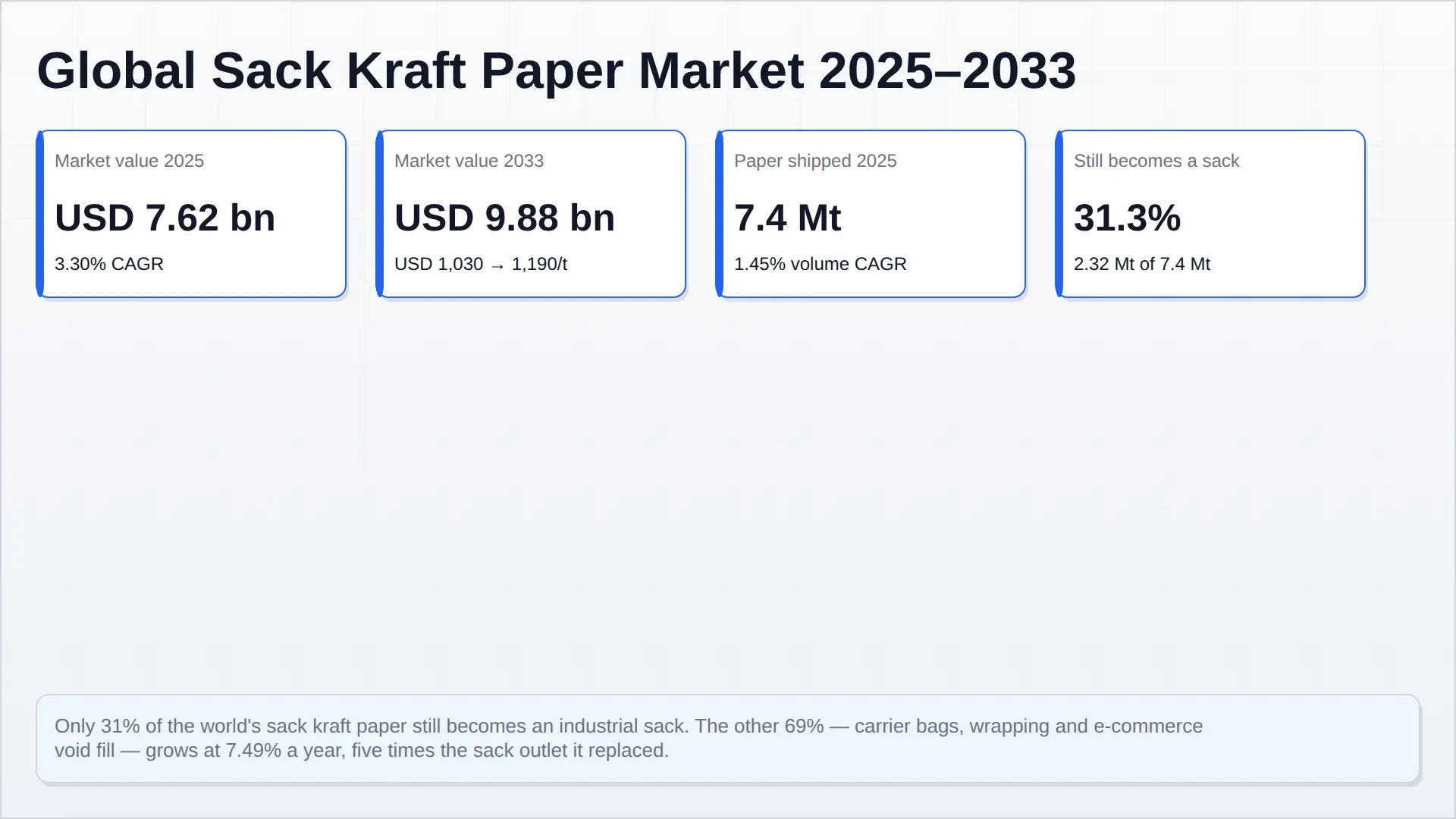
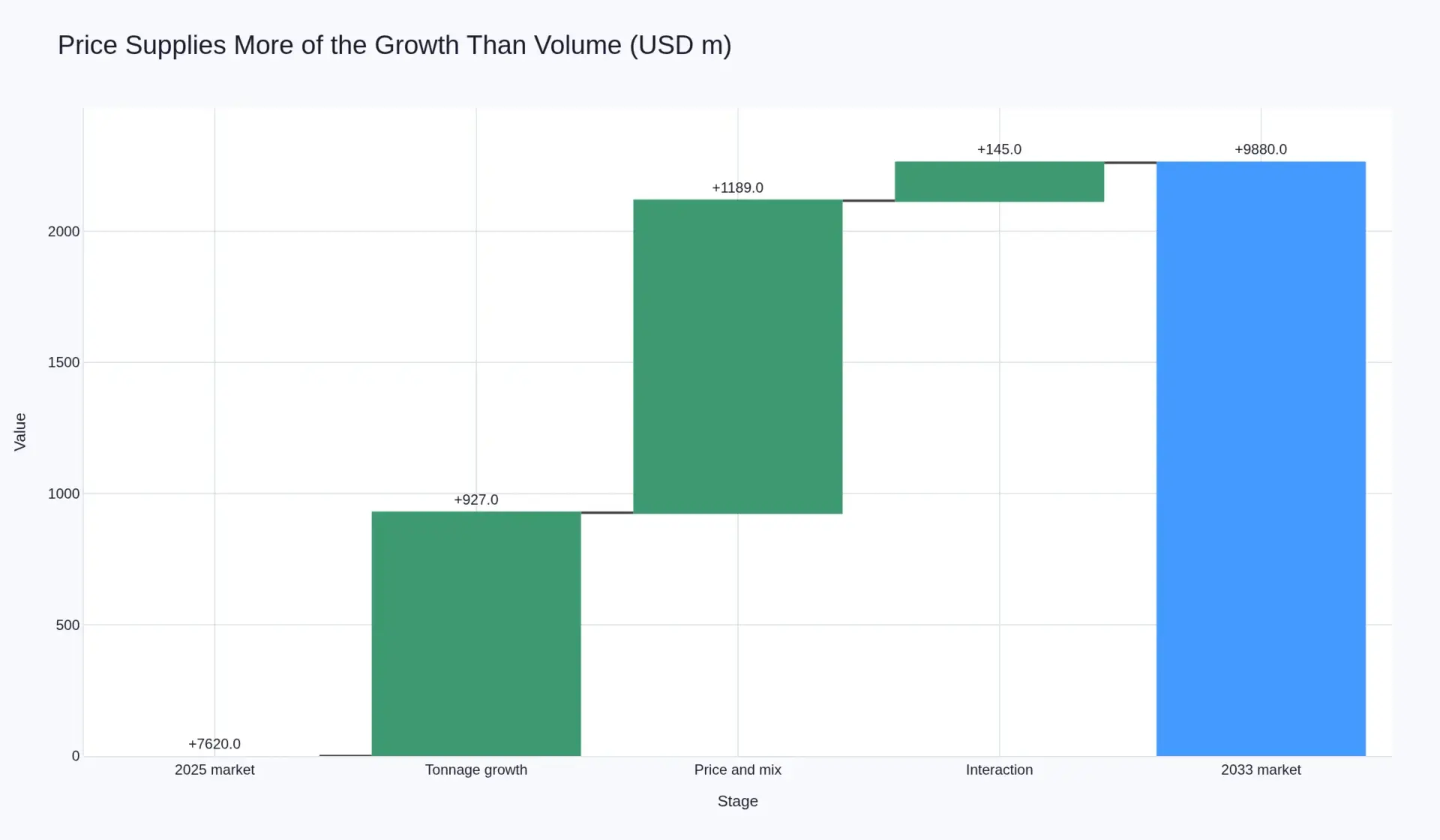
Sack kraft paper is a USD 7,620 million market in 2025 reaching USD 9,880 million by 2033 at a 3.30 per cent value CAGR, on 7.4 million tonnes of paper growing 1.45 per cent a year. Those two numbers are far apart because this is a cost-driven market now, not a volume-driven one: at constant 2025 prices the extra tonnage is worth USD 927 million and higher prices are worth USD 1,189 million. More than half the growth in this market is the price of the paper rather than the quantity of it.
The finding that reorganises the whole subject is a boundary one. Only about 31 per cent of the world's sack kraft paper still goes into an industrial sack. The industrial multiwall sack market — 18.1 billion sacks at an average of 128 grammes — consumes roughly 2.32 million tonnes of the 7.4 million tonnes this report sizes. The other two-thirds goes into carrier and consumer bags, wrapping and e-commerce void fill, food-service converting and specialty grades. One European producer told Fastmarkets that a decade ago 100 per cent of its sack kraft went into sacks; today it is under 70 per cent, with up to 35 per cent going into new applications such as e-commerce filler. Sack kraft is no longer a sack material. It is becoming a general-purpose kraft substrate, and the two markets are growing at different speeds.
Europe is simultaneously the industry's factory and the least relevant thing in it. European mills will produce about 2.24 million tonnes in 2025 — 30.3 per cent of world supply — of which 1.25 million tonnes is consumed in Europe and 993 thousand tonnes is exported net. Europe ships 44.3 per cent of its output out of the region. Its own 5.69 billion paper sacks contain only 728 thousand tonnes of paper, so more than 40 per cent of the paper Europe consumes never enters a sack at all.
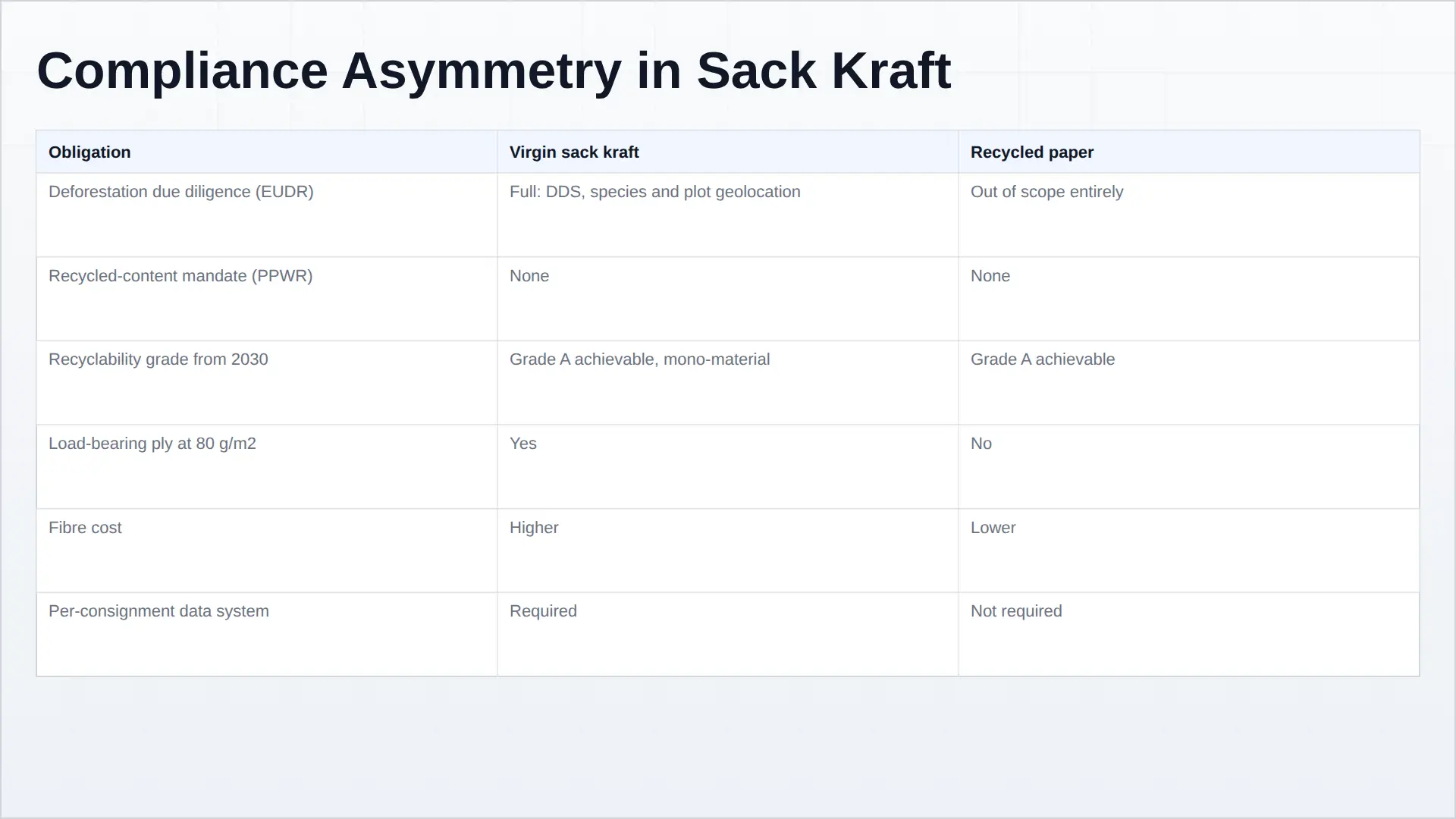
The regulatory clock is the reason the next eight years are not simply a continuation. The EU Deforestation Regulation applies to operators and traders of chapter 48 paper products from 30 December 2026, and in the forest-based value chain that date applies irrespective of company size. A sack kraft mill runs on virgin long-fibre softwood, which means the heaviest possible due-diligence file: species, harvest evidence, and plot polygons at six decimal places behind every tonne. Recovered fibre is explicitly out of scope — so the recycled alternative escapes the file entirely, and cannot make a 100-gramme high-porosity sack. That is the central asymmetry of this market and almost nobody has priced it.
1. Market Snapshot
Seven and a half million tonnes of paper a year and only a third of it still becomes a sack is the fact that reorganises this entire market. Sack kraft paper has spent a century defined by its destination: the multiwall sack of cement, of flour, of animal feed, of mineral. That destination is now a minority outlet. At 18.1 billion industrial sacks and an average of 128 grammes, the global multiwall sack industry consumes roughly 2,317 thousand tonnes of paper. This report sizes the paper itself at 7,400 thousand tonnes. The difference — 5.1 million tonnes — goes into carrier and consumer bags, wrapping and e-commerce void fill, food-service converting and specialty grades, and it is growing faster than the sack ever will.
Pheonix sizes the global sack kraft paper market at USD 7,620 million in 2025, reaching USD 9,880 million by 2033, a 3.30 per cent value CAGR, on 7,400 thousand tonnes of paper rising to 8,300 thousand tonnes at 1.45 per cent.
| Metric | 2025 | 2033 | CAGR 2026–2033 |
|---|---|---|---|
| Paper shipped | 7,400 kt | 8,300 kt | 1.45% |
| Blended mill-realised price | USD 1,030/t | USD 1,190/t | 1.82% |
| Market value, ex-mill | USD 7,620 m | USD 9,880 m | 3.30% |
| Of which industrial multiwall sacks | 2,317 kt (31.3%) | 2,660 kt (32.0%) | 1.35% |
| Of which everything else | 5,083 kt (68.7%) | 5,640 kt (68.0%) | 1.53% |
The arithmetic of 3.30 per cent is 1.45 per cent of tonnage and 1.82 per cent of price, and the decomposition matters more here than in most packaging markets because it is unusual. Of the USD 2,255 million of value growth, USD 927 million comes from extra tonnage at 2025 prices, USD 1,184 million from higher prices at 2025 volume, and USD 144 million from the interaction. Volume supplies 41.1 per cent of growth and price 52.5. This is a cost-driven market wearing a demand story, which is precisely the reverse of the woven polypropylene sack market it competes with.
Europe is the industry's factory and a shrinking share of its market. European mills will produce about 2.24 million tonnes in 2025 — 30.3 per cent of world supply — from installed capacity of roughly 2.53 million tonnes, at operating rates of 87 to 90 per cent. Of that output, 1.25 million tonnes is consumed inside Europe and 993 thousand tonnes is exported net, so the region ships 44.3 per cent of everything it makes out of the region. Its own 5.69 billion delivered paper sacks contain 728 thousand tonnes of paper. The other 522 thousand tonnes of European consumption never enters a sack at all.
The regulatory clock is why the next eight years are not a continuation of the last eight. The EU Deforestation Regulation applies to chapter 48 paper products from 30 December 2026, and in the forest-based value chain that date applies irrespective of company size. A sack kraft mill runs on virgin long-fibre softwood, which attracts the heaviest version of the obligation: species declaration, evidence of legal harvest, and plot polygons at six decimal places for every parcel over four hectares. Recovered fibre is explicitly out of scope.
That last clause is the hinge of the whole market. The recycled alternative escapes the deforestation file entirely and cannot make a 100-gramme high-porosity sack. So the same regulation that hands virgin kraft an unanswerable compliance burden also hands it a durable product moat, and the two effects land on the same tonne of paper. Nothing else in industrial packaging has that shape.
2. Market Definition and the Five Boundary Calls
What this report counts, and the five places where a different answer changes the market by billions. Sack kraft paper is a grade, not a format, and the boundary problems are correspondingly severe. They are stated here rather than buried in the methodology.
2.1 Unbleached and bleached are both inside
Unbleached — brown — sack kraft is roughly 72 per cent of tonnage and sells at about USD 995 a tonne. Bleached — white — is 28 per cent and sells at about USD 1,120, because it costs more in pulp and bleaching and because it is bought for print and food contact rather than for strength alone. Both are inside the count. A report that counted only brown would describe two-thirds of a market and miss the segment where the margin is.
2.2 Machine-glazed and machine-finished kraft papers are inside where they substitute
A large share of what the industry calls sack kraft is sold in machine-glazed (MG) and machine-finished (MF) form, and the boundary between "sack kraft" and "MG kraft paper" is a commercial convention rather than a technical one. Where an MG or MF grade is converted into a bag, a sack or a wrapping application it is inside this count. Where it goes to release liner, medical packaging or steel interleaving it is not — not because it is a different paper, but because it is a different market with a different buyer and a different price.
2.3 Kraftliner is out
Kraftliner is the same fibre and a different product: 150 grammes and heavier, made for corrugated board, priced off a separate benchmark and sold into a separate industry. Including it would roughly double the tonnage and destroy comparability with everything in this cluster. The distinction is also the one the industry's own pricing agencies maintain, which is why the two series diverge in the way they do.
2.4 Recycled-content grades are out, and that boundary is regulatory as well as technical
A testliner or a recycled fluting made from recovered fibre is not sack kraft, for a physical reason: a multiwall sack carrying 50 kilograms of cement through a drop test needs long virgin softwood fibre for tear and tensile strength, and recycled fibre is shorter and weaker. It is also outside the EUDR's scope, which means the product boundary and the compliance boundary happen to fall on the same line. That coincidence is worth more than a footnote and section 6.6 is about it.
2.5 VALUE is ex-mill, VOLUME is paper tonnage
Value is the mill's net selling value in US dollars, excluding freight, insurance and distributor margin. It is not the price of a sack and it is not the price of a filled tonne of cement. Volume is paper shipped in thousand tonnes — not filled-product tonnage, not sack count, and not pulp. Overlap warning: this tonnage sits inside the wider packaging market (Pheonix, Global Packaging) and inside the paper and board substrate aggregate; the share that becomes an industrial sack overlaps Pheonix, Global Industrial Paper Sacks; and the cement-driven share of that overlaps Pheonix, Global Cement Packaging. These are four views of overlapping tonnage and not four separate markets.
3. Market Size and Forecast
3.1 How the 2025 Base Was Built
The global tonnage is the softest number in this report and it is stated with its range rather than dressed up: a Pheonix capacity census of named machines plus a residual for Chinese, Indian and Southeast Asian capacity puts 2025 consumption between 6.9 and 7.8 million tonnes, with 7.4 million as the central case. The range is wide because the world's largest producing country publishes no machine-level register, and pretending otherwise would be the single easiest way to make this report wrong.
The reliable end of the base is Europe, because it is measured. European sack kraft demand was 1.25 million tonnes in 2025, up 2.8 per cent, with 993 thousand tonnes of net exports and operating rates of 87 to 90 per cent, according to Fastmarkets' economist for the region (Fastmarkets, Sack kraft supply and demand is shifting, June 2026). Demand plus net exports gives production of 2,243 thousand tonnes; dividing by the mid-point of the operating-rate range implies installed capacity of about 2,534 thousand tonnes. That leaves roughly 291 thousand tonnes of European capacity running idle or intermittently — 11.5 per cent of the installed base — and it explains every closure decision in the region.
The machine census then ties Europe to named assets. Mondi's sack kraft system runs from Frantschach in Austria, with three paper machines producing around 250 thousand tonnes of sack and kraft paper a year and an export rate above 80 per cent, through Dynäs in Sweden and Štětí in the Czech Republic, where a new 210 thousand tonne machine started up in December 2024 (Mondi, Štětí inauguration, November 2025). Billerud runs sack paper across Karlsborg — 335 thousand tonnes of total mill capacity, and the group's sack paper development centre — Skärblacka at 460 thousand tonnes including brown sack paper, Pietarsaari at 200 thousand tonnes and Gruvön at 870 thousand tonnes (Billerud, Karlsborg; Billerud, Skärblacka). Segezha's Karelia mill can produce up to 384 thousand tonnes of sack kraft paper and describes itself as having the capacity to be the world's third-largest sack paper manufacturer (Segezha Group, Segezha Pulp and Paper Mill). Natron-Hayat's PM 4 at Maglaj in Bosnia is geared for 80 thousand tonnes of unbleached sack kraft (PULPAPERnews, Natron-Hayat). Klabin's Correia Pinto complex in Santa Catarina is the Latin American anchor.
Price is built grade by grade rather than taken from one benchmark. Fastmarkets launched European average sack kraft assessments for bleached and unbleached semi-extensible 80 g+ on 22 January 2026, calculated as the simple average of its French, German, Italian and Spanish assessments (Fastmarkets, pricing notice, January 2026). Its Brazilian benchmark for unbleached extensible 78–85 g stood at BRL 5,300–5,600 per tonne in May 2026 — USD 1,024–1,082 — after a 5.83 per cent monthly rise. Those two series bracket the European and export price of the brown grade. The blended global mill-realised price of USD 1,030 is built from approximately USD 995 for unbleached and USD 1,120 for bleached, weighted 72/28 and adjusted down for Chinese and Indian domestic tonnage that clears below the export benchmarks.
3.2 The Regional Allocation Is the Forecast
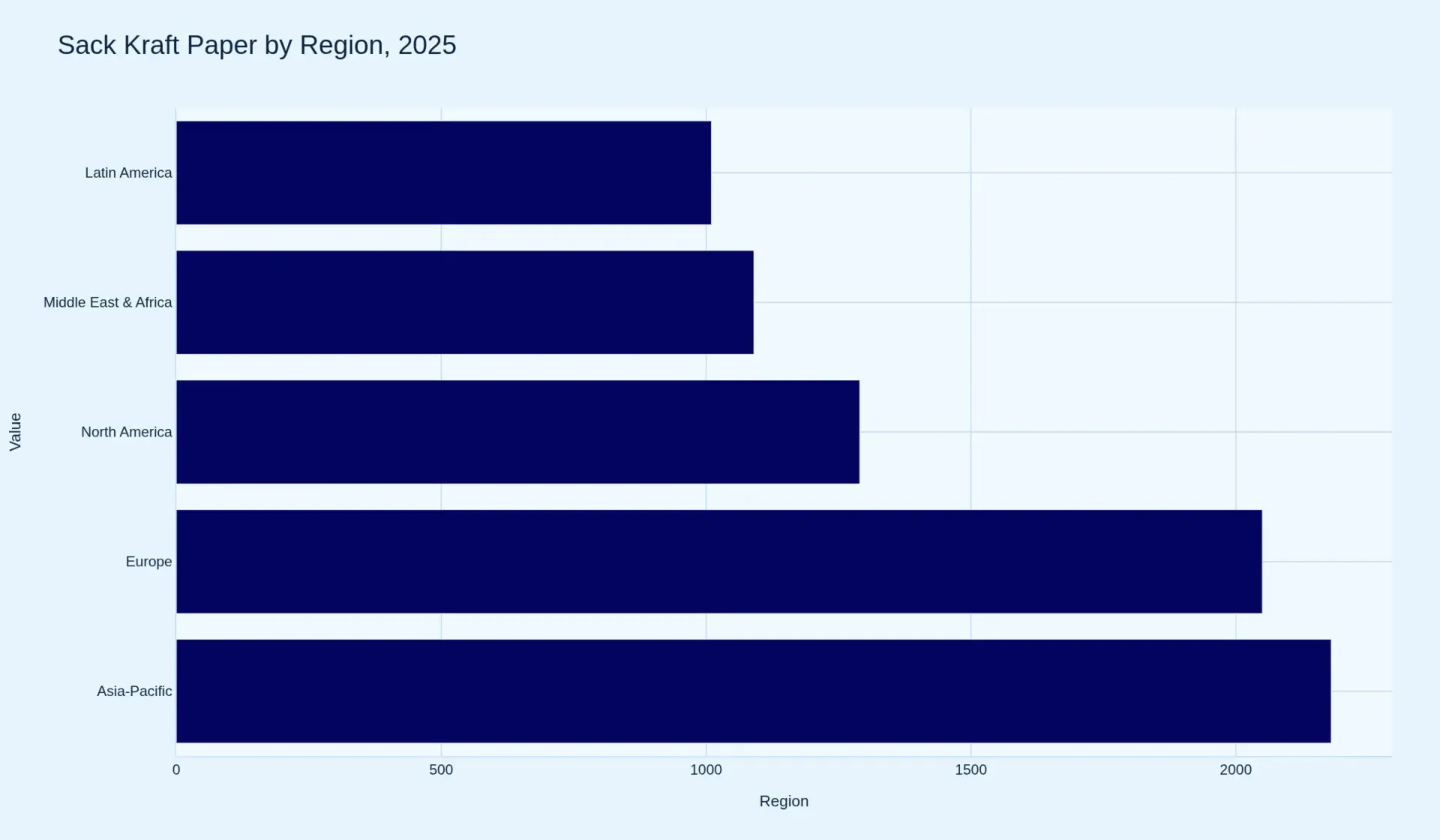
The regional split is not a share table. It is a statement about where a market growing 1.45 per cent in tonnage can find its growth.
| Region | 2025 value (USD m) | 2033 value (USD m) | CAGR | Share 2025 |
|---|---|---|---|---|
| Asia-Pacific | 2,180 | 3,140 | 4.67% | 28.6% |
| Europe | 2,050 | 2,410 | 2.04% | 26.9% |
| North America | 1,290 | 1,690 | 3.43% | 16.9% |
| Middle East & Africa | 1,090 | 1,310 | 2.32% | 14.3% |
| Latin America | 1,010 | 1,330 | 3.50% | 13.3% |
| Total | 7,620 | 9,880 | 3.30% | 100% |
Asia-Pacific is 28.6 per cent of value and supplies 40.7 per cent of the growth, but it is also where the number is least well observed. Europe is 26.9 per cent of value growing at 2.04 per cent — the slowest region in the report and the one that sets world price. The forecast's engine is Asian capacity and North American demand for kraft as a plastic replacement; its constraint is European fibre economics.
3.3 The Decomposition Is the Finding
Three growth rates describe this market and they point at three different audiences. Tonnage grows 1.45 per cent. The blended price grows 1.82 per cent. Value grows 3.30 per cent. Price therefore contributes more to value growth than volume does, and that is a structural claim rather than a cyclical one: the cost base of a sack kraft machine is energy, softwood fibre and capital, all three of which inflate faster than the price of a cement sack.
The volume path divides into two markets that behave differently. Industrial multiwall sacks grow 1.35 per cent — slower than the paper, because the sack is losing share inside its own material. Everything else grows 1.53 per cent, and inside that, wrapping and e-commerce void fill grows at 7.49 per cent. The consequence is quiet but decisive: by 2033 the sack is still 32.0 per cent of the market, but it supplies only 29.1 per cent of the growth. A paper machine built for a cement customer in 2015 is being sold into an e-commerce customer in 2030, and the grade specification barely changes.
There is a third decomposition that matters to the mill rather than the market. Price rises 1.82 per cent a year in dollars, but European producers spent 2025 and 2026 pushing through cost-driven increases in an environment where demand was, in the words of one EUWID market report, weaker in the fourth quarter of 2025 than normal seasonality would explain (EUWID, January 2026). Prices fell in the first quarter of 2026 and rose through the second and third. A market that can raise price into flat demand is a market with supply discipline, and this one has it — which is not the same thing as pricing power, because the increase was cost recovery rather than margin.
4. Four Structural Shifts Defining 2026–2033
4.1 The Substrate Decoupled From the Sack
The most important sentence in this market was said by a producer to a price reporting agency and it has been read as a demand story rather than a structural one. "Ten years ago, 100 per cent of the paper we sold was converted into sacks. Now, it is less than 70 per cent, with up to 35 per cent being used for new applications such as filler for e-commerce" (Fastmarkets, European unbleached sack kraft prices, October 2024).
Read that against the two markets it describes. Paper sack deliveries in Europe fell 15.9 per cent in 2023 and recovered 2.2 per cent in 2024 to 5.32 billion units, then 2.7 per cent in 2025 to 5.69 billion (EUROSAC, 2025 Congress; EUWID, European paper sack industry 2025). A 15.9 per cent collapse in sack deliveries ought to have taken 15.9 per cent out of sack kraft demand. It did not, because the sack had already stopped being the only outlet.
This is why the market survived its own end-use crisis. The kraft-for-plastic substitution in e-commerce and retail is the demand driver that replaced cement, and it is now large enough to be structural rather than marginal. North American demand for kraft and specialty packaging papers rose 5 per cent in 2025 to 3 million tonnes and was forecast to add a further 1.6 per cent in 2026, with the shift attributed to large retailers applying more paper in e-commerce from 2024 onward (Fastmarkets, June 2026).
The mills have already voted. Mondi's 210 thousand tonne machine at Štětí was justified on "the growing customer demand for paper-based flexible packaging, driven by eCommerce", and its grade range is described as serving construction, industrial and eCommerce applications in the same sentence (Mondi, November 2025). A machine of that size is not built on a cement forecast.
4.2 Europe Is Closing and Building at the Same Time
The European capacity story is routinely reported as a retreat. It is not. It is a swap, and the arithmetic changes the conclusion.
In October 2024 Mondi announced the permanent closure of its Stambolijski sack kraft paper mill in Bulgaria, a site Fastmarkets' asset database put at some 100 thousand tonnes a year of unbleached sack kraft, after a major fire made restart uneconomic (EUWID, 25 October 2024). Two months later, in December 2024, the same company started up a 210 thousand tonne machine at Štětí in the Czech Republic as part of a EUR 400 million investment, inaugurated in November 2025 and built by Bellmer as general contractor (paper-online, IMP S 2026 abstract).
Net European capacity rose by about 110 thousand tonnes across those two decisions — roughly EUR 1,900 of capital per annual tonne on the one hand and a write-off on the other. The 291 thousand tonnes of idle capacity identified in section 3.1 falls to about 180 thousand tonnes on the new configuration. The strategic content of the swap is not the tonnage: it is that a small single-machine site in a peripheral region was replaced by double the output at an integrated mill with pulp, energy, wood supply and logistics already in place. In this industry capacity follows fibre, not demand.
The proof is the project that did not happen. Mondi's proposed new sack kraft machine in Canada — aimed squarely at the North American market where kraft demand was growing 5 per cent — was paused in October 2025 on macroeconomic grounds, in a market whose participants still believe it could be viable if the demand for kraft wrapping continues. The demand is in North America. The fibre economics are in the Nordic region and Brazil. On current evidence, the fibre wins.
4.3 EUDR Turns Virgin Fibre Into a Documentation Asset
From 30 December 2026, operators and traders placing chapter 48 paper products on the EU market, or exporting them, must hold a due diligence statement filed through the EUDR information system, TRACES. The obligation covers, per consignment, the HS or CN code, quantity, country of production, direct supplier and client, production date range, evidence of legal harvest, and the geolocation of the plots of harvest — as polygons with six decimal places of latitude and longitude for any plot over four hectares, and a single point below that (Cepi, guidance on the revised EUDR, October 2026; European Commission, EUDR). For the wood commodity — which includes pulp and paper — the scientific name of the species is mandatory on every relevant product.
Two features of the timetable matter more than the date itself. Regulation (EU) 2025/2650, adopted on 19 December 2025, postponed application by one year to 30 December 2026 for medium and large operators and 30 June 2027 for micro and small enterprises — but in the forest-based value chain the entry into application is 30 December 2026 irrespective of company size. And the obligation attaches to the operator that first places the product on the market, which for European paper sold in Europe is the mill, and for imported paper is the EU importer.
That single clause reorganises the competitive map of this industry. A Nordic or Central European mill buying softwood from a known, registered, certified procurement area already holds the data the regulation demands, and has two years of building the system behind it. A mill selling into Europe from a region with opaque forest sourcing must now supply plot-level geolocation to its European customer, who becomes legally liable for it. The cost is not a tax. It is a data system, and a data system is a fixed cost that favours large integrated producers over small ones.
The industry's own disclosure shows what compliance looks like in practice. MM Board & Paper states that all its products containing virgin fibre, including grades combining virgin and recycled fibre, are covered by its EUDR readiness programme; where full information is required it is released through a customer portal; where reference and verification numbers must be transmitted they appear on order confirmations and delivery notes; and where no information is legally required the documents carry a statement explaining the product's EUDR status (MM Board & Paper, EUDR readiness, September 2026). Every mill in this market now has to be able to do that.
And then the twist. Products made entirely from recovered fibre that has completed its lifecycle are outside the regulation and require no due diligence statement at all. The material with the weaker physical properties has the cleanest file. Section 6.6 is about why that does not hand the market to recycled paper.
4.4 The Price Cycle Became a Cost Cycle
Sack kraft paper used to trade on demand. Since 2022 it has traded on cost, and the sequence is unusually legible.
Mills announced increases at the end of 2024, and implementation through the first half of 2025 was patchy — "a nuanced and variegated picture", in EUWID's phrase, with producers reported to be knocking euros off previously implemented increases as late as October 2024 (EUWID, April 2025). By the second quarter of 2025 the increases had taken hold across Germany and Europe. The fourth quarter of 2025 was then weak by more than normal seasonality, and brown grades came under more pressure than white. The first quarter of 2026 delivered reductions on both brown and white grades. The second quarter of 2026 reversed again, with steep cost increases linked to conflict in the Middle East, and the upward trend continued into July, with mills presenting further cost-driven demands for October (EUWID, June 2026; EUWID, September 2026).
Four direction changes in twenty-one months, none of them caused by a change in the demand for sacks. What actually swings this price is energy, pulp and freight. A sack kraft machine is among the more energy-intensive paper grades: low grammage at high strength means heavy refining and a large drying load per tonne, and the machines run continuously. When gas moves, the paper moves, and the converter finds out at the next quarterly negotiation.
That has a consequence for anyone buying this material on a fixed annual price: the risk is now carried by whoever signed last. The mills with integrated pulp and on-site energy recover fastest; merchant converters and non-integrated producers absorb the swing.
5. Market Drivers
5.1 The Kraft-For-Plastic Swap, Which Is Not About Cement
The largest single driver of this market is a substitution that happens in a fulfilment centre rather than a cement plant. Paper-based void fill, paper mailers, kraft wrapping and paper tape have taken volume from plastic film and air pillows across e-commerce since 2024, pushed by retailer commitments and by the packaging and packaging waste regime in Europe. Unbleached kraft is the natural beneficiary: it is repulpable in the standard waste-paper stream, it does not carry a recycled-content mandate, it photographs well, and it is cheap enough to be used as a filler rather than a package.
The consequence for a sack kraft mill is that it now has a customer it did not have in 2015, buying a grade it already makes, at a price that is not set by a cement tender. That is the single most important commercial development in the market and it is why a 210 thousand tonne machine could be justified in the weakest European paper market in a decade.
5.2 Construction Migrated From Cement to the Small End of the Book
Europe's paper sack statistics tell a precise story about construction that the aggregate hides. In 2024, deliveries of paper sacks rose 2.2 per cent overall while cement, milk powder and minerals declined for a third consecutive year. Every other application grew: food products excluding milk powder by 6.8 per cent, animal feed by 6.2 per cent, chemical products by 6.2 per cent and building materials excluding cement by 3.1 per cent (EUROSAC). Cement and building materials together remain 57 per cent of European paper sack deliveries, but the growth inside construction has moved to the small end of the book — mortars, renders, tile adhesives, grouts, insulation, dry mixes — where pack sizes are 5 to 25 kilograms, the sack is printed, and the buyer is a builder's merchant rather than a ready-mix plant.
That shift is good for paper. Small construction packs are filled on high-speed valve lines, they are handled individually, they must not sweat in storage, and they are sold off a shelf where print sells the product. A 20-kilogram tile adhesive sack is a specification product; a 50-kilogram cement sack is a commodity. The tonne of paper is the same and the margin is not.
5.3 Fill Speed Is a Hardware Upgrade, Not a Paper Upgrade
The most under-reported driver in this market is that a paper sack's economics are set at the filling line, and the filling line runs at a speed the paper determines. A modern rotary packer fills 2,000 to 4,000 sacks an hour. A sack that will not take air fast enough, or that generates dust at the valve, is a bottleneck worth far more per hour than the paper costs per tonne.
Which is why high-porosity and semi-extensible grades command a premium out of all proportion to their cost of production. Porosity lets the air out of the sack as fast as the product goes in; extensibility lets the paper stretch rather than rupture when a 25-kilogram pack is dropped or stacked. The technical names in the market — QuickFill-style high-porosity grades, microcreped and semi-extensible constructions — exist because converters and fillers will pay for throughput. This is the mechanism behind the price and mix component of the forecast, and it is the one part of the value story that is not simply cost pass-through.
5.4 Softwood Is the Ceiling on Everything
A sack kraft machine cannot run on recycled fibre or on hardwood alone. It needs long-fibre softwood — spruce and pine — for tear strength and tensile energy absorption, and it needs it in quantity: roughly 1.1 to 1.3 tonnes of pulp per tonne of paper, and pulp yield from softwood of about 45 to 50 per cent. That is why the industry's map is a map of boreal and temperate softwood: Sweden, Finland, Russia, the Czech and Polish spruce belt, Bosnia, and Brazil's pine plantations.
Fibre access is the entry barrier, and it is the reason this industry consolidates while the converting end never does. A new entrant can buy a paper machine; it cannot buy a forest catchment. As Fastmarkets' economist put it, it is "a challenging operation for a newcomer, as investments are capital-intensive with the demand for good-quality softwood" (Fastmarkets, June 2026).
5.5 Virgin Fibre's Food-Contact Advantage Nobody Prices
There is a premium sitting in this market that is almost never discussed in the mill's own commercial language, and it is about what virgin fibre does not contain. Recycled fibre carries mineral oil hydrocarbons (MOSH and MOAH) from printing inks in the recovered paper stream, and food-contact converters have spent a decade reformulating around them. Virgin kraft has no such legacy load. For dry food — flour, sugar, rice, semolina, milk powder, cocoa — a virgin-fibre sack with a functional barrier is the straightforward compliance answer.
Add the regulatory asymmetry from section 4.3 and the picture is unusual: virgin fibre is the material with the heaviest deforestation obligation and the cleanest food-contact file, and recycled fibre is the reverse. The buyer who needs both properties has one material that satisfies them and one that does not. That is a durable structural advantage which no competitor can legislate away, and it is why the food and feed share of this market is growing faster than the cement share.
6. Market Restraints
6.1 Bulk Substitution Deletes Tonnes Permanently
Cement and building materials are 57 per cent of European paper sack deliveries, and cement is the part of that which is shrinking. Every point of bagged share that converts to a silo or a tanker does not move to a competitor — it leaves the market, and the transition is one-way because a ready-mix supply chain does not go back to bags.
The scale is worth stating honestly rather than dramatically. Global cement production is 4,034 million tonnes and about 1,300 million tonnes of it leaves the plant bagged or in small bulk containers, which is roughly 26 billion bags of all materials. Paper takes about 10 billion of those, or 1,280 thousand tonnes of paper — 55.2 per cent of all the paper that goes into industrial sacks (Pheonix, Global Cement Packaging). A one-point shift in the global bagged share of cement is about 807 million sacks of all materials. Even at paper's share of bagged cement, a whole percentage point of substitution removes less than one per cent of the tonnage in this report. Bulk substitution is a slow structural headwind on the sack outlet, not a threat to the market — and the fact that the market survived a 15.9 per cent fall in European sack deliveries in 2023 is the empirical proof.
6.2 The Fibre Basket Cannot Be Bought
The restraint that actually binds is upstream. A sack kraft mill needs long-fibre softwood in a catchment it can reach economically, and it competes for that fibre with pulp mills, board mills, sawmills buying the same logs, and the energy market bidding for the same residues. In the Nordic region the fibre basket also competes with the forest's other valued outputs — biodiversity, carbon, recreation — and harvesting constraints tighten rather than loosen over a decade.
The practical consequence is that no amount of demand creates new sack kraft capacity where there is no forest. That is the reason a proposed machine in Canada could be paused while North American demand grew 5 per cent, and the reason the industry's answer to Asian demand growth is machines in Guangxi and Karelia rather than machines near the customer.
6.3 New Machines Arrive Into Weak Markets
Paper capacity is decided three to five years before it starts, and it starts into whatever market exists at the time. Mondi's 210 thousand tonne Štětí machine came on stream in December 2024 — 8.3 per cent of European capacity, added in a single investment, into a market whose fourth quarter of 2025 was weaker than normal seasonality and whose first quarter of 2026 delivered price reductions. That is not a criticism of the decision; the machine is a low-cost integrated asset that replaces higher-cost tonnage elsewhere in the same group's system. It is a description of why this industry's prices do not rise smoothly.
The asymmetry is unavoidable. Demand moves 1.45 per cent a year and is close to unpredictable at the margin. Supply moves in 200 thousand tonne steps and is completely predictable, because it is announced. Every capacity announcement in this market is a price event two to four years before it is a volume event.
6.4 Woven Polypropylene at a 2.3 Times Cost Gap
The competitive restraint on the sack outlet is not another paper. At 20 sacks to a tonne of cement, a woven polypropylene sack at USD 0.132 adds USD 2.64 of packaging to a tonne of product; the multiwall paper sack at USD 0.30 adds USD 6.00 — 2.27 times as much (Pheonix, Global Woven Polypropylene Sacks). Paper wins where cement is expensive, carbon is priced, the buyer is a multinational or the regulation is European. Everywhere else the woven sack still carries the cement.
Looked at from the paper side, the same fact is a cost structure. At USD 1,030 a tonne, the paper in a 128-gramme sack costs USD 0.132 — 43.9 per cent of the USD 0.30 the converter charges for the finished sack. The rest is conversion, print, valve, freight and margin. Which means a sack kraft mill's customer is a converter earning a thin margin on 56 per cent of a USD 0.30 article, and that converter's ability to absorb a paper price increase is bounded by what a cement company will pay.
6.5 Sanctions Moved the Converting, Not the Paper
When Segezha Group sold 100 per cent of Arka Merchants and its seven European converting mills in February 2023 — 704 million bags of annual capacity across Germany, Denmark, the Netherlands, Italy, Czechia, Turkey and Romania, about 13.2 per cent of European deliveries — the European paper sack industry lost a supplier and the Russian paper industry lost a customer. It did not lose its capacity. Segezha's Karelia mill still runs up to 384 thousand tonnes of sack kraft and exports to more than 70 countries (Segezha Group), and it is investing to raise bleached output on PM 11 from 50 thousand to 150 thousand tonnes from 2026 (EUWID, August 2025). Belarus is adding capacity too, with Bellesbumprom's sack kraft additions tracked in the European capacity pipeline.
The effect on the European market is therefore ambiguous in a way that matters. European converters lost a low-cost adjacent supplier and turned to Nordic and Central European mills. Russian paper redirected to Asia and to domestic converting. Europe's net export position strengthened. Sanctions reshaped the map without removing a single tonne of paper-making capability from the world.
6.6 Recycled Grades Escape EUDR and Cannot Make the Sack
It would be reasonable to read section 4.3 and conclude that the compliance burden on virgin fibre is an opening for recycled paper. It is not, and the reason is physical rather than regulatory.
A multiwall sack carrying 50 kilograms of cement is specified on tensile energy absorption, tear resistance and a drop test. That performance comes from long softwood fibre; recycled fibre is shorter, has been through at least one drying cycle, and loses strength with each one. Recycled kraft grades exist and serve wrapping, void fill and lower-strength bag applications perfectly well — and they cannot make the load-bearing ply of a cement sack at commercial grammages. So the EUDR-free material and the EUDR-burdened material are not substitutes in the band that matters, and the regulation widens a moat without opening a door.
The corollary is the thing to watch: if recycled content ever does reach the strength required, it arrives with no deforestation file, a lower carbon footprint and a lower fibre cost, all at once. That would be the most disruptive event available to this market, and it is a materials-science question rather than a policy one.
7. Segmentation
7.1 By Grade
Unbleached, or brown, sack kraft is 5,328 thousand tonnes — 72 per cent of volume — at about USD 995 a tonne, worth USD 5,301 million. Bleached, or white, is 2,072 thousand tonnes at about USD 1,120, worth USD 2,321 million. The white grade is more expensive because bleaching costs pulp yield and chemical, and it is bought for two reasons that have nothing to do with strength: print fidelity and food contact. White grades are where the branded, retail-facing end of this market lives, and they are growing faster than brown in every region except China.
7.2 By Grammage Band
Grammage is the specification variable that connects this paper to its application. 60 to 80 g/m2 covers bags, wrapping and void fill — roughly 38 per cent of tonnage. It is the band that has grown fastest since 2024 and the one where e-commerce demand shows up first. 80 to 100 g/m2 covers the standard multiwall sack plies — about 44 per cent, and it is the band where semi-extensible and high-porosity grades earn their premium. 100 to 150 g/m2 covers heavy-duty and industrial wrapping, about 18 per cent. The direction of travel across the whole market is downward within each band, because a machine that can hold strength at lower grammage converts fibre into margin.
7.3 By Property and Construction
Sack kraft is sold less on grammage than on property. Standard grades are the commodity base. Semi-extensible grades stretch before they rupture and are the specification of choice for cement and minerals at 50 kilograms. High-porosity grades let air escape as fast as product enters and are what makes a 4,000-sack-an-hour packer possible. Microcreped grades add extensibility mechanically and are appearing on new machines, including the Intelli-Microcrepe unit specified on Guangxi Jianhui's PM 8. MG and MF finishes serve print, release and food applications. Coated and barrier grades are the smallest and fastest-growing segment: a dispersion-coated or PE-coated kraft replaces a plastic film in a food or e-commerce application and takes the whole specification with it.
7.4 By End Use
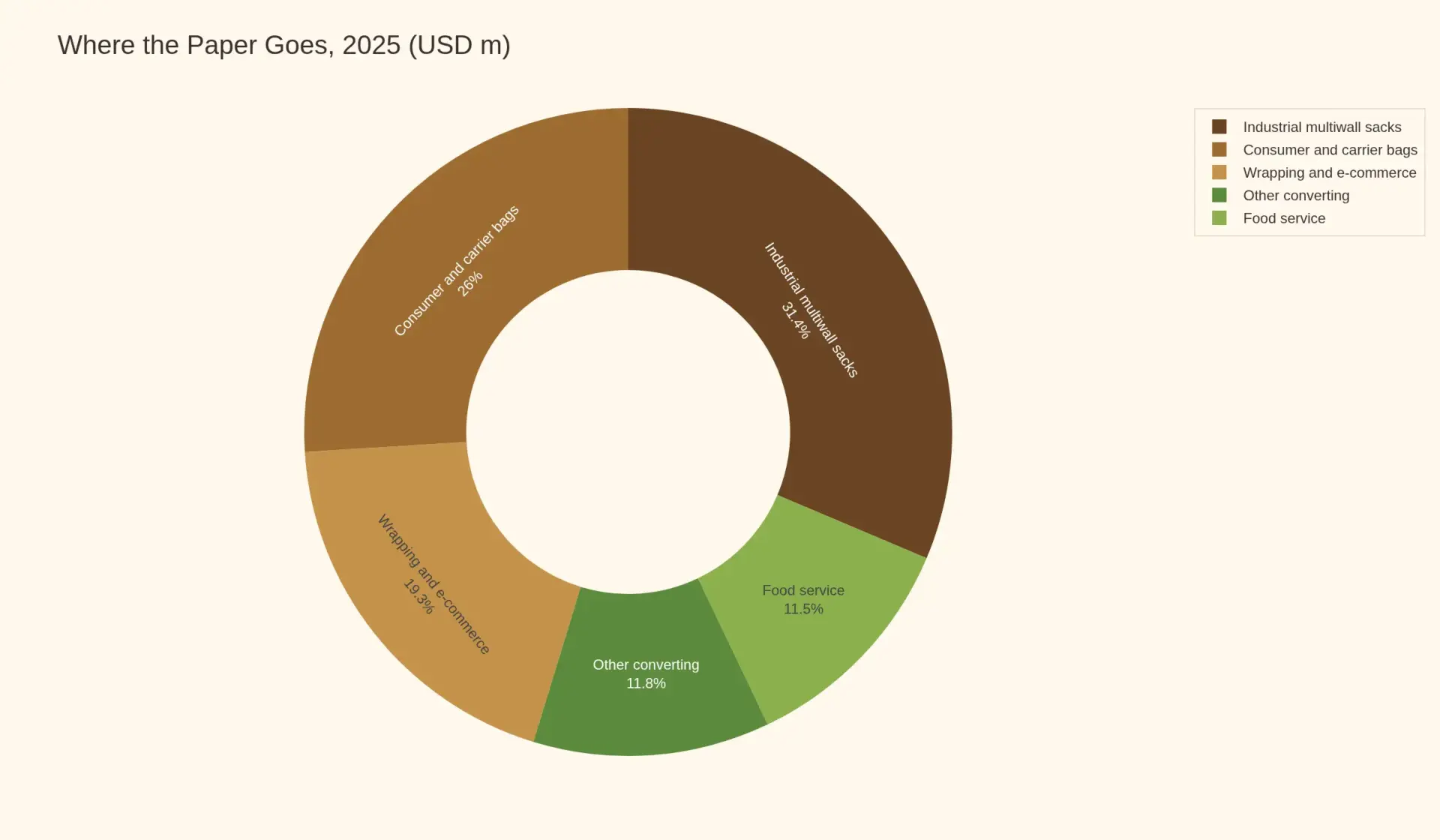
| End use | 2025 (USD m) | 2033 (USD m) | CAGR | Share 2025 |
|---|---|---|---|---|
| Industrial multiwall sacks | 2,390 | 2,660 | 1.35% | 31.4% |
| Consumer and carrier bags | 1,980 | 2,340 | 2.11% | 26.0% |
| Wrapping, void fill and e-commerce | 1,470 | 2,620 | 7.49% | 19.3% |
| Food service and food-contact converting | 880 | 1,080 | 2.59% | 11.5% |
| Other converting (medical, release, laminate) | 900 | 1,180 | 3.44% | 11.8% |
| Total | 7,620 | 9,880 | 3.30% | 100% |
Read the two largest rows against the two fastest. Industrial sacks are the biggest outlet and the slowest. Wrapping, void fill and e-commerce is the third largest and grows at 7.49 per cent, which is five times the sack. By 2033 that row is the second-largest outlet in the market and within USD 40 million of the sack it was built to serve. That is the single most consequential line in this report for anyone deciding where to put a paper machine.
7.5 By Route to Market
Four routes, with very different power. Integrated converter groups — the mills that own or are owned alongside sack plants — transfer paper internally and are largely insulated from merchant price. Independent converters buy on quarterly or annual contracts and carry the price risk. Merchants and traders move reel stock across regions and are the mechanism by which European paper reaches Asian and African converters. Export accounts for 44.3 per cent of European output and is priced off the same benchmarks as domestic volume but with freight as a swing factor.
The route matters because the customer behind it differs. An integrated group selling into its own sacks is managing a conversion margin. A merchant selling into an independent converter is managing a basis risk. The same tonne of paper carries entirely different economics depending on which of those four doors it goes through, and no published series distinguishes them.
8. Regional Analysis
8.1 Europe
USD 2,050 million, 26.9 per cent of value, growing 2.04 per cent — the slowest region and the one that sets the world price. Europe is the industry's centre of gravity: 2,243 thousand tonnes of production from 2,534 thousand tonnes of capacity, 1.25 million tonnes of demand, 993 thousand tonnes of net exports and 291 thousand tonnes of slack. It is the only region where all four numbers are measured rather than modelled.
The composition of European demand is the interesting part. Of 1.25 million tonnes consumed, only 728 thousand tonnes becomes the 5.69 billion sacks the industry delivers — 58.2 per cent. The balance goes to carrier bags, wrapping, food service and specialty grades. And within the sacks, the mix is migrating from cement to the small construction pack and to food and feed, both of which use bleached or white grades and both of which price better.
The strategic position is uncomfortable and clear: Europe makes 30 per cent of the world's sack kraft and consumes 17 per cent of it, while carrying the world's heaviest compliance obligation and its highest energy costs. Its export book is the business, and its export book is exposed to the EUDR documentation requirement travelling with the paper to the importer.
8.2 Russia, Belarus and the CIS
Sack kraft capacity in this region is real and largely outside the European market that measures itself. Segezha's Karelia mill at up to 384 thousand tonnes describes itself as capable of being the world's third-largest sack paper manufacturer and as Russia's only producer of unbleached high-porosity high-strength sack paper. Ilim adds machine-finished kraft. Bellesbumprom in Belarus has been adding bleached and unbleached sack kraft capacity through 2023 to 2025.
Sanctions did not remove this capacity; they redirected it. The February 2023 disposal of Segezha's seven European converting mills removed 704 million bags of European demand for Russian paper, and the answer has been Asia, the Middle East and domestic converting. The region's capacity is a permanent overhang on any European price recovery and a permanent complication for any European converter's cost position.
8.3 Asia-Pacific
USD 2,180 million, 28.6 per cent of value, growing 4.67 per cent — the largest region by value and the fastest of the three large ones. China is the biggest single producing and consuming country and the least transparent; India is structurally short of sack kraft and imports; Japan and Korea have mature, high-quality capacity serving domestic industrial demand.
The capacity signal to watch is Chinese quality, not Chinese quantity. Valmet is supplying Guangxi Jianhui Paper with a sack and kraft paper machine described as one of the largest sack kraft machine deliveries in Asia — 7,450 millimetres of wire width, a basis weight range of 50 to 110 g/m2, a design speed of 1,300 metres a minute, and a microcrepe extensible unit, scheduled to start at the end of 2026 (Valmet, September 2025). The company describes its policy as "paper instead of plastic". A machine of that specification is aimed at the export market as much as the domestic one, and it is the first credible Asian entrant into the top of the grade range.
8.4 North America
USD 1,290 million, 16.9 per cent of value, growing 3.43 per cent. This is the region where the demand story is strongest and the supply response weakest. US demand for kraft and specialty packaging papers rose 5 per cent in 2025 to 3 million tonnes; US multiwall paper shipments for cement and other heavy-weight industries reached 389 thousand tonnes in 2025, up 13.1 per cent, with a further 6.7 per cent projected for 2026; and AF&PA data show US unbleached packaging paper production for all bag and sack grades up 5.4 per cent to 520 thousand tons in the first quarter of 2026 (Fastmarkets, June 2026).
Almost none of that paper is made in North America. Billerud's two US mills produce graphic and label paper, containerboard and cartonboard, and no sack paper at all (Billerud, Annual and Sustainability Report 2025). A proposed Mondi sack kraft machine in Canada, aimed at supplying exactly this demand, was paused in October 2025 on macroeconomic grounds. The result is that the world's richest kraft-consuming region is structurally dependent on imports from Northern Europe and Brazil, and its growth accrues to mills on the other side of an ocean.
8.5 Latin America
USD 1,010 million, 13.3 per cent of value, growing 3.50 per cent. Klabin is the anchor and one of the few genuinely integrated, low-cost sack kraft producers outside the Nordic region, with its Correia Pinto complex in Santa Catarina and a management team that has been unusually explicit that sack kraft is becoming "a more specialized market with its own fundamentals" rather than a derivative of kraftliner.
Brazil is also a price setter. Its FOB benchmark for unbleached extensible 78–85 g is quoted in dollars and it moves: BRL 5,300–5,600 per tonne in May 2026 after a 5.83 per cent monthly increase, equivalent to USD 1,024–1,082. The flow signal is small in absolute terms and large in direction — Brazilian exports to Europe rose 30 per cent to 6,129 tonnes in 2025 while European sales to the US fell 77 per cent to 4,144 tonnes — a rounding error in tonnage that shows the trade pattern re-sorting around freight, tariffs and regional availability.
8.6 What the Geography Says
Three sentences summarise a very complicated map. Fibre is in the north and the tropics, demand is in Asia and North America, and regulation is in Europe. Europe's response has been to make more paper and sell it abroad, which is why 44.3 per cent of its output leaves the region. Asia's response has been to build machines where the pulp is and accept that its domestic grades trail the top of the range. North America's response has been to import, and its proposed domestic answer is paused.
That configuration does not change quickly, because each element is fixed by something the industry cannot move: forests, capital, or law. And it explains the report's central price finding — that a market growing 1.45 per cent in tonnage can grow 3.30 per cent in value. The tonnage sits where the fibre is, the price is set where the regulation is, and the two are 8,000 kilometres apart.
12. Watch List
- The EUDR application date holding at 30 December 2026. It has already been postponed once, by Regulation (EU) 2025/2650 adopted on 19 December 2025. A second postponement would remove the compliance advantage large integrated mills have spent two years building and would delay the one thing in this market with a fixed date.
- Whether the Mondi Canada project restarts. North American kraft demand grew 5 per cent in 2025 and US multiwall shipments grew 13.1 per cent, and there is no domestic sack kraft capacity to serve either. A restart would be the first new Western machine announced since Štětí.
- Chinese grade quality. Guangxi Jianhui's PM 8 at 1,300 metres a minute with a microcrepe unit is the first Asian machine specified to the top of the range. If it can hold a European cement specification, the export balance of the whole industry changes.
- The European energy price. Four price direction changes in twenty-one months, all cost-driven. A sack kraft machine's cost base is energy, fibre and capital, and the first of those is the most volatile.
- Recycled content reaching sack specification. Recycled grades are outside EUDR, outside the deforestation obligation and cheaper in fibre. They cannot currently make the load-bearing ply. If that changes, it changes everything in this report at once.
- Further European closures. About 180 thousand tonnes of European capacity is running idle or intermittently even after the Štětí addition. The next small single-machine site to lose its economics will be closed rather than sold.
- Whether the sack outlet's decline accelerates. Cement is 57 per cent of European paper sack deliveries and is shrinking. The market has so far replaced that volume with e-commerce and small construction packs; that substitution is not guaranteed to continue.
13. Methodology
The complete build — every coefficient, every cross-check, the primary programme and what was not modelled — is set out in the Research Methodology section below. In summary: the market is built from one measured regional anchor (European demand of 1.25 million tonnes plus 993 thousand tonnes of net exports, with operating rates of 87 to 90 per cent), a machine-level capacity census across Europe, Russia, Belarus, Turkey, Brazil and Asia, and a two-grade price build anchored on Fastmarkets' European and Brazilian benchmarks. The global tonnage is stated as a range of 6.9 to 7.8 million tonnes with 7.4 million as the central case, because the largest producing country publishes no machine-level register. Primary inputs from structured mill and converter interviews, conference work, an open-ended interview programme and a converter survey inform the coefficients where no published series exists and are labelled as Pheonix estimates in-line. No third-party market-research estimate is used, cited or referenced anywhere in this report.
14. About This Report
This report covers the global market for sack kraft paper — unbleached and bleached, in semi-extensible, high-porosity, microcreped, machine-glazed and machine-finished forms, across the 50 to 150 g/m2 band — measured ex-mill in US dollars, with a 2025 base year and a 2026–2033 forecast. It is published in the Packaging Materials & Formats segment of the Packaging industry, because sack kraft is a substrate that cuts across formats rather than a format in its own right. Related Pheonix research: Global Industrial Paper Sacks for the 31.3 per cent of this paper that becomes an industrial sack; Global Cement Packaging for the largest single application and the 55.2 per cent of sack tonnage that goes into it; Global Woven Polypropylene Sacks for the format that wins on cost wherever paper does not; Global FIBC & Bulk Bags for the substitution that deletes bagged demand rather than redistributing it; Global Packaging for the wider frame; and Europe PFAS-Free Food Contact Packaging for the food-contact chemistry that decides which fibre a dry-food buyer will accept.
Table of Contents
- Market Snapshot
- Market Definition and the Five Boundary Calls
- Market Size and Forecast
- 3.1 How the 2025 Base Was Built
- 3.2 The Regional Allocation Is the Forecast
- 3.3 The Decomposition Is the Finding
- Four Structural Shifts Defining 2026–2033
- 4.1 The Substrate Decoupled From the Sack
- 4.2 Europe Is Closing and Building at the Same Time
- 4.3 EUDR Turns Virgin Fibre Into a Documentation Asset
- 4.4 The Price Cycle Became a Cost Cycle
- Market Drivers
- 5.1 The Kraft-For-Plastic Swap, Which Is Not About Cement
- 5.2 Construction Migrated From Cement to the Small End of the Book
- 5.3 Fill Speed Is a Hardware Upgrade, Not a Paper Upgrade
- 5.4 Softwood Is the Ceiling on Everything
- 5.5 Virgin Fibre’s Food-Contact Advantage Nobody Prices
- Market Restraints
- 6.1 Bulk Substitution Deletes Tonnes Permanently
- 6.2 The Fibre Basket Cannot Be Bought
- 6.3 New Machines Arrive Into Weak Markets
- 6.4 Woven Polypropylene at a 2.3 Times Cost Gap
- 6.5 Sanctions Moved the Converting, Not the Paper
- 6.6 Recycled Grades Escape EUDR and Cannot Make the Sack
- Segmentation
- 7.1 By Grade
- 7.2 By Grammage Band
- 7.3 By Property and Construction
- 7.4 By End Use
- 7.5 By Route to Market
- Regional Analysis
- 8.1 Europe
- 8.2 Russia, Belarus and the CIS
- 8.3 Asia-Pacific
- 8.4 North America
- 8.5 Latin America
- 8.6 What the Geography Says
- Competitive Landscape
- Regulatory Landscape
- Strategic Outlook
- Watch List
- Methodology
- About This Report
Competitive Landscape
Competitive Landscape
This is the most consolidated market in the industrial packaging cluster, and it is consolidating for a reason nobody in converting can copy: the entry ticket is a forest catchment and EUR 400 million. Five producers account for roughly 30 per cent of world capacity and effectively all of the merchant export trade. The rest is Chinese domestic capacity that does not export at scale, and a long tail of single-machine mills that increasingly does not clear its cost of capital.
The core: five producers, three strategies
| Entity | Verified position | Why it matters here |
|---|---|---|
| Mondi Group | Sack kraft from Frantschach in Austria (three machines, around 250 thousand tonnes of sack and kraft paper, export rate above 80 per cent), Dynäs in Sweden and Štětí in the Czech Republic, where a new 210 thousand tonne machine started in December 2024 within a EUR 400 million investment (Mondi, November 2025) | The portfolio manager: it closed 100 thousand tonnes at Stambolijski and added 210 thousand at Štětí in the same eighteen months, and paused a Canadian project in October 2025. It is optimising a system, not defending a site |
| Billerud | Number five in sack paper globally on capacity, on AFRY’s count, with sack paper at 13 per cent of net sales — SEK 3,258 million in 2025 against SEK 3,240 million in 2024 — and a kraft and sack paper mill cluster at Karlsborg and Pietarsaari plus brown sack paper at Skärblacka (Billerud, Annual and Sustainability Report 2025) | The purest exposure in the market, and the most instructive: sack paper is the only product category in which Billerud’s 2025 net sales did not decline, in a year when group sales fell 9.5 per cent and operating profit fell from SEK 1,511 million to SEK 416 million |
| Segezha Group | Up to 384 thousand tonnes of sack kraft at the Karelia mill, described by the company as capacity to be the world’s third-largest sack paper manufacturer and as Russia’s only producer of unbleached high-porosity high-strength sack paper (Segezha Group); bleached output on PM 11 rising from 50 thousand to 150 thousand tonnes from 2026 (EUWID, August 2025) | The capacity that sanctions redirected rather than removed. Russia-only as a converter since February 2023, and expanding in the one grade — bleached — where European supply is shortest |
| Klabin | Brazil’s largest packaging paper producer, with sack kraft operations centred on Correia Pinto in Santa Catarina and the Brazilian FOB benchmark quoted in dollars | The low-cost tropical-fibre alternative to the Nordic model, and the producer whose own management argues sack kraft has decoupled from kraftliner into “a more specialized market with its own fundamentals” |
| Natron-Hayat | PM 4 at Maglaj in Bosnia is geared for 80 thousand tonnes of unbleached sack kraft (PULPAPERnews) | The Bosnian asset that gives south-east Europe a domestic supplier and illustrates the scale of a viable single-machine operation |
The strategic divergence is the story
Two of the five have made opposite calls on the same product in the same two years, and both are visible in public documents.
Billerud’s capital markets material classifies its focused category positions explicitly, and the entry for sack paper is “optimize target applications” — alongside “maintain strong position” for liquid packaging board, “accelerate growth” for cartonboard and coated liner, and “drive value” for MG paper (Billerud, Kepler Cheuvreux Autumn Conference, September 2025). That is a harvest position, stated plainly, by the world’s number five producer. Its sack paper market status was reported as weak in the fourth quarter of 2025 with a weak outlook for the first quarter of 2026, and segment net sales fell 17 per cent year on year to SEK 705 million.
Mondi spent EUR 400 million on 210 thousand new tonnes of the same product and inaugurated it in November 2025. The disagreement is not about demand. It is about which assets deserve capital. Billerud’s sack paper is made on multi-product machines at Karlsborg, Skärblacka and Pietarsaari that also make kraft paper, formable paper and pulp; Mondi’s new machine is a dedicated 210 thousand tonne asset on an integrated site with a EUR 400 million write-off behind it. If the dedicated low-cost asset is right, the multi-product asset is a marginal tonne waiting to be repurposed. If demand disappoints, the dedicated asset has nowhere else to go.
The second tier and the entrants
Below the five sit the regional specialists and the capacity pipeline. MM Group has been adding unbleached machine-finished and bleached and unbleached sack kraft capacity in Poland. Bellesbumprom in Belarus has added bleached and unbleached sack kraft through 2023 to 2025. Heinzel, Gascogne, Navigator and Nordic Paper have added narrower tonnage, mostly in machine-finished and low-grammage grades. Ilim Group has added machine-finished kraft in Russia.
And then the entrant that matters. Guangxi Jianhui Paper, established in November 2020 and based in Teng County in Guangxi, has ordered a sack and kraft paper machine from Valmet — 7,450 millimetres of wire, 50 to 110 g/m2, 1,300 metres a minute, with a microcrepe extensible unit, starting at the end of 2026 — described by the supplier as one of the largest sack kraft machine deliveries in Asia (Valmet, September 2025). It is an integrated forestry-pulp-paper project with an explicit “paper instead of plastic” framing. That is not a domestic Chinese machine built to serve a domestic price point. It is a machine specified to export.
Where the barriers actually are
Four, and only one is about money. Fibre — a catchment of long-fibre softwood at a delivered cost that works, which is why the industry is where the forests are and not where the customers are. Integration — pulp, energy and paper on one site, because the product cannot be made from dried market pulp without losing what it is sold for. Qualification — a cement company’s filling line qualifies a paper specification, a grammage, a porosity and a supplier, and switching requires re-trialling the line. And now, documentation — the ability to produce species-level and plot-level data for every tonne, which is a capability built over years and not a purchase order.
The strategic conclusion for a buyer follows directly. In a market growing 1.45 per cent in tonnage where the top five are moving in different directions, the risk is not that paper becomes scarce; it is that a specific supplier’s specific machine stops being the one its owner wants to run. Billerud has told the market which categories it intends to accelerate and which it intends to optimise. A converter who has not read that has not done the diligence.
Value Chain
Value Chain
Six stages, and the money is made at the second and third. This is the inverse of the converting end of industrial packaging: in woven polypropylene the machinery was the oligopoly and the converter was the commodity; here the machine and the forest are the oligopoly and the converter is the commodity. That single difference explains why this industry consolidates and the sack industry never has.
Stage one: the forest and the chip basket
Sack kraft begins as softwood — spruce and pine — bought as roundwood or as sawmill chips, and the basket is the most contested input in the chain. It competes with pulp mills, board mills, sawmills and the energy market for the same log, and increasingly with the forest’s non-timber values. The fibre requirement is specific: long tracheids for tear strength and tensile energy absorption, which is why birch, eucalyptus and recovered paper cannot substitute in the load-bearing ply.
Stage two: kraft pulp
Almost every sack kraft machine in the world is integrated to a kraft pulp mill on the same site, because drying and re-slushing pulp to move it between sites destroys the strength the product is sold for. Pulp yield from softwood is roughly 45 to 50 per cent, so every tonne of paper consumes something over two tonnes of wood before energy, and the mill’s economics are set as much by the recovery boiler and the lime kiln as by the paper machine. Integration is not a strategy in this industry; it is the technology.
Stage three: the paper machine
A sack kraft machine is 200 to 400 thousand tonnes a year and costs EUR 200 to 400 million including the mill infrastructure around it. Mondi’s Štětí machine — 210 thousand tonnes for EUR 400 million — implies about EUR 1,900 per annual tonne. Guangxi Jianhui’s PM 8, with a 7,450 millimetre wire and a 1,300 metre a minute design speed, is a machine of that class with the paper machine itself quoted at EUR 35 to 50 million. The property that matters is not grammage but strength at grammage, and every technical choice on the machine — refining, forming, pressing, the microcrepe unit, the size press — exists to buy strength that can then be sold as a grammage reduction.
Stage four: the converter
The multiwall sack plant prints, cuts, gussets, tubes, bottoms and valves paper into a sack of two to four plies, at a capital cost of a few million dollars and at margins that are thin and local. It buys paper at USD 1,030 a tonne and sells a sack at USD 0.30, of which the paper is USD 0.132 — 43.9 per cent. The other 56 per cent is conversion, print, valve, liner, freight and margin, and the converter’s leverage over any of it is limited by the fact that its customer is a cement company running an annual tender.
Stage five: the filler
Here the sack stops being a product and becomes a consumable of somebody else’s production line. A rotary packer fills 2,000 to 4,000 sacks an hour, and a sack that will not take air fast enough, or that dusts at the valve, or that bursts on the pallet, costs the filler more per hour than the sacks cost per day. This is where paper specification is actually decided — not by the converter and not by the mill — which is why a paper machine builder sells porosity and extensibility rather than strength.
Stage six: end of life
A paper sack is repulpable in the standard waste-paper stream, which is the quiet foundation of its regulatory position: paper gets recyclability grades under the packaging regulation and no recycled-content mandate, and a multiwall sack with a paper valve and a water-based adhesive is close to mono-material. A sack with a plastic liner or a PE dispersion coating is not, and that is where the design tension sits. Recycled sack kraft re-enters as wrapping, void fill or lower-grade board — not as another cement sack, for the strength reasons set out in section 6.6.
| Stage | What sets the price | Who holds the margin |
|---|---|---|
| Softwood fibre | Forest catchments, sawmill chip availability, energy competition | The forest owner, structurally |
| Kraft pulp | Wood cost, energy, chemical recovery efficiency | The integrated mill |
| Sack kraft machine | Grade mix, grammage at strength, operating rate | The integrated mill, cyclically |
| Converting to sacks | Labour, print, valve, qualification | The converter, thinly |
| Filling | Line throughput and reject rate, not sack price | The filler, by pass-through |
| End of life | Waste-paper price and recyclability grade | Municipal and recovery systems |
Where the value ends up
Across the chain, a mill selling sack kraft at USD 1,030 a tonne against a fibre, energy and capital cost base that has been inflating faster than that price is earning a cyclical return on roughly EUR 1,900 per annual tonne of capital. A converter earning 56 per cent of a USD 0.30 article against a labour and print cost base is earning a return on a few million dollars of equipment. The mill carries the capital and the cycle; the converter carries the customer relationship and almost nothing else. In a market where tonnage grows 1.45 per cent a year, the only durable value sits at the forest and at the machine — which is exactly where the last decade of consolidation has happened and where the next one will.
Investment Activity
Investment Activity
The capital going into this industry is replacement capital, not growth capital, and the distinction explains almost everything about the price. Capacity in Europe is being swapped rather than added: a 100 thousand tonne mill closed and a 210 thousand tonne machine started within eighteen months, at roughly EUR 1,900 per annual tonne. World tonnage grows 1.45 per cent a year. Investment is chasing quality and cost position, not volume.
The reference transaction: Štětí
Mondi’s 210 thousand tonne machine at Štětí in the Czech Republic is the benchmark for what a modern sack kraft asset costs and what it is for. EUR 400 million, started in December 2024, inaugurated in November 2025, built with Bellmer as general contractor, and justified on paper-based flexible packaging demand driven by e-commerce. It is not a cement sack machine that happens to make other grades; it is a machine whose specification — high strength, high porosity, a broad basis weight range — was chosen to serve construction, industrial and e-commerce applications from one reel.
Set that against the disposal. Stambolijski in Bulgaria, some 100 thousand tonnes a year of unbleached sack kraft, was fire-damaged and then permanently closed in October 2024 rather than rebuilt. One group, eighteen months, minus 100 thousand tonnes of high-cost capacity and plus 210 thousand tonnes of low-cost capacity. That is what consolidation looks like in a capital-intensive industry, and it is why the tonnage count barely moves while the cost curve drops.
The pipeline, and what it says
The European capacity pipeline tracked through 2021 to 2027 was overwhelmingly incremental and overwhelmingly eastern: a 130 thousand tonne unbleached machine-finished project at Mondi’s Czech site, 75 and later 150 thousand tonnes of bleached and unbleached sack kraft at MM Group in Poland, 160 thousand tonnes at Bellesbumprom in Belarus, 70 thousand tonnes of machine-finished kraft at Ilim in Russia, 60 thousand tonnes of bleached sack kraft at Segezha and a further 23 thousand tonnes of unbleached, and smaller additions at Gascogne in France, Heinzel in Austria, Navigator in Portugal and Nordic Paper in Sweden (Fastmarkets, kraft paper market outlook, capacity changes 2021–27).
Two features of that list matter. Almost none of it is Western European, so it does not compete for Western European demand — it competes for export share. And most of it is machine-finished or bleached, which means the investment is aimed at the higher-value end of the grade range rather than at more cement sack paper.
Asia is where the growth capital went
Guangxi Jianhui’s PM 8 is the clearest statement of intent in the market: a 7,450 millimetre machine capable of 50 to 110 g/m2 at 1,300 metres a minute, with a microcrepe extensible unit and a full automation and quality-control package, scheduled for start-up at the end of 2026, in a company established in November 2020 and framed around an integrated forestry-pulp-paper model. The paper machine alone is typically EUR 35 to 50 million; the mill around it is multiples of that.
Segezha’s bleached expansion on PM 11 — from 50 thousand to 150 thousand tonnes from 2026, effectively tripling output of the grade — is the second. Both are aimed at the same thing: white, high-strength, printable kraft, which is where the price is.
The investment that is not happening
Mondi’s proposed new sack kraft machine in Canada, aimed at the US market where kraft and specialty packaging paper demand grew 5 per cent in 2025, was paused in October 2025 on macroeconomic grounds. Market participants still believe it could be viable if kraft wrapping demand in North America continues to grow. Nothing in that decision was about demand. It was about capital cost per tonne in a region with no softwood fibre basket to match the Nordic one.
That is the shape of the whole investment story: the industry knows where its customers are going and it is building where its fibre is, which is why 44.3 per cent of European output is exported.
What it means for a buyer
In a market where capital is replacement capital, the risk of shortage is low and the risk of grade obsolescence is high. The machines being built now are specified for high-porosity, high-strength, printable grades; the machines being closed are the ones that are not. A converter whose specification sits on the older side of that line should expect its supply to consolidate onto fewer, larger and more distant mills — and should expect the qualification work to fall on the converter, not the mill.
Technology & Innovation
Technology and Innovation
Nothing in this product has changed in forty years and everything about it has changed in ten. A sack kraft machine is still a Fourdrinier forming section, a press section, a dryer and a reel. What has moved is how much strength can be built into how few grammes, how fast a sack can be filled without dusting, and how far the machine can be pushed.
Strength at grammage is the whole technology
Sack kraft is sold on tensile energy absorption, tear resistance and porosity, and every technical choice on the machine exists to buy strength that can then be sold as a reduction in weight. The band is roughly 50 to 150 g/m2 and it has migrated downward within every application for two decades. A mill that can hold a cement-sack specification at 80 grammes instead of 100 converts 20 per cent of its fibre straight into margin, which is why lightweighting is not a marketing story here but the central commercial lever.
Extensibility: mechanical stretch instead of more fibre
A sack fails on impact, and impact tolerance comes from how far the paper stretches before it tears. Semi-extensible grades build that in at the pulp and machine stage; microcreping builds it in mechanically, after drying, by compacting the sheet. It is the one genuinely transformative process technology in the last fifteen years because it delivers extensibility without the furnish constraints, and it is why a new Asian machine specifies a microcrepe unit rather than simply a wider wire — Guangxi Jianhui’s PM 8 includes one from Valmet.
Porosity: the specification that nobody outside the industry knows about
A rotary packer fills 2,000 to 4,000 sacks an hour and the air displaced by the product has to leave as fast as the product enters. High-porosity grades do that without letting the powder out, and they are branded accordingly — Billerud sells QuickFill as a named construction and describes it as high strength and porosity, and the company’s Karlsborg site houses a product development centre and a sack construction laboratory built around exactly this problem. Porosity is why a mill’s customer is not a purchasing department but a filling line, and why grade substitution in this market is slow.
Barrier and the retreat from plastic
The fastest-moving technical frontier is the one that removes plastic from a paper sack. Dispersion coatings, water-based barrier layers and PFAS-free grease barriers let a kraft sack carry food, or hold moisture out, without a polyethylene film — which matters twice: once for the packaging regulation’s recyclability grades, and once for the food-contact chemistry that decides whether a dry-food buyer will accept the pack. The technical problem is that a paper sack with a functional barrier is no longer mono-material, and the regulatory direction and the performance requirement pull against each other.
Machine speed and scale
The reference point for how far the hardware has come is instructive. Mondi’s Frantschach PM 6, at 920 metres a minute, was described as one of the world’s fastest sack paper machines. Guangxi Jianhui’s PM 8 is designed for 1,300 metres a minute on a 7,450 millimetre wire — roughly 40 per cent faster and considerably wider, with a basis weight range of 50 to 110 g/m2. That is a generation of difference in one order, and it is the reason a new machine can undercut an old one on cost even at the same fibre price.
And the innovation that actually matters: energy and yield
The least visible and most valuable technical work in this industry is in kilowatt-hours per tonne and pulp yield per cubic metre. A sack kraft mill is a chemical recovery plant with a paper machine attached, and the difference between a competitive and an uncompetitive site is often in the recovery boiler, the lime kiln and the dryer section rather than in the product. This is why capital in this industry goes into replacement rather than expansion, and why the closure decisions are made on energy and fibre rather than on demand.
Innovation intensity is low in the patent sense and high in the engineering sense. There is no intellectual-property moat in sack kraft; there is a cost-curve moat, and it is dug by engineers.
Market Risk
Market Risk
The largest risk in this forecast is not a demand risk. It is that the industry’s cost base — fibre and energy — moves faster than a price it can only raise when a converter agrees. Everything else here is ordinary cyclical exposure.
Risk 1: fibre cost and the catchment
Softwood is the single largest cost in a sack kraft mill and the one input nobody can substitute. The basket competes with pulp, board, sawmilling and energy for the same log, and with the forest’s non-timber values for the same land. Nordic harvesting constraints and the European forest-carbon debate both push in the same direction over the forecast period. A mill that loses its fibre economics does not reduce output gradually; the machine stops. That is what happened at Stambolijski, and it will happen again.
Risk 2: energy, which is now the swing variable
European sack kraft prices moved direction four times in twenty-one months — increases announced at the end of 2024, patchy implementation in early 2025, firm by the second quarter, weak by the fourth, reductions in the first quarter of 2026, then steep cost-driven increases in the second and third quarters of 2026 linked to conflict in the Middle East. Not one of those moves was caused by a change in demand for sacks. A producer that has sold forward at a fixed price into a gas spike is carrying a loss it cannot recover, and the asymmetry is worse for a non-integrated producer buying pulp as well as energy.
Risk 3: EUDR execution on 30 December 2026
This is the only risk in the report with a fixed date and it is operational rather than political. A mill or EU importer that cannot produce a due diligence statement, with plot-level geolocation and species declaration, for a given consignment cannot lawfully place that paper on the EU market or export it. The failure mode is not a fine; it is a consignment that does not ship. The industry has had two years and one postponement to build the systems, and the guidance published in October 2026 shows how much clarification was still arriving at the deadline. Mills with certified, registered procurement areas are prepared. Importers relying on third-party data are the exposed party.
Risk 4: the capacity swap going wrong
Europe added 210 thousand tonnes of low-cost capacity and removed 100 thousand tonnes of high-cost capacity, leaving about 180 thousand tonnes still idle or intermittent. If the export book holds, that resolves quietly. If European net exports of 993 thousand tonnes come under pressure from Chinese, Russian or Brazilian supply at the same time as domestic demand flattens, the industry has more capacity than demand for the first time in a decade — and the price consequence would be severe because a paper machine’s marginal cost is low and its shutdown cost is high.
Risk 5: the sack outlet’s decline
Cement and building materials are 57 per cent of European paper sack deliveries and cement is shrinking. The market has replaced that volume with e-commerce wrapping and small construction packs, both of which are growing faster than the sack ever did. But the replacement is younger than the thing it replaced: e-commerce packaging demand is a function of retailer policy, and retailer policy can reverse. A pulping or bagging shift in e-commerce would leave this market with a declining legacy outlet and no replacement.
Risk 6: the Russian and Belarusian overhang
Segezha’s up-to-384-thousand-tonne Karelia mill and Bellesbumprom’s Belarusian additions are producing into a world market from which their traditional European converting customers were severed in 2023. That tonnage has to go somewhere, and it goes east and south at whatever price clears. It is a permanent cap on any European price recovery, and it is structurally outside any policy the EU can apply.
Risk 7: the multi-product mill becomes the marginal tonne
The strategic divergence between the two largest European producers is itself a risk. If the dedicated, integrated, 210 thousand tonne asset is the right answer — and the capital has been committed on that view — then a sack kraft machine that shares its site with kraft paper, formable paper and market pulp is a marginal tonne whose owner can repurpose it the moment another grade pays better. Billerud has already told the market that sack paper is a category to optimise rather than to accelerate. A converter exposed to a single multi-product supplier is exposed to that supplier’s portfolio arithmetic.
What is not in the risk case
Recycled paper displacing virgin kraft in the load-bearing ply is not modelled, for the physical reasons in section 6.6. A collapse in global paper demand is not modelled: tonnage grows 1.45 per cent and the range in the base is 6.9 to 7.8 million tonnes, which is a defensible band rather than an optimistic one. Nor is a Chinese export surge modelled at scale — Jianhui’s machine is one machine, and a domestic market of China’s size absorbs its own capacity before it prices into Europe. The honest asymmetry is that this report’s volume risk is concentrated in one outlet, cement, and its price risk in two inputs, fibre and energy — and unlike the woven sack market, where both risks run off the same regulatory calendar, here they are completely uncorrelated.
Regulatory Landscape
Regulatory Landscape
One regulation decides this market’s next five years and it is not about packaging. The EU Deforestation Regulation attaches to the fibre, and sack kraft is the most fibre-exposed paper product in industrial packaging: no recovered content, no way to average compliance across a mixed furnish, and a customer base that exports.
EUDR: the obligation, and who carries it
Regulation (EU) 2023/1115 applies to seven commodities and their derived products, and Annex I includes all products of chapter 48 of the Combined Nomenclature, which is paper and paperboard, with the exception of bamboo-based products and recovered and recycled material (Cepi, guidance on the revised EUDR, October 2026). Products may not be placed on the EU market or exported unless they are deforestation-free, produced in accordance with the legislation of the country of production, and covered by a due diligence statement.
The statement is filed through the EUDR information system, TRACES, and it carries, per consignment: the HS or CN code, quantity, country of production, direct supplier and client, the date or time range of production, and evidence of legal harvest. Geolocation is required at plot level — polygons with six decimal places of latitude and longitude for plots over four hectares, a single point below that — and for the wood commodity the scientific name of the species is mandatory on all relevant products, including pulp and paper.
Two clauses decide who does the work. The obligation falls on the operator that first places the product on the market or exports it, which for European paper sold in Europe is the mill and for imported paper is the EU importer; downstream operators and traders must instead collect and keep information about their direct business partners. And the obligation to collect geolocation does not apply to downstream operators.
The effect on this industry is to make fibre data a competitive asset. A Nordic or Central European mill buying from a registered, certified procurement area holds the data already, at the standard required, for a furnish it can document plot by plot. A mill selling into Europe from a region with less transparent sourcing must now either supply that data to its European customer or lose the channel, because the importer carries the liability.
The timetable, which has already moved once
The regulation entered into force on 29 June 2023. By Regulation (EU) 2025/2650, adopted on 19 December 2025, application was postponed by one year: 30 December 2026 for medium and large operators and 30 June 2027 for micro and small enterprises, with products newly added to Annex I by delegated act coming into scope on 30 December 2027. Crucially, in the forest-based value chain the entry into application is 30 December 2026 irrespective of company size (European Commission, EUDR key dates).
Products from timber harvested during the transitional period and placed on the market before 30 December 2026 fall under the preceding timber regulation and need no due diligence statement, which means the industry has spent 2025 and 2026 running down older stock and documenting the date it was placed on the market. That is a real accounting exercise, and it is happening in mills now.
The asymmetry that defines the market
Annex I excludes goods produced entirely from material that has completed its lifecycle and would otherwise have been discarded as waste, and for pulp and paper the exclusion covers recovered waste and scrap explicitly — pre-consumer and post-consumer alike. A recycled testliner mill has no due diligence obligation. A sack kraft mill has the heaviest one in the chain.
Section 6.6 explains why that does not hand the market to recycled paper. But it does something else that is commercially significant: it makes the paperwork the qualification. A European converter choosing between a Nordic mill and an importer is choosing between a supplier that hands over a reference number with the delivery note and a supplier whose compliance it has to underwrite itself. That is a switching cost that did not exist in 2022.
Packaging and Packaging Waste Regulation
Regulation (EU) 2025/40 requires all packaging to be designed for material recycling and capable of being collected, sorted and recycled at scale, with recyclability performance grades applying from 2030 and an at-scale phase from 2035 including a recycling-rate threshold for the packaging categories in Annex II; extended producer responsibility fees are modulated to reward recyclability (EUROPEN, PPWR — all obligations, 2025). There is no recycled-content mandate for paper: the Article 7 minimums apply to plastic packaging, which is the asymmetry that has reshaped this cluster.
For a multiwall paper sack the practical consequence is favourable. A sack built from paper plies with a paper valve and a water-based adhesive is close to mono-material and sits in the 4-paper stream. A sack with a loose polyethylene liner or a PE dispersion coating does not, and every design decision that adds a plastic barrier now carries a fee consequence as well as a recycling one. The regulation is quietly pushing sack design back towards pure paper, which is good for paper tonnage and awkward for the food-contact applications that use the liner for a reason.
What regulation does not fix
None of these instruments addresses the variable that decides this market’s tonnage. Bulk substitution in cement is a capital and logistics decision taken by a cement producer and its customers, and no packaging rule makes a silo more or less attractive. A mill reading the deforestation regulation as a demand tailwind has misread which risk it carries: the regulation guarantees that the compliant tonne is more defensible and says nothing at all about how many tonnes there are.