
Editorial Article
Spain Shipped 57 Per Cent More Wine Than France and Earned a Third As Much
France exported 12.5 million hectolitres of wine and earned EUR 11,213 million for it. Spain exported 19.6 million hectolitres and earned EUR 2,977 million. France shipped 36 per cent less wine and took home 3.8 times as much money.
Put as a single realisation figure, France earned EUR 8.97 a litre and Spain earned EUR 1.52. That is a 5.9-fold difference on the same product category, in the same currency, on the same continent, in the same year. Nothing else in the food and beverage trade has a spread of that size between neighbouring competitors.
Three countries, three answers
| Country | Export volume | Export value | Realisation |
|---|---|---|---|
| France | 12.5 mhl | EUR 11,213 m | EUR 8.97/l |
| Italy | 21.0 mhl | EUR 7,843 m | EUR 3.74/l |
| Spain | 19.6 mhl | EUR 2,977 m | EUR 1.52/l |
| New Zealand | — | — | EUR 3.60/l |
| Italy, France and Spain together: 65 per cent of world wine export value. Italy alone: 22.2 per cent of volume, 23.2 per cent of value. | |||
Source: OIV 2025 world vitivinicultural statistics. Realisations are export value divided by export volume by country.
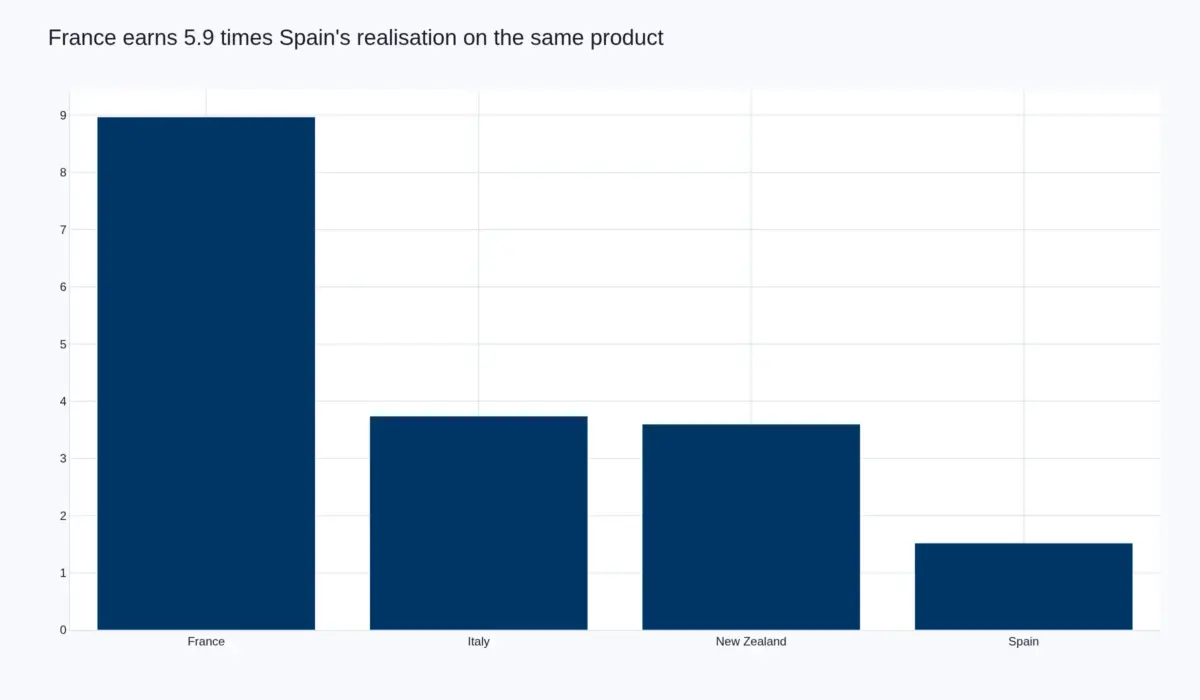
Italy is the informative one. It ships the most wine of the three, 21.0 million hectolitres, and it earns nearly as much as France on 68 per cent more volume — EUR 7,843 million against EUR 11,213 million, or 69.9 per cent of France’s money. Its realisation, EUR 3.74, is 2.5 times Spain’s and well under France’s. Italy is the country that has scale and value at the same time, and its value share is almost exactly proportionate to its volume share. It is not capturing a premium. It is capturing the middle.
The thought experiment that ends the mix argument
The standard explanation for the France–Spain gap is format mix: Spain ships more bulk, bulk earns EUR 0.75 a litre, and that drags the national average down. That explanation is partly right, and it is nowhere near big enough.
Run the arithmetic. Spain’s 19.6 million hectolitres is 1.96 billion litres. At France’s realisation of EUR 8.97, that volume would be worth EUR 17.58 billion — which is 52 per cent of the entire world’s wine export value of EUR 33.8 billion, from one country.
That result is absurd, and its absurdity is the finding. No mix shift produces it. Moving from bulk at EUR 0.75 to bottled at EUR 4.53 is a 6.04-fold gain, which is roughly the size of the France–Spain gap — so mix could account for it only if Spain sold almost entirely bulk and France almost entirely bottled. Neither is remotely true; both countries sell substantial volumes in both formats.
What remains, after mix is accounted for, is the part of the price that comes from what the label says: appellation, classification, château names, critics, the accumulated apparatus of a century of building a price. That is not a substance a producer can add. It is a position that has to be occupied for decades before it pays anything.
What that position is worth per hectolitre is set out in why moving one hectolitre out of bulk is worth 6.04 times more. The rungs of the ladder are priced by the capital needed to hold inventory through a production cycle rather than by a judgement about the wine — which is exactly why a gap of this size cannot be closed by better storytelling about a bottle that already exists.
New Zealand’s number is the interesting one
New Zealand realises EUR 3.60 a litre — very close to Italy, on a volume that is a rounding error against the European three. It got there by doing the opposite of what a scale producer would do: narrowing to essentially one variety and one story, and refusing to compete on price anywhere.
That is a genuine alternative path, and it is worth being precise about what it costs. It works at small volumes. Applied to 21 million hectolitres, the same strategy would require finding buyers for twenty-one million hectolitres of a single narrow proposition — and the moment a category needs that much distribution, it needs the price points that distribution demands.
Why 65 per cent of the world’s value sits in three countries
Not because the other producers make worse wine. Because the ladder’s upper rungs require three things that take decades to assemble: a legal classification that restricts supply, a set of brands that can carry a shelf price, and enough capital to hold inventory through a production cycle. France has all three. Spain has the first, partially, and has chosen volume over the other two for the bulk of its trade.
This is also why the same three countries can ship a declining volume into a declining market and still raise the value of the trade. The premium exists upstream of demand. It is not won from consumers each year; it is charged to them.
What an entrant should take from this
Three things, in order of usefulness.
Do not use a national average as a quality benchmark. A realisation figure is a weighted average of a format mix and a brand portfolio. Reading it as a verdict on what a country’s wine is worth confuses a portfolio decision with a property of the product.
The gap is not closable by mix alone. If a producer’s entire gap to the top price is explained by “we ship too much bulk”, the arithmetic above says the explanation is incomplete. Bulk-to-bottled is a 6.04× move; the France–Spain gap is 5.9×. There is no room left in that interval for the strategy to be purely a packaging decision.
The middle is a defensible place to be. Italy’s value share is proportionate to its volume share, which is another way of saying it has not been outcompeted and has not outcompeted anyone. It simply owns the volume it ships. In a market with no volume growth available, holding a proportionate position is a better outcome than most.
Sources and method. Export volumes, export values and per-country realisations are from the International Organisation of Vine and Wine (OIV) 2025 world vitivinicultural statistics. The EUR 17.58 billion hypothetical is Spain’s volume at France’s realisation, calculated; the 52 per cent comparison uses the world export value of EUR 33.8 billion reported by OIV. Internal-format realisations of EUR 0.75 (bulk), EUR 4.53 (bottled) and EUR 7.54 (sparkling) are OIV’s; the 6.04× multiple is calculated from them. The attribution of the residual price gap to appellation, brand and classification is analytical. Market context and forecast are from the Pheonix Research global premium wine market report.
Primary sources. International Organisation of Vine and Wine, State of the World Wine Sector in 2025 — the exporter tables that give France EUR 11,213 million on 12.5 mhl and Spain EUR 2,977 million on 19.6 mhl, from which both realisations are calculated. Market values are from the Pheonix Research Premium Wine Market Report 2026–2033.
Frequently Asked Questions
How big is the price gap between French and Spanish wine exports?
France realised EUR 8.97 a litre on 12.5 million hectolitres and earned EUR 11,213 million. Spain realised EUR 1.52 a litre on 19.6 million hectolitres for EUR 2,977 million. France shipped about 36 per cent less wine and earned 3.8 times as much money, a 5.9-fold difference in realisation.
Does format mix explain the France–Spain gap?
Partly. Bulk earns EUR 0.75 a litre against EUR 4.53 for bottled — a 6.04-fold difference, which is close to the size of the France–Spain gap. But mix could only explain the whole gap if Spain sold almost entirely bulk and France almost entirely bottled, and neither does. The residual sits in appellation, classification and brand, which take decades to build.
Why does the article call the mix explanation 'nowhere near big enough'?
At France's realisation, Spain's 1.96 billion litres would be worth EUR 17.58 billion — 52 per cent of the entire world wine export value of EUR 33.8 billion from a single country. The figure is absurd, which is the point: realisation is not a dial a country can turn by shipping in a different container.
How does New Zealand achieve high realisation on small volume?
It realises EUR 3.60 a litre, close to Italy, on a volume that is tiny against the European three — by narrowing to essentially one variety and one story and refusing to compete on price. It works because the volume is small; applied to 21 million hectolitres the same strategy would need distribution at price points the strategy rules out.