
Company Profile
Kimberly-Clark
Kimberly-Clark Corporation (NASDAQ: KMB) is a Dallas-based personal care and tissue company whose brands — Huggies, Kotex, Kleenex, Scott, Pull-Ups, GoodNites, Poise and Depend — put it in three of the categories Pheonix Research models directly: baby care, feminine care and adult care. It is one of the eight owners modelled on the Global Feminine Hygiene Products Market report, which sizes that market at US$39,800m in 2025 growing to US$53,650m by 2033 at 3.80%, and it is the subject of a US$48.7bn acquisition that will change its shape before the decade is out.
Identifiers
| Legal name | Kimberly-Clark Corporation |
|---|---|
| Listing | NASDAQ, ticker KMB |
| Headquarters | Dallas, Texas, United States |
| Founded | 1872, in Neenah, Wisconsin, as a paper mill partnership |
| Fiscal year | 1 January to 31 December |
| Wikidata ID | Q1741634 — label “Kimberly-Clark”, described as an American multinational personal care corporation |
| Pheonix entity ID | MIEN-node_88a683c6 |
| Official website | kimberly-clark.com |
| Investor relations | investor.kimberly-clark.com |
| Regulatory filings | SEC EDGAR, CIK 0000055785 |
| Pheonix coverage | Named against this Wikidata identifier on the Global Feminine Hygiene Products Market report, and discussed in The pad got shorter because nobody measures the absorbent core |
Executive Summary
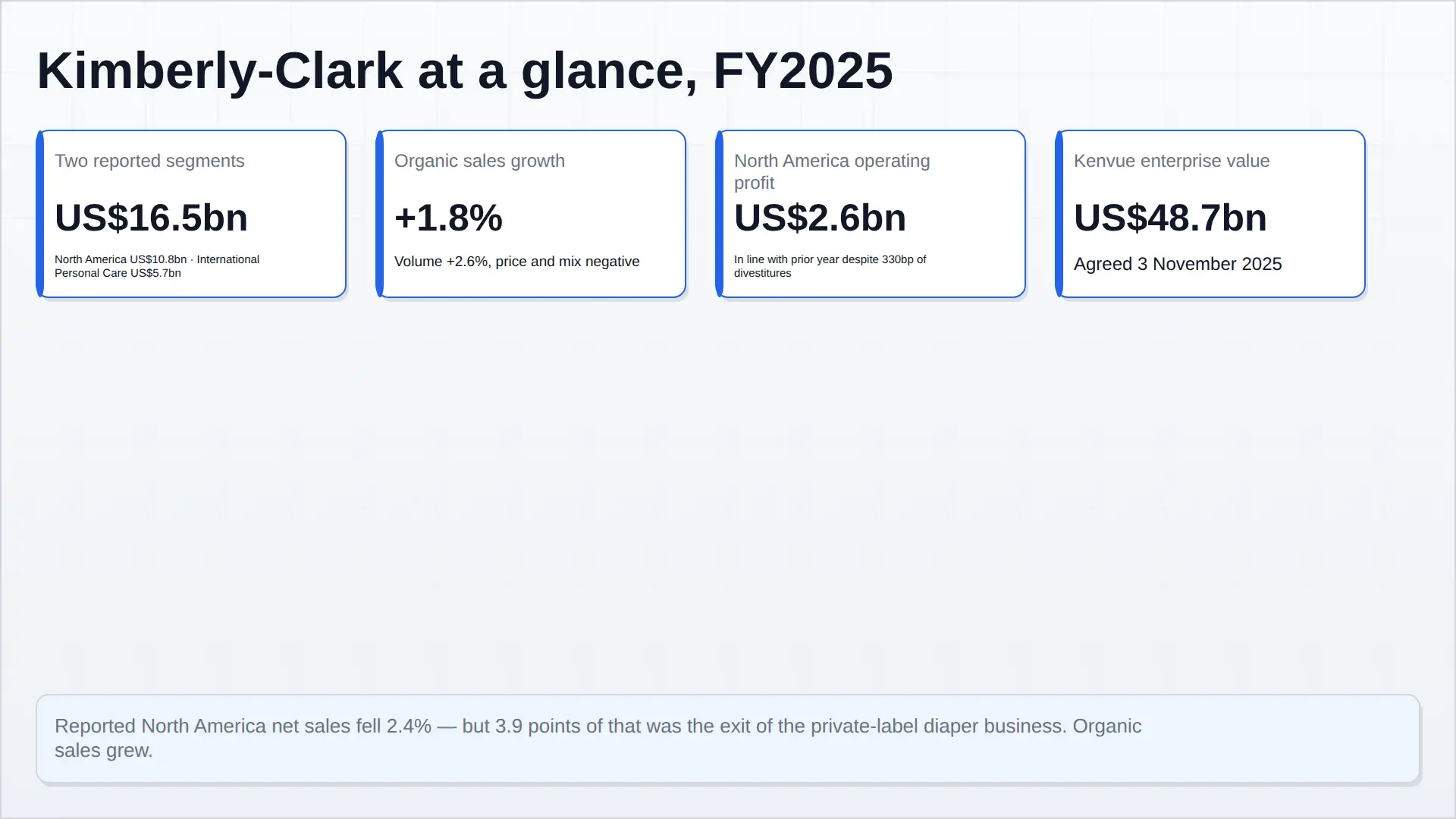
Kimberly-Clark reports two segments: North America, and International Personal Care. In the year to 31 December 2025 those two produced US$16.5bn of net sales — US$10.8bn in North America and US$5.7bn internationally. The reported figures look negative and the organic figures do not. North America net sales fell 2.4%, but 3.9 points of that decline was the exit from the company’s US private-label diaper business; organic sales grew 1.8% on volume growth of 2.6%, with price and mix slightly negative. International Personal Care fell 0.9% on currency, with organic growth of 1.7% driven by volume and improved portfolio mix, partly offset by price investment.
Profit held. North America operating profit was US$2.6bn, in line with the prior year despite a 330 basis point headwind from divestitures and business exits, and fourth-quarter operating profit rose 5.5% to US$580m. Personal Care value share gained 20 basis points for the year and volume share 90 basis points. The company is simultaneously in the middle of two transactions that redefine it: a 51% interest in International Family Care & Professional is being sold into a joint venture, and the acquisition of Kenvue — an enterprise value of approximately US$48.7bn — is expected to close in the second half of 2026.
|
US$16.5bn FY2025 net sales across the two reported segments |
+1.8% North America organic sales growth, on volume of +2.6% |
US$2.6bn North America operating profit, held despite a 330bp divestiture drag |
US$48.7bn Enterprise value of the Kenvue acquisition agreed in November 2025 |
Key Highlights
| Period | Highlight |
|---|---|
| FY2025 North America | Net sales US$10.8bn, down 2.4% — of which 3.9 points was the private-label diaper exit — with organic sales growth of 1.8% on volume growth of 2.6%. Operating profit US$2.6bn, in line with the prior year. |
| FY2025 International Personal Care | Net sales US$5.7bn, down 0.9% on unfavourable currency, with organic growth of 1.7%. Volume-led growth in baby and child care drove weighted share gains. |
| Share | Personal Care value market share up 20 basis points for the year, and volume share up 90 basis points, against category growth of roughly 2%. |
| Q4 FY2025 | North America net sales US$2.6bn (−3.0%), organic +0.8% on volume of +2.5%; operating profit US$580m (+5.5%). Adjusted operating profit US$629m against US$556m, up 13.1%. |
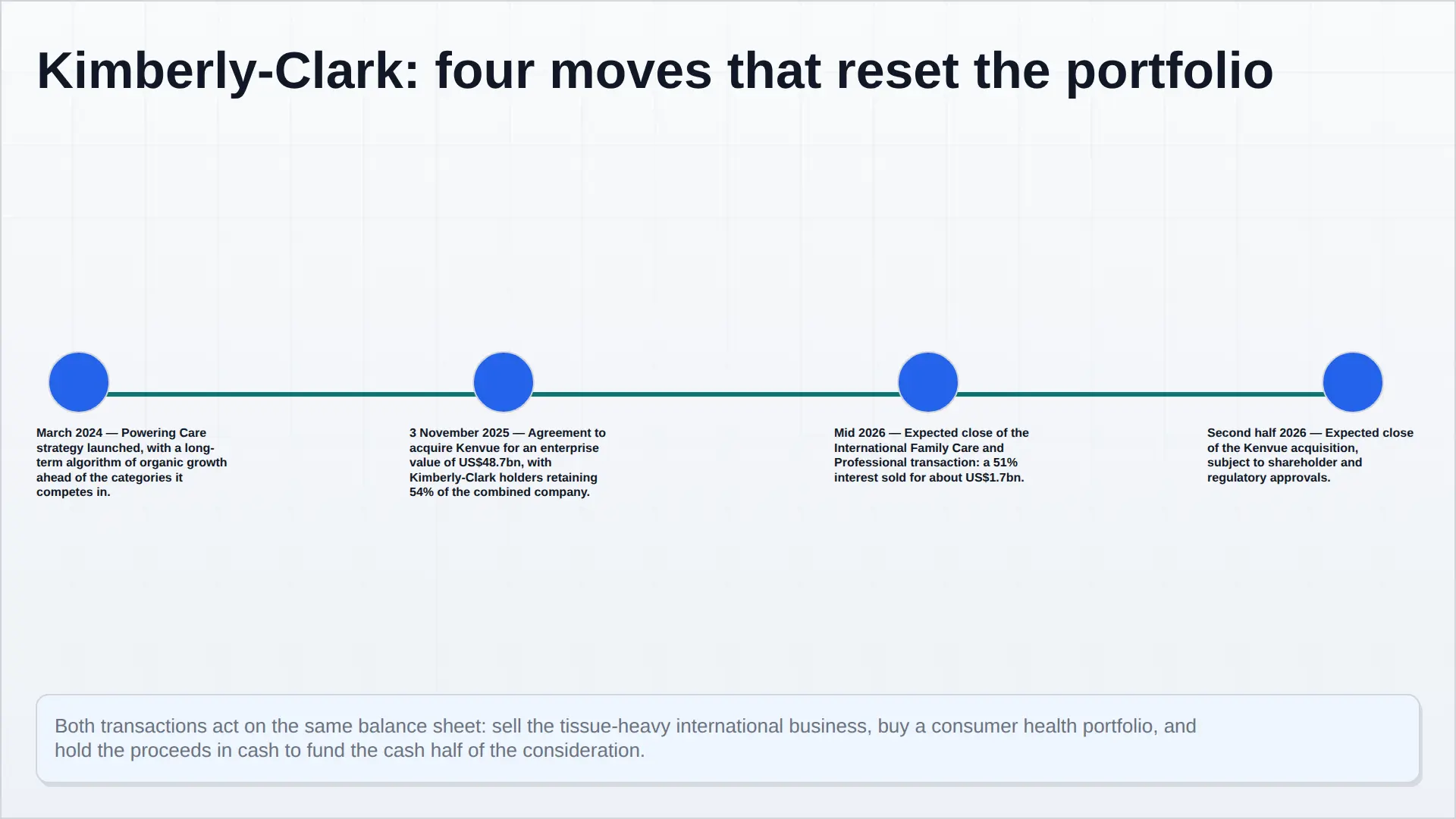
| International Family Care & Professional | A 51% interest sold into a joint venture for approximately US$1.7bn, expected to close mid-2026. The business is reported as discontinued operations and excluded from segment results. |
| Kenvue | Announced 3 November 2025 at an enterprise value of US$48.7bn: US$3.50 cash plus 0.14625 KMB shares per Kenvue share, US$21.01 per share. Kimberly-Clark holders to own about 54% of the combined company. Approximately US$2.1bn of run-rate synergies net of US$300m of reinvestment. |
| 2026 outlook | Organic sales growth in line to ahead of roughly 2% category growth; adjusted operating profit up mid-to-high single digits at constant currency; adjusted EPS from continuing operations up double digits at constant currency; adjusted free cash flow of approximately US$2bn on capital spending of about US$1.3bn. |
Company Overview
Business Description
North America is the larger and more profitable half. It carries three businesses: Consumer Personal Care, which holds Huggies, Pull-Ups and GoodNites in baby and child care, Kotex in feminine care, and Poise and Depend in adult care; Consumer Tissue, which holds Kleenex, Scott, Cottonelle and Viva; and K-C Professional, which sells away-from-home hygiene and safety products into commercial channels. International Personal Care carries the personal care brands outside North America, principally baby and child care, feminine care and adult care, and it grew volume in baby and child care through the year on what management described as price investment funded by mix.
The business being carved out is the tissue-heavy one. International Family Care & Professional combines the international consumer tissue operations with the professional business, and it is the part of Kimberly-Clark most exposed to pulp cost and least exposed to brand premium. Selling 51% of it to a joint venture, while retaining 49%, removes the consolidation but keeps the economic interest — the proceeds are being held in cash specifically to fund the cash half of the Kenvue consideration.
Organisational Structure and Footprint
The reporting structure was reorganised in 2025 around geography rather than category. Where the company previously reported Personal Care, Consumer Tissue and K-C Professional as segments, it now reports North America and International Personal Care, with the assets retained from the former international business folded into those two and the divested operations reported as discontinued. Corporate and Other was redefined to carry the operations of the former international segment that were sold before the transaction.
| Segment | Net sales | Share | Reported / organic |
|---|---|---|---|
| North America | 10.8 | 65.5% | −2.4% reported, +1.8% organic |
| International Personal Care | 5.7 | 34.5% | −0.9% reported, +1.7% organic |
| Two segments combined | 16.5 | 100.0% | Excludes Corporate and Other |
North America is 65.5% of segment sales and, by a wide margin, the larger share of profit — it produced operating profit of US$2.6bn on US$10.8bn of sales. The concentration matters for how the Kenvue deal should be read: the combined company would have had approximately US$32bn of 2025 net revenues and roughly US$7bn of adjusted EBITDA, so the acquisition roughly doubles the revenue base while leaving North America as the anchor of the profit pool.
Financial Performance
Key Financial Highlights
Fiscal 2025 was a year in which reported revenue fell and the underlying business grew. North America’s 2.4% decline decomposes cleanly: 1.8 points of organic growth, 3.9 points removed by the private-label diaper exit, and 0.3 points from currency and other. International Personal Care’s 0.9% decline was almost entirely currency; organic growth was 1.7%. The company also held price discipline — volume supplied 2.6 points of North America’s organic growth, which means price and mix were collectively negative, a mix of investment in value propositions and the effect of the exited business.
| Driver | Index points | What it represents |
|---|---|---|
| FY2024 net sales | 100.0 | Index base |
| Organic sales growth | +1.8 | Volume +2.6 points, price and mix negative |
| Private-label diaper exit | −3.9 | Deliberate withdrawal from the US private-label baby care business |
| Currency and other | −0.3 | Residual to the reported change |
| FY2025 net sales | 97.6 | A reported decline of 2.4% |
Revenue Breakdown
Two thirds of revenue is North American and roughly a third is international personal care. Read by category instead of by geography, the exposure is to three demographically-driven lines and one contested one. Baby and child care is tied to birth rates, which are falling in every mature market the company sells into. Feminine care grows in value while unit volumes are flat to lower in mature markets. Adult care is the structural growth line, tracking an ageing population. Tissue is the contested line: it is where private label is strongest, which is precisely why the private-label diaper exit and the international tissue carve-out both point in the same direction — away from the least defensible volume in the portfolio.
Profitability Analysis
North America held operating profit at US$2.6bn despite a 330 basis point headwind from divestitures and business exits. Two things carried it: strong productivity savings, and lower marketing, research and general expenses. Two things worked against it: unfavourable pricing net of cost inflation, including tariff impacts, and supply-chain related investment. In the fourth quarter the operating leverage was clearer — operating profit rose 5.5% to US$580m, and adjusted operating profit rose 13.1% to US$629m from US$556m.
Guidance for 2026 assumes that pattern continues: adjusted operating profit up mid-to-high single digits at constant currency, with adjusted free cash flow of about US$2bn held flat even as capital investment rises to roughly US$1.3bn from US$1.1bn. The complication is structural rather than operational. Adjusted EPS from continuing operations is guided to double-digit constant-currency growth largely because income from equity companies rises about 30% once the joint venture structure is in place, while adjusted EPS attributable to Kimberly-Clark overall is guided to be flat — the difference being the loss of the discontinued operations’ contribution. That is an accounting consequence of the carve-out, not a deterioration in the remaining business.
SWOT Analysis
|
Strengths
|
Weaknesses
|
|
Opportunities
|
Threats
|
Recent Developments
| Date | Event |
|---|---|
| 27 January 2026 | Reported fiscal 2025 results: North America net sales down 2.4% with organic growth of 1.8%, operating profit of US$2.6bn in line with the prior year, and adjusted operating profit up 13.1% in the fourth quarter. Guided 2026 to organic growth in line to ahead of roughly 2% category growth. |
| 12 February 2026 | Filed the 2025 annual report, confirming the two-segment structure, the treatment of International Family Care & Professional as discontinued operations, and the expected mid-2026 close of the joint venture transaction. |
| 3 November 2025 | Agreed to acquire Kenvue at an enterprise value of approximately US$48.7bn — US$3.50 in cash and 0.14625 Kimberly-Clark shares per Kenvue share, or US$21.01 per share — with Kimberly-Clark holders to own about 54% of the combined company. |
| 2025 | Exited the US private-label diaper business, removing 3.9 points of North America net sales and, with it, the least defensible volume in the baby care portfolio. |
| March 2024 | Launched the Powering Care strategy with a long-term algorithm of organic growth ahead of the categories and countries it competes in, and top-tier constant-currency growth on the bottom line. |
Business Strategy
Global Strategy
The strategy is stated as a growth algorithm rather than a set of ambitions: organic sales growth in line to ahead of the weighted average growth of the categories and countries in which the company competes — roughly 2% in the latest year — with mid-to-high single digit constant-currency growth in adjusted operating profit and about US$2bn of adjusted free cash flow. On the January 2026 call management was explicit that this is achieved by winning through superior consumer value propositions rather than “renting market share with promotion”, at every price tier and in every channel. Its evidence is the third consecutive year of positive volume-plus-mix led growth.
| Pillar | What it means in 2026 |
|---|---|
| Growth ahead of category | Organic growth in line to ahead of approximately 2% weighted category growth, on volume and mix rather than price. Volume supplied 2.6 points of the 1.8% North America organic growth. |
| Productivity and cost | Strong productivity savings and lower marketing, research and general expenses, which together carried North America operating profit to US$2.6bn despite a 330 basis point divestiture headwind. |
| Portfolio reshaping | Out of international tissue through a 51% joint venture sale at about US$1.7bn; into consumer health through Kenvue at US$48.7bn enterprise value; out of US private-label diapers entirely. |
| Cash and balance sheet | Adjusted free cash flow of approximately US$2bn and capital spending of about US$1.3bn, with joint venture proceeds held in cash to fund the US$6.8bn cash component of the Kenvue consideration. |
Focus-Market Strategy
North America is where the strategy is tested most directly, because it is 65.5% of segment sales and the market where private label is strongest. The response has been to compete on the value proposition at each price tier and through each channel, and to exit the volume that cannot be defended profitably — the private-label diaper business — rather than defend it with promotion. That produced a year of negative reported sales and positive organic growth, which is the intended trade.
Internationally the logic is different. Growth there was volume-led in baby and child care, funded by price investment and supported by portfolio mix, with weighted share gains concentrated in those categories. The carve-out of International Family Care & Professional separates the tissue-heavy part of that international footprint from the personal care brands, so the retained international business is a pure personal care operation in exactly the categories where the company claims share gains. Whether that survives contact with Kenvue — a consumer health business with a very different channel and margin structure — is the open question this page cannot yet answer.
Sources
- Kimberly-Clark Corporation, “Kimberly-Clark Reports Strong Finish to Second Year of Transformation” (fourth quarter and full year 2025 results), 27 January 2026 — investor.kimberly-clark.com
- Kimberly-Clark Corporation, Annual Report on Form 10-K for the year ended 31 December 2025, filed 12 February 2026 — SEC EDGAR
- Kimberly-Clark Corporation, “Kimberly-Clark to Acquire Kenvue, Creating a $32 Billion Global Health and Wellness Leader”, 3 November 2025 — investor.kimberly-clark.com
- Kimberly-Clark Corporation, investor presentation filed under Rule 425, SEC EDGAR
- Pheonix Research, Global Feminine Hygiene Products Market — market sizing and the owner concentration this page is written against
- Wikidata, Q1741634
Provenance: this page is bound to Wikidata Q1741634 and to the Pheonix entity MIEN-node_88a683c6. Financial figures are taken from Kimberly-Clark’s own reporting for fiscal 2025, in US dollars as reported, and reflect continuing operations unless stated otherwise. Segment figures are North America and International Personal Care as redefined in the 2025 annual report; the combined two-segment total excludes Corporate and Other. The Kenvue and International Family Care & Professional transactions had not closed at the time of writing and are described on the timings the company has stated. Last verified 18 November 2026.
Market Presence
Kimberly-Clark is mentioned across 3 market reports.
Global Baby Diapers Market Report, Size, Share and Forecast 2026–2033: The Price Comes From One Market and the Volume From Another
Global Adult Incontinence Products Market Report, Size, Share and Forecast 2026–2033: The Only Absorbent Category Where Volume Does the Work
