
Company Profile
Unicharm
Unicharm Corporation (Tokyo Stock Exchange Prime: 8113) is a Minato, Tokyo hygiene company whose baby care, feminine care and adult care brands make it the largest Japanese-owned participant in the category Pheonix Research models in its Global Feminine Hygiene Products Market report. It is also the clearest example in the sector of a company whose problem is not the category but one country: in 2025 its China business lost ¥17.5bn of core operating income while the group sold ¥945,268m of product around it.
Identifiers
| Legal name | Unicharm Corporation |
|---|---|
| Listing | Tokyo Stock Exchange Prime Market, ticker 8113 |
| Headquarters | Minato, Tokyo, Japan |
| Founded | 1961 |
| Fiscal year | 1 January to 31 December, reported under IFRS |
| Wikidata ID | Q5361268 — label “Unicharm”, described as a Japan company |
| Pheonix entity ID | MIEN-node_caf6cee7 |
| Official website | unicharm.co.jp |
| Investor relations | unicharm.co.jp/en/ir |
| Regulatory filings | Consolidated financial results for the year ended 31 December 2025 (PDF) and the Tokyo Stock Exchange timely disclosure system |
| Pheonix coverage | A named owner in the Global Feminine Hygiene Products Market report, and discussed in The pad got shorter because nobody measures the absorbent core |
Executive Summary
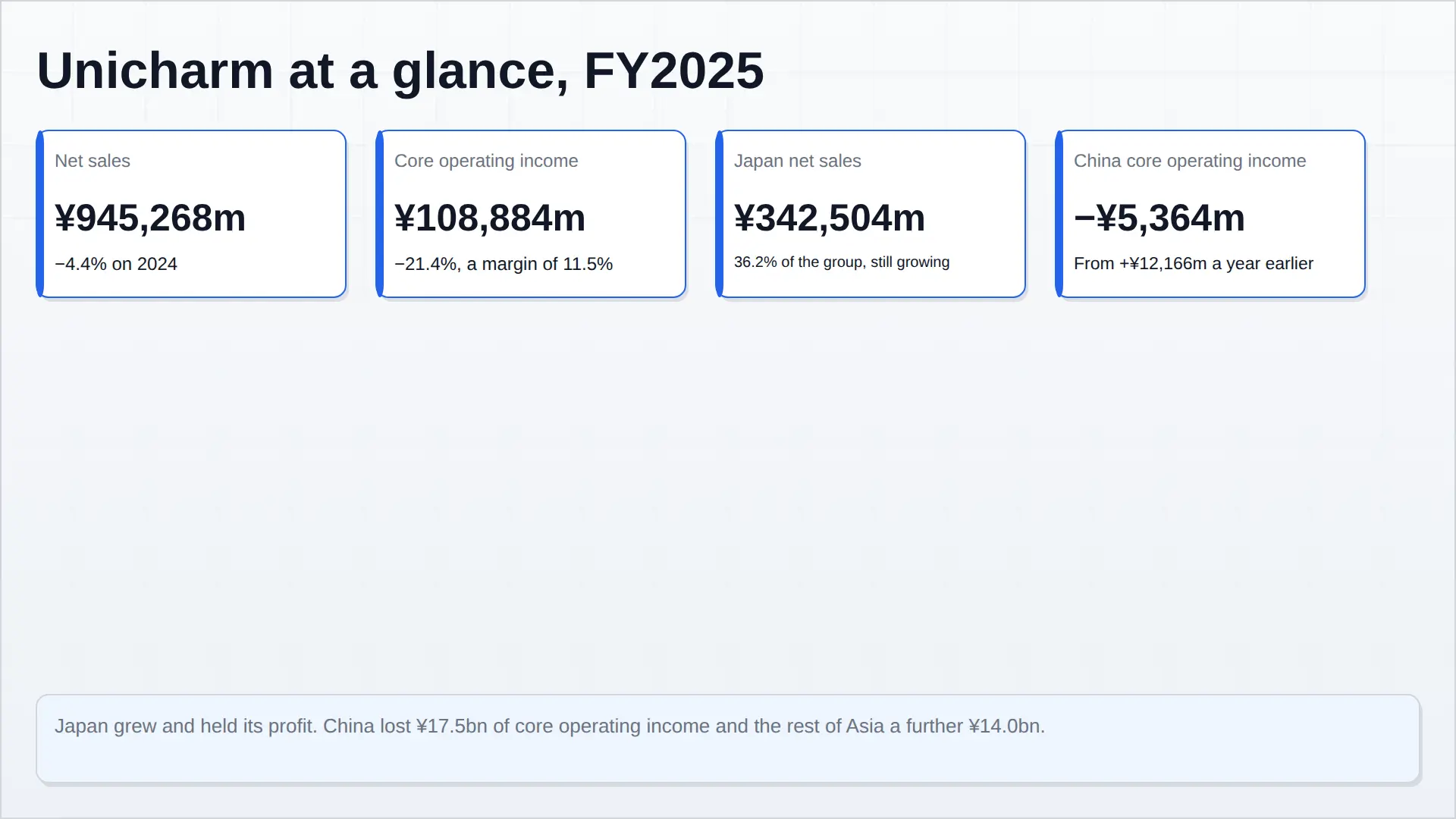
Unicharm’s 2025 was a year of contraction on every headline measure. Net sales fell 4.4% to ¥945,268m, core operating income fell 21.4% to ¥108,884m, profit before tax fell 21.7% to ¥105,386m and profit attributable to owners of the parent fell 20.3% to ¥65,212m. Core operating margin fell from 14.0% to 11.5% and return on equity from 11.1% to 8.3%. Total comprehensive income fell 44.0%.
The regional detail explains almost all of it, and none of the explanation is about Japan. Japan sold ¥342,504m, up ¥2,582m, and held core operating income at ¥67,350m, down only ¥630m. Japan is 36.2% of group sales and 61.9% of group core operating income. China sold ¥78,024m, down ¥29,300m, and swung from ¥12,166m of core operating income to a loss of ¥5,364m. The rest of Asia sold ¥311,269m, down ¥24,520m, and lost ¥13,991m of core operating income. Only the catch-all Others region grew, adding ¥7,525m of sales and ¥2,629m of profit.
|
¥945,268m FY2025 net sales, down 4.4% on 2024 |
¥108,884m Core operating income, down 21.4%, a margin of 11.5% |
36.2% Japan’s share of net sales, and 61.9% of core operating income |
−¥5,364m China core operating income, from +¥12,166m a year earlier |
Key Highlights
| Period | Highlight |
|---|---|
| FY2025 group | Net sales ¥945,268m (−4.4%); core operating income ¥108,884m (−21.4%) at an 11.5% margin against 14.0%; profit attributable to owners of the parent ¥65,212m (−20.3%). |
| Personal Care Business | Net sales ¥774,428m (−6.3%), or 81.9% of the group, with core operating income of ¥83,197m (−25.0%). |
| Japan | Net sales ¥342,504m, up ¥2,582m, and core operating income of ¥67,350m, down only ¥630m. The only large region to grow. |
| China | Net sales ¥78,024m, down ¥29,300m, and core operating income of −¥5,364m against +¥12,166m — a ¥17,530m swing, on continued uncertainty and a preference for lower-priced products among young consumers. |
| Rest of Asia | Net sales ¥311,269m, down ¥24,520m, with core operating income of ¥16,748m against ¥30,739m — a decline of ¥13,991m. |
| Feminine care, China | Sales were affected by product-quality rumours in November 2024 and again in March and October 2025, addressed through digital marketing in e-commerce and brand-building, alongside new formats including shorts-shaped napkins for daytime use. |
| Returns | Basic earnings per share ¥37.30 against ¥46.41; return on equity 8.3% against 11.1%; total comprehensive income ¥78,264m (−44.0%). |
Company Overview
Business Description
The Personal Care Business is the company: 81.9% of net sales across baby care, feminine care and adult care, sold under brands including Moony and MamyPoko in baby care, Sofy in feminine care and Lifree in adult care. Baby care is the largest line, and it is the one most exposed to the birth-rate problem across Japan, China and Southeast Asia. Feminine care is where the company has invested in format innovation — cooling napkins, shorts-shaped napkins for daytime use, character-licensed lines — particularly in China, where it has been fighting both a consumer preference for cheaper products and reputational damage from quality rumours.
Adult care is the growth answer and is treated as such. In Southeast Asia, in countries including Thailand, Indonesia and Vietnam, the company has been expanding the product line and promoting what it calls the Japanese care model, selling pad-type products and disposable underwear together rather than as separate purchases. That is a market-development strategy rather than a share strategy, and it is the part of the portfolio least exposed to the two forces that hurt 2025: birth rates and Chinese consumer sentiment.
Organisational Structure and Footprint
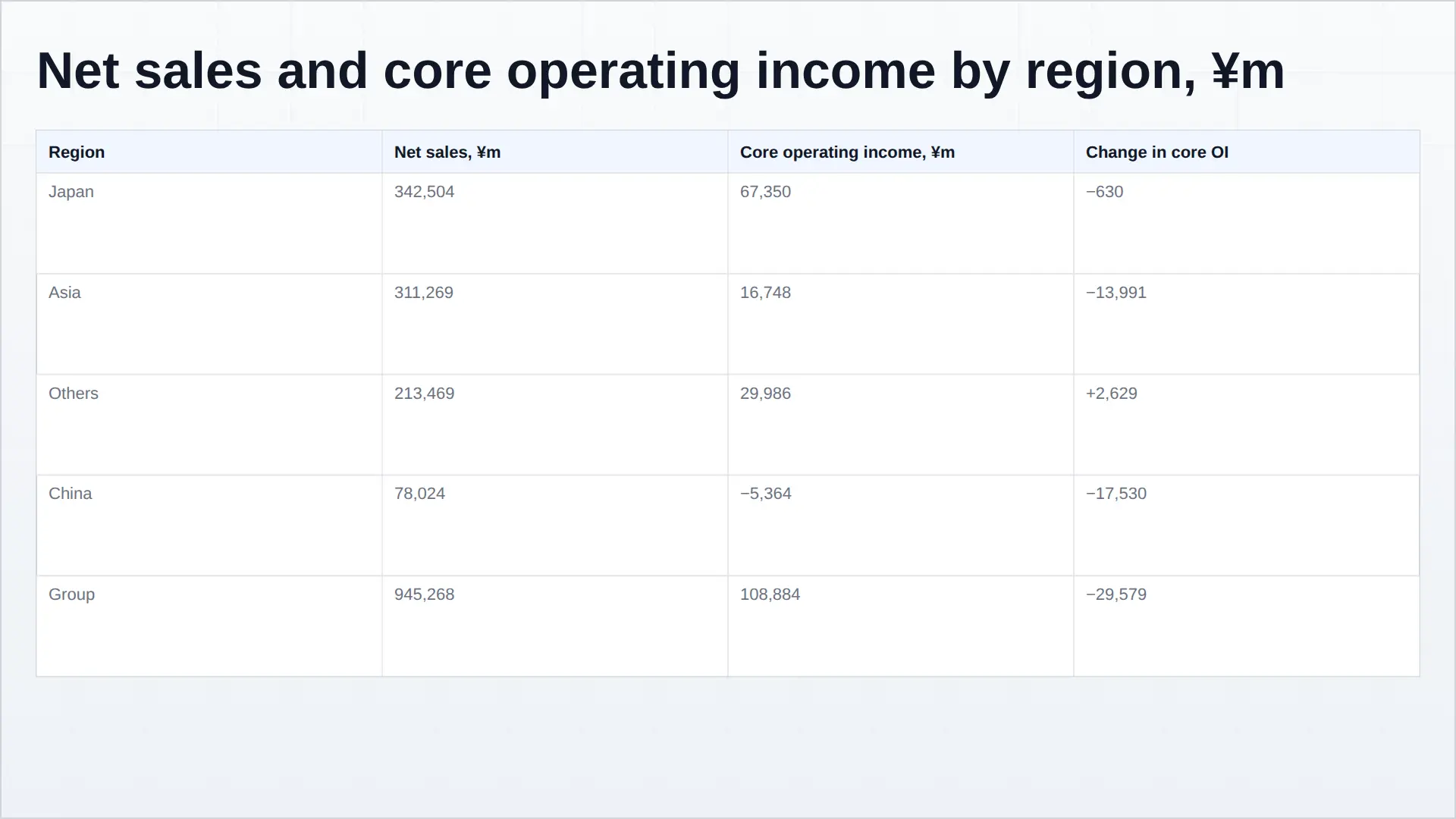
Unicharm reports by region — Japan, China, Asia and Others — alongside its business segments, and the regional cut is the one that matters. Japan is 36.2% of net sales, the rest of Asia 32.9%, Others 22.6% and China 8.3%. On profit the concentration is starker: Japan produced ¥67,350m of the ¥108,884m of group core operating income, or 61.9%, while China produced a loss and Asia produced less than half its prior-year contribution.
| Region | Net sales | Share | Core operating income | Change in profit |
|---|---|---|---|---|
| Japan | 342,504 | 36.2% | 67,350 | (630) |
| Asia | 311,269 | 32.9% | 16,748 | (13,991) |
| Others | 213,469 | 22.6% | 29,986 | 2,629 |
| China | 78,024 | 8.3% | (5,364) | (17,530) |
| Group | 945,268 | 100.0% | 108,884 | (29,579) |
Financial Performance
Key Financial Highlights
The group income statement deteriorated faster than revenue because the loss of sales was concentrated in the regions where margin was being defended. Net sales fell 4.4% to ¥945,268m and core operating income, which Unicharm defines as gross profit less selling, general and administrative expenses, fell 21.4% to ¥108,884m. Profit before tax fell 21.7% and profit attributable to owners of the parent fell 20.3% to ¥65,212m. Comprehensive income fell 44.0% to ¥78,264m, which suggests currency translation effects on top of the operating decline.
| Measure | 2024 | 2025 |
|---|---|---|
| Net sales | 988,981 | 945,268 |
| Core operating income | 138,463 | 108,884 |
| Core operating margin | 14.0% | 11.5% |
| Profit before tax | 134,537 | 105,386 |
| Profit attributable to owners of the parent | 81,842 | 65,212 |
| Basic earnings per share, ¥ | 46.41 | 37.30 |
| Return on equity | 11.1% | 8.3% |
| Total comprehensive income | 139,749 | 78,264 |
Revenue Breakdown
The company sells into four regions and the pattern within each is distinct. Japan is mature, stable and profitable: sales rose ¥2,582m and core operating income fell only ¥630m, which is the signature of a business defending margin in a flat market. China is in retreat on both measures, with sales down ¥29,300m and a ¥17,530m swing in core operating income. Asia — Southeast Asia and India — lost ¥24,520m of sales and ¥13,991m of profit, which is the more surprising of the two declines because it is the region where the company has been investing in adult care market development. Others, which includes the Americas, Europe and the Middle East, grew on both measures.
Within female hygiene specifically, the Chinese business has been dealing with something more than price. The company’s own disclosure cites rumours about the quality of sanitary products and about waste management in November 2024 and again in March and October 2025 as a cause of temporary sales declines, and describes its response as strengthening brand value through digital marketing in e-commerce, alongside new product concepts such as a shorts-shaped napkin for daytime use with enhanced ease of change, and character-licensed lines. That is a brand-trust problem being answered with product novelty and channel investment.
Profitability Analysis
Unicharm’s profitability is now a story about where the growth is not. Group core operating margin fell from 14.0% to 11.5% because the sales lost were in Asia and China at the same time as costs in those regions were not reduced proportionally. Japan, by contrast, held a core operating margin that can be read from the table above: ¥67,350m on ¥342,504m of sales. The remaining regions collectively produced ¥41,370m on ¥602,762m.
The strategic problem is arithmetic. If Japan is 61.9% of core operating income and cannot grow faster than a mature, shrinking-population market allows, then group profit growth has to come from regions that are currently destroying it. The adult care bet in Southeast Asia is the company’s answer, and it is the right category to bet on — an ageing population is a demand driver that does not depend on consumer sentiment in one country. But market development is slow, and it competes for capital with a Chinese feminine care business that needs brand rehabilitation at the same time.
SWOT Analysis
|
Strengths
|
Weaknesses
|
|
Opportunities
|
Threats
|
Recent Developments
| Date | Event |
|---|---|
| 12 February 2026 | Reported fiscal 2025 results: net sales down 4.4%, core operating income down 21.4%, profit attributable down 20.3%, with China swinging to a core operating loss and the rest of Asia losing ¥13,991m of profit. |
| October 2025 | A further round of reports on sanitary product quality and waste management affected Chinese feminine care sales, the third such episode after November 2024 and March 2025. |
| 2025 | Launched a shorts-shaped sanitary napkin for daytime use in China and expanded character-licensed ranges, while shifting brand investment into e-commerce and digital marketing. |
| 2025 | Expanded the adult care range and promoted the combined pad-and-disposable-underwear model in Thailand, Indonesia and Vietnam, where demand for adult excretion care is rising. |
Business Strategy
Global Strategy
Unicharm’s strategy in 2025 was executed as two different problems. In the mature markets the task is to hold margin while growing modestly, which Japan achieved. In the developing markets the task is to build categories before they are competitive, which is what the adult care programme in Southeast Asia is doing — expanding the product line and promoting a care model rather than discounting against local competitors. The third task, and the one that consumed the most management attention, is repairing brand trust in Chinese feminine care at the same time as defending price against consumers trading down.
| Pillar | What it means |
|---|---|
| Defend Japan | Grow sales modestly and protect core operating income, which fell only ¥630m on ¥342,504m of sales. Japan supplies 61.9% of group core operating income. |
| Build adult care abroad | Product-line expansion and the pad-and-underwear care model in Thailand, Indonesia and Vietnam, targeting rising adult excretion care demand. |
| Repair China | Digital marketing in e-commerce and product novelty — shorts-shaped napkins, licensed ranges — to rebuild brand value after three rounds of quality rumours. |
| Innovate the format, not the price | Cooling napkins, shorts-shaped napkins and ease-of-change design, aimed at consumers trading down to cheaper products rather than matching them on price. |
Focus-Market Strategy
Japan is the focus market and the profit engine, and the strategy there is unremarkable in the best sense: hold share in baby care against a falling birth rate, grow feminine care on format, and build adult care as the demographic wave arrives. It worked in 2025 — sales up, profit essentially flat.
Asia is where the growth is supposed to come from and where the profit went in 2025. A ¥24,520m fall in sales produced a ¥13,991m fall in core operating income, which is worse than proportional and indicates that costs were being added ahead of revenue. That is what market development looks like in a bad year, and the company’s position — that adult care demand is rising in Thailand, Indonesia and Vietnam and that the Japanese care model is the right product — is a claim about the medium term that the 2025 numbers cannot yet corroborate. For a reader tracking the feminine hygiene category as Pheonix Research models it, the useful observation is that Unicharm’s China problem is not about feminine hygiene demand at all: the category grows 3.80% a year in value globally, and Unicharm’s Chinese loss is about the price point, the trust in the brand and the channel, not about whether women buy pads.
Sources
- Unicharm Corporation, “Consolidated Financial Results for the Fiscal Year Ended December 31, 2025; Flash Report [IFRS]”, 12 February 2026 — unicharm.co.jp (PDF)
- Unicharm Corporation, investor relations library — unicharm.co.jp/en/ir
- Pheonix Research, Global Feminine Hygiene Products Market — category value and volume growth, and the competitive chapter Unicharm is named in
- Pheonix Research, The pad got shorter because nobody measures the absorbent core
- Wikidata, Q5361268
Provenance: this page is bound to Wikidata Q5361268 and to the Pheonix entity MIEN-node_caf6cee7. Financial figures are taken from Unicharm’s fiscal 2025 consolidated results under IFRS, in yen as reported. Core operating income is a non-IFRS measure the company defines as gross profit less selling, general and administrative expenses. Regional shares and the Japan share of core operating income are calculated from the reported regional figures. Last verified 18 November 2026.