
Company Profile
Edgewell Personal Care
Edgewell Personal Care Company (NYSE: EPC) is a Shelton, Connecticut consumer products company built on Schick in wet shave and Banana Boat in sun care. Until November 2025 it was also a participant in feminine care, and the sale of that business to Essity for US$340m is the single transaction that most directly tests the consolidation thesis running through Pheonix Research’s Global Feminine Hygiene Products Market report: a US$39,800m market in 2025 growing at 3.80%, in which ownership is being bought rather than grown.
Identifiers
| Legal name | Edgewell Personal Care Company |
|---|---|
| Listing | New York Stock Exchange, ticker EPC |
| Headquarters | Shelton, Connecticut, United States |
| Founded | 2015, as a spin-off of Energizer Holdings’ personal care business; the Schick brand dates to 1921 |
| Fiscal year | 1 October to 30 September |
| Wikidata ID | Q5337641 — label “Edgewell Personal Care”, described as an American consumer products company |
| Pheonix entity ID | MIEN-node_fa4ff920 |
| Official website | edgewell.com |
| Investor relations | ir.edgewell.com |
| Regulatory filings | SEC EDGAR, filings under ticker EPC |
| Pheonix coverage | The seller in the feminine care disposal that anchors the Global Feminine Hygiene Products Market report’s consolidation chapter, and a named counterparty in Seventeen countries removed the tampon tax |
Executive Summary
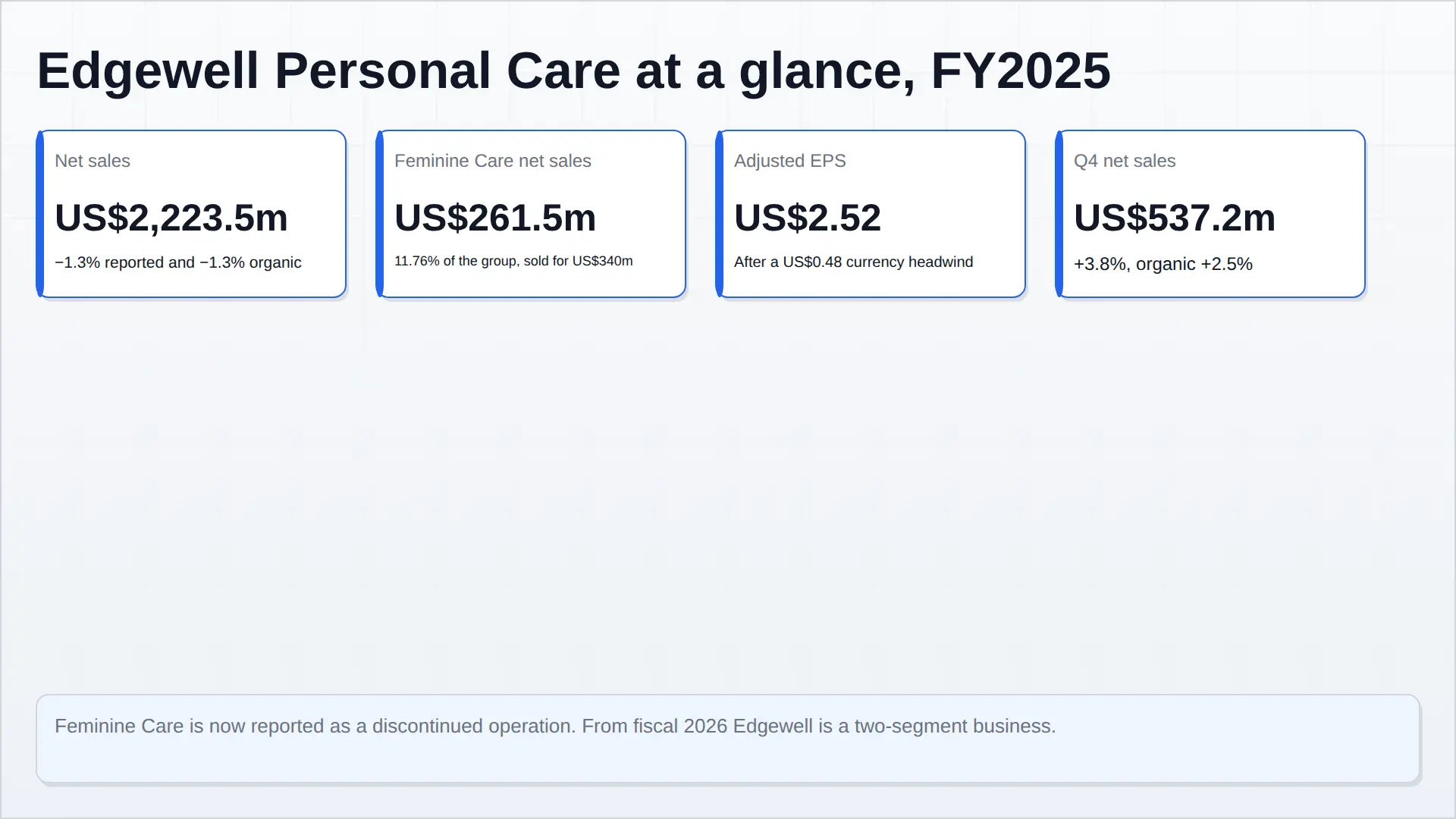
Edgewell’s fiscal year to 30 September 2025 closed with net sales of US$2,223.5m, down 1.3% on both a reported and an organic basis. The average conceals a wide split: North America organic sales fell 4.4% on lower volumes in wet shave, feminine care and sun care, while international markets grew 3.5% organically on higher volumes and increased pricing. Segment profit fell considerably faster than sales — US$304.3m against US$364.0m, a decline of 16.4% — with all three reporting units down.
The fourth quarter was better than the year, and the year-end was dominated by the portfolio decision. Net sales rose 3.8% in the quarter to US$537.2m, or 2.5% organically, but adjusted EBITDA fell to US$59.4m from US$78.9m and GAAP diluted earnings per share were negative US$0.66 for the quarter against US$0.53 for the full year, reflecting an impairment taken against the Feminine Care reporting unit once the sale was agreed. That sale — the entire Feminine Care business, to Essity, for US$340m — was announced on 13 November 2025 and reframes everything after it.
|
US$2,223.5m FY2025 net sales, down 1.3% reported and organic |
US$304.3m FY2025 segment profit, down 16.4% from US$364.0m |
US$261.5m Feminine Care net sales, 11.76% of the group |
US$340m Price Essity is paying for the Feminine Care business |
Key Highlights
| Period | Highlight |
|---|---|
| FY2025 | Net sales US$2,223.5m, down 1.3% reported and organic. North America organic −4.4%; international organic +3.5%. Adjusted EPS US$2.52, including a US$0.48 currency headwind. |
| FY2025 profit | Segment profit US$304.3m against US$364.0m, down 16.4%. General corporate and other expenses fell to US$54.1m from US$65.7m, partly offsetting the decline. |
| Q4 FY2025 | Net sales US$537.2m (+3.8%, organic +2.5%). Adjusted EBITDA US$59.4m against US$78.9m. GAAP diluted EPS −US$0.66 on a Feminine Care impairment. |
| Feminine Care disposal | Definitive agreement to sell the business to Essity for US$340m, announced 13 November 2025. Reported as a discontinued operation from that point. |
| Q3 FY2026 | Net sales US$570.1m (+1.7%, organic +1.1%). North America organic +3.0% on improving execution and distribution; international −1.4% on Middle East disruption and wet shave manufacturing consolidation. Adjusted EPS US$0.72, flat. |
| FY2026 outlook | Reported net sales +1.3% to +1.8%, including about 130 basis points of favourable currency; organic net sales flat to +0.5%; GAAP EPS flat to US$0.20. Presented on a continuing-operations basis. |
Company Overview
Business Description
Wet Shave is the core: men’s systems, women’s systems, disposables and shave preparations sold under Schick, Wilkinson Sword and Edge, worth US$1,218.9m in fiscal 2025, or 54.8% of net sales, and US$190.3m of segment profit. Sun and Skin Care is the second leg at US$743.1m and 33.4% of net sales, carrying Banana Boat and Hawaiian Tropic in sun care alongside Bulldog, Jack Black, Cremo and Wet Ones in grooming and skin, and it produced US$98.4m of segment profit. Feminine Care — tampons, pads and liners, including Playtex and o.b. — was the smallest unit at US$261.5m, 11.76% of net sales, and US$15.6m of segment profit.
Those three numbers explain the disposal better than any strategy document. Feminine Care was 11.76% of sales and about a twentieth of segment profit, and it was shrinking faster than the group: net sales fell 7.8% in fiscal 2025, from US$283.6m to US$261.5m, and segment profit nearly halved from US$28.8m to US$15.6m. Selling it for US$340m realises more than the business generated in a decade of segment profit, and leaves a company that is 88.2% wet shave and sun and skin care by revenue.
Organisational Structure and Footprint
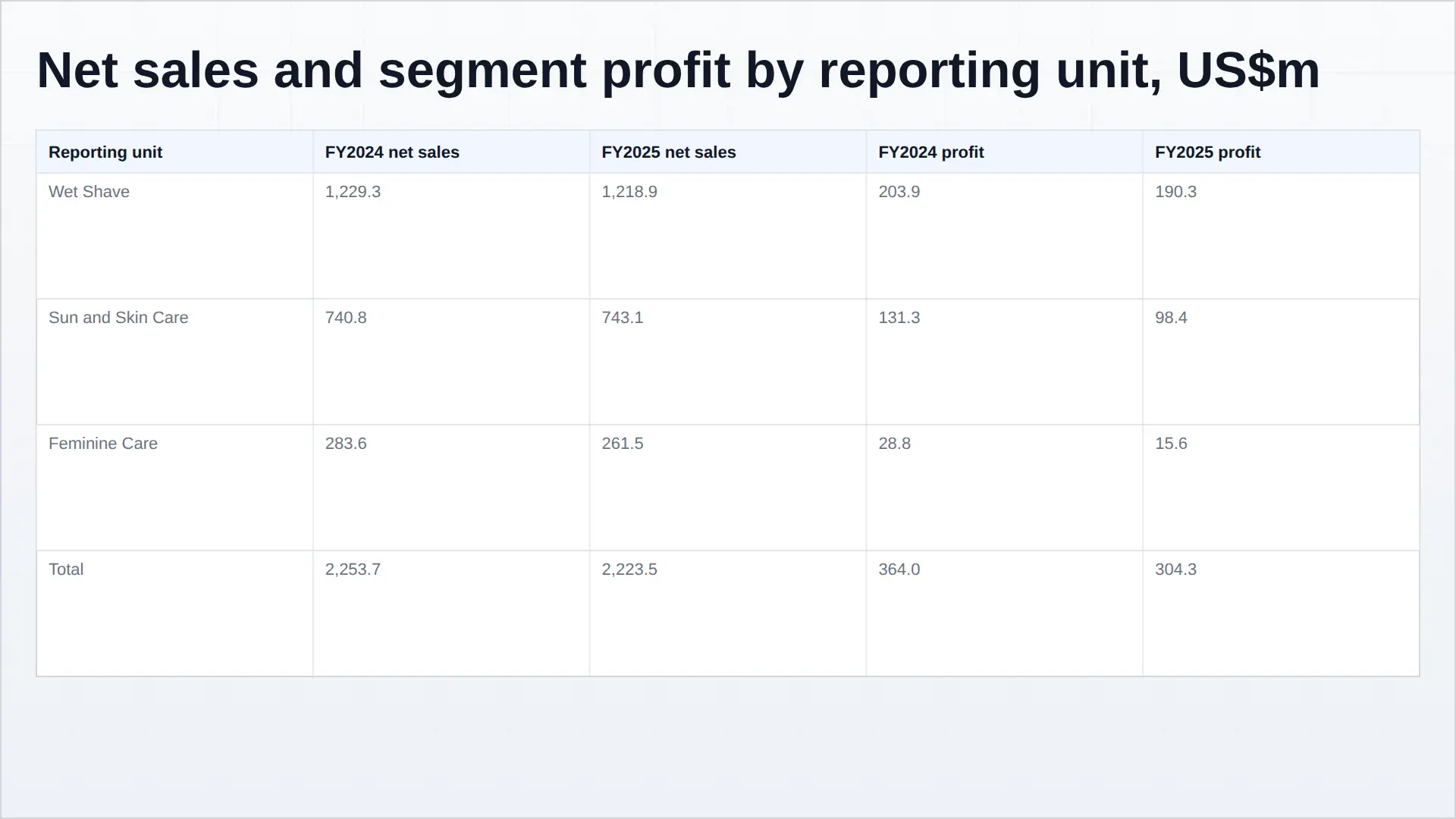
Edgewell reported three segments through fiscal 2025 and two from fiscal 2026. Segment profit is measured before general corporate expenses, share-based compensation, items the company treats as unusual or non-recurring, and amortisation of intangibles — which is why the segment figures do not add to a reported operating profit. Interest and other financial items are managed centrally and never allocated to a segment.
| Reporting unit | Net sales 2024 | Net sales 2025 | Share 2025 | Profit 2024 | Profit 2025 |
|---|---|---|---|---|---|
| Wet Shave | 1,229.3 | 1,218.9 | 54.8% | 203.9 | 190.3 |
| Sun and Skin Care | 740.8 | 743.1 | 33.4% | 131.3 | 98.4 |
| Feminine Care | 283.6 | 261.5 | 11.76% | 28.8 | 15.6 |
| General corporate and other | — | — | — | (65.7) | (54.1) |
| Total | 2,253.7 | 2,223.5 | 100.0% | 364.0 | 304.3 |
Financial Performance
Key Financial Highlights
The defining feature of fiscal 2025 was that profit fell an order of magnitude faster than revenue. Net sales declined 1.3% while segment profit declined 16.4%. Only part of that is volume: the company describes organic net sales as down 1.3% with currency excluded, so the deterioration is margin, not demand alone. Sun and Skin Care lost US$32.9m of segment profit on flat sales. Feminine Care lost US$13.2m on a 7.8% sales decline. Even Wet Shave, which held revenue to within 1%, gave up US$13.6m of profit.
| Measure | FY2025 | Basis |
|---|---|---|
| Net sales | US$2,223.5m | Reported, down 1.3% |
| Organic net sales change | −1.3% | Excludes currency |
| Segment profit | US$304.3m | Down 16.4% from US$364.0m |
| Adjusted EPS | US$2.52 | Includes a US$0.48 currency headwind |
| GAAP diluted EPS | US$0.53 | Full year; the fourth quarter was −US$0.66 |
| Adjusted EBITDA, fourth quarter | US$59.4m | Against US$78.9m, including US$11.2m of currency |
| Cash and available facilities | US$397.1m | At 30 June 2026, plus US$418.8m undrawn revolver |
Revenue Breakdown
By reporting unit the mix is 54.8% wet shave, 33.4% sun and skin care and 11.76% feminine care. By geography the split matters more than the arithmetic, because the two halves of the business moved in opposite directions in fiscal 2025: North America organic sales fell 4.4% on lower volumes in wet shave, feminine care and sun care, partly offset by growth in skin care and grooming, while international markets delivered organic growth of 3.5% on higher volumes and increased pricing. The recovery in fiscal 2026 has come from the same place the weakness did — North America returned to organic growth of 3.0% in the third quarter on improving execution, increased distribution and strength across priority brands.
Profitability Analysis
Profitability is now a two-segment question. Wet Shave and Sun and Skin Care together produced US$288.7m of the US$304.3m of segment profit in fiscal 2025, and the sun and skin unit is the one with the most visible margin problem: it lost US$32.9m of profit while adding US$2.3m of sales. Management attributes the pressure to lower gross margin and higher marketing and selling, general and administrative expense rather than to price alone.
The fiscal 2026 trajectory has been one of stabilisation rather than recovery. Third-quarter net sales grew 1.7% to US$570.1m and organic growth was 1.1%, but adjusted EPS were flat at US$0.72 and GAAP diluted EPS fell from US$0.46 to US$0.26. Full-year organic growth guidance was trimmed to flat to 0.5% from a prior range of −1% to +2%, with reported growth of 1.3% to 1.8% flattered by about 130 basis points of currency. The company entered the year with US$397.1m of cash and US$418.8m available under its US$1bn-class revolver, which is a balance sheet that can absorb a weak year but not a strategic misstep.
SWOT Analysis
|
Strengths
|
Weaknesses
|
|
Opportunities
|
Threats
|
Recent Developments
| Date | Event |
|---|---|
| 5 August 2026 | Reported third-quarter fiscal 2026 net sales of US$570.1m (+1.7%, organic +1.1%), with North America organic growth of 3.0% and adjusted EPS flat at US$0.72. Trimmed full-year organic growth guidance to flat to 0.5%. |
| November 2025 — 2026 | Executed the wet shave manufacturing consolidation, which the company cites as a short-term drag on international supply in fiscal 2026. |
| 13 November 2025 | Announced a definitive agreement to sell the entire Feminine Care business to Essity for US$340m, and reported an impairment against the Feminine Care reporting unit in the same quarter. |
| 13 November 2025 | Reported fourth-quarter and full-year fiscal 2025 results: net sales of US$2,223.5m (−1.3%), segment profit of US$304.3m (−16.4%), adjusted EPS of US$2.52 and GAAP diluted EPS of US$0.53, and provided fiscal 2026 outlook on a continuing-operations basis. |
| 1 July 2015 | Became an independent listed company on the spin-off of Energizer Holdings’ personal care business, inheriting Schick, Edge, Skintimate, Playtex and the Banana Boat and Hawaiian Tropic sun care brands. |
Business Strategy
Global Strategy
Edgewell’s stated approach is to concentrate capital on brands with defensible positions in mature categories, and to fund the growth of those brands through cost reduction rather than acquisition. The Feminine Care disposal is the clearest expression of it: rather than invest to defend an 11.76% revenue line earning US$15.6m of segment profit, the company sold it and kept the proceeds. Alongside that it has been consolidating wet shave manufacturing, a decision that cost it international sales in the short term but reduces the fixed cost base in a category where volume is not growing.
| Pillar | What it means |
|---|---|
| Concentrate the portfolio | Two segments and 88.2% of revenue in wet shave and sun and skin care, with US$340m of proceeds from the category that was sold. |
| Manufacturing footprint | Consolidating wet shave manufacturing to take fixed cost out of a flat-volume category, at the cost of short-term international supply disruption. |
| Distribution and execution | North America organic growth of 3.0% in the third quarter of fiscal 2026, attributed to improving execution, increased distribution and strength in priority brands. |
| Premiumisation within grooming | Bulldog, Jack Black and Cremo grew in North America while legacy categories declined, at higher price points than the mass shave range. |
Focus-Market Strategy
North America is the focus market and the problem market. It declined 4.4% organically in fiscal 2025 on lower volumes across wet shave, feminine care and sun care, and then returned to growth of 3.0% in the third quarter of fiscal 2026. Management’s explanation for the turn is execution rather than market recovery: better distribution, stronger priority brands and improving commercial discipline. That is a fragile kind of recovery because it is not underwritten by category growth.
International markets behave differently. Organic growth of 3.5% in fiscal 2025 came from higher volumes and increased pricing, and in fiscal 2026 the segment fell 1.4% on temporary disruption from the Middle East conflict and from the wet shave manufacturing consolidation. The strategic question the disposal poses is whether a company that is now 88.2% wet shave and sun and skin care can generate growth in two mature categories without the smaller, faster-declining feminine care unit to manage for cash — and whether US$340m is better deployed paying down debt than buying growth.
Sources
- Edgewell Personal Care Company, “Edgewell Personal Care Announces Fourth Quarter and Fiscal 2025 Results; Provides 2026 Outlook”, 13 November 2025 — ir.edgewell.com
- Edgewell Personal Care Company, “Edgewell Personal Care Announces Third Quarter Fiscal 2026 Results”, 5 August 2026 — ir.edgewell.com
- Edgewell Personal Care Company, annual report on Form 10-K for the fiscal year ended 30 September 2025 — SEC EDGAR
- Pheonix Research, Global Feminine Hygiene Products Market, and the press release Feminine hygiene grew 0.80 per cent in volume and 3.80 per cent in value
- Wikidata, Q5337641
Provenance: this page is bound to Wikidata Q5337641 and to the Pheonix entity MIEN-node_fa4ff920. Financial figures are taken from Edgewell’s own reporting in US dollars as reported. Fiscal 2025 figures include Feminine Care; figures for the third quarter of fiscal 2026 and the fiscal 2026 outlook are on a continuing-operations basis and exclude it. Segment shares are calculated from reported segment net sales. Last verified 18 November 2026.