
Editorial Article
The Robot Has No Second Owner: A USD 15,750 Shortfall on One Cell Explains Why Robotics-as-a-Service Grows 15.8% a Year and Still Can't Get Cheaper
Here is the number that governs the robotics-as-a-service industry, and it appears in no press release. A USD 105,000 robot cell on a 48-month subscription is usually priced on an assumption that it will be worth about a quarter of its cost when the contract ends. If the market actually clears at ten per cent — because the fixture was built for one part, the software version no longer matches, and the safety file was written for one building — the provider absorbs USD 15,750 on that single cell.
That loss arrives in one month, four years later. It is larger than the cumulative software and service margin earned across the entire relationship. And it is the reason the robotics-as-a-service market report we published this week argues that the growth of this market is a residual-value story wearing a technology costume.
The contract is shorter than the asset
An industrial robot is engineered to run for seven to ten years. A robotics-as-a-service agreement runs three to five. That gap is not a detail of contract law; it is the whole business. The provider’s margin on the contract itself is thin — it is competing against a bank loan, and its customer could finance the hardware directly at a rate the provider has to beat while carrying operational risk the bank refuses to take. The margin that makes the business worth doing lives after the term, when the asset goes to its second owner.
Which raises a question the industry answers with a slide rather than a number. What is a second owner actually buying?
Redeployability was the original promise
It was written down. In April 2021, when Hirebotics launched its packaged welding cell at USD 1,300 a month, the announcement described the arrangement in exactly the terms that matter: the customer does not buy or own the equipment; the provider rents the equipment and the service for a set period, “after which it is returned and deployed at another customer site.”
That single clause is the load-bearing wall of the entire model. Everything downstream of it — the monthly price, the term, the provider’s return on capital — depends on the second customer existing, wanting substantially the same thing, and being reachable. Four things break that chain, and they break in order.
The fixture goes first. A cell configured for one family of parts carries tooling designed around those parts. Change the part, and you change the fixture, the grip points, the approach path and the cycle time. The robot survives; the engineering around it does not.
The software version goes second. A cell commissioned on a specific release of an orchestration platform, with part programs saved against it, is a cell whose value declines with every release the platform moves on to. This is not unique to robotics — it is the reason used industrial equipment sells at a discount to its original specification — but in a subscription model the provider is the one holding it.
The safety file goes third, and this one is getting worse (see below).
The resale market goes last, because there isn’t really one. There is no published benchmark for what a five-year-old robot is worth. That absence is not a gap in the trade press; it is a hole in the capital structure of the industry, and we will come back to it.
The standards are taxing redeployment
Two changes have made the safety file more expensive in the last eighteen months, and both of them fall on the party redeploying the cell rather than the party that built the robot.
ISO 10218-2:2025 split the safety requirement between the robot and the application, which means the requirements now attach to the cell — the assembly of robot, tooling, guarding, safety controller and interface — rather than to the arm. And Regulation (EU) 2023/1230, which applies from 20 January 2027, defines machinery to include an assembly of machinery or of partly complete machinery arranged and controlled so that they function as an integral whole. A provider that installs and operates such an assembly is placing machinery on the market, and becomes the manufacturer for conformity purposes: technical file, risk assessment, declaration of conformity, document retention.
Read that from the residual-value side rather than the compliance side, because that is where it bites. The risk assessment is site-specific. A cell assessed in one building cannot simply be moved to another and declared conformant; it needs a new assessment for the new installation. So every redeployment carries a compliance cost that did not exist for the first deployment, and that cost is engineering labour, which does not deflate.
Our Robotics Systems Integration Services report makes the same point from the integrator’s side: from 20 January 2027, the contractor that assembles the cell is the manufacturer of it, and the technical file is a new line in the cost of every job. For a RaaS provider, that line is incurred twice on the same asset — once at first deployment and again at redeployment — which is precisely a tax on the residual value the business model depends on. The Machine Safety & Functional Safety Components report quantifies the retrofit wave that the same deadline is creating; a RaaS operator is on both sides of it, paying for compliance and selling the outcome.
Two companies that died of concentration, not of autonomy
The residual problem becomes fatal when it meets customer concentration, because in a subscription the customer is also the counterparty. Two cases are worth naming.
Bossa Nova’s retail-scanning fleet effectively ended when Walmart ended the programme. The robots worked. The relationship did not, and there was no second market for a shelf-scanning robot configured for one retailer’s aisles.
Berkshire Grey listed through a SPAC in 2021 and agreed in 2023 to be taken private by SoftBank. It was a genuinely capable automation company with an order book concentrated in a small number of very large e-commerce and retail customers, each of which could slow capital spending faster than the provider could redeploy hardware it had already bought. Public markets did not fund the gap; a strategic holder did.
In both cases the failure mode was the same: an asset-heavy provider with a narrow redeployment pool and a small number of counterparties. That is not a technology failure. It is a portfolio failure, and it is the reason a RaaS lender’s credit committee should look more like a lessor’s than a venture firm’s.
The manufacturers already own the answer
FANUC, ABB, KUKA and Yaskawa all resell robots. That means each of them holds a live transaction history of what a five-year-old machine of a given model and duty cycle actually fetches, in which geography, to which kind of buyer. An independent provider’s residual assumption is a spreadsheet opinion. An OEM’s is a price series.
This is the quiet asymmetry in the market. It is not that the OEMs build better robots — the independent providers often deploy better applications. It is that residual value is the only function in the chain with real pricing power, and only the party with a resale desk can price it. It is why the value chain is converging from both ends: the OEMs move toward subscription because it monetises installed base, and the independents move toward software and service because that is what they can defend.
The one company that solved it with a catalogue
Formic is the most interesting counter-example because it solved the residual problem with product strategy rather than finance. By October 2026 it was running hundreds of robots across more than 100 facilities in over 30 states, had accumulated 750,000 production hours, and reported 99.6% fleet uptime and a 97% customer renewal rate. It raised USD 50 million to scale.
What matters for this argument is what Formic refuses to do. Its applications — palletising, case packing, machine tending, kitting, assist work — are deliberately generic. That is not a lack of ambition; it is a residual-value strategy. A standard palletiser with a standard gripper can go to the next customer. A bespoke welding fixture cannot. Narrow catalogues make a second owner possible, and a second owner is what turns a depreciating asset into a financeable one.
The humanoid is a residual-value event
The International Federation of Robotics recorded almost 6,900 humanoid robots sold in 2025 across 171 manufacturers. Against 542,076 industrial robots installed in 2024, that is a rounding error, and it is the most important number in the technology chapter of our report anyway — for a reason that has nothing to do with dexterity.
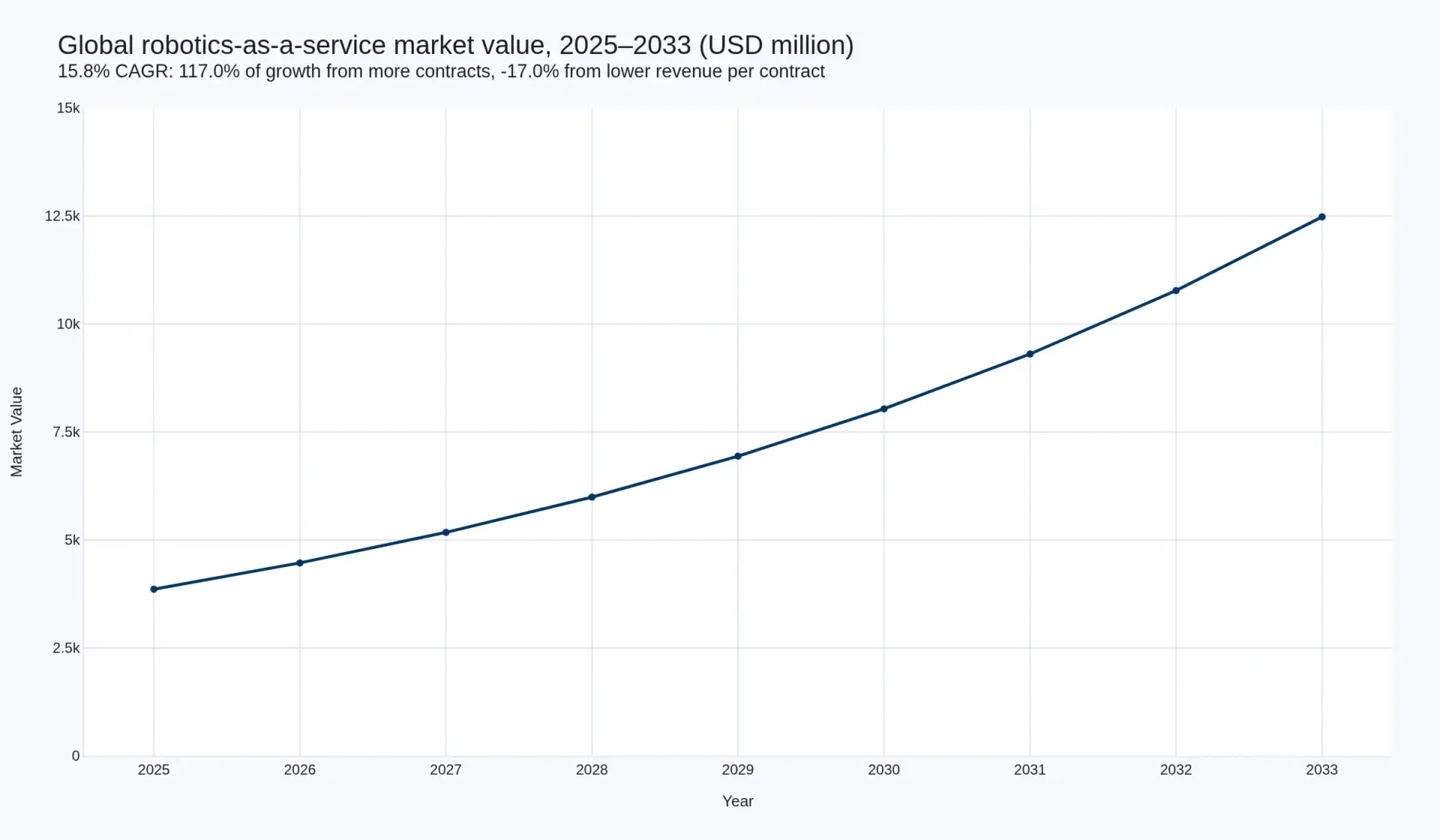
A general-purpose platform is redeployable by construction. If a bipedal or wheeled humanoid can be moved from a palletising job to a kitting job by changing software rather than tooling, then the residual-value problem that constrains this entire market largely disappears. The asset stops being a bet on one application and becomes a bet on a platform. That is why the bull case in our forecast — USD 15,386.0 million in 2033 against a base of USD 12,480.0 million — depends less on humanoids working than on humanoids being general. And it is why the early humanoid fleet will almost certainly be deployed as a service: no mid-sized customer will buy an unproven bipedal platform outright, so the provider absorbs the technical risk and sells output. If humanoids succeed, they arrive as RaaS by default rather than by strategy.
Simulation is a residual-value technology
The cost of reprogramming a robot for its next owner is the single largest lever on residual value, and it is an engineering problem with a software answer. Our Offline Robot Programming & Simulation report finds that the value in that toolchain sits with the validated virtual controller rather than with the simulator itself. In financial terms, that is the difference between a cell that takes three weeks of on-site engineering to recommission and a cell that takes three days. Every week removed raises the residual, which lowers the monthly price, which widens the addressable market.
This is why the two halves of the automation cluster belong in one conversation. The Robot End Effectors & Grippers report finds 41% of that category’s value concentrated in 4% of its units. In a purchase, that concentration is a revenue line for a tooling supplier. In a subscription, it is the provider’s largest single source of unplanned service cost — and the component that decides whether a redeployed cell needs new tooling at all.
The infrastructure the market is missing
There is no used-robot price index. There is no equivalent of a residual guide that a lender can underwrite against, which means robot receivables cannot easily be pooled, which means the asset side of this industry is funded with equity and expensive private credit. That single absence sets the cost of funds for every operator in the market at once.
The arithmetic is unforgiving. Every 100 basis points of funding cost is USD 1,050 a year on a USD 105,000 cell, or 1.0% of its price. The software annuity on the same cell is 0.91%. A provider cannot price its way out of a rate move, and it cannot hedge the residual it cannot measure.
Three things would change the market’s growth rate more than any improvement in autonomy. A credible, published residual index would let lenders price the asset. Standard mechanical and software interfaces would let a cell move between owners without a rebuild. A first securitisation of robot receivables would move the funding from equity to capital markets, where the spread is thinner and the volume is larger. None of those is a robotics problem. All three are the reason the base case is 15.8% rather than 25%.
What to watch
Four indicators would tell you early that the residual assumption is breaking. Renewal rates below 90% at any operator of scale, because customers choosing not to renew is the market’s own verdict on the asset’s second life. A drift in contract term from 48 months toward 24, which shortens the provider’s window to recover deployment cost. The first published used-robot price series. And the first securitisation of robot receivables.
Until then, treat every subscription price as a statement about the future value of a machine with no second owner. The companies that get that number right will be the ones still standing in 2033 — and they will most likely be the ones that already own a resale desk, or the ones disciplined enough to build a catalogue a stranger could use.
The companion piece to this article — on how the company that invented robot hiring moved from USD 1,300 a month to a USD 105,000 list price — is published alongside this one, and the full six-chapter analysis is in Global Robotics-as-a-Service (RaaS) Market Report, Size, Share and Forecast 2026–2033.
Frequently Asked Questions
What is residual value and why does it decide the RaaS business?
Residual value is what a robot or cell is worth when the subscription ends. A typical RaaS contract runs three to five years while the asset is engineered to last seven to ten, so the provider's margin does not come from the contract at all — it comes from redeploying the asset to a second customer. A USD 105,000 cell is usually priced on a residual of roughly a quarter of its cost; if the market clears at ten per cent instead, the provider absorbs USD 15,750 on that single cell, which is more than the entire software and service margin earned across the relationship.
Why is there no used-robot price index?
Because nobody publishes one. There is no equivalent of a residual guide for robots, so a lender cannot underwrite a robot receivable, so robot receivables are not pooled or securitised, so the asset side of the industry is funded with equity and expensive private credit. The robot manufacturers hold the closest thing to an index because they resell their own machines and see actual clearing prices; an independent provider's residual assumption is an opinion. The absence sets the cost of funds for every operator at once — every 100 basis points is USD 1,050 a year on a USD 105,000 cell, or 1.0% of its price.
How should a buyer test a provider's residual assumption before signing?
Ask five things. What residual did your monthly price assume, in writing. Who owns the asset at the end of the term and who carries the shortfall. Whether the contract is a finance lease under IFRS 16 or ASC 842, which puts a right-of-use asset back on the buyer's balance sheet and undoes the opex case. What the renewal rate is on contracts that reached term, not a general retention figure. And who signs the conformity file after 20 January 2027, when Regulation (EU) 2023/1230 makes the party placing the assembly on the market the manufacturer.