
Editorial Article
19.3 Cents of Every Fast-Food Dollar Leaves Before the Franchisee Pays a Wage
Every line in a restaurant’s profit and loss statement is a cost that can, in principle, be argued down. Food can be resourced. Labour can be scheduled. Rent can be renegotiated. The franchise royalty cannot be touched at all, because it is not calculated on any of those things — it is calculated on revenue, and revenue is the only number an operator cannot shrink without losing the store.
That is the mechanism behind the figure at the centre of the global QSR and fast food market report. McDonald’s booked USD 26.9 billion of revenue on USD 139.4 billion of systemwide sales in its most recent fiscal year — 19.3 cents of every dollar a customer hands over, retained by the brand owner before the operator has bought a single patty. Applied across a market of USD 875.6 billion in 2025, USD 169.0 billion reaches brand owners and USD 706.6 billion stays with the people running the restaurants.
The dollar, split
| Layer | 2025 value | Basis |
|---|---|---|
| Systemwide consumer spend | USD 875.6 billion | Pheonix Research market model |
| Retained by brand owners | USD 169.0 billion | 19.3% capture rate |
| Retained by restaurant operators | USD 706.6 billion | Residual after capture |
| Market, 2033 | USD 1,298.2 billion | 5.1% CAGR (exact rate 5.05%) |
| Added annual value, 2025–2033 | USD 422.6 billion | Difference of the two values |
| Capture rate source | 19.3% | McDonald’s: 26.9 ÷ 139.4 |
The 19.3 per cent is measured on one company and applied to the market as a structural capture rate. It is a good proxy for the franchised segment and a poor one for the independents, who pay no royalty at all — which is why the report treats it as a lens on the franchised layer rather than as a description of the whole industry.
A levy on revenue behaves differently from a cost
The operator’s margin is the residual of everything else. That single accounting fact makes a gross-revenue levy behave asymmetrically under inflation. If an operator runs a 5 per cent net margin and its food cost rises by one percentage point as a share of sales, roughly a fifth of its profit has gone. The brand owner’s 19.3 cents does not move.
It often moves the other way. Input inflation produces menu price increases, and the royalty is charged on the increased price — the levy is inflation-protected by construction, while the cost it is charged alongside is not. This is not a scandal, and it is not hidden; it is the design. But it does mean the market’s headline growth rate is not one fact. A 5.05 per cent year is a 5.05 per cent rise in royalty income at essentially zero incremental capital for one party, and a 5.05 per cent rise in sales — before the cost of serving them — for the other.
Which of those two parties is buying the growth is the more important question, and it is not visible in the headline rate. Of the roughly 7 per cent growth the category delivered, only 3.1 points came from stores that were already open — the breakdown of systemwide against comparable sales is set out here. The rest was bought with new steel, new leases and somebody else’s capital, and the royalty is collected on it from the first day of trading.
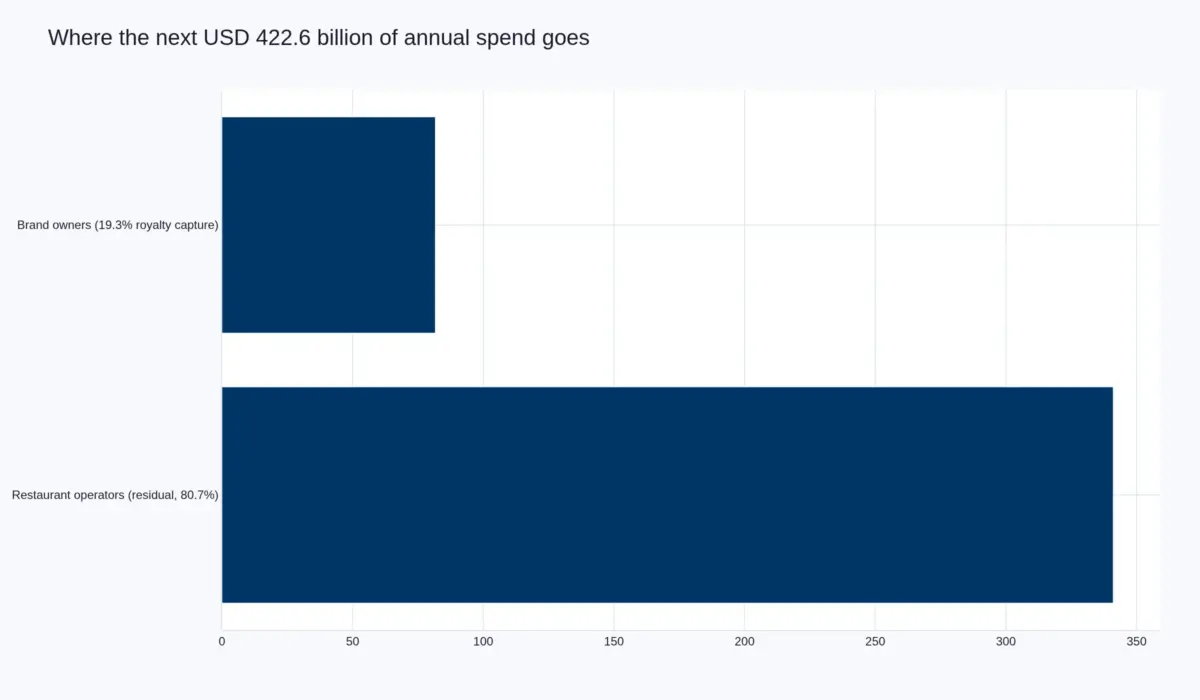
The report’s own framing follows from this. Over eight years the market adds USD 422.6 billion of annual spend. Whoever holds the royalty capture on the franchised share of that delta collects on it whether or not the individual store that generated it made money.
The cost base the brand owner does not carry
Franchising is usually described as an asset-light model, and the description is accurate but incomplete. It is more precisely an exposure-light model. Yum Brands operates roughly 61,000 units, 97 per cent of them franchised, with about 49,000 people directly employed against more than a million working in its franchise restaurants — a ratio the company itself puts at roughly 20 to 1.
| Cost line | Brand owner | Restaurant operator |
|---|---|---|
| Food, packaging and consumables | — | Borne in full |
| Crew labour | — | Borne in full; ~20× the brand’s own headcount |
| Rent, energy, equipment, refit capex | — | Borne in full |
| Royalty and advertising contribution | Received | Paid, on gross sales |
| Menu architecture, brand, standards | Borne | Executed under licence |
| Packaging and reuse obligations | Sets the specification | Buys the packaging; bears the cost |
That last row has a date attached. EU Regulation 2025/40 applies from 12 August 2026, and its packaging and reuse obligations land on the party that buys the packaging. The brand will rewrite the specification; the operator will pay for it, out of the residual.
What would actually break this argument
Three things, in order of how quickly they would show up in the data.
First, franchisee profitability disclosure. The current system is priced on brand-owner economics because brand-owner economics are the ones that get published. If a large franchisor began reporting median franchisee EBITDA alongside its own royalty income, the 19.3 per cent would stop being an abstraction and start being a negotiating position. Nothing in the current reporting cycle requires that, and the absence is itself informative.
Second, a shift in the royalty base. A royalty charged on operating profit rather than gross sales would move the entire risk allocation. No large system has done it, for the obvious reason.
Third, an independent resurgence. Independents do not carry the levy and can price below the franchised layer indefinitely. If the value of the brand’s menu architecture falls faster than the operator’s cost of complying with it, the capture rate becomes a tax on a shrinking base rather than a rent on a growing one. That is a slow failure, and it is the one worth watching.
None of this makes the franchised model a bad one. It makes it a particular one: a structure in which the party with the smallest margin carries the largest share of the cost stack, and the party with the largest margin carries the smallest. Read that way, the 19.3 cents is not a statistic about fast food. It is the price of the sign.
Sources and method. Market size, forecast and the brand-operator split are Pheonix Research estimates built from the capture rate above. The capture rate is calculated from McDonald’s reported revenue and systemwide sales in its most recent annual filing. Unit counts, franchised share and headcount ratios are from Yum Brands’ reported disclosures. The packaging compliance date is EU Regulation 2025/40, applicable from 12 August 2026. Derived figures are calculated, not asserted; where a rate is rounded in the text, the exact value is given in the table.
Primary sources. McDonald’s Corporation, Form 10-K for the year ended 31 December 2025 — systemwide sales of USD 139.4 billion against revenue of USD 26.9 billion, the 19.3 per cent capture rate used throughout. Market sizing and the 2025–2033 path are from the Pheonix Research QSR and Fast Food Market Report 2026–2033.
Frequently Asked Questions
Why is a gross-revenue royalty riskier for a franchisee than a profit-based fee?
Because the franchisee's margin is the residual of every other cost. A royalty charged on sales is fixed as a share of turnover regardless of whether the store made money, so input inflation, wage increases and packaging compliance all compress a margin the royalty does not share. A fee on operating profit would move with the franchisee, which is precisely why almost no large system uses one.
Where does the 19.3 per cent capture rate come from?
It is calculated from McDonald's reported revenue of USD 26.9 billion against systemwide sales of USD 139.4 billion in its most recent fiscal year — 26.9 divided by 139.4 equals 19.3 per cent. Pheonix Research applies it to the market as a structural capture rate for the franchised layer; independents pay no royalty, so it does not describe the whole industry.
Does the franchisor benefit from food price inflation?
Effectively yes. Input inflation typically produces menu price increases, and a royalty charged on the increased price rises with it, while the cost that triggered the increase does not fall on the franchisor at all. The royalty is inflation-protected by construction; the operator's margin is not.
What changes for franchisees on 12 August 2026?
EU Regulation 2025/40 applies from that date and its packaging and reuse obligations fall on the party that buys the packaging — the restaurant operator. The franchisor will set the specification; the franchisee pays for the transition out of the residual margin.