
Editorial Article
One Certified Cuisine Cook for Every 45.5 Japanese Restaurants
There are 3,976 people in the world certified to cook Japanese cuisine at the standard Japan recognises. There are 181,000 Japanese restaurants outside Japan. That is one certified chef for every 45.5 outlets.
The shortage is the single most important fact about this market, because everything else about it — the growth rate, the geography, the unit economics — is downstream of how the industry chose to solve it. It could not export enough cooks. So it exported the technique inside the product instead.
Two ledgers, one cuisine
| Measure | 2025 value | Growth | What it counts |
|---|---|---|---|
| Japan food exports | JPY 1,700.5 billion (USD 14.66 billion) | +12.8% | Ingredients and processed food leaving Japan |
| Global Japanese restaurant market | USD 19.61 billion | 3.99% | Consumer spend in branded Japanese restaurants |
| Exports as a share of the downstream market | 74.8% | — | Upstream supply into the format |
| Restaurant market, 2033 | USD 26.82 billion | 3.99% CAGR | Pheonix Research model |
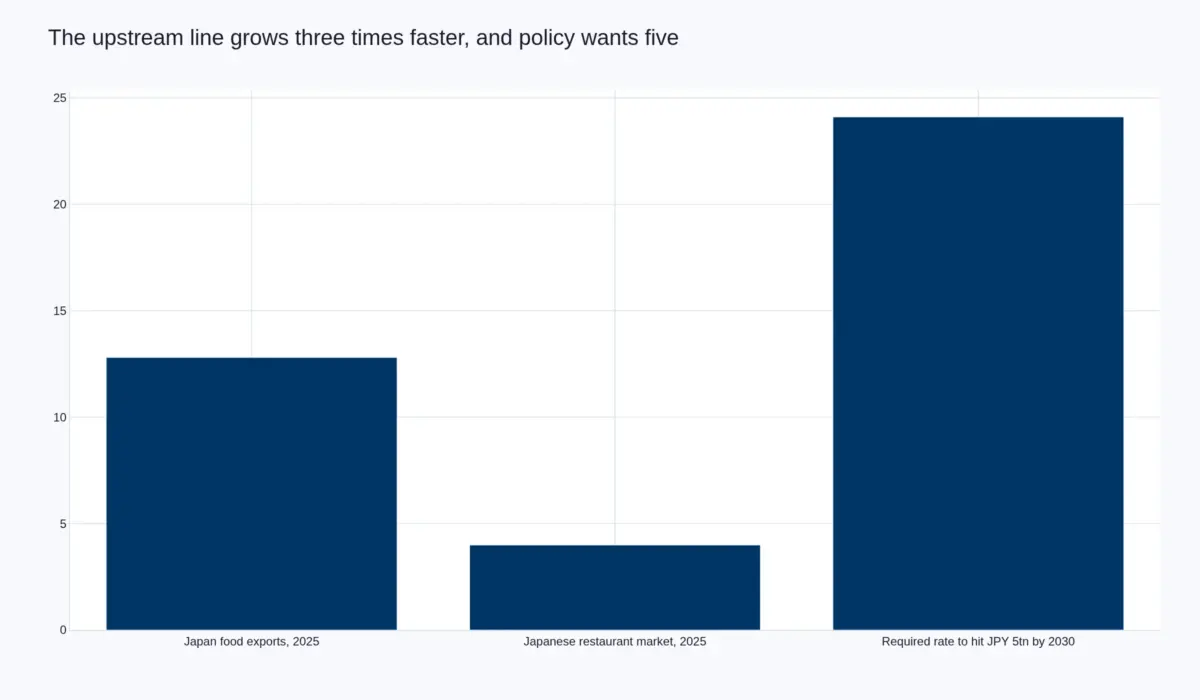
The export line has now set a record for thirteen consecutive years. It is growing at roughly three times the rate of the restaurant market it supplies, and it is already three-quarters the size of that market. Whatever the Japanese food business is, it is no longer primarily a restaurant business.
The ingredient is the visa
A cook cannot be in Jakarta and Seoul and São Paulo at once. A specification can. Once a cuisine is codified into stocks, sauces, seasonings and frozen components that carry the profile rather than merely approximating it, the constraint stops being labour and starts being logistics — and logistics scales, at 12.8 per cent a year.
This is why the export line kept growing through the year in which one import market closed its border to Japanese seafood and 15,260 Japanese restaurants in that country shut. The ingredient trade is diversified in a way the restaurant estate is not. A shipment can be redirected to a different port in weeks. A restaurant cannot be redirected to a different country at all.
The restaurant estate did rotate rather than simply disappear — every region outside China and Europe added Japanese restaurants over the same two years, 9,260 of them outside China. But rotation is a slower and far more expensive way to move capacity than a redirected shipment, which is precisely the argument for holding the specification upstream.
Where the margin goes when the supplier grows three times faster
This is the part operators tend to miss. If a restaurant market compounds at 3.99 per cent while its input base compounds at 12.8 per cent, the input base is capturing share of the final consumer value — unless the restaurant raises its menu prices faster than its ingredient costs rise, which is a different business than the one most operators think they are in.
The mechanism is the same one that governs the franchise royalty in the QSR market: whoever supplies a specification that the operator cannot produce in-house holds pricing power over the residual. A ramen shop that buys its tare and its stock instead of making them has outsourced the one part of the product that made it a ramen shop. That is a rational trade against a labour shortage, and it is a permanent transfer of margin.
The certified-chef number is the measurement of how little choice there was. At one certified cook for every 45.5 outlets, in-house production at scale is not merely difficult. It is arithmetically impossible.
The 2030 target tells you where policy attention is pointed
Japan’s stated ambition is JPY 5 trillion of food exports by 2030, from a 2025 base of JPY 1,700.5 billion. That requires 24.1 per cent compound growth every year for five years — five times the rate the country just achieved in a record year.
A target that large is not a forecast. It is a statement that the current mix is considered insufficient, which is why agricultural policy has moved toward processed and value-added goods, certification and export infrastructure rather than toward opening more restaurants abroad. A kilogram of raw fish leaves the country at one price. The same fish as a certified, branded, shelf-stable component leaves at another. The gap between those two prices is where a 24 per cent growth rate would have to come from.
What this means for the restaurant operator
Three practical implications follow, and none of them require a view on demand.
Specification is the moat and the risk. If the product is the ingredient, then the supplier holds the position the operator used to hold. Owning the specification — even if not manufacturing it — is the only way to keep it.
Geography should follow the supply line, not the diaspora. The markets adding outlets fastest are the ones least dependent on Japanese-origin inputs. That is not a coincidence; it is what makes them able to grow.
The format’s growth rate is not a demand forecast. A 3.99 per cent market growing on 2 per cent unit growth and 2 per cent average volume growth is a mature market delivering a mature return. The expansion in this cuisine’s economics is happening one step upstream, at 12.8 per cent, and it is being booked by somebody else.
Sources and method. Food export values are Japan’s Ministry of Agriculture, Forestry and Fisheries trade statistics for 2025: JPY 1,700.5 billion, up 12.8 per cent, a thirteenth consecutive annual record; the USD 14.66 billion conversion is at the reported rate. The 2030 target of JPY 5 trillion and the 24.1 per cent required growth rate are calculated from that base over five years. Certified cuisine cook numbers are from the government’s certified cuisine professional register. Restaurant market value, unit counts and average unit volumes are the Pheonix Research model for the global Japanese restaurant market. The margin-transfer argument is analytical, not a disclosed figure.
Primary sources. Ministry of Agriculture, Forestry and Fisheries, Japan: 2025 agricultural, forestry and fishery exports — JPY 1,700.5 billion, up 12.8 per cent, the thirteenth consecutive record — and the 2025 overseas Japanese restaurant count for the 181,000-estate denominator. The JPY 5 trillion 2030 target and the 24.1 per cent rate it implies are calculated from those two figures.
Frequently Asked Questions
What does the 3,976-certified-chef figure mean for the market?
It stands for the scarcity that determined the industry's strategy. In-house production of stocks, sauces and seasonings at scale requires cooks the market does not have, so the technique was codified into processed and semi-processed ingredients that carry the flavour profile. The export line has grown 12.8 per cent a year partly because of that substitution, not despite it.
How large are Japan's food exports and how fast are they growing?
JPY 1,700.5 billion, or about USD 14.66 billion, up 12.8 per cent in 2025 — a thirteenth consecutive annual record. It is now equivalent to 74.8 per cent of the downstream Japanese restaurant market, and growing at roughly three times that market's 3.99 per cent rate.
What would it take to reach JPY 5 trillion of food exports by 2030?
It requires 24.1 per cent compound growth annually for five years from the 2025 base of JPY 1,700.5 billion — five times the rate achieved in a record year. That is why policy has shifted toward processed and value-added goods and certification rather than toward opening more restaurants abroad.
Why does a faster-growing supplier base matter to restaurant margins?
Because the input base is compounding at 12.8 per cent while the restaurants it supplies compound at 3.99 per cent. Unless menu prices rise faster than ingredient costs, value migrates upstream to whoever supplies a specification the operator cannot produce in-house. The labour shortage removed the option of producing it in-house.