
Editorial Article
A 10.38 Per Cent Grower Inside a 7.72 Per Cent Industry Adds 5.7 Per Cent of the Growth
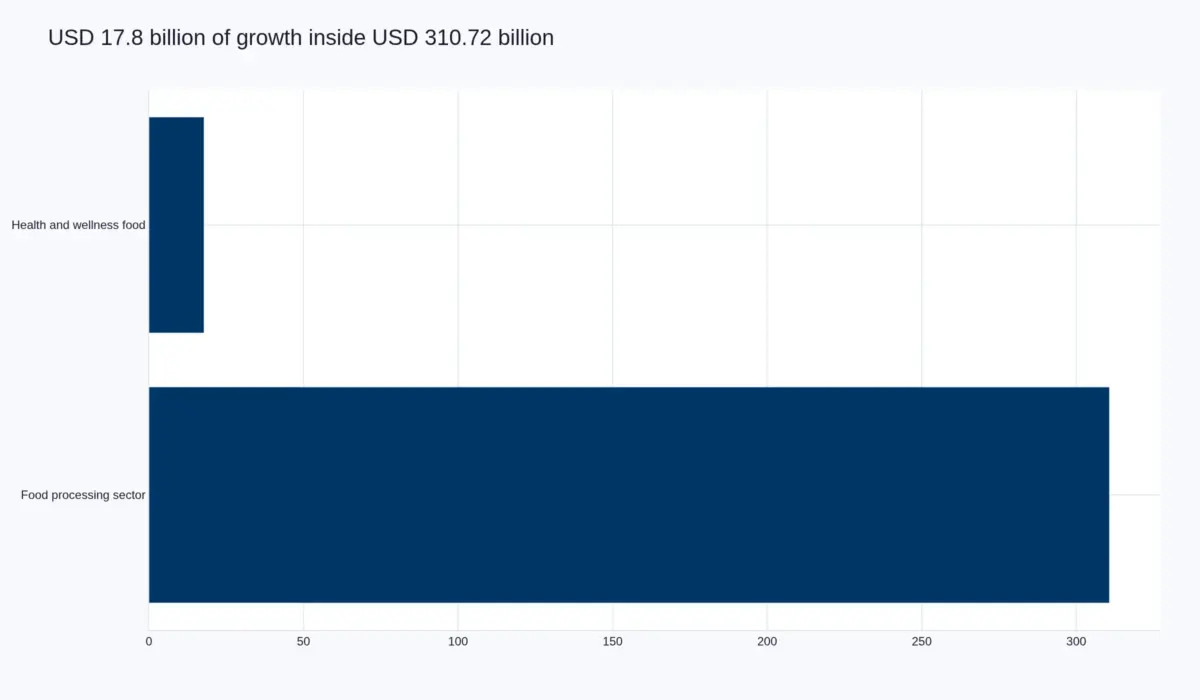
A market growing at 10.38 per cent inside an industry growing at 7.72 per cent sounds like the fast lane. Run the absolute numbers and the picture inverts: the fast-growing category contributes 5.7 per cent of the industry’s incremental value over the forecast period.
That is not an argument against the category. It is an argument about where its value actually comes from, which is the substantiated claim on the pack rather than the volume of food in it: USD 10.21 a person a year buys two or three products, once each, and the premium is charged for the reason printed on the front.
India’s health and wellness food market adds USD 17.8 billion of annual value between 2025 and 2033. The food processing sector it sits inside adds USD 310.72 billion over the same span. The category grows 2.66 percentage points faster every year and still supplies barely one rupee in eighteen of the industry’s growth.
The share arithmetic, done properly
| Measure | FY25 | FY33 | Change |
|---|---|---|---|
| Food processing sector | USD 382.24 bn | USD 692.96 bn | +USD 310.72 bn at 7.72% |
| Health and wellness food | USD 14.8 bn | USD 32.6 bn | +USD 17.8 bn at 10.38% |
| Share of the sector | 3.87% | 4.70% | +0.83 points |
| Contribution to sector growth | 5.7% | 17.8 ÷ 310.72 | |
Eight years of outgrowing the host by a third, and the share moves by less than one percentage point. This is not a failure of the category. It is what happens when a small number grows quickly inside a large number growing steadily: the base decides the direction, not the rate.
Any presentation of this market that leads with 10.38 per cent and omits the 310.72 billion is describing the numerator and hiding the denominator.
Why the denominator is the more interesting number
The food processing sector’s 7.72 per cent is not a wellness story at all. It is a processing story. India has moved processed food from 13.70 per cent to 20.40 per cent of agricultural exports in a decade, and the sector’s expansion is driven by the mechanics of feeding a large urban population from a long supply chain: cold storage, formalised retail, packaging, shelf life.
Every one of those forces expands the shelf on which a health-positioned product can sit. That is the channel through which wellness grows — not by persuading people to eat differently, but by putting more packaged food in front of more people and letting one product in twenty-five carry a claim.
Which reframes the whole opportunity. The category does not need consumers to change their beliefs. It needs the processing transition to continue, because every increment of that transition is a new surface area for a claim.
What 4.70 per cent means strategically
A 4.70 per cent share after eight years of double-digit growth is the definition of a structurally marginal category, and marginality has consequences that a growth rate conceals.
It has no pricing power over its host. A category at 4.70 per cent cannot move input costs for the sector, cannot set the terms of retail access, and cannot discipline the commodity producers who supply it. It takes prices from the industry that surrounds it.
It is a marketing line before it is a supply chain. The value is created in the substantiated claim discussed in the companion piece, and claims can be copied faster than factories can be built. The barrier is regulatory, not industrial, and regulatory barriers move when policy moves.
Its growth is a residual of somebody else’s investment. The cold chain, the modern retail footprint and the packaging base that make the category possible are all funded by the processing transition, not by the wellness premium. The category is, in the precise sense, a free rider on 7.72 per cent and pays for it with share that never quite arrives.
The other way to read the same numbers
There is a legitimate bullish reading, and it does not depend on the share at all. A category adding USD 17.8 billion of annual value in eight years is a category that will have roughly doubled. If the claim-based premium is durable — and the 2016 regulatory architecture has survived long enough to look durable — then doubling at a fixed share is a perfectly good outcome for the businesses inside it.
The error to avoid is not optimism. It is presenting the growth rate as though it described the industry. A 10.38 per cent category inside a 7.72 per cent sector is a good business and a small one, and both facts have to survive contact with the same paragraph.
What would move the share rather than the rate
Only two things can. A legal definition of “healthy” would either shrink the category to products that meet a threshold or expand it to include commodity foods that could now be labelled — the second would move the 4.70 per cent materially and compress the premium while doing it. Or a step-change in the processing transition: if processed food’s share of the food economy rose as fast in the next decade as its share of agricultural exports did in the last one, the shelf would grow faster than any category on it.
Neither is in the forecast. The forecast says 4.70 per cent, and 4.70 per cent is the number that should travel with the 10.38.
Sources and method. Market values and the food processing sector base are the Pheonix Research model for the India health and wellness food market. The sector’s FY33 terminal of USD 692.96 billion is calculated by compounding the FY25 base of USD 382.24 billion at 7.72 per cent over eight years; the category’s USD 32.6 billion terminal at 10.38 per cent. Absolute changes, the 5.7 per cent contribution to sector growth and the share figures are calculated from those values. Processed food’s share of agricultural exports — 20.40 per cent against 13.70 per cent a decade earlier — is from Indian government statistics. The framing of the category as a free rider on the processing transition is analytical.
Primary sources. India Brand Equity Foundation, Food Processing Industry in India — the USD 382.24 billion FY25 sector base and the growth path to USD 692.96 billion by FY33. Category size and forecast are from the Pheonix Research India Health and Wellness Food Market Report 2026–2033; the 5.7 per cent contribution is calculated from those two paths.
Frequently Asked Questions
How much absolute value does the health food category add?
USD 17.8 billion, from USD 14.8 billion in 2025 to USD 32.6 billion by 2033. Over the same period the food processing sector adds USD 310.72 billion, from USD 382.24 billion to USD 692.96 billion, so the category supplies about 5.7 per cent of the industry's incremental value.
How much does the category's share of food processing change?
From 3.87 per cent in FY25 to 4.70 per cent by 2033 — 0.83 of a percentage point. A small number growing at 10.38 per cent inside a large number growing at 7.72 per cent moves share slowly, because the base decides direction and only the margin moves the ratio.
Why is the sector growth rate more important than the category growth rate?
Because the denominator is a processing story: processed food rose from 13.70 to 20.40 per cent of India's agricultural exports in a decade, driven by cold chain, formalised retail and packaging. That expansion puts more packaged food on more shelves, and every increment of it creates new surface area for a substantiated claim.
What does a 4.70 per cent share imply strategically?
No pricing power over its host, a narrow base of products carrying the claim, and dependence on cold chain and retail investment funded by the processing transition rather than by the wellness premium itself. In that sense the category is a free rider on 7.72 per cent growth.