
Global Collagen Market Report, Size, Share and Forecast 2026–2033
Market Forecast Snapshot (2025???2033)
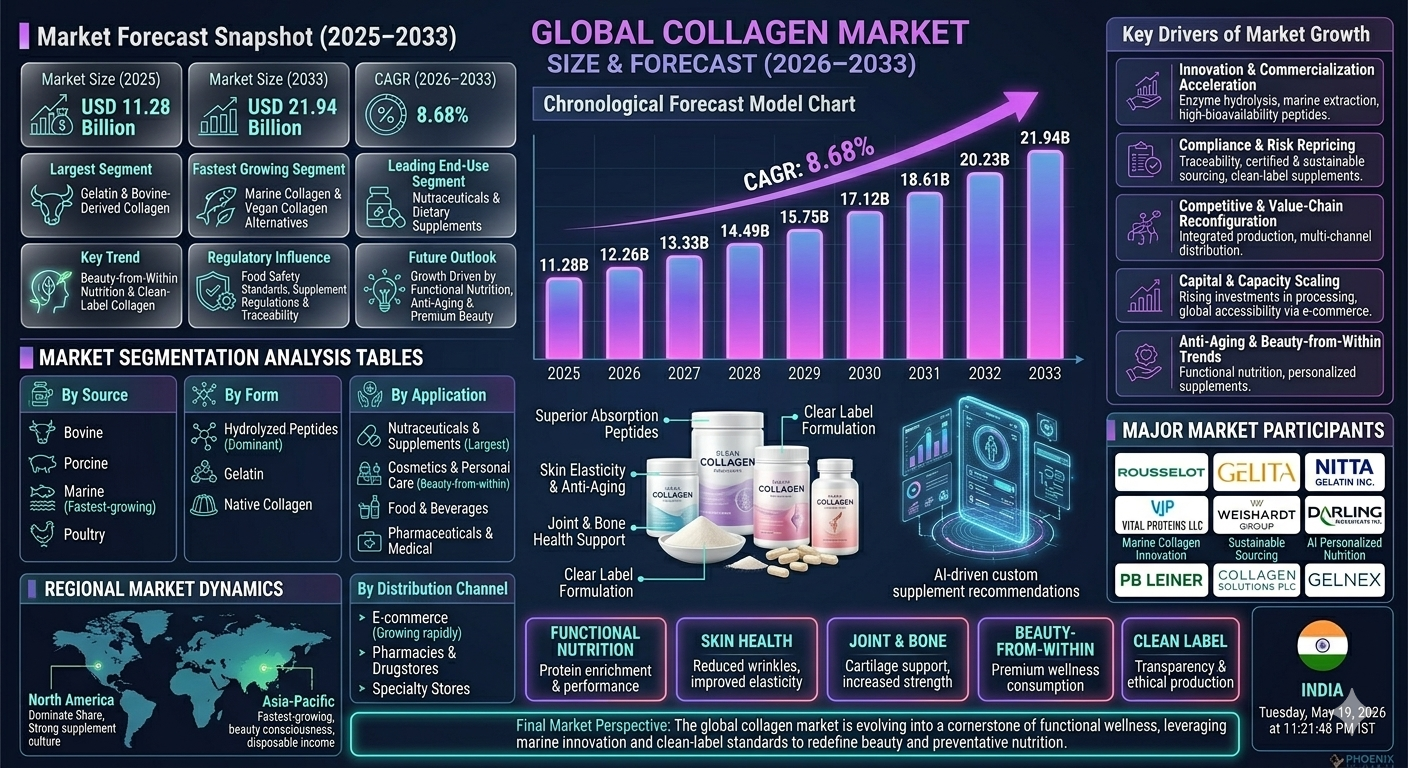
| Metric | Value |
|---|---|
| Market Size (2025) | USD 11.28 Billion |
| Market Size (2033) | USD 21.94 Billion |
| CAGR (2026???2033) | 8.68% |
| Largest Segment | Gelatin & Bovine-Derived Collagen |
| Fastest Growing Segment | Marine Collagen & Vegan Collagen Alternatives |
| Leading End-Use Segment | Nutraceuticals & Dietary Supplements |
| Key Trend | Beauty-from-Within Nutrition & Clean-Label Collagen Products |
| Regulatory Influence | Food Safety Standards, Health Supplement Regulations & Source Traceability Requirements |
| Future Outlook | Growth Driven by Functional Nutrition, Anti-Aging Demand & Premium Beauty Supplements |
Global Collagen Market
Market Size & Forecast
The Global Collagen Market is expected to witness strong growth during the forecast period from 2026 to 2033. The market was valued at USD 11.28 billion in 2025 and is projected to reach approximately USD 21.94 billion by 2033, registering a CAGR of 8.68%. The market growth is primarily driven by rising demand for dietary supplements, increasing awareness of skin health and anti-aging solutions, and expanding applications in food, pharmaceuticals, and cosmetics industries. Collagen is widely used for improving skin elasticity, joint health, bone strength, and overall wellness. Rising consumer preference for functional nutrition, protein-rich diets, and preventive healthcare is accelerating market expansion. In addition, growing adoption of marine collagen, clean-label supplements, and personalized nutrition products is supporting long-term market development.Global Collagen Market Overview
Collagen is a structural protein derived from animal or marine sources and widely used in food, beverages, pharmaceuticals, cosmetics, and medical applications. The market includes gelatin, hydrolyzed collagen peptides, native collagen, marine collagen, and plant-based collagen-boosting alternatives. Collagen products are widely utilized across nutraceutical supplements, skincare formulations, functional foods, sports nutrition, and orthopedic treatments. The market is shifting from traditional gelatin-based products toward hydrolyzed collagen peptides, marine-derived sources, and vegan collagen-stimulating formulations.Structural Drivers of Market Growth
1. Innovation and Commercialization Acceleration
Rapid innovation in enzymatic hydrolysis, marine extraction technologies, and bioavailable collagen peptides is accelerating product effectiveness and absorption efficiency. Advanced formulation techniques are improving functional benefits in skin, joint, and bone health applications.Market Implications
Companies investing in marine collagen innovation, clean-label formulations, and high-bioavailability products are expected to strengthen market positioning.2. Compliance and Risk Repricing
Food safety regulations, sourcing transparency requirements, halal and kosher certifications, and supplement quality standards are influencing market modernization. Consumers are increasingly demanding traceable and ethically sourced collagen products.Market Implications
Firms offering certified, transparent, and sustainably sourced collagen ingredients are likely to gain stronger consumer trust.3. Competitive and Value-Chain Reconfiguration
The market is highly competitive as nutraceutical companies, cosmetic brands, pharmaceutical manufacturers, and ingredient suppliers expand collagen-based product portfolios. Vertical integration from raw material sourcing to finished supplement production is reshaping value-chain dynamics.Market Implications
Companies focusing on integrated production, premium branding, and multi-channel distribution may gain stronger margins.4. Capital and Capacity Scaling
Rising investments in collagen extraction facilities, marine processing plants, and nutraceutical manufacturing infrastructure are supporting market expansion. Growth in e-commerce supplement sales is also increasing global accessibility.Market Implications
Operators scaling production efficiency and global distribution networks are expected to capture future opportunities.Market Segmentation Analysis
By Source
1. Bovine Collagen
Largest segment due to wide availability and cost efficiency.2. Porcine Collagen
Widely used in pharmaceutical and medical applications.3. Marine Collagen
Fastest-growing segment due to high bioavailability and beauty-focused applications.4. Poultry Collagen
Used in joint health supplements and functional nutrition.By Form
1. Hydrolyzed Collagen (Collagen Peptides)
Most widely used due to easy absorption and versatility.2. Gelatin
Used in food processing and confectionery products.3. Native Collagen
Used in medical and specialized applications.By Application
1. Nutraceuticals & Dietary Supplements
Largest segment due to strong demand for wellness and anti-aging products.2. Cosmetics & Personal Care
Strong growth driven by skincare and beauty-from-within trends.3. Food & Beverages
Used in functional foods and protein enrichment.4. Pharmaceuticals & Medical
Used in wound healing, tissue regeneration, and orthopedic treatments.Regional Market Dynamics
North America
North America dominates the collagen market due to strong supplement consumption, fitness trends, and advanced nutraceutical industries.Europe
Europe remains a major market driven by clean-label demand and regulatory compliance for health supplements.Asia-Pacific
Asia-Pacific is the fastest-growing region due to rising disposable income, beauty consciousness, and expanding functional food demand.Latin America
Latin America is gradually expanding with growing health awareness and supplement adoption.Middle East & Africa
The region is witnessing emerging growth driven by premium wellness product adoption.Competitive Landscape
The Global Collagen Market is highly competitive with nutraceutical companies, ingredient manufacturers, and cosmetic brands expanding globally.Key Companies Operating in the Market Include:
- Rousselot
- Gelita AG
- Nitta Gelatin Inc.
- Vital Proteins LLC
- Weishardt Group
- Amicogen Inc.
- PB Leiner
- Darling Ingredients Inc.
- Collagen Solutions PLC
- Gelnex
Strategic Outlook
The future of the collagen market will be shaped by marine collagen innovation, personalized nutrition, clean-label product development, and expanding beauty-from-within applications. Advanced bioengineering, sustainable sourcing, and high-absorption peptide formulations will significantly improve product performance. The rise of preventive healthcare, functional nutrition, and premium wellness consumption is expected to create strong long-term growth opportunities.Final Market Perspective
The Global Collagen Market remains a key segment within the nutraceutical, cosmetic, and functional food industries. Rising demand for anti-aging solutions, joint health support, and beauty nutrition continues driving long-term market growth. Companies capable of delivering scalable, scientifically backed, clean-label, and high-quality collagen solutions will be best positioned to capture future opportunities. The convergence of wellness trends, marine innovation, and personalized nutrition is expected to redefine the future of the global collagen industry.Table of Contents
Table of Contents
- 1. Executive Summary
- 1.1 Global Collagen Market Snapshot (2026???2033)
- 1.2 Market Size & CAGR Analysis
- 1.3 Largest & Fastest-Growing Segments
- 1.4 Key Regional Insights
- 1.5 Major Market Growth Drivers
- 1.6 Competitive Landscape Overview
- 1.7 Strategic Outlook Through 2033
- 2. Introduction & Market Overview
- 2.1 Definition of Collagen
- 2.2 Scope of the Study
- 2.3 Evolution of Collagen-Based Products
- 2.4 Nutraceutical & Functional Ingredient Ecosystem
- 2.5 Regulatory & Quality Compliance Framework
- 2.6 Beauty-from-Within & Wellness Trends
- 2.7 Product Innovation Landscape
- 3. Research Methodology
- 3.1 Primary Research
- 3.2 Secondary Research
- 3.3 Market Size Estimation Model
- 3.4 Forecast Assumptions (2026???2033)
- 3.5 Data Validation & Market Triangulation
- 4. Market Dynamics
- 4.1 Drivers
- 4.1.1 Rising Demand for Nutraceuticals & Supplements
- 4.1.2 Increasing Anti-Aging Awareness
- 4.1.3 Growth in Functional Nutrition Consumption
- 4.1.4 Expansion of Marine Collagen Adoption
- 4.1.5 Rising Preventive Healthcare Trends
- 4.2 Restraints
- 4.2.1 High Cost of Marine Collagen Production
- 4.2.2 Raw Material Supply Constraints
- 4.2.3 Regulatory Complexity Across Regions
- 4.2.4 Ethical and Sourcing Concerns
- 4.3 Opportunities
- 4.3.1 Plant-Based Collagen Alternatives
- 4.3.2 Personalized Nutrition Solutions
- 4.3.3 Clean-Label Product Innovation
- 4.3.4 Expansion into Emerging Markets
- 4.4 Challenges
- 4.4.1 Bioavailability Optimization
- 4.4.2 Consumer Trust & Transparency Issues
- 4.4.3 Competitive Ingredient Substitution
- 4.4.4 Product Differentiation Pressure
- 4.1 Drivers
- 5. Global Collagen Market Analysis (USD Billion), 2026???2033
- 5.1 Market Size Overview
- 5.2 CAGR Analysis
- 5.3 Regional Revenue Distribution
- 5.4 Product Innovation Trends
- 5.5 Application Demand Analysis
- 5.6 Future Growth Projections
- 6. Market Segmentation (USD Billion), 2026???2033
- 6.1 By Source
- 6.1.1 Bovine Collagen
- 6.1.2 Porcine Collagen
- 6.1.3 Marine Collagen
- 6.1.4 Poultry Collagen
- 6.2 By Form
- 6.2.1 Hydrolyzed Collagen (Collagen Peptides)
- 6.2.2 Gelatin
- 6.2.3 Native Collagen
- 6.3 By Application
- 6.3.1 Nutraceuticals & Dietary Supplements
- 6.3.2 Cosmetics & Personal Care
- 6.3.3 Food & Beverages
- 6.3.4 Pharmaceuticals & Medical
- 6.1 By Source
- 7. Market Segmentation by Geography
- 7.1 North America
- 7.2 Europe
- 7.3 Asia-Pacific
- 7.4 Latin America
- 7.5 Middle East & Africa
- 8. Competitive Landscape
- 8.1 Market Share Analysis
- 8.2 Product Innovation Benchmarking
- 8.3 Strategic Partnerships & Collaborations
- 8.4 Vertical Integration Analysis
- 8.5 Brand Positioning Strategies
- 9. Company Profiles
- 9.1 Rousselot
- 9.2 Gelita AG
- 9.3 Nitta Gelatin Inc.
- 9.4 Vital Proteins LLC
- 9.5 Weishardt Group
- 9.6 Amicogen Inc.
- 9.7 PB Leiner
- 9.8 Darling Ingredients Inc.
- 9.9 Collagen Solutions PLC
- 9.10 Gelnex
- 10. Strategic Intelligence & Pheonix AI Insights
- 10.1 Nutraceutical Demand Forecast Engine
- 10.2 Beauty-from-Within Analytics Dashboard
- 10.3 Ingredient Innovation Tracker
- 10.4 Consumer Preference Opportunity Analyzer
- 10.5 Automated Porter???s Five Forces Analysis
- 11. Future Outlook & Strategic Recommendations
- 11.1 Investment in Marine Collagen Innovation
- 11.2 Expansion of Clean-Label Product Portfolios
- 11.3 Strengthening Sustainable Sourcing Practices
- 11.4 Development of Personalized Nutrition Platforms
- 11.5 Long-Term Market Outlook (2033+)
- 12. Appendix
- 13. About Pheonix Research
- 14. Disclaimer
Competitive Landscape
Global Collagen Market Competitive Intensity & Market Structure Overview
The global collagen market is highly competitive and moderately consolidated, characterized by the strong presence of multinational ingredient manufacturers, nutraceutical companies, pharmaceutical suppliers, and cosmetic brands. Competitive intensity is driven by raw material sourcing efficiency, marine and bovine supply chain integration, bioavailability innovation, clean-label positioning, and regulatory compliance across food, pharmaceutical, and cosmetic applications.
The market structure includes established global gelatin and collagen peptide manufacturers with vertically integrated operations alongside specialized nutraceutical and beauty-focused brands offering premium collagen-based supplements. Competition is increasingly influenced by marine collagen innovation, hydrolyzed peptide technology, sustainable sourcing practices, and clinically validated functional benefits.
Rising demand for anti-aging solutions, functional nutrition, beauty-from-within products, and joint health supplements is significantly intensifying competition across the global collagen market.
Global Collagen Market Competitive Intensity & Market Structure Current Scenario
Leading Global Collagen Companies
Rousselot: One of the largest global collagen and gelatin producers, known for high-quality pharmaceutical and nutraceutical-grade collagen ingredients.
Gelita AG: Major collagen peptide manufacturer specializing in bioactive collagen solutions for nutrition, health, and medical applications.
Nitta Gelatin Inc.: Leading Japanese company offering gelatin and collagen products for food, pharmaceutical, and cosmetic industries.
Vital Proteins LLC: Prominent consumer-facing brand focused on collagen supplements and beauty-from-within nutrition products.
Weishardt Group: Established collagen and gelatin producer with strong expertise in bovine and marine collagen solutions.
Amicogen Inc.: Biotechnology-driven company focusing on advanced collagen peptides and functional bioactive ingredients.
PB Leiner: Global gelatin and collagen manufacturer offering diversified solutions for food, health, and pharmaceutical markets.
Darling Ingredients Inc.: Major player in sustainable collagen sourcing and ingredient production through animal by-product utilization.
Collagen Solutions PLC: Specialized provider of medical-grade collagen for regenerative medicine and biomedical applications.
Gelnex: Growing global supplier of gelatin and collagen products with strong presence in nutraceutical and food industries.
Key Competitive Intensity & Market Structure Drivers
Rising demand for marine collagen and vegan collagen alternatives is intensifying innovation and product differentiation across the industry.
Increasing consumer preference for clean-label, traceable, and sustainably sourced collagen products is reshaping sourcing and production strategies.
Expanding applications in nutraceuticals, cosmetics, functional foods, and pharmaceuticals are driving cross-industry competition.
Advancements in enzymatic hydrolysis and peptide engineering are enhancing product bioavailability and functional performance.
Growing e-commerce penetration and direct-to-consumer supplement brands are increasing competitive pressure on traditional ingredient suppliers.
Strategic Implications of Competitive Intensity & Market Structure
Companies are increasingly investing in marine collagen extraction technologies and alternative protein innovation to meet evolving consumer preferences.
Vertical integration across raw material sourcing, processing, and branded supplement manufacturing is becoming a key competitive advantage.
Clinical validation and scientific research-backed claims are strengthening product differentiation and consumer trust.
Strategic partnerships between ingredient manufacturers and nutraceutical brands are enhancing global market reach and distribution efficiency.
Sustainability initiatives, including ethical sourcing and waste utilization, are becoming central to long-term brand positioning.
Global Collagen Market Competitive Intensity & Market Structure Forward Outlook
The global collagen market is expected to remain highly competitive as demand for functional nutrition, anti-aging solutions, and premium wellness products continues to expand.
Future competition will increasingly focus on marine collagen innovation, plant-based collagen alternatives, precision nutrition formulations, and advanced peptide bioengineering technologies.
North America and Europe will continue to lead in premium product innovation, while Asia-Pacific is expected to drive volume growth and manufacturing expansion.
Advancements in sustainable sourcing, personalized nutrition, and bioactive ingredient development are expected to significantly reshape market dynamics.
Overall, companies that successfully combine scientific innovation, supply chain integration, sustainability, and strong brand positioning will remain strongly positioned in the evolving global collagen market.
Value Chain
Global Collagen Market Value Chain & Supply Chain Evolution Overview
The Global Collagen Market value chain is evolving from traditional animal by-product utilization systems into a highly refined, science-driven, and premium nutraceutical ecosystem. This transformation is being driven by rising demand for functional nutrition, beauty-from-within products, anti-aging supplements, and clean-label health solutions across global consumer markets.
The collagen value chain is becoming increasingly sophisticated, integrating biotechnology, advanced extraction processes, marine sourcing innovation, and strict quality traceability systems. Manufacturers are focusing on improving bioavailability, purity, and functional performance of collagen ingredients to meet expanding applications in nutraceuticals, cosmetics, pharmaceuticals, and functional foods.
The upstream segment begins with raw material sourcing, primarily from bovine, porcine, poultry, and marine origins. Animal hides, bones, fish skin, and scales serve as key inputs for collagen extraction. Increasing demand for marine and sustainable sources is reshaping sourcing strategies globally.
The core processing stage involves collagen extraction, enzymatic hydrolysis, purification, filtration, and peptide formulation. Advanced biotechnological processes are improving molecular weight control, absorption efficiency, and product consistency. High-purity collagen peptides and hydrolyzed collagen forms are increasingly replacing traditional gelatin-based products.
The downstream segment includes formulation, blending, packaging, and distribution across nutraceutical supplements, functional foods, skincare products, and pharmaceutical applications. Strong growth in e-commerce and direct-to-consumer wellness brands is accelerating global market accessibility.
Overall, the collagen value chain is transitioning into a high-value, science-led, and consumer-driven ecosystem where purity, traceability, bioavailability, and sustainability define competitive advantage.
Global Collagen Market Value Chain & Supply Chain Evolution Current Scenario
The current collagen market structure reflects a dual ecosystem combining traditional gelatin production systems with rapidly expanding hydrolyzed collagen peptide and marine collagen manufacturing platforms.
Bovine-derived collagen remains the dominant raw material source due to cost efficiency and large-scale availability, while marine collagen is gaining rapid traction due to its superior bioavailability and strong association with beauty and skincare benefits.
Manufacturing processes are increasingly adopting enzymatic hydrolysis, advanced filtration technologies, and quality standardization systems to meet pharmaceutical-grade and nutraceutical-grade requirements.
Distribution channels are shifting toward digital-first models, with e-commerce platforms, wellness brands, and direct-to-consumer supplement companies driving significant market growth.
Regulatory compliance, including food safety standards, halal/kosher certifications, and source traceability requirements, is playing a critical role in shaping product development and global trade flows.
Key Value Chain & Supply Chain Evolution Signals in Global Collagen Market
Marine collagen expansion is a major structural shift, driven by consumer preference for sustainable, high-absorption, and beauty-focused protein supplements.
Clean-label formulation demand is increasing pressure on manufacturers to eliminate additives, artificial processing agents, and non-traceable ingredients.
Bioavailability innovation is enhancing product effectiveness through advanced peptide engineering and enzymatic hydrolysis techniques.
Vertical integration strategies are being adopted by companies seeking control over raw material sourcing, extraction, and finished product formulation.
E-commerce-driven distribution is accelerating global accessibility of collagen supplements, particularly in beauty and wellness segments.
Strategic Implications of Value Chain & Supply Chain Evolution in Global Collagen Market
The evolving collagen value chain presents strong strategic opportunities for ingredient manufacturers, nutraceutical brands, cosmetic companies, and biotechnology firms.
Competitive advantage is increasingly determined by sourcing transparency, product purity, scientific validation, bioavailability performance, and premium brand positioning.
Companies investing in marine collagen innovation, clean-label formulations, and advanced peptide technologies are expected to gain stronger market leadership.
Strategic partnerships between collagen producers, cosmetic brands, pharmaceutical companies, and wellness platforms are becoming increasingly important for global expansion.
Organizations capable of balancing scientific innovation, regulatory compliance, sustainability sourcing, and consumer-focused branding will achieve stronger long-term positioning.
Global Collagen Market Value Chain & Supply Chain Evolution Forward Outlook
Between 2026 and 2033, the collagen value chain is expected to evolve into a highly advanced, biotechnology-driven, and personalized nutrition ecosystem.
Marine-based collagen extraction technologies and sustainable sourcing systems will continue to expand, reducing dependency on traditional animal-derived inputs.
AI-driven formulation systems and personalized nutrition platforms will enable customized collagen products tailored to skin health, joint support, and anti-aging requirements.
Advanced bioengineering techniques will improve peptide absorption efficiency and functional performance across applications.
Traceability systems using blockchain and digital supply chain tracking will enhance transparency and consumer trust in sourcing practices.
Ultimately, the future collagen value chain will be defined by biotechnology innovation, clean-label transparency, sustainability integration, and personalized wellness solutions.
Market-Specific Value Chain
- Raw Material Sourcing: Bovine hides, porcine skin, poultry by-products, marine fish skin and scales
- Extraction & Processing: Collagen extraction plants, enzymatic hydrolysis facilities, filtration and purification systems
- Ingredient Manufacturing: Hydrolyzed collagen peptide producers, gelatin manufacturers, marine collagen processors
- Product Formulation: Nutraceutical brands, cosmetic formulation companies, functional food developers
- Packaging & Branding: Supplement packaging firms, wellness brand developers, private label manufacturers
- Distribution Channels: E-commerce platforms, pharmacies, health stores, cosmetic retail networks
- End-Use Applications: Nutraceuticals, cosmetics, functional foods, pharmaceuticals, sports nutrition products
Investment Activity
Global Collagen Market Investment & Funding Dynamics Overview
The Global Collagen Market is witnessing strong investment momentum driven by rising demand for functional nutrition, anti-aging solutions, beauty-from-within supplements, and expanding applications across nutraceutical, cosmetic, and pharmaceutical industries. Ingredient manufacturers, nutraceutical brands, cosmetic companies, and biotech firms are actively investing in marine collagen production, hydrolyzed collagen peptide technologies, clean-label formulation systems, and advanced extraction and processing infrastructure.
Investment activity is accelerating due to growing consumer preference for high-bioavailability supplements, protein-enriched functional foods, personalized nutrition products, and sustainable ingredient sourcing. The shift toward preventive healthcare and wellness-oriented lifestyles is significantly reshaping capital allocation across the market.
Additionally, expanding investments in marine processing facilities, enzymatic hydrolysis technologies, traceability systems, and premium nutraceutical manufacturing platforms are strengthening long-term growth opportunities globally.
Global Collagen Market Investment & Funding Dynamics Current Scenario
Currently, the global collagen market demonstrates increasing investment activity due to rising capital requirements for raw material sourcing, extraction technology upgrades, formulation innovation, and large-scale nutraceutical production. Leading companies are heavily investing in marine collagen extraction systems, high-purity peptide production, clean-label product development, and advanced bioavailability enhancement technologies.
The market is attracting strong funding into nutraceutical startups, functional nutrition brands, cosmetic ingredient innovators, marine biotechnology firms, and supplement-focused e-commerce platforms.
The industry is witnessing active mergers, acquisitions, and strategic partnerships as nutraceutical companies, pharmaceutical firms, and cosmetic brands pursue portfolio expansion, vertical integration, and global distribution scaling.
Key Investment & Funding Dynamics Signals in Global Collagen Market
- Rising demand for anti-aging supplements and beauty-from-within nutrition is accelerating product innovation investments.
- Expansion of marine collagen and vegan collagen alternatives is increasing biotechnology-focused capital deployment.
- Growing adoption of clean-label and traceable supplement formulations is strengthening transparency-driven funding.
- Strategic investments in enzymatic hydrolysis and high-bioavailability peptide technologies are reshaping production priorities.
- Partnerships between nutraceutical firms, cosmetic brands, and biotech manufacturers are improving product diversification and scalability.
- Increasing regulatory focus on food safety, supplement quality standards, and source traceability is supporting investor confidence.
- Rising demand for functional nutrition and preventive healthcare solutions is accelerating R&D spending.
Strategic Implications of Investment & Funding Dynamics in Global Collagen Market
- Continuous investment in marine collagen innovation and peptide bioavailability enhancement is essential for long-term competitiveness.
- Capital allocation toward clean-label manufacturing systems and traceable supply chains will strengthen market positioning.
- Companies offering premium, scientifically validated, and sustainable collagen products are expected to gain stronger market share.
- Strategic acquisitions will accelerate vertical integration and global distribution expansion.
- Investments in personalized nutrition platforms and functional wellness ecosystems will remain key priorities.
- Compliance with food safety regulations and supplement quality standards will remain critical for sustained consumer trust.
- Organizations scaling biotech-driven collagen innovation and premium nutraceutical ecosystems are expected to capture significant future opportunities.
Global Collagen Market Investment & Funding Dynamics Forward Outlook
Looking ahead, the Global Collagen Market is expected to maintain strong investment growth driven by functional nutrition demand, anti-aging product expansion, personalized wellness trends, and premium supplement adoption.
Future capital deployment will increasingly focus on marine collagen technologies, clean-label peptide innovation, sustainable sourcing systems, advanced extraction platforms, and integrated nutraceutical ecosystems.
Preventive healthcare and beauty-from-within nutrition will remain major long-term innovation priorities.
In conclusion, the Global Collagen Market represents a high-growth wellness and nutraceutical investment landscape where biotech innovation, premium nutrition demand, clean-label trends, and functional health ecosystems will define future capital strategies.
Technology & Innovation
Global Collagen Market Technology & Innovation Landscape Overview
The global collagen market is undergoing rapid technological advancement driven by innovations in enzymatic hydrolysis processes, marine extraction technologies, bioactive peptide engineering, advanced purification systems, and next-generation nutraceutical formulation science. The evolution of collagen technologies is increasingly focused on improving bioavailability, enhancing functional efficacy, enabling clean-label production, and expanding application diversity across nutrition, cosmetics, and medical sectors.
Modern collagen production systems are integrating high-precision filtration technologies, low-temperature extraction methods, AI-assisted formulation optimization, and automated peptide synthesis systems to improve product purity, stability, and absorption efficiency. These innovations are significantly enhancing collagen performance in skin health, joint support, and anti-aging applications.
The market is also witnessing growing adoption of marine bio-extraction systems, vegan collagen-boosting biotechnology, sustainable sourcing frameworks, and advanced molecular weight control technologies that are redefining next-generation functional nutrition solutions globally.
Global Collagen Market Technology & Innovation Current Scenario
Currently, innovation in the collagen market is centered around bioavailability enhancement and source diversification technologies. Traditional collagen processing methods are being replaced by advanced enzymatic hydrolysis systems that produce highly absorbable collagen peptides.
Marine collagen extraction technologies are gaining significant traction due to their superior absorption rates, lower allergen risk, and strong alignment with beauty-from-within product trends.
Peptide engineering and molecular customization are emerging as key innovation areas, enabling manufacturers to tailor collagen formulations for specific health benefits such as skin elasticity, bone density, and muscle recovery.
Clean-label formulation technologies are increasingly being adopted to eliminate artificial additives, preservatives, and chemical stabilizers, aligning with rising consumer demand for transparency and natural sourcing.
Advanced purification and de-fatting systems are improving product quality, reducing impurities, and enhancing functional performance.
Vegan collagen alternatives are also expanding rapidly through biotechnology-driven collagen-stimulating ingredients that promote natural collagen synthesis in the human body.
Key Technology & Innovation Trends in Global Collagen Market
- Enzymatic Hydrolysis Technology: Producing highly bioavailable collagen peptides for improved absorption.
- Marine Collagen Extraction Systems: Delivering high-purity, beauty-focused collagen solutions.
- Peptide Molecular Engineering: Customizing collagen functionality for targeted health benefits.
- Clean-Label Formulation Science: Eliminating additives and improving product transparency.
- Advanced Filtration & Purification Systems: Enhancing purity and functional stability.
- Sustainable Sourcing Technologies: Ensuring ethical and traceable raw material supply chains.
- Vegan Collagen-Boosting Biotechnology: Supporting plant-based collagen synthesis alternatives.
- Low-Temperature Processing Methods: Preserving protein integrity and biological activity.
- AI-Driven Nutraceutical Formulation: Optimizing dosage, absorption, and efficacy profiles.
- Microencapsulation Technology: Improving stability and controlled release in supplements.
Strategic Implications of Technology & Innovation
Technological advancements are significantly reshaping competitive dynamics in the collagen market by shifting competition from commodity protein production toward high-value, scientifically engineered functional nutrition solutions.
Companies investing in marine collagen innovation, peptide engineering, and clean-label formulation technologies are achieving stronger competitive differentiation through superior absorption performance, premium branding, and enhanced consumer trust.
The growing integration of biotechnology and nutraceutical science is enabling manufacturers to develop highly targeted wellness solutions addressing skin health, joint support, and anti-aging needs.
Advanced automation and precision extraction systems are helping producers improve yield efficiency, reduce waste, and maintain consistent product quality.
However, high production costs, raw material sourcing complexity, regulatory compliance requirements, and standardization challenges remain key barriers to large-scale adoption.
Global Collagen Market Technology & Innovation Forward Outlook
The future of collagen technology is expected to evolve toward bioengineered, highly personalized, and sustainability-driven functional nutrition ecosystems capable of delivering precision health benefits.
Emerging innovations include synthetic biology-based collagen production, personalized peptide nutrition systems, AI-driven health-responsive formulations, and advanced fermentation-based collagen alternatives.
Next-generation marine biotechnology is expected to enable ultra-pure collagen extraction with improved environmental sustainability and higher yield efficiency.
Smart nutraceutical systems may increasingly integrate personalized nutrition data to optimize collagen intake based on individual health profiles.
Advanced plant-based collagen stimulators will continue to expand, offering scalable vegan-friendly alternatives for global wellness markets.
Overall, the global collagen market is evolving toward a highly advanced ecosystem combining biotechnology, precision nutrition, sustainable sourcing, and intelligent formulation science to redefine the future of beauty, wellness, and functional health industries worldwide.
Market Risk
Global Collagen Market Risk Factors & Disruption Analysis
The Global Collagen Market operates within a highly regulated, science-driven, and consumer-sensitive nutraceutical ecosystem influenced by raw material sourcing dependencies, animal-origin supply chain constraints, evolving clean-label expectations, and increasing regulatory scrutiny on health claims and product traceability.
While the market demonstrates strong long-term growth driven by rising demand for functional nutrition, anti-aging supplements, beauty-from-within products, and sports nutrition, it remains exposed to supply chain volatility, regulatory tightening, ethical sourcing concerns, and increasing competition from plant-based alternatives.
A defining structural characteristic of the market is its dependence on animal- and marine-derived raw materials, enzymatic processing systems, and stringent quality validation frameworks that ensure safety, bioavailability, and compliance with global food and supplement standards.
Gelatin and bovine-derived collagen continue to dominate market volume, while value growth is increasingly shifting toward marine collagen peptides and vegan collagen-boosting formulations supported by clean-label positioning and premium wellness branding.
The market is also transitioning from commodity-based collagen ingredients toward clinically positioned, branded nutraceutical formulations integrated into beauty, wellness, and preventive healthcare ecosystems.
Global Collagen Market Current Risk Environment
The current market environment is characterized by strong consumer demand, tightening regulatory oversight, and increasing differentiation pressure across product categories.
One of the most significant disruption factors involves raw material sourcing and supply chain stability.
Bovine, porcine, and marine collagen supply chains are vulnerable to livestock cycles, fisheries sustainability constraints, disease outbreaks, and geopolitical trade restrictions affecting animal-derived raw materials.
Another major risk area is regulatory scrutiny over health claims and product labeling.
Authorities across North America, Europe, and Asia are increasingly enforcing strict guidelines on nutritional claims, functional benefits, dosage transparency, and clinical substantiation.
The market also faces ethical and consumer preference shifts toward plant-based, vegan, and cruelty-free alternatives.
This is creating substitution pressure on traditional animal-derived collagen products, particularly in premium wellness and beauty segments.
Additionally, quality consistency, contamination risk, and processing standardization remain critical operational challenges due to complex enzymatic extraction and hydrolysis processes.
Key Market Risk & Disruption Signals in Global Collagen Market
- Raw Material Supply Volatility: Dependence on bovine, porcine, and marine sources affected by livestock and fisheries cycles.
- Regulatory Tightening: Increasing scrutiny on health claims, labeling accuracy, and supplement compliance standards.
- Ethical & Consumer Shift Pressure: Rising demand for vegan, cruelty-free, and plant-based alternatives.
- Supply Chain Traceability Risk: Growing requirement for transparent sourcing and certification compliance.
- Substitution Threat: Plant-based collagen boosters and alternative protein innovations reducing animal collagen share.
- Price Sensitivity: Commodity-like pressure in gelatin and bovine collagen segments impacting margins.
- Quality & Bioavailability Variability: Differences in molecular weight and absorption efficiency affecting product performance.
- Clinical Validation Pressure: Increasing demand for scientific proof supporting functional claims.
Strategic Implications of Market Risk & Disruption
The evolving disruption landscape is pushing the collagen industry toward premiumization, scientific validation, and ingredient differentiation rather than commodity-scale production.
One of the most important strategic implications is the shift toward branded, clinically validated collagen formulations supported by research-backed efficacy claims.
Companies are increasingly required to invest in marine collagen innovation, sustainable sourcing certification, enzymatic process optimization, and clean-label product development.
Vertical integration across raw material sourcing, peptide extraction, formulation development, and nutraceutical branding is becoming a key competitive advantage.
The convergence of beauty-from-within nutrition, personalized wellness, and functional food innovation is reshaping value-chain dynamics.
Organizations with stronger scientific credibility, traceability systems, and premium product positioning are expected to outperform commodity suppliers in the long term.
Global Collagen Market Forward Risk Outlook
Looking ahead to 2026???2033, the Global Collagen Market is expected to evolve into a highly differentiated, science-led, and sustainability-focused wellness category.
- Expansion of Marine Collagen Dominance: High bioavailability segments will capture increasing value share.
- Acceleration of Vegan Collagen Alternatives: Plant-based collagen boosters will gain rapid traction in premium markets.
- Stricter Regulatory Enforcement: Clinical validation and labeling transparency will become mandatory competitive requirements.
- Rising Personalized Nutrition: AI-driven wellness and tailored supplementation will expand product segmentation.
- Growth of Beauty-from-Within Ecosystems: Integration of skincare and nutraceuticals will strengthen category expansion.
- Greater Supply Chain Traceability: Blockchain and digital verification systems will improve consumer trust.
- Increased Industry Consolidation: Large nutraceutical and ingredient companies will strengthen market control through acquisitions.
- Premiumization of Functional Nutrition: Shift from commodity collagen to high-value, science-backed formulations.
In conclusion, the Global Collagen Market represents a scientifically evolving, regulation-intensive, and consumer-driven nutraceutical ecosystem where sourcing integrity, clinical validation, product innovation, and clean-label transparency will define long-term competitive leadership.
Regulatory Landscape
Global Collagen Market Regulatory & Policy Environment Overview
The regulatory and policy environment governing the global collagen market is shaped by food safety standards, dietary supplement regulations, source traceability requirements, animal-derived ingredient controls, labeling compliance frameworks, and health claim verification rules. As collagen becomes increasingly popular across nutraceuticals, cosmetics, and functional foods, regulatory oversight is intensifying to ensure product safety, ingredient transparency, ethical sourcing, and consumer protection.
Collagen-based products derived from bovine, porcine, marine, and poultry sources are subject to varying regulatory classifications depending on their application in food, pharmaceuticals, or cosmetic formulations. This creates a complex compliance environment requiring strict adherence to sourcing documentation, processing standards, and product labeling requirements.
The rapid expansion of marine collagen and vegan collagen alternatives is also driving policy evolution around novel ingredients, sustainability claims, and clean-label certification frameworks across global markets.
Global Collagen Market Regulatory & Policy Environment Current Scenario
The current regulatory framework for the collagen market is primarily governed by food safety authorities, pharmaceutical regulators, and cosmetic compliance bodies, each enforcing specific standards based on end-use applications.
In North America, collagen products are regulated under dietary supplement frameworks that require compliance with labeling accuracy, good manufacturing practices (GMP), and substantiation of health-related claims. Regulatory agencies closely monitor ingredient sourcing and product safety.
In Europe, collagen is regulated under strict food and novel food regulations, requiring safety assessments, traceability documentation, and compliance with EFSA guidelines for health claims and ingredient usage. Cosmetic applications are also governed by stringent ingredient safety standards.
Asia-Pacific markets including Japan, China, South Korea, and India are strengthening regulatory oversight on nutraceuticals and functional foods, with increasing emphasis on product certification, import compliance, and ingredient transparency.
Religious and ethical certification frameworks such as halal and kosher standards also play a significant role in determining market accessibility for collagen products globally.
Key Regulatory & Policy Environment Signals in Global Collagen Market
- Food Safety Standards: Regulations ensure collagen products meet strict safety, purity, and contamination control requirements.
- Health Supplement Regulations: Dietary supplement frameworks govern labeling, dosage limits, and health claim validation.
- Source Traceability Requirements: Transparency in bovine, porcine, and marine sourcing is increasingly mandatory for consumer trust.
- Animal-Derived Ingredient Controls: Regulatory oversight ensures ethical sourcing, disease prevention, and quality assurance.
- Clean-Label and Natural Claim Compliance: Marketing claims related to purity and natural sourcing must be scientifically supported.
- Novel Food Approval Processes: New collagen formulations and vegan alternatives may require regulatory pre-market approval.
Strategic Implications of Regulatory & Policy Environment
The evolving regulatory landscape is encouraging collagen manufacturers to invest heavily in traceable supply chains, certified sourcing programs, GMP-compliant production facilities, and advanced quality testing systems.
Health claim regulations are pushing companies toward stronger clinical validation, scientific substantiation, and transparent consumer communication strategies.
The rise of marine collagen and alternative protein sources is accelerating regulatory scrutiny on sustainability claims and ingredient authenticity verification.
Certification requirements such as halal, kosher, and vegan labeling are expanding market segmentation and influencing product development strategies.
Overall, compliance-driven differentiation is becoming a key competitive factor in premium nutraceutical and beauty-from-within product categories.
Global Collagen Market Regulatory & Policy Environment Forward Outlook
Between 2026 and 2033, the regulatory environment for the global collagen market is expected to become more standardized, transparency-focused, and science-driven across major regions.
Governments are likely to strengthen enforcement of health claims validation, expand traceability requirements, and introduce stricter controls on animal-derived ingredient sourcing and labeling practices.
Marine collagen and vegan collagen alternatives may face evolving regulatory pathways, particularly regarding novel food approvals and sustainability certifications.
Digital traceability systems and blockchain-based ingredient verification are expected to gain broader regulatory acceptance to improve supply chain transparency.
Overall, regulatory and policy developments will remain a critical market driver, with companies investing in compliance excellence, scientific validation, and transparent sourcing expected to maintain long-term competitive advantage.