
Rapport sur le marché mondial de la production d'électrolyte de batterie, Taille & Prévision 2026-2033
Aperçu de la prévision du marché mondial de la production d'électrolyte de batterie jusqu'en 2033
Le marché de la production d'électrolyte de batterie devrait croître à partir de 11,49 milliards de dollars en 2025 pour atteindre 41,08 milliards de dollars d'ici 2033, représentant un taux de croissance annuelle composé (CAGR) de base de 17.27%. La croissance devrait être la plus forte durant les premières années de la période de prévision, le taux de croissance annuel atteignant un pic de 19,18 % en 2029. Cette expansion sera soutenue par une demande croissante en véhicules électriques et systèmes de stockage d'énergie (ESS), l'expansion continue des capacités et les progrès technologiques en matière d'électrolytes.
La prévision du marché couvre 2026–2033 et suit une approche déterministe avec trois scénarios de croissance. Le scénario optimiste suppose un CAGR de 19.77%, tandis que le scénario de base se situe à 17.27% et le scénario conservateur à 14.77%. Ces scénarios reflètent différentes sortes de résultats potentiels liés à l'exécution des investissements, à l'adoption des technologies et aux risques du marché.| Métrique | Valeur |
|---|---|
| Année de base | 2025 |
| Taille du marché de base | 11,49 milliards de dollars |
| Période de prévision | 2026–2033 |
| CAGR de base | 17.27% |
| CAGR optimiste | 19.77% |
| CAGR conservateur | 14.77% |
| Point final de base en 2033 | 41,08 milliards de dollars |
| Forme de croissance | Frontal; croissance annuelle maximale en 2029 |
| Plus grande région (indicative) | Asie-Pacifique, ancrée en Chine |
| Région la plus dynamique (indicative) | Moyen-Orient / Afrique du Nord (Maroc, Arabie saoudite) |
| Segment de haut niveau (indicatif) | Formulations d'électrolyte liquide pour les batteries de véhicules électriques |
| Tendances clés | Globalisation des capacités, adoption de LiFSI, progrès en recherche et développement sur les électrolytes solides, concentration de l'approvisionnement en fluor |
| Unité | Milliards de dollars US |
Aperçu du marché mondial de la production d'électrolyte de batterie
Cette prévision couvre le marché mondial de la production d'électrolyte de batterie – l'activité spécifique de fabrication chimique consistant à formuler des solutions d'électrolyte liquide pour les batteries lithium-ion. Le marché inclut l'approvisionnement en sels de lithium (LiPF₆, LiFSI), solvants organiques (EC, DMC, EMC, DEC) et additifs fonctionnels ; le mélange de ces composants dans des conditions contrôlées ; les tests de contrôle qualité ; et la logistique des matériaux dangereux pour livrer l'électrolyte fini aux fabricants de cellules de batterie. Exclu figurent l'exploitation minière en amont du lithium, du fluor et du soufre ; la purification du solvant isolée ; la synthèse des additifs ; et l'assemblage en aval des cellules de batterie, l'intégration des packs et la fabrication des systèmes de stockage d'énergie (ESS). La production d'électrolyte solide est exclue jusqu'à l'échelle commerciale (après 2027), mais est incluse en tant que vecteur technologique. Selon une estimation web unique, le marché était estimé à 11,49 milliards de dollars en 2025. Au cours de Horizon de prévision 2026–2033, la direction du marché est très positive, avec un taux de croissance annuel moyen (CAGR) de base de 17.27%. Le parcours de croissance est anticipé à un rythme plus élevé au début, atteignant un pic de croissance annuelle de 19,18 % en 2029, puis décélérant jusqu'en 2033 à mesure que les ajouts de capacité mûrissent et que la pénétration du marché des véhicules électriques se stabilise.Points clés
- Le marché des électrolytes de batterie devrait croître depuis 11,49 milliards de dollars en 2025 pour atteindre 41,08 milliards de dollars d'ici 2033, représentant un taux de croissance annuelle composé (CAGR) de base de 17.27%. La croissance devrait être la plus forte au début de la période de prévision, avec une croissance annuelle atteignant 19,18 % en 2029.
- Les engagements de capacité aident à offrir une meilleure visibilité sur l'offre future. Capchem a sécurisé un 300 000 tonnes commande de trois ans provenant de CATL, tandis que Haike Xinyuan a un 100 000 tonnes/an contrat de solvant avec BYD. Nippon Shokubai étend également sa capacité en LiFSI jusqu'à 12 400 MT/an d'ici 2027. Ensemble, ces engagements soutiennent l'expansion du marché prévue, en particulier pendant 2028–2029.
- le contrôle de la Chine sur 60–69 % de la production mondiale de fluorite et sa position forte en chimie du fluor restent un risque majeur structurel en matière d'approvisionnement. Toute perturbation pourrait exercer une pression sur les producteurs d'électrolytes non chinois et contribuer à une plus grande volatilité des prix.
- La crise du soufre en 2026, déclenchée par la fermeture du détroit d'Hormuz, a montré comment la dépendance aux sources de soufre en by-product pouvait affecter les coûts de production des sels de lithium en aval. Cette perturbation ajoute une autre source d'incertitude à court terme, particulièrement pour la scénario de croissance conservateur.
- Les projets d'électrolytes à état solide pourraient créer un segment à plus haute valeur à mesure que la commercialisation progresse. Samsung SDI et EcoPro BM visent tous les deux 2027 pour la production en masse. Cependant, une adoption généralisée durant la période de prévision reste peu probable en raison des défis techniques et de mise à l'échelle en cours.
Analyse de base et des scénarios de croissance de la production du marché mondial des électrolytes de batterie
La prévision déterministe établit une base de 11,49 milliards de dollars en 2025, provenant d'une seule estimation web. Sur la fenêtre de prévision de sept ans (2026–2033), la trajectoire de base atteint 41,08 milliards de dollars, déterminée par un mélange d'investissements, de technologies, de réglementations, de concurrence, de risques et de signaux de chaîne de valeur. La forme de croissance est anticipée à un rythme plus élevé au début, avec le taux de croissance annuel le plus élevé de 19,18 % en 2029, suivi d'une décélération progressive jusqu'à 14,74 % en 2033. Ce profil reflète un déploiement précoce des investissements et des technologies : les signaux d'investissement (extensions de capacité, accords de fourniture) dominent en 2027–2028, les signaux technologiques (avancées des batteries de véhicules électriques, adoption du LiFSI) atteignent leur pic en 2029–2030, et les signaux de concurrence et de réglementation maintiennent la croissance à un rythme plus faible par la suite.| Année | Valeur du marché (milliards de dollars US) | Taux de croissance annuelle |
|---|---|---|
| 2025 | 11.49 | — (année de base) |
| 2026 | 13.47 | 17.27% |
| 2027 | 15.90 | 17.97% |
| 2028 | 18.87 | 18.71% |
| 2029 | 22.49 | 19.18% |
| 2030 | 26.54 | 18.04% |
| 2031 | 30.97 | 16.68% |
| 2032 | 35.80 | 15.60% |
| 2033 | 41.08 | 14.74% |
Comparaison des scénarios
Trois scénarios définissent la fourchette plausible des résultats. Le scénario optimiste (Taux de croissance annuelle composée (CAGR) de 19,77 %) suppose une mise en œuvre complète des extensions de capacité annoncées, une adoption rapide des sels de lithium avancés (LiFSI), aucune interruption majeure de la chaîne d'approvisionnement, et des impulsions réglementaires issues des normes de sécurité chinoises stimulant la demande de reformulation. Le scénario conservateur (Taux de croissance annuelle composée (CAGR) de 14,77 %) intègre la matérialisation des contraintes d'approvisionnement en fluor, des impacts prolongés de la crise du soufre en 2026 sur les coûts de LiPF₆, une commercialisation des solides plus lente que prévu, et une fragmentation réglementaire (interdiction des PFAS dans l'UE) retardant les décisions d'investissement. Le scénario de base (Taux de croissance annuelle composée (CAGR) de 17,27 %) représente le chemin central, avec des extensions de capacité qui se déroulent selon le planning, l'adoption de la technologie qui progresse, mais des risques structurels partiellement matérialisés. Les modificateurs nets au niveau des années quantifient la contribution des moteurs chaque année. Dans le scénario de base, les modificateurs nets passent d'un niveau modeste en 2027 (dominé par les axes investissement et technologie) à un pic en 2029 (entraîné par la technologie et les signaux de chaîne de valeur), puis diminuent jusqu'en 2033 (dirigés par les axes prévision et concurrence). L'axe des risques est négatif pendant toutes les années, avec le modificateur le plus négatif en 2030, reflétant l'impact cumulé de la concentration de l'offre et de la volatilité des matières premières.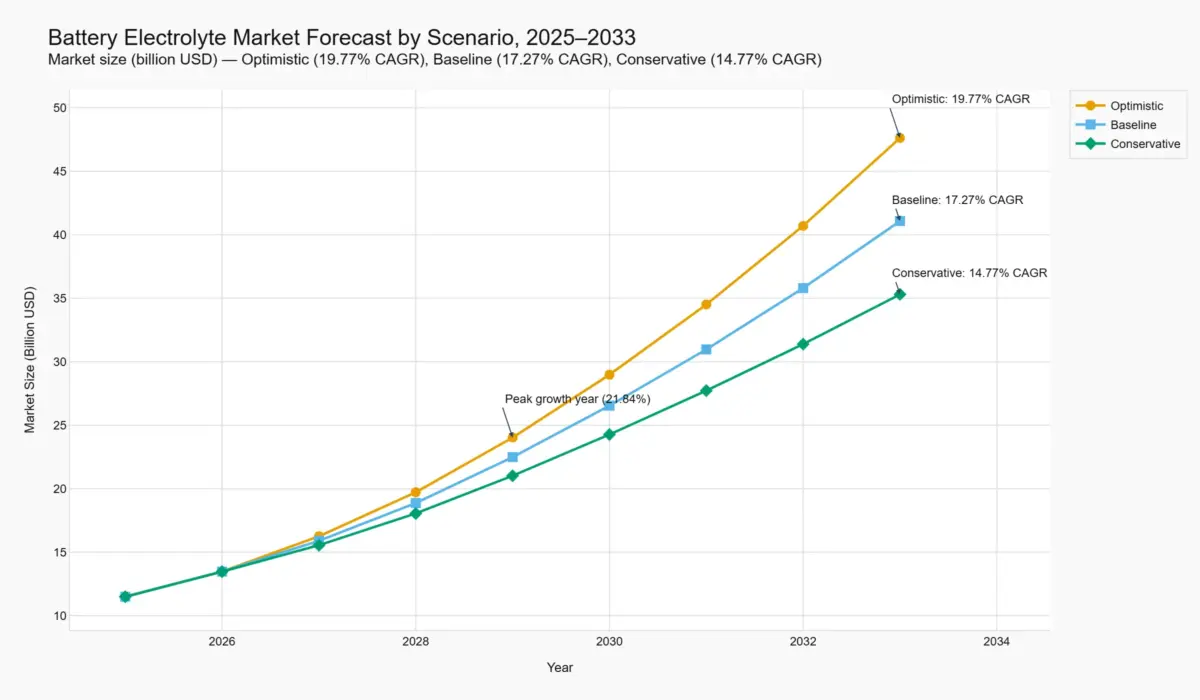
Moteurs, freins, opportunités et menaces du marché mondial de la production d'électrolyte de batterie
Moteurs clés
Extension de capacité et accords de fourniture à long terme
Les engagements de capacité annoncés offrent une visibilité sur le volume jusqu'en 2028 et au-delà. Capchem a sécurisé un commande de trois ans de CATL pour 300 000 tonnes d'électrolyte, structurée en 50 000 tonnes en 2026 (±10 % de fluctuation), 100 000 tonnes en 2027 (±12 %), et 150 000 tonnes en 2028 (±15 %). Haike Xinyuan a signé un contrat de trois ans avec BYD en janvier 2026 pour au moins 100 000 tonnes de solvant pour batteries lithium par an (DMC, EC, EMC, DEC) via le pipeline vers le projet Hubei de BYD. Ces accords correspondent directement à la trajectoire de croissance prévue, en particulier à l'augmentation du volume en 2028-2029.Diversification géographique de la capacité de production
Deux grands producteurs chinois construisent des usines à l'étranger. Capchem a investi 260 millions de dollars dans une usine au Royaume-Saoudite (Yanbu) pour produire 200 000 tonnes de solvants carbonates et 100 000 tonnes de glycol éthylène, avec des travaux qui prendront jusqu'à trois ans. Tinci Materials a signé un accord de 282,3 millions de dollars avec le Maroc pour une usine produisant 150 000 tonnes d'électrolyte, 100 000 tonnes de LiPF₆ et 50 000 tonnes de matériaux LFP, visant la production d'ici 2028. Ces investissements réduisent les coûts logistiques trans-régionaux et améliorent la sécurité d'approvisionnement pour les clients européens et du Moyen-Orient.Adoption des sels de lithium avancés (LiFSI)
Nippon Shokubai a annoncé une extension de la capacité de LiFSI de 2 400 MT/an à 12 400 MT/an d'ici 2027 dans sa joint-venture Hunan Fluopont. Le LiFSI permet une durée de vie plus longue des batteries, une charge plus rapide et une meilleure performance à basse température, répondant directement aux exigences de performance des véhicules électriques et des systèmes de stockage d'énergie de nouvelle génération. Cette extension soutient le modificateur de croissance motivé par la technologie en 2028-2029.Freins
Concentration de l'approvisionnement en fluor et goulots d'étranglement liés à la pureté
La Chine contrôle 60–69 % de la production mondiale de fluorite (8 à 9 millions de tonnes par an), et environ 60 % de cela est des acidespar d'acide (CaF₂ ≥97 %). L'HF de grade batterie nécessite des plafonds plus stricts d'impuretés —l'arsenic inférieur à 5 ppm et le phosphore inférieur à 100 ppm au niveau premium — créant un goulot d'étranglement séquentiel de la mine à la conversion en LiPF₆. Toute interruption à la mine, à l'enrichissement ou à l'étape de fluorisation se propage directement à la disponibilité et aux coûts de l'électrolyte.Crise du soufre et volatilité des matières premières
La fermeture du détroit d'Ormuz en février 2026 a perturbé près de la moitié du commerce maritime mondial du soufre. Le soufre est la matière première de l'acide sulfurique, essentiel à la production de sels de lithium. La Chine a pris des mesures pour protéger son approvisionnement intérieur, accentuant ainsi les pressions sur les coûts mondiaux. Bien que l'impact direct sur les prix du LiPF₆ ait été atténué par des stocks abondants, cette crise a révélé une vulnérabilité cachée des matières premières dépendantes de sous-produits.volatilité des prix du carbonate de lithium
Les prix à la livraison du carbonate de lithium de qualité batterie en juillet 2026 se sont situés à 150 000–154 000 RMB/MT, en baisse de 5,0 % semaine sur semaine, motivée par une offre accrue et une demande prudente. Bien que les coûts de production du LiPF₆ aient été modérément augmentés au premier trimestre 2026, des stocks abondants et un taux d'utilisation stable des fabricants de cellules ont limité la hausse, entraînant un indice des prix baissier à travers l'Amérique du Nord, l'Europe et l'Asie.Opportunités
Commercialisation de l'électrolyte solide
Objectifs de Samsung SDI la production en masse de batteries à électrolyte solide d'ici la deuxième moitié de 2027, avec des échantillons qui ont reçu des retours positifs des clients concernant la sécurité et la densité d'énergie. EcoPro BM opère un usine pilote de 40 tonnes par an d'électrolyte solide à base de sulfure, a passé les tests de qualification, et vise la production en masse en 2027. Bien qu'une adoption massive soit peu probable dans l'horizon de prévision, un segment premium pour les électrolytes solides pourrait émerger après 2027.Réformulation impulsionnée par la réglementation
de la Chine norme GB 38031-2025 (en vigueur en juillet 2026) impose l'absence de feu et d'explosion en cas de défaillance thermique, obligeant directement la reformulation de l'électrolyte avec des additifs retardateurs de flamme et de nouveaux sels de lithium. Cela crée une demande pour des électrolytes de plus haute valeur, différenciés en termes de performance, et accélère la consolidation parmi les fournisseurs capables de supporter les coûts de conformité.Localisation de la chaîne d'approvisionnement occidentale
Green Energy Origin (GEO) a annoncé l' acquisition des actifs d'électrolyte de Mitsubishi Chemical à Memphis, dans le Tennessee, et au Royaume-Uni, complétant ainsi sa usine tchèque existante de 200 000 tonnes par an. Feon Energy a signé un MoU avec Orbia pour la fabrication de électrolytes de nouvelle génération basée aux États-Unis. Ces mesures réduisent la dépendance aux importations chinoises et servent les marchés croissants de véhicules électriques et de défense en Amérique du Nord et en Europe.Menaces
Restriction géopolitique des exportations de produits chimiques fluorés
La domination chinoise en chimie du fluor, allant de l'extraction de fluorspar à la production d'HF en passant par la conversion en LiPF₆, crée une vulnérabilité stratégique analogue aux terres rares. Toute restriction des exportations d'HF ou de LiPF₆ limiterait directement la production d'électrolytes hors Chine, augmentant les coûts et allongeant les délais de livraison pour les fabricants de batteries à l'échelle mondiale. Le risque est conditionnel, mais structurellement incontestable.Restriction des PFAS au sein de REACH en Europe
L'Agence européenne des produits chimiques (ECHA) a proposé une restriction large des substances per- et polyfluoroalkyl (PFAS) au sein de REACH, couvrant de nombreuses substances fluorées utilisées dans les électrolytes de batteries. Le comité d'évaluation des risques a adopté un avis en mars 2026, et la portée finale ainsi que les périodes de transition restent incertaines. Une phase-out ou des limites strictes d'utilisation des PFAS obligerait à reformuler la plupart des produits d'électrolyte actuellement vendus en Europe.Surcapacité et compression des marges
Tinci a arrêté un projet d'électrolyte national de 2,65 milliards de yuans au milieu d'une surcapacité du marché et d'une forte concurrence, même si des projets en dehors du pays continuent. Cela signifie que l'expansion de la capacité dépasse la demande dans certaines régions, et que la géographie stratégique est priorisée par rapport à la croissance totale du volume. Les taux d'utilisation de 90 % chez Tinci indiquent un équilibre serré à court terme, mais le risque de surcapacité dans les années de prévision externes (2031-2033) est significatif.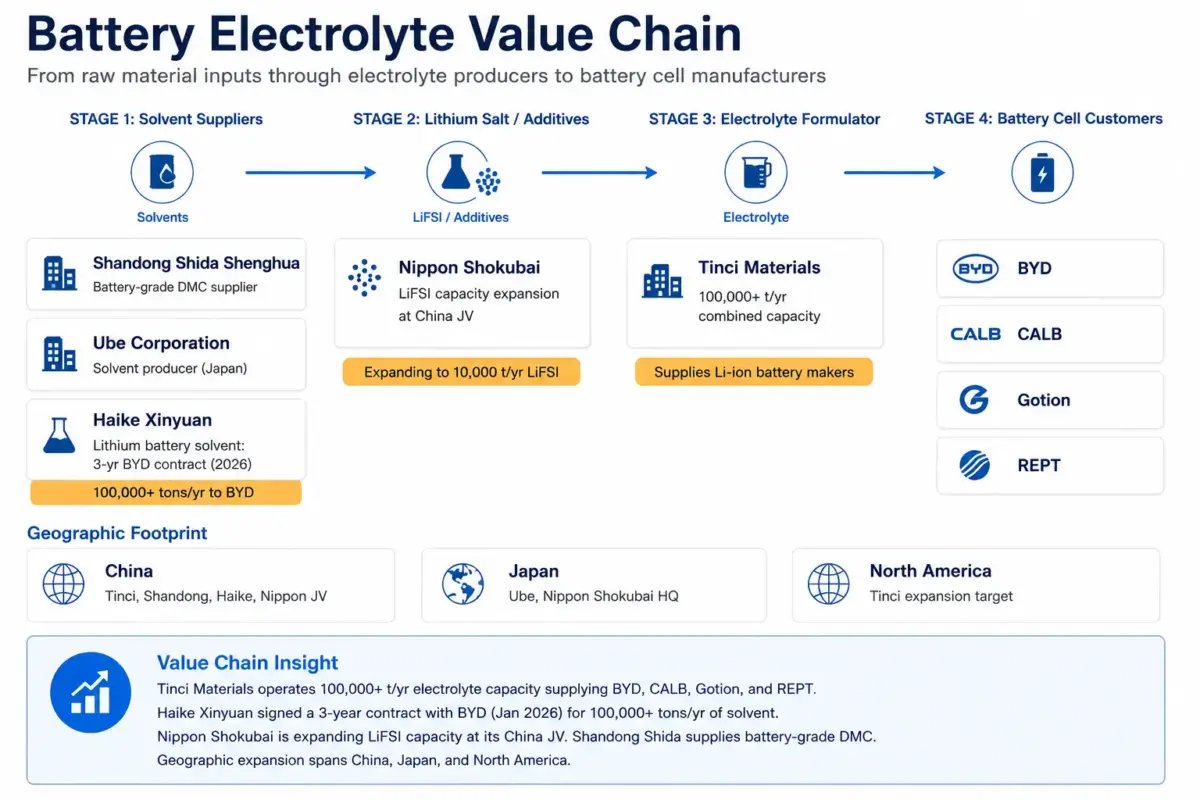
Segmentation du marché mondial de la production d'électrolyte de batterie
- Par type de produit
- Électrolyte liquide normalisé
- LiPF6Électrolytes basés sur LiPF
- Électrolytes lithium-ion standard
- Électrolytes haute tension
- Électrolytes pour charge rapide
- Électrolytes à basse température
- Électrolytes à base de LiFSI
- Électrolytes à haute performance pour véhicules électriques
- Électrolytes pour le stockage d'énergie
- LiPF6Électrolytes basés sur LiPF
- Formulations d'électrolytes sur mesure
- Électrolytes à haute performance
- Électrolytes retardateurs de flamme
- Électrolytes haute tension
- Électrolytes pour charge rapide
- Électrolytes spécifiques à l'application
- Électrolytes conformes aux réglementations
- Électrolytes à haute performance
- Technologies avancées d'électrolytes
- Électrolytes à état solide
- Électrolytes à état solide à base de sulfures
- Électrolytes à état solide à base d'oxydes
- Électrolytes à état solide à base de polymères
- Électrolytes liquides de nouvelle génération
- Formulations d'électrolytes à sel double
- Électrolytes à état solide
- Électrolyte liquide normalisé
- Par type de matériau utilisé
- Sel de lithium
- Hexafluorophosphate de lithium (LiPF6)
- Bis(fluorosulfonyl)imide de lithium (LiFSI)
- Autres sels de lithium
- Solvants organiques
- Carbonate d'éthylène (EC)
- Diméthyl carbonate (DMC)
- Éthyl méthyl carbonate (EMC)
- Diéthyl carbonate (DEC)
- Additifs fonctionnels
- Fluoroéthylène carbonate (FEC)
- Vinyl carbonate (VC)
- Additifs retardateurs de flamme
- Autres additifs de performance
- Sel de lithium
- Par application finale
- Batteries de véhicules électriques
- Véhicules électriques passagers
- Véhicules électriques commerciaux
- Bus électriques
- Batteries pour deux-roues
- Systèmes de stockage d'énergie
- Stockage d'énergie à grande échelle
- Stockage d'énergie commercial
- Stockage d'énergie résidentiel
- Électronique grand public
- Smartphones
- Ordinateurs portables et tablettes
- Électronique portatif
- Autres appareils électroniques portables
- Batteries de véhicules électriques
Analyse régionale du marché mondial de la production d'électrolyte pour batteries
[caption id="attachment_102949" align="aligncenter" width="700"]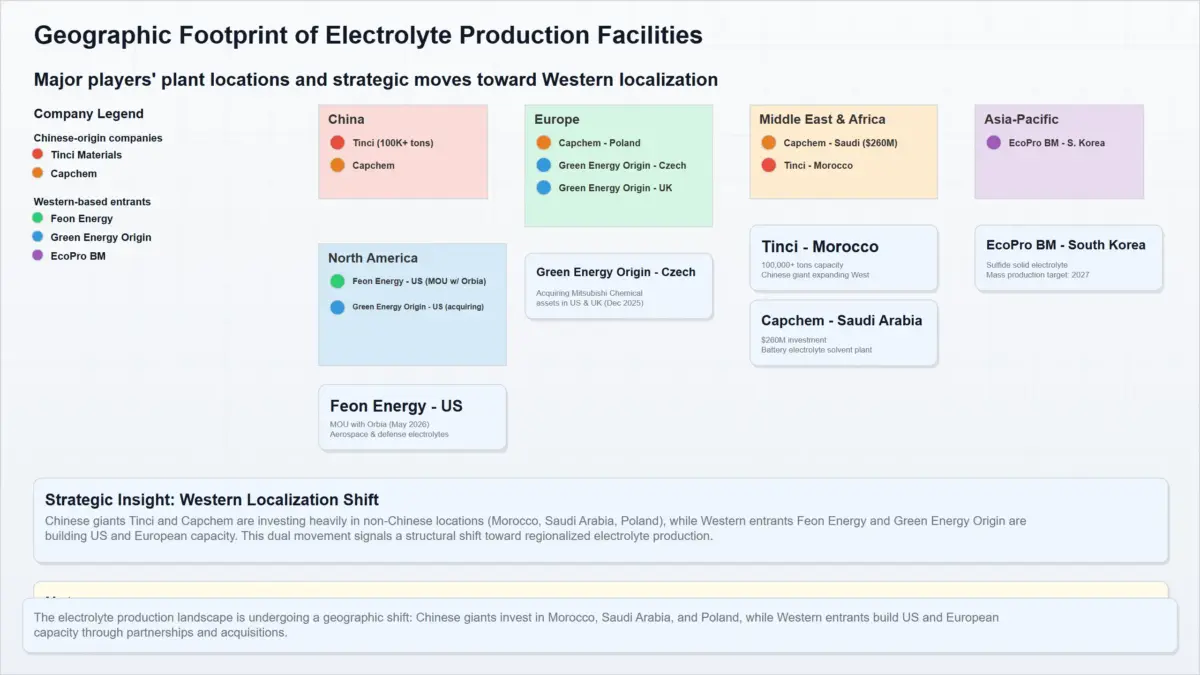 empreinte géographique de la production d'électrolyte à l'échelle mondiale
Asie-Pacifique—ancré par Chine—domine le marché de la production d'électrolyte pour batteries sur tous les segments : approvisionnement en matières premières (fluorspar, sels de lithium, solvants), formulation d'électrolyte et fabrication de cellules de batterie en aval. La Chine représente 60–69 % de la production mondiale de fluorite et abrite les plus grands producteurs mondiaux d'électrolyte (Tinci, Capchem) et fabricants de batteries (CATL, BYD). L'accord de fourniture Haike-BYD (100 000 tonnes/an par pipeline au Hubei) et le contrat Capchem-CATL (300 000 tonnes sur trois ans) illustrent les chaînes d'approvisionnement intégrées de la région.
Europe est la principale destination des investissements de capacité à l'étranger. Tinci's usine de 282,3 millions de dollars au Maroc (150 000 tonnes d'électrolyte, visant 2028) et Capchem's extension en Pologne (+50 000 tonnes d'électrolyte) sont explicitement conçus pour servir les clients européens en véhicules électriques. Green Energy Origin's acquisition des actifs d'électrolyte du Royaume-Uni de Mitsubishi Chemical et son usine existante de 200 000 tonnes en République tchèque renforcent davantage la capacité d'approvisionnement en Europe. La pression réglementaire exercée par la restriction de l'UE sur les PFAS introduit une incertitude pour les électrolytes fluorés vendus en Europe.
Amérique du Nord développe sa capacité domestique via des projets à petite échelle soutenus par des politiques. Anthro Energy a reçu un subvention de 24,9 millions de dollars du DOE pour une usine de 12 000 tonnes métriques (25 GWh) de polymère d'électrolyte au Kentucky. L'accord de principe de Feon Energy avec Orbia vise la fabrication d'électrolyte de nouvelle génération aux États-Unis. L'acquisition de GEO de l'usine de Memphis, Tennessee par Mitsubishi Chemical ajoute une capacité immédiate. Ces investissements restent encore de l'ordre de grandeur bien inférieur aux projets chinois à l'étranger.
Moyen-Orient émerge comme un nouveau centre de production. Capchem's usine de 260 millions de dollars en Arabie saoudite à Yanbu produira 200 000 tonnes de solvants carbonates et 100 000 tonnes de glycol éthylène, exploitant les avantages locaux en énergie et la proximité géographique avec les marchés européens et asiatiques.
Japon et Corée du Sud contribuent à la technologie et aux matériaux spécialisés. Nippon Shokubai (Japon) étend sa capacité de production de LiFSI en Chine. Samsung SDI et EcoPro BM (Corée du Sud) visent tous les deux 2027 pour la production en masse d'électrolyte solide, positionnant la région comme leader en technologie d'électrolyte de nouvelle génération.
empreinte géographique de la production d'électrolyte à l'échelle mondiale
Asie-Pacifique—ancré par Chine—domine le marché de la production d'électrolyte pour batteries sur tous les segments : approvisionnement en matières premières (fluorspar, sels de lithium, solvants), formulation d'électrolyte et fabrication de cellules de batterie en aval. La Chine représente 60–69 % de la production mondiale de fluorite et abrite les plus grands producteurs mondiaux d'électrolyte (Tinci, Capchem) et fabricants de batteries (CATL, BYD). L'accord de fourniture Haike-BYD (100 000 tonnes/an par pipeline au Hubei) et le contrat Capchem-CATL (300 000 tonnes sur trois ans) illustrent les chaînes d'approvisionnement intégrées de la région.
Europe est la principale destination des investissements de capacité à l'étranger. Tinci's usine de 282,3 millions de dollars au Maroc (150 000 tonnes d'électrolyte, visant 2028) et Capchem's extension en Pologne (+50 000 tonnes d'électrolyte) sont explicitement conçus pour servir les clients européens en véhicules électriques. Green Energy Origin's acquisition des actifs d'électrolyte du Royaume-Uni de Mitsubishi Chemical et son usine existante de 200 000 tonnes en République tchèque renforcent davantage la capacité d'approvisionnement en Europe. La pression réglementaire exercée par la restriction de l'UE sur les PFAS introduit une incertitude pour les électrolytes fluorés vendus en Europe.
Amérique du Nord développe sa capacité domestique via des projets à petite échelle soutenus par des politiques. Anthro Energy a reçu un subvention de 24,9 millions de dollars du DOE pour une usine de 12 000 tonnes métriques (25 GWh) de polymère d'électrolyte au Kentucky. L'accord de principe de Feon Energy avec Orbia vise la fabrication d'électrolyte de nouvelle génération aux États-Unis. L'acquisition de GEO de l'usine de Memphis, Tennessee par Mitsubishi Chemical ajoute une capacité immédiate. Ces investissements restent encore de l'ordre de grandeur bien inférieur aux projets chinois à l'étranger.
Moyen-Orient émerge comme un nouveau centre de production. Capchem's usine de 260 millions de dollars en Arabie saoudite à Yanbu produira 200 000 tonnes de solvants carbonates et 100 000 tonnes de glycol éthylène, exploitant les avantages locaux en énergie et la proximité géographique avec les marchés européens et asiatiques.
Japon et Corée du Sud contribuent à la technologie et aux matériaux spécialisés. Nippon Shokubai (Japon) étend sa capacité de production de LiFSI en Chine. Samsung SDI et EcoPro BM (Corée du Sud) visent tous les deux 2027 pour la production en masse d'électrolyte solide, positionnant la région comme leader en technologie d'électrolyte de nouvelle génération.
Entreprises leaders du marché
Le paysage concurrentiel est façonné par cinq acteurs clés ayant des stratégies distinctes basées sur l'échelle de capacité, l'étendue géographique et la concentration technologique.| Entreprise | Siège social | Capacité clé / investissement | Focus stratégique |
|---|---|---|---|
| Tinci Materials | Chine | ~850 000 tonnes/an d'électrolyte ; 650 000 tonnes en cours de construction ; usine au Maroc de 282,3 M$ | Leadership en termes de mise à l'échelle, diversification géographique, intégration verticale vers LiPF₆ et LFP |
| Capchem Technology | Chine | Usine en Arabie saoudite de 260 M$ (200 000 tonnes de solvants) ; extension en Pologne (+50 000 tonnes d'électrolyte) ; contrat de 300 000 tonnes avec CATL | Sécurité des solvants en amont, approvisionnement multi-régions, accords de vente à long terme |
| Nippon Shokubai | Japon | Extension de LiFSI de 2 400 à 12 400 tonnes/an d'ici 2027 (société conjointe Hunan Fluopont) | Sel lithium avancé (LiFSI/IONEL™) pour électrolytes de véhicules électriques et systèmes de stockage d'énergie de haute performance |
| Green Energy Origin (GEO) | Europe / États-Unis | Usine tchèque de 200 000 tonnes ; acquisition des actifs de Mitsubishi Chemical (États-Unis, Royaume-Uni) | Localisation de la chaîne d'approvisionnement occidentale, développement de capacité par acquisition |
| EcoPro BM | Corée du Sud | Pilote de 40 tonnes/an d'électrolyte solide à base de sulfure ; objectif de production en masse en 2027 | Électrolyte solide de nouvelle génération, développement de cathode intégré |
Pourquoi la production d'électrolyte est le goulet d'étranglement structurel dans l'expansion des batteries
Le marché des électrolytes de batterie est façonné par trois tendances étroitement liées : une forte demande en aval provenant des marchés des véhicules électriques et des systèmes de stockage d'énergie, une expansion rapide de la capacité par les producteurs chinois, et une vulnérabilité structurelle dans la chaîne d'approvisionnement en fluor en amont. Le marché est prévu pour croître à partir de 11,49 milliards de dollars en 2025 pour atteindre 41,08 milliards de dollars d'ici 2033. Cette croissance reflète non seulement des volumes plus élevés, mais aussi une valeur par litre croissante, car des sels avancés tels que LiFSI, des additifs de performance et des reformulations imposées par la réglementation rendent les formulations d'électrolyte plus complexes et coûteuses.
Le marché est particulièrement important en raison de la combinaison d'échelle et de concentration de l'approvisionnement. La Chine contrôle 60–69 % de la production mondiale de fluorite, ainsi que la majorité de la capacité de conversion de HF et la plus grande part de la capacité de production d'électrolyte. En conséquence, les chaînes d'approvisionnement en batterie en dehors de la Chine, notamment celles en Europe, en Amérique du Nord et marchés émergents, restent dépendantes des entrées chinoises en électrolyte à plusieurs étapes de production. Le crise du soufre en 2026, déclenché par la fermeture du détroit d'Hormuz, a montré comment un événement géopolitique en dehors de l'industrie des batteries peut se propager via les matières premières et finalement affecter les coûts des sels lithium. Le goulet d'étranglement en fluor est structurel plutôt que cyclique, et y remédier dans la période de prévision nécessiterait un investissement significatif dans l'exploitation de minerais d'acide et la capacité de purification de HF non chinois.
Les développements technologiques créent des options supplémentaires pour le marché. Les électrolytes solides, avec Samsung SDI et EcoPro BM visant 2027, des technologies d'électrolyte liquide novatrices telles que Acetolyte d'Asahi Kasei, qui est déjà commercialisée, et des formulations à double sel pourraient soutenir les segments premium et offrir des alternatives potentielles. Cependant, ces technologies ne sont pas prévues pour remplacer à grande échelle les électrolytes liquides à base de LiPF₆ pendant la 2026–2033 période de prévision. Cela signifie que la dépendance au fluor est susceptible de persister tout au long de la prévision.
L'activité d'investissement met également en évidence l'importance stratégique du marché. Tinci, Capchem et Nippon Shokubai ont engagé des capacités nouvelles importantes à travers la Chine, le Maroc, l'Arabie saoudite, la Pologne et la Malaisie. Ces investissements sont soutenus par des accords de vente à long terme, notamment Capchem-CATL et Haike-BYD, qui offrent une meilleure visibilité sur les volumes futurs. Le marché s'élargit donc tout en connaissant une restructuration géographique, avec des implications significatives pour la sécurité de la chaîne d'approvisionnement, le pouvoir de négociation des prix et le rythme d'adoption des technologies.Table des matières
1. Résumé exécutif
1.1 Aperçu du marché (2026–2033) 1.2 Points clés du marché 1.3 Hypothèses de prévision et aperçu des scénarios 1.4 Aperçu de la demande et de l'offre 1.5 Point de vue de l'analyste2. Aperçu du marché
2.1 Introduction au marché mondial de la production d'électrolyte de batterie 2.2 Définition du marché et périmètre 2.3 Analyse de la chaîne de valeur de l'industrie 2.4 Évolution du marché et tendances historiques 2.5 Structure de la chaîne d'approvisionnement 2.6 Production d'électrolyte, approvisionnement en sel de lithium et demande en batterie de véhicule électrique3. Aperçu de la prévision du marché mondial de la production d'électrolyte de batterie (en milliards de dollars), 2025–2033
3.1 Taille du marché de la base (2025) 3.2 Prévision de base du marché (2033) 3.3 Taux de croissance annuel composé (2025–2033) 3.4 Direction du marché 3.5 Plus grande région 3.6 Région qui croît le plus rapidement 3.7 Plus grand segment 3.8 Segment qui croît le plus rapidement 3.9 Tendances clés 3.10 Perspective future4. Analyse des scénarios de prévision du marché
4.1 Scénario de prévision de base 4.2 Scénario de prévision optimiste 4.3 Scénario de prévision conservateur 4.4 Prévision du marché année par année (2025–2033) 4.5 Analyse de la forme de croissance 4.6 Analyse du taux de croissance annuel 4.7 Comparaison des scénarios et implications du marché5. Dynamiques du marché
5.1 Moteurs 5.1.1 Expansion de la capacité et accords d'approvisionnement à long terme 5.1.2 Diversification géographique de la capacité de production 5.1.3 Adoption de sel de lithium avancé (LiFSI) 5.2 Contraintes 5.2.1 Concentration de l'approvisionnement en fluor et blocages liés à la pureté 5.2.2 Volatilité de la matière première en soufre 5.2.3 Volatilité des prix du carbonate de lithium 5.3 Opportunités 5.3.1 Commercialisation d'électrolyte solide 5.3.2 Réforme réglementaire de l'électrolyte 5.3.3 Localisation de la chaîne d'approvisionnement occidentale 5.4 Menaces 5.4.1 Restrictions d'exportation géopolitiques sur les produits chimiques fluorés 5.4.2 Risques réglementaires liés aux PFAS en Europe 5.4.3 Surcapacité et compression des marges6. Segmentation du marché par type de produit (en milliards de dollars), 2025–2033
6.1 Électrolytes liquides standards 6.1.1 Électrolytes basés sur LiPF₆ 6.1.2 Électrolytes basés sur LiFSI 6.1.3 Électrolytes à sel de lithium mixte 6.1.4 Électrolytes liquides à haute performance 6.2 Formulations d'électrolytes personnalisées 6.2.1 Électrolytes à haute tension 6.2.2 Électrolytes à charge rapide 6.2.3 Électrolytes à retardement de flamme 6.2.4 Électrolytes à basse température 6.3 Électrolytes de nouvelle génération 6.3.1 Électrolytes solides 6.3.2 Électrolytes polymères 6.3.3 Électrolytes à base de sulfure 6.3.4 Électrolytes hybrides7. Segmentation du marché par entrée matérielle (en milliards de dollars), 2025–2033
7.1 Sels de lithium 7.1.1 LiPF₆ 7.1.2 LiFSI 7.1.3 LiBF₄ 7.1.4 Autres sels de lithium 7.2 Solvants organiques 7.2.1 Carbonate d'éthylène (EC) 7.2.2 Diméthyl carbonate (DMC) 7.2.3 Éthyl méthyl carbonate (EMC) 7.2.4 Diéthyl carbonate (DEC) 7.3 Additifs fonctionnels 7.3.1 Fluoroéthylène carbonate (FEC) 7.3.2 Vinyle carbonate (VC) 7.3.3 Additifs à retardement de flamme 7.3.4 Additifs à performance8. Segmentation du marché par application finale (en milliards de dollars), 2025–2033
8.1 Batteries de véhicules électriques 8.2 Systèmes de stockage d'énergie (ESS) 8.3 Électronique grand public 8.4 Batteries industrielles et spécialisées9. Segmentation du marché par chimie de batterie (en milliards de dollars), 2025–2033
9.1 Batteries LFP 9.2 Batteries NMC 9.3 Batteries NCA 9.4 Chimies de batterie émergentes10. Analyse du marché régional
10.1 Asie-Pacifique 10.2 Europe 10.3 Amérique du Nord 10.4 Moyen-Orient et Afrique11. Analyses régionales
11.1 Asie-Pacifique – Centre de production mondial 11.2 Europe – Localisation et transition réglementaire 11.3 Amérique du Nord – Expansion de la capacité soutenue par des politiques 11.4 Moyen-Orient – Centre émergent de fabrication d'électrolyte 11.5 Japon et Corée du Sud – Innovation en électrolyte avancée12. Analyse de la chaîne d'approvisionnement et des investissements
12.1 Analyse de la chaîne d'approvisionnement en LiPF₆ 12.2 Chaîne de valeur de fluorite à cellule de batterie 12.3 Points de blocage de la chaîne d'approvisionnement 12.4 Projets d'expansion de capacité 12.5 Incitations gouvernementales et localisation 12.6 Évaluation des risques de matière première13. Paysage concurrentiel
13.1 Analyse de la structure du marché 13.2 Matrice de positionnement concurrentiel 13.3 Capacité actuelle et planifiée de production d'électrolyte 13.4 Développements stratégiques 13.5 Expansion de capacité et activités d'investissement14. Profils des entreprises
14.1 Tinci Materials 14.2 Capchem Technology 14.3 Nippon Shokubai 14.4 Green Energy Origin (GEO) 14.5 EcoPro BM 14.6 Shandong Shida Shenghua 14.7 Ube Corporation 14.8 Feon Energy15. Intelligence stratégique et insights basés sur l'intelligence artificielle
15.1 Pheonix Forecast Intelligence Engine 15.2 Tableau de bord de l'intelligence de la chaîne d'approvisionnement en électrolyte 15.3 Tableau de bord du risque d'approvisionnement en sel de lithium 15.4 Intelligence d'adoption technologique 15.5 Intelligence des opportunités d'investissement16. Opportunités d'investissement et de croissance
16.1 Expansion mondiale de capacité 16.2 Commercialisation de LiFSI 16.3 Localisation de la chaîne d'approvisionnement occidentale 16.4 Développement d'électrolyte solide 16.5 Partenariats stratégiques et accords d'approvisionnement à long terme17. Pourquoi le marché mondial de la production d'électrolyte de batterie s'élargit
17.1 Demande de croissance des EV & ESS 17.2 Globalisation de la capacité 17.3 Importance de la chaîne d'approvisionnement en fluorine 17.4 Progrès technologiques 17.5 Perspective du marché à long terme18. Principaux enseignements analytiques
18.1 Analyse de la croissance front-loaded 18.2 Évaluation des risques de la chaîne d'approvisionnement 18.3 Perspective de commercialisation technologique 18.4 Hypothèses et limites des prévisions19. Méthodologie et approche de recherche
19.1 Méthodologie de recherche 19.2 Cadre de modélisation des prévisions 19.3 Sources de données 19.4 Hypothèses et limites20. À propos de Pheonix Research
21. Avertissement
Paysage concurrentiel
Paysage concurrentiel
Les géants chinois et la course aux capacités
Tinci Materials et Capchem dominent la production mondiale d'électrolyte de batterie grâce à une capacité massive et une expansion agressive. Tinci exploite actuellement environ 850 000 tonnes de capacité annuelle d'électrolyte avec un taux d'utilisation de 90 %, tandis que 650 000 tonnes sont en cours de construction. Les commandes cumulées dépassent 3,4 millions de tonnes, avec des clients clés comprenant CALB, Gotion High-tech et REPT Batteries. Un accord de fourniture récent avec Chutian New Energy a augmenté le volume depuis un minimum de 550 000 tonnes jusqu'à au moins 1,01 million de tonnes — une augmentation de plus de 80 %. En dehors de ses opérations domestiques, Tinci a entamé la construction d'un projet de 280 millions de dollars au Maroc, qui produira 150 000 tonnes d'électrolyte, 100 000 tonnes de fluorure de lithium hexafluoré et 50 000 tonnes de matériaux de phosphate de lithium. Capchem investit 260 millions de dollars dans une usine au Royaume-Saoudite située dans le parc industriel lourd de Yanbu pour produire annuellement 200 000 tonnes de solvants carbonates et 100 000 tonnes de glycol éthylène — des matières premières essentielles pour la fabrication d'électrolytes. L'entreprise investit également 200 millions de yuans (environ 28,6 millions de dollars) pour étendre sa capacité d'électrolyte en Pologne de 50 000 tonnes, renforçant ainsi sa présence en Europe. Ces deux expansions visent à sécuriser l'approvisionnement en matières premières et à réduire les coûts logistiques interrégionaux. Les deux producteurs concurrents se disputent sur l'échelle, la vitesse de déploiement et l'intégration verticale. Alors que Tinci se concentre sur la capacité d'électrolyte directe, Capchem construit la capacité de solvants en amont qui peut servir ses propres usines et ses clients tiers.| Participant | Relation | Dimension concurrentielle | Capacité actuelle (tonnes/an) | Planifiée/en construction | Région clé |
|---|---|---|---|---|---|
| Tinci Materials | Concurrent de Capchem | Capacité de production d'électrolyte | ~850 000 (électrolyte) | 650 000 tonnes d'électrolyte en construction ; projet au Maroc : 150 000 tonnes d'électrolyte, 100 000 tonnes de LiPF6, 50 000 tonnes de LFP | Chine, Maroc, République tchèque (déplacé) |
| Capchem | Concurrent de Tinci | Capacité de solvant en amont / d'électrolyte | Non spécifiée directement | Saoudite : 200 000 tonnes de solvants carbonates, 100 000 tonnes de glycol ; Pologne : +50 000 tonnes d'électrolyte | Royaume-Saoudite, Pologne |

Localisation des chaînes d'approvisionnement : Production aux États-Unis et en Europe
Nouveaux acteurs ciblent les marchés occidentaux via des partenariats et des acquisitions afin de créer une production locale d'électrolyte, réduisant ainsi la dépendance à la production chinoise. En mai 2026, Feon Energy a signé un mémorandum d'entente avec Orbia Fluor & Energy Materials afin d'activer la fabrication d'électrolytes de batterie lithium de nouvelle génération aux États-Unis, en se concentrant initialement sur les applications aéronautiques et de défense. Orbia apporte une expertise en matières fluorées et une infrastructure existante de fabrication d'électrolytes aux États-Unis. Green Energy Origin (GEO) a annoncé en décembre 2025 qu'il acquerrait des installations de fabrication d'électrolyte de Mitsubishi Chemical Corporation à Memphis, dans le Tennessee, et au Royaume-Uni. Cette acquisition s'aligne sur la capacité existante de production d'électrolyte de GEO de 200 000 tonnes par an en République tchèque, ajoutant immédiatement de la capacité de production et des redondances d'approvisionnement à travers l'Amérique du Nord et l'Europe occidentale. Ces initiatives diffèrent par leur approche : Feon Energy utilise un modèle de partenariat pour accéder à la capacité de fabrication, tandis que GEO poursuit l'acquisition directe d'usines établies. Les deux visent à servir les marchés en croissance rapide de véhicules électriques, de stockage d'énergie et de défense avec des électrolytes localement sources.| Participant | Relation | Dimension concurrentielle | Produit / Focalisation client | Géographie | Base de mesure |
|---|---|---|---|---|---|
| Feon Energy | Partenariat avec Orbia | Fabrication d'électrolyte de nouvelle génération | Aéronautique, défense, mobilité, stockage de réseau | États-Unis (via Orbia) | MOU annoncé en mai 2026 ; infrastructure existante de fabrication d'électrolyte aux États-Unis d'Orbia |
| Green Energy Origin | Acquisition des actifs de Mitsubishi Chemical | Capacité de production d'électrolyte | Chaîne d'approvisionnement pour véhicules électriques et stockage d'énergie | États-Unis (Memphis, TN), Royaume-Uni, République tchèque | Acquisition annoncée en décembre 2025 ; GEO possède une usine de 200 000 tonnes par an en République tchèque |
Électrolytes de nouvelle génération : Électrolytes à état solide et formulations spécialisées
Alors que l'expansion de la capacité domine le paysage concurrentiel actuel, une course technologique parallèle se déroule dans les électrolytes à état solide. EcoPro BM a annoncé en juillet 2026 qu'il avait développé un procédé de fabrication d'électrolyte solide à base de sulfure propre. L'entreprise opère actuellement une usine pilote de 40 tonnes par an, et les produits issus de ce site ont passé les tests de qualification des principaux fabricants de batteries. EcoPro BM a achevé la conception de la production en masse et vise la production en masse commerciale la plus précoce en 2027, selon la demande des clients. L'entreprise développe simultanément des matériaux de cathode optimisés pour les électrolytes à état solide, renforçant ainsi sa position intégrée en matière de matériaux. Ce calendrier place EcoPro BM parmi les premiers acteurs dans la commercialisation des électrolytes à état solide. Ce changement technologique représente une dimension concurrentielle différente de la course aux capacités d'électrolytes liquides, en mettant l'accent sur l'innovation des processus et la qualification des clients plutôt que sur l'échelle.
Points clés
-
- Tinci Materials et Capchem restent des acteurs majeurs en termes de capacité, avec une capacité de Tinci dépassant 850 000 tonnes par an, tandis que Capchem investit 260 millions de dollars pour établir une capacité de production de solvants en Arabie saoudite.
- Les fabricants de batteries sécurisent des approvisionnements en électrolytes à long terme via des accords pluriannuels. Les commandes cumulées de Tinci ont dépassé 3,4 millions de tonnes, offrant une meilleure visibilité sur la demande future et les volumes de production.
- Les chaînes d'approvisionnement des États-Unis et de l'Europe se concentrent de plus en plus sur la réduction de la dépendance aux importations chinoises. Des acquisitions d'actifs tels que Green Energy Origin–Mitsubishi et des partenariats tels que Feon Energy–Orbia soutiennent le développement de réseaux d'approvisionnement plus locaux.
- La production d'électrolytes à état solide se rapproche de la commercialisation. EcoPro BM vise la production en masse en 2027 après avoir réussi les tests de qualification des clients, bien que l'adoption plus large dépendra du développement technique et à l'échelle de la production.
- L'expansion des capacités dépasse la demande actuelle dans certains domaines, mais les taux d'utilisation restent élevés. Le taux d'utilisation de 90 % de Tinci indique que les conditions d'offre et de demande à court terme restent relativement tendues malgré l'expansion continue des capacités de production.
Chaîne de valeur
Chaîne de valeur : Production mondiale d'électrolyte pour batteries
La chaîne de valeur de la production d'électrolyte pour batterie s'étend de l'approvisionnement en matières premières chimiques — sel de lithium, solvants et additifs — à la formulation et au mélange d'électrolyte, jusqu'à la livraison aux fabricants de cellules de batterie lithium-ion. Ce chapitre examine les participants soutenus, les capacités, les engagements d'approvisionnement et les dynamiques géographiques pour la période 2025-2027, en se basant sur les investissements et contrats annoncés. L'exploitation minière en amont de lithium et de fluorine ainsi que l'assemblage de packs de batterie en aval sont exclues.Points clés
- Tinci Materials domine avec plus de 850 000 tonnes de capacité annuelle d'électrolyte et s'étend vers l'Amérique du Nord avec une usine de 200 000 tonnes, indiquant un changement stratégique dans les chaînes d'approvisionnement.
- Des accords de fourniture à long terme, tels que le contrat de trois ans entre Haike Xinyuan et BYD pour 100 000 tonnes de solvant annuellement, assurent la disponibilité des matières premières pour les principaux fabricants de batteries.
- Les ajouts de capacité en LiFSI par Nippon Shokubai (extension de 10 000 MT/an) répondent à la demande croissante d'électrolytes de haute performance pour les applications EV et ESS.
- La chaîne de valeur reste fortement concentrée en Chine, mais les investissements à l'étranger, tels que l'usine de Tinci aux États-Unis, signalent une diversification précoce.
- La production de solvants est dominée par les producteurs chinois et japonais (Shandong Shida, Ube), avec le DMC de qualité batterie comme entrée critique. Montrez le flux soutenu des matières premières vers les producteurs d'électrolyte jusqu'aux fabricants de cellules de batterie, y compris les capacités clés, les contrats et les marqueurs géographiques.\n Revendications et preuves soutenues par la recherche.\n Participants à chaque étape : fournisseurs de solvants (Shandong Shida, Ube, Haike), producteurs de sel de lithium/additifs (Nippon Shokubai), formateur d'électrolyte (Tinci), et clients de cellules de batterie (BYD, CALB, Gotion, REPT). Les capacités, les volumes de contrats et les emplacements d'expansion (Chine, Japon, Amérique du Nord) sont mis en avant.
Architecture de la chaîne de valeur et entrées de matériau
La chaîne de valeur de l'électrolyte commence avec des entrées chimiques brutes. Les sels de lithium (LiPF₆, LiFSI), les solvants organiques (diméthyl carbonate, éthyl méthyl carbonate, carbonate d'éthylène, diéthyl carbonate) et les additifs fonctionnels sont achetés par les producteurs d'électrolyte, qui les mélangent en formulations propriétaires avant de les expédier aux fabricants de cellules de batterie. Deux producteurs de solvants avec des rôles soutenus sont Shandong Shida Shenghua Chemical Group et Ube Corporation. Le département des ventes de matériaux d'électrolyte de Shandong Shida fournit du diméthyl carbonate (DMC) de qualité batterie ainsi que EMC, EC, DEC et PC aux producteurs d'électrolyte. Ube est le seul fabricant de DMC au Japon et affirme que son DMC de haute qualité devient le standard de facto pour les électrolytes de batteries lithium-ion. Haike Xinyuan a signé un contrat de trois ans avec BYD en janvier 2026 pour fournir au moins 100 000 tonnes de solvant pour batterie lithium annuellement — y compris DMC, EC, EMC et DEC — par pipeline vers le projet de Hubei de BYD. Ce contrat relie directement un producteur de solvant à une usine de batterie spécifique en aval. Le plus grand producteur d'électrolyte soutenu par les preuves est Guangzhou Tinci Materials Technology. Tinci exploite des lignes de production d'électrolyte avec une capacité annuelle combinée d'environ 850 000 tonnes et fournit des fabricants de batteries lithium-ion tels que CALB, Gotion High-tech et REPT Batteries, avec des commandes cumulées dépassant 3,4 millions de tonnes. Du côté des additifs, Nippon Shokubai produit le LiFSI (imide bis(fluorosulfonyl) de lithium), un sel de lithium de haute performance utilisé dans des formulations d'électrolyte avancées. À travers sa joint-venture Hunan Fluopont New Materials en Chine, la capacité actuelle s'élève à 2 400 tonnes métriques par an (MT/an), passant de 1 200 MT/an en 2022 après la débottlenecking.| Composant | Fournisseur | Capacité actuelle / contrat | Présence géographique |
|---|---|---|---|
| Électrolyte | Tinci Materials | 850 000 tonnes/an ; 650 000 tonnes en construction | Chine ; Amérique du Nord (prévue) |
| Solvant DMC | Shandong Shida Shenghua | DMC de qualité batterie fourni aux producteurs d'électrolyte | Chine |
| Solvant DMC | Ube Corporation | Seul fabricant de DMC au Japon ; fournit le marché d'électrolyte de batterie lithium-ion | Japon |
| Solvant pour batterie lithium (DMC, EC, EMC, DEC) | Haike Xinyuan | ≥100 000 tonnes/an pour BYD sous contrat de trois ans à partir de janvier 2026 | Chine (Hubei) |
| LiFSI (additif sel de lithium) | Nippon Shokubai (joint-venture Hunan Fluopont) | 2 400 MT/an actuel ; expansion de 10 000 MT/an | Chine (Hunan) |
Trajectoires d'expansion des capacités et engagements de fourniture
Plusieurs expansions de capacité et des accords de fourniture à long terme transforment le paysage des électrolytes jusqu'en 2027. Ces investissements reflètent les efforts pour sécuriser l'approvisionnement en face de la demande croissante en véhicules électriques (VE) et en systèmes de stockage d'énergie (ESS), avec la plupart des activités centrées en Chine et un projet notable à l'étranger. Tinci Materials est le plus actif en matière d'expansion. Elle dispose actuellement de 850 000 tonnes de capacité annuelle d'électrolyte, avec un taux d'utilisation d'environ 90 %, et de 650 000 tonnes en cours de construction. L'entreprise prévoit des ventes totales d'électrolyte de 720 000 tonnes en 2025. Dans un mouvement géographique significatif, Tinci a entamé la construction de son premier grand centre de production hors de Chine : une usine d'électrolyte de 200 000 tonnes en Amérique du Nord, avec un investissement total d'environ 200 millions de dollars américains. Haike Xinyuanle contrat de trois ans avec BYD, en vigueur à partir de janvier 2026, engage à fournir au moins 100 000 tonnes de solvant par an. L'accord couvre la livraison par pipeline vers le projet de Hubei de BYD et inclut le DMC, l'EC, l'EMC et le DEC. Haike s'engage explicitement à assurer une capacité de production suffisante pour satisfaire la demande annuelle d'achat de BYD, qui ne devrait pas être inférieure à 100 000 tonnes. Nippon Shokubai poursuit une expansion progressive de la capacité de production de LiFSI au sein de sa joint-venture Hunan Fluopont. La capacité actuelle est de 2 400 MT/an. L'entreprise a annoncé une capacité supplémentaire de 10 000 MT/an, à construire en phases, portant ainsi la capacité totale à 12 400 MT/an d'ici 2027. Le communiqué de presse cite les moteurs de la demande provenant des VE (autonomie accrue, recharge plus rapide, rendement à basse température) et des ESS, où la demande s'accroît rapidement.| Entreprise | Produit | Ajout de capacité | Lieu | Échéance | Partenaire de vente (le cas échéant) |
|---|---|---|---|---|---|
| Tinci Materials | Électrolyte | 200 000 tonnes/an (nouvelle usine) ; 650 000 tonnes en cours de construction (en plus des 850 000 tonnes existantes) | Amérique du Nord (nouvelle) ; Chine (en cours de construction) | Travaux entamés en 2025 ; travaux en cours | — |
| Haike Xinyuan | Solvant pour batterie lithium (DMC, EC, EMC, DEC) | ≥100 000 tonnes/an | Chine (Hubei, livraison par pipeline vers BYD) | Contrat commence en janvier 2026 ; durée de trois ans | BYD |
| Nippon Shokubai (Hunan Fluopont) | LiFSI | 10 000 MT/an (en phases, de 2 400 à 12 400 MT/an) | Chine (Hunan) | Mise en service progressive d'ici 2027 | — |
Implications pour les clients en aval et les dynamiques du marché
Les expansions de capacité et les contrats à long terme ont des implications directes pour les fabricants de cellules de batterie, les constructeurs de véhicules électriques (VE) et les intégrateurs de systèmes de stockage d'énergie (ESS). BYD assure l'approvisionnement en solvant pour son projet de batterie de Hubei grâce à l'accord avec Haike, garantissant un accès stable au DMC, EC, EMC et DEC au moins pendant trois ans à partir de 2026. Tinci Materials a sécurisé des commandes cumulatives de plus de 3,4 millions de tonnes auprès de clients tels que CALB, Gotion High-tech, et REPT Batteries. La prévision de ventes de l'entreprise pour 2025 de 720 000 tonnes ainsi que ses revenus et profits solides au premier trimestre 2026 indiquent une demande en aval saine. L'expansion de la capacité de LiFSI par Nippon Shokubai vise directement les segments des VE et des ESS. L'entreprise note que le LiFSI permet une autonomie accrue, une recharge plus rapide et un rendement amélioré à basse température – des exigences clés pour les prochaines générations de VE et de stockage d'énergie à grande échelle. Avec une capacité de LiFSI prévue à 12 400 MT/an d'ici 2027, Nippon Shokubai sera mieux positionné pour fournir des additifs d'électrolyte de haute performance aux fabricants de batteries en Chine, le plus grand marché mondial des batteries lithium-ion (LIB). Géographiquement, la chaîne de valeur reste ancrée en Chine, qui abrite la majeure partie de la capacité de production de solvant, de LiFSI et d'électrolyte. L'usine de Tinci en Amérique du Nord est la seule usine électrolytique hors de Chine mentionnée dans les preuves disponibles et représente une première étape vers la diversification de la chaîne d'approvisionnement pour les fabricants de cellules de batterie en Amérique du Nord. Cependant, aucune donnée n'est disponible sur d'autres producteurs d'électrolyte hors de Chine, à l'exception de Ube et Nippon Shokubai du Japon, ni sur les prix ou les prévisions de la demande d'électrolyte, limitant ainsi une évaluation complète des dynamiques de concurrence.Activité d'investissement
Portée et contexte
Ce chapitre examine les activités d'investissement dans l'industrie de la production d'électrolyte pour batteries lithium-ion. Il couvre les projets de type greenfield, les extensions de capacité, les acquisitions, les sociétés en participation, ainsi que les initiatives financées par le gouvernement. Il n'inclut pas l'extraction des matières premières, d'autres composants de batterie tels que les cathodes, les anodes et les séparateurs, ni l'assemblage en aval des cellules de batterie.
Le marché de l'électrolyte de batterie a été estimé à 11,49 milliards de dollars en 2025, selon une estimation web unique. Toutes les données et dates présentées dans ce chapitre sont basées sur les annonces publiques des entreprises et des gouvernements.Extension de capacité mondiale : domination chinoise et pôles régionaux
Le schéma dominant en matière d'investissement dans les électrolytes est la construction de grands usines par des producteurs chinois dans des localisations stratégiques à l'étranger. Ces installations sont conçues pour servir des pôles régionaux de véhicules électriques et de stockage d'énergie, contournant les barrières tarifaires et raccourcissant les lignes d'approvisionnement vers les grands fabricants de cellules de batterie en Europe, au Moyen-Orient et en Asie du Sud-Est. Tinci Materials a signé un accord d'investissement de 2,6 milliards de dirhams marocains (282,3 millions de dollars) avec le gouvernement du Maroc pour construire une usine au parc industriel de Jorf Lasfar. L'usine aura une capacité de production annuelle de 150 000 tonnes d'électrolytes et d'autres matières premières clés pour les batteries au lithium. Tinci s'est engagé à atteindre les objectifs de production et d'exportation dans les cinq ans suivant la date d'entrée en vigueur, ciblant ainsi l'année 2028. Ce projet suit un plan précédemment annoncé de 300 000 tonnes qui a été réduit ; la société a également annulé son plan d'inscription en Suisse en raison des changements des conditions opérationnelles. Capchem, par le biais de sa joint-venture à 80:20 Middle East Capchem, a annoncé un investissement de 260 millions de dollars à Yanbu, en Arabie saoudite. L'installation produira 200 000 tonnes par an de solvants carbonates et 100 000 tonnes par an d'éthylène glycol, en utilisant la technologie propriétaire Ecosip déjà déployée en Chine et en Pologne. La construction prendra trois ans. Séparément, le filiale de Capchem, Novolyte, a entamé les travaux en janvier 2026 d'une nouvelle usine de fabrication d'électrolytes pour batteries au parc technologique de Kulim Hi-Tech Park dans le Kedah, en Malaisie. La capacité de la phase 1 est de 30 000 tonnes, prévue pour commencer la production au quatrième trimestre de 2026. Novolyte opère déjà une usine de phase 1 dans le même parc, permettant ainsi une production locale et la satisfaction des commandes locales. À l'inverse, les efforts domestiques aux États-Unis et au Royaume-Uni sont nettement plus modestes et dépendent fortement des financements gouvernementaux. Anthro Energy a reçu l'approbation du Département de l'Énergie des États-Unis en avril 2026 pour passer à la phase d'exécution de sa première usine à grande échelle de production d'électrolytes avancés appartenant aux États-Unis. Le financement de 24,9 millions de dollars soutient un centre de production de 25 GWh à Louisville, dans le Kentucky, capable de produire annuellement environ 12 000 tonnes métriques d'électrolytes polymères, en utilisant dès le départ des matières premières exemptes de FEOC (Foreign Entity of Concern). TaiSan, une entreprise britannique spécialisée dans les matériaux pour batteries au sodium, a reçu environ 1 million de livres sterling dans le cadre du programme DRIVE35 pour mener un projet avec le CPI (Centre for Process Innovation). Le projet développera des systèmes automatisés de formulation d'électrolytes et d'assemblage de cellules. Le subvention fait partie de la promesse du gouvernement britannique de 4 milliards de livres sterling pour la mobilité à zéro émission.| Projet / Entreprise | Investisseur / Partenaire | Géographie | Montant / Capacité | Chronologie | Statut |
|---|---|---|---|---|---|
| Usine Tinci Maroc | Tinci Materials | Jorf Lasfar, Maroc | 282,3 million de dollars; 150 000 t/an d'électrolyte et de matières premières | Objectif de production 2028 | Accord signé; en cours de développement |
| Usine Capchem Arabie saoudite | Middle East Capchem (Société conjointe Capchem) | Yanbu, Arabie saoudite | 260 million de dollars; 200 000 t/an de solvants de carbonate + 100 000 t/an de glycol éthylène | Construction sur 3 ans | Annoncé |
| Usine Novolyte Malaisie | Novolyte (Société filiale de Capchem) | Kulim Hi‑Tech Park, Kedah, Malaisie | 30 000 t/an Phase 1 | T4 2026 | Mise en chantier janvier 2026 |
| Usine avancée d'électrolyte d'Anthro Energy | Anthro Energy (Entreprise américaine) | Louisville, Kentucky, États-Unis | Subvention de 24,9 million de dollars; 12 000 tonnes métriques/an (25 GWh) | Approbation du DOE avril 2026; passage à la construction | Planification / pré-construction |
| Usine automatisée d'électrolyte et d'assemblage de cellules de TaiSan | TaiSan (Entreprise britannique) + CPI | Cambridge, Royaume-Uni | ~1 million de livres subvention DRIVE35 | Attribué avril 2026 | R&D / essai pilote |
Consolidation via les fusions-acquisitions et les sociétés en participation
Au-delà de la construction de nouvelles usines, les acquisitions et les sociétés en participation sont en train de redéfinir la propriété des capacités et l'accès aux technologies, apportant souvent l'expertise chinoise dans de nouvelles régions sans courir le risque complet d'une construction de nouvelle usine. Green Energy Origin (GEO) a annoncé le 12 décembre 2025 un accord définitif pour l'acquisition d'actifs de fabrication d'électrolyte de Mitsubishi Chemical Corporation (MCC) aux États-Unis (Memphis, Tennessee) et au Royaume-Uni. Cette opération suit le début de l'usine de production d'électrolyte de 200 000 tonnes par an de GEO en République tchèque. GEO a déclaré que l'acquisition fournira immédiatement une capacité de production supplémentaire et des redondances d'approvisionnement à travers l'Amérique du Nord et l'Europe occidentale, renforçant ainsi sa collaboration mondiale en recherche et développement et en brevets. En Chine, Hualu Hengsheng et Tinci Materials ont signé un accord cadre de coopération stratégique le 30 juin (2028) pour un projet de production d'électrolyte de batterie lithium de 300 000 tonnes par an. Selon cet accord, Hualu Hengsheng aidera Tinci à construire le projet dans le parc industriel chimique Dezhou Yunhe Hengsheng. Notamment, Tinci a mis fin à un projet distinct d'électrolyte national de 2,65 milliards de yuans en raison de la surcapacité du marché et de la forte concurrence, soulignant un changement stratégique vers des projets à grande échelle sélectionnés. Nippon Shokubai a annoncé en avril 2026 une expansion de la capacité de lithium bis(fluorosulfonyl)imide (LiFSI) à sa société conjointe Hunan Fluopont New Materials Co., Ltd. en Chine. L'entreprise ajoutera 10 000 tonnes métriques par an (MT/y) de LiFSI sous le nom commercial IONEL™, portant ainsi la capacité totale de 2 400 MT/y à 12 400 MT/y d'ici 2027. Cette expansion répond à la demande croissante provenant à la fois des applications de véhicules électriques et du stockage d'énergie, où les exigences de performance telles que la durée de vie prolongée des batteries, la recharge rapide et la production à basse température sont propices à l'adoption de sel lithium avancé.| Parties | Type de transaction | Capacité / Investissement | Focus technologique |
|---|---|---|---|
| GEO (Green Energy Origin) acquiert les usines de MCC (Mitsubishi Chemical Corp.) | Acquisition | Installations à Memphis (États-Unis) et au Royaume-Uni ; GEO exploite déjà une usine tchéque de 200 000 t/an | Empreinte mondiale de production d'électrolyte ; redondance des approvisionnements |
| Hualu Hengsheng & Tinci Materials | Accord de cadre stratégique (Société en participation) | Projet d'électrolyte de 300 000 t/an à Dezhou, en Chine | Exploiter un parc chimique existant ; Tinci a arrêté son projet distinct de 2,65 milliards de yuans |
| Nippon Shokubai étend sa JV Hunan Fluopont | Extension de capacité (Société en participation en Chine) | +10 000 MT/an de LiFSI ; total de 12 400 MT/an d'ici 2027 | Sel lithium avancé (LiFSI/IONEL™) pour électrolytes de haute performance |
Trajectoires technologiques : De la matière première aux électrolytes de performance
Plusieurs investissements révélés signalent un passage des formulations d'électrolyte standard vers des produits différenciés visant les batteries à haute tension, à charge rapide et plus sûres. L'expansion de Nippon Shokubai en matière de LiFSI est le meilleur exemple : le LiFSI est un sel lithium qui améliore la conductivité et la stabilité à haute tension et basse température, le rendant essentiel pour les batteries des véhicules électriques de nouvelle génération. L'expansion de 2 400 MT/an à 12 400 MT/an d'ici 2027 représente une augmentation plus que cinq fois supérieure, ce qui indique une forte demande anticipée à la fois du marché des véhicules électriques et des systèmes de stockage d'énergie. L'usine d'Anthro Energy produira des électrolytes polymères plutôt que des liquides conventionnels. L'entreprise décrit sa technologie comme un « électrolyte polymère de nouvelle génération » qui améliore les performances et la sécurité des batteries au lithium. L'usine est conçue pour être sans FEOC dès le départ, la positionnant comme une alternative domestique pour les fabricants de cellules de batterie américains recherchant la sécurité de leur chaîne d'approvisionnement. Avec une capacité annuelle de 12 000 tonnes (équivalent à 25 GWh), elle est relativement petite par rapport aux usines chinoises à l'étranger, mais représente un point d'ancrage stratégique dans un composant critique. Le projet DRIVE35 de TaiSan se concentre sur l'automatisation de la formulation d'électrolyte et de l'assemblage de cellules. En améliorant l'efficacité de production, la qualité et l'échelle, le projet vise à accélérer la commercialisation des technologies de batterie essentielles à la transition vers le transport à zéro émission du Royaume-Uni. Bien que le subvention de 1 million de livres soit modeste, elle vise l'innovation dans les processus de fabrication qui pourrait réduire les coûts des électrolytes de nouvelle génération, particulièrement pour les chimies à base de sodium sur lesquelles TaiSan spécialise. Ces investissements axés sur la technologie, bien qu'ils soient encore modestes en termes de capacité globale, pourraient créer un segment premium sur le marché des électrolytes. Cependant, les chiffres communiqués ne montrent pas encore si ces projets sont suffisants pour déplacer la chaîne de valeur loin de la production à grande échelle de matières premières.Technologie et innovation
Production d'électrolyte de batterie : chemins technologiques
Le marché de la production d'électrolyte de batterie est en transition technologique vers des formulations à double sel, des électrolytes solides, des électrolytes liquides innovants et des chimies sans fluor. Ces chemins visent collectivement à améliorer la sécurité thermique, à élargir les plages de température de fonctionnement, à augmenter la densité de puissance et à réduire l'impact environnemental. Bien que la recherche académique continue d'avancer dans la compréhension fondamentale, des lignes de production pilote sont opérationnelles, et une cellule commerciale contenant un électrolyte acétonitrile innovant est déjà sur le marché. Les objectifs de production en masse pour les solutions à électrolyte solide sont concentrés autour de 2027.- Les électrolytes à double sel LiFSI-LiPF6 démontrent une rétention de capacité supérieure à 78 % à 60 °C et permettent un fonctionnement à -20 °C, offrant un chemin à court terme vers des cellules Li-ion plus sûres et à température plus large.
- Deux grands acteurs (Samsung SDI, EcoPro BM) visent 2027 pour la production en masse d'électrolytes solides, avec des retours positifs des clients et des produits pilote qualifiés.
- Une cellule commerciale (EAS UHP601300 LFP 22) utilisant un électrolyte acétonitrile innovant est déjà en livraison, atteignant une densité de puissance continue 60 % plus élevée.
- Les électrolytes sans fluor pour les batteries Li-S restent à l'étape de la recherche, mais pourraient réduire les charges environnementales et coûtes si mis à l'échelle.
- Toutes les technologies suivies visent à répondre aux limites de sécurité et de performance des électrolytes conventionnels LiPF6/carbonate, créant un paysage concurrentiel avec des niveaux de maturité variables.
Avancées des électrolytes à double sel et à large gamme de températures
Une étude publiée en 2026 dans IOPscience (Journal of The Electrochemical Society) a décrit un électrolyte à double sel contrôlé (E-DS) avancé LiFSI-LiPF6 conçu pour le fonctionnement en conditions extrêmes. Dans les cellules (~4,1 mAh cm0.8Mn0.1Co0.1O2 )-2, la formulation E-DS fournit une rétention de capacité supérieure à 78 % après 300 cycles à 60 °C, maintient la capacité de décharge rapide à 30 °C et fonctionne efficacement à -20 °C. Les cellules pleinement chargées tolèrent également la surcharge jusqu'à 4,8 V à des températures élevées avec une évolution thermique réduite, transformant une configuration traditionnellement instable à haute tension en un état intrinsèquement sûr. Le mécanisme repose sur l'anion FSI- plus petit et plus dissocié, qui forme des interfaces électrode/électrolyte ultrathin, denses et riches en inorganique. Ces interfaces suppriment la décomposition du solvant, la dissolution des métaux de transition et la reconstruction de surface par rapport à l'électrolyte conventionnel LiPF6/carbonate. Ce travail établit un nouveau benchmark pour les électrolytes contenant du carbonate, atteignant simultanément une haute densité énergétique, un fonctionnement à large gamme de température (-20 à 60 °C) et une excellente sécurité thermique dans les batteries lithium-ion à teneur élevée en nickel. Les implications d'adoption sont les plus fortes pour les véhicules électriques passagers et les applications à haute densité énergétique, bien que les données sur l'échelle industrielle et les coûts soient absentes des recherches publiées.Poussée vers la commercialisation des électrolytes solides
Samsung SDI vise la production en masse de batteries à état solide d'ici la deuxième moitié de 2027. Les cadres de l'entreprise ont confirmé que les échantillons ont reçu des retours positifs des clients mondiaux pour leur sécurité et leur densité énergétique. Les clients potentiels comprennent les fabricants de véhicules électriques et les développeurs de robots humanoïdes, ces derniers étant attendus pour impulser une forte demande en raison de la densité énergétique supérieure de la technologie dans les conceptions à espace restreint. L'avancée de l'entreprise contraste avec celle des fabricants chinois de batteries tels que CATL et BYD, qui ont notoirement moins d'optimisme sur la faisabilité et les économies de la production en masse d'électrolytes solides. EcoPro BM a dévoilé une cible parallèle de production en masse pour 2027 sur les électrolytes solides à base de sulfure. L'entreprise a développé indépendamment un procédé de fabrication propre et opère actuellement une usine pilote avec une capacité annuelle de 40 tonnes métriques. Les produits fabriqués sur le site ont passé des tests de qualification menés par les grands fabricants de batteries. La conception de la ligne de production en masse est achevée, en attente de la demande client. La convergence des deux grands fournisseurs sud-coréens autour d'un calendrier de 2027 signale que la production d'électrolyte solide passe du prototypage à un déploiement industriel en phase initiale, initialement dans les segments de batteries premium.| Technologie | Participant | Métrique fournie | Période | Application | Implication basée sur des preuves |
|---|---|---|---|---|---|
| Dual-salt LiFSI-LiPF6 (E-DS) | Étude académique (IOPscience 2026) | >78 % de rétention après 300 cycles à 60 °C ; fonctionnement à -20 °C | Publication de recherche 2026 | Cellules Li-ion NMC à haute densité énergétique | Établit un nouveau benchmark pour les électrolytes contenant du carbonate ; données d'échelle non fournies |
| Électrolyte solide (totalement solide) | Samsung SDI | Retours positifs des clients sur la sécurité et la densité énergétique | Production en masse ciblée 2e moitié 2027 | Véhicules électriques de luxe, robots humanoïdes | Intérêt client validé ; contraste avec le scepticisme industriel sur la faisabilité |
| Électrolyte solide (à base de sulfure) | EcoPro BM | Usine pilote de 40 tonnes ; tests de qualification passés | Production en masse ciblée dès 2027 | Fourniture de matériaux pour batterie | Technologie de processus sécurisée ; conception de ligne terminée, en attente de la demande client |
| Liquide innovant (Acetolyte) | Asahi Kasei / EAS Batteries | 2 550 W/kg (+60 %), 2 400 cycles à 5C/5C 100 % DoD | Ventes commerciales commencées en juin 2026 | Cellules LFP à haute puissance, mobilité, stockage stationnaire | Première déploiement commercial ; modèle de licence fournit un modèle pour l'adoption |
| Sans fluor (LiTIM) | Étude académique (ACS Omega 2026) | Utilisation prometteuse de soufre à haute vitesse de décharge par rapport au LiTFSI | Publication de recherche 2026 | Batteries lithium-soufre | Réduction de la charge environnementale ; étape de recherche précoce, données industrielles absentes |
Électrolytes liquides innovants entrant en utilisation commerciale
L'électrolyte innovant contenant du cyanure d'acétone d'Asahi Kasei, Acetolyte, a déjà atteint le marché via un accord de licence et de commercialisation avec le fabricant allemand de batteries EAS Batteries. La cellule cylindrique à ultra-haute puissance LFP résultante (UHP601300 LFP 22) fournit une capacité nominale de 22 Ah. Elle atteint 2 550 W/kg en décharge continue, une augmentation de 60 % par rapport aux cellules utilisant des électrolytes conventionnels, et 3 760 W/kg en décharge par impulsion de 2 secondes, une amélioration d'environ 10 %. La cellule maintient une durée de vie en cycles de 2 400 cycles à 5C/5C et à 100 % de profondeur de décharge à température ambiante, atteignant 80 % de sa capacité initiale. EAS a commencé les ventes en juin 2026, et les échantillons sont actuellement évalués par les clients dans divers secteurs, notamment la mobilité et le stockage stationnaire. L'accord de licence, signé en novembre 2025, inclut un modèle de sous-licence ciblant les OEM mondiaux et les fabricants de batteries, offrant un chemin structuré pour une adoption plus large des formulations d'électrolytes liquides innovants.Électrolytes sans fluor émergents pour des chimies de nouvelle génération
Une étude publiée en 2026 dans ACS Omega a examiné des électrolytes sans fluor total pour les batteries lithium-soufre (Li-S). La recherche a comparé une série de sels lithium basés sur des anions de Hückel, y compris le candidat sans fluor LiTIM (lithium 2,4,5-tricyanoimidazolide), aux électrolytes conventionnels basés sur LiTFSI. LiTIM a démontré une utilisation prometteuse du soufre à haute vitesse de décharge, répondant à des limitations à long terme des cellules Li-S telles que le transfert de polysulfures et l'usure de capacité. Le travail a évalué systématiquement la formulation de cathode (noirs de carbone, liant, teneur en soufre) et les rapports électrolyte-soufre pour identifier des modèles de cathodes optimisés pour les tests. Bien que les avantages environnementaux et de coût de l'élimination du fluor soient clairs, la technologie reste à l'étape de recherche. L'échelle industrielle, les coûts de fabrication et les données sur la durée de vie en cycles à long terme sous des conditions réalistes ne sont pas encore disponibles, ce qui place le déploiement commercial plus loin que les chemins à double sel, liquide innovant ou solide. Chemins technologiques du marché mondial de la production d'électrolytes pour batteries
Risque de marché
Étendue et points clés
Ce chapitre examine le paysage des risques entourant la production d'électrolyte de batterie, avec une attention particulière aux électrolytes basés sur le fluorure de lithium hexafluorophosphate (LiPF₆) utilisés dans les batteries lithium-ion. Il couvre les principaux matières premières en amont, notamment le fluorure de calcium (fluorspar), le fluor, l'acide sulfurique et le carbonate de lithium, ainsi que la concentration géopolitique, la volatilité des prix et les risques opérationnels dans les usines de batteries. Les électrolytes non LiPF₆ et les activités d'assemblage en aval au-delà de l'intégration de l'électrolyte sont exclus.
- L'approvisionnement en LiPF₆ est exposé à trois points critiques de restriction : la production concentrée de fluorspar acide, avec la Chine qui représente 60 à 69 % de la production mondiale ; les exigences strictes en matière d'impuretés pour l'hydrofluorique (HF) de qualité batterie ; et la capacité limitée de conversion en LiPF₆ hors de la Chine.
- La position forte de la Chine en chimie du fluor crée un risque géopolitique significatif, similaire à celui observé dans les chaînes d'approvisionnement en terres rares. Toute restriction d'exportation pourrait avoir un impact majeur sur la production mondiale d'électrolyte.
- La crise du soufre de 2026, déclenchée par la fermeture du détroit d'Hormuz, a mis en lumière comment la dépendance aux matières premières par dérivés pour l'acide sulfurique peut amplifier les perturbations de l'approvisionnement et augmenter la pression sur la production des sels de lithium.
- La volatilité des prix du carbonate de lithium affecte directement les coûts de production du LiPF₆ et le prix de l'électrolyte. Les conditions du premier trimestre 2026 restaient baissières malgré la forte demande continue du marché des véhicules électriques, ajoutant une autre couche d'incertitude pour les producteurs.
- Les incidents de sécurité opérationnelle dans les usines de gigafactory de batteries peuvent également créer des risques réglementaires et logistiques pour la manipulation et le stockage de l'électrolyte. L'incident de fuite chimique et de stockage inadéquat à la usine CATL de Debrecen illustre les défis opérationnels potentiels liés à la manipulation et au stockage des matériaux liés à l'électrolyte dans les grandes installations de batteries.
Le goulet d'étranglement du fluor : de la mine de fluorspar à la sel de LiPF₆
Chaque cellule lithium-ion contient environ 200 à 400 grammes de fluor, principalement dans le sel d'électrolyte LiPF₆. Ce fluor provient de six étapes de traitement en amont sous forme de fluorure de calcium dans une mine de fluorspar. La chaîne est courte, contrainte en approvisionnement à plusieurs niveaux, et de plus en plus tarifée comme un cluster de tension à mesure que la production mondiale de batteries s'oriente vers plus de 30 millions d'unités de véhicules électriques par an d'ici 2030. L'approvisionnement en fluorspar acide est le premier lien critique : la production mondiale de fluorspar de toutes les qualités est d'environ 8 à 9 millions de tonnes par an, avec la Chine qui représente environ 60 % (certaines estimations placent la part à 69 %). De ce total, environ 60 % correspond au fluorspar acide (CaF₂ ≥ 97 %), qui est l'entrée de la chimie du fluor. La chaîne de batteries nécessite la fin extrême du spectre du fluorspar acide : l'hydrofluorique de qualité batterie exige des plafonds d'impuretés plus stricts, particulièrement l'arsenic inférieur à 5 ppm et le phosphore inférieur à 100 ppm au niveau premium. Le fluorspar standard (CaF₂ ≥ 97 %, SiO₂ ≤ 1 %, CaCO₃ ≤ 1,5 %) alimente l'industrie générale de l'hydrofluorique, mais le matériau de qualité premium avec ≥97,5 % de CaF₂ et des impuretés réduites est un sous-ensemble plus petit. Ce goulet d'étranglement séquentiel — de l'approvisionnement géographique concentré, au fluorspar acide de qualité limitée, à la production d'hydrofluorique limitée en pureté — signifie qu'une quelconque perturbation à la mine, à l'élaboration ou à l'étape de fluorisation se propage directement à la disponibilité et aux coûts de LiPF₆.| Région | Part de la production mondiale de fluorspar | Pays producteurs clés (niveaux suivants) |
|---|---|---|
| Chine | 60–69% | — |
| Le reste du monde | — | Mexique, Mongolie, Vietnam, Afrique du Sud, Afghanistan, Iran, Kenya, Espagne |

Avantage géopolitique et risque de restriction d'exportation
La domination de la Chine en chimie du fluor dépasse la minéralisation en amont. Avec les plus grandes réserves du monde, la Chine produit environ 6 millions de tonnes de fluorite par an — environ 69 % de la production mondiale. Ce minéral est la base des applications avancées dans l'aéronautique, l'énergie nucléaire, les semi-conducteurs et les batteries de véhicules électriques. Le pays contrôle également les étapes de conversion en aval : fluorspar vers acide hydrofluorique, et HF vers LiPF₆. Les chaînes d'approvisionnement en batteries non chinoises dépendent des chimiques fluorés chinois à plusieurs étapes, créant une vulnérabilité stratégique similaire à celle des terres rares. Bien que mesures explicites de contrôle d'exportation pour les chimiques fluorés n'aient pas été annoncées, le précédent des restrictions des terres rares et l'utilisation croissante de licenciats, de normes de pureté et de quotas par la Chine dans d'autres domaines minéraux critiques rendent le mécanisme plausible. Toute restriction d'exportation ciblant l'HF ou le LiPF₆ réduirait directement la production d'électrolyte hors de la Chine, augmentant les coûts et allongeant les délais de livraison pour les fabricants de batteries à l'échelle mondiale. Le risque est conditionnel et incertain, mais la concentration structurelle est incontestée.Vulnérabilités cachées des matières premières : crise du soufre et volatilité du carbonate de lithium
Crise du soufre
La fermeture du détroit d'Hormuz en février 2026 a mis en lumière une vulnérabilité cachée : près de la moitié du soufre transporté par mer dans le monde passe normalement par ce point de passage. Le soufre est la matière première pour l'acide sulfurique, le plus grand volume chimique inorganique du monde, essentiel pour la dissolution du lithium et des terres rares. La crise a révélé comment les points de passage géographiques, la dépendance aux produits dérivés et le contrôle des politiques (la Chine a pris des mesures pour protéger sa production domestique) se combinent pour amplifier les perturbations à travers les réseaux de production mondiaux. Pour la production d'électrolyte, le mécanisme est indirect mais critique : les pénuries d'acide sulfurique augmentent les coûts et limitent la production de sel de lithium, ce qui affecte à son tour la fabrication de LiPF₆.Dynamique des prix du LiPF₆ et du carbonate de lithium
Les prix à la livraison du carbonate de lithium de qualité batterie en juillet 2026 variaient entre 150 000 à 154 000 yuans/tonne (moyenne de 152 000 yuans/tonne), soit une baisse de 5,0 % semaine sur semaine. Le concentré de spodumène (SC6, CIF) avait une moyenne de 2 200 dollars/tonne, soit une baisse de 4,3 % semaine sur semaine. La baisse était due à une augmentation de l'offre — la reprise de production de la mine Jianxiawo — et à une perspective prudemment optimiste de la demande. Bien que les stocks restent relativement tendus, les prix des sels de lithium se sont adoucis parmi la volatilité. Cela influence directement les coûts de production du LiPF₆ : la synthèse du LiPF₆ utilise du carbonate de lithium, et des prix plus fermes du carbonate de lithium et de l'HF ont légèrement augmenté les coûts de base de production du LiPF₆ au premier trimestre 2026. Cependant, des stocks abondants et des taux d'exploitation stables chez les fabricants de cellules ont limité tout potentiel de hausse, entraînant un indicateur de prix baissier à travers l'Amérique du Nord, l'Europe et l'Asie.| Région | Schéma de l'indice de prix du premier trimestre 2026 | Moteurs clés |
|---|---|---|
| Amérique du Nord | En limité à légèrement plus bas | L'amélioration plus forte de la production de véhicules électriques ou une disponibilité plus serrée chinoise pourraient apporter un soutien |
| Europe | Légèrement plus bas avec un faible potentiel de hausse | Réapprovisionnement par de grands fabricants de batteries ; coûts logistiques plus élevés ; réallocations d'exportation asiatique |
| Asie | Baissier, pression descendante | Stocks abondants, taux d'exploitation stables, prix des sels de lithium et des solvants plus bas |
Risques opérationnels dans la manipulation et le stockage de l'électrolyte
Au-delà des chaînes d'approvisionnement en amont, les échecs opérationnels dans les usines de gigafactory de batteries ajoutent des risques logistiques et réglementaires pour les producteurs et manipulateurs d'électrolyte. En mars 2026, un bureau gouvernemental en Hongrie a signalé que des matières dangereuses étaient stockées de manière inappropriée et sans autorisation dans la section semi-finie de la usine de batterie CATL de Debrecen. L'utilisation non autorisée de l'édifice a été interdite et une procédure de protection de l'environnement a été initiée. En juin 2026, environ un litre de carbonate diéthyl — un solvant courant pour l'électrolyte — a fuité d'un contenant de stockage lors d'une opération de transfert près de la ligne de production 4. La fuite a été maîtrisée en cinq minutes sans blessures, et CATL a lancé une enquête interne. Ces incidents, bien qu'isolés, soulignent que même après avoir géré les contraintes d'approvisionnement en amont, la logistique et le stockage d'électrolyte au point d'utilisation restent vulnérables à l'erreur humaine, à l'absence d'autorisations et aux lacunes procédurales. Pour les producteurs d'électrolyte fournissant ces usines, les conséquences peuvent inclure des négociations de contrats, des protocoles de stockage plus stricts et des coûts d'assurance plus élevés. L'environnement réglementaire dans les pays d'accueil peut se resserrer, en particulier pour la manipulation des produits chimiques dangereux.Résumé des risques clés
| Risque | Mécanisme | Participant exposé/géographie | Timing | Conséquence soutenue |
|---|---|---|---|---|
| Bottleneck de concentration et de pureté de l'acide fluorhydrique | La Chine contrôle 60–69 % du fluorite ; l'acide fluorhydrique de grade batterie a des plafonds stricts d'impuretés (As <5 ppm, P <100 ppm) | Producteurs non-chinois de LiPF₆, formateurs d'électrolyte, fabricants de cellules de batterie | En cours, structurel | Les contraintes d'approvisionnement se propagent de la mine à la cellule ; substitution limitée |
| Restriction géopolitique d'exportation sur les produits chimiques du fluor | La Chine domine la production d'HF et la conversion en LiPF₆ ; des contrôles d'exportation pourraient suivre l'exemple des terres rares | Fabricants d'électrolyte et de batterie mondiaux hors de Chine | Conditionnel, plausible dans 1–3 ans | Interruption sévère de l'approvisionnement en électrolyte non-chinois ; pics de prix |
| Crise du soufre (fermeture du détroit d'Hormuz) | Fourniture dépendante du soufre en by-product ; la moitié du soufre maritime transite par un point de gorge ; la Chine protège son approvisionnement domestique | Producteurs de sel de lithium, fabricants d'électrolyte exposés aux coûts de l'acide sulfurique | Février 2026 – en cours | Choc de l'approvisionnement en acide sulfurique ; augmentation des coûts de traitement du sel de lithium et des métaux de batterie |
| Volatilité des prix du carbonate de lithium | La synthèse de LiPF₆ nécessite du carbonate de lithium ; les oscillations des prix affectent la base de coûts de production | Producteurs de LiPF₆, formateurs d'électrolyte, fabricants de cellules | Q1–Q3 2026 | Pression de prix ; indice LiPF₆ baissier malgré des coûts de matières premières solides |
Paysage réglementaire
Cadre réglementaire de la production d'électrolyte de batterie
Ce chapitre examine les principales réglementations encadrant la production d'électrolyte de batterie selon trois cadres majeurs : les normes obligatoires de sécurité des batteries électriques en Chine, les réglementations REACH de l'Union européenne, y compris la restriction proposée des PFAS, ainsi que les normes internationales IEC pertinentes. Il se concentre sur les exigences qui affectent directement la production et la sécurité de l'électrolyte de batterie. Les marchés d'électrolyte non liés aux batteries, le modélisation des coûts et les réglementations en dehors de ces juridictions sont exclus.- La norme obligatoire chinoise de non-feu/non-explosion de juillet 2026 représente la plus stricte exigence mondiale en matière de débordement thermique, obligeant directement la reformulation de l'électrolyte et le développement de nouveaux additifs.
- La restriction continue des PFAS sous REACH menace l'utilisation des sels et solvants fluorés d'électrolyte, avec des règles finales attendues à la fin des années 2020, créant une incertitude sur l'approvisionnement.
- IEC 60086-1:2026 fournit des exigences de base en matière de sécurité et de classification de l'électrolyte, mais reste en arrière des exigences fondées sur les performances des normes GB chinoises.
- Le seuil de déclaration de REACH de 1 tonne impose des obligations de partage de données et des coûts aux producteurs d'électrolyte plus petits, ce qui pourrait accélérer la concentration du marché.
- La fragmentation réglementaire entre les régimes chinois, européen et IEC oblige les producteurs d'électrolyte à maintenir plusieurs variantes de produits et dossiers de conformité.
La norme chinoise de non-feu/non-explosion transforme les exigences en matière d'électrolyte
À partir du 1er juillet 2026, la Chine a mis en œuvre deux normes nationales obligatoires : GB 38031-2025 (Exigences de sécurité des batteries de traction pour véhicules électriques) et GB 18384-2025 (Exigences de sécurité des véhicules électriques). La disposition clé exige que les systèmes de batterie ne doivent pas s'enflammer ou exploser, même en cas de débordement thermique. Cela remplace l'ancienne norme qui n'exigeait qu'une alerte de cinq minutes avant l'incendie ou l'explosion. Pour démontrer la conformité, les fabricants doivent passer un nouveau test de propagation thermique conçu pour vérifier qu'un événement de débordement thermique ne provoque pas d'incendie ou d'explosion. Deux scénarios supplémentaires de test abordent des préoccupations de sécurité pratiques : le test d'impact sur le bas du véhicule pour simuler les chocs avec des débris de route et les collisions avec le trottoir, ainsi qu'une évaluation de durabilité de 300 cycles de charge rapide à haute puissance pour vérifier la sécurité à long terme de la batterie sous des charges ultra-rapides répétées. Les normes exigent également un dispositif de coupure haute tension indépendant opérable par un simple tap ou un appui prolongé, remplaçant les contrôles basés sur le logiciel. Pour les producteurs d'électrolyte, ces exigences influencent directement les décisions de formulation. Le seuil de non-feu/non-explosion pousse le développement d'additifs réfrigérants, de solvants alternatifs et de nouveaux sels de lithium capables d'étouffer ou de contenir le débordement thermique. Selon les experts cités dans les preuves d'appui, les règles plus strictes devraient accélérer la concentration parmi les fabricants de batteries et leurs fournisseurs d'électrolyte en raison des coûts croissants de conformité.REACH et restrictions des PFAS de l'Union européenne : un moteur de reformulation imminente
Selon la réglementation REACH de l'Union européenne (Règlement (CE) no 1907/2006), toute substance fabriquée ou importée en Union européenne à un rythme d'au moins une tonne par an doit être enregistrée auprès de l'Agence européenne des produits chimiques (ECHA). Cette obligation couvre les solvants d'électrolyte tels que le carbonate d'éthylène et le carbonate de diméthyle ainsi que les sels. Lorsque plusieurs entreprises fabriquent la même substance, l'enregistrement doit être effectué via une soumission conjointe, nécessitant le partage de données et la répartition des coûts. Pour les petits producteurs spécialisés d'électrolyte, la charge administrative et les tests peuvent être proportionnellement plus élevés. Au-delà de l'enregistrement, l'ECHA a proposé une restriction large des substances per- et polyfluoralkyl (PFAS) sous REACH. Cette restriction couvrirait de nombreuses substances fluorées utilisées dans les électrolytes de batterie, y compris certains solvants et sels. Le Comité d'évaluation des risques a adopté un avis le 2 mars 2026, et le Comité d'analyse socio-économique a ensuite émis son propre avis. La Commission européenne a mis à jour son itinéraire des restrictions en juillet 2026, confirmant que le travail sur la restriction des PFAS continue en parallèle des contrôles des substances dangereuses. La portée finale et les périodes de transition restent incertaines, mais la proposition signale un potentiel retrait ou des limites strictes d'utilisation des PFAS dans les électrolytes de batterie. Pour les producteurs d'électrolyte, la combinaison des obligations d'enregistrement REACH et de la restriction imminente des PFAS crée une double pression : maintenir la conformité aux obligations d'enregistrement existantes tout en investissant dans des alternatives non fluorées. Les chaînes d'approvisionnement font face à l'incertitude concernant la disponibilité continue des composés fluorés clés. dates clés de mise en œuvre réglementaire électrolyte de batterie
Normes IEC comme seuil global minimal
IEC 60086-1:2026 (14e édition) spécifie les exigences générales pour les piles primaires, couvrant les dimensions, la dénomination, les marquages, les méthodes d'essai, les performances, la sécurité et les aspects environnementaux. En tant qu'outil de classification, il définit les lettres du système, les électrodes, les électrolytes et les tensions de circuit ouvert nominales et maximales pour les systèmes électrochimiques. Pour les producteurs d'électrolyte fournissant les marchés de piles primaires, cette norme établit les exigences de base en matière de sécurité et de performance. Cependant, IEC 60086-1:2026 se concentre sur les piles primaires (non rechargeables). La série IEC 62660 traite des essais de performance et de sécurité pour les cellules lithium-ion, mais aucune exigence spécifique aux électrolytes de cette série n'est couverte par les preuves fournies. Dans l'ensemble, les normes IEC servent d'indicateur minimal mondial qui reste en arrière des exigences fondées sur les performances des normes GB chinoises. Les producteurs d'électrolyte visant les marchés mondiaux doivent se conformer aux exigences de base IEC et aux réglementations régionales plus strictes.Comparaison réglementaire
| Juridiction | Règle / Norme | Exigence | Date d'effet | Participant concerné |
|---|---|---|---|---|
| Chine | GB 38031-2025, GB 18384-2025 | Aucun feu ou explosion en cas de débordement thermique ; test d'impact sous le véhicule ; test de charge rapide de 300 cycles ; coupure physique haute tension | 1er juillet 2026 | Producteurs d'électrolyte de batterie, fabricants de batterie, OEM de véhicules électriques |
| Union européenne | Restriction des PFAS sous REACH (proposée) | Restriction de la fabrication, de la mise sur le marché ou de l'utilisation des PFAS ; évaluation en cours | Proposé ; décision finale attendue à la fin des années 2020 | Producteurs d'électrolyte utilisant des solvants/sels fluorés |
| Union européenne | Enregistrement REACH (article 6) | Enregistrement de toutes les substances ≥1 tonne par an ; soumission conjointe requise | Continu (en cours) | Producteurs et importateurs d'électrolyte |
| International | IEC 60086-1:2026 | Exigences générales pour les piles primaires, y compris la classification de l'électrolyte et la sécurité | 2026 (14e édition) | Producteurs d'électrolyte de piles primaires |