Rapport sur le marché mondial des équipements de fabrication de batteries, taille et prévision 2026-2033
Aperçu de la prévision du marché mondial de l'équipement de fabrication de batteries (2026–2033)
| Métrique | Valeur |
|---|---|
| Année de base | 2025 |
| Taille du marché en année de base | 19,41 milliards de dollars US |
| Période de prévision | 2025–2033 |
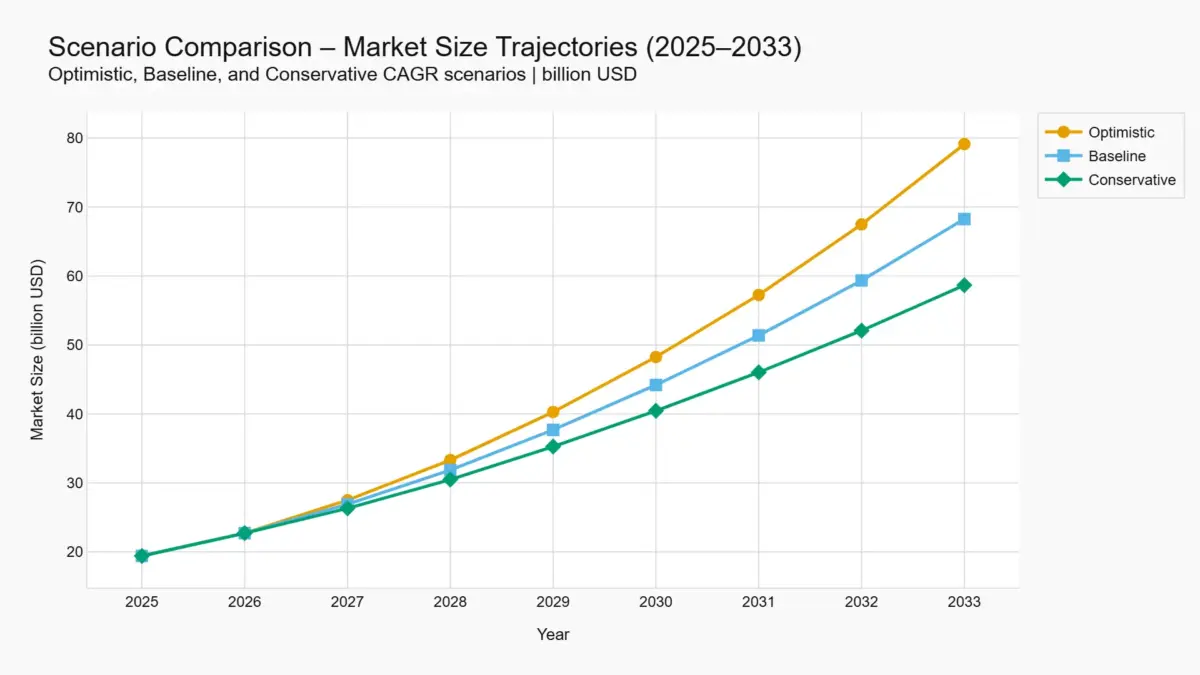
| Taux de croissance annuel moyen (CAGR) de base | 17.02% |
| Taux de croissance annuel moyen (CAGR) du scénario optimiste | 19.52% |
| Taux de croissance annuel moyen (CAGR) du scénario conservateur | 14.52% |
| Valeur du marché de base en 2033 | 68,25 milliards de dollars US |
| Forme de croissance | Frontal (investissement initial et mise en œuvre technologique précoce) |
| Principaux moteurs de la demande | Investissements dans les gigafactories (ex. : Waaree 16 GWh), conformité aux réglementations sur l'empreinte carbone de l'Union européenne, programme de subvention de 500 millions de dollars du Département de l'énergie des États-Unis |
| Principaux risques/contraintes | Substitution par les fournisseurs de robotique (ABB/KUKA), incertitudes des politiques commerciales |
| Focus régional (fourni) | Aucune décomposition quantitative par région fournie |
| Focus sur les segments (fourni) | Quatre segments d'équipement : fabrication d'électrodes, assemblage de cellules, formation/test, assemblage de modules/packs – aucune valeur au niveau des segments fournie |
Taille du marché mondial de l'équipement de fabrication de batteries et trajectoire de base
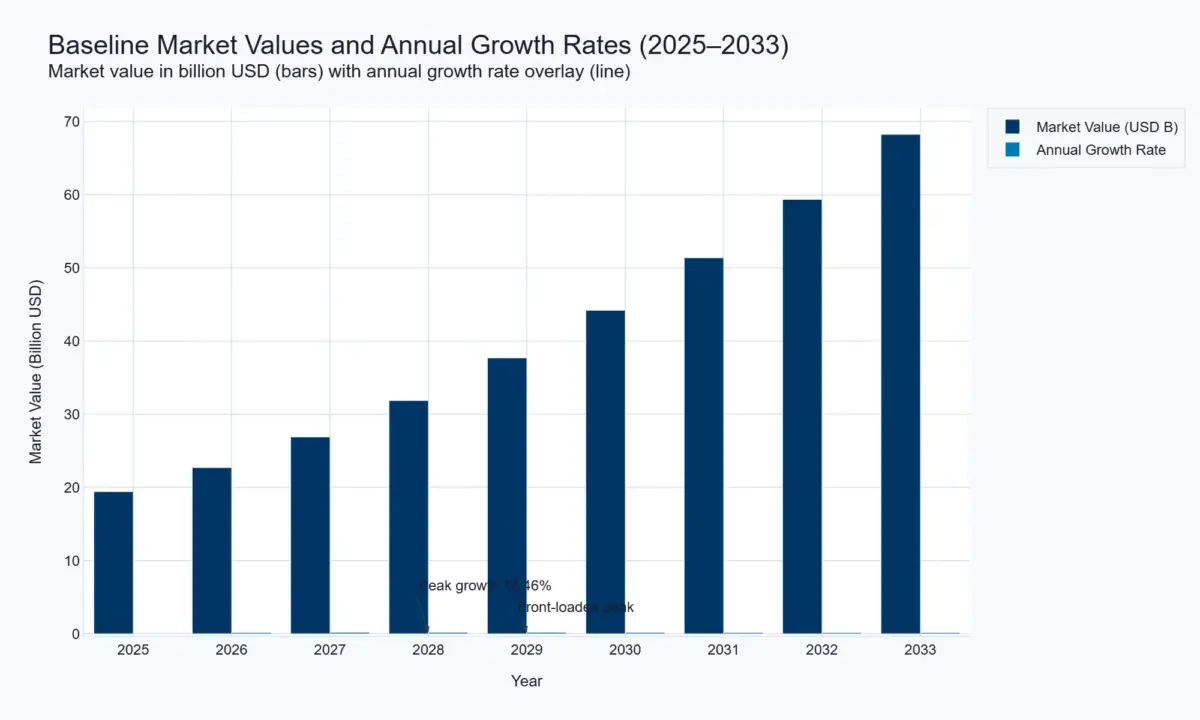
Le marché mondial de l'équipement de fabrication de batteries couvre les machines et les systèmes utilisés pour produire des cellules de batteries lithium-ion et des packs de batteries. Il inclut l'équipement utilisé pour la fabrication d'électrodes, l'assemblage de cellules, la formation et le test des batteries, ainsi que l'assemblage de modules et de packs. Le marché couvre également des composants métalliques de précision, des systèmes d'automatisation et de contrôle, ainsi que des logiciels lorsqu'ils sont fournis en tant que parties intégrantes des équipements de fabrication de batteries. Le marché a été estimé à 19,41 milliards de dollars US en 2025 et devrait atteindre 68,25 milliards de dollars US d'ici 2033 dans le scénario de base. Cela représente un taux de croissance annuel moyen (CAGR) de 17,02 % sur la période de prévision de huit ans, de 2025 à 2033. La trajectoire de croissance est frontale, ce qui signifie que les taux de croissance les plus élevés se produisent durant les premières années (2027–2029), motivés par la mise en œuvre simultanée des investissements, de l'adoption technologique et de la conformité réglementaire. Après 2030, la croissance se modère à mesure que les facteurs de risque s'accumulent et que la première vague d'investissement initial passe.Trajectoire du marché mondial des équipements de fabrication de batteries année par année
| Année | Valeur du marché (en milliards de dollars) | Taux de croissance annuel |
|---|---|---|
| 2025 | 19.41 | — |
| 2026 | 22.71 | 17.02% |
| 2027 | 26.89 | 18.40% |
| 2028 | 31.86 | 18.46% |
| 2029 | 37.69 | 18.31% |
| 2030 | 44.20 | 17.27% |
| 2031 | 51.38 | 16.24% |
| 2032 | 59.35 | 15.52% |
| 2033 | 68.25 | 14.99% |
Principaux moteurs de la croissance du marché mondial des équipements de fabrication de batteries
Expansion des gigafactories en Inde – Waaree Energies
Waaree Energies investit environ 8 175 crore de roupies (1 milliard de dollars) pour construire une gigafactory de 16 GWh de batteries lithium-ion en Andhra Pradesh, en Inde. Approuvée en début 2026, cette installation produira des cellules de batterie, des packs et des stockages à grande échelle—créant environ 3 000 emplois directs le long du processus. En tant que projet tout nouveau, elle devrait stimuler une forte demande pour l'équipement clé de fabrication, notamment l'équipement pour électrodes, assemblage de cellules et tests. L'acquisition d'équipements devrait augmenter significativement jusqu'en 2026 et 2027.Conformité aux réglementations sur les batteries de l'UE
La Règlement sur les batteries de l'UE (UE) 2023/1542 (Article 7) exige des opérateurs économiques et des fabricants d'émettre des déclarations formelles sur l'empreinte carbone pour toutes les batteries sur le marché de l'UE. Pour se conformer, les usines de production doivent déployer un équipement spécialisé capable de mesurer la consommation d'énergie et de tracer les origines des matériaux.
Points clés et indicateurs :
-
Diligence matérielle : Règles couvrant le cobalt, le lithium, le nickel et le graphite naturel entrent en vigueur à partir du 18 août 2025.
-
Impact de l'équipement : Crée une forte demande orientée conformité pour des systèmes avancés de formation, de test et de gestion des données, malgré les retards actuels dans les désignations des organismes notifiés.
-
Signaux Métriques : Évalué comme un signal positif avec 0.443 de confiance, vérifié par le Centre Commun de Recherche de la Commission européenne.
Programme de subventions de la U.S. DOE pour la fabrication de batteries
Le Département de l'Énergie des États-Unis, dans le cadre de l'Infrastructure Investment and Jobs Act (IIJA) Section 40207, a publié le NOFO DE-FOA-0003585, mettant jusqu'à 500 millions de dollars à disposition pour le traitement, la fabrication et le recyclage des matériaux de batteries nationaux. Les candidatures étaient à déposer le 24 avril 2026, avec des attributions prévues au troisième trimestre 2026. Le programme vise à augmenter de 15 % la production des minéraux critiques d'ici 2030. L'équipement pour le revêtement d'électrodes, l'assemblage de cellules et le recyclage en bénéficiera directement. Le signal directionnel positif (confiance 0,471) est basé sur une seule source gouvernementale. Timing : les attributions en H2 2026 commenceront l'achat d'équipement en 2027–2028.Substitution d'automatisation par les fournisseurs de robots
Des fournisseurs de robots industriels tels qu'ABB et KUKA proposent des robots spécialement conçus pour le empilage de cellules de batterie et l'assemblage de modules. Les robots ABB IRB 4600 et IRB 6620 gèrent le placement de cellules et le soudage au laser, tandis que KUKA fournit des robots certifiés pour les salles propres pour toutes les formats de cellules (sachets, prismatiques, cylindriques). Cette concurrence côté fournisseur représente un signal directionnel négatif pour les fabricants traditionnels d'équipements, car les systèmes robotiques intégrés peuvent remplacer les machines dédiées à l'empilage et à l'assemblage. Le signal est négatif avec une confiance de 0,4765 et des confirmations issues des sites web des deux entreprises. L'effet devrait s'intensifier durant la période de prévision à mesure que les coûts d'automatisation diminuent. La conjonction des réglementations, des financements publics et des investissements privés dans les gigafactories crée une opportunité large pour les fournisseurs d'équipements capables de proposer des solutions numériques intégrées et des fonctionnalités permettant de respecter les normes. La collaboration Siemens-Northvolt (investissement de 10 millions d'euros dans une gigafactory suédoise de 32 GWh) montre comment les portefeuilles d'automatisation et de logiciels peuvent différencier les offres d'équipements. En outre, l'adoption de la technologie de revêtement d'électrodes sèche (Dürr X.Cellify DC, visant une réduction de 65 % de l'énergie) ouvre un nouveau segment pour les équipements de capital qui réduisent à la fois les coûts de capital (CapEx) et les coûts opérationnels (OpEx) pour les fabricants de cellules.Chemins de scénario et implications du marché
La prévision est construite sous trois scénarios de CAGR reflétant différentes hypothèses concernant l'intensité et le timing des investissements, de l'adoption technologique, des réglementations, des risques et de la concurrence. Tous les scénarios partagent une forme de croissance frontale déclenchée par un investissement et un déploiement technologique précoces. Dans le scénario optimiste, un fort investissement et une forte adoption technologique accélèrent la croissance en début de période, avec des modificateurs nets atteignant +0,1474 en 2029. Le scénario de base intègre des offsets modérés, avec un ralentissement des années ultérieures (le modificateur net passant de +0,1404 en 2029 à +0,0281 en 2033). Le scénario conservateur reflète un investissement plus faible en début de période et des effets prolongés de risques et de concurrence, en particulier liés à la substitution par l'automatisation et aux barrières commerciales. Implications : Les fabricants d'équipements doivent prioriser les opportunités d'investissement à court terme (2026–2029) lorsque les moteurs d'investissement et réglementaires sont les plus forts. Dans les années ultérieures, la différenciation par des solutions numériques, un soutien à la conformité et des chaînes d'approvisionnement robustes sera cruciale. Les participants exposés aux importations d'équipements chinois devraient développer des stratégies d'approvisionnement alternatives pour atténuer les risques liés aux contrôles d'exportation.Segmentation du marché mondial des équipements de fabrication de batteries
- Par type d'équipement
- Équipements de fabrication d'électrodes
- Équipements de mélange
- Systèmes de mélange de pâte
- Mélangeurs de pâte cathodique
- Mélangeurs de pâte anodique
- Systèmes de mélange sous vide
- Équipements de mélange à haute vitesse
- Systèmes de mélange de pâte
- Équipements de revêtement
- Équipements de calandrage
- Équipements de découpe d'électrodes
- Équipements de mélange
- Équipements d'assemblage de cellules
- Équipements d'empilage d'électrodes
- Équipements de bobinage
- Équipements de remplissage d'électrolyte
- Équipements de scellage de cellules
- Équipements de formation et de test
- Systèmes de formation
- Équipements de vieillissement
- Systèmes de test de batteries
- Équipements d'inspection de qualité
- Équipements d'assemblage de modules et de packs
- Systèmes d'assemblage de modules
- Lignes d'assemblage de packs de batterie
- Équipements de soudage au laser
- Systèmes de test en fin de ligne
- Équipements de fabrication d'électrodes
- Par type de batterie
- Équipements de fabrication de batteries lithium-ion
- Fosphate de fer lithium (LFP)
- Lignes de production LFP
- Traitement des électrodes
- Assemblage des cellules
- Formation et vieillissement
- Assemblage des modules
- Lignes de production LFP
- Nickel-manganèse-cobalt (NMC)
- Nickel-cobalt-aluminium (NCA)
- Titanate de lithium (LTO)
- Fosphate de fer lithium (LFP)
- Équipements de fabrication de batteries à état solide
- Équipements de batteries à base de sulfure
- Équipements de batteries à base d'oxyde
- Équipements à état solide en polymère
- Équipements à état solide hybrides
- Équipements de fabrication de batteries à ion sodium
- Équipements de traitement des électrodes
- Équipements d'assemblage de cellules
- Équipements de formation
- Équipements de test
- Autres équipements de fabrication de batteries avancés
- Équipements de batteries lithium-soufre
- Équipements de batteries à flux
- Équipements de batteries à base de zinc
- Équipements de batteries de nouvelle génération
- Équipements de fabrication de batteries lithium-ion
- Par niveau d'automatisation
- Équipements manuels
- Systèmes de production pilote
- Équipements de fabrication en laboratoire
- Prototypage de cellules
- Production en petite quantité
- Applications de recherche et développement
- Systèmes de recherche académique
- Équipements de fabrication en laboratoire
- Production semi-manuelle
- Équipements de laboratoire
- Équipements de fabrication de prototypes
- Systèmes de production pilote
- Équipement semi-automatisé
- Lignes de production modulaires
- Systèmes d'assemblage assistés
- Systèmes de fabrication flexibles
- Systèmes d'inspection intégrés
- Équipement pleinement automatisé
- Lignes de production robotisées
- Systèmes de fabrication basés sur l'intelligence artificielle
- Équipement d'usine intelligente
- Lignes de production de l'industrie 4.0
- Systèmes de fabrication numériques
- Plateformes de jumeaux numériques
- Systèmes de maintenance prédictive
- Inspection par vision machine
- Systèmes d'exécution de fabrication (MES)
- Équipements manuels
- Par utilisateur final
- Fabricants de batteries
- Fabricants de cellules
- Gigafactoires
- Production de cellules cylindriques
- Production de cellules prismatiques
- Production de cellules de type poche
- Production de cellules à état solide
- Gigafactoires
- Fabricants de modules
- Fabricants de packs de batterie
- Fabricants de batteries par sous-traitance
- Fabricants de cellules
- Constructeurs automobiles
- Fabricants de véhicules passagers
- Fabricants de véhicules commerciaux
- Fabricants de bus électriques
- Fabricants de deux-roues
- Fabricants de systèmes de stockage d'énergie
- Stockage d'énergie résidentiel
- Stockage d'énergie commercial
- Stockage d'énergie à grande échelle
- Systèmes de stockage de micro-réseaux
- Organisations de recherche et développement
- Instituts de recherche
- Universités
- Laboratoires gouvernementaux
- Centres d'innovation en batterie
- Fabricants de batteries
Insights régionaux
- Inde – La gigafactory de 16 GWh de Waaree en Andhra Pradesh représente une importante augmentation de capacité, stimulant la demande d'équipements à partir de 2026.
- Union européenne – La réglementation sur les batteries de l'UE (2023/1542) et les normes IEC (2026) créent une demande impulsée par la conformité pour l'équipement de test et de formation. La collaboration Siemens–Northvolt (32 GWh en Suède) illustre le déploiement d'équipements numériques intégrés.
- États-Unis – Le programme de subvention de 500 millions de dollars du DOE et les investissements privés (Forge Nano SPAC, lignes d'assemblage EnPower) indiquent une croissance croissante de la demande domestique, bien que l'incertitude concernant les tarifs ait ralenti les annonces de projets.
- Chine – Domine la fabrication de machines de découpe d'électrodes (Naura, Wuxi Lead), mais fait face à des restrictions sur l'exportation d'équipements à haute densité.
Entreprises principales du marché
Selon le chapitre sur le paysage de la concurrence fourni, les participants clés incluent :- Naura Technology Group et Wuxi Lead Intelligent Equipment – principaux fabricants de machines de découpe d'électrodes de batterie entièrement automatiques (Chine).
- Siemens AG– fournit le portefeuille Digital Enterprise pour la numérisation des gigafactories ; a investi 10 millions d'euros dans l'installation de 32 GWh de Northvolt.
- Toray Engineering, Hakusan, MTI – autres fabricants mondiaux d'équipements de découpe (Japon/États-Unis).
- ANDRITZ– a fourni une ligne de formation de 1,5 GW pour un constructeur allemand de luxe (en exploitation en janvier 2026).
- EnPower – a investi dans des lignes d'assemblage de cellules automatisées à Indianapolis pour UAV/défense (en exploitation au deuxième trimestre 2026).
- Forge Nano – développeur d'équipements de dépôt en couche atomique ; a levé 40 M $ + 97 M $ de série D + 23 M $ PIPE ; fusion SPAC valorisée à 1,2 milliard de dollars.
Pourquoi l'investissement dans la fabrication de batteries reste critique
La transition énergétique mondiale repose sur une production à grande échelle de batteries. Le marché des équipements est la base permettant d'y parvenir : sans lignes de production avancées à haut débit, les objectifs de capacité des cellules ne peuvent être atteints. La trajectoire de croissance frontale souligne que les engagements de capital à court terme (2025–2029) détermineront les positions sur le marché. Les financements publics (DOE), les mandats réglementaires (UE), et les projets de gigafactory privés (Waaree, Northvolt) convergent pour créer un cycle de demande soutenu. En parallèle, la substitution par l'automatisation et les risques commerciaux introduisent des pressions concurrentielles qui récompensent les fournisseurs d'équipements agiles. Le marché reste critique car l'équipement de fabrication de batteries influence directement le coût, la qualité et la sécurité des chaînes d'approvisionnement en batteries du monde.Table des matières
1. Résumé exécutif
1.1 Aperçu du marché (2025–2033) 1.2 Points clés de croissance 1.3 Aperçu du cadre de scénario 1.4 Méthodologie de prévision et hypothèses 1.5 Aperçu de la demande et de l'offre 1.6 Point de vue de l'analyste2. Aperçu du marché
2.1 Introduction au marché mondial de l'équipement de fabrication de batteries 2.2 Définition du marché et périmètre 2.3 Analyse de la chaîne de valeur de l'industrie 2.4 Évolution du marché et tendances historiques 2.5 Écosystème de l'équipement de fabrication de batteries 2.6 Tendances technologiques, automatisation et fabrication numérique3. Aperçu de la prévision du marché mondial de l'équipement de fabrication de batteries (en milliards de dollars), 2025–2033
3.1 Taille du marché pour l'année de base (2025) 3.2 Prévision du marché de base (2033) 3.3 Taux de croissance annuel composé (2025–2033) 3.4 Analyse de la forme de croissance 3.5 Principaux moteurs de la demande 3.6 Principaux risques et contraintes 3.7 Aperçu du segment d'équipement 3.8 Perspective future4. Analyse des scénarios de prévision du marché
4.1 Périmètre du marché et trajectoire de base 4.2 Scénario de prévision de base 4.3 Scénario de prévision optimiste 4.4 Scénario de prévision conservateur 4.5 Prévision du marché année par année (2025–2033) 4.6 Analyse de l'inflexion de croissance (2027–2029) 4.7 Comparaison des scénarios et implications du marché 4.8 Méthodologie de prévision et hypothèses5. Moteurs, freins, opportunités et menaces du marché
5.1 Investissements dans l'expansion des gigafactory 5.2 Conformité aux réglementations sur les batteries de l'Union européenne 5.3 Programme de subventions pour la fabrication de batteries du DOE des États-Unis 5.4 Substitution par les fournisseurs de robots 5.5 Fabrication numérique et technologie d'électrode sèche 5.6 Risques géopolitiques et incertitudes politiques commerciales6. Défis du marché
6.1 Restrictions liées au contrôle des exportations 6.2 Incertitudes politiques commerciales 6.3 Concurrence en automatisation 6.4 Dépendances de la chaîne d'approvisionnement 6.5 Risques liés aux investissements capitaux7. Segmentations du marché par type d'équipement (en milliards de dollars), 2025–2033
7.1 Équipement de fabrication d'électrodes 7.1.1 Équipement de mélange 7.1.1.1 Systèmes de mélange de pâte 7.1.1.1.1 Mélangeurs de pâte cathodique 7.1.1.1.2 Mélangeurs de pâte anodique 7.1.1.1.3 Systèmes de mélange sous vide 7.1.1.1.4 Équipement de mélange à haute vitesse 7.1.2 Équipement de revêtement 7.1.3 Équipement de calandrage 7.1.4 Équipement de découpe d'électrodes 7.2 Équipement d'assemblage de cellules 7.2.1 Équipement d'empilage d'électrodes 7.2.2 Équipement de bobinage 7.2.3 Équipement de remplissage d'électrolyte 7.2.4 Équipement de scellage de cellules 7.3 Équipement de formation et de test 7.3.1 Systèmes de formation 7.3.2 Équipement d'âge 7.3.3 Systèmes de test de batterie 7.3.4 Équipement d'inspection de qualité 7.4 Équipement d'assemblage de modules et de packs 7.4.1 Systèmes d'assemblage de modules 7.4.2 Lignes d'assemblage de packs de batterie 7.4.3 Équipement de soudage au laser 7.4.4 Systèmes de test en fin de ligne8. Segmentations du marché par type de batterie (en milliards de dollars), 2025–2033
8.1 Équipement de fabrication de batteries lithium-ion 8.1.1 Batterie au phosphate de fer lithium (LFP) 8.1.2 Batterie nickel-manganèse-cobalt (NMC) 8.1.3 Batterie nickel-cobalt-aluminium (NCA) 8.1.4 Batterie lithium-titane (LTO) 8.2 Équipement de fabrication de batteries à état solide 8.2.1 Équipement pour batteries à base de sulfure 8.2.2 Équipement pour batteries à base d'oxyde 8.2.3 Équipement à état solide en polymère 8.2.4 Équipement à état solide hybride 8.3 Équipement de fabrication de batteries à ion sodium 8.4 Autres équipements de fabrication de batteries avancées9. Segmentations du marché par niveau d'automatisation (en milliards de dollars), 2025–2033
9.1 Équipement manuel 9.2 Équipement semi-automatisé 9.3 Équipement entièrement automatisé 9.4 Systèmes de fabrication numérique10. Segmentations du marché par utilisateur final (en milliards de dollars), 2025–2033
10.1 Fabricants de batteries 10.2 Constructeurs automobiles 10.3 Fabricants de systèmes de stockage d'énergie 10.4 Organismes de recherche et développement11. Analyse du marché régional
11.1 Inde – Expansion des gigafactory 11.2 Union européenne – Demande d'équipement guidée par la réglementation 11.3 États-Unis – Financement du DOE et expansion de la fabrication 11.4 Chine – Leadership de la fabrication et contrôles d'exportation12. Analyse approfondie de la structure du marché et de l'écosystème des équipements
12.1 Flux de processus de fabrication de batteries 12.2 Analyse de la chaîne de valeur des équipements 12.3 Écosystème des équipements de fabrication d'électrodes 12.4 Écosystème des équipements d'assemblage de cellules 12.5 Écosystème des équipements de formation et de test 12.6 Écosystème des équipements d'assemblage de modules et de packs 12.7 Composants de précision, automatisation et intégration logicielle 12.8 Industrie 4.0, intégration de l'intelligence artificielle et usine intelligente 12.9 Fabrication numérique et plateformes de gestion des usines (MES) 12.10 Technologie de fabrication d'électrodes sèches 12.11 Chaîne d'approvisionnement des équipements et dépendances critiques 12.12 Résumé comparatif de la segmentation des équipements13. Analyse de l'expansion de capacité et des investissements
13.1 Pipeline des gigafactory mondiales 13.2 Gigafactory Waaree 16 GWh 13.3 Programme de fabrication de batteries du DOE 13.4 Partenariat Siemens–Northvolt 13.5 Chronologie d'expansion de capacité (2025–2030) 13.6 Impact des investissements sur la demande en équipements14. Paysage concurrentiel
14.1 Analyse de la structure du marché 14.2 Matrice de positionnement concurrentiel 14.3 Développements stratégiques 14.4 Concurrence en automatisation et en robotique 14.5 Benchmarking technologique15. Profils des entreprises
15.1 Naura Technology Group 15.2 Wuxi Lead Intelligent Equipment 15.3 Siemens AG 15.4 Toray Engineering 15.5 Hakusan Corporation 15.6 MTI Corporation 15.7 ANDRITZ AG 15.8 EnPower Inc. 15.9 Forge Nano 15.10 ABB 15.11 KUKA AG16. Intelligence stratégique et insights basés sur l'intelligence artificielle
16.1 Moteur de prévision de la demande de Pheonix 16.2 Tableau de bord du marché des équipements de batteries 16.3 Intelligence de fabrication alimentée par l'intelligence artificielle 16.4 Intelligence de l'usine intelligente et de l'automatisation 16.5 Intelligence sur les investissements en équipements de batteries mondiaux17. Opportunités d'investissement et de croissance
17.1 Investissements en équipements de gigafactory 17.2 Solutions de fabrication numérique 17.3 Équipements de formation et de test 17.4 Automatisation de l'usine intelligente 17.5 Équipements de fabrication d'électrodes sèches 17.6 Technologies de fabrication de batteries de nouvelle génération18. Pourquoi l'équipement de fabrication de batteries reste critique
18.1 Fondement de la production mondiale de batteries 18.2 Expansion des gigafactory entraînant la demande en équipements 18.3 Transformation par l'automatisation et la fabrication numérique 18.4 Localisation de la chaîne d'approvisionnement et innovation en équipements 18.5 Croissance à long terme à travers l'écosystème de fabrication de batteries19. Annexe
20. À propos de Pheonix Research
21. Avertissement
Paysage concurrentiel
Paysage concurrentiel du marché mondial de l'équipement de fabrication de batteries
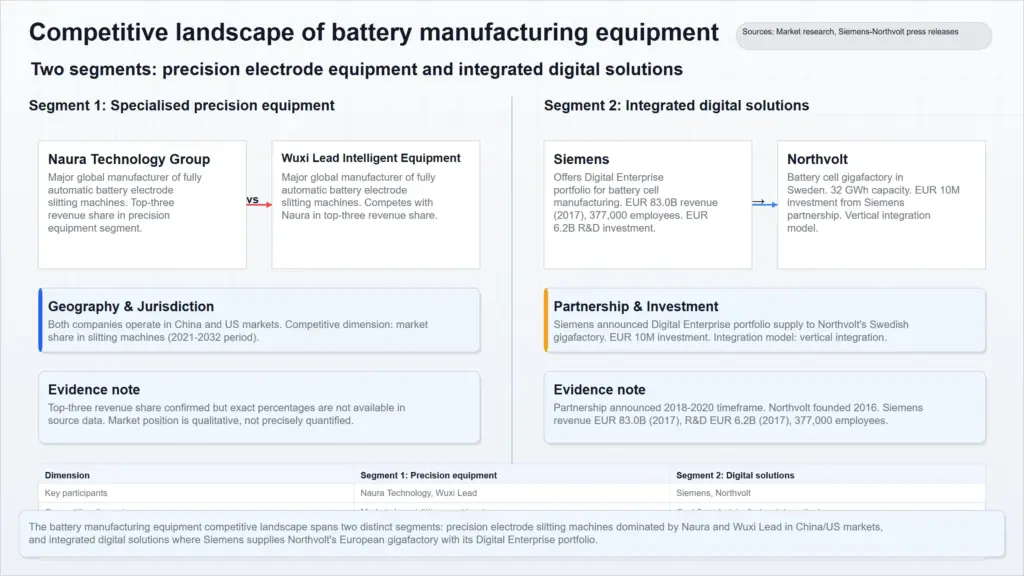
Le paysage concurrentiel du marché de l'équipement de fabrication de batteries est façonné par des entreprises fournissant des machines et des technologies pour la production de cellules et de packs de batteries lithium-ion. La concurrence est principalement axée sur deux domaines : l'équipement de processus précis, notamment les machines de découpe automatique d'électrodes, et les solutions d'automatisation et de numérisation intégrées pour les gigafactories. L'analyse couvre le marché mondial, avec une attention particulière au segment de découpe d'électrodes en Chine et à l'étude de cas de l'intégration numérique en Europe.
Le marché mondial de l'équipement de fabrication de batteries a été estimé à environ USD 19,41 milliards de dollars en 2025 (estimation d'un seul site web), créant un marché important et en croissance pour les fournisseurs d'équipements. L'analyse exclut l'équipement utilisé pour le traitement des matières premières en amont, l'équipement de recyclage de batteries, ainsi que les applications finales au-delà de la fabrication de batteries.Points clés
- Naura Technology Group et Wuxi Lead Intelligent Equipment sont parmi les rares fabricants reconnus à l'échelle mondiale de machines de découpe automatique d'électrodes de batteries, positionnant les entreprises chinoises comme des fournisseurs critiques dans une étape de processus axée sur la précision.
- Siemens concurrence dans l'équipement de batterie via son portefeuille Digital Enterprise, offrant une numérisation de bout en bout ; son investissement de 10 millions d'euros dans la gigafactory de 32 GWh de Northvolt signale une stratégie basée sur la coopération pour sécuriser des projets de référence.
- Le marché est divisé entre des OEM spécialisés en matériel et des fournisseurs d'automatisation/logiciels intégrés, chacun servant différentes dimensions concurrentielles (précision du processus vs. numérisation au niveau de l'usine).
- Prévisions de production de machines de découpe d'électrodes en Chine (2021-2032) sont mentionnées dans les études de marché, suggérant une croissance continue de la demande, bien que les chiffres exacts ne soient pas disponibles dans les preuves fournies.
Équipement de précision spécialisée : découpe d'électrodes
Les machines de découpe automatique d'électrodes de batteries sont une partie importante de la fabrication de cellules lithium-ion. Elles sont utilisées pour couper précisément les feuilles d'électrodes revêtues avant que les cellules ne passent à l'étape suivante de l'assemblage. Le marché mondial inclut plusieurs fabricants établis, tels que Toray Engineering, Hakusan, MTI, Nagano-Automation, Maysun, Naura Technology, Ruian Loyal Machinery, Wuxi Lead Intelligent Equipment et Wuxi Jinye Complete Equipment. Parmi ces entreprises, Naura Technology Group et Wuxi Lead Intelligent Equipment sont reconnus comme des acteurs majeurs sur le marché mondial.
Le rapport ne fournit pas de parts de revenus exactes, mais il indique que les trois principaux fournisseurs représentaient une part non spécifiée des revenus en 2025, montrant que le marché est quelque peu concentré. L'étude fournit également une prévision pour la valeur de production des machines de découpe automatique d'électrodes de batterie en Chine, 2021-2032 (section 3.6.3), ce qui indique une continuation des investissements et de l'expansion des capacités en Chine. Naura et Wuxi Lead ont un avantage car ils sont proches de la plus grande base de production de cellules de batterie au monde, ce qui les aide à la logistique et à l'échelle de production. Cependant, le rapport ne fournit pas de valeurs exactes de production ou de parts de marché, donc le niveau de concentration du marché ne peut être mesuré précisément. Toray et Hakusan du Japon ainsi que MTI des États-Unis sont également actifs sur le marché, ce qui en fait un marché mondial avec une concurrence répartie sur différentes régions.Solutions numériques intégrées : la collaboration Siemens-Northvolt
Contrairement à la concentration au niveau des composants des fabricants de machines de découpe, les grands fournisseurs d'automatisation industrielle concurrencent en offrant une numérisation d'usine complète. L'exemple le plus clairement fourni est la collaboration annoncée en mai 2018 entre Siemens et Northvolt. Siemens a convenu de fournir son portefeuille Digital Enterprise à Northvolt pour la construction et l'exploitation de sa gigafactory de cellules de batteries lithium-ion à Skellefteå, en Suède. La collaboration comprenait un investissement de 10 millions d'euros de la part de Siemens, et après le début de la production (la usine a ouvert en 2020 avec une capacité planifiée de 32 GWh), Northvolt est devenu un fournisseur préféré de batteries lithium-ion pour Siemens. La logique concurrentielle est double. Premièrement, Siemens utilise la collaboration comme un projet de référence pour la production future de batteries, montrant comment son portefeuille (logiciel, automatisation, calcul en nuage) peut numériser toute la chaîne de valeur - de la conception et de la planification du processus à l'ingénierie et aux services. Jan Mrosik, alors PDG de Siemens Digital Factory, a déclaré : « Avec notre portefeuille Digital Enterprise, nous contribuons à une production de cellules de batterie compétitive en Europe qui exploite pleinement les bénéfices du logiciel et de l'automatisation : une plus grande flexibilité, efficacité et qualité avec un temps de marché plus court. » Deuxièmement, l'accord côté fourniture (Siemens achetant des batteries) crée un incitatif en boucle fermée, alignant les ventes d'équipement de Siemens sur l'acheminement en aval. Peter Carlsson, fondateur de Northvolt, a souligné l'adéquation stratégique de la collaboration : « Avec son expertise de premier plan en électrification, automatisation et numérisation, Siemens deviendra un partenaire technologique, fournisseur et client important pour Northvolt. » Cette approche contraste avec le modèle transactionnel, axé sur le matériel, des fournisseurs d'équipements de découpe d'électrodes.| Dimension | Fabricants d'équipements spécialisés (par exemple, Naura, Wuxi Lead) | Fournisseurs d'automatisation intégrée (par exemple, Siemens) |
|---|---|---|
| Focus produit | Machines de précision pour un seul processus (découpe d'électrodes) | Portefeuille complet de Digital Enterprise (logiciel, automatisation, services) |
| Accent géographique | Chine (base de production domestique) avec des ventes mondiales | Europe (projet de référence en Suède) avec une portée mondiale |
| Proposition de valeur | Précision, fiabilité et efficacité des coûts au niveau du processus pour une étape spécifique | Flexibilité, qualité et réduction du temps de marché au niveau de l'usine grâce à une numérisation complète |
| Échelle d'investissement | Non divulgué pour les projets individuels ; croissance du marché implicite via les prévisions de production en Chine (2021‑2032) | Investissement en capital de 10 millions d'euros plus engagement à long terme pour l'approvisionnement en batteries |
| Structure du marché | Plusieurs acteurs ; les trois premiers détiennent une part de revenus mesurée mais non divulguée | Partenariats à grande échelle ; modèle de projet de référence pour l'acquisition de clients |
Chaîne de valeur
Étendue du marché mondial de l'équipement de fabrication de batteries et taxonomie des équipements
Le marché de l'équipement de fabrication de batteries englobe les machines et systèmes utilisés pour produire des cellules lithium-ion et des packs de batteries. Ce chapitre couvre quatre segments d'équipements principaux : la fabrication d'électrodes, l'assemblage de cellules, la formation et les tests, ainsi que l'assemblage de modules et de packs. Les fournisseurs en amont fournissent des composants de machines industrielles, des pièces métalliques précises, des composants électriques et électroniques, des systèmes d'automatisation et de contrôle, des matériaux spécialisés (céramiques, polymères), ainsi que des outils logiciels et de simulation. Les clients en aval incluent les producteurs de cellules lithium-ion, les fabricants de packs de véhicules électriques, les assemblers de systèmes de stockage d'énergie et les lignes de production de batteries pour appareils électroniques grand public. Des services d'accompagnement tels que l'entretien, la conseil, la formation et la logistique complètent l'écosystème. Le marché global adressable est estimé à 19,41 milliards de dollars en 2025, selon une estimation web unique. La couverture de ce chapitre est limitée aux deux investissements pour lesquels des preuves sont disponibles ; aucun données n'ont été fournies concernant les équipements de fabrication d'électrodes ou d'assemblage de modules/packs, ni pour les régions en dehors de l'Allemagne et des États-Unis.| Segment d'équipement | Entrées en amont | Applications en aval | Exemple d'investissement récent (d'après les preuves fournies) |
|---|---|---|---|
| Fabrication d'électrodes | Matériaux spécialisés, pièces métalliques précises, automatisation/contrôle | Production de cellules lithium-ion | Aucun investissement spécifique dans le paquet fourni |
| Assemblage de cellules | Automatisation/contrôle, pièces métalliques précises, logiciel | Production de cellules lithium-ion | Lignes d'assemblage automatisées d'EnPower, 60 MWh, Indianapolis, deuxième trimestre 2026 |
| Formation et tests | Électronique de puissance, composants électriques/électroniques, logiciel | Production de cellules lithium-ion pour véhicules électriques | Ligne de formation ANDRITZ de 1,5 GW, 50 000 canaux, Allemagne, janvier 2026 |
| Assemblage de modules et de packs | Automatisation/contrôle, composants électriques, logiciel | Pack de véhicule électrique, système de stockage d'énergie | Aucun investissement spécifique dans le paquet fourni |
Signaux d'investissement contrastés : formation à haute capacité vs. assemblage spécialisé
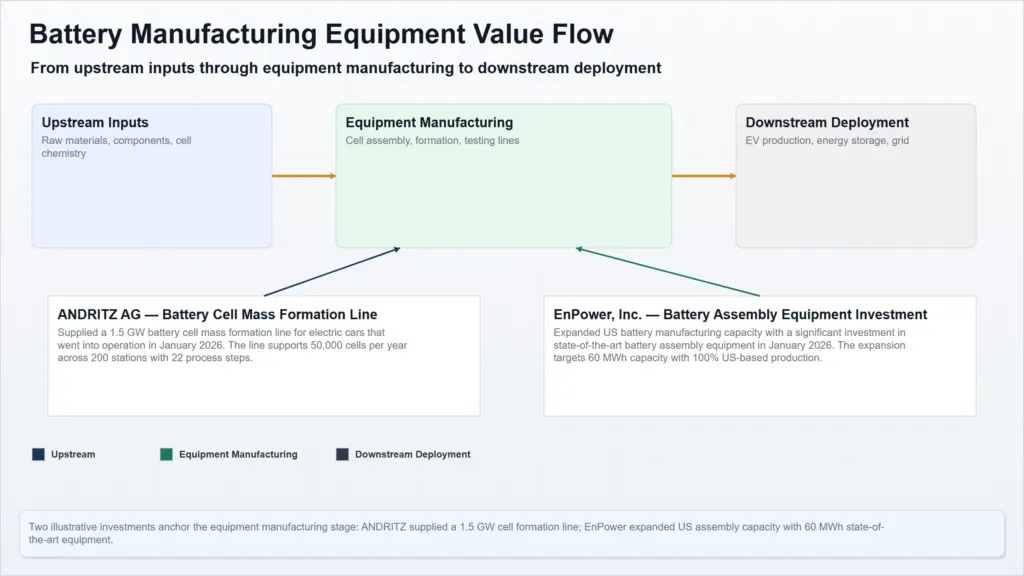
Deux annonces d'expansion d'équipements mettent en évidence la diversité des capacités, des usages finaux et des géographies sur le marché. Une filiale d'ANDRITZ a livré une ligne de formation en masse de 1,5 gigawatt à un producteur de batteries dans le sud de l'Allemagne. La ligne, dotée de 50 000 canaux et d'un débit de 200 cellules par minute, produit des cellules de boosters cylindriques pour un célèbre constructeur automobile premium allemand. L'équipement intègre des électroniques de puissance intégrées, un suivi des données en temps réel et des solutions numériques ; ANDRITZ fournit également l'installation, la mise en service et le soutien tout au long du cycle de vie. La ligne a entré en service en janvier 2026, et la société indique qu'elle « travaille intensivement sur les commandes suivantes ». À l'inverse, EnPower a annoncé un investissement dans des lignes d'assemblage automatisées avancées à son siège à Indianapolis. Les nouvelles lignes ajouteront 60 MWh de capacité d'assemblage annuelle pour des cellules de haute performance destinées aux secteurs UAV et de défense. L'équipement comprend le traitement d'électrodes, le contrôle qualité et l'automatisation de bout en bout. EnPower souligne que sa source de matériaux est à 100 % non-FEOC, assurant ainsi une chaîne d'approvisionnement nationale. Les lignes sont attendues pleinement opérationnelles d'ici le deuxième trimestre 2026. La société décrit cet investissement comme « une étape critique pour renforcer la chaîne d'approvisionnement en batteries aux États-Unis » et comme répondant à « un besoin urgent de batteries de haute performance, sécurisées et nationales ».| Aspect | ANDRITZ (Allemagne) | EnPower (États-Unis) |
|---|---|---|
| Échelle de capacité | Ligne de formation de 1,5 GW | Capacité d'assemblage annuelle de 60 MWh |
| Application finale | Cellules de boosters pour un constructeur premium de véhicules électriques | UAV et cellules de haute performance pour la défense |
| Centre géographique | Allemagne du sud (coopération européenne complète) | Indianapolis, Indiana (100 % d'origine nationale) |
| Type d'équipement | Ligne de production de masse : 50 000 canaux, 200 cellules/min, 22 modules, 14 racks | Lignes d'assemblage automatisées de cellules avec traitement des électrodes et contrôle qualité |
| Accent mis sur la technologie | Solutions numériques, gestion des données, électronique de puissance avancée, services sur l'ensemble du cycle de vie | Automatisation de bout en bout, approvisionnement en matériaux non-FEOC, contrôle qualité |
| Calendrier | Opérationnel en janvier 2026 | Opérationnel à 100 % au deuxième trimestre 2026 |
| Type de client | Automobiliste allemand de luxe réputé | Secteur de la défense et des UAV aux États-Unis |
Implications du marché pour les participants et les délais
Les deux investissements annoncés indiquent une demande croissante dans deux segments d'équipement distincts : les lignes de formation de production de masse et les lignes d'assemblage spécialisées de cellules. Les facteurs d'achat varient selon l'application : l'échelle, les capacités numériques et les services sur l'ensemble du cycle de vie influencent les décisions pour les lignes automobiles à grande échelle, tandis que la sécurité de la chaîne d'approvisionnement, l'automatisation et l'autonomie d'approvisionnement dominent les projets orientés défense. Les deux investissements sont attendus opérationnels au premier semestre 2026, s'alignant sur l'expansion globale de la production de cellules de batterie. Pour les fabricants d'équipements, le marché européen semble valoriser la différenciation technologique (solutions numériques, électronique de puissance) et un soutien sur l'ensemble du cycle de vie, comme le montre la « coopération européenne complète » d'ANDRITZ et sa capacité « à l'emporter sur d'autres concurrents ». En Amérique du Nord, l'accent mis sur l'approvisionnement non-FEOC et les chaînes d'approvisionnement nationales suggère que les fournisseurs d'équipements capables d'offrir des lignes d'assemblage modulaires basées aux États-Unis et des chaînes de matériaux sécurisées auront un avantage concurrentiel. Le marché adressable total de 19,41 milliards de dollars en 2025 fournit un contexte pour l'échelle de l'opportunité, mais les tendances de croissance au niveau des segments, les parts de marché concurrentielles et les prix restent non soutenus par les preuves fournies. Les fabricants d'équipements doivent surveiller les exigences évolutives des clients automobiles par rapport à ceux de la défense et des UAV, car ces segments demanderont probablement des configurations d'équipement de plus en plus différenciées.Activité d'investissement
Chapitre d'investissement : Marché des équipements de fabrication de batteries
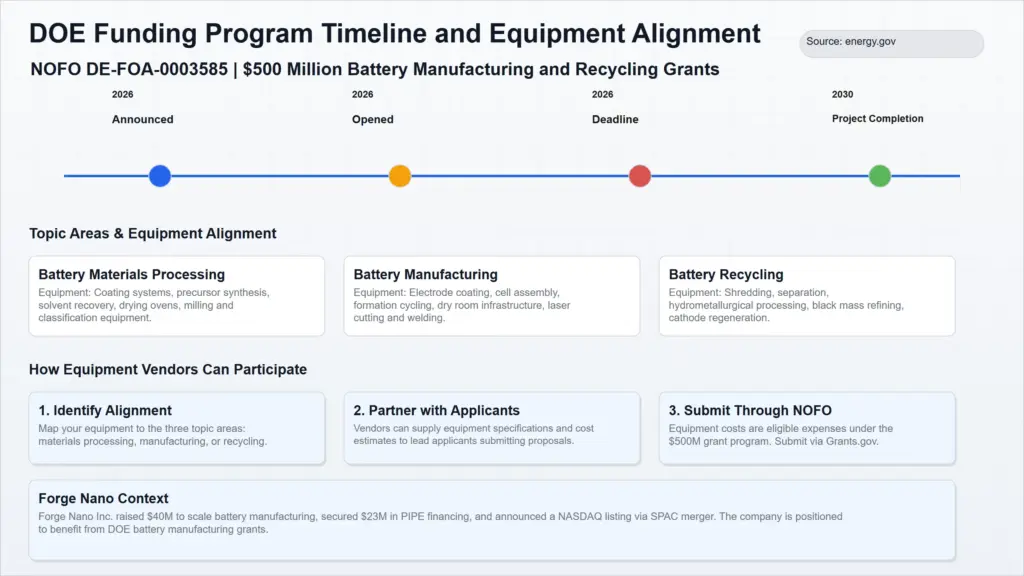
Ce chapitre couvre les activités d'investissement dans les équipements de fabrication de batteries, en mettant l'accent sur le financement public et privé aux États-Unis pendant la période 2025-2026. L'analyse s'appuie sur deux sources principales : un programme de financement de 500 millions de dollars du Département de l'Énergie des États-Unis et le financement levé par Forge Nano Inc., qui développe des équipements de dépôt en couche atomique. Le financement divulgué inclut le engagement de 500 millions de dollars du DOE et le financement de Forge Nano comprenant 40 millions de dollars, 23 millions de dollars PIPE et 97 millions de dollars de série D.Points clés
- Le Département de l'Énergie des États-Unis a lancé une opportunité de financement de 500 millions de dollars pour le traitement des matériaux de batteries, la fabrication et le recyclage, dans le cadre de l'Article 40207 de l'IIJA. Les attributions sont attendues au troisième trimestre 2026, et le programme vise à augmenter la production des minéraux critiques de 15 % d'ici 2030.
- Forge Nano a levé 40 millions de dollars en 2025, puis a sécurisé un financement PIPE de 23 millions de dollars et une série D de 97 millions de dollars entre 2025 et mi-2026. L'entreprise a également signé un accord de fusion avec une SPAC de 1,2 milliard de dollars.
- Plusieurs investisseurs stratégiques, notamment Samsung SDI, GM, Volkswagen et LG Technology Ventures, ont investi dans Forge Nano. Leur participation montre que les entreprises automobiles et de batteries prennent un intérêt particulier aux équipements de revêtement avancés et à leur rôle dans la production future des batteries.
- La technologie de dépôt en couche atomique de Forge Nano peut être utilisée à la fois dans les applications semi-conductrices et de batterie. Cela donne à l'entreprise une exposition à plusieurs industries et a contribué à attirer un plus large groupe d'investisseurs à mesure qu'elle se rapproche de sa liste en NASDAQ.
- Dans l'ensemble, la combinaison de financements publics et d'investissements privés soutient le développement de la chaîne d'approvisionnement en équipements de batterie aux États-Unis. Cependant, les informations disponibles couvrent uniquement une entreprise d'équipements et les activités basées aux États-Unis, donc elles ne donnent pas une image complète des investissements sur le marché mondial.
Paysage des investissements : flux de capitaux publics et privés
Entre 2025 et 2026, les investissements divulgués dans les équipements de fabrication de batteries comprennent 500 millions de dollars de financement public du Département de l'Énergie des États-Unis et des levées de capitaux privés par Forge Nano : 40 millions de dollars en 2025, un financement PIPE de 23 millions de dollars et une série D de 97 millions de dollars. Le programme du DOE est la troisième ronde sous l'Article 40207 de la Loi sur les investissements dans l'infrastructure et les emplois (IIJA), axé sur le traitement des matériaux critiques nationaux, le recyclage et la fabrication des composants de batterie. Les investissements privés sont concentrés sur les équipements de revêtement avancés, avec la technologie de dépôt en couche atomique de Forge Nano attirant un ensemble diversifié d'investisseurs stratégiques et financiers.| Projet / Entreprise | Investisseur / Partenaire | Géographie | Montant | Timing | Statut |
|---|---|---|---|---|---|
| Subventions du DOE pour le traitement, la fabrication et le recyclage des matériaux de batterie (DE-FOA-0003585) | Département de l'Énergie des États-Unis (Bureau de déploiement de la fabrication) | États-Unis | 500 millions de dollars | Date de publication le 13 mars 2026 ; candidatures à soumettre avant le 24 avril 2026 ; attributions attendues au troisième trimestre 2026 | Ouvert ; sélections anticipées au deuxième trimestre 2026, attributions au troisième trimestre 2026 |
| Forge Nano Inc. (équipements de dépôt en couche atomique pour les batteries et les semi-conducteurs) | Cocapitainés par RockCreek et Ascent Funds ; actionnaires stratégiques comprennent GM Ventures, Volkswagen, LG Technology Ventures, Hanwha, Mitsui Kinzoku, Sumitomo Corporation of Americas, Air Liquide ; Samsung SDI (PIPE et Série D) | États-Unis (Denver, Colorado) | 40 millions de dollars (2025) + 23 millions de dollars PIPE + 97 millions de dollars Série D ; fusion avec SPAC avec ~182 millions de dollars de capital engagé provenant du PIPE et de la Série D | 2025-2026 ; annonce de la fusion SPAC en avril 2026, prévue à la fin du deuxième semestre 2026 | Rounds de financement fermés ; fusion en attente de la liste NASDAQ |
Étude de cas de capital privé : Trajectoire de financement de Forge Nano
Forge Nano, une entreprise basée aux États-Unis qui développe des équipements de dépôt en couche atomique (ALD) pour la fabrication de semi-conducteurs et de batteries, a levé 40 millions de dollars en 2025, un financement PIPE de 23 millions de dollars et a clôturé sa série D à 97 millions de dollars. La trajectoire de financement de l'entreprise illustre la convergence des objectifs politiques publics, des intérêts corporatifs stratégiques et de la demande du marché financier pour la technologie d'équipement.- Avril 2025 : Financement de 40 millions de dollars cocapitainé par RockCreek et Ascent Funds. L'investissement total en capital a dépassé 140 millions de dollars. Les actionnaires stratégiques comprennent GM Ventures, Volkswagen, LG Technology Ventures, Hanwha, Mitsui Kinzoku, Sumitomo Corporation of Americas et Air Liquide.
- Juillet 2026 : Financement PIPE supplémentaire de 23 millions de dollars au prix de 10,00 dollars par action, augmentant ainsi le montant total des engagements PIPE à 123 millions de dollars. Samsung SDI s'est engagé à 20 millions de dollars, répartis entre 10 millions de dollars en PIPE et 10 millions de dollars en Série D. La Série D a été clôturée à 97 millions de dollars, terminant ainsi la formation de capital pré-IPO.
- Avril 2026 : Accord de combinaison commerciale définitif avec Archimedes Tech SPAC Partners II Co. valorisé à 1,2 milliard de dollars. Le capital engagé provenant du PIPE et de la Série D totalise environ 182 millions de dollars. La transaction est prévue pour se clore au deuxième semestre 2026, avec une cotation en NASDAQ sous le ticker NANO.
Catalyseurs du secteur public : Le programme de 500 millions de dollars du DOE
Le Département de l'Énergie des États-Unis, par l'intermédiaire de son Office of Critical Minerals and Energy Innovation, a publié le 13 mars 2026 la Notice of Funding Opportunity DE-FOA-0003585, rendant disponibles jusqu'à 500 millions de dollars pour des projets visant à développer des infrastructures nationales de traitement, de fabrication et de recyclage des matériaux de batterie. Il s'agit de la troisième vague de financement dans le cadre du programme IIJA Section 40207. Le programme est organisé en trois domaines d'intérêt :- Traitement des minéraux critiques domestiques à partir de matières premières brutes
- Recyclage des matériaux critiques domestiques
- Fabrication domestique des matériaux de batterie et de leurs composants
Technologie et innovation
Paysage technologique dans l'équipement de fabrication de batteries
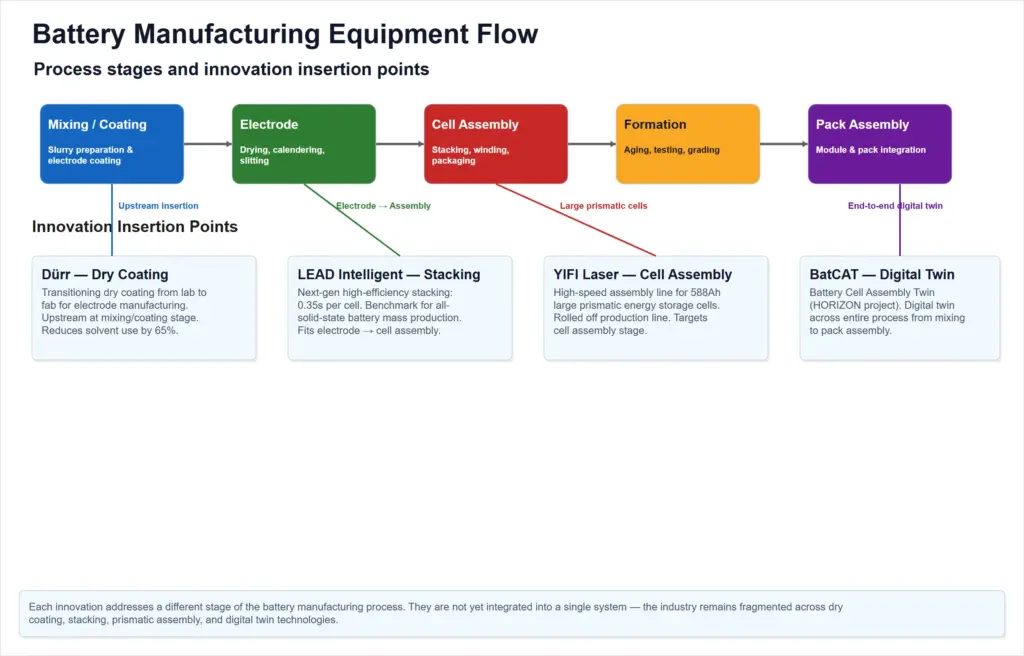
Ce chapitre aborde les technologies d'équipements pour la fabrication d'électrodes, l'assemblage de cellules, la formation et les tests, ainsi que l'assemblage de modules/boîtier. Les services d'appui tels que l'entretien, le conseil, la formation, les infrastructures et la chaîne d'approvisionnement sont exclus. Les innovations récentes améliorent l'efficacité de production grâce aux jumeaux numériques, à l'assemblage prismatique à haute vitesse, à l'empilement à état solide complet et au revêtement d'électrode sec. Cependant, leur impact collectif dépend de leur intégration dans les lignes de production et du moment de mise à l'échelle.Jumeaux numériques et optimisation des processus
Le projet BatCAT financé par l'Union européenne (Jumeau numérique d'assemblage de cellules de batterie) développe un jumeau numérique qui combine des méthodes basées sur les données et des méthodes physiques pour améliorer la fabrication de batteries. Le projet se concentre sur trois défis principaux : la conception de cellules de batterie, les opérations de production et la confiance dans les données de fabrication. BatCAT crée un espace de données transversal à la chimie couvrant les batteries lithium-ion, les cellules monétaires sodium-ion et les batteries à flux redox, visant à améliorer la qualité du produit et l'efficacité des processus.
Le jumeau numérique est conçu pour fournir une analyse des données en temps réel et soutenir la prise de décision dans les environnements de production Industry 5.0. Le projet est aligné sur le plan d'action BATTERY 2030+ et devrait livrer ses résultats d'ici 2030. Pour les fabricants d'équipements OEM, les fabricants de cellules et les intégrateurs de systèmes, le projet pointe vers une utilisation accrue des jumeaux numériques dans la production de batteries. Cependant, BatCAT est encore à l'étape du prototype et n'a pas encore de calendrier confirmé de déploiement commercial.
Comparaison des métriques d'innovation clés
Trois des quatre innovations ont des mesures de performance quantitatives claires, tandis que BatCAT ne fournit pas une seule métrique numérique de performance car il se concentre principalement sur le développement de jumeaux numériques. YIFI Laser signale un débit de 20 PPM, LEAD Intelligent Equipment signale un temps de cycle de 0,35 seconde par cellule avec une augmentation de vitesse de 50 % et une amélioration du rendement de 30 %, tandis que Dürr signale une réduction de 65 % de la consommation d'énergie.
La comparaison met donc en évidence différentes zones d'amélioration parmi les technologies : YIFI Laser se concentre sur le débit de production, LEAD Intelligent sur le temps de cycle, la vitesse et le rendement, et Dürr sur l'efficacité énergétique. La contribution de BatCAT est plus qualitative à cette étape, avec un accent principal sur l'analyse des données en temps réel, le modélisation transversale à la chimie et le soutien à la prise de décision numérique plutôt qu'une amélioration mesurée de la production.Assemblage à haute vitesse pour les cellules de grande taille
Fabrication de batteries à état solide
LEAD Intelligent a dévoilé une solution d'empilement à haute efficacité de nouvelle génération pour les batteries à état solide, atteignant 0,35 seconde par cellule. La solution répond au défi longtemps persistant d'atteindre simultanément la précision, le rendement et l'efficacité dans les processus d'empilement et d'empilement-coupe des cellules à état solide. LEAD affirme une augmentation de vitesse d'empilement de 50 % et une amélioration du rendement de 30 % par rapport aux méthodes précédentes. La technologie comble le fossé entre les processus à l'échelle de laboratoire et l'équipement de production de masse industrielle. Elle a été présentée lors de la 10e conférence annuelle de l'industrie des batteries lithium-ion de Qidian en janvier 2026. Cette innovation réduit le risque chronologique de la production de masse à état solide, car les acheteurs d'équipements peuvent désormais s'attendre à des solutions d'empilement prêtes pour la production qui offrent la vitesse et le rendement nécessaires à la viabilité commerciale.Revêtement d'électrode sec : transition du laboratoire à l'usine
La technologie de revêtement sec X.Cellify DC de Dürr transitionne la fabrication d'électrodes du traitement de couche humide vers une approche en film sec. Dans le revêtement humide conventionnel, le matériau actif est dispersé dans un solvant, appliqué sur une feuille métallique, séché dans des fours longs, et le solvant est souvent récupéré – ce qui nécessite de grands sécheurs, de la gestion du solvant et une énergie considérable. Le revêtement sec élimine ces étapes en formant un film autonome de matériau actif par dosage et calandrage, puis en collant le film des deux côtés du collecteur de courant. Le Dr. Stefan Doose a présenté cette technologie lors de l'Exposition des batteries en Europe. Dürr affirme que le revêtement sec réduit la consommation d'énergie de 65 % et réduit directement à la fois le coût d'investissement et le coût d'exploitation tout en réduisant l'emprise de l'usine. La technologie passe du laboratoire à l'usine ; les clients évaluent les prototypes, mais la prête à la production de masse n'est pas encore affirmée.Comparaison des technologies
| Technologie / Innovation | Participant | Métrique | Période | Application | Implication |
|---|---|---|---|---|---|
| Jumeau numérique pour l'assemblage de cellules | BatCAT (HORIZON) | Aucune métrique unique fournie ; aligné sur BATTERY 2030+ ; espace de données transversal à la chimie | Projet jusqu'en 2030 | Batteries lithium-ion, cellules monétaires sodium-ion, batteries à flux redox | Prototype émergent ; l'intégration dans les lignes de production exigera des normes industrielles à l'échelle du secteur |
| Ligne d'assemblage prismatique à haute vitesse | YIFI Laser | 20 PPM | Commercial (mis en production en 2026) | Cellules de stockage d'énergie de grande taille (187–588 Ah) | Réduit le coût par cellule et l'emprise de l'usine ; permet une expansion rapide de la capacité de stockage d'énergie |
| Solution de pile à étages à état solide | LEAD Intelligent | 0,35 s/cellule ; augmentation de vitesse de 50 % ; amélioration du rendement de 30 % | Commercial (dévoilé en janvier 2026) | Piles à état solide | Réduit les risques de production en masse ; les acheteurs d'équipements disposent maintenant d'un benchmark pour la pile à état solide |
| Revêtement d'électrode sec | Dürr (X.Cellify DC) | Réduction de l'énergie de 65 % | Transition de laboratoire à usine (présentée en 2026) | Fabrication d'électrodes | Réduction des coûts d'investissement et d'exploitation ; élimine la manipulation des solvants ; la surface nécessaire en usine diminue |
Implications pour l'industrie
Chaque innovation — jumeau numérique, assemblage prismatique à haute vitesse, pile à état solide et revêtement sec — répond à un verrou spécifique de la fabrication. Le jumeau numérique de BatCAT est un prototype qui, si sa commercialisation est réussie, pourrait optimiser l'ensemble du processus d'assemblage de la cellule. La ligne de 20 PPM de YIFI et l'empilement de LEAD à 0,35 s/cellule sont déjà commercialisés et peuvent être achetés aujourd'hui, bien qu'ils ciblent des formats et des chimies de cellules différents. Le revêtement sec de Dürr est encore en phase pilote, mais il offre une amélioration majeure en termes d'efficacité énergétique et d'utilisation de l'espace en amont. Les acheteurs d'équipements doivent évaluer leurs propres cartes routières chimiques et leurs objectifs d'échelle avant de prioriser leurs investissements. L'absence d'une solution intégrée unique signifie que les usines combineront probablement les équipements les plus performants provenant de plusieurs fournisseurs, rendant l'interopérabilité et la standardisation essentielles pour les gains d'efficacité futurs.Risque de marché
Risque : Marché des équipements de fabrication de batteries
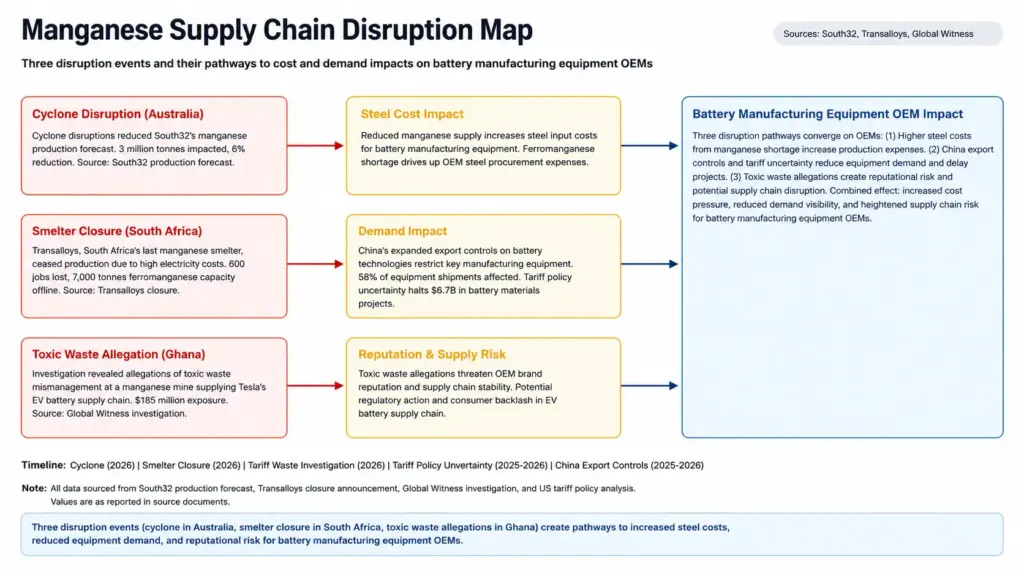
- Les interruptions causées par les cyclones en Australie et la fermeture de l'ultime usine d'élaboration du manganèse en Afrique du Sud réduisent l'offre mondiale de manganèse, ce qui pourrait entraîner une hausse des coûts des déchets toxiques. Les allégations de déchets toxiques dans une mine de manganèse au Ghana, qui fournit la chaîne d'approvisionnement en véhicules électriques de Tesla, introduisent un risque de réputation et réglementaire, pouvant déclencher des audits ESG plus stricts et un changement d'approvisionnement, affectant la base de clients des fabricants d'équipements.
- L'incertitude sur la politique tarifaire des États-Unis a bloqué les projets de matériaux de batteries : les nouvelles annonces de projets aux États-Unis ont chuté à 19 en H1 2023 (6,7 milliards de dollars
- Les contrôles d'exportation chinois sur les équipements de fabrication de batteries (en vigueur le 8 novembre 2025) restreignent l'expédition de machinerie clé vers les producteurs de cellules non chinois, perturbant les chaînes d'approvisionnement et forçant une source alternative qui pourrait augmenter les coûts et allonger les délais de livraison pour les fabricants d'équipements.
Risques d'approvisionnement en matières premières : Contraintes de manganèse
L'interruption causée par le cyclone en Australie réduit la production de manganèse de South32
Le cyclone tropical Narelle a perturbé les opérations de la mine Gemco de South32 dans le Northern Territory en mars 2026. L'entreprise a réduit sa prévision de production pour le manganèse en Australie en fiscal 2026 à 3 millions de tonnes métriques humides (wmt), soit plus de 6 % en baisse par rapport à la prévision précédente. La production du troisième trimestre était de 589 000 wmt, en hausse par rapport à zéro au même trimestre de l'année précédente. Le cyclone a touché une région critique d'approvisionnement en manganèse, et la production réduite renforce la disponibilité mondiale du métal. Le manganèse est essentiel pour l'acier à haute résistance utilisé dans les équipements de fabrication de batteries et pour certaines cathodes de batterie. Le mécanisme est : interruption minière → réduction de l'approvisionnement en manganèse → coûts d'entrée plus élevés pour les composants en acier → pression potentielle sur les marges des fabricants d'équipements, et incertitude pour les producteurs de cellules dépendant des chimies de cathodes riches en manganèse.La dernière usine d'élaboration de manganèse en Afrique du Sud cesse de produire
Transalloys, la dernière usine d'élaboration de manganèse en Afrique du Sud, a cessé de produire en juillet 2026 après des années de pertes financières croissantes causées par les coûts élevés d'électricité et le rythme lent de la réduction des tarifs. L'installation à Mpumalanga a mis environ 600 emplois directs et 7 000 emplois en aval en danger, avec un investissement de 6 milliards de rands menacé. La fermeture de Transalloys élimine une source majeure de ferromanganèse, un ingrédient pour la fabrication d'acier et des pièces métalliques précises utilisées dans les équipements de fabrication de batteries. Le mécanisme : réduction de l'approvisionnement en ferromanganèse → prix plus élevés pour les aciers spécialisés et les composants fabriqués → coûts d'approvisionnement augmentés pour les fabricants d'équipements et leurs fournisseurs de composants.Allégations de déchets toxiques dans une mine de manganèse au Ghana alimentant la chaîne de Tesla
Une enquête menée par Global Witness entre 2025 et 2026 a révélé que les déchets d'une grande mine de manganèse au Ghana, un fournisseur clé de la chaîne d'approvisionnement en véhicules électriques, y compris Tesla, créent des conditions toxiques pour les communautés locales. Les entretiens avec plus de 150 résidents ont documenté des problèmes de santé chroniques (problèmes de peau, d'yeux, de respiration) et des sources d'eau contaminées. Une étude sur l'eau de 2022 a trouvé une concentration élevée d'arsenic et d'autres métaux toxiques dans l'eau de la fosse minière ; les auteurs ont averti des risques de cancers, d'avortements spontanés et même de modifications de l'ADN. Le Ghana est le quatrième plus grand producteur mondial de manganèse, et la Chine traite plus de 90 % des produits de manganèse du monde. Ces allégations créent un risque de réputation et réglementaire : les producteurs de cellules et leurs fournisseurs d'équipements pourraient être soumis à la pression de renforcer les audits ESG, de modifier l'approvisionnement ou de redéfinir les chaînes d'approvisionnement pour éviter les matières premières provenant de mines contestées. Pour les fabricants d'équipements, un éloignement du manganèse du Ghana ou du manganèse traité en Chine pourrait modifier les schémas de demande pour certains matériaux de batterie et, par extension, l'équipement qui les traite.| Risque | Mécanisme | Participant exposé / géographie | Timing | Conséquence soutenue |
|---|---|---|---|---|
| Cyclone réduit la production de manganèse en Australie | Réduction de la production minière renforce l'offre mondiale → coûts d'entrée en acier plus élevés pour l'équipement ; incertitude pour les utilisateurs de cathodes riches en manganèse | Fabricants d'équipements de batteries (via les coûts en acier) ; producteurs de cellules utilisant des chimies à haut teneur en manganèse ; Australie, mondial | 2026 (réduction de prévision ; perturbation en mars 2026) | Guidance fiscale de South32 pour 2026 : 3 M wmt, en baisse de plus de 6 % par rapport à la prévision précédente |
| Fermeture de l'usine d'élaboration en Afrique du Sud | Perte de la dernière source nationale de ferromanganèse → approvisionnement en métal régional plus restreint → coûts plus élevés pour les aciers spécialisés en fabrication d'équipements | Fabricants d'équipements achetant des composants en acier ; Afrique du Sud, mondial | 2026 (fermeture en juillet 2026) | Transalloys a cessé la production ; 600 emplois directs et 7 000 emplois en aval menacés ; investissement de 6 milliards de rands en jeu |
| Allégations de déchets toxiques dans une mine au Ghana | Pression de réputation et réglementaire → redirection potentielle de l'approvisionnement guidée par l'ESG → demande modifiée pour le manganèse de batterie et l'équipement de traitement | Chaîne d'approvisionnement de Tesla ; flux d'exportation de manganèse du Ghana ; Chine (traitant plus de 90 % des produits de manganèse mondiaux) ; fabricants d'équipements dépendant de ces flux | 2025–2026 (enquête publiée, effets sanitaires documentés) | Plus de 150 personnes affectées ; eau de fosse minière contenant de l'arsenic ; appels à l'action non encore mis en œuvre |
Risques politiques commerciaux et contrôles d'exportation
La politique tarifaire américaine bloque l'investissement dans les projets de matériaux de batteries
Après le changement de politique tarifaire de l'administration Trump, les nouveaux projets de composants de batteries ou d'extraction de minéraux aux États-Unis ont chuté brutalement. Pendant les six premiers mois de 2023, les entreprises ont annoncé 19 projets représentant un investissement planifié de 6,7 milliards de dollars. Depuis le changement de politique, seuls trois nouveaux projets aux États-Unis ont été annoncés. Exemples spécifiques : Group14 a retardé sa usine d'anodes en silicium en Washington jusqu'à ce que la clarté tarifaire s'améliore ; Aspen Aerogels a annulé une usine en Géorgie qui avait été conditionnellement approuvée pour un prêt de 670 millions de dollars de la Department of Energy ; le prêt de 306 millions de dollars d'Eos Energy, clos en décembre 2025, est désormais soumis à une révision par le service des prêts. Pour les fabricants d'équipements de fabrication de batteries, le mécanisme est clair : moins de projets et de projets de matériaux de batterie plus petits → demande réduite pour l'équipement de production de cellules → commandes et revenus plus faibles pour les fabricants d'équipements. Le blocage du pipeline est concentré aux États-Unis, mais l'effet se propage globalement car les projets qui auraient acheté de l'équipement auprès de fabricants américains, européens ou asiatiques sont reportés ou annulés.Les contrôles d'exportation étendus de la Chine restreignent l'équipement de fabrication de batteries
Le 9 octobre 2025, le ministère du Commerce et l'Administration générale des douanes de la Chine ont conjointement publié la décision n° 58 de 2025, en vigueur le 8 novembre 2025. Cela ajoute « équipements pour la fabrication de batteries lithium-ion rechargeables et déchargeables » (y compris cellules et packs avec une densité d'énergie ≥ 300 Wh/kg) à la Liste des articles à double usage, une catégorie contrôlée d'exportation. L'expédition de tels équipements nécessite maintenant un permis d'exportation des autorités chinoises. La décision contrôle également la technologie de batterie et les cellules lithium-ion à haute densité elles-mêmes. La Chine est le principal producteur d'équipements de fabrication de batteries ; ces contrôles limitent l'approvisionnement d'équipements critiques aux fabricants de cellules non chinois. Pour les fabricants d'équipements hors de Chine, le mécanisme inclut deux voies : (1) les fabricants dépendant des composants chinois font face à des interruptions d'approvisionnement, des coûts plus élevés ou des délais de livraison plus longs alors qu'ils cherchent des sources alternatives ; (2) les fabricants basés en Chine peuvent avoir un avantage concurrentiel en contrôlant l'accès aux machines restreintes, tandis que les fabricants hors de Chine pourraient perdre des parts de marché si leurs clients ne peuvent pas obtenir l'équipement contrôlé. Le timing (en vigueur à la fin de 2025) signifie que l'impact deviendra visible dans les commandes d'équipement et les calendriers de livraison en 2026.Paysage réglementaire
Étendue de ce chapitre
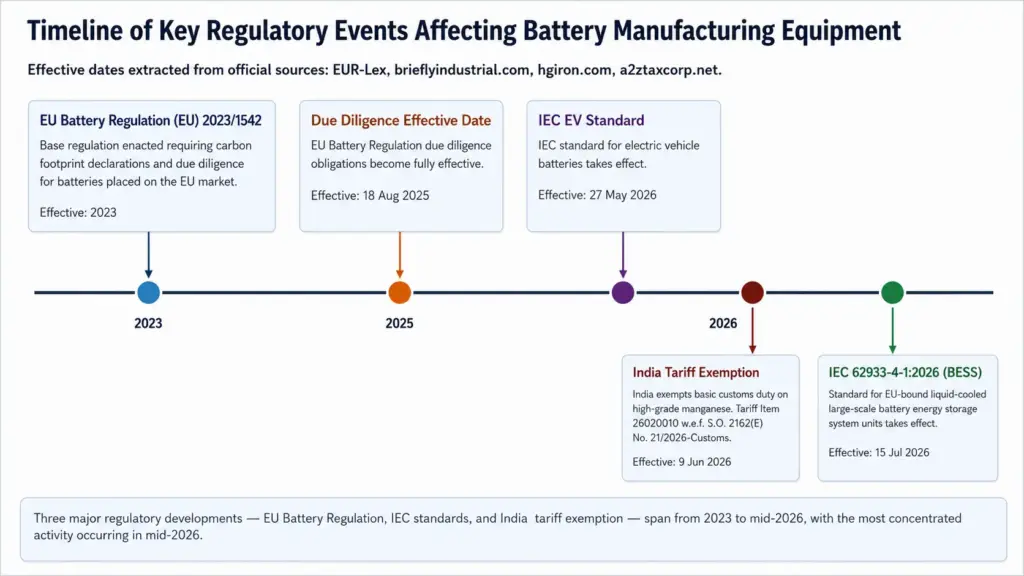
Les développements réglementaires dans l'Union européenne, les organismes internationaux de normalisation et l'Inde redéfinissent les exigences d'entrée sur le marché et les structures de coûts pour l'équipement de fabrication de batteries. Les exportateurs, les organismes de certification et les fabricants de batteries et de packs en aval doivent adapter leurs stratégies de conformité et leurs investissements capitaux à trois changements distincts mais simultanés : les obligations de durabilité contraignantes et de diligence raisonnable dans l'UE, les nouvelles normes de sécurité harmonisées de la Commission Électrotechnique Internationale (CEI) et une exemption de tarif sur une matière première critique en Inde.Normes et réglementations de l'UE et internationales redéfinissant l'accès au marché
Réglementation sur les batteries de l'Union européenne (UE) 2023/1542
La réglementation (UE) 2023/1542, modifiée par (UE) 2025/1561, impose des obligations de diligence raisonnable aux opérateurs économiques qui mettent des batteries sur le marché de l'Union européenne ou les mettent en service. Ces obligations couvrent l'approvisionnement, le traitement et le commerce du cobalt, du graphite naturel, du lithium et du nickel. Elles incluent des exigences de vérification par des tiers par des organismes notifiés et de divulgation d'informations sur la gestion des risques de la chaîne d'approvisionnement. Les obligations de diligence raisonnable s'appliquent à partir de 18 août 2025. La réglementation définit également l'« empreinte carbone » comme la somme des émissions et des suppressions de gaz à effet de serre exprimées en équivalents CO₂, basée sur une étude d'empreinte environnementale du produit, et impose des déclarations d'empreinte carbone pour les batteries mises sur le marché. Cependant, la désignation des organismes notifiés prend plus de temps que prévu, et les schémas de diligence raisonnable concernant les matières premières de batteries nécessitent encore un développement et une mise en œuvre supplémentaires. Cela crée une incertitude concernant l'aptitude à l'application pendant la période initiale de conformité. Pour les exportateurs d'équipements de fabrication de batteries, la réglementation affecte directement l'accès au marché : l'équipement utilisé pour produire des batteries destinées à l'Union européenne doit permettre la collecte des données nécessaires aux déclarations d'empreinte carbone et aux rapports de diligence raisonnable. Les fabricants de cellules et de packs de batteries en aval auront besoin d'équipement permettant de garantir la traçabilité de l'origine des matériaux et de la consommation d'énergie. Les organismes de certification et les services de conseil technique font face à une demande supplémentaire pour vérifier la conformité.CEI 62933-4-1:2026 – Norme de sécurité pour les systèmes de stockage d'énergie (BESS)
Le 15 juillet 2026, la CEI a officiellement publié et rendu obligatoire la CEI 62933-4-1:2026, remplaçant la CEI 62933-4:2022. La nouvelle norme s'applique à toutes les unités de stockage d'énergie à grande échelle refroidies par liquide expédiées vers l'Union européenne. Elle exige une capacité de formation de réseau et une certification par des tiers, et ajoute des exigences de test dynamique couvrant la réponse inertielle en temps réel, le support de démarrage à vide et la résistance aux faibles tensions (LVRT). Ce changement de règlement affecte directement l'accès au marché des systèmes de stockage d'énergie (BESS), les cycles d'essai de type et la validité des déclarations de conformité CE. Les fabricants et les fournisseurs orientés exportation ressentiront cet impact à l'étape de qualification du produit, où les spécifications techniques, les dossiers de conformité et la préparation à la certification doivent être mis à jour.CEI 62660-3:2026 – Harmonisation des tests de sécurité des batteries pour véhicules électriques
Publiée le 27 mai 2026, la CEI 62660-3:2026 harmonise les exigences de tests de sécurité pour les batteries lithium-ion secondaires utilisées dans les véhicules routiers électriques. La norme intègre des protocoles de test qui étaient autrefois divergents entre GB/T (Chine), UN GTR 20 (UE), JIS C 8714 (Japon) et KS C IEC 62660-3 (Corée du Sud). L'adoption réduit la durée moyenne d'approbation de type pour les systèmes de batteries exportés vers l'Union européenne, la Corée du Sud et le sud-est de l'Asie de 12 semaines à 7 semaines – une réduction de 40 %. Pour l'équipement de fabrication de batteries, cela signifie que l'équipement produisant des cellules ou des packs pour l'exportation vers plusieurs marchés peut être conçu selon un seul ensemble de paramètres de sécurité, réduisant ainsi les logistiques de certification et le temps de mise sur le marché. Cependant, la norme impose de nouvelles exigences de test qui pourraient nécessiter des modifications d'équipement ou des accessoires de test supplémentaires.| Juridiction | Règle / norme | Exigence | Date d'entrée en vigueur | Partie concernée |
|---|---|---|---|---|
| Union européenne | Réglementation sur les batteries de l'Union européenne (UE) 2023/1542, modifiée par (UE) 2025/1561 | Déclarations d'empreinte carbone ; diligence raisonnable sur le cobalt, le lithium, le nickel et le graphite naturel ; vérification par des tiers par des organismes notifiés | Obligations de diligence raisonnable à partir du 18 août 2025 (désignation des organismes notifiés retardée) | Exportateurs d'équipements de fabrication de batteries, opérateurs économiques, organismes notifiés |
| International (spécifique au marché de l'UE) | CEI 62933-4-1:2026 | Capacité de formation de réseau, certification par des tiers, tests dynamiques (réponse inertielle, démarrage à vide, LVRT) pour les systèmes de stockage d'énergie à grande échelle refroidis par liquide | 15 juillet 2026 | Fabricants d'équipements de stockage d'énergie (BESS), exportateurs vers l'UE, organismes de certification |
| International (mondial) | CEI 62660-3:2026 | Tests de sécurité harmonisés pour les batteries de traction des véhicules électriques ; acceptation unique selon GB/T, UN GTR 20, JIS C 8714, KS C IEC 62660-3 | 27 mai 2026 | Fabricants de cellules et de packs de batteries pour véhicules électriques, exportateurs d'équipements, organismes de certification |
| Inde | Notification n° 21/2026-Customs (Ministère des Finances du gouvernement de l'Inde) | Exemption de la douane de base (0 %) sur l'oreille de manganèse de haute qualité sous l'item tarifaire 26020010 | 9 juin 2026 | Fabricants d'équipements de batteries domestiques (via une réduction des coûts d'approvisionnement) |