
Global Hot Yoga and Infrared Studio Market Size, Share, Trends and Forecast 2026–2033
The market, in one paragraph
Hot yoga is a USD 2,390.2 million business in 2025, spread across roughly 5,250 heated studios and 2.39 million paying members. It compounds at 5.4 per cent a year to USD 3,640.5 million by 2033 in our base case — faster than gym membership, slower than the Pilates studios taking its floor space. But the number that explains the competitive position is not the growth rate. It is the pair of prices: a month of unlimited at-home practice now costs USD 19.99, and a single live studio class costs USD 18. One month of the substitute costs 1.11 times one unit of the product.
That is the argument of this report. Hot yoga's competitive threat is not another yoga chain. It is that heat stopped being scarce. An infrared-heated fitness franchise can deliver the same sweat in a smaller box with no instructor and no front desk. A digital subscription can deliver the instruction with no room at all. The studio's answer has been to sell what neither can — a 40-degree room, a room full of other people, a scheduled hour that cannot be abandoned halfway. That answer still works. It is simply no longer worth what it was in 2015.
What this report counts
Scope: consumer revenue from memberships, class packs and drop-ins at studios whose primary product is a class taught in a heated room — hot yoga in the Bikram lineage and its infrared-heated successors, plus infrared-heated interval formats such as HOTWORX.
Excluded deliberately, each for a stated reason:
- Unheated yoga studios — a different product with a different cost base and a materially lower price point.
- Big-box gyms with a hot room — the revenue cannot be attributed to the heated product.
- Infrared sauna-only studios — counted as an adjacent format competing for the same occasion, not as part of the core denominator. Perspire, the largest such chain, reports nearing 100 studios open with over 200 in development.
- At-home digital subscriptions and home infrared equipment — modelled only as substitution pressure. Mixing recurring subscription revenue into a studio-revenue denominator would flatter the market's growth rate for reasons that have nothing to do with studios.
- Apparel and retail — merchandising is a margin line inside a studio, not a market.
2025 market size, built bottom-up
Pheonix does not license a third-party figure for this market, because the published ones describe a different scope: most count all yoga studios, or all boutique fitness, and neither answers the question a studio operator or a franchise investor is actually asking. We sized it from disclosed operator scale instead, then applied a stated multiple to the unaffiliated long tail.
| Segment | Studios, 2025 | Revenue per studio (USD) | 2025 revenue (USD m) | Share |
|---|---|---|---|---|
| Heated yoga studios | 4,300 | 500,000 | 2,150.0 | 90.0% |
| Infrared-heated fitness studios | 950 | 252,855 | 240.2 | 10.05% |
| Total | 5,250 | 455,279 | 2,390.2 | 100% |
Three inputs do the work, and each is either disclosed or stated openly as an assumption:
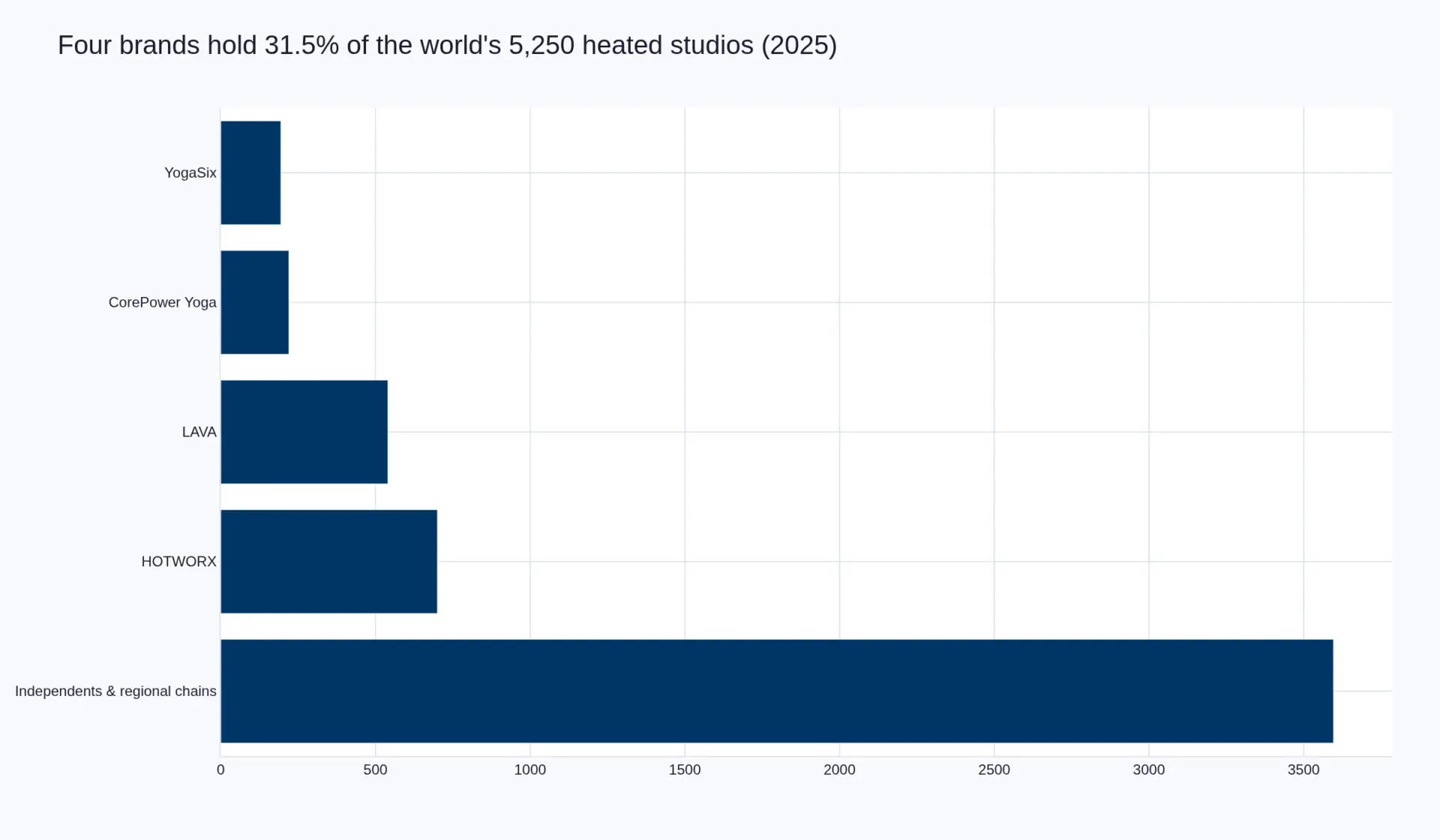
- Disclosed fleets. LAVA 540 studios in Japan (company release, March 2025); HOTWORX 700 studios at August 2025 and 800+ locations on its own site today; CorePower Yoga 220+ locations; YogaSix 194 operational studios and 635 licences sold (Xponential Fitness FY2024 Form 10-K). That is 1,654 studios, or 31.5 per cent of global supply.
- Long tail. A 1.6x multiple over the disclosed fleets for unaffiliated studios and regional chains, giving 4,300 heated yoga studios worldwide.
- Revenue per studio. USD 500,000 for heated yoga — below the USD 668,000 North American average unit volume Xponential reported for Q4 2024, because the long tail and lower-income markets run at lower volumes; and USD 252,855 for infrared fitness, derived from HOTWORX's own disclosure of 250,000+ members across 700+ studios, which is 357.1 members per site, at a modelled USD 59 a month.
At an average revenue per studio of USD 455,279, the whole market is about 2.39 million members paying roughly USD 1,000 a year each. Set that against the 55.78 million American adults who practised yoga in 2022 on National Health Interview Survey data — 16.8 per cent of the adult population — and the binding constraint is arithmetic. The heated studio business reaches 4.29 per cent of the US yoga public. The gap is not awareness. It is conversion, and price.
Why heat stopped being a moat
Bikram Choudhury's contribution to this industry was not the 26 postures. It was the discovery that a heated room is a product you can franchise, standardise and charge a premium for. The moat was the room, the heat and the script.
Two things dissolved it. The first was infrared. A franchisee can now buy radiant panels, a smaller box and an app, staff the site for a few hours a day and run around-the-clock access at 357 members a site. HOTWORX's model — 30-minute isometric sessions and 15-minute HIIT inside a patented infrared sauna — monetises the heat itself rather than the teaching. Its modelled revenue per site, USD 252,855, is 50.6 per cent of a heated yoga studio's USD 500,000, on a footprint with no instructor in it. That is a better small-business proposition, and franchise capital has noticed: 700 studios to 800+ locations inside a year, with entry into Dubai, Ireland and Saudi Arabia.
The second was the digital class. CorePower Yoga, the largest owner-operator in the category with 220+ locations, sells an At Home membership at USD 19.99 a month — down from USD 49 — against USD 18 for a single live class and USD 75 for five. The studio's own price card states the substitution: an entire month of instruction costs 1.11 times one hour in the room. What the room still sells is presence, ritual, and the impossibility of leaving halfway through.
The room is the inventory, and it is not filling
The clearest evidence on supply comes from the only operator that discloses it. Xponential Fitness — which owns YogaSix, and 3,233 open studios across eight brands — closed 225 studios in 2024, about 6.96 per cent of its global open base, against guidance of 3 to 5 per cent. It attributed the excess to StretchLab, CycleBar and YogaSix; it did not break the figure out by brand, so the YogaSix share is not knowable from the filing. It also disclosed that roughly 30 per cent of licences contractually obligated to open were more than twelve months behind schedule and inactive.
Meanwhile the openings mix has moved. In 2025 Pilates is expected to account for 46 per cent of new studio openings, yoga — largely hot — for 27 per cent, cycling for 4 per cent and barre for 2 per cent. Pilates is not stealing hot yoga's customers. It is taking its leases, its franchisees and its square footage, which for a fixed-cost box business amounts to the same thing two years later.
Regional structure
Japan is the densest hot yoga market on earth per head of population and the only one with a genuinely scaled owner-operator. LAVA's 540 studios are 12.6 per cent of the world's heated yoga studios and 10.3 per cent of all heated studios including infrared — and it runs them on the balance sheet, with 6,009 social-insurance-insured employees, 11.1 per studio including head office. Its own disclosure that 2.5 million people have taken a trial class works out to 4,630 trialists per studio: the Japanese model converts a very large funnel at a modest price rather than a small funnel at a premium.
North America is the highest-revenue, lowest-growth region: the deepest installed base, the most franchise capital, and the greatest exposure to digital substitution. Asia-Pacific excluding India is where participation growth sits — 37.2 per cent of yoga participants on the industry estimates boutique operators use — but it is also where price per class is lowest, which is why unit growth there does not convert into revenue growth at the same rate.
Forecast, 2025–2033
| Scenario | 2025 (USD m) | 2033 (USD m) | CAGR | What has to be true |
|---|---|---|---|---|
| Conservative | 2,390.2 | 3,027.9 | 3.0% | Members flat; growth comes only from price and mix; Pilates takes the new leases |
| Base | 2,390.2 | 3,640.5 | 5.4% | Studios +3.0% a year to 6,650; revenue per studio +2.33% |
| Optimistic | 2,390.2 | 4,262.9 | 7.5% | Infrared formats scale internationally and at-home proves additive rather than substitutive |
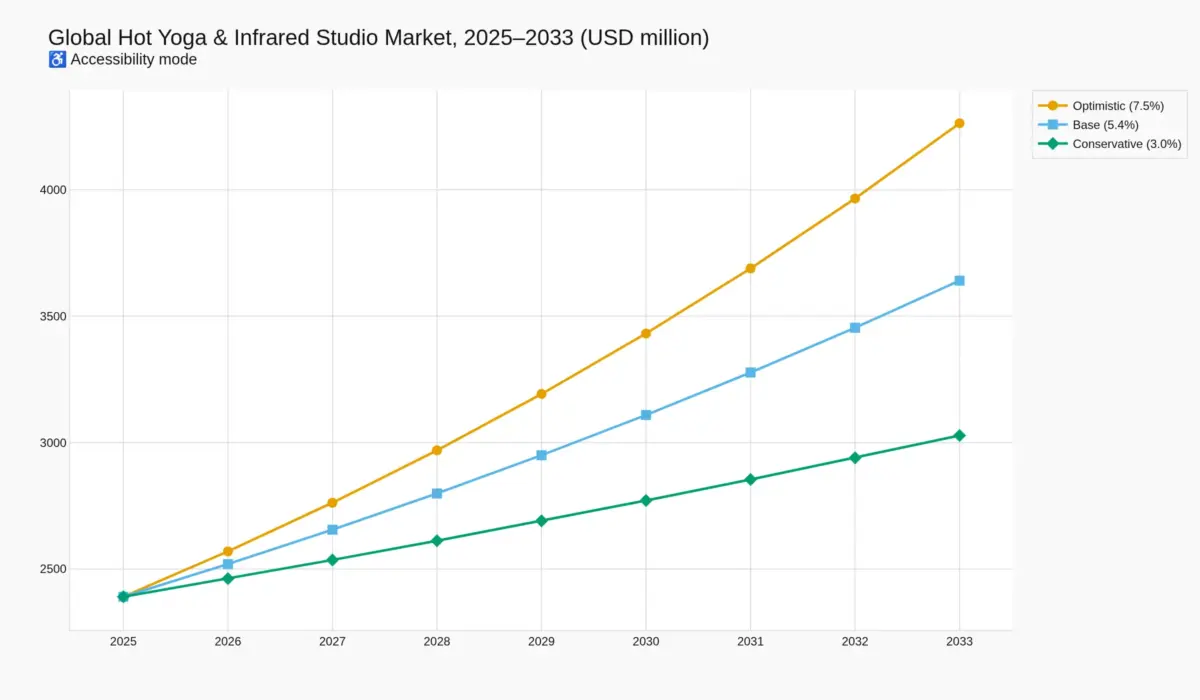
All three paths compound at a constant rate from the same 2025 base, so the fan is not three forecasts — it is one forecast and two tests of it. The base case adds USD 1,250.3 million of annual revenue across the eight years; the optimistic case adds USD 1,872.7 million and the conservative case USD 637.7 million. The whole USD 1,235.0 million spread between the outer cases in 2033 is decided by one variable: whether revenue per studio can keep rising while the price of the substitute keeps falling.
The base case is deliberately unexciting, and the reason is in the split: studio count grows 3.0 per cent, revenue per studio grows 2.33 per cent, and the 5.4 per cent is the two compounded. A market that needs a price rise every year to hit its forecast is a market whose growth is a pricing decision rather than a demand discovery. The optimistic case rests on one testable proposition — that a USD 19.99 digital subscription recruits people who would never have bought a full-price studio membership, rather than cannibalising those who would.
What would move us off the base case
Three observable events would change the number inside twelve months: a disclosed fall in the closure rate at the multi-brand franchisors; an infrared operator crossing 1,500 locations without a matching rise in closures; or a digital-only operator buying studio distribution, which would be the first consolidation event in a segment that has never had one.
How much the assumptions are worth
The largest judgement in this forecast is not the growth rate. It is the flat USD 500,000 of revenue per studio applied to all 4,300 heated yoga sites, 2,646 of which — 61.5 per cent — are unaffiliated and unmeasured. So we rebuilt 2025 a second way: the 1,654 disclosed studios at Xponential's own reported North American average unit volume of USD 668,000, and the long tail at USD 400,000, a fifth below the blended figure. Infrared fitness is held at USD 240.2 million in every build.
| 2025 build | Heated yoga (USD m) | Infrared (USD m) | Total (USD m) | vs reported |
|---|---|---|---|---|
| Flat USD 500,000 per studio (reported) | 2,150.0 | 240.2 | 2,390.2 | — |
| Two-tier: USD 668,000 chains, USD 400,000 long tail | 2,163.3 | 240.2 | 2,403.5 | +0.56% |
| Long tail repriced across all heated studios | 1,720.0 | 240.2 | 1,960.2 | −17.99% |
The two-tier build lands USD 13.3 million above the figure we publish — 0.56 per cent — with the chains pulled up and the long tail pulled down. That is the useful result: the flat assumption survives being replaced by a differentiated one, because the two tiers offset. What it does not survive is the long tail repricing as a whole. At USD 400,000 for every heated studio, chains included, the market is USD 1,960.2 million, 17.99 per cent lower, and every 2033 value in the forecast table above falls by the same proportion.
The same arithmetic sets the two formats against each other. At a modelled USD 59 a month, an infrared-heated site needs 706 members to match a heated yoga studio's USD 500,000 — on a smaller footprint, with no instructor in it. It carries 357 today. The distance between 357 and 706 is the growth case for the format, and it is why the number to watch is unit count rather than price: the site does not need a higher ticket, it needs twice the members.
Related Pheonix research
- Global Cold Plunge & Recovery Equipment Market 2026–2033 — the recovery format competing for the same wellness budget and the same second lease.
- Global Climbing Gym Market 2026–2033 — the closest comparable in experience-led, membership-priced studio retail.
- Global Meditation Market 2026–2033 — the digital mind-body comparable and the price benchmark for at-home practice.
- Global Aromatherapy Market 2026–2033 — the retail-side wellness adjacency in scent and ritual.
- Global Snow Sports Market 2026–2033 — seasonal, heat-inverse demand inside the same leisure segment.
All 2025 and 2033 values in this report are Pheonix Research estimates. The methodology, the assumption set and the exclusions are stated in full in the Research Methodology section and are not licensed from any third party.
Table des matières
Paysage concurrentiel
Four brands hold 31.5 per cent of the supply
The market is fragmented by any measure. LAVA’s 540 studios, CorePower Yoga’s 220+, YogaSix’s 194 and HOTWORX’s 700 disclosed sites — 800+ on its current site — total 1,654 studios, or 31.5 per cent of the 5,250 heated studios worldwide. The remaining 68.5 per cent is independents and small regional chains. LAVA, the largest single brand by studio count, holds 10.3 per cent of all heated studios and 12.6 per cent of heated yoga studios specifically. There is no operator in this market with pricing power over a region, which is why pricing is set by the local substitute rather than by a leader.
The competitor is the reference price, not the studio
The relevant competitor for a USD 180 monthly studio membership is not the studio two streets away. CorePower Yoga charges USD 18 for a single live class and USD 75 for five, and sells an At Home membership at USD 19.99 a month, down from USD 49. A month of instruction therefore costs 1.11 times one hour of it. Every studio in the category is now arguing against its own price card, and the argument it makes is presence: the room, the heat, the cohort, the scheduled hour. That is a real product, but it is a narrower one than the market priced in 2015.
The franchisee is leaving faster than the customer
Xponential Fitness closed 225 studios in 2024 across its 3,233-site global base — 6.96 per cent, against 3 to 5 per cent guidance — and attributed the elevated rate to StretchLab, CycleBar and YogaSix. It did not split the figure by brand. It also disclosed that about 30 per cent of licences contractually obligated to open were more than twelve months behind schedule and inactive. The customer did not leave; the operator did. In a business where the room is the inventory, that is the more consequential number.
Infrared is a different unit economic, not a different workout
HOTWORX runs 250,000+ members across 700+ studios — 357.1 members a site — at a modelled USD 59 a month, giving USD 252,855 of revenue per studio. Against a heated yoga studio’s USD 500,000 that is 50.6 per cent of the revenue on a smaller footprint, with no instructor on the payroll and around-the-clock access. The heat is the product and the technology is the patented infrared sauna, not the teaching. A second infrared format, the sauna-only studio, competes for the same consumer occasion without offering the workout at all: Perspire reports nearing 100 studios open and over 200 in development, and signed five multi-unit agreements covering 15 new studios in September 2025 alone.
Adjacent formats taking the same wellness budget
Contrast and recovery is the fastest-moving adjacency: see our Cold Plunge & Recovery Equipment report, where the same consumer buys a second membership rather than a second class pack. The closest structural comparable in experience-led studio retail remains the climbing gym market, which shares the fixed-lease, membership-priced, community-retention model and has consolidated faster.
Two adjacent reads sit behind this chapter. The meditation market prices the same mind-body hour with no room and no heat at all, which is the low end of the substitution this chapter describes. Snow sports, in the same Leisure, Sports, Toys & Hobby segment, runs the opposite model — equipment and travel sold against a season rather than a room sold against a month. The editorial version of this argument is Hot Yoga Sold a Room. Infrared Studios Sell the Same Sweat Without One.
Chaîne de valeur
Step one: the room
A heated studio is a real-estate business wearing a fitness business’s clothes. YogaSix’s typical site is about 2,000 square feet designed for up to 40 people; Club Pilates’ is roughly 1,500 square feet for 12. The heat plant, humidity control, flooring and sound are the capital, and unlike a spinning bike they cannot be moved to a cheaper site. The lease and the fit-out are sunk, which sets the utilisation threshold every other decision is measured against.
Step two: the labour
Instructor cost is the swing line, and the two models diverge sharply. LAVA, the Japanese owner-operator, carries 6,009 social-insurance-insured employees across 540 studios — 11.1 per studio including head office — and runs a 200-hour teacher-training pipeline on a YogaSix equivalent to keep supply in-house. US franchise models push instructor cost to franchisee payroll or contractor status. At-home practice removes this line entirely, which is the whole of its cost advantage, not the video.
Step three: utilisation
The room has 40 mats and a fixed number of hours. Because cost is largely fixed, every unsold mat in an off-peak class is pure margin lost, and pricing becomes a schedule problem: intro offers, off-peak packs, free weeks, and the presale. HOTWORX franchisees sold 605 memberships in a single day in Grand Island, Nebraska, during the first day of presales, off 570 booked appointments. The presale is not marketing. It is the working-capital mechanism that funds the fit-out before the door opens.
Step four: retention sets the average unit volume
At USD 455,279 of revenue per studio and roughly USD 1,000 per member a year, the average site carries about 455 members. The marginal member costs almost nothing to serve; the marginal acquisition costs a month or two of discount. So AUV is set by churn, not by sign-ups — which is why the fracturing of the franchise base shows up first as stalled AUV and only later as closures.
Where the value sits
Value accrues to whoever holds the scarce input. In Japan it is the site network and the employment model. In the US it is the franchise licence and the equipment order, which is why the franchisor earns a royalty of roughly 7 per cent plus a 2 per cent marketing fund on system-wide sales regardless of whether an individual site survives. The instructor, the app and the heat are all replicable; the lease is not.
Activité d'investissement
Capital enters as franchise licences, not as consolidation
There has been no disclosed M&A in the core heated-studio segment over the period examined — a fact worth stating plainly, because it explains the structure. Capital enters site by site through franchise investment rather than through acquisition, so the market adds capacity without ever concentrating it. That is why a category with USD 2.39 billion of revenue still has no operator above 10.3 per cent share.
The only scaled disclosures are franchise disclosures
- Xponential Fitness FY2024: 3,233 open studios globally, USD 1.7 billion of system-wide sales, North American average unit volume of USD 668,000 in Q4, up from USD 612,000 a year earlier. Royalty roughly 7 per cent of franchisee sales plus a 2 per cent marketing fund. Equipment revenue alone was USD 12.7 million in Q4. It sold 400 licences in the year, down on prior quarters, and 225 studios closed.
- HOTWORX: 700+ studios and 250,000+ members at its August 2025 release, and 800+ locations on its own site today. International entry into Dubai, Ireland and Saudi Arabia, with Canada and Mexico on the roadmap — expansion through master licences rather than owned sites.
- Perspire Sauna Studio: nearing 100 studios open, over 200 in development, and five multi-unit agreements covering 15 new studios signed in September 2025. The adjacent infrared format is attracting exactly the multi-unit franchisee capital the yoga studios are losing.
- LAVA International: 540+ studios and 2.5 million cumulative trialists, run as an owner-operator with 6,009 insured employees. This is the only genuinely scaled balance-sheet operator in the category, and it is Japanese.
The incentive asymmetry
A franchisor is paid on openings and on system-wide sales. A franchisee is paid on surplus after rent, payroll and royalty. When those two diverge, the franchisor’s growth metric can improve while the underlying unit economics deteriorate — which is the most plausible reading of a year with record system-wide sales and a 6.96 per cent closure rate at the same company. Investors underwriting this category should weight AUV trend and closure rate over licence counts, and should treat the roughly 30 per cent of obligated licences sitting inactive as capacity that will either open late or not at all.
What would attract different capital
Two events. A franchisee failure wave that forces royalty repricing would move the asset from growth to cash-flow ownership, which is where private equity usually arrives. Or a digital operator buying studio distribution to defend its subscription against churn. Neither has happened. Until one does, this market’s investment story is a small-business formation story, and should be valued as one.
Technologie et innovation
The innovation that mattered was the box, not the workout
Hot yoga’s original technology was a forced-air heating system and a script. The change that made the format franchisable at scale was the infrared panel and the small, unstaffed room. HOTWORX’s patented infrared sauna lets a site run 30-minute isometric sessions and 15-minute HIIT sessions with app-based booking and around-the-clock access — which converts a heat business into a capacity business. 357.1 members a site is what that innovation is worth.
The heated yoga response has been format, not technology
On the yoga side the innovation is programming: infrared-heated vinyasa, candlelit and playlist-led power classes, sound and temperature modulation, and the bundling of live and on-demand access into a single membership. CorePower Yoga’s All Access membership bundles unlimited studio, live and on-demand — a hedge, not a moat: the same membership can be consumed entirely at home for USD 19.99.
Biometrics and heat safety
The genuinely technical frontier is physiological, not digital. Heat-strain monitoring, hydration and heart-rate tracking during a 40-degree class are the difference between a premium product and a liability, and wearables make that monitoring cheap enough to standardise. Expect heat-safety instrumentation to become a franchise standard rather than a differentiator, because the liability exposure sits with the operator, not the technology vendor.
Why innovation is not the constraint
Patent activity in this segment is low and the formats are copyable within a season; the defensible assets are the lease, the equipment and the local brand. That means the binding constraint on this market is not what studios can build. It is what they can charge while a USD 19.99 substitute sits on the same phone. For the digital mind-body comparables and the price benchmarks they set, see our Global Meditation Market report.
Risque de marché
Substitution risk: high, and priced
The substitute is not hypothetical and it is not expensive. Unlimited at-home instruction costs USD 19.99 a month against USD 18 for a single live class. Infrared-heated fitness delivers the sweat from a smaller, unstaffed box at roughly half a heated yoga studio’s revenue per site — and it is expanding internationally. Recovery and contrast formats compete for the same second membership: see our Cold Plunge & Recovery Equipment report.
Supply risk: the closure rate is the leading indicator
Xponential closed 225 studios in 2024 — 6.96 per cent of its global base, above its own guidance — with YogaSix among the brands it named, and roughly 30 per cent of obligated licences more than a year behind schedule. Because the room is the inventory, a closure removes capacity permanently; a delayed opening does not add it. Both flatter a demand reading taken from openings alone.
Cost risk: an energy-intensive box inside a retail lease
Heating 2,000 square feet to 40 degrees with humidity control, in a retail lease, is the least flexible cost stack in boutique fitness. Rent and energy are the two lines a studio cannot renegotiate quickly, which is why operators respond to demand softness with schedule cuts and instructor reductions before they touch price.
Labour and liability risk
Instructor supply and classification are live issues: the Japanese model carries 6,009 insured employees across 540 studios, while US franchisees typically do not, and any tightening of contractor classification raises unit costs materially. Separately, exertional heat illness is the category’s structural liability, and it is uninsurable in the sense that a single serious incident can close a site.
Participation risk
Demand tracks a very large population: 55.78 million American adults practised yoga in 2022, 16.8 per cent of adults, and SFIA counts 34.2 million participants in 2023, up 19.1 per cent over five years. The market’s membership base is 4.29 per cent of the US practitioner pool. The risk is not that people stop being interested in yoga. It is that the heated studio never converts more than a twentieth of them, because the price of the substitute keeps falling.
Paysage réglementaire
Minimal formal approval, and that is the point
There is no licence to operate a heated yoga class in most markets. Entry requires a lease, a fit-out, insurance and, in some jurisdictions, a food or pool-adjacent permit only if ancillary services are offered. The absence of a regulatory gate is why this market fragments: supply can be added in a quarter, which is also why no incumbent can defend a price.
What actually binds: three constraints
- Heat safety and duty of care. Exertional heat illness is the category’s structural liability. The operator carries it, insurers price it, and it becomes more expensive as the format moves into infrared sauna work at higher temperatures and shorter intervals.
- Employment classification. The Japanese owner-operator model carries 6,009 social-insurance-insured employees across 540 studios, 11.1 per studio including head office. US franchise models rely on contractor or part-time instructor arrangements. Any tightening of classification rules moves unit cost directly, and asymmetrically against the franchise model.
- Consumer subscription and cancellation rules. Membership businesses with auto-renewal sit inside a tightening consumer-protection environment in several markets. Studios with presale-heavy launches and multi-month minimum terms are the most exposed to a change in cancellation or negative-option billing requirements.
Health claims are the quiet exposure
Infrared and hot formats are routinely marketed on detoxification, circulation and recovery. Claim substantiation for a fitness service is enforced with wide variation across markets, and the risk concentrates in the infrared segment where the marketing leans hardest on physiology. A single adverse finding against a scaled franchise brand would reset the marketing language across the category — which is a commercial risk, not a legal technicality.
What is not a regulatory risk
There is no standards body, no approval pathway and no exclusivity right to protect. Nothing in this regulatory landscape will stop a competitor opening. It will only stop a competitor from saying certain things once they have.