
Global Aromatherapy Market Report, Size & Forecast 2026-2033
Global Aromatherapy Market Forecast Snapshot (2026???2033)
| Metric | Value |
|---|---|
| Market Size (2025) | ?? ?? ?? ?? ?? ?? ?? ?? ?? ?? ?? ?? ?? ?? ?? ?? ?? ?? ?? ?? ?? ?? ?? ?? ?? ?? ?? ?? ?? ?? ?? ?? ?? ?? ?? ?? ?? ?? ?? ?? ?? ?? ?? ?? ?? USD 2.45 Billion |
| Market Size (2033) | ?? ?? ?? ?? ?? ?? ?? ?? ?? ?? ?? ?? ?? ?? ?? ?? ?? ?? ?? ?? ?? ?? ?? ?? ?? ?? ?? ?? ?? ?? ?? ?? ?? ?? ?? ?? ?? ?? ?? ?? ?? ?? ?? ?? ?? USD 5.85 Billion |
| CAGR (2026???2033) | ?? ?? ?? ?? ?? ?? ?? ?? ?? ?? ?? ?? ?? ?? ?? ?? ?? ?? ?? ?? ?? ?? ?? ?? ?? ?? ?? ?? ?? ?? ?? ?? ?? ?? ?? ?? ?? ?? ?? ?? ?? ?? ?? ?? ?? ?? ?? ?? 11.50% |
| Largest Segment | ?? ?? ?? ?? ?? ?? ?? ?? ?? ?? ?? ?? ?? ?? ?? ?? ?? ?? ?? ?? ?? ?? ?? ?? ?? ?? ?? ?? ?? ?? ?? ?? ?? ?? ?? ?? ?? ?? ?? ?? ?? ?? ?? ?? ?? ??Essential Oils |
| Fastest Growing Segment | ?? ?? ?? ?? ?? ?? ?? ?? ?? ?? ?? ?? ?? ?? ?? ?? ?? ?? ?? ?? ?? ?? ?? ?? ?? ?? ?? ?? ?? ?? ?? ?? ?? ?? ?? ?? Consumer Aromatherapy Devices |
| Leading End-Use Segment | ?? ?? ?? ?? ?? ?? ?? ?? ?? ?? ?? ?? ?? ?? ?? ?? ?? ?? ?? ?? ?? ?? ?? ?? ?? ?? ?? ?? ?? ?? ?? ?? ?? ?? ?? ?? Homecare & Personal Wellness |
| Key Trend | ?? ?? ?? ?? ?? ?? ?? ?? ?? ?? ?? ?? ?? ?? ?? ?? ??Natural Wellness Solutions, Essential Oil Blends & Smart Diffuser Technologies |
| Regulatory Influence | ?? ?? ?? ?? ?? ?? ?? ?? ?? ?? ?? ?? ?? ?? ?? ??Product Safety Standards, Labeling Regulations & Essential Oil Quality Certifications |
| Future Outlook | Growth Driven by Preventive Healthcare, Stress Management Awareness & Rising Demand for Natural Therapies |
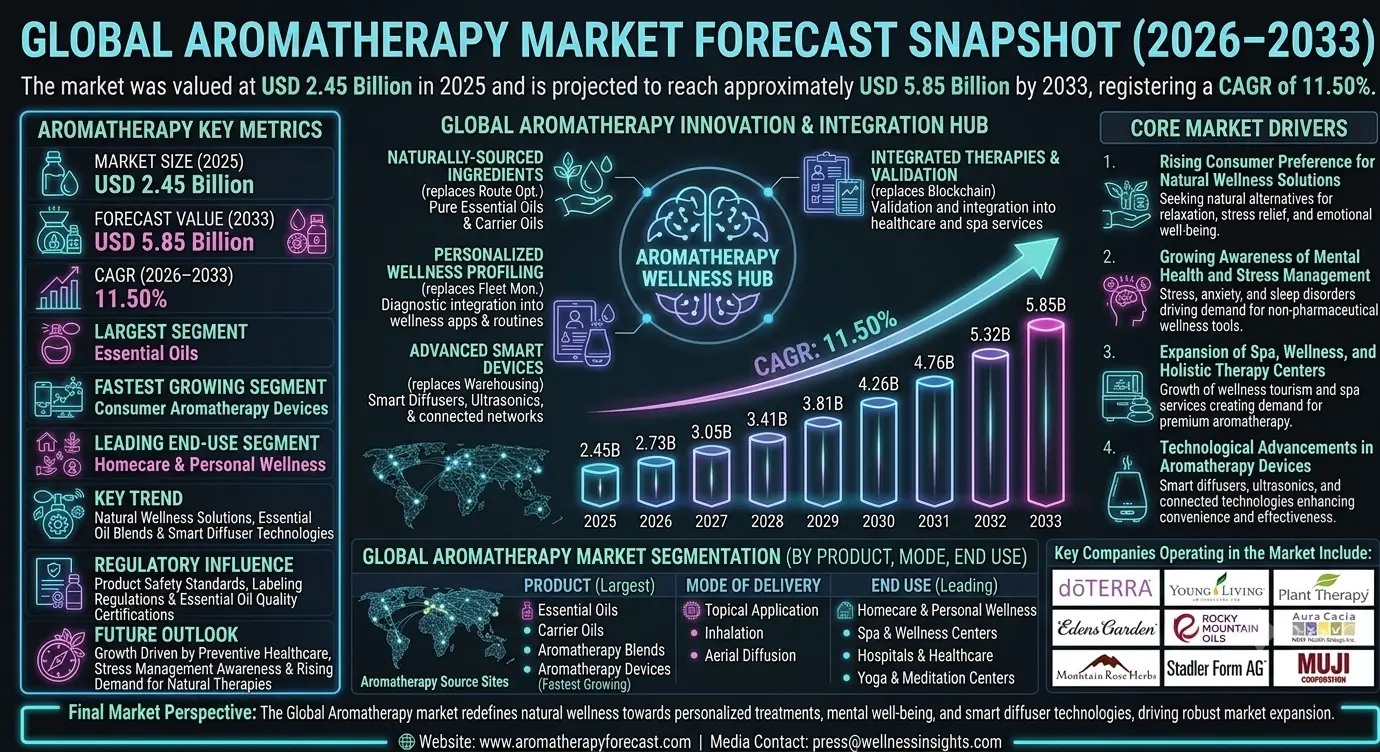
Global Aromatherapy Market Size & Forecast
The Global Aromatherapy Market is expected to witness strong growth during the forecast period from 2026 to 2033. The market was valued at USD 2.45 billion in 2025 and is projected to reach approximately USD 5.85 billion by 2033, registering a CAGR of 11.50%. Market growth is primarily driven by increasing consumer preference for natural wellness solutions, rising awareness regarding stress management and mental well-being, growing adoption of complementary therapies, and expanding demand for essential oils across personal care and healthcare applications. The growing focus on holistic health and preventive wellness is further supporting market expansion worldwide.Global Aromatherapy Market Overview
Aromatherapy is a complementary wellness practice that utilizes essential oils and aromatic plant extracts to support physical, emotional, and psychological well-being. The market includes essential oils, carrier oils, aromatherapy blends, diffusers, inhalers, and other aromatherapy products used across homecare, spas, wellness centers, healthcare facilities, and personal care applications. Technological advancements in diffuser systems and increasing integration of aromatherapy into wellness programs are contributing to market growth.Structural Drivers of Market Growth
1. Rising Consumer Preference for Natural Wellness Solutions
Consumers are increasingly seeking natural and plant-based alternatives for relaxation, stress relief, sleep improvement, and emotional well-being. Market Implications: Manufacturers are expanding their portfolios of organic essential oils and wellness-focused aromatherapy products.2. Growing Awareness of Mental Health and Stress Management
Increasing levels of stress, anxiety, and sleep disorders are driving demand for non-pharmaceutical wellness therapies. Market Implications: Aromatherapy products are gaining wider acceptance as supportive wellness tools in homes and wellness facilities.3. Expansion of Spa, Wellness, and Holistic Therapy Centers
The growth of wellness tourism and spa services is creating significant demand for premium aromatherapy products and treatments. Market Implications: Commercial wellness operators are increasing purchases of therapeutic-grade essential oils and diffuser systems.4. Technological Advancements in Aromatherapy Devices
Smart diffusers, ultrasonic devices, and connected wellness technologies are enhancing user convenience and product effectiveness. Market Implications: Technology-enabled aromatherapy solutions are creating new growth opportunities across consumer and commercial segments.Market Segmentation Analysis
By Product Type
- Essential Oils Largest segment due to extensive use in relaxation, skincare, therapeutic applications, and wellness routines.
- Carrier Oils Used to dilute essential oils and improve application safety for massage and skincare purposes.
- Aromatherapy Blends Specialized formulations designed for sleep support, stress relief, focus enhancement, and mood improvement.
- Aromatherapy Devices Fastest-growing segment including diffusers, nebulizers, vaporizers, and smart aromatherapy systems.
By Mode of Delivery
- Topical Application Widely used in massage therapy, skincare treatments, and personal wellness applications.
- Inhalation Popular delivery method through diffusers, inhalers, and vaporization systems.
- Aerial Diffusion Utilized for ambient fragrance, relaxation environments, and wellness spaces.
By End Use
- Homecare & Personal Wellness Largest segment driven by increasing consumer adoption of aromatherapy for stress relief and relaxation.
- Spa & Wellness Centers Major users of premium aromatherapy products for therapeutic and relaxation services.
- Hospitals & Healthcare Facilities Growing adoption as a complementary therapy supporting patient comfort and well-being.
- Yoga & Meditation Centers Utilize aromatherapy products to enhance mindfulness and wellness experiences.
Regional Market Dynamics
North America
Leading region due to strong consumer awareness, high spending on wellness products, and widespread adoption of complementary therapies.Europe
Driven by growing preference for natural healthcare solutions, established wellness industries, and increasing demand for organic products.Asia-Pacific
Fastest-growing region supported by expanding wellness culture, rising disposable income, and increasing popularity of holistic healthcare practices.Latin America
Growing market driven by increasing awareness of natural wellness products and expanding spa and wellness industries.Middle East & Africa
Emerging market supported by wellness tourism development, luxury spa expansion, and growing interest in preventive health practices.Competitive Landscape
The Global Aromatherapy Market is highly competitive with essential oil producers, wellness brands, personal care companies, and aromatherapy device manufacturers focusing on product innovation, sustainability, and premium product offerings. Key Companies Operating in the Market Include:- doTERRA International LLC
- Young Living Essential Oils
- Plant Therapy Essential Oils
- Edens Garden
- Rocky Mountain Oils
- Aura Cacia
- NOW Health Group, Inc.
- Mountain Rose Herbs
- Stadler Form AG
- Muji Corporation
Strategic Outlook
The future of the aromatherapy market will be shaped by increasing consumer interest in natural wellness, personalized self-care solutions, and smart aromatherapy technologies. Manufacturers are expected to focus on organic sourcing, sustainable production practices, and premium therapeutic-grade essential oils to meet evolving consumer preferences. Growing integration of aromatherapy into wellness programs, hospitality services, and healthcare environments will further expand market opportunities. Digital wellness trends and connected home technologies are expected to drive adoption of smart diffusers and automated aromatherapy systems. Additionally, increasing awareness regarding mental well-being, stress management, and holistic health will continue to support long-term demand across global markets.Final Market Perspective
The Global Aromatherapy Market is emerging as a significant segment within the broader wellness and complementary healthcare industry. Rising consumer demand for natural therapies, increasing focus on mental well-being, and continuous innovation in aromatherapy products are driving sustained market growth. As consumers increasingly embrace preventive wellness and holistic lifestyles, companies investing in quality, innovation, and sustainable practices will be well-positioned to capitalize on long-term opportunities within the global aromatherapy ecosystem.Table of Contents
Table of Contents
- Executive Summary
- Global Aromatherapy Market Snapshot (2026???2033)
- Market Size & Growth Overview
- Key Market Highlights
- Largest & Fastest-Growing Segments
- Leading End-Use Segment Overview
- Key Market Trends in Natural Wellness & Aromatherapy Solutions
- Strategic Outlook Through 2033
- Market Introduction & Overview
- Definition of Aromatherapy
- Scope of the Global Aromatherapy Market
- Evolution of Aromatherapy and Holistic Wellness Practices
- Role of Aromatherapy in Preventive Healthcare and Personal Wellness
- Value Chain Analysis of the Aromatherapy Ecosystem
- Regulatory Influence (Product Safety Standards, Labeling Regulations & Essential Oil Quality Certifications)
- Transition Toward Natural Wellness Solutions, Essential Oil Blends & Smart Diffuser Technologies
- Research Methodology
- Primary Research Approach
- Secondary Research Sources
- Market Size Estimation Methodology
- Forecasting Assumptions (2026???2033)
- Data Validation & Triangulation Process
- Market Dynamics
- Structural Drivers of Market Growth
- Rising Consumer Preference for Natural Wellness Solutions
- Growing Awareness of Mental Health and Stress Management
- Expansion of Spa, Wellness, and Holistic Therapy Centers
- Technological Advancements in Aromatherapy Devices
- Market Restraints
- Limited Clinical Validation of Certain Aromatherapy Claims
- Variability in Essential Oil Quality and Authenticity
- High Cost of Premium Therapeutic-Grade Products
- Market Opportunities
- Expansion of Smart and Connected Aromatherapy Devices
- Growing Demand for Organic and Sustainable Essential Oils
- Integration of Aromatherapy into Healthcare and Wellness Programs
- Increasing Popularity of Personalized Wellness Solutions
- Market Challenges
- Regulatory Variations Across Countries
- Supply Chain Constraints for Natural Ingredients
- Consumer Misconceptions and Product Standardization Issues
- Structural Drivers of Market Growth
- Global Aromatherapy Market Size & Forecast (2026???2033)
- Market Revenue Analysis
- CAGR Analysis
- Consumer Wellness Adoption Trends
- Essential Oils and Aromatherapy Device Demand Analysis
- Investment and Product Innovation Trends
- Future Market Outlook
- Market Segmentation Analysis (2026???2033)
- By Product Type
- Essential Oils (Largest Segment)
- Carrier Oils
- Aromatherapy Blends
- Aromatherapy Devices (Fastest-Growing Segment)
- By Mode of Delivery
- Topical Application
- Inhalation
- Aerial Diffusion
- By End Use
- Homecare & Personal Wellness (Largest Segment)
- Spa & Wellness Centers
- Hospitals & Healthcare Facilities
- Yoga & Meditation Centers
- By Product Type
- Regional Market Analysis
- North America (Largest Regional Market)
- Europe
- Asia-Pacific (Fastest-Growing Region)
- Latin America
- Middle East & Africa
- Competitive Landscape
- Market Structure & Competitive Analysis
- Key Player Benchmarking
- Strategic Developments
- Product Innovation, Sustainability & Wellness Strategies
- Partnerships, Acquisitions & Distribution Network Expansion
- Company Profiles
- doTERRA International LLC
- Young Living Essential Oils
- Plant Therapy Essential Oils
- Edens Garden
- Rocky Mountain Oils
- Aura Cacia
- NOW Health Group, Inc.
- Mountain Rose Herbs
- Stadler Form AG
- Muji Corporation
- Strategic Outlook
- Future of Natural Wellness and Aromatherapy Applications
- Expansion of Smart Diffuser and Connected Wellness Technologies
- Growth of Sustainable and Organic Essential Oil Production
- Increasing Integration into Healthcare and Hospitality Sectors
- Long-Term Market Outlook (2033+)
- Final Market Perspective
- Appendix
- About Pheonix Market Research
- Disclaimer
Competitive Landscape
Global Aromatherapy Market Competitive Intensity & Market Structure Overview
The Global Aromatherapy Market is highly competitive and moderately fragmented, with the presence of essential oil manufacturers, wellness brands, personal care companies, aromatherapy device producers, and natural health product providers. Competitive intensity is primarily driven by product quality, ingredient sourcing, brand reputation, therapeutic efficacy, sustainability practices, and innovation in aromatherapy delivery systems.
Companies compete across essential oils, carrier oils, aromatherapy blends, diffusers, inhalation products, wellness solutions, and therapeutic-grade formulations. Growing consumer preference for natural wellness products, stress management solutions, and holistic healthcare approaches is intensifying competition across the global aromatherapy ecosystem.
The market structure is evolving from traditional essential oil products toward integrated wellness solutions that combine aromatherapy, smart home technologies, personalized self-care, and premium natural ingredients. Strategic collaborations between wellness brands, essential oil suppliers, healthcare providers, and retail platforms are reshaping competitive dynamics across global markets.
Global Aromatherapy Market Competitive Intensity & Market Structure Current Scenario
Leading Global Aromatherapy Companies
- doTERRA International LLC: One of the leading aromatherapy companies globally, offering a broad portfolio of essential oils, wellness products, and therapeutic-grade formulations supported by a strong direct-selling network.
- Young Living Essential Oils: A major player specializing in premium essential oils, wellness solutions, and seed-to-seal quality assurance programs designed to ensure product purity and consistency.
- Plant Therapy Essential Oils: A recognized provider of high-quality essential oils and aromatherapy products focused on affordability, transparency, and consumer education.
- Edens Garden: A leading aromatherapy brand known for its extensive range of essential oils, proprietary blends, and wellness-focused product innovations.
- Rocky Mountain Oils: A manufacturer and distributor of therapeutic-grade essential oils, diffuser products, and natural wellness solutions for personal and commercial use.
- Aura Cacia: A prominent natural wellness brand offering ethically sourced essential oils, aromatherapy blends, and body care products through global retail channels.
- NOW Health Group, Inc.: A diversified natural health company providing essential oils, aromatherapy products, and wellness supplements through broad distribution networks.
- Mountain Rose Herbs: A supplier of organic essential oils, herbal products, and sustainable aromatherapy ingredients focused on environmental responsibility and product quality.
- Stadler Form AG: A technology-focused company offering innovative aromatherapy diffusers, humidifiers, and smart wellness devices designed for modern consumer lifestyles.
- Muji Corporation: A global lifestyle and retail company offering minimalist aromatherapy products, essential oils, and diffuser systems integrated into home wellness environments.
Key Competitive Intensity & Market Structure Drivers
The increasing demand for natural and plant-based wellness products is intensifying competition as companies expand their portfolios of organic essential oils and therapeutic aromatherapy solutions.
Growing awareness regarding mental well-being, stress management, sleep support, and preventive healthcare is creating strong demand for premium aromatherapy products across residential and commercial applications.
Innovation in smart diffusers, ultrasonic aromatherapy systems, and connected wellness devices is driving technology-based competition among aromatherapy product manufacturers.
Sustainability concerns and consumer preference for ethically sourced ingredients are encouraging companies to invest in responsible sourcing, organic certification, and environmentally friendly packaging solutions.
The expansion of e-commerce platforms and digital wellness channels is increasing market accessibility while enabling direct-to-consumer business models and personalized customer engagement strategies.
Strategic Implications of Competitive Intensity & Market Structure
Companies with strong sourcing networks, premium product portfolios, recognized wellness brands, and proven product quality standards are expected to maintain significant competitive advantages.
Investment in organic ingredients, therapeutic-grade certifications, sustainable sourcing practices, and product transparency is becoming increasingly important for long-term market differentiation.
Manufacturers focusing on innovation in aromatherapy devices, personalized wellness solutions, and smart home integration are likely to strengthen customer engagement and market positioning.
Strategic expansion through e-commerce platforms, wellness partnerships, spa collaborations, and healthcare integration initiatives is enabling companies to broaden their customer reach globally.
Organizations capable of combining product efficacy, sustainability, technological innovation, and strong consumer trust will be best positioned to compete effectively in the evolving aromatherapy market.
Global Aromatherapy Market Competitive Intensity & Market Structure Forward Outlook
The competitive landscape of the global aromatherapy market is expected to become increasingly innovation-driven as consumers continue to prioritize natural wellness, self-care, and preventive health solutions.
Future competition will be shaped by advancements in smart aromatherapy devices, personalized essential oil formulations, sustainable ingredient sourcing, and AI-enabled wellness recommendations.
Aromatherapy companies are expected to increase investments in organic product development, connected wellness technologies, premium therapeutic solutions, and digital customer engagement platforms to strengthen market positioning.
Over the forecast period, companies that successfully balance product quality, sustainability, innovation, consumer education, and wellness effectiveness will be best positioned to lead the evolving global aromatherapy market.
Value Chain
Global Aromatherapy Market Value Chain & Supply Chain Evolution Overview
The Global Aromatherapy Market operates through a specialized value chain encompassing botanical cultivation, essential oil extraction, formulation development, device manufacturing, packaging, distribution, and end-user wellness applications. The industry connects agricultural producers, essential oil manufacturers, wellness brands, aromatherapy device companies, healthcare providers, and retail networks.
The value chain is increasingly influenced by growing consumer demand for natural wellness solutions, sustainable sourcing practices, premium therapeutic-grade oils, and smart aromatherapy technologies. As awareness of preventive healthcare and mental well-being expands globally, manufacturers are investing in product innovation, quality assurance, and digital wellness integration.
Technological advancements in extraction methods, smart diffusers, connected wellness devices, and personalized aromatherapy solutions are reshaping the market while creating new opportunities across both consumer and commercial segments.
Global Aromatherapy Market Value Chain & Supply Chain Evolution Current Scenario
Market-Specific Value Chain
- Botanical Cultivation & Raw Material Sourcing: Cultivation and harvesting of aromatic plants, flowers, herbs, roots, and spices used for essential oil production.
- Essential Oil Extraction & Processing: Steam distillation, cold pressing, solvent extraction, and purification processes used to produce high-quality essential oils.
- Formulation & Product Development: Development of essential oil blends, carrier oils, therapeutic formulations, wellness products, and aromatherapy solutions.
- Aromatherapy Device Manufacturing: Production of diffusers, nebulizers, vaporizers, ultrasonic systems, inhalers, and smart aromatherapy devices.
- Quality Assurance & Certification: Product testing, purity verification, therapeutic-grade certification, labeling compliance, and quality management processes.
- Packaging & Branding: Product packaging, sustainable material selection, branding strategies, and premium wellness product positioning.
- Distribution & Retail Channels: Supply through wellness retailers, pharmacies, e-commerce platforms, specialty stores, spas, and direct-to-consumer channels.
- End User Utilization: Homecare consumers, wellness centers, spas, healthcare facilities, yoga studios, and meditation centers utilizing aromatherapy products.
Company-to-Stage Mapping
- Botanical Cultivation & Raw Material Sourcing: Essential oil farms, organic botanical growers, agricultural cooperatives, and sustainable sourcing partners.
- Essential Oil Extraction & Processing: doTERRA International LLC, Young Living Essential Oils, Plant Therapy Essential Oils, and Mountain Rose Herbs.
- Formulation & Product Development: Edens Garden, Aura Cacia, NOW Health Group, and aromatherapy product manufacturers.
- Aromatherapy Device Manufacturing: Stadler Form AG, Muji Corporation, smart diffuser manufacturers, and wellness technology companies.
- Quality Assurance & Certification: Independent testing laboratories, certification organizations, and quality management providers.
- Packaging & Branding: Wellness brands, sustainable packaging suppliers, and premium personal care product companies.
- Distribution & Retail Channels: E-commerce platforms, pharmacies, specialty wellness retailers, health stores, and direct sales networks.
- End User Utilization: Individual consumers, spas, wellness resorts, healthcare institutions, and holistic therapy practitioners.
Key Value Chain & Supply Chain Evolution Signals
- Growth of Organic and Sustainable Sourcing: Increasing demand for responsibly sourced botanical ingredients is strengthening sustainable supply chain practices.
- Expansion of Smart Aromatherapy Devices: Connected diffusers and automated wellness systems are improving user convenience and personalization.
- Rise of Therapeutic-Grade Essential Oils: Consumers are seeking higher-quality products with verified purity and performance standards.
- Increasing Integration into Wellness Programs: Aromatherapy is becoming a common component of wellness centers, spas, hospitality services, and healthcare environments.
- Growth of Direct-to-Consumer Sales Models: Digital platforms are improving consumer access to premium aromatherapy products worldwide.
- Expansion of Personalized Wellness Solutions: Customized aromatherapy blends and targeted wellness formulations are gaining market traction.
Strategic Implications of Value Chain Evolution
- Investment in Sustainable Raw Material Supply: Secure access to high-quality botanical resources supports product consistency and brand reputation.
- Expansion of Smart Wellness Technologies: Technology-enabled aromatherapy solutions create new opportunities for product differentiation.
- Strengthening Quality Assurance Programs: Verified purity and certification standards enhance consumer trust and regulatory compliance.
- Development of Premium Product Portfolios: Therapeutic-grade oils and specialized blends support premium pricing strategies.
- Enhancement of Digital Commerce Infrastructure: Strong online distribution capabilities improve global market reach and customer engagement.
- Growth of Healthcare and Wellness Partnerships: Collaboration with wellness providers and healthcare organizations expands commercial opportunities.
Global Aromatherapy Market Value Chain & Supply Chain Evolution Forward Outlook
- Expansion of certified organic and sustainably sourced essential oil ecosystems.
- Increasing adoption of smart diffusers and connected aromatherapy technologies.
- Growth of personalized aromatherapy formulations and wellness programs.
- Strengthening of digital retail and direct-to-consumer distribution channels.
- Rising integration of aromatherapy into healthcare, hospitality, and wellness services.
- Development of advanced quality testing and traceability systems across supply chains.
The aromatherapy value chain is expected to become increasingly sustainability-focused, technology-enabled, and consumer-centric. Natural wellness trends, preventive healthcare adoption, and innovation in aromatherapy products will continue shaping future market development.
Organizations that successfully combine sustainable sourcing, premium product quality, smart wellness technologies, and strong distribution networks will be best positioned to achieve long-term growth and leadership in the Global Aromatherapy Market.
Investment Activity
Global Aromatherapy Market Investment & Funding Dynamics Overview (2026???2033)
The Global Aromatherapy Market is witnessing strong investment activity driven by increasing consumer preference for natural wellness solutions, growing awareness of mental well-being, rising adoption of preventive healthcare practices, and expanding demand for essential oil-based products. Essential oil manufacturers, wellness brands, personal care companies, venture capital firms, private equity investors, and healthcare-focused organizations are actively investing in therapeutic-grade essential oils, aromatherapy product innovation, smart diffuser technologies, sustainable sourcing initiatives, and digital wellness platforms.
Investment momentum is accelerating as companies seek to capitalize on the growing demand for holistic wellness and plant-based therapeutic solutions. Capital allocation is increasingly focused on organic essential oil production, personalized aromatherapy blends, AI-enabled wellness platforms, advanced diffuser systems, and premium aromatherapy product development.
Additionally, growing investments in sustainable ingredient sourcing, eco-friendly packaging, connected wellness devices, and integrated self-care ecosystems are creating significant long-term opportunities across the global aromatherapy industry.
Current Investment & Funding Landscape
The current market environment is characterized by increasing capital deployment across wellness-focused consumer products, essential oil manufacturing, and smart aromatherapy technologies. Industry participants are investing heavily in high-quality essential oil extraction facilities, product diversification strategies, research into therapeutic applications, and digital wellness solutions.
Significant funding is being directed toward consumer aromatherapy devices, ultrasonic and smart diffusers, wellness subscription services, organic cultivation programs, and direct-to-consumer distribution channels to strengthen market presence and consumer engagement.
Strategic collaborations among essential oil producers, wellness brands, healthcare organizations, hospitality operators, and technology providers are reshaping investment flows and accelerating innovation throughout the aromatherapy value chain.
Key Investment & Funding Dynamics Signals
- Growing demand for natural wellness and stress management solutions is driving investment in aromatherapy products and services.
- Expansion of organic and sustainably sourced essential oil production is attracting environmentally focused capital.
- Rising adoption of smart diffusers and connected wellness technologies is supporting technology-driven funding initiatives.
- Increasing consumer focus on mental well-being, relaxation, and preventive healthcare is strengthening investment confidence.
- Strategic investments in premium aromatherapy blends, therapeutic-grade oils, and personalized wellness products are expanding market opportunities.
- Growing integration of aromatherapy into spas, hospitality services, wellness centers, and healthcare environments is creating new commercial investment avenues.
- Expansion of e-commerce wellness platforms and direct-to-consumer sales models is driving funding across digital distribution channels.
Strategic Implications of Investment & Funding Dynamics
- Continuous investment in product quality, sustainable sourcing, and essential oil innovation is critical for maintaining competitive differentiation.
- Capital allocation toward smart aromatherapy devices, digital wellness ecosystems, and personalized self-care solutions will strengthen market positioning.
- Companies developing organic, certified, and ethically sourced aromatherapy products are expected to secure stronger long-term growth opportunities.
- Strategic partnerships between wellness brands, healthcare providers, hospitality companies, and technology developers will accelerate market expansion.
- Investments in consumer education, product transparency, and wellness-focused marketing strategies will remain key growth priorities.
- Compliance with product safety standards, labeling regulations, essential oil quality certifications, and sustainability requirements will continue influencing investment decisions.
- Organizations building integrated capabilities across essential oil production, wellness product development, digital engagement, and distribution networks are expected to capture substantial future value.
Forward Outlook
Looking ahead, the Global Aromatherapy Market is expected to maintain strong investment momentum driven by increasing adoption of natural therapies, rising wellness spending, expanding preventive healthcare initiatives, and growing consumer interest in holistic lifestyles.
Future capital deployment will increasingly focus on next-generation aromatherapy devices, organic essential oil cultivation, personalized wellness solutions, smart home wellness technologies, and sustainable product innovation.
As consumers continue prioritizing mental well-being, relaxation, and natural healthcare alternatives, investment activity is expected to expand across essential oil manufacturing, wellness technology platforms, healthcare integration initiatives, and premium aromatherapy product ecosystems.
In conclusion, the Global Aromatherapy Market represents an attractive wellness-focused investment landscape where natural wellness solutions, sustainable sourcing, smart diffuser technologies, personalized aromatherapy products, and holistic healthcare adoption will define future funding priorities, competitive differentiation, and long-term market expansion.
Technology & Innovation
Global Aromatherapy Market Technology & Innovation Landscape Overview
The Global Aromatherapy Market is experiencing significant technological advancement as manufacturers focus on enhancing product effectiveness, user convenience, and wellness outcomes through innovative essential oil formulations and advanced delivery systems. The increasing consumer preference for natural wellness solutions, stress management therapies, and preventive healthcare practices is encouraging companies to invest in research and development activities aimed at improving product quality and therapeutic performance. Innovation across the market is centered on essential oil extraction technologies, smart aromatherapy devices, personalized wellness solutions, and sustainable production practices, creating a more sophisticated and consumer-oriented aromatherapy ecosystem.
Technological developments are also supporting greater product accessibility and adoption across homecare, wellness centers, healthcare facilities, and hospitality environments. Manufacturers are leveraging digital technologies, connected wellness platforms, and automated diffuser systems to improve customer experiences while ensuring consistent aromatherapy delivery. As demand for premium and therapeutic-grade aromatherapy products continues to increase, innovation is becoming a critical factor influencing market competitiveness and long-term growth.
Global Aromatherapy Market Technology & Innovation Current Scenario
The current technology landscape within the aromatherapy market is characterized by advancements in essential oil extraction methods, ultrasonic diffusion systems, smart aroma delivery devices, and quality assurance technologies. Companies are increasingly adopting steam distillation, cold-press extraction, and supercritical CO??? extraction techniques to preserve the purity and therapeutic properties of essential oils while improving production efficiency. These innovations are helping manufacturers deliver high-quality products that meet growing consumer expectations for effectiveness, safety, and sustainability.
The market is also witnessing growing adoption of smart diffusers equipped with mobile connectivity, programmable settings, automated scheduling functions, and voice assistant integration. Digital wellness platforms are enabling consumers to personalize aromatherapy experiences based on mood, sleep patterns, relaxation needs, and lifestyle preferences. In addition, manufacturers are investing in advanced testing technologies, ingredient traceability systems, and quality certification programs to strengthen product transparency and regulatory compliance across global markets.
Key Technology & Innovation Trends in Global Aromatherapy Market
- Advanced Essential Oil Extraction Technologies: Improving purity, potency, and preservation of therapeutic compounds through modern extraction methods.
- Smart Diffuser Systems: Integrating Wi-Fi, Bluetooth, mobile applications, and voice-controlled functionality for personalized aromatherapy experiences.
- Ultrasonic Diffusion Technology: Enhancing fragrance dispersion while maintaining essential oil integrity and therapeutic effectiveness.
- Connected Wellness Platforms: Supporting customized wellness programs through digital monitoring and aromatherapy integration.
- Therapeutic-Grade Product Development: Increasing focus on premium-quality formulations designed for targeted wellness applications.
- AI-Based Personalization Solutions: Enabling individualized fragrance recommendations and wellness routines based on consumer preferences.
- Sustainable Production Technologies: Supporting environmentally responsible sourcing, processing, and manufacturing practices.
- Ingredient Traceability Systems: Enhancing transparency regarding sourcing, authenticity, and quality assurance of essential oils.
- Automated Aroma Dispensing Solutions: Improving consistency and convenience across residential and commercial applications.
- Eco-Friendly Packaging Innovations: Expanding adoption of recyclable, refillable, and sustainable packaging materials.
Strategic Implications of Technology & Innovation
Technological innovation is enabling aromatherapy companies to improve product differentiation, enhance therapeutic effectiveness, and strengthen consumer engagement within an increasingly competitive marketplace. Manufacturers investing in smart wellness technologies, advanced extraction processes, and premium-quality formulations are gaining advantages through improved product performance and stronger brand positioning. Innovation is also helping companies address growing consumer demand for personalized wellness experiences and environmentally responsible products.
The increasing integration of aromatherapy products with digital wellness ecosystems is creating new opportunities for customer retention, subscription-based services, and value-added product offerings. At the same time, regulatory compliance, quality certifications, and product safety requirements remain important considerations for market participants seeking to maintain consumer trust and expand their global presence. Companies that successfully combine innovation, quality assurance, and sustainability initiatives are expected to strengthen their competitive positions over the long term.
Global Aromatherapy Market Technology & Innovation Forward Outlook
The future of the Global Aromatherapy Market is expected to be shaped by continued advancements in smart wellness technologies, personalized aromatherapy solutions, and sustainable manufacturing processes. Emerging innovations in artificial intelligence, connected home ecosystems, and digital health platforms are likely to enhance the personalization and effectiveness of aromatherapy experiences while expanding application opportunities across healthcare, hospitality, and consumer wellness sectors. Manufacturers are expected to increase investments in research and product development to address evolving consumer expectations for convenience, quality, and therapeutic value.
As awareness regarding preventive healthcare, mental well-being, and holistic lifestyle practices continues to grow, technology will play an increasingly important role in supporting market expansion and product innovation. Advancements in essential oil science, automated diffusion systems, sustainable sourcing practices, and digital wellness integration are expected to create new growth opportunities while strengthening the long-term development of the global aromatherapy market. Companies that prioritize innovation, product transparency, and consumer-centric solutions will be well-positioned to capitalize on future market opportunities.
Market Risk
Global Aromatherapy Market Risk Factors & Disruption Threats Overview
The Global Aromatherapy Market operates within the broader wellness, personal care, and complementary healthcare industries, benefiting from rising consumer interest in natural therapies, stress management solutions, and preventive wellness practices. However, despite its strong growth outlook, the market faces several structural risks related to regulatory oversight, product quality concerns, raw material dependency, and evolving consumer expectations.
A major structural risk is the lack of globally standardized regulations governing aromatherapy products and therapeutic claims. Regulatory authorities in different regions maintain varying requirements for essential oil safety, labeling, marketing claims, and product certifications, creating compliance challenges for manufacturers operating internationally.
Another significant disruption factor is the market???s dependence on natural botanical ingredients and essential oil crops. Climate change, adverse weather conditions, agricultural disruptions, and biodiversity challenges can affect crop yields, raw material availability, and pricing stability for key ingredients such as lavender, eucalyptus, peppermint, tea tree, and citrus oils.
The market is also exposed to product quality and authenticity concerns. Adulteration, contamination, inconsistent purity levels, and counterfeit products can negatively impact consumer trust and brand reputation while increasing regulatory scrutiny.
Additionally, increasing competition from alternative wellness solutions, functional supplements, mindfulness applications, wearable health technologies, and other non-pharmaceutical wellness products may influence consumer spending patterns and market growth dynamics.
Global Aromatherapy Market Risk Factors & Disruption Threats Current Scenario
The current market is characterized by growing demand for essential oils, aromatherapy blends, and wellness devices across homecare, personal wellness, spa, hospitality, and healthcare environments.
Consumers are increasingly prioritizing natural and plant-based solutions for relaxation, sleep support, mood enhancement, and stress management, driving broader adoption of aromatherapy products globally.
Manufacturers are investing in organic sourcing, sustainability initiatives, therapeutic-grade formulations, and smart diffuser technologies to strengthen product differentiation and meet evolving consumer preferences.
At the same time, regulatory agencies and consumer advocacy groups are placing greater emphasis on ingredient transparency, product safety, authenticity verification, and substantiation of wellness-related claims.
Competition continues to intensify as essential oil producers, wellness brands, personal care companies, and technology-enabled wellness providers expand their product portfolios and distribution networks.
Key Risk Factors & Disruption Threats Signals in Global Aromatherapy Market
A major disruption signal is the increasing consumer demand for certified organic, sustainably sourced, and ethically produced essential oils, influencing purchasing decisions across wellness-focused demographics.
Another important signal is the growing adoption of smart aromatherapy devices integrated with mobile applications, automation features, and connected wellness ecosystems.
The rise of ingredient traceability technologies and transparency-focused labeling practices is reshaping quality assurance expectations throughout the industry.
Growing scientific research evaluating the effectiveness and safety of aromatherapy applications is influencing both healthcare adoption and regulatory policy discussions.
Increasing focus on environmental sustainability and responsible sourcing practices is encouraging companies to invest in regenerative agriculture, eco-friendly packaging, and biodiversity protection initiatives.
Strategic Implications of Risk Factors & Disruption Threats in Global Aromatherapy Market
Manufacturers must prioritize product quality, ingredient purity, and transparent sourcing practices to strengthen consumer trust and differentiate their brands in an increasingly competitive market.
Investment in sustainable cultivation programs, diversified supplier networks, and responsible sourcing partnerships will be essential for ensuring long-term raw material security and supply chain resilience.
Companies should strengthen compliance capabilities to address evolving regulations concerning product safety, labeling requirements, ingredient disclosures, and wellness marketing claims.
Expansion of research and clinical evidence supporting aromatherapy applications may help improve market credibility and encourage broader adoption within healthcare and wellness settings.
Strategic partnerships with wellness centers, healthcare providers, hospitality operators, digital wellness platforms, and retail channels will support market expansion and customer engagement initiatives.
Global Aromatherapy Market Risk Factors & Disruption Threats Forward Outlook
Looking ahead to 2026???2033, the Global Aromatherapy Market is expected to evolve toward higher standards of quality assurance, sustainability, personalization, and technology integration.
Regulatory oversight is likely to increase, encouraging greater emphasis on product testing, ingredient traceability, certification programs, and responsible marketing practices.
Advancements in smart diffuser technologies, connected wellness platforms, and personalized aromatherapy solutions will continue to create new growth opportunities across consumer and commercial segments.
Sustainability considerations will become increasingly important as consumers, retailers, and regulators demand environmentally responsible sourcing, packaging, and production practices.
Overall, the market will remain strongly growth-oriented but increasingly shaped by regulatory compliance, raw material sustainability, product authenticity, and wellness innovation. Long-term industry leaders will be defined by their ability to deliver safe, effective, transparent, and environmentally responsible aromatherapy solutions that align with evolving global wellness trends.
Regulatory Landscape
Global Aromatherapy Market Regulatory & Policy Environment Overview
The regulatory and policy environment governing the Global Aromatherapy Market is evolving as regulatory authorities, healthcare agencies, consumer protection organizations, and quality certification bodies increase oversight of wellness products, essential oils, and complementary health solutions. Regulations are primarily focused on product safety, ingredient quality, labeling accuracy, manufacturing standards, advertising claims, and sustainable sourcing practices.
Manufacturers of essential oils, aromatherapy blends, wellness products, and aromatherapy devices must comply with a broad range of regulations related to consumer safety, product composition, quality assurance, packaging requirements, and international trade standards. As consumer demand for natural and plant-based wellness products continues to grow, regulatory compliance is becoming increasingly important for maintaining product credibility and market access.
The expansion of preventive healthcare, holistic wellness programs, and natural therapies is encouraging policymakers and industry organizations to establish clearer frameworks that support consumer protection while fostering innovation within the aromatherapy industry.
Global Aromatherapy Market Regulatory & Policy Environment Current Scenario
The current regulatory landscape is characterized by growing scrutiny of product quality, ingredient authenticity, and safety standards for essential oils and aromatherapy products. Regulatory authorities are increasingly monitoring product labeling, purity claims, and ingredient sourcing practices to ensure consumer transparency and safety.
Labeling regulations are becoming more important as consumers seek detailed information regarding essential oil composition, usage instructions, safety precautions, allergen disclosures, and country of origin. Manufacturers are required to provide accurate product information and avoid misleading health-related claims.
Product safety standards are playing a critical role in the market, particularly for concentrated essential oils that may pose risks if improperly formulated, stored, or used. Compliance with manufacturing quality standards is becoming essential for both consumer confidence and regulatory approval.
Sustainability policies are also influencing market dynamics as governments and industry groups encourage responsible sourcing of botanical ingredients, biodiversity protection, environmentally friendly packaging, and ethical supply chain management.
At the same time, wellness product marketing regulations are expanding to ensure that aromatherapy products are not promoted using unsubstantiated therapeutic or medical claims that could mislead consumers.
Key Regulatory & Policy Environment Signals in Global Aromatherapy Market
- Product Safety Standards:
Regulations governing the safe formulation, manufacturing, storage, and distribution of essential oils and aromatherapy products. - Labeling & Consumer Information Requirements:
Policies requiring accurate ingredient disclosure, usage guidelines, allergen information, and safety warnings. - Essential Oil Quality Certification Frameworks:
Standards supporting purity verification, quality assurance, and authenticity testing of essential oils and botanical extracts. - Advertising & Health Claim Regulations:
Rules governing promotional claims related to wellness benefits, therapeutic applications, and product effectiveness. - Sustainable Sourcing & Environmental Compliance Policies:
Guidelines promoting responsible harvesting, biodiversity conservation, ethical sourcing, and sustainable production practices. - Manufacturing Quality & Good Practice Standards:
Frameworks ensuring consistency, contamination control, and product quality throughout production processes.
Strategic Implications of Regulatory & Policy Environment
The evolving regulatory environment is encouraging aromatherapy product manufacturers to strengthen quality control systems, implement ingredient traceability programs, and obtain recognized certifications for essential oil purity and authenticity. Regulatory compliance is becoming a significant differentiator in increasingly competitive wellness markets.
Product safety requirements are driving investments in laboratory testing, quality assurance procedures, and standardized manufacturing processes to ensure consistent product performance and consumer protection.
Labeling and transparency regulations are encouraging companies to provide more comprehensive product information, helping build trust among health-conscious consumers seeking natural wellness solutions.
Sustainability policies are accelerating investments in responsible sourcing practices, eco-friendly packaging solutions, and environmentally sustainable cultivation methods for aromatic plants and botanical ingredients.
Marketing compliance requirements are prompting companies to focus on evidence-based communication strategies and avoid unsupported therapeutic claims, reducing regulatory risks while enhancing brand credibility.
Global Aromatherapy Market Regulatory & Policy Environment Forward Outlook
Between 2026 and 2033, the regulatory environment for the Global Aromatherapy Market is expected to become more comprehensive as consumer demand for natural wellness products continues to increase and regulatory authorities expand oversight of complementary health products.
Product quality and safety standards are likely to become more rigorous, with increased emphasis on ingredient traceability, purity verification, contamination testing, and manufacturing consistency across global markets.
Certification programs for organic, natural, and sustainably sourced ingredients are expected to gain greater importance, helping consumers identify high-quality aromatherapy products and supporting market transparency.
Environmental regulations are likely to encourage broader adoption of sustainable sourcing practices, biodiversity protection initiatives, and recyclable packaging solutions throughout the aromatherapy value chain.
Overall, the future regulatory landscape will be shaped by the convergence of product safety standards, labeling regulations, essential oil quality certifications, sustainability requirements, and consumer protection policies. Companies capable of delivering safe, transparent, high-quality, and sustainably produced aromatherapy solutions will be best positioned to capitalize on long-term opportunities within the expanding global wellness industry.