
Editorial Article
No Depth, Only Breadth: In the Enema Market, Chronic Use Is the Risk, Not the Prize
In most of healthcare, chronicity is the commercial prize. A patient who needs something every day for twenty years is a better customer than a patient who needs it once, and every growth model in medicine is built on converting the acute into the chronic. The enema is the rare product where the logic runs the other way: its benefit is speed, its liability is repetition, and the label says so in plain language.
That single inversion explains almost everything about this category — why it grows at a modest 7.05 per cent rather than at the double-digit rates its demographics would seem to justify, why ten large companies compete in it without ever consolidating it, and why the forecast it supports is a bet on population rather than on behaviour.
The arithmetic, and why the increments matter more than the rate
The market was USD 2.85 billion in 2025 and reaches USD 4.92 billion in 2033 at a 7.05 per cent CAGR. Those two numbers describe a multiple of 1.73 times and a net addition of USD 2.07 billion — and it is the 2.07 that has to be earned, not the 7.05.
Because the curve compounds, 42.1 per cent of the 2033 market is revenue that does not exist today. Four dollars in every ten at the end of the window have to be won. And the curve is quiet about what that asks of each individual year: the first year adds USD 0.20 billion, the final year adds USD 0.32 billion, and every increment in between is larger than the one before it. The average is USD 258.7 million a year, but no year actually delivers the average. 56.8 per cent of the total addition arrives in the final four years.
| Year | Market value (USD Billion) | Increment (USD Billion) |
|---|---|---|
| 2025 | 2.85 | — |
| 2026 | 3.05 | 0.20 |
| 2027 | 3.27 | 0.22 |
| 2028 | 3.50 | 0.23 |
| 2029 | 3.74 | 0.25 |
| 2030 | 4.01 | 0.26 |
| 2031 | 4.29 | 0.28 |
| 2032 | 4.59 | 0.30 |
| 2033 | 4.92 | 0.32 |
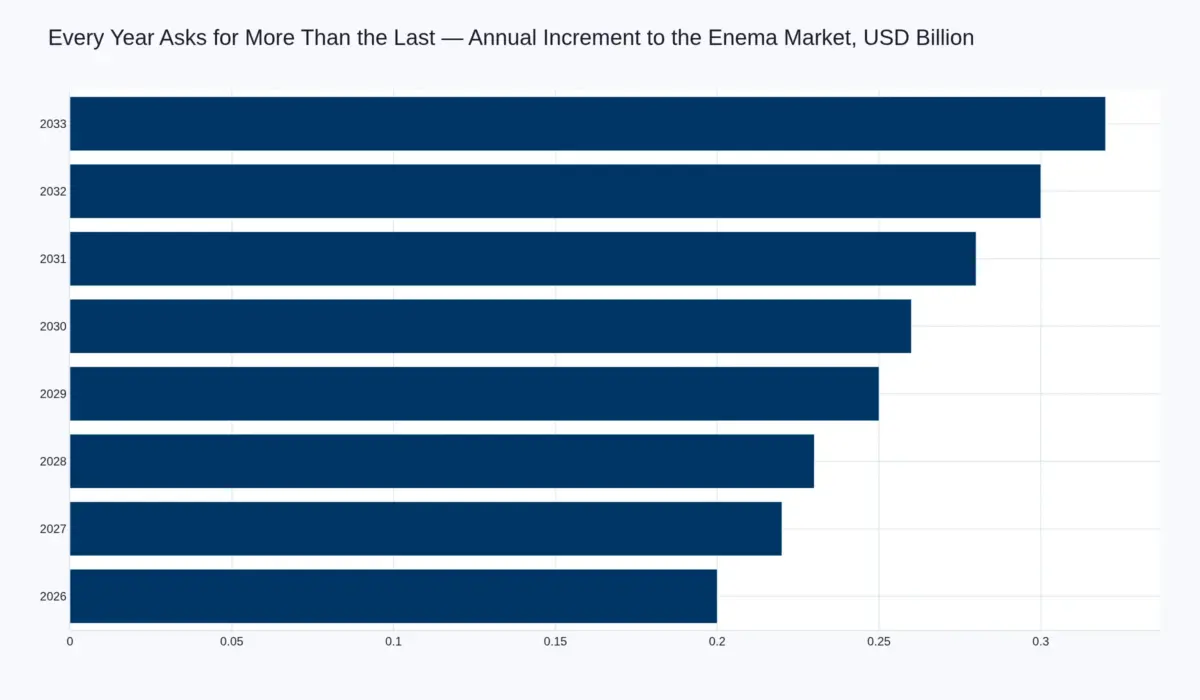
A compounding curve applied to a growing base quietly demands a step-up each year. Most categories meet that demand through depth — more units per customer, more procedures per patient, more intensity. This one can barely use that lever at all, and where it tries, two documents get in the way.
The first ceiling: a label that sends your heaviest users to someone else
A saline enema is sold over the counter, which is the source of its reach and the origin of its limit. The drug facts label specifies one 118 mL bottle in 24 hours and states that using more than one in 24 hours can be harmful. It then does something commercially remarkable: it instructs anyone aged 55 or over, anyone with kidney or heart problems, anyone who is dehydrated, and anyone on a sodium-restricted diet to ask a doctor before use — and warns against use beyond three days without medical advice.
Read that as a marketer rather than a clinician and it is a frequency cap aimed precisely at the chronic, older, comorbid customer who would otherwise be the heaviest user. The people with the greatest need are the people the label routes to a clinician rather than to the shelf.
The FDA put the label there for good reason. Its 2014 safety communication described a review of the agency’s adverse-event database and the medical literature that identified 54 cases of serious harm in 25 adults and 29 children from oral or rectal over-the-counter sodium phosphate — predominantly hyperphosphataemia, hypocalcaemia and hypernatraemia — with renal and cardiac consequences, some deaths, and most cases occurring where the labelled dose was exceeded or more than one dose was used in a day. The same action took oral sodium phosphate bowel-cleansing products off the over-the-counter shelf entirely while leaving the rectal form in place under tighter labelling. That asymmetry is the regulator drawing a line: the enema was judged defensible at a capped dose with clear risk communication, and the oral lavage was not.
So the first ceiling is not that the product is unsafe. It is that the product is safe enough to sell without a prescription only because its use is rationed by its own packaging.
The second ceiling: a guideline that keeps the enema a rescue tool
The institutional side has an entirely different constraint, and it arrives as clinical guidance rather than as a warning.
Multi-society bowel-preparation guidance from the American Society of Gastrointestinal Endoscopy, the American Society of Colon and Rectal Surgeons and the Society of American Gastrointestinal and Endoscopic Surgeons positions enemas as an adjunct. They are useful for washing out the distal colon in patients with poor or incomplete cleansing, and in patients with a proximal stoma or a defunctioned distal colon. The supporting evidence is graded as largely anecdotal, with no recent prospective trials. ASGE’s own technology review puts the same point from the other direction: adjunctive therapies including enemas do not appear to improve the efficacy of full-volume polyethylene glycol preparation.
That is a narrow, durable, and unglamorous role. It will not disappear, because nothing else reaches the distal colon in a patient with a defunctioning stoma. But it will not deepen either. An enema is what a unit reaches for when a preparation fails, not what a preparation is built on — which means the hospital revenue line tracks procedure volume, not enema use per procedure. More colonoscopies means more of everything. It does not mean more enemas per colonoscopy.
What is left is breadth, and breadth is real
Strip out depth and what remains is a genuine, if slower, driver. Chronic constipation is one of the most common gastrointestinal disorders worldwide: a meta-analysis across 45 population-based studies put pooled global prevalence of chronic idiopathic constipation at around 14 per cent, with prevalence rising with age and roughly twice as high in women as in men. Add an ageing population, expanding colorectal screening programmes that generate procedures and therefore rescue cases, and the steady migration of bowel management into the home, and 7.05 per cent becomes a defensible number.
But notice what kind of number it is. It is a demographics bet. It assumes more people, not more use per person. That is why 7.05 per cent is plausible here and 15 per cent would not be, and it is the single most useful check on any forecast of this category: if the model requires intensity per patient to do the work, the model is probably wrong.
The one place depth is permitted
There is an exception, and it is instructive precisely because it requires a physician.
Prescription 5-ASA enemas for distal ulcerative colitis are the one segment where using the product more — and for longer — is the point. Systematic review evidence supports rectal 5-ASA as a first-line treatment for mildly to moderately active distal ulcerative colitis, superior both to placebo and to rectal corticosteroids, with pooled evidence showing markedly better odds of symptomatic improvement.
This is what depth looks like when it is allowed: a clinician directs it, a dossier supports it, a payer may fund it, and the label is not rationing it. It is also a pharmaceutical business — gastroenterology call point, prescription access, reimbursement relationship — that is structurally separate from the over-the-counter trade and small in patient volume. It will not carry a global value series. It is, however, where the category’s most defensible margin sits, and that contrast is the whole story: the volume is in the tier where depth is capped, and the margin is in the tier where volume is small.
Why the industry looks the way it does
Ten tier-1 participants, a fragmented structure, and high competitive intensity. Those facts sound contradictory and are not, and the reason is the same inversion.
In the over-the-counter tier there is no molecule moat. A saline enema is a published composition of monobasic sodium phosphate and dibasic sodium phosphate heptahydrate in a fixed volume, in a moulded bottle with a lubricated tip. Nothing there is defensible through intellectual property, because nothing there is novel. Position is won at retail shelf, through packaging execution, and through the distributor and group-purchasing relationships that put a box in front of an institutional buyer. The ten players are not ten competitors in one game: they are brand owners who hold the demand and distributors who hold the access.
The transaction record makes the point more sharply than any argument. When Prestige Brands agreed to acquire C.B. Fleet Company in December 2016 and completed the deal in January 2017, it paid USD 825 million in cash against trailing revenue of roughly USD 205 million across the acquired business — about 4.02 times revenue. What it bought included the category’s leading enema brand, a leading paediatric laxative brand, and a “mix and fill” manufacturing facility in Lynchburg, Virginia.
But roughly 65 per cent of that portfolio’s revenue came from a feminine-hygiene brand. Everything else, bowel care included, accounted for the remainder — on the order of USD 71.75 million. The world’s leading enema brand has therefore never carried a standalone valuation at scale. It travelled inside a bundle whose value was carried by a different category. Where no standalone multiple exists, no consolidator has a price to anchor a bid against, and the market stays fragmented. That is not an accident of history; it is what happens to a category whose best-known product is designed to be used once.
What would have to be true — and what would break it
Three conditions underwrite the forecast, and each has a mirror-image falsifier worth watching.
- Breadth keeps expanding. Prevalence is high, it rises with age, and care keeps moving home. The falsifier: a sustained reversal in home-care utilisation, or a reclassification that moves routine bowel management out of over-the-counter retail.
- The label stays where it is. One bottle in 24 hours is compatible with a very large population using the product occasionally. The falsifier: a tighter monograph that further restricts at-risk groups, which would cut the heaviest-using cohort out of the addressable base.
- Institutional use holds its adjunct role. The enema’s niche in failed preparations and stoma patients is durable because nothing else fills it. The falsifier: prep protocols standardising in a way that eliminates the rescue step, which would remove the line while leaving procedure counts unchanged.
There is also a risk the forecast cannot see because the model cannot decompose it: price. This is a nominal value series with no volume component, and a category with no intellectual-property protection, an active private-label presence and a single-digit unit price has no structural defence against price erosion. If realised price per unit falls faster than volume grows, the dollar outcome is worse than the rate implies, and this series would not show it.
What is striking is that none of these failure modes requires a scientific disappointment. No molecule has to fail. The downside case in this category is regulatory and operational, which is a different shape of risk from the one most healthcare markets carry — and, given that the product has been chemically unchanged for decades, an honest one.
What this number is not
It is one value series: USD 2.85 billion to USD 4.92 billion at 7.05 per cent. It carries no volume series, so it implies no price per unit and no volume per capita. It splits no value by segment, indication, end-use or region — so the statement that cleansing enemas are the largest segment and disposable ready-to-use formats the fastest-growing is a structural ranking, not a modelled dollar share, and the same is true of North America leading and Asia Pacific growing fastest.
The clinical and regulatory evidence used above — the labelling, the 2014 FDA communication, multi-society bowel-preparation guidance, Cochrane evidence on rectal 5-ASA, published prevalence — explains the mechanism of the forecast. None of it is an input to the arithmetic. That distinction is worth holding on to, because the argument here is not that the model proves a thesis. It is that the thesis and the model point the same way: a category that cannot sell more of itself to any one person has to find more people, and 7.05 per cent is roughly what finding them looks like.
Frequently Asked Questions
How large is the enema-based products market and how fast is it growing?
The market was valued at USD 2.85 billion in 2025 and is forecast to reach USD 4.92 billion by 2033, a CAGR of 7.05% over 2026–2033. That is a net addition of USD 2.07 billion, or 1.73 times the 2025 base. Because the curve compounds, 42.1% of the 2033 market is revenue that does not exist today, and 56.8% of the total addition falls in the final four years.
Why can't the enema market grow by being used more?
Both of the category's revenue pools are capped, and neither cap is clinical. At home, the over-the-counter drug facts label permits one 118 mL bottle in 24 hours and directs users aged 55 and over, those with kidney or heart problems, those who are dehydrated and those on sodium-restricted diets to ask a doctor first — which limits frequency among the people who need the product most. In hospital, multi-society bowel-preparation guidance positions enemas as an adjunct for incomplete cleansing and for patients with a proximal stoma or defunctioned distal colon, on evidence described as largely anecdotal. Growth therefore has to come from more patients and more procedures rather than from more use per patient.
Why has the enema market stayed fragmented despite ten tier-1 players?
Because there is no durable asset to consolidate. The over-the-counter tier has no molecule moat — a saline enema is a published composition in a moulded bottle — so share is decided by brand, shelf position and distribution contracts. When Prestige Brands acquired C.B. Fleet in 2017 for USD 825 million against roughly USD 205 million of trailing revenue, about 65% of that portfolio's revenue came from a feminine-hygiene brand, so the leading enema brand has never carried a standalone valuation at scale. Without a benchmark multiple, no consolidator has a price to bid against.
Is there any part of the market where more intensive use is supported?
Prescription 5-ASA enemas for distal ulcerative colitis. Systematic review evidence supports rectal 5-ASA as a first-line treatment for mildly to moderately active distal ulcerative colitis, superior to placebo and to rectal corticosteroids. It is the one segment where longer and more intensive use is intended rather than rationed — because a clinician directs it — and it carries the category's most defensible margin. It is also small in patient volume and structurally separate from the over-the-counter trade.