
Global Freelance Platforms Market Report, Size & Forecast 2026-2033
Global Freelance Platforms Market Forecast Snapshot (2026???2033)
| Metric | Value |
|---|---|
| Market Size (2025) | ?? ?? ?? ?? ?? ?? ?? ?? ?? ?? ?? ?? ?? ?? ?? ?? ?? ?? ?? ?? ?? ?? ?? ?? ?? ?? ?? ?? ?? ?? ?? ?? ?? ?? ?? ?? ?? ?? ?? ?? ?? ??USD 6.85 Billion |
| Market Size (2033) | ?? ?? ?? ?? ?? ?? ?? ?? ?? ?? ?? ?? ?? ?? ?? ?? ?? ?? ?? ?? ?? ?? ?? ?? ?? ?? ?? ?? ?? ?? ?? ?? ?? ?? ?? ?? ?? ?? ?? ?? ?? ??USD 16.40 Billion |
| CAGR (2026???2033) | ?? ?? ?? ?? ?? ?? ?? ?? ?? ?? ?? ?? ?? ?? ?? ?? ?? ?? ?? ?? ?? ?? ?? ?? ?? ?? ?? ?? ?? ?? ?? ?? ?? ?? ?? ?? ?? ?? ?? ?? ?? ?? ?? ?? ?? ?? 11.50% |
| Largest Segment | ?? ?? ?? ?? ?? ?? ?? ?? ?? ?? ?? ?? ?? ?? ?? ?? ?? ?? ?? ?? ?? ?? ?? ?? ?? ?? ?? ?? ?? ?? ?? ?? Project-Based Freelancing Platforms |
| Fastest Growing Segment | ?? ?? ?? ?? ?? ?? ?? ?? ?? ?? ?? ?? ?? ?? ?? ?? ?? ?? ?? ?? ?? ?? ?? ?? ?? ?? ?? ?? ?? ?? ?? ??AI & Technology Freelancing Services |
| Leading End-Use Segment | ?? ?? ?? ?? ?? ?? ?? ?? ?? ?? ?? ?? ?? ?? ?? ?? ?? ?? ?? ?? ?? ?? ?? ?? ?? ?? ?? ?? ?? ?? ?? Small & Medium-Sized Enterprises (SMEs) |
| Key Trend | ?? ?? ?? ?? ?? ?? Remote Work Adoption, AI-Powered Talent Matching & Global Gig Economy Expansion |
| Regulatory Influence | ?? ?? ?? ?? ?? ?? Labor Classification Regulations, Cross-Border Payment Policies & Data Protection Laws |
| Future Outlook | ??Growth Driven by Digital Workforce Expansion, Flexible Employment Models & Demand for Specialized Skills |
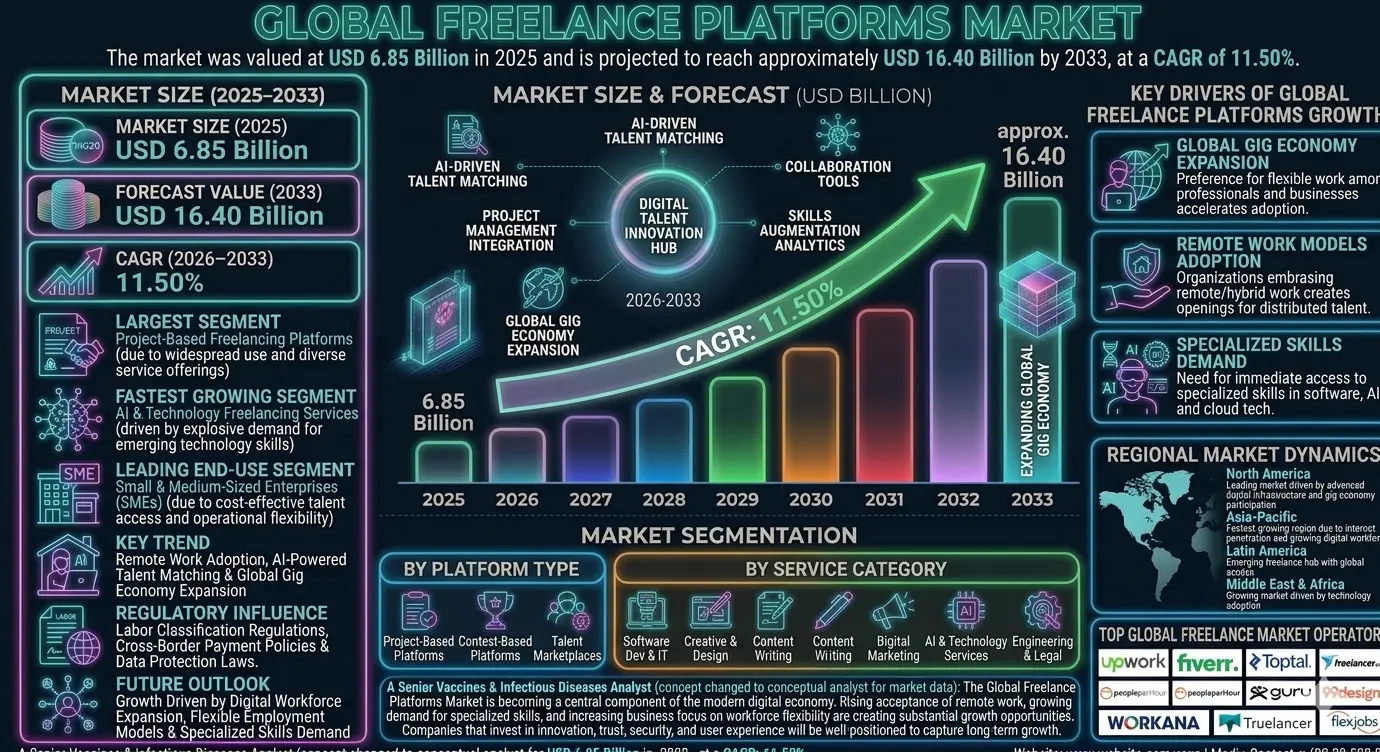
Global Freelance Platforms Market Size & Forecast
The Global Freelance Platforms Market is expected to witness robust growth during the forecast period from 2026 to 2033. The market was valued at USD 6.85 billion in 2025 and is projected to reach approximately USD 16.40 billion by 2033, registering a CAGR of 11.50%. Market growth is fueled by the rapid expansion of the gig economy, increasing adoption of remote work, rising demand for flexible workforce solutions, and growing digital transformation across industries. Businesses are increasingly leveraging freelance platforms to access specialized talent, reduce operational costs, and improve workforce scalability.Global Freelance Platforms Market Overview
Freelance platforms are digital marketplaces that connect independent professionals with businesses and individuals seeking services across domains such as software development, graphic design, content creation, digital marketing, consulting, finance, engineering, and legal services. These platforms facilitate project management, talent sourcing, payment processing, and collaboration. The market continues to evolve through artificial intelligence, automated talent matching, integrated productivity tools, and secure payment ecosystems.Structural Drivers of Market Growth
1. Expansion of the Global Gig Economy
The growing preference for flexible work arrangements among professionals and businesses is accelerating the adoption of freelance platforms worldwide. Market Implications: Platform operators are expanding service categories and global talent networks to capture rising demand.2. Increasing Adoption of Remote Work Models
Organizations are increasingly embracing remote and hybrid work environments, creating opportunities for distributed freelance talent. Market Implications: Freelance marketplaces are experiencing higher user registrations and project volumes across industries.3. Growing Demand for Specialized Digital Skills
Businesses require on-demand access to professionals with expertise in software development, AI, cybersecurity, digital marketing, and cloud technologies. Market Implications: High-skill freelance categories are generating premium service revenues and driving platform growth.4. Technological Advancements in Talent Matching
AI-driven algorithms and analytics tools are improving freelancer discovery, project matching, and hiring efficiency. Market Implications: Platforms utilizing intelligent matching technologies are enhancing customer satisfaction and retention rates.Market Segmentation Analysis
By Platform Type
- Project-Based Freelancing Platforms: Largest segment serving businesses requiring short-term and task-specific services.
- Contest-Based Platforms: Enable freelancers to compete for projects through creative submissions.
- Talent Marketplace Platforms: Focus on long-term engagements and specialized professional services.
By Service Category
- Software Development & IT Services: Major segment driven by growing digital transformation projects.
- Creative & Design Services: Includes graphic design, branding, animation, and multimedia content creation.
- Content Writing & Translation: Supports digital publishing, marketing, and localization requirements.
- Digital Marketing: Growing demand for SEO, social media management, and performance marketing expertise.
- AI & Technology Freelancing Services: Fastest-growing segment driven by demand for emerging technology skills.
By End Use
- Small & Medium-Sized Enterprises (SMEs): Largest segment due to cost-effective workforce access and operational flexibility.
- Large Enterprises: Increasing adoption for specialized project requirements and workforce augmentation.
- Individual Clients: Utilize freelance services for personal, creative, and business-related projects.
Regional Market Dynamics
North America
Leading market driven by advanced digital infrastructure, strong gig economy participation, and widespread remote work adoption.Europe
Significant growth supported by increasing freelancer populations, startup ecosystems, and flexible employment trends.Asia-Pacific
Fastest-growing region due to expanding internet penetration, growing digital workforce, and rising demand for online services.Latin America
Emerging freelance hub supported by increasing digitalization and access to global project opportunities.Middle East & Africa
Growing market driven by entrepreneurship initiatives, technology adoption, and remote work expansion.Competitive Landscape
The Global Freelance Platforms Market is highly competitive with international marketplace providers competing through platform innovation, talent quality, service diversification, and payment security. Key Companies Operating in the Market Include:- Upwork Inc.
- Fiverr International Ltd.
- Toptal LLC
- Freelancer Limited
- PeoplePerHour Ltd.
- Guru.com
- 99designs by Vista
- Workana
- Truelancer
- FlexJobs Corporation
Strategic Outlook
The future of the freelance platforms market will be driven by increasing workforce decentralization, AI-powered recruitment tools, and the continued growth of digital employment models. Businesses are expected to rely more heavily on freelance talent to address skill shortages, improve operational agility, and accelerate innovation. Advanced technologies such as AI-driven candidate matching, automated project management, and integrated collaboration tools will enhance platform efficiency and user experiences. Cross-border freelancing opportunities will continue expanding as organizations seek global talent pools and professionals pursue international projects. Additionally, secure payment systems, compliance management solutions, and workforce analytics tools will play a critical role in shaping the next generation of freelance marketplaces.Final Market Perspective
The Global Freelance Platforms Market is becoming a central component of the modern digital economy. Rising acceptance of remote work, growing demand for specialized skills, and increasing business focus on workforce flexibility are creating substantial growth opportunities. As technology continues to improve talent matching, collaboration, and payment processes, freelance platforms will play an increasingly important role in connecting businesses with skilled professionals worldwide. Companies that invest in innovation, trust, security, and user experience will be well-positioned to capture long-term growth in the evolving global gig economy.Table of Contents
Table of Contents
- Executive Summary
- Global Freelance Platforms Market Snapshot (2026???2033)
- Market Size & Growth Overview
- Key Market Highlights
- Largest & Fastest-Growing Segments
- Leading End-Use Segment Overview
- Key Market Trends in Remote Work & Digital Talent Platforms
- Strategic Outlook Through 2033
- Market Introduction & Overview
- Definition of Freelance Platforms
- Scope of the Global Freelance Platforms Market
- Evolution of the Global Gig Economy
- Role of Freelance Platforms in Workforce Transformation
- Value Chain Analysis of Freelance Marketplace Ecosystems
- Regulatory Influence (Labor Classification Regulations, Cross-Border Payment Policies & Data Protection Laws)
- Transition Toward AI-Powered Talent Matching & Digital Workforce Management
- Research Methodology
- Primary Research Approach
- Secondary Research Sources
- Market Size Estimation Methodology
- Forecasting Assumptions (2026???2033)
- Data Validation & Triangulation Process
- Market Dynamics
- Structural Drivers of Market Growth
- Expansion of the Global Gig Economy
- Increasing Adoption of Remote Work Models
- Growing Demand for Specialized Digital Skills
- Technological Advancements in Talent Matching
- Market Restraints
- Regulatory Uncertainty Around Freelance Employment
- Intense Platform Competition and Pricing Pressure
- Trust and Quality Assurance Challenges
- Market Opportunities
- Expansion of AI & Technology Freelancing Services
- Growth of Cross-Border Freelance Engagements
- Increasing SME Adoption of Freelance Talent
- Integration of Workforce Analytics and Automation Tools
- Market Challenges
- Worker Classification and Compliance Requirements
- Cybersecurity and Data Privacy Risks
- Platform Dependency and Talent Retention Issues
- Structural Drivers of Market Growth
- Global Freelance Platforms Market Size & Forecast (2026???2033)
- Market Revenue Analysis
- CAGR Analysis
- Gig Economy Growth Trends
- Remote Work Adoption Analysis
- Investment and Funding Trends
- Future Market Outlook
- Market Segmentation Analysis (2026???2033)
- By Platform Type
- Project-Based Freelancing Platforms (Largest Segment)
- Contest-Based Platforms
- Talent Marketplace Platforms
- By Service Category
- Software Development & IT Services
- Creative & Design Services
- Content Writing & Translation
- Digital Marketing
- AI & Technology Freelancing Services (Fastest-Growing Segment)
- By End Use
- Small & Medium-Sized Enterprises (SMEs) (Largest Segment)
- Large Enterprises
- Individual Clients
- By Platform Type
- Regional Market Analysis
- North America (Largest Regional Market)
- Europe
- Asia-Pacific (Fastest-Growing Region)
- Latin America
- Middle East & Africa
- Competitive Landscape
- Market Structure & Competitive Analysis
- Key Player Benchmarking
- Strategic Developments
- AI-Powered Recruitment & Platform Innovation Strategies
- Partnerships, Acquisitions & Global Marketplace Expansion
- Company Profiles
- Upwork Inc.
- Fiverr International Ltd.
- Toptal LLC
- Freelancer Limited
- PeoplePerHour Ltd.
- Guru.com
- 99designs by Vista
- Workana
- Truelancer
- FlexJobs Corporation
- Strategic Outlook
- Future of AI-Powered Freelance Marketplaces
- Expansion of Global Digital Workforce Networks
- Growth of Cross-Border Freelancing Opportunities
- Evolution of Workforce Management & Collaboration Tools
- Long-Term Market Outlook (2033+)
- Final Market Perspective
- Appendix
- About Pheonix Market Research
- Disclaimer
Competitive Landscape
Global Freelance Platforms Market Competitive Intensity & Market Structure Overview
The Global Freelance Platforms Market is highly competitive and moderately fragmented, characterized by the presence of large international marketplaces, specialized talent networks, regional freelance platforms, and niche service providers. Competitive intensity is primarily driven by platform scale, talent quality, AI-powered matching capabilities, user experience, pricing structures, payment security, and global workforce accessibility.
Companies compete across project-based freelancing, talent marketplaces, creative services, software development, consulting, digital marketing, and emerging technology segments. The rapid expansion of the gig economy, increasing remote work adoption, and growing demand for specialized digital skills are intensifying competition across the global freelance ecosystem.
The market structure is evolving from traditional job outsourcing models toward intelligent digital talent ecosystems that integrate AI-driven talent discovery, project collaboration tools, compliance management, and secure payment solutions. Platform operators are increasingly investing in automation, workforce analytics, and specialized talent communities to strengthen their competitive positioning.
Global Freelance Platforms Market Competitive Intensity & Market Structure Current Scenario
Leading Global Freelance Platform Companies
- Upwork Inc.: One of the largest global freelance marketplaces, offering project-based and long-term talent solutions across technology, creative, business, and professional service categories.
- Fiverr International Ltd.: A leading digital services marketplace known for its gig-based service model, enabling businesses to access freelancers across diverse skill categories.
- Toptal LLC: A premium talent network specializing in highly skilled professionals across software development, finance, project management, and consulting services.
- Freelancer Limited: A global freelancing platform connecting businesses with independent professionals through project bidding and talent sourcing solutions.
- PeoplePerHour Ltd.: A freelance marketplace focused on connecting businesses with freelancers in design, development, marketing, and business support services.
- Guru.com: A well-established platform providing flexible hiring solutions for businesses seeking freelance talent across technical and professional disciplines.
- 99designs by Vista: A specialized creative marketplace focused on graphic design, branding, logo development, and visual content services.
- Workana: A leading freelance platform serving Latin American markets while facilitating global talent engagement across multiple professional categories.
- Truelancer: A rapidly expanding freelance marketplace providing affordable access to digital talent across software, content, design, and marketing services.
- FlexJobs Corporation: A specialized platform focused on remote, flexible, and freelance employment opportunities across various industries and professional sectors.
Key Competitive Intensity & Market Structure Drivers
The growing demand for remote work and flexible workforce models is intensifying competition among freelance platforms seeking to attract both skilled professionals and enterprise clients.
AI-powered talent matching, automated recruitment systems, and workforce analytics tools are becoming critical differentiators as platforms strive to improve hiring efficiency and project success rates.
Increasing demand for specialized expertise in artificial intelligence, cybersecurity, cloud computing, software development, and digital transformation is driving competition for high-value freelance talent.
Cross-border freelancing growth is expanding global talent pools while increasing competition among platforms to provide secure payment systems, compliance support, and international workforce management capabilities.
Labor classification regulations, data privacy requirements, and payment compliance standards are creating additional barriers to entry and influencing platform operating strategies.
Strategic Implications of Competitive Intensity & Market Structure
Companies with strong global freelancer networks, advanced AI capabilities, trusted payment ecosystems, and enterprise-focused workforce solutions are expected to maintain significant competitive advantages.
Investment in intelligent talent discovery, automated project management tools, and integrated collaboration environments is becoming increasingly important for long-term differentiation.
Platforms focusing on high-skill professional categories such as AI, software engineering, data science, and digital consulting are likely to capture premium revenue opportunities.
Strategic partnerships with enterprises, educational institutions, and workforce development organizations are enabling platforms to strengthen talent pipelines and expand market reach.
Organizations capable of delivering trust, transparency, compliance, and superior user experiences across both freelancers and clients will be best positioned to compete effectively in the evolving digital workforce ecosystem.
Global Freelance Platforms Market Competitive Intensity & Market Structure Forward Outlook
The competitive landscape of the global freelance platforms market is expected to become increasingly AI-driven, data-centric, and globally interconnected as businesses continue adopting flexible workforce strategies.
Future competition will be shaped by advancements in AI-powered recruitment, predictive workforce analytics, automated compliance management, and integrated productivity solutions designed for distributed teams.
Freelance platform providers are expected to increase investments in talent verification technologies, secure cross-border payment systems, skills assessment frameworks, and enterprise workforce management capabilities.
The growing demand for specialized technology professionals, combined with continued expansion of remote work and global talent sourcing, will further strengthen market opportunities across multiple industry verticals.
Over the forecast period, companies that successfully balance platform innovation, workforce quality, regulatory compliance, payment security, and scalable global operations will be best positioned to lead the evolving global freelance platforms market.
Value Chain
Global Freelance Platforms Market Value Chain & Supply Chain Evolution Overview
The Global Freelance Platforms Market operates through a digital value chain that connects businesses, independent professionals, technology providers, payment processors, and workforce management systems. The ecosystem enables organizations to access specialized talent on demand while providing freelancers with global employment opportunities across multiple industries.
The value chain is increasingly driven by artificial intelligence, cloud-based collaboration tools, secure payment systems, and digital workforce management technologies. As remote work and flexible employment models continue to expand globally, freelance platforms are evolving into comprehensive talent ecosystems that support recruitment, project management, communication, compliance, and payments.
The market is also witnessing growing integration of automation, workforce analytics, and cross-border transaction capabilities, enabling more efficient talent matching and global workforce participation.
Global Freelance Platforms Market Value Chain & Supply Chain Evolution Current Scenario
Market-Specific Value Chain
- Talent Acquisition & Freelancer Onboarding: Registration, profile creation, skill verification, portfolio development, certification validation, and onboarding of freelance professionals.
- Platform Development & Technology Infrastructure: Development of marketplace platforms, AI-powered matching engines, cloud infrastructure, mobile applications, and collaboration tools.
- Project Posting & Talent Matching: Businesses publish project requirements while AI algorithms and search systems match suitable freelancers with client needs.
- Contracting & Workforce Management: Proposal submission, project agreements, milestone management, time tracking, and workflow coordination.
- Payment Processing & Financial Services: Escrow systems, payment gateways, cross-border transactions, invoicing, taxation support, and freelancer payouts.
- Project Delivery & Collaboration: Communication tools, file sharing, project monitoring, productivity platforms, and client-freelancer collaboration systems.
- Quality Assurance & Reputation Management: Reviews, ratings, dispute resolution, performance monitoring, and trust-building mechanisms.
- End User Utilization: SMEs, large enterprises, startups, government organizations, and individual clients utilizing freelance talent for project execution.
Company-to-Stage Mapping
- Talent Acquisition & Freelancer Onboarding: Upwork Inc., Fiverr International Ltd., Freelancer Limited, Toptal LLC, and PeoplePerHour Ltd.
- Platform Development & Technology Infrastructure: Upwork, Fiverr, Workana, Truelancer, cloud service providers, and software development partners.
- Project Posting & Talent Matching: AI-powered marketplace operators, talent discovery platforms, and workforce analytics providers.
- Contracting & Workforce Management: Upwork Enterprise, Toptal, FlexJobs Corporation, and workforce management solution providers.
- Payment Processing & Financial Services: PayPal, Stripe, Payoneer, Wise, escrow service providers, and financial technology companies.
- Project Delivery & Collaboration: Slack, Microsoft Teams, Zoom, Google Workspace, and integrated productivity platforms.
- Quality Assurance & Reputation Management: Platform review systems, rating engines, compliance monitoring tools, and dispute resolution services.
- End User Utilization: SMEs, multinational enterprises, startups, entrepreneurs, agencies, and individual customers worldwide.
Key Value Chain & Supply Chain Evolution Signals
- Expansion of AI-Powered Talent Matching: Artificial intelligence is improving freelancer discovery, skill assessment, and project matching accuracy.
- Growth of Remote Work Ecosystems: Increasing adoption of distributed workforce models is driving demand for digital freelance platforms.
- Rise of Specialized Freelance Services: High-demand categories such as AI, cybersecurity, cloud computing, and software development are expanding rapidly.
- Advancement of Cross-Border Payment Solutions: Secure international payment systems are enabling seamless global freelancer participation.
- Integration of Workforce Analytics: Data-driven insights are helping organizations optimize talent utilization and project performance.
- Expansion of Enterprise Freelance Programs: Large organizations are increasingly adopting freelance workforce strategies to improve agility and access specialized skills.
Strategic Implications of Value Chain Evolution
- Investment in AI Recruitment Technologies: Platforms leveraging intelligent matching systems can improve user engagement and hiring efficiency.
- Expansion of Global Talent Networks: Access to international freelancer pools enhances platform competitiveness and service diversity.
- Strengthening Payment Security Infrastructure: Reliable financial systems improve trust among freelancers and clients.
- Development of Enterprise Workforce Solutions: Customized freelance management services can attract large corporate clients.
- Enhancement of Compliance Capabilities: Labor classification management and regulatory compliance tools are becoming increasingly important.
- Growth of Integrated Collaboration Platforms: End-to-end project management capabilities improve customer retention and operational efficiency.
Global Freelance Platforms Market Value Chain & Supply Chain Evolution Forward Outlook
- Expansion of AI-driven freelancer matching and workforce analytics systems.
- Growth of specialized freelance categories including AI, cloud computing, and cybersecurity services.
- Increasing adoption of enterprise-focused freelance workforce solutions.
- Strengthening of global payment, compliance, and taxation management infrastructure.
- Expansion of remote work ecosystems and cross-border talent engagement.
- Integration of advanced collaboration, productivity, and project management tools.
The freelance platforms value chain is expected to become increasingly intelligent, automated, and globally interconnected. Digital workforce expansion, technological innovation, and flexible employment models will continue reshaping how businesses access talent and execute projects.
Organizations that successfully combine AI-powered matching, secure payment infrastructure, compliance management, and seamless collaboration capabilities will be best positioned to achieve long-term growth and competitive leadership in the Global Freelance Platforms Market.
Investment Activity
Global Freelance Platforms Market Investment & Funding Dynamics Overview (2026???2033)
The Global Freelance Platforms Market is witnessing strong investment activity as businesses increasingly adopt flexible workforce models and digital talent sourcing strategies. Venture capital firms, private equity investors, technology companies, and strategic corporate investors are actively deploying capital into freelance marketplaces, AI-powered talent matching platforms, workforce management solutions, cross-border payment systems, and digital collaboration technologies.
The expansion of the global gig economy, growing acceptance of remote work, and rising demand for specialized digital skills are encouraging substantial funding across the freelance ecosystem. Capital investments are increasingly focused on platform scalability, artificial intelligence integration, talent verification systems, secure payment infrastructure, and enterprise workforce solutions.
Additionally, increasing investments in AI-driven recruitment technologies, workforce analytics, freelancer upskilling platforms, and global talent management systems are creating long-term growth opportunities throughout the market.
Current Investment & Funding Landscape
The market is currently experiencing significant capital inflows as platform operators seek to expand user bases, improve talent quality, and strengthen platform capabilities. Investors are showing strong interest in platforms that provide high-skill talent access, enterprise-grade workforce solutions, and technology-enabled hiring efficiencies.
Funding activity is particularly concentrated in high-growth segments such as AI and technology freelancing services, software development marketplaces, digital marketing talent platforms, and specialized professional services networks. Companies are also investing heavily in automation tools that improve project matching, freelancer onboarding, and customer retention.
Strategic partnerships among freelance platforms, payment providers, HR technology companies, and enterprise software vendors are further driving innovation and enhancing the overall digital workforce ecosystem.
Key Investment & Funding Dynamics Signals
- Growing adoption of remote and hybrid work models is accelerating investments in freelance talent platforms.
- Rising demand for AI, software development, cybersecurity, and digital transformation expertise is attracting premium funding into specialized freelancer networks.
- Increasing use of AI-powered talent matching and recruitment automation tools is driving technology-focused investments.
- Expansion of cross-border freelancing opportunities is supporting investment in global payment and compliance infrastructure.
- Growing enterprise adoption of on-demand workforce solutions is encouraging platform expansion and service diversification.
- Investments in identity verification, payment security, and trust-building technologies are strengthening platform reliability.
- Rising focus on freelancer training, certification, and skill development programs is creating new funding opportunities.
Strategic Implications of Investment & Funding Dynamics
- Companies investing in AI-driven talent matching and workforce automation technologies are expected to gain stronger competitive positioning.
- Capital allocation toward enterprise-focused freelance solutions and managed workforce services will support long-term revenue growth.
- Platforms offering specialized talent pools and premium professional services are likely to attract higher investor interest.
- Strategic collaborations between freelance marketplaces, HR technology firms, and payment providers will accelerate ecosystem development.
- Investments in cross-border payment systems, compliance tools, and workforce analytics will remain critical growth priorities.
- Compliance with labor classification regulations, data protection laws, and international payment requirements will increasingly influence investment decisions.
- Organizations building integrated capabilities across talent acquisition, workforce management, collaboration, and payments are expected to capture substantial long-term value.
Forward Outlook
Looking ahead, the Global Freelance Platforms Market is expected to maintain strong investment momentum driven by workforce decentralization, digital employment growth, and increasing demand for specialized professional skills. Future capital deployment will focus on AI-powered hiring solutions, global talent marketplaces, workforce analytics platforms, and enterprise freelance management systems.
Investors are also expected to increase funding for cross-border workforce infrastructure, secure digital payment ecosystems, freelancer productivity tools, and skill development technologies as the global gig economy continues to expand.
As businesses seek greater workforce flexibility and access to global talent pools, investment activity will broaden across talent sourcing platforms, collaboration technologies, compliance solutions, and digital workforce ecosystems.
In conclusion, the Global Freelance Platforms Market represents a rapidly evolving digital workforce investment landscape where AI-powered talent matching, remote work enablement, secure payment infrastructure, and specialized skill marketplaces will define future funding priorities, competitive differentiation, and long-term market growth.
Technology & Innovation
Global Freelance Platforms Market Technology & Innovation Landscape Overview
The global freelance platforms market is undergoing rapid technological transformation driven by advancements in artificial intelligence-powered talent matching, cloud-based collaboration tools, automated workforce management systems, digital payment technologies, and data-driven recruitment analytics. As remote work and the gig economy continue to expand globally, freelance platforms are evolving into intelligent digital ecosystems that connect businesses with specialized talent efficiently and securely.
Modern freelance marketplaces increasingly integrate AI algorithms, machine learning models, predictive hiring analytics, automated skill assessment tools, and workflow management solutions to improve project matching accuracy, hiring speed, and freelancer productivity. These innovations are enabling businesses to identify qualified professionals while helping freelancers access relevant opportunities more effectively.
The market is also witnessing strong adoption of secure payment gateways, blockchain-based contract systems, cloud collaboration platforms, virtual communication technologies, and automated compliance management solutions, enhancing transparency, trust, and operational efficiency across global freelance engagements.
Global Freelance Platforms Market Technology & Innovation Current Scenario
Current innovation in the freelance platforms market is primarily centered around AI-driven talent discovery, remote workforce enablement, and platform automation. Companies are increasingly leveraging intelligent technologies to optimize recruitment processes, project management, and freelancer engagement.
AI-powered talent matching systems are being widely adopted to analyze freelancer profiles, skill sets, project requirements, work history, and performance metrics, enabling more accurate hiring decisions.
Cloud-based collaboration environments are supporting seamless communication, project tracking, file sharing, and workflow coordination between clients and freelancers operating across multiple geographies.
Automated payment and contract management platforms are simplifying global transactions, reducing administrative burdens, and ensuring secure compensation processes for freelancers and businesses.
Remote work technologies are further strengthening platform ecosystems by enabling distributed workforce management, virtual team collaboration, and real-time project monitoring.
Additionally, analytics-driven workforce intelligence tools are helping organizations assess talent availability, project costs, productivity trends, and workforce planning requirements more effectively.
Key Technology & Innovation Trends in Global Freelance Platforms Market
- AI-Powered Talent Matching: Intelligent algorithms improving freelancer-client project compatibility.
- Machine Learning Recruitment Analytics: Predictive hiring and performance evaluation capabilities.
- Cloud-Based Collaboration Platforms: Real-time communication, project tracking, and workflow management.
- Automated Skill Assessment Tools: Digital testing and certification systems for talent validation.
- Secure Digital Payment Ecosystems: Faster and safer cross-border payment processing.
- Blockchain-Based Smart Contracts: Enhancing transparency, trust, and payment security.
- Remote Workforce Management Solutions: Supporting distributed team coordination and productivity monitoring.
- Workforce Analytics & Business Intelligence: Data-driven talent acquisition and project optimization.
- Integrated Compliance Management Systems: Addressing labor regulations, taxation, and contractor classification requirements.
- AI-Enabled Customer Support Automation: Chatbots and virtual assistants improving user experience and platform efficiency.
Strategic Implications of Technology & Innovation
Technological advancements are transforming freelance platforms from simple job marketplaces into intelligent workforce orchestration ecosystems capable of managing talent acquisition, project execution, payment processing, and compliance workflows at scale.
Companies investing in AI-driven recruitment technologies, advanced collaboration platforms, and secure payment infrastructures are strengthening their competitive positioning through improved user experiences, higher engagement rates, and operational efficiency.
The convergence of artificial intelligence, cloud computing, workforce analytics, and automation is enabling businesses to build agile, scalable, and globally distributed workforces while reducing hiring complexity.
Automation technologies are improving project delivery timelines, reducing administrative costs, and enhancing transparency across freelance engagements.
However, labor classification regulations, data privacy concerns, cybersecurity risks, platform competition, and cross-border compliance challenges remain key factors influencing market development and platform strategies.
Global Freelance Platforms Market Technology & Innovation Forward Outlook
The future of the freelance platforms market is expected to evolve toward AI-first workforce ecosystems, decentralized talent networks, automated project management frameworks, and globally integrated digital labor marketplaces.
Emerging innovations include generative AI-powered hiring assistants, blockchain-based freelancer identity verification, predictive workforce planning systems, autonomous project coordination tools, and advanced skills intelligence platforms.
Cross-border freelancing is expected to expand significantly as organizations increasingly access global talent pools to address skill shortages and accelerate digital transformation initiatives.
The integration of AI, cloud collaboration technologies, workforce analytics, and secure digital financial infrastructure will further enhance platform scalability, trust, and operational efficiency.
Overall, the global freelance platforms market is evolving into a highly connected, technology-driven ecosystem where artificial intelligence, automation, digital payments, and remote workforce technologies collectively redefine the future of work and global talent engagement.
Market Risk
Global Freelance Platforms Market Risk Factors & Disruption Threats Overview
The Global Freelance Platforms Market operates within a rapidly evolving digital labor ecosystem shaped by remote work adoption, workforce flexibility, technological innovation, and cross-border talent mobility. While the industry benefits from the expansion of the gig economy and increasing demand for specialized skills, it faces significant risks related to labor regulations, platform competition, cybersecurity concerns, economic uncertainty, and the growing influence of artificial intelligence on knowledge-based work.
A major structural risk is the increasing regulatory scrutiny surrounding freelancer classification, worker rights, taxation, and employment protections. Governments across multiple jurisdictions are reevaluating labor laws to determine whether freelancers should be treated as independent contractors or employees, potentially impacting platform business models and operating costs.
Another important disruption factor is the rapid advancement of artificial intelligence and automation technologies. AI-powered tools are increasingly capable of performing tasks such as content creation, coding assistance, graphic design, customer support, and administrative functions, potentially reducing demand for certain freelance services.
The market is also exposed to cybersecurity and data privacy risks, as freelance platforms handle sensitive client information, payment data, intellectual property, and project-related communications across global networks.
Additionally, economic downturns and corporate budget constraints can lead businesses to reduce discretionary project spending, affecting freelance project volumes and platform revenues.
Global Freelance Platforms Market Risk Factors & Disruption Threats Current Scenario
The current market is characterized by strong growth in remote work adoption, increasing utilization of freelance talent by SMEs and enterprises, and rising demand for specialized digital skills across industries.
Freelance platforms are investing heavily in AI-powered talent matching systems, productivity tools, project management capabilities, and secure payment ecosystems to improve user experiences and platform efficiency.
At the same time, policymakers are introducing new labor frameworks, taxation requirements, and digital marketplace regulations that may reshape workforce classification standards and compliance obligations.
Businesses continue to expand cross-border hiring strategies to access global talent pools, creating opportunities while simultaneously increasing exposure to international compliance and payment complexities.
Competition remains intense as established freelance marketplaces, niche talent platforms, staffing firms, and professional networking ecosystems compete for clients and skilled professionals.
Key Risk Factors & Disruption Threats Signals in Global Freelance Platforms Market
A major disruption signal is the growing regulatory focus on gig economy labor practices, worker protections, social security contributions, and freelancer classification rules in major economies.
Another important signal is the rapid adoption of generative AI technologies, which are reshaping demand for certain freelance categories while creating new opportunities in AI-related services and consulting.
The increasing use of AI-driven talent matching, skills verification, and automated recruitment systems is transforming how freelancers and clients connect on digital platforms.
Growing demand for cybersecurity, cloud computing, data analytics, AI engineering, and software development expertise is driving premium growth opportunities within high-skill freelance segments.
Cross-border freelancing activity continues to increase as businesses seek cost-effective global talent, strengthening the importance of international payment systems and compliance infrastructure.
Strategic Implications of Risk Factors & Disruption Threats in Global Freelance Platforms Market
Platform operators must strengthen compliance capabilities to address evolving labor regulations, taxation requirements, data privacy standards, and workforce classification frameworks across multiple jurisdictions.
Investment in AI-powered matching engines, skills assessment tools, and workforce analytics platforms will be critical for improving hiring efficiency and maintaining competitive differentiation.
Companies should prioritize cybersecurity, fraud prevention, and secure payment infrastructure to protect users, safeguard intellectual property, and maintain trust within digital marketplaces.
Diversification into high-growth service categories such as AI consulting, cybersecurity, software engineering, and emerging technology services will help platforms capture premium market opportunities.
Strategic partnerships with payment providers, enterprise software vendors, educational institutions, and workforce development organizations will support long-term ecosystem growth and user engagement.
Global Freelance Platforms Market Risk Factors & Disruption Threats Forward Outlook
Looking ahead to 2026???2033, the Global Freelance Platforms Market is expected to evolve into a more intelligent, globally connected, and skills-driven workforce ecosystem.
AI-powered recruitment systems, automated project management tools, and advanced workforce analytics will increasingly streamline talent acquisition and project execution processes.
Regulatory frameworks governing gig work, worker protections, and digital labor platforms are likely to become more comprehensive, requiring greater compliance and operational transparency.
Demand for highly specialized professionals in areas such as artificial intelligence, cloud computing, cybersecurity, digital transformation, and advanced engineering is expected to drive sustained market expansion.
Overall, the market will remain strongly growth-oriented but increasingly shaped by labor policy reforms, AI-driven workforce transformation, cybersecurity requirements, and global talent mobility. Long-term leaders will be defined by their ability to deliver secure, compliant, scalable, and technology-enabled freelance ecosystems that effectively connect businesses with skilled professionals worldwide.
Regulatory Landscape
Global Freelance Platforms Market Regulatory & Policy Environment Overview
The regulatory and policy environment governing the Global Freelance Platforms Market is evolving rapidly as governments, labor authorities, tax agencies, and digital regulators respond to the growing influence of the gig economy and remote workforce models. Regulatory frameworks are increasingly focused on labor classification, worker rights, taxation, cross-border service transactions, digital platform accountability, and data protection requirements.
Freelance marketplace operators, independent professionals, businesses, payment providers, and workforce management platforms must comply with a broad range of regulations governing employment status, contractor engagement, digital payments, tax reporting, consumer protection, and cybersecurity. As freelance work becomes more globalized, regulatory compliance is becoming a critical factor for sustainable platform growth and international expansion.
The continued rise of remote work, digital labor marketplaces, and AI-powered talent platforms is encouraging policymakers to modernize workforce regulations while balancing labor flexibility, worker protections, and business innovation.
Global Freelance Platforms Market Regulatory & Policy Environment Current Scenario
The current regulatory environment is characterized by increasing scrutiny of worker classification practices. Governments across major economies are evaluating the distinction between independent contractors and traditional employees to ensure fair labor standards, social security contributions, and workplace protections.
Cross-border payment regulations are playing an increasingly important role in global freelance ecosystems. Platforms facilitating international transactions must comply with anti-money laundering (AML) requirements, know-your-customer (KYC) standards, foreign exchange regulations, and payment reporting obligations.
Data privacy and cybersecurity regulations have become central to platform operations due to the large volumes of personal, financial, and professional information exchanged through freelance marketplaces. Compliance with regional and national data protection laws is essential for maintaining user trust and regulatory approval.
Taxation frameworks are also evolving to address digital labor markets. Many jurisdictions are introducing reporting requirements for platform operators and freelancers to improve transparency and tax compliance in the gig economy.
At the same time, digital platform governance policies are expanding to address issues such as transparency in talent matching algorithms, dispute resolution processes, platform accountability, and fair marketplace practices.
Key Regulatory & Policy Environment Signals in Global Freelance Platforms Market
- Labor Classification Regulations: Rules defining the legal status of freelancers, independent contractors, and platform-based workers.
- Cross-Border Payment & Financial Compliance Policies: AML, KYC, foreign exchange, and international payment regulations governing freelance transactions.
- Data Protection & Privacy Laws: Requirements for safeguarding user information, financial data, and digital communications.
- Tax Reporting & Digital Economy Taxation Frameworks: Policies requiring income disclosure, platform reporting, and tax compliance for freelance earnings.
- Platform Accountability & Consumer Protection Rules: Regulations governing marketplace transparency, dispute resolution, and fair business practices.
- Cybersecurity & Digital Infrastructure Standards: Frameworks ensuring secure transactions, identity verification, and protection against fraud and cyber threats.
Strategic Implications of Regulatory & Policy Environment
The evolving regulatory landscape is encouraging freelance platform operators to invest in compliance infrastructure, workforce classification tools, secure payment systems, and transparent platform governance mechanisms. Regulatory readiness is becoming a key competitive differentiator in global digital labor markets.
Labor classification regulations are prompting platforms to reassess contractor engagement models and develop compliance strategies that align with changing employment laws across multiple jurisdictions.
Cross-border payment requirements are driving investments in secure financial infrastructure, identity verification technologies, and automated compliance management systems to support international transactions efficiently.
Data protection regulations are encouraging platforms to strengthen cybersecurity frameworks, enhance consent management processes, and improve transparency regarding user data collection and usage practices.
Tax reporting obligations are increasing operational complexity while simultaneously creating opportunities for platforms that offer integrated compliance support and financial management tools for freelancers and businesses.
Global Freelance Platforms Market Regulatory & Policy Environment Forward Outlook
Between 2026 and 2033, the regulatory environment for the global freelance platforms market is expected to become more comprehensive as governments continue adapting labor and digital economy policies to accommodate expanding freelance workforces and cross-border employment models.
Labor regulations are likely to evolve toward clearer frameworks defining freelancer rights, benefits eligibility, social protections, and platform responsibilities while preserving workforce flexibility and entrepreneurial opportunities.
Digital payment and taxation regulations are expected to become increasingly standardized across international markets, improving transparency while facilitating compliant cross-border freelance engagements.
Data privacy and cybersecurity requirements will likely become more stringent as freelance platforms continue to manage growing volumes of sensitive user information and digital transactions. Compliance with advanced security standards will become essential for market credibility.
Overall, the future regulatory landscape will be defined by the convergence of labor classification regulations, cross-border payment policies, tax compliance frameworks, data protection laws, and digital platform governance standards. Companies capable of delivering compliant, secure, transparent, and globally scalable freelance marketplace solutions will be best positioned to capitalize on long-term opportunities within the evolving global gig economy.