
Global People Counting System Market Report, Size & Forecast 2026-2033
Global People Counting System Market Size & Forecast
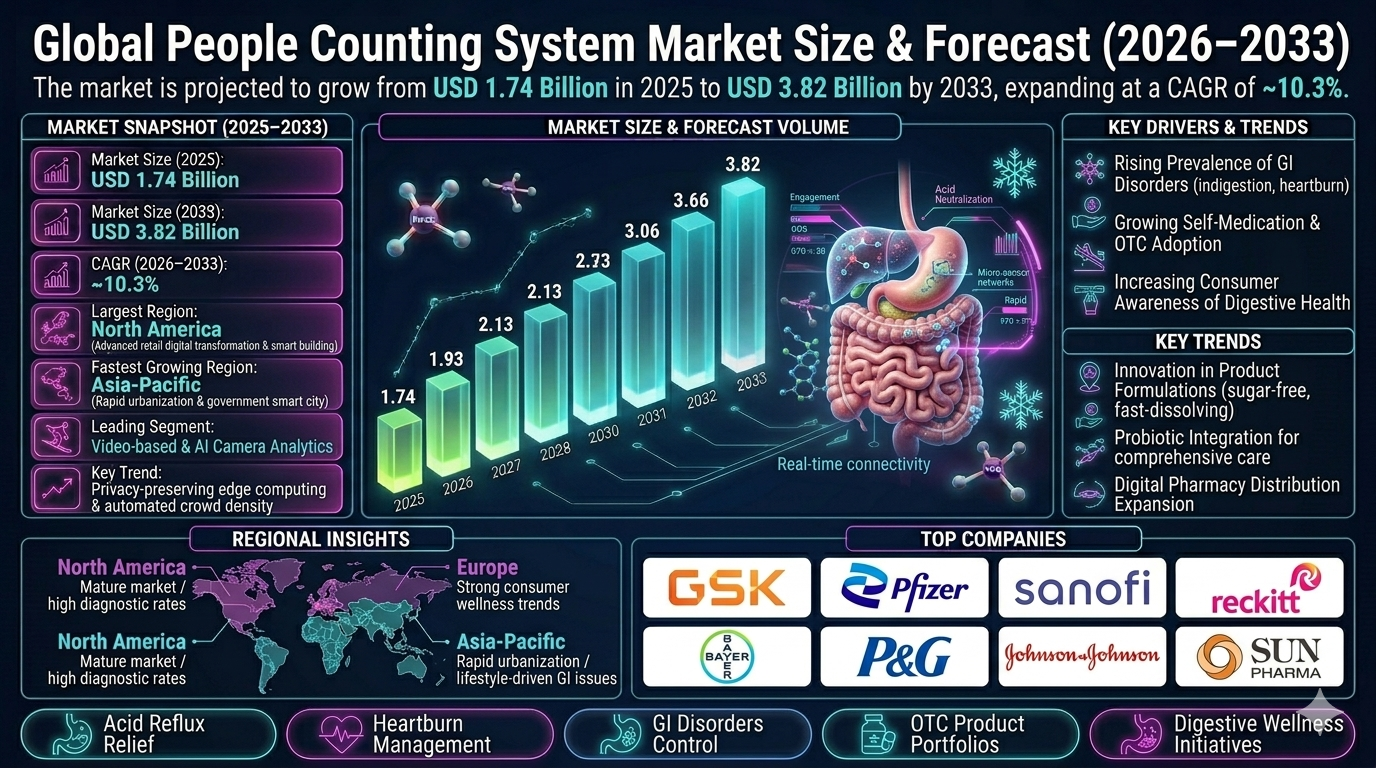
The global people counting system market is projected to witness substantial growth during the forecast period from 2026 to 2033. The market was valued at approximately USD 1.74 billion in 2025 and is expected to reach nearly USD 3.82 billion by 2033, expanding at a CAGR of around 10.3%. The market growth is driven by increasing demand for smart retail analytics, growing adoption of intelligent building management systems, rising investments in smart city infrastructure, and the integration of AI-powered occupancy monitoring technologies across commercial and public spaces. People counting systems are advanced monitoring solutions used to track and analyze foot traffic movement within physical environments such as retail stores, transportation hubs, corporate offices, healthcare facilities, educational institutions, and public venues. These systems enable businesses to optimize space utilization, improve operational efficiency, enhance customer experiences, and support data-driven decision-making. The market is undergoing rapid transformation through the adoption of AI-powered computer vision, thermal imaging, IoT connectivity, cloud-based analytics, and edge computing technologies. Additionally, growing focus on occupancy management, crowd control, security monitoring, and business intelligence analytics is accelerating global market expansion.| Metric | Value |
|---|---|
| Market Size (2025) | USD 1.74 Billion |
| Market Size (2033) | USD 3.82 Billion |
| CAGR (2026???2033) | 10.3% |
| Base Year | 2025 |
| Forecast Period | 2026???2033 |
| Leading Growth Driver | Increasing demand for smart retail analytics and intelligent building management systems |
| Key Technology Trends | AI-powered computer vision, thermal imaging, IoT connectivity, cloud analytics, edge computing |
| Major Application Areas | Retail stores, transportation hubs, corporate offices, healthcare facilities, educational institutions |
| Key Market Opportunity | Expansion of smart city infrastructure and occupancy monitoring solutions |
| Core Business Benefits | Space optimization, operational efficiency, crowd control, and business intelligence analytics |
| Regional Growth Factors | Rising investments in smart infrastructure and growing adoption of AI-based monitoring technologies worldwide |
Global People Counting System Market Overview
The people counting system market forms an essential segment of the smart analytics, security technology, and intelligent infrastructure industry. These systems provide actionable insights into customer behavior, traffic flow patterns, occupancy levels, and operational performance. The market includes infrared beam counters, video-based counting systems, thermal sensors, Wi-Fi/Bluetooth tracking systems, stereoscopic vision systems, and AI-powered camera analytics solutions. Organizations are increasingly adopting people counting technologies to improve resource allocation, enhance facility management, and optimize customer engagement strategies. Technological advancements in computer vision, machine learning algorithms, sensor fusion, and real-time cloud analytics are significantly improving counting accuracy and system intelligence. Major market participants include Axis Communications AB, Hikvision Digital Technology Co., Ltd., FLIR Systems, RetailNext Inc., V-Count, Irisys GmbH, HELLA Aglaia Mobile Vision GmbH, Traf-Sys Inc., Eurotech S.p.A., and Sensormatic Solutions.Key Drivers of Global People Counting System Market Growth
Rising Demand for Retail Analytics
Retailers are increasingly deploying people counting systems to analyze customer traffic patterns, optimize store layouts, and improve conversion rates. Footfall analytics is becoming a critical component of modern retail strategy.Growth of Smart Building Infrastructure
Smart commercial buildings are integrating occupancy monitoring systems for energy optimization, security management, and operational efficiency. This is significantly driving market adoption.Increasing Focus on Crowd Management and Safety
Public venues, transportation hubs, and event spaces are adopting people counting technologies to improve crowd control and ensure compliance with occupancy regulations. Safety and regulatory requirements are accelerating deployment.Advancements in AI and Computer Vision Technologies
AI-powered analytics and machine learning algorithms are improving detection accuracy, real-time processing capabilities, and actionable insights. This is enhancing the overall value proposition of people counting systems.Expansion of Smart Cities and Public Infrastructure Projects
Governments are increasingly deploying people counting systems in urban infrastructure projects to improve public space management and optimize transportation planning. This creates strong long-term growth opportunities.Global People Counting System Market Segmentation
By Technology
The market is segmented into infrared systems, video-based systems, thermal imaging systems, Wi-Fi/Bluetooth tracking systems, and stereoscopic vision systems. Video-based and AI-powered vision systems dominate the market due to superior accuracy and advanced analytics capabilities.By Component
The market includes hardware, software, and services. Hardware accounts for a significant market share due to extensive sensor and camera deployments.By Application
Applications include retail analytics, transportation monitoring, corporate occupancy management, healthcare facility management, educational campus monitoring, and event crowd management. Retail analytics remains the largest application segment globally.By End User
End users include retail, transportation, corporate offices, healthcare, education, hospitality, and government sectors. Retail remains the dominant end-user segment.Regional Market Dynamics
North America
North America dominates the global people counting system market due to advanced smart building adoption, retail digital transformation, and strong investments in analytics-driven infrastructure. The United States remains the leading regional market.Europe
Europe holds a significant market share supported by smart city initiatives, retail modernization, and strict occupancy management regulations. Germany, the United Kingdom, and France are key regional contributors.Asia-Pacific
Asia-Pacific is the fastest-growing region due to rapid urbanization, smart city expansion, growing retail infrastructure, and increasing technology adoption. China, India, Japan, and South Korea are major growth markets.Middle East & Africa
The Middle East is witnessing strong growth due to smart infrastructure investments and advanced commercial development projects. UAE and Saudi Arabia are major regional contributors.Latin America
Latin America is gradually expanding due to retail modernization and increasing investments in digital monitoring technologies. Brazil and Mexico are leading regional markets.Competitive Landscape
The global people counting system market is highly competitive and innovation-driven, with established surveillance technology providers and analytics solution developers competing through technological advancements and system integration capabilities. Key players include Axis Communications AB, Hikvision Digital Technology Co., Ltd., FLIR Systems, RetailNext Inc., V-Count, Irisys GmbH, HELLA Aglaia Mobile Vision GmbH, Traf-Sys Inc., Eurotech S.p.A., and Sensormatic Solutions. Companies are increasingly investing in AI-driven analytics, edge computing integration, cloud-based dashboards, and privacy-compliant occupancy monitoring solutions. Strategic collaborations with smart building developers, retailers, and public infrastructure operators are strengthening market positioning.Strategic Outlook
The strategic outlook for the global people counting system market remains highly positive due to rising demand for occupancy intelligence and real-time analytics. Future growth opportunities include AI-powered behavioral analytics, digital twin integration, advanced crowd prediction systems, and smart urban mobility applications. Growing emphasis on operational intelligence, customer experience optimization, and occupancy safety will significantly shape future market evolution. Manufacturers investing in advanced analytics, privacy-preserving technologies, and scalable cloud infrastructure are expected to strengthen competitive advantage.Final Market Perspective
The global people counting system market continues to play a vital role in enabling intelligent space management, retail optimization, and public infrastructure efficiency worldwide. Rising demand for smart analytics, occupancy intelligence, and AI-powered monitoring systems will continue driving market growth throughout the forecast period. Organizations that successfully combine technological innovation, analytical precision, and scalable deployment capabilities will remain strongly positioned in the evolving global people counting system market.Table of Contents
Table of Contents
1. Executive Summary
1.1 Market Snapshot
1.2 Key Market Highlights
1.3 Largest Segment Analysis
1.4 Fastest Growing Segment Analysis
1.5 Regional Market Insights
1.6 Competitive Landscape Snapshot
1.7 Future Market Outlook
2. Global People Counting System Market Introduction
2.1 Market Definition
2.2 Scope of Study
2.3 Research Assumptions
2.4 Research Methodology
2.5 Forecast Parameters
3. Global People Counting System Market Overview
3.1 Market Evolution
3.2 Industry Ecosystem Analysis
3.3 Value Chain Analysis
3.4 Pricing & Revenue Structure Analysis
3.5 Smart Infrastructure & Occupancy Analytics Overview
3.6 Technology Landscape
3.6.1 Infrared Counting Systems
3.6.1.1 Beam-Based Occupancy Monitoring
3.6.1.1.1 Entry & Exit Traffic Analytics
3.6.1.1.1.1 Real-Time Occupancy Tracking
3.6.1.1.1.2 Space Utilization Optimization
3.6.2 Video-Based People Counting Systems
3.6.2.1 AI-Powered Computer Vision Analytics
3.6.2.1.1 Behavioral Traffic Analysis
3.6.2.1.1.1 Retail Footfall Intelligence
3.6.2.1.1.2 Conversion Rate Optimization
3.6.3 Thermal Imaging Systems
3.6.3.1 Occupancy & Safety Monitoring
3.6.3.1.1 Crowd Density Detection
3.6.3.1.1.1 Public Space Safety Management
3.6.3.1.1.2 Smart Building Integration
3.6.4 Wi-Fi & Bluetooth Tracking Systems
3.6.4.1 Mobile Device Detection
3.6.4.1.1 Visitor Flow Analytics
3.6.4.1.1.1 Location Intelligence Solutions
3.6.4.1.1.2 Consumer Behavior Mapping
3.6.5 Stereoscopic Vision Systems
3.6.5.1 3D Occupancy Detection
3.6.5.1.1 High-Accuracy Traffic Counting
3.6.5.1.1.1 AI-Based Depth Analytics
3.6.5.1.1.2 Smart Mobility Applications
4. Regulatory Landscape
4.1 Data Privacy Regulations
4.1.1 Smart Surveillance Compliance
4.1.1.1 AI & Video Analytics Governance
4.1.1.1.1 Occupancy Monitoring Standards
4.1.1.1.2 Public Safety Regulations
5. Market Trends & Innovation Outlook
5.1 AI-Powered Occupancy Analytics
5.1.1 Computer Vision Expansion
5.1.1.1 Edge Computing Integration
5.1.1.1.1 Cloud-Based Analytics Platforms
5.1.1.1.2 Real-Time Behavioral Intelligence
5.2 Smart City Infrastructure Growth
5.2.1 Urban Mobility Intelligence
5.2.1.1 Intelligent Public Space Management
5.2.1.1.1 Smart Transportation Monitoring
5.2.1.1.2 Crowd Prediction & Flow Optimization
6. Global People Counting System Market Dynamics
6.1 Market Drivers
6.1.1 Rising Demand for Retail Analytics
6.1.1.1 Customer Footfall Optimization
6.1.1.1.1 Retail Conversion Intelligence
6.1.1.1.1.1 Data-Driven Store Management
6.1.2 Growth of Smart Building Infrastructure
6.1.2.1 Occupancy-Based Energy Optimization
6.1.2.1.1 Intelligent Facility Management
6.1.2.1.1.1 Smart Workspace Analytics
6.1.3 Increasing Focus on Crowd Management & Safety
6.1.3.1 Public Venue Monitoring
6.1.3.1.1 Occupancy Compliance Solutions
6.1.3.1.1.1 Event Safety Management
6.1.4 Advancements in AI & Computer Vision Technologies
6.1.4.1 AI-Based Counting Accuracy
6.1.4.1.1 Machine Learning Analytics
6.1.4.1.1.1 Predictive Occupancy Intelligence
6.1.5 Expansion of Smart Cities & Public Infrastructure
6.1.5.1 Urban Analytics Deployment
6.1.5.1.1 Intelligent Transportation Systems
6.1.5.1.1.1 Public Infrastructure Optimization
6.2 Market Restraints
6.2.1 High Installation & Integration Costs
6.2.2 Privacy & Surveillance Concerns
6.2.3 Complexity in Multi-Site Deployments
6.2.4 Data Security Challenges
6.3 Market Opportunities
6.3.1 AI-Powered Behavioral Analytics
6.3.2 Smart Retail & Omnichannel Analytics
6.3.3 Digital Twin & Smart Infrastructure Integration
6.3.4 Occupancy Intelligence for Smart Workspaces
6.4 Market Challenges
6.4.1 Counting Accuracy in High-Density Environments
6.4.2 Regulatory Compliance Complexity
6.4.3 Cybersecurity Risks in Connected Systems
6.4.4 Integration Challenges with Legacy Infrastructure
7. Global People Counting System Market Size Analysis (USD Billion), 2026???2033
7.1 Revenue Forecast Analysis
7.2 CAGR Analysis
7.3 Demand-Supply Analysis
7.4 Technology Adoption Analysis
7.5 Pricing Trend Analysis
7.6 Market Share Analysis
8. Global People Counting System Market Segmentation Analysis
8.1 By Technology
8.1.1 Infrared Systems
8.1.2 Video-Based Systems
8.1.3 Thermal Imaging Systems
8.1.4 Wi-Fi/Bluetooth Tracking Systems
8.1.5 Stereoscopic Vision Systems
8.2 By Component
8.2.1 Hardware
8.2.2 Software
8.2.3 Services
8.3 By Application
8.3.1 Retail Analytics
8.3.2 Transportation Monitoring
8.3.3 Corporate Occupancy Management
8.3.4 Healthcare Facility Management
8.3.5 Educational Campus Monitoring
8.3.6 Event Crowd Management
8.4 By End User
8.4.1 Retail
8.4.2 Transportation
8.4.3 Corporate Offices
8.4.4 Healthcare
8.4.5 Education
8.4.6 Hospitality
8.4.7 Government
9. Regional Market Analysis
9.1 North America
9.1.1 U.S.
9.1.2 Canada
9.1.3 Mexico
9.2 Europe
9.2.1 Germany
9.2.2 U.K.
9.2.3 France
9.2.4 Italy
9.2.5 Spain
9.2.6 Rest of Europe
9.3 Asia-Pacific
9.3.1 China
9.3.2 Japan
9.3.3 India
9.3.4 South Korea
9.3.5 Australia
9.3.6 Rest of Asia-Pacific
9.4 Middle East & Africa
9.4.1 UAE
9.4.2 Saudi Arabia
9.4.3 South Africa
9.4.4 Rest of Middle East & Africa
9.5 Latin America
9.5.1 Brazil
9.5.2 Mexico
9.5.3 Rest of Latin America
10. Competitive Landscape
10.1 Market Share Analysis
10.2 Competitive Benchmarking
10.3 Strategic Developments
10.4 AI & Analytics Innovation
10.5 Partnerships & Collaborations
10.6 Smart Infrastructure Positioning Analysis
11. Company Profiles
11.1 Axis Communications AB
11.2 Hikvision Digital Technology Co., Ltd.
11.3 FLIR Systems
11.4 RetailNext Inc.
11.5 V-Count
11.6 Irisys GmbH
11.7 HELLA Aglaia Mobile Vision GmbH
11.8 Traf-Sys Inc.
11.9 Eurotech S.p.A.
11.10 Sensormatic Solutions
12. Strategic Intelligence & Pheonix AI Insights
12.1 Pheonix Market Forecast Engine
12.2 Smart Infrastructure Trend Analyzer
12.3 Retail Analytics Intelligence Dashboard
12.4 Occupancy Monitoring Opportunity Mapping
12.5 AI-Based Crowd Prediction Framework
12.6 Automated Porter???s Five Forces Analysis
13. Future Outlook & Strategic Recommendations
13.1 AI-Based Analytics Expansion Strategies
13.2 Smart Building Integration Roadmap
13.3 Occupancy Intelligence Adoption Strategies
13.4 Cloud & Edge Analytics Development
13.5 Long-Term Market Outlook (2033+)
14. About Pheonix
15. Market Research
16. Disclaimer
Competitive Landscape
Global People Counting System Market Competitive Intensity & Market Structure Overview
The global people counting system market is highly competitive and moderately fragmented, characterized by strong competition among surveillance technology providers, smart analytics companies, AI-powered computer vision developers, and intelligent infrastructure solution providers. Competitive intensity is driven by technological innovation, analytics accuracy, real-time processing capabilities, system scalability, and integration with broader smart building ecosystems.
The market structure consists of global security technology manufacturers, specialized occupancy analytics vendors, cloud-based software providers, IoT infrastructure developers, and regional system integrators. Competition is shaped by sensor precision, AI algorithm sophistication, deployment flexibility, privacy compliance, and enterprise analytics capabilities.
Rapid smart infrastructure adoption, increasing demand for occupancy intelligence, expanding retail analytics deployment, and growing integration of AI-enabled monitoring systems are intensifying competition across the global people counting system market.
Global People Counting System Market Competitive Intensity & Market Structure Current Scenario
Leading Global People Counting System Companies
Axis Communications AB: Leading smart surveillance and analytics solutions provider with advanced AI-powered people counting and occupancy intelligence systems.
Hikvision Digital Technology Co., Ltd.: Major global video surveillance technology provider offering scalable people counting analytics integrated with smart security platforms.
FLIR Systems: Strong market participant with thermal imaging-based people counting solutions designed for high-accuracy occupancy analytics.
RetailNext Inc.: Specialized retail analytics company focused on advanced footfall intelligence and customer behavior analytics solutions.
V-Count: Prominent provider of AI-driven visitor analytics and occupancy management systems for retail and commercial environments.
Irisys GmbH: Established thermal people counting solutions provider focused on high-precision occupancy detection technologies.
HELLA Aglaia Mobile Vision GmbH: Key computer vision specialist offering intelligent people counting systems powered by advanced machine learning algorithms.
Traf-Sys Inc.: Provider of integrated traffic and people counting analytics systems for transportation and public infrastructure applications.
Eurotech S.p.A.: Industrial IoT solutions provider offering edge-integrated occupancy analytics platforms.
Sensormatic Solutions: Major retail intelligence company delivering enterprise-grade people counting and shopper analytics solutions globally.
Key Competitive Intensity & Market Structure Drivers
The growing demand for retail footfall analytics and customer behavior intelligence is significantly intensifying competition among analytics solution providers.
Rapid deployment of smart building infrastructure and occupancy optimization systems is increasing competition around integrated monitoring capabilities.
Advancements in AI-powered computer vision and edge analytics are driving continuous innovation and differentiation across the market.
Increasing privacy regulations and compliance requirements are creating competitive advantages for vendors offering privacy-preserving analytics technologies.
The expansion of smart city projects and public infrastructure modernization is increasing opportunities for large-scale integrated deployment solutions.
Strategic Implications of Competitive Intensity & Market Structure
Companies are increasingly investing in AI model enhancement and sensor fusion technologies to improve counting accuracy and reduce environmental interference.
Strategic partnerships with smart building developers, retail chains, transportation operators, and municipal authorities are becoming essential for market expansion.
Cloud-based analytics dashboards and edge computing integration are emerging as key differentiators for scalable enterprise deployment.
Privacy-compliant occupancy intelligence platforms are becoming critical to securing adoption across highly regulated public and commercial environments.
Vendors are increasingly focusing on interoperability with building management systems, security infrastructure, and digital twin platforms to strengthen competitive positioning.
Global People Counting System Market Competitive Intensity & Market Structure Forward Outlook
The global people counting system market is expected to remain highly competitive as AI-powered analytics and intelligent infrastructure adoption accelerate globally.
Future competition will increasingly focus on behavioral analytics, predictive occupancy intelligence, digital twin integration, and autonomous edge processing capabilities.
Asia-Pacific and North America are expected to remain major competitive growth regions due to smart city investments and rapid commercial digitalization.
Advancements in privacy-preserving AI, multimodal sensor analytics, and cloud-edge hybrid architectures are expected to significantly reshape market dynamics.
Overall, companies that successfully combine analytical precision, scalable deployment architecture, regulatory compliance, and advanced AI-driven intelligence will remain strongly positioned in the evolving global people counting system market.
Value Chain
Global People Counting System Market Value Chain & Supply Chain Evolution Overview
The global people counting system market value chain is evolving rapidly as smart infrastructure development, AI-powered occupancy analytics, intelligent building automation, and real-time business intelligence platforms reshape the broader analytics and smart monitoring ecosystem. People counting systems have become critical tools for optimizing physical space utilization, understanding traffic flow behavior, improving operational efficiency, and enabling data-driven decision-making across commercial, transportation, public infrastructure, and institutional environments.
The people counting system value chain spans sensor component manufacturing, imaging hardware production, software analytics development, AI model engineering, cloud infrastructure integration, system deployment, data management services, and end-user operational optimization. This interconnected ecosystem includes semiconductor manufacturers, camera and sensor developers, AI software companies, cloud analytics providers, systems integrators, infrastructure developers, facility operators, and enterprise end-users.
Major companies including Axis Communications AB, Hikvision Digital Technology Co., Ltd., FLIR Systems, RetailNext Inc., V-Count, Irisys GmbH, HELLA Aglaia Mobile Vision GmbH, Traf-Sys Inc., Eurotech S.p.A., and Sensormatic Solutions are actively investing in AI-based computer vision, edge analytics, cloud-connected occupancy intelligence platforms, privacy-preserving analytics, and advanced behavioral monitoring technologies to strengthen market leadership.
Upstream supply chain operations depend on semiconductor fabrication, camera lens production, thermal sensor manufacturing, wireless communication modules, edge processors, embedded electronics, and cloud computing infrastructure. Midstream activities focus on device assembly, software development, AI algorithm training, system integration, testing, calibration, and deployment engineering. Downstream operations include infrastructure installation, dashboard analytics delivery, occupancy monitoring services, facility optimization consulting, and long-term performance support.
Operational priorities across the people counting value chain increasingly emphasize counting accuracy, real-time analytics, low-latency processing, privacy compliance, system scalability, interoperability with building management systems, and predictive occupancy intelligence. However, the market continues to face challenges related to data privacy regulation, deployment complexity, hardware cost sensitivity, environmental detection variability, and system integration across legacy infrastructure.
Global People Counting System Market Value Chain & Supply Chain Evolution Current Scenario
The current people counting system market is being shaped by expanding smart retail adoption, increasing smart building investments, rising demand for occupancy intelligence, and accelerated digital transformation across physical infrastructure environments. Organizations are increasingly replacing conventional manual counting methods with AI-powered automated analytics systems capable of delivering highly accurate, real-time occupancy insights.
North America currently dominates the global people counting system market due to strong smart building penetration, advanced retail analytics adoption, and significant investments in intelligent commercial infrastructure. The United States remains the leading regional market driven by enterprise digital transformation initiatives.
Europe maintains a strong market position supported by smart city development, retail modernization, and stringent occupancy compliance requirements. Asia-Pacific is emerging as the fastest-growing region due to rapid urbanization, expanding commercial infrastructure, and increasing adoption of AI-powered monitoring technologies.
Retail remains the largest application segment, with retailers leveraging people counting analytics to optimize store layouts, improve staffing efficiency, and enhance customer conversion strategies.
Organizations across transportation, healthcare, education, and public infrastructure are increasingly integrating people counting systems into broader operational intelligence platforms to improve crowd management, resource planning, and facility utilization.
Key Value Chain & Supply Chain Evolution Signals in Global People Counting System Market
One of the most significant transformation signals is the rapid transition toward AI-powered computer vision systems. Advanced machine learning algorithms are dramatically improving counting accuracy, movement tracking, and behavioral pattern recognition.
Another major signal is the increasing deployment of edge computing architectures. Processing occupancy data directly at the device level reduces latency, improves privacy compliance, and enhances real-time decision-making capabilities.
Privacy-preserving analytics is emerging as a critical market trend. Organizations increasingly demand solutions capable of delivering occupancy intelligence without storing personally identifiable visual data.
Cloud-based occupancy analytics platforms are rapidly expanding, enabling centralized dashboard management, multi-location analytics, and cross-site performance benchmarking.
Integration with broader smart building management systems is becoming increasingly important, allowing occupancy insights to optimize HVAC controls, lighting automation, energy efficiency, and facility operations.
Predictive crowd intelligence and behavioral forecasting are emerging as advanced value-added capabilities that enable proactive space planning and operational optimization.
Strategic Implications of Value Chain & Supply Chain Evolution in Global People Counting System Market
Leading market participants are increasingly prioritizing AI software differentiation, hardware-software integration, privacy-compliant analytics, and scalable cloud-based deployment models to maintain competitive advantage. Competitive differentiation increasingly depends on counting accuracy, deployment flexibility, analytical depth, and interoperability with enterprise systems.
Companies capable of delivering end-to-end occupancy intelligence ecosystems with strong analytics capabilities and seamless integration are expected to capture premium market opportunities.
Strategic partnerships between people counting technology providers, smart building developers, retail analytics firms, cloud platform providers, and systems integrators are becoming increasingly important for ecosystem expansion and deployment scalability.
Recurring analytics subscription models are emerging as key revenue drivers, shifting market focus from hardware-centric sales toward long-term software and services monetization.
Privacy compliance is becoming a strategic differentiator as organizations seek occupancy analytics solutions aligned with evolving regional data protection regulations.
Manufacturers increasingly localize deployment support and regional service capabilities to improve implementation speed and strengthen customer retention across geographically diverse infrastructure projects.
Global People Counting System Market Value Chain & Supply Chain Evolution Forward Outlook
Between 2026 and 2033, the people counting system value chain is expected to become significantly more intelligent, autonomous, and integrated with broader digital infrastructure ecosystems. AI-driven occupancy intelligence will evolve from passive monitoring toward predictive operational orchestration.
Advanced computer vision models will continue improving behavioral interpretation, movement pattern analysis, anomaly detection, and real-time crowd forecasting accuracy.
Edge AI processing will become increasingly central to future system architectures, enabling faster analytics, improved data security, and reduced cloud dependency.
Digital twin integration will enable physical environment simulation using occupancy data, allowing organizations to optimize space utilization, emergency response planning, and infrastructure performance.
People counting systems will increasingly integrate with smart city infrastructure, transportation management systems, and autonomous facility operations platforms.
Cloud-native analytics platforms will continue expanding multi-site operational intelligence capabilities, enabling enterprise-scale occupancy benchmarking and centralized performance optimization.
Ultimately, the future people counting value chain will evolve into a highly connected, predictive, and privacy-preserving occupancy intelligence ecosystem capable of enabling autonomous space optimization, operational efficiency, and intelligent infrastructure management worldwide.
Market-Specific Value Chain
- Sensor & Hardware Component Manufacturing: Semiconductors, imaging sensors, thermal detectors, processors, wireless modules, camera optics, and embedded hardware production.
- System Engineering & AI Software Development: Computer vision algorithm development, machine learning model training, edge analytics architecture, software engineering, and occupancy intelligence platform design.
- Device Assembly & System Integration: Hardware assembly, calibration, testing, software deployment, interoperability engineering, and integration with enterprise systems.
- Infrastructure Deployment & Installation: Site installation, commercial infrastructure integration, smart building deployment, network configuration, and implementation services.
- Analytics Delivery & Operational Intelligence: Real-time dashboards, occupancy reporting, predictive analytics, behavioral insights, and enterprise performance optimization services.
- Long-Term Optimization & Intelligent Automation: Digital twin integration, predictive occupancy forecasting, autonomous facility optimization, and next-generation smart infrastructure intelligence.
Company-to-Stage Mapping
- Sensor & Hardware Component Manufacturing: Semiconductor manufacturers, thermal imaging suppliers, embedded electronics producers, optical component manufacturers.
- System Engineering & AI Software Development: RetailNext Inc., V-Count, HELLA Aglaia Mobile Vision GmbH, computer vision analytics developers.
- Device Assembly & System Integration: Axis Communications AB, Hikvision Digital Technology Co., Ltd., Eurotech S.p.A.
- Infrastructure Deployment & Installation: Traf-Sys Inc., smart building integrators, infrastructure deployment service providers.
- Analytics Delivery & Operational Intelligence: Sensormatic Solutions, Irisys GmbH, cloud analytics platform operators.
- Long-Term Optimization & Intelligent Automation: FLIR Systems, digital twin technology providers, AI-driven smart infrastructure solution companies.
Investment Activity
Global People Counting System Market Investment & Funding Dynamics Overview
The global people counting system market is experiencing strong investment momentum driven by the rapid adoption of AI-powered analytics, increasing smart building deployments, rising retail digital transformation initiatives, and expanding investments in intelligent infrastructure worldwide. Between 2026 and 2033, capital inflows are expected to accelerate across occupancy intelligence platforms, computer vision technologies, cloud-based analytics systems, and smart infrastructure monitoring solutions.
The people counting system market represents a strategically important segment within the broader smart analytics, intelligent surveillance, and digital infrastructure ecosystem. Venture capital firms, private equity investors, smart city infrastructure funds, and enterprise technology investors are increasingly directing capital toward advanced people counting solutions to capitalize on the growing demand for operational intelligence and space utilization analytics.
A major structural shift influencing funding activity is the transition from traditional sensor-based counting systems toward AI-enabled computer vision platforms capable of delivering real-time occupancy analytics, predictive insights, and integrated behavioral intelligence. This transition is encouraging substantial investment in machine learning algorithms, edge computing systems, cloud analytics architecture, and advanced sensor fusion technologies.
Growing convergence between people counting technologies, smart building ecosystems, retail intelligence platforms, and urban mobility analytics is creating significant cross-sector investment opportunities. Strategic funding is increasingly supporting scalable deployment models, privacy-compliant analytics infrastructure, and next-generation occupancy intelligence systems.
Current Investment & Funding Landscape
Current investment activity in the people counting system market is concentrated around AI-based computer vision systems, occupancy analytics software platforms, smart building integration technologies, edge processing capabilities, and real-time cloud analytics infrastructure.
- North America: Leads global investment activity due to strong smart building adoption, retail analytics innovation, and large-scale digital transformation initiatives.
- Europe: Attracting significant funding due to advanced smart city programs, regulatory focus on occupancy management, and intelligent infrastructure modernization.
- Asia-Pacific: Emerging as the fastest-growing investment region due to rapid urbanization, large-scale retail expansion, and increasing smart infrastructure deployment.
- Middle East: Witnessing rising strategic investments driven by smart commercial developments and urban infrastructure digitization projects.
- Latin America: Gradually attracting investment as retail modernization and smart public infrastructure initiatives gain momentum.
Key Investment & Funding Drivers
- Growing demand for AI-powered retail analytics and customer behavior intelligence.
- Expansion of smart buildings and occupancy optimization systems.
- Rising adoption of crowd management and public safety monitoring solutions.
- Increasing investments in smart city infrastructure and intelligent transportation systems.
- Advancements in computer vision, edge analytics, and sensor fusion technologies.
- Growing enterprise demand for operational intelligence and facility optimization.
- Rising deployment of privacy-compliant analytics systems.
- Expansion of cloud-based occupancy management platforms.
Strategic Investment Areas
- AI & Computer Vision: Funding for real-time analytics engines, behavioral analysis systems, and machine learning optimization.
- Edge Computing Infrastructure: Investment in low-latency occupancy processing and decentralized analytics deployment.
- Cloud Analytics Platforms: Capital allocation toward scalable dashboards, multi-location intelligence systems, and predictive occupancy analytics.
- Smart Building Integration: Funding for interoperability with HVAC, security, and building automation systems.
- Privacy-Preserving Analytics: Investments in anonymized data processing and compliance-oriented monitoring technologies.
- Retail Intelligence Solutions: Strategic spending on customer journey mapping and conversion optimization analytics.
Strategic Investment Implications
- Companies with strong AI-driven analytics capabilities are attracting premium investor valuations.
- Technology differentiation in computer vision accuracy and predictive intelligence is becoming a key funding determinant.
- Integrated ecosystem compatibility is increasingly shaping capital allocation decisions.
- Scalable cloud deployment capabilities are central to long-term investment attractiveness.
- Privacy compliance and secure analytics processing are becoming critical investment priorities.
- Cross-industry applicability is significantly enhancing investor confidence.
Forward Investment Outlook
The global people counting system market is expected to remain a highly attractive investment segment throughout the forecast period due to rising demand for occupancy intelligence, AI-powered analytics, and smart infrastructure modernization.
Future funding activity is expected to prioritize predictive crowd analytics, digital twin integration, autonomous occupancy management systems, advanced edge AI processors, and real-time urban mobility intelligence platforms.
- North America: Will continue leading investments through enterprise analytics adoption and intelligent commercial infrastructure deployment.
- Asia-Pacific: Will experience the strongest capital inflows driven by rapid urbanization and large-scale smart city development.
- Europe: Will maintain strong funding activity centered on occupancy compliance and sustainable smart infrastructure innovation.
- Middle East: Will emerge as a strategic growth investment destination for advanced smart city deployments.
Long-term innovation investments will increasingly focus on behavioral intelligence systems, multimodal occupancy sensing, autonomous crowd optimization, and AI-driven public infrastructure management.
Overall, the people counting system market is positioned as a high-growth digital infrastructure investment opportunity driven by intelligent analytics adoption, smart building expansion, and next-generation occupancy intelligence innovation.
Technology & Innovation
Global People Counting System Market Technology & Innovation Landscape Overview
The Global People Counting System Market is undergoing rapid technological transformation driven by advancements in artificial intelligence, computer vision, edge computing, IoT-enabled monitoring, and cloud-based analytics platforms. The increasing need for accurate occupancy intelligence, behavioral analytics, and real-time traffic monitoring is accelerating innovation across retail, transportation, smart buildings, public infrastructure, and commercial environments.
Modern people counting systems are evolving beyond simple footfall tracking into intelligent occupancy management solutions capable of delivering actionable insights related to movement patterns, customer behavior, space utilization, and crowd dynamics. These innovations are enabling organizations to optimize operational performance, improve safety, and support data-driven strategic planning.
The market is increasingly shaped by privacy-preserving analytics, AI-powered image processing, sensor fusion technologies, and real-time data integration that collectively enhance counting accuracy, scalability, and deployment flexibility across diverse use cases.
Global People Counting System Market Technology & Innovation Current Scenario
Currently, the people counting system market is experiencing strong innovation through AI-powered computer vision technologies capable of highly accurate detection, tracking, and occupancy analysis in dynamic environments.
Edge computing integration is becoming increasingly important, enabling local data processing, faster response times, reduced latency, and lower cloud dependency for real-time occupancy analytics.
Thermal imaging sensors and stereoscopic vision systems are gaining traction due to their ability to provide high counting accuracy under varying lighting conditions while supporting privacy-compliant monitoring.
IoT-connected people counting systems are improving operational intelligence through continuous real-time data transmission, centralized monitoring dashboards, and integration with broader smart building management systems.
Cloud-based analytics platforms are increasingly being adopted to deliver remote access, historical traffic analysis, occupancy forecasting, and performance reporting across multi-location deployments.
Privacy-focused innovations such as anonymous video analytics, non-identifiable sensor tracking, and GDPR-compliant occupancy monitoring solutions are also becoming key differentiators in the market.
Key Technology & Innovation Trends in Global People Counting System Market
- AI-Powered Computer Vision: Advanced image recognition systems enabling accurate people detection and movement analysis.
- Edge Computing Integration: Localized processing for low-latency occupancy analytics and faster system response.
- Thermal Imaging Analytics: Privacy-preserving occupancy monitoring under diverse environmental conditions.
- Stereoscopic Vision Systems: High-precision 3D tracking for improved counting accuracy.
- IoT-Connected Monitoring: Real-time data transmission across intelligent infrastructure networks.
- Cloud-Based Occupancy Analytics: Centralized dashboards for remote monitoring and traffic trend analysis.
- Sensor Fusion Technology: Combining multiple sensing methods for improved reliability and analytical depth.
- Predictive Crowd Analytics: AI-driven forecasting of occupancy patterns and crowd behavior trends.
- Privacy-Compliant Analytics Solutions: Anonymous data processing supporting regulatory compliance.
- Digital Twin Integration: Virtual occupancy modeling for intelligent space optimization and planning.
Strategic Implications of Technology & Innovation
Technological innovation is significantly reshaping competitive dynamics in the people counting system market by shifting competition from basic traffic counting toward intelligent occupancy analytics and integrated operational intelligence platforms.
Companies investing in AI-driven analytics, edge processing capabilities, and cloud-integrated occupancy intelligence are achieving stronger market differentiation through improved accuracy, scalability, and decision-support functionality.
The integration of people counting systems with smart building ecosystems is enabling facility managers to optimize energy consumption, improve resource allocation, and enhance occupant safety.
Retailers and commercial operators are leveraging advanced behavioral analytics to improve store layout planning, customer engagement strategies, and operational efficiency.
However, challenges including implementation costs, privacy regulations, data security concerns, and integration complexity with legacy infrastructure remain significant barriers to widespread adoption.
Global People Counting System Market Technology & Innovation Forward Outlook
Looking ahead, the people counting system market is expected to evolve toward fully autonomous, AI-driven occupancy intelligence ecosystems capable of predictive analytics, adaptive crowd management, and intelligent infrastructure optimization.
Future innovation is likely to focus on self-learning analytics systems capable of continuously improving detection accuracy through machine learning and contextual environmental adaptation.
Advanced digital twin integration is expected to enable virtual modeling of occupancy dynamics, traffic simulation, and real-time infrastructure optimization.
Multimodal sensing systems combining computer vision, thermal analytics, wireless tracking, and environmental intelligence will further enhance monitoring precision and operational insight.
Privacy-preserving AI technologies and decentralized analytics frameworks are also expected to gain importance as organizations prioritize regulatory compliance and ethical data management.
Overall, the Global People Counting System Market is entering a new era of intelligent occupancy analytics characterized by AI-powered automation, predictive behavioral intelligence, scalable cloud ecosystems, and smart infrastructure integration, positioning the market for sustained technological advancement and long-term growth.
Market Risk
Global People Counting System Market Risk Factors & Disruption Threats Overview
The global people counting system market is experiencing rapid expansion driven by increasing demand for smart retail analytics, intelligent occupancy monitoring, AI-powered building management systems, and smart city infrastructure investments. Despite strong long-term growth prospects, the market faces several risks and disruption threats related to privacy regulations, technology accuracy limitations, cybersecurity vulnerabilities, integration complexity, and shifting enterprise investment priorities.
One of the most significant risks affecting the people counting system market is the growing scrutiny surrounding data privacy and surveillance regulations. As people counting technologies increasingly rely on video analytics, AI-based image processing, and wireless tracking, compliance with global privacy laws such as GDPR and other regional data protection frameworks has become a critical operational challenge.
Accuracy limitations in complex real-world environments represent another major challenge. Factors such as crowded spaces, overlapping movement patterns, lighting conditions, environmental interference, and sensor blind spots can reduce counting precision and impact system reliability.
Cybersecurity risks are also becoming increasingly significant as connected counting systems rely on cloud-based dashboards, edge devices, IoT networks, and real-time analytics platforms that may be vulnerable to unauthorized access, data breaches, or network disruptions.
Integration complexity with existing enterprise systems such as building management platforms, retail analytics tools, and facility automation infrastructure may slow deployment and increase implementation costs.
Economic uncertainty and shifting enterprise capital expenditure priorities may delay smart infrastructure investments, particularly in retail, transportation, and commercial real estate sectors.
Additionally, rapid technological evolution is shortening product lifecycles, creating competitive pressure for continuous innovation.
Global People Counting System Market Risk Factors & Disruption Threats Current Scenario
The current market is benefiting from increasing adoption of AI-powered vision systems, occupancy management requirements, and smart building digitalization initiatives.
However, privacy concerns related to biometric detection, camera surveillance, and wireless tracking technologies are prompting stricter regulatory oversight across several regions.
Organizations are increasingly demanding privacy-preserving analytics solutions that anonymize collected data while maintaining analytical accuracy.
System vendors are facing strong pressure to improve counting precision across highly dynamic environments such as transportation hubs, stadiums, retail complexes, and event venues.
Cloud adoption is accelerating, but concerns related to data security, latency, and infrastructure reliability remain important operational challenges.
Competition is intensifying as AI analytics firms, sensor manufacturers, and building automation providers expand into occupancy intelligence solutions.
Global People Counting System Market Key Risk Factors & Disruption Threat Signals
- Privacy Regulation Pressure: Stricter compliance requirements for video analytics and occupancy monitoring data.
- Counting Accuracy Limitations: Reduced reliability in crowded, low-light, or complex movement environments.
- Cybersecurity Vulnerabilities: Risks associated with connected IoT systems and cloud analytics platforms.
- System Integration Complexity: Challenges integrating with legacy enterprise infrastructure.
- Technology Obsolescence: Rapid innovation shortening hardware and software lifecycle relevance.
- Enterprise Budget Constraints: Delayed smart infrastructure spending due to economic uncertainty.
- Cloud Dependency Risks: Service outages and latency issues affecting real-time analytics performance.
- Competitive Saturation: Increasing vendor competition compressing pricing and margins.
- Sensor Performance Variability: Environmental interference impacting operational consistency.
- Regulatory Standard Fragmentation: Varying compliance requirements across global regions.
Strategic Implications of Risk Factors
People counting system providers must prioritize privacy-by-design architectures to address growing regulatory and customer concerns regarding data protection.
Continuous investment in AI model training, sensor fusion technologies, and environmental adaptability will be essential to improve counting precision and maintain market trust.
Strengthening cybersecurity frameworks and implementing robust encryption, authentication, and cloud security protocols will become increasingly critical.
Manufacturers should focus on modular and interoperable system designs that simplify integration with broader smart building and enterprise analytics ecosystems.
Strategic partnerships with facility management providers, smart city developers, and enterprise software vendors can strengthen deployment scalability and market reach.
Global People Counting System Market Forward Risk Outlook
Looking ahead to 2026???2033, the people counting system market will continue expanding as intelligent occupancy analytics become essential for operational optimization across commercial and public infrastructure.
Future disruption will likely come from AI-driven behavioral analytics, privacy-preserving edge intelligence, and increasingly autonomous smart building systems.
Vendors unable to meet evolving privacy standards, cybersecurity expectations, and enterprise integration requirements may face declining competitiveness.
The strongest opportunities will emerge for providers delivering highly accurate, privacy-compliant, cloud-scalable, and interoperable occupancy intelligence solutions.
Overall, sustained market leadership will depend on technological precision, regulatory adaptability, digital security excellence, and scalable deployment innovation.
Regulatory Landscape
Global People Counting System Market Regulatory & Policy Environment Overview
The regulatory and policy environment governing the global people counting system market is shaped by data privacy regulations, surveillance compliance standards, occupancy safety mandates, smart infrastructure policies, cybersecurity frameworks, and public monitoring governance requirements. As people counting systems increasingly rely on AI-powered computer vision, cloud analytics, and sensor-based occupancy monitoring, regulatory oversight has expanded to address privacy protection, ethical data collection, and secure deployment practices.
Governments and regulatory authorities worldwide oversee the deployment of people counting systems to ensure compliance with data protection laws, public safety requirements, and digital monitoring transparency standards. These regulations significantly influence product architecture, data processing practices, analytics deployment models, and customer implementation strategies.
The increasing adoption of smart cities, intelligent buildings, and AI-driven public infrastructure monitoring is accelerating the development of policies focused on privacy-preserving analytics, anonymized occupancy monitoring, and secure data lifecycle management.
Global People Counting System Market Regulatory & Policy Environment Current Scenario
The current regulatory landscape for people counting systems combines digital privacy frameworks with public infrastructure monitoring standards and commercial building occupancy regulations.
In North America, regulatory oversight is influenced by data privacy laws, commercial surveillance standards, workplace occupancy requirements, and cybersecurity regulations. In the United States, state-level privacy legislation and sector-specific monitoring compliance frameworks increasingly shape system deployment practices.
Europe maintains one of the most comprehensive regulatory environments through the General Data Protection Regulation (GDPR), which imposes strict requirements for data minimization, anonymization, consent management where applicable, and transparent processing of occupancy-related analytics data.
Asia-Pacific markets including China, Japan, South Korea, and India are strengthening digital surveillance governance, public monitoring controls, and smart infrastructure compliance standards as AI-based occupancy technologies gain wider adoption.
Emerging markets across Latin America, the Middle East, and Africa are increasingly introducing digital infrastructure governance policies and smart city frameworks that support regulated deployment of people counting technologies.
Key Regulatory & Policy Environment Signals in Global People Counting System Market
- Data Privacy and Protection Regulations: Strict requirements for anonymized data processing, limited retention periods, and privacy-compliant analytics are becoming central to deployment strategies.
- Occupancy Safety Compliance: Building safety regulations increasingly require accurate occupancy monitoring to support crowd control and emergency management.
- AI Governance Standards: Regulatory scrutiny of AI-powered analytics is increasing, particularly around algorithm transparency and non-intrusive monitoring practices.
- Cybersecurity Compliance: Connected people counting systems must comply with secure data transmission, storage encryption, and network resilience standards.
- Public Surveillance Transparency Requirements: Regulatory bodies are emphasizing clear disclosure and governance for monitoring systems deployed in public spaces.
- Smart City Infrastructure Policies: Government digital transformation initiatives are encouraging compliant deployment of occupancy intelligence systems across urban infrastructure.
Strategic Implications of Regulatory & Policy Environment
The evolving regulatory landscape is encouraging technology providers to prioritize privacy-by-design system architectures, edge-based processing, anonymized analytics frameworks, and transparent data governance mechanisms.
Compliance with data protection regulations is increasingly becoming a critical competitive differentiator, particularly in highly regulated commercial, public infrastructure, and healthcare environments.
Occupancy safety mandates are driving stronger demand for highly accurate people counting systems capable of real-time monitoring, emergency alert integration, and automated occupancy threshold enforcement.
Cybersecurity requirements are influencing investments in secure cloud infrastructure, encrypted communications, access control protocols, and compliance-certified analytics platforms.
AI governance standards are also accelerating development of explainable analytics models and non-identifiable vision-based counting solutions that balance operational intelligence with privacy protection.
Global People Counting System Market Regulatory & Policy Environment Forward Outlook
Between 2026 and 2033, the regulatory environment for the global people counting system market is expected to become increasingly privacy-centric, AI-governed, and digitally standardized.
Governments are likely to strengthen privacy compliance requirements for occupancy monitoring systems, particularly around biometric avoidance, anonymized processing, and ethical deployment practices.
Smart building and smart city regulations are expected to introduce broader occupancy monitoring mandates to improve public safety, energy optimization, and urban operational intelligence.
AI-specific regulatory frameworks may require greater transparency in analytics decision-making, algorithm validation, and auditability of automated occupancy monitoring systems.
Cross-border data governance requirements will likely increase the importance of localized processing, regional data residency compliance, and secure analytics deployment architectures.
Overall, regulatory and policy developments will remain a major market influence, with companies investing in privacy-compliant innovation, cybersecurity resilience, and intelligent edge analytics expected to maintain long-term competitive advantage.