
Global Cryptocurrency Mining Market Report, Size, Share and Forecast 2026–2033
Global Cryptocurrency Mining Market Forecast Snapshot (2026???2033)
| Metric | Value |
|---|---|
| Market Size (2025) | ?? ?? ?? ?? ?? ?? ?? ?? ?? ?? ?? ?? ?? ?? ?? ?? ?? ?? ?? ?? ?? ?? ?? ?? ?? ?? ?? ?? USD 3.85 Billion |
| Market Size (2033) | ?? ?? ?? ?? ?? ?? ?? ?? ?? ?? ?? ?? ?? ?? ?? ?? ?? ?? ?? ?? ?? ?? ?? ?? ?? ?? ?? ??USD 9.42 Billion |
| CAGR (2026???2033) | ?? ?? ?? ?? ?? ?? ?? ?? ?? ?? ?? ?? ?? ?? ?? ?? ?? ?? ?? ?? ?? ?? ?? ?? ?? ?? ?? ?? ?? ?? ?? ?? 11.84% |
| Largest Segment | ?? ?? ?? ?? ?? ?? ?? ?? ?? ?? ?? ?? ?? ?? ?? ?? ?? ?? ?? ?? ?? ?? ?? ?? ?? ?? ?? Bitcoin Mining |
| Fastest Growing Segment | ?? ?? ?? ?? ?? ?? ?? ?? ?? ?? ?? ?? ?? ?? Renewable Energy-Powered Mining Operations |
| Leading End-Use Segment | ?? ?? ?? ?? ?? ?? ?? ?? ?? ?? ?? ?? ?? ?? ?? ?? ?? ?? ?? ?? ?? ?? ?? ?? Commercial Mining Farms |
| Key Trend | ?? ?? ?? ?? ?? ?? ?? Energy-Efficient Mining Hardware & Sustainable Mining Infrastructure |
| Regulatory Influence | Cryptocurrency Regulations, Energy Consumption Policies & Digital Asset Compliance Frameworks |
| Future Outlook | Growth Driven by Institutional Crypto Adoption, Mining Efficiency Improvements & Renewable Energy Integration |
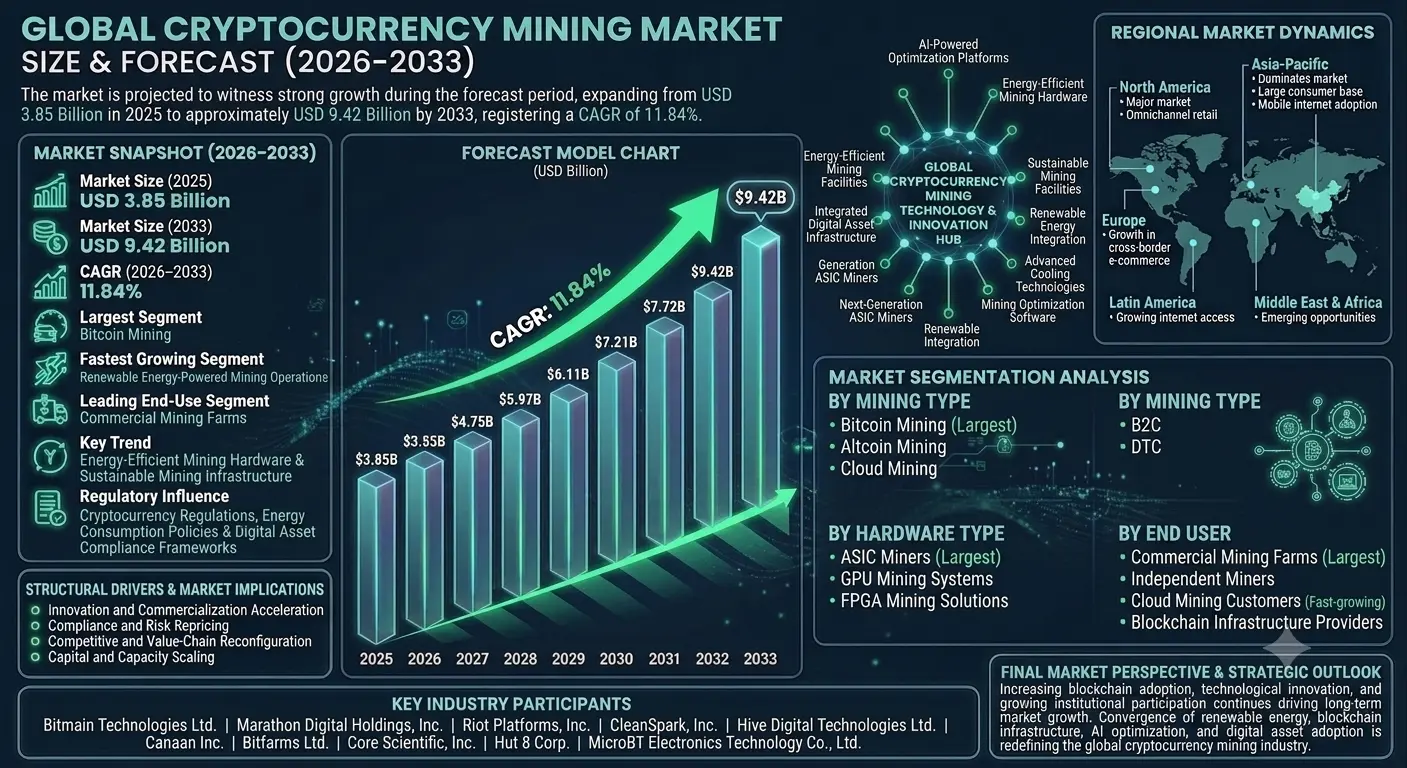
Global Cryptocurrency Mining Market Size & Forecast
The Global Cryptocurrency Mining Market is expected to witness strong growth during the forecast period from 2026 to 2033. The market was valued at USD 3.85 billion in 2025 and is projected to reach approximately USD 9.42 billion by 2033, registering a CAGR of 11.84%. The market growth is primarily driven by increasing cryptocurrency adoption, rising institutional participation in digital assets, expanding blockchain ecosystems, and continuous advancements in mining hardware technologies. Cryptocurrency mining serves as the backbone of proof-of-work blockchain networks by validating transactions, securing decentralized ledgers, and generating new digital assets. In addition, growing investments in large-scale mining facilities, renewable energy-powered operations, and advanced ASIC mining equipment are supporting long-term market expansion.Global Cryptocurrency Mining Market Overview
Cryptocurrency mining refers to the computational process of validating blockchain transactions and creating new cryptocurrency units through specialized hardware and software systems. The market includes Bitcoin mining, altcoin mining, cloud mining services, mining hardware, mining software, hosting services, and mining infrastructure solutions. Mining operations are widely utilized by commercial mining farms, institutional investors, independent miners, blockchain infrastructure providers, and cryptocurrency ecosystem participants. The market is evolving toward energy-efficient mining systems, AI-powered optimization platforms, sustainable mining facilities, and integrated digital asset infrastructure.Structural Drivers of Market Growth
1. Innovation and Commercialization Acceleration
Rapid advancements in ASIC mining hardware, cooling technologies, energy management systems, and mining optimization software are improving operational efficiency and profitability. Next-generation mining equipment is enabling higher hash rates while reducing power consumption.Market Implications
Companies investing in advanced mining technologies, energy optimization solutions, and scalable infrastructure are expected to strengthen market leadership.2. Compliance and Risk Repricing
Cryptocurrency regulations, taxation policies, environmental standards, anti-money laundering requirements, and energy consumption regulations are influencing industry dynamics. Governments are increasingly introducing compliance frameworks to regulate mining operations and digital asset activities.Market Implications
Firms operating compliant, transparent, and energy-efficient mining facilities are likely to gain stronger market acceptance.3. Competitive and Value-Chain Reconfiguration
The market is highly competitive as mining companies, hardware manufacturers, hosting providers, energy suppliers, and blockchain infrastructure firms expand their capabilities. Strategic partnerships between miners, renewable energy providers, and data center operators are reshaping industry value chains.Market Implications
Companies focusing on vertical integration, energy efficiency, and mining scalability may achieve stronger long-term positioning.4. Capital and Capacity Scaling
Rising investments in mining farms, data center infrastructure, renewable power generation, and digital asset ecosystems are supporting market growth. Institutional participation and increased demand for blockchain security continue driving capacity expansion.Market Implications
Organizations scaling mining operations, energy resources, and infrastructure capabilities are expected to capture future opportunities.Market Segmentation Analysis
By Mining Type
1. Bitcoin Mining
This remains the largest segment due to Bitcoin's dominant market capitalization, network security requirements, and global adoption.2. Altcoin Mining
Growing demand driven by expanding blockchain networks and diversified cryptocurrency ecosystems.3. Cloud Mining
Increasing adoption due to lower hardware investment requirements and simplified participation.By Hardware Type
1. ASIC Miners
Largest segment due to superior efficiency, high hash rates, and widespread Bitcoin mining applications.2. GPU Mining Systems
Widely utilized for specific altcoin mining applications and blockchain research.3. FPGA Mining Solutions
Growing adoption due to flexibility and energy-efficient computing capabilities.By End User
1. Commercial Mining Farms
Largest segment due to industrial-scale cryptocurrency mining operations and institutional investments.2. Independent Miners
Strong participation supported by decentralized blockchain ecosystems.3. Cloud Mining Customers
Fast-growing segment driven by ease of access and reduced infrastructure requirements.4. Blockchain Infrastructure Providers
Growing utilization of mining resources for network security and validation services.Regional Market Dynamics
North America
North America dominates the global cryptocurrency mining market due to favorable infrastructure, increasing institutional investments, advanced mining facilities, and growing renewable energy integration.Asia-Pacific
Asia-Pacific remains a major market supported by strong hardware manufacturing capabilities, expanding blockchain ecosystems, and increasing digital asset adoption.Europe
Europe is witnessing significant growth driven by sustainable mining initiatives, regulatory clarity, and renewable energy-powered mining projects.Latin America
Latin America is emerging as an attractive market due to access to low-cost energy resources and increasing cryptocurrency adoption.Middle East & Africa
The region is witnessing growing interest supported by digital asset innovation, energy diversification initiatives, and blockchain technology investments.Competitive Landscape
The Global Cryptocurrency Mining Market is highly competitive with mining operators, hardware manufacturers, cloud mining providers, and blockchain infrastructure companies competing across global markets.Key Companies Operating in the Market Include:
- Bitmain Technologies Ltd.
- Marathon Digital Holdings, Inc.
- Riot Platforms, Inc.
- CleanSpark, Inc.
- Hive Digital Technologies Ltd.
- Canaan Inc.
- Bitfarms Ltd.
- Core Scientific, Inc.
- Hut 8 Corp.
- MicroBT Electronics Technology Co., Ltd.
Strategic Outlook
The future of the cryptocurrency mining market will be shaped by renewable energy adoption, next-generation ASIC hardware, AI-driven mining optimization, and sustainable blockchain infrastructure. Advanced cooling systems, smart energy management, carbon-neutral mining initiatives, and integrated digital asset ecosystems will significantly improve operational efficiency. The rise of institutional cryptocurrency adoption, blockchain expansion, and sustainable mining technologies is expected to create strong long-term growth opportunities.Final Market Perspective
The Global Cryptocurrency Mining Market remains a critical component of the digital asset ecosystem. Increasing blockchain adoption, technological innovation, and growing institutional participation continue driving long-term market growth. Companies capable of delivering scalable, energy-efficient, secure, and technologically advanced mining solutions will be best positioned to capture future opportunities. The convergence of renewable energy, blockchain infrastructure, AI optimization, and digital asset adoption is expected to redefine the future of the global cryptocurrency mining industry.Table of Contents
Table of Contents
- Executive Summary
- Global Cryptocurrency Mining Market Snapshot (2026???2033)
- Market Size & Growth Overview
- Key Market Highlights
- Largest & Fastest-Growing Segments
- Leading End-Use Segment Overview
- Key Market Trends & Mining Infrastructure Transformation
- Strategic Outlook Through 2033
- Market Introduction & Overview
- Definition of Cryptocurrency Mining
- Scope of the Global Cryptocurrency Mining Market
- Evolution of Blockchain Mining Technologies
- Role of Mining in Digital Asset & Blockchain Ecosystems
- Value Chain Analysis of Cryptocurrency Mining Operations
- Regulatory Influence (Cryptocurrency Regulations, Energy Consumption Policies & Digital Asset Compliance Frameworks)
- Transition Toward Sustainable & Energy-Efficient Mining Infrastructure
- Research Methodology
- Primary Research Approach
- Secondary Research Sources
- Market Size Estimation Methodology
- Forecasting Assumptions (2026???2033)
- Data Validation & Triangulation Process
- Market Dynamics
- Structural Drivers of Market Growth
- Innovation and Commercialization Acceleration in Mining Hardware & Software
- Compliance and Risk Repricing in Cryptocurrency Ecosystems
- Competitive and Value-Chain Reconfiguration
- Capital and Capacity Scaling in Mining Infrastructure
- Market Restraints
- High Energy Consumption and Operational Costs
- Cryptocurrency Price Volatility
- Regulatory Uncertainty Across Jurisdictions
- Market Opportunities
- Expansion of Renewable Energy-Powered Mining Operations
- Growth in Institutional Participation in Digital Assets
- Development of AI-Driven Mining Optimization Platforms
- Expansion of Cloud Mining and Hosting Services
- Market Challenges
- Environmental Sustainability Concerns
- Increasing Mining Difficulty and Network Competition
- Infrastructure and Power Supply Constraints
- Structural Drivers of Market Growth
- Global Cryptocurrency Mining Market Size & Forecast (2026???2033)
- Market Revenue Analysis
- CAGR Analysis
- Hash Rate & Mining Capacity Trends
- Energy Consumption Analysis
- Investment Trends
- Future Market Outlook
- Market Segmentation Analysis (2026???2033)
- By Mining Type
- Bitcoin Mining (Largest Segment)
- Altcoin Mining
- Cloud Mining
- By Hardware Type
- ASIC Miners (Largest Segment)
- GPU Mining Systems
- FPGA Mining Solutions
- By End User
- Commercial Mining Farms (Largest Segment)
- Independent Miners
- Cloud Mining Customers (Fastest-Growing Segment)
- Blockchain Infrastructure Providers
- By Mining Type
- Regional Market Analysis
- North America (Largest Regional Market)
- Asia-Pacific
- Europe
- Latin America
- Middle East & Africa
- Competitive Landscape
- Market Structure & Competitive Analysis
- Key Player Benchmarking
- Strategic Developments
- Mining Hardware Innovation & Sustainability Strategies
- Partnerships, Capacity Expansion & Infrastructure Investments
- Company Profiles
- Bitmain Technologies Ltd.
- Marathon Digital Holdings, Inc.
- Riot Platforms, Inc.
- CleanSpark, Inc.
- Hive Digital Technologies Ltd.
- Canaan Inc.
- Bitfarms Ltd.
- Core Scientific, Inc.
- Hut 8 Corp.
- MicroBT Electronics Technology Co., Ltd.
- Strategic Outlook
- Future of Renewable Energy-Powered Mining Operations
- AI-Driven Mining Optimization & Automation
- Expansion of Sustainable Blockchain Infrastructure
- Growth of Institutional Mining & Digital Asset Ecosystems
- Long-Term Market Outlook (2033+)
- Final Market Perspective
- Appendix
- About Phoenix Market Research
- Disclaimer
Competitive Landscape
Global Cryptocurrency Mining Market Competitive Intensity & Market Structure Overview
The global cryptocurrency mining market is highly competitive and moderately concentrated, with competition occurring among large-scale mining operators, mining hardware manufacturers, cloud mining providers, hosting service companies, and blockchain infrastructure participants. Competitive intensity is primarily driven by mining efficiency, energy costs, hardware performance, operational scalability, regulatory compliance, and access to low-cost power sources.
Companies compete across Bitcoin mining, altcoin mining, cloud mining services, mining infrastructure deployment, and blockchain validation operations. Increasing institutional participation in digital assets, growing blockchain adoption, and the pursuit of sustainable mining practices are intensifying competition across global markets.
The market structure is evolving from traditional energy-intensive mining operations toward integrated digital infrastructure ecosystems that combine renewable energy resources, advanced ASIC hardware, AI-powered optimization systems, and large-scale data center capabilities. Strategic partnerships between mining companies, energy providers, and technology developers are reshaping industry dynamics.
Global Cryptocurrency Mining Market Competitive Intensity & Market Structure Current Scenario
Leading Global Cryptocurrency Mining Companies
- Bitmain Technologies Ltd.: The world’s leading manufacturer of ASIC mining hardware and a major contributor to global cryptocurrency mining infrastructure through its Antminer product portfolio.
- Marathon Digital Holdings, Inc.: One of the largest publicly traded Bitcoin mining companies, focused on large-scale mining operations and strategic infrastructure expansion.
- Riot Platforms, Inc.: A major Bitcoin mining operator known for its vertically integrated mining facilities and focus on operational efficiency.
- CleanSpark, Inc.: A rapidly growing mining company emphasizing energy-efficient operations, infrastructure optimization, and renewable energy integration.
- Hive Digital Technologies Ltd.: A blockchain infrastructure and cryptocurrency mining company recognized for its sustainable and renewable energy-powered mining operations.
- Canaan Inc.: A leading mining hardware manufacturer providing advanced ASIC mining systems and blockchain computing solutions.
- Bitfarms Ltd.: A prominent cryptocurrency mining operator utilizing large-scale facilities and renewable energy resources across multiple regions.
- Core Scientific, Inc.: A major provider of blockchain infrastructure, mining hosting services, and industrial-scale cryptocurrency mining operations.
- Hut 8 Corp.: A diversified digital asset infrastructure company focused on cryptocurrency mining, data center services, and blockchain-related operations.
- MicroBT Electronics Technology Co., Ltd.: A leading ASIC mining hardware producer known for its WhatsMiner product line and high-performance mining equipment.
Key Competitive Intensity & Market Structure Drivers
The increasing demand for high-performance mining hardware and improved hash rate efficiency is intensifying competition among equipment manufacturers and mining operators.
Access to low-cost electricity and renewable energy resources has become a critical competitive factor influencing profitability and long-term sustainability.
Regulatory developments related to cryptocurrency activities, taxation, environmental compliance, and energy consumption are shaping strategic decisions across the industry.
The growing adoption of AI-driven mining optimization, advanced cooling technologies, and smart energy management systems is driving technological differentiation.
Institutional investment in digital assets and expanding blockchain infrastructure requirements are encouraging large-scale capacity expansion and industry consolidation.
Strategic Implications of Competitive Intensity & Market Structure
Companies with access to efficient mining hardware, scalable infrastructure, diversified energy resources, and strong financial capabilities are expected to maintain significant competitive advantages.
Investment in renewable energy integration, advanced ASIC technologies, and intelligent operational management systems is becoming a key factor for long-term market differentiation.
Mining operators focusing on sustainability, energy efficiency, and regulatory compliance are likely to strengthen their market positioning as environmental scrutiny increases.
Strategic expansion through vertical integration, infrastructure development, and partnerships with energy providers is enabling companies to improve operational resilience and profitability.
Organizations capable of combining technological innovation, cost-efficient operations, energy optimization, and scalable mining capacity will be better positioned to compete effectively across global cryptocurrency markets.
Global Cryptocurrency Mining Market Competitive Intensity & Market Structure Forward Outlook
The competitive landscape of the global cryptocurrency mining market is expected to become increasingly technology-driven as blockchain adoption, institutional participation, and sustainability initiatives continue to accelerate worldwide.
Future competition will be shaped by advancements in next-generation ASIC hardware, AI-powered mining optimization, renewable energy integration, advanced cooling systems, and carbon-neutral mining strategies.
Market participants are expected to increase investments in energy-efficient infrastructure, digital asset ecosystems, hosting services, and sustainable mining technologies to strengthen competitive positioning.
Over the forecast period, companies that successfully balance mining efficiency, technological innovation, regulatory compliance, sustainability, and operational scalability will be best positioned to lead the evolving global cryptocurrency mining market.
Value Chain
Global Cryptocurrency Mining Market Value Chain & Supply Chain Evolution Overview
The Global Cryptocurrency Mining Market operates through a highly technology-driven value chain that encompasses semiconductor manufacturing, mining hardware production, software development, energy procurement, mining operations, blockchain validation, digital asset management, and cryptocurrency distribution. The market plays a vital role in maintaining the security, decentralization, and transaction validation of proof-of-work blockchain networks.
The cryptocurrency mining ecosystem relies on a complex network of hardware manufacturers, data center operators, energy providers, cloud mining platforms, mining pool operators, and blockchain infrastructure companies. The efficiency of the value chain is heavily influenced by hardware performance, electricity costs, regulatory frameworks, and technological innovation.
As the industry matures, mining companies are increasingly investing in renewable energy integration, advanced cooling systems, AI-powered mining optimization, and sustainable infrastructure development to improve profitability and environmental performance.
Additionally, growing institutional participation and expanding blockchain adoption are accelerating investments in large-scale mining facilities, next-generation ASIC equipment, and digital asset infrastructure, transforming the overall mining value chain.
Global Cryptocurrency Mining Market Value Chain & Supply Chain Evolution Current Scenario
Market-Specific Value Chain
- Semiconductor & Chip Manufacturing: Production of specialized integrated circuits, processors, and semiconductor components used in mining hardware.
- Mining Hardware Manufacturing: Design and production of ASIC miners, GPU mining systems, FPGA devices, cooling equipment, and power management systems.
- Mining Software & Platform Development: Development of mining operating systems, optimization software, monitoring tools, mining pool platforms, and AI-based performance management solutions.
- Energy Procurement & Infrastructure: Sourcing electricity from grid networks, renewable energy projects, hydroelectric facilities, solar farms, and energy management providers.
- Mining Operations & Data Centers: Deployment and operation of commercial mining farms, hosting facilities, colocation centers, and cloud mining infrastructure.
- Blockchain Validation & Mining Pools: Transaction verification, block creation, consensus participation, and reward distribution through mining pools and blockchain networks.
- Digital Asset Storage & Distribution: Management of mined cryptocurrencies through digital wallets, exchanges, institutional custody providers, and trading platforms.
- End User Utilization: Institutional investors, cryptocurrency holders, blockchain participants, enterprises, and digital asset ecosystem stakeholders utilizing mined assets.
Company-to-Stage Mapping
- Semiconductor & Chip Manufacturing: TSMC, Samsung Electronics, Intel Corporation, and advanced semiconductor suppliers.
- Mining Hardware Manufacturing: Bitmain Technologies Ltd., MicroBT Electronics Technology Co., Ltd., Canaan Inc., and hardware equipment manufacturers.
- Mining Software & Platform Development: Mining pool operators, software developers, blockchain infrastructure providers, and AI optimization solution vendors.
- Energy Procurement & Infrastructure: Renewable energy providers, utility companies, hydroelectric operators, and energy infrastructure developers.
- Mining Operations & Data Centers: Marathon Digital Holdings, Riot Platforms, CleanSpark, Hive Digital Technologies, Bitfarms, Core Scientific, and Hut 8.
- Blockchain Validation & Mining Pools: Foundry USA, AntPool, F2Pool, ViaBTC, Binance Pool, and other mining pool operators.
- Digital Asset Storage & Distribution: Coinbase, Binance, Kraken, institutional custody providers, and cryptocurrency exchanges.
- End User Utilization: Institutional investors, enterprises, retail cryptocurrency holders, blockchain developers, and decentralized ecosystem participants.
Key Value Chain & Supply Chain Evolution Signals in Global Cryptocurrency Mining Market
Expansion of Renewable Energy-Powered Mining
Mining companies are increasingly utilizing hydroelectric, solar, wind, and other renewable energy sources to reduce operating costs and meet sustainability objectives.
Growth of Energy-Efficient ASIC Hardware
Advancements in ASIC chip architecture are delivering higher hash rates with lower energy consumption, improving mining profitability and competitiveness.
Integration of AI-Driven Mining Optimization
Artificial intelligence and predictive analytics are being adopted to optimize hardware performance, energy utilization, cooling efficiency, and operational uptime.
Expansion of Institutional Mining Infrastructure
Institutional investors are supporting the development of large-scale mining facilities, advanced data centers, and professionally managed mining ecosystems.
Supply Chain Diversification for Mining Equipment
Manufacturers and mining operators are diversifying sourcing strategies to reduce semiconductor shortages and improve hardware availability.
Growth of Cloud Mining and Hosting Services
Cloud mining providers and hosting operators are expanding service offerings to enable broader participation without direct hardware ownership.
Strategic Implications of Value Chain & Supply Chain Evolution
Investment in Sustainable Mining Infrastructure
Organizations investing in renewable energy integration, carbon reduction initiatives, and efficient cooling technologies can strengthen long-term competitiveness.
Expansion of Advanced Hardware Capabilities
Continuous innovation in ASIC development and semiconductor efficiency is becoming a critical differentiator in mining profitability.
Strengthening Vertical Integration Models
Mining firms integrating energy generation, mining operations, hosting services, and digital asset management can improve operational control and margins.
Development of Intelligent Mining Ecosystems
AI-powered monitoring, automation, predictive maintenance, and energy optimization platforms are enhancing operational efficiency across mining facilities.
Enhancement of Regulatory Compliance Systems
Mining operators are investing in compliance frameworks, transparency measures, and environmental reporting systems to address evolving regulations.
Expansion of Global Mining Hubs
Regions offering low-cost energy, supportive regulations, and robust infrastructure are emerging as major cryptocurrency mining centers.
Global Cryptocurrency Mining Market Value Chain & Supply Chain Evolution Forward Outlook
The cryptocurrency mining value chain is expected to become increasingly sustainable, automated, and infrastructure-focused as blockchain adoption expands globally. Future growth will be driven by renewable energy integration, AI-enabled optimization, next-generation mining hardware, and institutional investment.
Key Future Developments Include:
- Expansion of renewable energy-powered mining facilities worldwide.
- Increased adoption of next-generation ASIC mining hardware.
- Growth of AI-based mining optimization and predictive analytics solutions.
- Development of carbon-neutral and environmentally sustainable mining operations.
- Expansion of institutional-scale mining farms and digital asset infrastructure.
- Strengthening of regulatory compliance and transparent mining frameworks.
As the market evolves, competitive advantage will increasingly depend on energy efficiency, hardware innovation, operational scalability, regulatory compliance, and sustainable infrastructure deployment.
Companies that successfully integrate advanced mining technologies, renewable energy resources, intelligent operational systems, and secure blockchain infrastructure will be best positioned to achieve long-term growth and leadership within the Global Cryptocurrency Mining Market.
Investment Activity
Global Cryptocurrency Mining Market Investment & Funding Dynamics Overview
The Global Cryptocurrency Mining Market is witnessing significant investment activity driven by increasing institutional adoption of digital assets, expansion of blockchain networks, rising demand for mining infrastructure, and continuous advancements in energy-efficient mining technologies. Cryptocurrency mining companies, digital asset investors, venture capital firms, private equity funds, energy providers, and technology companies are actively investing in ASIC mining hardware, renewable energy-powered mining facilities, high-performance data centers, cooling technologies, and blockchain infrastructure solutions.
Investment momentum is accelerating as mining operators seek to improve profitability, scalability, and sustainability while adapting to evolving regulatory frameworks. Capital allocation is increasingly focused on next-generation mining equipment, AI-powered mining optimization platforms, energy management systems, renewable energy integration, and large-scale commercial mining farms.
Additionally, growing investments in carbon-neutral mining initiatives, cloud mining platforms, advanced cooling systems, and digital asset infrastructure ecosystems are creating substantial long-term opportunities across the global cryptocurrency mining industry.
Global Cryptocurrency Mining Market Investment & Funding Dynamics Current Scenario
Currently, the market is experiencing strong capital deployment as mining operators expand infrastructure to support growing blockchain transaction volumes and cryptocurrency adoption. Industry participants are investing heavily in industrial-scale mining facilities, energy-efficient ASIC hardware, renewable energy partnerships, and high-density computing environments.
The market is benefiting from increasing institutional participation and strategic investments aimed at improving operational efficiency and reducing energy consumption. Significant funding is being directed toward renewable energy-powered mining projects, data center expansion, advanced cooling technologies, and mining software optimization platforms.
Furthermore, strategic collaborations among mining companies, energy providers, hardware manufacturers, cloud service providers, and blockchain infrastructure firms are reshaping investment flows and accelerating innovation throughout the cryptocurrency mining value chain.
Key Investment & Funding Dynamics Signals in Global Cryptocurrency Mining Market
- Growing demand for Bitcoin mining and blockchain validation services is driving large-scale infrastructure investments.
- Expansion of renewable energy-powered mining operations is increasing capital deployment across sustainable mining projects.
- Rising adoption of advanced ASIC mining hardware and AI-powered optimization technologies is supporting technology-focused funding.
- Increasing institutional participation in digital assets and blockchain ecosystems is strengthening investment confidence.
- Strategic investments in high-performance data centers, immersion cooling systems, and energy management platforms are improving operational efficiency.
- Growing focus on carbon reduction, energy efficiency, and environmental sustainability is attracting ESG-oriented capital.
- Expansion of cloud mining services and blockchain infrastructure platforms is creating new funding opportunities.
Strategic Implications of Investment & Funding Dynamics in Global Cryptocurrency Mining Market
- Continuous investment in energy-efficient mining hardware, renewable energy integration, and infrastructure modernization is essential for maintaining competitive leadership.
- Capital allocation toward AI-driven mining optimization, advanced cooling technologies, and scalable mining facilities will strengthen market positioning.
- Companies developing sustainable and compliant mining ecosystems are expected to secure stronger long-term growth opportunities.
- Strategic partnerships between miners, energy providers, hardware manufacturers, and blockchain technology firms will accelerate industry innovation.
- Investments in digital asset infrastructure, cloud mining services, and smart energy management solutions will remain key growth priorities.
- Compliance with cryptocurrency regulations, taxation policies, environmental standards, and digital asset governance frameworks will continue influencing investment decisions.
- Organizations building integrated capabilities across mining operations, energy sourcing, blockchain infrastructure, and digital asset management are expected to capture substantial future value.
Global Cryptocurrency Mining Market Investment & Funding Dynamics Forward Outlook
Looking ahead, the Global Cryptocurrency Mining Market is expected to maintain strong investment momentum driven by institutional crypto adoption, blockchain ecosystem expansion, mining efficiency improvements, and renewable energy integration.
Future capital deployment will increasingly focus on next-generation ASIC systems, AI-powered mining optimization, renewable energy-powered facilities, advanced cooling infrastructure, and sustainable digital asset operations.
As industry participants continue prioritizing operational efficiency, environmental sustainability, and regulatory compliance, investment activity is expected to expand across mining infrastructure, blockchain security services, energy innovation, and digital asset ecosystem development.
In conclusion, the Global Cryptocurrency Mining Market represents a strategically important digital infrastructure investment landscape where renewable energy integration, energy-efficient mining technologies, AI optimization, scalable mining operations, and blockchain ecosystem growth will define future funding priorities, competitive differentiation, and long-term industry expansion.
Technology & Innovation
Global Cryptocurrency Mining Market Technology & Innovation Landscape Overview
The global cryptocurrency mining market is undergoing rapid technological transformation driven by advancements in next-generation ASIC mining hardware, AI-powered mining optimization platforms, renewable energy integration, advanced cooling technologies, and intelligent energy management systems. As blockchain adoption expands globally, mining operators are increasingly focusing on improving efficiency, sustainability, and profitability while addressing growing regulatory and environmental concerns.
Modern cryptocurrency mining ecosystems are increasingly integrating high-performance ASIC processors, immersion cooling systems, real-time monitoring platforms, automated workload optimization tools, and cloud-connected mining infrastructure to maximize hash rates and reduce operational costs. These innovations are enabling mining facilities to improve performance while minimizing energy consumption.
The market is also witnessing strong adoption of renewable energy-powered mining operations, AI-driven energy optimization software, smart grid integration technologies, and modular mining data centers, which are improving operational resilience, sustainability, and long-term economic viability across large-scale mining operations.
Global Cryptocurrency Mining Market Technology & Innovation Current Scenario
Current innovation in the cryptocurrency mining market is primarily centered around energy-efficient hardware development, intelligent mining optimization, and sustainable infrastructure deployment. The industry is transitioning from energy-intensive mining models toward highly optimized and environmentally conscious mining ecosystems.
Advanced ASIC mining technologies are being widely deployed to deliver higher computational performance while significantly reducing power consumption per hash generated.
AI-powered mining management platforms are enabling real-time optimization of mining workloads, hardware performance, energy utilization, and operational efficiency across mining facilities.
Immersion cooling and liquid cooling technologies are increasingly being adopted to enhance hardware longevity, reduce overheating risks, and improve overall mining productivity.
Renewable energy integration is becoming a major industry focus, with mining operators utilizing solar, wind, hydroelectric, and other clean energy sources to lower operating costs and support sustainability goals.
Additionally, cloud-based monitoring systems and automated infrastructure management tools are improving operational visibility, scalability, and performance management across geographically distributed mining operations.
Key Technology & Innovation Trends in Global Cryptocurrency Mining Market
- Next-Generation ASIC Mining Hardware: High-efficiency processors delivering improved hash rates and lower energy consumption.
- AI-Powered Mining Optimization: Intelligent systems for workload balancing, performance tuning, and operational efficiency.
- Renewable Energy Integration: Solar, wind, and hydroelectric power adoption for sustainable mining operations.
- Immersion Cooling Technologies: Advanced cooling systems improving hardware performance and lifespan.
- Smart Energy Management Platforms: Real-time monitoring and optimization of electricity consumption.
- Modular Mining Data Centers: Scalable infrastructure designed for rapid deployment and operational flexibility.
- Cloud-Based Mining Management: Centralized monitoring and control of distributed mining assets.
- Smart Grid Connectivity: Dynamic energy sourcing and load balancing capabilities.
- Carbon-Neutral Mining Solutions: Technologies supporting emissions reduction and sustainability objectives.
- Blockchain Infrastructure Automation: Automated operational management and network performance optimization.
Strategic Implications of Technology & Innovation
Technological advancements are reshaping the cryptocurrency mining industry by transitioning it from a hardware-centric activity into a data-driven, energy-optimized, and sustainability-focused digital infrastructure ecosystem.
Companies investing in advanced ASIC technologies, AI-driven mining intelligence, and renewable energy infrastructure are strengthening their competitive positioning through improved efficiency, lower operational costs, and enhanced profitability.
The convergence of artificial intelligence, advanced semiconductor technologies, and renewable energy systems is enabling mining operators to maximize output while addressing environmental and regulatory challenges.
Automation and predictive analytics are improving scalability while reducing equipment failures, maintenance requirements, energy waste, and operational risks.
However, cryptocurrency price volatility, evolving regulatory frameworks, rising hardware costs, and energy policy uncertainty remain significant challenges affecting long-term investment and operational planning.
Global Cryptocurrency Mining Market Technology & Innovation Forward Outlook
The future of the cryptocurrency mining market is expected to evolve toward fully automated, AI-optimized, and renewable energy-powered mining ecosystems supported by advanced computing technologies and intelligent infrastructure management.
Emerging innovations include autonomous mining facilities, AI-driven energy trading systems, next-generation ultra-efficient ASIC chips, decentralized mining networks, and carbon-negative mining infrastructure.
Sustainable mining initiatives are expected to accelerate significantly as governments, institutional investors, and blockchain stakeholders increasingly prioritize environmental responsibility and energy efficiency.
The integration of smart grids, energy storage systems, and real-time infrastructure analytics will further enhance operational resilience, profitability, and scalability across mining operations.
Overall, the global cryptocurrency mining market is evolving into a highly advanced digital infrastructure ecosystem where artificial intelligence, renewable energy, advanced semiconductors, and automation technologies collectively redefine blockchain validation, digital asset production, and mining economics.
Market Risk
Global Cryptocurrency Mining Market Risk Factors & Disruption Threats Overview
The Global Cryptocurrency Mining Market operates within a rapidly evolving environment influenced by cryptocurrency adoption trends, blockchain network economics, energy market dynamics, and regulatory developments. While the industry benefits from growing institutional participation, increasing digital asset acceptance, and advancements in mining technology, it faces significant structural risks associated with regulatory uncertainty, energy consumption concerns, hardware supply constraints, and cryptocurrency market volatility.
A major structural risk is the increasing scrutiny of cryptocurrency mining’s environmental impact and energy consumption. Governments and regulatory authorities are implementing stricter policies regarding carbon emissions, power usage, and sustainability standards, which may affect mining profitability and operational viability.
Another critical disruption factor is the dependence on cryptocurrency prices and mining rewards. Significant fluctuations in digital asset valuations, mining difficulty levels, and block reward mechanisms can directly influence revenue generation and investment decisions.
The market is also exposed to supply chain risks related to ASIC chips, semiconductor availability, advanced computing hardware, and cooling technologies. Manufacturing disruptions, geopolitical tensions, and export restrictions can impact equipment availability and operational expansion.
Additionally, the transition of certain blockchain networks toward alternative consensus mechanisms such as Proof-of-Stake (PoS) presents a long-term competitive challenge to traditional Proof-of-Work (PoW) mining activities.
Global Cryptocurrency Mining Market Risk Factors & Disruption Threats Current Scenario
The current market is characterized by growing institutional investment in cryptocurrency mining infrastructure, increasing deployment of renewable energy-powered mining facilities, and rising demand for energy-efficient mining hardware.
Mining operators are actively pursuing lower-cost energy sources, advanced cooling systems, and AI-driven optimization technologies to improve profitability and operational resilience.
At the same time, regulatory authorities across multiple jurisdictions are introducing stricter oversight regarding cryptocurrency mining activities, taxation frameworks, energy consumption, and environmental compliance requirements.
Volatility in cryptocurrency markets continues to influence mining economics, capital allocation decisions, and expansion strategies among both institutional and independent miners.
Competition remains intense as mining companies, hosting providers, hardware manufacturers, and energy partners seek to expand operational capacity and secure long-term access to affordable power resources.
Key Risk Factors & Disruption Threats Signals in Global Cryptocurrency Mining Market
A major disruption signal is the growing implementation of environmental regulations targeting energy-intensive mining operations, particularly in regions pursuing carbon neutrality and sustainability goals.
Another important signal is the increasing adoption of renewable energy sources, including solar, wind, hydroelectric, and geothermal power, to reduce operating costs and improve regulatory compliance.
The emergence of AI-powered mining optimization platforms is enhancing energy efficiency, predictive maintenance, and resource utilization across large-scale mining operations.
Rising geopolitical tensions and semiconductor supply chain disruptions are creating uncertainty regarding hardware procurement, production capacity, and equipment pricing.
Growing institutional involvement in digital assets is driving demand for professionally managed, compliant, and scalable mining infrastructure capable of supporting long-term blockchain ecosystem growth.
Strategic Implications of Risk Factors & Disruption Threats in Global Cryptocurrency Mining Market
Mining operators must prioritize energy efficiency, renewable power integration, and environmental sustainability to remain competitive in an increasingly regulated operating environment.
Investment in next-generation ASIC hardware, advanced cooling technologies, and AI-based operational management systems will be critical for maintaining profitability and hash rate competitiveness.
Companies should diversify energy sourcing strategies and establish long-term power agreements to reduce exposure to electricity price volatility and supply disruptions.
Compliance with cryptocurrency regulations, taxation requirements, anti-money laundering standards, and environmental policies will become essential for maintaining operational continuity and investor confidence.
Strategic partnerships with renewable energy providers, semiconductor manufacturers, data center operators, and blockchain infrastructure firms will play an increasingly important role in supporting sustainable growth and scalability.
Global Cryptocurrency Mining Market Risk Factors & Disruption Threats Forward Outlook
Looking ahead to 2026???2033, the Global Cryptocurrency Mining Market is expected to evolve toward more energy-efficient, environmentally sustainable, and technologically advanced mining ecosystems.
Regulatory oversight of digital assets and mining operations is likely to intensify, encouraging broader adoption of compliant, transparent, and low-carbon mining models.
Renewable energy integration, smart energy management systems, and carbon-neutral mining initiatives are expected to become central competitive differentiators across the industry.
Advancements in ASIC performance, AI-driven optimization platforms, immersion cooling technologies, and infrastructure automation will significantly improve operational efficiency and cost management.
Overall, the market will remain growth-oriented but increasingly shaped by regulatory compliance, energy economics, sustainability requirements, and technological innovation. Long-term industry leaders will be defined by their ability to deliver scalable, secure, cost-efficient, and environmentally responsible cryptocurrency mining operations within an evolving global digital asset landscape.
Regulatory Landscape
Global Cryptocurrency Mining Market Regulatory & Policy Environment Overview
The regulatory and policy environment governing the Global Cryptocurrency Mining Market is evolving rapidly as governments, financial regulators, energy authorities, environmental agencies, and digital asset oversight bodies seek to balance innovation, financial stability, energy sustainability, and security concerns. Regulatory frameworks are increasingly shaping the operational landscape for cryptocurrency mining activities across both developed and emerging markets.
Cryptocurrency mining companies, blockchain infrastructure providers, mining hardware manufacturers, hosting operators, cloud mining platforms, and institutional investors must comply with a growing range of regulations covering digital assets, taxation, anti-money laundering (AML) requirements, energy consumption, environmental sustainability, cybersecurity, and financial reporting obligations. As the scale and economic significance of cryptocurrency mining expand, regulatory oversight continues to become more comprehensive.
The increasing integration of digital assets into mainstream financial ecosystems and the growing focus on sustainable mining operations are encouraging policymakers to establish clearer frameworks that support responsible industry development while addressing environmental and economic concerns.
Global Cryptocurrency Mining Market Regulatory & Policy Environment Current Scenario
The current regulatory environment is characterized by significant variation across jurisdictions. While some countries actively support cryptocurrency mining through favorable policies and infrastructure investments, others have implemented restrictions or enhanced oversight due to concerns regarding energy consumption, financial risks, and environmental impact.
Cryptocurrency regulations remain a central factor influencing market operations. Regulatory authorities are introducing frameworks governing digital asset activities, mining business registration, taxation obligations, financial disclosures, and compliance requirements for entities participating in blockchain ecosystems.
Energy consumption policies are becoming increasingly important as large-scale mining operations require substantial electricity resources. Governments and energy regulators are implementing measures to monitor energy usage, encourage grid stability, and promote renewable energy integration within mining operations.
Environmental regulations are also shaping industry practices by encouraging sustainable mining infrastructure, carbon reduction initiatives, emissions reporting, and responsible energy sourcing strategies. These requirements are particularly relevant in regions pursuing ambitious climate and sustainability goals.
Additionally, anti-money laundering, cybersecurity, and digital asset compliance frameworks are receiving greater regulatory attention as authorities seek to strengthen transparency, reduce illicit financial activities, and enhance trust within the broader cryptocurrency ecosystem.
Key Regulatory & Policy Environment Signals in Global Cryptocurrency Mining Market
- Cryptocurrency & Digital Asset Regulations: Frameworks governing mining activities, digital asset operations, licensing requirements, taxation, and financial reporting obligations.
- Energy Consumption Policies: Regulations monitoring electricity usage, energy efficiency standards, grid management requirements, and sustainable energy utilization.
- Environmental Sustainability Requirements: Standards addressing carbon emissions, renewable energy adoption, environmental reporting, and sustainable infrastructure development.
- Anti-Money Laundering (AML) & Financial Compliance Rules: Requirements designed to improve transparency, financial integrity, transaction monitoring, and regulatory accountability.
- Cybersecurity & Digital Infrastructure Standards: Regulations governing operational security, network protection, data integrity, and infrastructure resilience.
- Taxation & Reporting Policies: Rules covering mining income reporting, digital asset taxation, corporate disclosures, and regulatory audits.
Strategic Implications of Regulatory & Policy Environment
The evolving regulatory landscape is encouraging mining operators to strengthen compliance capabilities, improve transparency, and adopt more sustainable operating models. Regulatory compliance is increasingly becoming a key factor influencing investor confidence, market access, and long-term operational viability.
Cryptocurrency regulations are driving the formalization of mining activities, encouraging companies to implement robust governance frameworks, financial reporting systems, and risk management practices that align with regulatory expectations.
Energy consumption regulations are accelerating investments in renewable energy-powered mining operations, energy-efficient ASIC hardware, advanced cooling systems, and intelligent energy management technologies. Companies capable of reducing energy intensity are expected to gain competitive advantages.
Environmental compliance requirements are creating opportunities for mining operators that prioritize carbon-neutral strategies, renewable energy partnerships, and sustainable infrastructure development. Sustainability performance is becoming an increasingly important consideration for investors and stakeholders.
The growing emphasis on AML, cybersecurity, and digital asset compliance is encouraging organizations to enhance monitoring systems, operational security measures, and regulatory engagement strategies to ensure long-term business continuity.
Global Cryptocurrency Mining Market Regulatory & Policy Environment Forward Outlook
Between 2026 and 2033, the regulatory environment for the global cryptocurrency mining market is expected to become more structured as governments seek to establish clearer digital asset policies and address concerns related to energy consumption, financial oversight, and environmental sustainability.
Digital asset regulations are likely to become increasingly standardized across major markets, providing greater regulatory clarity while introducing stronger compliance, reporting, and governance obligations for mining operators and infrastructure providers.
Energy-related regulations are expected to place greater emphasis on efficiency improvements, renewable energy integration, carbon footprint reduction, and responsible grid participation. Sustainable mining practices are likely to receive increasing regulatory support.
Environmental policies may introduce stricter requirements regarding emissions disclosures, sustainability reporting, renewable energy sourcing, and lifecycle environmental impact assessments for large-scale mining facilities.
Overall, the future regulatory landscape will be shaped by the convergence of cryptocurrency regulations, energy consumption policies, environmental sustainability requirements, taxation frameworks, cybersecurity standards, and digital asset compliance measures. Companies capable of delivering compliant, transparent, energy-efficient, and environmentally responsible mining operations will be best positioned to capitalize on long-term opportunities within the evolving global cryptocurrency mining market.