
Global Ethanol in Pharmaceutical & Healthcare Market Report, Size & Forecast 2026-2033
Global Ethanol in Pharmaceutical & Healthcare Market Forecast Snapshot (2026???2033)
| Metric | Value |
|---|---|
| Market Size (2025) | ?? ?? ?? ?? ?? ?? ?? ?? ?? ?? ?? ?? ?? ?? ?? ?? ?? ?? ?? ?? ?? ?? ?? ?? ?? ?? ?? ?? ?? ?? ?? ?? ?? ?? ?? ?? ?? ?? ?? ?? ?? ?? ?? ?? ??USD 9.80 Billion |
| Market Size (2033) | ?? ?? ?? ?? ?? ?? ?? ?? ?? ?? ?? ?? ?? ?? ?? ?? ?? ?? ?? ?? ?? ?? ?? ?? ?? ?? ?? ?? ?? ?? ?? ?? ?? ?? ?? ?? ?? ?? ?? ?? ?? ?? ?? ?? ??USD 16.95 Billion |
| CAGR (2026???2033) | ?? ?? ?? ?? ?? ?? ?? ?? ?? ?? ?? ?? ?? ?? ?? ?? ?? ?? ?? ?? ?? ?? ?? ?? ?? ?? ?? ?? ?? ?? ?? ?? ?? ?? ?? ?? ?? ?? ?? ?? ?? ?? ?? ?? ?? ?? ?? ?? ??7.10% |
| Largest Segment | ?? ?? ?? ?? ?? ?? ?? ?? ?? ?? ?? ?? ?? ?? ?? ?? ?? ?? ?? ?? ?? ?? ?? ?? ?? ?? ?? ?? ?? ?? ?? ?? ?? ?? ?? ?? ?? Pharmaceutical-Grade Ethanol |
| Fastest Growing Segment | ?? ?? ?? ?? ?? ?? ?? ?? ?? ?? ?? ?? ?? ?? ?? ?? ?? ?? ?? ?? ?? ?? ?? ?? ?? ?? ?? ?? ?? ?? ?? ?? ?? ?? ?? ?? ??Hand Sanitizers & Disinfectants |
| Leading End-Use Segment | ?? ?? ?? ?? ?? ?? ?? ?? ?? ?? ?? ?? ?? ?? ?? ?? ?? ?? ?? ?? ?? ?? ?? ?? ?? ?? ?? ?? ?? ?? ?? ?? ?? ?? ?? ?? ??Pharmaceutical Manufacturers |
| Key Trend | Rising Demand for Pharmaceutical Solvents, Infection Control Products & High-Purity Ethanol Applications |
| Regulatory Influence | USP Standards, Good Manufacturing Practices (GMP) & Healthcare Product Safety Regulations |
| Future Outlook | Growth Driven by Expanding Pharmaceutical Production, Healthcare Hygiene Requirements & Biopharmaceutical Development |
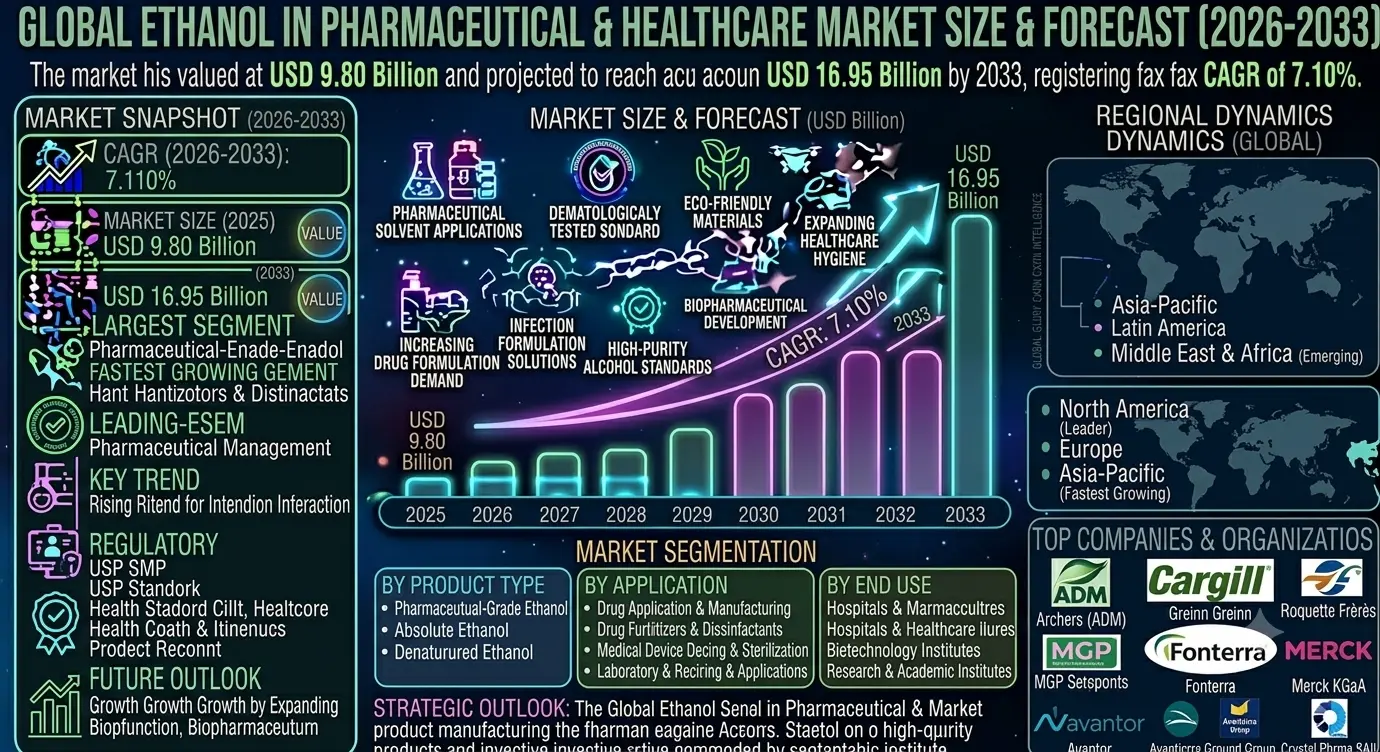
Global Ethanol in Pharmaceutical & Healthcare Market Size & Forecast
The Global Ethanol in Pharmaceutical & Healthcare Market is expected to witness steady growth during the forecast period from 2026 to 2033. The market was valued at USD 9.80 billion in 2025 and is projected to reach approximately USD 16.95 billion by 2033, registering a CAGR of 7.10%. Market growth is primarily driven by increasing pharmaceutical manufacturing activities, growing demand for disinfectants and sanitizers, rising healthcare expenditure, and expanding use of ethanol as a solvent, preservative, and antimicrobial agent in healthcare applications. The increasing focus on infection prevention and pharmaceutical quality standards continues to support market expansion globally.Global Ethanol in Pharmaceutical & Healthcare Market Overview
Ethanol is widely used across pharmaceutical and healthcare industries due to its effectiveness as a solvent, preservative, extraction agent, disinfectant, and antiseptic. Pharmaceutical-grade ethanol is a critical ingredient in liquid medications, syrups, tinctures, vaccines, topical formulations, and medical disinfectants. The market serves pharmaceutical manufacturers, hospitals, healthcare facilities, contract manufacturing organizations, and research institutions. Growing biopharmaceutical production and increasing demand for healthcare hygiene products are further contributing to market development.Structural Drivers of Market Growth
1. Expansion of Pharmaceutical Manufacturing Activities
The growing production of prescription drugs, over-the-counter medicines, and specialty pharmaceuticals is increasing demand for pharmaceutical-grade ethanol. Market Implications: Ethanol suppliers are expanding production capacities and quality assurance systems to meet pharmaceutical industry requirements.2. Rising Demand for Disinfectants and Sanitizers
Healthcare facilities continue to prioritize infection control measures, driving sustained demand for ethanol-based sanitization products. Market Implications: Manufacturers of medical disinfectants and hand sanitizers are increasing procurement of high-purity ethanol.3. Growing Use in Drug Formulation and Solvent Applications
Ethanol serves as a critical solvent and carrier agent in numerous pharmaceutical formulations and extraction processes. Market Implications: Demand for pharmaceutical-grade ethanol is increasing alongside the development of advanced drug formulations.4. Expansion of Biopharmaceutical and Vaccine Production
Increasing investments in biologics, vaccines, and advanced therapeutics are creating additional demand for ethanol in production processes. Market Implications: Ethanol suppliers supporting biopharmaceutical manufacturing are expected to benefit from long-term industry growth.Market Segmentation Analysis
By Product Type
- Pharmaceutical-Grade Ethanol Largest segment due to extensive use in medicines, syrups, tinctures, and pharmaceutical manufacturing processes.
- Absolute Ethanol High-purity ethanol used in specialized pharmaceutical and laboratory applications.
- Denatured Ethanol Used in specific healthcare and industrial healthcare-related applications where human consumption is not intended.
By Application
- Drug Formulation & Manufacturing Major application segment utilizing ethanol as a solvent, preservative, and extraction medium.
- Hand Sanitizers & Disinfectants Fastest-growing segment driven by increasing healthcare hygiene and infection control requirements.
- Medical Device Cleaning & Sterilization Used for surface disinfection and sterilization procedures across healthcare facilities.
- Laboratory & Research Applications Supports pharmaceutical research, diagnostics, and analytical testing activities.
By End Use
- Pharmaceutical Manufacturers Largest segment driven by widespread use of ethanol in pharmaceutical production and formulation activities.
- Hospitals & Healthcare Facilities Significant consumers of ethanol-based disinfectants and sterilization products.
- Biotechnology Companies Utilize ethanol in biologics manufacturing, research, and product development.
- Research & Academic Institutes Use ethanol for laboratory analysis, testing, and pharmaceutical research applications.
Regional Market Dynamics
North America
Leading region due to advanced pharmaceutical manufacturing infrastructure, stringent quality standards, and strong healthcare spending.Europe
Driven by a well-established pharmaceutical industry, regulatory compliance requirements, and growing biopharmaceutical production.Asia-Pacific
Fastest-growing region supported by expanding pharmaceutical manufacturing capacity, rising healthcare investments, and increasing exports of pharmaceutical products.Latin America
Growing market driven by healthcare sector expansion and increasing pharmaceutical production activities.Middle East & Africa
Emerging market supported by healthcare modernization programs, growing pharmaceutical investments, and increasing demand for infection control products.Competitive Landscape
The Global Ethanol in Pharmaceutical & Healthcare Market is characterized by the presence of specialty chemical manufacturers, ethanol producers, pharmaceutical ingredient suppliers, and healthcare chemical companies competing through product purity, regulatory compliance, and supply chain reliability. Key Companies Operating in the Market Include:- Archer Daniels Midland Company (ADM)
- Cargill Incorporated
- Green Plains Inc.
- Roquette Fr??res
- MGP Ingredients, Inc.
- Fonterra Co-operative Group
- Merck KGaA
- Avantor, Inc.
- Manildra Group
- Crystal Pharma SAU
Strategic Outlook
The future of the ethanol in pharmaceutical and healthcare market will be shaped by increasing pharmaceutical production, expansion of biopharmaceutical manufacturing, and sustained demand for infection prevention products. Manufacturers are expected to focus on high-purity ethanol production, regulatory compliance, and supply chain optimization to meet evolving pharmaceutical industry requirements. Technological advancements in pharmaceutical processing and biologics development will continue to expand application opportunities. Growing healthcare investments across emerging economies and increasing emphasis on hygiene and patient safety are expected to create additional demand for ethanol-based healthcare products. Companies that maintain stringent quality standards and reliable supply capabilities will be well-positioned to capitalize on future market growth.aFinal Market Perspective
The Global Ethanol in Pharmaceutical & Healthcare Market remains a critical component of the pharmaceutical and healthcare value chain. Increasing demand for pharmaceutical formulations, healthcare disinfectants, and biopharmaceutical production processes is supporting sustained market expansion. As healthcare systems continue to evolve and pharmaceutical innovation accelerates, organizations investing in high-quality, compliant, and scalable ethanol production capabilities will be well-positioned to capture long-term opportunities in the global healthcare ecosystem.Table of Contents
Table of Contents
- Executive Summary
- Global Ethanol in Pharmaceutical & Healthcare Market Snapshot (2026???2033)
- Market Size & Growth Overview
- Key Market Highlights
- Largest & Fastest-Growing Segments
- Leading End-Use Segment Overview
- Key Market Trends in Pharmaceutical Solvents, Disinfectants & High-Purity Ethanol Applications
- Strategic Outlook Through 2033
- Market Introduction & Overview
- Definition of Ethanol in Pharmaceutical & Healthcare Applications
- Scope of the Global Ethanol in Pharmaceutical & Healthcare Market
- Evolution of Ethanol Usage in Healthcare and Pharmaceutical Manufacturing
- Role of Ethanol in Drug Formulation, Sterilization & Infection Control
- Value Chain Analysis of the Pharmaceutical Ethanol Ecosystem
- Regulatory Influence (USP Standards, Good Manufacturing Practices (GMP) & Healthcare Product Safety Regulations)
- Transition Toward High-Purity Ethanol, Biopharmaceutical Applications & Advanced Healthcare Solutions
- Research Methodology
- Primary Research Approach
- Secondary Research Sources
- Market Size Estimation Methodology
- Forecasting Assumptions (2026???2033)
- Data Validation & Triangulation Process
- Market Dynamics
- Structural Drivers of Market Growth
- Expansion of Pharmaceutical Manufacturing Activities
- Rising Demand for Disinfectants and Sanitizers
- Growing Use in Drug Formulation and Solvent Applications
- Expansion of Biopharmaceutical and Vaccine Production
- Market Restraints
- Fluctuating Raw Material Prices and Feedstock Availability
- Stringent Regulatory Compliance Requirements
- Supply Chain Disruptions and Production Constraints
- Market Opportunities
- Growth of Biopharmaceutical Manufacturing
- Increasing Demand for High-Purity Pharmaceutical-Grade Ethanol
- Expansion of Healthcare Infrastructure in Emerging Markets
- Rising Adoption of Ethanol-Based Infection Control Products
- Market Challenges
- Maintaining Consistent Product Purity Standards
- Regulatory Variations Across Global Markets
- Competition from Alternative Solvents and Disinfectants
- Structural Drivers of Market Growth
- Global Ethanol in Pharmaceutical & Healthcare Market Size & Forecast (2026???2033)
- Market Revenue Analysis
- CAGR Analysis
- Pharmaceutical Manufacturing Demand Trends
- Healthcare Hygiene and Infection Control Product Analysis
- Investment and Capacity Expansion Trends
- Future Market Outlook
- Market Segmentation Analysis (2026???2033)
- By Product Type
- Pharmaceutical-Grade Ethanol (Largest Segment)
- Absolute Ethanol
- Denatured Ethanol
- By Application
- Drug Formulation & Manufacturing
- Hand Sanitizers & Disinfectants (Fastest-Growing Segment)
- Medical Device Cleaning & Sterilization
- Laboratory & Research Applications
- By End Use
- Pharmaceutical Manufacturers (Largest Segment)
- Hospitals & Healthcare Facilities
- Biotechnology Companies
- Research & Academic Institutes
- By Product Type
- Regional Market Analysis
- North America (Largest Regional Market)
- Europe
- Asia-Pacific (Fastest-Growing Region)
- Latin America
- Middle East & Africa
- Competitive Landscape
- Market Structure & Competitive Analysis
- Key Player Benchmarking
- Strategic Developments
- Product Purity, Compliance & Manufacturing Strategies
- Partnerships, Acquisitions & Supply Chain Expansion
- Company Profiles
- Archer Daniels Midland Company (ADM)
- Cargill Incorporated
- Green Plains Inc.
- Roquette Fr??res
- MGP Ingredients, Inc.
- Fonterra Co-operative Group
- Merck KGaA
- Avantor, Inc.
- Manildra Group
- Crystal Pharma SAU
- Strategic Outlook
- Future of Pharmaceutical-Grade Ethanol Applications
- Expansion of Biopharmaceutical and Vaccine Manufacturing
- Growth of Ethanol-Based Infection Prevention Solutions
- Advancements in High-Purity Production and Quality Assurance
- Long-Term Market Outlook (2033+)
- Final Market Perspective
- Appendix
- About Pheonix Market Research
- Disclaimer
Competitive Landscape
Global Ethanol in Pharmaceutical & Healthcare Market Competitive Intensity & Market Structure Overview
The Global Ethanol in Pharmaceutical & Healthcare Market is moderately consolidated, with competition concentrated among pharmaceutical-grade ethanol manufacturers, specialty chemical suppliers, bioethanol producers, and pharmaceutical ingredient providers. Competitive intensity is primarily driven by product purity, regulatory compliance, supply reliability, production scalability, and the ability to meet stringent pharmaceutical and healthcare quality standards.
Companies compete across pharmaceutical-grade ethanol, absolute ethanol, denatured ethanol, disinfectant formulations, drug manufacturing applications, and biopharmaceutical processing solutions. Growing demand for high-purity ethanol in pharmaceutical formulations, vaccines, laboratory applications, and infection control products is intensifying competition across global markets.
The market structure is evolving toward highly regulated and quality-focused supply chains, where manufacturers are investing in advanced purification technologies, GMP-certified production facilities, and sustainable bio-based ethanol manufacturing processes. Strategic collaborations between ethanol producers, pharmaceutical companies, and healthcare product manufacturers are reshaping competitive dynamics across the industry.
Global Ethanol in Pharmaceutical & Healthcare Market Competitive Intensity & Market Structure Current Scenario
Leading Global Ethanol in Pharmaceutical & Healthcare Companies
- Archer Daniels Midland Company (ADM): One of the leading global ethanol producers supplying high-quality ethanol solutions for pharmaceutical, healthcare, and industrial applications.
- Cargill Incorporated: A major supplier of bio-based ethanol and specialty ingredients supporting pharmaceutical manufacturing and healthcare product development.
- Green Plains Inc.: A prominent ethanol producer focused on high-purity ethanol production and sustainable manufacturing capabilities.
- Roquette Fr??res: A leading provider of pharmaceutical excipients and specialty ingredients, including ethanol-based solutions for healthcare applications.
- MGP Ingredients, Inc.: Specializes in premium and pharmaceutical-grade alcohol production serving pharmaceutical, healthcare, and laboratory markets.
- Fonterra Co-operative Group: Operates in specialty ingredient markets and supports pharmaceutical manufacturing supply chains through high-quality ingredient solutions.
- Merck KGaA: A global life sciences and healthcare company supplying laboratory-grade ethanol and pharmaceutical manufacturing materials.
- Avantor, Inc.: Provides high-purity ethanol products and laboratory chemicals widely used in pharmaceutical research and healthcare applications.
- Manildra Group: A major producer of pharmaceutical-grade ethanol and specialty alcohol solutions for healthcare and pharmaceutical industries.
- Crystal Pharma SAU: Focuses on pharmaceutical ingredients and high-quality ethanol solutions supporting drug manufacturing and healthcare applications.
Key Competitive Intensity & Market Structure Drivers
Increasing pharmaceutical manufacturing activities worldwide are intensifying competition among ethanol suppliers as pharmaceutical companies require consistent access to high-purity and regulatory-compliant ethanol products.
Growing demand for hand sanitizers, disinfectants, and infection control products is driving capacity expansion and strengthening competition among healthcare ethanol manufacturers.
Stringent regulatory frameworks including USP standards, GMP requirements, and pharmaceutical quality regulations are raising entry barriers and reinforcing the importance of quality assurance capabilities.
The expansion of biopharmaceutical production, vaccine manufacturing, and advanced therapeutic development is creating additional demand for specialized ethanol grades and reliable supply partnerships.
Sustainability initiatives and bio-based production technologies are becoming important competitive differentiators as healthcare organizations increasingly prioritize environmentally responsible sourcing practices.
Strategic Implications of Competitive Intensity & Market Structure
Companies with strong regulatory compliance capabilities, pharmaceutical-grade production facilities, and robust quality management systems are expected to maintain significant competitive advantages.
Investment in purification technologies, production efficiency, and supply chain resilience is becoming essential for long-term market competitiveness.
Manufacturers capable of ensuring uninterrupted supply, product consistency, and global regulatory compliance are likely to secure long-term contracts with pharmaceutical and healthcare customers.
Strategic partnerships with pharmaceutical manufacturers, biotechnology companies, and healthcare institutions are enabling suppliers to strengthen market presence and expand application opportunities.
Organizations that successfully combine product quality, scalability, regulatory expertise, and sustainable production practices will be best positioned to compete in the evolving pharmaceutical and healthcare ethanol market.
Global Ethanol in Pharmaceutical & Healthcare Market Competitive Intensity & Market Structure Forward Outlook
The competitive landscape of the global ethanol in pharmaceutical & healthcare market is expected to become increasingly quality-driven and innovation-focused as pharmaceutical production and healthcare hygiene requirements continue to expand worldwide.
Future competition will be shaped by advancements in high-purity ethanol manufacturing, sustainable bioethanol production technologies, pharmaceutical processing innovations, and biopharmaceutical industry growth.
Market participants are expected to increase investments in GMP-certified facilities, advanced purification systems, supply chain optimization, and environmentally sustainable production processes to strengthen competitive positioning.
Over the forecast period, companies that successfully balance regulatory compliance, production scalability, supply reliability, sustainability, and product purity will be best positioned to lead the evolving global ethanol in pharmaceutical & healthcare market.
Value Chain
Global Ethanol in Pharmaceutical & Healthcare Market Value Chain & Supply Chain Evolution Overview
The Global Ethanol in Pharmaceutical & Healthcare Market operates through a highly regulated value chain encompassing feedstock sourcing, ethanol production, purification, pharmaceutical-grade processing, formulation integration, distribution, and end-use healthcare applications. Ethanol serves as a critical ingredient in pharmaceutical manufacturing, disinfectants, sanitizers, vaccines, laboratory applications, and healthcare sterilization processes.
The industry is characterized by stringent quality requirements, regulatory compliance standards, and supply chain traceability. Pharmaceutical and healthcare manufacturers rely on high-purity ethanol that meets USP, GMP, and healthcare safety standards to ensure product efficacy and patient safety.
Growing pharmaceutical production, increasing biopharmaceutical investments, and rising demand for infection control products are driving expansion across the global ethanol value chain. Manufacturers are investing in production capacity expansion, advanced purification technologies, and quality assurance systems to support rising demand.
Technological advancements in ethanol purification, sustainable feedstock sourcing, and supply chain digitalization are improving operational efficiency and product consistency while supporting evolving pharmaceutical industry requirements.
Global Ethanol in Pharmaceutical & Healthcare Market Value Chain & Supply Chain Evolution Current Scenario
Market-Specific Value Chain
- Feedstock Sourcing: Procurement of corn, sugarcane, grains, molasses, and other bio-based raw materials used for ethanol production.
- Ethanol Production: Fermentation, distillation, and large-scale ethanol manufacturing processes conducted by ethanol producers.
- Purification & Pharmaceutical-Grade Processing: Advanced purification, dehydration, filtration, and quality control processes to achieve pharmaceutical-grade ethanol standards.
- Formulation & Product Integration: Incorporation of ethanol into pharmaceuticals, syrups, tinctures, vaccines, sanitizers, disinfectants, and healthcare products.
- Packaging & Regulatory Compliance: Product packaging, quality testing, certification, and compliance with pharmaceutical and healthcare regulations.
- Distribution & Logistics: Storage, transportation, inventory management, and supply chain coordination across pharmaceutical and healthcare networks.
- End User Applications: Utilization by pharmaceutical manufacturers, hospitals, biotechnology companies, laboratories, and healthcare facilities.
Company-to-Stage Mapping
- Feedstock Sourcing: Agricultural producers, grain suppliers, sugar processors, and bio-feedstock providers.
- Ethanol Production: Archer Daniels Midland Company (ADM), Cargill Incorporated, Green Plains Inc., Manildra Group, and major ethanol manufacturers.
- Purification & Pharmaceutical-Grade Processing: Roquette Fr??res, MGP Ingredients, Merck KGaA, Avantor, Inc., and specialty ethanol purification companies.
- Formulation & Product Integration: Pharmaceutical manufacturers, vaccine developers, sanitizer producers, and healthcare product manufacturers.
- Packaging & Regulatory Compliance: Pharmaceutical packaging companies, testing laboratories, and regulatory compliance service providers.
- Distribution & Logistics: Chemical distributors, pharmaceutical supply chain operators, healthcare logistics providers, and warehousing companies.
- End User Applications: Pharmaceutical manufacturers, hospitals, healthcare facilities, biotechnology companies, and research institutions.
Key Value Chain & Supply Chain Evolution Signals in Global Ethanol in Pharmaceutical & Healthcare Market
Expansion of Pharmaceutical Manufacturing Capacity
Increasing global pharmaceutical production is driving higher demand for pharmaceutical-grade ethanol across formulation and manufacturing activities.
Growing Demand for Infection Control Products
Healthcare providers continue to increase usage of ethanol-based sanitizers, disinfectants, and sterilization products to support infection prevention efforts.
Advancement in High-Purity Ethanol Processing
Manufacturers are investing in advanced purification and quality control technologies to meet stringent pharmaceutical-grade standards.
Growth of Biopharmaceutical and Vaccine Production
Expanding biologics and vaccine manufacturing activities are creating additional opportunities for ethanol utilization across production processes.
Digitalization of Supply Chain Management
Companies are implementing real-time tracking, inventory optimization, and quality monitoring systems to improve supply chain efficiency and traceability.
Focus on Sustainable Feedstock Sourcing
Ethanol producers are increasingly adopting sustainable agricultural sourcing and environmentally responsible production practices.
Strategic Implications of Value Chain & Supply Chain Evolution
Investment in High-Purity Production Capabilities
Companies expanding pharmaceutical-grade ethanol production can strengthen their position within regulated healthcare markets.
Enhancement of Quality Assurance Systems
Advanced testing, certification, and compliance programs are becoming critical for maintaining regulatory approvals and customer trust.
Expansion of Healthcare and Pharmaceutical Partnerships
Strategic collaborations with pharmaceutical manufacturers and healthcare providers can support long-term supply agreements and market expansion.
Optimization of Global Supply Networks
Strengthening logistics and inventory management capabilities can improve supply reliability and operational resilience.
Support for Biopharmaceutical Manufacturing Growth
Suppliers aligned with biologics and vaccine production trends can benefit from expanding pharmaceutical innovation activities.
Implementation of Sustainable Manufacturing Practices
Sustainable feedstock sourcing and energy-efficient production processes can improve competitiveness and regulatory alignment.
Global Ethanol in Pharmaceutical & Healthcare Market Value Chain & Supply Chain Evolution Forward Outlook
Looking ahead, the ethanol value chain within the pharmaceutical and healthcare industry is expected to become increasingly quality-focused, technology-driven, and integrated with advanced pharmaceutical manufacturing ecosystems.
Key Future Developments Include:
- Expansion of pharmaceutical-grade ethanol production capacity worldwide.
- Growing integration with biologics, vaccine, and advanced therapeutic manufacturing.
- Increased adoption of digital quality monitoring and supply chain visibility systems.
- Advancement of high-purity ethanol purification technologies.
- Strengthening of regulatory compliance and traceability requirements.
- Expansion of sustainable feedstock sourcing and environmentally responsible production practices.
As the market evolves, competitive advantage will increasingly depend on product purity, regulatory compliance, supply reliability, manufacturing scalability, and technological innovation.
Companies that successfully integrate advanced production capabilities, quality assurance systems, sustainable sourcing strategies, and efficient supply chain operations will achieve stronger long-term positioning in the Global Ethanol in Pharmaceutical & Healthcare Market.
Investment Activity
Global Ethanol in Pharmaceutical & Healthcare Market Investment & Funding Dynamics Overview (2026???2033)
The Global Ethanol in Pharmaceutical & Healthcare Market is experiencing steady investment growth driven by expanding pharmaceutical manufacturing activities, increasing demand for infection control products, rising healthcare expenditure, and growing applications of high-purity ethanol across drug formulation and biopharmaceutical production. Pharmaceutical ingredient suppliers, specialty chemical manufacturers, biotechnology companies, healthcare product manufacturers, private equity firms, and strategic investors are actively investing in pharmaceutical-grade ethanol production, purification technologies, healthcare disinfectant manufacturing, and biopharmaceutical processing infrastructure.
Investment momentum is strengthening as healthcare and pharmaceutical organizations seek reliable, high-quality ethanol supplies that comply with stringent regulatory standards. Capital allocation is increasingly focused on capacity expansion projects, advanced purification systems, quality assurance infrastructure, supply chain optimization, and sustainable ethanol production technologies.
Additionally, growing investments in ethanol-based sanitizers, pharmaceutical excipients, vaccine production support systems, and healthcare-grade chemical manufacturing facilities are creating significant long-term opportunities across the global healthcare and pharmaceutical value chain.
Current Investment & Funding Landscape
The current market landscape is characterized by rising capital deployment across pharmaceutical-grade ethanol production, healthcare hygiene products, and biopharmaceutical manufacturing support infrastructure. Industry participants are investing heavily in high-purity ethanol processing facilities, GMP-compliant production systems, advanced quality control laboratories, and integrated supply networks.
Significant funding is being directed toward infection prevention products, pharmaceutical solvent applications, biologics manufacturing support, and healthcare sterilization solutions to meet growing global healthcare requirements.
Strategic collaborations among ethanol producers, pharmaceutical manufacturers, biotechnology firms, healthcare providers, and contract manufacturing organizations (CMOs) are reshaping investment flows and strengthening market competitiveness.
Key Investment & Funding Dynamics Signals
- Growing demand for pharmaceutical-grade ethanol is driving investments in high-purity production and quality assurance systems.
- Expansion of pharmaceutical manufacturing and drug formulation activities is increasing capital deployment across ethanol supply infrastructure.
- Rising consumption of hand sanitizers, disinfectants, and infection control products is supporting healthcare-focused investments.
- Increasing investments in biopharmaceuticals, vaccines, and advanced therapeutics are creating new opportunities for ethanol suppliers.
- Strategic funding for GMP-compliant facilities, purification technologies, and laboratory-grade ethanol production is enhancing product quality and compliance.
- Growing emphasis on supply chain resilience and localized production capabilities is influencing investment priorities globally.
- Investments in sustainable and bio-based ethanol production technologies are attracting environmentally focused capital.
Strategic Implications of Investment & Funding Dynamics
- Continuous investment in high-purity ethanol production, regulatory compliance, and manufacturing efficiency is essential for maintaining competitive leadership.
- Capital allocation toward pharmaceutical processing infrastructure and healthcare hygiene product manufacturing will strengthen market positioning.
- Companies developing advanced purification technologies and scalable production capabilities are expected to secure stronger long-term growth opportunities.
- Strategic partnerships between ethanol manufacturers, pharmaceutical companies, biotechnology firms, and healthcare institutions will accelerate industry expansion.
- Investments in quality control systems, traceability technologies, and supply chain optimization will improve operational reliability.
- Compliance with USP standards, GMP requirements, healthcare safety regulations, and pharmaceutical quality guidelines will continue shaping investment decisions.
- Organizations building integrated capabilities across ethanol production, pharmaceutical supply, healthcare applications, and biopharmaceutical support services are expected to capture substantial future value.
Forward Outlook
Looking ahead, the Global Ethanol in Pharmaceutical & Healthcare Market is expected to maintain stable investment momentum driven by pharmaceutical industry expansion, increasing healthcare hygiene requirements, growing biologics production, and rising demand for pharmaceutical-grade ingredients.
Future capital deployment will increasingly focus on high-purity ethanol technologies, advanced pharmaceutical manufacturing support systems, sustainable production methods, and healthcare-grade disinfection solutions.
As pharmaceutical innovation, vaccine production, and infection prevention initiatives continue expanding globally, investment activity is expected to grow across ethanol processing infrastructure, healthcare chemical manufacturing, pharmaceutical formulation support, and biopharmaceutical production ecosystems.
In conclusion, the Global Ethanol in Pharmaceutical & Healthcare Market represents a strategically important healthcare and pharmaceutical investment landscape where high-purity ethanol production, regulatory compliance, infection control applications, biopharmaceutical expansion, and supply chain reliability will define future funding priorities, competitive differentiation, and long-term market growth.
Technology & Innovation
Global Ethanol in Pharmaceutical & Healthcare Market Technology & Innovation Landscape Overview
The global ethanol in pharmaceutical and healthcare market is witnessing significant technological advancement as manufacturers focus on improving product purity, production efficiency, regulatory compliance, and supply chain reliability. Growing demand for pharmaceutical-grade ethanol, disinfectants, sanitizers, and biopharmaceutical applications is encouraging investments in advanced purification technologies, automated production systems, and quality assurance solutions. Technological innovation is helping manufacturers achieve higher levels of consistency, safety, and traceability while meeting stringent pharmaceutical and healthcare industry standards. As healthcare systems continue to expand globally, innovation remains critical for ensuring the availability of high-quality ethanol products across diverse medical and pharmaceutical applications.
The market is also benefiting from advancements in process automation, digital quality monitoring systems, sustainable production technologies, and precision manufacturing platforms. Companies are increasingly adopting intelligent production controls, real-time monitoring tools, and advanced analytical technologies to optimize operations and maintain compliance with evolving regulatory requirements. These innovations are improving operational efficiency while supporting the growing demand for pharmaceutical and healthcare-grade ethanol worldwide.
Global Ethanol in Pharmaceutical & Healthcare Market Technology & Innovation Current Scenario
Current innovation within the ethanol in pharmaceutical and healthcare market is primarily focused on product purification, manufacturing efficiency, contamination control, and regulatory compliance. Manufacturers are investing in advanced distillation systems, molecular filtration technologies, and high-precision purification processes to produce ethanol that meets stringent pharmaceutical-grade specifications. Automation technologies are increasingly being integrated into production facilities to improve process consistency, reduce operational risks, and strengthen quality management systems.
Digital technologies are also transforming production and quality assurance activities across the market. Real-time monitoring systems, data analytics platforms, and automated inspection technologies are enabling manufacturers to improve traceability, optimize production performance, and ensure compliance with healthcare and pharmaceutical regulations. Additionally, sustainable production initiatives and energy-efficient processing technologies are helping organizations reduce environmental impact while maintaining high product quality standards.
Key Technology & Innovation Trends in Global Ethanol in Pharmaceutical & Healthcare Market
- Advanced Purification Technologies: Enhancing ethanol purity levels for pharmaceutical, laboratory, and healthcare applications.
- Automated Production Systems: Improving manufacturing efficiency, consistency, and process control.
- Digital Quality Monitoring Platforms: Supporting real-time quality assurance and regulatory compliance management.
- High-Efficiency Distillation Technologies: Increasing production performance while reducing energy consumption.
- Contamination Control Solutions: Strengthening product safety and pharmaceutical-grade manufacturing standards.
- Data Analytics & Process Optimization Tools: Enhancing operational visibility and production efficiency.
- Smart Manufacturing Technologies: Supporting automated workflow management and production scalability.
- Sustainable Ethanol Production Processes: Reducing environmental impact through improved resource utilization and energy management.
- Advanced Laboratory Testing Systems: Ensuring product consistency, purity verification, and regulatory compliance.
- Supply Chain Traceability Solutions: Improving transparency, quality tracking, and product authentication across distribution networks.
Strategic Implications of Technology & Innovation
Technological innovation is strengthening the ability of ethanol manufacturers to meet the increasingly stringent requirements of pharmaceutical and healthcare customers. Companies investing in advanced purification systems, automated manufacturing technologies, and digital quality management platforms are improving product reliability while enhancing operational efficiency. These advancements are enabling suppliers to support growing demand from pharmaceutical manufacturers, hospitals, biotechnology companies, and healthcare facilities that require high-purity ethanol products for critical applications.
Innovation is also helping manufacturers improve regulatory compliance, reduce production costs, and enhance supply chain resilience. As demand for pharmaceutical formulations, healthcare disinfectants, and biopharmaceutical products continues to grow, companies that successfully integrate advanced technologies into their operations are expected to strengthen their competitive positions. However, ongoing compliance requirements, production costs, and quality assurance challenges remain important considerations for industry participants.
Global Ethanol in Pharmaceutical & Healthcare Market Technology & Innovation Forward Outlook
The future of the ethanol in pharmaceutical and healthcare market is expected to be shaped by continued advancements in purification technologies, intelligent manufacturing systems, digital quality assurance platforms, and sustainable production methods. Emerging innovations such as artificial intelligence-driven process optimization, predictive quality management, advanced filtration systems, and next-generation pharmaceutical manufacturing technologies are expected to further improve efficiency, product quality, and regulatory compliance. Manufacturers are likely to increase investments in automation and digital transformation to meet growing global demand and evolving industry standards.
As pharmaceutical production expands, healthcare infrastructure develops, and biopharmaceutical innovation accelerates, technology will play an increasingly important role in supporting reliable ethanol supply and product quality. The integration of advanced manufacturing technologies, digital monitoring systems, and sustainable production practices is expected to create new growth opportunities while strengthening the long-term role of ethanol within the global pharmaceutical and healthcare ecosystem.
Market Risk
Global Ethanol in Pharmaceutical & Healthcare Market Risk Factors & Disruption Threats Overview
The Global Ethanol in Pharmaceutical & Healthcare Market plays a critical role in pharmaceutical manufacturing, healthcare hygiene, medical disinfection, and biopharmaceutical production. While the market continues to benefit from rising healthcare expenditures, growing pharmaceutical output, and increasing demand for infection control solutions, it remains exposed to multiple operational, regulatory, supply chain, and competitive risks that could influence long-term growth.
One of the most significant structural risks involves fluctuations in feedstock availability and raw material pricing. Ethanol production largely depends on agricultural commodities such as corn, sugarcane, wheat, and other biomass sources. Adverse weather conditions, changing agricultural policies, and commodity price volatility can directly impact production costs and supply stability.
The market also faces regulatory compliance risks due to stringent pharmaceutical quality requirements. Pharmaceutical-grade ethanol must meet strict purity standards established by organizations such as the United States Pharmacopeia (USP), European Pharmacopoeia, and various national regulatory authorities. Any failure to comply with these standards may result in product recalls, regulatory penalties, and loss of customer trust.
Another major disruption threat is supply chain vulnerability. Global logistics disruptions, transportation bottlenecks, geopolitical tensions, and trade restrictions can affect the timely delivery of ethanol to pharmaceutical manufacturers and healthcare facilities, particularly in regions highly dependent on imports.
Additionally, increasing competition from alternative solvents, evolving pharmaceutical formulation technologies, and changing manufacturing processes may reduce demand in certain traditional ethanol applications over the long term.
Global Ethanol in Pharmaceutical & Healthcare Market Risk Factors & Disruption Threats Current Scenario
The current market environment is characterized by strong demand for pharmaceutical-grade ethanol across drug manufacturing, sanitization products, laboratory applications, and biotechnology processes. Healthcare organizations continue to prioritize infection prevention measures, supporting stable consumption of ethanol-based disinfectants and antiseptic products.
However, manufacturers are facing rising production costs due to fluctuations in agricultural feedstock prices, energy costs, packaging expenses, and transportation charges. These cost pressures are influencing profit margins across the ethanol value chain.
Regulatory authorities worldwide are increasing oversight of pharmaceutical ingredients, manufacturing processes, and healthcare product quality standards. Producers must continually invest in testing, documentation, traceability systems, and quality management programs to maintain compliance.
Market participants are also experiencing increased pressure to ensure supply chain resilience as pharmaceutical companies seek dependable sourcing partners capable of meeting strict quality and delivery requirements.
At the same time, sustainability expectations are growing, encouraging manufacturers to adopt environmentally responsible production methods, renewable energy integration, and lower-carbon ethanol manufacturing practices.
Key Risk Factors & Disruption Threat Signals in Global Ethanol in Pharmaceutical & Healthcare Market
A key disruption signal is the increasing volatility of agricultural commodity markets, which can create uncertainty in feedstock pricing and production economics for ethanol manufacturers.
Another significant signal is the tightening of pharmaceutical and healthcare regulations related to ingredient purity, manufacturing standards, product traceability, and quality assurance requirements. More stringent compliance obligations may increase operational costs across the industry.
The emergence of alternative pharmaceutical solvents and advanced drug delivery technologies may gradually alter formulation practices and reduce ethanol usage in selected pharmaceutical applications.
Growing geopolitical uncertainties, trade restrictions, and supply chain disruptions are creating concerns regarding cross-border movement of pharmaceutical ingredients and healthcare raw materials.
Cybersecurity risks are also becoming increasingly important as pharmaceutical manufacturers and chemical suppliers digitize production systems, supply chain management platforms, and quality control operations.
In addition, sustainability regulations and environmental policies targeting industrial emissions, energy consumption, and resource utilization may require ethanol producers to make substantial investments in cleaner production technologies.
Strategic Implications of Risk Factors & Disruption Threats in Global Ethanol in Pharmaceutical & Healthcare Market
Manufacturers must strengthen supply chain diversification strategies to reduce dependence on single-source feedstock suppliers and mitigate risks associated with commodity price fluctuations and logistical disruptions.
Continuous investment in quality assurance, pharmaceutical-grade production infrastructure, laboratory testing capabilities, and regulatory compliance systems will remain essential to maintain market credibility and customer confidence.
Companies should focus on developing long-term supply agreements with pharmaceutical manufacturers, healthcare institutions, and biotechnology firms to improve revenue visibility and reduce market uncertainty.
Investment in sustainable ethanol production technologies, energy-efficient manufacturing facilities, and environmentally responsible sourcing practices can help organizations address evolving regulatory and customer expectations.
Advanced digital monitoring systems, predictive analytics, and supply chain visibility tools may help reduce operational risks while improving production efficiency and inventory management.
Strategic expansion into high-growth healthcare segments such as biologics manufacturing, vaccine production, advanced therapeutics, and pharmaceutical research applications may provide additional growth opportunities while reducing dependence on traditional end-use markets.
Global Ethanol in Pharmaceutical & Healthcare Market Risk Factors & Disruption Threats Forward Outlook
Between 2026 and 2033, the Global Ethanol in Pharmaceutical & Healthcare Market is expected to experience continued growth, supported by expanding pharmaceutical production, increasing healthcare investments, and rising demand for infection control solutions. However, market participants will need to navigate a complex risk environment shaped by regulatory evolution, supply chain uncertainty, and changing healthcare industry requirements.
Quality and compliance standards are expected to become increasingly rigorous, particularly for pharmaceutical-grade ethanol used in sensitive healthcare applications. Manufacturers that proactively invest in certification programs, quality management systems, and regulatory readiness will be better positioned for long-term success.
Supply chain resilience will remain a critical competitive factor as pharmaceutical companies seek reliable suppliers capable of ensuring uninterrupted access to high-purity ethanol products.
Sustainability initiatives are expected to gain greater importance, encouraging broader adoption of renewable feedstocks, carbon reduction programs, waste minimization strategies, and environmentally responsible manufacturing practices.
Technological advancements in pharmaceutical development, biotechnology manufacturing, and healthcare product innovation will continue creating new opportunities while simultaneously reshaping application requirements for ethanol-based solutions.
Overall, the market is expected to remain fundamentally strong, but future growth will increasingly depend on regulatory compliance, operational resilience, supply security, product quality, and the ability to adapt to evolving pharmaceutical and healthcare industry demands. Organizations that successfully balance these priorities will be best positioned to capture long-term growth opportunities in the global ethanol for pharmaceutical and healthcare market.
Regulatory Landscape
Global Ethanol in Pharmaceutical & Healthcare Market Regulatory & Policy Environment Overview
The regulatory and policy environment governing the Global Ethanol in Pharmaceutical & Healthcare Market is highly structured due to the critical role ethanol plays in pharmaceutical manufacturing, healthcare hygiene, drug formulation, laboratory operations, and biopharmaceutical production. Regulatory authorities, healthcare agencies, pharmacopoeia organizations, and quality assurance bodies establish strict standards governing ethanol purity, manufacturing practices, storage, transportation, and end-use applications.
Ethanol manufacturers, pharmaceutical companies, biotechnology firms, healthcare institutions, and contract manufacturing organizations must comply with comprehensive regulations related to pharmaceutical-grade quality standards, Good Manufacturing Practices (GMP), product traceability, excise controls, safety requirements, and environmental compliance. Regulatory adherence is essential for ensuring product quality, patient safety, and uninterrupted pharmaceutical production.
The growing demand for high-purity ethanol in medicines, vaccines, disinfectants, and healthcare products is encouraging regulators to strengthen oversight while supporting supply chain resilience and global healthcare preparedness.
Global Ethanol in Pharmaceutical & Healthcare Market Regulatory & Policy Environment Current Scenario
The current regulatory landscape is centered on pharmaceutical quality standards and manufacturing compliance requirements. Regulatory authorities require pharmaceutical-grade ethanol to meet strict purity specifications and quality benchmarks before being used in healthcare and pharmaceutical applications.
USP, EP, JP, and other pharmacopoeial standards play a crucial role in defining acceptable quality parameters for ethanol used in drug formulations, laboratory applications, and healthcare products. Compliance with these standards is essential for market participation.
Good Manufacturing Practices (GMP) regulations are increasingly important as pharmaceutical companies seek to ensure product consistency, contamination control, and traceability throughout the production process. Manufacturers are required to maintain comprehensive documentation, quality assurance systems, and process validation procedures.
Healthcare product safety regulations continue to influence the use of ethanol in disinfectants, hand sanitizers, antiseptics, and medical cleaning solutions. Regulatory agencies closely monitor product effectiveness, ingredient composition, labeling, and safety claims.
In addition, transportation, storage, and excise regulations governing alcohol-based products remain important due to ethanol???s flammable nature and controlled status in many jurisdictions.
Key Regulatory & Policy Environment Signals in Global Ethanol in Pharmaceutical & Healthcare Market
- USP & Pharmacopoeial Standards:
Requirements governing purity, composition, testing methods, and quality specifications for pharmaceutical-grade ethanol. - Good Manufacturing Practices (GMP):
Regulations ensuring quality management, contamination prevention, process validation, and product consistency across manufacturing operations. - Healthcare Product Safety Regulations:
Frameworks governing the formulation, labeling, efficacy, and safety of ethanol-based disinfectants, sanitizers, and healthcare products. - Pharmaceutical Ingredient Compliance Requirements:
Standards regulating the use of ethanol as an excipient, solvent, preservative, and processing aid in pharmaceutical products. - Storage, Transportation & Hazardous Material Regulations:
Policies addressing the safe handling, packaging, transport, and storage of ethanol throughout the supply chain. - Environmental & Sustainability Compliance Standards:
Guidelines promoting responsible manufacturing practices, emissions management, waste reduction, and sustainable sourcing initiatives.
Strategic Implications of Regulatory & Policy Environment
The evolving regulatory environment is encouraging ethanol manufacturers to invest in advanced purification technologies, quality assurance systems, GMP-certified production facilities, and comprehensive compliance programs. Regulatory excellence is becoming a critical differentiator in pharmaceutical and healthcare supply chains.
Pharmacopoeial compliance requirements are driving continuous investments in laboratory testing, quality control infrastructure, and traceability systems to ensure consistent product quality and regulatory acceptance.
Healthcare product safety regulations are encouraging manufacturers to strengthen formulation controls, documentation processes, and post-market quality monitoring capabilities for ethanol-based healthcare products.
Supply chain regulations related to storage and transportation are increasing the importance of logistics optimization, risk management, and regulatory documentation throughout distribution networks.
Environmental compliance requirements are motivating industry participants to improve operational efficiency, reduce environmental impacts, and adopt sustainable manufacturing practices without compromising pharmaceutical-grade quality standards.
Global Ethanol in Pharmaceutical & Healthcare Market Regulatory & Policy Environment Forward Outlook
Between 2026 and 2033, the regulatory environment for the Global Ethanol in Pharmaceutical & Healthcare Market is expected to become increasingly rigorous as pharmaceutical production expands and healthcare quality expectations continue to rise worldwide.
Pharmaceutical-grade quality requirements are likely to become more stringent, with greater emphasis on product traceability, impurity control, process validation, and supply chain transparency.
Healthcare safety regulations are expected to strengthen oversight of ethanol-based disinfectants, sanitizers, and antiseptic products to ensure product efficacy and patient protection.
Global harmonization of pharmaceutical manufacturing standards may improve cross-border trade opportunities while increasing compliance expectations for ethanol producers serving multinational pharmaceutical companies.
Overall, the future regulatory landscape will be shaped by the convergence of USP standards, GMP requirements, healthcare product safety regulations, pharmaceutical ingredient compliance frameworks, and environmental sustainability policies. Companies capable of delivering high-purity, compliant, traceable, and sustainably produced ethanol solutions will be best positioned to capitalize on long-term opportunities within the expanding global pharmaceutical and healthcare industries.