
Global Soybean Seed Market Report, Size, Share and Forecast 2026–2033
Global Soybean Seed Market, 2026–2033
Soybean seed is the strangest market in the seed industry. It is the second-largest crop seed market in the world and by far the most concentrated by geography: 88.9% of its value sits in the Americas. It is the most thoroughly biotech crop ever planted, with genetically modified varieties on roughly three-quarters of world area. And it is the only major seed market in which the founding technology has already expired.
The glyphosate-tolerance patents that created the modern soybean seed business are gone. Roundup Ready 1's patent expired in 2010 and Roundup Ready 2 has since lapsed. In Brazil, three separate court actions are now asking whether royalties can still be collected on them at all, and the Supreme Federal Court is expected to hear the oldest of the three in 2026. So the question this report has to answer is not how fast soybean seed grows. It is what a farmer is actually paying for when the technology inside the bag has been generic for fifteen years.
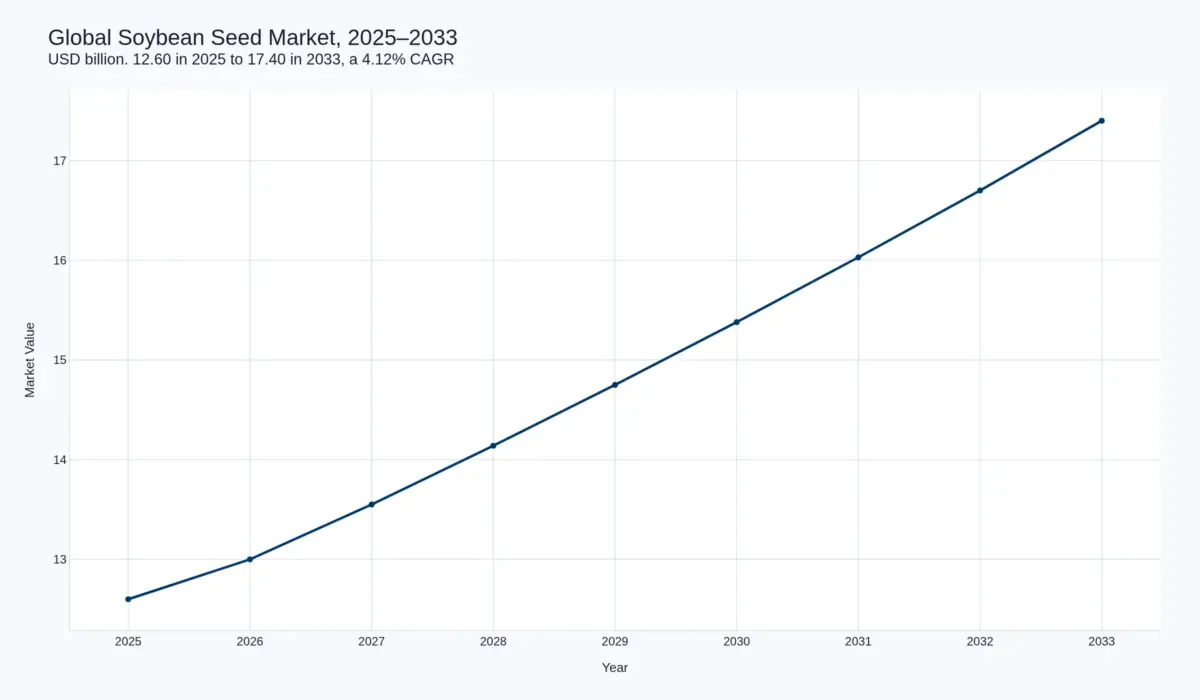
We size the global soybean seed market at USD 12.60 billion in 2025, rising to USD 17.40 billion by 2033 — a 4.12% CAGR. That base year is 16.1% of the USD 78.40 billion global seed market our seed report establishes for the same year, which makes soybean the second-largest single-crop seed market after corn and roughly half corn's value on considerably more land.
The answer to the generic-technology question is worth USD 3.90 billion. That is the share of the 2025 market — 31.0% — sitting on herbicide-tolerance traits whose original patents have expired. It is priced, collected and defended as though the patents were live, and in Brazil it is being litigated as we write. No other seed market in the world has a third of its value resting on an expired claim.
The second answer is where growth comes from, and it is not area. World soybean area reached about 130 million hectares in 2025 and supports 5.55 million tonnes of commercial seed. Commercial volume grows at 1.19% a year to 2033 against 4.12% for value, so roughly 29% of the growth is volume and 71% is price, mix and trait content. That is a slower value-decomposition than corn's 4.60% or hybrid seed's 6.06%, and it is slower for a specific reason: in soybean, the incumbent technology is going generic at the same time as the replacement technology is arriving.
The market at a glance
| Indicator | 2025 / period |
|---|---|
| Global market value, 2025 | USD 12.60 billion |
| Forecast value, 2033 | USD 17.40 billion |
| CAGR, 2026–2033 | 4.12% |
| Share of global seed value, 2025 | 16.1% |
| Commercial seed volume, 2025 | 5.55 million tonnes (1.19% CAGR to 2033) |
| Value per tonne of commercial seed, 2025 → 2033 | USD 2,270 → USD 2,852 |
| Value per planted hectare, 2025 → 2033 | USD 96.9 → USD 120.0 |
| Largest segment | GM and biotech-stacked seed, 88.9% of 2025 value |
| Value on expired patents | USD 3.90 billion, 31.0% of 2025 value |
| Fastest-growing segment | Non-GM conventional and food-grade seed, 5.50% CAGR |
| Largest region | North America, 44.8% (USD 5.65 billion) |
| Largest single market | United States, USD 5.34 billion, 42.4% of global value |
| Fastest-growing region | Asia-Pacific, 5.4% CAGR from a low commercial base |
| Americas share of world value | 88.9% (North America 44.8%, South America 44.0%) |
| US soybean plantings, 2026 | 84.7 million acres, up 4% from 81.2 million in 2025 |
| Brazil soybean area, 2026/27 | 49.3 million hectares, up 1.4% — slowest expansion in 20 years |
| Brazil uncertified seed area, 2025/26 | 9.6 million hectares, 20% of the crop, up from 3.1 million in 2021/22 |
| Largest supplier’s global share | Bayer, about 29% |
Market size and forecast
The shape of the path matters as much as its slope. 2026 is the softest year in the forecast, and it is soft for a reason that has nothing to do with seed demand: Brazilian growers are carrying high interest rates, sharply higher production costs and, in Rio Grande do Sul, an indebtedness problem serious enough that seed companies in the state expect to sell only 80–82% of the volume they produce against an ideal of 85%. We model 3.2% for 2026 and then a settlement in the low-to-mid fours as trait replacement in the Americas and commercial conversion in Asia do the work.
| Year | Value (USD billion) | Growth |
|---|---|---|
| 2025 | 12.60 | — |
| 2026 | 13.00 | 3.2% |
| 2027 | 13.55 | 4.2% |
| 2028 | 14.14 | 4.4% |
| 2029 | 14.75 | 4.3% |
| 2030 | 15.38 | 4.3% |
| 2031 | 16.03 | 4.2% |
| 2032 | 16.70 | 4.2% |
| 2033 | 17.40 | 4.2% |
Two mechanical points explain most of the forecast, and both are worth stating before the chapters that follow.
The first is that value per tonne rises 26% and value per hectare rises 24%, while volume rises 10%. Soybean seed is a value-per-unit market in the same way corn is, but with a smaller increment because the trait stack being replaced is cheaper than the trait stack being sold into corn. A bag of soybean seed in the United States cost USD 63.05 per planted acre in 2025 on USDA Economic Research Service data; the equivalent corn figure is roughly 75% higher. That gap is the whole difference between the two markets' growth rates.
The second is that commercial seed volume is structurally contested in a way that corn volume is not. In corn, the grower who plants a saved seed gets a visibly worse hybrid and knows it. In soybean, a saved seed of a self-pollinating variety is, agronomically, close to the seed he would buy. The only thing standing between the market and a much larger substitution is the law and the royalty collection system — and in Brazil, both are under pressure. That is why we model commercial volume at 1.19% against area growth of about 1.4%, rather than at par.
Three Structural Shifts Defining 2026–2033
1. The trait base has gone generic, and the value has moved to the stack. Roundup Ready 1 expired in 2010. Roundup Ready 2 has followed. The technologies now being sold are replacement stacks — Enlist E3, Conkesta E3, XtendFlex and the HT4 tolerance access that Corteva secured from Bayer in 2025 — and each of them is a licence over a base that is increasingly public. That is why USD 3.90 billion of a USD 12.60 billion market sits on expired claims: not because anyone is being deceived, but because in soybean the royalty is attached to a package — germplasm plus a current trait plus seed treatment plus service — and the package, not the patent, is what the grower buys.
2. Brazil's certified seed area has stopped growing while Brazil's soybean area has not. This is the single most important number in the report and it is not widely reported. Brazil's soybean area grew from about 40.9 million hectares in 2021/22 to 48.6 million in 2025/26 — an increase of 18.8%. Over the same four seasons, the area sown with uncertified soybean seed rose from 3.1 million hectares to 9.6 million, a 3.1-fold increase on CropLife Brasil data. Subtract one from the other and the certified area went from about 37.8 million hectares to about 39.0 million — up 3.2% in four years across a crop that grew 18.8%. Essentially all of Brazil's recent area expansion has been sown with saved or pirated seed. The industry calls this a royalty collection problem. It is more accurate to call it the loss of the incremental hectare.
3. The second-largest competitor changed its name, and its first quarterly print is misleading. Corteva separated its seed and genetics business as Vylor on 1 October 2026. Vylor's incentive is no longer to maximise seed revenue but to become a net out-licensor: royalty neutrality in 2026, two years ahead of plan, against a target of USD 1 billion of net royalty income by 2035. In the first quarter of 2026 Bayer's soybean seed and traits sales doubled on a currency- and portfolio-adjusted basis, and €448 million of that came from the Corteva licensing agreement. That is a one-off transfer, not demand. Anyone annualising it will over-forecast the market by a wide margin.
Market drivers
- Protein demand and crush capacity. Brazil's domestic soybean processing is projected to reach 63.7 million tonnes in 2026/27, up 2.5%, driven partly by biodiesel demand for soybean oil. Crush demand underwrites the seed replacement cycle.
- Trait replacement as a recurring purchase. Every time a new stack becomes the price of entry, growers on old technology must repurchase. That cycle, not area, is what produces the price/mix line in this forecast.
- US plantings recovery. US soybean area rises 4% to 84.7 million acres in 2026 from 81.2 million in 2025 on USDA NASS Prospective Plantings, reversing part of the 2024–25 decline and restoring volume to the highest-value market in the world.
- Seed treatment and seed-applied technology. Soybean lagged corn in seed-applied chemistry for a decade. It is catching up, and it is one of the few increments that can be added without a new trait.
- South American conversion potential. Argentina reached more than 30% Enlist E3 penetration in a single technology cycle, almost entirely through out-licensing — evidence that where the licence is cheap, penetration is fast.
Restraints
- Uncertified seed. The dominant restraint throughout this report. CropLife Brasil puts pirated seed at 28% of the Rio Grande do Sul market; ABRASS estimates total uncertified seed rose from 25% to 30% of the national market in a single season.
- Multiplier oversupply. Soybean seed oversupply reached 30–40% in 2024/25 — described by the Brazilian soybean seed producers' association as unprecedented. Seed that cannot hold commercial quality into the next season is dumped as grain at a fraction of its value.
- Patent expiry and litigation. Three Brazilian court actions challenge royalty collection on expired and multi-point technologies, with a Supreme Federal Court judgment expected in 2026.
- Slowing area growth. Brazil's 2026/27 expansion of 1.4% is the slowest in twenty years against a five-year average of 4.2%; US area remains below its 2024 level of 87.3 million acres.
Segmentation
We split the market three ways, because each split answers a different question. By technology, GM and biotech-stacked seed is USD 11.20 billion (88.9%) and conventional non-GM seed USD 1.40 billion (11.1%). By trait position — the split that matters for pricing power — proprietary stacked traits hold USD 7.30 billion (58.0%), off-patent glyphosate-only technology USD 3.90 billion (31.0%), and non-GM seed the remaining 11.1%. By end use, commodity crush dominates at 82.0%, food-grade and specialty at 14.0%, and forage, cover crop and other uses at 4.0%.
The non-GM segment is small and growing faster than the market, at 5.50% against 3.95% for GM seed. Its base is not a rejection of biotechnology; it is the food-grade complex — natto, tofu, edamame, high-oleic specialty oil — plus the Asian markets where commercial seed penetration is simply low. Do not mistake it for a premiumisation story in the West.
Regional analysis
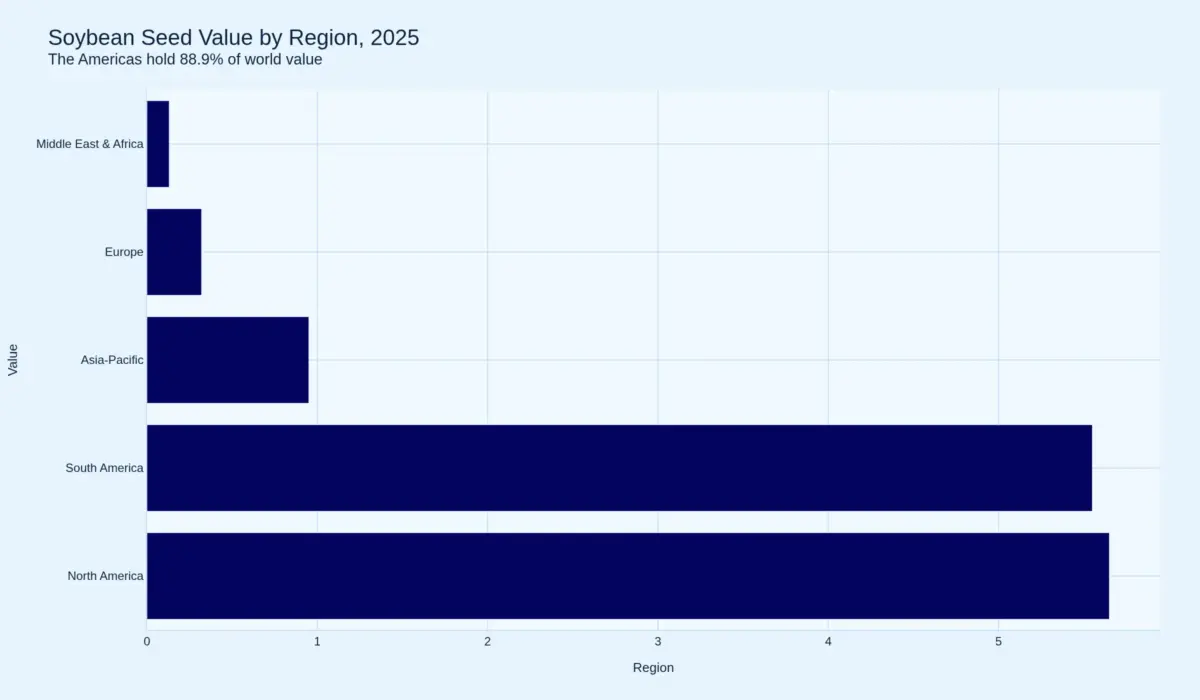
North America is the largest region at USD 5.65 billion, 44.8% of world value, of which the United States alone is USD 5.34 billion — 42.4% of the global market on 26% of global area. That ratio is the whole point. US soybean seed costs USD 63.05 per planted acre on ERS data, nearly all of it certified, nearly all of it carrying a current trait stack, and much of it carrying seed-applied chemistry. No other market monetises a soybean hectare like that.
South America is second at USD 5.55 billion, 44.0%, and it is the paradox of this report. Brazil is USD 3.95 billion (31.3%) and Argentina USD 1.15 billion (9.1%), on a combined soybean area larger than the United States'. Yet Brazilian value per hectare is roughly 40% below the American figure, because the certified share is falling at exactly the moment the area is rising. Brazil will keep growing in hectares through 2033 and will grow more slowly in commercial seed value than the world average. That is a deliberate and uncomfortable part of the forecast.
Asia-Pacific is USD 0.95 billion, 7.5% — China about USD 0.60 billion and India about USD 0.28 billion — and it is the fastest-growing region at 5.4%, from a base where most seed never enters a commercial channel. Europe is USD 0.32 billion (2.5%) and is the only region where non-GM seed is the default rather than the exception. Middle East & Africa is USD 0.13 billion (1.0%) and immaterial to world value, though not to future volume.
Competitive landscape
The top two suppliers hold roughly 44% of world value, which is high by seed-industry standards and low compared with corn's 60%. Bayer is the leader at about 29%, built on the Monsanto soybean franchise and the XtendFlex and HT4 tolerance platforms. Vylor, the separated Corteva seed and genetics business, is second with soybean seed sales of USD 1,878 million in 2025, down 3%, and with Enlist E3 in substantially all of its branded soybean portfolio. Syngenta is third, strongest in Brazil. Beneath them sits a genuinely important tier of Brazilian and Argentine independents — GDM, TMG, Brasmax, Don Mario — that supply the germplasm and the multiplier relationships in exactly the region where the market is largest and the certified share most fragile.
One entity deserves separate mention. Cultive Biotec is a joint operation of Bayer, BASF, Corteva and Syngenta that collects soybean royalties in Brazil. It is the mechanism through which the industry converts a legal right into a receivable at the grain elevator, and it is therefore the entity most exposed to the litigation described in Chapter 8.
Strategic outlook
Three positions will outperform through 2033. The first is trait licensing rather than trait selling: Vylor's decision to trade brand share for out-licensed penetration in Argentina and Brazil is a bet that a smaller share of a larger, cheaper-to-serve royalty pool beats a defended premium. The second is germplasm that survives the uncertified problem — varieties whose yield advantage is large enough that a grower saving seed of them still loses money by doing so. The third is the collection infrastructure itself: seed treatment, traceability, testing and the multiplier relationships that make a certified bag worth buying.
What will not work is a strategy built on defending an expired patent. That is a legal strategy, not a commercial one, and the Supreme Federal Court may end it in 2026.
Watch list
- Brazil's Supreme Federal Court, on whether royalties survive patent expiry for RR1 — expected 2026. A ruling against collection removes a substantial part of the USD 3.90 billion off-patent tranche.
- Brazil's Congress, on the bill that would extend germplasm royalties to saved seed and criminalise seed piracy with up to a year's imprisonment. If it passes, it is the largest single upside in this forecast.
- Vylor's royalty-neutrality date, and whether the USD 1 billion net royalty income target by 2035 is met from licensing income rather than price.
- Argentina's Enlist E3 penetration beyond 30% — the cleanest available read on how fast out-licensed technology converts a South American market.
- US plantings in 2027, against the 84.7 million acres intended for 2026 and the 87.3 million planted in 2024.
The bottom line
Soybean seed is a USD 12.60 billion market growing at 4.12% because it is the one major seed market where the technology cycle runs backwards: value is leaking out of the old trait at the same time as it is being added by the new one. The Americas hold 88.9% of it, Brazil holds the largest single uncertainty in it, and a third of it rests on patents that have expired. That is not a market in decline. It is a market whose pricing has become a legal question, and the answer arrives in a Brazilian courtroom before it arrives in a bag.
Further reading: the four-season hectare arithmetic underneath this report's lowest-in-cluster CAGR — certified soybean area rising 3.2 per cent while total planted area rose 18.8 per cent — is worked through in Brazil's Soybean Area Grew 18.8 Per Cent. Its Certified Seed Area Grew 3.2 Per Cent.
More in this series: A Third of the Soybean Seed Market Rests on Patents That Expired in 2010 — the USD 3.90 billion this report attributes to expired herbicide-tolerance technology, and the Brazilian royalty case now in front of the Supreme Federal Court.
Table of Contents
- Executive Summary
- Research Methodology & Scope
- Market Overview & Definitions
- 3.1 What This Market Measures: Seed Sales, Trait Fees and the Boundary With Grain
- 3.2 The Expired-Patent Problem: A Working Definition of Trait Position
- 3.3 Segmentation Framework
- 3.4 Forecasting Assumptions (2026–2033)
- Market Dynamics
- 4.1 Market Drivers
- 4.1.1 Protein Demand and Crush Capacity
- 4.1.2 Trait Replacement as a Recurring Purchase
- 4.1.3 United States Plantings Recovery
- 4.1.4 Seed Treatment and Seed-Applied Technology
- 4.1.5 Out-Licensing and Rapid Penetration in South America
- 4.2 Market Restraints
- 4.2.1 Uncertified Seed and the Loss of the Incremental Hectare
- 4.2.2 Multiplier Oversupply and Working Capital
- 4.2.3 Patent Expiry and Royalty Litigation
- 4.3 Market Opportunities
- 4.1 Market Drivers
- 5. Global Soybean Seed Market Size & Forecast (USD Million), 2026–2033
- 5.1 Market Revenue Analysis
- 5.2 CAGR Analysis
- 5.3 Demand-Supply Trends
- 5.4 Pricing Analysis
- 5.5 Investment Trends
- 5.6 Future Market Outlook
- 6. Market Segmentation Analysis (USD Million), 2026–2033
- 6.1 By Technology
- 6.1.1 GM and Biotech-Stacked Seed
- 6.1.2 Conventional Non-GM Seed
- 6.1.3 Food-Grade and Specialty Seed (Fastest-Growing)
- 6.2 By Trait Position
- 6.2.1 Proprietary Stacked Traits
- 6.2.2 Off-Patent Glyphosate-Only Technology
- 6.2.3 Non-GM Germplasm
- 6.3 By End Use
- 6.3.1 Commodity Crush and Oilseed
- 6.3.2 Food-Grade and Specialty
- 6.3.3 Forage, Cover Crop and Other
- 6.4 By Distribution Channel
- 6.4.1 Dealer and Retail Networks
- 6.4.2 Cooperatives, Multipliers and Contract Supply
- 6.4.3 Direct and Digital
- 6.1 By Technology
- 7. Regional Market Analysis
- 7.1 North America (Largest Market)
- 7.2 South America
- 7.3 Asia-Pacific (Fastest-Growing Market)
- 7.4 Europe
- 7.5 Middle East & Africa
- 8. Competitive Landscape
- 8.1 Market Share Analysis
- 8.2 Competitive Benchmarking
- 8.3 Strategic Developments
- 8.4 Germplasm Depth and Trait Licensing Position
- 8.5 Seed Production Capacity and Multiplier Relationships
- 9. Company Profiles
- 9.1 Bayer CropScience
- 9.2 Vylor (Corteva Seed & Genetics)
- 9.3 Syngenta Group
- 9.4 GDM Genética do Brasil
- 9.5 Tropical Melhoramento & Genética (TMG)
- 9.6 Brasmax
- 9.7 Don Mario and the Argentine Independent Tier
- 9.8 Cultive Biotec and the Royalty Collection Layer
- 9.9 Dabeinong and the Chinese Tier
- 9.10 Embrapa, Land-Grant Universities and the Public Base
- 10. Strategic Intelligence & Phoenix AI Insights
- 10.1 Soybean Seed Demand Forecast Model
- 10.2 Certified-Share Tracker by Brazilian State
- 10.3 Royalty Realisation and Off-Patent Exposure Model
- 10.4 Trait Replacement Cycle and Licence Value Assessment
- 10.5 Automated Porter’s Five Forces Analysis
- 11. Future Outlook & Strategic Recommendations
- 11.1 Price Against the Stack, Not the Patent
- 11.2 Own the Collection Point
- 11.3 Germplasm That Survives Substitution
- 11.4 The Brazil Decision Tree
- 12. Appendix: Data Tables
- 13. Glossary
- 14. Disclaimer
Competitive Landscape
Overview
The top two suppliers hold roughly 44% of world soybean seed value — high by seed-industry standards, low against corn’s 60%, and much lower than the geographic concentration would suggest. That gap between a concentrated market and a concentrated geography is the defining feature of soybean competition: almost all the value is in the Americas, but a meaningful share of it is delivered by regional independents that the global leaders cannot dislodge because they own the local germplasm and the multiplier relationships.
Current Scenario
Bayer is the leader at about 29% of world value, built on the Monsanto soybean franchise and now carried by the XtendFlex platform and the HT4 tolerance trait it licensed to Corteva in the 2025 settlement. Bayer Seed and Traits revenue was EUR 11,136 million in 2025, within which corn was EUR 7,149 million and soybeans declined about 8%. That decline is the most important disclosure in the competitive set: the market leader’s soybean business shrank in a year when the overall market grew, and it shrank in the Americas where its share is highest. Bayer’s response has been to move upstream in the collection chain — through Cultive Biotec, through the Pré-Certifica regularisation programme that signed up more than 25,000 growers across 1 million hectares in Rio Grande do Sul, and through a stated intent to convert growers to certified or legal saved seed before planting rather than pursuing them at the elevator after harvest.
Vylor — the seed and genetics business Corteva separated on 1 October 2026 — is second with soybean seed net sales of USD 1,878 million, down 3% from USD 1,927 million, of which price and mix contributed +2%, volume −4% and currency −1%. Total seed net sales were USD 9,898 million. Vylor’s strategic position is the most interesting in the market because it is deliberately unusual: it is trading brand share for licensed share. Substantially all of its branded soybean portfolio carries Enlist E3 in proprietary germplasm, and it reached more than 30% Enlist E3 penetration in Argentina primarily through out-licensing. It cut net royalty expense to about USD 120 million at year end, expects royalty neutrality in 2026 — two years ahead of plan — and targets USD 1 billion of net royalty income by 2035. It paid Bayer USD 610 million for the freedom to operate that makes this possible.
Syngenta is third at roughly 8%, with group seeds sales of USD 4.8 billion across all crops. Its soybean position is concentrated in Brazil, where it grew 17% in 2025, against a 12% decline and restructuring in North America. Syngenta is the clearest example of a global player whose soybean outcome is decided by a single national market.
The Brazilian and Argentine independents are the structural story. GDM, TMG, Brasmax, Don Mario and a long tail of regional houses hold an estimated 18% of world value and a much larger share of Brazilian certified volume. They supply germplasm licensed from the trait owners, multiply locally, and compete on adaptation to a specific latitude and soil. Their importance is not their size; it is that they are the channel through which out-licensing actually reaches the grower, and therefore the reason Vylor’s strategy can work at all.
Cultive Biotec sits across all of them. Formed by Bayer, BASF, Corteva and Syngenta to administer soybean royalty collection in Brazil, it is the only entity in this market whose business is compliance rather than seed. Its field consultants work the receiving units directly, and its reference-productivity system — 66 sacas per hectare in Rio Grande do Sul — is the mechanism that turns a legal right into a receivable.
China and India remain largely outside the commercial structure. China’s soybean area is around 10 million hectares with most seed saved or public, and while Beijing has approved GM soybean events and pressed for domestic production, adoption remains policy-led. India grows soybean on a large area with minimal commercial seed penetration and no food approval for GM soybean. Together they hold about 7% of world value on a far larger share of world area, which is the clearest measure of the monetisation gap this market still contains.
FY2025 results, competitive set
| Company | Relevant FY2025 figure | Change |
|---|---|---|
| Bayer | Seed and Traits revenue EUR 11,136m, of which corn EUR 7,149m | Soybean about −8% |
| Vylor (Corteva Seed & Genetics) | Soybean seed net sales USD 1,878m; total seed USD 9,898m | Soybean −3% (price/mix +2%, volume −4%) |
| Syngenta | Group seeds sales USD 4.8bn | Brazil +17%, North America −12% |
| Vylor net royalty position | Net royalty expense about USD 120m at year end | USD 90m improvement; neutrality targeted 2026 |
| Corteva to Bayer settlement | USD 610m cash outflow, largely Q1 2026 | Multi-year freedom to operate across corn, canola and cotton |
Signals
- Bayer’s soybean revenue fell 8% in 2025 while the market grew, which is what a leader looks like when its installed base is on older technology and its challengers are out-licensing.
- Vylor accepted a 3% revenue decline and a 4% volume decline to buy royalty neutrality a year early. That is a company deliberately shrinking the top line to change the shape of its margin.
- Enlist E3 reaching 30% of Argentina through licensing shows the independent tier is the fastest conversion channel in South America, not the branded one.
- The USD 610 million settlement price is a direct market valuation of freedom to operate in soybean and corn, and it was paid in cash from free cash flow in a single year.
Strategic Implications
Share of a royalty pool beats share of a market. Vylor’s arithmetic is that a small royalty on a large licensed area produces better returns, at lower working capital and lower political risk, than a defended brand premium. If the strategy succeeds, the metric by which this market should be judged changes from seed revenue to net royalty income — and every competitor with a proprietary stack will be forced to decide whether to defend share or license it.
The independent tier is an asset, not a rival. In Brazil, the regional houses are the only distribution channel with the reach to convert uncertified area at scale. A technology company that treats them as competitors to be squeezed will find itself selling against 20% of the national crop through its own dealer network alone.
Monitor the leader’s decline. Bayer’s 8% soybean decline is either a technology-cycle trough that the XtendFlex and HT4 platforms will reverse, or a structural share loss to licensed competitors. The 2026 and 2027 disclosures will settle it, and it is the single most consequential competitive question in this market.
Forward Outlook
By 2033 we expect the top two to hold a similar combined share but a very different composition: less branded seed revenue, more licensing and royalty income, and more of the value captured through collection infrastructure than through the bag. The Brazilian and Argentine independents will consolidate modestly but survive, because local adaptation is not something a global programme can replicate cheaply. The most likely structural surprise is consolidation in the collection layer itself, since a compliance business with four parents and one national mandate is an unusual arrangement to sustain through a period of litigation.
Value Chain
Overview
The soybean seed chain has six links, and the extraordinary thing about it is where the money is collected. Breeding and germplasm sit at the front; seed multiplication, conditioning and treatment in the middle; distribution and the grower at the back. In every other seed business the transaction closes when the grower buys the bag. In soybean — specifically in Brazil, which is the second-largest market in the world — a significant part of the transaction closes months later, when the grower delivers grain to an elevator. The seed chain has bolted its payment mechanism onto the grain chain, and that single architectural choice explains most of what follows.
Germplasm and breeding. Soybean is a self-pollinating crop, so a farmer who keeps seed from his own harvest gets, agronomically, something very close to what he planted. There is no hybrid vigour to lose and no inbreeding depression to punish him. This is the structural difference between soybean and corn, and it means the seed business has no biological lock on repurchase. Every repeat purchase in soybean is either a legal requirement or an economic choice. Breeding programmes therefore compete on genetic gain against a free alternative that improves at the same rate as the commercial one, one generation behind.
Seed multiplication. Commercial soybean seed is multiplied by contracted growers concentrated in specific belts: Rio Grande do Sul, Paraná, Mato Grosso and Goiás in Brazil; Iowa, Illinois, Indiana and Minnesota in the United States; Pergamino, Rosario and the Pampas core in Argentina. Seed rate is comparatively uniform by global standards at roughly 50–60 kilograms per hectare, which is why soybean is one of the few field crops where a tonnage aggregate is analysis rather than arithmetic. A Brazilian multiplier sells a 60-kilogram bag of technology-bearing seed for around R$220 excluding royalties; the same bag sold as grain returns roughly R$130. When the seed cannot be carried into the next season, that R$90 spread is the multiplier’s loss, and in 2024/25 the Brazilian association of soybean seed producers put oversupply at 30–40%, an unprecedented level.
Conditioning and treatment. Soybean seed is fragile in storage and loses germination fast in warm, humid conditions, which is precisely why saved seed is more common in the temperate South of Brazil than in Mato Grosso. Conditioning must deliver high germination, uniform grading and vigour; seed treatment has become the fastest-moving part of the chain, with fungicide, insecticide and nematicide packages and biologicals now standard in the United States and spreading in Brazil.
Royalty collection — the distinctive link. Brazil operates two parallel collection routes. If the grower buys certified seed, the technology is embedded in the price; industry practitioners put the royalty component at about 2.6% of the seed cost when purchased this way, with the Abrasem yearbook placing genetic-improvement royalties at 7.7% of a commercial soybean seed’s cost. If the grower saves seed, he must file an Anexo XIX declaration with the Ministry of Agriculture, produce the prior season’s purchase invoice, generate a boleto — in the region of R$270–284 per hectare — and pay it before harvest. Practitioners note that paying earlier costs less. If he does neither and technology is detected in his load, the industry retains 7.5% of the delivered grain. That 7.5% is widely described as a royalty. It is not; it is a fine, and the distinction is the subject of litigation.
Distribution. Dealer and retail networks carry the majority of volume in both the United States and Brazil, sell on credit against the next harvest, and carry the agronomic advice. Cooperatives and multipliers move a substantial block, particularly in Rio Grande do Sul and Paraná. Direct and digital channels are growing from a small base but remain marginal in value terms.
Current Scenario
The collection layer is now an institution in its own right. Cultive Biotec, a joint operation of Bayer, BASF, Corteva and Syngenta, administers soybean royalty collection in Brazil, and its field consultants work the receiving units directly. In Rio Grande do Sul the system uses 66 sacas per hectare as the reference productivity for the standard royalty volume; volumes above that are handled through commercial processes. Bayer ran a programme called Pré-Certifica in 2025/26 to regularise growers who had used the technology without paying for it, and reported more than 25,000 participating farmers covering more than 1 million hectares in the state. Its soybean business lead stated publicly that certified purchase or legal saved seed costs about half the post-planting royalty charged at the elevator — which is an unusually candid admission that the enforcement price, not the product price, has been setting the grower’s perception of value.
The economics at the grower level have moved against the certified bag. Aprosoja Brasil’s president notes that the exchange ratio was about 2.5 kilograms of soybeans per kilogram of seed up to 2015 and is now 6 to 7 kilograms, with biotechnology royalties inside the seed price identified as the driver. A Mato Grosso grower running 1,200 hectares who has saved seed for three seasons reports a cost reduction of about 30%, and argues his own seed is better adapted because it was born and graded on the farm.
At the other end of the chain, the multipliers are stressed. Apassul, the Rio Grande do Sul seed producers’ association, expects companies to sell 80–82% of the volume they produced for the current season against an ideal of 85%, after 75% the previous year, with margins described as practically zero after interest costs. Apasem puts certified seed use in Paraná at 80–85%.
Signals
- Certified seed area in Brazil rose from about 37.8 million hectares in 2021/22 to about 39.0 million in 2025/26 — 3.2% in four seasons — while total soybean area rose 18.8%. The incremental hectare went almost entirely to uncertified seed.
- Uncertified area rose 3.1-fold, from 3.1 to 9.6 million hectares, reaching 20% of a 48.6 million hectare crop on CropLife Brasil data.
- Bayer’s 25,000-farmer regularisation programme covers more than 1 million hectares in one state in one season, which indicates both the scale of non-compliance and the fact that it is regularisable.
- The 7.5% retention at the elevator is roughly double the R$270–284 per hectare charged for doing the paperwork, which means the penalty is priced to drive compliance rather than to recover value.
Strategic Implications
The elevator is the point of sale. In soybean, whoever controls the grain receiving relationship controls the royalty. That is why a technology company would rather partner with cooperatives, receiving units and multipliers than advertise to growers, and why the joint collection venture exists at all. Any commercial strategy in Brazil that does not reach the elevator is a strategy that relies on goodwill in a market where 20% of the area is already outside the system.
Multiplier health is a leading indicator, not a lagging one. A multiplier selling 80% of production at near-zero margin cannot invest in conditioning capacity or in carrying growers through a bad season. Two seasons of that and the certified supply base thins out precisely where the uncertified alternative is strongest. Watch Apassul and Apasem sell-through percentages before watching seed price lists.
Price against the free alternative, not against the competitor. The relevant benchmark for a bag of soybean seed in Rio Grande do Sul is not the other brand’s bag; it is the grower’s own harvested grain, valued at R$2.17 per kilogram. Every element of the offer has to be justified against that number or it will be arbitraged.
Forward Outlook
By 2033 the chain will be more instrumented and less intermediated. Seed treatment, traceability and rapid testing will make detection of unregistered technology cheaper and faster, which shifts the economics of non-compliance without changing the incentive to save seed. Collection will consolidate around the receiving units rather than the farm gate. The genuinely open question is legal: if Brazil’s Supreme Federal Court rules that royalties cannot survive patent expiry, the collection layer loses its cheapest and most contested tranche, and the chain’s economics shift decisively toward germplasm and current-generation traits. That decision, not any technology launch, is what reshapes this chain within the forecast window.
Investment Activity
Overview
Capital in soybean seed is being redeployed rather than raised. The industry is not short of money — Vylor generated enough free cash flow in 2025 to write a USD 610 million cheque to Bayer in a single quarter — but the direction of investment has changed. Money is moving out of branded seed commercial spend and into licensing positions, collection infrastructure and germplasm rights. That is a rational response to a market where the biological lock on repurchase is weak and the legal lock is contested.
Current Scenario
The largest single transaction was a settlement, not an acquisition. Corteva finalised a comprehensive resolution of all litigation with Bayer, paying USD 610 million in cash, largely in the first quarter of 2026, funded from 2025 free cash flow. What it bought was freedom to operate: multi-year clarity on technology access and licensing rights, regulatory support on Bayer traits, and out-licensing flexibility across corn, canola and cotton. The company framed it as supporting about USD 1 billion of aggregate earnings upside over the next decade across licensing and branded sales, an acceleration of triple-stack corn out-licensing by roughly five years and of its third-generation above-ground trait platform by two. For soybean specifically, it is what allows the Argentina and Brazil licensing strategy to be run at pace.
The royalty position is the new investment thesis. Vylor reduced net royalty expense by about USD 90 million in 2025 — part from increased corn out-licensing income, part from lower soybean royalty expense — and finished the year at roughly USD 120 million of net royalty expense. It now expects to reach royalty neutrality in 2026, two years ahead of its most recent guidance, and to become a net out-licensor thereafter, targeting USD 1 billion of net royalty income by 2035. That is a stated intention to invert the sign on the largest single cost line in a seed business, and it is the most consequential capital-allocation decision in this market.
Bayer’s first-quarter 2026 print is a transfer, not a trend. Bayer Crop Science reported 17.9% EBITDA growth in the first quarter of 2026, with soybean seed and traits sales doubling on a currency- and portfolio-adjusted basis, of which €448 million came from the licensing agreement with Corteva. This is the settlement working through the P&L as revenue rather than as a cost — inbound to Bayer, outbound from Vylor. It tells you the settlement was large; it tells you nothing about soybean demand, and annualising it would inflate any forecast.
The Brazilian multiplier tier is where the financial stress actually sits. Soybean seed oversupply reached 30–40% in 2024/25, described by the president of the Brazilian soybean seed producers’ association as unprecedented. Because soybean seed cannot hold commercial quality into the following season, surplus must be sold as grain: a 60-kilogram bag that would sell for R$220 as seed returns about R$130 as grain, and the multiplier absorbs the R$90 spread. Layer onto that a tighter rural credit market, high interest rates and, in Rio Grande do Sul, widespread grower indebtedness, and the associations are reporting margins close to zero and companies putting a foot on the brake on investment and cutting production.
There is a second-order risk that is easy to miss. Multipliers collect royalties at the point of sale and must remit them to the technology providers. Where a multiplier is financially distressed and fails to remit, the grower can be billed again at the elevator on delivery. That converts a counterparty credit problem into a grower relations problem for the technology owner, and it is the mechanism by which a strain in the smallest companies in the chain becomes a liability for the largest.
Where new capital is going. Three places. Collection and compliance technology — testing, traceability, digital Anexo XIX processing — because it is the only investment that directly defends the royalty base. Germplasm in the Brazilian and Argentine independent tier, since out-licensing only works if there are licensees with competitive genetics to license into. And seed treatment and biologicals, which raise value per bag without a regulatory approval or a breeding cycle. Gene editing in soybean attracts venture and corporate interest, but the near-term commercial targets are quality traits rather than yield, and the capital involved is small relative to the licensing flows above.
Signals
- USD 610 million paid in cash for freedom to operate, against a USD 120 million net royalty expense position, is a company buying its way out of a cost structure rather than out of a competitor.
- Royalty neutrality pulled forward two years and a USD 1 billion net royalty income target for 2035 together describe a deliberate inversion of the seed business model.
- Bayer’s €448 million licensing inflow in a single quarter shows how large the settlement is relative to annual soybean seed economics, and why it must not be read as demand.
- Apassul’s members selling 80–82% of produced volume against an 85% ideal, at margins described as practically zero, is a capital-starved supply base in the market that matters most.
Strategic Implications
Underwrite royalty income, not seed revenue. The returns in this market are increasingly in the licence, which is capital-light, requires no seed production and carries no inventory risk. An investor applying branded-seed logic — volume, price, share — will misprice the two largest players, both of which are actively converting revenue into royalty.
The multiplier tier is the systemic vulnerability. A supply base earning near-zero margins cannot fund conditioning capacity, cannot carry growers through a bad season and cannot reliably remit royalties. Investment in the Brazilian independent tier is not missionary; it is the maintenance of the only channel that can convert uncertified area.
Expect consolidation in collection, not in seed. A compliance business jointly owned by four competitors and operating one national mandate is an unstable structure through litigation. The most likely corporate action in this market over the forecast window is not a seed acquisition but a reorganisation of who owns the collection layer.
Forward Outlook
Investment through 2033 will be steady and structurally biased toward licensing, treatment and compliance. We expect Vylor to complete the transition to net out-licensor and to be judged thereafter on royalty income rather than seed sales, Bayer to keep buying collection reach in Brazil, and the Brazilian independent tier to consolidate modestly as credit remains tight. The one scenario that would change the capital picture materially is the passage of Brazil’s germplasm royalty reform, which would expand the royalty base to saved seed and justify a step-up in investment across the entire chain within a single season.
Technology & Innovation
Overview
Soybean is the only major seed market where innovation runs as a replacement cycle rather than a frontier. In corn, each generation of traits adds insect protection, herbicide tolerance and yield together, and the grower trades up. In soybean, the founding technology — glyphosate tolerance — is now generic and freely available in germplasm that is thirty years old, so the entire commercial proposition rests on persuading growers to move onto a replacement stack before the old one becomes the default. That is a harder sell than an upgrade, and it is why the technology chapter in this report is about the pace of substitution rather than the size of the yield gain.
Current Scenario
The trait ladder, and where it has reached. Roundup Ready 1 entered the market in 1996 and its patent expired in 2010; Roundup Ready 2 followed. Intacta RR2 PRO added lepidopteran protection on top of glyphosate tolerance. The current generation is a three-way stack: Enlist E3 combines 2,4-D choline, glyphosate and glufosinate tolerance, and Conkesta E3 adds insect protection to the same herbicide base. Bayer’s XtendFlex extends tolerance to dicamba — though the dicamba registration vacatur in the United States removed a degree of freedom from that platform and weighed on Bayer’s cotton business in 2025. The 2025 settlement between Bayer and Corteva, which cost Corteva USD 610 million in cash, provided multi-year clarity on technology access and included access to Bayer’s HT4 tolerance trait. Corteva has stated plainly that HT4 access is not royalty-free.
Penetration is now a licensing question, not a breeding one. Substantially all of Vylor’s branded soybean portfolio carries Enlist E3 in proprietary Corteva germplasm, and Enlist E3 has become the leading herbicide-tolerance trait for soybeans in the United States. In Argentina, the company achieved more than 30% market penetration of Enlist E3 primarily through out-licensing — which is the single most informative number in this chapter. It says that where the licence is priced to move and offered to independent seed houses, a South American market can be converted inside a normal technology cycle. In Brazil, growth in Conkesta E3 adoption is being pursued through licensing rather than brand, and double-digit trait penetration is expected.
The off-patent tranche is not idle. Roughly USD 3.90 billion of the 2025 market sits on glyphosate-only technology whose original patents have expired. It persists because the royalty in soybean is attached to a package: certified germplasm, a current trait, seed treatment, service and the legal right to plant. A grower buying an off-patent stack from a certified supplier is not paying for Roundup Ready; he is paying for the germplasm around it and for the certainty that comes with a certified lot. That is a legitimate product. It is also, in Brazil, being challenged in court.
Yield gain is the quiet constraint. Soybean genetic gain has been steady and unspectacular, with US yields improving at roughly half a bushel per acre per year over the long run. That matters commercially because the premium for a new stack has to be justified against a smaller yield increment than in corn. Where the stack’s benefit is herbicide flexibility rather than yield, the value case is agronomic convenience — and convenience is the first thing a grower economises on when margins compress.
Food-grade and specialty is the genuinely differentiated niche. High-oleic soybeans, natto and edamame varieties and tofu-grade germplasm carry contractual premiums and closed-loop production. This is where a seed company can charge on quality rather than on tolerance, and it is the fastest-growing segment in our segmentation at 5.50%.
Seed treatment and biologicals are the most accessible margin lever. Soybean lagged corn in seed-applied chemistry for a decade. Fungicide, insecticide and nematicide packages — and increasingly biologicals targeted at cyst nematode and sudden death syndrome — are now standard in the United States and expanding in Brazil. Because treatment can be added without a regulatory approval and without a breeding cycle, it is the fastest route to raising value per bag.
Gene editing is arriving where the trait is a quality trait. Soybean oil composition is the clearest early target: fatty-acid modification is a well-understood, consumer-invisible edit with an obvious end market. Edited drought and nematode traits are further out. The regulatory geography matters more than the science: Brazil and Argentina operate workable pathways, Japan has established a notification route for genome-edited products, and the European Union’s Regulation (EU) 2026/1388 — adopted 17 June 2026, in force 16 July 2026 and applying from 17 July 2028 — creates a separate pathway for certain new genomic techniques. Because the Americas hold 88.9% of soybean seed value, a functioning Brazilian and Argentine pathway is sufficient for commercialisation at scale.
Signals
- Argentina’s 30% Enlist E3 penetration through out-licensing, achieved in one technology cycle, is the benchmark for how fast a replacement stack can convert a market.
- Bayer’s soybean seed and traits revenue doubling in Q1 2026 on a €448 million licensing transfer is a mechanical effect of the Corteva settlement, not evidence of technology-led demand growth.
- Vylor’s net royalty expense fell to about USD 120 million at the end of 2025, with USD 90 million of improvement driven partly by lower soybean royalty expense — the cost of the trait stack is falling for the licensee at the same time as it is being defended for the grower.
- The dicamba vacatur demonstrates that a registered chemistry can be removed by a court, which makes herbicide-tolerance value legally contingent in a way that insect-protection value is not.
Strategic Implications
Sell the replacement, price the transition. The commercial task in soybean is not to convince a grower that a new stack is better; it is to make staying on the old one uneconomic. That requires transition pricing — a licence fee low enough that out-licensing converts share, which is precisely what Argentina demonstrated and what Vylor’s royalty-neutrality strategy is designed to do globally.
Treat seed treatment as the shortest path to value per hectare. With genetic gain slow and trait differentiation increasingly legal rather than agronomic, a treatment package is the most reliably monetisable increment in the bag. It also raises switching costs, because a treated lot is harder to replicate on farm.
Do not build a forecast on an editing launch. Gene editing will produce a proprietary soybean product within the window, most likely in oil quality and most likely launched in the Americas. It will not move the global value pool before 2033, and a plan that requires it to will be a plan that misses.
Forward Outlook
By 2033 the standard commercial soybean will carry a proprietary three-way herbicide stack, at least one seed-applied chemistry with a biological component, and — in a minority of volumes — a quality trait delivered through gene editing. The off-patent tranche will not disappear; it will erode as replacement stacks get cheap, which is the same mechanism that is already visible in Argentina. The technology that actually determines the market’s growth rate is not a gene. It is the enforcement technology: the test that tells a receiving unit whether the load in front of it was grown from a bag that was paid for.
Market Risk
Overview
Soybean seed carries an unusual risk profile: low technology risk, high substitution risk and a legal concentration that no other major seed market has. The market is not going to be disrupted by a technology it fails to adopt — it has already adopted every technology on offer. It can be materially compressed by a court ruling, by a grower deciding to keep his own seed, or by a credit squeeze in one Brazilian state.
Current Scenario
Uncertified seed is the dominant risk, and it is growing. Uncertified soybean seed area in Brazil rose from 3.1 million hectares in 2021/22 to 9.6 million in 2025/26 — 20% of a 48.6 million hectare crop, a 3.1-fold increase in four seasons on CropLife Brasil data. ABRASS estimates total uncertified seed rose from 25% to 30% of the national market in a single season. CropLife puts pirated seed specifically at 28% of the Rio Grande do Sul market. The consequence is the finding that organises this report: certified area grew only 3.2% in four years while total area grew 18.8%. The market’s volume forecast of 1.19% is a direct function of this risk, and if the trend accelerates it becomes the downside case.
Post-patent royalty collection may not survive. Brazil’s Supreme Federal Court is expected to hear the Roundup Ready 1 case in 2026. Appellate courts have twice upheld collection, but the constitutional question is unresolved and USD 3.90 billion — 31.0% of the 2025 market — sits on that tranche. A ruling against post-patent collection would not remove the germplasm value, but it would remove the pricing basis for roughly a third of the market’s value and force a rapid repricing onto current-generation traits.
Counterparty and pass-through risk in the multiplier tier. With 30–40% oversupply, near-zero margins and restricted rural credit, some Brazilian seed companies are financially strained. Multipliers collect royalties and remit them onward; where they do not, growers can be billed a second time at the elevator. That is a risk that damages the industry’s relationship with its customer at precisely the moment 20% of the crop is already outside the system.
Geographic concentration. The United States alone is 42.4% of world value and North America 44.8%. US soybean plantings were 87.3 million acres in 2024, 81.2 million in 2025 and are intended at 84.7 million in 2026 — a 6% swing in two years in the market that carries nearly half the value. A US acreage or margin shock is a global revenue shock.
Chemistry and registration risk. The dicamba registration vacatur removed a chemistry from a herbicide-tolerance platform and hit Bayer’s cotton business hard in 2025. Soybean’s value now sits on three-way stacks, each of which depends on at least one active ingredient remaining registered in its major markets. That is an exposure seed companies do not control.
Weather and production risk. Rio Grande do Sul has had consecutive seasons of severe drought or excess rain, which is the stated reason Bayer ran a state-specific regularisation programme there. Southern Brazil’s weather is a direct driver of both grower solvency and seed quality, and a poor season simultaneously reduces demand and damages the multiplier’s carried inventory.
Trade and geopolitical exposure. Soybean is the most trade-exposed of all the seed markets. Chinese demand underwrites Brazilian expansion — exports are projected to reach 118.0 million tonnes in 2026/27 — and any tariff or phytosanitary action that redirects that flow moves the Brazilian grower’s margin within a season, and with it the seed budget. We score geopolitical exposure moderate rather than high because the underlying demand is resilient and has so far rerouted rather than contracted, but the sensitivity is real.
Currency. With 44% of value in South America, the real and the peso matter. Vylor’s soybean revenue decline in 2025 included a −1% currency effect and its group results carried a Brazilian real headwind; a materially weaker real reduces the USD value of the Brazilian market without changing a single hectare planted.
Signals
- Uncertified area at 20% of the Brazilian crop is the largest single structural threat in this report, and it has tripled in four seasons.
- Two appellate wins do not settle a constitutional question; the Supreme Federal Court judgment expected in 2026 is a live binary over 31.0% of market value.
- Oversupply of 30–40% in 2024/25 is not a normal inventory cycle in a product that cannot be carried into the next season; it is a structural mismatch between multiplier capacity and certified demand.
- A 6% swing in US plantings within two years, in a market carrying 42.4% of world value in one country, is a concentration risk that no amount of Brazilian growth offsets quickly.
Strategic Implications
Run the Brazil scenario in two states. Every commercial plan in this market should be evaluated under both a germplasm-royalty reform that widens the base and a Supreme Court ruling that narrows it. The two outcomes differ by more than a third of the market’s pricing basis, and they are not mutually exclusive across the forecast window.
Treat non-compliance as a demand risk, not a legal nuisance. Litigation and enforcement recover money after the fact. The forward-looking problem is that a grower who saves seed for three seasons has left the market as a customer, and reacquiring him requires a yield advantage large enough to beat a free alternative. That is a product problem before it is a legal one.
Manage currency and geography together. A South American revenue line of 44% of world value with volatile currencies in the two largest markets means USD-reported growth can move materially without any change in hectares, price or share.
Forward Outlook
The risk profile is unlikely to improve much through the window. Uncertified share may stabilise if enforcement and reform bite, but it will not fall back to early-decade levels; the legal question will be answered one way or the other and will stay answered; and US acreage will keep swinging with the corn-soybean margin. We assess overall market risk as moderate, substitution risk as high and geopolitical exposure as moderate, and we would move the overall assessment to high if the Supreme Federal Court rules against post-patent collection and the congressional reform fails in the same legislative cycle. That combination, not any technology development, is what would turn a 4.12% forecast into a flat market.
Regulatory Landscape
Overview
Soybean seed is regulated at three layers: variety protection and seed law, which decide whether a variety can be sold and whether a royalty can be collected; biotechnology and chemistry approval, which decides what can be planted and sprayed; and trade policy, which decides where the grain goes and therefore what the grower can pay. In soybean the first layer is the one in active dispute, and unlike corn or rice, the dispute is not about approval. It is about whether an expired patent can still generate a payment.
Current Scenario
Brazil — the centre of gravity. Soybean seed is governed by the Cultivar Protection Law (Law 9,456/1997) and the Seed Law (Law 10,711/2003). Brazil permits growers to save seed for their own use, subject to declaring it through the Anexo XIX instrument at the Ministry of Agriculture, presenting the prior season’s purchase invoice and paying a per-hectare boleto before harvest. Where seed is saved without declaration and technology is detected, the industry retains 7.5% of the delivered grain — the practice growers call the multa na moega, the fine at the elevator.
Three court actions are live. The first challenges collection on Roundup Ready 1 technology after its patent expired in 2010, and on the elevator mechanism itself; the first-instance decision went against collection, Bayer won on appeal at the Rio Grande do Sul court and at the Superior Court of Justice, and the growers’ federation is seeking review at the Supreme Federal Court, with judgment expected in 2026. The second, filed in 2013, challenges an arrangement tied to Roundup Ready 2 that required growers to waive rights over post-patent royalties; the first decision favoured growers and the case continues. The third, filed in 2015, disputes collecting Intacta RR2 PRO royalties at more than one point in the chain and challenges contractual clauses as abusive; it awaits a first-instance decision.
Alongside the litigation, Congress is considering a reform that would do two things at once. It would extend royalty collection to germplasm on saved seed — today a grower saving seed pays only for the biotechnology of transgenic varieties, while genetic-improvement royalties are paid once at purchase, a model in force since 1997 that Aprosoja Brasil now says the breeding chain needs changed. And it would make seed piracy a crime punishable by up to a year’s imprisonment and a fine. CropLife Brasil puts annual losses to soybean seed piracy at approximately R$10 billion. The Abrasem 2025 yearbook puts genetic-improvement royalties at 7.7% of the cost of a commercial soybean seed, and notes that Embrapa bean contracts carry 4.4%.
Enforcement is expanding in parallel. Receiving units sample loads and run a strip test to confirm the presence of biotechnology; if technology is found without prior payment, the grower can be billed after delivery. Industry representatives are explicit that audits are not intended to punish compliant growers, and that the audit programme will widen into the next season.
United States. Protection runs through the Plant Variety Protection Act alongside utility patents, and trait access is licensed contractually. The regulatory event that mattered most in 2025 was not a seed regulation at all: the dicamba registration vacatur removed a chemistry that a herbicide-tolerance platform was built around, and it weighed heavily on Bayer’s cotton business. It is the clearest recent demonstration that in soybean, trait value is contingent on chemistry registration — an approval the seed owner does not control.
Argentina. Argentina combines a functioning seed law with royalty enforcement and a genuinely open licensing market. It reached more than 30% Enlist E3 penetration predominantly through out-licensing, which makes it the best evidence anywhere that a permissive, competitively priced licensing regime converts a South American soybean market quickly.
China and India. China has approved genetically modified soybean events and continues to press domestic production, but adoption is directed rather than market-led, and the seed system remains dominated by public varieties and farm-saved seed. India has no food approval for GM soybean and minimal commercial seed penetration. Neither market’s regulation is currently a constraint on global seed value, because neither generates much of it.
Europe. Europe is the only major region where non-GM is the default, and it is consequently a food-grade and specialty market rather than a technology market. Regulation (EU) 2026/1388, adopted 17 June 2026, in force 16 July 2026 and applying from 17 July 2028, creates a separate pathway for plants obtained by certain new genomic techniques — which matters to soybean principally as a precedent, and as an opening for edited quality traits in a market that has rejected transgenic ones.
Signals
- The Supreme Federal Court’s expected 2026 judgment on post-patent collection is the single largest binary in this report, and it sits directly beneath the USD 3.90 billion off-patent tranche.
- The congressional bill would simultaneously widen the royalty base to germplasm and criminalise piracy — the largest potential upside to the forecast, and a structural change rather than a price change.
- Brazil’s appellate courts have twice upheld collection on Roundup Ready 1, which means the legal direction of travel at appellate level is with the industry, not the growers.
- The dicamba vacatur proves a court can remove a chemistry platform from a trait stack, which makes regulatory risk in soybean chemical as well as biological.
Strategic Implications
Model the Supreme Federal Court as a scenario, not a footnote. A ruling against post-patent collection would force the industry onto germplasm-and-current-trait royalties, compress the off-patent tranche, and make the congressional reform more urgent rather than less. Any valuation of a Brazilian soybean seed position should be run under both outcomes.
Regulatory strategy is a pricing strategy. The difference between a 2.6% embedded royalty, a 3% declared saved-seed payment and a 7.5% retention at the elevator is a regulatory design choice, not a market outcome. Companies that invest in making the cheap compliant path easy — digital Anexo XIX, pre-planting programmes, cooperative partnerships — are effectively setting their own realised price.
Do not assume approval equals acceptance. China’s approvals have not produced commercial scale, India’s absence of approval has not stopped a large soybean crop, and Europe’s new genomic techniques pathway will not convert a non-GM market into a technology market. In soybean, the regulatory variable that matters is enforceability.
Forward Outlook
By 2033 the most likely outcome is a Brazil in which germplasm royalties apply to saved seed, piracy carries criminal exposure, and collection is largely digital and pre-planting. That would raise realised royalty per hectare without raising the headline price of a bag, which is the outcome most favourable to the industry and least visible in any published seed price series. The alternative — a Supreme Federal Court ruling that post-patent collection is unlawful — produces a cheaper, more commoditised market in which value migrates decisively to current-generation stacks and to germplasm. Both are plausible. Which one obtains will determine whether Brazil’s 49.3 million hectares are the growth engine of this market or its largest leak.