
Global Seed Treatment Market Report, Size, Share and Forecast 2026–2033
Global Seed Treatment Market, 2026–2033
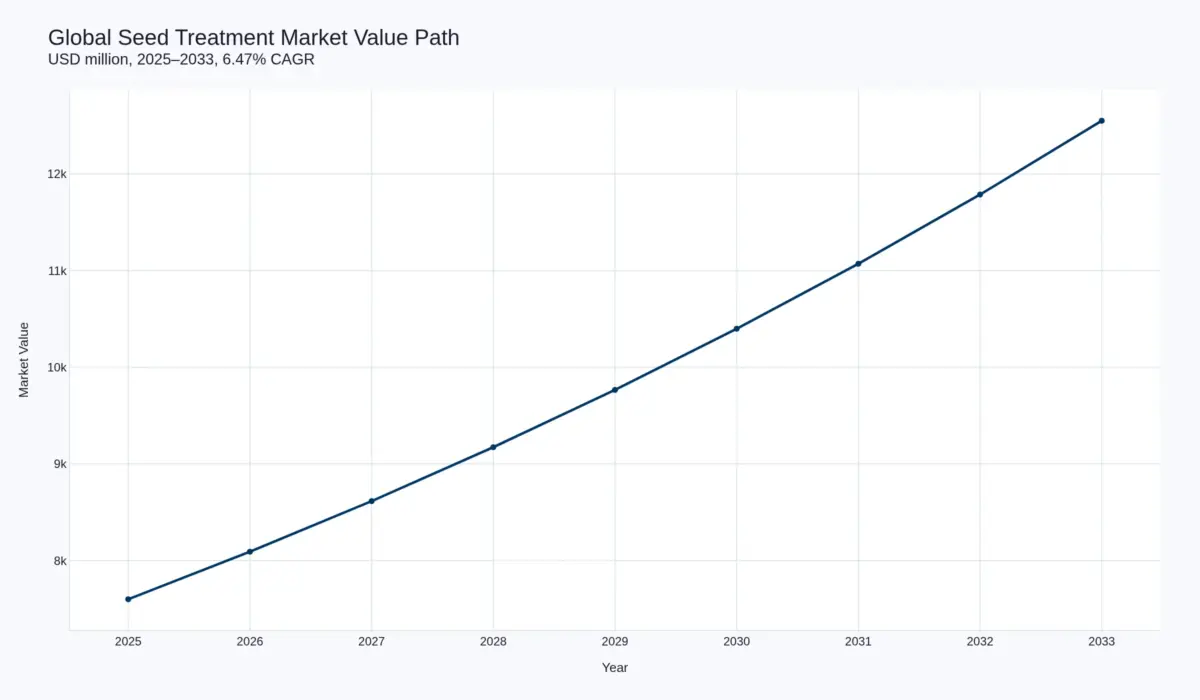
Seed treatment is the cheapest insurance in agriculture and one of the most concentrated profit pools in the input chain. A seedling that emerges uniform, free of soil-borne disease and protected from early insect and nematode pressure converts a seed investment into a stand; the product that delivers that protection costs a fraction of the seed it sits on, which is why attach rates hold even when commodity prices fall. We size the global seed treatment market at USD 7.60 billion in 2025, rising to USD 12.55 billion by 2033 — a 6.47% CAGR over 2026–2033. That base year is equivalent to 9.69% of the USD 78.40 billion global seed market our seed report establishes for the same year, and the ratio is the single most important number in this study: treatment value grows faster than the seed it is applied to, because the recipe gets longer.
The market at a glance
| Indicator | 2025 / period |
|---|---|
| Global market value, 2025 | USD 7.60 billion |
| Forecast value, 2033 | USD 12.55 billion |
| CAGR, 2026–2033 | 6.47% |
| Treatment value as share of global seed value | 9.69% |
| Largest product type | Chemical seed treatments, 82.5% of 2025 value |
| Fastest-growing product type | Biological seed treatments, 12.4% CAGR |
| Largest crop segment | Cereals & grains, 42.0% of 2025 value |
| Largest region | North America, 34.0% of 2025 value |
| Tier-1 suppliers | 4 (Bayer, Syngenta, Corteva, BASF) |
Market size and forecast
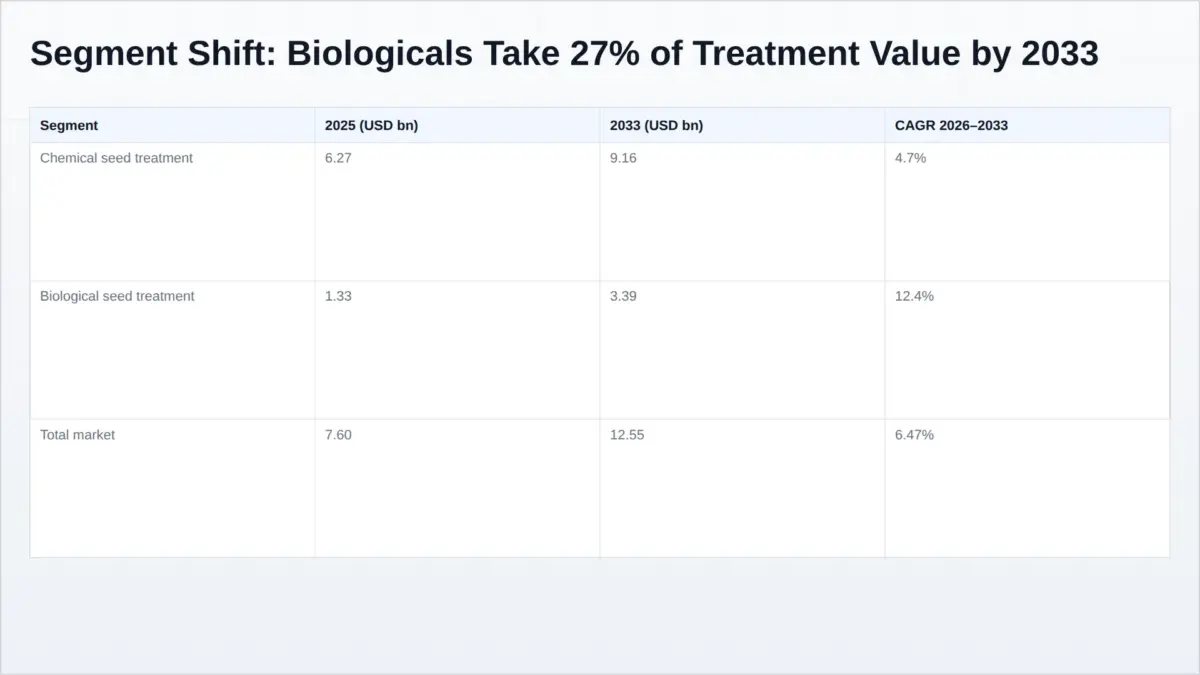
The market compounds at 6.47% across the eight-year window, but the average conceals a split that matters more than the headline. Conventional chemistry — the insecticide, fungicide and nematicide components that have defined a treated seed for three decades — grows at roughly 4.7% in our model, tracking planted area and seed-value inflation rather than any step change in intensity. Biologicals grow at 12.4%, and move from 17.5% of treatment value in 2025 to 27.0% by 2033. Roughly two-fifths of the absolute value added over the forecast period therefore comes from a product class that was a rounding error in this market fifteen years ago.
The arithmetic behind those rates is deliberately unglamorous. We do not adopt a licensed third-party estimate. The base year is triangulated from three independent directions: the seed-applied technology revenue disclosed or implied by the four tier-1 suppliers, a treatment-to-seed value ratio applied to the USD 78.40 billion seed base, and national treated-seed penetration data from the United States, Brazil, Argentina, France, Germany, China and India. The three approaches converge within a band of roughly USD 6.9–8.2 billion for 2025; we take the midpoint. The forecast applies segment-level growth rates that are separately reasoned in each chapter rather than a single blended rate, and then reconciles them back to the total.
Growth in this market is not primarily a volume story. Global planted area is close to flat, and where it expands — Brazilian safrinha corn, Argentine wheat, West African cereals — the increment is modest. What moves the number is value per treated unit: multi-component recipes replacing single-active dressings, premium seed lots carrying premium protection, and the steady migration of the treatment decision from the farm to the seed company. The last of these is structural. When a grower buys a bag of treated seed, the treatment is no longer a separate purchasing decision he can defer in a tight year — which is precisely why this market held its value through the 2024–2026 commodity price correction that squeezed foliar crop protection.
Three structural shifts defining 2026–2033
1. The biological attach becomes standard, not supplemental. Until recently a biological seed treatment was sold as an add-on with an agronomic story and a yield claim that agronomists treated politely. That is changing at the formulation level. Corteva's July 2025 addition of Lumidapt Valta LS, a nutrient seed treatment built on pine-derived lignosulfonates, to its LumiGEN corn package is the pattern: the biological component is now designed into the recipe, with a 2.0 bu/A advantage across multi-year testing cited for the combined package rather than for the product in isolation. Syngenta's biologicals business grew at a double-digit rate in 2025 and the company has built dedicated manufacturing capacity — a 22,000 m² facility at Orangeburg, South Carolina, sized to produce 16,000 tons of biostimulants a year. Syngenta puts the wider biologicals market on a roughly 10% CAGR toward USD 20 billion by 2030. Biological seed treatment is the most natural entry point in that market, because it is applied in a controlled, factory setting rather than in a spray tank.
2. Europe diverges from the rest of the world on chemistry, and treatment intensity follows the regulators. The European Commission's restriction and subsequent outdoor ban on clothianidin, imidacloprid and thiamethoxam removed the backbone of conventional cereal and oilseed rape dressing in the EU, and member states have since leaned on emergency authorisations — most visibly for sugar beet — to keep treated seed in the ground. The practical consequence is not that Europe stops treating seed. It is that Europe treats seed with a narrower, more expensive and more biological toolkit, while North and South America push conventional intensity further. Two regulatory regimes, two product mixes, one market.
3. Treatment share follows seed share. Seed treatment is sold, in the overwhelming majority of cases, as part of a seed purchase rather than as a standalone input. That bundling has a competitive consequence that is easy to miss: the four companies that dominate global seed also dominate global seed treatment, and every point of seed share a supplier wins carries treatment revenue with it. It also explains why the treatment portfolio is where these companies now differentiate seed offers that are otherwise genetically similar — and why the generic chemistry pressure that has flattened foliar crop protection has had far less purchase on the seed-applied layer.
What is driving growth
Five forces carry the forecast. The adoption of high-value hybrid and genetically modified seed raises the value at risk per hectare and therefore the willingness to protect it. Regulatory pressure on foliar applications pushes protection earlier in the season, into the seed. Early-season pest and nematode pressure — including the nematode complexes that have become a leading yield constraint in US and Brazilian soybean — has no effective foliar answer. Precision planting economics penalise uneven emergence, which is exactly what a good treatment prevents. And the biological pipeline is producing products that do something the chemistry cannot: nutrient mobilisation, root architecture, stress tolerance.
The restraints are equally concrete. Neonicotinoid restriction in Europe caps the conventional segment in a high-value region. Registration timelines for new active substances run five to eight years in major jurisdictions, and the re-registration burden on older actives is now a material cost of doing business. Generic competition is compressing prices in the simpler dressing categories, particularly in India and China. And treated seed is harder to move across borders than untreated seed, because a treated lot carries the regulatory status of the product on it — a friction that grows as residue and maximum-residue-limit compliance tightens.
How the market segments
By product type, chemical treatments hold 82.5% of 2025 value at USD 6.27 billion and biologicals 17.5% at USD 1.33 billion. By application technique, seed coating leads with 38.0% (USD 2.89 billion), ahead of seed dressing at 34.0% (USD 2.58 billion), pelleting at 18.0% (USD 1.37 billion) and priming and other techniques at 10.0% (USD 760 million). By crop, cereals and grains account for 42.0% (USD 3.19 billion), oilseeds 27.0% (USD 2.05 billion), vegetables 18.0% (USD 1.37 billion) and cotton with other industrial crops 13.0% (USD 988 million).
The technique split is where the biological shift is most visible. Coating — the film-coat that carries multiple actives and a colourant in one pass — is the enabling technology for complex recipes, and it is the segment where formulators compete on compatibility rather than on actives. Pelleting is a vegetable and sugar beet story: small, irregular seed has to be built up to a plantable shape, and the pellet itself becomes the delivery vehicle for protection and nutrition. Priming, the smallest category, is the most technically demanding and the fastest-rising in value per unit.
Regional picture
North America is the largest market at 34.0% of 2025 value (USD 2.58 billion), a function of near-universal treatment of US corn and soybean seed and the highest value per treated unit in the world. South America follows at 24.0% (USD 1.82 billion), where Brazilian soybean and safrinha corn, and Argentine wheat, carry the fastest-growing intensity in the market. Asia-Pacific is 19.0% (USD 1.44 billion), the largest market by treated area and the most price-sensitive. Europe is 16.0% (USD 1.22 billion) — a smaller share than its seed market would imply, precisely because of the chemistry restrictions described above — and the Middle East and Africa 7.0% (USD 532 million), the least penetrated region and the one with the most room above trend.
Competitive landscape
Four companies define the market. Bayer's Crop Science division reported sales of EUR 21,622 million in 2025, up 1.1% on a currency- and portfolio-adjusted basis, with Corn Seed & Traits at EUR 7,149 million (+13.2% adjusted) doing the heavy lifting and regulatory headwinds from the US dicamba label vacatur and the European expiry of Movento weighing on the crop protection lines. Syngenta Group reported full-year 2025 sales of USD 28.4 billion and EBITDA of USD 4.4 billion, up 13%, with the margin expanding 1.9 percentage points to 15.4% on a higher-margin portfolio and cost discipline. Corteva's seed-applied technology franchise, anchored by the LumiGEN package and the Lumialza nematicide, is the most complete treatment platform sold as part of a seed offer in North America. BASF brings formulation depth and a seed solutions business that is strong in Europe and in cereals outside the EU.
| Company | Latest reported scale | Seed-treatment relevance |
|---|---|---|
| Bayer CropScience | EUR 21,622m Crop Science sales, FY2025 (+1.1% fx & portfolio adj.) | SeedGrowth platform bundled into corn, soybean, cotton and vegetable seed |
| Syngenta Group | USD 28.4bn group sales, FY2025; EBITDA USD 4.4bn, +13% | Seedcare franchise; biologicals growing double digits, 16,000 t Orangeburg capacity |
| Corteva Agriscience | Seed and crop protection enterprise; LumiGEN platform | LumiGEN corn package, Lumialza nematicide, Lumidapt Valta LS nutrition treatment |
| BASF SE | Agricultural Solutions division | Formulation and seed solutions strength in European cereals |
Strategic outlook
Three conclusions follow from the analysis. First, the biological attach is the growth engine and the competitive battleground: suppliers who can deliver a stable, compatible multi-component biological recipe in a single coating pass will take share from those selling single actives, and the 12.4% growth rate in that segment will be captured by whoever controls the formulation, not whoever owns the microbe. Second, regulatory divergence is a portfolio problem, not a compliance problem: a company with one global recipe will lose either European access or American intensity, and the winners are already running region-specific formulations. Third, South America and South Asia are where the volume is and where the price per unit is lowest — the market's growth will be more value-driven in the north and more volume-driven in the south, and a single global pricing strategy will misprice both.
The market reaches USD 12.55 billion in 2033 with a materially different composition than it has today. Chemical protection remains the majority of value but stops being the majority of growth. Biologicals move from an add-on sold on agronomic faith to a designed-in component carrying measurable yield claims. And the treatment decision sits further than ever from the farmer — inside the seed company, inside the coating line, inside the recipe.
What to watch through 2033
- Whether a seed-applied RNAi or peptide nematicide reaches commercial scale in US soybean, which would open a product category with no incumbent chemistry.
- The pace of emergency authorisations for neonicotinoid-treated beet seed in the EU, and whether the Commission moves from derogation to a formal pathway.
- Biological formulation stability — shelf life on treated seed remains the binding constraint on farmer adoption in warm, humid markets.
- Consolidation among independent seed-coating and seed-technology specialists, which is where the tier-1 suppliers buy formulation capability rather than build it.
- Treated seed traceability rules, which would raise the cost of the unregistered and counterfeit segment that still absorbs meaningful volume in South Asia.
Adjacent markets in the Pheonix corpus that bear directly on this analysis: crop protection, agriculture technologies, AI in agriculture, remote sensing for agriculture, seaweed extract biostimulants and biochar.
Table of Contents
Table of Contents
- 1. Executive Summary
- 1.1 Global Seed Treatment Market Snapshot (2026–2033)
- 1.2 Market Size & Growth Overview
- 1.3 Key Market Highlights
- 1.4 Largest & Fastest-Growing Segments
- 1.5 Regional Performance Summary
- 1.6 Competitive Landscape Overview
- 1.7 Strategic Outlook Through 2033
- 2. Market Introduction & Overview
- 2.1 Definition of the Global Seed Treatment Market
- 2.2 Scope of Seed-Applied Inputs, Coatings & Application Services
- 2.3 Evolution of Seed Treatment Technologies & Seed-Applied Biotechnology
- 2.4 Seed Treatment Industry Value Chain Analysis
- 2.5 Regulatory & Compliance Framework (Registration, Treated Seed Trade & Residues)
- 2.6 Role of Seed Treatment in Early-Season Crop Establishment & Food Security
- 2.7 Transition Toward Biological & Integrated Seed-Applied Programs
- 3. Research Methodology
- 3.1 Primary Research Approach
- 3.2 Secondary Research Sources
- 3.3 Market Size Estimation Methodology
- 3.4 Forecasting Assumptions (2026–2033)
- 3.5 Data Validation & Triangulation
- 4. Market Dynamics
- 4.1 Market Drivers
- 4.1.1 Rising Adoption of High-Value Hybrid & Genetically Modified Seed
- 4.1.2 Regulatory Pressure on Foliar Pesticide Applications
- 4.1.3 Expansion of Biological & Microbial Seed Treatments
- 4.1.4 Growth of Precision Planting & Seed Singulation
- 4.1.5 Early-Season Pest, Nematode & Soil-Borne Disease Pressure
- 4.2 Market Restraints
- 4.2.1 Neonicotinoid Restrictions in the European Union
- 4.2.2 Long Registration Timelines & Re-Registration Costs
- 4.2.3 Generic Competition in Conventional Dressing Categories
- 4.3 Market Opportunities
- 4.3.1 Biological Seed Treatment in Row Crops
- 4.3.2 Seed-Applied RNAi & Peptide Nematicide Development
- 4.3.3 Treatment-as-a-Service & On-Farm Seed Coating
- 4.3.4 Penetration Growth in South Asia & Sub-Saharan Africa
- 4.4 Market Challenges
- 4.4.1 Treated Seed Trade Restrictions & Residue Compliance
- 4.4.2 Storage Stability & Shelf Life of Biological Formulations
- 4.4.3 Counterfeit & Unregistered Treated Seed
- 4.1 Market Drivers
- 5. Global Seed Treatment Market Size & Forecast (USD Million), 2026–2033
- 5.1 Market Revenue Analysis
- 5.2 CAGR Analysis
- 5.3 Demand-Supply Trends
- 5.4 Pricing Analysis
- 5.5 Investment Trends
- 5.6 Future Market Outlook
- 6. Market Segmentation Analysis (USD Million), 2026–2033
- 6.1 By Product Type
- 6.1.1 Chemical Seed Treatments (Largest Segment)
- 6.1.2 Biological Seed Treatments (Fastest-Growing Segment)
- 6.1.3 Seed-Applied Inoculants & Nutrient Treatments
- 6.2 By Application Technique
- 6.2.1 Seed Coating (Largest Technique)
- 6.2.2 Seed Dressing
- 6.2.3 Seed Pelleting
- 6.2.4 Seed Priming & Other Techniques
- 6.3 By Crop Type
- 6.3.1 Cereals & Grains (Largest Segment)
- 6.3.2 Oilseeds
- 6.3.3 Vegetables
- 6.3.4 Cotton & Other Industrial Crops
- 6.1 By Product Type
- 7. Regional Market Analysis
- 7.1 North America (Largest Market)
- 7.2 South America
- 7.3 Europe
- 7.4 Asia-Pacific
- 7.5 Middle East & Africa
- 8. Competitive Landscape
- 8.1 Market Share Analysis
- 8.2 Competitive Benchmarking
- 8.3 Strategic Developments
- 8.4 Biological Portfolio & Formulation Strategies
- 8.5 Partnerships, Acquisitions & Capacity Expansion Analysis
- 9. Company Profiles
- 9.1 Bayer CropScience AG
- 9.2 Syngenta Group (Seedcare)
- 9.3 Corteva Agriscience
- 9.4 BASF SE
- 9.5 FMC Corporation
- 9.6 Nufarm Limited
- 9.7 UPL Limited
- 9.8 Sumitomo Chemical / Valent BioSciences
- 9.9 Germains Seed Technology
- 9.10 Incotec Group (Croda)
- 10. Strategic Intelligence & Phoenix AI Insights
- 10.1 Seed Treatment Demand Forecast Model
- 10.2 Biological Adoption & Attach-Rate Analysis
- 10.3 Seed-Applied Technology Growth Tracker
- 10.4 Formulation Innovation & Patent Assessment
- 10.5 Automated Porter’s Five Forces Analysis
- 11. Future Outlook & Strategic Recommendations
- 11.1 Expansion of Biological Seed Treatment Portfolios
- 11.2 Investment in Formulation & Co-Application Compatibility
- 11.3 Growth Opportunities in South America & South Asia
- 11.4 Strengthening Treated Seed Traceability & Compliance
- 11.5 Long-Term Market Outlook (2033+)
- 12. Appendix
- 13. About Phoenix Market Research
- 14. Disclaimer
Competitive Landscape
Competitive Landscape
Overview
The seed treatment market is oligopolistic in the precise sense: four companies hold the majority of value, they hold it through control of the seed bag rather than through control of the active ingredient, and the fringe that surrounds them competes on formulation services, regional access or price rather than on the ability to displace a tier-1 recipe. Our estimate puts the four majors at roughly 55–60% of global treatment value in 2025, with the balance split between secondary multinationals, generic formulators in India and China, and independent seed-coating specialists who increasingly sit inside the major’s supply chain rather than outside it.
The concentration is not a function of chemistry. It is a function of bundling: a treatment reaches the farm inside a bag of seed, and the companies that sell the most seed sell the most treatment. Any analysis of share that ignores the seed franchise will misread the market.
2025 results: what the numbers actually signal
Bayer’s Crop Science closed 2025 with sales of EUR 21,622 million, down 2.9% as reported but up 1.1% on a currency- and portfolio-adjusted basis, and EBITDA before special items of EUR 4,188 million at a 19.4% margin. The composition is the story: Corn Seed & Traits delivered EUR 7,149 million, up 9.0% reported and 13.2% adjusted, while Fungicides fell 8.5%, Insecticides fell 16.5% and Soybean Seed & Traits slipped 10.5% on the US dicamba label vacatur. Seed grew through a crop protection contraction. That is the seed-applied logic working at the level of a division’s P&L.
Syngenta Group reported 2025 sales of USD 28.4 billion, 1% lower on a reported basis but up 2% excluding a deliberate USD 1 billion reduction in lower-margin grain trading, and EBITDA of USD 4.4 billion, up 13% (17% at constant exchange rates). The EBITDA margin expanded 1.9 percentage points to 15.4%. Two details matter for seed treatment specifically: the biologicals business grew at a double-digit rate across the full year, and the Orangeburg, South Carolina facility came online with capacity for 16,000 tons of biostimulants annually.
Q1 2026 sharpened the picture. Bayer’s Crop Science sales reached EUR 7,558 million, up 6.8% adjusted, with North America up 16.6%, soybean seed and traits recovering on a licensing resolution and the return of the dicamba label, and crop protection declining. The seed-applied layer is outperforming the spray layer in every reporting period we can observe.
| Player | FY2025 anchor | Treatment strategy |
|---|---|---|
| Bayer CropScience | EUR 21,622m sales; EBITDA pre-special EUR 4,188m; 19.4% margin | SeedGrowth embedded in corn, soybean, cotton and vegetable seed; cost discipline under the Five-Year Framework |
| Syngenta Group | USD 28.4bn sales; EBITDA USD 4.4bn, +13%; 15.4% margin | Seedcare plus a biologicals platform with owned manufacturing; capability acquisitions in strain libraries |
| Corteva Agriscience | Seed and crop protection enterprise | LumiGEN as a branded full recipe; Lumialza nematicide; Lumidapt nutrition treatment |
| BASF SE | Agricultural Solutions division | Formulation-led, strong in European cereals; seed solutions partnerships |
Strategy by player
Bayer runs the most integrated model: treatment is not sold as a brand to the grower, it is a component of a seed purchase, and the company’s advantage lies in the breadth of crops it can cover from one formulation platform. The 2025 numbers show the trade-off. Portfolio streamlining and the Five-Year Framework have cut research spend sharply — R&D at Crop Science fell 22.9% after special items and impairments, to EUR 2,013 million — which protects the margin but raises the question of whether the seed-applied pipeline can be funded internally at the same time as the litigation overhang is being absorbed.
Syngenta has made the clearest biological commitment of the four. The Seedcare franchise gives it the application channel; the biologicals platform gives it the products; the manufacturing capacity at Orangeburg gives it the cost base. Its stated view that the wider biologicals market compounds at around 10% toward USD 20 billion by 2030 sets the strategic frame, and seed treatment is where that growth is easiest to monetise because the application is factory-controlled.
Corteva competes on recipe branding. LumiGEN is presented to the grower as a named, complete package rather than as a list of actives, and the 2025 addition of Lumidapt Valta LS extends the principle into nutrition. The claim attached to that launch — a 2.0 bu/A advantage in multi-year testing — is the kind of measurable, package-level yield statement that generic dressings cannot easily match, and it is the template the rest of the market is copying.
BASF plays to formulation depth and European strength, where the restricted chemistry palette makes formulation know-how more valuable, not less. Its exposure is concentrated in cereals, which is the largest crop segment at 42.0% of 2025 value, but also the one where generic competition is fiercest outside the EU.
The specialist and generic fringe
Below the four sit two distinct groups. The seed-technology specialists — Germains, Incotec (Croda) and a long tail of regional coaters — own process knowledge in film coating, pelleting and priming, and are the natural acquisition targets for any major that wants biological formulation capability quickly. The generics — UPL, Nufarm, Sumitomo and a dense field of Indian and Chinese formulators — compete in seed dressing, the 34.0% technique segment where the product is a single active applied at low cost. Their constraint is not capability but access: without a seed franchise, they sell to seed companies that already have a preferred supplier, or they sell into the on-farm treatment channel that is shrinking.
Strategic implications
Three observations for competitive strategy. First, share is sticky: because treatment travels inside the seed bag, displacement requires a seed share shift or a seed-company relationship change, and both are slow. Second, the biological transition rewards manufacturers and penalises pure formulators, because a biological that cannot be produced consistently at scale is not a product — Syngenta’s investment in owned capacity is a moat, not an overhead. Third, the generic pressure that has hurt foliar crop protection has not yet reached the seed-applied layer in the same way, and the reason is technical: a multi-component recipe with a biological in it is much harder to copy than a single-active spray.
Forward outlook
We expect consolidation to run in two directions through 2033. Upstream, the majors will buy formulation and strain capability rather than build it, following the Intrinsyx and Novartis-collection template. Downstream, seed companies in emerging markets will increasingly bring treatment in-house as coating equipment gets cheaper, which will compress the standalone treatment brand in Asia-Pacific and open volume for suppliers selling formulation concentrates rather than finished product. The four majors keep their position on the strength of the seed bag, but the mix of what they sell through it changes materially: by 2033 biologicals are 27.0% of treatment value, and the competitive question is no longer who owns the best active, but who owns the best recipe.
Value Chain
Seed Treatment Value Chain Analysis
Overview
The seed treatment value chain is unusual among agricultural inputs because the product is never sold to the person who uses it as a separate item of choice. It is applied, in the great majority of volume, by a seed company onto seed that company is already selling, and the cost is recovered inside the seed price. That single structural fact determines where value is created, where it is captured, and why the chain has consolidated the way it has.
Five layers matter: active substance and biological discovery; formulation; application and coating at the seed plant; distribution and agronomy; and the farm. Between them sits an equipment and services layer — batch and continuous treaters, seed testing, treatment-as-a-service — that is small in revenue but decisive in whether a recipe performs.
The formulation layer
Formulation is where the economics sit. An active substance is a commodity input once it is off patent; a stable, compatible, seed-safe formulation is not. A modern corn recipe may carry an insecticide, two or three fungicides, a nematicide, a biological, a nutrient package, a polymer film and a colourant in a single pass, and the technical problem is not the individual components but their interaction: which actives degrade which biologicals, which surfactants damage the seed coat, which combination survives eighteen months in a warehouse in Mato Grosso. Corteva’s decision to add Lumidapt Valta LS into the existing LumiGEN corn recipe rather than sell it separately is an explicit statement that compatibility, not the active, is the product.
Two consequences follow. First, the formulator captures a disproportionate share of treatment value, because the seed company is buying a solved problem rather than a chemical. Second, formulators with a broad portfolio can price the recipe as a package, which insulates the seed-applied layer from the generic erosion that has flattened foliar crop protection — the same pressure Bayer reports in its 2025 crop protection lines, where price declined 0.1% for the division while Corn Seed & Traits grew 13.2% on an adjusted basis.
Application: where the recipe is assembled
Application has migrated almost entirely into the seed plant. On-farm treatment by growers survives in some geographies and in some crops — wheat in parts of Europe, cotton in parts of South Asia — but the direction of travel is one way, because factory application gives dose accuracy, operator safety, dust control and traceability that a farm-scale treater cannot match. The equipment layer that supports this is dominated by a small number of specialists and is a genuine barrier in emerging markets: a modern coating line is capital-intensive, and the return depends on throughput.
The technique mix tracks this. Coating holds 38.0% of 2025 market value at USD 2.89 billion precisely because it is the format that allows multi-component recipes in one pass. Dressing, at 34.0% (USD 2.58 billion), is the older single-active model and is where generics compete hardest. Pelleting, 18.0% (USD 1.37 billion), is capital-intensive and concentrated in vegetables and sugar beet, where seed is small, irregular and expensive. Priming and other techniques, 10.0% (USD 760 million), is the smallest but the most technically demanding.
Distribution and the bundling point
Distribution is distributor-led in most of the world, but the commercially important transaction happens one step earlier: between the treatment supplier and the seed company. A treatment brand reaches the farmer through the seed bag, with the seed company’s brand in front of it. This is why treatment market share is so stable and so closely correlated with seed share, and why a treatment supplier without a seed franchise — or a distribution agreement with one — faces a structural ceiling regardless of product quality.
It also creates the single most important pricing asymmetry in the market. A grower buying untreated seed can choose his protection separately and defer it in a bad year. A grower buying treated seed cannot. The treatment cost is embedded, small relative to the seed, and justified by early-season risk that is difficult to observe — which is why treatment revenue held through the 2024–2026 commodity correction that compressed foliar crop protection spending.
Value capture across the chain
| Layer | Role | Value capture |
|---|---|---|
| Discovery | Actives and microbial strains | High but lumpy; patent-protected where novel |
| Formulation | Recipe, compatibility, stability | Highest and most defensible margin in the chain |
| Application | Coating and treatment at seed plant | Capital-intensive, moderate margin, high switching cost |
| Seed company | Bundling treatment into the seed sale | Captures valuation premium on seed; controls access |
| Distribution | Agronomy and last-mile | Thin margin, high influence on recipe choice |
Strategic implications
Three implications follow for anyone buying, selling or investing in this chain. The formulation layer is the place to own capability: acquisitions in this market are almost always purchases of formulation know-how or biological strain libraries, not of manufacturing assets — Syngenta’s December 2024 acquisition of Intrinsyx Bio and its 2025 integration of the Novartis strains and natural products collection are both capability purchases, not capacity purchases. The seed company is the gatekeeper: a treatment brand’s addressable market is defined by which seed bags it sits in, so distribution agreements matter more than advertising. And the biological transition changes the technical bar rather than lowering it — a microbe is easy to source and hard to keep alive in a coating tank, which favours formulators with existing seed-plant relationships over biological start-ups with a good strain.
Forward outlook
Through 2033 we expect the formulation layer to consolidate further and the application layer to stay fragmented, because coating capacity is local and recipe control is global. The most likely structural change is vertical: seed companies bringing biological formulation in-house or acquiring the specialist coaters that hold it, which is exactly the pattern visible in the independent seed-technology specialists — Germains, Incotec and their peers — whose value lies in process knowledge rather than in actives. If that consolidation accelerates, the 12.4% biological growth rate will be captured upstream, by whoever owns the coating line, rather than by whoever owns the microbe.
Investment Activity
Investment Activity
Overview
Capital in this market flows to two places: capability and capacity. Capability means formulation know-how, microbial strain libraries and the seed-plant relationships that decide whose recipe is applied; capacity means fermentation and coating assets that determine whether a biological product can be made consistently at scale. The pattern of the last two years is that the majors are buying capability and building capacity, while independent specialists are consolidating around them.
We rate investment direction as rising, capital intensity as high, and recent M&A activity as present and continuing.
Where the money has gone
Syngenta’s 2024–2025 programme is the clearest case study. In December 2024 it acquired Intrinsyx Bio, a California start-up specialising in nutrient use efficiency products — a capability purchase with no manufacturing content. In early 2025 it completed the integration of the Novartis strains and natural products collection, a repository of natural compounds and genetic strains for agricultural use, which is effectively a purchased R&D pipeline. In parallel it opened a 22,000 m² biologicals facility at Orangeburg, South Carolina, designed for 16,000 tons of biostimulants a year, complementing existing sites in Brazil, Italy, India and Norway. Capability bought, capacity built.
The same logic drives the rest of the field. Bayer’s constraint is different: with Crop Science research and development expense down 22.9% after special items and impairments to EUR 2,013 million in 2025, and with a Five-Year Framework that prioritised portfolio streamlining and margin protection, the company is more likely to buy formulation capability than to fund an internal biologicals platform from scratch. Corteva has invested organically in recipe branding and in the LumiGEN franchise rather than through large transactions, extending the package into nutrition with Lumidapt Valta LS in 2025. BASF continues to invest in formulation and in biological partnerships rather than in seed ownership.
Capital intensity and where it binds
The capital-intensive step is not formulation — a formulation line is modest — but fermentation and coating. Fermentation capacity is expensive, slow to permit and difficult to run at consistent quality; it is the single largest barrier to entry in biological seed treatment and the reason the majors are building rather than buying finished product. Coating capacity is local and plant-level: a seed company installing a line to apply its own recipe is making a five-to-ten-year commitment, which is precisely why the treatment supplier’s relationship with that seed company is durable.
| Investment type | Recent examples | Purpose |
|---|---|---|
| Capability acquisition | Intrinsyx Bio (Dec 2024); Novartis strains collection (2025) | Nutrient use efficiency and strain library; pipeline without new capacity |
| Capacity build | Orangeburg, South Carolina: 22,000 m², 16,000 t biostimulants | Consistent supply of biologicals at scale |
| Organic recipe development | LumiGEN extension with Lumidapt Valta LS (2025) | Package-level differentiation and yield claims |
| Portfolio streamlining | Bayer Five-Year Framework; Crop Science R&D reduction | Margin protection; divestment of non-core assets |
The valuation question
Biological assets have been expensive for a decade and the pricing has become more disciplined. The 2021–2023 cycle saw biological and seed-technology specialists valued on pipeline promise; the current cycle values them on registration status, manufacturing readiness and, above all, whether the product can survive a coating line. That shift favours strategic buyers over financial ones, because only a strategic buyer can supply the seed-plant channel that converts a registered strain into revenue.
The corollary is that the independent seed-coating specialists — Germains, Incotec (owned by Croda) and their regional peers — are the most likely consolidation targets in the next phase. Their value is process knowledge: how to coat a particular seed species, how to keep a biological viable through the process, how to pellet a vegetable seed to a plantable shape. That knowledge does not appear on a balance sheet and cannot be bought quickly.
Public-market signals
The two listed bellwethers tell a consistent story. Bayer’s Crop Science delivered EBITDA before special items of EUR 4,188 million at a 19.4% margin in 2025, unchanged year on year, while absorbing a EUR 208 million negative currency effect that had been positive in 2024 — a reminder that this market’s reported growth is materially exposed to dollar and real movements. Syngenta Group lifted EBITDA 13% to USD 4.4 billion and expanded its margin 1.9 percentage points to 15.4%, explicitly on a higher-margin portfolio and cost discipline, having chosen to shed USD 1 billion of low-margin grain trading revenue to get there.
Both are prioritising mix over volume, which is the correct response in a market where value per treated unit, not tonnes, drives the number. It also means investment in the seed-applied layer is being funded from portfolio reallocation rather than from top-line expansion.
Strategic implications
Three implications for capital allocation. First, the highest-return investment in this market is biological formulation and stability, not discovery — a strain that cannot be stabilised has no commercial value. Second, capacity is the moat: fermentation ownership converts a formulation advantage into a supply advantage, and supply reliability is what seed companies actually buy. Third, the consolidation window for independent specialists is open now, because the majors need formulation capability faster than they can build it and are prepared to pay for process knowledge rather than for pipelines.
Forward outlook
Through 2033 we expect investment to concentrate in three areas: biological manufacturing capacity in North and South America, formulation capability acquisitions among seed-technology specialists, and regional coating capacity in Asia-Pacific as local seed companies bring treatment in-house. The $12.55 billion market of 2033 will be served by a more capital-intensive, more consolidated and more technically differentiated supplier base than the one serving the market today.
Technology & Innovation
Technology and Innovation
Overview
The technology frontier in seed treatment has moved twice in a decade. The first move was from single-active dressing to multi-component film coating, which made the recipe the unit of competition rather than the molecule. The second, still in progress, is the incorporation of living organisms and biological modes of action into that recipe — which turns a chemistry problem into a formulation and manufacturing problem, and changes who can compete.
Our assessment rates innovation intensity high and technology maturity at the growth stage: the underlying coating technology is mature, but the biological layer applied through it is not, and the interaction between the two is where most current development spend sits.
Formulation: the compatibility problem
A modern seed coating is a suspension of incompatible things. Insecticides, fungicides, a nematicide, one or more biologicals, a nutrient package, a polymer binder, a colourant and water must remain physically stable in a tank, dry to an adherent film on a seed, and still function after months of storage and the mechanical violence of a vacuum planter. Microbials are the hardest component: viable counts fall with temperature, with shear, with certain surfactants, and with the very actives they are meant to complement.
This is why the most commercially significant innovation of the past two years is not a new molecule but a new ingredient in an existing recipe. Corteva’s addition of Lumidapt Valta LS — a nutrition seed treatment built on lignosulfonates extracted from pine, carrying boron, sulfur, potassium, manganese, cobalt and molybdenum — to the LumiGEN corn package is a formulation achievement as much as an agronomic one. The company cites a 2.0 bu/A advantage across multi-year testing for the combined package, and presents the product as a companion to Lumialza, its nematicide, with the nutritional component building root structure that the nematicide then protects. That is recipe design, not product launch.
Biologicals: from add-on to designed-in
The biological layer now spans three distinct product classes, and they are at different stages of maturity. Biocontrols — microbial antagonists of soil-borne disease and nematodes — are the most established in seed application, because the seed is where the pathogen is. Biostimulants, which improve nutrient availability, root architecture and abiotic stress tolerance, are growing fastest, and seed application is their natural delivery route because the seedling is the stage at which the effect is needed. Nutrient use efficiency products, which enhance the uptake of applied fertiliser, are the newest and the most commercially promising in high-input systems where fertiliser cost is a large share of the grower’s budget.
Syngenta is the most explicit of the majors about the scale of this opportunity, putting the biologicals market on a roughly 10% CAGR toward close to USD 20 billion by 2030, and backing the view with capability acquisitions (Intrinsyx Bio in December 2024, for nutrient use efficiency; the Novartis strains and natural products collection, integrated in early 2025) and with manufacturing: a 22,000 m² facility at Orangeburg, South Carolina, built to produce 16,000 tons of biostimulants a year, alongside existing sites in Brazil, Italy, India and Norway.
The manufacturing detail matters more than the acquisition detail. A biological seed treatment is only a product if the viable count is consistent lot to lot and survives the coating process and eighteen months of warehouse conditions. Companies that own fermentation capacity control that variable; companies that buy a strain and formulate it do not.
Seed-applied RNAi and peptide nematicides
The most consequential development in the pipeline is the arrival of seed-applied modes of action that have no conventional chemistry equivalent. RNA interference delivered through a seed coat, and peptide nematicides applied as seed treatments, both target soil-borne pests at the point of attack, without the broad-spectrum soil toxicity of a fumigant or the foliar timing problem of a spray.
We treat this as a genuine category-opening possibility rather than a forecast input, because the technical and regulatory hurdles are real: RNAi actives face a novel regulatory question in most jurisdictions, and durability in soil is difficult to demonstrate. But the prize is large. Nematode pressure has become one of the leading constraints on US and Brazilian soybean yield, and there is no effective foliar answer. A seed-applied product that works would command a premium well above the current recipe average, and would raise the treatment share of seed value in the highest-value row crop in the world.
Application technology and precision planting
Treatment technology is co-evolving with planting technology, and the coupling is tighter than it looks. Precision planters singulate seed and control depth and spacing to a tolerance that makes uniform emergence the yield-limiting variable; a treatment that delays or staggers germination destroys the benefit of the machinery. That is the agronomic logic behind the emphasis on early vigour and uniform emergence in the current generation of products, and it is why seed treatment value rises as precision planting penetrates — the two technologies are complements, not substitutes.
On the application side, continuous treaters with in-line dosing and closed transfer have replaced batch equipment in large seed plants, improving dose accuracy and operator safety and making multi-component recipes practical at scale. Colourants do more work than buyers realise: a treated seed must be visibly distinguishable from untreated grain to prevent it entering the food chain, which is a regulatory requirement expressed as a formulation one.
Traceability and verification
The least glamorous technology in the chain may prove one of the most valuable. Treated-seed traceability — batch-level records linking seed lot, treatment recipe, application date and destination — is becoming a condition of access to regulated markets, and it is the only practical defence against the counterfeit and unregistered segment that absorbs meaningful volume in South Asia. Digital treatment verification, whether through batch coding, taggants in the coating or plant-level data capture, is where the treatment supplier can add a service margin that has nothing to do with agronomy.
Strategic implications
Three implications for technology strategy. First, formulation capability is the scarce resource, and it is scarcer in biologicals than in chemistry: the winners will be those who can keep a microbe alive in a tank with an insecticide. Second, manufacturing ownership is a competitive moat in biologicals in a way it never was in conventional chemistry, where toll manufacturing is routine — hence the capacity build-out by the majors. Third, the next step change in value per treated unit will come from modes of action that address pests chemistry cannot reach, not from a better version of an existing active.
Forward outlook
Through 2033 we expect the biological share of treatment value to rise from 17.5% to 27.0%, driven less by new modes of action than by the reformulation of existing recipes to include a biological component as standard. The technology that unlocks the second half of that growth is not discovery but stability — a formulation that keeps viable counts intact through a coating line and a tropical warehouse. Whichever supplier solves that first will set the specification the rest of the market has to meet, in the same way that a multi-component film coat became the specification for conventional treatment two decades ago.
Market Risk
Market Risk Analysis
Overview
The seed treatment market carries moderate overall risk and an unusual risk profile: regulatory and legal exposure are concentrated in one region, commodity exposure is indirect, and the most under-appreciated risk is technical rather than commercial. We rate geopolitical exposure high, substitution risk moderate and regulatory complexity high, and we would flag biological performance risk as the variable most likely to surprise an investor modelling this market from the outside.
Commodity and grower economics
Seed treatment demand is not strongly price-elastic, because the decision is embedded in the seed purchase and the cost is small relative to the seed. But it is not immune. The 2024–2026 commodity correction compressed grower margins, and the first response of a squeezed grower is to trade down on technology: conventional hybrids instead of premium traits, simpler recipes instead of full packages. The treatment layer has so far held value through this cycle, in part because the treatment is not separately visible on the invoice. A sustained multi-year squeeze on corn and soybean prices would test that, and would show up first in the South American premium segment rather than in the US.
Currency is a live and measurable exposure. Bayer’s Crop Science reported a EUR 208 million negative currency effect in 2025 against a EUR 37 million positive in 2024, and Syngenta’s reported sales fell 1% while constant-currency performance was materially better. Any forecast of this market in US dollars embeds a currency view, and reported growth can diverge from underlying growth by several points in a single year.
Regulatory and legal risk
Europe’s neonicotinoid restrictions represent a permanent structural loss of conventional volume in a high-value region, and the risk is not that the restrictions tighten further but that they become a template. Any jurisdiction that follows the EU’s precautionary approach on systemic seed-applied insecticides would remove the backbone of conventional cereal dressing in that market. Brazil and India are the two jurisdictions where such a shift would damage the forecast most.
In the United States the risk runs through litigation rather than regulation. The dicamba label vacatur that reduced Bayer’s soybean and cotton seed revenue in 2025 is the closest recent precedent: a legal outcome, not a scientific one, removed a technology from the market and moved a seed franchise. A similar event affecting a seed-applied active would pass through the same channel — seed value falls, treatment value falls with it.
Biological performance risk
The fastest-growing segment carries the weakest evidence base. Biological seed treatments have a well-documented history of inconsistent field performance, driven by soil conditions, native microbial competition, formulation instability and application errors. The commercial consequence is not usually a product recall; it is a slow loss of grower confidence and a reversion to conventional recipes in the following season.
This is the single largest threat to the forecast’s most important assumption. Our model has biologicals reaching 27.0% of treatment value by 2033; if field consistency does not improve materially, that share will not be reached regardless of how many products are registered. The mitigant is manufacturing and formulation discipline — which is why we weight capacity ownership so heavily in the competitive analysis — but it is a genuine risk, not a remote one.
Competitive and counterfeit risk
The concentration of the market among four majors is a price-supportive factor but a strategic vulnerability for buyers: it limits their ability to substitute and exposes them to coordinated pricing and allocation decisions. For the majors, the risk runs the other way — generic erosion in the simpler dressing categories, where an off-patent active in a basic formulation is a commodity, and where Indian and Chinese formulators have a structural cost advantage.
Counterfeit and unregistered treated seed is a persistent problem in South Asia. It suppresses the registered market’s volume, it creates residues that jeopardise export access, and it damages the category’s reputation when a farmer’s problem turns out to be a fake product. Traceability is the only durable answer, and it raises cost for legitimate participants before it removes cost from the system.
| Risk | Likelihood | Impact on the forecast |
|---|---|---|
| Biological field inconsistency slows adoption | Moderate to high | High — threatens the 12.4% biological CAGR directly |
| EU-style insecticide restriction spreads to Brazil or India | Low to moderate | High — removes conventional backbone in a growth region |
| Sustained multi-year commodity price squeeze | Moderate | Moderate — trade-down to simpler, cheaper recipes |
| Litigation-driven label loss in the US | Moderate | Moderate to high — passes through seed value into treatment |
| Generic and counterfeit pressure in emerging markets | High | Moderate — compresses price, not volume |
| Currency translation | High | Low to moderate — reporting effect, not demand effect |
Supply chain and climate
The supply chain risk in this market is narrow but sharp: fermentation capacity for biologicals and a small number of specialised raw material inputs for formulation. A single facility outage in a concentrated biological network would affect supply for a season, because a seed treatment has to be available exactly when seed is treated, and that window is fixed by the planting calendar with no flexibility to defer.
Climate affects the market through planting. Delayed or prevented planting in a major region reduces treated seed volume in that season directly, and the effect is visible in quarterly reporting: Bayer’s Q1 2026 North American seed growth reflects the timing of the season, not a change in underlying intensity. The market cannot recover a lost planting window, which makes it structurally more exposed to weather than foliar crop protection, where a spray missed in May can still be applied in June.
Strategic implications
Three implications for risk management. Participants should treat biological field performance as the primary technical risk to the growth thesis and demand multi-season, multi-environment data before committing recipe slots. They should assume European-style restriction is exportable and build region-specific formulation portfolios rather than betting on regulatory convergence. And they should treat the planting-window inflexibility of this market as a reason to hold inventory and capacity buffers that would be considered excessive in a less seasonal business.
Forward outlook
None of these risks is sufficient to derail the trajectory: the 6.47% CAGR to USD 12.55 billion in 2033 survives a slower biological adoption path, because conventional treatment volume alone plus modest biological growth gets close to it. What would change the shape of the forecast rather than its level is a biological performance shock combined with a new regulatory restriction in a growth market — a combination we consider unlikely in the same year, but which would move the market toward the low end of our range for several seasons.
Regulatory Landscape
Regulatory Landscape
Overview
Seed treatment is regulated twice over, and the two regimes do not always agree. The first governs the active substance and the formulated product: every treatment applied to a seed must be registered in the jurisdiction where the seed is sold and planted. The second governs the seed itself and, increasingly, the residue that travels with it across a border. A treated seed is therefore a market-access problem as well as a compliance problem, because a lot that is legal to sell in Iowa may be illegal to import into the European Union even when the crop is identical.
This double regulation explains most of the divergence in treatment intensity between regions, and it is the single largest source of non-market risk in the forecast.
The European Union: restriction by precedent
The EU is the world’s most restrictive major market for conventional seed dressing. Three neonicotinoids — clothianidin, imidacloprid and thiamethoxam — were severely restricted in 2013 under Regulation (EU) No 485/2013, which prohibited their use in bee-attractive crops including maize, oilseed rape and sunflower, with narrow exceptions for greenhouses and post-flowering treatment. Following EFSA’s 2018 conclusions, the Commission concluded that the remaining outdoor uses could not be considered safe for bees and moved to a complete ban on outdoor uses of all three. Acetamiprid remains approved with restrictions; thiacloprid was not renewed.
The practical effect has been more complicated than a ban headline suggests. Member states have repeatedly used emergency authorisations under Article 53 of Regulation (EC) No 1107/2009 to permit treated sugar beet seed, because no alternative gives adequate control of aphid-vectored virus yellows at establishment. The result is a European market where conventional cereal and oilseed rape dressing has largely disappeared, sugar beet survives on derogation, and the product mix has been pushed toward biologicals, alternative chemistry and physical treatments. That is the mechanism behind Europe’s 16.0% share of global treatment value — below what its seed market would justify.
Alongside the pesticide regime sits the seed marketing legislation — Directive 66/402/EC for cereals, 2002/57/EC for oil and fibre plants, 2002/55/EC for vegetables — which governs certification, varietal purity and the labelling of seed placed on the market, including treated seed. The Commission has been reviewing this framework to consolidate it and to accommodate new breeding techniques; Europe’s move toward a two-tier gene-editing framework, examined in our global seed report, will change which varieties enter the treated-seed pipeline in the first place.
North America: registration cost as the real barrier
The United States regulates seed treatments under FIFRA, with the Environmental Protection Agency registering both the active substance and the formulated product, and states layering their own labelling and restricted-use requirements on top. There is no equivalent of the EU’s precautionary reversal on neonicotinoids: treated corn and soybean seed remains near-universal, and the 2025 dicamba label vacatur that hit Bayer’s soybean and cotton seed franchises is a reminder that the risk in the US system is litigation and label withdrawal rather than pre-emptive restriction.
Canada runs a parallel federal system through the Pest Management Regulatory Agency and has conducted highly publicised re-evaluations of neonicotinoid uses, tightening some and retaining others. The North American risk is not a ban; it is the cost and time of re-registration, which structurally favours large portfolios over niche actives.
South America and Asia: registration as market structure
Brazil regulates through MAPA and Anvisa, and its registration backlog has historically been long enough that the treatment portfolio available to Brazilian growers lagged the US by several seasons — an important reason why Brazilian intensity growth is a catch-up story rather than a frontier story. Recent reforms have shortened timelines, and the effect on treatment value per hectare is visible in the forecast.
India’s CIB&RC under the Insecticides Act registers treatments and treated seed, and enforcement of unregistered product is weak enough that a substantial informal segment persists. China regulates through ICAMA, with a domestic registration system that has become faster and more predictable, particularly for biologicals, and which now shapes the competitive position of Chinese formulators in export markets. In both countries the regulatory variable that matters commercially is not stringency but predictability: a registered product with a five-year runway supports a coating-line investment, whereas an uncertain one does not.
Biologicals: a different pathway, not a lighter one
One of the attractions of biological seed treatments is that registration is often faster and cheaper than for conventional chemistry, particularly for microbial products with a favourable mammalian-toxicity profile. The United States and Brazil both operate dedicated biopesticide pathways with shorter review periods, and the EU’s data requirements for microorganisms under Regulation (EC) No 1107/2009 are less onerous than for synthetic actives.
That advantage should not be overstated. A microbial product still requires identity, characterisation, stability and non-target organism data, and the shelf-life and viable-count specifications are frequently harder to satisfy than the toxicology. In practice the regulatory advantage of biologicals is real but modest — measured in seasons, not years — and it is concentrated in jurisdictions that have built a dedicated pathway.
Residues and treated-seed trade
The most underrated regulatory constraint in this market is residue-based. Maximum residue limits under Regulation (EC) No 396/2005 apply to imported agricultural commodities, and a neonicotinoid residue in an imported grain lot is a trade problem regardless of whether the exporting country permits the treatment. Exporting countries must therefore either align their treatment practice with destination MRLs, apply for an import tolerance, or segregate supply. Each of those options costs money, and the cost falls disproportionately on smaller seed and grain exporters in South Asia and Africa.
Treated seed itself moves across borders under phytosanitary and seed-marketing rules that vary by destination, and several countries require that imported seed be untreated or treated only with locally registered products. This fragments supply chains and pushes multinationals toward local treatment rather than importing treated seed — a factor that favours the regional coater over the global brand.
Strategic implications
For suppliers, regulatory divergence is a portfolio problem. A single global recipe cannot serve both a market that has banned the active backbone and a market that is intensifying its use; the winners in this study run region-specific formulations and treat registration as product development rather than as a downstream administrative task. For investors, the regulatory calendar is the most reliable leading indicator of segment mix: each EU decision on a derogation or an active substance moves value between the chemical and biological lines. For growers and distributors, the practical implication is that treatment choice is increasingly constrained by where the crop will be sold, not only by what will protect it.
Forward outlook
Through 2033 we expect three trends. The EU will continue to restrict conventional dressing while tolerating derogations where no alternative exists, keeping its biological share the highest in the world. The US and Brazil will keep registration timelines as their binding constraint, which entrenches the position of large portfolios. And treated-seed traceability will tighten, most likely first through residue enforcement on imports, which raises the cost of the informal segment in South Asia and modestly accelerates the shift of volume toward registered, branded recipes.