
Global Corn (Maize) Seed Market Report, Size, Share and Forecast 2026–2033
Global Corn (Maize) Seed Market, 2026–2033
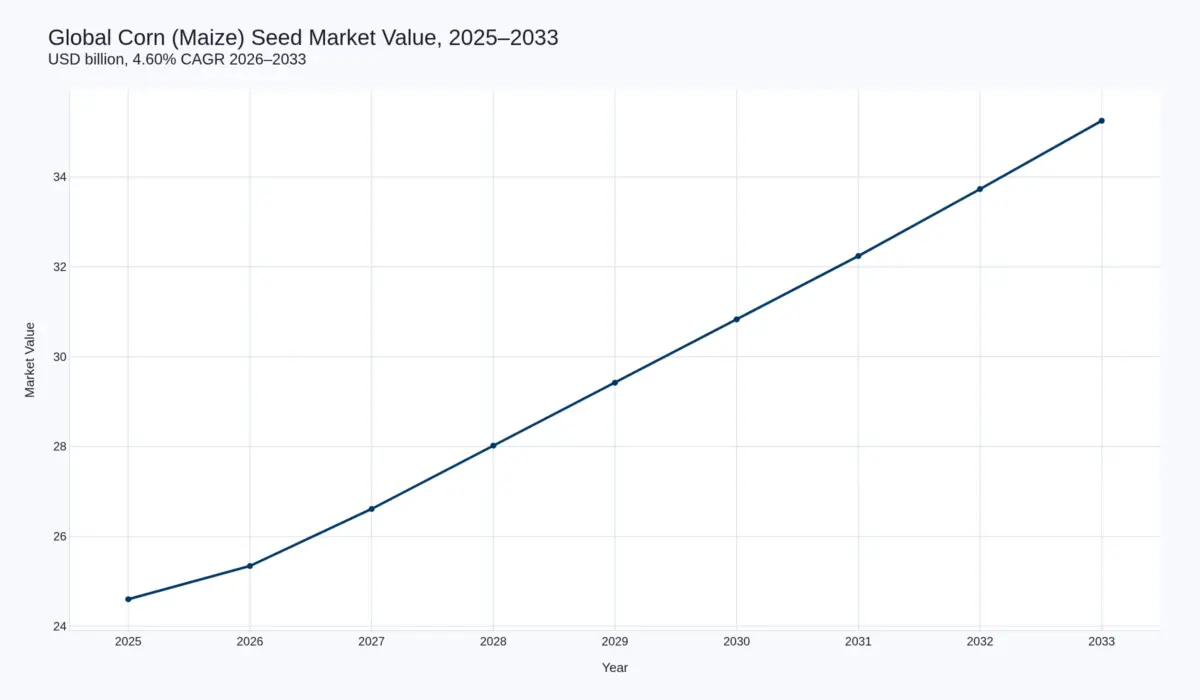
Corn is the largest seed market on earth and the most mature. Maize is grown on roughly 209 million hectares across at least 165 countries; it is hybrid on essentially every commercially farmed hectare in the Americas, Europe and China; and it has carried transgenic traits commercially for three decades. There is almost no conversion left to model, which is why the defensible number for this market sits below the industry conversation. We size the global corn seed market at USD 24.60 billion in 2025, rising to USD 35.25 billion by 2033 — a 4.60% CAGR. That base year is 31.4% of the USD 78.40 billion global seed market our seed report establishes for the same year, making corn comfortably the largest single crop in the seed industry.
The growth does not come from seed. Volume moves at 1.1% a year; nearly four-fifths of the forecast is price and technology — the same hectare, carrying a more expensive genetics package, bought by a grower earning less per acre than at any point in the past five years.
That is the tension at the centre of this report. On USDA Economic Research Service data the average United States corn acre returned a net value of production of minus USD 118.08 after total costs in 2025, with seed accounting for USD 111.33 of the cost of every planted acre on the most recent ERS estimate. In the same season Bayer's corn seed and traits business grew 13% on an adjusted basis to EUR 7,149 million, and Corteva's corn seed sales rose from USD 6,496 million to USD 7,002 million. The most squeezed customer in world agriculture is paying more per bag than ever and doing so rationally: land, fertiliser and machinery are fixed or sunk by the time planting starts, and the seed is the one line on the field that reliably returns more than it costs.
The market at a glance
| Indicator | 2025 / period |
|---|---|
| Global market value, 2025 | USD 24.60 billion |
| Forecast value, 2033 | USD 35.25 billion |
| CAGR, 2026–2033 | 4.60% |
| Share of global seed value, 2025 | 31.4% |
| Seed volume, 2025 | 4.30 million tonnes (1.11% CAGR to 2033) |
| Value per hectare, 2025 → 2033 | USD 117 → USD 163 |
| Largest segment | GM-stacked hybrid maize, 50.2% of 2025 value |
| Fastest-growing segment | Value-added & specialty corn, 6.2% CAGR |
| Largest region | North America, 45.8% (USD 11.27 billion) |
| Largest single country | United States, USD 11.00 billion, 44.7% of global value |
| Fastest-growing region | Middle East & Africa, 5.9% CAGR |
| Royalty share of a US seed bag | ~70%, against 42% five years earlier |
| Global maize area, 2025 | ~209 million hectares |
| Tier-1 suppliers | 4 (Bayer, Vylor, Syngenta, Limagrain) |
Market size and forecast
The path is uneven because the near term is squeezed and the long term is not. We model 3.0% growth in 2026 — the softest year in the window — on a 3.45 million acre cut in United States plantings, corn prices that leave the average American acre below breakeven, and a Chinese seed market where value per hectare is a fraction of the American level. Growth then rebuilds through 2028 as area stabilises, the next trait generation is priced in, and China's GM programme reaches scale, before settling at a sustainable 4.5–4.6% in the final years, which is roughly the rate at which genetic gain and technology can raise seed value per hectare in a crop that is not adding land.
| Year | Value (USD billion) | Growth |
|---|---|---|
| 2025 | 24.60 | — |
| 2026 | 25.34 | 3.0% |
| 2027 | 26.61 | 5.0% |
| 2028 | 28.02 | 5.3% |
| 2029 | 29.42 | 5.0% |
| 2030 | 30.83 | 4.8% |
| 2031 | 32.24 | 4.6% |
| 2032 | 33.73 | 4.6% |
| 2033 | 35.25 | 4.5% |
Decomposed, the arithmetic is unusually clean. Volume grows from 4.30 to 4.70 million tonnes of seed — global maize area expanding less than half a percent a year while seed rate per hectare drifts down under precision planting and better establishment. Value per tonne of seed rises from USD 5,721 to about USD 7,500. Value per hectare of maize rises from USD 117 to USD 163. Volume contributes 24% of the growth; price and technology contribute 76%. Any forecast of this market that is built on area is a forecast of the wrong thing.
Three Structural Shifts Defining 2026–2033
1. The seed bag became a royalty instrument
In testimony before the United States Senate Judiciary Committee in October 2025, an industry witness stated that the share of a seed bag's cost attributable to royalties had risen from 42% five years earlier to 70% today. That single number reframes what this market is. It is no longer primarily a manufacturing and distribution business that carries some licensed genetics; it is a licensing business that happens to ship seed. Bayer's 2025 corn growth was lifted by incremental licensing revenue following the resolution of its disputes with Corteva, and Corteva's own price/mix gain of 3% was described as execution of a price-for-value strategy on new technology rather than a volume achievement.
The consequence for the forecast is that corn seed value now moves with the size of the trait royalty pool rather than with the price of conditioning, bagging and freight. It also explains the market's most counter-intuitive behaviour: value rises fastest in exactly the years when the grower's margin is worst, because the technology is what the grower is buying to escape that margin.
2. China's GM maize went from pilot to national programme in three seasons
China planted 3.79 million hectares of genetically engineered corn in 2026, with 68,700 hectares of GE soybean, according to the Ministry of Agriculture and Rural Affairs as reported by USDA's Foreign Agricultural Service. Against a national corn area of roughly 43 million hectares, that is penetration approaching 9% — from a standing start. The variety pipeline has been approved in four batches since the channel opened in December 2023: 37 corn varieties in announcement 732, 27 in 830, 96 in 947 and 59 in 1072 in October 2026, for 219 approved GE corn varieties in total, plus 20 soybean varieties. Forty GE corn events and nine gene-edited corn events hold biosafety certificates for production use.
Two structural details matter more than the headline. First, all 219 varieties rest on just 13 transformation events, so the Chinese market is a small number of trait owners licensing into a very large number of breeders — Beijing Dabeinong's events sit inside 133 of the 219, or 60.7% of approvals. Second, the geography is moving from the north-east spring belt into the Huang-Huai-Hai summer belt, and the approval list is tilting towards companies that are simultaneously production bases and seed producers in Gansu, the country's core maize seed multiplication region. This is the only large untapped conversion in the world market, and it is being built as a domestic supply chain, at domestic price points.
3. Area stopped growing, so yield became the only lever
United States producers intend to plant 95.3 million acres of corn in 2026, down 3% or 3.45 million acres from 98.79 million in 2025, with intended area down or unchanged in 37 of 48 estimating states. Global harvested area has held near 209 million hectares for several seasons. Meanwhile China's corn imports fell by roughly 90% in two years, which removes the safety valve that previously allowed Chinese feed demand to be met without Chinese yield. In Brazil, 2025/26 corn area rose 3.5% and the safrinha crop reached 17.81 million hectares — but that growth came largely at the expense of a second soybean crop in a rotation, not from new land.
With area flat, national supply security depends entirely on genetic gain: plants per hectare, uniformity, stay-green under stress, and root architecture. That is a favourable backdrop for seed pricing and an unfavourable one for seed volume, which is exactly the divergence embedded in this forecast.
Market drivers
Feed and fuel demand, now domestic in China. Corn's end uses are structural: livestock feed, ethanol and starch. Global maize production is around 1.25 billion tonnes on FAO data, and the marginal tonne increasingly has to be grown where it is eaten. The collapse in Chinese imports converts a trade flow into a yield requirement, and yield requirements are met by buying better seed.
Trait stacking and next-generation events. Above-ground and below-ground insect control, multiple herbicide tolerances and drought tolerance are now sold as a single package, which raises the value of the bag faster than any single trait could. The 2026–2027 window adds out-licensed stacked technology to third parties in the United States following the Bayer–Corteva resolutions, which widens the pool of growers who can buy an elite stack inside a non-tier-1 brand.
Seed rate and plant population. Precision planting, variable-rate seeding and better singulation let growers push plant populations on the best ground and pull back on the poor ground. This raises seed value per hectare even as it trims total seed volume across the estate — the mechanism by which a flat area market still grows in revenue.
Grower economics that favour genetics over chemistry. Where a corn acre is below breakeven, the response is not to skip the seed; it is to skip the discretionary pass, the late fungicide, the extra nitrogen split. Bayer's own 2025 mix showed corn seed and traits up 13% while insecticides fell 12% and fungicides 5%. The hierarchy of what a squeezed grower protects is visible in those three numbers.
Value-added and specialty corn. Waxy, white, high-oil, high-starch and silage hybrids, and seed-production-grade lines, carry premiums that are contractual rather than commodity-linked. This is the fastest-growing positioning in the market at 6.2% and it is the only part of the corn seed business where a mid-tier breeder can earn tier-1 margins.
Segmentation
| Segment | Share of 2025 value | USD billion | CAGR 2026–2033 |
|---|---|---|---|
| GM-stacked hybrid maize | 50.2% | 12.34 | 5.6% |
| Conventional (non-GM) hybrid maize | 36.7% | 9.04 | 3.9% |
| Open-pollinated & low-price local seed | 13.1% | 3.22 | 3.0% |
| Mainstream hybrids (by positioning) | 88.0% | 21.65 | 4.4% |
| Value-added & specialty corn | 12.0% | 2.95 | 6.2% |
The technology split reconciles to the cluster. Our hybrid seed report establishes hybrid maize germplasm at USD 16.50 billion net of separately invoiced trait fees, of which the GM-bearing portfolio accounts for USD 7.46 billion. Adding the maize trait and technology fees that the grower actually pays inside the bag gives GM-stacked hybrid maize at USD 12.34 billion, or 50.2% of this market — and that figure reconciles exactly to the 47.2% maize share of the USD 26.15 billion GM seed market. Conventional hybrids hold USD 9.04 billion — a share that is falling, but slowly, because Europe, most of Africa and much of South Asia cannot buy the GM stack at any price. Open-pollinated and low-price local seed remains USD 3.22 billion, concentrated in Sub-Saharan Africa and parts of South Asia, where a bag costs a tenth of an American bag and the relevant comparison is farm-saved seed, not a competitor's hybrid.
Regional analysis
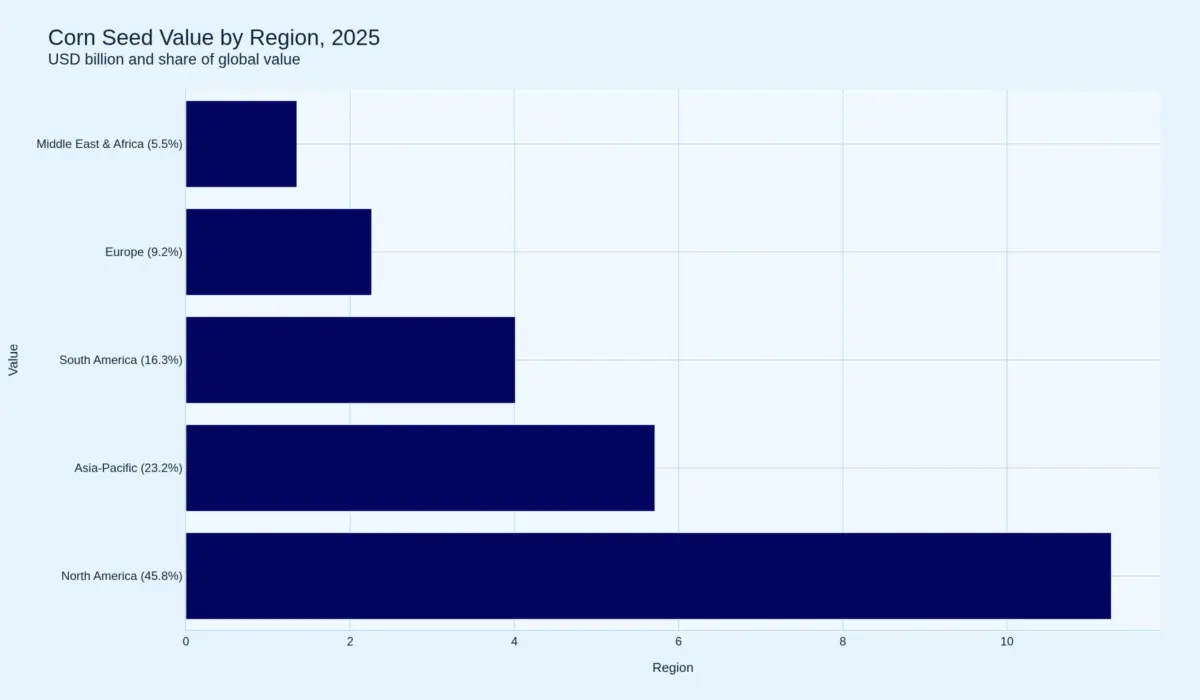
North America is USD 11.27 billion, or 45.8% of the world market, and the United States alone is USD 11.00 billion — 44.7%. That figure is arithmetic rather than assertion: at USD 111.33 of seed cost per planted acre — the most recent USDA ERS estimate, for 2024 — across 98.79 million planted acres in 2025, American growers spent on the order of USD 11 billion on corn seed. It is the most concentrated value pool in any agricultural input market on earth, and the most exposed to a single commodity price cycle. The region grows at 4.25%, below the global average, because its area has peaked and its technology adoption is already near ceiling.
Asia-Pacific is USD 5.71 billion (23.2%) and grows at 5.35%. China is around USD 4.30 billion of it — a market with 45 million hectares and an average yield of roughly 6.7 tonnes per hectare against an American 11.7, which is the gap the GM programme exists to close. India plants 14 million hectares at 3.82 tonnes per hectare, the lowest yield of any major producer, and remains the largest hybrid-conversion opportunity outside China, on a value pool that is a fraction of the American or Brazilian market because the seed price per hectare is a fraction of either. Indonesia, Vietnam, the Philippines and Pakistan add tropical hybrid volume.
South America is USD 4.01 billion (16.3%), growing at 4.65%, with Brazil at roughly USD 2.8 billion on 23 million hectares and Argentina at roughly USD 0.8 billion on 8 million. This is the most commercially aggressive region in the market: Syngenta's Brazilian seed sales rose 17% in 2025 as it gained share in both the summer and safrinha corn markets, and Corteva cited Brazil share gains alongside North America as the driver of its seed volume growth. Brazil is also where technology fees are collected most efficiently, which makes it the best laboratory for what a mature royalty regime looks like.
Europe is USD 2.26 billion (9.2%) and the slowest-growing region at 3.80%. Area is falling, the GM stack is unavailable for cultivation, and the entire value proposition is conventional breeding quality plus a regulatory calendar that will not admit gene-edited maize before 2028 at the earliest. It is nonetheless the highest-price-per-hectare non-GM market in the world, and the reason KWS, Limagrain and Syngenta keep investing in European maize germplasm.
Middle East & Africa is USD 1.35 billion (5.5%) and the fastest-growing at 5.90%, from the lowest base. Nigeria, Ethiopia and South Africa dominate; South Africa is a fully commercial, GM-adopting market, while the rest of the continent is a conversion story measured in purchased-seed penetration rather than technology.
Competitive landscape
| Company | Corn seed position, FY2025 |
|---|---|
| Bayer CropScience | Corn seed & traits EUR 7,149m, +13% adjusted; Crop Science EUR 21,622m; EBITDA before special items EUR 4,188m at a 19.4% margin |
| Vylor (Corteva seed & genetics) | Corn seed USD 7,002m, up from USD 6,496m; total seed USD 9,898m; seed operating EBITDA USD 2,636m, +19% |
| Syngenta Group | Seeds USD 4.8bn, +2%; Brazil seed sales +17%, LATAM +10%, China +6%, North America −12% on restructuring |
| Limagrain / Vilmorin | Largest independent European maize breeder; field seeds the core of a EUR 3bn-plus group |
| KWS | Maize a growth line inside a EUR 1,676.6m group; sugar beet funds maize and cereal breeding expansion |
| Chinese domestic tier | 219 approved GE corn varieties on 13 events; Dabeinong traits in 60.7% of them; Longping, Denghai, China Seed Group |
The concentration in this market is extreme and measurable. Bayer and Corteva account for more than half of United States corn, soybean and cotton seed sales on USDA ERS data; the four largest corn seed sellers hold 83.4% of the American market, with Corteva at 38.3%, Bayer at 33.3%, AgReliant at 6.8% and Syngenta at 5.0%. Globally we estimate Bayer at roughly 32% of corn seed value and Vylor at 28.5% — a combined 60%, with Syngenta at 7.7%, Limagrain at 3.0%, KWS at 2.4%, Chinese domestic breeders around 17.5% and everyone else splitting the remaining 8.9%.
The decisive competitive event of the forecast window is structural rather than agronomic. Vylor, the seed and genetics business Corteva separated on 1 October 2026, begins life holding the single largest corn germplasm library and a USD 7 billion corn franchise, valued on breeding returns rather than on a blended chemistry multiple. Corn is not a side bet for Vylor; it is the balance sheet. Watch whether a pure-play corn and soybean genetics company prices its technology more aggressively than a division inside a diversified group — the royalty share of a bag is already at 70%, and there is no obvious ceiling on it while growers have no substitute.
Strategic outlook
Defend the American value pool before chasing volume elsewhere. Forty-five per cent of world corn seed value sits in one country in the middle of a margin cycle. The right reading of the 2026 plantings cut is not that demand is deteriorating but that the market is being asked to pay more for less area, which is only sustainable if the technology keeps delivering. A single season in which a new trait underperforms on farm would be more damaging to this market's value than a three million acre reduction in plantings.
Treat China as a volume market with a regulated price. The conversion is real and large, but it arrives at Chinese seed prices, on domestic events, through domestic breeders. The value per hectare captured will be a fraction of the American figure. A participant who models China as a second United States will overpay for the position; a participant who models it as a profitable, politically-priced, volume business will not.
Seed production capacity is the least contestable asset in the chain. Hybrid maize multiplication runs at roughly one hectare of seed production to sixty or seventy hectares of commercial crop. As the Chinese programme scales and specialty corn grows, demand for isolation-grade multiplication land in Gansu, Xinjiang, the Brazilian Cerrado and the American Corn Belt rises faster than the land does. Owning or contracting that capacity is a strategic position, not a procurement decision.
The specialty portfolio is where a mid-tier breeder can still win. A waxy or white corn hybrid sold on contract to a processor is not competing with Bayer's flagship on yield; it is competing on specification, and the switching cost sits with the processor. Our 6.2% growth rate for this segment is the highest in the report and the least dependent on any single commodity price.
What we are watching
- Whether the 2026 United States plantings cut is a one-year rotation response to soybean economics or the start of a lower corn area plateau.
- China's 2027 GE corn area against the 3.79 million hectares of 2026, and whether the Huang-Huai-Hai summer belt converts faster than the north-east spring belt did.
- The royalty share of the American seed bag — if it moves beyond the mid-70s, the price-for-value argument is exhausted and the next leg has to come from genetic gain.
- Vylor's first full year as an independent company, and whether separation changes corn pricing behaviour in North America and Brazil.
- Brazilian safrinha area against soybean area, because the two compete for the same second-season window.
- The EU implementing rules under Regulation (EU) 2026/1388, which determine whether gene-edited maize reaches European fields this decade at all.
Conclusion
Corn seed is the closest thing agriculture has to a mature technology market: complete hybridisation, near-complete trait adoption where permitted, flat area and a customer in the worst margin cycle in five years. It is also a USD 24.60 billion market growing at 4.60% with three-quarters of that growth coming from technology value rather than volume. The two things an investor should hold in mind are the concentration — 45% of value in one country, 60% in two companies — and the fact that the price is now set by a royalty pool rather than by a seed plant. Everything in the forecast that can go wrong goes wrong through those two channels.
Further reading: Rice and Corn Are Sown on Almost the Same Area and Corn's Seed Market Is Nearly Four Times the Size — why 210 million hectares of maize produce a seed market 3.87 times the size of rice's 172 million, and what USD 117.1 of seed value per hectare does to that gap.
Further reading: Corn Seed Is 24 Per Cent Volume and 76 Per Cent Price — the decomposition of this report's 4.60% against 1.11% volume growth, the USD 275 a hectare the American grower pays against a USD 117 global average, and the three things that could break the price line.
Table of Contents
- Executive Summary
- Research Methodology & Scope
- Market Overview & Definitions
- 3.1 Why Maize Is Different From Every Other Seed Crop
- 3.2 Hybrid, GM and Open-Pollinated Maize: A Working Boundary
- 3.3 Segmentation Framework
- 3.4 Forecasting Assumptions (2026–2033)
- Market Dynamics
- 4.1 Market Drivers
- 4.1.1 Feed and Ethanol Demand for Grain
- 4.1.2 China’s Domestic Yield Imperative
- 4.1.3 Trait Stacking and the Royalty Share of a Bag
- 4.1.4 Precision Planting and Seed-Rate Economics
- 4.1.5 Value-Added and Specialty Corn
- 4.2 Market Restraints
- 4.2.1 Grower Margins and Trade-Down
- 4.2.2 Flat Area in the Mature Markets
- 4.2.3 Generic Germplasm and Trait Expiry
- 4.3 Market Opportunities
- 4.1 Market Drivers
- 5. Global Corn (Maize) Seed Market Size & Forecast (USD Million), 2026–2033
- 5.1 Market Revenue Analysis
- 5.2 CAGR Analysis
- 5.3 Demand-Supply Trends
- 5.4 Pricing Analysis
- 5.5 Investment Trends
- 5.6 Future Market Outlook
- 6. Market Segmentation Analysis (USD Million), 2026–2033
- 6.1 By Technology Class
- 6.1.1 GM-Stacked Hybrid Maize (Largest Segment)
- 6.1.2 Conventional (Non-GM) Hybrid Maize
- 6.1.3 Open-Pollinated & Low-Price Local Seed
- 6.2 By Product Positioning
- 6.2.1 Mainstream Hybrids
- 6.2.2 Value-Added & Specialty Corn (Fastest-Growing)
- 6.3 By Distribution Channel
- 6.3.1 Distributor & Dealer Network
- 6.3.2 Direct, Large-Grower & Contract Multiplication
- 6.3.3 Institutional, Government & Development Programmes
- 6.1 By Technology Class
- 7. Regional Market Analysis
- 7.1 North America (Largest Market)
- 7.2 Asia-Pacific
- 7.3 South America
- 7.4 Europe
- 7.5 Middle East & Africa (Fastest-Growing Market)
- 8. Competitive Landscape
- 8.1 Market Share Analysis
- 8.2 Competitive Benchmarking
- 8.3 Strategic Developments
- 8.4 Germplasm Depth & Breeding Pipeline
- 8.5 Licensing, Royalty Structures & Seed Production Capacity
- 9. Company Profiles
- 9.1 Bayer CropScience AG
- 9.2 Vylor (Corteva Seed & Genetics)
- 9.3 Syngenta Group
- 9.4 Limagrain / Vilmorin & Cie
- 9.5 KWS SAAT SE & Co. KGaA
- 9.6 Beijing Dabeinong Technology Group
- 9.7 Yuan Longping High-Tech Agriculture
- 9.8 Shandong Denghai Seeds
- 9.9 AgReliant Genetics
- 9.10 Stine Seed and the United States Independent Tier
- 10. Strategic Intelligence & Phoenix AI Insights
- 10.1 Corn Seed Demand Forecast Model
- 10.2 Trait Royalty Pool and Value Split Analysis
- 10.3 China GM Maize Conversion Tracker
- 10.4 Germplasm and Gene-Editing Patent Assessment
- 10.5 Automated Porter’s Five Forces Analysis
- 11. Future Outlook & Strategic Recommendations
- 11.1 Defending the United States Value Pool
- 11.2 Building a China Position That Survives Price Regulation
- 11.3 Seed Production Capacity as a Strategic Asset
- 11.4 Converting Specialty Corn from Niche to Portfolio
- 11.5 Long-Term Market Outlook (2033+)
- 12. Appendix
- 13. About Phoenix Market Research
- 14. Disclaimer
Competitive Landscape
Competitive Landscape
Overview
Corn seed is the most concentrated input market in agriculture, and the concentration is stable rather than contested. Two platforms hold roughly 60% of global value, four companies hold 83.4% of the United States market, and the rank order has not changed materially in a decade. What has changed is the mechanism: competition now runs through the size and structure of the trait royalty rather than through variety performance alone, because a bag that is 70% royalty is a licensing negotiation with seed attached.
We estimate the 2025 global split as Bayer at approximately 32%, Vylor at 28.5%, Syngenta at 7.7%, Limagrain at 3.0%, KWS at 2.4%, Chinese domestic breeders around 17.5% collectively, and the remaining 8.9% spread across Brazilian, Argentine, Indian, European and African independents. In the United States specifically, Corteva holds 38.3%, Bayer 33.3%, AgReliant 6.8% and Syngenta 5.0% on USDA Economic Research Service data, with Bayer and Corteva together accounting for more than half of American corn, soybean and cotton seed sales.
Bayer: the broadest franchise
Bayer’s corn seed and traits business generated EUR 7,149 million in 2025, up 13% on an adjusted basis and 9.0% as reported, inside a Crop Science division of EUR 21,622 million that held EBITDA before special items at EUR 4,188 million on a 19.4% margin despite a EUR 208 million negative currency effect. Management attributed the corn growth to three things: historically high North American corn acreage, strong global performance of the corn portfolio, and incremental licensing revenue released by the resolution of its disputes with Corteva in the fourth quarter. That last component matters for how the market should be read — part of the 2025 growth in corn seed was not seed sold but litigation settled.
Bayer’s portfolio is the broadest in the industry: corn at EUR 7,149 million, soybean at EUR 2,214 million, cotton at EUR 442 million and vegetables at EUR 772 million, sold through DEKALB and the consolidated Channel regional brands. Its exposure is also the clearest illustration of trait regulatory risk in the sector: the 2025 dicamba label vacatur in the United States pulled soybean seed and traits down 8% and cotton seed down 23% in a single season, on a court decision rather than a regulator’s determination.
Vylor: the pure play, and the market’s new reference point
Corteva’s corn seed sales reached USD 7,002 million in 2025, up from USD 6,496 million, inside total seed sales of USD 9,898 million. Seed operating EBITDA rose 19% to USD 2,636 million, with the segment margin up roughly 340 basis points, on price/mix of plus 3% and volume of plus 2%, the volume driven by increased corn area and share gains in North America and Brazil. North America seed alone was USD 6,271 million. Full-year 2026 guidance is for operating EBITDA of USD 4.0–4.2 billion.
The structural event is the separation of the seed and genetics business as Vylor on 1 October 2026. Corn is not a division inside Vylor; it is the balance sheet. Two consequences follow for competitors. A pure-play genetics company has no chemistry cash flow to absorb a bad seed season, which argues for firmer pricing and less discounting in a downturn. And it has a currency — its own equity — with which to acquire germplasm, which makes it the most likely buyer of every mid-tier maize breeder with a defensible library.
Syngenta: scale without a complete maize stack
Syngenta’s seeds business was USD 4.8 billion in 2025, up 2%, inside a group that lifted EBITDA 13% to USD 4.4 billion and expanded its margin 1.9 percentage points to 15.4%. The regional pattern is the most informative in the industry: Brazil seed sales up 17%, Latin America up 10%, China up 6%, Europe up 1%, Asia-Pacific/Middle East/Africa down 1%, and North America down 12% on restructuring. It gained share in both the Brazilian summer and safrinha corn markets, launched two new corn hybrids there, saw Argentine corn rebound strongly, and acquired a Chinese business specifically to strengthen its summer corn portfolio.
Syngenta’s position is best characterised as scale without a complete proprietary maize trait stack. That makes it simultaneously the most active licensor of third-party technology and the most exposed to a royalty regime set by others — which is precisely why the widening of stacked-trait out-licensing after the Bayer–Corteva resolutions matters more to Syngenta than to either of the two principals.
The regional specialists
Limagrain, through Vilmorin, is the largest independent European maize breeder and the clearest case of a family-controlled business holding a global franchise in a crop where it does not have a global share; its field seeds position in France, Germany and Central Europe is built on locally adapted germplasm rather than on traits. KWS brings maize inside a group that earned a 42.1% EBIT margin in sugar beet and is deliberately trading current segment profit for breeding expansion. AgReliant, at 6.8% of the United States market through LG Seeds, is the largest genuinely independent American platform and the best evidence that a licensing-based business model can hold share against two integrated giants. Below them, Stine Seed has built a substantial United States position on genetics licensed to others rather than on proprietary events — a model that becomes more viable as first-generation events come off patent.
The Chinese domestic tier
China is the one market where the competitive structure is being rebuilt from scratch rather than inherited. Across four approval batches since December 2023, 239 genetically engineered varieties have been approved by 95 applicant entities: 219 corn and 20 soybean. The corn approvals rest on just 13 transformation events, and Beijing Dabeinong’s traits sit inside 133 of the 219 — 60.7% of the national list. The first tier by approval count is Huannong Weiye with 13, Fengdu Gaoke and Lianchuang with 12 each, Hongxiang with 10 and China Seed Group with 10; the Beijing Academy of Agriculture and Forestry’s maize institute holds 8, Shandong Denghai 7 and Dabeinong’s own varieties 7.
This is a licensing market wearing a breeding market’s clothes, exactly as in the United States. The difference is that in China the trait owner is domestic and the state has a direct interest in who wins. Expect consolidation: 95 applicants is far more than a national maize seed market of roughly USD 4.3 billion can support once the trait layer is concentrated in a handful of events.
| Competitor | Estimated 2025 share of global corn seed value | Basis of position |
|---|---|---|
| Bayer CropScience | ~32% | Broadest germplasm plus DEKALB/Channel distribution; corn EUR 7,149m |
| Vylor (Corteva) | ~28.5% | Largest corn germplasm library; corn USD 7,002m; pure-play since October 2026 |
| Syngenta Group | ~7.7% | Brazil and Asia strength; seeds USD 4.8bn; licences key traits |
| Limagrain / Vilmorin | ~3.0% | European conventional maize germplasm |
| KWS | ~2.4% | European and Central European maize; sugar beet funds expansion |
| Chinese domestic tier | ~17.5% (collective) | 219 GE corn varieties on 13 events; domestic trait ownership |
| Others | ~8.9% | AgReliant, Stine, Brazilian, Argentine, Indian and African independents |
Strategic developments
Four developments define the competitive period. The Vylor separation creates the first pure-play seed and genetics company of scale, and changes how corn assets are valued. The Bayer–Corteva resolutions settled outstanding litigation and released incremental licensing income in the fourth quarter of 2025, with broader out-licensing of stacked technology to third-party brands following from 2026 and 2027 — a quiet widening of who can sell an elite stack. China’s normalisation of GE maize approval turned a pilot into a standing regulatory channel, with announcement 1072 in October 2026 the first batch issued after nationwide commercial planting was authorised. And seed production capacity has become a competitive variable: China’s approval list increasingly favours companies that hold both traits and Gansu multiplication capacity, while in the United States and Brazil the constraint on launching a new hybrid is conditioning plant throughput, not breeding.
Strategic implications
Three implications for competitive strategy. First, the royalty pool rather than the seed plant is where margin is made, so a competitor without proprietary events is structurally a licensee and should be valued accordingly. Second, the mid-tier’s defensible ground is locally adapted germplasm and specialty specification, not yield on the main crop — Limagrain in Europe and the specialty breeders demonstrate this, and it is the only route to tier-1 margins without a trait stack. Third, China will be won through domestic partnerships and production bases, not through imported technology; every global participant is currently building its Chinese maize position through a local acquisition or a local licence, and the ones that do not will be spectators to the largest conversion in the market.
Forward outlook
Through 2033 we expect the top two to hold their combined share within a few points, Syngenta to remain the most acquisitive mid-cap in maize as it fills the trait gap, and the Chinese domestic tier to consolidate from 95 applicants to a much smaller number of national brands clustered around a handful of events. The genuinely open question is what a pure-play Vylor does to pricing discipline in North America and Brazil in its first full independent year — that, more than any breeding announcement, will set the competitive tone of the forecast window.
Value Chain
Corn Seed Value Chain Analysis
Overview
Maize seed has the most industrialised value chain in agriculture and the shortest distance between breeder and grower of any major crop. Two properties drive everything else. First, hybrid maize seed is produced by crossing two inbred parents, so the product has to be made twice and the parent lines are the irreplaceable asset. Second, maize is planted at a seed rate of roughly 15–30 kilograms per hectare, some two orders of magnitude below wheat or rice, which makes seed logistics cheap per hectare of crop and makes the genetics the overwhelming component of the price. A bag of maize seed costs the grower more than twenty times its weight in grain, and the chain exists to justify that.
Six layers matter: germplasm and breeding; parent seed multiplication; commercial seed production on contract; conditioning, treatment and testing; licensing and trait royalty administration; and distribution to the farm. The fifth layer is the one that has grown fastest and is the least understood.
Breeding and germplasm: the concentration engine
Value is created in the breeding nursery and in the elite inbred library behind it. Maize breeding is uniquely amenable to scale because the crop is naturally cross-pollinated, easy to self, and produces large quantities of seed per crossing — which is why maize programmes consolidated into a handful of platforms decades before any other crop did. The four largest corn seed sellers hold 83.4% of the United States market and Bayer and Corteva hold more than half of American corn, soybean and cotton seed sales on USDA ERS data.
What makes the position defensible is not a patent on a plant but the depth of the inbred library and the recombination history embedded in it. An elite inbred that combines well across twenty environments took a decade to build and cannot be reconstructed from a competitor’s commercial hybrid, because the commercial hybrid is the cross, not the parent. This is why germplasm acquisitions in maize are priced per unit of library depth rather than per dollar of revenue, and why the mid-tier independents — Stine in the United States, AgReliant, the European and Brazilian family breeders — survive at all: they hold locally adapted material that a global programme cannot synthesise quickly.
Parent seed and commercial production: the land-bound constraint
Between the nursery and the grower sit two multiplication steps. Inbred parent seed is multiplied under strict isolation with rouging and purity testing. Commercial hybrid seed is then produced by contract growers who plant alternating strips of the two parents and detassel the female, or rely on a male-sterility system, to force the cross. The ratio is roughly one hectare of seed production to sixty or seventy hectares of commercial crop — an extraordinarily efficient multiplier, and the reason maize seed can be produced on a few million hectares worldwide and sold onto two hundred million.
Efficiency does not mean slack. Seed production is concentrated in geographies with reliable irrigation, low disease pressure and a dry harvest window: the American Corn Belt, Gansu and Xinjiang in China, the Brazilian Cerrado, Thailand, Indonesia, Chile and southern Europe. A heat event at flowering removes a season of supply rather than reducing it, because hybrid seed cannot be substituted from another year at short notice. Chinese policy has made this explicit by approving GE varieties preferentially for companies that are simultaneously production bases in Gansu — the industry is deliberately co-locating trait ownership with multiplication capacity, which is the clearest signal in the market that seed production is treated as strategic infrastructure rather than as procurement.
Conditioning, treatment and testing
Harvested seed is dried, sized, graded, treated and tested for germination and genetic purity before it is bagged. This layer is capital-intensive at plant level and increasingly where the differentiation sits, because treatment is now a technology sale in its own right: insecticide and fungicide seed treatments, biologicals and inoculants travel with most premium lots, and the seed-applied package is analysed separately in our seed treatment report. Conditioning capacity is also the practical bottleneck on launching a new hybrid at scale: a variety can be approved in a season and still take two more to reach national distribution through a limited number of plants sized for a twelve-week delivery window.
Licensing and the royalty layer
The layer that has changed most is the least physical. Trait technology in maize is licensed, not simply sold, and the royalty is collected either inside the bag price or as a separate technology fee at the point of sale or delivery. In the United States the royalty component of a seed bag’s cost has risen from 42% five years ago to about 70% today, on testimony given to the Senate Judiciary Committee in October 2025. That shift has two consequences. It moves the economics of the market from manufacturing to intellectual property, so gross margins track the size of the royalty pool rather than plant utilisation. And it puts the licensor and the licensee into permanent negotiation — the recent Bayer–Corteva resolutions, the incremental licensing income they released in the fourth quarter of 2025, and the widening of stacked-trait out-licensing to third-party brands from 2026–2027 are all consequences of that negotiation rather than of agronomy.
Distribution and the last mile
Distribution carries 66.0% of market value at USD 16.24 billion, split between distributor and dealer networks, direct large-grower and contract multiplication relationships at 23.0% (USD 5.66 billion), and institutional or government programmes at 11.0% (USD 2.71 billion). The channel matters more in maize than in any other seed crop because the purchase decision is made once, in a narrow window, on a whole-farm basis, and is increasingly bundled with agronomy advice, financing and precision-planting services by the retailer or cooperative. In the United States the seed decision is often taken in the autumn before planting, with early-pay discounts, which gives the dealer real influence over variety choice and gives the breeder a working-capital problem. In China and India, public procurement, demonstration plots and county-level extension still move adoption more than any single dealer’s recommendation.
| Layer | Role | Value capture |
|---|---|---|
| Germplasm and breeding | Elite inbred libraries, events and edits | Highest and most defensible; plant variety rights plus patents |
| Parent seed | Inbred multiplication under isolation | Internal cost centre; the real capacity constraint |
| Contract production | Commercial hybrid seed on grower land | Thin margin for the grower; seasonal risk transferred upstream |
| Conditioning and treatment | Drying, sizing, treating, purity testing | Capital-intensive, moderate margin, high switching cost |
| Licensing and royalties | Trait and technology fees | Fastest-growing layer; now around 70% of a US bag |
| Distribution | Agronomy, finance, precision planting | Thin margin, decisive influence on variety choice |
Strategic implications
Three implications follow. The place to own capability is germplasm and the events stacked into it, because that is where the royalty pool is generated and where the 70% share of the bag is earned. Seed production capacity should be treated as a strategic asset rather than a purchased service, since it is land-bound, geographies are fixed, and Chinese policy has already begun to bind trait approval to production bases. And the channel is a financing business as much as a sales one: in a market where the grower’s average acre lost money in 2025, whoever carries the seed decision through the winter carries the relationship.
Forward outlook
Through 2033 we expect the breeding and licensing layers to concentrate further while production stays regional and fragmented. The structural change to watch is vertical integration downwards by the mid-tier: independent breeders buying or contracting dedicated conditioning and multiplication capacity to protect supply of the specialty and locally adapted hybrids their margins depend on. In China, expect the first genuinely national maize seed brands to emerge out of the current 95-company approval list as trait owners consolidate distribution around the events they control.
Investment Activity
Investment Activity
Overview
Capital in corn seed flows into two very different kinds of asset, and the difference explains most of the industry’s financial behaviour. Germplasm investment is patient, largely expensed through research, and returns over a decade or more. Seed production capacity is land-bound, working-capital heavy and built in seasons. A business that underspends on the first loses its price premium within a cycle; a business that misjudges the second writes off inventory in a single year. The pattern of the past two years is that the majors are restructuring so that germplasm value is visible to public markets while simultaneously committing capital to the physical capacity that the next generation of hybrids will require.
We rate investment direction as rising, capital intensity as high, and recent merger and acquisition activity as present and continuing.
The Vylor separation: genetics priced on its own
The most consequential capital event in the market is Corteva’s separation of its seed and genetics business as Vylor, effective 1 October 2026, built on seed sales of USD 9,898 million and corn seed sales of USD 7,002 million. The logic is a valuation argument rather than an operational one: a pure-play genetics business is valued on breeding returns and germplasm depth, while the same assets inside a combined chemistry-and-seed company are valued on a blended multiple that reflects the slower growth of crop protection.
Three things follow for how corn assets are priced. A pure play has no chemistry cash flow to absorb a poor seed season, which argues for firmer pricing and less discounting in a downturn — a behavioural change worth more to the industry’s margin than any single variety launch. A pure play has its own equity as acquisition currency, which makes it the most probable buyer of every mid-tier maize breeder with a defensible library. And a pure play must show breeding returns explicitly, which means the royalty pool and the licensing line will become more visible in disclosure than they have ever been.
The royalty pool as an asset class
The single most important investment fact in this market is that roughly 70% of the cost of a United States seed bag is now royalty, against 42% five years earlier. That converts the industry’s economics from manufacturing to intellectual property: the return on a breeding programme is realised as a licensing stream that costs almost nothing to service, and the capital required to generate it sits in research rather than in plant. It also explains why litigation settlements now register in quarterly revenue — Bayer’s fourth-quarter 2025 corn growth included incremental licensing income released by the resolution of its disputes with Corteva.
For an investor, the corollary is that the value of a corn seed business is increasingly the present value of a royalty stream plus a distribution asset, rather than the present value of a manufacturing margin. That framework makes proprietary events and edited germplasm the only genuinely scarce assets in the chain, and it makes a conditioning plant a low-return asset whose value depends entirely on the traits that pass through it.
Where the physical capital is going
Seed production and conditioning capacity is the largest single category of physical investment and the least discussed. Hybrid maize production runs at roughly one hectare of seed production to sixty or seventy hectares of commercial crop, and the land must be isolated, irrigated and harvested dry. China is investing most aggressively: the approval list increasingly favours companies holding multiplication capacity in Gansu, and the national programme explicitly pairs trait ownership with production bases. In Brazil, capacity investment follows the safrinha crop into the Cerrado. In the United States, conditioning plant throughput rather than breeding is the binding constraint on launching a new hybrid at national scale.
Research infrastructure is the second category, and it is shifting from laboratories to data. Genomic selection, doubled haploids and high-throughput phenotyping have compressed the breeding cycle from roughly ten years towards six, and the constraint on a mid-tier breeder is now access to environments and trial data rather than capital for equipment. That has made local trial networks — European conventional specialists, Brazilian and Indian hybrids houses, Chinese provincial institutes — strategically valuable in a way their balance sheets do not show.
| Investment type | Recent examples | Purpose |
|---|---|---|
| Corporate separation | Vylor spin-off from Corteva, 1 October 2026 | Re-rate genetics separately from chemistry |
| Licensing resolution | Bayer–Corteva settlements, incremental Q4 2025 licensing income | Monetise the royalty pool; widen out-licensing |
| Seed production capacity | Gansu and Xinjiang multiplication; Cerrado expansion; US conditioning | Secure supply for the next hybrid generation |
| Emerging-market acquisition | Syngenta’s Chinese acquisition to strengthen summer corn | Buy local germplasm and distribution rather than build |
| Breeding technology | Genomic selection, doubled haploids, phenotyping at tier-1 and upper mid-tier | Compress cycle time; raise genetic gain per year |
Public-market signals
The listed bellwethers tell a consistent story of corn outperforming the rest of the portfolio. Bayer’s Crop Science held EBITDA before special items at EUR 4,188 million on a 19.4% margin despite a EUR 208 million negative currency effect, with corn seed and traits up 13% adjusted while insecticides fell 12% and fungicides 5%. Corteva’s seed segment lifted operating EBITDA 19% to USD 2,636 million and improved its margin by roughly 340 basis points on price/mix of plus 3%, with 2026 guidance of USD 4.0–4.2 billion. Syngenta lifted group EBITDA 13% to USD 4.4 billion and expanded its margin 1.9 percentage points to 15.4% while selling USD 1 billion of low-margin grain trading revenue. In each case corn seed is the most profitable thing the company sells and the most reliable line of price growth.
Working capital and the seasonal trap
Seed must be produced a season before it is sold, so a business growing at 4.6% a year funds a permanent inventory position equal to roughly one season of sales. The American early-pay system makes this worse: growers are incentivised to commit in autumn for spring delivery, which pulls revenue forward and pushes the financing burden onto the breeder and the dealer. In a market where the grower’s average acre lost USD 118 in 2025, the cost of carrying that receivable is a real and rising charge on the channel, and it is one of the reasons dealer consolidation continues in the Corn Belt.
The valuation question
Seed and genetics assets have traded at a premium to crop protection for most of the past decade, and the Vylor separation is the market’s attempt to crystallise that premium explicitly. The case rests on three properties chemistry does not have: a germplasm position is renewable without a re-registration cycle, the customer repeats the purchase every season by biology rather than by contract, and the price is not exposed to generic erosion in the way an off-patent molecule is — although the expiry of first-generation events is testing the third of those claims directly. The counter-argument is equally clear: breeding returns are slow, seed production is capital-heavy, and the entire value pool is concentrated in a single country in the middle of a margin cycle.
Strategic implications
Three implications for capital allocation. Breeding programmes should be valued on genetic gain per year and elite germplasm depth rather than on the number of varieties launched or the number of events stacked. Seed production capacity should be treated as a strategic asset with a strategic return, because the constraint on scaling the next hybrid or the next Chinese licence is physical throughput rather than breeding. And the consolidation window for mid-tier maize breeders is open now: Vylor has equity to spend, Syngenta has a trait gap to fill, and a germplasm library that would take fifteen years to breed can still be bought at a multiple of revenue rather than of earnings.
Forward outlook
Through 2033 we expect investment to concentrate in three places: seed production and conditioning capacity across Gansu, the Cerrado and the United States Corn Belt; breeding technology infrastructure at tier-1 and upper mid-tier level; and the licensing and royalty administration systems that make an event portfolio collectable across forty jurisdictions. The USD 35.25 billion market of 2033 will be served by a more consolidated, more capital-disciplined and more IP-intensive supplier base than the one serving the market today, with two integrated platforms, one aggressive pure play, and a long tail of regionally adapted specialists whose value rises as their independence becomes rarer.
Technology & Innovation
Technology and Innovation
Overview
The technology frontier in corn seed has not moved in the hybridisation mechanism for seventy years. Maize was the first major crop to be hybridised at scale and it is now effectively 100% hybrid in every commercial geography, so there is no equivalent of hybrid wheat left to open. What has moved, and moved fast, is everything upstream and everything on the seed: the speed of breeding cycles, the precision of selection, the density of trait stacking, the arrival of gene editing, and the plant-level control of where each seed goes in the field.
We rate innovation intensity high, patent activity high and technology maturity mature at the platform level with growth-stage activity in editing and in digital planting. The distinction matters commercially: mature platforms justify stable pricing, while the growth-stage layers are where the next increment of value per hectare is being created — and where a competitor can still take share without a generational germplasm advantage.
The trait layer: stacking, expiry and the post-patent turn
Current commercial maize genetics sells three things in one bag — above-ground insect control, below-ground insect control, and tolerance to one or more herbicides — plus increasingly a drought-tolerance or stay-green component. Stacking is what has driven the value of the bag: each additional event raises the royalty while adding little to the cost of production, which is why the royalty share of a United States seed bag moved from 42% to roughly 70% in five years.
That arithmetic is now meeting a countervailing force. The first generation of maize events is reaching the end of its patent life, and off-patent events commoditise quickly: a generic Bt event licensed to twenty regional brands destroys the premium attached to the original. The strategic response from the majors has been to widen out-licensing of stacked technology to third-party brands from 2026–2027 rather than defend exclusivity — better to take a royalty on a competitor’s bag than to lose the trait value entirely. For the market as a whole this raises measured penetration while compressing price per event, which is exactly why our GM-stacked segment grows at 5.6% rather than at the double-digit rates that the underlying adoption in China would suggest.
Gene editing: the real discontinuity
Gene editing is the only genuinely new technology in the maize pipeline and it is arriving unevenly. China has already granted biosafety certificates for production use to nine gene-edited corn events alongside forty transgenic corn events, and its approval architecture now treats edited traits as a normal channel rather than a special case. The United States imposes no separate pathway where the edit does not involve a plant pest, so edited maize can reach the field on a development timeline measured in years rather than the decade a transgenic event required. Europe is the laggard by statute: the New Genomic Techniques framework in Regulation (EU) 2026/1388 applies from 17 July 2028, and its implementing rules will determine whether edited maize is cultivated in Europe this decade at all.
The commercial significance is disproportionate to the number of events. An edit can improve an existing elite hybrid without the yield drag and regulatory burden of an introduced gene, which means the technology is additive to germplasm value rather than a separate product. That is precisely the kind of technology that raises the price of the bag without raising the cost of seed production.
Breeding speed: the quiet compounding advantage
The least visible innovation is the most economically important. Doubled haploid technology, genomic selection and high-throughput phenotyping have compressed the cycle from a first cross to a commercial hybrid from roughly ten years towards six, and have raised the number of candidates that can be evaluated per season by orders of magnitude. A breeding programme that recycles elite germplasm 40% faster compounds that advantage for as long as it is maintained; over a fifteen-year horizon it is worth more than any single trait.
This is also where the mid-tier can compete. A genomic selection pipeline is now affordable at the scale of a national breeder, and the constraint on breeding is data from environments rather than capital for laboratories. That favours breeders with dense local trial networks — the European conventional specialists, the Brazilian and Indian hybrids houses, and the Chinese provincial institutes.
Planting precision and the seed-rate paradox
Precision planting technology — singulation, downforce control, variable-rate seeding and high-resolution prescriptions — has changed what a seed is worth by changing where it lands. The best ground now carries plant populations that would have been considered reckless a decade ago; the poor ground carries fewer. The net effect on this market is precisely the paradox embedded in our forecast: seed value per hectare rises while total seed volume per hectare falls. A grower buying a variable-rate prescription is buying fewer seeds, placed better, from a more expensive hybrid. Value per hectare in our model rises from USD 117 to USD 163 while volume grows at only 1.1%.
Digital agronomy also shifts the point of sale. Where the prescription, the seed and the financing come from the same retailer, the breeder’s direct relationship with the grower weakens and the channel’s influence over variety choice strengthens — a commercial consequence of a technical change, and one that favours companies with the strongest dealer programmes.
On-seed technology and the integrated lot
Treatment and biologicals have become part of the product rather than an accessory. Fungicidal and insecticidal seed treatments, plus an expanding set of biological inoculants and biostimulants, are applied at conditioning and sold inside the bag. The value is real — early-season pest and disease control on a maize seedling is the highest-return intervention in the crop’s agronomy — but the technology is largely available to all competitors on licence, so it supports price rather than creating differentiation. Our seed treatment report sizes that adjacent market at USD 7.60 billion in 2025.
What technology has not solved
Three constraints remain stubborn. Maize yield in the United States has plateaued at around 11.7 tonnes per hectare, and the industry needs genetic gain of roughly 1.5–2% a year to keep pace with demand. Drought tolerance remains a partial trait rather than a solution, delivering advantage in moderate stress and little in severe stress. And there is still no technology that stabilises seed production itself: a heat event at flowering in a multiplication region removes a season of supply regardless of how good the hybrid is. That last constraint is agronomic, not genetic, and no amount of breeding spend will remove it.
Strategic implications
Three implications follow. Editing is the technology to watch and the one most likely to be underestimated, because its value accrues inside existing elite germplasm rather than as a separate product line. Breeding speed is a genuine compounding moat and the only technology advantage a mid-tier breeder can build without a trait portfolio. And the post-patent turn in first-generation events will compress price per event across the market, which means the participants who hold value through 2033 will be those with either new proprietary events or new edits inside germplasm others cannot replicate — not those defending the stack they launched in 2015.
Forward outlook
Through 2033 we expect edited maize to reach commercial scale first in China and the Americas, with Europe following only after 2028 and then only partially. We expect stacked-trait out-licensing to become the industry norm rather than a competitive concession, with the royalty attaching to the event rather than to the brand. And we expect precision planting to keep pushing seed rates down in the developed markets while pushing plant populations up — the mechanism by which a market with flat area still grows value per hectare by roughly 4% a year.
Market Risk
Market Risk Analysis
Overview
The corn seed market carries moderate overall risk, but the distribution of that risk is unusually skewed. The product is mature, the demand is biological and repeat-purchase, and the technology is proven across thirty seasons — which is why the growth rate in this report is stable across a wide range of scenarios. The risk is not in the trajectory. It is in the concentration: 44.7% of world value sits in a single country in the middle of its worst margin cycle in five years, and 60% of world value sits in two companies whose pricing power is now being examined by legislators.
We rate geopolitical exposure moderate, substitution risk low, and regulatory complexity moderate for the market as constituted, with a high tail risk attached to any single trait’s legal status.
The United States concentration
The market’s primary exposure is arithmetic. The United States is USD 11.00 billion of a USD 24.60 billion world market — 44.7% of global value from a country growing 37 million of the world’s 209 million hectares of maize. That happens because American seed costs USD 111.33 per planted acre against perhaps USD 60–90 per hectare in Brazil and a fraction of that across most of Asia and Africa. Any event that compresses American seed pricing has an outsized effect on the global number: a 5% price correction removes roughly USD 550 million, more than three times the value of the entire Middle East and Africa region’s annual growth.
And the American grower is under pressure. On USDA Economic Research Service data the average corn acre returned a net value of production of minus USD 118.08 after total costs in 2025, and producers responded by cutting 2026 plantings by 3.45 million acres. The historical evidence is that seed spending holds in a squeeze — Bayer’s corn seed and traits grew 13% adjusted in the same season that insecticides fell 12% — but there is a level of grower distress at which trade-down begins: a cheaper hybrid instead of the flagship, a lower plant population, a cut in the trait stack.
Royalty and antitrust risk
The royalty share of a United States seed bag rose from 42% to roughly 70% in five years, and that number has now been stated on the record before the Senate Judiciary Committee. Concentration in seed is a live political topic, and the plausible interventions are not divestiture but transparency: mandatory disclosure of technology fees, restrictions on bundling, and conditions attached to licensing. Each of those would compress the royalty pool without touching the seed business at all.
There is a second-order risk inside the same issue. Out-licensing of stacked technology to third parties from 2026–2027 widens who can sell an elite stack, which is good for measured penetration and bad for price per event. If out-licensing accelerates faster than new proprietary events arrive, the royalty pool dilutes before the next generation of technology is priced.
China policy risk
China is the largest conversion in the market and the one where the state sets both the pace and the price. The programme is politically durable because its objective is import substitution — corn imports fell roughly 90% in two years — but that same political logic makes it likely that seed pricing becomes an instrument of food-security policy at some point. The precedent is India’s price control on genetically modified cotton seed, and it is directly applicable: a government that treats seed as an input to national supply will eventually treat its price as a public-policy variable.
Foreign participation risk is separate and real. The 219 approved corn varieties rest on thirteen transformation events, and the events are overwhelmingly domestic; the terms on which foreign technology enters are set administratively and can change with a single notice. A participant that builds a Chinese maize position on imported technology is exposed to a decision it cannot influence.
Trait legal and regulatory risk
The 2025 dicamba label vacatur is the template: a technology was removed from the United States market by a court rather than a regulator, and it cost Bayer 8% of soybean seed and traits revenue and 23% of cotton seed revenue in one season. Maize carries the same category of exposure through its herbicide-tolerance traits, plus a growing European exposure as the New Genomic Techniques framework in Regulation (EU) 2026/1388 is implemented after 17 July 2028. A single adverse ruling on a widely used maize trait would be larger in effect than any plausible change in demand.
Generic germplasm and event expiry
The first generation of maize events is reaching the end of patent life, and off-patent events commoditise quickly in Brazil, Argentina and India, where a licensed generic stack at a 30% discount moves real volume. This is the most under-priced risk in the market: the industry’s pricing power rests on the claim that genetics does not face generic erosion the way chemistry does, and event expiry tests that claim directly. It is the main reason our GM-stacked segment compounds at 5.6% rather than at the rate of adoption.
Production, climate and currency
Seed production is a seasonal, geographically concentrated activity exposed to weather in a way the sale of seed is not. A heat event at flowering in a multiplication region does not reduce a harvest; it removes a season of supply, because hybrid seed cannot be substituted from another year at short notice. Chinese capacity is heavily concentrated in Gansu and Xinjiang — a deliberate policy concentration that is efficient and geopolitically exposed. Currency is a measurable drag: Bayer absorbed a EUR 208 million negative currency effect in 2025 against a EUR 37 million positive the prior year, and any USD-denominated forecast embeds a currency view that can move reported growth by several points in a single season.
| Risk | Likelihood | Impact on the forecast |
|---|---|---|
| United States seed price correction on grower margins | Moderate | Very high — 44.7% of global value in one country |
| Royalty transparency or licensing conditions imposed | Moderate | High — compresses the pool that drives 76% of growth |
| China extends price oversight to maize seed | Low to moderate | High — reprices the only large conversion |
| Adverse legal ruling on a major maize trait | Low to moderate | High — product-line scale in a single season |
| Generic event competition compresses price | High | Moderate — mainly Brazil, Argentina and India |
| Seed production failure in a major region | Low to moderate | Moderate to high — removes a season of supply |
| Currency translation | High | Low to moderate — reporting effect, not demand |
| Substitution of corn in feed rations | Low | Low — affects grain price, not seed technology spend |
Strategic implications
Three implications for risk management. Participants should treat the American value pool as the primary exposure of the market and stress the price assumption before the area assumption, because area moves predictably and price does not. They should assume that a royalty regime at 70% of a bag invites intervention within the forecast window and should build licensing strategies that survive transparency. And they should treat seed production capacity as a risk asset rather than a cost: multi-region multiplier contracts are the only practical insurance against a season lost to weather in a system that cannot substitute supply from another year.
Forward outlook
None of these risks is sufficient to derail the trajectory. The 4.60% CAGR to USD 35.25 billion survives a materially slower Chinese conversion, because the American, Brazilian and European markets alone plus modest trait pricing get close to it. What would change the shape of the forecast rather than its level is a genuine American seed price correction combined with a policy intervention on royalties in the same two-year window — a combination we consider unlikely, but which would move the market towards the bottom of our range for several seasons and would test the assumption on which the whole valuation case for pure-play genetics rests: that a germplasm position is immune to the generic erosion that governs chemistry.
Regulatory Landscape
Regulatory Landscape
Overview
Corn is simultaneously the most regulated crop in the world by trait pathway and the least regulated by variety registration, and that asymmetry explains most of the market’s geography. In the United States a new hybrid needs no variety registration at all; in Europe it needs national listing in every country it is sold into. In China a genetically engineered event needs a biosafety certificate, then a variety approval, then a seed production and operational licence, in that order and over several years; in Argentina much of the same sequence happens in a fraction of the time. The practical result is that the same genetics is available, priced and regulated completely differently in five markets that all grow the same crop.
We rate regulatory complexity moderate overall for the market as it is constituted — most of the value sits in jurisdictions with settled, if politically exposed, pathways — and high for any participant attempting a single global trait strategy.
United States: settled science, unsettled law
The American pathway is administratively permissive. A trait is deregulated by APHIS and, where it produces a pesticidal substance, registered by EPA under the plant-incorporated protectant regime; variety registration is voluntary and seed certification is a commercial rather than a statutory act for maize. This is why technology reaches American fields years before anywhere else, and why the American market accounts for 44.7% of global corn seed value on 31.4% of the world’s maize area.
The binding constraint is litigation, not regulation. The 2025 dicamba label vacatur removed a technology from the market on a court decision rather than a regulator’s finding, and it cost Bayer 8% of its soybean seed and traits revenue and 23% of its cotton seed revenue in a single year. That is the template every competitor should plan against: a legally exposed trait is a contingent liability the size of a product line.
A second regulatory front has opened on price rather than on safety. In October 2025 the Senate Judiciary Committee heard testimony that the royalty component of a seed bag’s cost had risen from 42% to 70% in five years, alongside evidence that Bayer and Corteva together account for more than half of United States corn, soybean and cotton seed sales. Concentration in seed is now a political topic in a way it was not five years ago, and the practical risk is not divestiture but fee transparency, licence terms and the terms on which out-licensing happens.
China: a pathway built deliberately, and quickly
China’s regulatory sequence is the most consequential in the market because it is the mechanism by which the only large conversion is happening. The Ministry of Agriculture and Rural Affairs opened a standing approval channel for genetically engineered varieties in December 2023 with announcement 732 (37 corn, 14 soybean varieties), followed by 830 in October 2024 (27 corn, 3 soybean), 947 in September 2025 (96 corn, 2 soybean) and 1072 in October 2026 (59 corn, 1 soybean). The cumulative total is 239 approved varieties, 219 of them corn, built on 13 transformation events.
Approval is only the middle step. In November 2025 the ministry issued 42 seed production and operational licences, including 30 companies licensed to produce genetically engineered seed, which is what converts an approved variety into a commercially available bag. Planting then scaled from about 10.65 million mu of demonstration area across eight provinces in 2024, to more than 30 million mu across thirteen provinces in 2025, to 57.85 million mu — 3.79 million hectares — across 23 provinces plus the Xinjiang Production and Construction Corps and Beidahuang in 2026, the first season of nationwide routine cultivation.
Two regulatory features are easy to miss and matter commercially. The approval list is tilting towards companies that hold multiplication capacity in Gansu as well as traits, which makes seed production a licensing criterion in practice. And the state’s motive is import substitution: Chinese corn imports fell roughly 90% in two years, so the regulatory objective is yield, not technology choice. That gives the programme an unusual degree of political durability, and it also means the state will take an active interest in the price of the resulting seed.
Brazil and Argentina: speed as a competitive advantage
Brazil approves traits through CTNBio on a technical basis and protects varieties through the SNPC, and it has become the most efficient major jurisdiction at actually collecting technology fees — a system built for soybean and now applied across the corn portfolio, including the safrinha crop that accounts for 77.6% of national corn output. The risk in Brazil is contractual rather than regulatory: royalty collection is contested in the courts, and a judicial challenge to a fee mechanism can remove a revenue line faster than any regulator.
Argentina approves events quickly and cultivates genetically modified maize on virtually the entire commercial area, which makes it the cheapest place in the world to observe what full adoption looks like. For both countries the regulatory constraint is export-market approval — a trait grown in Brazil but not yet approved in a major importing market creates a segregation cost that no domestic regulator can resolve.
Europe: the statutory laggard
Europe is the one major maize market where the regulatory framework is moving backwards relative to the technology. Cultivation of genetically modified maize is effectively unavailable, and the New Genomic Techniques framework in Regulation (EU) 2026/1388 — adopted in June 2026 and applying from 17 July 2028 — will only partially reopen the door, with detailed implementing rules still to be written. Until then European maize value rests entirely on conventional breeding, which is why the region is the highest-price-per-hectare non-GM market in the world and why its share of global value is falling.
The import side is separate and looser: Europe imports significant volumes of genetically modified maize and maize co-products as feed, approved event by event. That asymmetry — legal to feed, not to grow — is stable policy and should not be expected to converge before 2028 at the earliest.
India and the rest of Asia
India does not cultivate genetically modified maize, and its regulatory posture on transgenic traits in food crops is cautious. The maize seed market is nonetheless growing on the back of minimum support price support, ethanol demand and poultry feed, with hybrid adoption in the commercial belts already high. The relevant risk is not biosafety but price: India has previously imposed price controls on genetically modified cotton seed, and the precedent is a live one for any crop where the state regards seed as an input to a food-security objective.
Intellectual property and enforcement
The intellectual property regime in maize has shifted from plant variety rights towards patents on events, and the two are governed by different rules. Variety rights allow a breeder’s exemption and, in many jurisdictions, a farm-saved seed exemption; patents do not. That tension is the origin of most royalty disputes in Brazil and India, and it is the reason technology fees are increasingly collected at the point of sale or through bag-tag licensing rather than through the seed price alone.
Enforcement is the weakest link. Counterfeit and mislabelled maize seed is a material problem in parts of South Asia and Sub-Saharan Africa, where a grower cannot verify genetic purity and penalties are small. The practical countermeasures — batch coding, traceability from nursery to bag, demonstration plots — are funded by breeders rather than by regulators, and they are increasingly a condition of access to regulated import markets.
Strategic implications
Three implications follow. A trait portfolio should be stress-tested against litigation, not just against regulatory approval: the dicamba vacatur is the model for how a technology actually disappears. China’s pathway rewards companies that pair traits with multiplication capacity, so regulatory strategy and production strategy are now the same decision. And the European framework after 2028 will determine whether conventional breeding alone can sustain a USD 2.26 billion market at European price levels, or whether value migrates to jurisdictions where edited germplasm can be grown.
Forward outlook
Through 2033 we expect three movements. Approval timelines will shorten in most jurisdictions as digital variety testing and shared trial data become standard. China will continue to widen its GE maize channel while tightening the terms of foreign participation, and may extend price oversight to seed. And Europe will partially converge after 2028, narrowing the technology gap without closing it — a shift that matters less for European maize revenue than for the global cost of developing a trait, because a single market of Europe’s size coming back into the approval system lowers the cost of the next event for everyone.