
Global battery electrolyte production market Report, Size & Forecast 2026-2033
Global battery electrolyte production market Forecast Snapshot 2026 - 2033
The battery electrolyte production market is expected to grow from $11.49 billion in 2025 to $41.08 billion by 2033, representing a baseline CAGR of 17.27%. Growth is expected to be strongest in the earlier years of the forecast period, with the annual growth rate reaching a peak of 19.18% in 2029. This expansion will be supported by rising demand for EVs and energy storage systems (ESS), ongoing capacity expansion, and advances in electrolyte technologies.
The market forecast covers 2026–2033 and follows a deterministic approach with three growth scenarios. The optimistic scenario assumes a CAGR of 19.77%, while the baseline scenario stands at 17.27% and the conservative scenario at 14.77%. These scenarios reflect different potential outcomes related to investment execution, technology adoption, and market risks.| Metric | Value |
|---|---|
| Base year | 2025 |
| Base market size | $11.49 billion |
| Forecast window | 2026–2033 |
| Baseline CAGR | 17.27% |
| Optimistic CAGR | 19.77% |
| Conservative CAGR | 14.77% |
| Baseline 2033 endpoint | $41.08 billion |
| Growth shape | Front-loaded; peak annual growth in 2029 |
| Largest region (indicative) | Asia-Pacific, anchored by China |
| Fastest-growing region (indicative) | Middle East / North Africa (Morocco, Saudi Arabia) |
| Top-level segment (indicative) | Liquid electrolyte formulations for EV batteries |
| Key trends | Capacity globalization, LiFSI adoption, solid-state R&D progress, fluorine supply concentration |
| Unit | Billion USD |
Companion analysis. The cost logic of this report is written up for a non-specialist reader in The Salt That Tripled and Took the Cell With It, which traces the salt back through the fluorspar grade, the sulphur chokepoint and the lithium contract — three suppliers, and only one of them makes batteries.
Companion analysis. The additive behind this report’s value-per-litre growth is the subject of The Salt That Grows Five Times Faster Than the Market, which sets LiFSI capacity rising from 2,400 to 12,400 tonnes a year by 2027 — 5.17 times in about two years — against this forecast’s 17.27 per cent CAGR, and shows why the fastest-growing salt in the chain sits upstream of the tightest qualification.
Global battery electrolyte production market Overview
This forecast covers the Global battery electrolyte production market—the specialized chemical manufacturing activity of formulating liquid electrolyte solutions for lithium-ion batteries. The market includes sourcing of lithium salts (LiPF₆, LiFSI), organic solvents (EC, DMC, EMC, DEC), and functional additives; blending these components under controlled conditions; quality control testing; and hazardous-material logistics to deliver finished electrolyte to battery cell manufacturers. Excluded are upstream mining of lithium, fluorine, and sulphur; standalone solvent purification; additive synthesis; and downstream battery cell assembly, pack integration, and ESS manufacturing. Solid-state electrolyte production is excluded until commercial scale (post-2027) but is included as a technology vector. Based on a single web estimate, the market was valued at $11.49 billion in 2025. Over the 2026–2033 forecast horizon, the market direction is strongly positive, with a baseline CAGR of 17.27%. The growth path is front-loaded, reaching peak annual growth of 19.18% in 2029, then decelerating through 2033 as capacity additions mature and market penetration of EVs stabilizes.Key Takeaways
- The battery electrolyte market is expected to grow from $11.49 billion in 2025 to $41.08 billion by 2033, representing a baseline CAGR of 17.27%. Growth is expected to be strongest in the earlier part of the forecast period, with annual growth reaching 19.18% in 2029.
- Capacity commitments are helping provide greater visibility on future supply. Capchem has secured a 300,000-ton three-year order from CATL, while Haike Xinyuan has a 100,000 tons/yr solvent contract with BYD. Nippon Shokubai is also expanding LiFSI capacity to 12,400 MT/yr by 2027. Together, these commitments support the expected market expansion, particularly during 2028–2029.
- China's control of 60–69% of global fluorspar production and its strong position in fluorine chemistry remains a major structural supply risk. Any disruption could place pressure on non-Chinese electrolyte producers and contribute to greater price volatility.
- The 2026 sulphur crisis, triggered by the Strait of Hormuz closure, showed how dependence on by-product sources of sulphuric acid can affect downstream lithium salt production costs. The disruption adds another source of short-term uncertainty, particularly for the conservative growth scenario.
- Solid-state electrolyte projects could create a higher-value segment as commercialization progresses. Samsung SDI and EcoPro BM are both targeting 2027 for mass production. However, widespread adoption within the forecast period remains unlikely because of ongoing technical and scaling challenges.
Global battery electrolyte market production Growth Baseline and Scenario Analysis
The deterministic forecast establishes a 2025 base of $11.49 billion, sourced from a single web estimate. Over the seven-year forecast window (2026–2033), the baseline trajectory reaches $41.08 billion, driven by a composite of investment, technology, regulation, competition, risk, and value-chain signals. The growth shape is front-loaded, with the highest annual growth rate of 19.18% in 2029, followed by gradual deceleration to 14.74% by 2033. This profile reflects an early capex and technology ramp: investment signals (capacity expansions, supply agreements) dominate in 2027–2028, technology signals (EV battery advancements, LiFSI adoption) peak in 2029–2030, and competition and regulation signals sustain growth at a lower rate thereafter.| Year | Market value (billion USD) | Annual growth rate |
|---|---|---|
| 2025 | 11.49 | — (base year) |
| 2026 | 13.47 | 17.27% |
| 2027 | 15.90 | 17.97% |
| 2028 | 18.87 | 18.71% |
| 2029 | 22.49 | 19.18% |
| 2030 | 26.54 | 18.04% |
| 2031 | 30.97 | 16.68% |
| 2032 | 35.80 | 15.60% |
| 2033 | 41.08 | 14.74% |
Scenario comparison
Three scenarios define the plausible range of outcomes. The optimistic scenario (CAGR 19.77%) assumes full execution of announced capacity expansions, rapid adoption of advanced lithium salts (LiFSI), no major supply disruptions, and regulatory tailwinds from China's safety standards driving reformulation demand. The conservative scenario (CAGR 14.77%) incorporates the materialization of fluorine supply constraints, protracted impacts from the 2026 sulphur crisis on LiPF₆ costs, slower-than-expected solid-state commercialization, and regulatory fragmentation (EU PFAS restriction) delaying investment decisions. The baseline scenario (CAGR 17.27%) represents the central path, with capacity expansions proceeding on schedule, technology adoption advancing, but structural risks partially materializing. Year-level net modifiers quantify the driver contribution each year. In the baseline, net modifiers rise from a modest level in 2027 (dominated by investment and technology axes) to a peak in 2029 (driven by technology and value-chain signals), then decline through 2033 (led by forecast and competition axes). The risk axis is negative throughout all years, with the strongest negative modifier in 2030, reflecting the compounding impact of supply concentration and feedstock volatility.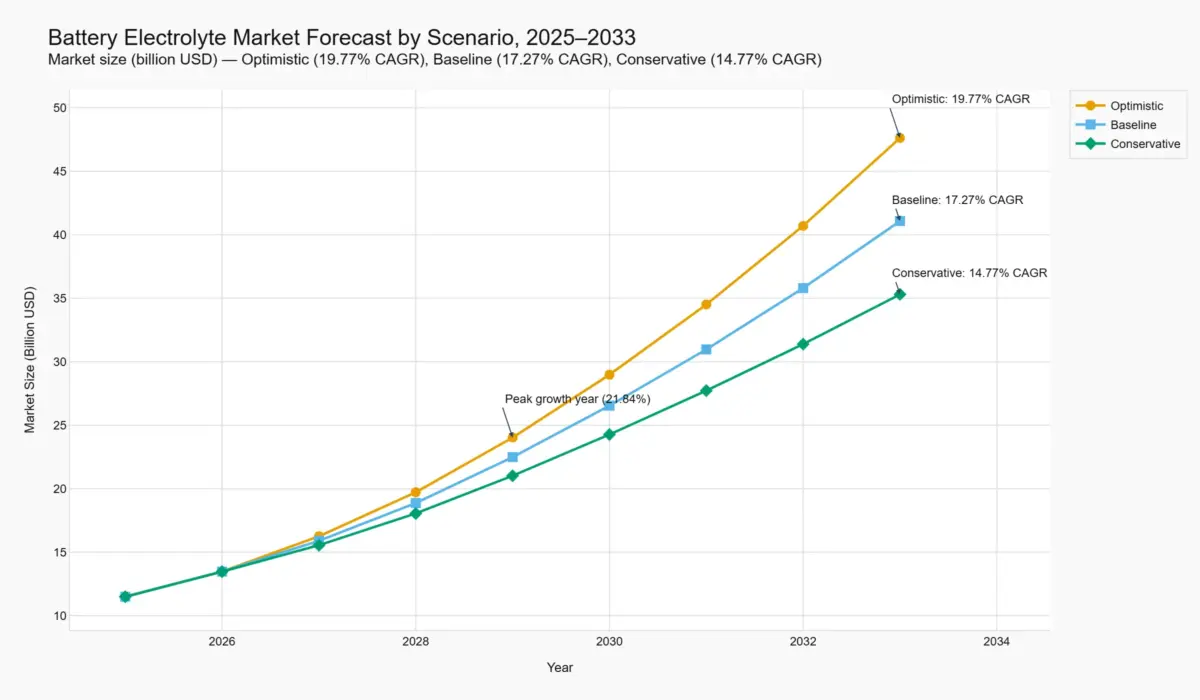
Drivers, Restraints, Opportunities, and Threats of the Global Battery Electrolyte production Market
Key Drivers
Capacity expansion and long-term supply agreements
Announced capacity commitments provide volume visibility through 2028 and beyond. Capchem secured a three-year order from CATL for 300,000 tons of electrolyte, structured as 50,000 tons in 2026 (±10% fluctuation), 100,000 tons in 2027 (±12%), and 150,000 tons in 2028 (±15%). Haike Xinyuan signed a three-year contract with BYD in January 2026 for at least 100,000 tons of lithium battery solvent annually (DMC, EC, EMC, DEC) via pipeline to BYD's Hubei project. These agreements directly correlate with the forecast growth path, particularly the volume ramp in 2028–2029.Geographic diversification of production capacity
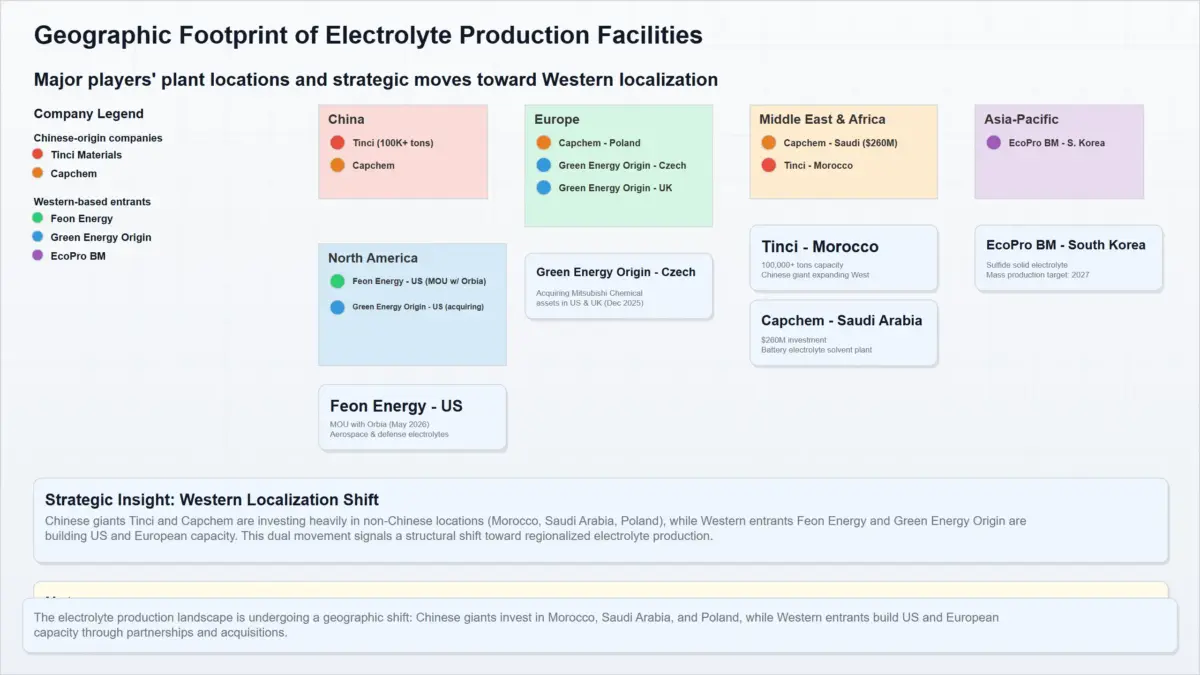
Two major Chinese producers are building overseas plants. Capchem invested $260 million in a Saudi Arabia facility (Yanbu) to produce 200,000 tons of carbonate solvents and 100,000 tons of ethylene glycol, with construction taking up to three years. Tinci Materials signed a $282.3 million deal with Morocco for a plant producing 150,000 tons of electrolyte, 100,000 tons of LiPF₆, and 50,000 tons of LFP materials, targeting production by 2028. These investments reduce cross-regional logistics costs and improve supply security for European and Middle Eastern customers.Advanced lithium salt adoption (LiFSI)
Nippon Shokubai announced a LiFSI capacity expansion from 2,400 MT/yr to 12,400 MT/yr by 2027 at its Hunan Fluopont joint venture. LiFSI enables longer battery life, faster charging, and improved low-temperature output, directly addressing performance requirements for next-generation EVs and ESS. This expansion supports the technology-driven growth modifier in 2028–2029.Restraints
Fluorine supply concentration and purity bottlenecks
China controls 60–69% of global fluorspar production (8–9 million tonnes per year), and roughly 60% of this is acid-grade acidspar (CaF₂ ≥97%). Battery-grade HF requires tighter impurity caps—arsenic below 5 ppm and phosphorus below 100 ppm at the premium tier—creating a sequential bottleneck from mine to LiPF₆ conversion. Any disruption at the mine, beneficiation, or fluorination stage propagates directly to electrolyte availability and cost.Sulphur crisis and feedstock volatility
The closure of the Strait of Hormuz in February 2026 disrupted nearly half of the world's seaborne sulphur trade. Sulphur is the feedstock for sulphuric acid, essential for lithium salt production. China moved to protect domestic supply, amplifying global cost pressures. While the direct impact on LiPF₆ prices was moderated by ample inventories, the crisis exposed a hidden vulnerability in by-product-dependent feedstocks.Lithium carbonate price volatility
Battery-grade lithium carbonate spot prices in July 2026 ranged RMB 150,000–154,000/MT, down 5.0% week-on-week, driven by incremental supply and cautious demand. While LiPF₆ production costs were modestly raised in Q1 2026, ample inventories and steady cell manufacturer operating rates capped upside, resulting in a bearish price index across North America, Europe, and Asia.Opportunities
Solid-state electrolyte commercialization
Samsung SDI targets mass production of all-solid-state batteries by H2 2027, with samples receiving positive customer feedback on safety and energy density. EcoPro BM operates a 40-ton-per-year sulfide-based solid electrolyte pilot plant, has passed qualification tests, and targets mass production in 2027. While mass adoption is unlikely within the forecast horizon, a premium segment for solid-state electrolytes could emerge post-2027.Regulatory-driven reformulation
China's GB 38031-2025 standard (effective July 2026) mandates no-fire/no-explosion in thermal runaway, directly compelling electrolyte reformulation with flame-retardant additives and novel lithium salts. This creates demand for higher-value, performance-differentiated electrolytes and accelerates consolidation among suppliers capable of meeting compliance costs.Western supply chain localization
Green Energy Origin (GEO) announced the acquisition of Mitsubishi Chemical's electrolyte assets in Memphis, Tennessee, and the UK, complementing its existing 200,000-ton-per-year Czech plant. Feon Energy signed an MOU with Orbia for US-based next-gen electrolyte manufacturing. These moves reduce dependence on Chinese imports and serve growing North American and European EV and defense markets.Threats
Geopolitical export restriction on fluorine chemicals
China's dominance in fluorine chemistry—from fluorspar mining to HF production to LiPF₆ conversion—creates a strategic vulnerability analogous to rare earths. Any export restriction on HF or LiPF₆ would directly curtail non-Chinese electrolyte production, raising costs and extending lead times for battery manufacturers globally. The risk is conditional but structurally undisputed.EU PFAS restriction under REACH
The European Chemicals Agency (ECHA) has proposed a broad restriction on per- and polyfluoroalkyl substances (PFAS) under REACH, covering many fluorinated compounds used in battery electrolytes. The Committee for Risk Assessment adopted an opinion in March 2026, and the final scope and transition periods remain uncertain. A phase-out or stringent use limits on PFAS would force reformulation of most current electrolyte products sold in Europe.Capacity oversupply and margin compression
Tinci halted a 2.65 billion yuan domestic electrolyte project amid market overcapacity and fierce competition, even as offshore projects proceed. This signals that capacity expansion is outpacing demand in some regions, and strategic geography is prioritized over total volume growth. Operating rates at 90% for Tinci suggest a tight near-term balance, but the risk of oversupply in the outer forecast years (2031–2033) is material.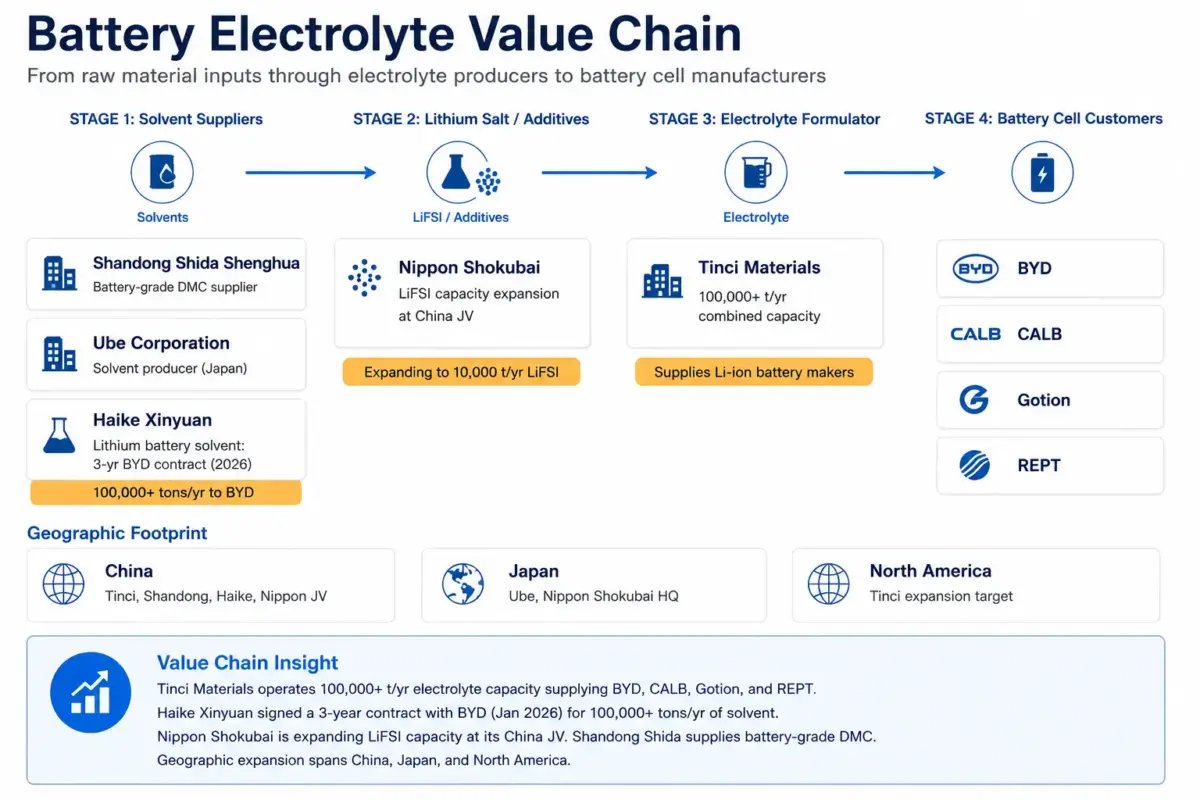
Global Battery Electrolyte Production Market Segmentation
- By Product Type
- Standardized Liquid Electrolyte
- LiPF6-Based Electrolytes
- Standard Lithium-Ion Electrolytes
- High-Voltage Electrolytes
- Fast-Charging Electrolytes
- Low-Temperature Electrolytes
- LiFSI-Based Electrolytes
- High-Performance EV Electrolytes
- Energy Storage Electrolytes
- LiPF6-Based Electrolytes
- Custom Electrolyte Formulations
- High-Performance Electrolytes
- Flame-Retardant Electrolytes
- High-Voltage Electrolytes
- Fast-Charging Electrolytes
- Application-Specific Electrolytes
- Regulatory-Compliant Electrolytes
- High-Performance Electrolytes
- Advanced Electrolyte Technologies
- Solid-State Electrolytes
- Sulfide-Based Solid Electrolytes
- Oxide-Based Solid Electrolytes
- Polymer-Based Solid Electrolytes
- Next-Generation Liquid Electrolytes
- Dual-Salt Electrolyte Formulations
- Solid-State Electrolytes
- Standardized Liquid Electrolyte
- By Material Input
- Lithium Salts
- Lithium Hexafluorophosphate (LiPF6)
- Lithium Bis(fluorosulfonyl)imide (LiFSI)
- Other Lithium Salts
- Organic Solvents
- Ethylene Carbonate (EC)
- Dimethyl Carbonate (DMC)
- Ethyl Methyl Carbonate (EMC)
- Diethyl Carbonate (DEC)
- Functional Additives
- Fluoroethylene Carbonate (FEC)
- Vinylene Carbonate (VC)
- Flame-Retardant Additives
- Other Performance Additives
- Lithium Salts
- By End-Use Application
- Electric Vehicle Batteries
- Passenger Electric Vehicles
- Commercial Electric Vehicles
- Electric Buses
- Two-Wheeler Batteries
- Energy Storage Systems
- Utility-Scale Energy Storage
- Commercial Energy Storage
- Residential Energy Storage
- Consumer Electronics
- Smartphones
- Laptops and Tablets
- Wearable Electronics
- Other Portable Electronics
- Electric Vehicle Batteries
Regional Insights of Global Battery Electrolyte Production Market
Leading Companies in the Market
The competitive landscape is shaped by five key players with distinct strategies based on capacity scale, geographic reach, and technology focus.| Company | Headquarters | Key capacity / investment | Strategic focus |
|---|---|---|---|
| Tinci Materials | China | ~850,000 tons/yr electrolyte; 650,000 tons under construction; $282.3M Morocco plant | Scale leadership, geographic diversification, vertical integration into LiPF₆ and LFP |
| Capchem Technology | China | $260M Saudi plant (200,000 tons solvents); Poland expansion (+50,000 tons electrolyte); 300,000-ton CATL contract | Upstream solvent security, multi-region supply, long-term off-take agreements |
| Nippon Shokubai | Japan | LiFSI expansion from 2,400 to 12,400 MT/yr by 2027 (Hunan Fluopont JV) | Advanced lithium salt (LiFSI/IONEL™) for high-performance EV and ESS electrolytes |
| Green Energy Origin (GEO) | Europe / US | 200,000-ton Czech plant; acquiring Mitsubishi Chemical assets (US, UK) | Western supply chain localization, acquisition-based capacity build |
| EcoPro BM | South Korea | 40-ton/yr sulfide-based solid electrolyte pilot; mass production target 2027 | Next-generation solid-state electrolyte, integrated cathode development |
Why Electrolyte Production Is the Structural Bottleneck in Battery Scale-Up
The battery electrolyte market is being shaped by three closely connected trends: strong downstream demand from EV and ESS markets, rapid capacity expansion by Chinese producers, and a structural vulnerability in the upstream fluorine supply chain. The market is expected to grow from $11.49 billion in 2025 to $41.08 billion by 2033. This growth reflects not just higher volumes, but also rising value per liter as advanced salts such as LiFSI, performance additives, and regulatory-driven reformulation make electrolyte formulations more complex and costly.
The market is particularly important because of the combination of scale and supply concentration. China controls 60–69% of global fluorspar production, along with the majority of HF conversion capacity and the largest share of electrolyte production capacity. As a result, battery supply chains outside China, including those in Europe, North America, and emerging markets, remain dependent on Chinese electrolyte inputs at several stages of production. The 2026 sulphur crisis, triggered by the Strait of Hormuz closure, showed how a geopolitical event outside the battery industry can spread through by-product feedstocks and ultimately affect lithium salt costs. The fluorine bottleneck is structural rather than cyclical, and addressing it within the forecast period would require significant investment in non-Chinese acidspar mining and HF purification capacity.
Technology developments are creating additional options for the market. Solid-state electrolytes, with Samsung SDI and EcoPro BM targeting 2027, novel liquid electrolyte technologies such as Asahi Kasei's Acetolyte, which is already commercial, and dual-salt formulations could support premium segments and provide potential alternatives. However, these technologies are not expected to replace LiPF₆-based liquid electrolytes at scale during the 2026–2033 forecast period. This means that dependence on fluorine is likely to remain throughout the forecast.
Investment activity also highlights the strategic importance of the market. Tinci, Capchem, and Nippon Shokubai have committed substantial new capacity across China, Morocco, Saudi Arabia, Poland, and Malaysia. These investments are supported by long-term off-take agreements, including Capchem-CATL and Haike-BYD, which provide greater visibility on future volumes. The market is therefore expanding while also undergoing a geographic restructuring, with significant implications for supply chain security, pricing power, and the pace of technology adoption.Table of Contents
1. Executive Summary
1.1 Market Snapshot (2026–2033)
1.2 Key Market Highlights
1.3 Forecast Assumptions & Scenario Overview
1.4 Demand-Supply Overview
1.5 Analyst Viewpoint
2. Market Overview
2.1 Introduction to the Global Battery Electrolyte Production Market
2.2 Market Definition & Scope
2.3 Industry Value Chain Analysis
2.4 Market Evolution & Historical Trends
2.5 Supply Chain Structure
2.6 Electrolyte Production, Lithium Salt Supply & EV Battery Demand
3. Global Battery Electrolyte Production Market Forecast Snapshot (USD Billion), 2025–2033
3.1 Base Year Market Size (2025)
3.2 Baseline Market Forecast (2033)
3.3 CAGR (2025–2033)
3.4 Market Direction
3.5 Largest Region
3.6 Fastest Growing Region
3.7 Largest Segment
3.8 Fastest Growing Segment
3.9 Key Trends
3.10 Future Outlook
4. Market Forecast Scenario Analysis
4.1 Baseline Forecast Scenario
4.2 Optimistic Forecast Scenario
4.3 Conservative Forecast Scenario
4.4 Year-by-Year Market Forecast (2025–2033)
4.5 Growth Shape Analysis
4.6 Annual Growth Rate Analysis
4.7 Scenario Comparison & Market Implications
5. Market Dynamics
5.1 Drivers
5.1.1 Capacity Expansion & Long-Term Supply Agreements
5.1.2 Geographic Diversification of Production Capacity
5.1.3 Advanced Lithium Salt (LiFSI) Adoption
5.2 Restraints
5.2.1 Fluorine Supply Concentration & Purity Bottlenecks
5.2.2 Sulphur Feedstock Volatility
5.2.3 Lithium Carbonate Price Volatility
5.3 Opportunities
5.3.1 Solid-State Electrolyte Commercialization
5.3.2 Regulatory-Driven Electrolyte Reformulation
5.3.3 Western Supply Chain Localization
5.4 Threats
5.4.1 Geopolitical Export Restrictions on Fluorine Chemicals
5.4.2 EU PFAS Regulatory Risks
5.4.3 Capacity Oversupply & Margin Compression
6. Market Segmentation by Product Type (USD Billion), 2025–2033
6.1 Standard Liquid Electrolytes
6.1.1 LiPF₆-Based Electrolytes
6.1.2 LiFSI-Based Electrolytes
6.1.3 Mixed Lithium Salt Electrolytes
6.1.4 High-Performance Liquid Electrolytes
6.2 Custom Electrolyte Formulations
6.2.1 High-Voltage Electrolytes
6.2.2 Fast-Charging Electrolytes
6.2.3 Flame-Retardant Electrolytes
6.2.4 Low-Temperature Electrolytes
6.3 Next-Generation Electrolytes
6.3.1 Solid-State Electrolytes
6.3.2 Polymer Electrolytes
6.3.3 Sulfide-Based Electrolytes
6.3.4 Hybrid Electrolytes
7. Market Segmentation by Material Input (USD Billion), 2025–2033
7.1 Lithium Salts
7.1.1 LiPF₆
7.1.2 LiFSI
7.1.3 LiBF₄
7.1.4 Other Lithium Salts
7.2 Organic Solvents
7.2.1 Ethylene Carbonate (EC)
7.2.2 Dimethyl Carbonate (DMC)
7.2.3 Ethyl Methyl Carbonate (EMC)
7.2.4 Diethyl Carbonate (DEC)
7.3 Functional Additives
7.3.1 Fluoroethylene Carbonate (FEC)
7.3.2 Vinylene Carbonate (VC)
7.3.3 Flame Retardant Additives
7.3.4 Performance Additives
8. Market Segmentation by End-Use Application (USD Billion), 2025–2033
8.1 Electric Vehicle Batteries
8.2 Energy Storage Systems (ESS)
8.3 Consumer Electronics
8.4 Industrial & Specialty Batteries
9. Market Segmentation by Battery Chemistry (USD Billion), 2025–2033
9.1 LFP Batteries
9.2 NMC Batteries
9.3 NCA Batteries
9.4 Emerging Battery Chemistries
10. Regional Market Analysis
10.1 Asia-Pacific
10.2 Europe
10.3 North America
10.4 Middle East & Africa
11. Regional Insights
11.1 Asia-Pacific – Global Production Hub
11.2 Europe – Localization & Regulatory Transition
11.3 North America – Policy-Supported Capacity Expansion
11.4 Middle East – Emerging Electrolyte Manufacturing Hub
11.5 Japan & South Korea – Advanced Electrolyte Innovation
12. Supply Chain & Investment Analysis
12.1 LiPF₆ Supply Chain Analysis
12.2 Fluorspar to Battery Cell Value Chain
12.3 Supply Chain Bottlenecks
12.4 Capacity Expansion Projects
12.5 Government Incentives & Localization
12.6 Feedstock Risk Assessment
13. Competitive Landscape
13.1 Market Structure Analysis
13.2 Competitive Positioning Matrix
13.3 Current & Planned Electrolyte Production Capacity
13.4 Strategic Developments
13.5 Capacity Expansion & Investment Activities
14. Company Profiles
14.1 Tinci Materials
14.2 Capchem Technology
14.3 Nippon Shokubai
14.4 Green Energy Origin (GEO)
14.5 EcoPro BM
14.6 Shandong Shida Shenghua
14.7 Ube Corporation
14.8 Feon Energy
15. Strategic Intelligence & AI-Driven Insights
15.1 Pheonix Forecast Intelligence Engine
15.2 Electrolyte Supply Chain Intelligence Dashboard
15.3 Lithium Salt Supply Risk Monitor
15.4 Technology Adoption Intelligence
15.5 Investment Opportunity Intelligence
16. Investment & Growth Opportunities
16.1 Global Capacity Expansion
16.2 LiFSI Commercialization
16.3 Western Supply Chain Localization
16.4 Solid-State Electrolyte Development
16.5 Strategic Partnerships & Long-Term Supply Agreements
17. Why the Global Battery Electrolyte Production Market Is Expanding
17.1 EV & ESS Demand Growth
17.2 Capacity Globalization
17.3 Fluorine Supply Chain Importance
17.4 Technology Advancements
17.5 Long-Term Market Outlook
18. Key Analytical Insights
18.1 Front-Loaded Growth Analysis
18.2 Supply Chain Risk Assessment
18.3 Technology Commercialization Outlook
18.4 Forecast Assumptions & Limitations
19. Methodology & Research Approach
19.1 Research Methodology
19.2 Forecast Modeling Framework
19.3 Data Sources
19.4 Assumptions & Limitations
20. About Pheonix Research
21. Disclaimer
Competitive Landscape
Competitive Landscape
Chinese Giants and the Capacity Race
Tinci Materials and Capchem dominate global battery electrolyte production through massive capacity and aggressive expansion. Tinci currently operates approximately 850,000 tons of annual electrolyte capacity with a 90% operating rate, while 650,000 tons are under construction. Cumulative orders exceed 3.4 million tons, with key clients including CALB, Gotion High-tech, and REPT Batteries. A recent supply agreement with Chutian New Energy increased volume from a minimum of 550,000 tons to at least 1.01 million tons—an increase of over 80%. Beyond its domestic operations, Tinci has commenced construction of a $280 million project in Morocco that will produce 150,000 tonnes of electrolyte, 100,000 tonnes of lithium hexafluorophosphate, and 50,000 tonnes of lithium-iron phosphate materials.
Capchem is investing $260 million in a Saudi Arabia plant at Yanbu Heavy Industrial Park to produce 200,000 tons of carbonate solvents and 100,000 tons of ethylene glycol annually—core upstream materials for electrolyte manufacturing. The company is also spending CNY 200 million (approximately $28.6 million) to expand its Polish electrolyte facility by 50,000 tons, strengthening its presence in Europe. Both expansions aim to secure raw material supply and reduce cross-regional logistics costs.
The two producers compete on scale, deployment speed, and vertical integration. While Tinci focuses on direct electrolyte capacity, Capchem builds upstream solvent capacity that can serve its own plants and third-party customers.
| Participant | Relationship | Competitive dimension | Current capacity (tons/year) | Planned/under construction | Key region |
|---|---|---|---|---|---|
| Tinci Materials | Competes with Capchem | Electrolyte production capacity | ~850,000 (electrolyte) | 650,000 tons electrolyte under construction; Morocco project: 150,000 tonnes electrolyte, 100,000 tonnes LiPF6, 50,000 tonnes LFP | China, Morocco, Czech Republic (relocated) |
| Capchem | Competes with Tinci | Upstream solvent / electrolyte capacity | Not directly specified | Saudi: 200,000 tons carbonate solvents, 100,000 tons glycol; Poland: +50,000 tons electrolyte | Saudi Arabia, Poland |

Localizing Supply Chains: US and European Production
New entrants are targeting Western markets through partnerships and acquisitions to create localized electrolyte supply, reducing dependence on Chinese production. In May 2026, Feon Energy signed a memorandum of understanding with Orbia Fluor & Energy Materials to enable US-based manufacturing of next-generation lithium battery electrolytes, initially focusing on aerospace and defense applications. Orbia brings expertise in fluorinated materials and existing US electrolyte manufacturing infrastructure.
Green Energy Origin (GEO) announced in December 2025 that it will acquire electrolyte manufacturing facilities from Mitsubishi Chemical Corporation in Memphis, Tennessee, and the United Kingdom. The acquisition complements GEO’s existing 200,000-ton-per-year electrolyte plant in the Czech Republic, immediately adding production capacity and supply redundancies across North America and Western Europe.
These moves contrast in approach: Feon Energy uses a partnership model to access manufacturing capability, while GEO pursues outright acquisition of established plants. Both aim to serve rapidly growing EV, grid storage, and defense markets with locally sourced electrolytes.
| Participant | Relationship | Competitive dimension | Product / Customer focus | Geography | Measured basis |
|---|---|---|---|---|---|
| Feon Energy | Partnership with Orbia | Next-gen electrolyte manufacturing | Aerospace, defense, mobility, grid storage | United States (via Orbia) | MOU announced May 2026; Orbia’s existing US electrolyte manufacturing infrastructure |
| Green Energy Origin | Acquires Mitsubishi Chemical assets | Electrolyte production capacity | EV and ESS supply chain | United States (Memphis, TN), United Kingdom, Czech Republic | Acquisition announced December 2025; GEO has 200,000-ton/year plant in Czech Republic |
Next-Generation Electrolytes: Solid-State and Specialized Formulations
While capacity expansion dominates the current competitive landscape, a parallel technology race is unfolding in solid-state electrolytes. EcoPro BM announced in July 2026 that it has developed a proprietary sulfide-based solid electrolyte manufacturing process. The company currently operates a 40-ton-per-year pilot plant, and products from this facility have passed qualification tests by major battery makers. EcoPro BM has completed mass production design and is targeting the earliest commercial mass production in 2027, contingent on customer demand. The company is simultaneously developing cathode materials optimized for solid-state electrolytes, enhancing its integrated materials position.
This timeline places EcoPro BM among early movers in solid-state commercialization. The technology shift represents a different competitive dimension from the liquid electrolyte capacity race, focusing on process innovation and customer qualification rather than scale.

Key takeaways
-
- Tinci Materials and Capchem remain major capacity players, with Tinci’s capacity exceeding 850,000 tons per year, while Capchem is investing $260 million to establish solvent production capacity in Saudi Arabia.
- Battery manufacturers are securing long-term electrolyte supplies through multi-year agreements. Tinci’s cumulative orders have surpassed 3.4 million tons, providing greater visibility on future demand and production volumes.
- US and European supply chains are increasingly focused on reducing dependence on Chinese imports. Asset acquisitions such as Green Energy Origin–Mitsubishi and partnerships such as Feon Energy–Orbia are supporting the development of more localized supply networks.
- Solid-state electrolyte production is moving closer to commercialization. EcoPro BM is targeting 2027 mass production after successfully passing customer qualification, although broader adoption will depend on further technical and production-scale development.
- Capacity expansion is running ahead of current demand in some areas, but operating rates remain high. Tinci’s 90% operating rate indicates that near-term supply-demand conditions remain relatively tight despite the ongoing expansion of production capacity.
Value Chain
Value Chain :Global battery electrolyte production Market
The battery electrolyte production value chain spans chemical raw material sourcing—lithium salts, solvents, and additives—through electrolyte formulation and mixing to delivery to lithium-ion battery cell manufacturers. This chapter examines the supported participants, capacities, supply commitments, and geographic dynamics for the 2025–2027 period based on announced investments and contracts. Upstream mining of lithium and fluorine and downstream battery pack assembly are excluded.
Key takeaways
- Tinci Materials dominates with over 850,000 tons of annual electrolyte capacity and is expanding into North America with a 200,000-ton plant, indicating a strategic shift in supply chains.
- Long-term supply agreements, such as Haike Xinyuan’s three-year contract with BYD for 100,000 tons of solvent annually, are securing raw material availability for major battery producers.
- LiFSI capacity additions by Nippon Shokubai (10,000 MT/yr expansion) address growing demand for high-performance electrolytes in EV and ESS applications.
- The value chain remains heavily concentrated in China, but overseas investments like Tinci’s U.S. plant signal early diversification.
- Solvent supply is dominated by Chinese and Japanese producers (Shandong Shida, Ube), with battery-grade DMC a critical input. Show the supported flow from raw material inputs through electrolyte producers to battery cell manufacturers, including key capacities, contracts, and geographic markers.\n Supported claims and evidence from research.\n Participants at each stage: solvent suppliers (Shandong Shida, Ube, Haike), lithium salt/additive producers (Nippon Shokubai), electrolyte formulator (Tinci), and battery cell customers (BYD, CALB, Gotion, REPT). Capacities, contract volumes, and expansion locations (China, Japan, North America) are highlighted.
Value Chain Architecture and Material Inputs
The electrolyte value chain begins with raw chemical inputs. Lithium salts (LiPF₆, LiFSI), organic solvents (dimethyl carbonate, ethyl methyl carbonate, ethylene carbonate, diethyl carbonate), and functional additives are procured by electrolyte producers, who blend them into proprietary formulations before shipping to battery cell manufacturers.
Two solvent producers with supported roles are Shandong Shida Shenghua Chemical Group and Ube Corporation. Shandong Shida’s electrolyte material sales department supplies battery-grade dimethyl carbonate (DMC) as well as EMC, EC, DEC, and PC to electrolyte producers. Ube is the sole manufacturer of DMC in Japan and states its high-quality DMC is becoming the de facto standard for lithium-ion battery electrolytes.
Haike Xinyuan signed a three-year contract with BYD in January 2026 to supply at least 100,000 tons of lithium battery solvent annually—including DMC, EC, EMC, and DEC—via pipeline to BYD’s Hubei project. This agreement directly ties a solvent producer to a specific downstream battery plant.
The largest electrolyte producer in the supported evidence is Guangzhou Tinci Materials Technology. Tinci operates electrolyte production lines with a combined annual capacity of approximately 850,000 tons and supplies lithium-ion battery manufacturers including CALB, Gotion High-tech, and REPT Batteries, with cumulative orders exceeding 3.4 million tons.
On the additive side, Nippon Shokubai produces LiFSI (lithium bis(fluorosulfonyl)imide), a high-performance lithium salt used in advanced electrolyte formulations. Through its joint venture Hunan Fluopont New Materials in China, current capacity stands at 2,400 metric tons per year (MT/yr), built from 1,200 MT/yr in FY2022 through debottlenecking.
| Component | Supplier | Current capacity / contract | Geographic presence |
|---|---|---|---|
| Electrolyte | Tinci Materials | 850,000 tons/yr; 650,000 tons under construction | China; North America (planned) |
| DMC solvent | Shandong Shida Shenghua | Battery-grade DMC supplied to electrolyte producers | China |
| DMC solvent | Ube Corporation | Sole Japanese DMC manufacturer; supplies LIB electrolyte market | Japan |
| Lithium battery solvent (DMC, EC, EMC, DEC) | Haike Xinyuan | ≥100,000 tons/yr to BYD under three-year contract from Jan 2026 | China (Hubei) |
| LiFSI (lithium salt additive) | Nippon Shokubai (Hunan Fluopont JV) | 2,400 MT/yr current; expanding by 10,000 MT/yr | China (Hunan) |
Capacity Expansion Trajectories and Supply Commitments
Several capacity expansions and long-term supply agreements are reshaping the electrolyte landscape through 2027. These investments reflect efforts to secure supply for surging EV and ESS demand, with most activity centered in China and one notable overseas project.
Tinci Materials is the most aggressive expander. It currently has 850,000 tons of annual electrolyte capacity with an operating rate of about 90%, and an additional 650,000 tons under construction. The company expects total electrolyte sales of 720,000 tons in 2025. In a significant geographic move, Tinci broke ground on its first large-scale manufacturing facility outside China—a 200,000-ton electrolyte plant in North America with a total investment of approximately USD 200 million.
Haike Xinyuan’s three-year contract with BYD, effective January 2026, commits at least 100,000 tons of solvent per year. The agreement covers pipeline delivery to BYD’s Hubei project and includes DMC, EC, EMC, and DEC. Haike explicitly commits to ensuring sufficient related production capacity to meet BYD’s annual procurement demand of no less than 100,000 tons.
Nippon Shokubai is pursuing a phased expansion of LiFSI capacity at its Hunan Fluopont joint venture. Current capacity is 2,400 MT/yr. The company announced an additional 10,000 MT/yr, to be built in phases, bringing total capacity to 12,400 MT/yr by 2027. The press release cites demand drivers from EVs (longer battery life, faster charging, low-temperature output) and from ESS, where demand is expanding rapidly.
| Company | Product | Capacity addition | Location | Timeline | Off-take partner (if any) |
|---|---|---|---|---|---|
| Tinci Materials | Electrolyte | 200,000 tons/yr (new plant); 650,000 tons under construction (in addition to existing 850,000) | North America (new); China (under construction) | Ground broken 2025; under construction ongoing | — |
| Haike Xinyuan | Lithium battery solvent (DMC, EC, EMC, DEC) | ≥100,000 tons/yr | China (Hubei, pipeline to BYD) | Contract starts January 2026; three-year term | BYD |
| Nippon Shokubai (Hunan Fluopont) | LiFSI | 10,000 MT/yr (phased, from 2,400 to 12,400 MT/yr) | China (Hunan) | Phased completion by 2027 | — |
Implications for Downstream Customers and Market Dynamics
The capacity expansions and long-term contracts have direct implications for battery cell manufacturers, EV OEMs, and ESS integrators. BYD secures solvent supply for its Hubei battery project through the Haike agreement, ensuring stable access to DMC, EC, EMC, and DEC for at least three years from 2026. Tinci Materials has locked in cumulative orders of more than 3.4 million tons with customers such as CALB, Gotion High-tech, and REPT Batteries. The company’s 2025 sales forecast of 720,000 tons and strong Q1 2026 revenue and profit indicate healthy downstream demand.
The LiFSI expansion by Nippon Shokubai directly targets EV and ESS segments. The company notes that LiFSI enables longer battery life, faster charging, and improved low-temperature output—key requirements for next-generation EVs and grid-scale storage. With LiFSI capacity set to reach 12,400 MT/yr by 2027, Nippon Shokubai will be better positioned to supply high-performance electrolyte additives to battery makers in China, the world’s largest LIB market.
Geographically, the value chain remains anchored in China, which hosts the bulk of solvent, LiFSI, and electrolyte production capacity. The Tinci North America plant is the only overseas electrolytic facility in the supported evidence and represents an early step toward supply chain diversification for North American battery cell producers. However, no data is available on other non-Chinese electrolyte producers beyond Japan’s Ube and Nippon Shokubai, nor on electrolyte pricing or demand forecasts, limiting a full assessment of competitive dynamics.
Investment Activity
Scope and Context
This chapter looks at investment activity across the battery electrolyte production industry for lithium-ion batteries. It covers greenfield projects, capacity expansions, acquisitions, joint ventures, and government-funded initiatives. It does not cover raw material extraction, other battery components such as cathodes, anodes, and separators, or downstream battery cell assembly.
The battery electrolyte market was estimated at $11.49 billion in 2025, based on a single web estimate. All figures and dates presented in this chapter are based on disclosed company and government announcements.
Global Capacity Expansion: Chinese Dominance and Regional Hubs
The dominant pattern in electrolyte investment is the construction of large‑scale plants by Chinese producers in strategic overseas locations. These facilities are designed to serve regional EV and energy storage hubs, bypassing tariff barriers and shortening supply lines to major battery cell manufacturers in Europe, the Middle East, and Southeast Asia.
Tinci Materials signed a MAD 2.6 billion ($282.3 million) investment agreement with Morocco’s government to build a factory in Jorf Lasfar Industrial Park. The plant will have an annual production capacity of 150,000 tons of electrolytes and other key lithium battery raw materials. Tinci has pledged to achieve production and export targets within five years of the effective date, targeting 2028. This project follows a previously announced 300,000‑ton plan that was downsized; the company also pulled its Swiss listing plan due to changed operating conditions.
Capchem, through its 80:20 joint venture Middle East Capchem, announced a $260 million investment in Yanbu, Saudi Arabia. The facility is to produce 200,000 tonnes per year of carbonate solvents and 100,000 tonnes per year of ethylene glycol, using proprietary Ecosip technology already deployed in China and Poland. Construction will take three years. Separately, Capchem’s subsidiary Novolyte broke ground in January 2026 on a new battery electrolyte manufacturing facility at Kulim Hi‑Tech Park in Kedah, Malaysia. Phase 1 capacity is 30,000 tons, scheduled to start production in Q4 2026. Novolyte already operates a Phase I plant in the same park, achieving local production and local order fulfillment.
In contrast, U.S. and UK domestic efforts are orders of magnitude smaller and heavily reliant on government funding. Anthro Energy received U.S. Department of Energy approval in April 2026 to advance its first large‑scale, U.S.–owned advanced electrolyte production facility into the execution phase. The $24.9 million award supports a 25 GWh production hub in Louisville, Kentucky, capable of producing approximately 12,000 metric tons of polymer electrolytes annually, using FEOC‑free (Foreign Entity of Concern‑free) inputs from day one. TaiSan, a UK sodium‑battery materials company, was awarded approximately £1 million under the DRIVE35 program to lead a project with CPI (Centre for Process Innovation). The project will develop automated electrolyte formulation and cell assembly systems. The grant is part of the UK Government’s £4 billion commitment to zero‑emission mobility.
| Project / Company | Investor / Partner | Geography | Amount / Capacity | Timeline | Status |
|---|---|---|---|---|---|
| Tinci Morocco plant | Tinci Materials | Jorf Lasfar, Morocco | $282.3 million; 150,000 t/y electrolyte & raw materials | Production target 2028 | Agreement signed; under development |
| Capchem Saudi Arabia plant | Middle East Capchem (Capchem JV) | Yanbu, Saudi Arabia | $260 million; 200,000 t/y carbonate solvents + 100,000 t/y ethylene glycol | 3‑year construction | Announced |
| Novolyte Malaysia plant | Novolyte (Capchem subsidiary) | Kulim Hi‑Tech Park, Kedah, Malaysia | 30,000 t/y Phase 1 | Q4 2026 | Groundbreaking Jan 2026 |
| Anthro Energy advanced electrolyte facility | Anthro Energy (U.S. company) | Louisville, Kentucky, USA | $24.9 million grant; 12,000 metric t/y (25 GWh) | DOE approval Apr 2026; moving to construction | Planning / pre‑construction |
| TaiSan automated electrolyte & cell assembly | TaiSan (UK company) + CPI | Cambridge, UK | ~£1 million DRIVE35 grant | Awarded Apr 2026 | R&D / pilot |
Consolidation via M&A and Joint Ventures
Beyond greenfield construction, acquisitions and joint ventures are reshaping capacity ownership and technology access, often bringing Chinese expertise into new regions without the full risk of a greenfield build.
Green Energy Origin (GEO) announced on December 12 2025 a definitive agreement to acquire electrolyte manufacturing assets from Mitsubishi Chemical Corporation (MCC) in the United States (Memphis, Tennessee) and the United Kingdom. The deal follows the commencement of GEO’s 200,000‑ton‑per‑year electrolyte plant in the Czech Republic. GEO stated that the acquisition will immediately provide additional production capacity and supply redundancies across North America and Western Europe, strengthening its global R&D and patent collaboration.
In China, Hualu Hengsheng and Tinci Materials signed a strategic cooperation framework agreement on June 30 (2028) for a 300,000‑tonne‑per‑year lithium battery electrolyte project. Under the agreement, Hualu Hengsheng will assist Tinci in building the project within the Dezhou Yunhe Hengsheng Chemical Industrial Park. Notably, Tinci has halted a separate 2.65 billion yuan domestic electrolyte project amid market overcapacity and fierce competition, highlighting a strategic shift toward selected large‑scale ventures.
Nippon Shokubai announced in April 2026 an expansion of lithium bis(fluorosulfonyl)imide (LiFSI) capacity at its joint venture Hunan Fluopont New Materials Co., Ltd. in China. The company will add 10,000 metric tons per year (MT/y) of LiFSI under the trade name IONEL™, raising total capacity from the current 2,400 MT/y to 12,400 MT/y by 2027. The expansion addresses growing demand from both EV and energy storage applications, where performance requirements such as longer battery life, faster charging, and low‑temperature output are driving adoption of advanced lithium salts.
| Parties | Transaction Type | Capacity / Investment | Technology Focus |
|---|---|---|---|
| GEO (Green Energy Origin) acquires MCC (Mitsubishi Chemical Corp.) plants | Acquisition | Facilities in Memphis (US) and UK; GEO already operates 200,000 t/y Czech plant | Global electrolyte production footprint; supply redundancy |
| Hualu Hengsheng & Tinci Materials | Strategic framework agreement (JV) | 300,000 t/y electrolyte project in Dezhou, China | Leveraging existing chemical park; Tinci halted separate 2.65 billion yuan project |
| Nippon Shokubai expands Hunan Fluopont JV | Capacity expansion (China JV) | +10,000 MT/y LiFSI; total to 12,400 MT/y by 2027 | Advanced lithium salt (LiFSI/IONEL™) for high‑performance electrolytes |
Technology Trajectories: From Commodity to Performance Electrolytes
Several disclosed investments signal a shift from standard electrolyte formulations toward differentiated products aimed at high‑voltage, fast‑charging, and safer batteries.
The Nippon Shokubai LiFSI expansion is the clearest example: LiFSI is a lithium salt that improves conductivity and stability at high voltages and low temperatures, making it essential for next‑generation EV batteries. The expansion from 2,400 MT/y to 12,400 MT/y by 2027 represents a more than fivefold increase, indicating strong anticipated demand from both EV and ESS markets.
Anthro Energy’s facility will produce polymer electrolytes rather than conventional liquids. The company describes its technology as a “next‑generation” polymer electrolyte that enhances lithium‑ion battery performance and safety. The facility is designed to be FEOC‑free from day one, positioning it as a domestic alternative for U.S. battery cell manufacturers seeking supply‑chain security. With 12,000 metric tons of annual capacity (25 GWh equivalent), it is small relative to Chinese overseas plants but represents a strategic foothold in a critical component.
TaiSan’s DRIVE35 project focuses on automation of electrolyte formulation and cell assembly. By improving production efficiency, quality, and scalability, the project aims to accelerate the commercialisation of battery technologies essential to the UK’s zero‑emission transport transition. While the £1 million grant is modest, it targets manufacturing process innovation that could lower costs for next‑generation electrolytes, particularly for sodium‑based chemistries where TaiSan specializes.
These technology‑focused investments, while still small in overall capacity, could create a premium segment in the electrolyte market. However, the disclosed figures do not yet show whether these projects are sufficient to shift the value chain away from commodity‑scale production.
Technology & Innovation
Battery Electrolyte Production: Technology Pathways
The battery electrolyte production market is undergoing a technology-driven transition toward dual-salt formulations, solid-state electrolytes, novel liquid electrolytes, and fluorine-free chemistries. These pathways collectively seek to improve thermal safety, widen operating temperature ranges, boost power density, and reduce environmental impact. While academic research continues to advance fundamental understanding, pilot production lines are operational, and a commercial cell containing a novel acetonitrile electrolyte is already in the market. Mass-production targets for solid-state solutions are concentrated around 2027.
- Dual-salt LiFSI-LiPF6 electrolytes demonstrate >78% capacity retention at 60°C and enable -20°C operation, offering a near-term path to safer, wider-temperature Li-ion cells.
- Two major players (Samsung SDI, EcoPro BM) are targeting 2027 for solid-state electrolyte mass production, with positive customer feedback and qualified pilot products.
- A commercial cell (EAS UHP601300 LFP 22) using a novel acetonitrile electrolyte is already shipping, achieving 60% higher continuous power density.
- Fluorine-free electrolytes for Li-S batteries remain at the research stage but could reduce environmental and cost burdens if scaled.
- All tracked technologies aim to address safety and performance limits of conventional LiPF6/carbonate electrolytes, creating a competitive landscape with varying readiness levels.
Dual-Salt and Wide-Temperature Electrolyte Advancements
A study published in 2026 in IOPscience (Journal of The Electrochemical Society) described an advanced LiFSI-LiPF6 dual-salt controlled-solvation electrolyte (E-DS) designed for extreme-condition operation. In graphite||LiNi0.8Mn0.1Co0.1O2 cells (~4.1 mAh cm-2), the E-DS formulation delivers >78% capacity retention after 300 cycles at 60 °C, retains fast-discharging capability at 30 °C, and operates effectively at -20 °C. Fully charged cells also tolerate overcharging to 4.8 V at elevated temperatures with lower heat evolution, transforming a traditionally unstable high-voltage configuration into an intrinsically safe state.
The mechanism relies on the smaller, more dissociating FSI– anion, which forms ultrathin, dense, inorganic-rich electrode/electrolyte interphases. These interphases suppress solvent decomposition, transition-metal dissolution, and surface reconstruction compared to the conventional LiPF6/carbonate electrolyte. The work establishes a new benchmark for carbonate-containing electrolytes, simultaneously achieving high energy density, wide-temperature operation (-20 to 60 °C), and outstanding thermal safety in nickel-rich lithium-ion batteries. Adoption implications are strongest for passenger EV and high-energy-density applications, though industrial scale-up and cost data remain absent from the published research.
Solid-State Electrolyte Commercialization Push
Samsung SDI is targeting mass production of all-solid-state batteries by the second half of 2027. Company executives confirmed that samples have received positive feedback from global customers for their safety and energy density. Potential clients include EV manufacturers and humanoid robot developers, with the latter expected to drive strong demand because of the technology’s superior energy density in space-constrained designs. The company’s progress contrasts with that of Chinese battery makers such as CATL and BYD, which have grown notably less optimistic about the feasibility and economics of mass-producing solid-state batteries.
EcoPro BM has disclosed a parallel 2027 mass-production target for sulfide-based solid electrolytes. The company independently developed a proprietary manufacturing process and currently operates a pilot plant with an annual capacity of 40 metric tons. Products manufactured at the facility have passed qualification tests conducted by major battery makers. The mass-production line design is complete, pending customer demand. The convergence of two major South Korean suppliers around a 2027 timeline signals that solid-state electrolyte production is transitioning from prototyping to early-stage industrial deployment, initially in premium battery segments.
| Technology | Participant | Supplied Metric | Period | Application | Evidence-Based Implication |
|---|---|---|---|---|---|
| Dual-salt LiFSI-LiPF6 (E-DS) | Academic study (IOPscience 2026) | >78% retention after 300 cycles at 60°C; operation at -20°C | 2026 research publication | High-energy NMC Li-ion cells | Establishes new benchmark for carbonate-containing electrolytes; scalability data not provided |
| Solid-State (all-solid-state) | Samsung SDI | Positive customer feedback on safety and energy density | Mass production targeted H2 2027 | Premium EVs, humanoid robots | Validated customer interest; contrasts with industry skepticism on feasibility |
| Solid-State (sulfide-based) | EcoPro BM | 40-ton pilot plant; passed qualification tests | Mass production targeted earliest 2027 | Battery materials supply | Process technology secured; line design complete, awaiting customer demand |
| Novel Liquid (Acetolyte) | Asahi Kasei / EAS Batteries | 2,550 W/kg (+60%), 2,400 cycles at 5C/5C 100% DoD | Commercial sales started June 2026 | High-power LFP cells, mobility, stationary storage | First commercial deployment; licensing model provides blueprint for adoption |
| Fluorine-Free (LiTIM) | Academic study (ACS Omega 2026) | Promising high-C-rate sulfur utilization vs. LiTFSI | 2026 research publication | Lithium-sulfur batteries | Reduces environmental burden; early research stage, industrial data absent |
Novel Liquid Electrolytes Entering Commercial Use
Asahi Kasei’s novel acetonitrile-containing electrolyte, Acetolyte, has already reached the market through a licensing and commercialization agreement with German battery manufacturer EAS Batteries. The resulting ultra-high-power cylindrical LFP cell (UHP601300 LFP 22) delivers a nominal capacity of 22 Ah. It achieves 2,550 W/kg under continuous discharge, a 60% increase compared with cells using conventional electrolytes, and 3,760 W/kg under a 2-second pulse discharge, an improvement of approximately 10%. The cell maintains a cycle life of 2,400 cycles at 5C/5C and 100% depth of discharge at room temperature, reaching 80% of its initial capacity.
EAS started sales in June 2026, and samples are currently being evaluated by customers across industries including mobility and stationary storage. The licensing agreement, signed in November 2025, includes a sublicensing model targeting global OEMs and battery manufacturers, providing a structured pathway for broader adoption of novel liquid electrolyte formulations.
Emerging Fluorine-Free Electrolytes for Next-Generation Chemistries
A study published in 2026 in ACS Omega investigated all-fluorine-free electrolytes for lithium-sulfur (Li-S) batteries. The research benchmarked a series of Hückel anion-based lithium salts—including fluorine-free candidate LiTIM (lithium 2,4,5-tricyanoimidazolide)—against conventional LiTFSI-based electrolytes. LiTIM demonstrated promising high-C-rate sulfur utilization, addressing long-standing limitations in Li-S cells such as polysulfide shuttling and capacity fading. The work systematically evaluated cathode formulation (carbon blacks, binder, sulfur content) and electrolyte-to-sulfur ratios to identify optimised model cathodes for testing.
While the environmental and cost benefits of eliminating fluorine are clear, the technology remains at the research stage. Industrial scalability, manufacturing cost, and long-term cycle-life data under realistic conditions are not yet available, placing commercial deployment further out than the dual-salt, novel liquid, or solid-state pathways.

Market Risk
Scope and key takeaways
This chapter examines the risk landscape surrounding battery electrolyte production, with a focus on lithium hexafluorophosphate (LiPF₆)-based electrolytes used in lithium-ion batteries. It covers key upstream feedstocks, including acidspar, fluorine, sulphuric acid, and lithium carbonate, as well as geopolitical concentration, price volatility, and operational risks at battery plants. Non-LiPF₆ electrolytes and downstream assembly activities beyond electrolyte integration are excluded.
- LiPF₆ supply is exposed to three key bottlenecks: concentrated acidspar supply, with China accounting for 60–69% of global production; strict impurity requirements for battery-grade hydrogen fluoride (HF); and limited LiPF₆ conversion capacity outside China.
- China’s strong position in fluorine chemistry creates a significant geopolitical risk, similar to the risks seen in rare earth supply chains. Any export restrictions could have a major impact on global electrolyte production.
- The 2026 sulphur crisis, triggered by the Strait of Hormuz closure, highlighted how dependence on by-product feedstocks for sulphuric acid can amplify supply disruptions and increase pressure on lithium salt production.
- Lithium carbonate price volatility directly affects LiPF₆ production costs and electrolyte pricing. Conditions in Q1 2026 remained bearish despite continued strong demand from the EV market, adding another layer of uncertainty for producers.
- Operational safety incidents at battery gigafactories can also create regulatory and logistical risks for electrolyte handling. The CATL Debrecen chemical leak and improper storage incident illustrates the potential operational challenges associated with handling and storing electrolyte-related materials at large-scale battery facilities.
The fluorine bottleneck: from acidspar mine to LiPF₆ salt
Every lithium-ion cell contains about 200–400 grams of fluorine, mostly in the electrolyte salt LiPF₆. That fluorine originates six processing steps upstream as calcium fluoride in a fluorspar mine. The chain is short, supply-constrained at multiple links, and increasingly priced as a tightening cluster as global battery production scales toward 30+ million EV units annually by 2030. Acidspar mine supply is the first critical link: global fluorspar production across all grades is approximately 8–9 million tonnes per year, with China accounting for roughly 60% (some estimates place the share at 69%). Of the total, about 60% is acid-grade fluorspar (acidspar, CaF₂ ≥ 97%), which is the entry point for fluorine chemistry. The battery chain requires the cleanest end of the acidspar spectrum: battery-grade HF demands tighter impurity caps, particularly arsenic below 5 ppm and phosphorus below 100 ppm at the premium tier. Standard acidspar (CaF₂ ≥ 97%, SiO₂ ≤ 1%, CaCO₃ ≤ 1.5%) feeds the general HF industry, but premium-grade material with ≥97.5% CaF₂ and lower impurities is a smaller subset. This sequential bottleneck—from concentrated geographic supply, to limited premium-grade acidspar, to purity-limited HF production—means that any disruption at the mine, beneficiation, or fluorination stage propagates directly to LiPF₆ availability and cost.
| Region | Share of global fluorspar production | Key producer countries (next tiers) |
|---|---|---|
| China | 60–69% | — |
| Rest of world | — | Mexico, Mongolia, Vietnam, South Africa, Afghanistan, Iran, Kenya, Spain |

Geopolitical leverage and export restriction risk
China’s dominance in fluorine chemistry extends beyond upstream mining. With the world’s largest reserves, China produces an estimated 6 million tonnes of fluorite annually—around 69% of global output. This mineral is the bedrock of advanced applications in aerospace, nuclear energy, semiconductors, and electric vehicle batteries. The country also controls the downstream conversion steps: fluorspar to hydrofluoric acid, and HF to LiPF₆. Non-Chinese battery supply chains depend on Chinese fluorine chemicals at multiple stages, creating a strategic vulnerability analogous to rare earths.
While no explicit export control measures have been announced for fluorine chemicals, the precedent of rare-earth restrictions and China’s growing use of licensing, purity standards, and quotas in other critical mineral domains makes the mechanism plausible. Any export restriction directed at HF or LiPF₆ would directly curtail electrolyte production outside China, raising costs and extending lead times for battery manufacturers globally. The risk is conditional and uncertain, but the structural concentration is undisputed.
Hidden feedstock vulnerabilities: sulphur crisis and lithium carbonate volatility
Sulphur crisis
The closure of the Strait of Hormuz in late February 2026 exposed a hidden vulnerability: nearly half of the world’s seaborne sulphur normally passes through this chokepoint. Sulphur is the feedstock for sulphuric acid, the world’s largest-volume inorganic chemical, essential for leaching lithium and rare earths. The crisis revealed how geographic bottlenecks, by-product dependence, and policy control (China moved to protect domestic supply) combine to amplify disruption across global production networks. For electrolyte production, the mechanism is indirect but critical: sulphuric acid shortages raise costs and constrain lithium salt output, which in turn affects LiPF₆ manufacturing.
Lithium carbonate and LiPF₆ price dynamics
Battery-grade lithium carbonate spot prices in July 2026 ranged RMB 150,000–154,000/MT (average RMB 152,000/MT), down 5.0% week-on-week. Spodumene concentrate (SC6, CIF) averaged USD 2,200/MT, down 4.3% week-on-week. The decline was driven by incremental supply—the Jianxiawo mine’s production restart—and cautious demand outlook. Although inventories remain relatively tight, lithium salt prices softened amid volatility. This directly feeds into LiPF₆ production costs: LiPF₆ synthesis uses lithium carbonate, and firmer lithium carbonate and HF costs modestly raised LiPF₆ production cost bases in Q1 2026. However, ample inventories and steady operating rates at cell manufacturers capped any upside, resulting in a bearish price index across North America, Europe, and Asia.
| Region | Q1 2026 price index pattern | Key drivers |
|---|---|---|
| North America | Range-bound to mildly softer | Upside contingent on sharper EV production rebound or tighter Chinese export availability |
| Europe | Modestly softer with limited upside | Restocking by large battery manufacturers; higher logistics costs; Asian export reallocations |
| Asia | Bearish, downward pressure | Ample inventories, steady operating rates, softer lithium salt and solvent costs |
Operational risks in electrolyte handling and storage
Beyond upstream supply chains, operational failures at battery gigafactories add logistical and regulatory risk for electrolyte producers and handlers. In March 2026, a government office in Hungary reported that hazardous materials were stored improperly and without permits in the semi-finished section of CATL’s Debrecen battery plant. The unauthorised use of the building was prohibited and an environmental protection procedure initiated. In June 2026, approximately one litre of diethyl carbonate—a common electrolyte solvent—leaked from a storage container during a transfer operation near production line 4. The leak was controlled within five minutes with no injuries, and CATL launched an internal investigation. These incidents, while isolated, highlight that even after managing upstream supply constraints, electrolyte logistics and storage at the point of use remain vulnerable to human error, inadequate permitting, and procedural gaps. For electrolyte producers supplying such plants, consequences can include contract renegotiations, stricter storage protocols, and higher insurance costs. The regulatory environment in host countries may tighten oversight, especially for hazardous chemical handling.
Summary of key risks
| Risk | Mechanism | Exposed participant/geography | Timing | Supported consequence |
|---|---|---|---|---|
| Acidspar supply concentration and purity bottleneck | China controls 60–69% of fluorspar; battery-grade acidspar has tight impurity caps (As <5 ppm, P <100 ppm) | Non-Chinese LiPF₆ producers, electrolyte formulators, battery cell makers | Ongoing, structural | Supply constraints propagate from mine to cell; limited substitution |
| Geopolitical export restriction on fluorine chemicals | China dominates HF production and LiPF₆ conversion; export controls could follow rare-earth precedent | Global electrolyte and battery manufacturers outside China | Conditional, plausible within 1–3 years | Severe disruption to non-Chinese electrolyte supply; price spikes |
| Sulphur crisis (Strait of Hormuz closure) | By-product dependent sulphur feedstock; half of seaborne sulphur transits chokepoint; China protecting domestic supply | Lithium salt producers, electrolyte manufacturers exposed to sulphuric acid costs | Feb 2026 – ongoing | Supply shock in sulphuric acid; increased costs for lithium salt and battery metal processing |
| Lithium carbonate price volatility | LiPF₆ synthesis requires lithium carbonate; price swings affect production cost base | LiPF₆ producers, electrolyte formulators, cell makers | Q1–Q3 2026 | Pricing pressure; bearish LiPF₆ index despite firm feedstock costs |
Regulatory Landscape
Regulatory Landscape for Battery Electrolyte Production
This chapter examines the key regulations governing battery electrolyte production across three major frameworks: China’s mandatory EV battery safety standards, the EU’s REACH chemical regulations, including the proposed PFAS restriction, and relevant international IEC standards. It focuses on requirements that directly affect battery electrolyte production and safety. Non-battery electrolyte markets, cost modeling, and regulations outside these jurisdictions are excluded.
- China’s July 2026 mandatory no-fire/no-explosion standard represents the world’s strictest thermal runaway requirement, directly compelling electrolyte reformulation and new additive development.
- The EU’s ongoing PFAS restriction under REACH threatens the use of fluorinated electrolyte salts and solvents, with final rules expected in the late 2020s, creating supply uncertainty.
- IEC 60086-1:2026 provides baseline electrolyte safety and classification but lags behind the performance-based mandates of China’s GB standards.
- REACH’s 1-tonne registration threshold imposes data-sharing and cost burdens on smaller electrolyte producers, potentially accelerating market consolidation.
- Regulatory fragmentation between China, EU, and IEC regimes forces electrolyte producers to maintain multiple product variants and compliance dossiers.
China’s No-Fire/No-Explosion Mandate Reshapes Electrolyte Requirements
Effective July 1, 2026, China enforced two mandatory national standards: GB 38031-2025 (Safety Requirements for Traction Batteries of Electric Vehicles) and GB 18384-2025 (Safety Requirements for Electric Vehicles). The key provision requires that battery systems must not catch fire or explode, even in the event of thermal runaway. This replaces the previous standard which only required a five-minute warning before fire or explosion.
To demonstrate compliance, manufacturers must pass a new thermal propagation test designed to verify that a thermal runaway event does not lead to fire or explosion. Two additional test scenarios address practical safety concerns: underbody impact testing to simulate road debris strikes and curb collisions, and a 300-cycle high-power fast-charging durability assessment to verify long-term battery safety under repeated ultrafast charging. The standards also mandate an independent physical high-voltage cutoff device operable by a single tap or long press, replacing earlier software-based controls.
For electrolyte producers, these requirements directly influence formulation decisions. The no-fire/no-explosion threshold pushes development of flame-retardant additives, alternative solvents, and novel lithium salts that can suppress or contain thermal runaway. Industry experts quoted in the supporting evidence expect the stricter rules to accelerate consolidation among battery manufacturers and their electrolyte suppliers due to rising compliance costs.
EU REACH and PFAS Restrictions: A Looming Reformulation Driver
Under the EU’s REACH regulation (Regulation (EC) No 1907/2006), any substance manufactured or imported in the European Union at one tonne per year or more must be registered with the European Chemicals Agency (ECHA). This obligation covers electrolyte solvents such as ethylene carbonate and dimethyl carbonate, as well as salts. When multiple companies manufacture the same substance, registration must be made through a joint submission, requiring data sharing and cost allocation. For smaller specialty electrolyte producers, the administrative and testing burden can be proportionally higher.
Beyond registration, ECHA has proposed a broad restriction on per- and polyfluoroalkyl substances (PFAS) under REACH. This restriction would cover many fluorinated compounds used in battery electrolytes, including certain solvents and salts. The Committee for Risk Assessment adopted an opinion on March 2, 2026, and the Committee for Socio-economic Analysis issued its own opinion thereafter. The European Commission updated its Restrictions Roadmap in July 2026, confirming that work continues on the PFAS restriction alongside other hazardous substance controls. The final scope and transition periods remain uncertain, but the proposal signals a potential phase-out or stringent use limits for PFAS in battery electrolytes.
For electrolyte producers, the combination of REACH registration duties and the looming PFAS restriction creates dual pressure: maintain compliance with existing registration obligations while investing in non-fluorinated alternatives. Supply chains face uncertainty over the continued availability of key fluorinated compounds.

IEC Standards as Minimum Global Benchmarks
IEC 60086-1:2026 (14th edition) specifies general requirements for primary batteries, covering dimensions, nomenclature, markings, test methods, performance, safety, and environmental aspects. As a classification tool, it defines system letters, electrodes, electrolytes, and nominal and maximum open circuit voltage for electrochemical systems. For electrolyte producers supplying primary battery markets, this standard sets baseline safety and performance requirements.
However, IEC 60086-1:2026 is focused on primary (non-rechargeable) batteries. The IEC 62660 series addresses performance and safety testing for lithium-ion cells, but no electrolyte-specific requirements from that series are covered by the supplied evidence. Overall, IEC standards serve as a minimal global benchmark that lags behind the performance-based mandates of China’s GB standards. Electrolyte producers targeting global markets must comply with both the basic IEC requirements and stricter regional regulations.
Regulatory Comparison
| Jurisdiction | Rule / Standard | Requirement | Effective Date | Affected Participant |
|---|---|---|---|---|
| China | GB 38031-2025, GB 18384-2025 | No fire or explosion in thermal runaway; underbody impact test; 300-cycle fast-charging test; physical high-voltage cutoff | July 1, 2026 | Battery electrolyte producers, battery manufacturers, EV OEMs |
| European Union | REACH PFAS restriction (proposed) | Restriction on manufacture, placing on market, or use of PFAS; evaluation ongoing | Proposed; final decision expected late 2020s | Electrolyte producers using fluorinated solvents/salts |
| European Union | REACH registration (Article 6) | Registration of all substances ≥1 tonne/year; joint submission required | Continuous (ongoing) | Electrolyte producers and importers |
| International | IEC 60086-1:2026 | General requirements for primary batteries including electrolyte classification and safety | 2026 (14th edition) | Primary battery electrolyte producers |
Show supported rules, jurisdictions, affected participants, dates, and requirements. Surviving regulation claims and their selected evidence. Instrument, jurisdiction, effective timing, obligation, and market consequence.