
Saudi Arabia Fleet Management Market Report, Size, Share and Forecast 2026–2033
Market Forecast Snapshot (2026???2033)
| Metric | Value |
|---|---|
| Market Size (2025) | USD 1.12 Billion |
| Market Size (2033) | USD 2.68 Billion |
| CAGR (2026???2033) | 11.52% |
| Largest Segment | Fleet Tracking & Telematics Solutions |
| Fastest Growing Segment | AI-Enabled Predictive Fleet Analytics |
| Leading End-Use Segment | Transportation & Logistics Companies |
| Key Trend | Connected Vehicle Ecosystems & Real-Time Fleet Intelligence |
| Regulatory Influence | Transportation Safety Regulations, Vehicle Tracking Mandates & Vision 2030 Digitalization Initiatives |
| Future Outlook | Growth Driven by Logistics Expansion, Smart Mobility Investments & Digital Fleet Optimization |
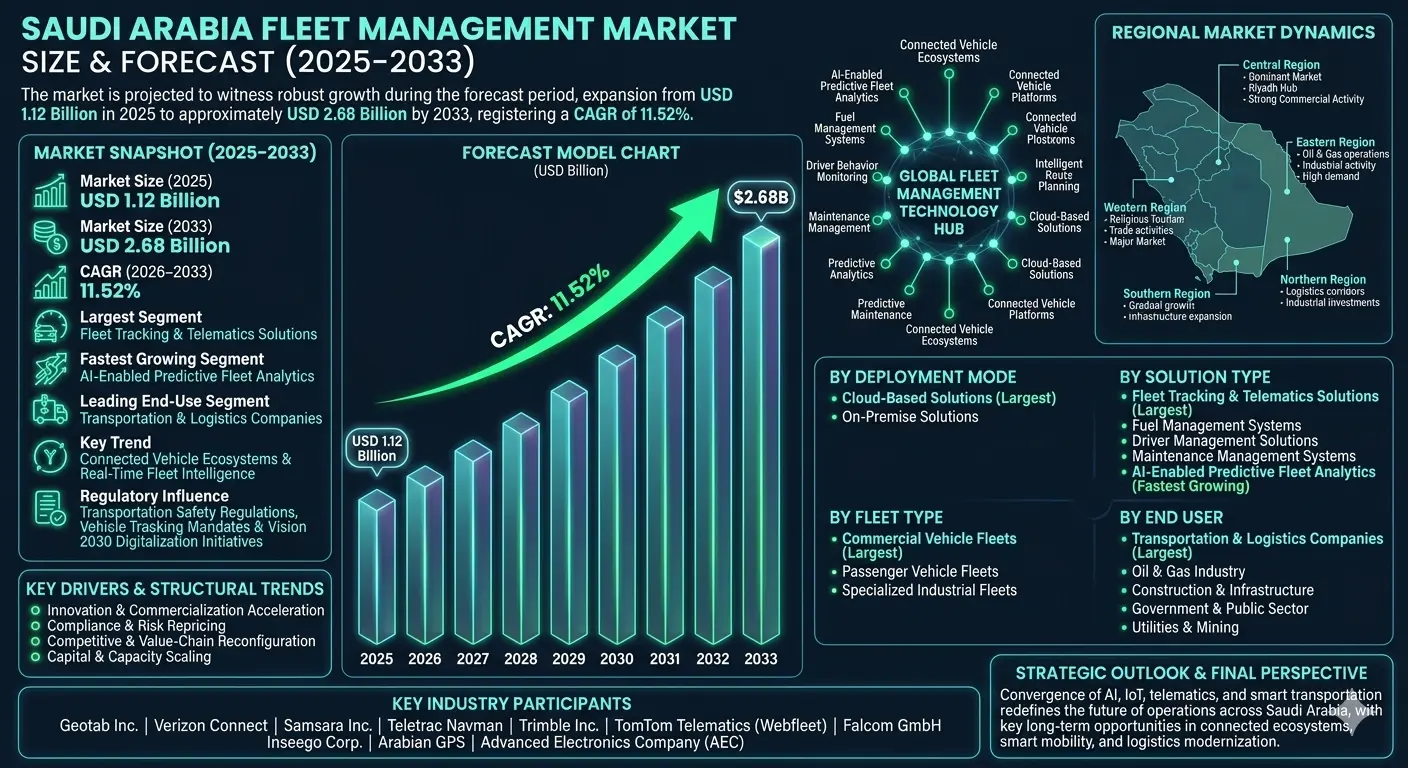
Saudi Arabia Fleet Management Market??Size & Forecast
The Saudi Arabia Fleet Management Market is expected to witness robust growth during the forecast period from 2026 to 2033. The market was valued at USD 1.12 billion in 2025 and is projected to reach approximately USD 2.68 billion by 2033, registering a CAGR of 11.52%. The market growth is primarily driven by the rapid expansion of transportation and logistics activities, increasing adoption of connected vehicle technologies, growing demand for operational efficiency, and government-led digital transformation initiatives under Vision 2030. Fleet management solutions are becoming increasingly essential for vehicle tracking, fuel management, driver monitoring, route optimization, maintenance scheduling, and regulatory compliance across commercial vehicle fleets. In addition, the growth of e-commerce, infrastructure development projects, and smart city initiatives is supporting long-term market expansion.Saudi Arabia Fleet Management Market Overview
Fleet management refers to the use of software, telematics, analytics, and connected technologies to monitor, manage, and optimize commercial vehicle operations. The market includes fleet tracking systems, telematics platforms, fuel management solutions, driver behavior monitoring systems, maintenance management software, and predictive analytics tools. Fleet management solutions are widely utilized across logistics, transportation, construction, oil & gas, government, mining, utilities, and public transportation sectors. The market is transitioning from conventional fleet supervision toward AI-powered, cloud-connected, and data-driven fleet intelligence platforms.Structural Drivers of Market Growth
1. Innovation and Commercialization Acceleration
Rapid innovation in telematics, Internet of Things (IoT), artificial intelligence, cloud computing, and connected vehicle technologies is transforming fleet operations. Advanced analytics platforms are enabling real-time monitoring, predictive maintenance, and intelligent route planning.Market Implications
Companies investing in AI-enabled fleet optimization, connected vehicle platforms, and advanced telematics solutions are expected to strengthen market leadership.2. Compliance and Risk Repricing
Transportation safety regulations, vehicle tracking requirements, driver monitoring mandates, and environmental compliance standards are influencing fleet management investments. Organizations are increasingly prioritizing operational transparency and fleet safety improvements.Market Implications
Firms offering compliant, secure, and regulatory-ready fleet management solutions are likely to gain stronger market trust.3. Competitive and Value-Chain Reconfiguration
The market is highly competitive as telematics providers, fleet software companies, transportation technology firms, and telecommunications operators expand their service portfolios. Integration of fleet management with logistics platforms, ERP systems, and smart mobility ecosystems is reshaping value-chain structures.Market Implications
Companies focusing on end-to-end fleet intelligence and integrated mobility solutions may gain stronger competitive advantages.4. Capital and Capacity Scaling
Rising investments in logistics infrastructure, smart transportation systems, connected vehicle technologies, and digital transformation programs are supporting market growth. Large-scale infrastructure and industrial projects are increasing demand for efficient fleet operations.Market Implications
Solution providers scaling advanced analytics, cloud infrastructure, and telematics capabilities are expected to capture future opportunities.Market Segmentation Analysis
By Solution Type
1. Fleet Tracking & Telematics Solutions
This remains the largest segment due to widespread demand for vehicle visibility and operational monitoring.2. Fuel Management Systems
Strong demand driven by fuel cost optimization and consumption monitoring.3. Driver Management Solutions
Growing adoption for safety improvement and compliance management.4. Maintenance Management Systems
Used for preventive maintenance scheduling and vehicle uptime optimization.5. AI-Enabled Predictive Fleet Analytics
Fastest-growing segment due to data-driven operational optimization capabilities.By Deployment Mode
1. Cloud-Based Solutions
Largest segment due to scalability, remote accessibility, and lower infrastructure requirements.2. On-Premise Solutions
Preferred by organizations requiring higher data control and customization.By Fleet Type
1. Commercial Vehicle Fleets
Largest segment due to extensive use in logistics and transportation operations.2. Passenger Vehicle Fleets
Growing demand from corporate mobility and rental service providers.3. Specialized Industrial Fleets
Strong utilization across construction, mining, and energy sectors.By End User
1. Transportation & Logistics Companies
Largest segment due to rising freight movement and supply chain optimization requirements.2. Oil & Gas Industry
Significant adoption for managing remote and large-scale vehicle operations.3. Construction & Infrastructure
Growing utilization driven by ongoing development projects.4. Government & Public Sector
Increasing deployment for public transportation and municipal fleet management.5. Utilities & Mining
Strong demand for asset monitoring and operational efficiency.Regional Market Dynamics
Central Region
The Central Region, led by Riyadh, dominates the market due to strong commercial activity, government investments, and logistics infrastructure development.Western Region
The Western Region remains a major market supported by trade activities, religious tourism transportation, and logistics operations.Eastern Region
The Eastern Region demonstrates strong demand driven by oil & gas operations, industrial activity, and fleet-intensive industries.Southern Region
The Southern Region is witnessing gradual growth due to infrastructure expansion and regional transportation development.Northern Region
The Northern Region is emerging as a growth area supported by logistics corridors and industrial investment projects.Competitive Landscape
The Saudi Arabia Fleet Management Market is highly competitive with telematics providers, fleet software developers, mobility technology companies, and telecommunications operators expanding their presence.Key Companies Operating in the Market Include:
- Geotab Inc.
- Verizon Connect
- Samsara Inc.
- Teletrac Navman
- Trimble Inc.
- TomTom Telematics (Webfleet)
- Falcom GmbH
- Inseego Corp.
- Arabian GPS
- Advanced Electronics Company (AEC)
Strategic Outlook
The future of the fleet management market will be shaped by connected vehicle ecosystems, AI-powered fleet intelligence, electric vehicle fleet integration, and predictive maintenance technologies. Real-time analytics, IoT connectivity, driver safety monitoring, and cloud-based fleet management platforms will significantly improve operational performance and cost efficiency. The rise of smart mobility initiatives, logistics modernization, and Vision 2030 digital transformation programs is expected to create strong long-term growth opportunities.Final Market Perspective
The Saudi Arabia Fleet Management Market remains a critical segment within transportation technology, logistics optimization, and smart mobility ecosystems. Rising demand for operational efficiency, fleet visibility, and digital transformation continues driving long-term market growth. Companies capable of delivering scalable, intelligent, secure, and data-driven fleet management solutions will be best positioned to capture future opportunities. The convergence of AI, IoT, telematics, and smart transportation technologies is expected to redefine the future of fleet operations across Saudi Arabia.Table of Contents
Table of Contents
- 1. Executive Summary
- 1.1 Saudi Arabia Fleet Management Market Snapshot (2025???2033)
- 1.2 Market Size & Growth Overview
- 1.3 Key Market Highlights
- 1.4 Largest & Fastest-Growing Segments
- 1.5 Regional Performance Summary
- 1.6 Competitive Landscape Overview
- 1.7 Strategic Outlook Through 2033
- 2. Market Introduction & Overview
- 2.1 Definition of Fleet Management Solutions
- 2.2 Scope of the Saudi Arabia Fleet Management Market
- 2.3 Evolution of Connected Fleet Technologies
- 2.4 Fleet Management Value Chain Analysis
- 2.5 Regulatory & Vision 2030 Framework Impact
- 2.6 Emerging Trends in Smart Mobility & Telematics
- 2.7 Digital Transformation in Transportation Sector
- 3. Research Methodology
- 3.1 Primary Research Approach
- 3.2 Secondary Research Sources
- 3.3 Market Size Estimation Methodology
- 3.4 Forecasting Assumptions (2026???2033)
- 3.5 Data Validation & Triangulation
- 4. Market Dynamics
- 4.1 Market Drivers
- 4.1.1 Expansion of Logistics & Transportation Sector
- 4.1.2 Rising Adoption of Connected Vehicle Systems
- 4.1.3 Demand for Operational Efficiency & Cost Optimization
- 4.1.4 Government-Led Digital Transformation (Vision 2030)
- 4.1.5 Growth of Smart City & Infrastructure Projects
- 4.2 Market Restraints
- 4.2.1 High Initial Deployment & Integration Costs
- 4.2.2 Data Privacy & Cybersecurity Concerns
- 4.2.3 Limited Digital Skills in Legacy Fleet Operations
- 4.3 Market Opportunities
- 4.3.1 AI-Driven Predictive Fleet Analytics
- 4.3.2 Electric Vehicle Fleet Integration
- 4.3.3 Expansion of Smart Mobility Ecosystems
- 4.3.4 Cloud-Based Fleet Management Platforms
- 4.4 Market Challenges
- 4.4.1 System Integration Complexity
- 4.4.2 Interoperability Across Fleet Technologies
- 4.4.3 Rapid Technological Obsolescence
- 4.1 Market Drivers
- 5. Saudi Arabia Fleet Management Market Size & Forecast (USD Billion), 2026???2033
- 5.1 Market Revenue Analysis
- 5.2 CAGR Analysis
- 5.3 Demand-Supply Trends
- 5.4 Pricing Analysis
- 5.5 Investment Trends
- 5.6 Future Market Outlook
- 6. Market Segmentation Analysis (USD Billion), 2026???2033
- 6.1 By Solution Type
- 6.1.1 Fleet Tracking & Telematics Solutions (Largest Segment)
- 6.1.2 Fuel Management Systems
- 6.1.3 Driver Management Solutions
- 6.1.4 Maintenance Management Systems
- 6.1.5 AI-Enabled Predictive Fleet Analytics (Fastest-Growing Segment)
- 6.2 By Deployment Mode
- 6.2.1 Cloud-Based Solutions
- 6.2.2 On-Premise Solutions
- 6.3 By Fleet Type
- 6.3.1 Commercial Vehicle Fleets
- 6.3.2 Passenger Vehicle Fleets
- 6.3.3 Specialized Industrial Fleets
- 6.4 By End User
- 6.4.1 Transportation & Logistics Companies (Largest Segment)
- 6.4.2 Oil & Gas Industry
- 6.4.3 Construction & Infrastructure
- 6.4.4 Government & Public Sector
- 6.4.5 Utilities & Mining
- 6.1 By Solution Type
- 7. Regional Market Analysis
- 7.1 Central Region
- 7.2 Western Region
- 7.3 Eastern Region
- 7.4 Southern Region
- 7.5 Northern Region
- 8. Competitive Landscape
- 8.1 Market Share Analysis
- 8.2 Competitive Benchmarking
- 8.3 Strategic Developments
- 8.4 Technology & Innovation Strategies
- 8.5 Partnerships & Expansion Activities
- 9. Company Profiles
- 9.1 Geotab Inc.
- 9.2 Verizon Connect
- 9.3 Samsara Inc.
- 9.4 Trimble Inc.
- 9.5 Teletrac Navman
- 9.6 TomTom Telematics (Webfleet)
- 9.7 Falcom GmbH
- 9.8 Inseego Corp.
- 9.9 Arabian GPS
- 9.10 Advanced Electronics Company (AEC)
- 10. Strategic Intelligence & Pheonix AI Insights
- 10.1 Fleet Demand Forecast Model
- 10.2 Smart Mobility Opportunity Analysis
- 10.3 Connected Vehicle Ecosystem Tracker
- 10.4 AI-Powered Predictive Maintenance Assessment
- 10.5 Automated Porter???s Five Forces Analysis
- 11. Future Outlook & Strategic Recommendations
- 11.1 Expansion of Smart Fleet Ecosystems
- 11.2 Investment in AI & Predictive Analytics
- 11.3 Growth of Electric & Connected Fleets
- 11.4 Cloud-Based Mobility Transformation Strategies
- 11.5 Long-Term Market Outlook (2033+)
- 12. Appendix
- 13. About Pheonix Market Research
- 14. Disclaimer
Competitive Landscape
Saudi Arabia Fleet Management Market Competitive Intensity & Market Structure Overview
The Saudi Arabia fleet management market is highly competitive and experiencing rapid transformation as transportation operators, logistics providers, industrial enterprises, and government agencies increasingly adopt connected fleet technologies. Competitive intensity is driven by technological innovation, telematics capabilities, data analytics performance, regulatory compliance, service reliability, and the ability to deliver measurable operational efficiency improvements.
The market structure consists of global telematics providers, regional fleet technology companies, telecommunications operators, vehicle tracking specialists, and software platform vendors competing to provide integrated fleet management solutions. The growing emphasis on digital transformation under Saudi Vision 2030 is encouraging market participants to expand their product portfolios and invest in advanced fleet intelligence capabilities.
Demand for real-time fleet visibility, route optimization, fuel efficiency management, driver safety monitoring, and predictive maintenance is intensifying competition across the industry. Companies are increasingly differentiating themselves through artificial intelligence, cloud-based fleet platforms, IoT-enabled vehicle connectivity, and advanced analytics solutions.
Saudi Arabia Fleet Management Market Competitive Intensity & Market Structure Current Scenario
Leading Saudi Arabia Fleet Management Companies
Geotab Inc.: Global fleet management technology provider offering advanced telematics, vehicle tracking, driver behavior monitoring, and data analytics solutions for commercial fleets.
Verizon Connect: Leading fleet and mobile workforce management company delivering connected vehicle technologies, route optimization, and real-time operational intelligence.
Samsara Inc.: Fast-growing connected operations platform specializing in AI-powered fleet management, vehicle diagnostics, safety monitoring, and cloud-based analytics.
Teletrac Navman: Established telematics provider offering fleet tracking, compliance management, maintenance monitoring, and transportation optimization solutions.
Trimble Inc.: Major transportation technology company providing fleet mobility solutions, route planning, asset tracking, and logistics management platforms.
TomTom Telematics (Webfleet): Global fleet management provider focused on connected vehicle solutions, fuel efficiency monitoring, and operational performance optimization.
Falcom GmbH: Specialized telematics and GPS tracking company offering vehicle monitoring, fleet visibility, and transportation management solutions.
Inseego Corp.: Technology company delivering IoT connectivity, fleet communication solutions, and intelligent vehicle management systems.
Arabian GPS: Regional fleet tracking and vehicle monitoring provider serving transportation, logistics, and industrial sectors across Saudi Arabia.
Advanced Electronics Company (AEC): Saudi-based technology solutions provider supporting transportation digitization, fleet intelligence, and connected mobility initiatives.
Key Competitive Intensity & Market Structure Drivers
Saudi Vision 2030 initiatives are accelerating digital transformation across transportation, logistics, and industrial sectors, increasing demand for advanced fleet management technologies.
The rapid expansion of e-commerce, logistics networks, and last-mile delivery services is intensifying competition among fleet solution providers seeking to improve operational efficiency and fleet visibility.
Transportation safety regulations, vehicle tracking mandates, and compliance requirements are encouraging organizations to adopt comprehensive fleet monitoring and driver management systems.
Growing adoption of connected vehicles, IoT-enabled telematics, and cloud-based fleet platforms is creating opportunities for technology-focused market participants to strengthen their competitive positions.
Increasing pressure to reduce fuel consumption, optimize fleet utilization, and lower operating costs is driving demand for AI-powered predictive analytics and intelligent route planning solutions.
Strategic Implications of Competitive Intensity & Market Structure
Companies investing in AI-driven fleet intelligence, predictive maintenance technologies, and real-time analytics platforms are expected to gain long-term competitive advantages as fleet digitization accelerates.
Strategic partnerships between telematics providers, telecommunications companies, logistics operators, and government entities are becoming increasingly important for expanding market reach and service capabilities.
Cloud-native fleet management platforms capable of integrating telematics, compliance management, driver safety monitoring, and maintenance optimization are expected to attract stronger enterprise adoption.
Localization of services, regional support capabilities, and alignment with Saudi regulatory requirements are emerging as important differentiators for both international and domestic providers.
Organizations offering integrated mobility ecosystems that combine fleet management, asset tracking, logistics optimization, and operational intelligence are likely to strengthen customer retention and recurring revenue opportunities.
Saudi Arabia Fleet Management Market Competitive Intensity & Market Structure Forward Outlook
The Saudi Arabia fleet management market is expected to become increasingly technology-driven as connected vehicle adoption, logistics modernization, and smart transportation initiatives continue to expand. Competitive intensity will rise as organizations seek more advanced solutions for operational efficiency, compliance, and fleet intelligence.
Future competition will be shaped by artificial intelligence, machine learning, IoT connectivity, predictive maintenance, electric vehicle fleet integration, and autonomous fleet management capabilities. Vendors that successfully integrate these technologies into scalable platforms will be well-positioned for growth.
The transportation and logistics sector is expected to remain the largest source of demand, while construction, oil & gas, utilities, and government fleet operators will continue expanding investments in digital fleet management solutions.
Over the forecast period, companies that effectively combine technological innovation, regulatory compliance, local market expertise, and end-to-end fleet optimization capabilities will be best positioned to capture value within Saudi Arabia’s rapidly evolving fleet management ecosystem.
Value Chain
Saudi Arabia Fleet Management Market Value Chain & Supply Chain Evolution Overview
The Saudi Arabia Fleet Management Market is undergoing rapid transformation driven by logistics sector expansion, smart mobility initiatives, connected vehicle adoption, and Vision 2030 digitalization programs. The market???s value chain is characterized by a technology-centric ecosystem integrating telematics hardware providers, IoT connectivity networks, software developers, cloud infrastructure providers, analytics platforms, fleet operators, and mobility service providers. This interconnected framework is reshaping fleet visibility, operational efficiency, regulatory compliance, and transportation management across the Kingdom.
A defining feature of this value chain is the convergence of telematics, artificial intelligence, cloud computing, and connected vehicle technologies. Modern fleet management solutions increasingly integrate GPS tracking, real-time vehicle diagnostics, predictive maintenance analytics, driver behavior monitoring, fuel optimization systems, and AI-powered route planning to improve operational performance and reduce costs.
Supply chain complexity continues to increase due to the integration of hardware devices, telecommunications infrastructure, cloud platforms, cybersecurity requirements, and regulatory compliance standards. Market participants must coordinate across sensor manufacturing, software development, connectivity services, installation networks, system integration, and after-sales support while ensuring scalability, reliability, and data security.
Companies are increasingly investing in AI-enabled fleet intelligence platforms, cloud-native fleet management software, IoT-enabled vehicle monitoring systems, and advanced analytics capabilities. The value chain is evolving into a digitally connected, data-driven, and service-oriented ecosystem focused on operational optimization, safety enhancement, and real-time decision-making.
Saudi Arabia Fleet Management Market Value Chain & Supply Chain Evolution Current Scenario
Market-Specific Value Chain
- Hardware & Component Sourcing: GPS modules, telematics control units, IoT sensors, onboard diagnostics (OBD) devices, cameras, fuel monitoring devices, and communication hardware.
- Manufacturing & Device Assembly: Telematics device manufacturing, sensor integration, vehicle tracking equipment assembly, testing, and certification.
- Software Development & Technology Integration: Fleet management software, AI-powered analytics platforms, cloud-based monitoring systems, route optimization tools, predictive maintenance solutions, and driver management applications.
- Connectivity & Infrastructure Services: Cellular network providers, satellite communication services, cloud hosting platforms, cybersecurity systems, and data management infrastructure.
- Regulatory & Compliance Management: Transportation safety compliance, vehicle tracking mandates, fleet reporting requirements, cybersecurity standards, and digital governance frameworks.
- Distribution & System Deployment: Technology integrators, telecom operators, fleet solution providers, vehicle dealerships, and enterprise software implementation partners.
- End User Utilization: Transportation & logistics companies, oil & gas operators, construction firms, government agencies, utilities, mining companies, and public transportation operators.
Company-to-Stage Mapping
- Hardware & Component Sourcing: GPS device manufacturers, IoT sensor suppliers, telecommunications equipment providers.
- Manufacturing & Device Assembly: Geotab Inc., Falcom GmbH, Inseego Corp.
- Software Development & Technology Integration: Samsara Inc., Verizon Connect, Trimble Inc., Teletrac Navman, Webfleet.
- Connectivity & Infrastructure Services: Saudi telecommunications providers, cloud infrastructure vendors, managed connectivity service providers.
- Regulatory & Compliance Management: Saudi transport authorities, cybersecurity regulators, vehicle safety compliance agencies.
- Distribution & System Deployment: Arabian GPS, Advanced Electronics Company (AEC), fleet technology integrators, telecom operators.
- End User Utilization: Logistics companies, transportation fleets, oil & gas operators, construction contractors, government fleet operators, utilities, and mining organizations.
Key Value Chain & Supply Chain Evolution Signals in Saudi Arabia Fleet Management Market
Expansion of Connected Vehicle Ecosystems
Connected vehicle technologies are becoming central to fleet operations, enabling real-time monitoring, vehicle diagnostics, and intelligent transportation management.
Growth of AI-Driven Fleet Intelligence
Artificial intelligence and predictive analytics are increasingly being deployed to optimize routes, improve fuel efficiency, reduce downtime, and enhance operational decision-making.
Rising Adoption of Cloud-Based Fleet Platforms
Cloud-native solutions are improving scalability, remote accessibility, centralized fleet visibility, and integration across multiple operational locations.
Increasing Regulatory Focus on Fleet Monitoring
Vehicle tracking mandates, driver safety regulations, and transportation compliance requirements are accelerating adoption of advanced fleet management systems.
Integration with Smart Mobility & Logistics Networks
Fleet management platforms are increasingly connecting with logistics management systems, ERP platforms, smart city infrastructure, and transportation ecosystems.
Emergence of Electric & Sustainable Fleet Technologies
Growing interest in fleet electrification and sustainable transportation initiatives is creating opportunities for advanced monitoring and energy management solutions.
Strategic Implications of Value Chain & Supply Chain Evolution
Investment in AI & Predictive Analytics Capabilities
Companies integrating predictive maintenance, intelligent route planning, and AI-driven operational analytics will strengthen long-term competitive positioning.
Expansion of Cloud-Based Service Models
Cloud deployment is becoming critical for scalability, multi-site fleet management, and real-time operational visibility.
Optimization of Connectivity Infrastructure
Reliable telecommunications networks and secure data transmission capabilities are becoming essential components of modern fleet management ecosystems.
Strengthening Compliance & Cybersecurity Frameworks
As fleet operations become increasingly connected, robust cybersecurity and regulatory compliance capabilities are critical for customer trust and operational continuity.
Development of Integrated Mobility Platforms
Combining fleet management with logistics, asset tracking, workforce management, and mobility services will create stronger customer value propositions.
Localization & Strategic Partnership Expansion
Partnerships with local technology providers, telecom operators, and transportation stakeholders are improving deployment efficiency and market reach across Saudi Arabia.
Saudi Arabia Fleet Management Market Value Chain & Supply Chain Evolution Forward Outlook
Looking ahead, the value chain is expected to evolve into a highly connected, AI-powered, and smart mobility-driven ecosystem.
Key Future Developments Include:
- Expansion of AI-enabled predictive fleet analytics and automated decision-support systems.
- Increased adoption of connected vehicle technologies and real-time fleet intelligence platforms.
- Growth of cloud-native fleet management ecosystems integrated with enterprise software platforms.
- Integration of electric vehicle fleet monitoring and energy management solutions.
- Expansion of IoT-enabled maintenance management and vehicle health diagnostics systems.
- Growing deployment of smart mobility infrastructure aligned with Saudi Vision 2030 initiatives.
As the market evolves, competitive advantage will increasingly depend on the ability to combine advanced telematics, AI-driven analytics, cloud scalability, cybersecurity, and regulatory compliance into unified fleet management ecosystems.
Companies that successfully integrate connected vehicle technologies, predictive maintenance intelligence, real-time operational analytics, and scalable cloud infrastructure will achieve superior customer value, operational efficiency, and long-term competitive positioning in the Saudi Arabia Fleet Management Market.
Investment Activity
Saudi Arabia Fleet Management Market Investment & Funding Dynamics Overview
The Saudi Arabia Fleet Management Market is witnessing significant investment activity driven by rapid logistics expansion, increasing adoption of connected vehicle technologies, rising demand for operational efficiency, and ongoing digital transformation initiatives under Saudi Vision 2030. Telematics providers, mobility technology companies, transportation operators, software developers, telecommunications firms, and institutional investors are actively investing in fleet intelligence platforms, AI-powered analytics systems, cloud-based fleet management solutions, IoT-enabled vehicle monitoring technologies, and smart mobility infrastructure.
Investment momentum is accelerating as organizations seek to optimize fleet utilization, improve vehicle visibility, enhance driver safety, and reduce operational costs. Market participants are allocating capital toward real-time telematics systems, predictive maintenance technologies, fuel management solutions, route optimization platforms, and connected transportation ecosystems.
Additionally, expanding investments in smart city initiatives, intelligent transportation networks, electric vehicle fleet integration, advanced analytics platforms, and digital logistics infrastructure are creating strong long-term growth opportunities across Saudi Arabia.
Saudi Arabia Fleet Management Market Investment & Funding Dynamics Current Scenario
Currently, the market is experiencing robust capital deployment as public and private sector organizations accelerate investments in fleet modernization and digital mobility solutions. Leading market participants are investing heavily in AI-enabled predictive fleet analytics, cloud-based telematics platforms, driver behavior monitoring technologies, automated maintenance management systems, and integrated fleet intelligence solutions.
The market is attracting increasing funding into fleet technology startups, mobility software developers, telematics innovators, logistics technology providers, and connected transportation solution companies. Strategic investors are focusing on technologies that improve fleet productivity, compliance management, operational transparency, and cost optimization.
Furthermore, the industry is witnessing active strategic partnerships, mergers, acquisitions, and technology collaborations among fleet management providers, telecommunications operators, logistics companies, and government stakeholders to accelerate digital transformation and service innovation.
Key Investment & Funding Dynamics Signals in Saudi Arabia Fleet Management Market
- Growing demand for fleet tracking and telematics solutions is accelerating investment in connected vehicle technologies.
- Expansion of transportation, logistics, and e-commerce activities is increasing capital deployment across fleet optimization platforms.
- Rising adoption of AI-powered predictive maintenance and analytics systems is driving technology-focused investments.
- Strategic investments in IoT-enabled fleet monitoring and real-time vehicle intelligence are enhancing operational visibility.
- Increasing emphasis on driver safety, fuel efficiency, and regulatory compliance is strengthening investor confidence.
- Partnerships between mobility technology providers, telecommunications companies, logistics operators, and government agencies are improving ecosystem scalability.
- Growing focus on smart mobility initiatives and digital transportation infrastructure is supporting long-term funding activity.
Strategic Implications of Investment & Funding Dynamics in Saudi Arabia Fleet Management Market
- Continuous investment in AI-driven fleet intelligence and connected vehicle ecosystems is essential for maintaining competitive differentiation.
- Capital allocation toward cloud-based fleet platforms, predictive analytics, and digital mobility infrastructure will strengthen market positioning.
- Companies offering integrated, scalable, and data-driven fleet management solutions are expected to achieve stronger market adoption.
- Strategic acquisitions and technology partnerships will accelerate innovation, market expansion, and operational capabilities.
- Investments in electric vehicle fleet management, smart transportation technologies, and intelligent logistics platforms will remain major growth priorities.
- Compliance with transportation safety regulations, vehicle tracking mandates, and operational governance requirements will continue influencing investment decisions.
- Organizations developing comprehensive fleet intelligence ecosystems aligned with Vision 2030 objectives are expected to capture substantial future opportunities.
Saudi Arabia Fleet Management Market Investment & Funding Dynamics Forward Outlook
Looking ahead, the Saudi Arabia Fleet Management Market is expected to maintain strong investment growth driven by logistics modernization, infrastructure expansion, smart mobility development, and increasing adoption of digital fleet technologies.
Future capital deployment will increasingly focus on AI-powered fleet optimization, connected vehicle ecosystems, predictive maintenance platforms, electric fleet integration technologies, autonomous mobility support systems, and cloud-based transportation management solutions.
As organizations continue prioritizing operational efficiency, real-time visibility, and intelligent asset management, investment activity is expected to expand across advanced telematics, mobility analytics, and digital transportation infrastructure.
In conclusion, the Saudi Arabia Fleet Management Market represents a high-growth mobility technology investment landscape where AI, IoT, telematics, smart transportation systems, and Vision 2030-driven digital transformation initiatives will define future funding priorities, innovation strategies, and long-term market expansion.
Technology & Innovation
Saudi Arabia Fleet Management Market Technology & Innovation Landscape Overview
The Saudi Arabia fleet management market is undergoing significant technological transformation driven by advancements in telematics platforms, AI-powered fleet analytics, IoT-enabled vehicle monitoring, cloud-based fleet management systems, and connected mobility technologies. As transportation networks expand under Vision 2030, organizations are increasingly adopting digital solutions to improve operational efficiency, vehicle utilization, safety, and regulatory compliance.
Modern fleet management ecosystems increasingly integrate GPS tracking systems, real-time vehicle diagnostics, predictive maintenance technologies, driver behavior monitoring platforms, and cloud-connected fleet control centers to enhance fleet visibility and reduce operational costs. These innovations are enabling businesses to optimize routes, improve fuel efficiency, and maximize vehicle uptime.
The market is also witnessing strong adoption of AI-driven predictive analytics, advanced telematics hardware, vehicle-to-cloud communication systems, and automated fleet reporting solutions, which are improving decision-making capabilities and supporting data-driven fleet operations across logistics, transportation, construction, and energy sectors.
Saudi Arabia Fleet Management Market Technology & Innovation Current Scenario
Current innovation in the Saudi Arabia fleet management market is primarily centered around connected vehicle intelligence, operational automation, and predictive fleet optimization. Organizations are increasingly transitioning from traditional fleet supervision methods toward digitally connected and analytics-driven fleet ecosystems.
Telematics and GPS tracking technologies are being widely deployed to provide real-time vehicle visibility, route optimization, fuel consumption monitoring, and fleet performance analytics.
AI-powered predictive maintenance systems are enabling fleet operators to identify potential mechanical issues before failures occur, reducing maintenance costs and minimizing vehicle downtime.
Driver monitoring and safety management solutions are increasingly being implemented to improve driver behavior, reduce accident risks, and ensure compliance with transportation safety regulations.
Cloud-based fleet management platforms are streamlining fleet administration by centralizing vehicle data, maintenance records, compliance reporting, and operational workflows.
Additionally, IoT-enabled vehicle sensors and advanced analytics platforms are improving asset utilization, fuel efficiency, and overall fleet productivity across commercial operations.
Key Technology & Innovation Trends in Saudi Arabia Fleet Management Market
- Advanced Telematics Systems: Real-time vehicle tracking, diagnostics, and fleet performance monitoring.
- AI-Powered Predictive Analytics: Data-driven maintenance forecasting and operational optimization.
- IoT-Based Vehicle Monitoring: Continuous tracking of vehicle health, fuel usage, and performance metrics.
- Cloud Fleet Management Platforms: Centralized fleet administration and remote operational control.
- Driver Behavior Analytics: Monitoring driving patterns to improve safety and compliance.
- Automated Route Optimization: Intelligent route planning to reduce fuel costs and improve delivery efficiency.
- Fleet Maintenance Automation: Digital scheduling and predictive service management solutions.
- Connected Vehicle Ecosystems: Vehicle-to-cloud and vehicle-to-platform communication technologies.
- Electric Fleet Integration: Fleet management systems supporting electric vehicle monitoring and charging optimization.
- Smart Mobility Integration: Connecting fleet operations with broader transportation and logistics ecosystems.
Strategic Implications of Technology & Innovation
Technological advancements are reshaping the Saudi Arabia fleet management industry by transitioning it from conventional vehicle tracking operations into a data-driven, connected, and intelligence-powered mobility ecosystem.
Companies investing in AI-enabled analytics, telematics innovation, and cloud-based fleet intelligence platforms are strengthening their competitive positioning through improved fleet visibility, cost optimization, and operational efficiency.
The convergence of artificial intelligence, IoT connectivity, and predictive analytics is enabling more proactive fleet management strategies, enhancing vehicle reliability and driver safety.
Automation and real-time monitoring systems are improving scalability while reducing fuel consumption, maintenance expenses, operational disruptions, and compliance risks.
However, cybersecurity concerns, integration complexity, data management challenges, and the need for continuous technology upgrades remain key barriers to large-scale digital transformation across fleet operations.
Saudi Arabia Fleet Management Market Technology & Innovation Forward Outlook
The future of the Saudi Arabia fleet management market is expected to evolve toward fully connected, AI-driven, and predictive fleet intelligence ecosystems supported by cloud computing, IoT infrastructure, and smart mobility technologies.
Emerging innovations include autonomous fleet monitoring systems, AI-powered logistics optimization platforms, digital twin technologies for fleet operations, and advanced electric vehicle fleet management solutions.
Adoption of connected transportation technologies is expected to accelerate significantly as logistics modernization, e-commerce growth, and Vision 2030 infrastructure initiatives continue expanding across the Kingdom.
The integration of fleet management platforms with smart city infrastructure, transportation networks, and enterprise resource planning systems will further enhance operational visibility, asset utilization, and decision-making capabilities.
Overall, the Saudi Arabia fleet management market is evolving into a highly digitalized ecosystem where artificial intelligence, telematics, IoT connectivity, predictive analytics, and smart mobility solutions collectively redefine fleet operations, transportation efficiency, and logistics management.
Market Risk
Risk Analysis ??? Saudi Arabia Fleet Management Market
The Saudi Arabia Fleet Management Market presents significant growth opportunities; however, several operational, regulatory, technological, and economic risks may influence market performance during the forecast period.
1. Data Security and Cybersecurity Risks
Fleet management platforms rely heavily on connected vehicles, cloud-based systems, telematics devices, and real-time data transmission. Cyberattacks, unauthorized access, ransomware incidents, and data breaches could compromise fleet operations, customer information, and business continuity.
2. Regulatory and Compliance Challenges
Changes in transportation regulations, vehicle tracking mandates, data privacy requirements, driver monitoring laws, and environmental compliance standards may increase implementation costs and create operational complexities for fleet operators and solution providers.
3. High Implementation and Integration Costs
Deploying advanced fleet management systems often requires investments in telematics hardware, software subscriptions, connectivity infrastructure, training programs, and system integration. Cost-sensitive organizations may delay adoption, particularly among small and medium-sized fleet operators.
4. Connectivity and Infrastructure Limitations
Although Saudi Arabia is investing heavily in digital infrastructure, fleet operations in remote industrial, mining, and oil & gas locations may face network coverage limitations, reducing the effectiveness of real-time monitoring and analytics solutions.
5. Technology Adoption and Workforce Resistance
Successful deployment of AI-driven fleet solutions requires organizational readiness and user acceptance. Resistance from drivers and fleet personnel, combined with limited digital skills, may slow implementation and reduce expected efficiency gains.
6. Economic and Fuel Price Volatility
Fluctuations in fuel prices, transportation demand, and broader economic conditions may impact fleet expansion plans and technology investment decisions. Economic uncertainty can lead organizations to postpone fleet modernization initiatives.
7. Dependence on Third-Party Technology Providers
Fleet operators increasingly depend on telematics vendors, cloud service providers, connectivity partners, and software developers. Service disruptions, vendor failures, or technology compatibility issues may negatively affect operational performance.
8. Competitive Market Pressure
The growing number of domestic and international fleet technology providers is intensifying market competition. Pricing pressure, rapid technological innovation, and evolving customer expectations may impact profitability and market positioning.
9. AI and Predictive Analytics Accuracy Risks
AI-enabled fleet intelligence solutions depend on high-quality data and accurate algorithms. Inaccurate predictions, system errors, or poor data quality could result in inefficient route planning, maintenance scheduling issues, and operational disruptions.
10. Supply Chain and Hardware Availability Risks
Fleet management solutions require sensors, telematics devices, communication modules, and related hardware. Global supply chain disruptions, semiconductor shortages, or logistics delays may impact deployment timelines and project execution.
Conclusion
While the Saudi Arabia Fleet Management Market is positioned for strong growth due to logistics expansion, smart mobility initiatives, and Vision 2030 digital transformation efforts, market participants must effectively address cybersecurity concerns, regulatory changes, technology adoption barriers, and infrastructure-related challenges to sustain long-term growth and competitiveness.
Regulatory Landscape
Saudi Arabia Fleet Management Market Regulatory & Policy Environment Overview
The regulatory and policy environment governing the Saudi Arabia Fleet Management Market is evolving rapidly as the Kingdom accelerates transportation modernization, logistics sector development, road safety enhancement, and digital transformation initiatives under Vision 2030. Government authorities are increasingly focusing on improving fleet efficiency, transportation safety, vehicle visibility, environmental sustainability, and operational transparency across commercial transportation networks.
Fleet operators, logistics companies, transportation service providers, and technology vendors must comply with a range of regulations covering vehicle tracking, driver safety, fleet monitoring, road transport operations, data security, and commercial vehicle compliance. These regulatory frameworks are creating favorable conditions for the adoption of advanced fleet management technologies throughout the Kingdom.
As Saudi Arabia continues investing in smart mobility infrastructure, intelligent transportation systems, and logistics hub development, regulatory authorities are encouraging greater deployment of telematics, connected vehicle technologies, and digital fleet monitoring solutions to improve transportation performance and regulatory compliance.
Saudi Arabia Fleet Management Market Regulatory & Policy Environment Current Scenario
The current regulatory landscape is strongly influenced by Saudi Arabia???s Vision 2030 strategy, which prioritizes digital transformation, logistics competitiveness, transportation efficiency, and smart infrastructure development. Government initiatives aimed at strengthening the Kingdom???s position as a global logistics hub are increasing demand for advanced fleet visibility and management capabilities.
Transportation safety regulations continue to play a central role in market development. Regulatory agencies are encouraging fleet operators to implement technologies that improve driver behavior monitoring, accident prevention, vehicle maintenance management, and operational accountability.
Vehicle tracking and telematics adoption are expanding across commercial transportation segments as organizations seek to comply with monitoring requirements while improving route optimization, fuel efficiency, and asset utilization. These technologies are becoming increasingly important for fleet operators managing large and geographically dispersed vehicle networks.
Environmental sustainability objectives are also influencing fleet modernization strategies. Fleet operators are gradually adopting technologies that support fuel consumption optimization, emissions monitoring, preventive maintenance, and future integration of electric and low-emission vehicles.
At the same time, growing digitization of transportation operations is increasing attention toward cybersecurity, data protection, and secure management of connected vehicle information generated through telematics and fleet analytics platforms.
Key Regulatory & Policy Environment Signals in Saudi Arabia Fleet Management Market
- Vision 2030 Digital Transformation Initiatives: Government programs promoting smart transportation, logistics modernization, and digital fleet operations.
- Transportation Safety Regulations: Enhanced focus on driver safety, vehicle monitoring, accident reduction, and operational compliance.
- Vehicle Tracking & Telematics Requirements: Increasing adoption of real-time fleet visibility and monitoring technologies across commercial fleets.
- Logistics Sector Development Programs: National investments supporting supply chain efficiency, transportation optimization, and logistics infrastructure growth.
- Environmental Sustainability Objectives: Encouragement of fuel efficiency improvements, emissions monitoring, and cleaner transportation technologies.
- Cybersecurity & Data Governance Requirements: Growing emphasis on protecting connected vehicle data and digital fleet management systems.
Strategic Implications of Regulatory & Policy Environment
The evolving regulatory landscape is encouraging fleet operators to accelerate investments in telematics, AI-powered analytics, cloud-based fleet platforms, and connected vehicle technologies. Regulatory compliance is increasingly becoming a strategic driver of digital fleet transformation rather than simply an operational requirement.
Transportation safety regulations are creating strong demand for driver monitoring solutions, maintenance management systems, vehicle diagnostics technologies, and predictive fleet intelligence tools capable of reducing operational risks and improving compliance outcomes.
Government-backed logistics expansion initiatives are increasing opportunities for fleet technology providers that can deliver scalable solutions supporting freight optimization, route planning, asset tracking, and supply chain visibility.
The increasing importance of data-driven transportation management is also encouraging integration between fleet management systems, logistics platforms, ERP solutions, and smart mobility ecosystems. Vendors offering interoperable and highly connected solutions are expected to gain competitive advantages.
Overall, organizations capable of aligning their technology offerings with transportation modernization goals, safety requirements, and digital transformation priorities are likely to strengthen their market position and expand long-term growth opportunities.
Saudi Arabia Fleet Management Market Regulatory & Policy Environment Forward Outlook
Between 2026 and 2033, the regulatory environment is expected to become increasingly supportive of connected transportation ecosystems, intelligent logistics operations, and AI-enabled fleet optimization. Government investments in smart city development and transportation infrastructure are likely to further accelerate fleet technology adoption.
Vehicle tracking, telematics integration, and real-time fleet monitoring capabilities are expected to become more deeply embedded within transportation management frameworks as authorities pursue greater operational transparency and efficiency across commercial transportation networks.
Sustainability initiatives may encourage broader adoption of fleet optimization technologies, fuel management systems, electric vehicle fleet integration solutions, and emissions reduction programs. Environmental performance monitoring is likely to become a more important component of fleet operations.
Advancements in artificial intelligence, IoT connectivity, predictive maintenance, and intelligent transportation systems are expected to support more sophisticated regulatory oversight while improving operational productivity for fleet operators.
Overall, the regulatory and policy environment will remain a major catalyst for market growth. Companies capable of delivering secure, compliant, data-driven, and future-ready fleet management solutions aligned with Vision 2030 objectives will be best positioned to capitalize on the long-term expansion of Saudi Arabia???s transportation and logistics ecosystem.