
Global Nanotechnology Market Size and Share Analysis 2026-2033
Global Nanotechnology Market Size & Forecast
The global nanotechnology market is projected to witness robust expansion during the forecast period from 2026 to 2033. The market was valued at approximately USD 85.4 billion in 2025 and is expected to reach nearly USD 210.6 billion by 2033, expanding at a CAGR of around 12.1%. The market growth is driven by rapid advancements in material science, increasing adoption in healthcare and electronics, rising demand for miniaturized devices, and expanding applications across energy, defense, and environmental technologies. Nanotechnology involves the manipulation of matter at the nanoscale (1???100 nanometers) to develop materials, devices, and systems with enhanced physical, chemical, and biological properties. It is a foundational enabling technology used across multiple industries including medicine, electronics, energy, and manufacturing. The market is experiencing strong momentum due to increasing R&D investments, growing commercialization of nanomaterials, and rising integration of nanotechnology into next-generation product development.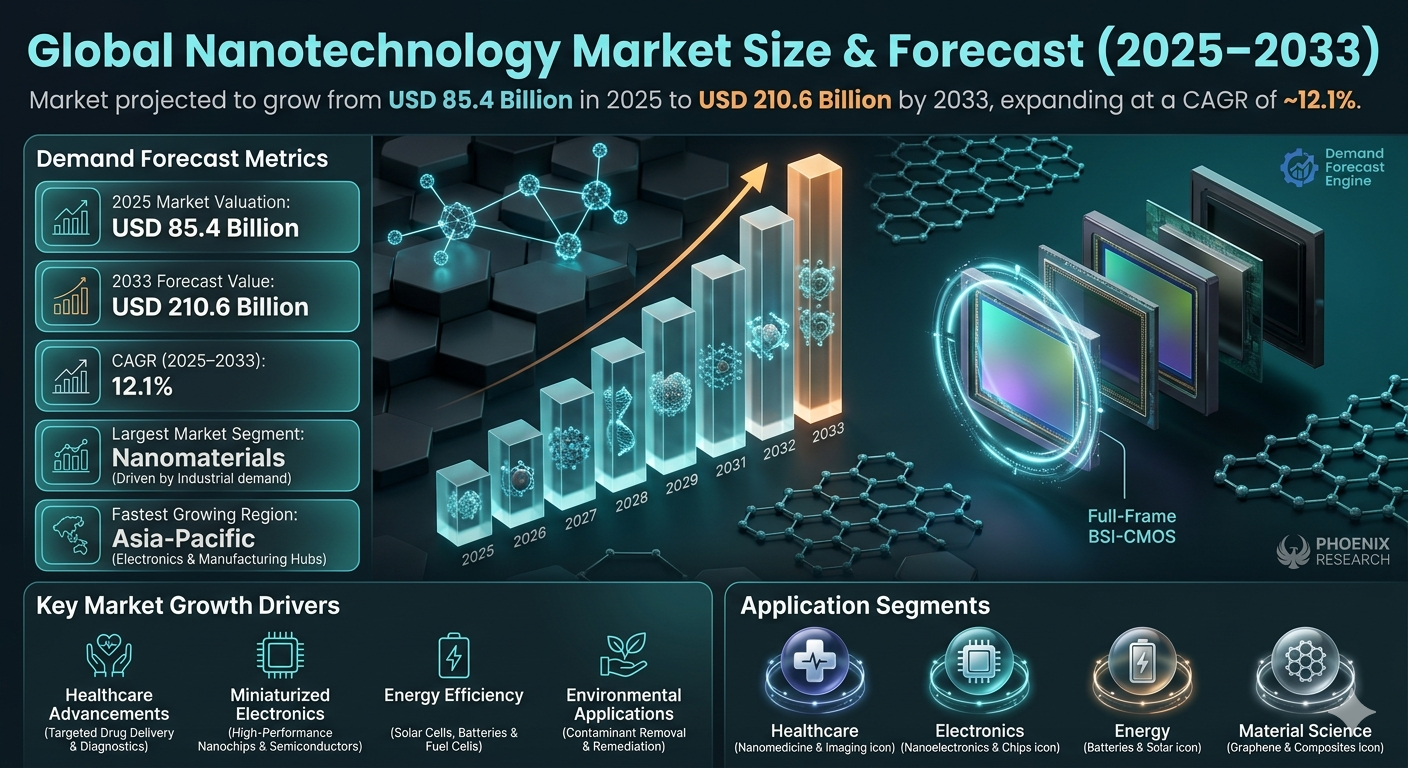
Global Nanotechnology Market Overview
The nanotechnology market is a key segment of advanced materials science and emerging technologies. It includes the development and commercialization of nanomaterials, nanodevices, nanosensors, and nano-enabled systems. The market is widely applied across healthcare (nanomedicine, drug delivery systems), electronics (nanochips, semiconductors), energy (solar cells, batteries), environmental applications (water purification, pollution control), and industrial manufacturing (coatings, catalysts). Technological breakthroughs in quantum dots, carbon nanotubes, graphene, nanorobotics, and nanocomposites are accelerating innovation across industries. Governments and private institutions are heavily investing in nanotechnology research programs to improve material performance, enhance energy efficiency, and develop advanced medical treatments. Major market participants include IBM Corporation, Thermo Fisher Scientific, Bruker Corporation, Nanoco Group, Cabot Corporation, NanoXplore, Applied Materials Inc., LG Chem, Bayer AG, and Oxford Instruments.Key Drivers of Global Nanotechnology Market Growth
Rapid Growth in Healthcare Applications
Nanotechnology is revolutionizing healthcare through targeted drug delivery systems, cancer therapy, diagnostic imaging, and regenerative medicine. Nanomedicine enables precise treatment with reduced side effects, significantly improving patient outcomes.Expansion of Electronics and Semiconductor Industry
The increasing demand for miniaturized, high-performance electronic devices is driving adoption of nanomaterials in chip manufacturing and advanced semiconductors. Nano-scale components enhance processing speed, energy efficiency, and device performance.Rising Demand for Energy-Efficient Solutions
Nanotechnology is widely used in improving solar panels, battery storage systems, and fuel cells. Nanomaterials enhance energy conversion efficiency and support renewable energy adoption.Growth of Environmental Applications
Nanotechnology is increasingly used in water purification, air filtration, pollution control, and environmental remediation. Nano-filters and nanocatalysts help remove contaminants at extremely high efficiency levels.Increasing R&D Investments and Government Support
Global governments are heavily funding nanotechnology research initiatives to accelerate innovation and commercialization. Public-private partnerships are playing a critical role in advancing nano-enabled technologies.Global Nanotechnology Market Segmentation
By Type
The market includes nanomaterials, nanodevices, nanosensors, nanocomposites, and nano tools. Nanomaterials account for the largest share due to widespread industrial usage.By Application
Applications include healthcare, electronics, energy, aerospace & defense, environment, textiles, and food & agriculture. Healthcare and electronics dominate the market due to high-value applications and continuous innovation.By Material Type
The market includes carbon-based nanomaterials (graphene, carbon nanotubes), metal-based nanoparticles, polymer-based nanomaterials, and semiconductor nanomaterials. Carbon-based nanomaterials are witnessing strong demand due to superior strength and conductivity properties.By End User
End users include pharmaceutical companies, electronics manufacturers, energy companies, research institutions, defense organizations, and industrial manufacturers. Pharmaceutical and electronics industries are the largest end-user segments globally.Regional Market Dynamics
North America
North America holds a significant share of the nanotechnology market due to strong R&D infrastructure, advanced healthcare systems, and high adoption of cutting-edge technologies. The United States leads in nanotechnology research and commercialization supported by government funding and private sector innovation.Europe
Europe is a major market driven by strong research initiatives, regulatory frameworks, and industrial applications in healthcare, energy, and automotive sectors. Germany, France, the United Kingdom, and Switzerland are key contributors.Asia-Pacific
Asia-Pacific is the fastest-growing region due to rapid industrialization, expanding electronics manufacturing, and increasing government investments in advanced technologies. China, Japan, South Korea, and India are leading contributors to nanotechnology research and production.Latin America
Latin America is gradually emerging with increasing adoption in healthcare, agriculture, and environmental applications. Brazil and Mexico are leading regional markets.Middle East & Africa
The region is witnessing early-stage adoption supported by investments in research, healthcare modernization, and energy diversification initiatives.Competitive Landscape
The global nanotechnology market is highly innovative and research-intensive, with participation from multinational corporations, research institutes, and specialized nanotech companies. Key players include IBM Corporation, Thermo Fisher Scientific, Bruker Corporation, Applied Materials Inc., Cabot Corporation, LG Chem, Bayer AG, Oxford Instruments, NanoXplore, and Nanoco Group. Companies are focusing on advanced material development, nanomedicine innovation, semiconductor integration, and scalable manufacturing of nanomaterials. Strategic collaborations between universities, governments, and private companies are accelerating commercialization of nanotechnology solutions.Strategic Outlook
The strategic outlook for the global nanotechnology market remains highly positive due to increasing cross-industry applications and continuous technological advancements. Future opportunities include nanorobotics, personalized medicine, advanced energy storage systems, smart materials, and next-generation semiconductor technologies. Integration of AI with nanotechnology research is expected to accelerate material discovery and application development. Companies investing in scalable nanomanufacturing, high-performance materials, and healthcare nanotech solutions are expected to gain strong competitive advantages.Final Market Perspective
The global nanotechnology market is evolving as a foundational technology platform enabling innovation across healthcare, electronics, energy, and environmental industries. Rising demand for high-performance materials, miniaturized devices, and sustainable solutions will continue driving market expansion throughout the forecast period. Organizations that successfully integrate advanced research, industrial scalability, and cross-sector applications will remain strongly positioned in the evolving nanotechnology ecosystem.Table of Contents
Table of Contents
1. Executive Summary
- 1.1 Global Digital Camera Market Snapshot (2026???2033)
- 1.2 Market Size & CAGR Analysis
- 1.3 Key Growth Drivers & Opportunities
- 1.4 Largest & Fastest-Growing Segments
- 1.5 Regional Market Highlights
- 1.6 Competitive Landscape Overview
- 1.7 Strategic Outlook Through 2033
2. Introduction & Market Overview
- 2.1 Definition of Digital Cameras
- 2.2 Market Scope & Industry Structure
- 2.3 Global Market Size & Forecast (2026???2033)
- 2.4 Evolution of Digital Imaging Technology
- 2.5 Digital Camera Industry Ecosystem
- 2.6 Impact of AI & Computational Photography
- 2.7 Regulatory & Compliance Framework
3. Research Methodology
- 3.1 Primary Research
- 3.2 Secondary Research
- 3.3 Data Collection Techniques
- 3.4 Market Estimation Methodology
- 3.5 Forecast Assumptions (2026???2033)
- 3.6 Data Validation & Market Triangulation
4. Market Dynamics
4.1 Market Drivers
- 4.1.1 Growth of Social Media & Content Creation Industry
- 4.1.2 Increasing Demand for Professional Photography Equipment
- 4.1.3 Advancements in Imaging Sensors & AI Autofocus
- 4.1.4 Expansion of OTT Platforms & Independent Filmmaking
- 4.1.5 Rising Demand for Action & Adventure Cameras
4.2 Market Restraints
- 4.2.1 Growing Smartphone Camera Capabilities
- 4.2.2 High Cost of Professional Camera Systems
- 4.2.3 Declining Demand for Compact Cameras
- 4.2.4 Supply Chain & Semiconductor Constraints
4.3 Market Opportunities
- 4.3.1 AI-Powered Computational Photography
- 4.3.2 Expansion of Creator Economy Ecosystems
- 4.3.3 Growth in 8K & Ultra-HD Video Production
- 4.3.4 Cloud-Connected Smart Camera Platforms
4.4 Market Challenges
- 4.4.1 Intense Market Competition
- 4.4.2 Rapid Technological Obsolescence
- 4.4.3 Pricing Pressure in Consumer Segments
- 4.4.4 Managing Professional & Consumer Product Balance
5. Global Digital Camera Market Analysis (USD Billion), 2026???2033
- 5.1 Market Revenue Analysis
- 5.2 CAGR Analysis
- 5.3 Market Share Analysis
- 5.4 Regional Revenue Distribution
- 5.5 Consumer Demand Trends
- 5.6 Technology Adoption Analysis
6. Market Segmentation (USD Billion), 2026???2033
6.1 By Product Type
- 6.1.1 DSLR Cameras
- 6.1.1.1 Entry-Level DSLR Cameras
- 6.1.1.2 Professional DSLR Cameras
- 6.1.2 Mirrorless Cameras
- 6.1.2.1 Full-Frame Mirrorless Cameras
- 6.1.2.2 APS-C Mirrorless Cameras
- 6.1.3 Compact Digital Cameras
- 6.1.3.1 Point-and-Shoot Cameras
- 6.1.3.2 Travel Compact Cameras
- 6.1.4 Action Cameras
- 6.1.4.1 Waterproof Action Cameras
- 6.1.4.2 Sports & Adventure Cameras
- 6.1.5 Instant Digital Cameras
- 6.1.5.1 Consumer Instant Cameras
- 6.1.5.2 Hybrid Instant Printing Cameras
6.2 By Lens Type
- 6.2.1 Fixed-Lens Cameras
- 6.2.2 Interchangeable-Lens Cameras
6.3 By Resolution
- 6.3.1 Below 20 MP
- 6.3.2 20???40 MP
- 6.3.3 Above 40 MP
6.4 By Application
- 6.4.1 Photography
- 6.4.2 Videography
- 6.4.3 Surveillance
- 6.4.4 Media & Entertainment
- 6.4.5 Healthcare Imaging
- 6.4.6 Scientific Research
- 6.4.7 Industrial Inspection
6.5 By Distribution Channel
- 6.5.1 Online Retail
- 6.5.2 Specialty Electronics Stores
- 6.5.3 Brand Outlets
- 6.5.4 Professional Equipment Distributors
7. Market Segmentation by Geography
- 7.1 North America
- 7.2 Europe
- 7.3 Asia-Pacific
- 7.4 Latin America
- 7.5 Middle East & Africa
8. Regional Market Insights
- 8.1 North America Market Analysis
- 8.2 Europe Market Analysis
- 8.3 Asia-Pacific Market Analysis
- 8.4 Latin America Market Analysis
- 8.5 Middle East & Africa Market Analysis
9. Competitive Landscape
- 9.1 Competitive Benchmarking
- 9.2 Market Share Analysis
- 9.3 Product Innovation Strategies
- 9.4 AI & Imaging Technology Developments
- 9.5 Strategic Partnerships & Collaborations
- 9.6 Mergers, Acquisitions & Investments
10. Company Profiles
- 10.1 Canon Inc.
- 10.2 Sony Corporation
- 10.3 Nikon Corporation
- 10.4 Fujifilm Holdings Corporation
- 10.5 Panasonic Holdings Corporation
- 10.6 OM Digital Solutions
- 10.7 Leica Camera AG
- 10.8 GoPro Inc.
- 10.9 Ricoh Imaging
- 10.10 Blackmagic Design
11. Strategic Intelligence & AI Insights
- 11.1 AI-Based Imaging Technology Trends
- 11.2 Computational Photography Adoption Analysis
- 11.3 Creator Economy Demand Forecast
- 11.4 Smart Connectivity & Cloud Ecosystem Insights
- 11.5 Porter???s Five Forces Analysis
12. Future Outlook & Strategic Recommendations
- 12.1 Future of Mirrorless Camera Systems
- 12.2 Expansion of Hybrid Photo-Video Devices
- 12.3 AI-Driven Camera Ecosystem Strategies
- 12.4 Growth Opportunities in Professional Imaging
- 12.5 Long-Term Market Outlook (2033+)
13. Appendix
14. About Pheonix Research
15. Disclaimer
Competitive Landscape
Global Nanotechnology Market Competitive Intensity & Market Structure Overview
The global nanotechnology market is highly innovation-driven and moderately consolidated, with a strong presence of multinational corporations, advanced material manufacturers, semiconductor companies, and research-intensive technology firms. Competition is primarily defined by R&D intensity, intellectual property strength, material innovation capabilities, and cross-industry commercialization reach.
The market operates as a hybrid ecosystem where large industrial players dominate commercialization, while universities, government laboratories, and specialized nanotechnology startups drive early-stage innovation and material discovery. Strategic collaboration between public and private stakeholders plays a critical role in accelerating technology transfer and scaling applications.
Increasing convergence between nanotechnology and sectors such as healthcare, electronics, energy storage, and environmental engineering is intensifying competition, particularly in high-value application areas such as nanomedicine, semiconductors, and advanced energy materials.
Global Nanotechnology Market Competitive Intensity & Market Structure Current Scenario
Leading Nanotechnology & Advanced Materials Companies
IBM Corporation: A key innovator in nanoscale semiconductor research and quantum computing technologies, driving advanced applications in nanoelectronics and computational materials science.
Thermo Fisher Scientific: Major provider of nanoscale analytical instruments and research tools supporting nanomaterial characterization and life sciences applications.
Bruker Corporation: Specializes in high-precision nanoscale measurement systems and analytical solutions used in research and industrial nanotechnology development.
Applied Materials Inc.: Leading semiconductor equipment manufacturer enabling nanoscale chip fabrication and advanced material deposition technologies.
Cabot Corporation: Key producer of carbon black and advanced nanomaterials used in industrial, energy storage, and performance material applications.
LG Chem: Strong player in nanomaterials for batteries, energy storage systems, and advanced chemical applications.
Bayer AG: Active in nanomedicine research and agricultural nanotechnology applications for targeted delivery systems and crop protection.
NanoXplore: Focused on graphene-based nanomaterials used in automotive, energy, and industrial applications.
Nanoco Group: Specializes in quantum dot nanomaterials used in display technologies and advanced optical applications.
Oxford Instruments: Provides nanoscale research tools and systems supporting material science, semiconductor research, and nanofabrication processes.
Key Competitive Intensity & Market Structure Drivers
High R&D intensity is the most critical competitive factor in the nanotechnology market, with companies investing heavily in advanced material science, nanoscale engineering, and cross-disciplinary innovation to maintain technological leadership.
Intellectual property (IP) ownership and patent portfolios significantly influence market positioning, as nanotechnology applications often require long development cycles and strong protection of proprietary materials and processes.
The expanding use of nanotechnology in semiconductors and electronics is intensifying competition among material suppliers and chip manufacturers, particularly in areas such as quantum dots, graphene, and nanoscale transistors.
Healthcare nanotechnology, particularly in drug delivery systems and diagnostic imaging, is emerging as a high-growth competitive segment with strong participation from pharmaceutical and biotechnology companies.
Energy storage and environmental applications are also becoming increasingly competitive, with nanomaterials playing a critical role in next-generation batteries, solar cells, and filtration systems.
Strategic Implications of Competitive Intensity & Market Structure
Companies are increasingly adopting cross-industry collaboration models, partnering with academic institutions, government agencies, and industrial players to accelerate nanotechnology commercialization and reduce development risk.
Scalable manufacturing of nanomaterials remains a key strategic challenge, and firms investing in cost-efficient production technologies are expected to gain long-term competitive advantages.
Integration of artificial intelligence and computational modeling into nanomaterial discovery is transforming R&D efficiency, enabling faster identification of high-performance materials and reducing experimental costs.
The semiconductor industry is expected to remain one of the most competitive domains within nanotechnology, driven by continuous demand for miniaturization and performance enhancement in computing systems.
Sustainability considerations are also influencing market strategies, with increasing focus on eco-friendly nanomaterials, green synthesis methods, and environmentally safe applications.
Global Nanotechnology Market Competitive Intensity & Market Structure Forward Outlook
The nanotechnology market is expected to become increasingly integrated across multiple industries, with competition shifting from isolated material development to ecosystem-based innovation involving healthcare, electronics, energy, and environmental sectors.
Future competitive advantage will be strongly influenced by advancements in nanorobotics, AI-driven material discovery, and scalable manufacturing platforms capable of mass-producing high-precision nanomaterials.
Emerging applications in personalized medicine, smart materials, and next-generation semiconductors are expected to create new high-value competitive segments within the market.
Overall, organizations that successfully combine deep scientific research capabilities, scalable industrial production, and strong cross-sector partnerships will remain strongly positioned in the evolving global nanotechnology ecosystem.
Value Chain
Global Nanotechnology Market Value Chain & Supply Chain Evolution Overview
The global nanotechnology market value chain is evolving into a highly research-intensive, multidisciplinary, and innovation-driven ecosystem that connects advanced material science, chemical engineering, semiconductor manufacturing, healthcare technologies, and industrial applications. The industry is increasingly shifting from laboratory-scale discovery toward large-scale commercialization of nanomaterials, nanodevices, and nano-enabled systems across multiple end-use sectors.
The value chain begins with upstream raw material sourcing and basic research inputs, including high-purity metals, carbon sources, polymers, chemical precursors, and specialized substrates used in nanoscale fabrication. Universities, government research institutions, and advanced material suppliers play a foundational role in developing new nanostructures and enabling early-stage innovation.
The research and development (R&D) and material engineering segment forms the core of the nanotechnology value chain. This includes nanomaterial synthesis, molecular engineering, quantum-level manipulation, and development of nanocomposites, carbon nanotubes, graphene-based structures, and semiconductor nanomaterials. Continuous innovation in fabrication techniques such as chemical vapor deposition, lithography, self-assembly, and nano-imprinting is driving technological advancement.
The nanofabrication and manufacturing stage involves scaling laboratory discoveries into industrial-grade materials and devices. This includes production of nanocoatings, nanosensors, nanoelectronics components, drug delivery nanoparticles, and energy storage materials. Specialized manufacturing facilities ensure precision control at atomic and molecular scales to maintain product consistency and performance.
The integration and product development layer includes embedding nanotechnology into final applications such as medical devices, semiconductors, energy systems, coatings, textiles, and environmental technologies. Companies integrate nano-enabled materials into batteries, solar panels, diagnostic tools, drug formulations, and high-performance electronic devices.
Commercialization and distribution involve pharmaceutical companies, electronics manufacturers, energy firms, aerospace and defense organizations, environmental solution providers, and industrial manufacturers. Nanotechnology products are increasingly commercialized through partnerships between research institutions, startups, and large multinational corporations.
Sustainability and regulatory compliance are becoming increasingly important across the value chain. Companies are focusing on safe nanomaterial handling, toxicity assessment, environmental impact evaluation, and compliance with global regulatory frameworks governing nanomaterial usage and disposal.
Global Nanotechnology Market Value Chain & Supply Chain Evolution Current Scenario
The current nanotechnology supply chain is characterized by high R&D intensity, fragmented commercialization pathways, and strong dependency on academic-industry collaboration. Most nanotechnology innovations originate from research institutions and are gradually transitioned into industrial applications through licensing, partnerships, and venture-backed startups.
North America and Europe dominate upstream research and innovation due to strong funding ecosystems, advanced laboratories, and established scientific infrastructure. The United States leads in nanotechnology commercialization, particularly in healthcare, electronics, and defense applications.
Asia-Pacific is emerging as a major manufacturing and scaling hub, particularly in electronics, semiconductors, and industrial nanomaterials. China, Japan, South Korea, and India are investing heavily in nanotechnology-enabled industrial applications and production capabilities.
The industry is increasingly transitioning toward application-specific nanomaterials tailored for healthcare, energy storage, and semiconductor performance enhancement. This shift is driving closer collaboration between material scientists, engineers, and end-use industries.
Digital transformation is influencing research workflows through AI-assisted material discovery, computational modeling of nanoscale structures, and simulation-based testing. These technologies are accelerating innovation cycles and reducing development costs.
However, the market continues to face challenges related to high production costs, scalability limitations, regulatory uncertainty, and concerns over nanomaterial toxicity and environmental safety.
Key Value Chain & Supply Chain Evolution Signals in Global Nanotechnology Market
One of the most significant transformation signals is the increasing convergence of nanotechnology with artificial intelligence and computational materials science. AI-driven simulations are accelerating the discovery of new nanomaterials and optimizing molecular structures for specific applications.
Another key signal is the rapid expansion of nanotechnology applications in healthcare, particularly in drug delivery systems, cancer treatment, diagnostic imaging, and regenerative medicine. Nanomedicine is becoming a major commercialization pathway for the industry.
The semiconductor industry is also driving strong demand for nanoscale materials as chip manufacturing moves toward smaller nodes and higher performance architectures. Nanotechnology is essential for next-generation electronics and quantum computing development.
Energy applications are expanding rapidly, with nanomaterials improving battery efficiency, solar energy conversion, hydrogen storage, and fuel cell performance. This is aligning nanotechnology with global sustainability and clean energy goals.
Environmental applications are gaining momentum through nanofiltration systems, pollution control technologies, and advanced water purification solutions capable of removing contaminants at molecular levels.
Additionally, regulatory frameworks and safety standards for nanomaterials are becoming more defined, influencing production practices and commercialization strategies across global markets.
Strategic Implications of Value Chain & Supply Chain Evolution in Global Nanotechnology Market
The evolving value chain presents significant strategic implications for research institutions, material manufacturers, healthcare companies, electronics firms, and energy solution providers. Organizations with strong R&D capabilities and scalable manufacturing technologies are gaining competitive advantage.
Collaboration between academia, industry, and government is becoming essential for accelerating commercialization and reducing time-to-market for nanotechnology innovations. Public-private partnerships are driving large-scale research initiatives globally.
Investment in scalable nanomanufacturing technologies is a key strategic priority, as the industry transitions from experimental research to industrial-scale production of nanomaterials and nano-enabled devices.
Companies focusing on application-specific nanotechnology solutions, particularly in healthcare and semiconductors, are expected to achieve strong market positioning due to high-value demand segments.
Supply chain integration across material sourcing, R&D, manufacturing, and end-use applications is becoming increasingly important to ensure efficiency, cost control, and product consistency.
Long-term competitiveness in the nanotechnology market will depend on balancing innovation speed, safety compliance, scalability, and cross-industry application development.
Global Nanotechnology Market Value Chain & Supply Chain Evolution Forward Outlook
Between 2026 and 2033, the nanotechnology value chain is expected to become increasingly industrialized, AI-driven, and application-focused. Advanced computational tools will accelerate material discovery and optimize nanoscale engineering processes.
Nanomanufacturing technologies will evolve toward higher scalability, precision automation, and cost-efficient production methods, enabling broader commercialization across industries.
Healthcare applications will continue to expand, particularly in targeted drug delivery, personalized medicine, and regenerative therapies, positioning nanotechnology as a core pillar of next-generation medical innovation.
The semiconductor and electronics industries will increasingly rely on nanotechnology for performance enhancement, miniaturization, and energy efficiency improvements in advanced computing systems.
Environmental and energy applications will expand significantly, with nanomaterials playing a critical role in sustainability solutions, clean energy systems, and pollution mitigation technologies.
Ultimately, the future nanotechnology value chain will evolve into a deeply interconnected, highly interdisciplinary ecosystem where material science, AI, biotechnology, and engineering converge to enable transformative global innovation.
Market-Specific Value Chain
- Raw Material & Chemical Inputs: High-purity metals, carbon sources, polymers, chemical precursors, specialty gases
- R&D & Material Discovery: Universities, research laboratories, nanomaterial scientists, computational modeling platforms
- Nanofabrication & Manufacturing: Nanomaterial producers, semiconductor fabs, coating manufacturers, nano-device fabrication units
- Product Integration & Engineering: Electronics manufacturers, pharmaceutical companies, energy solution providers, industrial manufacturers
- Commercialization & Distribution: Healthcare firms, electronics OEMs, energy companies, aerospace & defense contractors, environmental solution providers
- End-Use Applications: Healthcare, semiconductors, energy storage, environmental remediation, aerospace, defense, industrial manufacturing
Investment Activity
Global Nanotechnology Market Investment & Funding Dynamics Overview
Investment and funding in the global nanotechnology market are accelerating rapidly due to rising demand for advanced materials, next-generation healthcare solutions, high-performance electronics, and energy-efficient technologies. Between 2026 and 2033, capital inflows are expected to increasingly target nanomaterials manufacturing, nanomedicine platforms, semiconductor nanotechnology, energy storage innovations, and environmental nanotech applications.
Nanotechnology has evolved into a core enabling technology for multiple high-growth industries, making it a key focus area for governments, venture capital firms, corporate R&D divisions, and institutional investors. Funding activity is particularly strong in nanomedicine, carbon-based nanomaterials, semiconductor applications, and advanced coatings due to their strong commercialization potential and cross-industry demand.
Major companies including IBM Corporation, Thermo Fisher Scientific, Bruker Corporation, Applied Materials Inc., LG Chem, Bayer AG, Cabot Corporation, NanoXplore, Oxford Instruments, and Nanoco Group are significantly increasing investments in R&D, pilot-scale production facilities, and strategic partnerships with research institutions to accelerate commercialization of nanotechnology solutions.
Government-backed funding programs and public-private partnerships are also playing a critical role in accelerating innovation. Countries such as the United States, China, Japan, Germany, and South Korea are heavily investing in nanotechnology research clusters, national labs, and innovation hubs to maintain global competitiveness in advanced materials and semiconductor technologies.
Global Nanotechnology Market Investment & Funding Dynamics Current Scenario
Current investment activity in the nanotechnology market is strongly driven by healthcare innovation, semiconductor advancement, and renewable energy applications. Venture capital firms and corporate investors are increasingly funding startups focused on nanomedicine, biosensors, nano-enabled drug delivery systems, and advanced material synthesis technologies.
- North America: Leads global investment activity due to strong R&D infrastructure, venture capital participation, and advanced healthcare and semiconductor industries driving nanotechnology adoption.
- Europe: Witnessing steady funding growth supported by government-backed research initiatives, sustainability-focused nanomaterials development, and strong industrial applications in automotive and energy sectors.
- Asia-Pacific: Emerging as a high-growth investment hub driven by large-scale electronics manufacturing, semiconductor expansion, and increasing government support for advanced materials research.
- Latin America & Middle East & Africa: Gradually expanding investment activity focused on healthcare modernization, water treatment applications, and early-stage research initiatives.
Key Investment & Funding Dynamics Signals in Global Nanotechnology Market
- Strong funding momentum in nanomedicine is being driven by advancements in targeted drug delivery, cancer treatment technologies, and diagnostic imaging systems.
- Increasing semiconductor industry investments are supporting nanomaterials research for next-generation chips, quantum computing components, and high-performance electronics.
- Energy sector investments are focusing on nanotechnology-enabled batteries, solar cells, and fuel cells to improve efficiency and sustainability.
- Environmental applications such as nano-filtration, pollution control, and water purification are attracting green technology funding initiatives.
- Advanced materials development, including graphene, carbon nanotubes, and nanocomposites, is receiving strong industrial and venture capital backing.
- AI-driven materials discovery and computational nanotechnology are emerging as key innovation areas attracting next-generation research investments.
- Defense and aerospace applications are increasingly investing in nanotech-enabled coatings, sensors, and lightweight structural materials.
Strategic Implications of Investment & Funding Dynamics in Global Nanotechnology Market
- The investment landscape increasingly favors companies capable of bridging laboratory-scale innovation with scalable industrial production of nanomaterials and devices.
- Intellectual property portfolios and proprietary nanomanufacturing technologies are becoming critical determinants of competitive advantage and funding attractiveness.
- Cross-sector collaborations between universities, research institutes, and industrial players are accelerating commercialization and reducing time-to-market for nanotech innovations.
- Geographic diversification of R&D and production capabilities is becoming important as countries compete for leadership in advanced materials and semiconductor supply chains.
- Companies focusing on high-value applications such as nanomedicine, semiconductors, and energy storage are expected to achieve stronger investor interest and profitability.
- Sustainability-driven nanotechnology solutions are increasingly attracting ESG-focused investment funds and green technology financing programs.
- Organizations with strong research pipelines, scalable production systems, and diversified application portfolios are likely to maintain long-term market leadership.
Global Nanotechnology Market Investment & Funding Dynamics Forward Outlook
Looking ahead, the global nanotechnology market is expected to attract sustained long-term investment due to its foundational role in next-generation healthcare, electronics, energy, and environmental technologies.
Future funding activity will increasingly focus on nanorobotics, personalized medicine, advanced semiconductor manufacturing, smart materials, and high-efficiency energy systems.
- North America: Will continue leading innovation-driven investment in nanomedicine, semiconductors, and advanced materials research.
- Asia-Pacific: Will emerge as a dominant manufacturing and commercialization hub for nanotechnology-enabled electronics and industrial applications.
- Europe: Will strengthen its position in sustainable nanomaterials, green technologies, and regulated industrial applications.
Emerging opportunities are expected across AI-integrated material discovery, quantum nanotechnology, biodegradable nanomaterials, and next-generation energy storage systems.
Overall, the nanotechnology investment landscape will remain highly innovation-driven, with strong emphasis on scalability, commercialization potential, and cross-industry applicability. Governments, corporations, and investors will continue prioritizing nanotechnology as a strategic enabler of industrial transformation and technological advancement. Companies that successfully integrate advanced research capabilities with scalable manufacturing and diversified application strategies will remain strongly positioned in the evolving global nanotechnology market through 2033.
Technology & Innovation
Global Nanotechnology Market Technology & Innovation Landscape Overview
The global nanotechnology market is defined by rapid scientific and engineering advancements at the nanoscale, enabling the development of materials, devices, and systems with enhanced mechanical, electrical, chemical, and biological properties. Innovation in this market is driven by breakthroughs in nanomaterials engineering, semiconductor miniaturization, biomedical nanotechnology, and advanced energy storage systems.
Technological progress is increasingly focused on the commercialization of nanomaterials such as graphene, carbon nanotubes, quantum dots, and metal oxide nanoparticles. These materials are enabling performance improvements across industries including healthcare, electronics, energy, aerospace, and environmental remediation.
The integration of nanotechnology with artificial intelligence, advanced simulation tools, and computational material science is accelerating discovery cycles and reducing development time for new nano-enabled products. This convergence is significantly improving research efficiency and industrial scalability.
Global Nanotechnology Market Technology & Innovation Current Scenario
Currently, the nanotechnology landscape is characterized by strong research activity and increasing industrial adoption of nano-enabled solutions. In healthcare, nanomedicine is advancing rapidly with targeted drug delivery systems, nanoscale imaging agents, and cancer therapy platforms that improve treatment precision and reduce side effects.
In electronics and semiconductors, nanotechnology is enabling continued device miniaturization beyond traditional silicon limits. Nano-scale transistors, advanced lithography techniques, and quantum dot applications are improving processing speed, energy efficiency, and computational density in modern electronic systems.
Energy applications are also expanding, with nanomaterials enhancing lithium-ion batteries, solid-state batteries, supercapacitors, and next-generation solar cells. These innovations are improving energy density, charging speed, and overall system efficiency, supporting global clean energy transition goals.
Environmental applications of nanotechnology are gaining traction through advanced filtration systems, nanocatalysts, and pollution remediation technologies. Nano-enabled membranes are increasingly used for water purification, desalination, and industrial wastewater treatment due to their high efficiency and selectivity.
Material science innovation remains a core pillar of the market, with nanocomposites being widely used to improve strength, thermal resistance, and durability in aerospace, automotive, and construction industries. These materials are enabling lightweight yet high-performance structural applications.
Key Technology & Innovation Trends in Global Nanotechnology Market
- Nanomaterials Engineering: Development of graphene, carbon nanotubes, quantum dots, and advanced nanoparticles for high-performance applications.
- Nanomedicine & Drug Delivery: Targeted therapies, controlled drug release systems, and nanoscale diagnostic imaging technologies.
- Semiconductor Nanotechnology: Nano-transistors, quantum computing components, and advanced lithography techniques enabling device miniaturization.
- Energy Storage Nanotechnology: Nanostructured batteries, supercapacitors, and high-efficiency solar cell enhancements.
- AI-Driven Material Discovery: Machine learning models accelerating identification and optimization of new nanomaterials.
- Nanofabrication Techniques: Advanced deposition, self-assembly, and electron beam lithography methods for precise nanoscale manufacturing.
- Environmental Nanotechnology: Nano-filters, catalytic nanoparticles, and advanced water purification systems.
- Nanocomposites Development: Lightweight, high-strength materials used in aerospace, automotive, and defense applications.
- Nanorobotics Research: Early-stage development of nanoscale robotic systems for medical and industrial applications.
- Quantum Dot Technology: Applications in displays, imaging systems, and advanced optoelectronic devices.
Strategic Implications of Technology & Innovation
Technological innovation is transforming nanotechnology into a foundational enabling platform across multiple industries. Companies and research institutions investing in scalable nanomanufacturing and advanced material engineering are gaining strong competitive advantages in high-value sectors such as healthcare, semiconductors, and energy.
The convergence of nanotechnology with artificial intelligence and computational modeling is significantly accelerating research and development cycles. This is enabling faster material discovery, improved performance prediction, and reduced experimental costs, making nanotechnology more commercially viable at scale.
However, challenges remain in large-scale manufacturing, cost-efficient production, regulatory standardization, and safety assessment of nanomaterials. These factors continue to influence commercialization timelines and adoption rates across industries.
At the same time, increasing collaboration between universities, government research institutions, and private companies is strengthening innovation pipelines and supporting faster transition from laboratory research to industrial applications.
Global Nanotechnology Market Technology & Innovation Forward Outlook
Looking ahead, the nanotechnology market is expected to evolve into a highly integrated innovation ecosystem combining advanced materials science, artificial intelligence, biotechnology, and quantum engineering. This convergence will enable the development of next-generation products with unprecedented performance characteristics.
Future innovation is expected to focus on personalized nanomedicine, smart nanomaterials with adaptive properties, ultra-efficient energy storage systems, and next-generation semiconductor architectures that surpass current physical limitations of silicon-based technologies.
AI-assisted nanotechnology research will play a critical role in accelerating discovery, enabling predictive material modeling, and optimizing nanoscale manufacturing processes. This will significantly reduce development time and improve commercialization efficiency.
Nanorobotics and programmable nanosystems are expected to emerge as long-term innovation frontiers, particularly in targeted medical treatments, precision surgery, and advanced industrial manufacturing systems.
Overall, the technology and innovation landscape of the global nanotechnology market is evolving toward a highly interdisciplinary, AI-integrated, and application-driven ecosystem. Organizations that successfully combine advanced material science, scalable production capabilities, and cross-industry applications will remain strongly positioned in the future nanotechnology economy.
Market Risk
Global Nanotechnology Market Risk Factors & Disruption Threats Overview
The global nanotechnology market is highly innovation-driven and capital-intensive, with strong dependence on advanced research infrastructure, specialized manufacturing capabilities, and cross-disciplinary scientific expertise. Despite its strong long-term growth potential across healthcare, electronics, energy, and materials science, the industry faces several key risk factors including high R&D costs, technological uncertainty, regulatory complexity, scalability challenges, intellectual property risks, and safety-related concerns regarding nanomaterials.
One of the primary risk factors in the nanotechnology market is the extremely high cost of research and development. Developing nanomaterials, nanodevices, and nano-enabled systems requires advanced laboratories, precision equipment, long development cycles, and highly skilled scientific talent. These requirements significantly increase capital expenditure and limit participation to large corporations, government-backed institutions, and well-funded startups.
Technological uncertainty is another major challenge, as many nanotechnology applications are still in experimental or early commercialization stages. The transition from laboratory-scale innovation to large-scale industrial production is often difficult, with issues related to consistency, reproducibility, and performance stability of nanomaterials at scale.
Regulatory uncertainty and safety concerns also pose significant risks. Nanomaterials may exhibit unique chemical and biological behaviors that are not fully understood, raising concerns about toxicity, environmental impact, and long-term human exposure. As a result, regulatory frameworks vary widely across regions and continue to evolve, potentially delaying commercialization and increasing compliance costs.
Intellectual property (IP) risks are also highly relevant in this market. Nanotechnology innovation is heavily patent-driven, and overlapping IP claims, licensing disputes, and restricted access to core technologies can limit market entry for new participants and slow down innovation cycles.
Supply chain dependency on specialized raw materials, precision instrumentation, and semiconductor-grade components further adds vulnerability. Disruptions in advanced materials supply chains or geopolitical restrictions on critical technologies can significantly impact R&D continuity and commercialization timelines.
Additionally, commercialization challenges remain a key barrier. While nanotechnology has wide-ranging applications, many solutions struggle to achieve cost competitiveness compared to conventional materials and processes, limiting mass adoption in price-sensitive markets.
Global Nanotechnology Market Risk Factors & Disruption Threats Current Scenario
The current nanotechnology market environment is characterized by strong research momentum, increasing government funding, and growing private sector participation in advanced materials development. However, most applications remain in transitional stages between research, pilot production, and early commercialization.
Healthcare nanotechnology, particularly in drug delivery systems and diagnostics, is witnessing strong investment activity, but regulatory approval timelines remain lengthy due to safety validation requirements and clinical testing complexity.
In electronics and semiconductors, nanomaterials are increasingly integrated into advanced chip architectures, sensors, and energy-efficient components. However, production scalability and manufacturing precision continue to pose significant engineering challenges.
Energy and environmental applications, including nanotech-based batteries, solar cells, and water purification systems, are gaining traction, but cost efficiency and durability concerns still limit large-scale deployment in some regions.
Overall, the market is transitioning toward commercialization maturity, but the gap between scientific advancement and industrial-scale deployment remains a key structural challenge influencing growth speed and market penetration.
Global Nanotechnology Market Key Risk Factors & Disruption Threat Signals
- High R&D Costs: Capital-intensive research requiring advanced infrastructure and specialized expertise.
- Scalability Challenges: Difficulty in transitioning nanomaterials from lab-scale to industrial-scale production.
- Technological Uncertainty: Limited predictability in long-term performance and commercial viability of nano-enabled solutions.
- Regulatory Complexity: Evolving safety, environmental, and healthcare regulations across regions.
- Health & Environmental Risks: Uncertain toxicity and long-term exposure effects of engineered nanomaterials.
- Intellectual Property Disputes: Patent conflicts and restricted access to core nanotechnology innovations.
- Supply Chain Dependence: Reliance on specialized materials, advanced equipment, and semiconductor ecosystems.
- Commercialization Barriers: High production costs limiting competitiveness against conventional materials.
- Talent Shortage: Limited availability of highly skilled multidisciplinary researchers and engineers.
- Funding Volatility: Dependence on government grants and venture capital with fluctuating investment cycles.
Strategic Implications of Risk Factors
Companies operating in the nanotechnology market must prioritize scalable manufacturing techniques, cost-efficient material synthesis methods, and stronger integration between research and industrial production to improve commercialization success rates.
Strengthening regulatory engagement and early-stage compliance planning will be essential, particularly in healthcare and environmental applications where approval pathways are complex and evolving.
Firms should also invest in advanced simulation tools, AI-driven material discovery, and predictive modeling to reduce R&D uncertainty and accelerate innovation cycles.
Building strong intellectual property portfolios and strategic licensing agreements will remain critical for maintaining competitive advantage and securing long-term revenue streams.
Cross-sector partnerships between academia, government research institutions, and private industry will continue to play a key role in bridging the gap between scientific innovation and commercial deployment.
Global Nanotechnology Market Forward Risk Outlook
Looking ahead to 2026???2033, the nanotechnology market is expected to evolve from a predominantly research-driven ecosystem into a more commercialized and application-focused industry. However, the pace of growth will remain closely tied to breakthroughs in scalable manufacturing, regulatory clarity, and cost reduction.
Future developments in nanorobotics, nanomedicine, quantum materials, smart nanocomposites, and AI-assisted material engineering are expected to reshape multiple industries. At the same time, these advancements will increase technical complexity and intensify regulatory scrutiny.
The convergence of nanotechnology with artificial intelligence, biotechnology, and advanced semiconductor engineering is likely to become a defining trend, enabling faster innovation cycles but also increasing dependency on highly specialized ecosystems.
Geopolitical competition over advanced materials, semiconductor technologies, and strategic research capabilities may further influence global supply chains and innovation leadership in nanotechnology.
Overall, while the global nanotechnology market offers transformative long-term opportunities, sustained success will depend on balancing innovation intensity with scalability, safety assurance, regulatory alignment, and commercial viability.
Regulatory Landscape
Global Nanotechnology Market Regulatory & Policy Environment Overview
The regulatory and policy environment governing the global nanotechnology market is complex and continuously evolving due to the cross-sector nature of nanotechnology applications across healthcare, electronics, energy, environment, and defense industries. Regulatory frameworks primarily focus on nanomaterial safety, occupational exposure limits, environmental impact assessment, product approval processes, and responsible research and innovation (RRI) standards.
Nanotechnology regulation is challenging because nanoscale materials often exhibit novel physical and chemical properties compared to their bulk counterparts. As a result, many regulatory bodies are adapting existing chemical, pharmaceutical, and materials safety frameworks to account for nano-specific risks rather than creating entirely separate regulatory systems.
Globally, governments are increasingly emphasizing safe-by-design approaches, lifecycle risk assessment, and standardized testing protocols for nanomaterials. Regulatory agencies are also encouraging transparency in labeling, toxicity evaluation, and environmental monitoring to ensure responsible commercialization of nano-enabled products.
In addition, nanotechnology policy development is strongly influenced by public funding programs, national innovation strategies, and industrial competitiveness agendas. Many countries view nanotechnology as a strategic enabling technology for economic growth, healthcare advancement, and energy transition.
Global Nanotechnology Market Regulatory & Policy Environment Current Scenario
The current regulatory landscape for nanotechnology is characterized by partial integration into existing chemical, pharmaceutical, and environmental regulations, rather than standalone nano-specific laws in most regions. Regulatory authorities are gradually refining definitions, testing requirements, and risk assessment methodologies for nanomaterials.
In the United States, agencies such as the Environmental Protection Agency (EPA), Food and Drug Administration (FDA), and Occupational Safety and Health Administration (OSHA) regulate nanomaterials under existing frameworks covering chemicals, drugs, medical devices, and workplace safety. The focus is on material characterization, exposure limits, and product safety validation rather than separate nanotech legislation.
In Europe, the European Commission and European Chemicals Agency (ECHA) regulate nanomaterials under REACH (Registration, Evaluation, Authorisation and Restriction of Chemicals). The EU has introduced specific requirements for nano-form substance registration, labeling, and safety assessment, making it one of the more structured regulatory environments for nanotechnology.
Asia-Pacific countries such as China, Japan, South Korea, and India are actively developing nanotechnology governance frameworks, with a strong emphasis on industrial development, research funding, and emerging safety standards. Japan and South Korea have advanced guidelines for nanomaterial testing and commercialization, while China is rapidly expanding regulatory oversight alongside large-scale industrial adoption.
International organizations such as the OECD and ISO are playing a key role in standardizing nanomaterial definitions, testing methods, and risk assessment protocols to support global regulatory harmonization and trade facilitation.
Key Regulatory & Policy Environment Signals in Global Nanotechnology Market
- Nanomaterial Safety & Toxicology Standards: Regulatory focus on particle size, exposure pathways, toxicity profiles, and long-term environmental impact assessment.
- Chemical Regulation Integration: Nanomaterials are increasingly regulated under existing chemical safety frameworks such as REACH, TSCA, and similar national systems.
- Healthcare & Nanomedicine Approval Pathways: Nanotechnology-based drug delivery systems and medical devices require rigorous clinical validation and regulatory approval.
- Occupational Health & Workplace Exposure Controls: Strict guidelines are being developed for worker exposure to engineered nanoparticles in manufacturing environments.
- Environmental Risk Management: Regulations focus on nanoparticle release, bioaccumulation, wastewater impact, and ecosystem safety.
- Standardization & Testing Protocols: ISO and OECD frameworks are increasingly used for characterization, measurement, and risk assessment of nanomaterials.
Strategic Implications of Regulatory & Policy Environment
The evolving regulatory environment is significantly influencing R&D strategies, commercialization timelines, and investment decisions in the nanotechnology industry. Companies are increasingly required to invest in advanced safety testing, material characterization, and regulatory compliance infrastructure before scaling production.
Regulatory uncertainty in some regions is encouraging collaboration between industry players, research institutions, and government agencies to accelerate standard development and harmonize safety guidelines. This is particularly important for high-value applications such as nanomedicine, semiconductor manufacturing, and energy storage systems.
Environmental and occupational safety regulations are also driving innovation in safer nanomaterial design, including surface modification techniques, encapsulation technologies, and controlled-release nano-systems that reduce toxicity risks.
In parallel, strong government funding and policy support for nanotechnology research are accelerating commercialization, particularly in healthcare diagnostics, advanced materials, and clean energy technologies.
Global Nanotechnology Market Regulatory & Policy Environment Forward Outlook
Between 2026 and 2033, the regulatory environment for nanotechnology is expected to become more standardized, risk-based, and globally harmonized. Greater alignment between international regulatory bodies such as OECD, ISO, and regional agencies is expected to improve consistency in safety assessment and commercialization pathways.
Future regulatory frameworks are likely to incorporate more advanced methodologies for nanoscale risk evaluation, including real-time monitoring, AI-assisted toxicology modeling, and lifecycle impact assessment tools.
Governments are expected to increase funding for responsible nanotechnology development, with a stronger emphasis on environmental sustainability, ethical considerations, and public health protection.
As nanotechnology applications expand into critical sectors such as healthcare, energy storage, defense systems, and semiconductor manufacturing, regulatory scrutiny is expected to intensify, particularly for high-risk or high-exposure applications.
Overall, the regulatory and policy landscape will continue to play a decisive role in shaping innovation speed, commercialization pathways, and global competitiveness within the nanotechnology market. Companies that proactively align with evolving safety standards, invest in compliance infrastructure, and adopt responsible innovation practices will remain strongly positioned in the long-term growth of the industry.