
Editorial Article
20 Per Cent Premium, Twice the Profit — India Beer's Whole Growth Story Is a Mix Shift
About a fifth of the beer sold in India is premium. That single ratio, more than any volume forecast, decides what this industry earns — because a case of premium beer carries roughly twice the profit of a case of mainstream, and the mix can move without anyone drinking an extra litre.
Put it as arithmetic on United Breweries’ disclosed numbers. Net revenue of about INR 89.1 billion on 202 million cases at an EBITDA margin near 9.4 per cent gives roughly INR 8.375 billion of EBITDA, or about INR 41.5 per case across the portfolio. If premium carries twice the profit per case of mainstream at a 20 per cent premium share, the implied split is about INR 34.55 of EBITDA on a mainstream case and about INR 69.10 on a premium one.
Now move 20 million cases — one case in twenty of the whole portfolio — from mainstream to premium. Premium share rises from roughly 20 to about 30 per cent. Nothing else changes: same total volume, same total revenue per case.
| Illustrative mix shift | Before | After |
|---|---|---|
| Premium share of volume | ~20% | ~30% |
| Cases shifted | — | 20 million |
| EBITDA per mainstream case | INR 34.55 | INR 34.55 |
| EBITDA per premium case | INR 69.10 | INR 69.10 |
| Incremental EBITDA | — | INR 691 million |
| Change in total EBITDA | INR 8,375 million | +8.3% |
This is a Pheonix Research illustration, not a company forecast: it holds total case volume and average realisation constant and applies the reported ratio of premium to mainstream profit per case. Its purpose is to size the lever, not to predict the year.
Eight per cent of operating profit from a mix shift inside an existing case base, against a market whose total growth rate is 5.76 per cent. The lever is larger than the trend and it does not require a single new consumer.
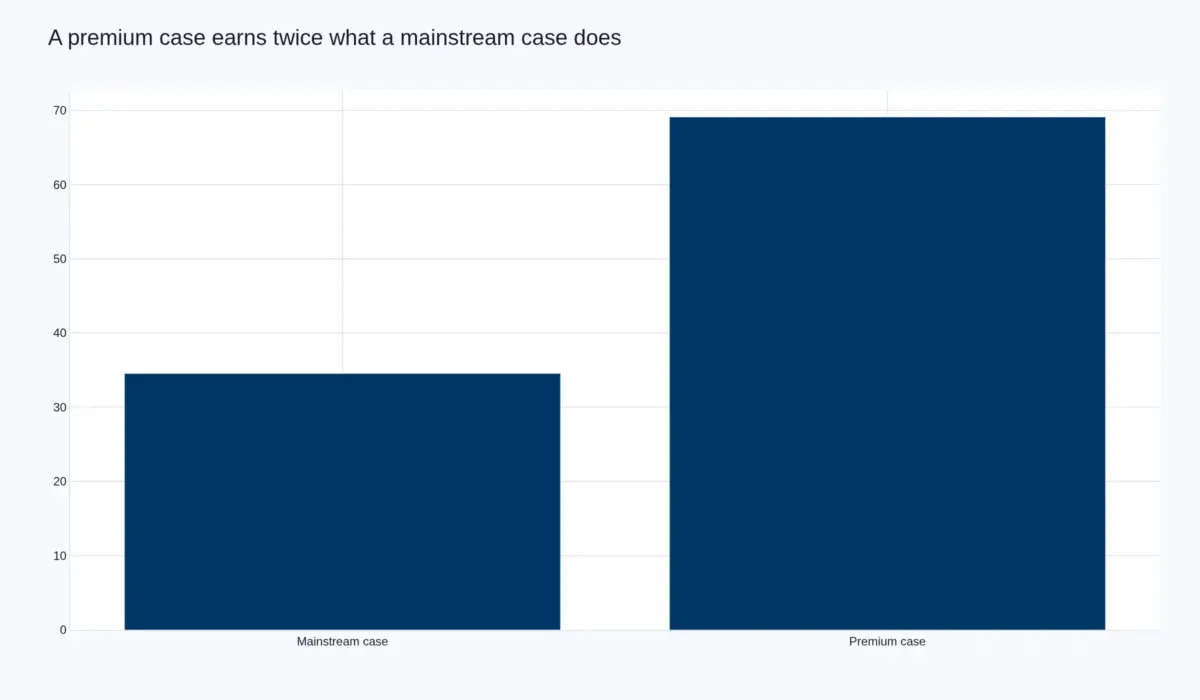
Why mix rather than volume, in one structural sentence
Because volume is taxed and mix is not. State excise falls on the litre, so every incremental litre carries the full weight of the duty, while every incremental rupee of price within the same litre is largely retained. That is why India’s brewers talk about premium portfolios and not about per-capita convergence. The per-capita number — 2.15 litres a year against a world average roughly double — is the prize, but reaching it requires volume that the tax structure actively discourages.
The mix route avoids that entirely. It takes the existing 400 million cases and makes each one more valuable.
The reason that lever is worth so much is the shape of the rupee it operates on. The brewer retains 30 paise of the consumer rupee and keeps under three of them as operating profit, so an increment to the retained share is worth several times its face value in EBITDA. Mix is the only place in this market where that multiplication is available, and it is why the mix question is a profit question rather than a marketing one.
The competitor is not another beer
Beer accounts for under 20 per cent of the alcohol consumed in India. Spirits occupy roughly 90 per cent of the shelf space. Multiply the two facts and premium beer is something like 4 per cent of the alcohol market — a rounding error in the category it competes in.
Which means the strategic question for a premium beer brand in India is not “how do we take share from the other lager”. It is “what price point and pack format make beer the drink someone chooses instead of whisky”. That is a distribution question, a serve-size question and a price-ladder question, and it is only marginally a brewing question.
It also explains why the premium tier can grow while total alcohol consumption does not. A consumer trading from spirits into premium beer is not adding to the alcohol market. They are moving value from one column of it to another, and beer captures that value at a far higher realisation than mainstream lager.
Why a price cut is not the answer
The instinct in a market at 2.15 litres per head is to cut price and buy penetration. The tax structure makes that self-defeating. Because excise is a fixed amount per unit, a price cut does not reduce the duty at all — it comes entirely out of the brewer’s 30 paise. A 10 per cent price reduction on a case would remove roughly INR 147 from a brewer retaining INR 441, which is over half the retained revenue and several times the total EBITDA per case.
No volume response is large enough to offset that. The brewer would have to more than double case volume — on a base of 202 million cases, in a market with under-20 per cent share of alcohol — to break even on a 10 per cent price cut. The arithmetic rules the strategy out before the market does.
What would change the argument
Three things, each identifiable.
A move to ad valorem duty. That would tax the premium increment and flatten the mix lever to the same slope as volume growth, collapsing the industry’s only reliable profit engine.
A sustained excise reduction in a large state. If a state cut duty and held it, volume would respond and the per-capita number could move. Karnataka’s experience in the opposite direction — a mid-teens volume fall in the first half after an excise increase — suggests the elasticity is there to be exploited in both directions, by whichever state wants the volume.
Premium share stalling. If the mix stops moving at 20 per cent, the industry’s profit growth has to come from volume in a market that taxes volume. That is a slower business than the last several years have been.
The mix is the story. It is worth about eight per cent of operating profit per ten points of share, it costs nothing in additional litres, and it is the one thing in Indian beer that the excise collector cannot take a fixed cut of.
Sources and method. Market value, forecast, case volume and per-capita consumption are the Pheonix Research model for the India beer market: USD 6.85 billion in 2025 to USD 10.72 billion by 2033 at 5.76 per cent, about 400 million cases. Company realisation, net revenue of approximately INR 89.1 billion on 202 million cases, and an EBITDA margin near 9.4 per cent are derived from United Breweries’ reported disclosures; the premium share of roughly 20 per cent of volume and the ratio of about 2× premium to mainstream profit per case are from the report. The implied EBITDA per case of INR 34.55 mainstream and INR 69.10 premium, the INR 691 million incremental EBITDA and the 8.3 per cent uplift are calculated from those inputs under a constant-volume, constant-realisation assumption and are illustrative rather than a forecast. Karnataka’s first-half volume decline is the company’s reported experience following the state’s excise revision.
Primary sources. JM Financial Institutional Securities, United Breweries — initiating coverage, 18 September 2025 — net revenue, EBITDA margin and premium mix, from which EBITDA per case is implied. Volume, case size and consumer price are from the Pheonix Research India Beer Market Report 2026–2033. The INR 691 million and 8.3 per cent figures are an illustration, not a forecast.
Frequently Asked Questions
How much of India's beer market is premium?
About 20 per cent of volume, against roughly half the market by value positioning and only about 10 per cent of United Breweries' top line — because a premium case earns a higher retail price on a similar cost base. Premium carries roughly twice the profit per case of mainstream.
What is a ten-point mix shift worth to a brewer?
Under a constant-volume, constant-realisation illustration, moving 20 million cases from mainstream to premium lifts premium share from about 20 to about 30 per cent and adds roughly INR 691 million of EBITDA — about 8.3 per cent of a INR 8,375 million base. It is a sizing of the lever, not a company forecast.
Why can't brewers simply cut price to gain volume?
Because excise is levied per unit of volume, a price cut does not reduce the duty — it comes entirely out of the brewer's retained 30 paise. A 10 per cent price cut would remove roughly INR 147 from INR 441 of retained revenue, far more than the total EBITDA per case, and no plausible volume response offsets that.
Who does premium beer actually compete with in India?
Because beer is under 20 per cent of alcohol consumed in India while spirits hold around 90 per cent of shelf space, premium beer is only about 4 per cent of the alcohol market. The competitive question is what price point and pack format make beer the drink chosen instead of spirits, which is a distribution and serve-size problem as much as a brewing one.