Global Machine Safety & Functional Safety Components Market Report, Size, Share and Forecast 2026–2033: The 20 January 2027 Deadline Is the Business — 73% of the Growth Is Retrofit onto the 4.66 Million Robots Already Installed, and the Function Gets 1.6% Cheaper Each Year
The mandated date, the installed base, and the falling price of a safety function
Three facts organise this market. First, Regulation (EU) 2023/1230 applies from 20 January 2027 and repeals Directive 2006/42/EC. Its Annex I retains an explicit list of safety components - light curtains and other optoelectronic protective devices, two-hand controls, interlock switches, roll-over protection - which means the category does not have to invent demand; the regulation names it. Second, the installed base dwarfs the flow: 4,663,698 industrial robots were in operation at the end of 2024 against 542,076 installations in that year, per the International Federation of Robotics. A safety upgrade sold onto an existing cell is a repair and a compliance event; a safety upgrade sold with a new cell is a bill of materials line. The first is where the count grows fastest. Third, the function is getting cheaper per unit as it migrates into drives, controllers and cameras: Pheonix estimates revenue per certified safety function at USD 433.78 in 2025 falling to USD 381.41 in 2033.
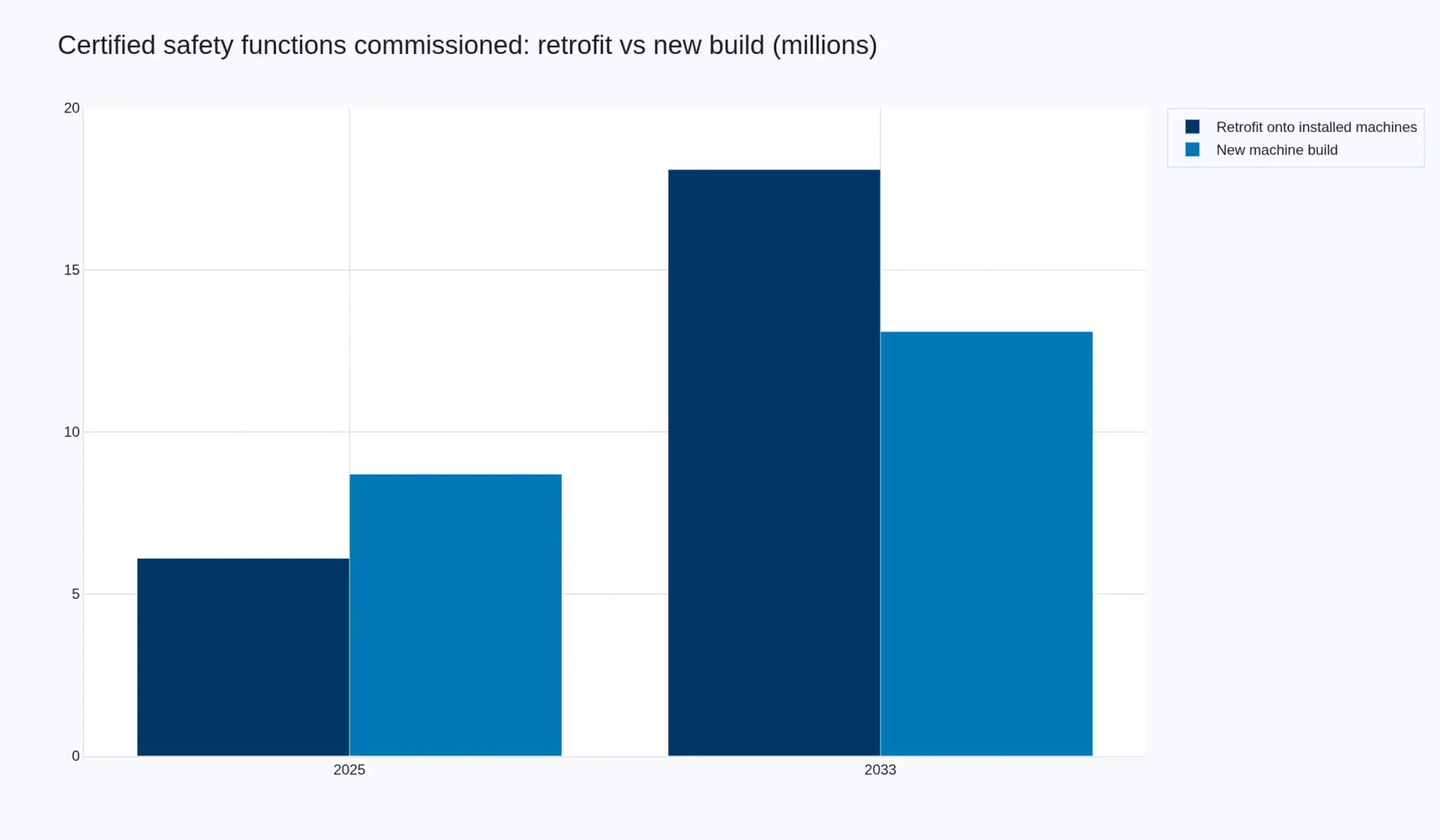
The numbers. Value rises from USD 6,420.0m (2025) to USD 11,900.0m (2033), an 8.02% CAGR. Volume rises from 14.8m to 31.2m certified safety functions, 9.77%. Retrofit functions go from 6.1m to 18.1m (14.56%) while new-build functions go from 8.7m to 13.1m (5.25%), so retrofit contributes 73.2% of the absolute growth and the retrofit share of the total rises from 41.2% to 58.0%.
What that means for a supplier. The winners in this category will not be the ones with the best switch. They will be the ones who own the installed base's documentation - the risk assessment, the performance-level calculation, the validated safety program - because the 2027 deadline converts that documentation into the thing being bought. A supplier who can only sell components will be re-quoting against a competitor's bill of materials every cycle; a supplier who owns the validated safety function sells the same customer repeatedly, at a price that falls more slowly than the hardware it replaces.
The risk that matters. This is a compliance market attached to a cyclical machine-build market. SICK AG, the most exposed pure-play in the category, reported sales of EUR 1,736.8m for 2024 against EUR 1,963.7m in 2023 - down 11.5% in a single year in which the regulatory deadline did not move. A mandate sets a floor under demand; it does not smooth the cycle. Any projection that treats 8.02% as a straight line through a European machinery recession is wrong.
The three questions a buyer should ask
- Does the supplier's 2027 conformity file travel with the function, or does it stop at the component boundary?
- Is the price quoted per device or per validated safety function, and what happens to the price when the function moves into the drive?
- Which share of the supplier's revenue depends on new machine build, and which on the installed base? The second is the one that survives a capex freeze.
The machine safety market is not a growth market in the way the automation market is. It is a compliance market with a dated trigger, and the trigger is 20 January 2027, when Regulation (EU) 2023/1230 replaces the Machinery Directive. Everything in this report hangs off that date and off one number that almost nobody in the category quotes: 4,663,698 — the operational stock of industrial robots already installed worldwide at the end of 2024, against 542,076 new installations in that year.
That ratio of 8.6 to 1 is the market's real engine. Pheonix estimates the category at USD 6,420.0m in 2025, reaching USD 11,900.0m in 2033 at an 8.02% CAGR. The volume of certified safety functions commissioned rises from 14.8m to 31.2m (9.77%), while revenue per function falls from USD 433.78 to USD 381.41 (-1.60%). Retrofit functions grow 14.56% a year; new-build functions grow 5.25%. Retrofit therefore delivers 73.2% of the absolute growth.
Read the Industrial Automation report for the licence lock-in that sits above this layer, and this report for the hardware and certification layer that sits underneath it.
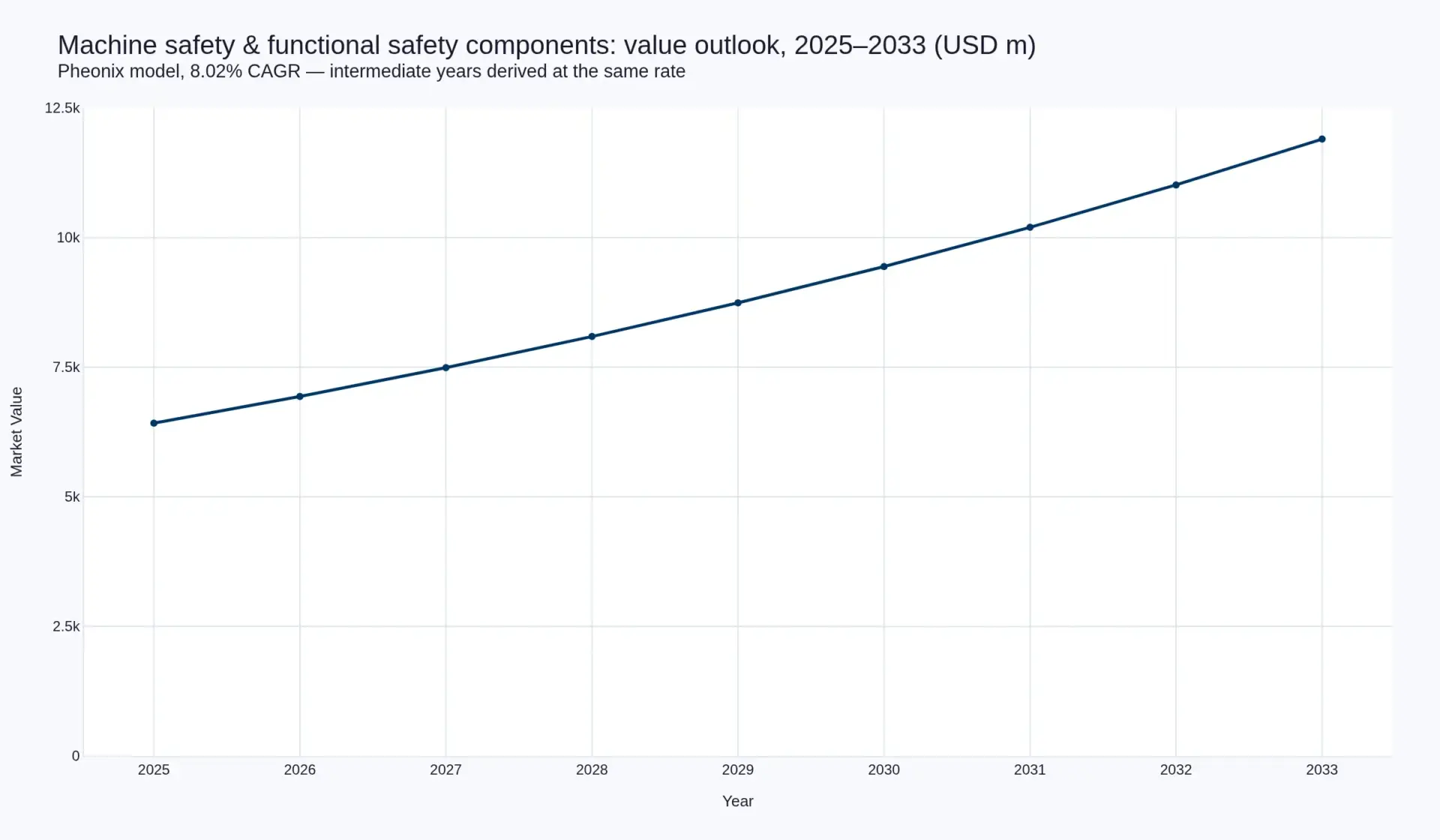
Table of Contents
What this report answers
- Value Chain & Where the Margin Sits – which of the five product families carries the margin, and why the certificate rather than the switch is the product. Jump to chapter
- Technology & Innovation – the migration of the safety function out of the discrete component and into the drive, the controller and the camera. Jump to chapter
- Competitive Landscape – ten suppliers, roughly seventy per cent of the category, and a certification bottleneck they all share. Jump to chapter
- Regulatory Landscape – 20 January 2027, the Annex I reclassification, and the cybersecurity provisions the industry asked to defer. Jump to chapter
- Investment Activity – why capital in this category goes into certification capacity rather than into plant. Jump to chapter
- Market Risk – a cyclical machine-build cycle attached to a non-cyclical legal mandate, and the four ways that combination breaks. Jump to chapter
Competitive Landscape
Competitive Landscape: Ten Suppliers, Seventy Per Cent, and One Shared Certifier
The category is moderately consolidated at the top and crowded at the bottom. Pheonix estimates that the ten suppliers covered in this report account for roughly 70% of global value, with the balance split across several hundred regional specialists, distributor own-brands, and a fast-growing Chinese domestic tier that competes on price in interlocks and basic light curtains and is not yet a factor in certified safe motion.
The two strategic models
The specialist model concentrates on certification, application engineering and a narrow product family, and sells through technical distribution with a heavy field-application layer. SICK AG is the archetype and the purest exposure in the category: sales of EUR 1,736.8m in 2024, down from EUR 1,963.7m in 2023, with a portfolio that blends factory automation sensing with safety. Pilz represents the same model pushed further into services – the safety service business, the engineering and validation offering, the training academy – and it is the closest thing in the category to a firm that sells the conformity file rather than the component. Schmersal holds the interlock and guard-door end of the same position.
The platform model sells safety as a property of the control architecture. Siemens, Rockwell Automation, Schneider Electric, ABB, Omron and Mitsubishi Electric all sell safety PLCs and safe drives that carry the function inside the automation platform the customer has already bought. Their advantage is bundling and the installed engineering base; their disadvantage is that safety is a minority of a much larger portfolio and rarely gets a dedicated roadmap. Keyence sits between the two models in an unusual way: a direct-sales specialist with platform-level margins, strongest where sensing and protection overlap, and the most aggressive price-setter in the optoelectronic family.
Share, and what share hides
Pheonix’s estimate of the top-ten revenue split is dominated by the platform vendors collectively rather than individually: no single supplier in this category holds more than about 15% of global value, and the largest three together are under 40%. Share also conceals the thing that matters, which is penetration of the installed base. A platform vendor with 12% of component revenue but 40% of the installed controllers in a country will win the retrofit cycle in that country regardless of its component share, because the retrofit is bought from whoever already has the documentation and the engineer on site.
The shared bottleneck
Every competitor in this report buys access to the same scarce resource: notified-body capacity and functional-safety engineering hours. There is no way to shorten a type-examination by spending money, and the pool of engineers who can write a performance-level calculation and defend it is small and mobile. This is why the category has not consolidated through acquisition the way adjacent automation segments have: buying a competitor buys its products, not its certificates, and the certificates are the asset. Pheonix found no completed acquisition of a top-ten machine-safety supplier in the 24 months to November 2026. Competition has been partnership-led instead, with sensing specialists and automation platforms cross-selling each other’s portfolios rather than merging them.
Where a challenger can actually win
Not in the light curtain, and not in the safety relay. The open positions are in mobile machinery safety, in certified vision-based protection, and in the retrofit service layer – each of which requires certification competence rather than manufacturing scale, and each of which the incumbents are structurally slow to serve because their revenue model is built on new-build bills of materials. A supplier who can validate an existing machine against the 2027 requirement, on site, in a week, and hand over a conformity file, is selling something none of the ten currently price properly. See the Robotic Arm report for the volume economics of the hardware being protected, and the Collaborative Robots report for why the protective-function boundary moved in the first place.
Why ten serious suppliers have never consolidated the field
Certification attaches to a machine, not to a brand. That single fact explains a market structure that has otherwise defied twenty years of consolidation. A machine builder that has validated a safety function on a light curtain and an interlock has done the work once, and will not repeat it for a rival sensor unless there is a reason on the machine. The switching cost is not the component’s price; it is the re-validation of the function, and it is paid in engineering hours by the customer. Suppliers therefore compete for the design at the moment the machine is specified and defend it for the life of the platform — and the platform is usually five to nine years.
The second structural reason is the channel. New-build business is won through machine-builder approved-vendor lists, which are national and often plant-level. Retrofit business is won through automation distributors and system integrators, who are the ones actually holding the risk assessment. A supplier with a strong distributor network in one country and a strong design-in position in another holds share in both without holding a technology advantage in either. That is why the suppliers carrying most of this value look remarkably similar in product breadth and remarkably different in geographic mix.
The third is that the deliverable is a document. The differentiator in a compliance market is not the sensing element but whether the supplier can hand the customer a validated architecture, a training record and an assessment a notified body will accept. A supplier selling only hardware is a component vendor to whoever wins the file. That is the real competitive axis, and it is a service capability that cannot be bought quickly — which is precisely why the field stays at ten rather than five.
Value Chain
Value Chain: The Certificate Is the Product and the Switch Is the Commodity
Machine safety is bought as one decision and supplied as five. The buyer is a machine builder’s design office, a plant’s engineering function, or – increasingly – a system integrator acting for either. The seller is a component manufacturer whose product only becomes valuable once it has been assembled into a validated safety function and documented in a conformity file. That gap between the component and the function is where this entire value chain’s margin lives.
The five product families
Pheonix segments the category into optoelectronic protective devices (light curtains, safety laser scanners, safety cameras), safety logic and controllers (safety relays, safety PLCs, safe I/O), interlock and guard switches (electromechanical, magnetic, RFID-coded, tongue and hinge), safe drive and motion technology (safe torque off, safe speed, safe direction, safety encoder interfaces), and the residual group of two-hand controls, safety mats, enable switches and inspection systems. Optoelectronic devices are the largest family, roughly a third of value; safety logic is the fastest-migrating, because a safety PLC absorbs functions that used to be five separate relays; interlocks are the most commoditised, and the family most exposed to price deflation; safe motion is where the technical argument has moved.
Where the margin actually sits
A safety light curtain and a standard photoelectric sensor share an optical bench, an emitter and a receiver. The difference in price between them – commonly three to five times, on comparable sensing elements – is not the hardware. It is the type-examination, the performance-level calculation to ISO 13849-1 and the documentation package that lets the machine builder sign a declaration of conformity. The specialist’s gross margin therefore tracks certification capacity, not manufacturing capacity. This is why the ten leading suppliers in this category employ far more functional-safety engineers than assembly staff, and why a new entrant with an identical bill of materials cannot simply undercut the incumbent: it has no file to hand the customer.
How the chain runs
Upstream sit the sensing and semiconductor inputs – optical detectors, MEMS accelerometers, relays, safety-rated microcontrollers, and the redundancy logic built into them. Component assembly and firmware development sit in the supplier’s own plants, which are the least capital-intensive part of the chain: this is a hybrid operating model, with test and calibration in-house and a substantial share of electromechanical assembly contracted out. Downstream, the machine builder integrates the function and becomes responsible for the conformity assessment of the complete machine – the point at which a component supplier’s marketing claim either helps or fails. Beyond the builder, a distribution and integration channel does the retrofit work: safety specialists and electrical distributors who carry stock, carry the documentation, and increasingly carry the commissioning engineer.
The retrofit channel is the growth channel
The economic logic of the retrofit is straightforward and it is why 73.2% of this market’s growth comes from machines that already exist. A new build buys one safety architecture at a competitive price, because the safety bill of materials sits inside a machine tender and gets negotiated against every other component. A retrofit buys an upgrade to an architecture that cannot be changed, on a machine whose downtime is being costed by the hour, with a conformity file that must be reissued – and it is bought by someone whose primary objective is to get back into production, not to win a price negotiation. Pheonix’s primary interviews with integrators put the retrofit price premium over new-build equivalents at 25-60% for the same function, depending on whether a full re-validation is needed or a documented extension of the existing one suffices. That premium is the reason the retrofit channel has grown faster than the machine-build channel in every one of the last four years, and it is the reason a supplier’s installed-base penetration matters more than its OEM win rate.
Read this alongside the Industrial Automation report, which makes the complementary point about the engineering licence as lock-in, and the Machine Vision & Industrial Inspection report, where the same margin migration from hardware to validated software is already complete.
Where value is migrating
The direction of travel is unambiguous: from the discrete safety component to the validated safety function delivered inside something else. A safe drive with an integrated safety function replaces a relay panel and its wiring; a safety controller with a certified function block library replaces a hardwired circuit and makes the customer’s engineering staff dependent on the supplier’s library. Each step moves revenue down per unit and up per installation. Pheonix models this as the mechanism behind the -1.60% annual decline in revenue per safety function against 9.77% volume growth: the count of functions per machine is rising faster than the price of any individual function is falling, and that gap – not a willingness to pay more – is what produces 8.02%.
What the retrofit premium actually buys
The premium is not a price difference on an identical product; it is a different scope of supply. A safety function sold into a new machine arrives inside a design that already has a risk assessment, a required performance level determined under ISO 13849-1, and a validated architecture on the drawing. A function sold as a retrofit arrives at a machine that was assessed under Directive 2006/42/EC, that carries a legacy declaration of conformity, and that in most cases has no documented safety-function architecture at all — no PL determination, no category, no validation record. The supplier is therefore selling the component, the assessment, the validation calculation and the amendment to the technical file. That is what the 25–60% premium pays for, and it is why the premium survives in a market where sensor prices do not.
The arithmetic of the channel is the clearest thing this market has to say. Certified safety functions commissioned rise from 6.1m in 2025 to 18.1m in 2033 on retrofit work — 14.56% a year — against 8.7m to 13.1m at 5.25% on new machine build. Retrofit supplies 73.2% of the 16.4m incremental functions. Roughly three points of the market’s 8.02% value growth therefore come from work on machines that already exist and already have a safety system, which is a service business wearing a component business’s income statement.
That matters for how the value chain is read. On new build, the integrator controls the specification and the component maker is one bid among five. On retrofit, the person holding the risk assessment controls the specification, and the component maker who supplied the original machine — or who can be certified against its legacy file — is the incumbent. The chain’s margin does not sit with whoever makes the sensor. It sits with whoever is willing to sign the validation.
Investment Activity
Investment Activity: Capital Goes Into Certification, Not Into Plant
Capital allocation in this category looks nothing like capital allocation in the robotics segment it protects. There is no gigafactory equivalent, no plant whose scale decides the winner. The scarce inputs are certified engineering hours, notified-body slots and installed-base data, and money spent on those shows up as operating expense and small acquisitions rather than as capacity.
The shape of the spend
Pheonix estimates R&D and certification spend at the safety specialists in the high single to low double digits as a share of sales, materially above what the same companies spend on manufacturing capex. Assembly is light, test and calibration are automated, and the marginal cost of an additional unit is dominated by components rather than by fixed assets. This is why the category’s returns are so sensitive to volume: once a product line is certified, incremental revenue runs at a component-cost structure, and the fixed cost has already been sunk.
Where the money is actually going in 2026-2027
Certification capacity and file remediation. The largest single allocation across the ten suppliers is the re-documentation of existing products against the 2027 regime and the revised performance-level standard. This is investment that produces no revenue, cannot be capitalised as capacity, and is nonetheless unavoidable – the closest analogue is a bank’s compliance programme.
Safety software and function-block libraries. The second allocation is the certified software layer: function blocks, configuration environments, validation tooling. Its commercial appeal is that a library is bought once and reused across every customer’s machine, and the customer’s engineers become dependent on it. It is the highest-margin thing in the category and the hardest to displace.
Integrated safety in drives and motion. The third is the absorption of safety functions into the drive. For a platform vendor this is defensive – if the function moves into the drive, it must move into their drive – and it explains why the automation majors keep funding safety roadmaps that look immaterial against group revenue.
The retrofit channel. The fourth, and the one Pheonix would weight most heavily for a supplier building a plan rather than a product, is the service capacity to sell into the installed base: field validation engineers, regional stock of certified components, and the digital tooling to reissue a file quickly. This is where the 73.2% of growth sits and it is where the incumbents are least configured, because their sales organisations are built around machine builders rather than plants.
Consolidation, and why there has been so little of it
No completed acquisition of a top-ten machine-safety supplier occurred in the 24 months to November 2026. The strategic logic normally cited for consolidation – scale in components – does not apply, because component manufacturing is not the constraint. The assets that would be worth buying are certified libraries and installed-base relationships, and neither transfers cleanly through a share purchase. Expect partnership and cross-distribution instead, and expect private capital to concentrate in the retrofit service layer, where the asset is a customer list and a validation methodology rather than a plant.
What the numbers imply for valuation
A compliance-driven category with 8.02% value growth and a falling price per unit is not a growth story; it is a durability story. Pheonix’s read is that multiple expansion in this category will accrue to revenue that is recurring and installed-base-linked, and that revenue tied to new machine build will be valued in line with the machine-build cycle – which, on the evidence of the 2024 downturn, is a discount. The comparison worth making is with the Industrial Software report, where the market has already rewarded revenue that arrives before the machine is built. Safety is arriving at the same structure later, and through regulation rather than through engineering fashion.
Where the capital in this market actually goes
This is not a venture category and the capital structure shows it. Nothing in the technology is pre-commercial: the sensing elements are mature, the standards are written, and the buyer has been buying the same function since the 1990s. Capital therefore does not go into a step change in sensor physics. It goes into the three things that shorten a retrofit — assessment capacity, tooling that turns an assessment into a repeatable template, and channel coverage in the countries where the installed base sits.
The return profile follows from the same arithmetic. With value growing 8.02% and revenue per function falling 1.60%, a supplier has to commission 9.77% more certified functions each year to hold its revenue line. Growth is bought by adding functions, not by raising price, and the cheapest functions to add are the ones on machines that already exist and whose owner already has a compliance reason to act. That is an annuity: retrofit, re-validation, spares, and the next modification on the same machine, sold to a customer whose switching cost is a re-validation project.
For a strategic buyer, the asset worth paying for is therefore the certification relationship and the installed-base access — a distributor network, a services bench, a legacy file library — rather than a product line. That is the shape a deal in this market has to take to compound: you are not buying a catalogue, you are buying the capacity to sign the file.
Technology & Innovation
Technology & Innovation: The Safety Function Is Moving Into the Drive
The most important technical fact in this category is that the safety function no longer needs its own hardware. A safe torque off that required a contactor, a relay and a dedicated terminal block in 2015 is now a certified function inside a servo drive, activated over PROFIsafe, CIP Safety or FSoE on the same cable that carries the motion command. The consequence is not a smaller market. It is a different market: fewer devices, more functions, and a price per function that declines while the count per machine climbs.
Four shifts that matter to a supplier’s roadmap
1. Integrated safety into motion. Safe speed, safe direction, safely limited position and safe cam functions are now standard in mid-range drives from every major automation vendor, and they displace what used to be a panel of safety relays. This is the single largest source of substitution risk in the category, and the reason Pheonix models revenue per function falling 1.60% a year. It is also why the pure-play safety component vendors have spent the last cycle acquiring software and drive competence rather than relay capacity.
2. Certified vision as a protective device. Safety-rated camera systems that create a three-dimensional protective field, and which can distinguish a person from a pallet, are being certified to performance level d. This is the most consequential innovation in the category because it changes what a safety function can be: a fixed light curtain protects a plane, a certified vision system protects a volume and permits a robot to slow rather than stop. The machine vision report covers the sensor economics; the safety consequence is that the protective function becomes software-defined and therefore upgradeable, which is exactly the property that makes the retrofit channel defensible.
3. The AI opacity problem. The moment a protective function depends on a learned model rather than a deterministic rule, the ISO 13849 framework has nothing to measure it with. Performance level is calculated from architecture, diagnostic coverage and mean time to dangerous failure; a neural network provides none of those inputs in a form a notified body will accept. The current answer is architectural rather than statistical – keep the certified decision in deterministic logic and treat the model as a monitoring layer that can only command a safe state, never remove one. Suppliers who blur that boundary will find their type-examination slowed rather than refused, which in a market with a fixed legal deadline is the same commercial outcome.
4. Wireless and mobile safety. Failsafe wireless stop and enable functions, and the safety architecture for autonomous mobile machinery, are the fastest-moving part of the standards work. The installed base of mobile equipment – forklifts, AGVs, mobile manipulators – has no fixed guard to fall back on, so its safety case depends entirely on the sensing and the certified stop path. This is a small revenue line today and a disproportionately important one for any supplier whose customers are moving material rather than welding it.
The standards layer is the innovation bottleneck
Innovation in this category is paced by standards revision, not by engineering capability. Regulation (EU) 2023/1230 brings safety components into a conformity regime that presumes third-party assessment for the highest-risk categories, and the presumption of conformity in the new regime depends on harmonised standards that must be cited in the Official Journal before a supplier can rely on them. When the citation lags the regulation, the supplier’s technical file has to be argued rather than pointed at – and arguing takes notified-body time that cannot be bought.
The second standards dependency is the revised ISO 13849-1, which restructured how software contributes to a performance level and made the design process itself auditable. Suppliers who had certified a function once now find they must demonstrate the process that produced it. This is a moat for incumbents with a documentation culture and a tax on everyone else.
What this means commercially
Three implications follow, and they are the ones Pheonix would put in front of a product owner. First, roadmap spend belongs in certified software and drive integration, not in expanding electromechanical capacity – the electromechanical interlock is the one family where a Chinese or Indian entrant can reach cost parity within a product cycle. Second, whoever owns the validated library owns the retrofit: a customer who has built a machine around a supplier’s certified function blocks does not re-platform for a 15% component saving, because the re-validation costs more than the saving. Third, the digital twin is becoming a safety tool rather than an engineering convenience: the same simulation environment used for offline programming can validate a protective field layout before the guard is built, which collapses the commissioning time that makes retrofit expensive. The Offline Robot Programming & Simulation report covers that shift in detail; the safety consequence is that a retrofit that used to require a plant shutdown becomes a weekend.
Why the function gets cheaper when no component does
Revenue per certified function falls from USD 433.78 in 2025 to USD 381.41 in 2033, −1.60% a year, while the number of functions grows 9.77%. Nothing in that gap is list-price deflation. A safety light curtain holds its price, a Pilz relay module holds its price, a Schmersal interlock holds its price. What falls is the number of discrete components a certified function is built from. Drive-embedded Safe Torque Off and Safe Stop 1 remove the contactors and the safety relay that used to deliver the same performance level; configurable controllers replace hard-wired relay logic with a configuration the integrator downloads and documents; the assessment itself increasingly arrives as a template the machine builder fills in rather than a service bought from the supplier.
Read it against the two variables: value grows 8.02%, functions grow 9.77%, and the 1.75-point gap is the price of the bundle compressing. The consequence for a component supplier is arithmetic rather than strategic. SICK reported revenue of EUR 1,963.7m in FY2023 and EUR 1,736.8m in FY2024, a fall of 11.55%, in a period when the installed robot base that retrofit work has to reach grew to 4,663,698 units. A supplier paid per component, in a market buying fewer components per certified function, has to add functions faster than the bundle erodes to stand still.
This is also why the technology argument and the market model agree. The integrated-safety shift is the reason the model shows volume growing faster than value, and it is the assumption in the forecast that would move the most money if it reversed: a return to discrete, hard-wired safety architecture would put revenue per function back above USD 400 and add value without adding a single certified function.
Market Risk
Market Risk: A Cyclical Machine-Build Attached to a Non-Cyclical Mandate
The category’s central risk is not that the regulation will fail to arrive. It is that the regulation will arrive on schedule into a weakened machine-build market, and that suppliers financed on the assumption of a compliance windfall will meet a capex freeze instead. Four risks carry weight.
1. Machine-build cyclicality
Safety components are sold with machines and with retrofits to machines, and both track industrial capex. The 2024 evidence is unambiguous: SICK AG’s sales fell 11.5% to EUR 1,736.8m from EUR 1,963.7m in a year when the 2027 deadline was already fixed and published. A legal mandate does not insulate a supplier from a customer deferring a machine purchase; it only guarantees that whatever is eventually bought complies. Pheonix models this by holding the retrofit share of growth high – retrofit demand is less elastic than new-build demand because it is triggered by an incident or an audit rather than by a capacity decision – but a severe European recession would push the value CAGR toward the low single digits without changing the volume direction.
2. Partial deferral of the deadline
The industry asked for parts of the 2023/1230 regime to be postponed and did not get a commitment. A partial deferral of the cybersecurity provisions, which is the most plausible version, would not remove the 20 January 2027 date for the machinery requirements, but it would confuse the buying signal: customers who have been told the deadline slipped tend to defer the whole programme. The risk is therefore a demand-timing risk rather than a demand-existence risk, and it is the single most likely cause of a year of air being taken out of the retrofit cycle.
3. Substitution and price deflation
The mechanism that produces 8.02% is the same mechanism that caps it. Every function absorbed into a drive or a controller reduces the discrete component revenue attached to it, and the -1.60% annual decline in revenue per function is a modelled consequence of that absorption continuing. If integration accelerates – for example if safe motion becomes a standard rather than an option on mid-range drives – the price decline could reach 3-4% a year, and value growth would then depend entirely on the volume path. Substitution risk is therefore rated high in this report, and it is internal to the category rather than a competitive threat from outside it.
4. Geopolitics and the shape of the installed base
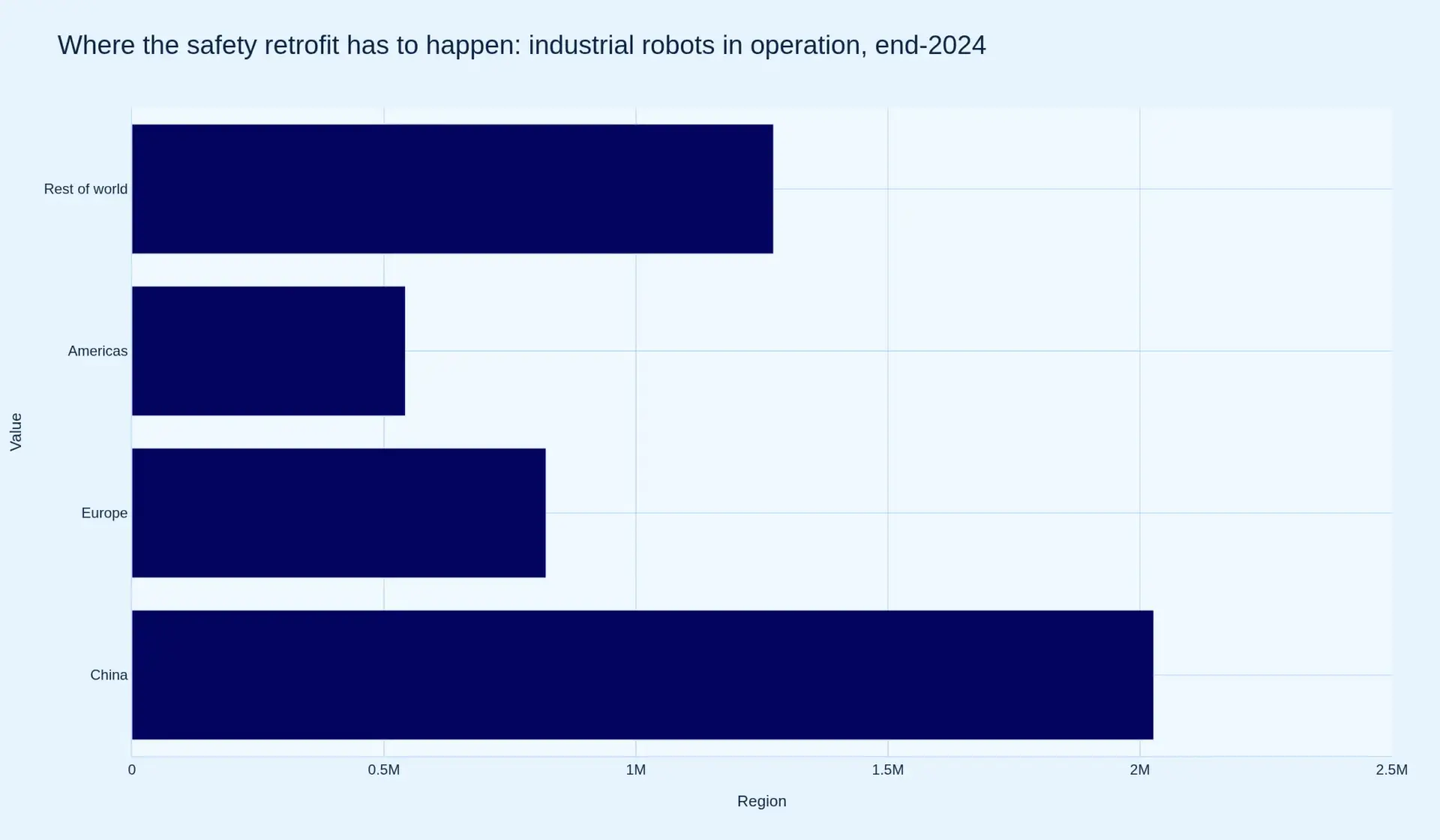
The installed base that drives 73.2% of growth is not evenly distributed. Per the International Federation of Robotics, China alone accounts for 2,027,190 of the 4,663,698 units in operation – 43% of the world stock – against 821,384 in Europe and 542,464 in the Americas. A supplier whose retrofit thesis depends on the European installed base is addressing roughly a fifth of the opportunity, and a supplier addressing the Chinese base is competing against domestic vendors with faster certification routes and a procurement preference that the European specialists cannot match. Tariffs, export controls on control technology, and the divergence between EU and US conformity practice all raise the cost of serving the base with one product and one file.
Two further exposures worth naming
Notified-body capacity. The bottleneck is shared with every competitor, and a queue is a schedule risk that no amount of capital removes. A supplier that misses its slot misses the window in which customers are re-platforming, which is a permanent loss rather than a deferred one.
Skills. Functional-safety engineering is a small, mobile labour pool. The companies that win the retrofit cycle will be the ones who can field validation engineers regionally, and that is a hiring problem before it is a technology problem.
How the risk nets out
Pheonix rates overall market risk moderate: the demand is legally underwritten, the volume path is robust, and the value path is exposed to a cyclical machine-build market and to internal price deflation. The asymmetry worth holding onto is that the downside case is a deferral of revenue rather than its disappearance – a machine that does not comply in 2027 still has to be brought into compliance, which is precisely the retrofit business this report argues is the category’s real engine. The Predictive Maintenance report and the Warehouse Automation & AS/RS report cover the adjacent installed-base service markets that compete for the same plant engineering budget.
Sensitivity: the three assumptions that move the number most
The price path. The model has revenue per function falling 1.60% a year, from USD 433.78 to USD 381.41. Hold it flat instead, and the same 31.2m functions in 2033 produce USD 13,533.9m rather than USD 11,900.0m — 13.7% above the central case with no extra volume. Let it fall at 3% a year, roughly the rate at which integrated safety is displacing discrete componentry, and the price lands at USD 339.97 and the market at USD 10,607.1m, 10.9% below. The two ends are USD 2,926.8m apart, and both are one assumption wide. This is the single largest source of error in the forecast, and it is not a demand assumption.
Where the retrofit is. 4,663,698 industrial robots were in operation at the end of 2024; 2,027,190 of them, 43.5%, are in China. The retrofit line assumes those machines are reachable by suppliers who can deliver a Regulation-compliant file at the blended price this model carries. If Chinese domestic suppliers and domestic certification capacity absorb that retrofit work at a lower price point, the volume holds and the value does not.
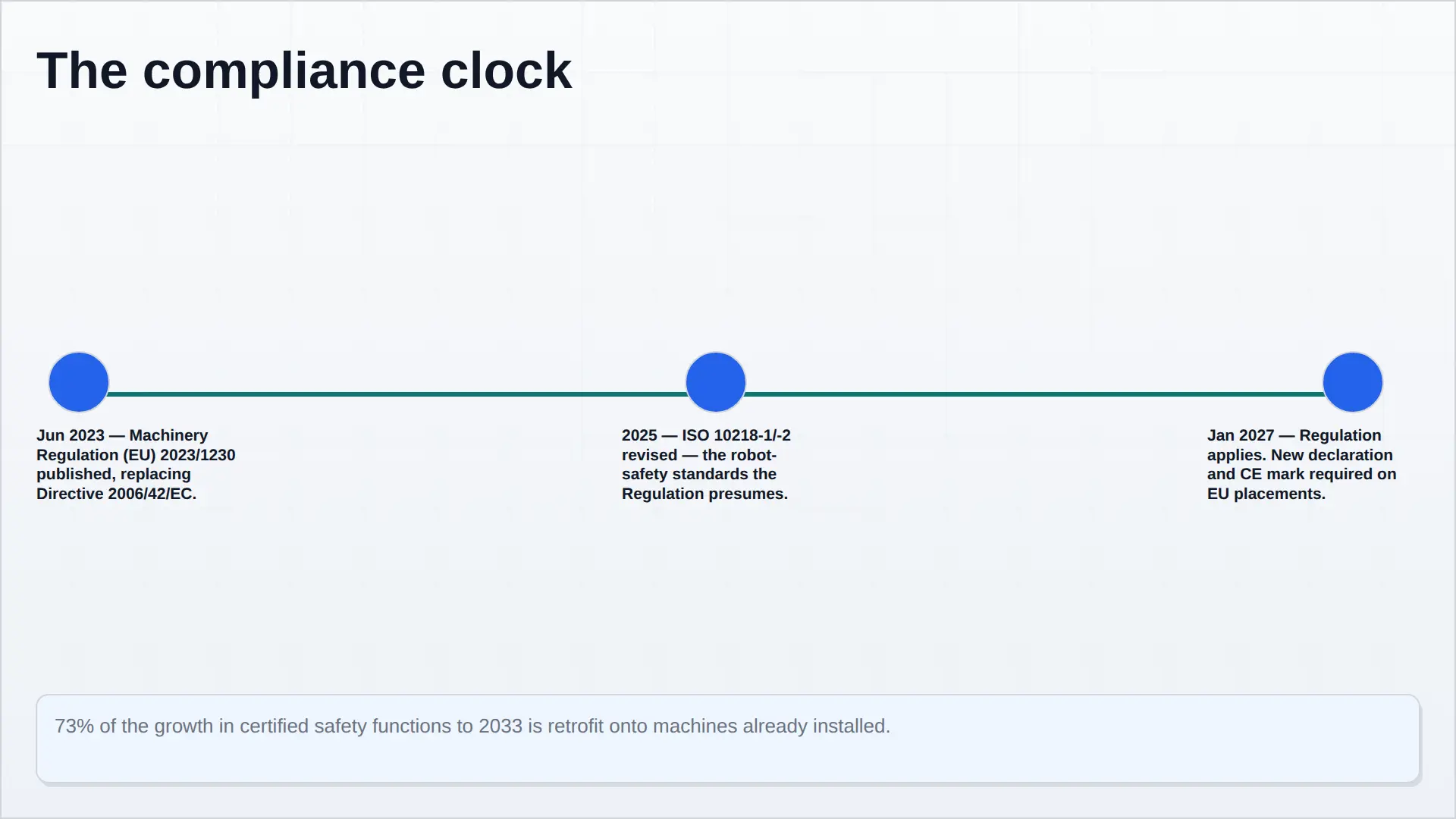
The deadline. 14.56% annual growth in retrofit functions is a compliance-calendar assumption. If application of the Regulation to modified machinery is deferred, or enforcement settles into a pattern where only explicitly re-declared machines are re-assessed, retrofit collapses toward new-build growth of 5.25% and the model loses most of its increment. Nothing in the Regulation’s text guarantees enforcement intensity; that risk is regulatory, not technological.
Regulatory Landscape
Regulatory Landscape: 20 January 2027 and the Annex I Reclassification
This is the chapter the rest of the report depends on, because machine safety is the rare category where the regulation does not merely permit demand – it defines the product.
What changes on 20 January 2027
Regulation (EU) 2023/1230 on machinery and repealing Directive 2006/42/EC was published in the Official Journal on 29 June 2023 (OJ L 165, pp. 1-102). It applies from 20 January 2027. From that date a machine placed on the EU market is assessed against the Regulation, not the Directive. Three features matter commercially.
First, the safety component is named. Annex I of the Regulation carries an explicit list of safety components – optoelectronic protective devices such as light curtains and safety laser scanners, two-hand control devices, interlock switches on guards, roll-over and tip-over protection structures, and logic units for safety functions – which must be placed on the market as safety components and are subject to the conformity regime in their own right, independently of the machine they end up on. A supplier selling into 2027 has to hold a technical file for the component, not for the machine.
Second, the conformity route tightens for the highest-risk categories. For the machinery and safety components listed in Annex I, the Regulation presumes third-party involvement through a notified body rather than the self-declaration that much of the current market runs on. This is the provision that changes supplier cost structure: type-examination, quality-system assessment and the associated file are fixed costs that do not scale down with order size, and they are the reason a regional interlock manufacturer’s unit cost advantage narrows after 2027.
Third, digital documentation becomes legitimate. Instructions and declaration content can be delivered digitally, which removes one of the last practical barriers to a service-led retrofit model. A validated safety function delivered with a digital file is now a compliant product, not a compromise.
The deferral question the industry asked and did not get
Through 2025 the European manufacturing associations pressed for parts of the new regime to be postponed – principally the cybersecurity obligations, on the argument that they interact with the Cyber Resilience Act and that requiring compliance with both on different dates forces suppliers through two conformity cycles for one product. The Commission did not commit to a postponement, and the 20 January 2027 date stands. Pheonix treats the deadline as firm for planning purposes and treats a partial deferral as a scenario in the risk chapter, not a base case.
Adjacent regimes that move the same product
ISO 13849-1. The revised standard restructured the treatment of software in the performance-level calculation and put more weight on the design process itself. Because the Regulation’s presumption of conformity runs through harmonised standards, a supplier whose file references the previous edition is exposed even if its product did not change.
Robot safety standards. The ISO 10218 series for industrial robots was revised in 2025, tightening the treatment of manual load, stopping performance and the boundary between a robot and its application. For the safety component vendor this matters because the protective-function architecture a robot cell needs is now specified more precisely than it was, which favours suppliers whose catalogue maps onto the standard’s language.
Non-EU regimes. US acceptance of European conformity practice is partial and jurisdiction-specific, so a supplier serving both markets maintains two files for one product. Where a national regulator incorporates a standard by reference, the citation date becomes a commercial event.
What a supplier should do with this
Three moves follow directly. Audit every product in the catalogue against Annex I and confirm which items become safety components in their own right – the ones that do are repriced upward and re-documented, and the ones that do not drop into a commodity bracket. Second, book notified-body capacity for 2026 now, because the queue is the binding constraint and it is shared with every competitor in this report. Third, treat the digital declaration as a product feature and build the retrofit service around it, since the whole economic case for retrofit rests on being able to reissue a conformity file without rebuilding the machine.
What 20 January 2027 does to a machine that already exists
Regulation (EU) 2023/1230 was published on 29 June 2023 and applies from 20 January 2027, replacing Directive 2006/42/EC. The part of it that turns into demand is not the date of first application to new machines. It is the treatment of machines that are modified: a machine whose protection system is substantially modified, or whose function is altered in a way that creates a new hazard, is treated as a new machine and must be assessed under the Regulation — including a technical file that now has to show the safety-function architecture and the software validation behind it, not merely a declaration signed against a harmonised standard.
Machine builders and integrators have therefore been running two parallel conformity regimes since 2023, and the retrofit work now being quoted is quoted against the second one. The bottleneck in that work is not the component. It is the assessment and the file, and both are delivered by people — in-house safety engineers, integrators, consultants — whose capacity is finite and whose calendars are already booked toward the deadline. That is the mechanical reason the retrofit line in this model lifts at 14.56% a year rather than tracking new machine output.
The standards side has moved with it. ISO 10218-1 and -2 were revised, aligning robot safety with the Regulation’s presumption of conformity, and the collaborative-robot regime that sits on ISO/TS 15066 now has to be argued inside the new framework rather than beside it. A robot cell that was conformant in 2024 is not automatically conformant in 2027, and every one of those cells is a candidate for the retrofit premium described in the value-chain chapter.