
Editorial Article
The Brewer Keeps 30 Paise of the Consumer Rupee and Excise Keeps the Rest
A case of beer in India sells for about INR 1,470. The brewer retains about INR 441 of it. The remaining seventy paise of every rupee goes to state excise and the trade — which makes the largest single beneficiary of a beer sold in India a state government, and makes the industry’s economics a branch of tax policy rather than of brewing.
This is not a complaint about taxation. It is the structural fact that determines what every strategy in this market is actually able to do. India’s beer market is USD 6.85 billion in 2025, roughly 400 million cases and 3.12 billion litres, growing to USD 10.72 billion by 2033 at 5.76 per cent. Every lever available for delivering that growth has to work through a cost stack in which the brewer controls the smallest part.
The rupee, split
| Layer | Per case | Per rupee of consumer spend |
|---|---|---|
| Consumer price | INR 1,470 (USD 17.12) | 1.00 |
| Retained by the brewer | INR 441 | 30 paise |
| Excise and trade margin | INR 1,029 | 70 paise |
| Brewer EBITDA | About INR 41 per case | About 2.8 paise |
Source: Pheonix Research calculations from the India beer market report model; excise and trade margin are combined because states do not disclose the split uniformly. Brewer realisation reflects United Breweries’ reported net revenue of about INR 89.1 billion on 202 million cases, an implied INR 441 per case.
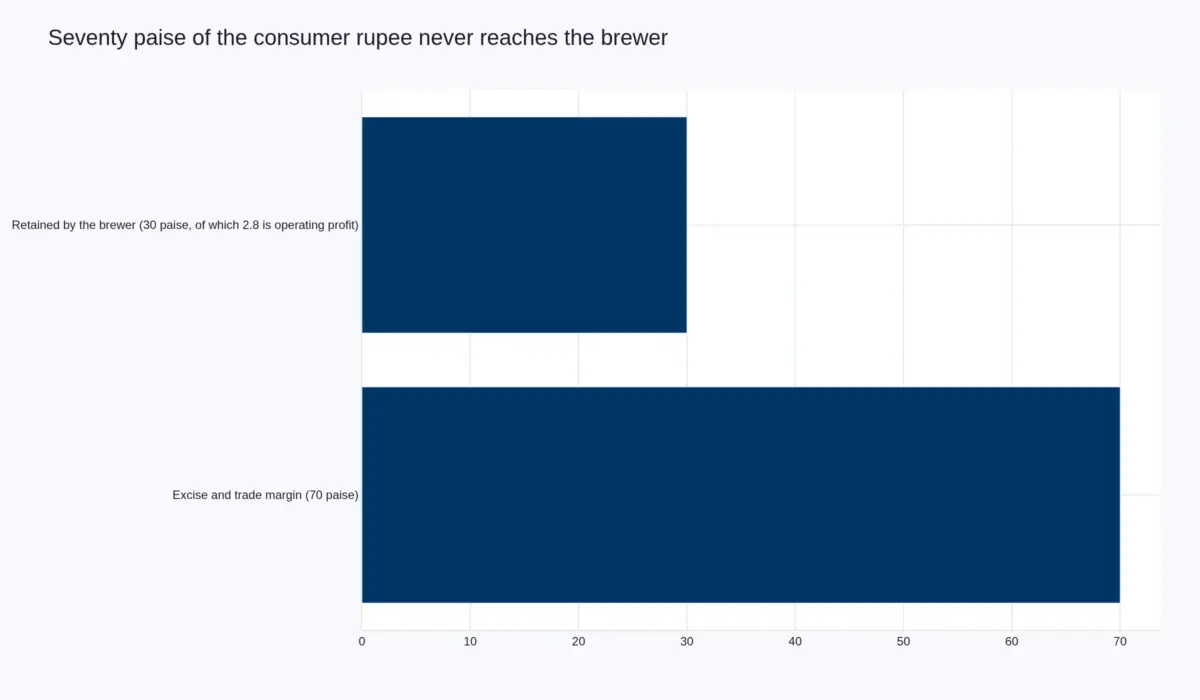
Read the last row twice. The brewer retains 30 paise of the rupee and keeps roughly 2.8 paise of it as operating profit, on an EBITDA margin near 9.4 per cent of net revenue. The distance between those two numbers is the entire competitive problem: a business with a 30 per cent revenue share and a 3 per cent profit share cannot buy growth the way a business with a 19 per cent profit share can.
Why excise on volume makes premiumisation the only lever
State excise in India is levied overwhelmingly on volume rather than on value. That single design choice determines the industry’s entire strategy.
A per-litre levy does not rise when the product inside the litre gets better. So a brewer who sells a case at INR 2,000 instead of INR 1,470 pays the same excise per case and keeps a much larger share of the increment. Premiumisation is not a marketing preference in this market. It is the only route to a higher retained share that the tax structure permits.
Compare it with an ad valorem duty, which would tax the increment at the same rate as the base and leave the retained share roughly where it was. The Indian structure does the opposite: it makes the first 70 paise of every incremental rupee of price almost entirely the brewer’s.
Which is why the state’s own revenue is a demand variable
India drinks about 2.15 litres of beer per person per year, against a world average roughly double that. At that level of penetration, a price increase is not absorbed. It switches people out of the category.
The evidence is recent and specific. Karnataka’s excise change produced a mid-teens fall in volume in the first half. A tax increase designed to raise revenue per litre instead reduced the number of litres, and the state’s revenue fell with them.
That is the peculiar tension of this market. The brewer needs premiumisation, the state needs revenue per unit, and the consumer at 2.15 litres a head is highly price-elastic because the category is a discretionary purchase at the margin. Every excise revision is therefore a live experiment in elasticity, conducted quarterly, by seven or eight different governments with different fiscal positions.
For anyone forecasting the market, this makes the excise calendar a more important input than the demographic one. A 5.76 per cent growth rate is not a demographic projection. It is a projection that assumes the current tax environment holds, and the current tax environment is revised annually by states that do not coordinate with each other.
What the brewer can actually do
Three things, and only one of them is within its control.
Shift the mix. Because excise is per unit, moving a case from mainstream to premium raises the retained share without raising the tax. This is the only lever that operates entirely on the right side of the structure, and it is the subject of the companion analysis on the mix shift.
Manage the trade margin. The 70 paise is not all government. A meaningful part is distributor and retailer margin, and it is negotiable in a way that excise is not — which is why route-to-market changes are worth more in this market than in almost any other packaged beverage.
Lobby for structure. A shift from specific to ad valorem duty would be a change in the opposite direction for brewers: it would tax the premium increment. The industry’s policy interest is therefore precisely the reverse of what a casual observer would assume — it wants the duty to stay on volume.
The number to watch
Not the market size. The retained share per case. It was about 30 per cent in the base year, and it is the single variable that reconciles a 5.76 per cent revenue forecast with the fact that the brewer keeps under 3 per cent of the consumer’s rupee. If realisation per case rises, the forecast is achievable on modest volume growth. If it holds flat, the market needs volume that its own tax structure is discouraging.
That is the whole of India’s beer economics in one line: a business that grows by getting better at what it sells, because the alternative — selling more of it cheaply — is taxed at seventy paise on the rupee.
Sources and method. Market value, volume and forecast are the Pheonix Research model for the India beer market: USD 6.85 billion in 2025 to USD 10.72 billion by 2033 at 5.76 per cent, about 400 million cases and 3.12 billion litres. Brewer realisation, net revenue and EBITDA margin are derived from United Breweries’ reported disclosures — approximately INR 89.1 billion net revenue on 202 million cases, an implied INR 441 per case, at an EBITDA margin near 9.4 per cent. Per-case consumer price, the excise and trade split, and per-capita consumption are from the report. The Karnataka volume decline refers to the company’s reported first-half experience following the state’s excise revision. The ad valorem comparison is analytical.
Primary sources. JM Financial Institutional Securities, United Breweries — initiating coverage, 18 September 2025 — industry and company volumes, realisation per case and the excise treatment the rupee split is built from. Market size and the consumer price per case are from the Pheonix Research India Beer Market Report 2026–2033; every derived figure is calculated from the inputs named beside it.
Frequently Asked Questions
How much of a beer's retail price does the brewer actually keep?
The consumer pays about INR 1,470 for a case. The brewer retains about INR 441, or 30 paise of the rupee, with the remaining 70 paise going to state excise and the trade. Of the brewer's 30 paise, roughly 2.8 paise survives as operating profit at an EBITDA margin near 9.4 per cent of net revenue.
Why is premiumisation the only growth lever in Indian beer?
Because state excise is levied on volume rather than value. A per-litre levy does not increase when the product inside the litre gets better, so a brewer selling a case at INR 2,000 pays the same excise as one selling at INR 1,470 and keeps most of the increment. An ad valorem duty would tax that increment instead.
How sensitive is Indian beer demand to price?
India consumes about 2.15 litres of beer per person per year, against a world average roughly double that, so the category is a discretionary purchase at the margin and is highly price-elastic. Karnataka's excise change produced a mid-teens volume fall in the first half — a revenue measure that reduced the litres it was taxing.
What does a 5.76 per cent growth forecast assume about taxation?
It assumes the current tax environment holds, and that environment is revised annually by states that do not coordinate with each other. Per-capita consumption and premium mix matter less to the outcome than the excise calendar, which is why forecasts built on demographics alone have underperformed.