
Global Electric Vehicle (EV) Lubricants Market Report, Size, Share and Forecast 2026-2033: The Car That Needs Fewer Fluids and Pays More for Them
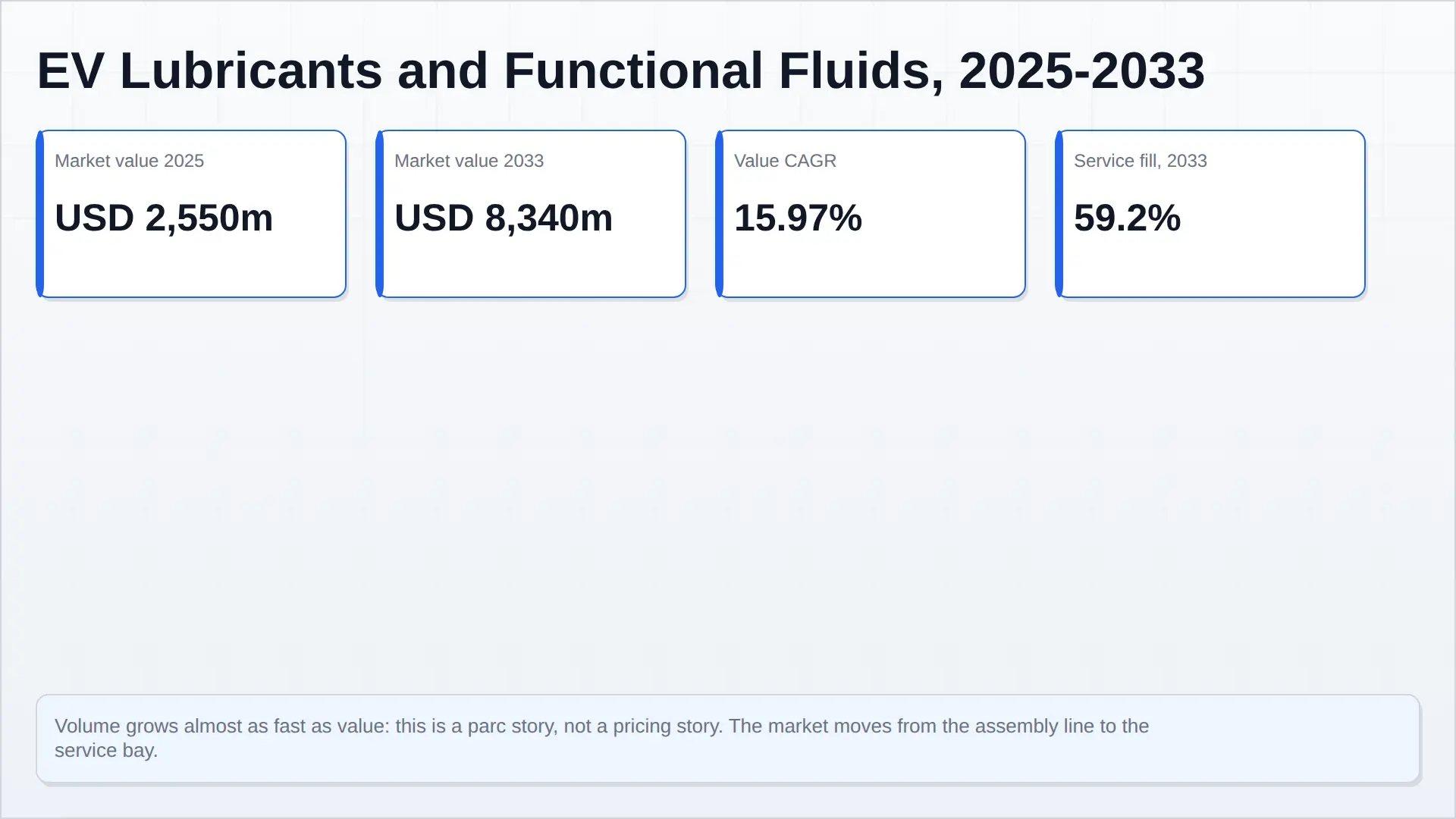
The global market for EV-specific lubricants and functional fluids is estimated at USD 2,550 million in 2025, rising to USD 8,340 million by 2033, a value CAGR of 15.97%. Volume moves from 357,000 tons to 1,098,000 tons at 15.08%. Volume and value grow at almost the same rate. In a specialty chemicals category that is unusual, and it is the first thing to understand here: almost none of this forecast comes from price. It comes from the number of vehicles that contain these fluids, and from the fact that the fluid content per vehicle is slowly shrinking at the same time.
That produces a market whose internal composition changes faster than its headline. Factory fill is 48.0% of 2025 value and will be 27.6% by 2033. Service fill rises from 45.0% to 59.2%. Dielectric and immersion fluids, a rounding error today at 7.0%, reach 13.2%. A supplier that holds a first-fill approval but no aftermarket route will grow at roughly half the market rate. A supplier that holds no approval at all will not grow at all, because in this category the specification is the product.
The specification is also the risk. Between June and September 2025 the EU committees assessing the proposed universal PFAS restriction reached provisional conclusions on lubricants, with final opinions scheduled through 2026. Fluorinated thickeners and additives sit inside some of the highest-value greases and dielectric fluids sold into electric drivetrains. The same chemistry that makes an immersion fluid work is the chemistry under review. On 24 December 2025, bp agreed to sell a 65% shareholding in Castrol to Stonepeak at an enterprise value of USD 10.1 billion, which is what the market currently thinks a lubricants business with an EV fluids franchise is worth. Both facts belong in the same paragraph, because they are the same question: which chemistry, and whose approval, survives the next five years.
1. Market snapshot
The global market for electric-vehicle-specific lubricants and functional fluids is estimated at USD 2,550 million in 2025 and forecast to reach USD 8,340 million by 2033, a compound annual growth rate of 15.97%. Volume moves from 357,000 tons to 1,098,000 tons across the same window, a CAGR of 15.08%. The market is counted across battery-electric and plug-in hybrid passenger cars, battery-electric vans, trucks and buses, and the dielectric fluids used in direct and immersion battery cooling.
| Metric | 2025 | 2033 | CAGR |
|---|---|---|---|
| Market value (USD million) | 2,550 | 8,340 | 15.97% |
| Volume (tons) | 357,000 | 1,098,000 | 15.08% |
| EV units in scope (million) | 80 | 380 | 21.5% |
| Value per unit in scope (USD) | 31.9 | 21.9 | -4.5% |
| Implied price and mix effect | +0.7% per year across the period | ||
Two features of that table decide everything that follows. Volume grows nearly as fast as value, so this is not a pricing story. And value per vehicle in scope falls by 4.5% a year even as the market grows 16%, because the parc is expanding much faster than the fluid content per vehicle, and because a fast-growing parc spends a larger share of its life as new vehicles carrying factory fill rather than as older vehicles buying service fluid.
2. What this report counts, and what it excludes
A category defined by a vehicle rather than by a chemistry has to draw its own boundary, and most published work on this subject does not. Ours is drawn as follows.
Counted. Fluids and lubricants whose specification exists because the vehicle is electric: e-axle and reduction-gearbox fluids, battery and power-electronics coolant, dielectric and immersion fluids, EV-specific bearing and chassis greases, and the brake fluid an electric vehicle consumes. Both factory fill and service fill are counted, because they are different businesses with different customers and different margins.
Excluded. Engine oil for plug-in hybrids and range-extenders, which is a conventional product sold to a partly electric vehicle. Conventional internal-combustion service fluids. Refrigerants, including R1234yf, which sit in a separate supply chain. Battery materials, cells and packs. Upstream merchant sales of base oil and additive packages, which would double-count. Brake and chassis hardware.
Treated separately. Electric two- and three-wheelers. The IEA expects their global stock to more than double to around 170 million units by 2030, which makes them the largest population of electric vehicles on earth and a poor proxy for fluid demand: a hub-motor e-scooter consumes a few grams of sealed-for-life grease and no coolant at all. They are counted inside the grease line, not as a demand driver, because treating 170 million scooters as if they were 170 million cars would inflate this market by an order of magnitude and tell a buyer nothing.
3. Size and forecast: the four-lever decomposition
The forecast is built from four levers rather than from a growth rate. Each one can be argued with independently.
| Lever | Direction | Effect on 2025-2033 value | Evidence base |
|---|---|---|---|
| EV units in scope | Expansion | +21.5% a year | IEA Stated Policies Scenario: 250 million EVs excluding two- and three-wheelers by 2030, four times the end-2024 stock; extrapolated to 380 million by 2033 |
| Channel mix, factory fill to service fill | Negative on value per unit | -4.5% a year on value per unit in scope | Pheonix model: production falls from 26% of parc in 2025 to 9% in 2033 |
| Fluid intensity per vehicle | Contraction | -1.3% a year | Lifetime-fill specifications, sealed coolant loops, smaller e-axle sums |
| Price and product mix | Expansion | +0.7% a year | Premium synthetic e-axle fluid and dielectric fluid offset by commoditised glycol coolant |
The second lever is the one most forecasts miss and the one an operator should care about most. In 2025, factory fill accounts for USD 1,226 million of a USD 2,550 million market. By 2033 it accounts for USD 2,301 million of USD 8,340 million. Factory fill still grows, at roughly 8.2% a year, but service fill grows at roughly 20% and dielectric fluid at roughly 25.5%. The reason is arithmetic rather than optimism: in 2025 the world's electric fleet is young and small, so a quarter of it was built in the same year; by 2033 the fleet is large enough that new production is a small fraction of it, and the aftermarket becomes the market.
| Channel | 2025 (USD m) | Share | 2033 (USD m) | Share | CAGR |
|---|---|---|---|---|---|
| Factory fill (OEM) | 1,226 | 48.0% | 2,301 | 27.6% | 8.2% |
| Service fill (aftermarket and dealer) | 1,148 | 45.0% | 4,940 | 59.2% | 20.0% |
| Dielectric and immersion fluids | 179 | 7.0% | 1,100 | 13.2% | 25.5% |
| Total | 2,553 | 100% | 8,341 | 100% | 15.97% |
4. Four structural shifts
The market moves from the line to the bay. A first-fill approval is a reference, not a revenue stream. It buys roughly 9.8 litres-equivalent once per vehicle and it buys the right to be specified when that vehicle eventually needs fluid. Suppliers that treat the approval as the destination rather than the entry ticket will watch the fastest-growing half of this market go to whoever owns the workshop relationship.
The specification moves from the vehicle to the axle. An internal-combustion car had one fluid specification that mattered, set by the engine manufacturer. An electric car has several, set by whoever designed the e-axle, the thermal loop and the battery. The trade literature on e-axle integration is explicit that once the motor is cooled by the axle fluid rather than by air, the requirements become materially more stringent, because the fluid must now be compatible with enamelled copper, with the potting compounds and with the electronics in the same housing. That is a materials-science problem, and it moves approval power toward Tier-1 suppliers such as Bosch, GKN, Magna and Hitachi Astemo, and away from the vehicle brand.
Lifetime fill is deferred revenue, not cancelled revenue. Toyota moved its hybrid and electric range from WS automatic-transmission fluid to a dedicated e-Axle Fluid TE from model year 2023, with ENEOS as a factory-fill supplier, and does not call for a scheduled change under normal conditions; the service literature notes that most real driving falls into the severe category the schedule excludes, and that technicians commonly recommend a change between 40,000 and 60,000 miles. Multiply that ambiguity across a fleet and it becomes a large, unpriced aftermarket that the OEM has not authorised and the independent workshop has already begun to serve.
The chemistry is being reclassified while it is being industrialised. The EU's proposed universal restriction on per- and polyfluoroalkyl substances reaches lubricants directly. The European Chemicals Agency's Committees for Risk Assessment and Socio-Economic Analysis reached provisional conclusions on lubricants in June and September 2025 respectively, with RAC's final opinion planned for March 2026 and SEAC's expected by the end of 2026. Fluorinated thickeners and some fluorinated additives sit inside high-value EV greases, and fluorinated dielectric fluids sit inside two-phase immersion cooling. The discontinuation of 3M's Novec production has already been credited with halting the growth of two-phase immersion cooling, in favour of single-phase water-glycol direct-to-chip. A category that was going to be built on one chemistry is being rebuilt on another, and the rebuild is happening during the scale-up rather than before it.
5. Demand drivers
Parc growth. The IEA's Stated Policies Scenario puts the global electric fleet, excluding two- and three-wheelers, at 250 million vehicles by 2030, four times the end-2024 level, with more than 90% of it electric cars. That is an average stock growth of about 25% a year, roughly half the 2018-2024 rate. Every vehicle in that stock carries an e-axle fluid and a coolant loop, and each one eventually buys a second fill.
Charging power. A lithium-ion pack is comfortable in a narrow window of roughly 20 to 40 degrees Celsius, and fast charging pushes heat generation well beyond what a passive system can remove. Coolant stops being a consumable and becomes a performance component: it decides the charging curve, and the charging curve is now a marketing number. That is why trade analysis of the European lubricants industry describes thermal management fluid as the most consequential new category the sector has seen.
Integration. As e-axles integrate the motor, the reduction gear and the inverter into one housing, the fluid must lubricate, cool and insulate at the same time. This is where electrical conductivity, material compatibility and aeration behaviour stop being laboratory curiosities and become release criteria.
Warranty economics. A non-approved fluid in a drivetrain under warranty is an uninsured liability for the owner and the workshop. That single fact does more to defend price in this category than any performance claim, and it is the reason the approval ladder, not the litre, is the unit of competition.
The aftermarket cohort arrives. The 2018-2022 electric cohort is now leaving warranty in volume. Its owners are the first significant population of EV drivers paying for fluid out of their own pocket, and they are finding a workshop network that is not yet trained for them.
6. Restraints on growth
Fewer litres, permanently. An internal-combustion car carries 4 to 7 litres of engine oil that is drained and replaced repeatedly over its life. That revenue does not migrate to the electric car; it disappears. Nothing in the EV fluid category replaces it litre for litre, and any forecast that implies otherwise is wrong.
Commoditised coolant. Water-glycol coolant is a mature, multi-source product with a low price ceiling. It is the largest single product line by value in this market and it is also the least defensible. Value grows there because volume grows, not because anyone has pricing power.
Price levels set in China. China is the largest share of the parc and the most price-competitive factory-fill market in the world. A supplier that wins volume there at Chinese factory-fill prices and loses European aftermarket volume at European aftermarket prices has won the wrong half of the trade.
Concentration among buyers. Thirty-odd OEMs and a handful of Tier-1 e-axle suppliers jointly control access to the specification. Approval is annual, renegotiable and increasingly awarded to suppliers who co-develop rather than supply.
Genuine lifetime fill. If sealed-for-life e-axle and coolant loops become the norm rather than the aspiration, service volume growth slows sharply. This is the single largest downside lever in the model and it is dealt with explicitly in chapter 18.
7. Segmentation
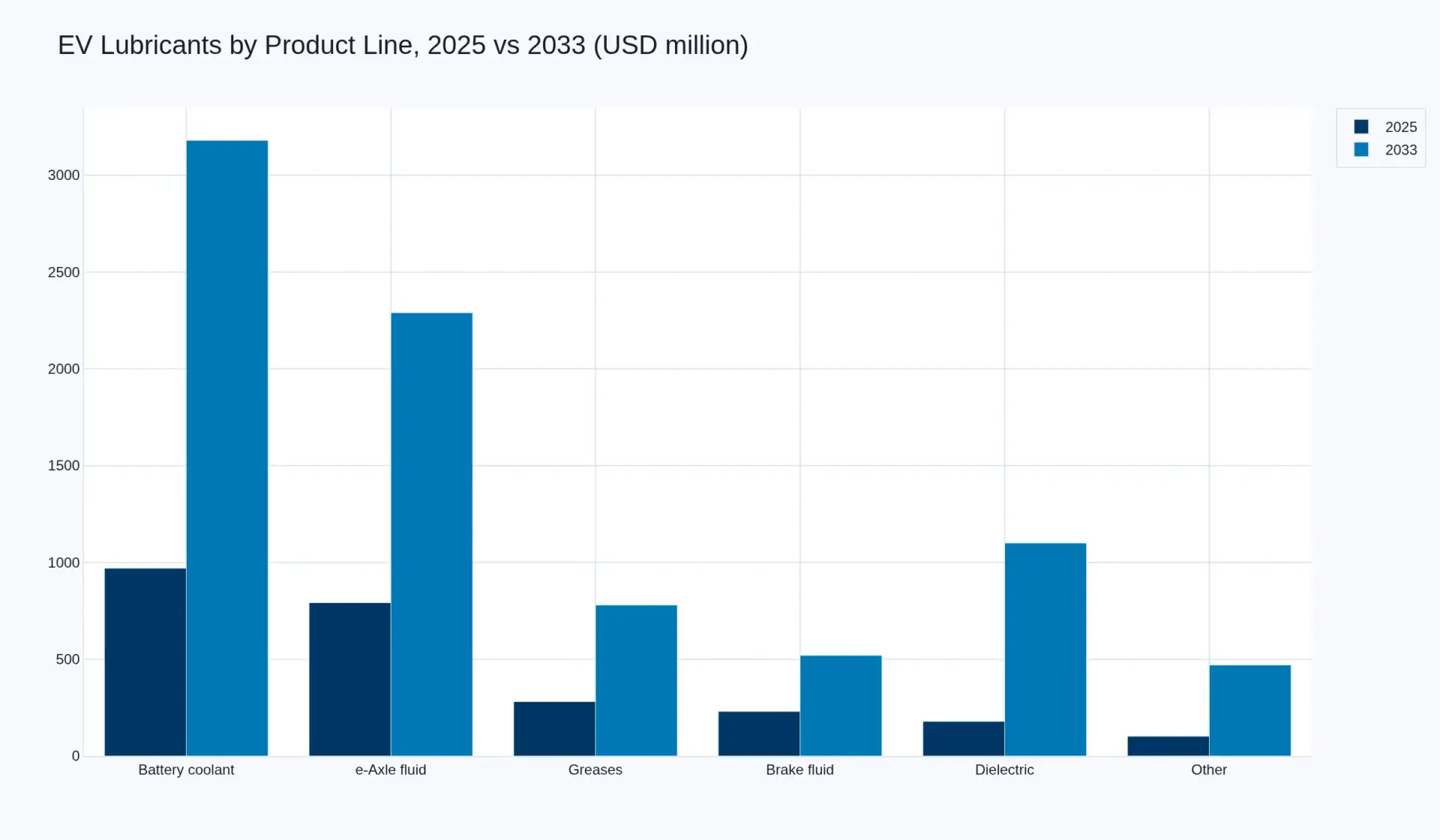
By product, the market is dominated by coolant, which is also where the least value is captured per litre. By vehicle type, passenger cars take the overwhelming majority of value. By channel, the balance shifts decisively toward service fill across the period.
| Product line | 2025 (USD m) | Share | 2033 (USD m) | CAGR |
|---|---|---|---|---|
| Battery and power-electronics coolant | 970 | 38.0% | 3,180 | 16.0% |
| e-Axle and transmission fluid | 792 | 31.0% | 2,290 | 14.2% |
| Greases, bearings and chassis | 281 | 11.0% | 780 | 13.6% |
| Brake and chassis fluids | 230 | 9.0% | 520 | 10.7% |
| Dielectric and immersion fluids | 179 | 7.0% | 1,100 | 25.5% |
| Other functional fluids and additives sold as product | 102 | 4.0% | 470 | 21.0% |
Brake fluid is the slowest line for a mechanical reason: regenerative braking does most of the deceleration, so the friction circuit does less work and heats less, and the service interval stretches. It is the one product in this market that electrification genuinely reduces per vehicle, and it is also the one most exposed to substitution by a different chemistry rather than to loss of volume.
8. Regional analysis
Three regions do three different jobs in this market, and conflating them is the most common error in commercial planning for it.
| Region | 2025 share | 2033 share | What the region sets |
|---|---|---|---|
| Asia-Pacific | 58% | 55% | Volume and factory-fill price. China alone is the majority of the parc |
| Europe | 21% | 23% | Specification and regulation. The approval ladder and the PFAS outcome are decided here |
| North America | 14% | 15% | Service margin. The most profitable aftermarket per litre |
| Rest of world | 7% | 7% | Growth optionality, two- and three-wheeler greases, import-dependent supply |
Asia-Pacific's share falls slowly even as its absolute value grows nearly fourfold, because European and North American parcs compound faster from a smaller base. Europe's share gain is not a volume story; it is the consequence of a specification regime that adds cost, complexity and value per litre. A supplier with a European approval and an Asian price is the only combination that works in this market. Most suppliers have one or the other.
16. Strategic outlook
Own the axle, then the loop, then the interval. The commercial sequence in this category is fixed. Win the e-axle fluid approval, because it is the hardest specification and the one that carries the warranty. Use that position to be specified on the coolant loop, which is the larger volume and the weaker margin. Then, and only then, invest in the service interval and the workshop relationship, because that is where the 20% growth sits and it cannot be entered retroactively.
Treat dielectric fluid as a different business. It is priced at roughly twice the level of the best e-axle fluid and it is bought by battery and vehicle engineers rather than by procurement. It is also the line most exposed to the PFAS outcome. A supplier entering it should assume it will be reformulated at least once inside the forecast window.
Do not fight the litre. Every litre this market loses to lifetime fill and to integration is lost permanently, and the response to it is not a better litre but a better position in the approval and service chain. The suppliers who spend the next five years defending volume will be defending a shrinking part of a growing market.
17. Watch list and calendar
- March 2026: RAC final opinion on the proposed universal PFAS restriction expected.
- End 2026: SEAC final opinion expected; the restriction dossier then moves to the Commission.
- End 2026: bp and Stonepeak expect to complete the Castrol transaction, subject to regulatory approval.
- Through 2030: EU CO2 standards for cars and vans continue to drive European parc growth and therefore European specification pressure.
- Ongoing: publication of OEM service schedules deciding whether e-axle fluid is lifetime or interval-based. This is the highest-frequency indicator available and it costs nothing to monitor.
18. What would change our mind
Three developments would falsify the forecast in this report, and each is observable.
Genuine lifetime fill at scale. If the majority of new e-axles and coolant loops are sealed for life with no severe-service exception, service fill does not reach 59% of value in 2033 and the market lands closer to USD 6 billion. The indicator is the service schedule, not the press release.
Dry e-axle architectures winning. If separately cooled motors with sealed bearings become the dominant design, the fluid requirement narrows to the reduction gear and the value per vehicle falls by roughly a quarter. Chinese cost-driven platforms are the place to watch, because they industrialise architecture decisions faster than anyone else.
Immersion cooling becoming standard rather than niche. A directly cooled pack takes 40 to 60 litres of dielectric fluid where a cold-plate pack takes none. If even a fifth of new production moved to immersion, the dielectric line alone would exceed the entire 2025 market. That is the upside case, and it is a materials-availability question rather than a demand question.
Sources. IEA Global EV Outlook 2025 (outlook for electric mobility; trends in electric car markets); European Chemicals Agency committee highlights, June 2025 and September 2025; bp announcement of the Castrol transaction with Stonepeak; bp announcement of the BYD and Castrol collaboration agreement; Castrol announcement of its technical partnership with Zenvo Automotive; ENEOS technical note on e-axle fluid and service intervals; F+L Asia analysis of e-axle integration and fluid requirements; Lube-Tech, Lubricants in the age of electric vehicles; Schneider Electric on the PFAS phase-out and liquid cooling. Pheonix model coefficients as disclosed in the methodology.
Related Pheonix research. Global Electric Vehicle (EV) Market; Global EV Battery Market; Global LFP Cathode Active Material Market; Global EV Charging Infrastructure Market; Global Battery Recycling Market.
Table des matières
Table of contents
- Market snapshot
- What this report counts, and what it excludes
- Size and forecast: the four-lever decomposition
- Four structural shifts
- Demand drivers
- Restraints on growth
- Segmentation by product, vehicle type and channel
- Regional analysis
- Value chain and where margin is captured
- Technology and innovation
- Competitive landscape and the approval ladder
- Regulatory landscape and the PFAS question
- Investment activity and the ownership question
- Market risk and what changed in this rebuild
- Company profiles
- Strategic outlook
- Watch list and calendar
- What would change our mind
Paysage concurrentiel
The structure is a pyramid with a narrow top
This market has three tiers and the boundaries between them are set by approval rather than by size. At the top sit the integrated majors with global blending, global OEM relationships and their own additive and research capability: Shell, ExxonMobil, Castrol under bp’s majority sale to Stonepeak, TotalEnergies, Chevron and FUCHS, alongside Petronas and Idemitsu Kosan regionally. In the middle sit the national champions and specialists, including Sinopec and PetroChina in China, Motul and Gulf in niche performance segments, Valvoline in service-fill retail, and ENEOS, which holds factory-fill positions with Japanese OEMs. At the base sits a long tail of domestic blenders who supply service fluid against a warranty argument they cannot win but a price the workshop cannot refuse.
Our estimate, and it is an estimate rather than a disclosed figure, is that the top five suppliers hold roughly 45% to 55% of OEM-approved EV fluid value globally, and a materially lower share of service-fill value. The gap between those two numbers is the most commercially interesting fact in this chapter: concentration is highest where the specification is hardest and lowest where the customer is. The majors built their position on the approval ladder, and the ladder does not extend into the workshop.
| Date | Event | What it tells you |
|---|---|---|
| January 2021 | BYD becomes the first global automaker to launch Castrol ON EV products across its aftersales operations | Service fill was treated as a strategic channel from the start, not an afterthought |
| August 2022 | BYD and Castrol sign a three-year strategic collaboration covering first fill, service fill, dealer-network promotion and a recommendation on the Han flagship | A single deal can hold both channels at once, which is the model the rest of the industry copied |
| July 2025 | Castrol becomes technical fluid partner to Zenvo Automotive, supplying battery thermal management fluid and gearbox oil for a hybrid hypercar | Low-volume halo programmes are being used to validate fluids that later migrate to volume platforms |
| 24 December 2025 | bp agrees to sell a 65% shareholding in Castrol to Stonepeak at an enterprise value of USD 10.1 billion, implying around 8.6 times LTM EBITDA | The EV fluids franchise is now priced inside a private-equity carve-out, not inside an oil major |
Approvals are granular, so share is granular
There is no such thing as an EV fluid market share in the abstract. Approvals are granted per OEM, per platform, per e-axle supplier and often per model year, which means the competitive map is a matrix rather than a leaderboard. A supplier can be the reference fluid on one manufacturer’s single-motor crossover and absent from the same manufacturer’s dual-motor saloon. That granularity has two consequences. It makes the category unusually open to a well-positioned challenger, because winning one platform is enough to establish a beachhead. And it makes consolidation difficult, because buying a competitor buys its approval list, which is only as durable as the platforms it covers.
The Tier-1 suppliers now hold the pen
The shift of specification authority toward e-axle and thermal-system suppliers is the most under-appreciated competitive fact in this market. Bosch, GKN, Magna, Hitachi Astemo, Nidec and the in-house units at the large OEMs design the integrated unit that the fluid has to survive, and their validation gate is harder than the vehicle manufacturer’s because they are the party that warrants the hardware. A lubricant company that has relationships only at the OEM level finds itself selling to the wrong room. The suppliers that have adapted have done so by embedding application engineers with Tier-1 development teams, which is a cost structure closer to specialty chemicals than to lubricants.
The China problem, stated precisely
China is roughly three-fifths of the parc in scope and a much larger share of e-axle architecture decisions, because Chinese platforms industrialised integrated e-axles earlier and at greater volume than anyone else. It is also the most price-competitive factory-fill market in the world and the home of a domestic supply base, Sinopec and PetroChina included, that can qualify against a local platform faster than a global brand can. The result is a structural asymmetry that shows up clearly in the numbers: a supplier’s global volume share can rise while its value share falls, because the litres it wins are Chinese factory-fill litres at Chinese prices. The response of the majors has been to buy position rather than win it, through co-branded service programmes and joint ventures rather than through price.
Where the long tail is actually strong
The base of the pyramid is not irrelevant. In service fill, the buyer is a workshop that needs the correct product available locally, at a price that leaves a margin, with documentation that satisfies a warranty claim. Domestic blenders with regional distribution and a fast-moving product line beat global brands in that environment routinely, and the more so where the OEM has not published a service interval and there is therefore no approved product to be undercut. This is also where counterfeiting and mislabelling concentrate, and where an OEM that has spent years validating a fluid watches its service revenue leak to a drum with an unlicensed label.
Competitive intensity, and what it is doing to returns
Intensity in this market is high and rising for a specific reason: the number of approvals is small, the number of suppliers competing for them is not falling, and the value at stake per approval is growing. That produces the classic winner’s-curse dynamic in which a supplier pays for a platform through co-development cost and price concession, wins the reference, and then discovers that the factory-fill margin does not repay the development. The survivors of that dynamic will be the ones that treat the approval as a marketing asset and monetise it in service fill, and there are currently more suppliers chasing approvals than there are suppliers with a credible service route. That imbalance, not the growth rate, is the commercial opportunity in this market over the next five years.
What actually decides the winner
Four things, in order. Access to an additive package that can pass a combined lubrication, cooling and insulation test, which is a relationship with a small number of specialists. A Tier-1 or OEM development relationship early enough to influence the specification rather than respond to it. Blending capacity positioned near the vehicle plants that will use it, because factory fill is a logistics business. And a service-fill route with training, documentation and local availability. A supplier with three of the four will grow; a supplier with the fourth alone will sell drums to workshops that undercut it.
Chaîne de valeur
The chain in five stages
An EV fluid is a formulated product, not a refined one, and the value chain that produces it has five stages that behave very differently. Base oils and glycols come first: Group III and Group IV base stocks for the e-axle and dielectric lines, monoethylene and monopropylene glycol for the coolant loop, and a thickener and additive package for the grease lines. The additive package is where the technical content concentrates, and it is supplied by a small group of specialists whose names rarely appear on a bottle. Second comes formulation and blending, the stage most people mean when they say lubricants company. Third is validation and approval, which is not a stage in the physical sense at all but consumes more calendar time than the first two combined. Fourth is factory-fill logistics, which is a supply-chain business dressed as a chemicals business. Fifth is service fill, which is a distribution and workshop-relationship business that happens to sell fluid.
Each stage captures a different share of the value and, more importantly, a different kind of value. The base-oil stage captures commodity economics and is exposed to crude, gas and glycol spreads. The additive stage captures technology rent, because the package determines whether the fluid can pass an OEM test at all. The blending stage captures utilisation economics: a plant is expensive to build and cheap to run, so the returns depend on how full it is across a product range that now includes many low-volume EV specifications. Approval captures scarcity. Factory fill captures volume at thin margin. Service fill captures margin at low volume.
Why additive suppliers sit above the brand
The conventional lubricants industry has lived for decades with a structure in which four or five additive houses, among them Lubrizol, Infineum, Afton Chemical and Chevron Oronite, supply detergents, dispersants, friction modifiers and anti-wear chemistry to every brand on the shelf. Electrification does not remove that layer, it strengthens it. An e-axle fluid has to deliver copper corrosion protection, oxidation stability, shear stability, aeration control and material compatibility simultaneously, and it has to do it in a formulation whose viscosity is being pushed down to protect range. That is an additive problem before it is a blending problem. The consequence is that the apparent competitive set of this market, the branded fluid suppliers, is only the visible half of it, and the more defensible half sits one stage upstream and is rarely discussed in market sizing.
The approval is the toll gate
Nothing in this chain is sold at scale without an approval, and the approval ladder is not one ladder. There is an OEM specification, usually issued by the vehicle manufacturer and referencing a proprietary test sequence. There is a Tier-1 specification, increasingly controlling, because the e-axle is designed by Bosch, GKN, Magna, Hitachi Astemo or an in-house unit and the fluid has to satisfy the people who warrant the unit rather than the people who market the car. There is an industry or national standard, less decisive here than in engine oils because the category is too young to be fully standardised. And there is a fleet or workshop specification in the aftermarket, which is where independent distributors attempt to substitute a cheaper equivalent against a warranty argument.
| Stage | What it sells | Margin character | Switching cost for the customer |
|---|---|---|---|
| Base oil and glycol | A commodity to a specification | Cyclical, volume-driven | Very low |
| Additive package | Performance in a test cell | High, technology rent | High, requalification required |
| Blending and formulation | Finished product at scale | Medium, utilisation-driven | Low to medium |
| OEM and Tier-1 approval | Permission to be specified | Very high, scarcity rent | Very high, warranty exposure |
| Factory fill | Volume on the assembly line | Thin, negotiated annually | Medium, logistics and audit cost |
| Service fill | Repeat purchase and trust | High per litre, low volume | Medium, workshop habit |
Two channels that share a bottle and nothing else
The same product sold to an assembly line and sold over a service counter is two businesses. Factory fill is negotiated with a purchasing organisation on an annual cycle, priced to a fraction of the aftermarket level, delivered on a schedule that punishes any interruption, and defended by audit and quality documentation rather than by brand. Service fill is sold through distributors, workshops and increasingly direct-to-consumer channels, priced several times higher, and defended by warranty language, training and the technician’s confidence that the correct product is in the drum. A supplier that wins the first and neglects the second hands the profitable half of the vehicle’s life to somebody else, and the 2022 BYD and Castrol agreement is the clearest worked example of a supplier deliberately structuring a deal to hold both: an existing first-fill arrangement, extended into service fill, dealer-network promotion and a recommendation on a named flagship model.
Glycol is a separate chain with a separate problem
Coolant looks like the easiest part of this market and is the least defensible. The chemistry is mature, the feedstock is a large-volume petrochemical intermediate, the specification is more forgiving, and the number of qualified suppliers per region is high. Value per litre is low and pricing power is close to zero. What makes the line interesting is not the fluid but the loop: sealed, multi-circuit thermal architectures have made it harder to specify, harder to fill correctly at the plant, and harder to service without introducing air or the wrong dilution. The supplier’s opportunity is therefore in the service equipment and the documentation as much as in the drum, and the suppliers who treat coolant as a logistics product rather than a chemistry product take a disproportionate share of the aftermarket.
Recovery, and the question nobody has answered
Used e-axle fluid is a small-volume, dispersed, non-hazardous waste stream that currently re-enters the conventional used-oil collection system, where it is a rounding error. Dielectric fluid is the opposite: high-value, low-volume, and in an immersion system it is a sealed charge that is recovered at decommissioning rather than drained at service. The circular-economy argument that has reorganised the tyre and packaging industries has not yet reached this category, and it will arrive first through the dielectric line, where the economics of recovering a fluid that costs tens of dollars a litre are obviously favourable. A supplier building an EV fluids position without a recovery pathway for the highest-value product it sells is building the same asset twice.
What the chain tells a buyer
Three things. The defensible margin in this market is at the approval stage and in the additive stage, not in blending. The growth is in service fill, which cannot be entered without the approval that precedes it. And the largest product line by volume, coolant, is the weakest by margin, which means a supplier’s reported EV fluid revenue says very little about whether the position is profitable. Any commercial assessment of a target in this category should be built on its approval list and its service reach, not on its litre volume.
Activité d'investissement
The Castrol transaction prices the transition
On 24 December 2025 bp announced that it had agreed to sell a 65% shareholding in Castrol to Stonepeak at an enterprise value of USD 10.1 billion, having concluded a strategic review of the business. The structure matters more than the headline. The implied valuation is around 8.6 times last-twelve-months EBITDA. Total net proceeds to bp are approximately USD 6.0 billion, including around USD 0.8 billion for the pre-payment of dividend income on the retained stake. The implied total equity value of Castrol is USD 8.0 billion after deducting joint-venture minority interests of about USD 1.8 billion, a significant proportion of which relates to the publicly listed Castrol India, and after other debt-like obligations of around USD 0.3 billion. Completion is expected by the end of 2026, subject to regulatory approval, and bp retains a 35% stake with a two-year lock-up and the option to sell thereafter.
Three things about that transaction are directly relevant to anyone valuing an EV fluids position. First, the multiple was set against a business with nine consecutive quarters of year-on-year earnings growth, which is what a lubricants franchise with a genuine EV product line and a service network looks like on a spreadsheet. Second, the buyer is infrastructure and real-assets capital rather than a chemicals strategic, which tells you the cash-flow profile being underwritten is stable, contract-like and not dependent on a technology bet. Third, the asset has been separated from an oil major’s integrated downstream and rehoused in a structure with a defined exit horizon, which means the growth plan it is now funded to execute has to be visible in five to seven years rather than twenty.
| Item | Detail |
|---|---|
| Announced | 24 December 2025 |
| Stake sold | 65% to Stonepeak; bp retains 35% |
| Enterprise value | USD 10.1 billion |
| Implied multiple | Around 8.6 times LTM EBITDA |
| Implied total equity value | USD 8.0 billion after JV minorities of c. USD 1.8 billion and c. USD 0.3 billion of debt-like items |
| Net proceeds to bp | c. USD 6.0 billion, including c. USD 0.8 billion of pre-paid dividends on the retained stake |
| Completion | Expected by end-2026, subject to regulatory approval |
| Governance | New joint venture, 65% Stonepeak and 35% bp; two-year lock-up on bp’s residual stake |
What that means for the rest of the field
The transaction establishes an observable reference point in a category that previously had none. Any independent fluid supplier with a credible OEM approval list and a service network is now priced off a comparable, and the comparable says the market rewards installed position rather than growth narrative. That is a demanding benchmark for specialists, and it explains why consolidation in this category is more likely to be horizontal, between regional blenders seeking approval coverage, than vertical into chemicals.
It also changes the incentives inside the acquired business. A private-equity-controlled Castrol has a defined hold period and a growth plan to deliver, which means the EV fluid and thermal fluid franchises will be pushed to convert approvals into revenue faster than an oil major’s capital allocation process would have required. Expect more co-branded service programmes of the kind signed with BYD in 2022, and more technical partnerships of the kind signed with Zenvo in July 2025, because both are inexpensive ways to accumulate specification credibility.
Where the rest of the capital is going
Investment in this category is concentrated in four places and only one of them is visible in press releases. The first is blending and filling capacity positioned near Chinese and eastern European vehicle plants, which is capacity investment sized to a specific platform contract rather than to a market forecast. The second is additive and formulation capability, where the money is spent on test cells and application engineers rather than on reactors, and where the barrier to entry is measured in validation time. The third is dielectric fluid development and, in China, immersion cooling integration work with battery manufacturers, which is the only part of this market with genuine venture-scale upside and genuine technology risk. The fourth, and the least discussed, is distribution and workshop enablement in the aftermarket: training, tooling, fluid identification and digital catalogues, which is where a supplier converts an approval into a repeat purchase.
What is not being funded at scale is basic chemistry for the post-PFAS generation of greases and dielectric fluids. The research is happening, but it is being funded inside incumbent additive houses and a small number of specialist formulators rather than through the sort of capital programmes that built the fluorochemical industry. Given that the regulatory timetable now runs through 2026 and a decision within two to four years, that is a gap between the size of the problem and the size of the cheque being written to solve it.
Public markets, private markets and the honest comparison
For a listed comparator, Castrol India is the cleanest read available, because it is a pure lubricants franchise in the fastest-growing parc in the world with a substantial service-fill business. Its valuation has historically reflected distribution and brand rather than technology. The private transaction prices a global franchise at a multiple that implies stable cash flows with modest growth, not a growth asset. Neither benchmark supports the valuations implied by some of the growth forecasts circulating for this category, and that disconnect is worth stating plainly: the strategic value of an EV fluid approval is high, but the earnings it produces are still lubricant earnings, and they should be capitalised as such.
What an investor should actually underwrite
Not the growth rate. The parc growth is a policy derivative and it is already in everyone’s model. What is underwriting-worthy in this market is the conversion of approval into service revenue, because that is the step most suppliers fail and the one that determines whether the 20% growth in service fill is captured or given away. The second underwrite is reformulation capability, because a supplier that cannot replace a fluorinated platform inside the regulatory timetable loses the highest-value lines it owns. The third is China exposure quality: the difference between a joint venture with a domestic OEM and a contract to supply a global platform built in China is the difference between a defended position and a price taker.
Technologie et innovation
One fluid, four jobs
In an internal-combustion drivetrain the transmission fluid has one job, which is to lubricate a gear set and survive. In an integrated e-axle the same fluid is asked to do four. It lubricates the reduction gear and the bearings. It cools the motor, because in most modern integrated units the motor is oil-cooled directly rather than air-cooled. It insulates, because the fluid sits inside a housing that also contains busbars and, in some architectures, the inverter. And it protects materials, because the same fluid is in contact with enamelled copper windings, with polyamide housings, with elastomer seals and with electronic components at temperatures that would have been considered a fault condition in a mechanical gearbox.
That combination is what makes this a chemistry problem rather than a viscosity problem. A fluid optimised for gear protection is usually not the fluid with the best heat-transfer characteristics; a fluid optimised for heat transfer may not have the film strength for a highly loaded gear set; and both have to be electrically compatible with a 400 or 800 volt system. The technical discussion of e-axle integration puts the point plainly: if the motor is dry and separately cooled, a conventional lubricant can be used, and if the motor is integrated and cooled by the axle fluid, the requirements become considerably more stringent.
| Requirement | Why it matters in an e-axle | Where it breaks a conventional fluid |
|---|---|---|
| Low viscosity with high film strength | Every millipoise of drag shows up in range | Conventional gear oils trade efficiency for protection |
| Electrical compatibility | Fluid contacts windings and busbars | Additive chemistry designed for metals can attack insulation |
| Copper corrosion protection | Winding and connector materials | Long drain intervals expose bare copper for years |
| Aeration and foam control | Motor speeds an order of magnitude above engine speeds | Foam removes cooling capacity and load capacity at once |
| Thermal conductivity | The fluid is the motor’s cooling medium | Lubricant-first formulations underperform as coolants |
| Material compatibility | Elastomers, polyamides, potting compounds | Aggressive base stocks swell or harden seals |
| Oxidation and shear stability | Lifetime or near-lifetime fill | Short-drain chemistry degrades before the warranty ends |
Lifetime fill is a test specification, not a marketing claim
When a manufacturer describes an e-axle fluid as a lifetime fill, it is making a claim about degradation over a service life of perhaps fifteen years and 200,000 kilometres, verified by accelerated testing rather than by field experience. The chemistry that survives that claim is a narrow one: highly stable synthetic base stocks, an oxidation package designed for a very low top-up rate, and a viscosity that does not shear down under continuous high-speed operation. This is why the specification cycle is long and why a supplier cannot enter the category quickly. It is also why the aftermarket argument, that the fluid should be changed at 40,000 to 60,000 miles under severe duty, is technically defensible even where the OEM schedule is silent, and commercially valuable to whoever makes it convincingly.
Thermal architecture is where the volume is decided
The fluid content of a battery-electric car is now decided mostly by its thermal architecture, not by its drivetrain. The simplest architecture is a cold plate under the pack fed by a glycol loop shared with the power electronics: four to eight litres of coolant, filled at the plant, topped up rarely. Cell-to-pack construction removes some plumbing and some volume. Direct cell cooling, where coolant is routed between cells, raises the volume and the specification difficulty. Immersion cooling, where the pack sits in a dielectric bath, changes the order of magnitude entirely: 40 to 60 litres per vehicle instead of none, at a price per litre several times that of glycol.
The direction of travel matters commercially. A lithium-ion pack is comfortable in a window of roughly 20 to 40 degrees Celsius, and the industry’s competitive pressure is now concentrated on charging time, which is a heat-generation problem. That pushes architectures toward more cooling, not less, and it pushes coolant from a consumable toward a performance component. The counter-pressure is cost and mass, which is why immersion has stalled outside China and why single-phase water-glycol direct-to-chip, the same 75/25 solution now dominant in data-centre liquid cooling, has proved easier to industrialise.
The PFAS question arrives inside the grease tin
The most consequential innovation constraint in this category is not mechanical. Fluorinated thickeners, principally PTFE, and fluorinated additives appear in high-performance greases and in the dielectric fluids that made two-phase immersion cooling work. The EU’s proposed universal restriction on per- and polyfluoroalkyl substances reached lubricants in the European Chemicals Agency’s committee process during 2025, and the committee timetable puts a final risk opinion in 2026 and a socio-economic opinion by the end of that year. In parallel, the withdrawal of 3M from fluorochemical production, including the Novec fluids used in two-phase immersion, has already reshaped the cooling market: the engineering response has been a shift toward single-phase water-glycol systems rather than a search for a drop-in fluorinated replacement.
For a formulator this is a reformulation programme with a deadline attached to somebody else’s calendar. Polyurea and lithium-complex thickeners, and hydrocarbon or ester-based dielectric candidates, are the obvious substitutes, and none of them is free: each carries a performance penalty somewhere, usually in high-temperature life, water resistance or dielectric strength, and each requires a new approval in a category where approval takes years. The suppliers who began that work before the timetable was published will own the replacement specification. The ones waiting for the final opinion will be reformulating against a deadline they cannot meet.
What is genuinely new, and what is not
Three developments in this category are real innovation rather than marketing. The first is the integration of the motor into the lubricated volume, which converts a transmission fluid into a combined coolant, lubricant and dielectric. The second is the arrival of fluid condition monitoring as a service product, using conductivity, moisture and particle sensing to convert a lifetime claim into a measurable state, which is the only credible way to sell service intervals into a market told its fluid never needs changing. The third is the industrialisation of dielectric immersion outside the laboratory, which is happening in China first, and which is the single design decision that could multiply this market’s value per vehicle.
What is not new, despite the volume of literature claiming otherwise, is the underlying chemistry. The base stocks, the additive families and the test methods all have decades of history behind them. The novelty is in the combination and in the approval, which is exactly why the incumbents hold an advantage and exactly why a Chinese domestic supplier with an OEM relationship and no legacy approval book can take share faster than a global brand can defend it.
Risque de marché
What changed in this rebuild, and why
The previous edition of this report put the market at USD 2.1 billion in 2025 rising to USD 4.6 billion by 2033 at about 9.2%, with no volume series and no channel decomposition. The rebuilt figures are USD 2,550 million in 2025 rising to USD 8,340 million by 2033 at 15.97%, with volume moving from 357,000 to 1,098,000 tons.
The base year moved by about 21%, which is within the tolerance of a category whose boundary nobody has standardised. The growth rate moved by nearly seven points, which is not, and the reason is a methodological error rather than new evidence. The earlier forecast treated EV fluid demand as proportional to electric vehicle sales, and applied a growth rate that reflected a maturing sales market. Fluid demand is proportional to the parc, not to sales, and the parc compounds far faster than sales do during a transition: the IEA expects the stock of electric vehicles excluding two- and three-wheelers to reach 250 million by 2030, four times its end-2024 level, which is roughly 25% a year. That single correction accounts for most of the difference between 9.2% and 15.97%, and the rebuild also introduces the channel split that shows where inside that growth the money actually sits.
The demand risks
Lifetime fill becoming real. This is the largest single downside. The model assumes the sealed-for-life claim remains partly rhetorical and that severe-duty service, independent workshops and warranty-expiry behaviour sustain a service market. If OEMs make the claim stick, service fill does not reach 59.2% of 2033 value and the market lands closer to USD 6 billion.
Architecture substitution. A dry e-axle with separately cooled motor and sealed bearings reduces fluid content per vehicle by roughly a quarter. Chinese cost-driven platforms are the most likely place for that design to win, because they optimise per vehicle rather than per platform.
Parc growth disappointing. Electric vehicle stock growth depends on policy that has been weakened in several markets since 2024. Because fluid demand lags the parc by construction, a slowdown in sales in 2026 shows up in fluid volume progressively through 2028 to 2032 rather than immediately, which makes the risk easy to under-react to.
The price and margin risks
Glycol commoditisation. Coolant is 38.0% of 2025 value and has the weakest pricing power of any line. A price war in water-glycol coolant would take several points off the headline CAGR without changing a single volume assumption.
Chinese factory-fill pricing. The largest parc is also the cheapest. Volume won there improves a supplier’s reported litres and degrades its reported margin, and the industry has a habit of celebrating the first and not publishing the second.
Approval inflation. More suppliers are chasing a fixed number of platform approvals than there is service revenue to repay them. That produces concession-led wins in which the reference is bought rather than earned, and it is the mechanism most likely to compress industry returns even while the market grows.
The regulatory and technology risks
PFAS. A restriction that reaches grease thickeners and dielectric fluids forces reformulation across the highest-value lines in the market. The timetable (a final risk opinion planned for March 2026, a socio-economic opinion by end-2026) is short relative to a validation cycle, and a supplier that has not begun work is exposed to losing an approval it cannot replace in time.
Dielectric supply. The withdrawal of the principal fluorochemical producer from the chemistry has already constrained two-phase immersion, and the engineering response has been to change architecture rather than supplier. A market that was forecast on one cooling design is being rebuilt on another, and the volume upside in this report’s dielectric line depends on single-phase and direct-cooling designs scaling, not on the fluorinated route.
Battery chemistry. Cell chemistry changes the heat load. Higher-energy-density and solid-state chemistries change the thermal profile, and a pack that runs cooler needs less cooling. This is a slow variable inside the forecast window and a fast one outside it.
Concentration, integrity and geopolitical exposure
Customer concentration is severe at the top of the market: a small number of OEMs and Tier-1 suppliers control the specifications, and the loss of a single platform can remove a material share of a supplier’s EV revenue in one model year. Counterfeit and mislabelled service fluid is a persistent integrity risk and an economic one, because it captures revenue from the supplier that paid for the approval and undermines the warranty case the entire pricing structure rests on.
Geopolitical exposure is high and asymmetric. China holds the majority of the parc, a large share of e-axle architecture decisions and a domestic supply base that is being deliberately built. Trade measures affecting vehicles, batteries or chemicals move the parc, the specification and the competitive map simultaneously. A supplier with European approvals, Chinese blending and North American service reach is diversified on paper and exposed on all three fronts at once.
| Risk | Probability inside the forecast window | Impact if it lands |
|---|---|---|
| Lifetime fill erodes service volume | Medium | High, roughly USD 2 billion of 2033 value |
| PFAS restriction reaches greases and dielectrics | High | Medium to high, reformulation cost and lost approvals |
| Glycol price compression | Medium | Medium, several points off headline CAGR |
| Dry e-axle architecture wins in China | Medium | Medium, roughly a quarter of fluid content per vehicle |
| Immersion cooling scales faster than modelled | Low to medium | Positive, would exceed the dielectric line in this forecast |
| Parc growth slows on weaker policy | Medium | High, but with a multi-year lag that hides it |
The one risk nobody prices
The industry’s own narrative. A category described for a decade as a market that electrification will shrink attracts defensive capital, defensive pricing and defensive product decisions, and the suppliers that behave as though they are managing a decline will deliver one. The arithmetic in this report says the opposite: fewer litres per vehicle, more value per litre, and a service market that becomes the majority of the category by the early 2030s. The risk is not that the arithmetic is wrong. It is that the industry acts on the story instead.
Paysage réglementaire
The regulation that matters is chemical, not automotive
Most of what governs this market is not written about vehicles. It is written about substances, and the most consequential file in Brussels for an EV fluid supplier has nothing to do with cars at all: the proposed universal restriction on per- and polyfluoroalkyl substances, submitted by five national authorities and under evaluation by the European Chemicals Agency since 2023.
The timetable is now specific. The Committees for Risk Assessment and Socio-Economic Analysis reached provisional conclusions on lubricants in 2025, with RAC addressing lubricants in June and SEAC reaching provisional conclusions on energy and lubricants in September. RAC’s final opinion is planned for March 2026 and SEAC’s is expected by the end of 2026, after which the dossier passes to the European Commission for a decision with the member states. That is a two-to-four-year runway to a restriction that would reach fluorinated thickeners, fluorinated additives and fluorinated dielectric fluids, with derogations to be argued case by case.
| Instrument | Reach into EV fluids | Status and timing |
|---|---|---|
| EU universal PFAS restriction (REACH) | Direct. Fluorinated grease thickeners, some additives, fluorinated dielectric fluids | RAC final opinion planned March 2026; SEAC final opinion expected end-2026; Commission decision thereafter |
| EU REACH authorisation and restriction, general | Additive chemistry, classification and labelling of formulations | Continuous; substance-by-substance |
| US TSCA PFAS reporting | Reporting obligation on manufacturers, processors and distributors of PFAS-containing products | Deadline extended repeatedly; currently reported as 31 January 2027, with state-level rules in parallel |
| EU CO2 standards for cars and vans | Indirect but decisive. Sets the European parc that buys the fluid | In force through 2030 and beyond |
| Euro 7, Regulation (EU) 2024/1257 | Indirect. Brake and tyre particulate limits change friction and abrasion behaviour | New type approvals from late 2026, with emissions limits phased in later in the decade |
| China NEV mandate and GB standards | Volume and specification. Domestic standards increasingly reference local test methods | Ongoing; revised on a shorter cycle than European rules |
| Right-to-repair and aftermarket access rules | Indirect. Governs whether an independent workshop can obtain specification and tooling | Divergent by jurisdiction; widening in the EU and US |
Why a restriction on chemicals reorganises a vehicle market
The PFAS file has three separate effects on this category and they operate on different clocks. The first is substitution pressure on grease: PTFE-thickened greases are a small-volume, high-value part of the EV line, and replacing them with polyurea or lithium-complex chemistry is technically feasible but requires requalification against bearings running at speeds that no legacy grease specification contemplated. The second is a supply shock in dielectric fluids. Two-phase immersion cooling depended on fluorinated fluids whose principal producer has withdrawn from the chemistry, and the engineering response has been to move to single-phase water-glycol rather than to find a drop-in. That decision, taken by cooling engineers rather than by regulators, has already removed a segment of the addressable market that several suppliers had counted on.
The third effect is on the direction of research. A formulator that expects a restriction will not invest in a fluorinated platform with a five-year payback, and the capital moves to hydrocarbon, ester and silicone candidates whose performance is worse today and improving. That is a rational response and it means the eventual restriction will land on a market that has partly pre-adapted, with the incumbents’ advantage in fluorinated chemistry worth less than their approval books are worth.
The automotive rules that drive volume
Vehicle regulation matters here only insofar as it sets the parc, but it sets it decisively. European CO2 standards for cars and vans, and the Chinese new-energy vehicle mandate, are the two instruments that between them determine how many vehicles enter the population that consumes these fluids. Where those rules tighten, volume follows; where they are relaxed or deferred, as has happened in several markets since 2024, the effect shows up in the parc three to five years later rather than immediately. A supplier reading only the chemical file and not the vehicle file will misjudge demand, and a supplier reading only the vehicle file will be surprised by a formulation deadline.
Standards, and the gap where they should be
The category is under-standardised in a way that suits incumbents. Because e-axle fluids are approved against proprietary OEM and Tier-1 test sequences rather than against a common industry standard, the cost of entry is a validation programme negotiated bilaterally, and the resulting specifications are not comparable across manufacturers. Engine oil had API and ACEA sequences that any qualified blender could test against; EV fluids largely do not. That is efficient for the OEMs, which get fluids optimised for their own hardware, and expensive for everyone else, and it is the structural reason this market’s competitive map is a matrix of bilateral approvals rather than a league table.
Compliance as a product feature
The compliance burden is not purely a cost. A fluid that is documented against both the OEM specification and a credible chemical-compliance pathway is easier for a fleet to procure, easier for a workshop to defend and easier for an OEM to audit, and in a category where the buyer is a warranty holder rather than a consumer, that documentation is worth more than a marginal performance claim. The suppliers that treat regulatory affairs as a commercial function rather than a legal one are, in our assessment, the ones best positioned for the next five years, because the next five years contain more reformulation than the last twenty did.