
Editorial Article
The Fuel Cell Was Ready. The Shelf Was Not.
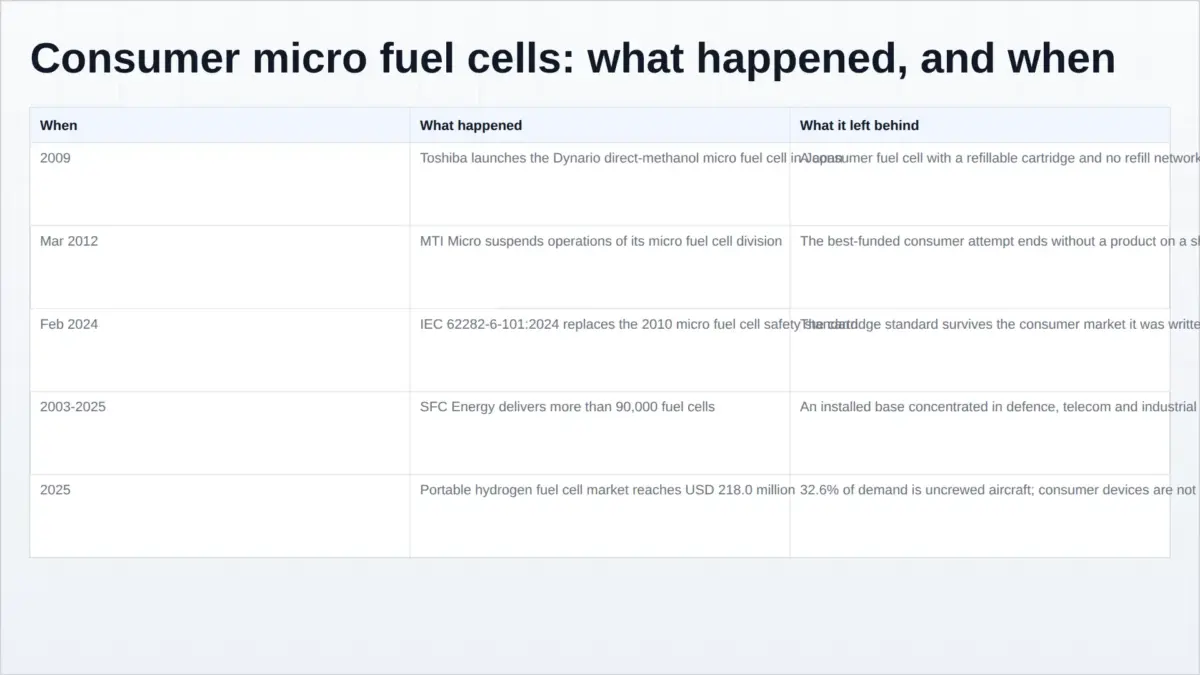
In March 2012, MTI Micro suspended operations of its micro fuel cell division. The company had spent a decade and a great deal of other people’s money building a methanol fuel cell small enough to sit inside a handheld device, and it stopped. It was not the first to try and it was not the last, but it was the best funded, and its closure is the moment the consumer fuel cell stopped being a forecast and became a history.
Three years earlier, Toshiba had put the Dynario on sale in Japan: a direct-methanol fuel cell you could hold, with a refillable cartridge and a USB output. It worked. It ran a phone. It came in a box. And then it went away, without a successor and without a market.
The conventional reading of that sequence is that the technology was not ready — too bulky, too expensive, too fiddly with the methanol. That reading is comfortable and it is mostly wrong. The cells worked. What did not exist was the thing a fuel cell needs in order to be a product rather than a prototype.
A battery needs a socket. A fuel cell needs an industry.
This is the whole argument, and it is an argument about infrastructure rather than electrochemistry.
A lithium-ion battery is a self-contained store of energy that refills from a wall socket. Sockets are the most widely deployed energy interface in human history; they are in every building, every airport, every train, and they were installed by somebody else, decades ago, at no cost to the battery industry. A battery company can ship a product and rely on a network that already exists.
A fuel cell is not a store of energy. It is a converter, and it is inert without fuel. Sell one to a consumer and you have not sold a product; you have sold a dependency on a supply chain that has to be built, certified, distributed, retailed and — because the fuel is methanol or hydrogen — regulated for transport and disposal before a single unit leaves the warehouse. The consumer becomes responsible for sourcing and storing a hazardous material. That is not a product experience. It is a logistics job.
Every consumer fuel cell attempt foundered on this and not on efficiency curves. Where you would have bought a cartridge, there was nothing. Where you would have disposed of one, there was no route. Where a retailer might have stocked them, there was a category buyer who correctly calculated that a product requiring its own fuel aisle was not a product they knew how to merchandise.
The regulatory proof that the product, not the technology, was the problem
If you want evidence that the cell itself was never the obstacle, look at what the standards apparatus did after the market died.
In February 2024, the International Electrotechnical Commission published IEC 62282-6-101:2024, the safety standard for micro fuel cell power systems — defined as systems and fuel cartridges that are “wearable or easily carried by hand”. It replaced IEC 62282-6-100:2010, which had been written when Toshiba and MTI Micro were still plausible businesses, and it did something its predecessor had not: it certifies the fuel cartridge as part of the object it governs.
Read that sequence again. The industry spent the 2000s failing to sell hand-carried fuel cells to consumers. Twelve years after the last serious attempt ended, a global standards body revised the specification for the cartridges those products would have used. Technical committees do not spend years on equipment nobody builds. The standard exists because the hardware class is real, sustained, and now supported by an institutional customer base that the consumer era never imagined.
What evaporated was not the cell. It was the assumption that a retail customer would accept the refuelling obligation.
The same stack found a buyer who already owned the logistics
The market that did form is the mirror image of the one that failed, and its defining feature is that the customer arrives with a supply chain attached.
A defence programme office has a depot, a hazardous-materials handling procedure, a qualified supplier list and a maintenance organisation. A telecom operator has field engineers who already visit every site. A drone operator has an operating base and a maintenance regime. When those organisations buy a fuel cell, the refuelling problem — the exact problem that killed the consumer device — is a problem they already solve for a living. The vendor does not have to build a retail fuel network. It has to satisfy a procurement requirement.
That is why the surviving suppliers describe themselves in ways a consumer electronics company never would. Doosan Mobility Innovation sells hydrogen vessels of 7 to 10.8 litres, and its own multi-purpose refilling equipment, as a product line standing beside its DP30 powerpack — because the vessel and the refiller are half the system and the customer expects to buy them together. SFC Energy, in its 2025 annual report, lists fuel cartridges among the things it sells, in a portfolio it describes as both direct methanol and PEM. Neither company markets a box that runs on fuel you source yourself.
The scale is real but it is not retail scale. SFC Energy has delivered more than 90,000 fuel cells since 2003 — an installed base that has generated 16.6 million kWh across 179 million operating hours — and reported group sales of EUR 143.274 million in 2025, with its fuel cell segment at EUR 99.835 million. Those are respectable numbers for an industrial supplier and they are a long way below what a successful consumer electronics line would have produced on the same engineering. That gap is the price of giving up on the shelf.
What the institutional market costs you
Selling to organisations rather than people solves the refuelling problem and creates three new ones, all visible in the same accounts.
The first is cyclicality. SFC Energy’s group sales were flat in 2025 at minus 1.0%, while order intake fell from EUR 167.762 million to EUR 118.427 million, with weakness in North America and an India delivery moved by a customer. A single buyer rescheduling a delivery moved a nine-figure business by a double-digit percentage. Consumer demand is fickle in aggregate and smooth in total; programme demand is the reverse.
The second is that certification never amortises. A consumer product spreads its safety approval across millions of units. A defence or telecom system spreads the same approval across thousands, and then across a five-year requalification cycle for the storage — a metal hydride system is capped at 150 litres and 25 MPa under 49 CFR 173.311 and ISO 16111, and comes back for inspection on a schedule. Fixed cost per unit stays high forever. That is the mechanical reason revenue per system in this market falls at only 4.56% a year while unit volumes compound at 27.46%: the hardware deflates, the compliance does not.
The third is that the moat is the cartridge, and a moat built on a proprietary consumable is a moat that invites a standards war. Every incumbent’s economics depend on the customer buying fuel from the company that sold the box. A multi-vendor cartridge standard certified under IEC 62282-6-101 would be excellent for customers and would remove the margin that currently funds certification, service networks and the smaller suppliers’ cash flow. Nobody in the industry is lobbying for it. Somebody eventually will.
The counterfactual worth taking seriously
It is tempting to conclude that the consumer fuel cell was simply a bad idea. That is too quick.
The reason it failed was a missing interface, and missing interfaces are usually fixed by standards rather than by engineering. A swappable cartridge — same form factor, same connector, certified once, sold by many — would have removed the single obstacle that killed the category: the requirement that a consumer adopt a fuel supplier along with a device. The technology to do that existed in 2009. What did not exist was a body willing to impose it, because the companies with the most to gain from a proprietary cartridge were the ones sitting on the committee.
That is the part of this story that is still live. A fuel cell is a device that cannot be sold without its fuel. Every market it has ever entered — military, telecom, drone, marine — succeeded to the exact extent that the fuel supply arrived with the customer. Every market it has failed to enter failed for the same reason in reverse. Pheonix Research’s modelling of the portable hydrogen fuel cell market puts it at USD 218.0 million in 2025 and USD 1,046.0 million in 2033, with uncrewed aircraft at 32.6% of demand and rising to 41.8%, and with the segments closest to a consumer purchase — outdoor recreation and construction — shrinking from a combined 12.3% to 6.2%. The consumer door did not reopen. It was bricked up, by logistics rather than by physics.
The full market analysis, including the value chain, the standards landscape and the forecast, is published as the Global Portable Hydrogen Fuel Cell Market Report, Size, Share and Forecast 2026–2033 in the Hydrogen & Electrolysers segment.
Frequently Asked Questions
Why did consumer fuel cells fail?
Not for technical reasons. A fuel cell is a converter that is inert without fuel, so selling one to a consumer means selling a dependency on a cartridge supply chain that has to be certified, distributed, retailed and disposed of. Batteries have no equivalent problem because every building already has a socket. Toshiba's Dynario reached the Japanese market in 2009 and MTI Micro suspended its micro fuel cell division in March 2012; neither had a refuelling network to sell into.
Did Toshiba's Dynario actually work?
The device functioned. Toshiba sold a direct-methanol micro fuel cell in Japan in 2009 with a refillable cartridge and a USB output. What it did not have was a route to refills, a returns route for spent cartridges, or a retailer willing to merchandise a product that needed its own fuel aisle. The product was withdrawn without a successor.
Which market did the same technology end up serving?
Institutional buyers, who arrive with the logistics already in place. Defence programme offices have depots and hazardous-materials procedures, telecom operators have field engineers visiting every site, and drone operators have operating bases. SFC Energy has delivered more than 90,000 fuel cells since 2003, almost all into those channels, and Pheonix Research models uncrewed aircraft at 32.6% of a USD 218.0 million portable hydrogen fuel cell market in 2025.
What would make a consumer fuel cell viable now?
A swappable, multi-vendor cartridge certified once under IEC 62282-6-101 would remove the requirement that a buyer adopt a fuel supplier along with a device. The technical basis existed in 2009; the obstacle is commercial, because a proprietary cartridge is exactly what funds the incumbent suppliers' certification and service networks.