
Company Profile
Ontex
Ontex Group NV (Euronext Brussels: ONTEX) is an Aalst, Belgium manufacturer of baby care, feminine care and adult care products, most of which it sells as retailer brands rather than under its own name. That makes it the counterparty the brand-led owners in Pheonix Research’s Global Feminine Hygiene Products Market report are competing against on the shelf, and it makes Ontex the clearest read available on what is happening to volume in the category rather than to price.
Identifiers
| Legal name | Ontex Group NV |
|---|---|
| Listing | Euronext Brussels, ticker ONTEX |
| Headquarters | Aalst, Belgium |
| Founded | 1979, in Belgium |
| Fiscal year | 1 January to 31 December |
| Wikidata ID | Q3352824 — label “Ontex”, described as a company |
| Pheonix entity ID | MIEN-node_981b84a9 |
| Official website | ontex.com |
| Investor relations | ontex.com/investors |
| Regulatory filings | Regulated information published through Euronext Brussels and the Belgian Financial Services and Markets Authority |
| Pheonix coverage | The retailer-brand counterweight to the brand owners modelled in the Global Feminine Hygiene Products Market report |
Executive Summary
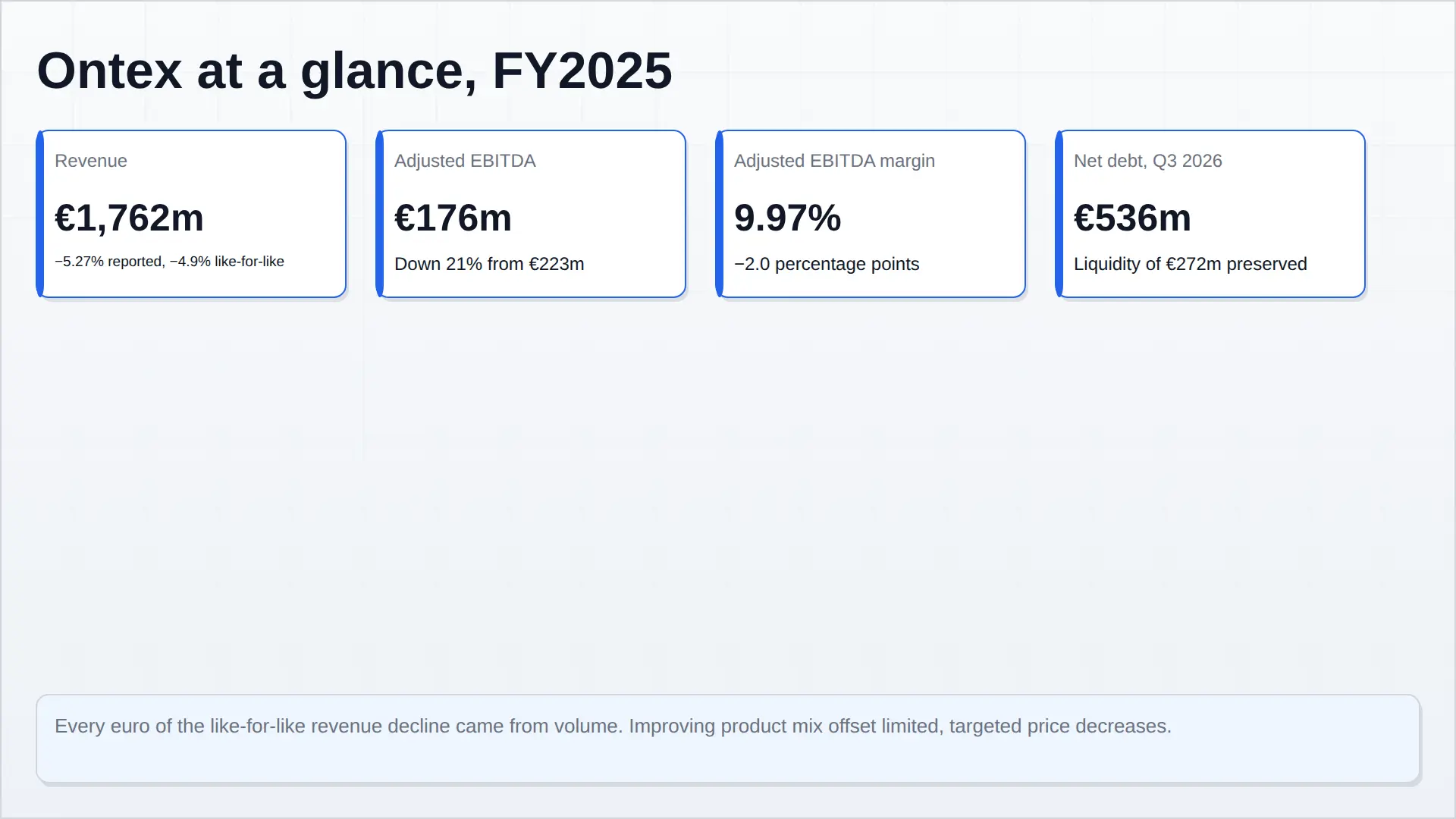
Ontex generated €1,762m of revenue in 2025, a like-for-like decline of 4.9% that the company attributes entirely to lower volumes. Adjusted EBITDA fell to €176m from €223m and the margin contracted 2.0 percentage points to 10.0%. That is a hard result for a business whose costs are largely fixed: the revenue reduction took with it the fixed-cost absorption that a manufacturer of this kind depends on, and a cost transformation programme only mitigated rather than offset the effect.
The volume story is specific and it is not about feminine care. Demand for retailer-brand baby care fell in Europe and North America on weak consumer demand amplified by intense promotions from the branded manufacturers, and Ontex’s baby care volumes fell more than the category because of its regional and customer exposure, customer destocking and supply chain constraints. Feminine care volumes were slightly down, broadly in line with market demand. Adult care kept growing, but more slowly than before. That ordering — baby care worst, feminine care flat to slightly down, adult care still growing — is the shape of European private-label hygiene demand in 2025.
|
€1,762m FY2025 revenue, −5.27% reported and −4.9% like-for-like |
€176m Adjusted EBITDA, down 21% from €223m |
9.97% Adjusted EBITDA margin, down 2.0 percentage points |
€536m Net debt at Q3 2026, with €272m of liquidity |
Key Highlights
| Period | Highlight |
|---|---|
| FY2025 | Revenue €1,762m, like-for-like −4.9%, entirely volume. Improving product mix offset limited, targeted price decreases. Operating profit €79m. |
| FY2025 profitability | Adjusted EBITDA €176m against €223m; margin 10.0%, down 2.0 percentage points on lower fixed-cost absorption, partly mitigated by the cost transformation programme. |
| Strategic review | Concluded in July 2026 with four strategic shifts: adult care to become the cornerstone of growth, baby and feminine care protected in Europe through a more targeted approach, a fundamental transformation of North America, and €240m of savings by the end of 2028. |
| H1 2026 | Adjusted EBITDA 9% below the prior year on a weaker first quarter; a €144m non-cash impairment and €30–35m of additional restructuring over 24 months booked against the plan. |
| Q3 2026 | Revenue €428m, −4% year on year but flat sequentially for a third quarter. Adjusted EBITDA €26m, down a third on the second quarter and half on the prior year, as input costs rose faster than price increases landed. |
| Outlook | Full-year 2026 adjusted EBITDA cut to €143–148m, free cash flow to €(10)–0m and year-end leverage capped at 3.75x, remaining inside the revolving credit facility covenants. |
Company Overview
Business Description
Ontex makes disposable hygiene products in three categories — baby care, feminine care and adult care — and sells most of them as retailer brands, the products that carry a supermarket’s or a pharmacy chain’s name rather than Ontex’s. It also supplies healthcare channels, where adult care demand is institutional as well as consumer. The consequence of that model is that Ontex does not own the consumer relationship and does not set the shelf price; it competes on cost, quality and service to the retailer, and its volumes follow the retailer’s promotional strategy and the branded manufacturer’s pricing.
That is exactly what happened in 2025. Where branded manufacturers promoted hard, retailer-brand baby care demand fell, and Ontex’s sales volumes in baby care fell by more than the category. Feminine care, the smallest of the three, held roughly in line with market demand — slightly down. Adult care continued to grow, at a lower pace, and it is the category the company has now designated as the cornerstone of its future growth, on the reasoning that Europe’s ageing population is a structural demand driver that does not depend on winning a promotional battle.
Organisational Structure and Footprint
Europe is the home market and, by the company’s own account, the resilient part of the group: it is where the adult care business sits, and it maintained a double-digit adjusted EBITDA margin through the first nine months of 2026 while the businesses in other regions were margin dilutive. North America is the problem: the company concluded that performance there had not translated into the returns expected from the investment made over recent years, and the response is a fundamental transformation of those operations to prioritise profitability rather than volume.
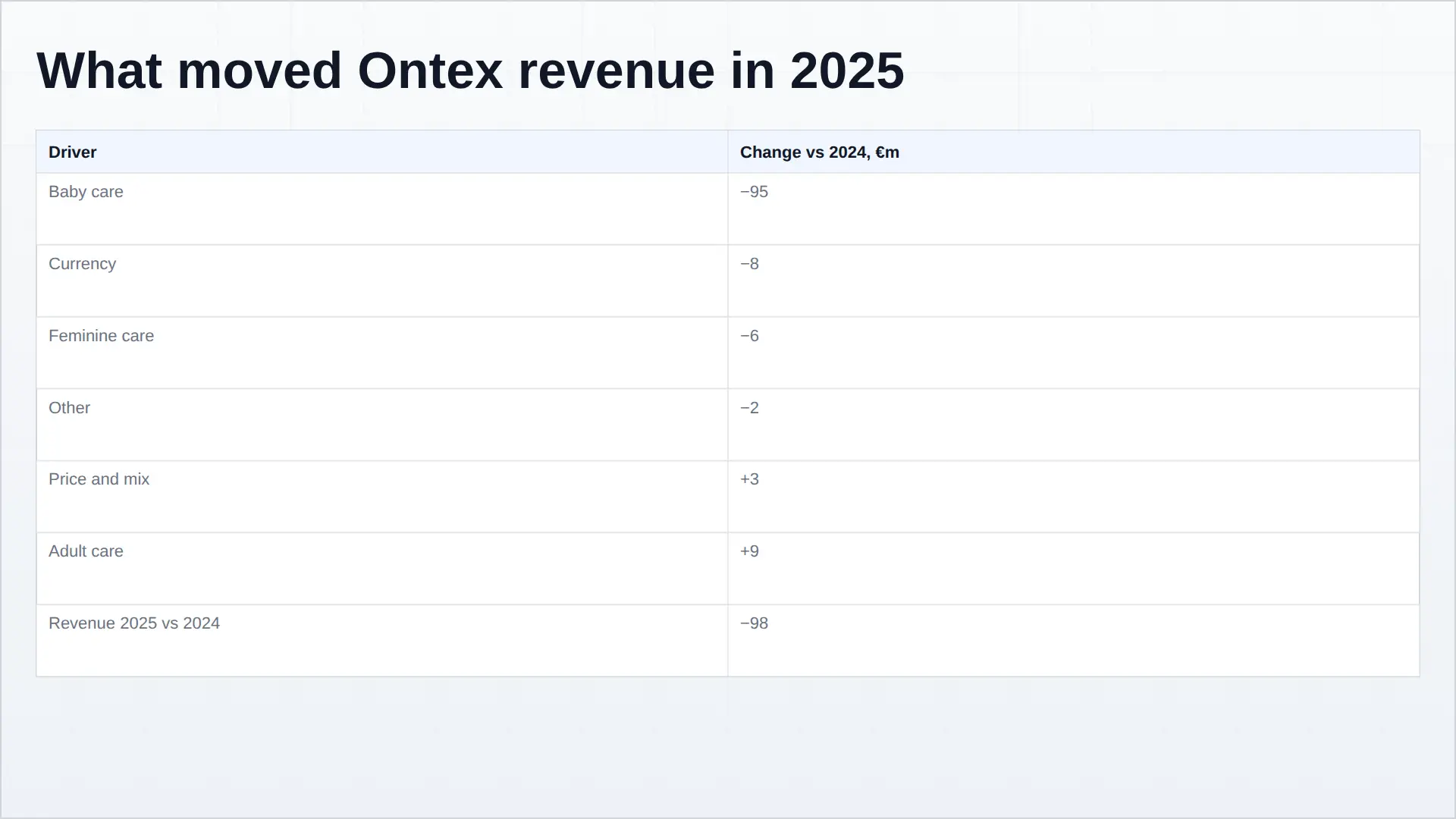
| Line | €m |
|---|---|
| Revenue 2024 | 1,860 |
| Baby care | −95 |
| Feminine care | −6 |
| Adult care | +9 |
| Other | −2 |
| Price and mix | +3 |
| Like-for-like 2025 | 1,770 |
| Currency | −8 |
| Revenue 2025 | 1,762 |
Components are rounded to the nearest €1m as the company presents them and do not sum exactly to the like-for-like total.
Financial Performance
Key Financial Highlights
Ontex entered 2025 expecting a difficult year and got a harder one. Revenue fell 5.27% on a reported basis and 4.9% like-for-like, and because the like-for-like decline was entirely volume, no pricing lever could offset it. Adjusted EBITDA fell from €222.6m to €175.6m and the margin from 12.0% to 10.0%. Operating profit was €79m. The cost transformation programme is what kept the margin from contracting further, but it did not prevent it.
| Measure | 2024 | 2025 |
|---|---|---|
| Revenue | 1,860 | 1,762 |
| Adjusted EBITDA | 222.6 | 175.6 |
| Adjusted EBITDA margin | 12.0% | 9.97% |
| Net debt | — | 536 at Q3 2026 |
| Leverage | — | 3.2x at H1 2026 |
| Liquidity | — | 272 at Q3 2026 |
Revenue Breakdown
Broken down by category, the 2025 decline is almost entirely one line. Baby care removed €95m of revenue; feminine care €6m; currency €8m. Adult care added €9m and price and mix added €3m. Nothing about that pattern suggests a consumer who has stopped buying hygiene products — it suggests a consumer trading down away from retailer brands in baby care in the two markets where branded manufacturers were promoting hardest, which is Europe and North America. The feminine care line, at a decline of €6m on a European business, is the most stable of the three.
Sequentially, the business has stopped getting worse. Revenue was stable at €428m for a third consecutive quarter in Q3 2026, even though that was 4% below the prior year because of exited overseas contracts and soft demand. North America sales stabilised with what the company describes as marked improvement in operational efficiency, and additional adult care capacity in Europe is ramping up as planned, with growth in adult and baby pants driving positive mix.
Profitability Analysis
The 2026 deterioration is a timing problem layered on a structural one. Input costs rose sharply in the third quarter while price increases ramped up more gradually than expected, which took adjusted EBITDA down to €26m — a third below the second quarter and half the prior year. Year to date, the Focus to Value programme had delivered €45m of savings, of which €16m came in the third quarter, against a total target of €240m by the end of 2028.
What makes the year uncomfortable rather than fatal is that the profitable part of the business is intact. Europe, which is home to adult care, maintained a double-digit adjusted EBITDA margin across the first nine months of 2026. The margin dilution sits in the other regions, which the transformation is designed either to fix or to make smaller. Net debt fell to €536m with €272m of liquidity preserved, and leverage of 3.2x at the half-year left room under the 3.75x covenant ceiling even after the outlook cut. The company now guides free cash flow of between minus €10m and zero for 2026 — thin, but enough to execute a plan that is mostly about cost and mix rather than capital.
SWOT Analysis
|
Strengths
|
Weaknesses
|
|
Opportunities
|
Threats
|
Recent Developments
| Date | Event |
|---|---|
| 28 October 2026 | Third-quarter revenue €428m (−4%), adjusted EBITDA €26m, and full-year adjusted EBITDA guidance cut to €143–148m with free cash flow of €(10)–0m and year-end leverage not to exceed 3.75x. |
| 30 July 2026 | Concluded the strategic review: four strategic shifts, a €40m addition to the productivity target taking total savings to €240m by end-2028, a €144m non-cash impairment, €30–35m of restructuring over 24 months, a CFO transition, a new Head of North America and a Transformation Management Office. |
| 12 February 2026 | Reported 2025 revenue of €1,762m (−4.9% like-for-like), adjusted EBITDA of €176m and operating profit of €79m, and initiated a strategic review of the group. |
Business Strategy
Global Strategy
The strategic review concluded in July 2026 replaced a volume-led plan with a value-led one. The four shifts are explicit: increase structural efficiency through the expanded Focus to Value programme; fundamentally transform North American operations to prioritise profitability; make adult care the cornerstone of growth while protecting baby and feminine care positions in Europe through a more targeted approach; and strengthen the balance sheet through cash generation rather than scale. A >20% reduction in white-collar, non-manufacturing positions sits inside the first of those, and a third of it had been implemented by the third quarter.
| Pillar | What it means |
|---|---|
| Focus to Value | €45m of savings delivered in the first nine months of 2026 against a €240m target by the end of 2028, including €40m of additional EBITDA identified in July 2026. |
| Adult care as cornerstone | Additional European adult care capacity ramping as planned, with adult and baby pants driving positive mix even as total revenue falls. |
| North America | A fundamental transformation of operations to prioritise profitability, with sales described as stabilised and operational efficiency markedly improved by the third quarter of 2026. |
| Simplify the organisation | More than a 20% reduction in white-collar non-manufacturing roles, a new CFO and Head of North America, and a Transformation Management Office to hold the pace of execution. |
Focus-Market Strategy
Europe is the focus market by default now. It is where adult care sits, it is where the company holds a defensible position with retailers, and it is the only region that held a double-digit adjusted EBITDA margin through the first nine months of 2026. The strategy for baby and feminine care in Europe is explicitly defensive rather than expansionary — protect the positions through a more targeted approach, rather than chase volume in a category where branded promotion is setting the price.
The contrast with the broader market that Pheonix Research models is worth stating plainly. The Global Feminine Hygiene Products report finds a category growing 3.80% in value on 0.80% volume growth, with 78.4% of the value growth coming from price and mix. Ontex sits at the other end of that: it sells the retailer-brand version, its volumes fell slightly in feminine care, and its price and mix contributed only €3m across the whole group. When the value growth in a category is price-led, the supplier whose proposition is lower price participates in the growth last. That is the structural argument for making adult care the cornerstone instead.
Sources
- Ontex Group, “Ontex 2025 full year and quarter 4 results”, 12 February 2026 — ontex.com
- Ontex Group, 2025 fourth-quarter results presentation and press release, 12 February 2026 — press release (PDF)
- Ontex Group, “Ontex 2026 quarter 2 and half year results” and outcome of the strategic review, 30 July 2026 — ontex.com
- Ontex Group, “Transformation of Ontex progressing well; Q3 impacted by steep input cost increases; Full-year adj. EBITDA outlook lowered to €143–148 million”, 28 October 2026 — press release (PDF)
- Pheonix Research, Global Feminine Hygiene Products Market — value and volume growth, and the price-and-mix decomposition this page is read against
- Wikidata, Q3352824
Provenance: this page is bound to Wikidata Q3352824 and to the Pheonix entity MIEN-node_981b84a9. Figures are taken from Ontex’s own regulated disclosures in euros as reported, on a continuing-operations basis. Adjusted EBITDA and leverage are alternative performance measures as the company defines them. Category movements in Table 1 are rounded as presented by the company. Last verified 18 November 2026.