
Editorial Article
Global Migraine Market: USD 8.10 Billion of New Revenue, and the Ceiling Is Reimbursement, Not Biology
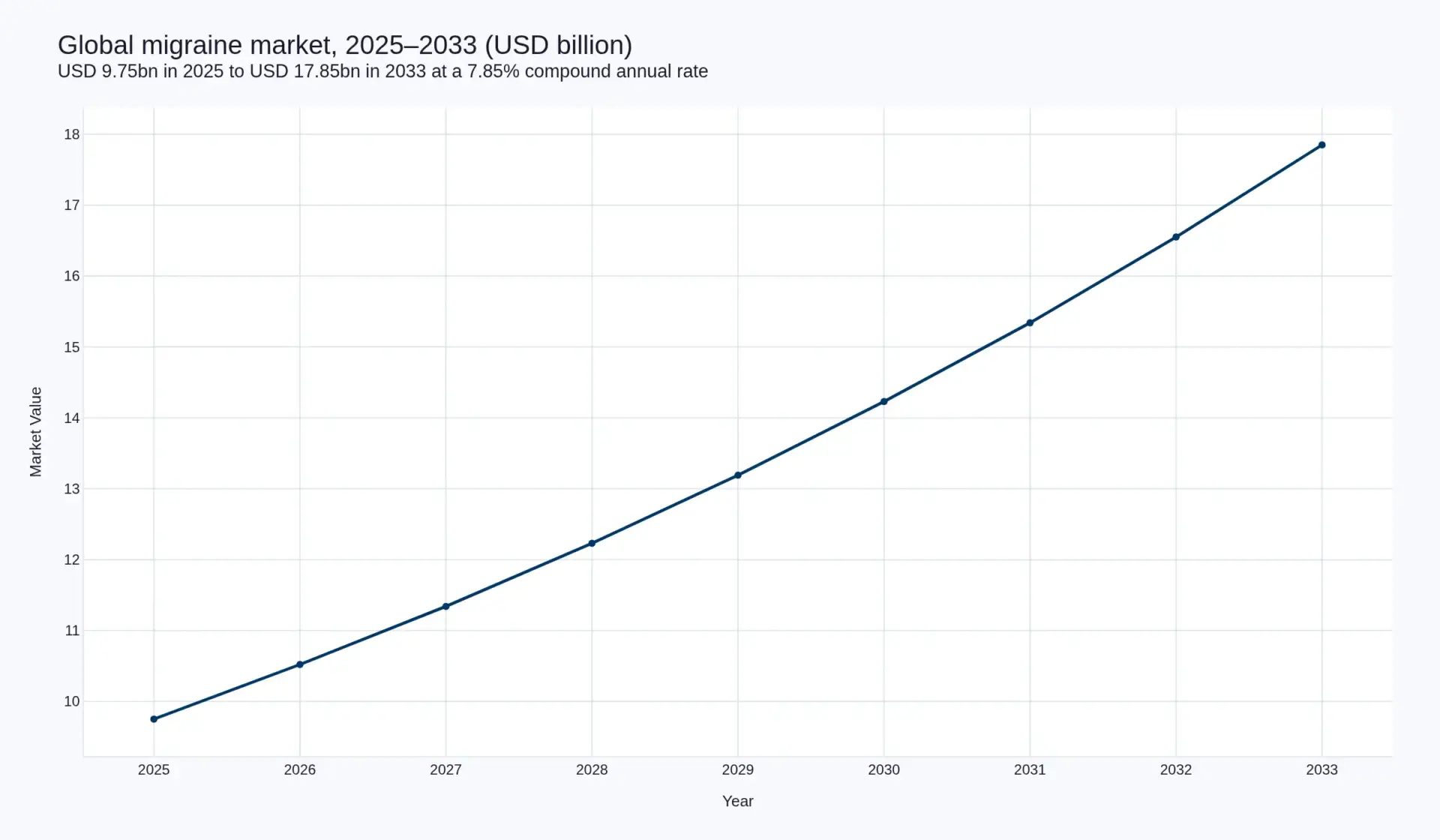
Pheonix Research puts the global migraine market at USD 9.75 billion in 2025 and USD 17.85 billion in 2033, a 7.85% compound annual rate. The percentage is the least interesting part of that pair. The absolute is the story: USD 8.10 billion of new annual revenue has to be created inside eight years — 1.83 times the base the market starts from, with 45.4% of everything it will sell in 2033 being revenue nobody is booking today.
That is a modest-sounding growth rate attached to an immodest demand. And it cannot be met the way this market has historically met demand, because the tier that carries most of today’s volume is politely described as price-competitive and less politely described as generic.
The arithmetic, held in dollars rather than in per cent
A constant rate is easy to read past. Compounded forward, the same 7.85% produces a rising absolute increment every year, because each year’s percentage is applied to a larger base. The average annual addition across the window is USD 1.01 billion. The final step alone — 2032 to 2033 — adds USD 1.30 billion. Nothing accelerates; the arithmetic simply gets heavier.
| Year | Market value (USD bn) | Increment on prior year (USD bn) |
|---|---|---|
| 2025 | 9.75 | — |
| 2026 | 10.52 | 0.77 |
| 2027 | 11.34 | 0.83 |
| 2028 | 12.23 | 0.89 |
| 2029 | 13.19 | 0.96 |
| 2030 | 14.23 | 1.04 |
| 2031 | 15.34 | 1.12 |
| 2032 | 16.55 | 1.20 |
| 2033 | 17.85 | 1.30 |
The reason that profile matters is that it is unforgiving of a weak year. A market adding three-quarters of a billion in 2026 has room to be wrong about 2033. A market that has to add 1.30 billion in the final year does not — by then the revenue is either in the run rate or it is not.
The growth cannot come from the tier that carries the volume
Migraine care is a two-tier market, and the tiers do not behave alike.
The lower tier is oral and largely generic: triptans, NSAIDs, beta blockers, antiepileptics, antidepressants. It treats the largest number of patients by a wide margin, it is the largest treatment segment in the model, and it stays that way through 2033. It is also a tier where price competition is the normal condition rather than a temporary phase. Revenue there is defended by volume and by nothing else.
The upper tier is biologic and near-biologic: CGRP monoclonal antibodies, oral gepants, ditans, non-invasive neuromodulation. A single patient-year in this tier costs multiples of a patient-year in the lower one, and the clinical case for treating migraine preventively rather than acutely has been rebuilt over the past decade around it. This is the fastest-growing tier in the model, and it does almost all of the value work.
A blended 7.85% is what a market looks like when an expensive tier takes share inside a cheap one that is not shrinking. It is not what a market looks like when a generic category raises prices.
One disclosure belongs here rather than in a footnote. The Pheonix model carries three headline figures and does not decompose them into segment dollar splits. What follows about which tier carries the increment is structural reasoning from how the two tiers are priced, not an arithmetic output of the model. The report itself ranks segments rather than assigning them shares, and it says so.
Seven players, and a structure that sounds contradictory
The market is moderately consolidated, with seven tier-1 players and high competitive intensity. Those three facts are usually presented as if one of them must be wrong. They are not, because the consolidation and the competition sit at different altitudes.
At the level of the biologic franchise the top of the field behaves like a small oligopoly: a handful of companies hold the protected assets, the clinical data and the payer relationships that make an asset commercially viable. AbbVie and Pfizer lead the field in this dataset, with Eli Lilly, Amgen, Teva, Lundbeck, Biohaven, Abbott, GSK and Dr. Reddy’s completing the profiled competitive set. At the level of the market as a whole the base is crowded, generic and contested, and the intensity of that contest is what keeps the blended growth rate in single digits rather than the mid-teens a pure-play biologic category would show.
That split is also the competitive risk map. A company’s position in the upper tier is defended by intellectual property and by clinical evidence. Its position in the lower tier is defended by manufacturing cost. The two are not transferable, and the strategic error available in this market is assuming that a strong biologic franchise confers pricing power in the generic base, or that scale in the generic base funds a biologic launch.
The gate is prior authorisation, not the molecule
Follow a patient through the value chain and the commercial decision is not made at the point of discovery, or manufacturing, or even efficacy. It is made at initiation.
A neurologist or headache specialist choosing a preventive biologic for a chronic patient commits the payer to a high per-patient annual spend, typically after documented failure of earlier lines. Prior authorisation and step therapy sit directly across that decision. This is the mechanism by which a product’s clinical superiority fails to translate one-for-one into revenue, and it is the single most consequential variable in the forecast.
Geography is the same mechanism seen from different angles. North America is the largest region because it prices the upper tier highest and reimburses it most reliably. Asia-Pacific is the fastest growing because it is adding diagnosed patients and specialty neurology capacity from a low base — growth from diagnosis, not from re-pricing. Europe sits between the two, and there the gate is health-technology assessment rather than the prescriber: a product can be approved, available and prescribed and still be commercially constrained by what the assessor will fund.
What would have to be true — and what would break it
Three conditions have to hold for the forecast to land, and the risks are their mirror image.
First, the biologic cohort has to keep expanding down the treatment ladder without a price reset. Expansion is the growth engine; a price reset is the one event that can turn a volume story into a revenue decline, because the tier’s revenue is concentrated in relatively few patients at high annual cost.
Second, oral CGRP antagonists have to extend the class to patients who will not accept an injection. The injectable cohort is limited by the size of the population willing to self-inject monthly for a condition that is episodic. Oral options change who says yes, and the forecast assumes they do.
Third, reimbursement in the largest markets has to keep funding chronic preventive treatment. This is the condition most likely to fail quietly, because it fails through formulary changes and step-therapy tightening rather than through anything visible in a clinical pipeline.
The falsifiers are therefore specific and unglamorous: a biosimilar or payer-driven price reset in the biologic tier; an oral class that fails to broaden the treated population beyond the existing injectable cohort; or a reimbursement contraction in North America or a health-technology-assessment reversal in Europe. None of those requires a scientific failure. That is the point.
What this number is not
This is a value forecast. It carries no unit or volume series, so no implied price per treated patient is published from it, and no epidemiology is inferred. It does not tell you how many people have migraine, how many are diagnosed, or how many are treated. It tells you what the treated market is worth, and what has to happen for it to be worth 83% more in eight years.
Held that way, the interesting question about the global migraine market is not whether it grows at 7.85%. It is whether the payers that gate the biologic tier keep saying yes at the rate the arithmetic requires — because USD 8.10 billion is not a clinical ambition, it is a reimbursement bet.
The full dataset, chapter set and methodology behind these figures are in the Global Migraine Market Report, Size, Share and Forecast 2026–2033.
Frequently Asked Questions
How big is the global migraine market?
Pheonix Research models the global migraine market at USD 9.75 billion in 2025, rising to USD 17.85 billion in 2033 — a 7.85% compound annual growth rate, in value terms. That is USD 8.10 billion of new annual revenue across the window, 1.83 times the 2025 base.
What is driving growth in the migraine market?
The upper tier of the market — CGRP monoclonal antibodies, oral gepants, ditans and non-invasive neuromodulation — where a patient-year costs multiples of the generic oral tier and where preventive treatment has been rebuilt clinically over the past decade. The generic tier of triptans, NSAIDs and older preventives carries the volume but is price-competitive, so the increment is carried by the expensive tier taking share inside a base that is not shrinking.
Is the migraine market consolidated?
Moderately consolidated, with seven tier-1 players and high competitive intensity — which is not a contradiction. Consolidation sits at the level of the biologic franchise, where AbbVie and Pfizer lead and Eli Lilly, Amgen, Teva, Lundbeck, Biohaven, Abbott, GSK and Dr. Reddy's complete the profiled set, while the generic base of the market remains crowded and contested.
What could slow the migraine market's growth?
Three things, all commercial rather than scientific: a biosimilar or payer-driven price reset in the biologic tier; oral CGRP antagonists failing to broaden the treated population beyond the existing injectable cohort; and reimbursement contraction — tighter prior authorisation or step therapy in North America, or a health-technology-assessment reversal in Europe.