
Editorial Article
From USD 33 an Hour to USD 105,000 Up Front: How the Company That Invented Robot Hiring Handed the Asset Back — and What That Reveals About Who Can Afford to Own a Robot
In October 2019, a Nashville company was selling welding robots by the hour. The rate was USD 33 an hour, there was no capital cost, the contract required the machine to be occupied for at least forty productive hours a week, and the customer could end it with thirty days’ notice. Rob Goldiez, the co-founder, explained the appeal to a trade publication in terms no leasing company would use: if business slows, he said, “just give your robot 30 days’ notice to end the contract. Keep your highly trained and valued employees employed — lay off your robot instead.”
In April 2021 the same company launched a packaged welding cell at USD 1,300 a month. The announcement described the arrangement precisely: “you don’t buy or own the equipment, rather the RSP rents the equipment and service for a set period of time, after which it is returned and deployed at another customer site.”
In 2026 that cell is on a public price list at USD 105,000. The software that runs it ships free in its basic version; the paid tier is USD 80 a month per cobot, and the care plan is USD 5,000 a year. Ownership is offered outright, with financing available “through our financing partners.”
Three price lists, seven years, one company, and a direction of travel that the entire robotics-as-a-service industry would rather not discuss. The company is Hirebotics. What it did is not a failure of the subscription model. It is the most honest piece of evidence in the sector about where the risk actually sits, and it is the reason our new robotics-as-a-service market report measures the market in contracts rather than robots and concludes that the growth is real, the price is falling, and the balance sheet is the product.
What actually changed between 2021 and 2026
| 2019 — BotX | 2021 — Cobot Welder | 2026 — Cobot Welder | |
|---|---|---|---|
| Commercial form | Hourly wage, USD 33/hour | Subscription, USD 1,300/month | Purchase, from USD 105,000 |
| Who owns the asset | Hirebotics | Hirebotics, returned and redeployed at the end of term | The customer, outright or through a financing partner |
| Minimum commitment | 40 productive hours a week | Monthly term | None; ownership is immediate |
| Exit | 30 days’ notice | End of term, equipment returned | Resale, at the customer’s risk |
| What the provider keeps | An hourly margin and utilisation risk | A monthly margin and residual risk | A software annuity at 0.91% of asset value and a service plan at 4.76% |
The robot did not change much. The configuration in 2021 was a Universal Robots UR10e, a Miller Invision 352 MPa power source, a Tregaskiss torch and a mobile cart. The configuration in 2026 is a Universal Robots UR8 Long with 68.9 inches of reach, a Miller Auto Deltaweld 350, a Tregaskiss Tough Gun, an operator panel with an e-stop and a 48-by-32-inch mobile workstation. Both are the same idea: put a welding torch on a collaborative arm, put the arm on a cart, and replace the pendants and the programming skill with an application on a phone.
What changed is who signs for the asset. And that change was not a marketing decision. It was a capital-markets decision wearing a product strategy’s clothes.
The annuity is worth less than the interest
Look at what Hirebotics kept when it handed the asset over. Beacon, the software that does the tap-to-teach programming, ships free. The paid tier is USD 80 a month per cobot, which is USD 960 a year. The care plan adds priority support, discounted repairs and loaner coverage for USD 5,000 a year. On a USD 105,000 system, that is a software annuity of 0.91% of asset value and a service annuity of 4.76%.
Together, the entire recurring line comes to 5.68% of the asset’s price per year. That is a good software business. It is a poor substitute for a lending spread, and the comparison that makes the point is one line of arithmetic. Every 100 basis points of funding cost on the same USD 105,000 asset is USD 1,050 a year, or 1.0% of its price.
A single 100-basis-point move in the cost of funds is worth more than the entire software annuity that the industry describes as its moat.
That is the whole argument. If you rent the robot, you have taken on a balance sheet of assets funded at your cost of capital, against customers who are comparing your monthly rate to a bank loan. If you sell the robot and keep the software, you have converted a spread business into a subscription business with gross margins in the eighties and no residual exposure at all. Hirebotics did not abandon robotics-as-a-service. It read the arithmetic and took the side of the trade with the better multiple.
Why the asset is a liability if you are small
A subscription model requires the provider to do something that looks like magic and is actually underwriting. It buys an asset, installs it, promises output, collects monthly, and at the end of the term takes the asset back and redeploys it. The 2021 announcement said this out loud: the equipment is “returned and deployed at another customer site.”
Everything in that sentence depends on the second customer existing and wanting substantially the same thing. For a welding cell, that means the fixture has to be generic enough to be re-used, the software version has to still be supported, the safety assessment has to be repeatable in a new building, and the resale market has to be deep enough to clear at a price the original contract assumed. Miss on any of those and the provider absorbs the difference. On a USD 105,000 cell, a residual that comes in fifteen points below assumption is a USD 15,750 loss, taken four years after the sale, on a relationship whose cumulative software and service margin is smaller than that.
That is why the market splits into three tiers, and why the middle one is being squeezed. The robot manufacturers — FANUC, ABB, KUKA, Yaskawa — already know what a five-year-old robot is worth, because they resell them. Their residual estimate is a transaction history; an independent provider’s is an opinion. The workflow specialists — Locus Robotics, which reported 6 billion cumulative picks in October 2025 across more than 350 sites, or Zebra Technologies’ Fetch business — own the software layer and can survive hardware deflation because their thousandth site costs a configuration rather than a build. And the full-stack asset owners, of which Formic is the clearest example with more than 100 facilities, 750,000 production hours and a 97% renewal rate, survive by keeping their application catalogue narrow enough that a returned robot has somewhere to go.
A small provider with a broad catalogue and no resale desk has none of those defences, so it does what Hirebotics did: it keeps the part of the business that compounds and gives away the part that depreciates.
The market is growing because the contract is getting cheaper
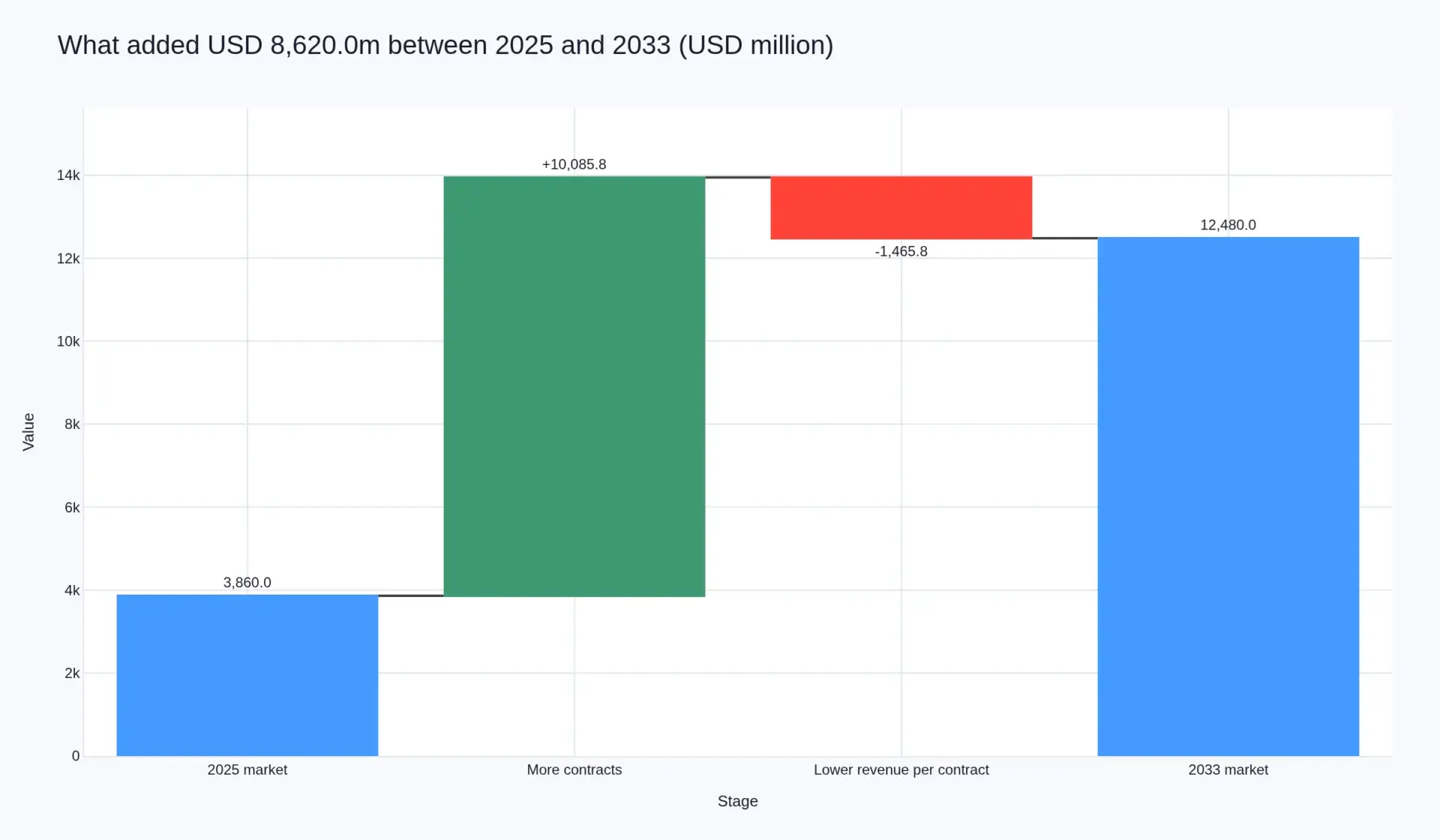
None of this means robotics-as-a-service is failing. Our report sizes the market at USD 3,860.0 million in 2025 rising to USD 12,480.0 million in 2033, a CAGR of 15.8%, on a contract count that goes from 46,500 to 168,000. The International Federation of Robotics recorded 31% growth in the RaaS fleet in 2024 and 42% in transport and logistics, against 14% in the underlying unit market. The model is outgrowing the hardware it runs on by a factor of three.
But the average contract is shrinking. Revenue per contract falls from USD 83,011 to USD 74,286, or 1.38% a year. Of the USD 8,620.0 million added between 2025 and 2033, contract count contributes 117.0% and revenue per contract subtracts 17.0%.
Those two facts are the same fact. The subscription is winning because it is getting cheap enough for a customer who would never have bought a robot — a fabricator with twelve welders, a contract cleaner, a regional palletiser. And it can only get cheap enough if someone other than the provider is holding the asset, or if the provider’s cost of funds is lower than its customer’s. That is the entire competitive dynamic of this industry, and it is a capital-markets dynamic, not a technology one.
What a buyer should ask before signing
Six questions separate a good subscription from an expensive one, and none of them is about the robot.
- Who owns the asset at the end of the term, and what residual did your price assume? Ask for the number. A provider that cannot state its residual assumption has not priced the contract; it has priced the first two years.
- Is this a lease in the accounts? Under IFRS 16 and ASC 842, a contract that transfers substantially all the risks and rewards of ownership puts a right-of-use asset back on your balance sheet. The opex promise can fail in the accounts while the invoice still looks like a subscription. Ask your auditor before you sign, not after.
- What is your renewal rate? Not your retention rate — your renewal rate, on contracts that reached term. A provider below 90% is telling you something about redesign risk and about the residual.
- What happens if my part mix changes? A subscription priced on one family of parts is a subscription that ends when the parts do. This is the question that separates a redeployable cell from a bespoke one.
- Who signs the conformity file after 20 January 2027? Regulation (EU) 2023/1230 treats an assembly of machinery that functions as an integral whole as machinery, which makes the party placing it on the market the manufacturer. If your provider says the robot maker carries that, get it in writing.
- What is your intervention rate and your mean time to recovery? Uptime percentages are not comparable between providers because nobody has defined what they exclude. Intervention rate per thousand operating hours is the number that predicts your service experience.
It is worth following the argument one step further, because the asset the provider gave back does not disappear. The companion article to this one takes the same USD 105,000 cell and asks who buys it at the end of the term — and finds that a fifteen-point miss on its resale value costs the provider USD 15,750, more than the entire software and service margin of the relationship.
The uncomfortable conclusion
The company that invented robot hiring is now, on its own public price list, a hardware reseller with a software attach. That is not hypocrisy. It is the clearest statement anyone in the category has made about where the value sits, and it was made by a price sheet rather than a strategy deck.
For buyers, the implication is liberating: the subscription is not a favour being done to you by a technology company. It is a financing arrangement with a service arm, and it should be compared against a bank loan, an equipment lease and an outright purchase on plain arithmetic. For anyone building in the category, the implication is harsher. The growth is in contracts that are getting cheaper. The margin is in residual value, and residual value belongs to whoever knows the resale market. Everyone else is selling software at 0.91% of asset value and calling it a moat.
The full analysis — six chapters on the value chain, competitive landscape, investment activity, technology and innovation, market risk and regulatory landscape — is in Global Robotics-as-a-Service (RaaS) Market Report, Size, Share and Forecast 2026–2033. The two companion reports that carry the engineering half of this argument are Robotics Systems Integration Services, on the deployment cost that sits inside every subscription, and Offline Robot Programming & Simulation, on the tooling that decides how cheaply a returned robot can be recommissioned for its next owner.
Frequently Asked Questions
Why did Hirebotics move from renting welding cobots to selling them?
Because renting a welding cell means funding a USD 105,000 asset and forecasting what it will be worth in four years, and the recurring revenue attached to the asset does not cover that risk. Beacon Pro at USD 80 a month is USD 960 a year, or 0.91% of the system price, and the care plan at USD 5,000 a year is 4.76%. Together the annuity is 5.68% of asset value a year, while a single 100-basis-point move in funding cost on the same asset is 1.0%. Selling the cell and keeping the software and service lines converts a spread business with residual risk into a subscription business without it.
Is robotics-as-a-service cheaper than buying a robot?
Only against the right comparison. The customer's real alternative is not cash but a bank loan or an equipment lease: the Equipment Leasing and Finance Association reports that 54% of United States equipment acquisitions were financed in 2024 and that roughly eight in ten businesses use some form of equipment financing. A RaaS subscription has to beat that rate while carrying operational risk the lender refuses to take. It wins where the provider's cost of funds is genuinely lower than the customer's and where the deployment is repeatable; it loses where the customer can borrow cheaply and the application is bespoke.
Why is revenue per RaaS contract falling while the market grows?
Because the number of contracts is rising faster than the average contract is getting bigger. Pheonix Research measures the market at 46,500 active contracts in 2025 rising to 168,000 in 2033 at 17.42% a year, while revenue per contract falls from USD 83,011 to USD 74,286, or 1.38% a year. The subscription is moving downmarket into smaller deployments, and price competition from lower-cost hardware and from the robot manufacturers' own captive finance programmes is pushing the monthly rate down. Contract count contributes 117.0% of the market's growth and revenue per contract subtracts 17.0%.