
Marché mondial des produits d'hygiène féminine par type (serviettes hygiéniques/protections, tampons, protège-slips, coupe menstruelle, lavant d'hygiène féminine, culottes menstruelles) et canal de distribution (supermarché, magasins de proximité, grands magasins, pharmacies de détail et achat en ligne), géographie (Amérique du Nord, Amérique du Sud, Europe, Asie-Pacifique, Moyen-Orient et Afrique) - Analyse des tendances de l'industrie et prévisions jusqu'en 2031
PRODUITS D'HYGIÈNE FÉMININE — DÉFINITION DU MARCHÉ MONDIAL : Les produits d'hygiène féminine sont des articles de soins personnels utilisés par les femmes pendant les règles, les pertes menstruelles et les pratiques alternatives liées aux organes génitaux. Ces produits jouent un rôle essentiel dans le maintien du bien-être reproductif des femmes et la promotion de pratiques d'hygiène intime sûres afin de prévenir toute forme d'infection. Généralement, ces produits sont fabriqués à partir de fibres polymériques, de pâte de cellulose et de fluff de bois, entre autres matériaux. Ils concernent particulièrement la menstruation, la propreté vaginale, la contraception et la maternité.
Les articles féminins sont disponibles en différentes tailles selon les morphologies. La taille du vagin variant selon les tranches d'âge, les différentes formes de ces produits attirent un grand nombre de clientes. La demande féminine pour ces articles a augmenté tant dans les pays développés que dans les pays émergents, en raison de l'adoption croissante des produits menstruels à travers le monde.
APERÇU DU MARCHÉ MONDIAL DES PRODUITS D'HYGIÈNE FÉMININE : Les produits d'hygiène féminine gagnent régulièrement en popularité en raison de la demande croissante dans l'ensemble de la zone géographique. Une meilleure connaissance de l'hygiène féminine, associée à la volonté d'utiliser des produits sanitaires sains et confortables, constitue un facteur majeur de croissance du secteur et génère un vaste marché pour les produits d'hygiène féminine à travers le monde. Une prise de conscience accrue de la santé et de l'hygiène des femmes, ainsi que l'arrivée de produits d'hygiène féminine à faible coût, sont des facteurs qui devraient stimuler la demande de produits d'hygiène féminine au cours de la période de prévision.
L'utilisation de substances chimiques dans la fabrication des produits d'hygiène féminine peut avoir des effets nocifs. En outre, l'élimination de ces produits peut contribuer à l'obstruction des canalisations, ce qui, à son tour, entrave la vente de ces produits. Par ailleurs, le développement du besoin en produits d'hygiène féminine créera d'attrayantes opportunités de marché dans les années à venir.
Selon Pheonix Research, la taille du marché mondial des produits d'hygiène féminine a enregistré un TCAC de 5,7 % de 2024 à 2031. En termes de segmentation géographique, la région Asie-Pacifique a dominé le marché et a été le principal contributeur en termes de revenus sur l'ensemble du marché mondial des produits d'hygiène féminine.
DYNAMIQUE DU MARCHÉ MONDIAL DES PRODUITS D'HYGIÈNE FÉMININE : Facteurs moteurs du marché ??? Progrès croissants dans les produits d’hygiène féminine. ??? Sensibilisation croissante à l’hygiène environnementale et personnelle.
Freins du marché ??? Stigmatisation sociale liée aux menstruations et aux produits d’hygiène féminine. ??? Effets indésirables des désinfectants chimiques.
SEGMENTATION DU MARCHÉ MONDIAL DES PRODUITS D'HYGIÈNE FÉMININE : Par Type de Produit ??? Serviettes hygiéniques/protections périodiques ??? Tampons ??? Protège-slips ??? Coupe menstruelle ??? Gel lavant intime ??? Culottes menstruelles
Par Canal de Distribution ??? Supermarchés ??? Magasins de proximité ??? Grands magasins ??? Pharmacies de détail ??? Achats en ligne
Par zone géographique Amérique du Nord o États-Unis o Canada o Mexique
Amérique du Sud o Brésil o Argentine o Reste de l’Amérique du Sud
??? Europe o Allemagne o France o Royaume-Uni o Italie o Espagne o Russie o Turquie o Belgique o Pays-Bas o Reste de l'Europe
??? Asie-Pacifique o Japon o Chine o Corée du Sud o Inde o Australie o Singapour o Malaisie o Indonésie o Thaïlande o Philippines o Reste de l’Asie-Pacifique
??? Moyen-Orient et Afrique o Afrique du Sud o Égypte o Arabie saoudite o Émirats arabes unis o Israël o Reste du Moyen-Orient et de l'Afrique
ANALYSE CONCURRENTIELLE : MARCHÉ MONDIAL DES PRODUITS D'HYGIÈNE FÉMININE : Le marché mondial des produits d'hygiène féminine est hautement concurrentiel, et les principaux acteurs ont utilisé diverses approches pour accroître leur présence sur ce marché, telles que des innovations de produits, des acquisitions, des contrats, des coentreprises, des alliances, des acquisitions, et autres. La portée de l'étude inclut les revenus du marché des produits d'hygiène féminine pour le monde entier, la région Asie-Pacifique, l'Amérique du Nord, l'Europe, l'Amérique du Sud, ainsi que le Moyen-Orient et l'Afrique.
ACTEURS CLÉS DU MARCHÉ : MARCHÉ MONDIAL DES PRODUITS D'HYGIÈNE FÉMININE : Voici quelques-uns des principaux concurrents actuellement présents sur le marché des produits d’hygiène féminine : - Procter & Gamble Company - Johnson & Johnson Services, Inc. - Edgewell Personal Care - Unicharm Corporation - Kimberly-Clark Corporation - Kao Corporation - Torunskie Zaklady Materialów Opatrunkowych S A - Prestige Consumer Healthcare, Inc. - Thinx, Inc - Diva International Inc. - Premier - First Quality Enterprises Inc - Hengan International Group Co. Ltd - Essity AB - Ontex Group NV - Natracare LLC
MÉTHODOLOGIE DE RECHERCHE : MARCHÉ MONDIAL DES PRODUITS D'HYGIÈNE FÉMININE Les modules de collecte de données avec des échantillons de grande taille sont utilisés pour la collecte des données et l'analyse de l'année de référence. L'analyse des parts de marché et l'analyse des tendances clés sont les principaux facteurs de succès pour tout rapport de marché. Des modèles statistiques et cohérents du marché sont utilisés pour analyser les données du marché. Veuillez demander un appel avec un analyste pour plus d'informations sur la méthodologie de recherche.
Les consultants en recherche de Phoenix utilisent leur méthodologie de recherche propriétaire pour évaluer les données, ce qui implique l’exploration de données, l’analyse de l’impact des variables de données sur le marché et la validation primaire. En outre, d’autres modèles de données comprennent un aperçu et un guide du marché, une matrice d’entreprises, une cartographie des fournisseurs selon l’intensité clé, une analyse des prévisions du marché, une analyse des parts d’entreprise, une analyse descendante et ascendante, et d’autres éléments.
OFFRE ET DEMANDE - RÉPONDANT DE LA RECHERCHE PRIMAIRE Côté demandeAcheteurs commerciaux, organismes d'achats groupés, associations, autorités de santé, universitaires et établissements d'enseignement supérieur, experts technologiques, chercheurs, promoteurs et investisseurs, entre autres.
Offre:Directeurs de produit, responsables marketing, cadres supérieurs et intermédiaires, distributeurs, spécialistes de l’intelligence économique, et gestionnaires d’autorités réglementaires, entre autres.
APERÇU DU RAPPORT : Pour obtenir des informations sur le milieu concurrentiel du marché Évaluation des utilisateurs finaux / Comportements des clients Évaluation détaillée de la demande et de l'offre Analyse des principaux moteurs et contraintes du marché Paysage concurrentiel des principaux acteurs impliqués Analyse approfondie de la segmentation du marché
Table des matières
Résumé exécutif Perspectives du marché mondial 3. Introduction 3.1. Objectifs de l'étude 3.2. Périmètre de l'étude – Couverture du marché / Taxonomie 3.3. Périmètre de l'étude – Couverture géographique 3.4. Parties prenantes du marché des produits d'hygiène féminine 3.5. Années d'étude et devise 3.6. Recherche et méthodologie 4. Tendances clés du marché 4.1. Tendances clés ayant un impact sur le marché 4.2. Tendances en matière d'innovation et de développement de produits 5. Impact post-Covid-19 6. Aperçu du marché parent et analyse qualitative 7. Analyse du cycle de vie des produits 8. Contexte du marché 8.1. Facteurs macroéconomiques 8.2. Facteurs de prévision - Pertinence et impact 8.3. Chaîne de valeur 8.4. Dynamique du marché 8.4.1. Moteurs 8.4.2. Contraintes 8.4.3. Analyse des opportunités 8.4.4. Défis 9. Paysage politique et réglementaire 10. Analyse de la chaîne d'approvisionnement 10.1. Liste des participants actifs - Par région 10.2. Principaux distributeurs/détaillants 11. Analyse de la chaîne de valeur et des prix 11.1. Analyse des prix moyens par région 11.2. Analyse de la chaîne de valeur 11.3. Facteurs influençant les prix 12. Marché mondial des produits d'hygiène féminine 13. Marché mondial des produits d'hygiène féminine - Par type de produit 13.1. Marché mondial des produits d'hygiène féminine, par serviettes hygiéniques/protège-slips 13.2. Marché mondial des produits d'hygiène féminine, par coupe menstruelle 13.3. Marché mondial des produits d'hygiène féminine, par tampons 13.4. Marché mondial des produits d'hygiène féminine, par produit de lavage intime féminin 13.5. Marché mondial des produits d'hygiène féminine, par protège-slips 13.6. Marché mondial des produits d'hygiène féminine, par culottes menstruelles 14. Marché mondial des produits d'hygiène féminine - Par canal de distribution 14.1. Marché mondial des produits d'hygiène féminine, par supermarché 14.2. Marché mondial des produits d'hygiène féminine, par pharmacies de détail 14.3. Marché mondial des produits d'hygiène féminine, par magasins de proximité 14.4. Marché mondial des produits d'hygiène féminine, par achat en ligne 14.5. Marché mondial des produits d'hygiène féminine, par grands magasins 15. Marché mondial des produits d'hygiène féminine, par zone géographique 15.1. Marché sud-américain des produits d'hygiène féminine, par pays 15.1.1. Marché sud-américain des produits d'hygiène féminine, par Brésil 15.1.2. Marché sud-américain des produits d'hygiène féminine, par Argentine 15.1.3. Marché sud-américain des produits d'hygiène féminine, par Autres 15.2. Marché nord-américain des produits d'hygiène féminine, par pays 15.2.1. Marché nord-américain des produits d'hygiène féminine, par États-Unis 15.2.2. Marché nord-américain des produits d'hygiène féminine, par Canada 15.3. Marché européen des produits d'hygiène féminine, par pays 15.3.1. Marché européen des produits d'hygiène féminine, par Royaume-Uni 15.3.2. Marché européen des produits d'hygiène féminine, par France 15.3.3. Marché européen des produits d'hygiène féminine, par Allemagne 15.3.4. Marché européen des produits d'hygiène féminine, par Italie 15.3.5. Marché européen des produits d'hygiène féminine, par Espagne 15.3.6. Marché européen des produits d'hygiène féminine, par Russie 15.3.7. Marché européen des produits d'hygiène féminine, par Turquie 15.3.8. Marché européen des produits d'hygiène féminine, par Belgique 15.3.9. Marché européen des produits d'hygiène féminine, par Pays-Bas 15.3.10. Marché européen des produits d'hygiène féminine, par Reste de l'Europe 15.4. Marché des produits d'hygiène féminine en Asie-Pacifique, par pays 15.4.1. Marché des produits d'hygiène féminine en Asie-Pacifique, par Chine 15.4.2. Marché des produits d'hygiène féminine en Asie-Pacifique, par Inde 15.4.3. Marché des produits d'hygiène féminine en Asie-Pacifique, par Japon 15.4.4. Marché des produits d'hygiène féminine en Asie-Pacifique, par Corée du Sud 15.4.5. Marché des produits d'hygiène féminine en Asie-Pacifique, par Malaisie 15.4.6. Marché des produits d'hygiène féminine en Asie-Pacifique, par Thaïlande 15.4.7. Marché des produits d'hygiène féminine en Asie-Pacifique, par Indonésie 15.4.8. Marché des produits d'hygiène féminine en Asie-Pacifique, par Singapour 15.4.9. Marché des produits d'hygiène féminine en Asie-Pacifique, par Philippines 15.4.10. Marché des produits d'hygiène féminine en Asie-Pacifique, par Australie 15.4.11. Marché des produits d'hygiène féminine en Asie-Pacifique, par Nouvelle-Zélande 15.4.12. Marché des produits d'hygiène féminine en Asie-Pacifique, par Reste de l'Asie-Pacifique 15.5. Marché des produits d'hygiène féminine au Moyen-Orient et en Afrique, par pays 15.5.1. Marché des produits d'hygiène féminine au Moyen-Orient et en Afrique, par Afrique du Sud 15.5.2. Marché des produits d'hygiène féminine au Moyen-Orient et en Afrique, par Égypte 15.5.3. Marché des produits d'hygiène féminine au Moyen-Orient et en Afrique, par Arabie saoudite 15.5.4. Marché des produits d'hygiène féminine au Moyen-Orient et en Afrique, par Émirats arabes unis 15.5.5. Marché des produits d'hygiène féminine au Moyen-Orient et en Afrique, par Israël 15.5.6. Marché des produits d'hygiène féminine au Moyen-Orient et en Afrique, par Reste du Moyen-Orient et de l'Afrique 15.6. Marché des produits d'hygiène féminine dans le reste du monde, par pays 16. Paysage concurrentiel 16.1. Analyse des parts de marché (2023) 16.2. Analyse des cinq forces de Porter Voici la traduction en français : 17. Profils d'entreprises 17.1. Procter & Gamble Company 17.1.1. Présentation générale 17.1.2. Analyse des revenus 17.1.3. Portefeuille de produits 17.1.4. Évolutions récentes 17.2. Johnson & Johnson Services, Inc. 17.2.1. Présentation générale 17.2.2. Analyse des revenus 17.2.3. Portefeuille de produits 17.2.4. Évolutions récentes 17.3. Edgewell Personal Care 17.3.1. Présentation générale 17.3.2. Analyse des revenus 17.3.3. Portefeuille de produits 17.3.4. Évolutions récentes 17.4. Unicharm Corporation 17.4.1. Présentation générale 17.4.2. Analyse des revenus 17.4.3. Portefeuille de produits 17.4.4. Évolutions récentes 17.5. Kimberly-Clark Corporation 17.5.1. Présentation générale 17.5.2. Analyse des revenus 17.5.3. Portefeuille de produits 17.5.4. Évolutions récentes 17.6. Kao Corporation 17.6.1. Présentation générale 17.6.2. Analyse des revenus 17.6.3. Portefeuille de produits 17.6.4. Évolutions récentes 17.7. Torunskie Zaklady Materialów Opatrunkowych S A 17.7.1. Présentation générale 17.7.2. Analyse des revenus 17.7.3. Portefeuille de produits 17.7.4. Évolutions récentes 17.8. Prestige Consumer Healthcare, Inc. 17.8.1. Présentation générale 17.8.2. Analyse des revenus 17.8.3. Portefeuille de produits 17.8.4. Évolutions récentes 17.9. Thinx, Inc 17.9.1. Présentation générale 17.9.2. Analyse des revenus 17.9.3. Portefeuille de produits 17.9.4. Évolutions récentes 17.10. Diva International Inc. 17.10.1. Présentation générale 17.10.2. Analyse des revenus 17.10.3. Portefeuille de produits 17.10.4. Évolutions récentes 17.11. Premier 17.11.1. Présentation générale 17.11.2. Analyse des revenus 17.11.3. Portefeuille de produits 17.11.4. Évolutions récentes 17.12. First Quality Enterprises Inc 17.12.1. Présentation générale 17.12.2. Analyse des revenus 17.12.3. Portefeuille de produits 17.12.4. Évolutions récentes 17.13. Hengan International Group Co. Ltd 17.13.1. Présentation générale 17.13.2. Analyse des revenus 17.13.3. Portefeuille de produits 17.13.4. Évolutions récentes 17.14. Essity AB 17.14.1. Présentation générale 17.14.2. Analyse des revenus 17.14.3. Portefeuille de produits 17.14.4. Évolutions récentes 17.15. Ontex Group NV 17.15.1. Présentation générale 17.15.2. Analyse des revenus 17.15.3. Portefeuille de produits 17.15.4. Évolutions récentes 17.16. Natracare LLC 17.16.1. Présentation générale 17.16.2. Analyse des revenus 17.16.3. Portefeuille de produits 17.16.4. Évolutions récentes 18. ANALYSE SWOT ET ANALYSE 19. CONCLUSION À PROPOS DE NOUS 21. RAPPORTS CONNEXESPaysage concurrentiel
3. Competitive landscape
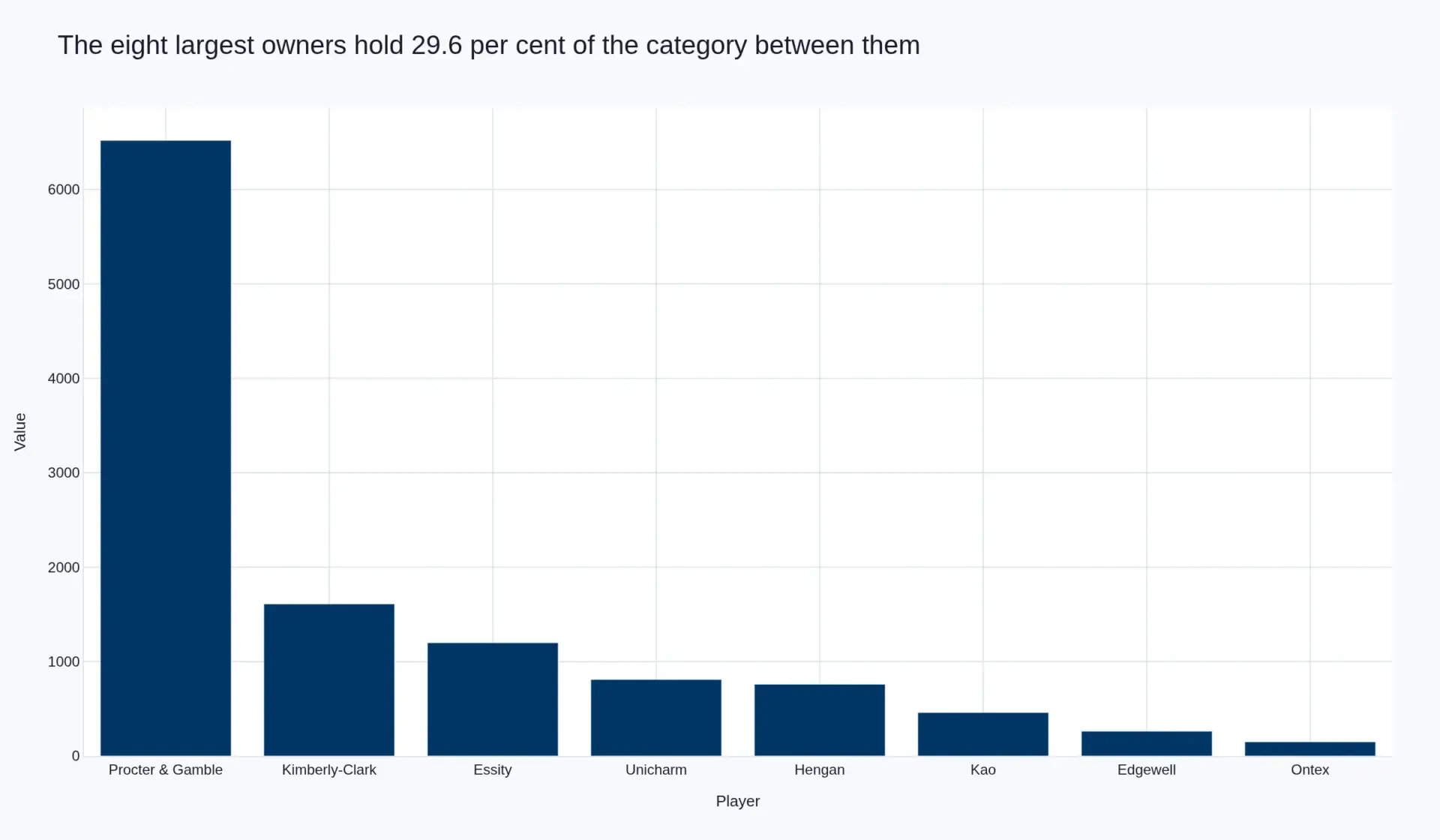
This is a category with a dominant brand owner and no consolidated market. Procter & Gamble holds a modelled 16.4 per cent of 2025 value — USD 6,520 million — and the next seven owners together hold 13.2 per cent. The eight largest come to 29.6 per cent, which means 70.4 per cent of the category, some USD 28,028 million, sits with private label, regional converters and the long tail of Chinese and Indian brands that never appear in a global share table but decide what a pad costs in Zhengzhou or Lucknow.
What is disclosed, and what we had to model
Almost nobody reports feminine care as a line item, and the two owners who come closest do so from opposite directions. Essity publishes Feminine Care as a category within its net sales: 9 per cent of SEK 138,494 million in 2025, roughly SEK 12,464 million. Edgewell, until February 2026, was the only large listed pure-play that reported Feminine Care as a full reporting segment — USD 261.5 million of net sales in fiscal 2025. Everyone else buries it. P&G’s Baby, Feminine and Family Care segment was USD 20,248 million in fiscal 2025 and grew organic sales 1 per cent; the feminine line inside it is not disclosed and is modelled here at USD 6,520 million. Kimberly-Clark’s 2025 reorganisation into North America and International Personal Care removed even the segment-level view. Hengan’s hygiene segment, RMB 6,571 million of 2025 revenue, carries diapers alongside pads.
| Owner | Disclosure basis | 2025 category revenue, USD m | Modelled share |
|---|---|---|---|
| Procter & Gamble | Modelled out of Baby, Feminine & Family Care (USD 20,248m, FY2025) | 6,520 | 16.4% |
| Kimberly-Clark | Modelled; category no longer separately reported | 1,610 | 4.0% |
| Essity | Disclosed: Feminine Care, 9% of SEK 138,494m | 1,200 | 3.0% |
| Unicharm | Modelled out of Personal Care (JPY 774,428m, FY2025) | 810 | 2.0% |
| Hengan International | Modelled out of hygiene segment (RMB 6,571m, 2025) | 760 | 1.9% |
| Kao | Modelled; not separately disclosed | 460 | 1.2% |
| Edgewell Personal Care | Disclosed: Feminine Care segment, USD 261.5m FY2025 | 262 | 0.7% |
| Ontex Group | Modelled; not separately disclosed | 150 | 0.4% |
| Long tail: private label and regional brands | Residual | 28,028 | 70.4% |
The four strategic postures
P&G is defending a price umbrella. Total company net sales were USD 84.3 billion in fiscal 2025, unchanged, with a one-point price increase offset by a one-point foreign-exchange drag; organic sales rose 2 per cent. The Baby, Feminine and Family Care segment’s organic growth of 1 per cent came with baby care declining low single digits on volume, which means the feminine line did the work of holding the segment flat. P&G’s posture through the period has been to hold price and let premium tiers — Always and Whisper line extensions — carry the mix, rather than to chase volume in the discount channel.
Kimberly-Clark is shrinking to fit. 2025 net sales of USD 16,447 million were 2.1 per cent lower, with a 3.9 per cent drag from exiting the private-label diaper business partially offset by 1.8 per cent organic growth in North America. North America Personal Care value share rose 20 basis points and volume share 90 basis points. The perimeter now excludes the divested international family care and professional business, and Thinx — acquired for more than USD 230 million in cash — sits inside a portfolio that no longer reports the category it belongs to.
Essity is buying the shelf it does not have. 2025 net sales were SEK 138,494 million with organic growth of 0.9 per cent, of which volume contributed nothing and price/mix contributed the whole 0.9 points. Feminine Care was named among the categories that performed strongly and profitably. The USD 340 million Edgewell acquisition, completed 2 February 2026, adds four North American brands to a portfolio that was stronger in Europe and Latin America, and takes Essity’s modelled category revenue from about USD 1,200 million to roughly USD 1,462 million.
Unicharm is absorbing a trust shock. Personal Care net sales fell 6.3 per cent to JPY 774,428 million in fiscal 2025 and core operating income fell 25.0 per cent to JPY 83,197 million, a 10.7 per cent margin against 13.4 per cent. The company attributes part of the decline to the sales effect of quality and waste-management rumours in China reported in November 2024, March 2025 and October 2025, and responded with e-commerce marketing and reassurance messaging. In India it went the other way: flat packs without individual wrapping, smaller pack sizes and an antibacterial proposition aimed at urban first-time buyers, which the company credits with high sales growth and margin improvement. In Japan it held the number-one share while the addressable population shrank.
Hengan’s hygiene segment earned RMB 1,459 million of segment profit on RMB 6,571 million of revenue at a group gross margin of 33.8 per cent, with profit attributable to shareholders up 10.3 per cent — a reminder that in a category priced in yuan, a defensive premiumisation strategy can still compound. Our conversations with retail buyers in three markets produced a consistent description of how the shelf is actually allocated: the brand owner negotiates the facings, the private label negotiates the price point underneath them, and the buyer’s real decision is how much of the second to allow.
Chaîne de valeur
4. Value chain and cost structure
A sanitary pad is four materials and a machine. Fluff pulp gives the core its bulk, superabsorbent polymer gives it its retention, spunbond and carded nonwovens give it a skin-facing topsheet and a liquid-impermeable backsheet, and adhesive holds the construction together and the product to the underwear. Everything commercially interesting about this category happens in the distance between what those four materials cost and what a pack of ten costs on a shelf.
Where a hundred units of retail value go
The stack below is Pheonix’s model of a mainstream branded pad sold through grocery in a high-income market, indexed so that the shelf price equals 100. It is built from disclosed segment margins, our converter interviews and channel checks, and it is a model, not a disclosure.
| Layer | Index (retail = 100) | Note |
|---|---|---|
| Retailer margin and retail logistics | 27 | Grocery and pharmacy, blended across formats |
| Brand net revenue | 73 | |
| Freight and warehousing | 6 | Low value-to-volume ratio makes this a real line |
| Cost of goods | 37 | |
| — fluff pulp | 10 | Largest single material; northern softwood kraft grade |
| — superabsorbent polymer | 4 | Delivered North America USD 0.77–0.94/lb, October 2025 |
| — nonwovens (topsheet, backsheet, acquisition layer) | 9 | Spunbond and carded, hydrophilic treatments |
| — adhesives and construction | 3 | |
| — film, wrapper and carton | 5 | The packaging line regulators now care about |
| — energy and conversion labour | 6 | Line speed is the lever |
| Brand marketing, R&D and SG&A | 12 | Includes the trade spend that buys the facings |
| Brand operating margin | 18 | Consistent with disclosed hygiene-segment margins |
Three things follow from this stack. The first is that the raw material exposure is concentrated: pulp and SAP together are 38 per cent of cost of goods, and both are globally priced in dollars. A converter who buys in rupees or naira is running a dollar cost base against a local price point, which is why Indian and Indonesian producers have been the most aggressive adopters of core designs that trade pulp for SAP and SAP for nothing at all. The second is that retail margin is nearly three-quarters the size of the brand’s entire gross margin. The shelf owner, not the brand owner, has the largest single claim on the consumer’s rupee or dollar, which is precisely why e-commerce — where that claim collapses to a fulfilment fee and an ad — is moving from 20 to 32 per cent of value. The third is that marketing at 12 points is larger than any single material line. In a category where the product is hard to differentiate on physical grounds, the spend that manufactures differentiation is the biggest cost after retail margin.
The input cycle has turned, and the price has not
Fluff pulp is a small, oddly structured corner of the pulp market: a northern softwood kraft grade produced on a limited number of lines, several of which can swing between fluff and paper grades depending on relative price. That swing capacity is what makes the price volatile, and the volatility is what converters plan around. The 2022 spike was followed by a normalisation through 2024 and 2025, and the delivered superabsorbent polymer price in North America was quoted at USD 0.77–0.94 per pound in October 2025. What did not normalise was the shelf price. This is the mechanical source of the 2.98 per cent annual realisation increase in our forecast: input costs went back down, list prices stayed where the inflation of 2022 had put them, and the difference fell through to margin and to the top line.
That gap is not infinite. Our conversations with private-label converters in Europe and South Asia converged on the same point: when the brand’s price gap to private label passes roughly 1.6x on a like-for-like absorbency specification, the shelf starts to switch, and the switch is fast because the retailer initiates it. Private label’s share is already inside the 70.4 per cent residual in the competitive section, and it is the single largest constraint on how much more realisation the category can extract before volume reacts.
Activité d'investissement
5. Investment activity
The capital story in feminine hygiene over 2024 to 2026 is not capacity. It is exit. Two of the three largest Western portfolio owners have spent the period deciding that feminine care is either not theirs or is something to be bought rather than built, and the price at which those decisions were made is the most useful valuation evidence the category has produced in a decade.
| Transaction | Date | Value | What it says |
|---|---|---|---|
| Essity acquires Edgewell’s Feminine Care segment (Playtex, Stayfree, Carefree, o.b.) | Signed 12 Nov 2025, closed 2 Feb 2026 | USD 340m cash, 1.30x the segment’s USD 261.5m of FY2025 net sales | A strategic buyer paying a modest revenue multiple for shelf position and four brands with genuine North American recognition |
| Kimberly-Clark acquires Thinx | Controlling stake Feb 2022, full ownership end-2023 | More than USD 230m in cash in total | Paid for a growth narrative; the brand’s revenue subsequently fell from just under USD 90m in 2022 to about USD 60m |
| Kimberly-Clark exits private-label diapers; separates international family care and professional | 2025 | Not disclosed | 3.9 per cent drag on 2025 North American sales in exchange for a higher-margin perimeter |
| Hengan hygiene segment reinvestment | 2025 | Segment profit RMB 1,459m on RMB 6,571m revenue | Premiumisation and omni-channel funded from a 33.8 per cent group gross margin |
The Essity price is the number to remember. USD 340 million for USD 261.5 million of revenue is 1.30x. That is not a growth multiple; it is a multiple for a business with distribution and no growth. It is also not a distressed price: Edgewell had already booked a USD 51.1 million goodwill impairment against the Feminine Care reporting unit in fiscal 2025 before agreeing the sale, so the buyer and the seller both arrived at the table with the same view of the asset’s trajectory. Edgewell’s stated use of proceeds — paying down its US revolving credit facility and reinvesting behind shave, sun and skin care — describes a company choosing where its capital compounds. The transition services agreement runs for at least a year across accounting, IT, quality assurance, operations, supply chain and sales, which tells you how entangled a feminine care business is with the rest of a personal care company’s back office.
Thinx is the cautionary number. Kimberly-Clark paid more than USD 230 million in cash for a brand whose revenue then halved. Some of that is category difficulty and some of it is the specific handling of the PFAS litigation: the brand settled a class action for USD 5 million in 2023 without admitting wrongdoing, and the way that was communicated — minimally — did visible damage to a brand whose entire equity was trust. Fifty-eight of ninety-five New York staff were laid off. For anyone underwriting a reusable feminine care asset, the lesson is that the liability sits in the product-claims file, not only in the P&L.
Where the next money goes. Our reading of the pipeline is that the next round of transactions will be about ingredients rather than brands. The 2024 Chinese quality scandal and the PFAS findings both point at the same weak link: nobody in the chain has a strong incentive to certify what is inside the absorbent core, and the party that does it first — a pulp producer with traceability, a SAP supplier with a bio-based grade, a converter with in-line metrology — acquires a defensible claim in a category where the physical product is otherwise a commodity. That is a supply-side investment thesis, and it is where we would expect the strategic buyers to look once the brand consolidation of 2025–26 has been absorbed.
Technologie et innovation
6. Technology and innovation
Nothing in a sanitary pad is technologically difficult. Everything in it is precisely tuned. The absorbent core is a blend of fluff pulp for wicking and distribution and superabsorbent polymer for retention under load, compressed to a density that trades thinness against leakage, with an acquisition layer above it to pull liquid through the topsheet before it can pool. The engineering question is always the same: how little material can sit between the consumer and a leak. Every commercial innovation of the last decade is an answer to it.
The core is where the margin is made
Three design families compete for the same shelf. The traditional pulp-heavy core is cheap per unit and thick, and it is what most of Africa, South Asia and rural China still buys. The ultra-thin SAP-heavy core costs more in polymer and less in pulp, converts on faster lines and lets a pack of ten fit in a handbag, which is why it wins wherever the consumer has somewhere to be. The airlaid core sits between them and is the form premium and organic brands gravitate to because it can carry a softer, more tactile story. Our converter interviews put the pulp-to-SAP substitution as the single biggest lever on cost of goods, and the one most exposed to a price move in either direction.
Unicharm’s range is the clearest catalogue of where product innovation is going, because the company does it by market rather than globally. Its Japanese and Chinese lines include cooling napkins for summer and shorts-shaped napkins — a pad engineered to be worn like underwear, with a daytime version launched in China expressly to make changing easier. In Thailand, Indonesia and Vietnam it sells charcoal-blended napkins. In Saudi Arabia it launched an olive-oil-blended product built around local practice, and exports to neighbouring markets grew on the back of it. In India, where penetration is low, it went the other way: an antibacterial proposition in urban areas, and flat packs without individual wrapping to hit a price point first-time buyers will try. None of this is a new material. All of it is a re-specification of the same four inputs against a local usage occasion.
Reusables are a materials problem wearing a sustainability story
Period underwear is a laminated textile: a wicking inner face, an absorbent middle and a liquid-impermeable barrier, usually a polyurethane film, with a leak-resistant cuff. Menstrual cups are medical-grade silicone, and their innovation curve is about fit and removal rather than absorption. Both categories sell on the promise that what touches the body is simpler and cleaner than a disposable. That promise is now the most contested thing in the category, because the 2025 Environmental Science & Technology Letters study of 59 reusable feminine hygiene products found total fluorine above 110 parts per million — the threshold used to indicate intentional fluorination — in 33 per cent of period underwear and 25 per cent of reusable pads tested. PFAS were detected in all 19 products taken forward for targeted analysis, with 6:2 and 8:2 fluorotelomer alcohols the most abundant. The authors’ own conclusion is the useful one for the industry: at least one product in every category tested carried no intentional fluorine, so the treatment is not necessary.
The measurement gap is now a design requirement
The Chinese pad scandal was not a materials failure. It was a metrology failure. A national standard that permits a 4 per cent length tolerance and says nothing about absorbent-core length allows a product to comply while delivering materially less absorbent material than the pack implies, and no consumer can tell without a tape measure. The revision of that standard is the most consequential technical change in the category, because it converts an invisible specification into a testable one. For converters, that moves in-line vision and weight measurement from a quality-control nice-to-have to a compliance cost; for brand owners it turns the absorbent core into a marketing claim rather than an engineering secret. Our interviews suggest the manufacturers who already run continuous core-weight monitoring regard the change as an advantage, because it lets them publish a number competitors cannot.
The other technology worth tracking is the one that does not touch the product. Unicharm’s Japanese business runs a cycle-and-condition tracking app alongside its sanitary range, tying the product to a data relationship with the user. In a category where the purchase is habitual and the brand otherwise interchangeable, owning the app is a cheaper form of differentiation than owning the absorbent core.
Risque de marché
8. Market risk and scenarios
The risk in this category is not that demand disappears. It is that the price mechanism that carried 78.4 per cent of the growth stops working while the cost base does not. Four things could break it, and three of them are already visible.
| Risk | Mechanism | Exposure | Indicator to watch |
|---|---|---|---|
| Private-label substitution | Brand price gap to private label passes the point where the retailer switches the shelf | High — 70.4 per cent of the category is already outside the eight largest owners | Private-label share in European grocery and North American club; brand gross margin disclosure |
| Trust and quality events | Length, absorbency or chemical findings trigger consumer audit and regulatory revision | High — demonstrated in China in 2024 and in the Thinx PFAS litigation | National standard revisions; state PFAS enforcement; class-action filings |
| Input cost reversal | Pulp or SAP rises while shelf prices are already stretched | Moderate — pulp and SAP are 38 per cent of cost of goods | Delivered SAP assessment; northern softwood kraft pricing; swing-mill capacity |
| Currency and trade friction | Dollar cost base against local revenue; tariff changes on imported finished goods | Moderate — highest for Indian, Indonesian and African converters | Exchange rates against the dollar; tariff schedules on HS 9619 |
| Demographic ceiling | Menstruating population growth slows and mature-market consumption per user declines | Moderate and slow-moving | Birth rates in China and South-East Asia; units per user per year |
Two of these deserve more than a line. The private-label risk is quantified in our own model: if the brand-to-private-label price gap closes from roughly 1.6x to 1.3x in Europe and North America, realisation growth falls by around a third and the base case value for 2033 drops by roughly USD 3.9 billion without any change in unit volume. The trust risk is harder to price because it operates through the shelf rather than the P&L: Unicharm’s Personal Care core operating income fell 25.0 per cent in a year in which the company explicitly attributed part of the sales decline to quality and waste-management rumours, and it took a category leader with a strong brand to absorb that.
Three scenarios to 2033
| Scenario | 2033 value, USD m | CAGR 2025–33 | What has to be true |
|---|---|---|---|
| Downside | 49,900 | 2.87% | Private label takes the mid-tier in Europe and North America, China stays in deflation and volume growth in India is offset by price erosion |
| Base | 53,650 | 3.80% | Realisation holds at 2.98 per cent a year, volume grows 0.80 per cent, and premium forms keep taking share without a trust event at scale |
| Upside | 57,300 | 4.66% | Indian and African penetration accelerates faster than expected, premiumisation reaches the mid-tier, and a certified-ingredient tier commands a durable premium |
The upside case does not require a new product. It requires the category to solve the thing the 2024 scandal exposed: a consumer who can verify what is in the pack. If a certified-core, disclosed-length, PFAS-free specification becomes the standard the premium tier competes on, the price ladder extends upward without a corresponding volume loss, and the whole scenario range shifts. If it does not, the base case is the ceiling — and 3.80 per cent on a category this size, earned more than three-quarters from price, is a reasonable but unexciting place to be.
Articles on this market
- The Pad Got Shorter Because Nobody Measures the Absorbent Core
- Seventeen Countries Removed the Tampon Tax. The Shelf Price Barely Moved.
Sources
All figures in this report are Pheonix Research estimates unless attributed. Editorial sources, in order of use:
- Procter & Gamble, fourth-quarter and fiscal year 2025 results
- Unicharm Corporation, consolidated financial results, fiscal year ended 31 December 2025 and investor meeting presentation
- Essity, facts and figures and annual report 2025
- Edgewell Personal Care, fiscal 2025 results, Form 8-K on the Feminine Care disposal and completion announcement
- Kimberly-Clark, fourth-quarter and full-year 2025 results
- Hengan International, annual results announcement, year ended 31 December 2025
- BBC News, Chinese companies apologise for ‘shrunken’ sanitary pads
- Press Information Bureau, Government of India, menstrual hygiene practices and NFHS-5 data; UNFPA India, menstrual hygiene among adolescent girls
- Wicks et al., PFAS in reusable feminine hygiene products, Environmental Science & Technology Letters, 2025
- World Bank, policy reforms for dignity, equality and menstrual health
- Fastmarkets, superabsorbent polymer delivered North America assessment
- Fortune, on Thinx and Kimberly-Clark
Provenance: Pheonix Research market report 87511. Base year 2025, forecast to 2033. Last verified November 2026.
Paysage réglementaire
7. Regulatory landscape
Feminine hygiene is regulated on three separate axes that rarely meet: product safety, packaging and waste, and tax. The complexity is not in any single instrument. It is that a company selling into forty markets is running forty product-safety regimes, one packaging regime that is tightening faster than any of them, and a tax treatment that changes with political fashion and, on the evidence, does not reach the consumer anyway.
| Jurisdiction | Instrument | Status | What it does |
|---|---|---|---|
| China | National standard for sanitary napkins (GB/T 8939) | Under revision following the November 2024 length controversy | Currently permits a 4 per cent length tolerance and specifies no minimum absorbent-core length; the revision is expected to address the core specification |
| United States | FDA device framework for tampons; no product-specific pre-market review for pads | In force | Tampons carry a device classification and labelling obligations; pads enter the market without pre-market authorisation, which is the asymmetry at the centre of the safety debate |
| European Union | General Product Safety Regulation; Packaging and Packaging Waste Regulation | GPSR applicable from 13 December 2024; PPWR applies from 2026 with recyclability criteria phased to 2030 | Tightens traceability and incident reporting, and forces packaging redesign and EPR fees onto a category whose wrapper is a large share of its waste |
| United States, state level | Textile PFAS restrictions and ingredient-disclosure laws | Phasing in across several states | Applies a 100 parts per million total-fluorine benchmark in some regimes, the same threshold the 2025 academic study used to identify intentional fluorination |
| 17+ countries | VAT removal on menstrual products | Kenya first in 2004; Malaysia, Lebanon, Tanzania, Ireland, Colombia and Mexico among those that have followed | Removes a consumption tax worth 5 to 20 per cent of shelf price; the World Bank’s assessment is that pass-through has been weak where markets are uncompetitive |
| India | Menstrual hygiene schemes and plastic-waste EPR | In force | Public procurement and school programmes extend access; EPR obligations attach to the disposable product’s packaging |
The product-safety asymmetry is the live issue
The United States is the clearest illustration of why this category keeps producing scandals. Tampons sit inside a device framework with classification and labelling obligations. Sanitary pads do not require pre-market authorisation at all. Two products used in the same way, on the same part of the body, for the same purpose, sit on opposite sides of a regulatory line that was drawn for historical reasons rather than toxicological ones. That asymmetry is why the PFAS findings matter more than their measured concentrations might suggest: they land in a category where the consumer has no institutional assurance to fall back on, so a single study becomes the entire evidence base.
Tax policy has removed the tax and not the price
More than a quarter of menstruating women and girls worldwide — some 500 million people — struggle to manage their periods, according to the World Bank, and the policy response has concentrated on removing consumption tax. Kenya began in 2004 and by 2016 had removed VAT on imported products and on the raw materials used to make them. At least seventeen countries have since followed. The World Bank’s own reading of the evidence is deflating: studies across Bangladesh, Kenya, Nigeria and South Africa found that removing the tax did not lead to cheaper products, because pass-through depends on competition and on how concentrated the retail chain is. That finding matters for this report’s forecast, because it means the tax lever does not create the volume growth the policy intends — penetration moves with distribution and with price points that local manufacturers set, not with the tax line.
Packaging is where the compliance cost is actually rising. A pad’s wrapper, backsheet film and carton are a meaningful fraction of its material footprint and almost all of its visible waste, and the European regime now attaches recyclability criteria and producer fees to them. Our expectation is that this accelerates a design shift already visible in the market: fewer SKUs, thinner laminates, paper-based wrappers, and a premium tier that pays for compliance while the value tier absorbs it.