
Global Superabsorbent Polymer Market Report, Size, Share and Forecast 2026–2033: The One Node in the Chain That Cannot Charge for What It Enables
Executive summary
| Market value, 2025 | USD 6,885 million |
|---|---|
| Market value, 2033 | USD 9,858 million |
| Value CAGR, 2026–2033 | 4.59% |
| Volume, 2025 → 2033 | 4,050 → 5,300 thousand tonnes (3.42% CAGR) |
| Realised price | USD 1,700 → 1,860 per tonne (1.13% CAGR) |
| Volume share of value growth | 71.5% |
| Fastest-growing end use | Industrial and other, 6.59% CAGR |
| Largest producer’s verified capacity | 710,000 t/yr — 17.2% of surveyed global capacity |
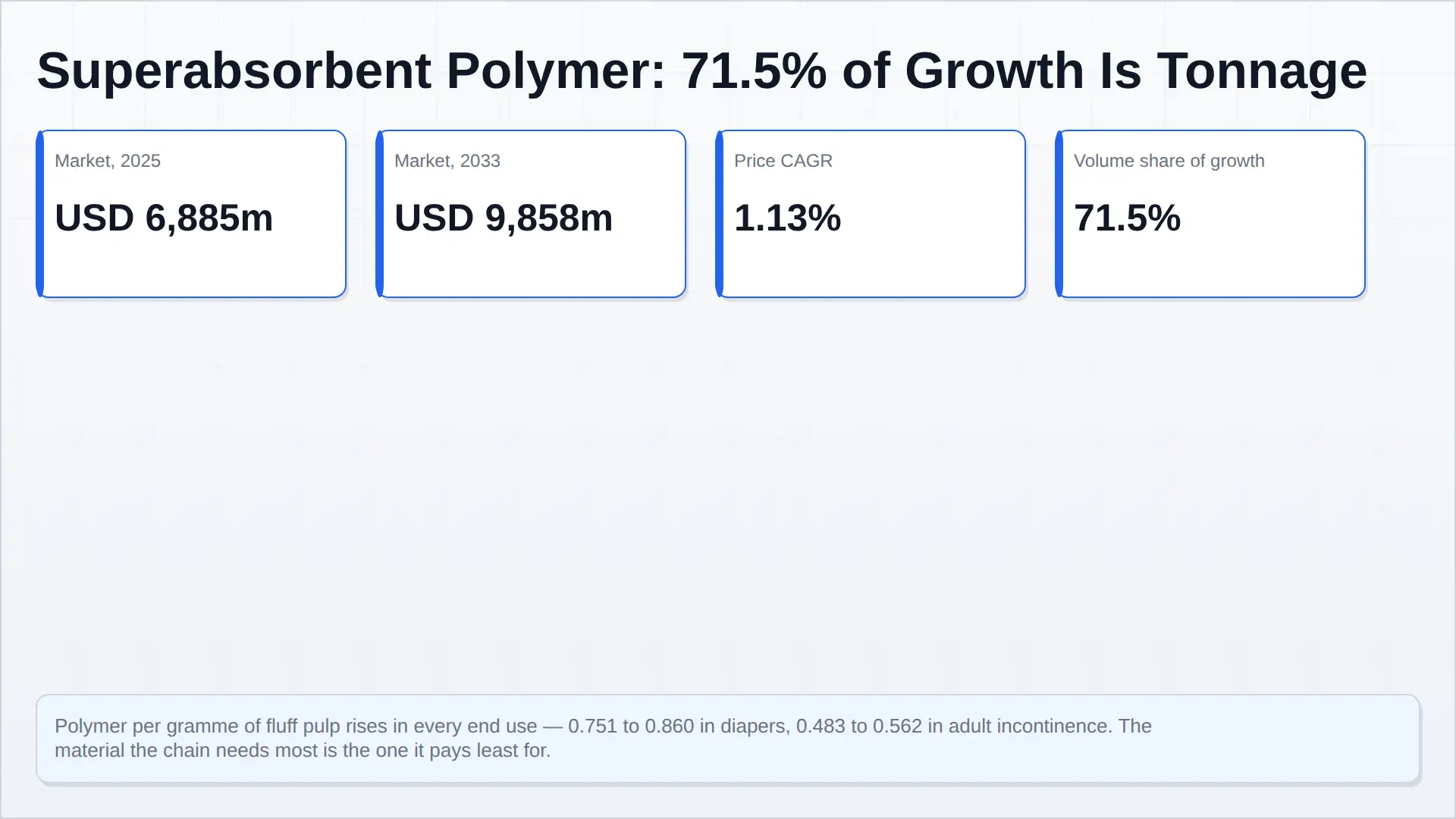
The global superabsorbent polymer market is USD 6,885 million in 2025 and reaches USD 9,858 million in 2033, 4.59 per cent a year. Volume moves from 4,050 thousand tonnes to 5,300 thousand, 3.42 per cent. Realised price rises from USD 1,700 a tonne to USD 1,860 — just 1.13 per cent a year, the slowest price growth of any node in this chain. 71.5 per cent of the added value is tonnage; only 28.5 per cent is price.
That ratio is the whole report. Superabsorbent polymer is the material that made the modern hygiene product possible. It holds hundreds of times its own weight in liquid, it is why a pad is two millimetres thick rather than fifteen, and it is the substance the entire industry has been substituting towards for thirty years. Every core redesign in the feminine hygiene and adult incontinence reports in this cluster removes fluff pulp and adds polymer. And the polymer producer still cannot raise the price.
The reason is capacity. By October 2020 eleven producers surveyed in the trade press carried 4,126,000 tonnes a year of capacity against world demand estimated at around 3,000,000 tonnes — a utilisation rate of 72.7 per cent. China alone held at least 1,260,000 tonnes, 30.5 per cent of that capacity, built against a domestic market that could not absorb it. Producers responded by exporting: one Chinese maker ran a 70 per cent export ratio, another 40 per cent, and most of the rest between 15 and 30 per cent. That is the mechanism by which a structural surplus in one country becomes a price ceiling for the world.
Nippon Shokubai is the largest producer and the clearest illustration of the paradox. It discloses 710,000 tonnes a year of superabsorbent capacity across six sites — Japan, Belgium, China, Singapore, Indonesia and the United States — and 980,000 tonnes of acrylic acid, the monomer it makes itself. That 710,000 tonnes is 17.2 per cent of the surveyed eleven-producer capacity. It is also, by its own description, the top producer in the world. Scale has not converted into pricing power, and the reason it has not is that the marginal tonne of polymer is set by capacity that already exists and is already being exported.
Where the volume comes from is the interesting part, and it is the opposite of where the value goes. Adult incontinence is the second-largest end use at 729,000 tonnes and grows 5.75 per cent a year; industrial and other is small at 162,000 tonnes and grows 6.59 per cent. Baby diapers are 70.0 per cent of the market and grow 2.89 per cent. Feminine hygiene grows 0.23 per cent — almost nothing — not because the category is shrinking but because a feminine hygiene core has largely finished its substitution toward polymer and has nowhere further to go.
Set the three reports in this cluster side by side and the arithmetic of the whole absorbent chain becomes visible. Feminine hygiene earns 78.4 per cent of its growth in price. Adult incontinence earns 69.9 per cent of its growth in volume. Fluff pulp earns 59.6 per cent in price. Superabsorbent polymer earns 71.5 per cent in volume and 1.13 per cent a year in price. Two of the four nodes can charge. The polymer producer, which supplies the material that makes the others’ products work, is the one that cannot.
Market definition, size and forecast
Scope. Polyacrylic acid-based superabsorbent polymers in powder and granular form for hygiene absorbent cores — baby diapers, adult incontinence products and feminine hygiene — plus industrial, agricultural, cable-water-blocking, construction and medical applications. Excluded: acrylic acid monomer sold as such, cellulose-based and starch-graft absorbents, superabsorbent fibre, and hydrogels sold for non-absorbent uses.
How the size is built. Producers disclose capacity and, in Nippon Shokubai’s case, site-level capacity by product. Demand is modelled from the three hygiene end markets using the per-unit polymer intensities in the companion reports, plus an industrial and other book. Price is a contract price reconciled against the disclosed capacity picture and the structural surplus. Every figure is labelled modelled where it is not disclosed.
Volume by end use
| End use | 2025 (thousand t) | 2033 (thousand t) | CAGR | Share of 2025 volume |
|---|---|---|---|---|
| Baby diapers | 2,835 | 3,560 | 2.89% | 70.0% |
| Adult incontinence | 729 | 1,140 | 5.75% | 18.0% |
| Feminine hygiene | 324 | 330 | 0.23% | 8.0% |
| Industrial and other | 162 | 270 | 6.59% | 4.0% |
| Total | 4,050 | 5,300 | 3.42% | 100.0% |
Growth here is narrowly based. Baby diapers contribute 55.5 per cent of the added tonnage and adult incontinence 31.5 per cent; between them they are 87 per cent of the market’s growth, and the two are driven by entirely different things. Diapers grow because penetration rises in markets where each diaper contains less polymer than a Western one; adult incontinence grows because the unit is polymer-rich and the unit count is rising at 4.99 per cent.
The substitution, measured
Because the companion reports in this cluster give both the fibre and the polymer volumes for the same end uses, the substitution can be stated directly as grammes of polymer per gramme of fluff pulp.
| End use | 2025 polymer per unit of fibre | 2033 polymer per unit of fibre |
|---|---|---|
| Baby diapers | 0.751 | 0.860 |
| Adult incontinence | 0.483 | 0.562 |
| Feminine hygiene | 0.472 | 0.489 |
It rises in all three. A baby diaper core moves from 0.751 grammes of polymer per gramme of fibre to 0.860; an adult brief from 0.483 to 0.562; a feminine hygiene pad from 0.472 to 0.489. This is the single cleanest piece of evidence in the cluster that the two material markets are not moving together: the fluff pulp report measures that same shift as fibre intensity falling 7.5 per cent per unit, and this report measures it as the polymer share rising. A converter redesigning a core is not choosing between suppliers. It is choosing between materials, and it has been choosing polymer for thirty years.
Value by region
| Region | 2025 (USD m) | 2033 (USD m) | CAGR | Share of 2025 value |
|---|---|---|---|---|
| Asia Pacific | 3,100 | 4,690 | 5.31% | 45.0% |
| Europe | 1,620 | 2,180 | 3.78% | 23.5% |
| North America | 1,240 | 1,690 | 3.95% | 18.0% |
| Rest of world | 925 | 1,298 | 4.33% | 13.4% |
| Total | 6,885 | 9,858 | 4.59% | 100.0% |
Asia Pacific is 45.0 per cent of value and grows fastest at 5.31 per cent, which is what a region that holds both the capacity and the fastest-growing end markets looks like. Chinese capacity is the reason the region is large; Chinese domestic demand is the reason the price is low. Those two facts are not in tension — the second is the consequence of the first, and the export ratios recorded in the trade survey are the transmission mechanism.
Where the USD 2,973 million of growth comes from
| Component | Contribution (USD m) | Share |
|---|---|---|
| Volume at the 2025 realised price | 2,125 | 71.5% |
| Realised price per tonne | 848 | 28.5% |
| Total value growth, 2025–2033 | 2,973 | 100.0% |
Compare the four nodes of this chain directly: 1.13 per cent price for the polymer, 1.73 per cent for the pulp, 1.64 per cent for the adult incontinence product and 2.98 per cent for the feminine hygiene product. The material furthest upstream and most essential to performance has the weakest price line, and it has it because its supply was overbuilt. That is not a market failure; it is a market doing what it is supposed to. It is also the reason a hygiene converter has been able to redesign a core, remove fibre, add gel and hold the shelf price.
Sources
- Nippon Shokubai Co., Ltd., Report 2024 (integrated report) — superabsorbent polymer capacity of 710,000 tonnes a year described as the top SAP producer in the world; acrylic acid capacity of 980,000 tonnes a year; site capacities at Himeji (Japan), Antwerp (Belgium), Zhangjiagang (China), Jurong Island (Singapore), Cilegon (Indonesia) and Houston (United States) — shokubai.co.jp
- Nonwovens Industry, “Superabsorbent Polymer Makers in the World and Their Production Capacities”, 6 January 2021 — eleven producers at 4,126,000 tonnes a year capacity as of October 2020; world demand estimated at around three million tonnes in 2019; Chinese capacity at a minimum of 1,260,000 tonnes a year; export ratios of 70 per cent and 40 per cent at two producers, 15–30 per cent at others — nonwovens-industry.com
- Pheonix Research, Global Fluff Pulp Market Report, Size, Share and Forecast 2026–2033 — pheonixresearch.com — used for the polymer-to-fibre ratio series and for the fibre price line.
- Pheonix Research, Global Adult Incontinence Products Market Report, Size, Share and Forecast 2026–2033 — pheonixresearch.com — used for unit volumes and for the polymer cost per unit.
- Pheonix Research, Global Feminine Hygiene Products Market Report, Size, Share and Forecast 2026–2033 — pheonixresearch.com — used for unit volumes, per-unit polymer intensity and the value decomposition.
- European Commission, Directorate-General for Environment, EU Deforestation Regulation (EUDR) — relevant to the bio-attributed and bio-based feedstock route — environment.ec.europa.eu
- EU Ecolabel, EU Pulps — Commission Decision (EU) 2023/1809 of 14 September 2023, the fluff pulp criteria against which the fibre this polymer displaces is assessed — eupulps.net
- Pheonix Research company profiles for Essity, Kimberly-Clark, Ontex and Unicharm, the four largest listed buyers of the material modelled here.
No market-research competitor data is used as an input to this report or cited anywhere in it. Producer capacities and the industry capacity survey are taken from the sources listed above; the market size, volume by end use, regional split, realised price series and polymer-to-fibre ratios are Pheonix modelled estimates, identified as such wherever they appear.
Press release and analysis on this market
- Press release: Superabsorbent Polymer Adds 3.42 Per Cent More Tonnage a Year and Moves Its Price 1.13 Per Cent
- One Point Two Six Million Tonnes and a Price That Cannot Move — the capacity story behind the price line.
- The Substituting Material Reprices Slower Than the Material It Replaces — why the swap continues anyway.
Table des matières
Paysage concurrentiel
Competitive landscape
Two facts set the structure of this market and they pull against each other. The top of the supply curve is concentrated in a handful of integrated producers with global site networks. The bottom of the supply curve is a large body of Chinese capacity that was built for a domestic market that did not arrive, and that capacity sets the marginal price everyone else has to live with.
| Producer | Position | Verified detail |
|---|---|---|
| Nippon Shokubai | Largest producer | 710,000 t/yr of SAP capacity across Himeji, Antwerp, Zhangjiagang, Jurong Island, Cilegon and Houston; 980,000 t/yr of acrylic acid. 17.2% of surveyed global capacity. Self-described top SAP producer in the world. |
| BASF, Evonik, Sumitomo Seika, SDP Global | Established majors | Named in the trade survey as major makers whose capacity did not change materially between 2019 and 2020 — a period of capacity discipline at the top of the curve. |
| Dansonpack Industries | Chinese producer | Export ratio risen to 70 per cent as a countermeasure to domestic surplus. |
| Satellite Science & Technology | Chinese producer | Exports raised to 40 per cent of output. |
| Remaining Chinese and Korean producers | Marginal supply | Export ratios of 15–30 per cent across the body of domestic producers; Chinese capacity at a minimum of 1,260,000 t/yr. |
The concentration at the top is real and does not confer pricing power. Nippon Shokubai at 710,000 tonnes is 17.2 per cent of surveyed capacity — a share that in most specialty chemicals would be decisive. Here it is not, because a share measures the ability to supply and the price is set by the ability to not supply. When the marginal producer in China can export at 70 per cent of output, the question a buyer asks is not who makes the best polymer but who will quote the lowest price this quarter.
Integration is the only durable defence. Nippon Shokubai makes 980,000 tonnes of acrylic acid, which is more than the monomer its 710,000 tonnes of polymer requires — it is a net seller of the feedstock. A producer that buys acrylic acid on the market pays a propylene-linked price and sells polymer into a surplus, and that spread is the entire business. Every point the monomer rises without a corresponding polymer increase is taken directly out of the non-integrated producer’s margin. This is why the competitive set that survives is the integrated one, and why the Chinese capacity tail, built with state support and feedstock advantage, can run at margins a Western stand-alone plant cannot.
The planned consolidation never completed. The trade survey records a planned combination of Nippon Shokubai’s and Sanyo Chemical’s superabsorbent businesses — the latter the parent of SDP Global — intended to build scale against exactly this price competition. It had not been finalised at the time of that survey, with the stated reason being the economic environment. That is the shape of the strategic problem in one sentence: the two largest Japanese producers concluded they needed to merge to compete on price with capacity that was not going to close.
Why nobody exits. A superabsorbent plant is a capital asset with a long life and low variable cost once built. In a surplus, the rational behaviour for each owner is to run and take share, because the alternative is to write off the asset. That is the mechanism that keeps utilisation at 72.7 per cent and the price at 1.13 per cent growth for a decade. It is also why this report does not forecast a price recovery: recovery requires closures, and closures require someone to accept the write-off.
Chaîne de valeur
Value chain and cost structure
Propylene becomes acrylic acid, acrylic acid becomes superabsorbent polymer, and polymer becomes the absorbent core. The chain is short and the margin sits in one specific place: the point where the monomer is made.
| Stage | What happens | Economics |
|---|---|---|
| Propylene | Refinery and cracker by-product | Oil-linked, cyclical, outside the industry’s control |
| Acrylic acid | Catalytic oxidation of propylene | Where integration is won or lost; Nippon Shokubai holds 980,000 t/yr |
| Superabsorbent polymer | Polymerisation, drying, surface cross-linking, classification | Sells into structural surplus; realised price USD 1,700/t |
| Core | Polymer blended with defibrised fluff pulp and nonwoven | Where the value is actually captured by the converter |
| Finished product | Diaper, brief or pad | Realisation USD 12.41 to 37.06 cents per unit across the shelf |
The polymer is 2.72 US cents of an adult incontinence unit and about 0.44 US cents of a feminine hygiene unit. Those are derived from roughly 16 grammes and 1.01 grammes of polymer respectively at USD 1,700 a tonne. Against realisations of 37.06 and 12.41 cents, the polymer is a minority of the cost of the finished product in both cases — and yet it is the material whose performance determines whether the product works at all.
Set the fibre and the polymer side by side on the same unit and the imbalance is stark. In an adult incontinence unit, fluff pulp costs 4.27 US cents and polymer 2.72 — fibre is the larger material cost, and fibre is the input whose price is rising faster (1.73 per cent against 1.13). The converter is therefore caught between two materials going in opposite directions: the one being removed from the design is getting more expensive, and the one being added is barely inflating at all. That is a favourable position for the converter and an unfavourable one for the pulp producer, and it is why the redesign programme continues.
Who can pass on a price increase, and who cannot. The integrated polymer producer can hold margin through a monomer rise because it makes the monomer. The non-integrated producer cannot, because it buys acrylic acid at a propylene-linked price and sells polymer into a market where the marginal tonne is set by exported Chinese capacity. The converter can, because a 2.72-cent material inside a 37.06-cent product can be absorbed and repriced at the next contract. The party with no pass-through is the stand-alone polymer producer, and that is the structural finding of this report.
Inventory and contract structure. Polymer is bought on quarterly or annual contracts against a volume forecast, and converters hold weeks of stock. Because the price has been flat to gently rising for a decade, there is little incentive on either side to hedge, and the exposure sits as an unmatched quarterly negotiation rather than as a traded risk. That is why the price line in the forecast is smooth and low: it reflects a contract market with structural surplus, not a commodity market with volatility.
Activité d'investissement
Investment activity
Almost nothing in this market is being built, and that is the strategy. The capital story of superabsorbent polymer is a story about capacity that already exists, who owns it, and why none of them will close it.
The build happened between 2012 and 2020, and it happened in China. Chinese capacity reached a minimum of 1,260,000 tonnes a year against a domestic market that could not absorb it, and the surplus was exported. At the same time the established majors held capacity flat: the trade survey records no material change in the capacity of Nippon Shokubai, BASF, Evonik, Sumitomo Seika or SDP Global between 2019 and 2020, and no expansions planned. The investment cycle was therefore not a global cycle at all. It was one country building and everyone else standing still.
Integration is where the capital goes now. Nippon Shokubai’s 980,000 tonnes of acrylic acid against 710,000 tonnes of polymer capacity is the shape of a strategy: own the feedstock, sell the surplus, and use the monomer position to protect a polymer margin that the market will not give you. Every expansion in this sector that is worth doing is an acrylic acid expansion, not a polymer one.
Consolidation was attempted and stalled. The planned combination of Nippon Shokubai’s superabsorbent business with Sanyo Chemical’s — giving the combined entity SDP Global’s capacity as well — was intended to build the scale needed to compete on price. It had not been finalised at the time of the trade survey. A merger of the two largest Japanese producers, proposed specifically because price competition had become unbearable, is the clearest available statement that participants do not expect the surplus to resolve itself.
The rational investment is now downstream of the polymer. Because polymer is cheap and fibre is comparatively expensive on the metrics in this cluster, the return on capital in absorbent hygiene is being earned by the converter who redesigns a core, not by the chemical company that supplies it. That is an uncomfortable conclusion for a report about the chemical company, and it is what the numbers say: 1.13 per cent price growth at the polymer node against 2.98 per cent realisation growth in the feminine hygiene product made from it.
What would change it. Three events, in order of plausibility. A wave of Chinese plant closures would tighten the market and let price rise; nothing in the disclosed record suggests it is happening. A binding biodegradability requirement in a major market would strand conventional polyacrylic acid capacity and reprice the compliant product upward. Or a sustained rise in propylene and acrylic acid would compress non-integrated producers out, consolidating supply by attrition rather than by decision. Only the second would be fast.
Technologie et innovation
Technology and innovation
The performance frontier in superabsorbent polymer has moved from how much liquid a gramme can hold to how fast it can take it in and how well it keeps it under load. That shift matters commercially because it is the reason the material keeps displacing fibre despite having no pricing power.
| Vector | Mechanism | Commercial effect |
|---|---|---|
| Gel bed strength and permeability | Absorbency under load and flow through a swollen bed | Lets a core be thinner and hold more; the main driver of fibre displacement |
| Surface cross-linking | Treatment that stiffens the particle surface | Higher absorption against pressure; the basis of premium hygiene grades |
| Fluff-less and low-fluff cores | Core formed almost entirely from polymer | Raises polymer per unit and removes pulp; visible in this cluster’s ratio series |
| Bio-based and bio-attributed acrylic acid | Alternative feedstock for the monomer | Raises unit cost; wins tender specifications rather than consumer demand |
| Superabsorbent fibre | Fibrous rather than particulate form | Niche; would change the core-design equation if it scaled |
Performance grades are the only margin. A commodity polymer in a surplus market earns the surplus price. A grade that lets a converter remove 10 per cent of the fibre from a core, or reduce thickness by a millimetre, earns a share of the value it creates. That is why the integrated producers compete on absorption under load rather than on price per tonne, and it is why the price line in this report is 1.13 per cent rather than zero.
The substitution has a visible end point, and feminine hygiene has reached it. That end use grows 0.23 per cent a year in polymer volume — effectively flat — because a feminine hygiene core is now mostly polymer and there is very little fibre left to replace. The polymer-to-fibre ratio there moves only from 0.472 to 0.489 across the whole forecast window. Diapers, at 0.751 rising to 0.860, and adult incontinence at 0.483 rising to 0.562, still have room. The end of the substitution is the end of the volume story, and it is visible from here in one end use already.
Bio-based is a specification product, not a supply source. Bio-attributed acrylic acid exists and costs more. It sells into tenders that require a lower fossil-carbon content, and it will grow as those specifications spread in Northern Europe. It will not displace conventional capacity at scale while conventional polymer trades at a surplus price, and a reader should treat bio-based announcements as marketing and tender positioning rather than as a change in the supply curve.
Recycling is harder here than for fibre. A superabsorbent particle in a used hygiene product is contaminated with biological material and bonded into a laminate. Recovering it economically has not been demonstrated, and the recovered material would compete with virgin polymer at USD 1,700 a tonne. Recycled content in this market is a regulatory cost, not a source of supply.
Risque de marché
Market risk and scenarios
| Risk | Level | Transmission |
|---|---|---|
| Structural overcapacity | High | 72.7% utilisation in the surveyed capacity base; the defining condition of the market and the cap on price. |
| Chinese export policy | Moderate–High | Export ratios of 70% and 40% at two producers show how fast domestic surplus becomes a global price event. |
| Acrylic acid and propylene cost | Moderate | Non-integrated producers buy the monomer at a propylene-linked price and sell into surplus; the spread is the business. |
| Biodegradability and microplastics regulation | Moderate | Would raise cost for conventional polyacrylic acid and favour bio-based or alternative absorbents. |
| Substitution by cellulose and recycled absorbents | Moderate | Real at the low-performance end; not a threat to the high-SAP core in adult incontinence. |
| Demand destruction in hygiene | Low | The end markets are non-discretionary and the substitution trend runs toward polymer, not away. |
Base case — 4.59 per cent, USD 9,858 million by 2033. Volume grows 3.42 per cent, led by diapers and adult incontinence. Price grows 1.13 per cent as the surplus persists and only the integrated producers hold margin. This is a volume market with a price ceiling, and it grows because the world uses more nappies and more briefs.
Upside — 6.0 per cent, approximately USD 10,974 million. Requires either meaningful Chinese capacity closure or a regulatory shift that strands conventional capacity, combined with adult incontinence at the top of its range. In this scenario price contributes materially for the first time in a decade and the market earns above its volume growth.
Downside — 3.2 per cent, approximately USD 8,858 million. Requires the surplus to deepen: further Chinese capacity coming on stream into a soft diaper market, with price flat to falling. Even here the market grows, because tonnage does. What it does not do is earn.
Three things to watch. Chinese export volumes, which are the clearest leading indicator of price pressure. The acrylic acid to propylene spread, which determines whether the marginal producer can cover cash cost. And announced biodegradability or recycled-content requirements in the EU, which would be the one regulatory event capable of changing the structure rather than the price.
The honest caveat. Market size, volume by end use, the regional split, the realised price series and the polymer-to-fibre ratios are modelled. The producer capacities, the capacity survey and the export ratios are disclosed and are quoted as such. No participant reports superabsorbent polymer revenue at the global level, and the model is anchored on disclosed capacity and on the per-unit intensities published in the companion reports in this cluster.
Paysage réglementaire
Regulatory landscape
Superabsorbent polymer is lightly regulated as a substance and heavily regulated as a component of a disposable product. The distinction matters because the compliance cost lands on the converter, while the design consequence lands on the polymer.
| Instrument | Reach | Consequence for this market |
|---|---|---|
| EU chemicals regulation (REACH) | Acrylic acid and polymer substances placed on the EU market | Registration and safe-use obligations; a fixed cost per substance that favours scale |
| Medical device rules (EU MDR) | Absorbent products classified as medical devices | Material choice enters a technical file and a clinical evaluation; change control is slow |
| Single-use plastics and disposability rules | Finished hygiene products, wipes and packaging | Pressure on the whole product; the polymer is the component most exposed to a biodegradability requirement |
| Packaging and packaging waste rules | Hygiene packaging | Recycled-content and labelling obligations on the pack, not the core |
| Tender specifications | Public and insurer-funded procurement | The effective regulator: a bio-based or recycled-content threshold in a tender changes the product faster than statute |
The polymer’s real regulatory exposure is biodegradability. Polyacrylic acid is not biodegradable, and the environmental argument against disposable absorbent hygiene products converges on exactly that. No major jurisdiction currently requires a biodegradable absorbent core, and the practical obstacles — performance, cost, and the absence of an infrastructure that would treat the product differently — are large. But it is the one regulatory event that would change this market’s structure rather than its price, because it would strand conventional capacity and hand an advantage to whoever has a compliant alternative at scale.
Medical device classification slows substitution in one direction and speeds it in another. Where an absorbent product is a medical device, changing the absorbent material requires change control and evidence, which makes converters conservative about switching supplier. That protects incumbents. It does not protect the material itself, because the redesign toward a low-fluff core is a change the converter initiates and documents rather than a supplier switch.
Procurement is the live regulatory frontier. As with every report in this cluster, the specification in a public or insurer-funded tender is the rule that actually binds. A requirement for a minimum bio-based content, a recycled-content threshold or a declared carbon footprint per unit would reprice the compliant polymer upward and leave the surplus capacity selling to markets with no such requirement. Watch Nordic and Dutch procurement, not Brussels, for the first real signal.
What is not regulated. No jurisdiction regulates the ratio of polymer to fibre in a product, and none is likely to. The substitution that defines this report is a commercial and engineering decision, not a compliance one — which is why it has been so steady and so unopposed.