
Editorial Article
The Only Material Whose Customer Is Paying to Use Less of It
Most commodity markets have a customer who wants more of the product, or a cheaper version of it, or both. The fluff pulp market has a customer designing the product out.
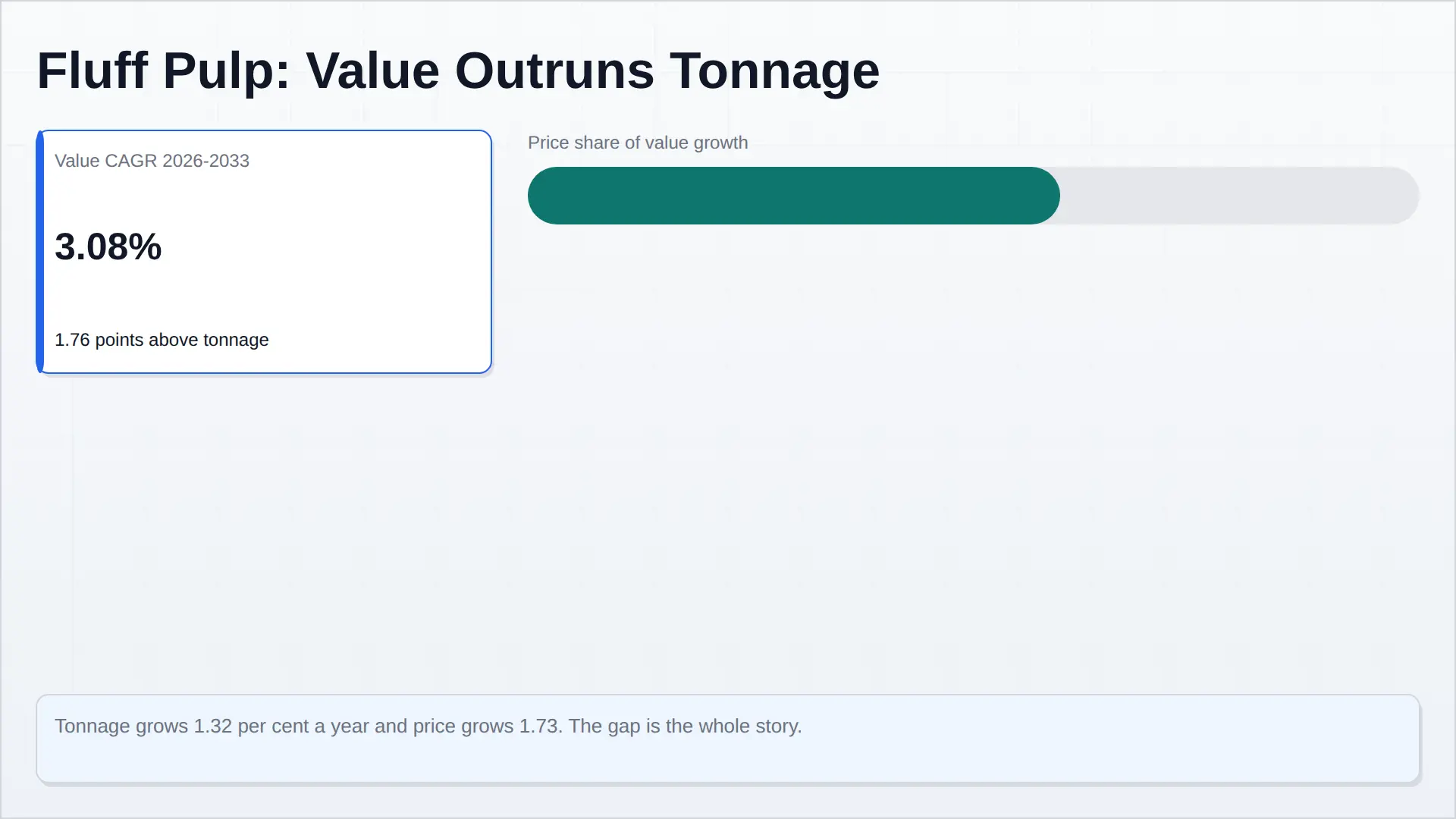
The global fluff pulp market is modelled at USD 8.85 billion in 2025 rising to USD 11.28 billion in 2033 — 3.08 per cent a year. Volume rises from 6,860 to 7,620 thousand air-dried tonnes, 1.32 per cent. Realised price rises from USD 1,290 to USD 1,480 a tonne, 1.73 per cent.
Put those three numbers together and you get the argument: price accounts for 59.7 per cent of the value added to this market, the highest price share of any node in the absorbent hygiene chain. The adult incontinence product that the fibre goes into gets 30.1 per cent of its growth from price. The polymer blended alongside it in the same core gets 28.5 per cent. The input is repricing faster than the output it becomes.
The customer is also the competitor
Low-fluff and fluff-less cores are the largest single force in this market. Converters are designing fibre out of the absorbent core and replacing it with superabsorbent polymer, and the tonnage consequence is already in the growth rates: fluff pulp volume grows 1.32 per cent a year while the polymer displacing it grows 3.42 per cent.
That is an unusual position for a supplier to be in. The market is not shrinking — 760 thousand additional tonnes between now and 2033 is real volume — but every tonne of it is being won against a design trend that wants less of the material. A pulp producer selling into this market is not competing only with other pulp producers. It is competing with the engineering department at its own customer.
The price is set by a product this market does not make
Here is the part that makes fluff pulp’s price line hard to model from hygiene demand alone. Most fluff mills are swing mills: the same fibre line can produce paper-grade softwood kraft instead. A mill therefore does not compare the fluff price to its own cost of production; it compares it to the price of the alternative it could be making.
In July 2025 European market pulp was oversupplied and falling. Bleached eucalyptus kraft settled USD 60 a tonne lower at USD 1,060. For northern bleached softwood kraft, buyers were targeting USD 1,500 while sellers held out for USD 1,520. That spread — softwood over hardwood at roughly 45 per cent — is the economic space in which a fluff grade prices itself, because a fluff grade is a softwood kraft grade with additional processing and a different customer.
When packaging and board grades earn more per tonne of fibre, fluff supply tightens without a single tonne of capacity being closed. The price required to keep a swing mill on fluff is set by a market that has nothing to do with hygiene.
One point seven three against one point six four
The adult incontinence report models finished-product realisation at 1.64 per cent a year. This report models fluff pulp price at 1.73 per cent. The difference is small annually and compounds: over eight years it is a structural transfer of roughly one percentage point of realisation from the converter to the mill, on a product whose volume is growing.
In feminine hygiene the arithmetic runs the other way. That market’s realisation is 2.98 per cent, comfortably above this market’s 1.73 per cent pulp price, which is why the feminine hygiene value chain has been able to absorb pulp inflation and still expand margin. Two categories, sitting on opposite sides of the same input — and the same tonne of pulp is a margin problem in one and a margin cushion in the other.
A small cost that swings the whole contract
Fibre is 10 of a 100-index shelf price in feminine hygiene. In absolute terms a feminine hygiene unit carries about 0.28 US cents of fibre against a 12.41-cent realisation, and an adult incontinence unit about 4.27 cents against 37.06. Neither is a dominant cost. Both are the most volatile line in it, because polymer, nonwoven and converting costs move slowly and pulp reprices quarterly.
That is why the pulp line, not the polymer line, is the most negotiated item in a hygiene supply agreement. It is not the biggest number in the stack; it is the one that moves between the signing and the shipping.
What would change the answer
Three things, none of them in the forecast. Closures, which would tighten supply but require an owner to write off a swing asset. Hardwood encroachment, which is the quiet substitute: bleached eucalyptus kraft is short-fibre, cheap and has been creeping into the low-performance end of hygiene for years. It cannot match softwood fluff on pad integrity at low density, which is why it has not displaced the grade — but every point the softwood spread narrows is a point of pressure on this price line.
And recycling, which is the one most often claimed and least supported. Absorbent hygiene products are a laminate of pulp, polymer, polypropylene and polyethylene, and separating the fibre economically at scale has not been demonstrated against virgin fluff at USD 1,290 a tonne. European collection schemes are being built because regulation requires them, not because the recovered fibre competes. Treat recycled content as a cost line in a tender specification, not as a supply source.
How this was researched
Seventy per cent secondary, thirty per cent primary. Producer capacity and grade ranges are taken from mill disclosure — Stora Enso’s Skutskär at 545,000 Adt/a, Domtar’s Plymouth at 390,000 air dry metric tonnes — and from the third-party certification registers that name producing mills grade by grade. Prices rest on market-pulp price reporting. The primary programme comprises structured interviews with pulp commercial teams and mill technical managers, open-ended interviews with converters and core-design engineers, converting-line procurement conversations, trade-show proceedings and a converter survey on fluff-reduction programmes. No market-research competitor data is used or cited.
Read next
- 935,000 tonnes is 13.6 per cent of the world. That is not why the price moves — concentration, optionality and the certification moat.
- The substituting material reprices slower than the material it replaces — the other side of the swap.
- Seven cents of material in a thirty-seven cent product — where fibre sits in the unit cost stack.
Frequently Asked Questions
How big is the global fluff pulp market?
USD 8.85 billion in 2025 rising to USD 11.28 billion in 2033, a 3.08 per cent CAGR, on volume rising from 6,860 to 7,620 thousand air-dried tonnes, 1.32 per cent a year.
Why is price doing so much of the work?
Price accounts for 59.7 per cent of the value added between 2025 and 2033, the highest of any node in the absorbent hygiene chain, against 30.1 per cent for adult incontinence products and 28.5 per cent for superabsorbent polymer.
What sets the fluff pulp price?
Most fluff mills are swing mills that can produce paper-grade softwood kraft instead. A mill compares the fluff price to the alternative it could be making, so fluff supply tightens when packaging and board grades earn more per tonne — without any capacity closing.
What would change this forecast?
Closures, which would require an owner to write off a swing asset; hardwood encroachment from bleached eucalyptus kraft at the low-performance end; or recycled absorbent fibre becoming economic at scale, which has not been demonstrated against virgin fluff at USD 1,290 a tonne.