
Global Organic Soaps Market Report, Size, Share and Forecast 2026–2033
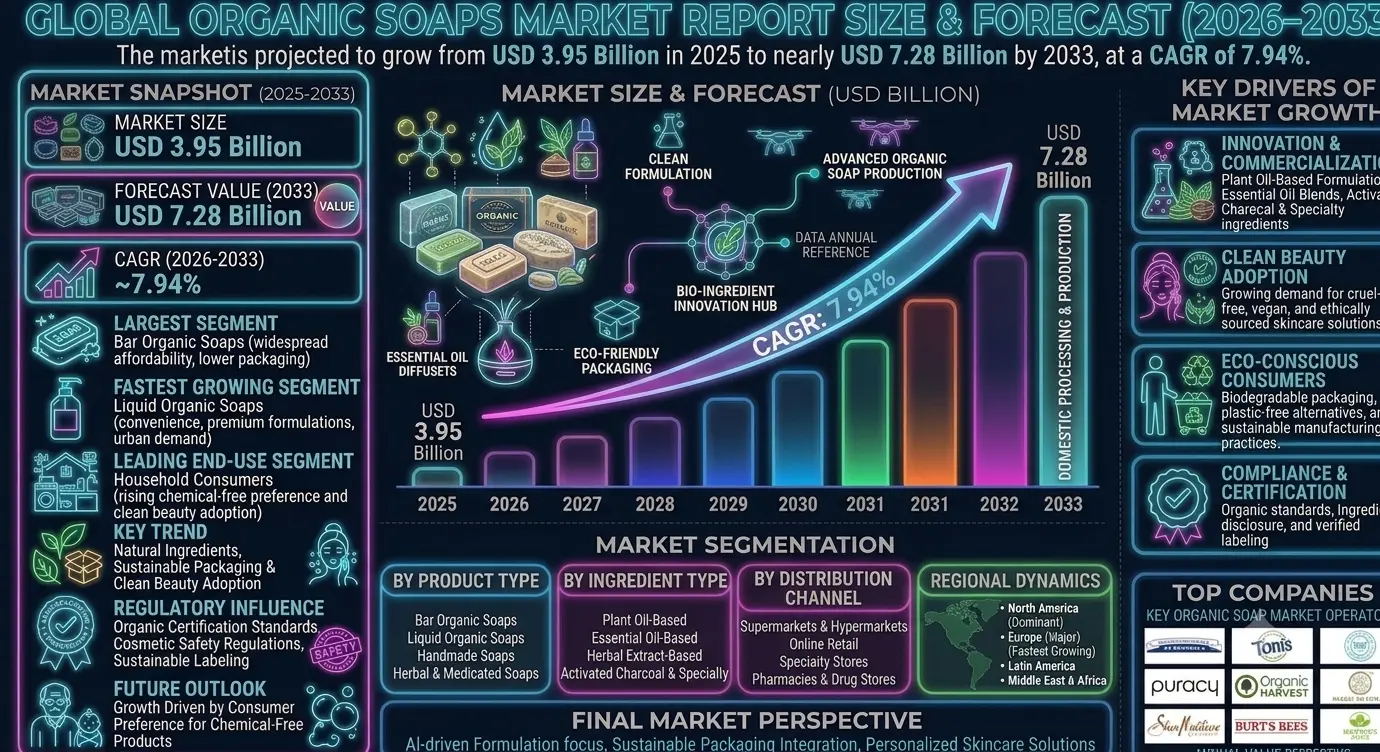
Market Forecast Snapshot (2026???2033)
| Metric | Value |
|---|---|
| Market Size (2025) | USD 3.95 Billion |
| Market Size (2033) | USD 7.28 Billion |
| CAGR (2026???2033) | 7.94% |
| Largest Segment | Bar Organic Soaps |
| Fastest Growing Segment | Liquid Organic Soaps |
| Leading End-Use Segment | Household Consumers |
| Key Trend | Natural Ingredients, Sustainable Packaging & Clean Beauty Adoption |
| Regulatory Influence | Organic Certification Standards, Cosmetic Safety Regulations & Sustainable Labeling Requirements |
| Future Outlook | Growth Driven by Consumer Preference for Chemical-Free Personal Care Products |
Global Organic Soaps Market Size & Forecast
The Global Organic Soaps Market is expected to witness steady growth during the forecast period from 2026 to 2033. The market was valued at USD 3.95 billion in 2025 and is projected to reach approximately USD 7.28 billion by 2033, registering a CAGR of 7.94%. The market growth is primarily driven by rising consumer awareness regarding natural skincare products, increasing concerns about synthetic chemicals, growing demand for eco-friendly personal care products, and expanding clean beauty trends. Organic soaps are increasingly preferred due to their natural formulations, skin-friendly ingredients, and reduced environmental impact compared to conventional personal care products. In addition, increasing demand for cruelty-free, vegan, and sustainably sourced products is supporting long-term market expansion.Global Organic Soaps Market Overview
Organic soaps are cleansing products manufactured using naturally derived ingredients such as plant oils, herbal extracts, essential oils, and organic additives without the use of harsh synthetic chemicals. The market includes bar soaps, liquid soaps, handmade soaps, herbal soaps, medicated organic soaps, and specialty skincare cleansing products. Organic soaps are widely utilized for personal hygiene, skincare, wellness routines, and premium beauty care applications. The market is evolving toward sustainable production practices, natural ingredient transparency, eco-friendly packaging, and premium organic skincare solutions.Structural Drivers of Market Growth
1. Innovation and Commercialization Acceleration
Advancements in organic formulations, botanical ingredient extraction, natural fragrance development, and sustainable manufacturing technologies are driving product innovation. Manufacturers are increasingly introducing specialized products for sensitive skin, anti-aging, moisturizing, and therapeutic skincare applications.Market Implications
Companies investing in premium organic ingredients and product differentiation are expected to strengthen market leadership.2. Compliance and Risk Repricing
Organic certification standards, cosmetic safety regulations, ingredient disclosure requirements, and environmental sustainability guidelines are influencing market development. Consumers are increasingly demanding certified and transparent product labeling.Market Implications
Firms offering certified organic, sustainable, and ethically sourced products are likely to gain stronger consumer trust.3. Competitive and Value-Chain Reconfiguration
The market is highly competitive as personal care brands, organic product manufacturers, artisanal soap makers, and clean beauty companies expand their offerings. E-commerce channels and direct-to-consumer business models are reshaping industry value chains.Market Implications
Companies focusing on brand authenticity, ingredient transparency, and sustainability initiatives may achieve stronger market positioning.4. Capital and Capacity Scaling
Increasing investments in organic ingredient sourcing, sustainable packaging solutions, and premium personal care product development are supporting market growth. Growing consumer spending on natural wellness and beauty products is creating favorable market conditions.Market Implications
Organizations scaling production capabilities and expanding organic product portfolios are expected to capture future opportunities.Market Segmentation Analysis
By Product Type
1. Bar Organic Soaps
This remains the largest segment due to widespread consumer familiarity, affordability, and lower packaging requirements.2. Liquid Organic Soaps
Fastest-growing segment driven by convenience, premium formulations, and increasing demand in urban households.3. Handmade Organic Soaps
Growing popularity due to artisanal appeal and customized ingredient combinations.4. Herbal & Medicated Organic Soaps
Strong demand for skincare benefits and therapeutic applications.By Ingredient Type
1. Plant Oil-Based Soaps
Largest segment due to extensive use of coconut oil, olive oil, and palm oil alternatives.2. Essential Oil-Based Soaps
Growing demand driven by aromatherapy and wellness benefits.3. Herbal Extract-Based Soaps
Widely utilized for skin nourishment and natural healing properties.4. Activated Charcoal & Specialty Ingredient Soaps
Increasing adoption in premium skincare segments.By Distribution Channel
1. Supermarkets & Hypermarkets
Largest segment due to extensive retail availability.2. Online Retail
Fastest-growing segment supported by digital commerce and direct-to-consumer sales.3. Specialty Stores
Strong demand for premium and certified organic products.4. Pharmacies & Drug Stores
Significant utilization for therapeutic and skincare-focused products.Regional Market Dynamics
North America
North America dominates the global organic soaps market due to strong clean beauty adoption, high consumer awareness, and increasing demand for sustainable personal care products.Europe
Europe remains a major market supported by stringent organic standards, eco-conscious consumers, and premium skincare demand.Asia-Pacific
Asia-Pacific is the fastest-growing region due to rising disposable incomes, growing skincare awareness, and expanding organic beauty product adoption.Latin America
Latin America is witnessing gradual expansion driven by increasing demand for natural and herbal personal care products.Middle East & Africa
The region is experiencing emerging growth due to rising wellness trends and expanding premium personal care markets.Competitive Landscape
The Global Organic Soaps Market is highly competitive with multinational personal care brands, specialty organic product manufacturers, and artisanal soap companies competing globally.Key Companies Operating in the Market Include:
- Dr. Bronner's
- Tom's of Maine
- The Honest Company
- Puracy
- Organic Harvest
- Khadi Natural
- SheaMoisture
- Yardley London
- Burt's Bees
- Nature's Gate
Strategic Outlook
The future of the organic soaps market will be shaped by sustainable ingredient sourcing, clean beauty innovation, biodegradable packaging, and personalized skincare solutions. Plant-based formulations, ethical manufacturing practices, and digital brand engagement strategies will significantly enhance market competitiveness. The rise of natural wellness trends and environmentally conscious consumer behavior is expected to create strong long-term growth opportunities.Final Market Perspective
The Global Organic Soaps Market remains a rapidly growing segment within the personal care and beauty industry. Rising demand for natural, sustainable, and chemical-free products continues driving long-term market growth. Companies capable of delivering certified organic, environmentally responsible, and consumer-focused skincare solutions will be best positioned to capture future opportunities. The convergence of clean beauty, sustainability, and wellness lifestyles is expected to redefine the future of the global organic soaps industry.Table of Contents
Table of Contents
- Executive Summary
- Global Organic Soaps Market Snapshot (2026???2033)
- Market Size & Growth Overview
- Key Market Highlights
- Largest & Fastest-Growing Segments
- Leading End-Use Segment Overview
- Key Market Trends & Sustainability Transformation
- Strategic Outlook Through 2033
- Market Introduction & Overview
- Definition of Organic Soaps
- Scope of the Global Organic Soaps Market
- Evolution of Natural & Organic Personal Care Products
- Role of Organic Soaps in Personal Care & Wellness Industry
- Value Chain Analysis of Organic Soap Manufacturing
- Regulatory Influence (Organic Certification Standards, Cosmetic Safety Regulations & Sustainable Labeling Requirements)
- Transition Toward Clean Beauty & Sustainable Skincare Solutions
- Research Methodology
- Primary Research Approach
- Secondary Research Sources
- Market Size Estimation Methodology
- Forecasting Assumptions (2026???2033)
- Data Validation & Triangulation Process
- Market Dynamics
- Structural Drivers of Market Growth
- Innovation and Commercialization Acceleration in Organic Formulations
- Compliance and Risk Repricing in Organic Personal Care Products
- Competitive and Value-Chain Reconfiguration
- Capital and Capacity Scaling in Sustainable Manufacturing
- Market Restraints
- Higher Product Costs Compared to Conventional Soaps
- Limited Availability of Certified Organic Raw Materials
- Supply Chain Complexity for Sustainable Sourcing
- Market Opportunities
- Expansion of Clean Beauty & Wellness Trends
- Growth in Vegan & Cruelty-Free Personal Care Products
- Increasing Demand for Premium Skincare Solutions
- Expansion of E-Commerce & Direct-to-Consumer Channels
- Market Challenges
- Intense Competition Among Organic Personal Care Brands
- Regulatory Variations Across Global Markets
- Consumer Verification of Organic Product Claims
- Structural Drivers of Market Growth
- Global Organic Soaps Market Size & Forecast (2026???2033)
- Market Revenue Analysis
- CAGR Analysis
- Demand-Supply Trends
- Pricing Analysis
- Investment Trends
- Future Market Outlook
- Market Segmentation Analysis (2026???2033)
- By Product Type
- Bar Organic Soaps (Largest Segment)
- Liquid Organic Soaps (Fastest-Growing Segment)
- Handmade Organic Soaps
- Herbal & Medicated Organic Soaps
- By Ingredient Type
- Plant Oil-Based Soaps (Largest Segment)
- Essential Oil-Based Soaps
- Herbal Extract-Based Soaps
- Activated Charcoal & Specialty Ingredient Soaps
- By Distribution Channel
- Supermarkets & Hypermarkets (Largest Segment)
- Online Retail (Fastest-Growing Segment)
- Specialty Stores
- Pharmacies & Drug Stores
- By Product Type
- Regional Market Analysis
- North America
- Europe
- Asia-Pacific (Fastest-Growing Region)
- Latin America
- Middle East & Africa
- Competitive Landscape
- Market Structure & Fragmentation Analysis
- Key Player Benchmarking
- Strategic Developments
- Clean Beauty & Product Innovation Strategies
- Partnerships, Expansion & Distribution Trends
- Company Profiles
- Dr. Bronner’s
- Tom’s of Maine
- The Honest Company
- Puracy
- Organic Harvest
- Khadi Natural
- SheaMoisture
- Yardley London
- Burt’s Bees
- Nature’s Gate
- Strategic Outlook
- Future of Sustainable Ingredient Sourcing
- Clean Beauty Innovation & Product Differentiation
- Expansion of Biodegradable & Eco-Friendly Packaging
- Growth of Personalized Organic Skincare Solutions
- Long-Term Market Outlook (2033+)
- Final Market Perspective
- Appendix
- About Pheonix Market Research
- Disclaimer
Competitive Landscape
Global Organic Soaps Market Competitive Intensity & Market Structure Overview
The Global Organic Soaps Market is highly competitive and moderately fragmented, characterized by the presence of multinational personal care companies, organic skincare brands, specialty beauty product manufacturers, and artisanal soap producers. Competitive intensity is primarily driven by product quality, ingredient transparency, brand reputation, sustainability initiatives, pricing strategies, and distribution reach.
Companies compete by offering a wide range of organic soap products formulated with plant-based ingredients, essential oils, herbal extracts, and eco-friendly additives. Growing consumer preference for natural skincare, clean beauty products, and environmentally responsible personal care solutions is intensifying competition across both developed and emerging markets.
The market structure is evolving from conventional personal care products toward certified organic, vegan, cruelty-free, and sustainably manufactured skincare solutions. E-commerce expansion, direct-to-consumer business models, and premium product positioning are reshaping competitive dynamics across the industry.
Global Organic Soaps Market Competitive Intensity & Market Structure Current Scenario
Leading Global Organic Soaps Companies
Dr. Bronner’s: A leading organic personal care brand recognized for its certified organic soaps, sustainable sourcing practices, and environmentally responsible manufacturing.
Tom’s of Maine: A prominent natural personal care company offering organic and naturally derived cleansing products focused on ingredient transparency and sustainability.
The Honest Company: A consumer-focused wellness and personal care brand providing clean-label, naturally formulated skincare and cleansing products.
Puracy: A growing natural personal care company known for plant-based formulations, eco-friendly ingredients, and household wellness products.
Organic Harvest: A major organic beauty and skincare brand offering certified organic personal care products, including soaps and cleansing solutions.
Khadi Natural: A well-established herbal and organic personal care manufacturer specializing in natural soaps, skincare products, and wellness formulations.
SheaMoisture: A leading natural skincare brand known for ethically sourced ingredients, organic formulations, and premium personal care products.
Yardley London: A globally recognized personal care company offering herbal and natural soap products with strong brand heritage and market presence.
Burt’s Bees: A major natural beauty brand focused on plant-based ingredients, sustainable product development, and environmentally conscious skincare solutions.
Nature’s Gate: A natural personal care manufacturer offering botanical-based cleansing and skincare products across global markets.
Key Competitive Intensity & Market Structure Drivers
Rising consumer awareness regarding harmful synthetic ingredients and growing demand for natural skincare products are intensifying competition among market participants.
The increasing adoption of clean beauty products, vegan formulations, and cruelty-free certifications is creating new opportunities for product differentiation and premium positioning.
Organic certification standards, cosmetic safety regulations, and sustainable labeling requirements are encouraging companies to strengthen product transparency and regulatory compliance.
Expansion of online retail platforms, social media marketing, and direct-to-consumer distribution channels is reshaping customer engagement and competitive strategies.
Growing demand for premium wellness products and environmentally responsible personal care solutions is increasing competition within the high-value organic skincare segment.
Strategic Implications of Competitive Intensity & Market Structure
Companies with strong brand credibility, certified organic product portfolios, and established distribution networks are expected to maintain significant competitive advantages.
Investment in sustainable packaging solutions, natural ingredient innovation, and premium skincare formulations is becoming a critical factor for long-term market differentiation.
Manufacturers focusing on ethical sourcing, transparent ingredient disclosure, and environmentally responsible production practices are likely to strengthen consumer loyalty.
Strategic expansion into emerging markets and digital commerce platforms is enabling companies to diversify revenue streams and capture new growth opportunities.
Organizations capable of combining product efficacy, affordability, sustainability, and regulatory compliance will be better positioned to compete effectively across diverse consumer segments.
Global Organic Soaps Market Competitive Intensity & Market Structure Forward Outlook
The competitive landscape of the global organic soaps market is expected to become increasingly innovation-driven as clean beauty trends, natural wellness lifestyles, and sustainable consumption patterns gain momentum worldwide.
Future competition will be shaped by advancements in plant-based formulations, biodegradable ingredients, personalized skincare products, and environmentally responsible packaging technologies.
Manufacturers are expected to increase investments in sustainable sourcing, product customization, digital brand engagement, and premium organic skincare innovation to strengthen competitive positioning.
Over the forecast period, companies that successfully balance product innovation, sustainability, brand authenticity, manufacturing efficiency, and global market reach will be best positioned to lead the evolving global organic soaps market.
Value Chain
Global Organic Soaps Market Value Chain & Supply Chain Evolution Overview
The Global Organic Soaps Market is experiencing significant transformation driven by growing consumer demand for natural personal care products, clean beauty trends, sustainable consumption patterns, and increasing awareness regarding chemical-free skincare solutions. The market value chain spans organic raw material cultivation, ingredient processing, formulation development, soap manufacturing, packaging, distribution, retailing, and end-user consumption.
A defining characteristic of the value chain is the increasing emphasis on ingredient transparency, ethical sourcing, organic certification compliance, and environmentally responsible manufacturing practices. Market participants are focusing on developing premium organic formulations using plant-based oils, herbal extracts, essential oils, and naturally derived additives while reducing reliance on synthetic chemicals.
Supply chain operations are becoming increasingly complex as manufacturers seek certified organic ingredients, sustainable packaging materials, traceable sourcing networks, and environmentally friendly production processes. Companies must coordinate with farmers, ingredient suppliers, certification agencies, packaging providers, retailers, and e-commerce platforms to maintain product quality and regulatory compliance.
The value chain is evolving toward a sustainability-driven ecosystem supported by organic agriculture, eco-friendly manufacturing, digital commerce channels, and circular packaging initiatives. Companies that successfully integrate responsible sourcing, premium product innovation, and transparent supply chain management are strengthening their competitive positioning.
Global Organic Soaps Market Value Chain & Supply Chain Evolution Current Scenario
Market-Specific Value Chain
- Organic Raw Material Cultivation: Production of plant oils, herbal extracts, botanical ingredients, essential oils, natural fragrances, and organic additives used in soap manufacturing.
- Ingredient Processing & Extraction: Processing of natural oils, herbal concentrates, botanical extracts, and specialty organic ingredients for formulation development.
- Product Formulation & R&D: Development of organic soap formulations focused on skincare benefits, sustainability, fragrance innovation, and consumer preferences.
- Soap Manufacturing & Packaging: Production of bar soaps, liquid soaps, handmade soaps, and specialty organic cleansing products along with eco-friendly packaging integration.
- Distribution & Retail Networks: Supply through supermarkets, hypermarkets, specialty stores, pharmacies, wellness retailers, and online platforms.
- End User Consumption: Household consumers, wellness-focused consumers, skincare enthusiasts, and environmentally conscious buyers utilizing organic soap products for personal care applications.
Company-to-Stage Mapping
- Organic Raw Material Cultivation: Certified organic farms, botanical ingredient producers, essential oil manufacturers, and sustainable agriculture suppliers.
- Ingredient Processing & Extraction: Natural ingredient processors, herbal extract suppliers, essential oil producers, and specialty organic ingredient manufacturers.
- Product Formulation & R&D: Dr. Bronner’s, Tom’s of Maine, The Honest Company, Puracy, Organic Harvest, and Khadi Natural.
- Soap Manufacturing & Packaging: SheaMoisture, Yardley London, Burt’s Bees, Nature’s Gate, and other organic personal care product manufacturers.
- Distribution & Retail Networks: Retail chains, specialty organic stores, pharmacies, wellness retailers, and e-commerce platforms.
- End User Consumption: Household consumers, skincare users, wellness-focused individuals, and premium personal care product buyers.
Key Value Chain & Supply Chain Evolution Signals in Global Organic Soaps Market
Growing Demand for Certified Organic Ingredients
Consumers increasingly prefer products supported by recognized organic certifications, transparent ingredient sourcing, and clean-label formulations.
Expansion of Sustainable Packaging Solutions
Manufacturers are adopting biodegradable, recyclable, plastic-free, and environmentally responsible packaging solutions to strengthen sustainability commitments.
Rapid Growth of E-Commerce and Direct-to-Consumer Channels
Online retail platforms are enabling brands to improve consumer engagement, expand geographic reach, and enhance product accessibility.
Rising Popularity of Plant-Based and Vegan Formulations
Growing consumer interest in cruelty-free, vegan, and ethically sourced products is accelerating innovation across organic soap product portfolios.
Increasing Demand for Premium Skincare Solutions
Consumers are seeking specialized organic soaps offering moisturizing, anti-aging, therapeutic, and sensitive-skin benefits.
Strengthening Supply Chain Transparency
Companies are investing in traceability systems and responsible sourcing programs to improve consumer trust and regulatory compliance.
Strategic Implications of Value Chain & Supply Chain Evolution
Investment in Sustainable Ingredient Sourcing
Organizations developing long-term partnerships with certified organic suppliers can strengthen product authenticity and supply stability.
Expansion of Premium Product Portfolios
Manufacturers introducing differentiated formulations and wellness-focused products can improve brand value and customer retention.
Digital Commerce and Brand Engagement
Direct-to-consumer platforms, digital marketing strategies, and personalized customer experiences can enhance competitive positioning.
Strengthening Regulatory Compliance
Compliance with organic certification standards, ingredient disclosure regulations, and cosmetic safety requirements can improve market credibility.
Advancement of Eco-Friendly Packaging Initiatives
Sustainable packaging investments can support environmental goals and meet evolving consumer expectations.
Supply Chain Resilience and Traceability
Transparent sourcing networks and diversified supplier relationships can reduce operational risks and strengthen brand trust.
Global Organic Soaps Market Value Chain & Supply Chain Evolution Forward Outlook
Looking ahead, the value chain is expected to evolve into a highly transparent, sustainability-focused, and consumer-centric ecosystem supported by certified organic sourcing, digital commerce expansion, and environmentally responsible manufacturing practices.
Key Future Developments Include:
- Expansion of certified organic ingredient sourcing programs.
- Increased adoption of biodegradable and recyclable packaging materials.
- Growth of vegan, cruelty-free, and plant-based soap formulations.
- Expansion of direct-to-consumer and online retail business models.
- Greater focus on ingredient traceability and supply chain transparency.
- Development of premium personalized organic skincare solutions.
As the market evolves, competitive advantage will increasingly depend on the ability to combine sustainable sourcing, product innovation, certification compliance, digital engagement, and responsible manufacturing practices within an integrated value chain ecosystem.
Companies that successfully integrate premium organic formulations, sustainable packaging, transparent sourcing networks, and strong consumer engagement strategies will achieve stronger market positioning, brand loyalty, and long-term growth in the Global Organic Soaps Market.
Investment Activity
Global Organic Soaps Market Investment & Funding Dynamics Overview
The Global Organic Soaps Market is witnessing increasing investment activity driven by rising consumer preference for natural skincare products, expanding clean beauty trends, growing demand for chemical-free personal care solutions, and increasing awareness regarding sustainable consumption. Investors, personal care manufacturers, private equity firms, and clean beauty brands are actively allocating capital toward organic product development, sustainable ingredient sourcing, eco-friendly packaging solutions, and premium skincare innovations.
Investment momentum is accelerating as consumers increasingly prioritize transparency, wellness-focused lifestyles, and environmentally responsible products. Capital deployment is expanding across plant-based formulations, certified organic ingredients, cruelty-free product development, and direct-to-consumer beauty platforms.
Additionally, growing investments in sustainable supply chains, biodegradable packaging technologies, herbal ingredient cultivation, and digital commerce capabilities are creating significant long-term opportunities throughout the global organic soaps industry.
Global Organic Soaps Market Investment & Funding Dynamics Current Scenario
Currently, the market is experiencing strong funding activity as personal care companies expand their organic product portfolios to meet evolving consumer demand. Industry participants are investing heavily in natural ingredient research, premium organic formulations, sustainable manufacturing facilities, and brand expansion initiatives.
The market is benefiting from increasing venture capital participation, strategic acquisitions, and private investments focused on clean beauty, wellness products, and sustainable consumer goods. Significant capital is being directed toward organic certification compliance, ingredient traceability systems, and environmentally responsible production practices.
Furthermore, partnerships between organic ingredient suppliers, skincare brands, e-commerce platforms, and sustainability-focused organizations are strengthening investment flows and supporting long-term industry development.
Key Investment & Funding Dynamics Signals in Global Organic Soaps Market
- Growing consumer demand for natural, plant-based, and chemical-free skincare products is driving investment across organic soap manufacturing.
- Expansion of clean beauty and wellness-focused product categories is increasing capital allocation toward innovation and brand development.
- Rising adoption of sustainable packaging and biodegradable materials is attracting environmental and sustainability-focused investments.
- Increasing demand for cruelty-free, vegan, and ethically sourced products is creating new funding opportunities.
- Strategic investments in organic ingredient cultivation and supply chain transparency are strengthening long-term business resilience.
- Growth of e-commerce and direct-to-consumer distribution channels is supporting digital commerce investments.
- Premiumization trends within the personal care sector are encouraging investment in high-value organic skincare formulations.
Strategic Implications of Investment & Funding Dynamics in Global Organic Soaps Market
- Continuous investment in organic product innovation and sustainable ingredient sourcing will remain critical for market differentiation.
- Capital allocation toward eco-friendly packaging, certification programs, and supply chain transparency will strengthen brand credibility.
- Companies developing premium and specialized organic soap formulations are expected to secure stronger long-term growth opportunities.
- Strategic partnerships with organic farmers, ingredient suppliers, and sustainability organizations will improve sourcing stability.
- Investments in digital marketing, e-commerce infrastructure, and direct-to-consumer platforms will support customer acquisition and retention.
- Compliance with organic certification standards, cosmetic safety regulations, and sustainable labeling requirements will continue influencing funding decisions.
- Organizations building integrated ecosystems focused on clean beauty, sustainability, and consumer wellness are expected to capture substantial future value.
Global Organic Soaps Market Investment & Funding Dynamics Forward Outlook
Looking ahead, the Global Organic Soaps Market is expected to maintain strong investment momentum driven by increasing consumer demand for sustainable personal care products, expanding clean beauty adoption, and rising awareness regarding health-conscious lifestyles.
Future capital deployment will increasingly focus on advanced organic formulations, biodegradable packaging technologies, sustainable sourcing programs, and personalized skincare solutions.
As consumers continue prioritizing natural ingredients, environmental responsibility, and product transparency, investment activity is expected to expand across organic manufacturing, sustainable supply chains, digital retail platforms, and premium skincare innovation.
In conclusion, the Global Organic Soaps Market represents an attractive consumer goods investment landscape where clean beauty innovation, sustainable manufacturing, ethical sourcing, eco-friendly packaging, and wellness-focused product development will define future funding priorities, competitive positioning, and long-term market growth.
Technology & Innovation
Global Organic Soaps Market Technology & Innovation Landscape Overview
The Global Organic Soaps Market is witnessing continuous innovation driven by advancements in natural ingredient processing, sustainable manufacturing technologies, eco-friendly packaging solutions, botanical formulation science, and clean beauty product development. The market demonstrates a moderate innovation intensity level as manufacturers focus on enhancing product efficacy, ingredient transparency, sustainability, and consumer safety.
At the center of this transformation is the shift from conventional soap manufacturing toward naturally derived, environmentally responsible, and skin-friendly formulations that meet growing consumer demand for chemical-free personal care products.
A major area of innovation involves advanced botanical extraction technologies that preserve the active properties of plant oils, herbal extracts, and essential oils while improving product quality and performance.
The market is also experiencing significant developments in formulation science, including cold-process soap manufacturing, preservative-free formulations, natural fragrance technologies, and specialty ingredient integration for targeted skincare applications.
Manufacturers are increasingly investing in sustainable packaging innovations such as biodegradable wrappers, recyclable containers, compostable materials, and plastic-free packaging alternatives to reduce environmental impact.
Product innovation is expanding toward personalized skincare soaps, therapeutic organic formulations, vegan-certified products, and multifunctional cleansing solutions designed for specific skin concerns.
Additionally, sustainable sourcing technologies, ethical ingredient traceability systems, and digital transparency platforms are improving consumer trust and supporting regulatory compliance.
The convergence of natural ingredient science, sustainable manufacturing, eco-friendly packaging, and clean beauty innovation is redefining the future technology landscape of the global organic soaps market.
Global Organic Soaps Market Technology & Innovation Landscape Current Scenario
Currently, the Global Organic Soaps Market is characterized by increasing adoption of sustainable production methods, advanced natural formulations, and environmentally responsible product development strategies.
1. Advanced Botanical Extraction Technologies
Manufacturers are utilizing innovative extraction methods to retain the nutritional and therapeutic properties of natural ingredients used in organic soap formulations.
2. Cold-Process Manufacturing Techniques
Cold-process soap production is gaining popularity for preserving natural oils, vitamins, and beneficial plant compounds.
3. Natural Fragrance & Essential Oil Innovation
Advanced blending technologies are enabling the development of long-lasting natural fragrances without synthetic additives.
4. Sustainable Packaging Solutions
Biodegradable, recyclable, and plastic-free packaging materials are becoming increasingly common across product portfolios.
5. Vegan & Cruelty-Free Product Development
Manufacturers are expanding vegan-certified and cruelty-free formulations to meet evolving consumer preferences.
6. Specialty Organic Formulations
Targeted products for sensitive skin, anti-aging care, moisturizing benefits, and therapeutic skincare applications are gaining market traction.
Key Technology & Innovation Landscape Signals in Global Organic Soaps Market
Several innovation signals are influencing the development of the market:
1. Growing Demand for Ingredient Transparency
Consumers increasingly seek detailed information regarding ingredient sourcing, formulation processes, and product certifications.
2. Expansion of Clean Beauty Trends
Rising preference for chemical-free and naturally derived personal care products is accelerating formulation innovation.
3. Adoption of Sustainable Packaging Technologies
Environmental concerns are driving investments in biodegradable and recyclable packaging solutions.
4. Increasing Popularity of Plant-Based Ingredients
Manufacturers are expanding the use of botanical oils, herbal extracts, and naturally derived active ingredients.
5. Digital Product Traceability Systems
Technology-enabled transparency platforms are helping consumers verify ingredient authenticity and sourcing practices.
6. Growth of Personalized Skincare Products
Customized organic soap formulations are emerging as a key product differentiation strategy.
7. Sustainable Manufacturing Adoption
Eco-friendly production processes are becoming important competitive factors across the industry.
Strategic Implications of Technology & Innovation Landscape in Global Organic Soaps Market
The evolving innovation landscape is reshaping competition within the organic soaps industry. Companies are increasingly competing through formulation quality, ingredient authenticity, sustainability initiatives, and packaging innovation.
Manufacturers investing in advanced botanical extraction, sustainable ingredient sourcing, eco-friendly packaging, and specialized skincare formulations are expected to strengthen long-term market positioning.
Strategic collaborations between organic ingredient suppliers, packaging technology providers, sustainability certification organizations, and personal care brands are accelerating product innovation and commercialization.
The growing convergence of clean beauty, ethical sourcing, wellness trends, and environmental sustainability is creating significant differentiation opportunities across the market.
Additionally, compliance with organic certification standards, cosmetic safety regulations, and sustainable labeling requirements is encouraging continuous investment in innovation and product development.
Global Organic Soaps Market Technology & Innovation Landscape Forward Outlook
Looking ahead to 2026???2033, the Global Organic Soaps Market is expected to witness accelerated innovation focused on sustainability, ingredient science, personalized skincare, and environmentally responsible manufacturing.
Future technological developments are likely to include:
1. AI-Assisted Formulation Development
Artificial intelligence will support the creation of customized organic soap formulations based on consumer skincare needs and ingredient performance data.
2. Advanced Natural Ingredient Processing
Improved extraction and preservation technologies will enhance ingredient potency and product effectiveness.
3. Smart Traceability & Transparency Platforms
Digital systems will provide end-to-end visibility across ingredient sourcing and manufacturing processes.
4. Next-Generation Sustainable Packaging
Fully compostable, biodegradable, and zero-waste packaging solutions are expected to become mainstream.
5. Personalized Organic Skincare Solutions
Customized cleansing products tailored to individual skin profiles will gain broader market acceptance.
6. Circular Economy Manufacturing Models
Resource-efficient production systems and sustainable sourcing practices will support long-term industry growth.
7. Multifunctional Organic Soap Innovations
Future products will combine cleansing, skincare, wellness, and therapeutic benefits within a single formulation.
In conclusion, companies capable of combining natural ingredient innovation, sustainable packaging technologies, ethical sourcing practices, advanced formulation science, and clean beauty principles will be best positioned to lead the future evolution of the Global Organic Soaps Market.
Market Risk
Global Organic Soaps Market Risk Factors & Disruption Threats Overview
The Global Organic Soaps Market operates within the rapidly evolving personal care, beauty, and wellness industry, where consumer preferences are increasingly shifting toward natural, sustainable, and chemical-free products. While the market benefits from growing awareness of skin health, clean beauty trends, and environmental sustainability, it faces several structural risks related to raw material availability, certification compliance, greenwashing concerns, changing consumer preferences, and competitive market saturation.
A major structural risk is the dependence on natural and organic raw materials. Organic soap manufacturers rely heavily on plant oils, herbal extracts, essential oils, and naturally sourced ingredients, making them vulnerable to agricultural yield fluctuations, climate-related disruptions, and supply chain instability.
Another significant disruption factor is the complexity of organic certification and regulatory compliance. Companies must adhere to varying international standards for organic labeling, ingredient sourcing, cosmetic safety, and sustainability claims. Regulatory changes can increase compliance costs and impact product positioning.
Consumer trust also represents a critical risk factor. Growing concerns regarding misleading sustainability claims and greenwashing practices are increasing scrutiny of product labels, ingredient transparency, and certification authenticity across the industry.
Additionally, intense competition from conventional personal care brands entering the natural products segment is creating pricing pressure and making brand differentiation increasingly challenging.
Global Organic Soaps Market Risk Factors & Disruption Threats Current Scenario
The current market environment is characterized by strong demand for natural skincare products, eco-friendly personal care solutions, and sustainable beauty brands across both developed and emerging markets.
Consumers are increasingly seeking transparency in ingredient sourcing, manufacturing practices, and environmental impact, encouraging brands to strengthen sustainability commitments.
At the same time, fluctuations in the cost of organic ingredients, packaging materials, and transportation services are impacting production economics and profit margins.
E-commerce platforms and direct-to-consumer channels are accelerating market accessibility, while social media and influencer marketing continue to shape consumer purchasing decisions.
Manufacturers are investing in innovative formulations, biodegradable packaging, vegan product lines, and ethically sourced ingredients to strengthen competitive positioning.
Key Risk Factors & Disruption Threats Signals in Global Organic Soaps Market
A major disruption signal is the growing demand for ingredient transparency, with consumers increasingly scrutinizing sourcing practices, certifications, and product claims.
Another important signal is the expansion of sustainable packaging regulations and environmental standards, which are influencing packaging design, material selection, and supply chain strategies.
The rise of personalized skincare and wellness-focused products is reshaping product development priorities across the organic personal care sector.
Digital commerce growth is increasing market accessibility while intensifying competition among established brands, emerging startups, and artisanal manufacturers.
Advancements in plant-based formulations, biotechnology-derived ingredients, and eco-friendly manufacturing processes are creating new opportunities for product innovation and differentiation.
Strategic Implications of Risk Factors & Disruption Threats in Global Organic Soaps Market
Companies must strengthen supplier relationships and diversify sourcing networks to reduce risks associated with raw material shortages and agricultural disruptions.
Investment in certification programs, traceability systems, and transparent labeling practices will be essential for building consumer trust and maintaining regulatory compliance.
Manufacturers should focus on product differentiation through premium formulations, sustainability initiatives, ethical sourcing, and unique brand storytelling.
Expansion of digital marketing strategies, direct-to-consumer channels, and personalized customer engagement programs will become increasingly important for market growth.
Organizations capable of balancing product innovation, affordability, sustainability, and regulatory compliance will be better positioned to achieve long-term competitive success.
Global Organic Soaps Market Risk Factors & Disruption Threats Forward Outlook
Looking ahead to 2026???2033, the Global Organic Soaps Market is expected to continue expanding as consumers increasingly prioritize natural wellness, sustainable lifestyles, and clean beauty products.
Organic ingredient transparency, environmentally responsible manufacturing, and biodegradable packaging solutions are expected to become standard industry expectations.
Technological advancements in natural ingredient extraction, formulation science, and sustainable production processes will support future product innovation.
Emerging markets in Asia-Pacific, Latin America, and the Middle East are expected to create significant growth opportunities as awareness of organic personal care products continues to rise.
Overall, the market will remain highly competitive but growth-oriented, with long-term success increasingly determined by brand credibility, sustainability leadership, product quality, regulatory compliance, and the ability to meet evolving consumer expectations for natural and ethical personal care solutions.
Regulatory Landscape
Global Organic Soaps Market Regulatory & Policy Environment Overview
The regulatory and policy environment governing the Global Organic Soaps Market is evolving as governments, certification agencies, and consumer protection authorities place greater emphasis on product safety, ingredient transparency, environmental sustainability, and organic integrity. As consumer demand for natural and chemical-free personal care products continues to rise, regulatory frameworks are increasingly focused on ensuring that organic soap products meet established standards for formulation, labeling, sourcing, and manufacturing practices.
Organic soap manufacturers, personal care brands, ingredient suppliers, and distributors must comply with a broad range of regulations covering cosmetic safety, organic certification, ingredient disclosure, environmental compliance, product labeling, and advertising claims. Regulatory oversight is becoming increasingly important as consumers seek assurance regarding the authenticity, safety, and sustainability of organic personal care products.
The growing popularity of clean beauty products, plant-based ingredients, cruelty-free formulations, and sustainable packaging solutions is encouraging policymakers and industry organizations to strengthen standards that promote responsible manufacturing and transparent product communication.
Global Organic Soaps Market Regulatory & Policy Environment Current Scenario
The current regulatory environment is characterized by increasing attention to organic certification requirements, cosmetic safety regulations, and sustainable labeling practices. Manufacturers are required to ensure that products marketed as organic or natural comply with applicable certification standards and accurately represent ingredient composition.
Cosmetic safety regulations continue to play a critical role in product development and commercialization. Regulatory authorities oversee ingredient safety, manufacturing quality standards, contamination controls, and consumer protection measures to ensure that organic soap products are safe for everyday use.
Ingredient transparency requirements are becoming increasingly important as consumers demand greater visibility into product formulations. Manufacturers are expected to provide accurate ingredient lists, sourcing information, allergen disclosures, and product claims that comply with regulatory guidelines.
Environmental regulations are also influencing market development by encouraging sustainable sourcing practices, eco-friendly packaging materials, waste reduction initiatives, and responsible manufacturing processes. Many brands are adopting biodegradable packaging and environmentally conscious production methods to align with evolving sustainability expectations.
In addition, advertising and marketing regulations are receiving greater scrutiny to prevent misleading claims related to organic content, natural ingredients, sustainability benefits, and ethical sourcing practices.
Key Regulatory & Policy Environment Signals in Global Organic Soaps Market
- Organic Certification Standards: Requirements governing the sourcing, processing, and labeling of organic ingredients used in personal care products.
- Cosmetic Safety Regulations: Standards ensuring product safety, ingredient compliance, manufacturing quality, and consumer protection.
- Ingredient Disclosure Requirements: Regulations mandating transparent labeling of ingredients, allergens, and formulation details.
- Sustainable Packaging & Environmental Policies: Guidelines encouraging recyclable materials, reduced packaging waste, and environmentally responsible manufacturing practices.
- Advertising & Product Claim Compliance: Regulatory oversight aimed at preventing misleading claims regarding organic, natural, eco-friendly, and wellness-related product attributes.
- Ethical Sourcing & Supply Chain Standards: Frameworks promoting responsible procurement of botanical ingredients, fair-trade practices, and sustainable resource management.
Strategic Implications of Regulatory & Policy Environment
The evolving regulatory landscape is encouraging manufacturers to prioritize certification, transparency, and sustainability throughout product development and marketing strategies. Compliance with recognized organic and cosmetic standards is becoming a critical factor in building consumer trust and brand credibility.
Organic certification requirements are driving investments in certified ingredient sourcing, traceability systems, and quality assurance programs. Brands that can demonstrate verified organic credentials are expected to gain stronger competitive positioning in premium personal care segments.
Cosmetic safety regulations are encouraging manufacturers to strengthen formulation testing, manufacturing controls, and product quality management systems to ensure compliance and consumer safety.
Environmental policies are creating opportunities for companies investing in biodegradable packaging, renewable materials, low-impact production processes, and broader sustainability initiatives that align with consumer preferences.
Marketing and labeling compliance requirements are reinforcing the importance of transparent communication, encouraging brands to substantiate product claims and provide clear information regarding ingredient origins and environmental benefits.
Global Organic Soaps Market Regulatory & Policy Environment Forward Outlook
Between 2026 and 2033, the regulatory environment for the global organic soaps market is expected to become more comprehensive as governments and certification organizations strengthen oversight of organic product claims, cosmetic safety standards, and environmental sustainability requirements.
Organic certification frameworks are likely to become increasingly standardized and traceable, supported by enhanced documentation, digital verification systems, and stricter supply chain transparency requirements.
Cosmetic safety regulations are expected to evolve further, with greater scrutiny of ingredient safety, manufacturing practices, product testing procedures, and consumer health protection measures.
Sustainability-focused regulations are anticipated to encourage broader adoption of recyclable packaging, biodegradable materials, ethical sourcing programs, and circular economy practices across the personal care industry.
Overall, the future regulatory landscape will be shaped by the convergence of organic certification standards, cosmetic safety requirements, sustainable labeling regulations, environmental responsibility initiatives, and consumer transparency expectations. Companies capable of delivering certified organic, compliant, sustainable, and high-quality soap products will be best positioned to capitalize on long-term growth opportunities within the evolving global personal care and wellness ecosystem.